
Submitted:
24 July 2025
Posted:
29 July 2025
Read the latest preprint version here
Abstract
In this article the proof of the binary Goldbach conjecture is established (Any integer greater than one is the mean arithmetic of two positive primes). To this end, Chen’s weak conjecture is proved (Any even integer greater than one is the difference of two positive primes) and a "localised" algorithm is developed for the construction of two recurrent sequences of primes (U2n) and (V2n), ((U2n) dependent of (V2n)) such that for any integer n their sum is equal to 2n: (U2n) and (V2n) are extreme Goldbach decomponents. To form them, a third sequence of primes (W2n) is defined for any integer n ≥ 3 by W2n = Sup (p ∈ : p ≤ 2n - 3), p denoting the set of positive primes. The Goldbach conjecture has been proved for all even integers 2n between 4 and 4. 1018 neighbourhoodof 10100, 10200, and 10300 for interval of amplitude 109 The table of extreme Goldbach decomposants, compiled using the programs in Appendix 14 and written with the Maxima and Maple scientific computing software, as well as files from ResearchGate, Internet Archive, and the OEIS, reaches values of the order of 2n = 105000. In addition, a global proof by strong recurrence "finite ascent and descent method" on all the Goldbach decomponents is provided by using sequences of primes (Wq2n) defined by Wq2n = Sup (p ∈ : p ≤ 2n - q) for any odd positive prime q, and a majorization of U2n by n0.525, 0.7 ln2.2 (n) with probability one and 5 ln1.3 (n) on average for any integer n large enough is justified. Finally, the Lagrange-Lemoine-Levy (3L) conjecture and its generalization called "Bachet-Bézout-Goldbach"(BBG) conjecture are proven by the same type of method.
Keywords:
prime number theorem
; binary goldbach conjecture
; chen’s weak conjecture
; lagrangelemoine- levy conjecture
; bachet-bézout-goldbach conjecture
; goldbach decomponents
; computational number theory
; gaps between consecutive primes.
1. Overview
Number theory, "the queen of mathematics" studies the structures and properties defined on integers and primes ( Euclid [15], Hadamard [18], Hardy, Wright [20], Landau [26], Tchebychev ). Numerous problems have been raised and conjectures made, the statements of which are often simple but very difficult to prove. These main components include :
● Elementary arithmetic .
˽ Operations on integers, determination and properties of primes.
( Basic operations, congruence, gcd, lcm, ………..).
Decomposition of integers into products or sums of primes
( Fundamental theorem of arithmetic, decomposition of large numbers, cryptography and Goldbach's conjecture, see Filhoa,Jaimea,de Oliveira Gouveaa,Keller Füchter, ).
● Analytical number theory .
Distribution of primes : Prime Number Theorem, the Riemann hypothesis, (see Hadamard [18], De la Vallée-Poussin [45], Littlewood and Erdos [14], ,.....).
Gaps between consecutive primes ( Bombieri,Davenport [3], Cramer [9], Baker,Harmann,Iwaniec, Pintz [4,5,24], Granville [17], Maynard [31], Tao [43],
Shanks [40], Tchebychev and Zhang ).
● Algebraic, probabilistic, combinatorial and algorithmic number theories .
Modular
arithmetic.
Diophantine approximations and equations.
Arithmetic and algebraic functions.
Diophantine and number geometry.
Computational number theory.
2. Definitions notations and background
The integers h, m,M, n, N, k, K ,p, q, Q, r,..…used in this article are always positive. (2.1)
The symbol " / " means : such as or knowing that. . (2.2)
Let be the infinite set of positive primes (called simply primes) (2.3)
( = 2 ; = 3 ; = 5 ; = 7 ; = 11 ; = 13 ; ......... )
For any non-zero integer K = { p ∈ : p ≤ 2K }(2.4)
Writing the large numbers calculated in Appendix 14 is simplified by defining the following constants:
M = ; R = 4. ; G = ; S = ; T = 10 1000 (2.5)
ln(x) denotes the neperian logarithm of the real x > 0 (2.6)
Let () be the sequence of primes defined by
∀ n ∈ ℕ + 3 = Sup ( p ∈ : p ≤ 2n - 3 ) (2.7)
For any odd prime q , let () be the sequence of primes defined by
∀ n ∈ ℕ n ≥ = Sup ( p ∈ : p ≤ 2n - q ) (2.8)
Any sequence denoted by () = () verifying (2.9) is called a Goldbach sequence.
∀ n ∈ ℕ + 2 , ∈ and + = 2n (2.9)
and are also known as "Goldbach partitions or Goldbach decomponents".
Iwaniec,Pintz have shown that for a sufficiently large integer n there is always a prime between n − and n . Baker and Harman [4],concluded that there is a prime in the interval [ n ; n + o ( Thus this results provides an increase of the gap between two consecutive primes and of the form
> 0 ∈ │ ∀ k ∈ ℕ k ≥ - < (2.10)
The results obtained on the Cramer-Granville-Maier-Nicely conjecture [1,3,9,17,30],imply the following majorization.
For any real c > 2 and for any integer k ≥ 500
- ≤ 0.7 () (with probability one) (2.11)
and
- ≤ 20.ln()(on average) (2.12)
The following abbreviations have been adopted :
● Lagrange-Lemoine-Levy conjecture (3L) conjecture (2.13)
● Bachet-Bézout-Goldbach conjecture (BBG) conjecture (2.14)
● (Extreme) Goldbach decomponents (E).G.D. (2.15)
3. Introduction
Tchebychev and Vinogradov have taken important steps and obtained promising results on the Goldbach conjecture (Any integer n ≥ 2 is the mean arithmetic of two primes). Indeed, Helfgott, Platt proved the ternary Goldbach conjecture in 2013.
Silva, Herzog, Pardi held the record for calculating the terms of Goldbach sequences after determining pairs of primes ( ) verifying
∀ n ∈ ℕ │ 4 ≤ 2n ≤ 4.1018 + = 2n (3.1)
Goldbach's conjecture has also been verified for all even integers 2n satisfying
≤ 2n ≤ + : k = 3, 4, 5, 6,........,20
and
≤ 2n ≤ + : k = 20, 21, 22, 23, 24,.......,30
by Deshouillers, te Riele, Saouter [11].
In previous research work there is no explicit construction of recurrent Goldbach sequences.
In this article, for any integer n greater than two the E.G.D. and are computed iteratively using a simple and efficient "localised" algorithm.
Using Maxima and Maple scientific computing software on a personal computer Silva's record is broken and many E.G.D. are calculated up to the neighbourhood of
2n = 10500 , 101000, 105000 and G.D. around (see Sainty [37]
"In Researchgate.net, Internet Archive, and OEIS, E.G.D. files are supplied : E.G.D. File S around 2n = for S = 1, 2, 3,............., 10000").
The binary Goldbach conjecture can be proved globally by strong recurrence on all G.D. using () sequences of primes in the same way via Goldbach(-) conjecture (Any even integer greater than one is the difference of two primes) demonstrated in Teorem 4.
● Remark.
1. Chen conjecture: For any integer K ≥ 1 there are infinitely many pairs of primes with a difference equal to 2K.
2. De Polignac conjecture : Same as Chen, but with consecutive pairs of primes.
3. What we know : April 2013, Yitang Zhang demonstrates that the smallest even integer 2K verifying the conjecture is greater than 70 million.
In 2014 James Maynard then Terence Tao lowered this limit to 246.
We validate Chen’s weak conjecture by verifying directly in the primes tables that all even gaps from 2 to 246 are possible (see Appendix 16 ).
(BBG) conjecture are validated.
Using case disjunction reasoning we construct two recurrent E.G.D. sequences of primes () and () according to the sequence ( ) by the following process
Firstly,
= 2 and = 2 (3.2)
For any integer n greater than two
● Either
( 2n - ) is a prime
then and are defined directly in terms of .
● Either
( 2n - ) is a composite number
then and are determined from the previous terms of the sequence ().
( This process can be reversed by first determining the increasing sequence of primes less than Inf ( 2n - ∈ : k ∈ ℕ ) , which saves a lot of computing time when programming ).
4. Theorem (Chen’s weak or Goldbach(-) conjecture)
∀ K ∈ ℕ* p , q ∈ │ p - q = 2K (4.1)
If K ≥ 2 3 ≤ q ≤ 2K and 3 + 2K ≤ p ≤ 4K
Practical method on some examples:
First of all (5 - 3 = 2), then we begin the process at (7 - 3 = 4); we will select the smallest primes for which the difference is precisely 6 (11 - 5 = 6), then 8 (11 - 3 = 8), then 10
(13 - 3 = 10),......... , then 2K (demonstration established by strong recurrence, by the asurd and feedback). All pairs of Goldbach(-) partitions obtained by this method for K between 2 and 123 are listed in Appendix 16 to validate it using Tao results.
Proof. An other proof can also be established by strong recurrence on the integer K ≥ 2. Let ( K ) be the following property
" ∀ K ∈ ℕ* p, q ∈ │ p - q = 2K 3 ≤ q ≤ 2K and 2K + 3 ≤ p ≤ 4K " (4.2)
►( 2 ) is true : 7 - 3 = 4 q = 3 ≤ 4 and p = 7 ≤ 4 x 2 = 8
► Let’s show
∀ M ∈ ℕ │ 2 ≤ M ≤ K then ( M ) ( K + 1 )
We reason through the absurd
Let p , q ∈ │ p ≥ q
∀ P , Q ∈ │ P ≥ Q h, m ∈ ℕ │
P = p + 2h and Q = q + 2m
we assume that
P - Q = p + 2h - q - 2m ≠ 2( K + 1 ) (4.3)
Therefore
p - q ≠ 2( K + 1 - h + m ) (4.4)
You can always choose h ≥ m and h - m ≤ K + 1 .
The set {K + 1 - h + m ; 2h and 2m are any gaps between primes} contains all even integers between 2 and 2K.
However the strong recurrence hypothesis asserts that
∀ M ∈ ℕ │ M ≤ K p, q ∈ │ p - q = 2M(4.5)
By choosing : M = K + 1 - h + m
this contradicts (4.4).
So
h, m ∈ ℕ │ P - Q = p + 2h - q - 2m = 2( K + 1 ) (4.6)
knowing
p, p + 2h, q, q + 2m ∈ h ≥ m and h - m ≤ K + 1
Thus validating the heredity of property (K ).
The property (K ) is therefore true. As a result Goldbach(-) conjecture is validated.
5. Corollary
Let ) and ) be two sequences of primes determined by
= Inf ( p ∈ : p - 2K ∈ ) and = Inf ( p ∈ : 2K + p ∈ ) = - 2K (5.1)
They are defined for any integer K ∈ * (5.2)
and satisfy
lim = + (5.3)
, ∈ and - = 2K (5.4)
│ 2 ≤ K ≤ 16 3 ≤ ≤ 2K and 2K + 3 ≤ ≤ 4K(5.5)
For any integer K large enough
3 ≤ ≤ and 2K + 3 ≤ ≤ 2K + (5.6)
Proof.
(5.1) ; (5.2) : According to the previous theorem, the sequences ( ) and are defined by strong recurrence (finite descent).
(5.3) : ≥ 2K lim = +
(5.4) : By construction, these sequences thus verify : - = 2K
(5.5) : The property can be verified directly term-to-term by examining the sequence proposed above.
(5.6) : This property is verified up to 2K = 246 by calculations on the previous list.
We prove this result by recurrence
First of all, we order the Goldbach(-) decomponents at a fixed prime q , so as to obtain the estimate (5.6) more easily.
Let be the (r + 1)th prime :
We examine the sequences of primes ( ( K ) satisfying :
(K ) = 2K + 3
((K ) ; 2K ) → (5;2) ; (7 4) ; (11;8) ; (13;10) ; (17;14) ; (19;16) ; (23;20) ; (29;26) ; (29;28);..
(K ) = 2K + 5
((K ) ; 2K ) → (7;2) ; (11;6) ; (13;8) ; (17;12) ; (19;14) ; (23;18) ; (29;24) ; (31;26) ; (37;32)................................
(K ) = 2K + 7
((K ) ; 2K ) → (11;4) ; (13;6) ; (17;10) ; (19;12) ; (23;16) ; (29;22) ; (31;24) ; (37;30)...........
(K) = 2K + 11
(T11(K ) ; 2K ) → (13;2) ; (17;6) ; (19;8) ; (23;12) ; (29;18) ; (31;20) ; (37;26) ; (41;30) ; (43;34).........................
(T13(K ) ; 2K ) → (17;4) ; (19;6) ; (23;10) ;(29;16) ; (31;18) ; (37;24) ; (41;28) ; (43;30 ; (47;34)..........................
......................................
(K ) = 2K + ( K ∈ : (K ) and are primes ) (see Appendix 16 )
For any integer K satisfying > the property holds for ( K ).
Therefore it is generally validated for all K > , since we obtain all possible cases of
Chen's weak conjecture starting with (K), then (K ), then (K ) .... for ≤ .
(can be proved by strong recurrence using the same method as in Theorem 4 by "finite descent").
Let a = and ( r ) be the following property
"For any integer M │ 2M < there exists at least a prime q < │ 2 M + q ∈
▶ () is true (see Appendix 16).
▶ Let’s show : ( r ) ( r + 1)
≤ + (5.6)
It is assumed that M │
(K) - ≠ 2M knowing 2M < ∀ (R), ∈ h, s ∈ ℕ │ (K) = (R) + 2h and = + 2s (5.7)
then
(R) - ≠ 2( M + s - h ) (5.8)
which is impossible according to the hypothesis of strong recurrence since
2( M + s - h ) is less than Sup and that all primes (R) , satisfy the recurrence hypothesis.
We deduce that : ( r ) ( r + 1)
Thus the property (5.5) is true.
6. Lemma (Goldbach’s fundamental Lemma)
Let q be an odd prime
For any integer n ≥ there exists an integer s │
2n - ∈ (6.1)
Let ( ) be the sequence of primes defined by
∀ n ∈ ℕ n ≥ = Inf ( 2n - ∈ : k ∈ ℕ ) (6.2)
All G.D. are contains in the set {(2n - ; ) : n ∈ ℕ + 3}
For any integer n ≥ ≤ (6.3)
≤ o (6.4)
Proof. The proofs of propositions (6.1), (6.2) and (6.3) are established following the same principle of strong recurrence as in Theorem 4 and Corollary 5 by "return, absurd and finite descent"
(6.1) : For any integer n > 3 and for any odd primes r, q │ 3 ≤ r < q,
there exists an integer │
2n - = 2n - 2 - = 2(n - ) -
or
2( n + 1) - = 2( n + 1 - ) - then by recurrence and the absurd the property is validated.
(Proof to develop).
Remark. A better estimate of the following form can be obtained by the same method with probability one or on average using the results of Bombieri [3], Cramer [9], Granville ,
Nicely and Maier :
n ∈ ℕ : n ≥ ;
For any real c > 2 < 1.7 (with probability one) (6.5)
and
< K’.(n) (on average) ( 6.6)
7. Principle of proof
To determine the E.G.D. three sequences of primes ( ( ), ( are defined and they verify the following properties
lim = + (7.1)
∀ n ∈ ℕ + 2 is defined as a function of = Sup ( p ∈ Ƥ : p ≤ 2n - 3 ) (7.2)
( ) is an increasing sequence of primes that contains all of them except = 2 (7.3)
lim (7.4)
() is a complementary sequence to ( ) of negligible primes with respect to 2n (7.5)For any integer n
● If ( 2n - ) is a prime
then and are defined by
= and = 2n - (7.6)
● Otherwise, if ( 2n - ) is a composite number
we search for two previous terms of the sequence (), ) and satisfying the following conditions
, , [ + 2k ] ∈ (7.7) + = 2(n - k )
which is always possible (see Theorem 4 and "Goldbach’s fundamental Lemma 6")
So by setting
= and = + 2k (7.8)
two new primes and satisfying (4.10) are generated │
+ = 2n (7.9)
This process is then repeated incrementing n by one unit (n ← n + 1).
● Remark. Using the same method as in Theorem 4, we can the following equivalent property by strong recurrence : For any integer n greater than 48
(n) : " There exists an integer K such that 2K + (7.10)
To this end, .
▶ (49) is true.
▶ The heredity of the property (n) : (n) (n + 1)
can be proved by the absurd and returning to the previous terms by noting that
For any integer r │ r ≤ n , there is at least one integer │
= 2 + then
2K + = 2( K + ) + = 2P + (7.11)
By posing : P = K + and ≤ n
Now, according to the recurrence hypothesis on (n) there exists an integer P │
2P + ∈ (7.12)
then there exists an integer K │
2K + ∈ (7.13)
In summary, the property (n) is hereditary and, as a result, verifiable.
We apply the same type of reasoning using Theorem 4 to the general case with the sequence (), showing :
For any integer n > 2 there exists an integer K │
2K + ∈
8. Theorem (Goldbach conjecture)
There exists at least a recurrent sequence ( ) = ( of primes satisfying the following conditions.
For any integer n ≥ ,
and + = 2n (8.1)
(Any integer n ≥ is the mean arithmetic of two primes)
An algorithm can be used to explicitly compute any term and (8.2)
Proof.
▄ GLOBAL STRONG RECURRENCE :
The proof can be made using the following strong recurrence principle.
Let (n) be the property defined for any integer n ≥ 2 by
(n) : " For any integer p satisfying 2 ≤ p ≤ n there exists two primes and such their sum is equal to 2p ".
( ∀ p ∈ ℕ │ 2 ≤ p ≤ n ,
and + = 2p )
Let's show by strong recurrence that (n) is true for any integer n ≥ 2
▶ (2) is true : it suffices to choose = = 2 .
▶ Let's show that the property (n) is hereditary : (n) (n + 1)
Assume property (n) is true.
● If ( 2(n + 1) - ) is a prime
then and are defined by
= and = 2(n+1) - (8.3)
● Otherwise, if ( 2(n+1) - ) is a composite number
there exists an integer k to obtain two terms ) and satisfying the following conditions
, and + 2k ∈ Ƥ (8.4) + = 2( n +1- k )
we use the previous terms of the sequence ( ).
For any integer q │ 1 ≤ q ≤ n - 3 we have
3 ≤ ≤ n .
Then there exists an integer k 1 ≤ k ≤ n - 3 │
= + 2k ∈ Ƥ (8.5)
following the Bertrand principle and Theorem 4 since all primes smaller than are in the set { : k ≤ n }
( If there were no such primes, we would have a contradiction with the Theorem 4 or with Goldbach’s fundamental Lemma 6 ) . In fact, in an equivalent way (see the previous remark) we can copy the proof of Teorem 4 by performing a similar strong recurrence ”finite descent feedback and absurd” directly on the set { : k ≤ n } │
= + 2k ∈ Ƥ (8.6)
The smallest integer k │ ∈ Ƥ is denoted by .
So by setting
= + 2 and = ∈ Ƥ (8.7)
(These two terms are primes)
In the previous steps two primes and whose sum is equal to 2(n - ) were
determined.
+ = 2(n -) (8.8)
By adding the term to each member of the equality (8.6) it follows
+ 2 + = 2(n - ) + 2 (8.9)
[ + 2] + = 2n (8.10)
+ = 2n (8.11)
Two new primes and satisfying ( + = 2(n + 1) ) are generated.
It follows that (n + 1) is true. Then the property (n) is hereditary :
(n) (n + 1).
Therefore for any integer n ≥ 2 the property (n) is true.
It follows
n ∈ ℕ + 2 there are two primes and and such their sum is 2n : + = 2n
▄ ALGORITHM :
For any integer n
● If ( 2n - ) is a prime
then and are defined by
= and = 2n - (8.12)
● Otherwise, if ( 2n - ) is a composite number
we use the previous terms of the sequence ( ).
For any integer q │ 1 ≤ q ≤ n - 3 we have
3 ≤ ≤
n .
Then there exists an integer k 1 ≤ k ≤ n - 3 │
= + 2k ∈ Ƥ (8.13)
following Theorem 4 since all primes smaller than are in the set { : k ≤ n }
( If there were no such primes, we would have a contradiction with the Theorem 4 or with Goldbach’s fundamental Lemma 6 ) . In fact, in an equivalent way (see the previous remark) we can copy the proof of Teorem 4 by performing a similar strong recurrence ‘’finite descent return and absurd” directly on the set { : k ≤ n } │
= + 2k ∈ Ƥ (8.14)
The smallest integer k │ ∈ Ƥ is denoted by .
So
= + 2 and = ∈ Ƥ (8.15)
(These two terms are primes)
In the previous steps two primes and whose sum is equal to 2(n - ) were
determined.
+ = 2(n -) (8.16)
By adding the term to each member of the equality (8.16) it follows
+ 2 + = 2(n - ) + 2(8.17)
[ + 2] + = 2n (8.18)
+ = 2n (8.19)
Finally, for any integer n ≥ 3 this algorithm determines two sequences of primes ( )
and ( ) verifying Goldbach's conjecture.
9. Lemma
The sequence () verifies the following majorization
For any integer n ≥ 65
≤ (2 (9.1)
and
= o ((2) (9.2)
Proof. According to the programm 12.2 and Appendix 14 the majorization (9.1) is verified
for any integer n │ 65 ≤ n ≤ 2000 .
For any integer n > 2000 the proof is established by recurrence. For this purpose let (n ) be the following property
(n ) : " ≤ " .(9.3)
▶ (2000) is true according to program 13.2 and the table in appendix 14.
▶ For any integer n ≥ 2000 let’s show that (n ) is hereditary :
(n) .(n + 1)
Assume that (n ) is true : then
● If ( 2(n + 1) - ) is a prime
then and are defined by
= and = 2(n + 1) - (9.4)
2(n + 1) - K . < < 2(n + 1)
= 2(n + 1) - < K ≤ K
● Otherwise, if ( 2(n + 1) - ) is a composite number
p ∈ │ = + 2p (9.5)
= 2p + = 2p + 2(n + 1 - p) - 2(n + 1) - (9.6)
Via " Goldbach's fundamental Lemma 6 " it follows that
< K (9.7)
(n + 1) is true then (n ) is hereditary.
So for any integer n ≥ 2000 the property (n ) is true.
Finally ≤
10. Proposition
Liaison between Goldbach conjecture and fundamental theorem of arithmetic.
A log-exp correspondence is established by linking the sum and product of primes via Goldbach's conjecture and the fundamental theorem of arithmetic, since if G.D. of 2n are p' and q', and if 2n decomposes into factors P " and Q " │
( p’, q’ ∈ Ƥ │ p’ q’ and P " Q " ) ; then,
2n = P ".Q " = p’ + q’ and p’ - q’ = 2K
ln(P ".Q ") = ln(P ") + ln(Q ")
= ln(p’ + q’) = ln(p’(1 + q’/p’))
≈ ln(p’) + q’/p’
By choosing p’ = next or prevprime(P ") (P " = p’ +/- a)
we obtain a q' localization of the form
q’ ≈ [ p’.ln(Q ")] ≈ [ p’.ln(2n / P ")] ≈ [ p’.ln(2n / p’)]
.then
2n ≈ p’( 1 + ln(2n / p’))
2n ≈ p’( 1 + ln(2n / P ")) ≈ p’( 1 + ln(2n / (p’ +/- a))
2n ≈ p’( 1 + ln(2n / (p’(1 +/- a/p’)))
2n ≈ p’( 1 + ln((2n / p’).(1 / (1 +/- a / p’))))
2n ≈ p’( 1 + ln(2n/p’) + ln(1/(1 +/- a/p’)))
2n ≈ p’( 1 + ln(2n/p’)) -/+ a
You can solve equations like these using Maple,
solve( 2n +/- a = x*( 1 + ln(2n / x)), x)
to locate p' and proceed by successive next or prevprime to determine two G.D. of 2n,
(programming possible in Algorithm 14). This procedure appears to generalise Pocklington's theorem, and we observe that the G.D. and their number G(E) are related to the number of prime factors in the decomposition of 2n .
Examples :
● evalf(solve([90 = x*(1 + ln(96/x)), x < 96], x));
{x = 64.12418697} ; p’ = 67 q’ = 29
● evalf(solve([1000 = x*(1 + ln(1100/x)), x < 1100], x));
{x = 665.6361412}
prevprime(665); 661
isprime(1100 - 661); true ; p’ = 661 q’ = 439
● evalf(solve([9700 = x*(1 + ln(10000/x)), x < 10000], x));
{x = 7652.697929}
prevprime(7652); 7649
isprime(10000 - 7649); true ; p’ = 7649 q’ = 4351
● evalf(solve([99950 = x*(1 + ln(100000/x)), x < 100000], x));
{x = 96854.43333}
a := prevprime(96799); a := 96797 # Obtenu au bout de 3 ou 4 prevprime( )
isprime(100000 - a); true ; p’ = 96799 q’ = 3201
Solutions are :
= Re(- (2n +/- a)/LambertW(-1,-(2n +/- a) / (2n.e)))
and
= Re(- (2n +/- a)/LambertW(-(2n +/- a) / (2n.e)))
Remarks. For any composite number n greater than three,
gcd( n , p ) = gcd(n , 2n - p ) = gcd( n , q ) = gcd( n , K ) = 1.
The smallest E.G.D. is less than the square of the largest prime factor. The smallest of two G.D. of 2n# is greater than n ( if n ∈ Ƥ ).
Méthode de localisation des produits de G.D. ( Différence de carrés N² - K² ou moyennes géométriques ).
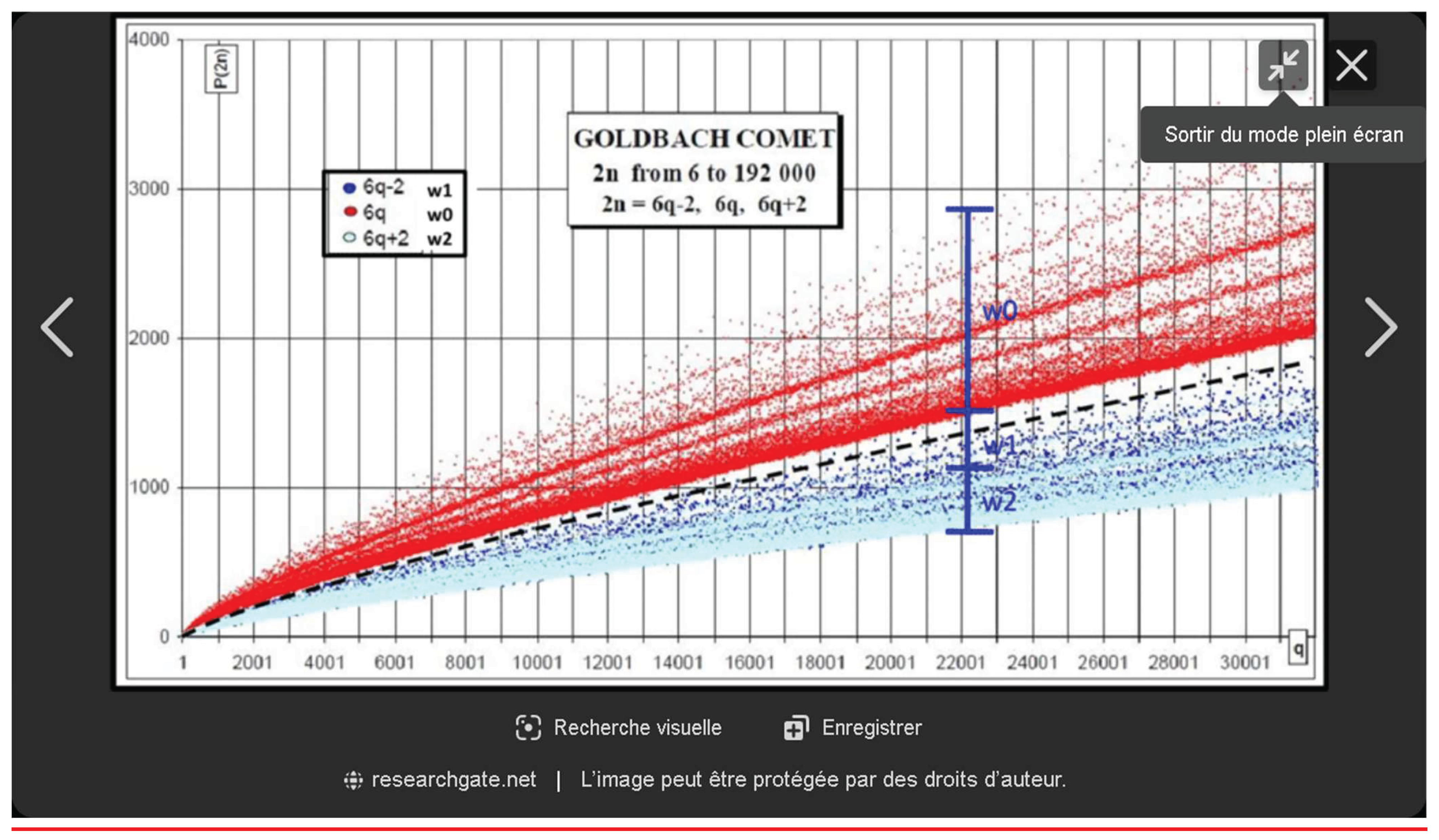
Localement (au voisinage de 2n ), il existe une sous-suite ( , ) de G.D. de 2s telle que la suite produit . = s² - k² soit presque croissante ( les variations de la moyenne géométrique suivent presque celles de la moyenne arithmétique). Ainsi, il est possible de déterminer des décomposants de Goldbach de 2n par l’algorithme suivant en choisissant un voisinage de 2n de l’ordre de c.ln²(2n) en accord avec les estimations effectuées sur la fonction de répartition G(E) associée à la comète de Goldbach.
>
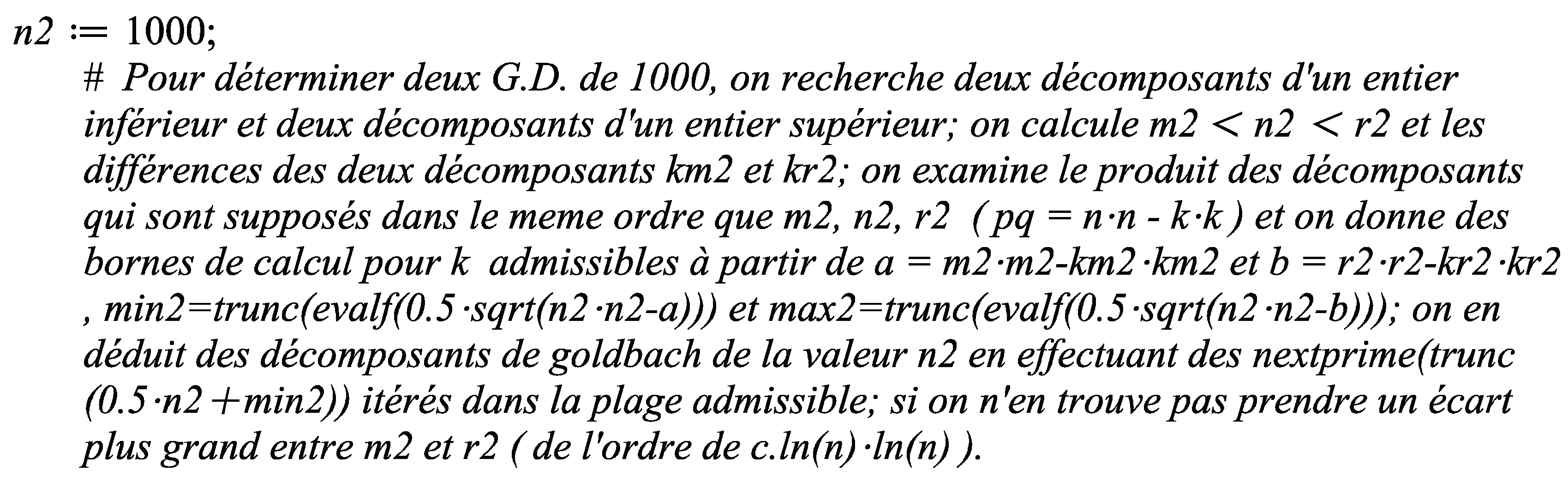
pinf := prevprime(735); pinf := 733
qinf := nextprime(17); qinf := 19
psup := nextprime(1050); psup := 1051
qsup := nextprime(29); qsup := 31
m2 := pinf + qinf; m2 := 752
r2 := psup + qsup; r2 := 1082
km2 := pinf - qinf; km2 := 714
kr2 := psup - qsup; kr2 := 1020
a := m2*m2 - km2*km2; a := 55708
b := r2*r2 - kr2*kr2; b := 130324
min2 := trunc(0.5*evalf(sqrt(n2*n2 - b))); min2 := 466
max2 := trunc(0.5*evalf(sqrt(n2*n2 - a))); max2 := 485
em1 := 0.5*n2 + min2;
em := nextprime(trunc(0.5*n2) + min2 - 1);
nextprime(em); em1 := 966.0
em := 967 971
em2 := 0.5*n2 + max2; em2 := 985.0
q := n2 - 971; q := 29
isprime(q); true
11. Theorem
For any integer n 3 it is easy to check
( ) is a positive increasing sequence of primes (11.1)
{ : n IN + 3 } = (11.2)
lim = +oo (11.3)
( ) and () are sequences of primes and the set { : k ≤ n } (11.4)
contains all primes less than ln( n )
n ≤ (11.5)
3n (11.6)
lim = +oo (11.7)
Proof.
(11.1) : For any integer n ≥ 2 .Therefore, ≤ . So the sequence () is increasing.
(11.2) : Any prime except = 2 is odd, hence the result.
(11.3) : lim = lim = +oo
(11.4) : By definition = or there exits an integer k ≤ n - 2 │ = .
So the terms of the sequence ( ) are primes.
(11.5) : According to Lemma 9, for any integer n ≥ 65
< therefore
< < n
and
= 2n - > 2n - n > n
For any integer n │ 3 ≤ n ≤ 65 verification is carried out according to the computer program in paragraph 13.2 and the table in appendix 14.
We can also see that by construction ≥ because if we assume the opposite then is not the largest prime number verifying
( + ) = n .
So
≥ n
According to (11.5) n = 2n - ≤ 2n - n ≤ n (11.6)
≤ 2n - ≤ 2n - = (11.7)
By (11.5) for any integer n ≥ 2 :n lim = +oo .
12 Lemma
We dissociate the following cases mod 6 for any even integer 2n n ≥ 3: p + q = 2n p, q ∈ Ƥ
If 2n = 6m then (p ; q) = (6r + 5 ; 6(m - r - 1) + 1) or (6r+1 ; 6(m - 1 - r) + 5)
If 2n = 6m + 2 then (p ; q) = ( 6r + 1 ; 6(m - r) + 1)
If 2n = 6m + 4 then (p ; q) = (6r + 5 ; 6(m- 1 - r) + 5)
Table : Sum of integers 1, 5 mod 6 (in /6).
| p + q mod 6 | 1 | 5 |
| 1 | 2 | 0 |
| 5 | 0 | 4 |
(To adapt with 2n = 30m + k)

Table 1.
7, 11, 13, 17, 19, 23, 29 mod 30 (in /30).
| + mod 30 | 1 | 7 | 11 | 13 | 17 | 19 | 23 | 29 |
| 1 | 2 | 8 | 12 | 14 | 18 | 20 | 24 | 0 |
| 7 | 8 | 14 | 18 | 20 | 24 | 26 | 0 | 6 |
| 11 | 12 | 18 | 22 | 24 | 28 | 0 | 4 | 10 |
| 13 | 14 | 20 | 24 | 26 | 0 | 2 | 6 | 12 |
| 17 | 18 | 24 | 28 | 0 | 4 | 6 | 10 | 16 |
| 19 | 20 | 26 | 0 | 2 | 6 | 8 | 12 | 18 |
| 23 | 24 | 0 | 4 | 6 | 10 | 12 | 16 | 22 |
| 29 | 0 | 6 | 10 | 12 | 16 | 18 | 22 | 28 |
Proof.
13. Properties
For any integer k ≥ 2 there are infinitely many integers n │ = (13.1) ~ 2n (n +oo)(13.2)
For any integer n ≥ 5000
and lim ( ) = 0(13.3)
The smallest integer n │2n - is obtained for n = 49 and = (79 ; 19) (13.4)
( This type of terms increases in the Goldbach sequence ( ) as n increases in the sense of the Schnirelmann density and there are an infinite number of them; their proportion per interval can be computed using the results given in ).
The sequence ( ) is "extremal" in the sense that for any integer n (13.5)
and are the largest and smallest possible primes │ + = 2n.
The Cramer-Granville-Maier-Nicely conjecture [9,17,30],is verified with probability one. It leads to the following majorization
For any integer p ≥ 500
≤ 0.7 [ (with probability one) (13.6)
The proof is similar to that of Lemma 9 and is validated by the studying functions of the type
f : x a .g (x) + b ( a,b > 0 ; c > 2) with
g : x 0.7 [l and h : x 0.7 by using Maple software.
According to Bombieri and using the same method as in the proof of Lemma 9,
we obtain the following estimate of > 0 = O ( )) (on average) (13.7)
14. Algorithm
14.1. Algorithm written in natural language.
Inputs :
Input four integer variables : k, N, n, P
Input : = 2 , = 3 , = 5 , 7 , ................., the first N primes.
: n ← 3
: P = M, R, G, S or T as indicated in paragraph 2
Algorithm body :
Compute : = Sup( p : p ≤ 2n - 3 )
If = (2n - ) is a prime
← and ← (14.1.1)
otherwise
If is a composite number
Let : k = 1
B.1) While + 2k is a composite number
assign to k the value k + 1 (k k + 1).
return to B1)
End while
Assign to k the value ( )
Let :
= + 2 and = (14.1.2)
Assign to n the value n + 1 (n and return to A)
End :
Outputs for integers less than Print ( 2n = ● ; 2n - 3 = ● ; = ● ; = ● ; = ● ; = ● )
Outputs for large integers :
Print ( 2n - P = ● ; 2n - 3 - P = ● ; - P = ● ; = ● ; = ● )
14.2. Program written with Maxima software for 2n around
c: 10**1000 ; for n :c+40000 step 2
thru c+40100 do
(b:2,test : 0 , b :next_prime(b) ,e :n - b ,
if primep(e)
then print(n-c, b ,e - c)
else while test=0 do (e :n -b ,if primep(e)
then test:1 , print(n-c, b ,e - c)
else test : 0 ,b:next-prime(b));
14.3. Program written with Maplesoft Maple for 2n around
G := 10^1000:
V := [1, 11, 13, 17, 19, 23, 29]:
A := G + 500000:
B := A + 59:
b:=2:
st := time( ):
for q from A by 6 to B do # Program modulo 30 .using the results of Lemma 11
Possibility of inverting the two loops or defining three similar structures with s := 0, 1, 2.
for s from 0 to 2 do
n := q + s + s:
b := trunc(0.59b - 20); # Improving computation time: the idea is to recognise that for any integer n large enough there exists a Goldbach decomponent and a successor such that
(E):│- │< k.(n) ; this reduces the number of ‘nextprime(●)’ operations which take up the most computing time.
( If G = : Computingtime is around 10 sec for thirty terms;The algorithm can be refined by exploiting frame (E). Cesàro averages can also be used to determine the initial condition for b).
t:= 0:
R := [[1, 5], [1], [5]]: Q := [[1, 7, 11, 13, 17, 19, 23, 29], [1, 13, 19], [11, 17, 23], [7, 13, 17, 19, 23, 29], [1, 7, 19], [11, 17, 23, 29], [1, 11, 13, 19, 23, 29], [1, 7, 13], [17, 23, 29], [1, 7, 11, 17, 19, 29], [1, 19, 7, 13], [11, 23, 29], [1, 23, 7, 17, 11, 13], [7, 19, 13], [11, 17, 29]]:
while t = 0 do .
b := nextprime(b + 100); # Additional test possible by improving Lemma 11. (with V mod 30).
# Possibility of replacing nextprime with a faster procedure ( see Sainty [37]).( the computation time is greatly reduced by replacing with b:=nextprime(b + k(b,G)), k(b,G) constant around 150 for G=, k(b,G) chosen randomly with the rand procedure or very slowly increasing as a function of b and G ), but in general we don't obtain the E.G.D. but any Goldbach decomponents.
e := n - b;
K := e mod 6;
if K in R[s+1] then
if isprime(e)
Then t := 1;
print(n - G, b, e - G);
end if;
end if;
end do:
end do:
end do:
Computingtime:= time( ) - st;
Comments : Possible test with gcd(n , b) = 1 and gcd(n , 2n - b) = 1 then isprime(b) and isprime(2n - b) may be faster than nextprime( ).
RESULTS :
G =b: b:= nextprime(b+rand(100..150)) b:= nextprime(b+100) b:= nextprime(b+150)
|
n - G b n - G - b 500000, 54133, 445867 500002, 40693, 459309 500004, 422393, 77611 500006, 49157, 450849 500008, 222991, 277017 500010, 259451, 240559 500012, 521981, -21969 500014, 622561, -22547 500016, 342929, 157087 500018, 25097, 474921 500020, 95083, 404937 500022, 201821, 298201 500024, 226337, 273687 500026, 255859, 244167 500028, 8147, 491881 500030, 83833, 416197 500032, 43261, 456771 500034, 162251, 337783 500036, 179203, 320833 500038, 12601, 487437 500040, 608471,-108431 500042, 157103, 342939 500044, 145531, 354513 500046, 440303, 59743 500048, 162577, 337471 500050, 258637, 241413 500052, 111791, 388261 500054, 139661, 360393 500056, 126397, 373659 500058, 40739, 459319 500060, 106121, 393939 ComComputtime:= 179.343 sec |
500000, 139387, 360613 500002, 40693, 459309 500004, 731447, -231443 500006, 54139, 445867 500008, 205651, 294357 500010, 100109, 399901 500012, 40693, 459319 500014, 261823, 238191 500016, 82913, 417103 500018, 300889, 199129 500020, 12583, 487437 500022, 233591, 266431 500024, 159871, 340153 500026, 106087, 393939 500028, 608459, -108431 500030, 30347, 469683 500032, 43261, 456771 500034, 201833, 298201 500036, 186859, 313177 500038, 95101, 404937 500040, 121763, 378277 500042, 9029, 491013 500044, 148663, 351381 500046, 304847, 195199 500048, 157109, 342939 500050, 40459, 459591 500052, 8171, 491881 500054, 223037, 277017 500056, 49207, 450849 500058, 301349, 198709 Computtime:= 188.250 sec |
500000, 361069, 138931 500002, 40693, 459309 500004, 535637, -35633 500006, 277789, 222217 500008, 205651, 294357 500010, 138959, 361051 500012, 40693, 459319 500014, 145501, 354513 500016, 198659, 301357 500018, 26309, 473709 500020, 77347, 422673 500022, 160709, 339313 500024, 162553, 337471 500026, 106087, 393939 500028, 263009, 237019 500030, 151813, 348217 500032, 24049, 475983 500034, 400031, 100003 500036, 145037, 354999 500038, 854257, -354219 500040, 121763, 378277 500042, 8161, 491881 500044, 145987, 354057 500046, 304847, 195199 500048, 12611, 487437 500050, 163729, 336321 500052, 100151, 399901 500054, 155291, 344763 500056, 126397, 373659 500058, 208277, 291781 500060, 67547, 432513 Computime:= 163.828 sec |
b:= nextprime(b+rand(150..175)) b:= nextprime(b+rand(140..160))
| n-G b n-b-G | n-G b n-b-G | |
| 500000, 139387, 360613 500002, 90481, 409521 500004, 422393, 77611 500006, 145007, 354999 500008, 604339, -104331 500010, 138959, 361051 500012, 221021, 278991 500014, 334843, 165171 500016, 297779, 202237 500018, 167267, 332751 500020, 54577, 445443 500022, 139409, 360613 500024, 336491, 163533 500026, 12589, 487437 500028, 263009, 237019 500030, 145517, 354513 500032, 334861, 165171 500034, 163697, 336337 500036, 318979, 181057 500038, 221047, 278991 500040, 761591, -261551 500042, 178691, 321351 500044, 54601, 445443 500046, 174989, 325057 500048, 84229, 415819 500050, 163729, 336321 500052, 159899, 340153 500054, 155291, 344763 500056, 166183, 333873 500058, 151841, 348217 Computtime:= 174.438 sec |
500000, 112429,-387571 500002, 40693, 459309 500004, 277787, 222217 500006, 82903, 417103 500008, 148627, 351381 500010, 139397, 360613 500012, 40693, 459319 500014, 145501, 354513 500016, 388313, 111703 500018, 258329, 241689 500020, 77347, 422673 500022, 453683, 46339 500024, 67511, 432513 500026, 221197, 278829 500028, 263009, 237019 500030, 112459, 387571 500032, 178681, 321351 500034, 208253, 291781 500036, 274019, 226017 500038, 14071, 485967 500040, 162257, 337783 500042, 361111, 138931 500044, 52903, 447141 500046, 582299, -82253 500048, 8167, 491881 500050, 67537, 432513 500052, 111791, 388261 500054, 126641, 373413 500056, 126397, 373659 500058, 40739, 459319 Computtime:= 138.578 sec |
Record : 116 sec; see in researchgate files PDFGOLDBACHTEST4,10 (For n from G+5000000 to 5000058 by 2), [37]. |
500000, 9473, 490527
500002, 24019, 475983
500004, 8123, 491881
500006, 9479, 490527
500008, 25087, 474921
500010, 57917, 442093
500012, 8999, 491013
500014, 9001, 491013
500016, 40697, 459319
500018, 9491, 490527
500020, 9007, 491013
500022, 139409, 360613
500024, 9011, 491013
500026, 9013, 491013
500028, 8147, 491881
500030, 26321, 473709
500032, 24049, 475983
500034, 54167, 445867
500036, 57943, 442093
500038, 9511, 490527
500040, 57947, 442093
500042, 8161, 491881
500044, 24061, 475983
500046, 162263, 337783
500048, 8167, 491881
500050, 12613, 487437
500052, 8171, 491881
500054, 9041, 491013
500056, 9043, 491013
500058, 40739, 459319
Computingtime : 343.453 sec
G = n - G n - b - G b n - G b n - b - G
40000, 39957, 43 40050, 86117, -46067
40002, 39091, 911 40052, 503, 39549
40004, 39957, 47 40054, 97, 39957
40006, 39549, 457 40056, 89393, -49337
40008, 25369, 14639 40058, 101, 39957
40010, 39957, 53 40060, 103, 39957
40012, 39549, 463 40062, 971, 39091
40014, 17737, 22277 40064, 107, 39957
40016, 39957, 59 40066, 109, 39957
40018, 39957, 61 40068, 977, 39091
40020, 39091, 929 40070, 113, 39957
40022, 39141, 881 40072, 523, 39549
40024, 39957, 67 40074, 983, 39091
40026, 35443, 4583 40076, 16937, 23139
40028, 39957, 71 40078, 937, 39141
40030, 39957, 73 40080, 4637, 35443
40032, 39091, 94140082, 941, 39141
40034, 35443, 4591 40084, 127, 39957
40036, 39957, 79 40086, 4643, 35443
40038, 39091, 947 40088, 131, 39957
40040, 39957, 83 40090, 541, 39549
40042, 23139, 16903 40092, 4649, 35443
40044, 39091, 953 40094, 137, 39957
40046, 39957, 89 40096, 139, 39957
40048, 39549, 499 40098, 31991, 8107
40100, 1009, 39091
G = n - G b n - b - G
100000, 36529, 63471
100002, 77069, 22933
100004, 22717, 77287
100006, 181873, -81867
100008, 12239, 87769
100010, 4547, 95463
100012, 4549, 95463
100014, 22727, 77287
100016, 59497, 40519
100018, 24847, 75171
100020, 12251, 87769
100022, 12253, 87769
100024, 4561, 95463
100026, 22739, 77287
100028, 22741, 77287
100030, 4567, 95463
100032, 12263, 87769
100034, 36563, 63471
100036, 42649, 57387
100038, 12269, 87769
100040, 23143, 76897
100042, 36571, 63471
100044, 43973, 56071
100046, 4583, 95463
100048, 24877, 75171
100050, 12281, 87769
G = n - G b n - b - G n - G b n - b - Gn - G b n - b - G
100000, 31147, 68853100050, 12611, 87439 100100, 31247, 68853
100002, 309371, -209369 100052, 12613, 87439 100102, 31249, 68853
100104, 105071, -4967
100106, 13649, 86457
100004, 31151, 68853 100054, 13597, 86457 100108, 640669, -540561
100006, 31153, 68853 100056, 105023, -4967 100110, 12671, 87439
100008, 12569, 87439 100058, 12619, 87439100112, 31259, 68853
100114, 87991, 12123
100116, 122033, -21917
100118, 18379, 81739
100010, 13553, 86457 100060, 54151, 45909
100012, 31159, 68853 100062, 108971, -8909
100014, 108923, -8909 100064, 103091, -3027
100016, 12577, 87439 100066, 87943, 12123
100018, 592237, -492219100068, 18329, 81739
100020, 104987, -4967 100070, 13613, 86457
100022, 12583, 87439 100072, 31219, 68853
100024, 13567, 86457 100074, 264881, -
100026, 18287, 81739 100076, 12637, 87439
100028, 12589, 87439 100078, 107971, -7893
100030, 31177, 68853 100080, 12641, 87439
100032, 61871, 38161 100082, 76913, 23169
100034, 13577, 86457 100084, 13627, 86457
100036, 31183, 68853 100086, 12647, 87439100038, 108947, -8909 10038, 108947, -8909 100088, 61927, 38161
100040, 12601, 87439 100090, 13633, 86457
100042, 31189, 68853 100092, 12653, 87439
100044, 457091, -357047100094, 61933, 38161
100046, 18307, 81739 100096, 87973, 12123
100048, 13591, 86457 100098, 12659, 87439
100120, 31267, 68853
100122, 61961, 38161
100124, 31271, 68853
100126, 13669, 86457
100128, 12689, 87439
100130, 31277, 68853
100132, 76963, 23169
100134, 122051, -21917
100136, 12697, 87439
100138, 13681, 86457
100140, 18401, 81739
100142, 12703, 87439
100144, 13687, 86457
100146, 152993, -52847
100148, 13691, 86457
100150, 13693, 86457
1000000, 35509, 964491
1000002, 113, 999889
1000004, 69193, 930811
1000006, 95233, 904773
1000008, 69197, 930811
1000010, 31873, 968137
1000012, 35521, 964491
1000014, 69203, 930811
1000016, 127, 999889
1000018, 35527, 964491
1000020, 131, 999889
Maple program corrected and improved by the online code checker (IA) : CODEGPT , Yihao.com and AI CLAUDE, (see Sainty [37]).
15. Appendix
Application of Algorithm 14 : Table of extreme Goldbach partitions and computed from program 14.2 ( 2 ≤ 2n ≤ + 4020 ).
The ** sign in the table below indicates the results given by the algorithm 14 in case B) of return to the previous terms of the sequence (.
WATCH OUT !
To simplify the display of large numbers n ( 2n > ) the results are entered as follows :
2n - P , (2n - 3) - P , - P , , - P and with
P = M, R, G, S, or T constants defined in (2.3)
| 2n 2n - 3 | =2n - | |||
| 4 1 | X | X | 2 | 2 |
| 6 3 | 3 | 3 | 3 | 3 |
| 8 5 | 5 | 3 | 5 | 3 |
| 1 10 7 | 7 | 3 | 7 | 3 |
| 112 9 | 7 | 5 | 7 | 5 |
| 14 11 | 11 | 3 | 11 | 3 |
| 16 13 | 13 | 3 | 13 | 3 |
| 18 15 | 13 | 5 | 13 | 5 |
| 20 17 | 17 | 3 | 17 | 3 |
| 22 19 | 19 | 3 | 19 | 3 |
| 24 21 | 19 | 5 | 19 | 5 |
| 26 23 | 23 | 3 | 23 | 3 |
| 28 25 | 23 | 5 | 23 | 5 |
| 30 27 | 23 | 7 | 23 | 7 |
| 32 29 | 29 | 3 | 29 | 3 |
| 34 31 | 31 | 3 | 31 | 3 |
| 36 33 | 31 | 5 | 31 | 5 |
| 38 35 | 31 | 7 | 31 | 7 |
| 40 37 | 37 | 3 | 37 | 3 |
| 80 77 | 73 | 7 | 73 | 7 |
| 82 79 | 79 | 3 | 79 | 3 |
| 84 81 | 79 | 5 | 79 | 5 |
| 86 83 | 83 | 3 | 83 | 3 |
| 88 85 | 83 | 5 | 83 | 5 |
| 90 87 | 83 | 7 | 83 | 7 |
| 92 89 | 89 | 3 | 89 | 3 |
| 94 91 | 89 | 5 | 89 | 5 |
| 96 93 | 89 | 7 | 89 | 7 |
| **98 95 | 89 | 9 | 79 | 19 |
| 10097 | 97 | 3 | 97 | 3 |
| 120117 | 113 | 7 | 113 | 7 |
| **122 119 | 113 | 9 | 109 | 13 |
| 124121 | 113 | 11 | 113 | 11 |
| 126123 | 113 | 13 | 113 | 13 |
| **128 125 | 113 | 15 | 109 | 19 |
| 130127 | 127 | 3 | 127 | 3 |
| 132129 | 127 | 5 | 127 | 5 |
| 134131 | 131 | 3 | 131 | 3 |
| 136133 | 131 | 5 | 131 | 5 |
| 138135 | 131 | 7 | 131 | 7 |
| 140137 | 137 | 3 | 137 | 3 |
| **500 497 | 491 | 9 | 487 | 13 |
| 502499 | 499 | 3 | 499 | 3 |
| 504501 | 499 | 5 | 499 | 5 |
| 506503 | 503 | 3 | 503 | 3 |
| 508505 | 503 | 5 | 503 | 5 |
| 510507 | 503 | 7 | 503 | 7 |
| 1000 997 | 997 | 3 | 997 | 3 |
| 1002 999 | 997 | 5 | 997 | 5 |
| 1004 1001 | 997 | 7 | 997 | 7 |
| **1006 1003 | 997 | 9 | 983 | 23 |
| 1008 1005 | 997 | 11 | 997 | 11 |
| 1010 1007 | 997 | 13 | 997 | 13 |
| 1012 1009 | 1009 | 3 | 1009 | 3 |
| 1014 1011 | 1009 | 5 | 1009 | 5 |
| 1016 1013 | 1013 | 3 | 1013 | 3 |
| 1018 1015 | 1013 | 5 | 1013 | 5 |
| 10002 9999 | 9973 | 29 | 9973 | 29 |
| 10004 10001 | 9973 | 31 | 9973 | 31 |
| **10006 10003 | 9973 | 33 | 9923 | 83 |
| **10008 10005 | 9973 | 35 | 9967 | 41 |
| 10010 10007 | 10007 | 3 | 10007 | 3 |
| 10012 10009 | 10009 | 3 | 10009 | 3 |
| 10014 10011 | 10009 | 5 | 10009 | 5 |
| 10016 10013 | 10009 | 7 | 10009 | 7 |
| **10018 10015 | 10009 | 9 | 10007 | 11 |
| 10020 10017 | 10009 | 11 | 10009 | 11 |
| 2n - M (2n - 3) - M | - M | = 2n - | - M | |
| +1000 +997 | +993 | 7 | +993 | 7 |
| **+1002 +999 | +993 | 9 | +931 | 71 |
| +1004 +1001 | +993 | 11 | +993 | 11 |
| +1006 +1003 | +993 | 13 | +993 | 13 |
| **+1008+1005 | +993 | 15 | +919 | 89 |
| +1010 +1007 | +993 | 17 | +993 | 17 |
| +1012 +1009 | +993 | 19 | +993 | 19 |
| +1014 +1011 | +1011 | 3 | +1011 | 3 |
| +1016 +1013 | +1011 | 5 | +1011 | 5 |
| +1018 +1015 | +1011 | 7 | +1011 | 7 |
| **+1020+1017 | +1011 | 9 | +931 | 89 |
| 2n - R (2n - 3) - R | - R | = 2n - | - R | |
| **+1000 +997 | +979 | 21 | +903 | 97 |
| +1002 +999 | +979 | 23 | +979 | 23 |
| **+1004 +1001 | +979 | 25 | +951 | 53 |
| **+1006+1003 | +979 | 27 | +903 | 103 |
| +1008 +1005 | +979 | 29 | +979 | 29 |
| +1010 +1007 | +979 | 31 | +979 | 31 |
| **+1012+1009 | +979 | 33 | +951 | 61 |
| **+1014+1011 | +979 | 35 | + 781 | 233 |
| +1016 +1013 | +979 | 37 | +979 | 37 |
| **+1018 +1015 | +979 | 39 | +951 | 67 |
| +1020+1017 | +1017 | 3 | +1017 | 3 |
| 2n - G (2n - 3) - G | - G | = 2n - | - G | |
| **+10000 +9997 | +9631 | 369 | +7443 | 2557 |
| **+10002 +9999 | +9631 | 371 | +9259 | 743 |
| +10004 +10001 | +9631 | 373 | +9631 | 373 |
| **+10006 +10003 | +9631 | 375 | +8583 | 1423 |
| **+10008 + 10005 | +9631 | 377 | +6637 | 3371 |
| +10010 +10007 | +9631 | 379 | +9631 | 379 |
| **+10012 +10009 | +9631 | 381 | +8583 | 1429 |
| +10014 +10011 | +9631 | 383 | +9631 | 383 |
| **+10016 +10013 | +9631 | 385 | +9259 | 757 |
| **+10018 +10015 | +9631 | 387 | +4491 | 5527 |
| +10020 +10017 | +9631 | 389 | +9631 | 389 |
| 2n-S (2n-3)-S | - S | = 2n - | - S | |
| **+20000 +19997 | +18031 | 1969 | +17409 | 2591 |
| **+20002 +19999 | +18031 | 1971 | + 17409 | 2593 |
| +20004 +20001 | +18031 | 1973 | +18031 | 1973 |
| **+20006 +20003 | +18031 | 1975 | +16663 | 3343 |
| **+20008 +20005 | +18031 | 1977 | +16941 | 3067 |
| +20010 +20007 | +18031 | 1979 | +18031 | 1979 |
| **+20012 +20009 | +18031 | 1981 | +5671 | 14341 |
| **+20014 +20011 | +18031 | 1983 | +4101 | 15913 |
| **+20016 +20013 | +18031 | 1985 | +3229 | 16787 |
| +20018 +20015 | +18031 | 1987 | +18031 | 1987 |
| **+20020 +20017 | +18031 | 1989 | +16941 | 3079 |
| 2n-T (2n-3)-T | -T | = 2n - | ||
| **+40000 +39997 | +29737 | 10263 | + 21567 | 18433 |
| **+40002 +39999 | +29737 | 10265 | +22273 | 17729 |
| +40004 +40001 | +29737 | 10267 | +29737 | 10267 |
| **+40006 +40003 | +29737 | 10269 | +21567 | 18439 |
| +40008 +40005 | +29737 | 10271 | +29737 | 10271 |
| +40010 + 40007 | +29737 | 10273 | +29737 | 10273 |
| **+40012 +40009 | +29737 | 10275 | +10401 | 29611 |
| **+40014 +40011 | +29737 | 10277 | -56003 | 96017 |
| **+40016 +40013 | +29737 | 10279 | +27057 | 12959 |
| **+40018 +40015 | +29737 | 10281 | +25947 | 14071 |
| **+40020 +40017 | +29737 | 10283 | +24493 | 15527 |
16. Appendix
| 7-3=4 | 11-5=6 | 11-3=8 | 13-3=10 | 17-5=12 | 17-3=14 | 19-3=16 | 23-5=18 |
| 23-3=20 | 29-7=22 | 29-5=24 | 29-3=26 | 31-3=28 | 37-7=30 | 37-5=32 | 37-3=34 |
| 41-5=36 | 41-3=38 | 43-3=40 | 47-5=42 | 47-3=44 | 53-7=46 | 53-5=48 | 53-3=50 |
| 59-7=52 | 59-5=54 | 59-3=56 | 61-3=58 | 67-7=60 | 67-5=62 | 67-3=64 | 71-5=66 |
| 71-3=68 | 73-3=70 | 79-7=72 | 79-5=74 | 79-3=76 | 83-5=78 | 83-3=80 | 89-7=82 |
| 89-5=84 | 89-3=86 | 101-13=88 | 97-7=90 | 97-5=92 | 97-3=94 | 101-5=96 | 101-3=98 |
| 103-3=100 | 107-5=102 | 107-3=104 | 109-3=106 | 113-5=108 | 113-3=110 | 131-19=112 | 127-13=114 |
| 127-11=116 | 131-13=118 | 127-7=120 | 127-5=122 | 127-3=124 | 131-5=126 | 131-3=128 | 137-7=130 |
| 137-5=132 | 137-3=134 | 139-3=136 | 149-11=138 | 151-11=140 | 149-7=142 | 149-5=144 | 149-3=146 |
| 151-3=148 | 157-7=150 | 157-5=152 | 157-3=154 | 163-7=156 | 163-5=158 | 163-3=160 | 167-5=162 |
| 167-3=164 | 173-7=166 | 173-5=168 | 173-3=170 | 179-7=172 | 179-5=174 | 179-3=176 | 181-3=178 |
| 191-11=180 | 193-11=182 | 191-7=184 | 191-5=186 | 191-3=188 | 193-3=190 | 197-5=192 | 197-3=194 |
| 199-3=196 | 211-13=198 | 211-11=200 | 233-31=202 | 211-7=204 | 211-5=206 | 211-3=208 | 223-13=210 |
| 229-17=212 | 227-13=214 | 223-7=216 | 223-5=218 | 223-3=220 | 227-5=222 | 227-3=224 | 229-3=226 |
| 233-5=228 | 233-3=230 | 239-7=232 | 239-5=234 | 239-3=236 | 241-3=238 | 251-11=240 | 271-29=242 |
| 251-7=244 | 251-5=246 |
17. Appendix
(K)
| = 3 | = 5 | = 7 | = 11 | = 13 | = 17 | = 19 | = 23 | = 29 | = 31 | =37 | |
| 2K = 2 | 5 | 7 | 13 | 19 | 31 | ||||||
| 2K = 4 | 7 | 11 | 17 | 23 | 41 | ||||||
| 2K = 6 | 11 | 13 | 17 | 19 | 23 | 29 | 37 | 43 | |||
| 2K = 8 | 11 | 13 | 19 | 31 | 37 | ||||||
| 2K = 10 | 13 | 23 | 29 | 41 | 47 | ||||||
| 2K = 12 | 17 | 19 | 23 | 29 | 31 | 41 | 43 | ||||
| 2K =14 | 17 | 19 | 31 | 37 | 43 | ||||||
| 2K = 16 | 19 | 23 | 29 | 47 | 59 | ||||||
| 2K = 18 | 23 | 29 | 31 | 37 | 41 | 47 | 61 | ||||
| 2K =20 | 23 | 31 | 37 | 43 | 67 | ||||||
| 2K=22 | 29 | 41 | 53 | ||||||||
| 2K=24 | 29 | 31 | 37 | 41 | 43 | 47 | 53 | 71 | |||
| 2K=26 | 29 | 31 | 37 | 43 | 73 | ||||||
| 2K=28 | 31 | 41 | 47 | 59 | |||||||
| 2K=30 | 37 | 41 | 43 | 47 | 53 | 59 | 61 | ||||
| 2K=32 | 37 | 43 | 61 | 79 | |||||||
| 2K=34 | 37 | 41 | 47 | 53 | |||||||
| 2K=36 | 41 | 43 | 47 | 53 | 59 | 67 | 83 | ||||
| 2K=38 | 41 | 43 | 61 | 67 | |||||||
| 2K=40 | 43 | 47 | 53 | 59 | 71 | ||||||
| 2K=42 | 47 | 53 | 59 | 61 | 71 | 73 | 89 | ||||
| 2K=44 | 47 | 61 | 67 | 73 | |||||||
| 2K=46 | 53 | 59 | |||||||||
| 2K=48 | 53 | 59 | 61 | 67 | 71 | 79 | |||||
| 2K=50 | 53 | 61 | 67 | 73 | 79 | 97 | |||||
| 2K=52 | 59 | 71 | 83 | ||||||||
| 2K=54 | 59 | 61 | 67 | 71 | 73 | 83 | |||||
| 2K=56 | 59 | 61 | 67 | 73 | 79 | ||||||
| 2K=58 | 61 | 71 | 89 | ||||||||
| 2K=60 | 67 | 71 | 73 | 79 | 83 | 89 |
18. Perspectives and generalizations
18.1 Other Goldbach sequences () independent of may be studied using the increasing sequences of primes ( defined by
For any integer n = Sup ( p f (n) ) (18.1.1)
f is a function defined on the interval J = [3 ; +[ and satisfying the following conditions
● f is strictly increasing on the interval J
● f (3) = 3 and = +●
For example, one of the following functions defined on J can be selected.
■ f : x a x + 3 - 3a(a : 0 < a
■ g : x[ 49 ] ( [x] is the integer part of the real x )
■ h : x + 3
18.2 Using this method it would be interesting to study the Schnirelmann density of primes 3 , 5 , 7, 11 ,........ ... in the sequence ( ) on variable intervals and the Caesaro sums of E.D.G.’s with a view to more efficient programming for their calculation.
18.3 It is possible to exceed the values shown in the table of 2n = ( Many E.G.D have been calculated for values of 2n in the order of , (and G.D. in the order of Sainty ) by perfecting this algorithm, exploiting the fact that one of Goldbach's decomponents can be chosen equal to 4p + 3, (G.D. are primes of the form 6m + 1 or 6m + 5 and can be expressed more precisely using primes of the form 30m + r :
r ∈ [1,7,11,13,17,19,23,29] (see Table mod 30, Lemma 11) ,by using De Pocklington Theorem [6,34],, Primality tests [37], Cipolla-Axler-Dusart type functions and improvment of primes frames [2,8,12,13], via a new Prime number Theorem to better identify the terms of ( supercomputers and more efficients software as C++, or Assembleur compilation.
18.4 Any Goldbach decomponent of order 2n = can be determined more quickly by replacing the instruction b:=2 by b:=trunc(c.b + d) and b := nextprime(b) with
b := nextprime(b + k(b, G)), where k(b, G) is a constant of around 150 for G = 10¹⁰⁰⁰ and is chosen randomly using the rand procedure or increases very slowly as a function of b and G. An increasing sequence of primes, , can also be determined in stages by replacing the initial value b:=2 by b:=trunc(b - .(n) - ) and by setting c := trunc( a.(b) ),
1 ≤ d ≤ 2 and b := b + c for each stage, followed by b := nextprime(b) until the next stage, ( see Sainty ); Note that for any even integer 2n large enough there exists G.D. , , , │ + = 2n and + = 2( n + 1 ) with
- and - < k.(n)). It is therefore advisable to develop adaptive algorithms based on this model using A.I., as a function of the program's G parameter.
18.5 Diophantine equations and conjectures of the same nature ((3L) conjecture [9,21,23,26,27],) can be processed using similar reasoning and algorithms.
▄ To validate the (3L) conjecture we study the following sequences of primes ( W ), (and (defined by
For any integer = Sup ( p (18.5.1)
● If = ( 2n + 1 - 2 ) is a prime
then let
= and = (18.5.2)
● If is a composite number
then there exists an integer k 1 + 2k ∈ (18.5.3)
then let
= and =+ 2k (18.5.4)
▄ Using the same type of reasoning a generalization, the (BBG) conjecture of the following form can be validated
● Let K and Q be two odd integers prime to each other :
For any integer n │ 2n(K + Q ) there exist two primes and verifying
K . + Q. = 2n (18.5.5)
● Let K and Q be two integers of different parity prime to each other :
For any integer n │ 2n (K + Q ) there are two primes and verifying
K + Q . = 2n + 1 (18.5.6)
18.6 Remark.
GOLDBACH (-) :
= Inf ( p ∈ : p - 2K ∈ ) and = Inf ( p ∈ : 2K + p ∈ ) = - 2K
GOLDBACH (+) :
= Sup ( p ∈ : 2K - p ∈ ) and = Inf ( p ∈ : 2K - p ∈ ) = 2K - (It is possible to envisage symmetries in the Goldbach triangle).
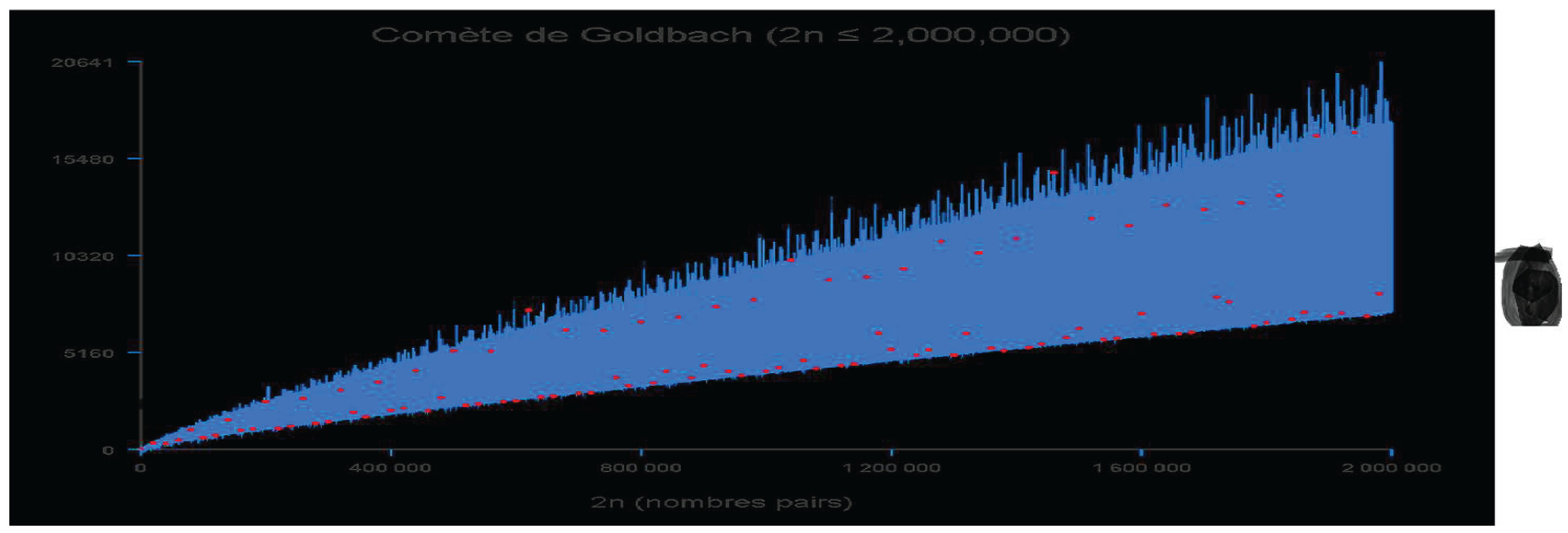
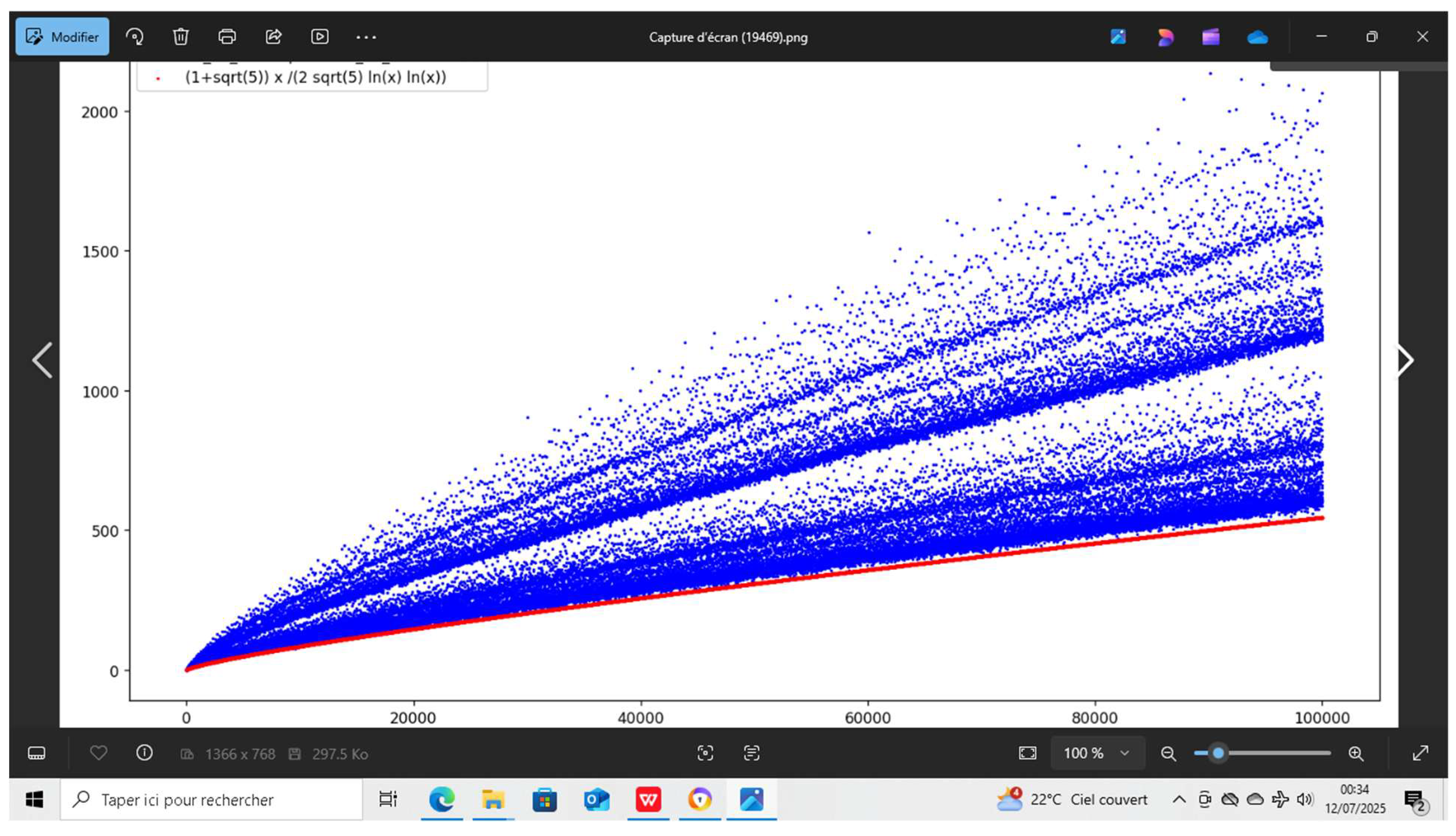
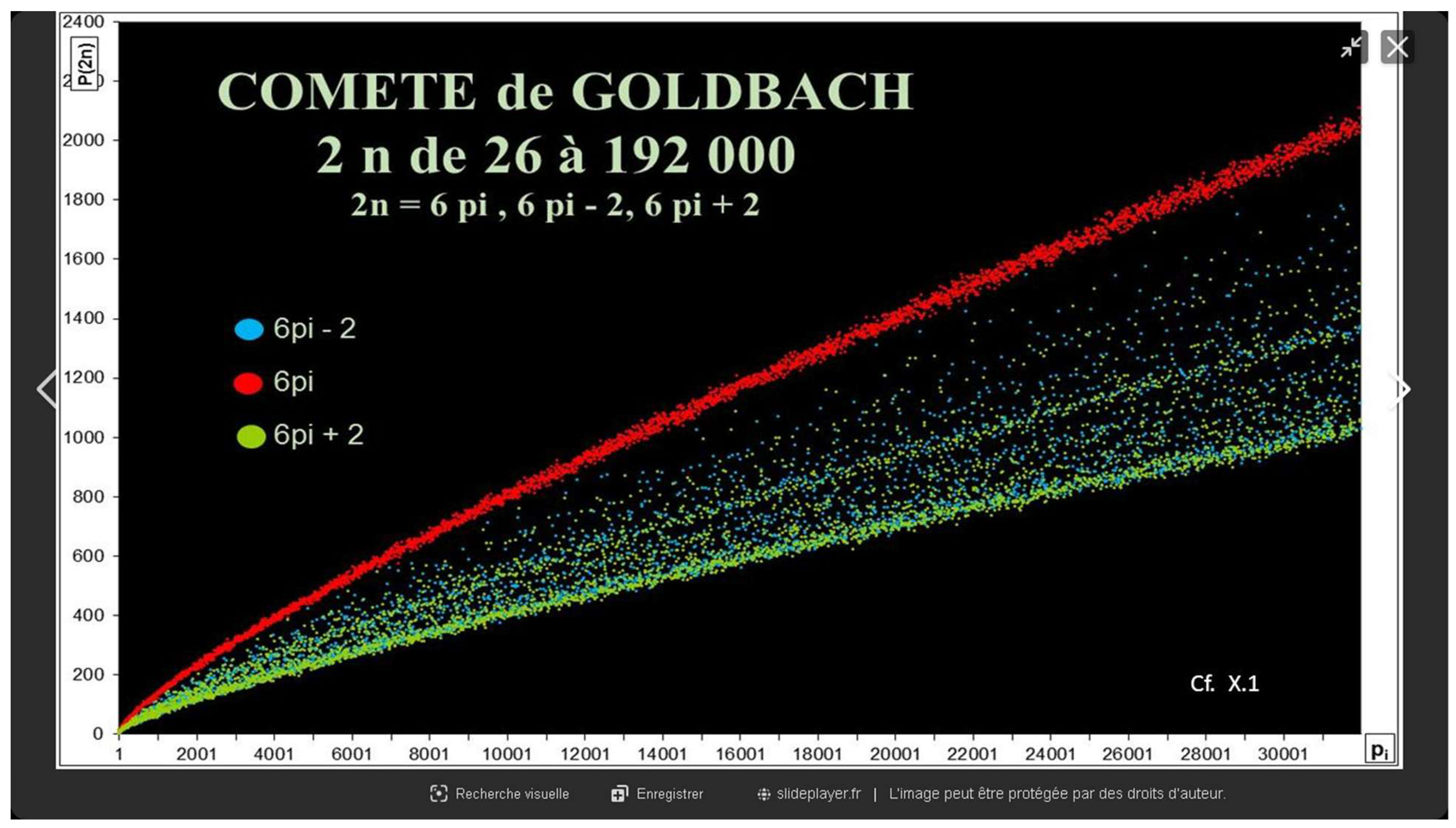
18.7 The sequences () generate all the G.D. and may enable us to better estimate the values of distribution function G of the Goldbach's Comet, probably of type :
< G(E) < , see Woon .
19. Conclusion
19.1 A recurrent and explicit Goldbach sequence ( ) = (; ) verifying
n ∈ , ∈ += 2n
has been developed using an simple and efficient "localised" algorithm. The Goldbach conjecture has been proved by strong recurrence (absurd and finite descent), and a relation (Proposition 10) is established between the fundamental theorem of arithmetic and the Goldbach conjecture (sum and product of primes), allowing fast computation of G.D. of very large even integers using a generalized Pocklington-type algorithm and perhaps another demonstration of Goldbach's conjecture via the decomposition of 2n into prime factors.
19.2 The records of Silva and Deshouillers, te Riele, Saouter are beaten on a personal computer. Hundreds E.G.D. and are obtained for values around 2n = , twenty-six around 2n = seventy-five around 2n = and G.D. around 2n = for a computation time of less than three hours (see Sainty ).
19.3 For a given integer n ≥ 49 the evaluation of the terms and does not require the computing of all previous terms and │ 1 k < n - 1 . we will only consider those that verify :
≤ 5. and 2n - 5.(2n) ≤ ≤ 2n(on average) (19.3.1)
This property allows any E.G.D and to be calculated quite quickly, the upper limit being defined by the scientific software and the computer's ability to determine the largest prime preceding 2n - 2 (next or prevprime(2n - 2) function).
19.4 Therefore the (BBG), the (3L) and the binary Goldbach(- / +) conjectures "Any even integer greater than three is the sum and difference of two primes" are true.
In fact these two conjectures are intertwined.
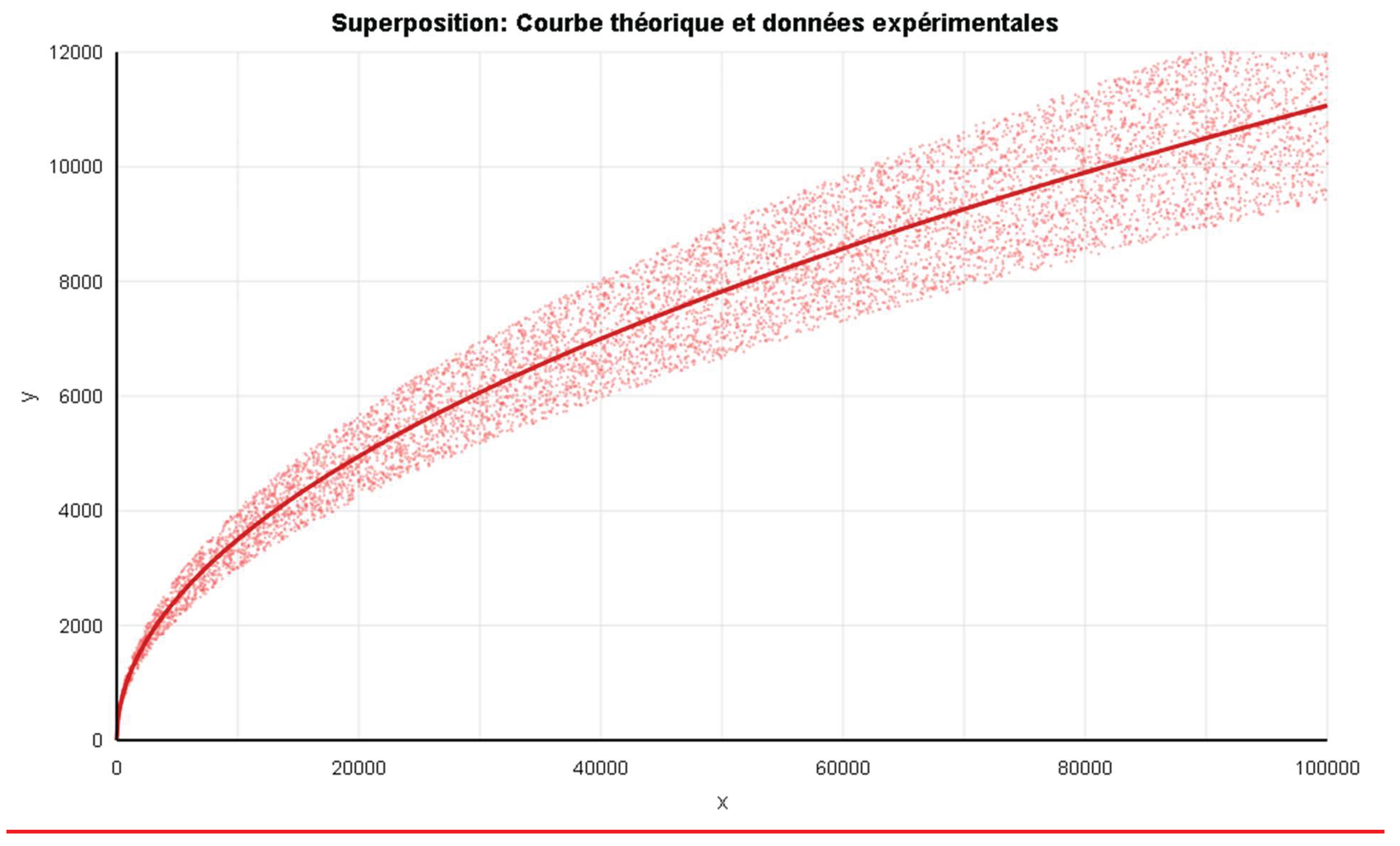
Framing and mean value of the Goldbach comet by functions of the type f : x -> a.x /(x) , ( via AI CLAUDE : to be specified ).
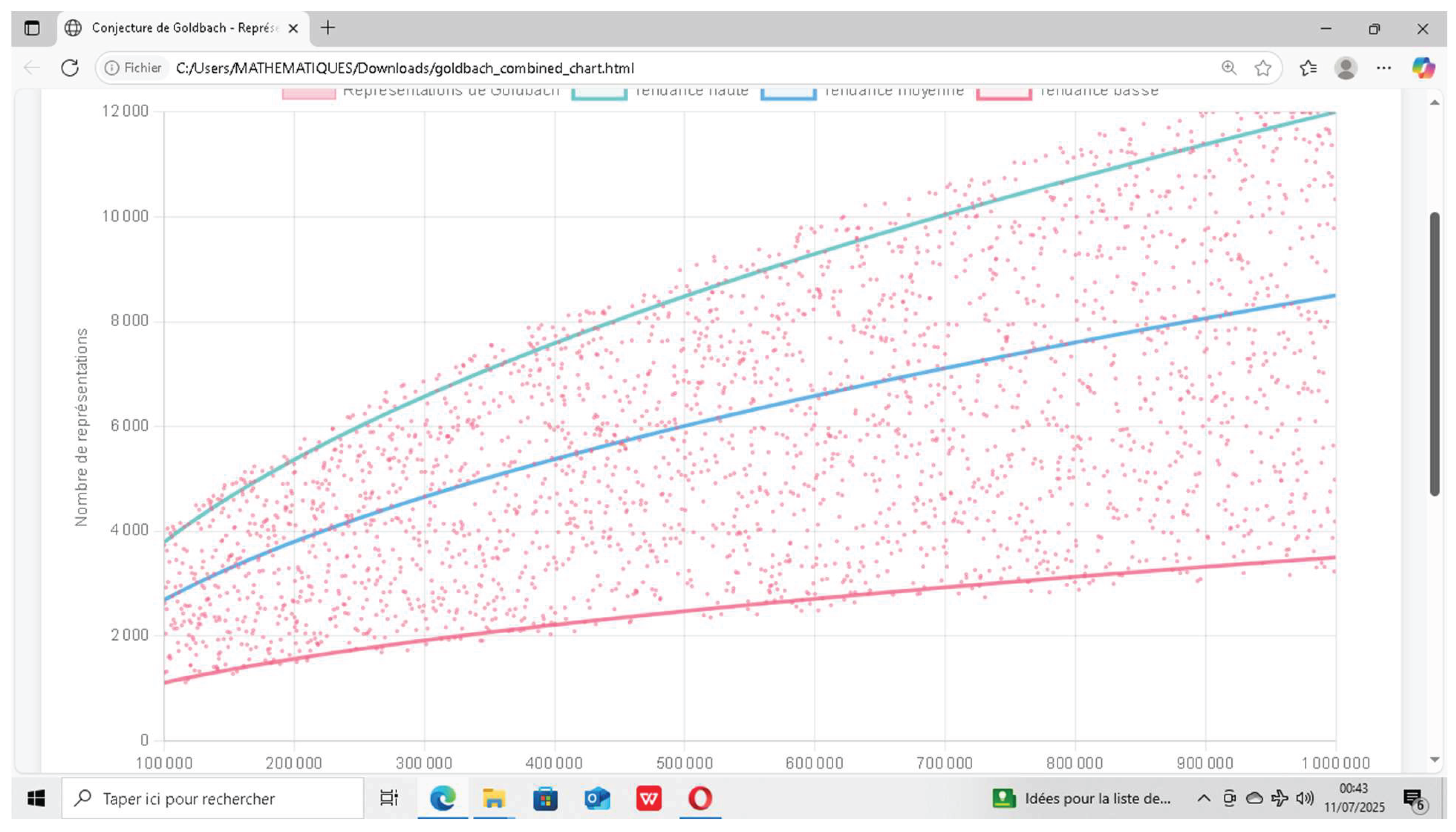
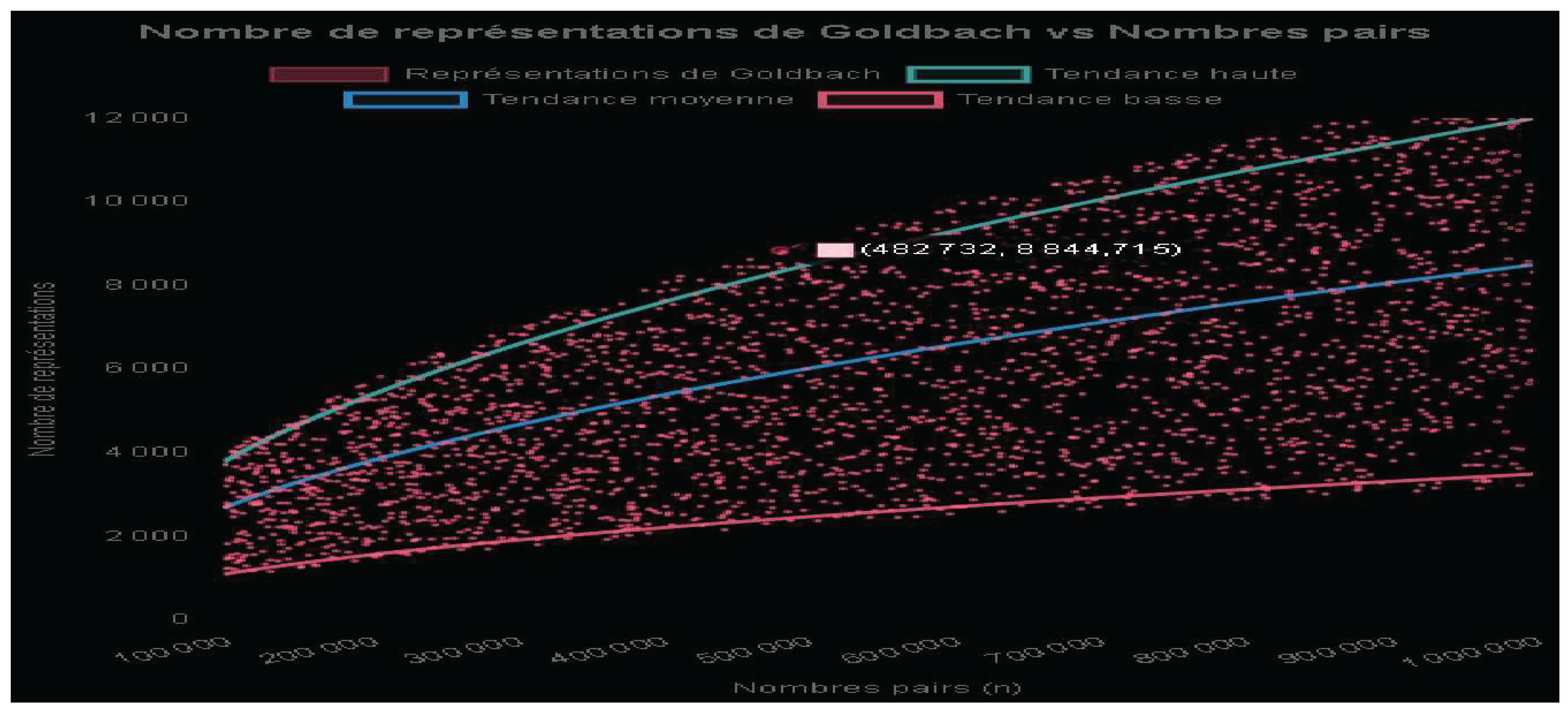

Comments :
The majority of mathematicians believe Goldbach's conjecture to be true, mainly,, based on statistical reasoning centred on the distribution of primes. The larger the number, the more ways there are to decompose it into a sum of two or three other primes. A crude heuristic approach to this argument (for the Binary Goldbach Conjecture) is to consider the prime number theorem, this states that a randomly chosen integer m has a probability of being prime equal to 1/ln(m).
. Therefore, if n is a large even integer and m is a number between 3 and n, the probability that both m and (n - m) are primes is approximately 1/(ln(n).ln(n - m)). Although this heuristic argument is imperfect for several reasons, such as the lack of consideration of correlations between the probabilities of m and (n – m) being primes, it nevertheless indicates that the total number of ways of writing a large even integer n as the sum of two odd primes is approximately proportional to n / (n).
References
- L. Adleman, K. Mc Curley, " Open Problems in Number Theoretic Complexity " , " II. Algorithmic number theory" (Ithaca, NY,1994), 291–322, Lecture Notes in Comput. Sci., 877, Springer, Berlin, (1994).
- C. Axler, “ New Estimates for the nth Prime ” 19.4.2 2 Journal of Integer Sequences, Vol. 22, 30 p., (2019),.
- E. Bombieri, Davenport, " Small differences between prime numbers ", Proc. Roy. Soc. Ser. A293 , pp. 1-18 , (1966) .
- R. C. Baker, Harman, G. " The difference between consecutive primes". Proc. London Math. Soc. (3) 72, 2 (1996), 261–280.
- R. C. Baker, Harman, G., and Pintz, J. " The difference between consecutive primes ". II. Proc. London Math. Soc. (3) 83, 3 (2001), 532–562.
- [6] J. Brillhart, D. H. Lehmer & J. L. Selfridge, " New primality criteria and factorizations of 2m ± 1" , Math. Comp., vol. 29, no 130, 1975, p. 620-647 (read online [archive]), Th. 4.
- J. R. Chen, " On the representation of a large even integer as the sum of a prime and the product of at most two primes ". Kexue Tongbao 17 (1966), pp. 385-386 (Chinese) .
- M. Cipolla, " La determinazione assintotica dell n imo numero primo ", Rend. Acad. Sci. Fis. Mat. Napoli 8(3) (1902).
- H. Cramer, "On the order of magnitude of the difference between consecutive prime numbers", Acta Arithmetica vol. 2 , (1986), p.23-46 . [CrossRef]
- N. Dawar, “Lemoine's Conjecture: A Limited Solution Using Computers” , TechRxiv [ Archive online ] (2023).
- Deshouillers, J.-M.; te Riele, H. J. J.; and Saouter, Y. "New Experimental Results Concerning The Goldbach Conjecture." In Algorithmic Number Theory: Proceedings of the 3rd International Symposium (ANTS-III) held at Reed College, Portland, OR, June 21-25, 1998 (Ed. J. P. Buhler). Berlin: Springer-Verlag, pp. 204-215, 1998. Modélisation, analyse et simulation (MAS), Rapport MAS-R9804, 31 mars 1998.
- P. Dusart, ”About the prime counting function π ” , PhD Thesis. University of Limoges, France, (1998).
- P. Dusart, ’’HDR : Estimations explicites en théorie des nombres’’ , HDR, University of Limoges, France, (2022).
- P. Erdos, "On a new method in elementary number theory which leads to an elementary proof of the prime number theorem", Proc. Natl. Acad. Sci. USA 36, pp. 374-384 (1949). [CrossRef]
- Euclid, (trans. Bernard Vitrac), "Les éléments d'Euclide", Ed. PUF Paris, vol.2, p. 444-446 and p. 339-341, (1994).
- G. G. Filhoa, G.D.G. Jaimea, F.M.de Oliveira Gouveaa, S. Keller Füchter, "Bridging Mathematics and AI: A novel approach to Goldbach’s Conjecture", Contents lists available at ScienceDirect : Measurement: Sensors journal homepage : www.sciencedirect.com/journal.
- A. Granville, "Harald Cramér and the distribution of prime numbers", Scandinavian Actuarial Journal, 1: 12–28,(1995). [CrossRef]
- J. Hadamard, "On the zeros of the function ζ(s) of Riemann". C. R. 122, p.1470-1473 (1896), and "On the distribution of zeros of the function ζ'(s) and its arithmetical consequences". S. M. F. Bull. 24, pp. 199-220 (1896).
- J. Härdig, "Goldbach’s conjecture", Examensarbete i matematik, 15 hp U.U.D.M. Project Report.
- August 2020:37, UPPSALA UNIVERSITET.
- G. H. Hardy, Wright , "An introduction to the Theory of numbers", Oxford : Oxford University Press 621 p. (2008).
- G. H. Hardy, J. E. Littlewood, "Some problems of 'partitio numerorum’" ; III: «On the expression of a number as a sum of primes« (Acta Math. Vol. 44: pp. 1 – 70, (1922).
- H. Helfgott, Platt , "The ternary Goldbach conjecture", Gaz. Math. Soc. Math. Fr. 140, pp. 5-18 (2014). "The weak Goldbach conjecture", Gac. R. Soc. Mat. Esp. 16, no. 4, 709-726 (2013). "Numerical verification of the ternary Goldbach conjecture up to 8.875.1030, Exp. Math. 22, n° 4, 406-409 (2013).(arXiv1312.7748, 2013), (to appear in Ann. Math.).
- L. Hodges, "A lesser-known Goldbach conjecture", Math. Mag., 66 (1993): 45–47.
- H. Iwaniec, Pintz, "Primes in short intervals". Monatsh. Math. 98, pp. 115-143 (1984). [CrossRef]
- J. O. Kiltinen and P. B. Young, "Goldbach, Lemoine, and a Know/Don't Know Problem", Mathematics Magazine, 58(4) (Sep., 1985), p. 195–203.
- E. Landau, "Handbuch der Lehre von der Verteiligung der Primzahlen", vol. 1 and vol. 2 (1909) , published by Chelsea Publishing Company (1953). [CrossRef]
- E. Lemoine, “L’intermédiaire de mathématiciens”, vol. 1, 1894, p. 179, vol. 3, 1896, p. 151.
- H. Levy, “On Goldbach’s conjecture”, Math. Gaz." 47 (1963): 274.
- J. Littlewood , "Sur la distribution des nombres premiers", CRAS Paris, vol. 158, (1914), p. 1869-1875.
- H. Maier, ”Primes in short intervals”. Michigan Math. J., 32(2):221–225, 1985.
- J. Maynard, "Small gaps between primes", Annals of Mathematics, vol. 181, 2015, p. 383–413 (arXiv 1311.4600), [Submitted on 19 Nov 2013 (v1), last revised 28 Oct 2019 (this version, v3)].
- [32] T. R. Nicely, "New maximal prime gaps and first occurrences", Mathematics of Computation, 68 (227): 1311–1315, (1999). [CrossRef]
- D. Parrochia, "Sur les conjectures de Goldbach forte et faible (quelques remarques historico-épistémologiques)". Preprint submitted on 15 Dec 2023,. HAL Id: hal-04346907 , https://hal.science/hal-04346907v1.
- H. C. De Pocklington, " The determination of the prime or composite nature of large numbers by Fermat's theorem ", Proc. Cambridge Philos. Soc., vol. 18, 1914-1916, p. 29-30.
- O. Ramaré, Saouter, "Short effective intervals containing primes", J. Number theory, 98, No. 1, p..10-33, (2003). [CrossRef]
- [ P. Ribenboim," The New Book of Prime Number Records ", Springer, 1996, 3e éd. (read online [archive]), p. 52.
- Ph. Sainty, "Primes frames" , "Primality tests" , "Goldbach decomponents : E.D.G. File S Around 2n = 10S for S = 1, 2, 3,............., 1000", htpps://www.researchgate.net, Internet Archive archive.org and (OEIS).
- The On-Line Encyclopedia of Integer Sequences, https://oeis.org (to appear).
- Ph. Sainty, "About the strong EULER-GOLDBACH conjecture", Matematicheskie Zametki /Mathematical Notes, In press., hal-03838423, HAL Id:hal-03838423, https://cnrs.hal.science/hal-03838423v1,Submitted on 3 Nov 2022 .
- L. Schnirelmann, "Schnirelmann density", Wikipedia, (on line, internet) and "A proof of the fundamental theorem on the density of sums of sets of positive integers", Annals of Math, 2nd series, vol. 43, no. 3, (1942),.
- pp. 523-527.
- D. Shanks, "On Maximal Gaps between Successive Primes", Mathematics of Computation, American Mathematical Society, 18 (88): 646–651, (1964).
- T. O. e Silva, Herzog, Pardi, "Empirical verification of the even Goldbach conjecture and computation of prime.
- gaps up to 4.1018''. Math. Comput. 83, no. 288, pp. 2033-2060 (2014).
- [42] Z-W. Sun, "On sums of primes and triangular numbers" » [archive], arXiv, 2008 (arXiv 0803.3737).
- T. Tao, "Every odd number greater than 1 is the sum of at most five primes", Math. Comput. 83, no. 286,.
- p.997-1038(2014). [CrossRef]
- P. Tchebychev, "Mémoire sur les nombres premiers" J. math. pures et appliquées, 1ère série, t.17,.
- p. 366-390 et p. 381-382, (1852).
- C.- J. de La Vallée-Poussin, "Recherches analytiques sur la théorie des nombres premiers", Brux. S. sc. 21 B, pp. 183-256, 281-362, 363-397, vol.21 B, pp. 351-368, (1896).
- Vinogradov, "Representation of an odd number as a sum of three primes". Dokl. Akad.Nauk. SSR, 15:291-294, (1937).
- [47] E.W. Weisstein, "Levy's Conjecture" » [archive], sur MathWorld , CRC Concise Encyclopédie de mathématiques (CRC Press, ), 733-4, (1999).
- M. S. Chin Woon, "On Partitions of Goldbach’s Conjecture" DPMMS, arXiv : math/ 0010027v2.
- [math.GM 4 Oct 2000].
- Y. Zhang, "Bounded gaps between primes", Ann. Math. (2) 179, no. 3, pp.1121-1174 (2014). [CrossRef]
Disclaimer/Publisher’s Note: The statements, opinions and data contained in all publications are solely those of the individual author(s) and contributor(s) and not of MDPI and/or the editor(s). MDPI and/or the editor(s) disclaim responsibility for any injury to people or property resulting from any ideas, methods, instructions or products referred to in the content. |
© 2025 by the authors. Licensee MDPI, Basel, Switzerland. This article is an open access article distributed under the terms and conditions of the Creative Commons Attribution (CC BY) license (http://creativecommons.org/licenses/by/4.0/).
Copyright: This open access article is published under a Creative Commons CC BY 4.0 license, which permit the free download, distribution, and reuse, provided that the author and preprint are cited in any reuse.