

Submitted:
13 October 2024
Posted:
14 October 2024
You are already at the latest version
Abstract
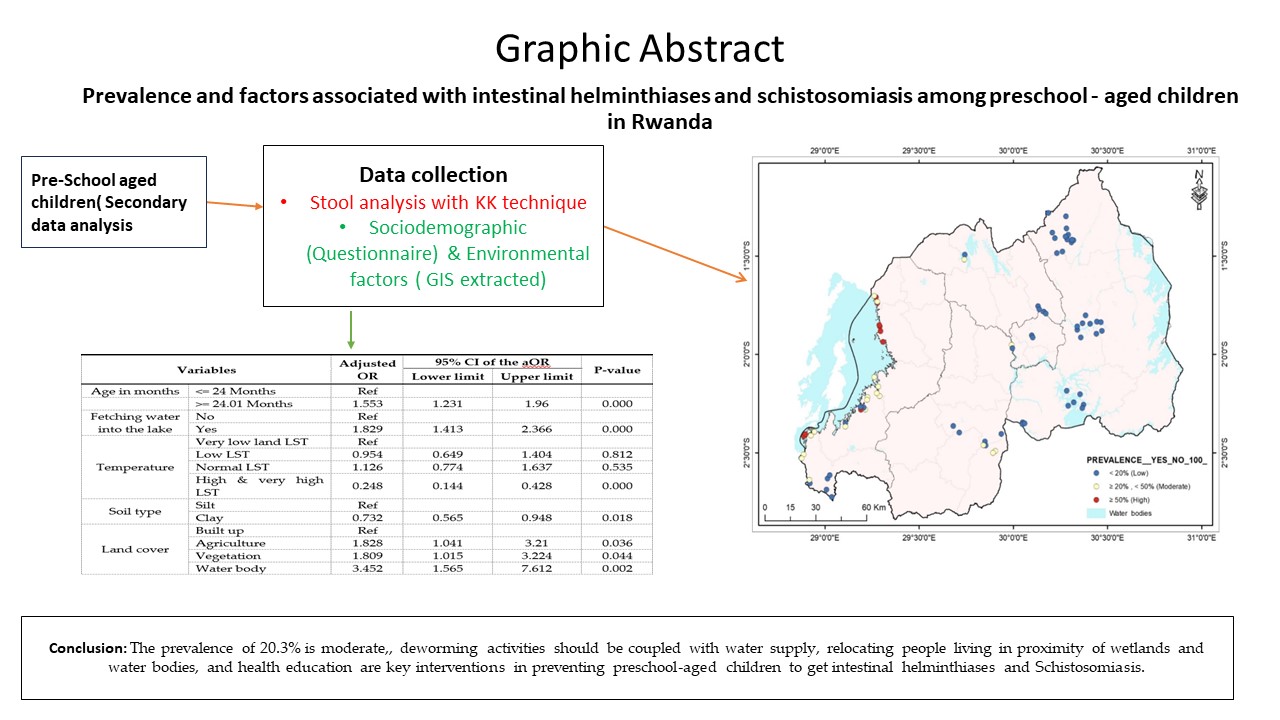
Background: Intestinal helminthiases and schistosomiasis are among the neglected tropical diseases targeted by the World Health Organization (WHO) for elimination as a public health issue by 2030. For this, it is important to determine their distribution and predicting factors, after a decade of mass deworming campaigns. In particular, such information is scarce among pre-school aged children who have not been the target for epidemiological studies and schistosomiasis deworming activities. This cross-sectional study and secondary data analysis focused on preschool-aged children and was aimed to determine the prevalence of intestinal helminthiases (Ascaris, ankylostoma, trichirus trichura, taenia) and Schistosomiasis, and identify the factors associated with them in Rwanda. Methods: Data from 4,675 preschool-aged children randomly selected from 17 districts endemic to Schistosoma mansoni were analyzed. Parasitological assessment was performed using the Kato Katz technique. Having at least one intestinal helminthiasis or schistosomiasis case was considered a positive outcome. A structured questionnaire for childcare guardians, literature, and GIS were used to collect information regarding environmental factors. Data were aggregated at village level to calculate village prevalence used in depicting the distribution of intestinal helminthiases and schistosomiasis. Descriptive analysis was performed, and prevalence was assessed as a measure of frequency. The chi-square test was used for bivariate analysis whereas logistic regression was used for multivariable analysis. The confidence level was set at 95%, and the decision was made based on the P-value. Odds ratios (ORs) were assessed as a measure of association. STATA 15 and ArcGIS software were used in this study. Results: The prevalence of intestinal helminthiases and schistosomiasis among preschool-aged children was 20.3%. Ascaris was the most prevalent parasite in this study (15%). Being older than 24 months, having self-employed parents, residence, fetching water into the lake or water body, land cover, clay soil, and high LST are predictors of intestinal helminthiases and schistosomiasis among preschool-aged children in Rwanda. Conclusion: The prevalence of 20.3% is moderate and in the march towards the elimination of these parasitic infections, deworming activities should be coupled with water supply, reinforcement of the use of Early Child Development (ECD), relocating people living in proximity of wetlands and water bodies, and health education are key interventions in preventing preschool-aged children to get intestinal helminthiases and Schistosomiasis.
Keywords:
1. Introduction
2. Materials and Methods
3. Results
3.1. Description of Socio-Demographic, WASH, and Environmental Characteristics
3.2. Prevalence of Intestinal Parasites and Schistosomiasis among Preschool-Aged Children
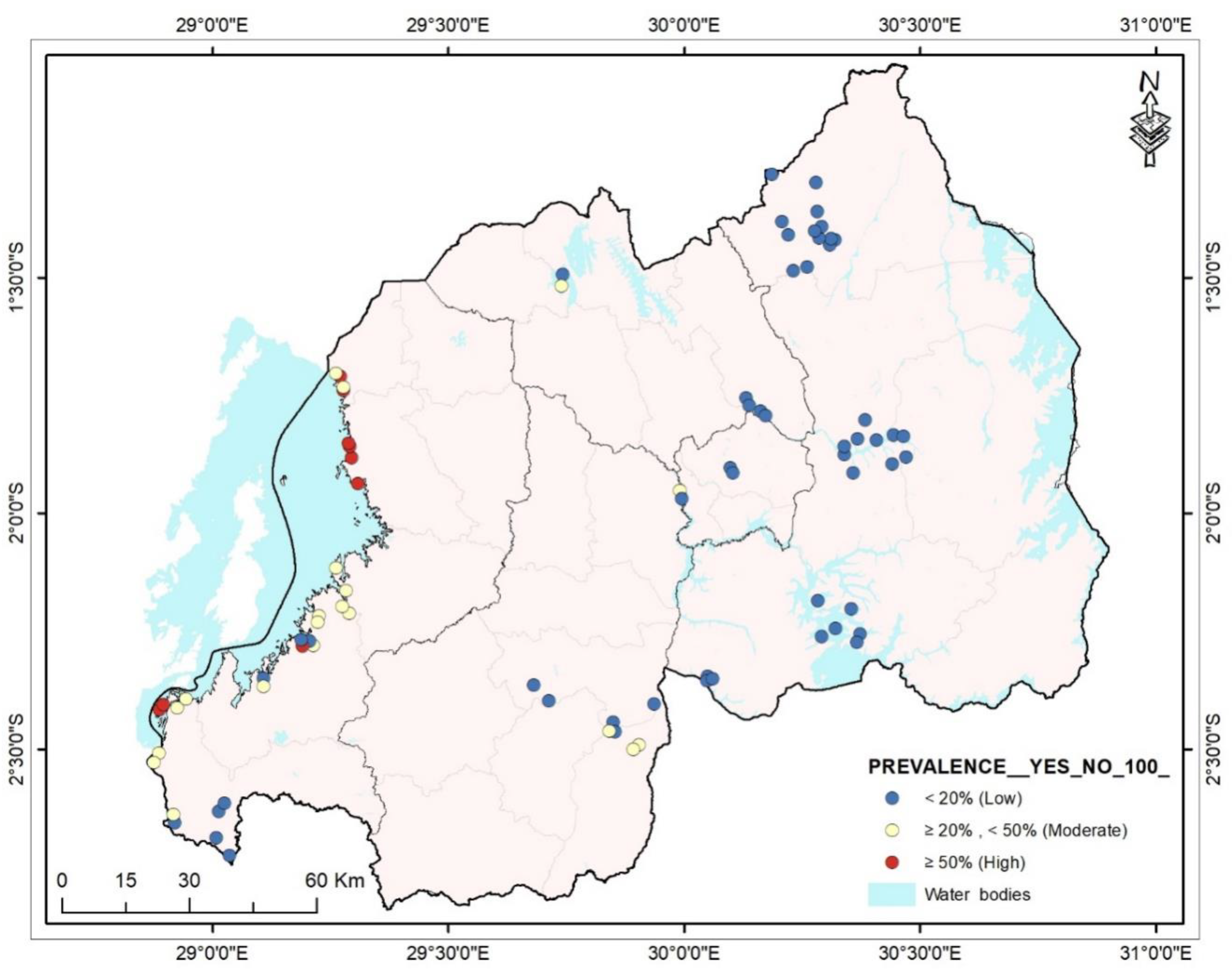
3.3. Distribution of Intestinal Parasites and Schistosomiasis among Preschool-Aged Children in Rwanda
3.4. Factors Associated with Intestinal Helminths and Schistosoma Infections
4. Discussion
5. Conclusions
6. Recommendations
Author Contributions
Institutional Review Board Statement
Data Availability Statement
Conflicts of Interest
References
- Braseth AL, Elliott DE, Ince MN. Parasitic Infections of the Gastrointestinal Track and Liver. Gastroenterol Clin North Am. 2021;50(2):361–81. [CrossRef]
- USAID. Working to Protect Neglected tropical diseases. USAID web [Internet]. 2022;(August). Available from: https://www.neglecteddiseases.gov/wp-content/uploads/2022/09/USAID-NTD-Fact-Sheet-August-2022.pdf.
- Karshima, SN. Prevalence and distribution of soil-transmitted helminth infections in Nigerian children: A systematic review and meta-analysis. Infect Dis Poverty. 2018;7(1):1–14. [CrossRef]
- Uniting to combat NTDs. Kigali Declaration on neglected tropical diseases: Commitment to end ntds. 2020;1–5. Available from: https://unitingtocombatntds.org/en/the-kigali-declaration/the-declaration/.
- Anteneh T, Giday A, Alano A, Awoke A, W/Chirkos A, Dibisa N, et al. Intestinal Parasitosis. 2008;11, 14,.
- Institute of Health Metrics and evaluation (IHME). Intestinal nematode infections— Level 3 cause. Glob Burd Dis [Internet]. 2019;393. Available from: https://www.healthdata.org/results/gbd_summaries/2019/intestinal-nematode-infections-level-3-cause.
- Institute for Health Metrics and Evaluation. Schistosomiasis — Level 3 cause. Glob Burd Dis [Internet]. 2021;393. Available from: http://www.healthdata.org/results/gbd_summaries/2019/schistosomiasis-level-3-cause.
- Ugbomeh A, Goodhead D, Green A, Onwuteaka J. Prevalence of Human Intestinal Nematode Parasites in Three Rural Communities of the Niger Delta, Nigeria. Asian J Biol. 2018;6(3):1–10. [CrossRef]
- Mulambalah CS, Ruto J. Prevalence and infection intensity of geohelminthiases among school children as an environmental health indicator to guide preventive activities in Nandi County, Kenya. Trop J Med Res. 2016;131–7. [CrossRef]
- Rodríguez-Guardado A, Pozo E, Fernandez-García R, Amo-Fernandez J, Nozal-Gancedo T. [Hookworm as cause of iron deficiency anemia in the prison population]. Rev española Sanid Penit. 2013;15(2):63–5.
- Zemene T, Shiferaw MB. Prevalence of intestinal parasitic infections in children under the age of 5 years attending the Debre Birhan referral hospital, North Shoa, Ethiopia. BMC Res Notes. 2018;11(1):1–10. [CrossRef]
- World Health Organization (WHO). Weekly epidemiological record Relevé épidémiologique hebdomadaire. 2022;(48):621–32. Available from: https://apps.who.int/iris/bitstream/handle/10665/364997/WER9748-eng-fre.pdf?sequence=1&isAllowed=y.
- Hajissa K, Islam MA, Sanyang AM, Mohamed Z. Prevalence of intestinal protozoan parasites among school children in africa: A systematic review and meta-analysis. PLoS Negl Trop Dis [Internet]. 2022;16(2):1–20. [CrossRef]
- Habib A, Andrianonimiadana L, Rakotondrainipiana M, Andriantsalama P, Randriamparany R, Randremanana RV, et al. High prevalence of intestinal parasite infestations among stunted and control children aged 2 to 5 years old in two neighborhoods of antananarivo, madagascar. PLoS Negl Trop Dis. 2021;15(4):1–22. [CrossRef]
- Tsegaye B, Yoseph A, Beyene H. Prevalence and factors associated with intestinal parasites among children of age 6 to 59 months in, Boricha district, South Ethiopia, in 2018. 2020;1–7. [CrossRef]
- Rujeni N, Morona D, Ruberanziza E, Mazigo HD. Schistosomiasis and soil-transmitted helminthiasis in Rwanda: An update on their epidemiology and control. Infect Dis Poverty. 2017;6(1):1–11. [CrossRef]
- Marcelline U, Noella U, Tharcisse M, Corine K, Josephat M, Anson BJ. The Impact of Malaria and Gastrointestinal Helminthiasis Co-infection on The Impact of Malaria and Gastrointestinal Helminthiasis Co-infection on Anaemia and Severe Malaria among Children in Bugesera District, Rwanda. 2016;(January).
- Butera E, Mukabutera A, Nsereko E, Munyanshongore C, Rujeni N, Mwikarago IE, et al. two years of age in a rural area of Rutsiro district, Rwanda – a cross-sectional study. 2019;8688:1–9. [CrossRef]
- Mohammed J, Shiferaw A, Zeleke A, Eshetu Y, Gebeyehu Z, Ayehu A, et al. Prevalence and Associated Risk Factors of Intestinal Parasites among Diarrheic Under-Five Children Attending Bahir Dar and Han Health Centers, Northwest Ethiopia: A Cross-Sectional Study. J Parasitol Res. 2022;2022. [CrossRef]
- Boonjaraspinyo S, Boonmars T, Ekobol N, Artchayasawat A, Sriraj P. Prevalence and Associated Risk Factors of Intestinal Parasitic Infections: A Population-Based Study in Phra Lap Sub-District, Mueang Khon Kaen District, Khon Kaen Province, Northeastern Thailand. 2023.
- Yin A, Lee Y, Dlamini S, Maphalala G, Liao C, Fan C. Epidemiologic Investigation of Intestinal Parasite Infection and Associated Risk Factors among Primary Schoolchildren in the Manzini and Lubombo Provinces, the Kingdom of Eswatini. 2022;2022. [CrossRef]
- Asires A, Wubie M, Reta A. Prevalence and Associated Factors of Intestinal Parasitic Infections among Food Handlers at Prison, East and West Gojjam, Ethiopia. 2019;2019. [CrossRef]
- Deka S, Kalita D, Hazarika NK. Prevalence and Risk Factors of Intestinal Parasitic Infection in Under - Five Children With Malnutrition: A Hospital Based Cross - Sectional Study. 2022.
- Tigabu A, Taye S, Aynalem M, Adane K. Prevalence and associated factors of intestinal parasitic infections among patients attending Shahura Health Center, Northwest Ethiopia. BMC Res Notes [Internet]. 2019;12(1):1–8. [CrossRef]
- Mehraj V, Hatcher J, Akhtar S, Rafique G, Beg MA. Prevalence and Factors Associated with Intestinal Parasitic Infection among Children in an Urban Slum of Karachi. 2008;3(11). [CrossRef]
- Khan W, Rahman H, Rafiq N, Kabir M, Salim M, Escalante PDLR. Saudi Journal of Biological Sciences Risk factors associated with intestinal pathogenic parasites in schoolchildren. Saudi J Biol Sci [Internet]. 2022;29(4):2782–6. [CrossRef]
- Al-fakih AA, Al-wrafi EA, Al-motawkil AAAA, Shabalah AA, Aqeel AF, Mahdi MA, et al. Prevalence of Intestinal Parasitic Infections and Associated Risk Factors Among Schoolchildren in Ibb Governorate, Southwest Yemen: A Cross-Sectional Study. 2022;(September):325–33. [CrossRef]
- Mushimiye S. A. L and Bizimana J. Prevalence And Influencers Of Intestinal Protozoa Infection Among School Children At Kigim. J Heal Sci Nurs. 2017;2(10):67–91.
- Rujeni N, Bayingana JB, Nyandwi E, Ntakarutimana A, Kagabo J, Rutayisire R, et al. Prevalence Mapping of Schistosoma mansoni Among Pre-school Age Children in Rwanda. Front Pediatr. 2022;10(June):1–7. [CrossRef]
- Deka, MA. Predictive Risk Mapping of Schistosomiasis in Madagascar Using Ecological Niche Modeling and Precision Mapping. Trop Med Infect Dis. 2022;7(2). [CrossRef]
- Nelwan, ML. Risk factors of schistosomiasis. 2023. Available from: https://ssrn.com/abstract=3722691.
- United Nations. The Sustainable Development Goals Report. 2022;32. Available from: https://unstats.un.org/sdgs/report/2022/The-Sustainable-Development-Goals-Report-2022.pdf.
- Gomes ECS, Marcelino JMR, Cavalcante KRLJ, Nascimento WRC. Quality control of the slides by Kato-Katz method for the parasitological diagnosis of schistosomiasis infection by Schistosoma mansoni. 2017;(April):110–4. [CrossRef]
- Rwanda MoH. RWANDA Neglected Tropical DISEASES Strategic Plan 2019-2024. MoH Website [Internet]. 2019;1:42. Available from: https://moh.gov.rw/fileadmin/templates/Strategic_Plans/RWANDA_NTD_STRATEGIC_PLAN_2019-2024-compressed.pdf.
- Gileydi M, Antonio J, Javier N, Id RD, Alejandro G. Prevalence and associated risk factors of Intestinal parasites in rural high-mountain communities of the Valle del Cauca — Colombia. 2020;1–15.
- Abela-Ridder B, Biswas G, Mbabazi PS, Craven M, Gerber A, Hartenstein L, et al. Ending the neglect to attain the sustainable development goals: a road map for neglected tropical diseases 2021–2030. Who. 2020. 196 p.
- Doni NY, Gürses G, Şimşek Z, Zeyrek FY. Prevalence and associated risk factors of intestinal parasites among children of farm workers in the southeastern anatolian region of Turkey. Ann Agric Environ Med. 2015;22(3):438–42. [CrossRef]
- Nhambirre OL, Cossa-Moiane I, Bauhofer AFL, Chissaque A, Lobo ML, Matos O, et al. Intestinal Parasites in Children up to 14 Years Old Hospitalized with Diarrhea in Mozambique, 2014–2019. Pathogens. 2022;11(3):2014–9. [CrossRef]
- Aleka Y, G/egziabher S, Tamir W, Birhane M, Alemu A. Prevalence and Associated Risk Factors of Intestinal Parasitic Infection among Under five Children in University of Gondar Hospital, Gondar, Northwest Ethiopia. Biomed Res Ther. 2015;2(8):347–53. [CrossRef]
- Bharti B, Bharti S, Khurana S. Worm Infestation: Diagnosis, Treatment and Prevention. Indian J Pediatr. 2018;85(11):1017–24. [CrossRef]
- Gupta R, Rayamajhee B, Sherchan SP, Rai G, Mukhiya RK, Khanal B, et al. Prevalence of intestinal parasitosis and associated risk factors among school children of Saptari district, Nepal: A cross-sectional study. Trop Med Health. 2020;48(1). [CrossRef]
- Martinez, AJ. Free-Living Amebas: Natural History, Prevention, Diagnosis, Pathology, and Treatment of Disease. Free Amebas Nat Hist Prev Diagnosis, Pathol Treat Dis. 2019;1–10.
- Quihui L, Valencia ME, Crompton DWT, Phillips S, Hagan P, Morales G, et al. Role of the employment status and education of mothers in the prevalence of intestinal parasitic infections in Mexican rural schoolchildren. BMC Public Health. 2006;6:1–8. [CrossRef]
- Ruberanziza E, Owada K, Clark NJ, Umulisa I, Ortu G, Lancaster W, et al. Mapping Soil-Transmitted Helminth Parasite Infection in Rwanda: Estimating Endemicity and Identifying At-Risk Populations. 2019. [CrossRef]
- National Institute of Statistics of Rwanda (NISR). The Fifth Rwanda Population and Housing Census, Main Indicators Report. 2023. 1–14 p.
- Scholte RGC, Schur N, Bavia ME, Carvalho EM. Spatial analysis and risk mapping of soil-transmitted helminth infections in Brazil, using Bayesian geostatistical models. 2013;8(1):97–110. [CrossRef]
- S. Brooker, Michael E. ghh Systems and Remote Sensing in the Epidemiology and Control of Human Helminth Infections. 2000.
- Brooker S, Singhasivanon P, Waikagul J, Supavej S, Kojima S, Takeuchi T, et al. Mapping soil-transmitted helminths in Southeast Asia and implications for parasite control. Southeast Asian J Trop Med Public Health. 2003;34(1):24–36.
- Zeme LL, Kitesa K, Mulisa G, Feyisa CD. Prevalence of Intestinal Parasitic Infection and Associated Factors among Adama Science and Technology University Student Adama Town, Oromia, Ethiopia. 2022;4(3):375–85.
- Fuhrimann S, Winkler MS, Kabatereine NB. Risk of Intestinal Parasitic Infections in People with Different Exposures to Wastewater and Fecal Sludge in Kampala, Uganda: A Cross-Sectional Study. 2016;1–19.
- Vieira P, Maciel S, Castro LS, Murat PG, German M, Junior H, et al. Enteroparasites in Riverside Settlements in the Pantanal Wetlands Ecosystem. 2018;2018.
- Malavade, SS. Assessment of soil transmitted helminth infection (STHI) in school children, risk factors, interactions and environmental control in El Salvador. Diss Abstr Int Sect B Sci Eng [Internet]. 2016;77(1-B(E)):No Pagination Specified. Available from: http://ovidsp.ovid.com/ovidweb.cgi?T=JS&CSC=Y&NEWS=N&PAGE=fulltext&D=psyc13&AN=2016-26526-277%0Ahttp://sfx.library.cdc.gov/cdc?sid=OVID:psycdb&id=pmid:&id=&issn=0419-4217&isbn=978-1339010823&volume=77&issue=1-B%28E%29&spage=No&pages=No+Pagination+Specifie.
- Campbell SJ, Nery S V., Wardell R, D’Este CA, Gray DJ, McCarthy JS, et al. Water, Sanitation and Hygiene (WASH) and environmental risk factors for soil-transmitted helminth intensity of infection in Timor-Leste, using real time PCR. PLoS Negl Trop Dis. 2017;11(3):1–20. [CrossRef]
- Soares Magalhães RJ, Salamat MS, Leonardo L, Gray DJ, Carabin H, Halton K, et al. Mapping the Risk of Soil-Transmitted Helminthic Infections in the Philippines. PLoS Negl Trop Dis. 2015;9(9):3. [CrossRef]

| Variable | n | % | |
|---|---|---|---|
| Total | 4675 | 100 | |
| Age in months | <= 24 Months | 848 | 18.14 |
| >= 24.01 Months | 3827 | 81.86 | |
| Gender | Female | 2317 | 49.56 |
| Male | 2358 | 50.44 | |
| Residence | City of Kigali | 120 | 2.57 |
| Southern | 591 | 12.64 | |
| Western | 1911 | 40.88 | |
| Northern | 359 | 7.68 | |
| Eastern | 1694 | 36.24 | |
| Parents’ occupation | Casual worker | 145 | 3.22 |
| Farmer | 4062 | 90.31 | |
| Government employee | 41 | 0.91 | |
| Self-employed | 154 | 3.42 | |
| Unemployed | 96 | 2.13 | |
| Child care giver during the day | Mother | 3479 | 74.62 |
| Father | 258 | 5.53 | |
| Sister | 156 | 3.35 | |
| Brother | 37 | 0.79 | |
| Other | 732 | 15.7 | |
| Nutritional status | Not stunted | 3078 | 65.84 |
| Stunted | 1597 | 34.16 | |
| Fetching water into the lake water body | No | 780 | 16.68 |
| Yes | 3895 | 83.32 | |
| Bathing in the lake or water body | No | 1669 | 36.24 |
| Yes | 2937 | 63.76 | |
| Rainfall (Precipitation) | Low | 1994 | 42.65 |
| Moderate | 2259 | 48.32 | |
| High | 422 | 9.03 | |
| Temperature | Very low land LST | 540 | 11.55 |
| Low LST | 1419 | 30.35 | |
| Normal LST | 1936 | 41.41 | |
| High & Very high LST | 780 | 16.68 | |
| Soil type | Silt | 882 | 18.87 |
| Clay | 3793 | 81.13 | |
| soil pH | Acidic | 4675 | 100 |
| Land cover | Built up | 106 | 2.27 |
| Agriculture | 3043 | 65.09 | |
| Vegetation | 1224 | 26.18 | |
| Water body | 302 | 6.46 | |
| Parasites | n | % | CI (95%) | |
|---|---|---|---|---|
| Lower limit | Upper limit | |||
| Schistosomiasis | 37 | 0.8 | 0.55 | 1.08 |
| Ascaris | 702 | 15 | 14 | 16.07 |
| Trichuris | 361 | 7.7 | 6.97 | 8.52 |
| Ankylostoma | 68 | 1.5 | 1.13 | 1.84 |
| Tenia | 10 | 0.2 | 1.1 | 0.39 |
| Other parasites | 11 | 0.2 | 0.11 | 0.42 |
| Overall prevalence (presence of at least one parasite | 949 | 20.3 | 19.15 | 21.48 |
| Variable | Presence of parasites | Absence of parasites | Chi2 | P-value | |
|---|---|---|---|---|---|
| n (%) | n (%) | ||||
| Overall | 949 (20.30) | 3726 (79.70) | |||
| Age in months | 13.639 | 0.000 | |||
| <= 24 Months | 133 (15.68) | 715(84,32) | |||
| >= 24.01 Months | 816 (21.32) | 3011 (78.68) | |||
| Gender | 0.847 | 0.357 | |||
| Female | 483 (20.85) | 1834 (79.15) | |||
| Male | 466 (19.76) | 1892 (80.24) | |||
| Residence | 578.84 | 0.000 | |||
| City of Kigali | 7 (5.83) | 113 (94.17) | |||
| Southern | 88 (14.89) | 503 (85.11) | |||
| Western | 707 (37.00) | 1204 (63) | |||
| Northern | 40 (11.14) | 319 (88.86) | |||
| Eastern | 107 (6.32) | 1587 (93.68) | |||
| Parents ‘occupation | 39.165 | 0.000 | |||
| Casual worker | 32 (22.07) | 113 (77.93) | |||
| Farmer | 772 (19.01) | 3290 (80.99) | |||
| Government employee | 6 (14.63) | 35 (85.37) | |||
| Self-employed | 57 (37.01) | 97 (62.99) | |||
| Unemployed | 30 (31.25) | 66 (68.75) | |||
| Child care giver during the day | 23.402 | 0.000 | |||
| Mother | 677 (19.46) | 2802 (80.54) | |||
| Father | 63 (24.42) | 195 (75.58) | |||
| Sister | 17 (10.90) | 139 (89.1) | |||
| Brother | 12 (32.43) | 25 (67.57) | |||
| Other | 178 (24.32) | 554 (75.68) | |||
| Nutritional status | 0.046 | 0.829 | |||
| Not stunted | 622 (20.21) | 2456 (79.79) | |||
| Stunted | 327 (20.48) | 1270 (79.52) | |||
| Fetching water into the lake | 5.179 | 0.023 | |||
| No | 135 (17.31) | 645 (82.69) | |||
| Yes | 814 (20.90) | 3081 (79.1) | |||
| Bathing in the lake | 16.401 | 0.000 | |||
| No | 286 (17.14) | 1383 (82.860 | |||
| Yes | 650 (22.13) | 2287 (77.87) | |||
| Rainfall (Precipitation) | 458.967 | 0.000 | |||
| Low | 118 (5.92) | 1876 (94.08) | |||
| Moderate | 670 (29.66) | 1589 (70.34) | |||
| High | 161 (38.15) | 261 (61.85) | |||
| Temperature | 186.306 | 0.000 | |||
| Very low land LST | 80 (14.81) | 460 (85.18) | |||
| Low LST | 284 (20.01) | 1135 (79.98) | |||
| Normal LST | 540 (27.89) | 1396 (72.10) | |||
| High & Very high LST | 45 (5.76) | 735 (94.23) | |||
| Soil type | 5.416 | 0.020 | |||
| Silt | 154 (17.46) | 728 (82.54) | |||
| Clay | 795 (20.96) | 2998 (79.04) | |||
| Land cover | 23.152 | 0.000 | |||
| Built up | 25 (23.58) | 81 (76.42) | |||
| Agriculture | 582 (19.13) | 2461 (80.87) | |||
| Vegetation | 299 (24.43) | 925 (75.57) | |||
| Water body | 43 (14.24) | 259 (85.76) | |||
| Variables | Adjusted OR | 95% CI of the aOR | P-value | ||
|---|---|---|---|---|---|
| Lower limit | Upper limit | ||||
| Age in months | <= 24 Months | Ref | |||
| >= 24.01 Months | 1.553 | 1.231 | 1.96 | 0.000 | |
| Residence | City of Kigali | Ref | |||
| Southern | 1.674 | 0.595 | 4.71 | 0.329 | |
| Western | 5.702 | 2.024 | 16.068 | 0.001 | |
| Northern | 1.195 | 0.454 | 3.147 | 0.718 | |
| Eastern | 0.885 | 0.373 | 2.098 | 0.781 | |
| Parents ‘occupation | Casual worker | Ref | |||
| Farmer | 0.929 | 0.584 | 1.477 | 0.755 | |
| Government employee | 0.548 | 0.2 | 1.506 | 0.243 | |
| Self-employed | 2.492 | 1.397 | 4.444 | 0.002 | |
| Unemployed | 1.594 | 0.82 | 3.096 | 0.169 | |
| Child care giver during the day | Mother | Ref | |||
| Father | 0.781 | 0.533 | 1.146 | 0.206 | |
| Sister | 1.206 | 0.689 | 2.111 | 0.511 | |
| Brother | 1.254 | 0.549 | 2.866 | 0.591 | |
| Other | 0.824 | 0.639 | 1.063 | 0.136 | |
| Fetching water into the lake | No | Ref | |||
| Yes | 1.829 | 1.413 | 2.366 | 0.000 | |
| Bathing in the lake | No | Ref | |||
| Yes | 0.966 | 0.784 | 1.19 | 0.742 | |
| Rainfall (Precipitation) | Low | Ref | |||
| Moderate | 1.674 | 0.888 | 3.154 | 0.111 | |
| High | 1.692 | 0.831 | 3.442 | 0.147 | |
| Temperature | Very low land LST | Ref | |||
| Low LST | 0.954 | 0.649 | 1.404 | 0.812 | |
| Normal LST | 1.126 | 0.774 | 1.637 | 0.535 | |
| High & very high LST | 0.248 | 0.144 | 0.428 | 0.000 | |
| Soil type | Silt | Ref | |||
| Clay | 0.732 | 0.565 | 0.948 | 0.018 | |
| Land cover | Built up | Ref | |||
| Agriculture | 1.828 | 1.041 | 3.21 | 0.036 | |
| Vegetation | 1.809 | 1.015 | 3.224 | 0.044 | |
| Water body | 3.452 | 1.565 | 7.612 | 0.002 | |
Disclaimer/Publisher’s Note: The statements, opinions and data contained in all publications are solely those of the individual author(s) and contributor(s) and not of MDPI and/or the editor(s). MDPI and/or the editor(s) disclaim responsibility for any injury to people or property resulting from any ideas, methods, instructions or products referred to in the content. |
© 2024 by the authors. Licensee MDPI, Basel, Switzerland. This article is an open access article distributed under the terms and conditions of the Creative Commons Attribution (CC BY) license (http://creativecommons.org/licenses/by/4.0/).