
Submitted:
12 October 2024
Posted:
14 October 2024
You are already at the latest version
Abstract
Drowning is among the most common reasons of children’s death aged one to fourteen around the globe. With rising populations and the growing popularity of swimming pools in hotels and villas, the incidence of drowning has accelerated. Accordingly, the development of systems for detecting and preventing drowning has become increasingly critical to provide safe swimming settings. In this paper, we propose a comprehensive review of recent existing advancements in automated drowning detection and prevention systems. The existing approaches can be broadly categorized according to their objectives into two main groups: detection-based systems and detection and rescue-based systems. Automatic drowning detection approaches could be further categorized into computer vision-based approaches where camera-captured images are analyzed by machine learning algorithms to detect instances of drowning, and sensing-based approaches where sensing instruments are attached to swimmers to track their behavior. We explore the advantages and limitations of each approach. Additionally, we discuss the technical challenges and unresolved issues related to this domain. Based on this study, we provide researchers and practitioners with a comprehensive analysis of the state-of-the-art techniques for drowning detection and prevention.
Keywords:
Drowning detection
; prevention
; rescue
; Swimming pool safety
; IoT
; artificial intelligence: AI
; deep learning
; machine learning
; surveillance technology
1. Introduction
Drowning is a significant global public health issue that requires urgent and focused attention. As published by World Health Organization (WHO) report [2], drowning is ranked as the third most frequent cause of unintended injury death. Drowning ranks among the highest five cases of death in 48 out of 85 nations for those between the ages of 1 and 14 as illustrated by Figure 1. Globally, there are approximately 236,000 drowning deaths each year. Figure 2 shows that drowning is the first leading reason of mortality rates for children aged 5 to 14 in the Western Pacific region. This age group was the most often drowned throughout all areas, with rankings from second to sixth cause of death, while it was the ninth and tenth and in the African region [3,4].
As reported in [1], more than 90% of these drowning deaths are at a much lower rate in middle nations. Most underdeveloped nations lack data on catastrophic drowning injuries due to a lack of an acceptable mortality reporting system. Furthermore, most of the research that is restricted to fewer nations shows that 15% of these near-drowning incidents will result in death, while 20% will suffer serious neurological damage. All the incidents that happened in a pool area had the cervical spine as the most injured bodily area because of drowning. Anoxic brain damage caused by submersion was also the leading cause of mortality in the hospital.
Zaara et al. [5] reported that as the populations grow and the popularity of villas and hotels with swimming pools increases, the percentage of drowning deaths also rises. Governments and organizations have conducted numerous investigations to identify effective methods for reducing drowning accidents. Some of these methods incorporate providing parents with information on drowning risks through child surveillance programs. However, these solutions were not enough and were considered rudimentary. The authors reported that unintentional deadly drowning remains a serious health issue in Tunisia for children, particularly those aged 7 to 18. Based on the 200 casualties covered in their study, the summer represents the highest rate of death observations, as beach visits were the most frequent.
Given its significance, various Drowning Detection (DD) and Drowning Prevention (DP) approaches have been proposed in the literature. A thorough analysis of these approaches is essential for offering researchers and industry professionals a comprehensive overview of the current methods. This not only enables them to select solutions that best suit their needs but also highlights potential gaps in the research, opening the door for future exploration and innovation.
Some research efforts have been made to survey DD approaches. Most of these efforts emphasize public health perspectives with limited focus on technological detection. Few research efforts have reviewed DD approaches without diving into the integration of detection systems with automated prevention and rescue systems.
Crawford et al. [6] provide a systematic review of public health interventions aimed at preventing child drowning with a specific focus on policy, education, and community-based interventions. The study lacks the coverage of technological solutions for DD. The research study [7] highlights regional drowning prevention strategies from a public health perspective with limited technological coverage, focusing on Turkey’s unique challenges. The regional focus on a certain country reduces general applicability to global DD issues.
Jalalifar et al. [8] present an overview of recent advancements in DD, with a specific focus on image processing and sensor-based methods. The research presented in [9] focuses on Machine Learning (ML) and Deep Learning (DL) based DD algorithms. The study presented [10] explores the use of DD technology in embedded systems, Artificial Intelligence (AI), and Internet of Things (IoT) within enclosed environments with limited focus on open water bodies and other swimming environments. The relevant surveys and their contributions, scopes, and limitations are summarized in Table 1.
In this paper, we summarize and analyze the up-to-date DD and DP approaches. The main contributions of this research are:
- Categorization of existing approaches into two main groups; detection-based systems that focus solely on detecting drowning incidents to notify parents or lifeguards to perform manual rescue, and detection and prevention systems that integrate both detection and automated rescue mechanisms.
- Classification of detection methods into Computer Vision (CV)-Based Approaches that involve the use of overhead or underwater cameras and machine learning algorithms to analyze visual data for DD, and Sensor-Based Approaches that rely on wearable sensors to monitor the swimmer’s physical parameters like heart rate, oxygen levels, and motion to detect potential drowning.
- Highlighting the limited research on automatic rescue systems, as most current approaches focus on detection but lack integrated rescue functionalities, which remains a key area for future development.
- Identifying key technical challenges in DD and DP systems.
Exploring future research areas and opportunities to enhance DD and DP systems.
The remainder of this paper is organized as follows. Section 2 outlines the search methodology followed to identify approaches related to DD and DP. Section 3, which is the focus of our paper, presents an extensive description and comparison of the most current research approaches in the field of DD (Section 3.1) and DP (Section 3.2). Section 4 addresses the main technical challenges and open research issues in this field. Concluding remarks and future directions are presented in Section 5.
2. Search Methodology
In this section, we outline our search methodology for identifying approaches related to DD and DP. We began by gathering research papers using specific search queries. Next, we refined the collection by applying inclusion and exclusion criteria to retain only the most relevant studies. Finally, we expanded the selection by reviewing and incorporating relevant references and citations from the chosen papers.
2.1. Search Criteria
By reviewing the definitions of DD and DP, we identified the appropriate search keywords. Inspired by previous systematic reviews—particularly on keyword organization and the use of a synonym generator to establish related terms and synonyms—we refined the search query to maximize the retrieval of relevant articles. This process resulted in the following search query, which we used to select articles based on their titles and abstracts:
("Drowning" OR "swimming") AND ("detection" OR "identification" OR "recognition" OR "prevention" OR "rescue" OR "safety") AND ("smart" OR "intelligent" OR "AI" OR "learning" OR "algorithm")
We applied this query on Google Scholar, which provides a broad index of scholarly articles from various repositories, ensuring comprehensive coverage of relevant research on DD and DP approaches.
2.2. Inclusion and Exclusion Criteria
After running our search query, we observed that many of the results were not directly relevant to our study. To refine the search and concentrate on publications aligned with our research objectives and questions, we applied inclusion and exclusion criteria to filter the articles retrieved from the query.
To prioritize the most recent research on drowning detection and prevention (DD and DP), we limited our selection to publications from January 2018 onward. This timeframe was chosen to ensure the inclusion of the latest approaches in the field. Additionally, we included only papers specifically addressing DD and DP. Papers not written in English, as well as surveys, systematic reviews, and roadmap papers, were excluded as our interest lies solely in studies that provide concrete contributions to DD and DP.
2.3. Results
We executed a search query on Google Scholar to retrieve papers based on their title similarity to our query, which initially returned a total of 32 papers. To refine this collection, we applied our inclusion and exclusion criteria, which reduced the set of initial papers from 32 to 8. To ensure thorough coverage, we employed the Snowballing approach, reviewing the references and citations of these papers to identify additional relevant studies that may have been overlooked by the search engines. Ultimately, this process resulted in a final collection of 16 papers forming the core of our study.
3. Analysis of Existing Drowning Detection and Prevention Approaches
Automatic DD and DP approaches can be classified according to their objectives into two main categories: detection-based systems and detection and prevention (rescue)-based systems. DD systems focus solely on detecting drowning incidents to notify parents and lifeguards to perform manual rescue for the victims, while detection and rescue-based systems integrate detection with automated rescue mechanisms. The state-of-the-art approaches are summarized and discussed in this section.
The performance and accuracy of the different DD and DP systems are based on metrics provided by the original studies (if given). We reported these values directly from the source articles, ensuring they reflect the authors’ methods and context for each system. Key performance metrics often used in these studies include accuracy, precision, recall, and sometimes additional measures like response time and false positive rates, depending on the approach used. For example, accuracy measures the overall correctness of the system in detecting drowning events, while precision and recall focus on its ability to correctly identify true positives and avoid false negatives, respectively. The inclusion of these metrics allows readers to objectively compare the effectiveness of different systems in the context and testing environments specific to each study, contributing to a well-rounded assessment.
3.1. Drowning Detection Approaches
Automated DD approaches can be broadly classified into two categories. The first category is CV approaches where overhead or underwater cameras are utilized to oversee swimmers, and the footage from these cameras analyzed by ML algorithms to detect instances of drowning. The second category is sensing approaches, where sensing instruments are attached to swimmers to track their behavior by measuring parameters such as heartrate, oxygen level, motion, and depth. This section provides a summary of recent advancements in DD approaches.
3.1.1. CV-Based Drowning Detection Approaches
CV-based systems have played a significant role over the past few decades in a wide range of applications, such as target and object detection [11,12,13,14,15,16], human action and event recognition [17,18,19,20], environment modeling for moving cameras, medical image analysis [21,22,23,24], and emotion or deception recognition [25,26,27]. In CV-based DD approaches, overhead or underwater cameras are employed to observe swimmers, with the captured pictures from these cameras analyzed by ML algorithms to detect potential drowning incidents [28].
The most commonly used ML algorithms in DD systems are Convolutional Neural Network (CNN) algorithms and their variants such as YOLO (You Only Look Once). CNN models are superior in their ability to process visual data and are often employed in CV-based approaches to detect drowning from normal swimming activities. The major advantage of a CNN is that it can learn directly from input images, eliminating the need for preprocessing and feature extraction techniques [29,30,31,32,33,34,35,36,37,38]. YOLO is an effective and efficient algorithm for DD due to its ability to process images at high speeds which is critical for real-time monitoring and immediate intervention in drowning scenarios [10].
A. Body Parts Coordinates and DL
Fok [39] proposes an underwater pool safety DD system. Sixteen cameras are placed at various locations of the pool. The main function of the cameras is to capture and record the coordinates of key body parts, such as knees, arms, shoulders, and elbows, during every swimming motion. The captured images are then labeled and fed into the DL system, allowing it to learn and recognize specific body movements and positions. When the algorithm determines that the likelihood of drowning exceeds a preset threshold, it triggers an audio alarm to immediately alert the lifeguard.
The main drawback of this system is the large number of cameras used to cover the whole pool. Further, the system does not fully replace the role of human lifeguard.
B. IoT and Transfer Learning
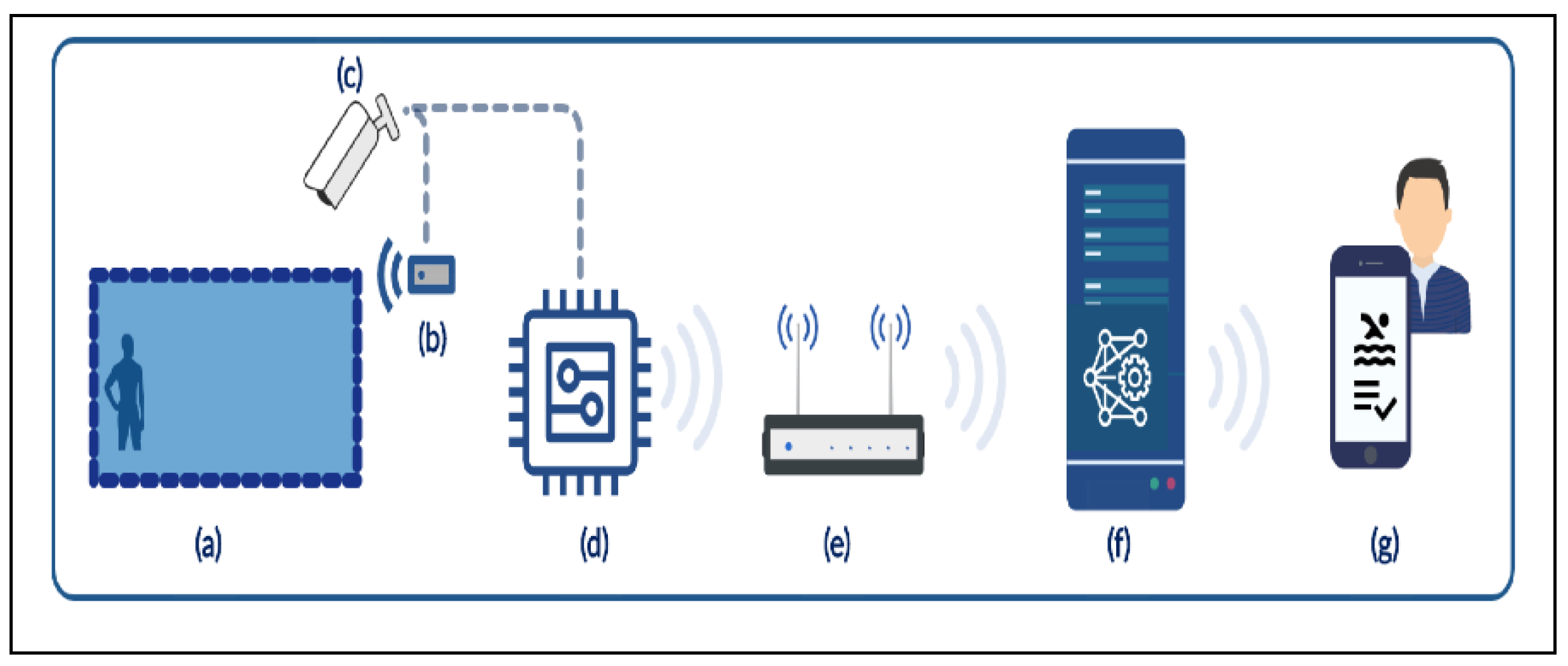
Alotaibi [40] proposes an IoT and deep ML based DD system. which consists of three parts. The first part is the sensing unit which consists of cameras and motion detection sensors. This will capture a 2D picture using the camera when the motion sensor is activated. The second part is the IoT network which performs the address and identification of different devices in addition to the transmission and communication between the different parts of the system. This part contains the Wi-Fi device, Raspberry Pi 3, router and server station. TensorFlow platform and Keras library are employed for the deep transfer learning classification task. The third part is the mobile alarm application which will receive an alert when a moving object is detected with the type of the moving object (human, animal, or object) and if a drowning incident is detected. The system overview is illustrated in Figure 3. The system achieves a high classification accuracy of 99%. However, its disadvantages are that it uses the phone to alarm users, which may go unnoticed, and the system relies on Wi-Fi for communication, which can sometimes become disconnected.
C. CV-ResNet
A CV-based and deep transfer learning-based approach for early drowning identification is proposed in [29]. The approach investigated five pre-trained CNN models, namely SqueezeNet, GoogleNet, AlexNet, ShuffleNet, and ResNet50. The five models were trained on a dataset of drowning and non-drowning swimmers gathered throughout the google search engine. ResNet50 model achieved 100% accuracy in both validation and testing. This model functioned effectively in terms of accuracy and training time and can be implemented in various settings such as schools, gyms, hotels, and villas. The work can be improved by investigating more pre-trained CNN models, including more drowning and swimming image data, and integrating the DD model with an automated rescue system.
D. Improved YOLOv5
Yang et al. [41] proposed a DD approach in indoor swimming pools through the development of a custom dataset and improvements to the YOLOv5 algorithm. A dataset of 8,572 images was created using drones, which recorded simulated drowning scenarios along with swimming and treading water. This dataset forms the basis for evaluating the algorithm’s performance. The paper introduces two enhancements to YOLOv5. The first enhancement is employing an Improved Coordinate Attention (ICA) module, which refines the detection of water-related behaviors by replacing the Rectified Linear Unit (ReLU) activation function with Sigmoid Linear Unit (SiLU). This change enhances the module’s ability to detect and localize specific behaviors such as drowning. The second enhancement involves replacing the Pyramid Attention Network (PAN) module with the Bi-directional Feature Pyramid Network (BiFPN) to enhance the detection accuracy across different scales of objects. The enhanced YOLOv5 algorithm was trained using the custom dataset and achieved superior performance over the original YOLOv5. It recorded a high mean average precision of 98.5%, a detection accuracy of 98.1%, and a recall rate of 98.0%, reflecting substantial improvements in DD accuracy.
The study highlights several limitations. The dataset was created using a limited number of simulated subjects, which may not fully represent real-world drowning situations where conditions like lighting, attire, and posture can vary. Moreover, drone usage faces practical limitations, such as battery life, regulations, and weather conditions. The model can be enhanced by expanding its application to outdoor environments such as beaches, addressing the model’s sensitivity to target deformation, and streamlining it for more efficient deployment on devices with limited memory.
E. AquaYOLO
Xue and Zhang [42] introduced an enhanced YOLOv5 algorithm for DD in open water settings like seas or oceans. The researchers collected video footage using drones over open water bodies, simulating various drowning incidents in real marine environments. The dataset includes images representing multiple human activities such as drowning, swimming, and treading water. To ensure diversity and realism, the simulations were conducted under different weather conditions, lighting variations (e.g., cloudy, sunny), and at various times of the day, capturing the complex nature of real-world marine environments. The dataset consists of thousands of images, with precise annotations for each frame indicating whether the subject was drowning or engaged in other water activities. YOLOv5 is upgraded with additional mechanisms to handle the complexities of marine environments, including water turbulence, reflections, and multiple object movements in open water.
The proposed model struggles with significant detection challenges that lead to high false positive rates. These challenges are related to the variability of open water conditions, such as inconsistent lighting, wave interference, and complex reflections, making it harder to generalize across all water environments.
Table 2 highlights the features and limitations of each of the above approaches.
3.1.2. Sensor-Based Drowning Detection Approaches
Recent developments in mechatronics, IoT, and wearable technology have greatly enhanced the capabilities of smart sensors, broadening their scope of applications. Sensor technology has demonstrated versatility and importance in improving human health, safety, performance, and overall quality of life. These applications include healthcare and medicine, sports and fitness, occupational safety, and driver and passenger monitoring [43,44]. In the sensor-based DD approaches, instruments are attached to swimmers to track their behavior by measuring parameters such as heart rate, oxygen level, motion, water pressure, and depth.
A. Multi-Sensor Device
Jalalifar et al. [45] suggested a waterproof wearable drowning detecting system based on heartrate, blood oxygen saturation, water depth/pressure, and acceleration sensors. A microcontroller processes the data and compares it to adjustable pre-defined threshold values. If an observed value exceeds the corresponding threshold for a certain period, a "Drowning" message appears on the display. Furthermore, the board is Wi-Fi enabled, allowing it to transmit signals to a specific IP address that can be accessed via a cell phone or a laptop. Figure 4 depicts the general block diagram of the system.
The advantage of this system is that it can detect a variety of potentially dangerous aquatic drowning scenarios as the sensor outputs are continually monitored. The disadvantage is that Wi-Fi connections should be provided at all times, as otherwise, the system will stop alerting in dangerous situations.
B. Heart Rate Pressure
The drowning alarm system introduced in [46] is based on the notion of heart rate pressure. It is comprised of two fundamental modules: the wristband, which resembles a watch, with a microcontroller on the transmitter side, while the receiver side, which would be with the lifeguard, is comprised of another microcontroller, a buzzer, and an Liquid Crystal Display (LCD) display. People accessing the swimming zone would be told to wear a wristband that would be worn at all times. The heart rate pressure would be adjusted at specific high and low values that would serve as thresholds to alert when there is genuine danger. Once the user enters the pool, the heart rate sensor attached to the microcontroller continually measures and monitors the user’s heart rate pressure. Whenever the present value exceeds the specified limits, a warning signal is transmitted to the recipient, who is the on-duty lifeguard. An Radio Frequency (RF) module is employed for wireless signal transmission. When the microcontroller receives a valid signal, it turns on the buzzer. The system overview is presented in Figure 5.
The advantage of this system is that it sends an alert directly to the lifeguard and the user’s heart pressure is continually measured. The downside of this system is that it does not guarantee the rescue of the drowning individual 100% of the time for many reasons, for example, if the lifeguard didn’t notice the alert. Moreover, it only depends on heart rate.
C. Ultrasonic Drowning Recognition System
A study in [47] seeks to detect and localize drowning swimmers in swimming pools. The swimmer’s location is determined through ultrasonic transmitters and receivers. The swimmer’s depth is estimated using hydraulic pressure detectors. Data from these detectors is transmitted and processed remotely. Acoustic simulators were used to verify the practicality of the suggested approach by looking at distance data gathered by ultrasonic signals. The results show that this approach works well for determining the swimmer’s 3D location. Analyzing movement data can then identify if the swimmer is drowning. A warning is then issued if it is suspected that the swimmer is drowning. The system is illustrated in Figure 6.
The system has the benefit of being cost-effective and energy efficient, as ultrasonic equipment takes the place of the camera in information gathering, and does not require image processing tools. The disadvantage of this technique is that it does not guarantee the rescue of the drowning individual all of the time for a variety of reasons, one of which is if the lifeguard fails to notice the alarm and takes time with the rescue.
D. Swimmers Goggles
The paper proposed by [48] describes a wearable DD system attached to the swimmer’s goggles. The device does not have an impact on swimmers while swimming and is suitable for all age groups. The system is composed of two DD sensors and an alarm transmitter unit as shown in Figure 7. The system analyzes the motion of the user while swimming. As the distressed motion of the body when drowning will cause the water around the system to move in an irregular motion, the system will therefore send an alarm to the lifeguard to inform them of the drowning situation. The two detection sensors are connected using a microcontroller and a simple resistive-based circuit. The connection is made in a way that will only allow the circuit to be connected (closed) when the water touches the band and will not be connected (open) when it is in the air.
The advantages of this system are the simple design and low cost. However, it has low efficiency since the sensor must be placed closer to the mouth, not the head, and does not guarantee the rescue of the drowning individual if the lifeguard doesn’t notice the alert.
E. Wrist Band
The system described in [49] uses a heartbeat sensor worn on the head or hand of the swimmer for heartbeat rate tracing. When the swimmer’s heartbeat deviates from the typical range of 60 to 100 beats per minute, an LED lights up, and a buzzer sounds. This concept can be expanded by adding a GSM module to the transmitter and receiver, as seen in Figure 8, to enable messages to be sent to the lifeguard’s mobile phone and family members. The main limitation of this system is that it is helpful only when the lifeguard is close to the drowning individual.
F. Yarn-Based Strain Sensor
Lu et al. [50] proposes a yarn-based strain sensor into a fabric designed for underwater monitoring to enhance DD and DP capabilities. The authors developed a durable and conductive yarn-based sensor by enhancing polyester/polyurethane (PPY) core-spun yarn with polydopamine and silver nanoparticles. This combination improved conductive material bonding and loading. The yarn was coated with a hydrophobic PDMS layer to protect it from wear, peeling, and degradation. The researchers reported that the yarn sensor maintained its electrical properties after undergoing harsh mechanical tests, including abrasion, bending, and immersion in seawater. It demonstrated a 30% working range, lasted over 10,000 tensile cycles, and had a rapid response time of 210 milliseconds. The sensor accurately detected human motion in both dry and underwater conditions, consistently showing reliable resistance changes. For practical applications, a Y-shaped Falling Water Alarm Sensor (FWAS) was developed using water-soluble Vinylon yarn. When triggered by water immersion, the sensor detected a resistance change within 1.3 seconds, sending a distress signal. The proposed system is illustrated in Figure 9.
The durability and flexibility of the proposed approach make the sensor suitable for various aquatic conditions with a timely response to drowning incidents. However, the limited field-testing data could affect generalizability. The sensor’s performance in highly turbulent waters or with multiple simultaneous users may need further investigation.
Table 3 summarizes the sensor-based DD approaches offering a clear comparison of their strengths and limitations.
3.2. Drowning Detection and Prevention Approaches
This section summarizes and discusses recent approaches of detection and rescue-based systems that integrate detection with automated rescue mechanisms.
A. Gravity Force Elevator
Pillalamarri and Jain [51] present an artificial intelligence-based approach to automatic lifesaving in swimming pools without the presence of a human lifeguard. The system includes an alerting method and a responsive elevator assembly surface that covers the entire pool bottom. An automated drown rescue device is created using gravity force, sturdy tactical switches, an Arduino board, and mechanical screw jacks. A number of weight-detecting waterproof tactical switches are positioned to detect any person who falls onto the pool’s bottom. The system also includes loudspeakers and a drainage motor control. The current design incorporates the simplest algorithm, the most up-to-date mechanical supporting structures, and a quick-responding Arduino microcontroller.
A tiny prototype has been used as shown in Figure 10 to test the principal function of the system, which is to raise the victim during emergencies. However, the automatic rescue designs have not been examined successfully so far in a real swimming pool.
Overall, for the result, the Arduino-board got into the specified PANIC condition and launched the rescue operation after sensing weights on tactical-switch for 50 seconds continuously. By raising the jack elevator assembly, turning on the drainage pump, and enabling the loudspeaker, the prototype successfully completed a rescue operation in 30 seconds.
The main advantage of the lifting mechanism is its ability to cover the whole pool with multiple weight-sensitive waterproof tactical switches that can detect any object falling on the pool bottom. The system uses a simple algorithm and a quick-responding Arduino microcontroller. On the other hand, the system needs strong and heavy-duty mechanical structures and hard-wired logic, as well as efficient load-bearing models to automatically lift the victim in case of emergency.
B. Gantry Robot
The suggested system in [52] is divided into three components. These are an overhead camera outfitted with a DD and DP system that can assess the state of a swimming individual by assessing factors such as form and motion, a gantry robot, and an LED display with an alert device as depicted in Figure 11. When the overhead camera recognizes a drowning incident, it triggers the LED light and alarm module, which aids in the rescue of the drowning victim. And at the same time, the system sends the locations to the gantry robot. The robot has three joints and moves in three-dimensional space. The robot moves to the coordinates of the victim, which were identified by the camera, and throws a ring buoy at the victim. The ring buoy is attached with a nylon chain that will aid the victim to mount efficiently. A load cell is incorporated into the end joint that, when a load is detected, will gently draw the floating victim.
The advantage of this system is that it can automatically rescue the drowned person without the need of a lifeguard. The downside is that this system may not be effective for rescuing children because the ring buoy will be thrown from the top, and therefore difficult for drowning children to pull themselves up the buoy.
C. AuFloat
The authors in [53] invented the AuFloat (Autonomous Float) as an aid buoy for drowning victims that can be operated and observed remotely through a Smart Phone application. The system is fitted with a GPS chip for coordinate computations, and a compass unit for direction identification. The system can run in a manual mode or half-automated mode. Aufloat employs a Logitech C270 1280x720 resolution camera, an 1100 GPH high torque electrical pump, and a Lipo 12 V 15600 mAh battery. The maximum speed of the Aufloat is 0.95 m/s. The system overview is shown in Figure 12.
When the system is tested, the camera can recognize the face and hand of the drowning person in low-light settings and at a distance of up to 4 meters. The Haar Cascade Algorithm is used to detect victims in an image processing system. Aufloat can communicate with a remote control up to 700 meters.
D. Cameras and Robotic Arm
The authors in [54] proposed cameras and a robotic arm solution to detect and rescue drowning people. The system has a minimum of four cameras placed on top of the pool to capture images in the whole area. The quality of the images must be acceptable, though if not the algorithm of enhancement will fix the quality. The system uses the Cam-shift algorithm to detect the swimmer and the Kalman filter for tracking. When the person is swimming normally the system detects the movement by capturing different images from different locations. However, when there is a drowning situation, the system will detect a circular image with a rapid change in the background indicating that the person is drowning. The data is sent to the controller, who commands the robotic arm to rescue the person.
The advantage of this system is that the cameras cover the whole area of the pool. However, if the pool is bigger, more cameras will be required which will increase the overall cost. The system overview is presented in Figure 13.
E. Sensors and Diaphragm Pump
Ghute et al. [55] propose a DP system based on analyzing oxygen saturation levels and underwater movements through integrating sensor technologies and communication modules with diaphragm pump rescue mechanism. The system involves a transmitter module worn by the swimmer to monitors vital signs and movement patterns. The system employs sensors like the SPO2 sensor to monitor oxygen saturation levels and the MPU-6050 accelerometer and gyroscope to detect underwater movements. These sensors gather real-time data on the swimmer’s condition and the depth at which the swimmer is located. This information is processed by a microcontroller and then transmitted via an HC-12 RF module to a receiver. When the swimmer’s heart rate falls outside a predefined range (45-150 bpm) or abnormal underwater positions are detected, an alert is sent to a receiver, which displays the critical information on an LCD and triggers a buzzer. The system also includes an emergency switch that can be activated manually, sending alerts and providing the swimmer’s location. The system successfully sends alerts and initiates rescue mechanisms, by activating a diaphragm pump to assist the swimmer in staying afloat. The block diagram of the system is illustrated in Figure 14.
One of the limitations of the proposed system is the dependency on the swimmer wearing the device, in addition to the potential challenges in maintaining accurate sensor readings in turbulent or highly chlorinated water environments. The system can be enhanced by integrating CV-based predictive models.
Table 4 summarizes the DP approaches highlighting their strengths and limitations.
4. Technical Challenges and Open Issues
Most current drowning systems focus on detection and alert techniques rather than rescue technologies. In addition to their potential value, such systems may also face several technical challenges that prevent them from being very effective. Approaches of automatic DD and DP can be categorized into either computer vision approaches or sensing approaches.
CV-based approaches utilize overhead or underwater cameras to oversee swimmers and apply ML techniques to detect instances of drowning. However, some people consider the cameras in drowning systems to be a breach of privacy since they are the main component of most drowning systems. In addition, adding more than one camera to a system could increase costs when installing the system in large pools.
It may be challenging to determine which ML strategy is right for a certain system. Numerous ML algorithms are available, with varying levels of accuracy, complexity, computational cost, data diversity, and overfitting. There are several ML methods available that are computationally expensive and often have poor prediction accuracy [56,57]. Weak and imprecise training can give rise to many false positives and false negatives.
The lack of standardized, large-scale datasets for training and validating DD algorithms remains a critical issue, slowing the improvement of system performance [58]. In addition, swimming and drowning data is normally imbalanced as the number of drowning cases is much fewer than normal swimming cases. Data imbalance is one of the major challenges that ML classification algorithms face as these algorithms are biased towards the majority class [59,60]. As a result, many DD systems face difficulties distinguishing between normal swimming behavior and genuine drowning incidents, leading to false alarms or missed detections [45].
In the sensing-based approaches, sensors are connected to the swimmers to monitor their behavior based on certain metrics such as the individual’s oxygen level, heart rate, motion, and depth. Several challenges face sensing-based approaches. Water rippling, splashing, and shifting reflections all cause random motion that frequently results in interference and inaccuracy. The precision and accuracy of sensing devices both decrease with swimming actions, demonstrating how water and arm movement may be used as significant interference inputs. Water might disrupt electrical impulses by acting as a conductive path and preventing cardiac detection via the heartrate instruments [61].
In many applications, the measurement may be affected by gross observation error which can be due to sensor malfunction or excessive noise interference. Such errors are called outliers, and various techniques have been investigated and developed to deal with the effect of outliers [62,63]. Additionally, users are alerted by mobile phones and via the internet by some of these systems. Thus, these types may be ineffective if the internet is weak or unavailable, and mobile phones may run out of battery or go noticed if an alarm sounds. In a number or application where accurate location is required, one of the challenges is the effect of an outlier in positioning estimation (GPS) which reduces the accuracy of the system [64]. Several research groups have explored the challenges associated with Underwater Wireless Sensor Networks (UWSNs), such as limited bandwidth, signal propagation delays, the Doppler effect, and significant transmission losses [65,66,67]. One of the major challenges in UWSNs is the undersea environment, which puts severe limitations and constraints on energy resources and communication [68,69,70].
There are various challenges related to cost and complexity. High-tech solutions such as AI-driven systems and multi-sensor technologies can be expensive and complex, limiting their adoption in smaller or less affluent locations [45]. Dynamic swimming environments with such variances in lighting, water clarity, and pool size pose significant challenges for CV and sensor-based systems, reducing their overall effectiveness [9].
There are also several technical challenges associated with automatic drowning rescue systems, such as the fact that no rescue can be ensured without a lifeguard on hand. In addition, they may use heavy-duty mechanical equipment and hard-wired connections, which may make rescue operations more dangerous and of a longer duration. Moreover, some systems require the drowning person to exert some effort to catch the buoy, which may be hindered by the influence of fear, worry, and anxiety on the body causing muscular pain and tightness [71].
Integrating DD systems with automated rescue mechanisms faces several key challenges. One major challenge is the timely response. While some systems detect drowning early, coordinating a fast, automated rescue action requires effective synchronization between detection and rescue technologies. Another issue is system scalability and adaptability to different environments. Detection systems designed for pools may not perform as effectively in open water, where visibility and sensor accuracy are weakened. Additionally, integrating detection systems with real-time rescue systems, such as automated rescue drones or floating devices, can face issues related to power consumption, battery life, and overall device durability in severe conditions [8,9].
To improve drowning detection and prevention efficacy and reliability, future research should focus on the development of advanced AI and ML models to enhance detection accuracy and reduce both false positive and negative rates. To address the data imbalance issue in ML models, several strategies could be implemented such as oversampling the minority class, under-sampling the majority class, and cost-sensitive learning. Exploring the effectiveness of ensemble methods such as bagging and boosting can enhance model robustness against data imbalance by combining predictions from multiple classifiers to minimize bias towards the majority class. Employing evaluation metrics such as Precision, Recall, F1-score, False Positive rates, and Area Under Precision-Recall Curve (AUC) are more reliable than relying only on accuracy in evaluating ML model’s performance on imbalanced data [72,73,74,75,76,77].
Diverse data collection and comprehensive data augmentation are critical strategies to enhance the robustness of ML prediction models in varying conditions. DD models should be trained and evaluated on datasets that captured a wide range of environmental and lighting conditions, as well as various swimming activities. This included videos from different swimming pools and beaches with variations in size, water clarity, and lighting, as well as different camera angles. To further improve generalizability and avoid overfitting, data augmentation techniques, such as spatial transformation, altering lighting conditions, introducing noise, and modifying backgrounds, could be applied [78,79,80]. In addition, deploying drowning detection systems in real-world environments requires continuous monitoring and periodic review to adapt to changes in conditions and system wear over time. Future work could explore adaptive models that fine-tune themselves based on feedback from false alarms or missed detections during deployment.
Multi-sensor integration, through combining vision sensors, thermal sensors, sonar sensors, and motion sensors data, could enhance detection reliability. Additionally, robotic advancements in autonomous rescue devices, such as drones with faster response times, could significantly improve system efficiency. Further, having a collaborative platform that enables these systems to learn from previous rescues, would also enhance their predictive capabilities.
5. Conclusion and Future Directions
This review offers an in-depth analysis of the recent advancements in automated drowning detection and prevention systems, highlighting both strengths and limitations of current approaches. We categorized these systems into two major groups: detection-based systems, and detection and rescue-based systems. While detection systems have made notable advances, particularly with the integration of CV and sensor technologies, automatic rescue mechanisms remain underdeveloped and present a substantial area for future research.
Several technical challenges exist, including the lack of standardized, large-scale datasets, data imbalance, high false positive and negative rates, and privacy concerns. Vision-based systems are challenged by environmental variables such as lighting and water clarity, while sensor-based systems face interference issues from water movement and signal disruption. Furthermore, the integration of detection with real-time automated rescue mechanisms, such as drones and autonomous devices, remains a critical challenge due to scalability, power consumption, and system reliability in diverse aquatic environments.
Future directions for research should focus on several aspects. Improving AI and ML algorithms, particularly those that can handle edge cases like rare drowning events, would improve system accuracy and response times. Further work on optimizing real-time data analysis and predictive algorithms will enhance system responsiveness in emergency scenarios. More research should be performed to develop standard benchmark datasets to evaluate drowning detection systems. Future research could investigate adaptive models that adjust themselves based on feedback from false alarms or missed detections during deployment. Exploring non-intrusive monitoring techniques is essential to address privacy concerns in public and private swimming areas.
In addition, investigating the integration of diverse sensor technologies such as underwater, thermal, and motion sensors would provide more comprehensive monitoring solutions. Expanding the role of IoT in connecting various devices would create a more robust, interconnected drowning prevention network. Further investigation is needed into underwater rescue detection approaches with targets such as divers and equipment.
Furthermore, more research should be investigated on integrating effective prevention mechanisms with drowning detection systems. Robotic advancements in autonomous rescue devices, such as drones with faster response times, could significantly improve system efficiency. Further, having a collaborative platform that enables these systems to learn from previous rescues, would also enhance their predictive capabilities.
Acknowledgments
The authors would like to thank Maree Starck for taking the time to review the article for English language.
References
- Z. Mohtasham-Amiri, "Traumatic injuries in drowning," Journal of Injury and Violence Research, vol. 14, 2022.
- W. H. Orgnization, "Drowning," W.H.O, 2023.
- WHO, "Global Report on Drowning: Preventing a Leading Killer," World Heath Orgnization, 2014.
- World Drowning Prevention Day," (PAHO), Pan American Health Organization, 2023.
- Zaara, M.; Belhaj, A.; Naceur, Y.; Makni, C.; Gharbaoui, M.; Bellali, M.; Zhioua, M.; Allouche, M. Patterns of unintentional fatal drowning among children in North Tunisia : A 10-year study. Rev. D Epidemiologie Et De Sante Publique 2022, 70, 31–37. [CrossRef]
- Crawford, G.; D’orazio, N.; Gray, C.; Royce, B.; Maher, T.; Della Bona, M.; Leavy, J.E. Public health interventions to prevent children drowning: an updated systematic review. J. Public Heal. 2024, 1–22. [CrossRef]
- I. Ali and A. E. Peden, "The burden, risk factors and prevention strategies for drowning in Turkiye: a systematic literature review," BMC public health, vol. 24, no. 1, p. 528, 2024. [CrossRef]
- Jalalifar, S.; Belford, A.; Erfani, E.; Razmjou, A.; Abbassi, R.; Mohseni-Dargah, M.; Asadnia, M. Enhancing Water Safety: Exploring Recent Technological Approaches for Drowning Detection. Sensors 2024, 24, 331. [CrossRef]
- Alharbi, N. Exploring Advance Approaches for Drowning Detection: A Review. Eng. Technol. Appl. Sci. Res. 2024, 14, 16032–16039. [CrossRef]
- Kao, W.-C.; Fan, Y.-L.; Hsu, F.-R.; Shen, C.-Y.; Liao, L.-D. Next-Generation swimming pool drowning prevention strategy integrating AI and IoT technologies. Heliyon 2024, 10, e35484. [CrossRef]
- Du, S.; Chen, S. Salient Object Detection via Random Forest. IEEE Signal Process. Lett. 2013, 21, 51–54. [CrossRef]
- Avola, D.; Cinque, L.; Foresti, G.L.; Mercuri, C.; Pannone, D. A Practical Framework for the Development of Augmented Reality Applications by using ArUco Markers. International Conference on Pattern Recognition Applications and Methods. LOCATION OF CONFERENCE, ItalyDATE OF CONFERENCE; pp. 645–654. [CrossRef]
- Avola, D.; Foresti, G.L.; Cinque, L.; Massaroni, C.; Vitale, G.; Lombardi, L. A multipurpose autonomous robot for target recognition in unknown environments. 2016 IEEE 14th International Conference on Industrial Informatics (INDIN). LOCATION OF CONFERENCE, FranceDATE OF CONFERENCE; pp. 766–771. [CrossRef]
- Cao, X.; Yang, L.; Guo, X. Total Variation Regularized RPCA for Irregularly Moving Object Detection Under Dynamic Background. IEEE Trans. Cybern. 2015, 46, 1014–1027. [CrossRef]
- Avola, D.; Cinque, L.; Foresti, G.L.; Marini, M.R.; Pannone, D. A Rover-based System for Searching Encrypted Targets in Unknown Environments. 7th International Conference on Pattern Recognition Applications and Methods. LOCATION OF CONFERENCE, PortugalDATE OF CONFERENCE; pp. 254–261.
- Lei, S.; Zhang, B.; Wang, Y.; Dong, B.; Li, X.; Xiao, F. Object Recognition Using Non-Negative Matrix Factorization with Sparseness Constraint and Neural Network. Information 2019, 10, 37. [CrossRef]
- Bakheet, S.; Al-Hamadi, A. A Discriminative Framework for Action Recognition Using f-HOL Features. Information 2016, 7, 68. [CrossRef]
- Avola, D.; Bernardi, M.; Foresti, G.L. Fusing depth and colour information for human action recognition. Multimedia Tools Appl. 2018, 78, 5919–5939. [CrossRef]
- Tu, Z.; Li, H.; Zhang, D.; Dauwels, J.; Li, B.; Yuan, J. Action-Stage Emphasized Spatiotemporal VLAD for Video Action Recognition. IEEE Trans. Image Process. 2019, 28, 2799–2812. [CrossRef]
- Avola, D.; Cascio, M.; Cinque, L.; Foresti, G.L.; Massaroni, C.; Rodola, E. 2-D Skeleton-Based Action Recognition via Two-Branch Stacked LSTM-RNNs. IEEE Trans. Multimedia 2019, 22, 2481–2496. [CrossRef]
- Song, W. A New Method for Refined Recognition for Heart Disease Diagnosis Based on Deep Learning. Information 2020, 11, 556. [CrossRef]
- D. Avola, L. Cinque, A. Fagioli, G. Foresti and A. Mecca, "Ultrasound medical imaging techniques: a survey," ACM Computing Surveys (CSUR), vol. 54, no. 3, pp. 1-38, 2021. [CrossRef]
- B. Yu, L. Zhou, L. Wang, W. Yang, M. Yang, P. Bourgeat and J. Fripp, "SA-LuT-Nets: learning sample-adaptive intensity lookup tables for brain tumor segmentation," IEEE Transactions on Medical Imaging, vol. 40, no. 5, pp. 1417--1427, 2021. [CrossRef]
- Avola, D.; Cinque, L.; Fagioli, A.; Filetti, S.; Grani, G.; Rodola, E. Multimodal Feature Fusion and Knowledge-Driven Learning via Experts Consult for Thyroid Nodule Classification. IEEE Trans. Circuits Syst. Video Technol. 2021, 32, 2527–2534. [CrossRef]
- Avola, D.; Cinque, L.; Fagioli, A.; Foresti, G.L.; Massaroni, C. Deep Temporal Analysis for Non-Acted Body Affect Recognition. IEEE Trans. Affect. Comput. 2020, 13, 1366–1377. [CrossRef]
- Avola, D.; Cascio, M.; Cinque, L.; Fagioli, A.; Foresti, G.L. LieToMe: An Ensemble Approach for Deception Detection from Facial Cues. Int. J. Neural Syst. 2020, 31, 2050068. [CrossRef]
- Khan, W.; Crockett, K.; O’Shea, J.; Hussain, A.; Khan, B.M. Deception in the eyes of deceiver: A computer vision and machine learning based automated deception detection. Expert Syst. Appl. 2020, 169, 114341. [CrossRef]
- Faisal, T.; Negassi, I.; Goitom, G.; Yassin, M.; Bashir, A.; Awawdeh, M. Systematic development of real-time driver drowsiness detection system using deep learning. IAES Int. J. Artif. Intell. (IJ-AI) 2022, 11. [CrossRef]
- Shatnawi, M.; Albreiki, F.; Alkhoori, A.; Alhebshi, M. Deep Learning and Vision-Based Early Drowning Detection. Information 2023, 14, 52. [CrossRef]
- Ko, B.C. A Brief Review of Facial Emotion Recognition Based on Visual Information. Sensors 2018, 18, 401. [CrossRef]
- N. Alhadhrami, A. Abobakr, A. Alhammadi and M. Shatnawi, "Multiple Classification of Date Fruit using Transfer Learning," in 2023 Advances in Science and Engineering Technology International Conferences (ASET), 2023. [CrossRef]
- Alhanaee, K.; Alhammadi, M.; Almenhali, N.; Shatnawi, M. Face Recognition Smart Attendance System using Deep Transfer Learning. Procedia Comput. Sci. 2021, 192, 4093–4102. [CrossRef]
- M. Shatnawi, N. Almenhali, M. Alhammadi and K. Alhanaee, "Deep learning approach for masked face identification," International Journal of Advanced Computer Science and Applications, vol. 13, no. 6, 2022. [CrossRef]
- A. R. Khan, "Facial Emotion Recognition Using Conventional Machine Learning and Deep Learning Methods: Current Achievements, Analysis and Remaining Challenges," Information, vol. 13, no. 6, p. 268, 2022. [CrossRef]
- Siddique, M.F.; Ahmad, Z.; Kim, J.-M. Pipeline leak diagnosis based on leak-augmented scalograms and deep learning. Eng. Appl. Comput. Fluid Mech. 2023, 17. [CrossRef]
- Siddique, M.F.; Ahmad, Z.; Ullah, N.; Ullah, S.; Kim, J.-M. Pipeline Leak Detection: A Comprehensive Deep Learning Model Using CWT Image Analysis and an Optimized DBN-GA-LSSVM Framework. Sensors 2024, 24, 4009. [CrossRef]
- L. Alzubaidi, J. Zhang, A. Humaidi, A. Al-Dujaili, Y. Duan, O. Al-Shamma, J. Santamaría, M. Fadhel, M. Al-Amidie and L. Farhan, "Review of deep learning: concepts, CNN architectures, challenges, applications, future directions," J Big Data, vol. 8, no. 1, p. 53, 2021. [CrossRef]
- Jiao, J.; Zhao, M.; Lin, J.; Liang, K. A comprehensive review on convolutional neural network in machine fault diagnosis. Neurocomputing 2020, 417, 36–63. [CrossRef]
- W. W. T. Fok, "Artificial Intelligence for Drowning Detection and Swimmer Performance Analysis System," KE Newsletter, Hong Kong, 2020.
- Alotaibi, A. Automated and Intelligent System for Monitoring Swimming Pool Safety Based on the IoT and Transfer Learning. Electronics 2020, 9, 2082. [CrossRef]
- Yang, R.; Wang, K.; Yang, L. An Improved YOLOv5 Algorithm for Drowning Detection in the Indoor Swimming Pool. Appl. Sci. 2023, 14, 200. [CrossRef]
- W. Xue and Y. Zhang, "Marine drowning detection method based on improved YOLOv5," in 4th International Conference on Internet of Things and Smart City (IoTSC 2024), 2024. [CrossRef]
- Formica, D.; Schena, E. Smart Sensors for Healthcare and Medical Applications. Sensors 2021, 21, 543. [CrossRef]
- Zheng, W.; Yang, Y.; Liu, C.; Zhou, W. Recent Advancements in Sensor Technologies for Healthcare and Biomedical Applications. Sensors 2023, 23, 3218. [CrossRef]
- Jalalifar, S.; Kashizadeh, A.; Mahmood, I.; Belford, A.; Drake, N.; Razmjou, A.; Asadnia, M. A Smart Multi-Sensor Device to Detect Distress in Swimmers. Sensors 2022, 22, 1059. [CrossRef]
- S. N. John, I. G. Ukpabio, O. Omoruyi, G. Onyiagha, E. Noma-Osaghae and K. O. Okokpujie, "Design of a drowning rescue alert system," International Journal of Mechanical Engineering and Technology (IJMET), vol. 10, pp. 1987-1995, 2019.
- Liu, H.; Frej, M.B.H.; Wen, B. A Novel Method for Recognition, Localization, and Alarming to Prevent Swimmers from Drowning. 2019 IEEE Cloud Summit. LOCATION OF CONFERENCE, USADATE OF CONFERENCE; pp. 65–71. [CrossRef]
- Roy, A.; Srinivasan, K. A novel drowning detection method for safety of Swimmers. 2018 20th National Power Systems Conference (NPSC). LOCATION OF CONFERENCE, IndiaDATE OF CONFERENCE; pp. 1–6. [CrossRef]
- J. G. Ramani, J. Gayathri, R. Aswanth and M. Gunasekaran, "Automatic prevention of drowning by inflatable wrist band system," in 2019 5th International Conference on Advanced Computing \& Communication Systems (ICACCS), IEEE, 2019, pp. 346-349. [CrossRef]
- Lu, D.; Wang, Q.; Zhang, X.; Liao, S.; Cai, Y.; Wei, Q. Highly durable yarn-based strain sensor with enhanced underwater monitoring capabilities and rapid drowning detection for safety applications. Chem. Eng. J. 2024, 498. [CrossRef]
- P. Laxman and A. Jain, "Drown Alerting, Preventing And Autonomous Rescue System using Ardiuno, Tacticle switche (weight sensors) and Artificial Intelligence," International Journal of Advanced Trends in Computer Science and Engineering, vol. 10, no. 2, 2021.
- Jose, A.; Udupa, G. Gantry robot system for preventing drowning accidents in swimming pools. Mater. Today: Proc. 2020, 46, 4975–4981. [CrossRef]
- A. Ilham, S. P. Della, B. M. Buana, M. Syai’in, I. Munadhif, J. Endrasmono, M. A. Jami’in, L. Subiyanto, R. T. Soelistijono, A. Wahidin and others, "AuFloat (Autonomous Float) Based-on Artificial Inteligent and LORA (Long Range) Using Haar Cascade Method for Rescuing of Water Accident Victims," in 2019 International Symposium on Electronics and Smart Devices (ISESD), IEEE, 2019, pp. 1-4. [CrossRef]
- M. A. Hayat, G. Yang, A. Iqbal, A. Saleem and M. Mateen, "Comprehensive and comparative study of drowning person detection and rescue systems," in 2019 8th International Conference on Information and Communication Technologies (ICICT), 2019. [CrossRef]
- M. Ghute, T. Katole, A. Hadge, A. Walke and G. Gabhane, "Design of Drowning Rescue Alert System," in 2024 8th International Conference on Inventive Systems and Control (ICISC), 2024. [CrossRef]
- M. Shatnawi and N. Zaki, "Prediction of inter-domain linker regions in protein sequences: A survey," in 2013 9th International Conference on Innovations in Information Technology (IIT), 2013. [CrossRef]
- Shatnawi, M.; Alhanaee, K.; Alhammadi, M.; Almenhali, N. Advancements in Machine Learning-Based Face Mask Detection: A Review of Methods and Challenges. Int. J. Electr. Electron. Res. 2023, 11, 844–850. [CrossRef]
- Peden, A.E.; Scarr, J.; Minh, T.D.; Latif, R.; Anh, D.L.T.; Chong, T.L.; Fong, D.; Mei, G.C.; Suvanprakorn, A.; Suwanrit, S.; et al. Drowning prevention challenges and opportunities: An exploratory study of perspectives of delegates from ASEAN nations. PLOS ONE 2024, 19, e0304138. [CrossRef]
- Shatnawi, M.; Zaki, N.; Yoo, P.D. Protein inter-domain linker prediction using Random Forest and amino acid physiochemical properties. BMC Bioinform. 2014, 15, S8–S8. [CrossRef]
- Shatnawi, M. Novel Tree-Based Proximity Search with SMOTE and Compositional Indexing Techniques for Protein Domain Identification. 2016 27th International Workshop on Database and Expert Systems Applications (DEXA). LOCATION OF CONFERENCE, PortugalDATE OF CONFERENCE; pp. 71–75. [CrossRef]
- Cosoli, G.; Antognoli, L.; Veroli, V.; Scalise, L. Accuracy and Precision of Wearable Devices for Real-Time Monitoring of Swimming Athletes. Sensors 2022, 22, 4726. [CrossRef]
- Alessandri, A.; Awawdeh, M. Moving-horizon estimation with guaranteed robustness for discrete-time linear systems and measurements subject to outliers. Automatica 2016, 67, 85–93. [CrossRef]
- Awawdeh, M.J.; Faisal, T.; Bashir, A.; Alshbatat, A.I.N.; Momani, R.T.H. Moving-horizon estimation approach for nonlinear systems with measurement contaminated by outliers. TELKOMNIKA (Telecommunication, Comput. Electron. Control. 2023, 22, 219–231. [CrossRef]
- Awawdeh, M.; Ibrahim, T.F.; Bashir, A.; Queen, F.M. Study of positioning estimation with user position affected by outlier: a case study of moving-horizon estimation filter. TELKOMNIKA (Telecommunication, Comput. Electron. Control. 2022, 20, 426–436. [CrossRef]
- Awan, K.M.; Shah, P.A.; Iqbal, K.; Gillani, S.; Ahmad, W.; Nam, Y. Underwater Wireless Sensor Networks: A Review of Recent Issues and Challenges. Wirel. Commun. Mob. Comput. 2019, 2019, 6470359. [CrossRef]
- Khan, Z.U.; Gang, Q.; Muhammad, A.; Muzzammil, M.; Khan, S.U.; El Affendi, M.; Ali, G.; Ullah, I.; Khan, J. A Comprehensive Survey of Energy-Efficient MAC and Routing Protocols for Underwater Wireless Sensor Networks. Electronics 2022, 11, 3015. [CrossRef]
- S. Fattah, A. Gani, I. Ahmedy, M. Y. I. Idris and I. A. Targio Hashem, "A survey on underwater wireless sensor networks: Requirements, taxonomy, recent advances, and open research challenges}," Sensors, vol. 20, no. 18, p. 5393, 2020. [CrossRef]
- M. Aman, Q. Gang, Z. Shang, Z. U. Khan, M. S. Khan, I. Ullah and others, "Realization of RSSI Based, Three Major Components (Hx, Hy, Hz) of Magnetic Flux Created around the MI-TD Coil," in 2023 IEEE International Conference on Electrical, Automation and Computer Engineering (ICEACE), 2023. [CrossRef]
- S. U. Khan, Z. U. Khan, M. Alkhowaiter, J. Khan and S. Ullah, "Energy-efficient routing protocols for UWSNs: A comprehensive review of taxonomy, challenges, opportunities, future research directions, and machine learning perspectives," Journal of King Saud University-Computer and Information Sciences, p. 102128, 2024. [CrossRef]
- Q. Gang, A. Muhammad, Z. U. Khan, M. S. Khan, F. Ahmed and J. Ahmad, "Machine learning-based prediction of node localization accuracy in IIoT-based MI-UWSNs and design of a TD coil for omnidirectional communication," Sustainability, vol. 14, no. 15, p. 9683, 2022. [CrossRef]
- K. Star, "Physical Symptoms of Panic Disorder and Anxiety," 2023.
- M. A. Talukder, M. M. Islam, M. A. Uddin, K. F. Hasan, S. Sharmin, S. A. Alyami and M. A. Moni, "Machine learning-based network intrusion detection for big and imbalanced data using oversampling, stacking feature embedding and feature extraction," Journal of big data, vol. 11, no. 1, p. 33, 2024. [CrossRef]
- Araf, I.; Idri, A.; Chairi, I. Cost-sensitive learning for imbalanced medical data: a review. Artif. Intell. Rev. 2024, 57, 80. [CrossRef]
- M. A. Aish, A. A. Ghafoor, F. Nasim, K. I. Ali, S. Akhter and S. Azeem, "Improving Stroke Prediction Accuracy through Machine Learning and Synthetic Minority Over-sampling," Journal of Computing & Biomedical Informatics, vol. 7, no. 2, 2024.
- M. S. Hossain, M. S. Hossain, S. Kl"uttermann and E. M"uller, "Evaluating Anomaly Detection Algorithms: A Multi-Metric Analysis Across Variable Class Imbalances," in 2024 International Joint Conference on Neural Networks (IJCNN), 2024. [CrossRef]
- Zakariah, M.; AlQahtani, S.A.; Al-Rakhami, M.S. Machine Learning-Based Adaptive Synthetic Sampling Technique for Intrusion Detection. Appl. Sci. 2023, 13, 6504. [CrossRef]
- Fayaz, S.; Shah, S.Z.A.; Din, N.M.U.; Gul, N.; Assad, A. Advancements in Data Augmentation and Transfer Learning: A Comprehensive Survey to Address Data Scarcity Challenges. Recent Adv. Comput. Sci. Commun. 2024, 17, 1–22. [CrossRef]
- K. Alobeidli, M. Shatnawi and B. Almansoori, "Image Classification for Toxic and Non-Toxic Plants in UAE," in 2023 Advances in Science and Engineering Technology International Conferences (ASET), 2023. [CrossRef]
- Kumar, T.; Brennan, R.; Mileo, A.; Bendechache, M. Image Data Augmentation Approaches: A Comprehensive Survey and Future Directions. IEEE Access 2024, PP, 1–1. [CrossRef]
- T.-H. Cheung and D.-Y. Yeung, "A survey of automated data augmentation for image classification: Learning to compose, mix, and generate," IEEE transactions on neural networks and learning systems, 2023. [CrossRef]
Figure 1.
Distribution of drowning cases as a cause of death among 1–14 years old, selected countries by WHO [3].
Figure 1.
Distribution of drowning cases as a cause of death among 1–14 years old, selected countries by WHO [3].
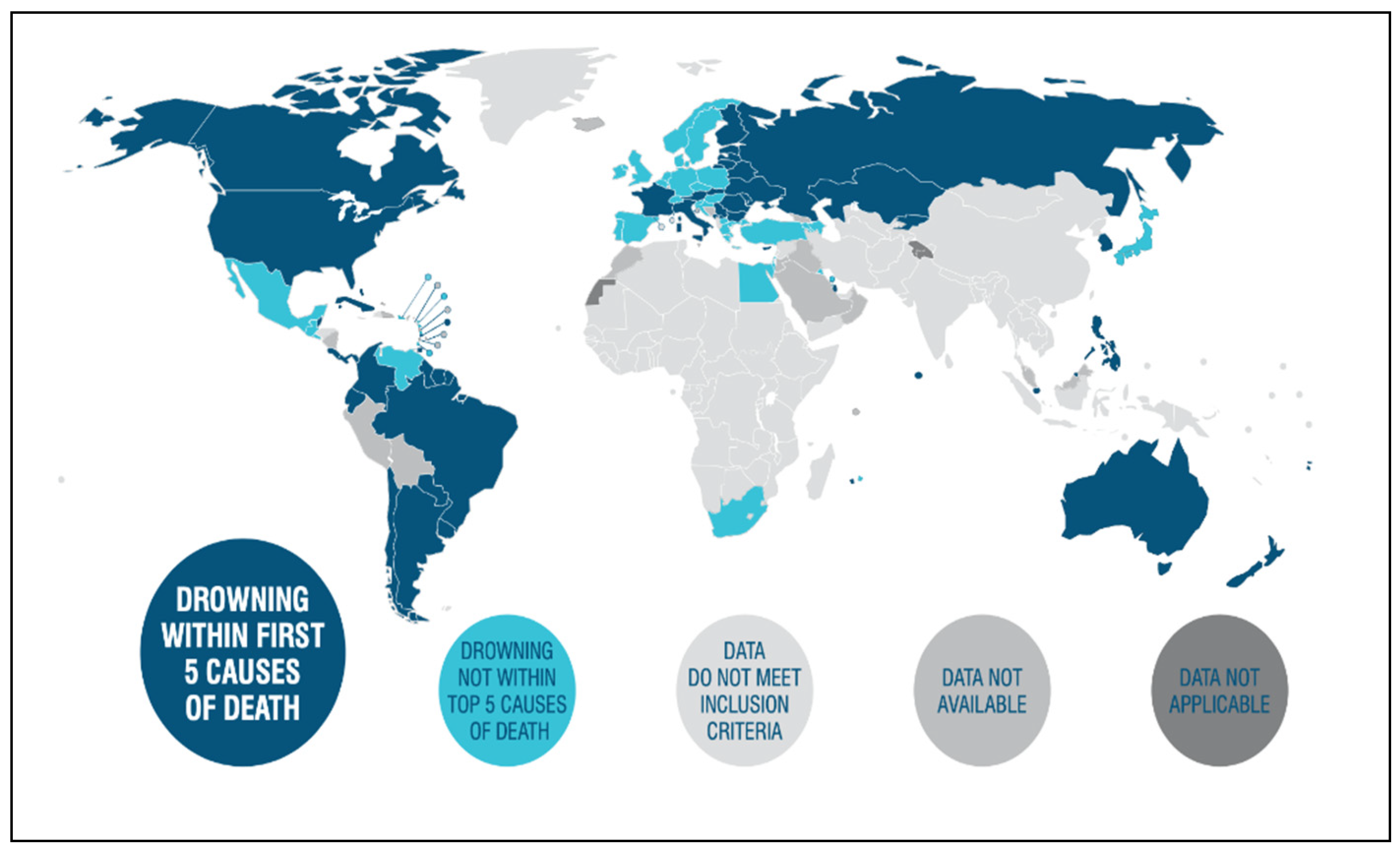
Figure 2.
Global distribution of drowning as a leading cause of death by age group and region [3].
Figure 2.
Global distribution of drowning as a leading cause of death by age group and region [3].
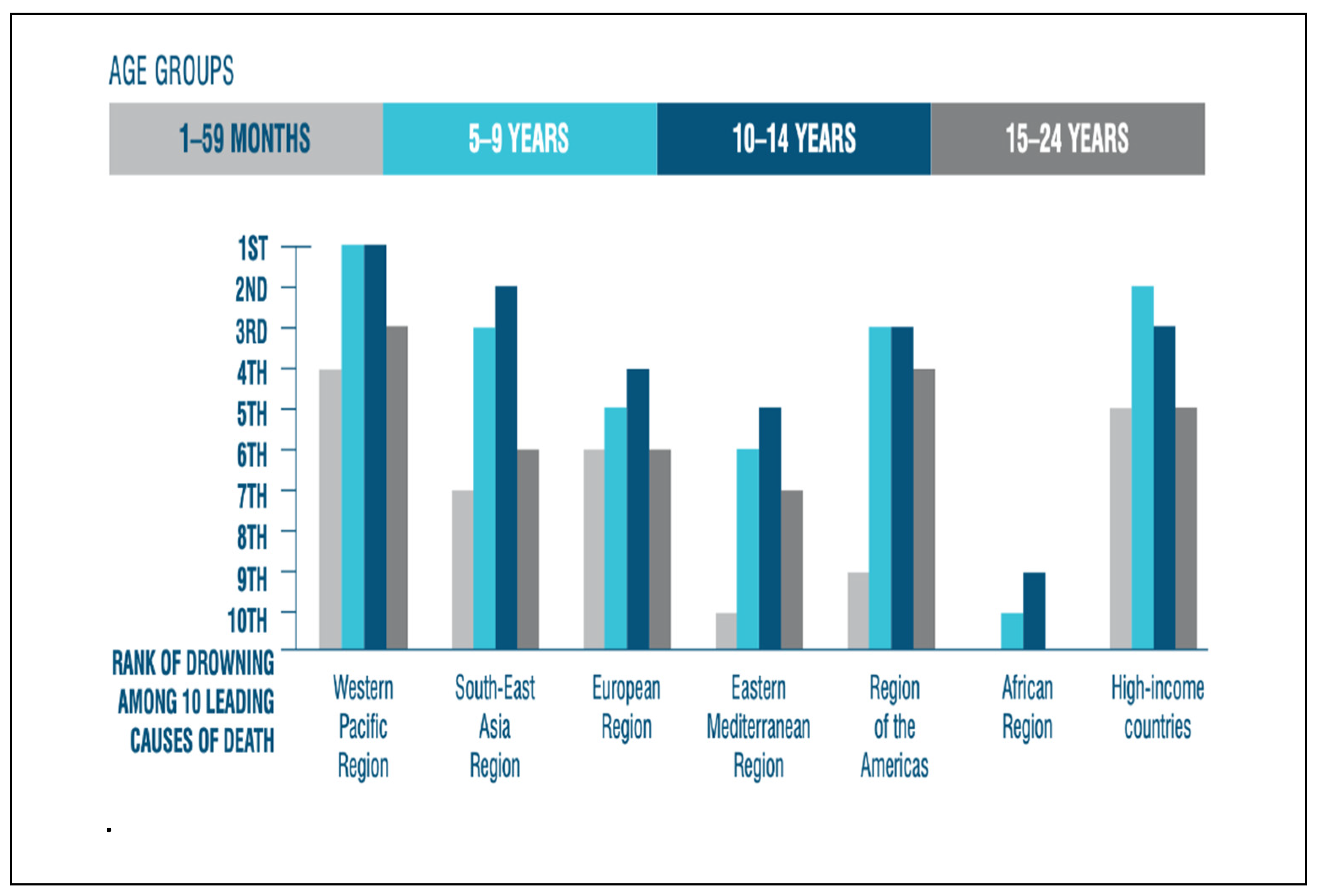
Figure 3.
Overview of the system proposed by Alotaibi [40]: (a) swimming pool, (b) motion-detection sensor, (c) overhead camera, (d) Raspberry Pi 3, (e) router, (f) server station used to process captured images by using process transfer learning, and (g) mobile alarm application.
Figure 3.
Overview of the system proposed by Alotaibi [40]: (a) swimming pool, (b) motion-detection sensor, (c) overhead camera, (d) Raspberry Pi 3, (e) router, (f) server station used to process captured images by using process transfer learning, and (g) mobile alarm application.
| Reference | Key Contribution | Scope | Limitations |
|---|---|---|---|
| [6] | Public health-focused drowning prevention strategies for children | Policy, education, and community-based prevention | Lacks technological coverage |
| [7] | Regional drowning prevention strategies, focusing on Turkey | Public health interventions in Turkey | Limited to one country, lacks technological insights |
| [8] | Overview of image processing and sensor-based DD methods | Sensor-based and image-based technologies | Focuses on technology, but lacks integration with automated rescue systems |
| [9] | Review of ML and DL algorithms for DD | Machine Learning and Deep Learning applications | Limited discussion on real-world implementation and rescue system integration |
| [10] | AI, IoT, and embedded systems for DD in enclosed environments | Technology for enclosed environments (e.g., pools) | Limited focus on open water bodies or outdoor swimming environments |
Figure 4.
DD system proposed by [45].
Figure 4.
DD system proposed by [45].
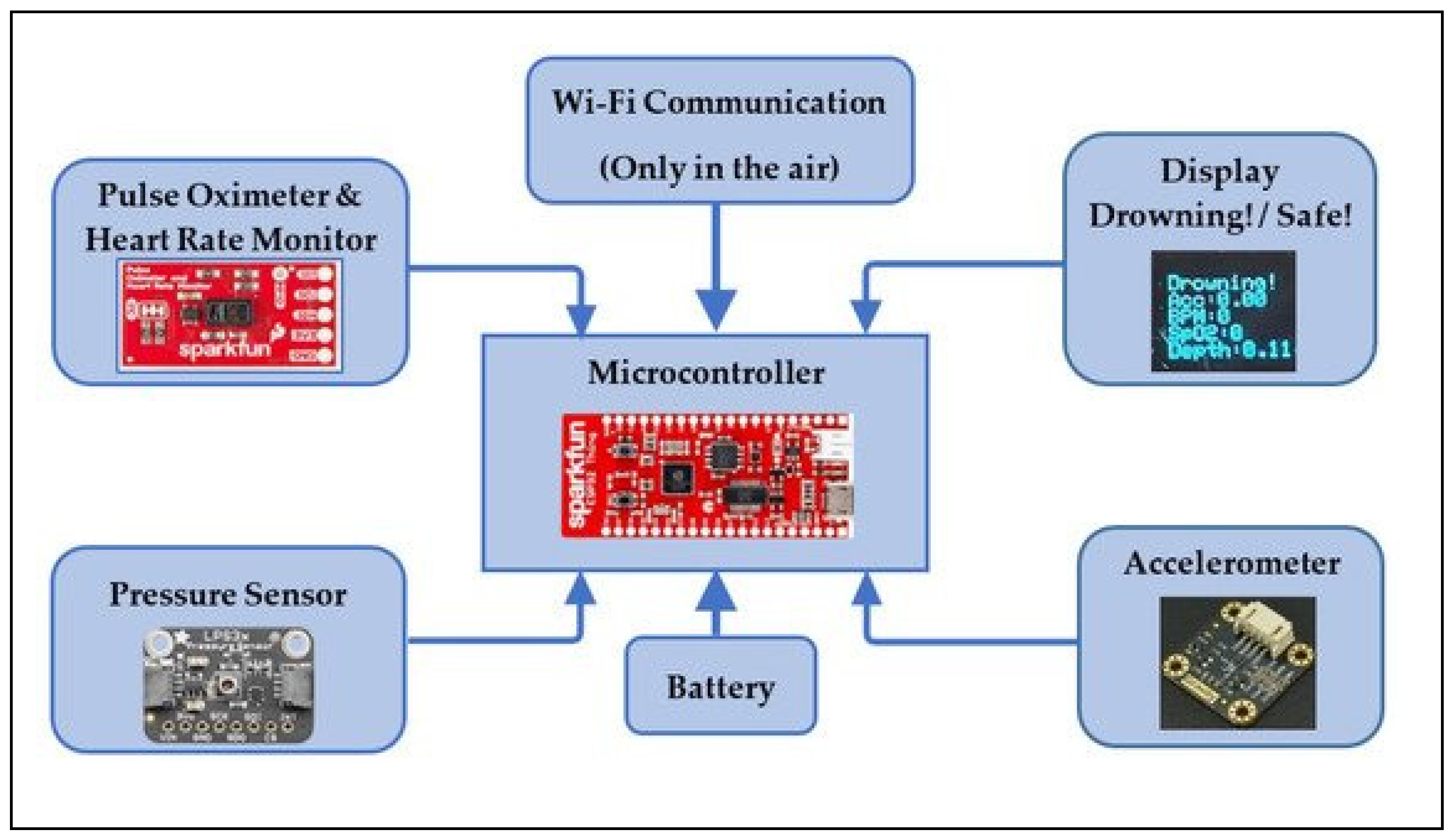
Figure 5.
Heart rate drowning system functional diagram (a) Transmitter module (b) Receiver module.
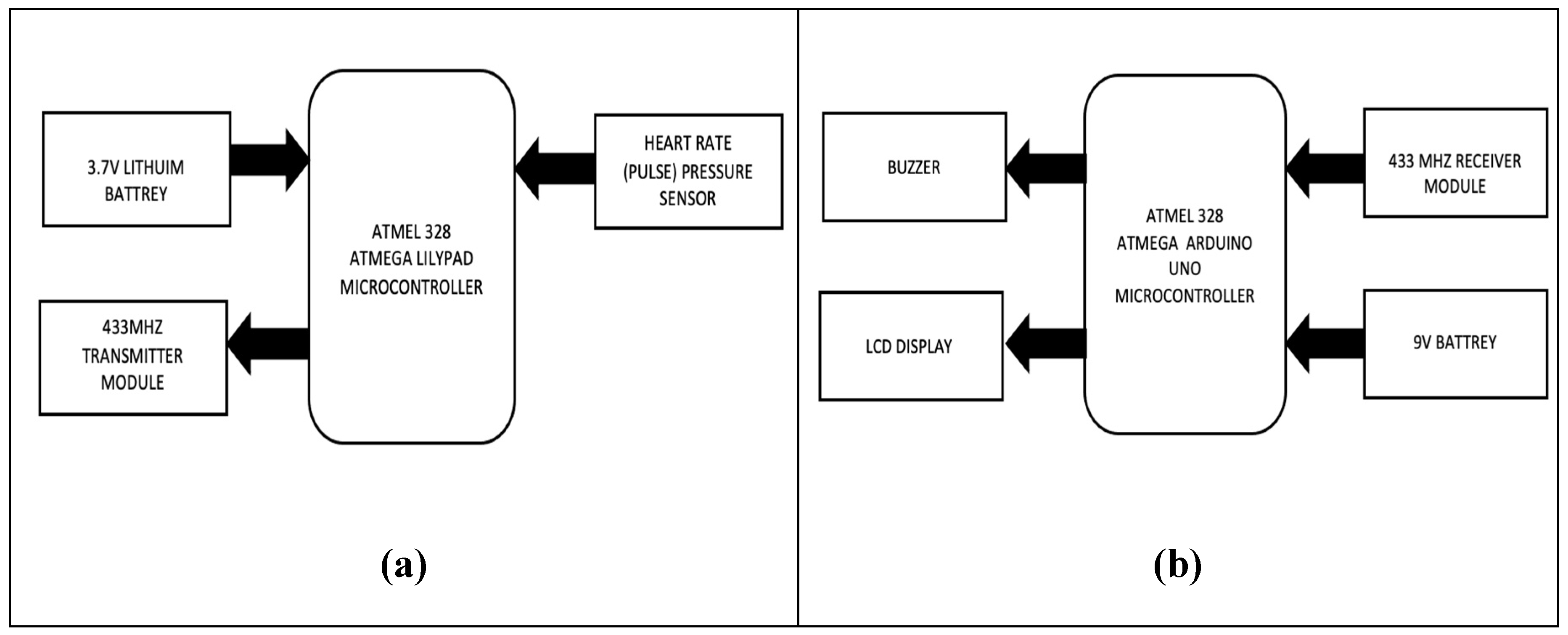
Figure 6.
Ultrasonic drowning recognition system.
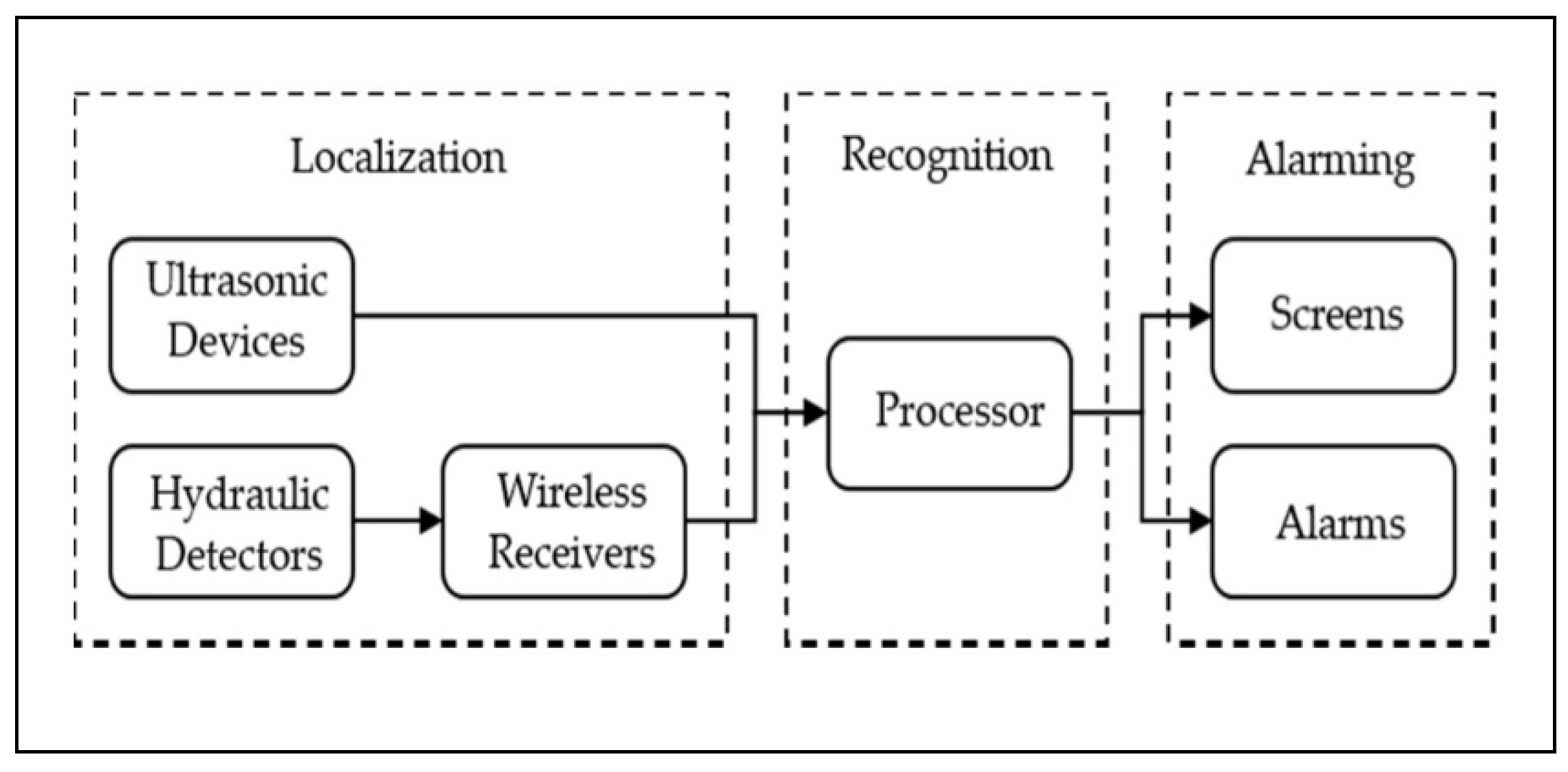
Figure 7.
The goggles with 2 DD sensors and the alarm transmitter unit [48].
Figure 7.
The goggles with 2 DD sensors and the alarm transmitter unit [48].
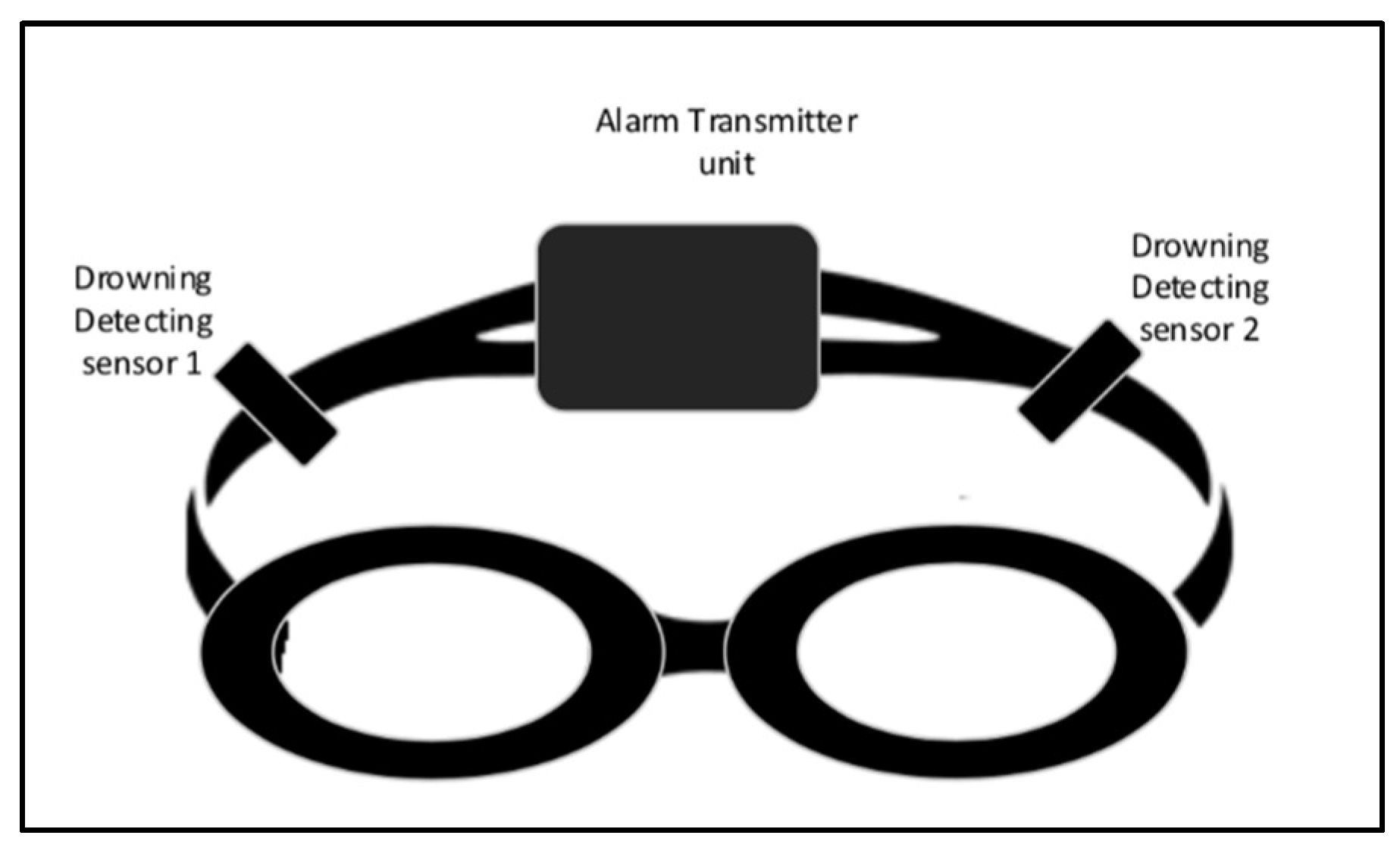
Figure 8.
Wrist Band DD (a) transmitter unit and (b) receiver unit [49].
Figure 8.
Wrist Band DD (a) transmitter unit and (b) receiver unit [49].
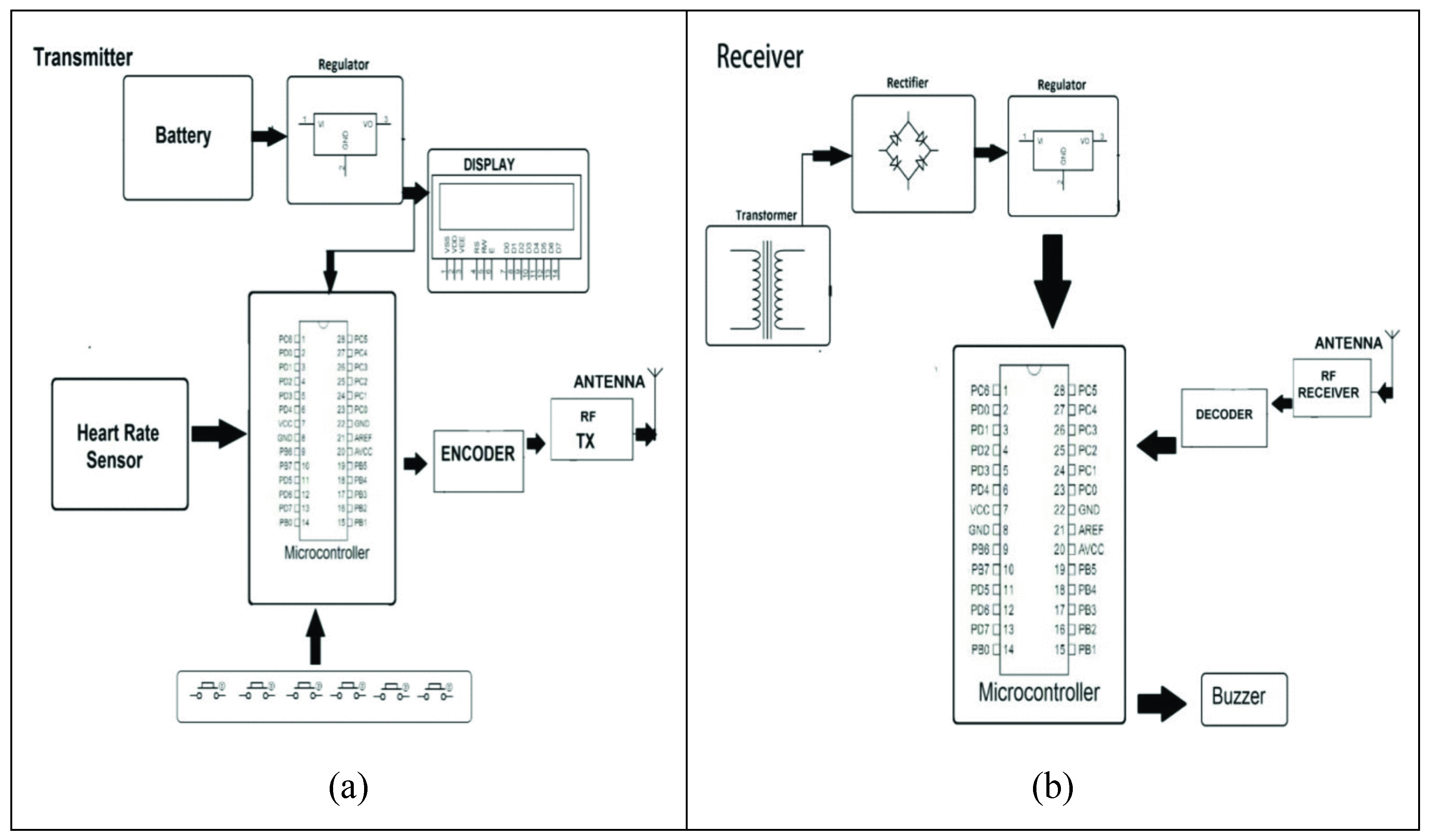
Figure 9.
(a) Relative resistance variation in water when the sensor was mounted on the swimmer’s finger. (b) Resistance variation of a sensor mounted on a diver’s leg during rapid movement underwater. Sensor mounted on (c) wrist brace, (d) knee brace, and (e) elbow brace to monitor joint movement at different bending angles. (f) Resistance variation of FWAS for accidental fall into water [50].
Figure 9.
(a) Relative resistance variation in water when the sensor was mounted on the swimmer’s finger. (b) Resistance variation of a sensor mounted on a diver’s leg during rapid movement underwater. Sensor mounted on (c) wrist brace, (d) knee brace, and (e) elbow brace to monitor joint movement at different bending angles. (f) Resistance variation of FWAS for accidental fall into water [50].
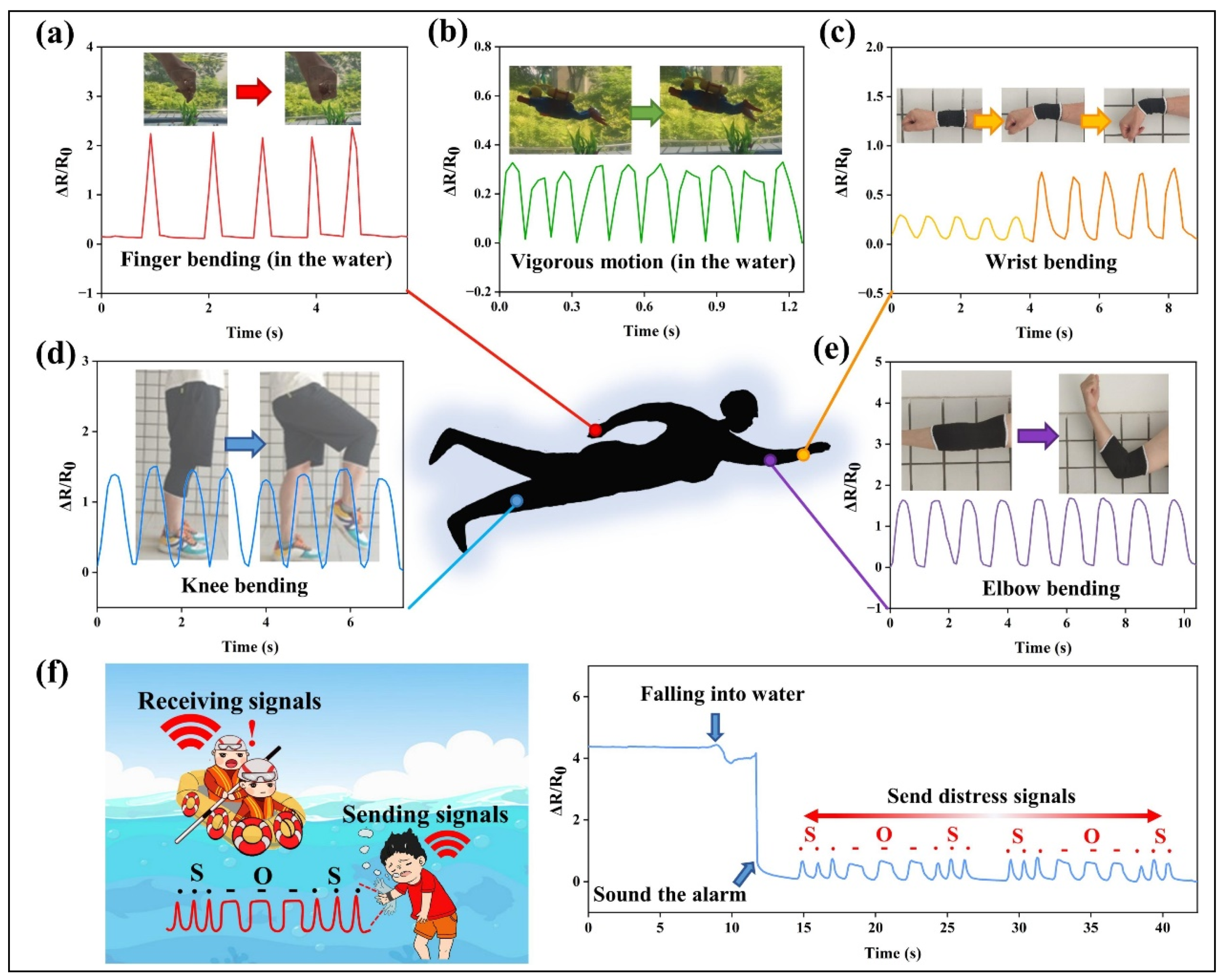
Figure 10.
lifting mechanism with a revolutionary automated drown rescue device [51].
Figure 10.
lifting mechanism with a revolutionary automated drown rescue device [51].
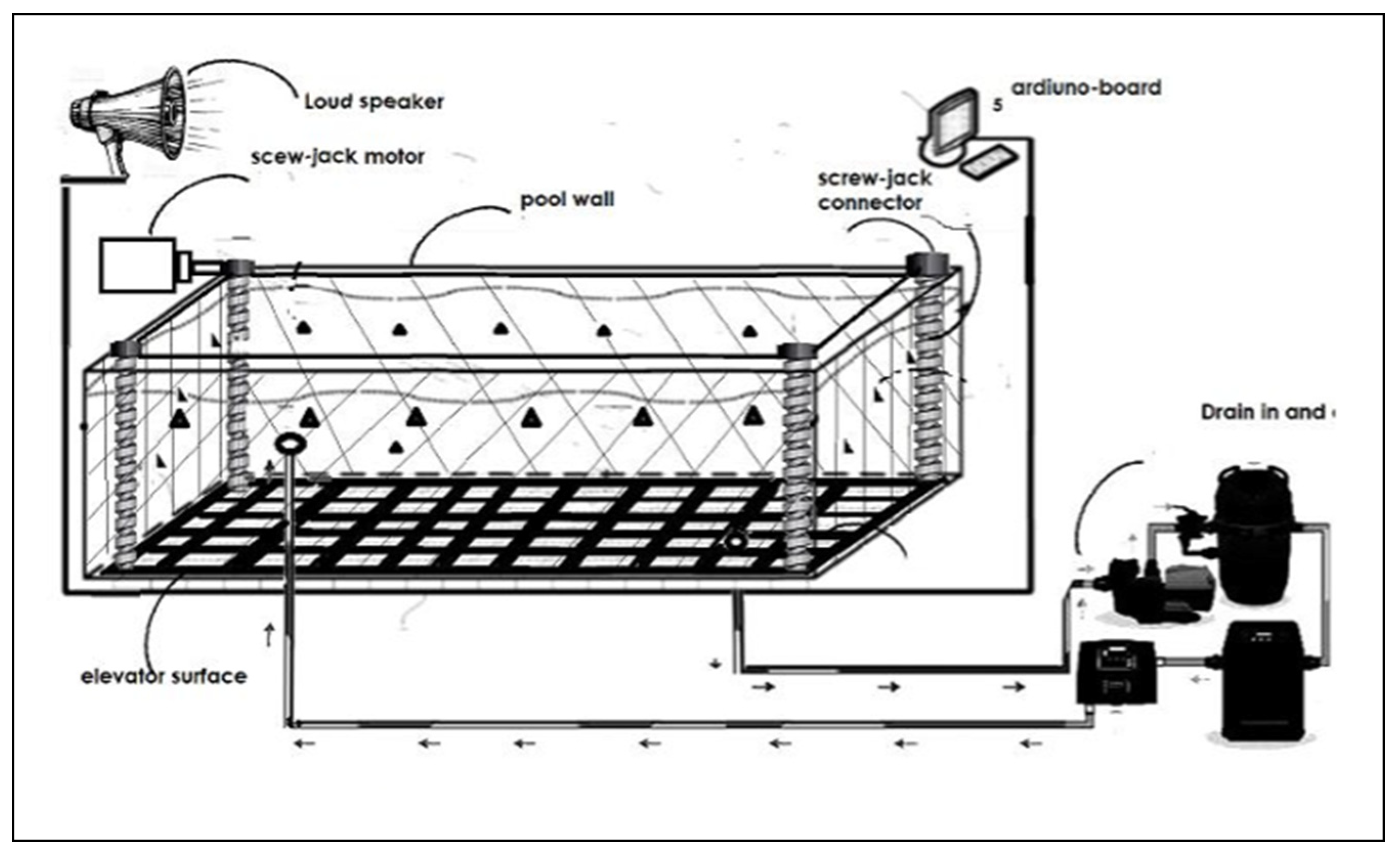
Figure 11.
Gantry robot drowning preventive system [52].
Figure 11.
Gantry robot drowning preventive system [52].
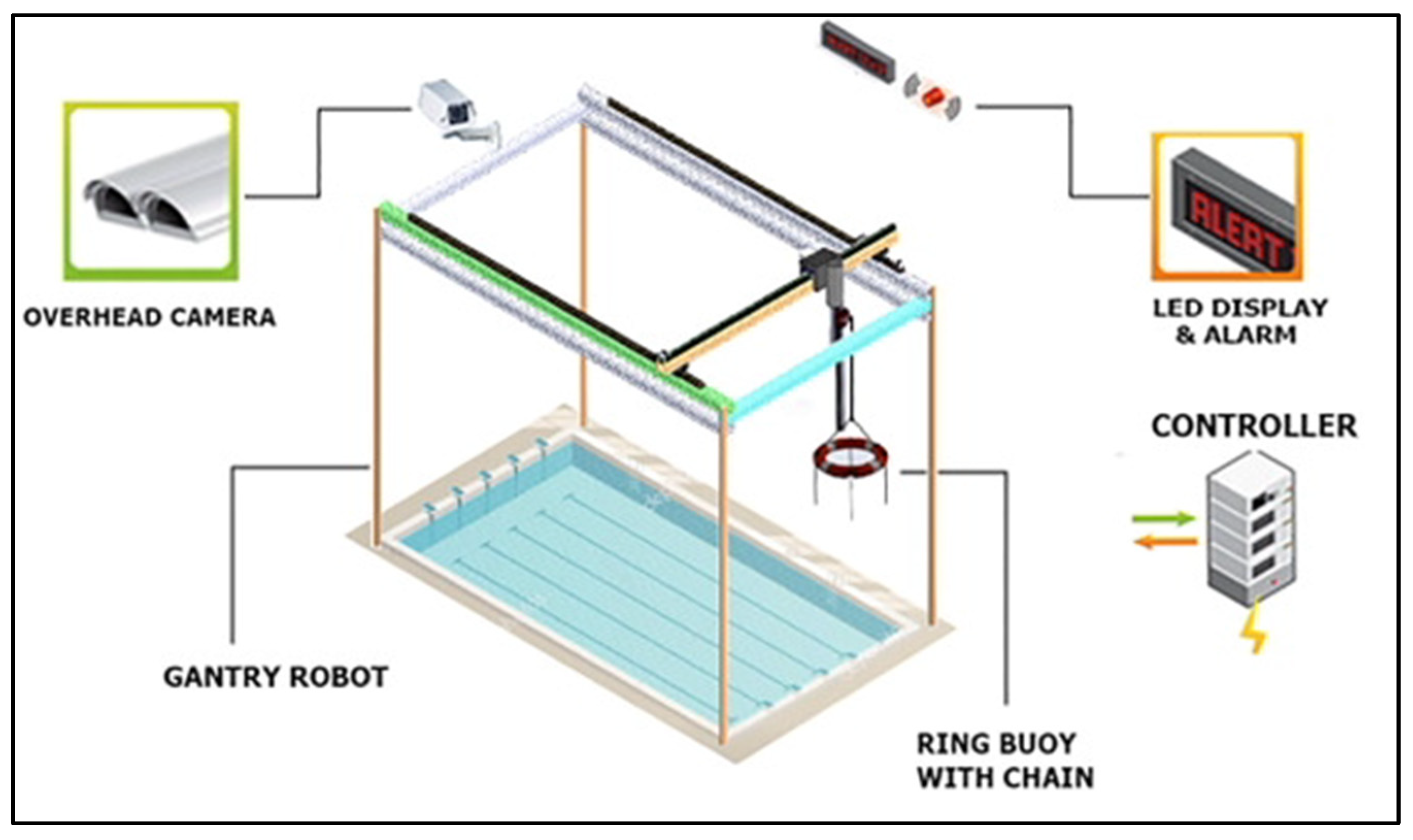
Figure 12.
AuFloat overview [53].
Figure 12.
AuFloat overview [53].
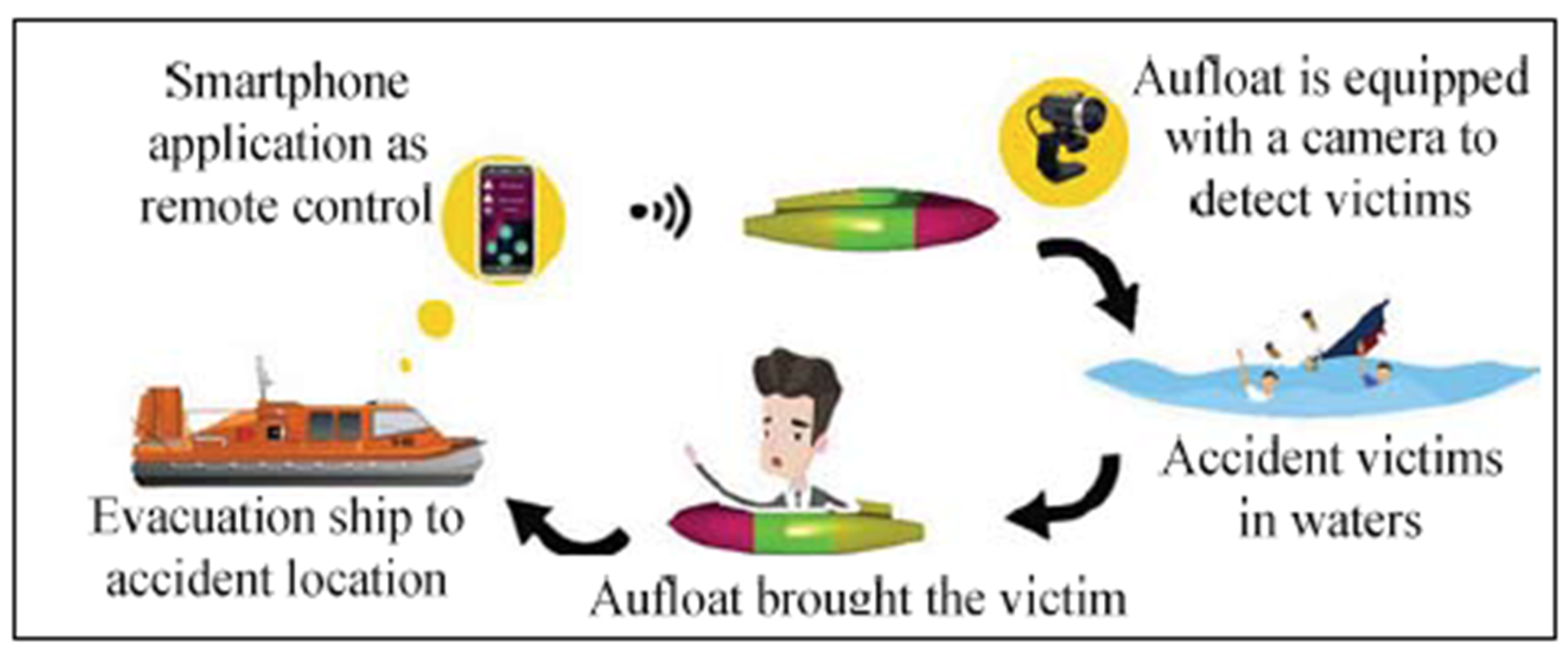
Figure 13.
Cameras and Robotic Arm Drowning Rescue System [54].
Figure 13.
Cameras and Robotic Arm Drowning Rescue System [54].
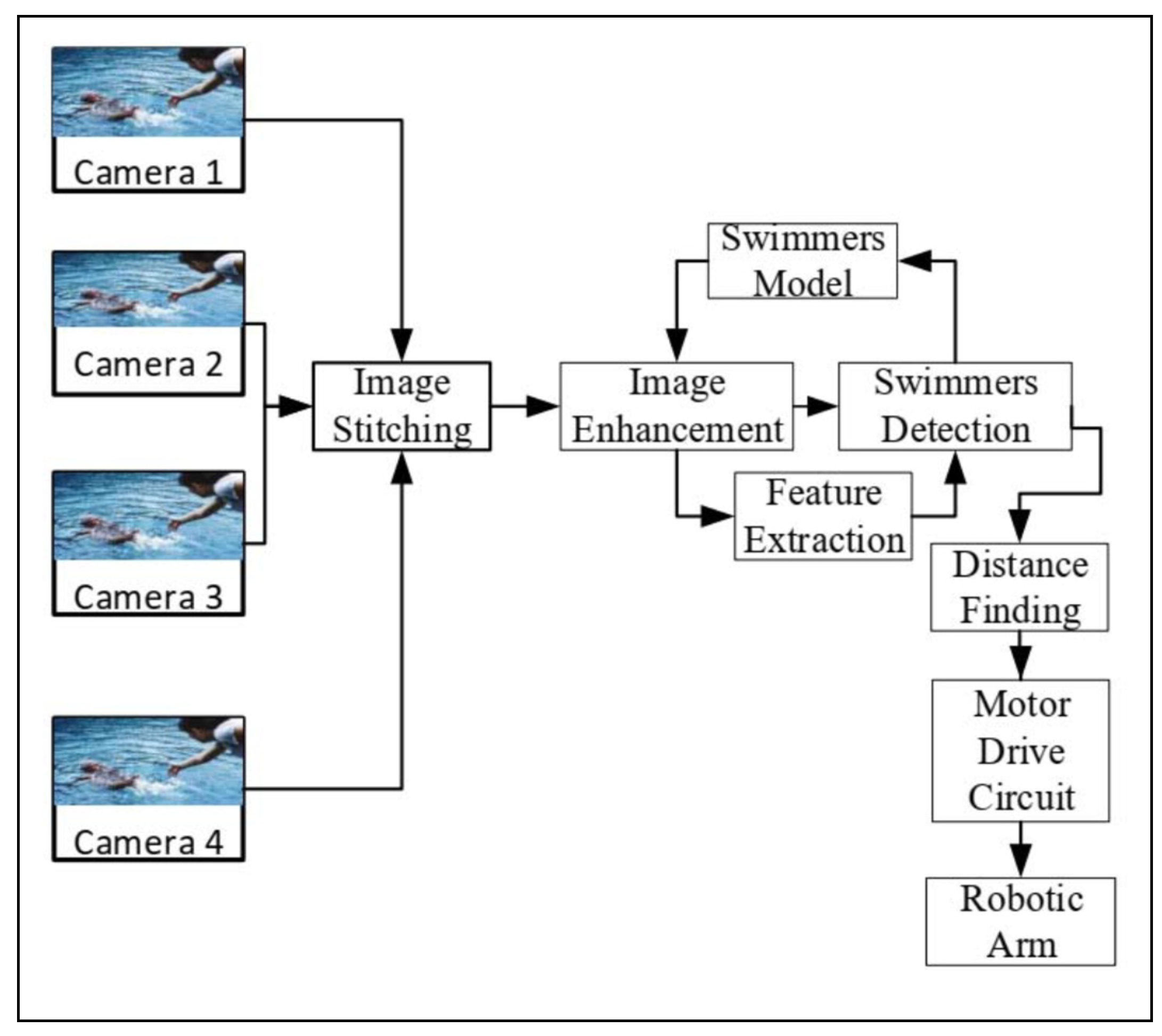
Figure 14.
Block Diagram for (a) transmitter unit and (b) receiver unit [55].
Figure 14.
Block Diagram for (a) transmitter unit and (b) receiver unit [55].
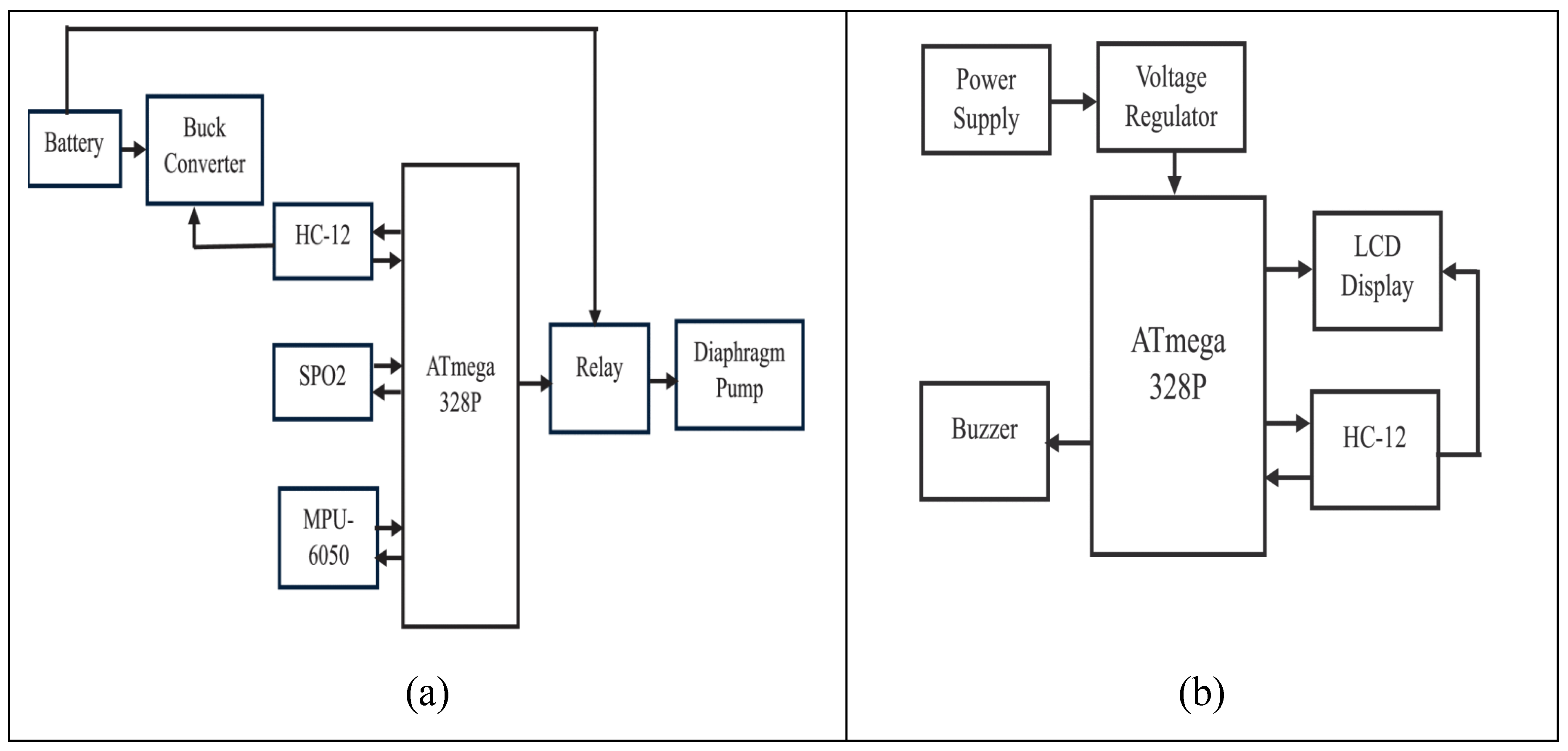

Table 1.
Relevant surveys and their contributions, scopes, and limitations.
| Reference | Key Contribution | Scope | Limitations |
|---|---|---|---|
| [6] | Public health-focused drowning prevention strategies for children | Policy, education, and community-based prevention | Lacks technological coverage |
| [7] | Regional drowning prevention strategies, focusing on Turkey | Public health interventions in Turkey | Limited to one country, lacks technological insights |
| [8] | Overview of image processing and sensor-based DD methods | Sensor-based and image-based technologies | Focuses on technology, but lacks integration with automated rescue systems |
| [9] | Review of ML and DL algorithms for DD | Machine Learning and Deep Learning applications | Limited discussion on real-world implementation and rescue system integration |
| [10] | AI, IoT, and embedded systems for DD in enclosed environments | Technology for enclosed environments (e.g., pools) | Limited focus on open water bodies or outdoor swimming environments |
Table 2.
CV-based drowning detection approaches.
| Approach | System Description | Tools Used | Advantages | Limitations |
|---|---|---|---|---|
| Body Parts Coordinates and DL [39] | 16 underwater cameras are used to capture key body parts during swimming, which are fed into a deep learning system for DD. | - Cameras - DL system - Arduino alarm |
- Can identify key body parts and movements specific to drowning. | - Many cameras are used to cover the whole pool which increases the total cost. - Not a full replacement for human lifeguards. |
| IoT and Transfer Learning [40] | Combines IoT, deep learning, and motion sensors. Images are captured upon motion detection and classified using deep learning. The system sends alerts through a mobile application. | - Cameras - IoT network - Wi-Fi - Raspberry Pi 3 - TensorFlow - Keras |
- High classification accuracy of 99% - IoT-based for real-time alerts. - Low complexity |
- Uses mobile alerts that may be unnoticeable. - Reliant on Wi-Fi, which can disconnect. |
| CV-ResNet [29] | Uses 5 CNN models to analyze drowning and non-drowning behaviors from internet-sourced images. | - ResNet50 - SqueezeNet - GoogleNet - AlexNet - ShuffleNet |
- Achieves 100% accuracy in validation and testing - Adaptable to different swimming pool environments like schools and gyms |
- Limited dataset - Not integrated to rescue mechanism. |
| Improved YOLOv5 [41] | Custom dataset of 8,572 images created using drones for simulating drowning in swimming pools. Enhanced YOLOv5 with ICA and BiFPN modules to improve detection. | - YOLOv5 - ICA - BiFPN |
- High accuracy rate - Efficient in water behavior analysis |
- Limited dataset - Drone-related challenges (battery, regulations) - Not fully tested in real-world environments. |
| AquaYOLO [42] | Enhanced YOLOv5 for open water DD, using video footage from drones. | - YOLOv5 - Drones |
- Adapted to complex open water environments - Handles diverse weather and lighting scenarios |
- High false positives due to water variability (lighting, reflections) - Difficult to generalize across all marine settings. |
Table 3.
Sensor-based drowning detection approaches.
| Approach | System Description | Tools Used | Advantages | Limitations |
|---|---|---|---|---|
| Multi-Sensor Device [45] | Waterproof wearable system with heart rate, oxygen saturation, water depth/pressure, and acceleration sensors. Alerts when thresholds are exceeded. | - Microcontroller - Wi-Fi - Multiple sensors - Alert |
- Can detect a wide range of drowning scenarios - Continuous monitoring. |
- Requires continuous Wi-Fi connection |
| Heart Rate Pressure [46] | Wristband that tracks heart rate and pressure and alerts lifeguards when the heart rate exceeds preset limits. Uses an RF module for alerts. | - Heart rate sensor - Microcontroller - RF module |
- Directly alerts lifeguards - Constant heart rate monitoring. |
- Relies solely on heart rate - Does not guarantee rescue if the lifeguard misses the alert. |
| Ultrasonic Drowning System [47] | Uses ultrasonic transmitters/receivers to track swimmer depth and location, alerting based on movement analysis. | - Ultrasonic sensors - Hydraulic pressure detectors - Wireless transmitter/Receiver - Alarm |
- Cost-effective - Energy-efficient - 3D location detection. |
- Requires manual intervention by lifeguards - May miss alarms in real-time. |
| Swimmers Goggles [48] | Goggles with DD sensors that monitor irregular water motion around the swimmer, sending alerts to lifeguards. | - Googles - Sensors - Microcontroller - resistive circuit |
- Simple design - Low-cost - Unobtrusive for swimmers. |
- Low efficiency - Sensor placement is crucial - Depends on lifeguard alertness. |
| Wrist Band [49] | Heartbeat sensor worn on the head or hand, alerts lifeguard with LED and buzzer when heart rate deviates from normal. | - Heartbeat sensor - GSM - LED - Alarm |
-Cost-effective Expands with GSM to send alerts to lifeguard and family. -Inclusion of buzzer and light indication system |
Only effective if the lifeguard is nearby; depends on immediate response. |
| Yarn-Based Strain Sensor [50] | Strain sensor integrated into fabric, detecting underwater motion with high durability and fast response time. | - Yarn-based strain sensor - PDMS layer |
- Durable - Flexible - Works well in aquatic environments - Rapid response |
- Limited field testing - Needs further investigation in turbulent waters or multi-user scenarios. |
Table 4.
Drowning detection and prevention approaches.
| Approach | System Description | Tools Used | Advantages | Limitations |
|---|---|---|---|---|
| Gravity Force Elevator [51] | AI-based system with a responsive elevator assembly that raises victims from the pool bottom using weight-detecting switches and mechanical jacks. | - Arduino - Tactical switches - Mechanical jacks - Loudspeakers - Drainage motor |
- Covers the entire pool - Automatically raises the victim in emergencies. |
- Requires heavy-duty structures and hard-wired logic - Not tested in real-life pools |
| Gantry Robot [52] | Uses an overhead camera for DD and coordinates with a robot to throw a ring buoy to the victim and pull them to safety. | - Overhead camera - Gantry robot with chains - Load cell - LED display and alarm |
- Automatic rescue - No lifeguard needed |
- Not effective for children as it relies on the victim pulling themselves up with the buoy |
| AuFloat [53] | Autonomous floating buoy system, remotely operated via smartphone, equipped with GPS and a camera to assist in open-water rescues. | - GPS - Camera - Smartphone app - Electrical pump - Compass module - Battery |
- Can be operated remotely up to 700 m - Effective in low-light conditions |
- Limited detection range (up to 4 m) - Requires manual oversight. |
| Cameras and Robotic Arm [54] | Pool surveillance system with multiple cameras and a robotic arm for rescue. Cameras track drowning movements and send data to the arm for rescue. | - Overhead cameras - Cam-shift algorithm -Kalman filter - Robotic arm - Motor & motor drive circuit |
- Covers the entire pool area with automated tracking and rescue. | - Expensive to scale for larger pools due to the need for more cameras. |
| Sensors and Diaphragm Pump [55] | Wearable sensor system that monitors vital signs like heart rate and underwater movements, triggering a diaphragm pump to keep the swimmer afloat. | - SPO2 sensor - Accelerometer - Gyroscope - Diaphragm pump - Microcontroller - RF module |
- Real-time monitoring of vital signs - Automatic rescue initiation with location tracking |
- Relies on the swimmer wearing the device - Sensors may be less accurate in turbulent or chlorinated water. |
Disclaimer/Publisher’s Note: The statements, opinions and data contained in all publications are solely those of the individual author(s) and contributor(s) and not of MDPI and/or the editor(s). MDPI and/or the editor(s) disclaim responsibility for any injury to people or property resulting from any ideas, methods, instructions or products referred to in the content. |
© 2024 by the authors. Licensee MDPI, Basel, Switzerland. This article is an open access article distributed under the terms and conditions of the Creative Commons Attribution (CC BY) license (http://creativecommons.org/licenses/by/4.0/).
Copyright: This open access article is published under a Creative Commons CC BY 4.0 license, which permit the free download, distribution, and reuse, provided that the author and preprint are cited in any reuse.


