

Submitted:
11 October 2024
Posted:
12 October 2024
You are already at the latest version
Abstract
The measurement of shoulder range of motion (ROM) has gained value within the healthcare field. Thanks to modern technology, goniometers have been developed as mobile applications; however, the reliability and validity of many of these apps have not been established. Such is the case of reliability of the OnForm app and validity of the My ROM app, object of this study. Methods: With data obtained from both apps from the measurement of bilateral external and internal rotation (at 90º of shoulder abduction) of 49 subjects, four different tests were run: inter-observer, test-retest, and intra-observer and one for validity. The statistical method applied was the intraclass correlation coefficient (ICC). Results: Both, OnForm and My ROM obtained in all the tests, significant results that prove that they are valid and reliable tools for athletes’ assessment. Conclusions: Both OnForm and My ROM are valid and reliable tools for daily use in clinical practice. They may be used by a single evaluator, they are easy to find with a convenient price, and the availability of the results is immediate.
Keywords:
shoulder
; range of motion
; assessment
; reliability
; validity
; mobile applications
; goniometer
; smartphone
1. Introduction
Measuring range of motion (ROM) is a way of determining functional mobility [1]. Even though the assessment of ROM is very important in the medical, physical therapy, and sports settings, unassisted data collection makes it subjective, and therefore unreliable [2].
The standardized and objective ROM measurement is very important for recording baseline data for research, and very useful in the clinical practice to detect functional limitations, monitor changes in joint mobility, evaluate response to treatment, find asymmetries and movement restrictions, understand the mechanism of many injuries and making an easy path towards adequate prevention programs [3,4].
Universal goniometers (UG) and digital inclinometers (DI) are the common tools used to measure ROM, they are frequently used in clinical practice due to their ease usage, low cost, and time effective. Today, with modern technology, smartphone applications (apps) have been developed as a substitute for these instruments [1,2,4].
Recent studies have compared these applications’ intra- and inter-observer reliability to the DIs and UGs, obtaining equivalent or superior results in ROM measurements. However, this has not been established for many of the apps available [5].
The measurement of shoulder ROM has gained value within the healthcare field, since many pathologies have been associated with movement limitations, mostly in shoulder internal rotation and abduction [6,7,8]. This limitation along with repetitive loads may cause various conditions such as subacromial impingement, superior labrum anterior to posterior (SLAP) lesions, and rotator cuff tears [9,10,11].
For this reason a complete examination of the shoulder, including an accurate measurement of ROM, should be part of the standard assessment in clinical practice, injury prevention programs, evaluation of treatment response and pre- and post-season tests, mainly in overhead athletes [9,11].
The purpose of this study was to evaluate the validity and reliability of two mobile apps for shoulder ROM measurement. It was hypothesized that both apps would display very good intra-observer, inter-observer, test-retest, and validity values to assess shoulder ROM.
2. Materials and Methods
Study Protocol
The measurement consistency (reliability) and accuracy (validity) of two mobile apps, MyROM and OnForm, for shoulder ROM measurement were evaluated in a sample of volunteers. The following tests were performed: intra- and inter-observer reliability, repetition with a test- retest, and validity.
Sample
A sample of healthy volunteers was obtained from the Bachelor of Science of Sport and master’s degree. Forty-nine subjects (7 women and 42 men) with ages ranging from 19 to 29 years were involved. All participants were informed verbally and in writing of the studies´ characteristics, all accepted their participation and signed a consent form. It was carried out following the ethical standards of the last Helsinki Declaration (2013)
The participants completed a demographic questionnaire that included information about age, weight, height, and if they performed overhead activities. Patients were included if they were able to execute the movements of internal and external rotation of both shoulders during the passive measurements of both observers and were available for the repeated measurements.
Inclusion Criteria
- Healthy subjects, without physical lesions or limitations which would interfere carrying out the necessary shoulder rotations.
- Subjects older than 18 and younger than 50 years old.
- Subjects with availability to attend at the dates established for the measurements.
- Subjects with Spanish, Catalan or English language knowledge.
Exclusion Criteria
- Subjects with some medical condition or injury that contraindicate the rotation of the shoulder.
- Subjects younger that 18 and older than 50 years
- Subjects with recent shoulder surgeries
- Subjects with acute or subacute shoulder injuries
- Subjects with current shoulder pain
Each participant had his/her internal and external rotation measured for each shoulders, accounting for a total of 392 measurements for each mobile application, resulting in a base sample of 789 data.
Observers
Two independent observers participated in this study. Both were health care professionals, the first one with previous experience in the use of both applications and the measurement of shoulder ROM. The second one was a PhD student without previous experience with the applications who received specific training for its correct use.
Instruments
The data of shoulder ROM were taken with two iPhone mobile phones, with camera and level apps. One phone had the the OnForm application installed, and the second one had the MyROM application.
To set the mobile phone with the OnForm app installed a portable tripod was used. This was set at a 2-meter distance from a gurney, and at a height where subsequently the elbow of the participant (previously measured with a calibrated tape) was placed. To ensure the 90 degrees of the shoulders of the participants, a plumb was used before each new measurement (Figure 1).
The measures obtained were registered with a computer in an Excel ® spreadsheet for further analysis.
Procedure
The OnForm and MyROM apps were downloaded to two iPhone mobile phones. First, the internal and external rotation tests were set in the MyROM app. Then, the gurney was put into place and two meters were calculated and marked with a measuring adhesive tape from the gurney. The tripod was positioned in this place.
Afterwards, the phone with the OnForm app downloaded was placed in the tripod, and the iPhone level app was applied to verify that the phone was at 0º. The OnForm app was started and the adequate functioning of the camera was assured (Figure 1).
The experiment was explained to the participants, and then they laid down in a supine position on the gurney. With the adhesive tape marks at both sides of the gurney, the arm to be measured was set at 90º of shoulder abduction and in a perpendicular direction from the camera.
The first observer started the video recording with the phone set on the tripod, and then went to a position beside the gurney to measure the ROM, setting the second mobile phone with the MyROM application fixed on the forearm on the side that was to be measured. The instructions given by the app were followed until the measurement was taken, first in internal rotation (the phone was placed in the external part of the forearm). Next, without pausing the video, the same observer set the tripod on the other side of the gurney and repeated the same procedure of internal rotation on the contralateral side. The same observer then returned to the initial position and repeated the procedure with external rotation (the phone was placed on the internal part of the forearm). The video was stopped between participants. The second observer did the exact same procedure with all the participants. All the tests were measured in degrees (º). This was repeated on two different moments with a 3-hour gap, for the convenience of the participants.
Each observer separately analyzed their video on the OnForm application. The MyROM application results were downloaded as a list, and all the data from both applications and both observers was transferred to a spreadsheet for further statistical analysis.
Statistical Analysis
The statistical analysis was conducted using SPSS (IBM 2019) and Jamovi (version 2.2.5) software’s. Means and standard deviations were calculated for continuous data, along with 95% confidence intervals with intraclass correlation coefficients (ICCs).
Four different analyses were made: intra-observer, which used data from the same observer taken over three separate attempts; inter-observer, where the data of observer 1 was compared with the data of observer 2 and test - retest which considers data from two different days for the same subject.
Validity was calculated by comparing the repeatability of the data from each observer in the OnForm app (as a Gold Standard) against the data from the same observer on the MyROM application.
The data was labeled with the Cicchetti (1994) criteria for interpretation for ICC agreement measures: less than 0.40: Poor; between 0.40 and 0.59: Fair; between 0.60 and 0.74: Good; and between 0.75 and 1.00: Excellent.
3. Results
3.1. Intra - Observer Reliability
3.2. Inter - Observer Reliability
3.3. Test - Retest
Test - Retest with both apps showed excellent results, according to Cicchetti guidelines.
3.4. Validity
MyROM validity test showed excellent results, according to Cicchetti criteria (Table 7).
4. Discussion
The aim of this study was to provide, inter and intra - observer, and test - retest reliability and validity measurements for shoulder internal and external rotation assessment, measured with two low-cost mobile apps (MyROM and OnForm). The results showed that reliability was excellent (perfect or almost perfect) in all tests performed for both apps, except for inter-observer reliability, which was from good to (almost) perfect in both methods. The MyROM validity results were also perfect. Consequently, the measurement repetitions with the two apps can be considered reliable and valid and its use can be considered safe and adequate for the measurement of the glenohumeral ROM (internal and external rotation).
Even though some existing articles already reviewed the measurement of ROM with mobile apps for some joints, specific studies of the glenohumeral ROM with this kind of tool are scarce. The absence of studies on reliability and validity tests of mobile apps for shoulder ROM prevents the opportunity of using a valuable and practical tool for the assessment of athletes and other types of patients. This study promotes the inclusion of these apps in the day-to-day clinical shoulder evaluation, being one of the first to provide intra- and inter-observer reliability and validity measurements[5].
Other studies that tested intra - observer reliability of different types of goniometers, like the one guided by laser (HALO), obtained results that varied from 0.82 to 0.91 which are considered as excellent values. This was also compared to the universal goniometer which had an excellent result, with variations of the ICC from 0.83 to 0.95. Among these 3 methods, the MyROM and OnForm applications turned out to be the most reliable according to the ICC values [12].
Another study compared a manual goniometer (Lafayette) and an iPhone© app (Knee goniometer) and obtained an intra-observer reliability of 0.927 for the manual goniometer and 0.982 for the mobile app. This indicates that the reliability for the mobile app goniometers is generally excellent, including MyROM and OnForm, as they all rank at excellent correlation levels [13].
Most of the studies check the reliability of different goniometers comparing them with the UG, especially in knee extension and flexion tests. Pearson's r results were > 0.91 (strong correlation) for the UG and of 0.83 - 0.94 (strong correlation) for the DI [14]. This gives us an idea of how the digital measurements can be as reliable as the manual gold standard.
A similar study in 2012 found that the DI was more reliable than the UG, obtaining Pearson's r of 0.69 - 0.89 and 0.46 - 0.55, respectively. Two other apps have been studied with this type of test, iGoniometer and the Knee Goniometer app (KGA). The former obtained a Pearson's r of 0.93 (strong correlation) and the latter of 0.92 (strong correlation). Compared to the results of this study, a similarity can be observed between the other mobile applications and the results obtained with OnForm and MyROM [12,14].
The OnForm app has been validated in previous studies. When comparing data obtained from the My ROM app (n=392) and taking the OnForm as the “gold standard”, there was an excellent ICC for both internal and external rotation (ICC of 0.919 and 0.880, respectively). Therefore, the My ROM app is can be considered a valid tool to evaluated glenohumeral rotation.
A study evaluated the validity of an application called The Simple Goniometer app against the UG with a positive Pearson's r correlation >0.96, which made The Simple Goniometer app valid [14]. Compared to My ROM, it has a slightly higher correlation (both fall into the category of strong correlation), but it should be taken into account that it was performed to measure knee flexion and the measurements were performed by a single observer although they were later evaluated by two assistants [14].
Certain advantages and disadvantages of the applications used in this study should be mentioned: the ROM in internal rotation with the My ROM application does not allow a good fixation of the coracoid process, which means that each observer using a different force or technique could obtain different data. This also causes the degrees of internal rotation to be higher with My ROM versus OnForm. Another disadvantage of the My ROM is that it depends on the size of the cell phone, depending on how awkward it is to place on the forearm. Also, My ROM does not provide as much personalized attention as the OnForm. On the other hand, the My ROM application gives you the results immediately and lists them in a perfectly ordered table, providing immediate feedback to both the clinician and the patient so that decisions can be made in a very straight forward manner in the same appointment. In addition, outcomes are shared online so that they are available anywhere.
Future research should aim to evaluate cheaper and more practical systems in specific joints and their implementation in today’s athletes assessment.
5. Conclusions
Both OnForm and My ROM are valid and reliable tools for daily use in clinical practice. They may be used by a single evaluator, they are easy to download and have a convenient price.
Author Contributions
Conceptualization, M.S; E.A-G., and J.T.; methodology M.S; J.T.; software, J.T.; validation M.S, J.T, M.T and E.A-G.; formal analysis, J.T .; investigation J.T; resources, M.S; E.A-G., J.T.; data curation, J.T.; writing—original draft preparation, J.T.; writing—review and editing, J.T; M.S; E.A-G.; M.T.; visualization, J.T; M.S.; supervision, M.S; E.A-G. All authors have read and agreed to the published version of the manuscript.”
References
- M. G. Gauvin, D. L. Riddle, and J. M. Rothstein, “Reliability of Clinical Measurements of Forward Bending Using the Modified Fingertip-to-Floor Method,” Phys. Ther., vol. 70, no. 7, pp. 443–447, Jul. 1990. [CrossRef]
- J. L. Merritt, T. J. McLEAN, R. P. Erickson, and K. P. Offord, “Measurement of Trunk Flexibility in Normal Subjects: Reproducibility of Three Clinical Methods,” Mayo Clin. Proc., vol. 61, no. 3, pp. 192–197, Mar. 1986. [CrossRef]
- P. A. Clapis, S. M. Davis, and R. O. Davis, “Reliability of inclinometer and goniometric measurements of hip extension flexibility using the modified Thomas test,” Physiother. Theory Pract., vol. 24, no. 2, pp. 135–141, Jan. 2008. [CrossRef]
- H. Ekedahl, B. Jönsson, and R. B. Frobell, “Fingertip-to-Floor Test and Straight Leg Raising Test: Validity, Responsiveness, and Predictive Value in Patients With Acute/Subacute Low Back Pain,” Arch. Phys. Med. Rehabil., vol. 93, no. 12, pp. 2210–2215, Dec. 2012. [CrossRef]
- J. W. L. Keogh et al., “Reliability and validity of clinically accessible smartphone applications to measure joint range of motion: A systematic review,” PLOS ONE, vol. 14, no. 5, p. e0215806, May 2019. [CrossRef]
- W. Bakhsh and G. Nicandri, “Anatomy and Physical Examination of the Shoulder,” Sports Med. Arthrosc. Rev., vol. 26, no. 3, pp. e10–e22, Sep. 2018. [CrossRef]
- A. I. Cuesta-Vargas and C. Roldán-Jiménez, “Validity and reliability of arm abduction angle measured on smartphone: a cross-sectional study,” BMC Musculoskelet. Disord., vol. 17, no. 1, p. 93, Dec. 2016. [CrossRef]
- P. Goetti, P. J. Denard, P. Collin, M. Ibrahim, P. Hoffmeyer, and A. Lädermann, “Shoulder biomechanics in normal and selected pathological conditions,” EFORT Open Rev., vol. 5, no. 8, pp. 508–518, Aug. 2020. [CrossRef]
- J.-Y. Lim, T.-H. Kim, and J.-S. Lee, “Reliability of measuring the passive range of shoulder horizontal adduction using a smartphone in the supine versus the side-lying position,” J. Phys. Ther. Sci., vol. 27, no. 10, pp. 3119–3122, 2015. [CrossRef]
- S. May, K. Chance-Larsen, C. Littlewood, D. Lomas, and M. Saad, “Reliability of physical examination tests used in the assessment of patients with shoulder problems: a systematic review,” Physiotherapy, vol. 96, no. 3, pp. 179–190, Sep. 2010. [CrossRef]
- J. D. Trojan, L. E. Meyer, C. M. Edgar, S. M. Brown, and M. K. Mulcahey, “Epidemiology of Shoulder Instability Injuries in Collision Collegiate Sports From 2009 to 2014,” Arthrosc. J. Arthrosc. Relat. Surg., vol. 36, no. 1, pp. 36–43, Jan. 2020. [CrossRef]
- S. Correll, J. Field, H. Hutchinson, G. Mickevicius, A. Fitzsimmons, and B. Smoot, “RELIABILITY AND VALIDITY OF THE HALO DIGITAL GONIOMETER FOR SHOULDER RANGE OF MOTION IN HEALTHY SUBJECTS,” Int. J. Sports Phys. Ther., vol. 13, no. 4, pp. 707–714, Aug. 2018. [CrossRef]
- M. Ockendon and R. Gilbert, “Validation of a Novel Smartphone Accelerometer-Based Knee Goniometer,” J. Knee Surg., vol. 25, no. 04, pp. 341–346, May 2012. [CrossRef]
- A. Jones, R. Sealey, M. Crowe, and S. Gordon, “Concurrent validity and reliability of the Simple Goniometer iPhone app compared with the Universal Goniometer,” Physiother. Theory Pract., vol. 30, no. 7, pp. 512–516, Oct. 2014. [CrossRef]
Figure 1.
Test scene: tripod and gurney placement, and position of the subject.
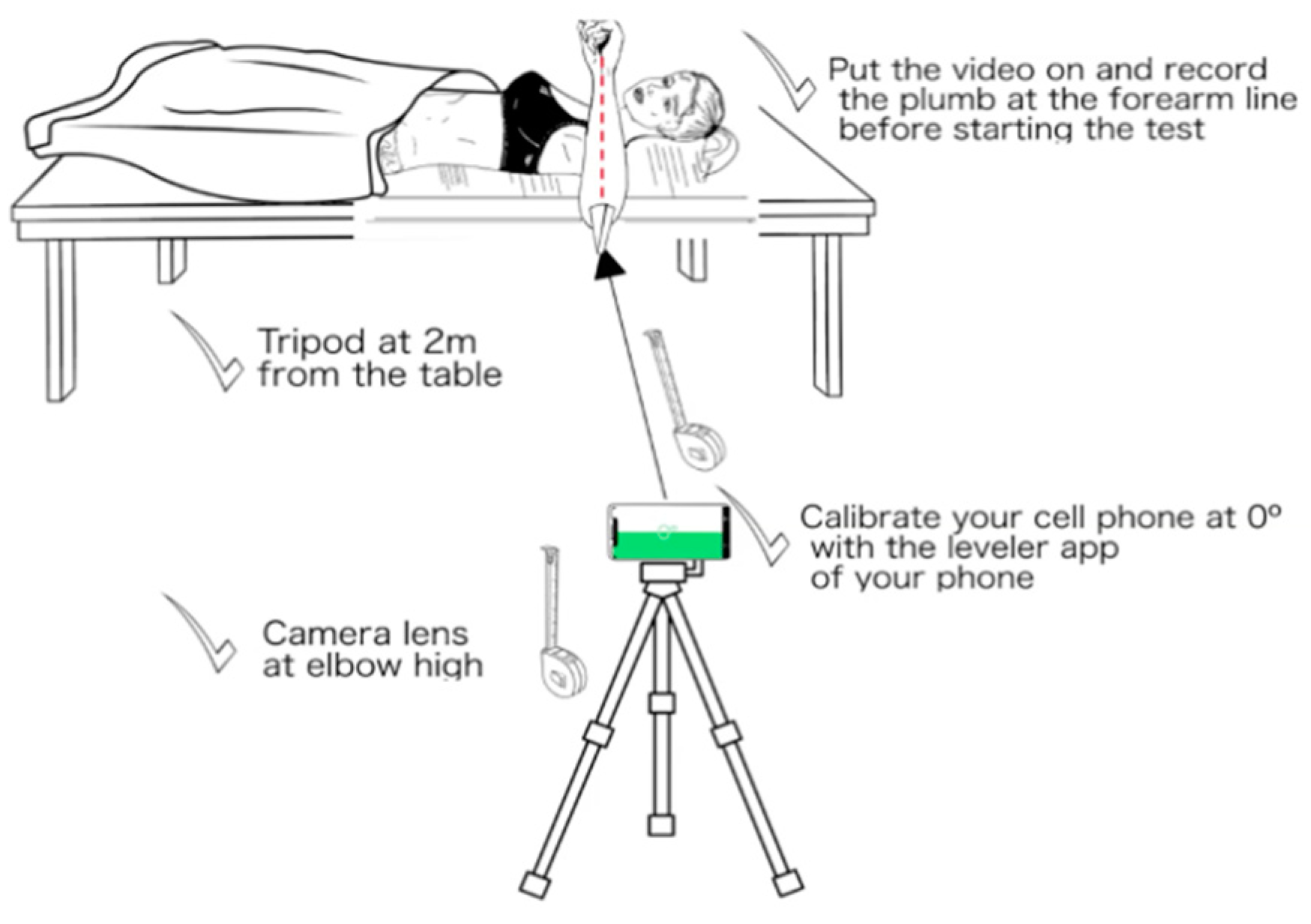

Table 1.
MyROM Intra - observer ICC results and interpretation.
| Data | ICC | 95% CI Lower Bound | 95% CI Upper Bound | Interpretation |
|---|---|---|---|---|
| Total Data | 0.922 | 0.832 | 0.963 | Excellent (0.75 - 1.0) |
| Internal Rotation | 0.838 | 0.625 | 0.926 | Excellent (0.75 - 1.0) |
| External Rotation | 0.980 | 0.963 | 0.990 | Excellent (0.75 - 1.0) |
1 ICC: Intraclass Correlation Coefficient.
Table 2.
OnForm Intra - observer ICC results and interpretation.
| Data | ICC | 95% CI Lower Bound | 95% CI Upper Bound | Interpretation |
|---|---|---|---|---|
| Total Data | 1.0 | 1.0 | 1.0 | Excellent (0.75 - 1.0) |
| Internal Rotation | 0.999 | 0.998 | 1.0 | Excellent (0.75 - 1.0) |
| External Rotation | 0.999 | 0.999 | 1.0 | Excellent (0.75 - 1.0) |
Table 3.
MyROM Inter - observer ICC results and interpretation.
| Data | ICC | 95% CI Lower Bound | 95% CI Upper Bound | Interpretation |
|---|---|---|---|---|
| All data | 0.907 | 0.867 | 0.935 | Excellent (0.75 - 1.0) |
| Internal Rotation | 0.733 | 0.553 | 0.840 | Good (0.60 - 0.74) |
| External Rotation | 0.930 | 0.882 | 0.958 | Excellent (0.75 - 1.0) |
Table 4.
OnForm Inter - observer ICC results and interpretation.
| Data | ICC | 95% CI Lower Bound | 95% CI Upper Bound | Interpretation |
|---|---|---|---|---|
| All data | 0.991 | 0.853 | 0.946 | Excellent (0.75 - 1.0) |
| Internal Rotation | 0.706 | 0.399 | 0.857 | Good (0.60 - 0.74) |
| External Rotation | 0.904 | 0.999 | 0.953 | Excellent (0.75 - 1.0) |
Table 5.
MyROM Test - Retest ICC results and interpretation.
| Data | ICC | 95% CI Lower Bound | 95% CI Upper Bound | Interpretation |
|---|---|---|---|---|
| All data | 0.811 | 0.702 | 0.882 | Excellent (0.75 - 1.0) |
| Internal Rotation | 0.800 | 0.581 | 0.905 | Excellent (0.75 - 1.0) |
| External Rotation | 0.845 | 0.674 | 0.926 | Excellent (0.75 - 1.0) |
Table 6.
OnForm Test - Retest ICC results and interpretation.
| Data | ICC | 95% CI Lower Bound | 95% CI Upper Bound | Interpretation |
|---|---|---|---|---|
| All data | 0.934 | 0.890 | 0.961 | Excellent (0.75 - 1.0) |
| Internal Rotation | 0.815 | 0.612 | 0.912 | Excellent (0.75 - 1.0) |
| External Rotation | 0.888 | 0.764 | 0.947 | Excellent (0.75 - 1.0) |
Table 7.
MyROM Validity ICC results and interpretation .
| Data | ICC | 95% CI Lower Bound | 95% CI Upper Bound | Interpretation |
|---|---|---|---|---|
| All data | 0.965 | 0.958 | 0.972 | Excellent (0.75 - 1.0) |
| Internal Rotation | 0.919 | 0.892 | 0.939 | Excellent (0.75 - 1.0) |
| External Rotation | 0.880 | 0.840 | 0.910 | Excellent (0.75 - 1.0) |
Disclaimer/Publisher’s Note: The statements, opinions and data contained in all publications are solely those of the individual author(s) and contributor(s) and not of MDPI and/or the editor(s). MDPI and/or the editor(s) disclaim responsibility for any injury to people or property resulting from any ideas, methods, instructions or products referred to in the content. |
© 2024 by the authors. Licensee MDPI, Basel, Switzerland. This article is an open access article distributed under the terms and conditions of the Creative Commons Attribution (CC BY) license (http://creativecommons.org/licenses/by/4.0/).
Copyright: This open access article is published under a Creative Commons CC BY 4.0 license, which permit the free download, distribution, and reuse, provided that the author and preprint are cited in any reuse.