

Submitted:
10 October 2024
Posted:
11 October 2024
You are already at the latest version
Abstract
In principle, weak sustainability, WS, requires that inclusive wealth, IW, be non-decreasing. WS provides a more complete account of the sustainability of a geographical entity (e.g., the world, a nation, or a sub-national region) than sustainability indicators, SIs, on one hand, and conventional economic accounts (e.g., gross domestic product, GDP) on the other. We briefly summarize WS theory, noting that it was developed, implicitly, for a geographical space without internal boundaries. Empirical WS assessment was developed by international bodies (the World Bank and the UN Environmental Program) to shine light upon national governments that might be maintaining the current welfare of their citizens, but investing insufficiently in national assets to maintain intertemporal wealth. In so doing, the need arose to address a suite of issues stemming from national boundaries that may limit the mobility of people, resources, goods and services. WS assessment at sub-national levels (states and counties, in the case of the US) has similar motivations – to provide more complete accountability for regional officials who may be maintaining welfare by consuming assets – but the implications of cross-boundary flows are much greater given the porosity of regional boundaries. WS scholars and practitioners have arrived at a consensus that the appropriate criterion for WS status is IW/capita, i.e. the welfare of people should be sustained. Regional economists and economic geographers tend to associate regional success with population growth, which may increase total IW at some cost to individual welfare. We consider this issue in some depth – what is at issue, and how any conflict might be resolved – ultimately concluding that IW/capita is the appropriate criterion for WS assessment, while leaving broader questions of population ethics unresolved. We summarize recent research [1] that starts with the Arrow et al framework [2] and improves methods of assessing IW, especially its health capital component, and assesses IW/capita for all states and counties in the US. These improved methods reveal substantially more not-WS states and counties than the Arrow et al framework [2]. The not-WS counties exhibit a distinct rural bias, consistent with the hypotheses and empirical findings of regional scientists. Our work demonstrates that regional WS assessment is feasible, produces results that are consistent with prior expectations based on reasoning and empirical research, and has the potential to provide fresh insights into longstanding questions of regional development.
Keywords:
Weak sustainability
; sustainability assessment
; US states
; US counties
; intergenerational equity
; population ethics
; regional economic development
1. Introduction
Early accounts of weak sustainability, WS, were implicitly global, ignoring geographical boundaries. Here we address several issues that arise when conceptualizing and assessing WS for sub-national regions. To expedite the exposition, we use the acronym WS in two contexts. It may mean weak sustainability, as in WS assessment, or weakly sustainable, as in a particular region is not-WS, but the context is transparent in each case. For ease of exposition, we refer to local regions that are within a state or province as counties.
Because the assets that comprise inclusive wealth, IW, are unevenly distributed across space, a state or province that is WS may very well have counties that are not. Perhaps a county is maintaining welfare by disinvesting in its assets, a policy that may be effective in the relatively short run. Standard accounting procedures, e.g. GDP – which is concerned mostly with flows of goods and services, and is agnostic to market failures of various kinds – are likely to identify this problem only in retrospect. Because they do not explicitly account for the productive base of the capitals that generates the service flows, i.e., market goods and services in the case of GDP, these approaches will only detect a depreciation of assets once it translates into a diminution of their service flows.
If a county is interested in assessing its sustainability, it likely monitors a battery of sustainability indicators, SIs, in some cases on dashboards that allow hypothetical experimentation with policy instruments. Typically, the chosen SIs are responsive in some ways to the Sustainable Development Goals, SDGs, which explicitly address near-term welfare as well as long-term sustainability [3]. The proliferation of SIs has impeded standardization and comparability [4]. A recent bibliographic review of the current status and trends in SDG-related research through 2022, seven years after the SDGs were established in their current form, identified 312 articles [5]. Bonnet et al [6] used principal components analysis of more than 70 SIs to help interpret the performance relative to the SDGs of more than 70 administrative districts in France; and citations suggest that other researchers are following their lead. There has been a flurry of activity aimed at developing Sustainable Development Indexes that would help summarize and interpret the plethora of SIs [7. 8].
Local WS assessment offers an alternative approach, maintaining capital accounts focused firmly on long-term sustainability, correcting for many of the market failures that plague GDP and designed to provide early warning of potential problems of this kind. In this article, we provide a rationale for local (U.S. county-level) WS assessment; address long-standing questions regarding the assessment criterion, inclusive wealth/capita, and how it relates to population and prosperity; implement a framework for WS assessment in the spirit of Arrow et al [2], but accounting for the permeable borders and lack of self-sufficiency typical of small regions; and summarize several important methodological innovations attributable to [1] in capital accounting methods at the local level.
To illustrate this approach, we share the results of an assessment of the WS status of all US counties [1], where WS is as indicated by the change in IW/capita between 2010 and 2017, a date-range imposed by availability of key data on human health. Using our improved estimates of IW, the findings reveal that that 32 states are WS and 18 are not-WS. Overall, 38.7% of US counties, accounting for 23.6% of US population, are not-WS. WS states have 37% not-WS counties accommodating 16% of their population, whereas not-WS states have 27% WS counties accounting for 56% of their population. That is, not-WS status is more prevalent in rural counties, to the extent that the majority of people in not-WS states live in WS counties that tend to be urban. We recommend further research to determine whether county-level WS evaluation, which is likely to be expensive relative to SIs, for example, provides commensurately improved sustainability assessment.
2. Methods
In Section 3 addressing the WS criterion, we build a coherent conceptual argument with appropriate reference to the literature, concluding that intergenerational equity is the fundamental value motivating WS, and therefore the correct WS criterion is IW/capita. We observe that the regional economics and geography literature is inclined to a favorable view of regional population growth – a growing region must be doing something right! – which suggests that total IW may be an appropriate indicator of regional success. These apparent conflicting conclusions motivate excursions into intergenerational equity, intragenerational equity, and population ethics.
In Section 4, we explore the implications of regional scale for WS assessment, revealing several necessary amendments to the procedures used at global and national scales.
In Section 5, we summarize the empirical findings of [1], noting that this work begins with the Arrow et al [2] framework of IW assessment. Jones introduces several key improvements to their methods of assessing IW, especially its health capital component, and assesses the change in IW/capita between 2010 and 2017 for all states and counties in the US. When these calculations werefinalized in 2023, the most recent update of a key data series on labor productivity was 2017. These improved methods, for which more details are provided in Section 5, resulted in not-WS conclusions for many more states and counties than were assessed as not-WS using the Arrow et al framework and underscore the importance of the refinements we implement.
3. The WS Criterion
Here, we define WS, frame it as a matter of intergenerational equity, and address a question that often arises: should a society’s WS status be judged in terms of total IW or IW per capita? The total versus average question asks which we value more – a large population living well, or a somewhat larger population living not quite so well – raising issues re how we value human lives and thus obliging us to delve a little into the vexed terrain of population ethics.
3.1. WS Theory and Assessment at the National Level
In the early years following World War II, concerns arose that post-war reconstruction was generating unsustainable demands for exhaustible resources. The WS literature had its origins in economic growth theory and its maintained hypothesis was that sustainability is not threatened so long as other kinds of capital can be substituted readily for depletable resources [9,10,11]. Optimistic expectations about the responsiveness of technology to research effort and the substitutability of different kinds of capital suggested a goal of sustaining human welfare rather than specific resources [9,10,11]. The WS narrative relies on discovery of new deposits of scarce resources and/or new technologies that enable substitution of scarce resources with plentiful ones in ways that can still satisfy human demands. If all of this holds up, society can enjoy non-diminishing welfare, w(t), even as familiar resources become scarce.
The conceptual commitment embodied in WS is that different kinds of capital are substitutable so that increases in one kind can compensate for decreases in another [2,12,13]. WS posits that welfare can be sustained through the generations so long as inclusive wealth (IW) is non-diminishing. The fundamental equation of WS is
where w(t) is IW at t = 0, given an infinite time horizon, and w(t) is discounted at (g-p), the growth rate of productivity minus population. That is, discounting addresses the growth in productivity and population, but time preference is maintained at zero consistent with intergenerational equity. For a finite accounting period ending at T,
That is, for a finite accounting period, inclusive wealth includes the present value of a finite time-stream of future welfare plus the assets remaining at the end of the period. This basic theory is agnostic to geographical boundaries and thus implicitly global in scale, a consequence (we suspect) of Solow’s methodological thrust to simplify the analysis in pursuit of the essence of a problem [14]. Nevertheless, political boundaries may impede flows of resources, goods and services, with serious consequences for theory and empirical analysis. This was recognized at the national level in the 1990s [15,16], and the flow of articles identifying inconsistencies and offering improvements to national WS accounts continues to this day and, we anticipate, beyond.
In WS assessment, typically, t is measured in years and accounts are updated annually. WS status is typically tracked relative to a two-part criterion: welfare should be maintained without disinvesting in assets. That is, w(t) should be non-diminishing and ΔIW(t) should be non-negative. A practical means for assessing WS was adopted initially by the World Bank in the 1980s using the genuine savings or adjusted net savings indicator. More comprehensive accounts that track the actually physical quantities of the IW components over time, as well as their time invariant accounting values, were assembled by theWorld Bank and the UN Environmental Program (UNEP). Over time these accounts have been refined and expanded to include more than 200 countries. Influenced by Arrow et al [2], the genuine savings approach, focusing on flows of welfare and capitals of various kinds has been challenged by inclusive wealth, IW, accounting, which relies on the notion that asset values reflect everything that is knowable about future prospects. Conceptually, these approaches are equivalent (Equation (2)). The advantage claimed for IW accounting is that wealth is readily observable and already incorporates beliefs about future prospects, whereas projecting future flows of welfare and changes in wealth relies on maintained assumptions that are untestable and thus in practice is beset with uncertainties. The World Bank has restructured their accounts in the direction of wealth accounting [17]. There is perhaps an incongruity: an important motivation for the WS accounting agenda is that current expectations may be unrealistic, yet these same expectations drive the wealth accounts [18]. There has been a steady flow of papers, most recently [19,20], identifying inconsistencies in the World Bank and UNEP WS accounts.
3.2. WS Accounting for Regional Economies
At the global level, population at time t+1 is determined by population at time t plus births and minus deaths in the interim. A region with porous boundaries may experience a gain in total IW and a loss in IW/capita if the population growth rate (p) exceeds its productivity growth rate (g) (Equation (1)), where p is impacted not only by births and deaths but also by migration across regional boundaries. Population is a resource, as Arrow et al [2] point out, but not unambiguously so. People produce and they consume, and their overall net contribution to IW will depend on their relative productivity and consumption levels, which will vary by income, knowledge, skills, life stage, etc.
The WS status of a region is always conditional on population. For example, a not-WS region may be WS given a smaller population that is better adjusted to its resource base and other relevant circumstances. With relatively small regions and permeable borders, people may migrate in search of better opportunities. International migration [21] draws the most attention in the current discourse, but state and local boundaries are more permeable than national borders. There is the potential for mutual benefit when people leave a not-WS county to relocate in a WS county. This kind of migration may have favorable consequences for resource allocation in both the region of origin and the destination. However, because local and regional migration occurs in response to incentives that favor the young, highly-skilled, and mobile, it is likely that the benefits will be tilted toward the destination counties [22}. Counties experiencing net outmigration are at greater risk of seeing their populations tilt toward the older and less healthy end of the spectrum. Thus, it is not at all certain that a given not-WS county will achieve WS status by outmigration. There are few ethical objections to voluntary and beneficial outmigration. However, there are strong ethical proscriptions of coercive efforts to reduce population, and some kinds of incentives may cross the borderline into coercion [23]. Many countries have experienced declines in internal migration, but countries like the U.S. still witness considerable population movements within and across states [24]
The regional economics and economic geography literature has traditionally treated in-migration as a signal of regional prosperity [25]. Open regions and spatial equilibrium forces imply that people will seek to increase their utility by moving to regions with better amenities or economic opportunities [26], a clear signal that tends to welcome internal migration as a beneficial adjustment to changing circumstances: a growing region must be doing something right!
3.3. The WS Criterion
The question persists: is WS is best evaluated by total IW or IW/capita? For example, utilitarians by some accounts [27] are inclined to favor a total IW criterion. The permeability of regional boundaries invites a closer examination of this issue. Regional economists and economic geographers tend to focus more on the importance of aggregate human capital, e.g., in the form of agglomeration economies, and therefore are more open than WS scholars to the notion that total IW matters at least as much as IW/capita for the prosperity of a region. In this context, it seems important to consider carefully the justification for the WS criterion of IW/capita or, equivalently w(t)/capita, as opposed to total IW or w(t). These literatures bring to the front a question that scholars of WS have long sought to avoid: which is better, a large and prosperous population or a somewhat larger but somewhat less prosperous population?
3.3.1. WS and Population
In the simple case of constant rates of growth, (g – p), i.e. the difference between the growth rates for productivity and population, has been central to the definition of WS: if g falls below p, the system is not WS. In the constant growth case, WS is achieved when inclusive wealth per capita, IW/capita, rather than total IW is sustained. It has been shown that with more complex growth trajectories the above criterion remains serviceable given modest adjustments [28]. It seems that IW/capita is accepted as the appropriate criterion by consensus among WS researchers, although not without some misgivings induced by unresolved issues in population ethics.
3.3.2. Sustainability and Intergenerational Equity
The definition of weak sustainability is clear: as a matter of justice, welfare must be maintained through a very long sequence of future generations. But how should we characterize equity in welfare or, equivalently, the inclusive wealth that supports it? The grand equity game – how can we organize things so that no-one, present and future, would be motivated to change their prospects re which generation they will be born into and how their welfare will rank within that generation – has not been specified and solved. A prevailing approach to intergenerational equity has emerged. First, define a generation as consisting of all persons alive on earth during a given time period. This is a clear departure from the ordinary understanding of generations in which several generations co-exist at any given time. Then, let each generation be represented by a fictional generational-person, a unitary decision maker. In this way, the issue of intragenerational equity is set aside. Now, assume a Rawlsian veil of ignorance process – in this case, the veil of ignorance is hardly a fiction: our generational-persons are unborn and have no generational turf to defend. This process will be resolved when all generational-persons are indifferent to which generation they are born into. The usual Rawlsian solution is that, with strong risk-aversion, they will choose intergenerational equality. However, with each generation represented by a fictional generational-person, if the w(t) trajectory is monotonic there will be little potential reward for gambling and they will choose intergenerational equality regardless of risk preference. Asheim [29], who worried that present generations might be saving too much, given that rising productivity is likely to benefit future generations, argues that the present value of IW/capita should be equal for all generations, after discounting for future increases in productivity but not for time preference.
So, a Rawlsian intergenerational game generates the fundamental requirement of WS: no generation should realize less welfare/capita than its predecessor. You might object that, if the generational-persons are uncertain how many generations will pass before the world ends, they would need incentives to accept assignment to later generations. Another objection might imagine that generational welfare is distributed stochastically, a situation in which outcomes might depend on the risk-preferences of the generational-persons. The WS framework rules out these cases because they violate intergenerational equity. This is not a trivial point: weak sustainability theory sets sustainability as the goal and deduces what is needed to assure its achievement.
3.3.3. Intragenerational Equity
Members of the current generation have little opportunity to redress any concerns they may have about the current intragenerational distribution of income and wealth, but they can play Rawlsian veil of ignorance games to explore the ideal intragenerational distribution of welfare. If strongly risk averse, they would choose intragenerational equality or, if maximizing generational welfare requires incentives, the level of inequality that maximizes the welfare of the worst-off person. As a matter of fact, there is a strong and growing tendency for distributions of income and wealth to be right-skewed [30], in which case a relatively few people are very well-off while there are many in the middling to low range. Discussions of equity in the context of sustainability often speculate on how the “average” person might fare [31], without noticing that the average person does not experience the average outcome. With right-skewed distributions, the average outcome, IW/capita or w(t)/capita, will be greater than the median i.e. the outcome that the “average” person will experience. In Rawlsian games, strongly risk-averse people would choose the distribution that maximizes the welfare of the worst-off person, risk-neutral persons would choose the distribution with the highest median outcome, and only the risk-preferring would choose the distribution that maximizes the mean outcome. To emphasize, the plausible range on the appropriate intragenerational distribution is bounded by the maximin and maximedian distributions. The distribution with the highest IW/capita lies outside that set.
So, the discussion of intergenerational distribution has endorsed the maximean criterion (i.e. maximize w(t)/capita), but consideration of intragenerational distribution suggests that maximedian would be preferred to maximean by all but those of risk-preferring disposition. Note that both criteria normalize population, so the trade-off of population for standard of living is not at issue. With normal distributions the median is equal to the mean, so the question arises only with skewed distributions. Then, for issues germane to everyday life, interest tends to focus more on the median. However, WS theory is mute on this point given its concentration on intergenerational equity.
3.4. The Intergenerational Commitment
Our discussion of intergenerational equity has led us back to the intergenerational commitment to sustainability [32] that is, a specific ethical restraint on excess consumption consistent, for example, with the Brundtland Report [33]. The current generation – as an unearned consequence of its transitory presence – has opportunity for self-serving choices, consuming more than its share in the intergenerational scheme of things. We have argued that members of the current generation have little opportunity to change their endowed distribution of income and wealth, but they must nevertheless bear the costs of contribution to the intergenerational sustainability commitment. In the real world, as opposed to our discussion to this point, generations overlap prompting, in addition to ethical restraint, nontrivial parental and altruistic motivations to provide for the future.
So, the current generation will forego some consumption for saving and investment that benefits the future more than themselves, but how much? Our discussion of intragenerational equity suggests that debates about that are likely to focus on the median cost, i.e. the average person’s contribution to generational self-sacrifice which, we would hope, is guided by Mulgan’s [34] minimal condition: that, at least, the well-off are morally obligated to avoid conscious acts that reduce the welfare of the badly-off.
There remains the possibility of stochastic w(t), i.e. that some generations encounter bad times while others experience good times. An unfortunate generation has a strong incentive to survive, and subsequent generations would benefit unambiguously from their survival, since the first generation to perish ends the game for all subsequent generations. A commonsense general form of the intergenerational commitment in an uncertain world is that each generation in its turn is obligated to make a good-faith effort to endow the next generation with non-diminishing IW {32]. A good-faith bequest from an unlucky generation may be smaller than the benchmark, if justified by increased chances of generational survival. Lucky generations are obligated to use some of their good fortune to augment their bequest, helping get future generations return to the non-decreasing expected (w(t)) path.
3.5. Population
Population may vary across generations, and each generation in its time may make choices that may influence the trajectory of population. WS requires that IW/capita be non-diminishing over time. This per se tells us nothing about the virtues of population growth, positive or negative. Two questions arise: Can we bring reason to bear on the question of ideal population size? And, given a sense of the objective, can we design policies that encourage change in the desired direction while respecting human dignity [35]? Barry [36] observes wistfully that it won’t be easy: ideas about justice that are quite familiar in other contexts often have radical implications when applied to intergenerational justice. Andersson et al [23] address how population policies became ethically contentious and how this relates to philosophical debates in environmental ethics, population ethics and political philosophy.
To over-simplify, there is a contest between those who would prefer a larger population and those who worry that the population is already too large. If utility is the measure, total IW and IW/capita both fail to offer plausible resolutions of extreme cases: total IW is likely to endorse a larger population living frugally, all else equal, while IW/cap is likely to endorse a very small but very rich population [27]. At a practical level, utilitarian criteria tend to recommend larger populations than egalitarian criteria [37]. IW/capita is consistent with egalitarian criteria and appeals to those who worry that the population is already too large. Utilitarians who support larger populations are inclined to argue that all lives are valuable, and there is room to trade-off a little standard of living in order to accommodate more lives. Lee objects [38]: lives are neutral per se until we know whether they are filled with good or bad things. He seems to be correct about that, but it doesn’t settle the total vs average IW question. Environmentalists tend to worry that the human footprint is already too large and, other things equal, decreasing populations are desirable. For example simulations have shown that sustainability policies are more cost-effective when populations are smaller [39]. Bradshaw and Brook [40] address some of the complexities entailed in population and sustainability policies, concluding that population policy is not the best way to approach sustainability problems.
There have been attempts to formalize population policy criteria. Various stylized criteria have been proposed. Fleurbaey and Tungodden [] suggest egalitarian criteria, and Bossert [41] and Blackorby et al [42] have proposed maximin social welfare orderings. Berger and Emmerling [43] propose a framework that can accommodate multiple dimensions of equity and argue that many of the more specialized formulations can be accommodated in their framework.
The bottom line for this section is that population ethics and policy are inherently challenging issues that have raised questions that remain unanswered despite a lot of effort from serious thinkers.
3.6. Resolution: For WS Assessment, IW/Capita is the Appropriate Criterion
To better understand the virtue of the IW/capita criterion in WS assessment, consider the obvious counter-proposition: the WS criterion should be total IW. Suppose a jurisdiction had an opportunity to embark on a course of action that would maximize total IW thirty years from now, but at the cost of some reduction in IW/capita (in another project, our simulations with imposed population settings surprised us by generating that result for certain scenarios). Should the jurisdiction take up this opportunity? Utilitarians would offer familiar reasons for Yes:
- The jurisdiction would be richer in aggregate.
- Each of its people would be a little poorer, but there would be more of them, i.e. more people having opportunity for lives that would be fulfilling.
But they would encounter egalitarians offering a powerful reason for No:
- We are, and should be, reluctant to start down the road of trading-off a little welfare for everyone in order to increase total welfare.
So, utilitarian ethics is at an impasse. However, sustainability theory provides a tie-breaker. The fundamental concept of WS is that members of each succeeding generation enjoy no less welfare than their predecessors, which clearly implies the “No” answer. If we had omitted “members of”, there would be ambiguity: one could claim that “no less welfare” means no less total welfare, thus thwarting the proposed tie-breaker. The defense of including “members of” is straight-forward: beginning with Solow’s seminal article, the difference between the growth rates for productivity and population, i.e. (g – p), has been central to the definition of WS: if g falls below p, the system is not WS. Suppose that in the status quo g = p exactly. If 1 person is added to p and IW is held constant, the county becomes not-WS. If, as is more likely, the added person, i, brings below-average IWi, total IW will increase but delta-IW/capita will fall: the county will become not-WS even as total IW increases. By definition, WS requires non-diminishing welfare/capita.
We conclude that the counter-proposition is rejected because by definition WS requires maintaining welfare/capita, not total welfare. Does this solve the population ethics problem? No, by appealing to the definition of WS, we have solved the problem of the correct WS criterion but that is all we have solved. WS is about sustaining welfare and the wealth that generates it. It is not about optimization – it offers us a sustainable world, and it is open to the idea that some sustainability paths provide more abundance than others, but it makes no claim concerning the best of all feasible worlds [13]. So, we have settled on the WS criterion, IW/capita, but we have done so without solving the optimal population problem.
To summarize: the core principle of WS is intergenerational equity, i.e. the prospects of members of future generations should be non-diminishing. Thus, the WS criterion is IW/capita. This is simple enough if we assume implicitly that population is unchanging and can be adjusted to accommodate more complex population trajectories [28]. The requirement that (g – p) ≥ 0, i.e. productivity grows at least as fast as population, plays a crucial role in WS formulations [9,31] Two kinds of caveats follow.
First, intragenerational equity also rejects a total IW criterion but, with right-skewed distributions of income and wealth, is less supportive of an IW/capita criterion, preferring something in the range bounded by maximedian and maximin criteria, both of are more egalitarian than maximean. So, the current generation will feel at least somewhat conflicted by appeals to IW/capita.
Second, most of the literature, including [2,28] implicitly assumes monotone w(t) trajectories. If w(t) is stochastic such that, within a relatively stable trend, some generations are luckier than others, criteria grounded in intergenerational equity become more tenuous, and the intergenerational commitment, an ethical restraint, becomes more salient. Being less formal than rigorous notions of equity, it is more open to commonsense solutions to intractable problems and good-faith adjustments to outcomes of stochastic systems.
4. WS Assessment for Sub-National Regions
Solow chose to abstract from boundaries, thereby developing a theory that operates implicitly at global scale. Nevertheless, political boundaries may impede flows of resources, goods and services, with serious consequences for theory and empirical analysis. This was recognized at the national level in the 1990s [15,16] and the flow of articles identifying inconsistencies and offering improvements continues to this day and, we anticipate, beyond.
Boundaries at regional and local levels tend to be more permeable than national boundaries, but the details matter and there remains work to do, to refine local and subnational regional WS assessment methods. The work reported in this article has enabled us to identify several adaptations of WS assessment practice that improve its applicability at the county level.
4.1. Regional Scale – Implications for Population
Our work here, being addressed to subnational regions (e.g., states, provinces, metropolitan regions, cities, towns), must address the implications of permeable boundaries. The regional context of our research focuses more than the usual attention on population. In a globalized world with decreased spatial frictions, migration is a main driver of changes in regional human capital [44]. A region’s ability to prosper and develop depends on its ability to attract and retain residents [45,46] Recognizing the essential role of human capital in the knowledge economy [47], policymakers have often focused on increases in human capital as a means to enhance regional competitiveness. Regional development policies seek to attract new high-skilled [22] and, in the case of declining regions, stem the out-migration of younger, more educated workers [48]. A focus on human capital is reinforced by urban economists’ emphasis on agglomeration economies, including the spatial concentration of high-skilled labor, as the primary engine of knowledge spillovers, innovation, and economic prosperity in developed countries [49, 50). Because population is relatively mobile across in-country regional boundaries, regional policies are often designed to attract and maintain population, and measures of regional development are attentive to population trends.
In considering questions of regional sustainability, we can’t escape the fact that geography and spatial structure matter at a regional scale. As economic geographers emphasize, a place is defined by a combination of physical (“first-nature”) and human (“second-nature”) geographies [51]. Cities are dominated by people and their activities, leading to second-nature economies of agglomeration. In contrast, first-nature geography dominates many rural places, implying a larger role for natural factors in shaping economic opportunities [52]. Rural regions adjacent to cities occupy an in-between space, given their proximity to economic and consumption-based opportunities. Regions are connected in space and regional scientists have long focused on the fundamental role of distance in mediating the different types of spatial interactions among regions, including commuting, migration, and the flows of traded goods. Nonetheless, there is a dearth of literature on the implications of geography and space for the sustainability of regions. By integrating a WS framework with longstanding regional concepts and theories, it’s possible to begin to develop a clearer understanding of how spatial forces shape regional sustainability. To illustrate, consider four representative cases:
- (1)
- An urban or suburban region with growing population: Growing urban regions supply new housing through conversion of undeveloped (e.g., agricultural or natural) land to new development and redevelopment of existing residential land to increase residential density. In the U.S., density constraints are common and new land is generally plentiful at the urban fringe, and thus many U.S. urban areas exhibit strong outward urban expansion. By applying a WS framework, we can clarify and quantify the conditions that may drive a growing region towards unsustainability. For example, without land use controls, a region will tend towards unsustainability if it consumes too much natural capital in converting land into housing or doesn’t invest sufficiently in other forms of capital to keep pace with growing public service demands (e.g., new roads, utilities, and other built infrastructure) or educational needs (e.g., new schools).
- (2)
- An urban or suburban region with declining population: Urban areas by definition have a high concentration of immobile physical capital, including buildings, roads, and other physical infrastructure. As is well-established in the urban and regional literature, this durable capital depreciates over time and, without sufficient investment to maintain its value, can spur even greater population declines, e.g., due to “flight from blight.” [53]. Applying a WS lens, a region will tend towards unsustainability if the rate of depreciation in a region’s built capital outpaces the rate of population decline.
- (3)
- A rural region that relies on its natural resource base: Exploitation of natural resources can fuel an export-based regional economy that is initially prosperous and growing. However, as resources are depleted and the costs of extraction rise, rural regions with a highly dependency on resource exploitation or primary processing are susceptible to long-term economic decline [54]. Conversely, regions that can transform their natural capital into a strong base for natural amenities may attract tourists or full-time residents that can spark new businesses and support a local economy. However, given a reliance on external flows of people and capital, an amenity-based economy also leaves communities more vulnerable [55]. In either case, a WS approach provides guidance to regional policymakers: by investing a proportion of the profits from resource extraction or amenity-based activities in a sovereign wealth fund (akin to a rainy day fund) or other immobile assets (e.g., educational institutions), a natural resource dependent region can buffet itself against economic factors of decline that may otherwise lead to a lack of investment and eventual regional unsustainability.
- (4)
- A rural region with declining population: Unlike urban or suburban areas, rural areas do not have a concentration of built capital and thus their sustainability depends even more on the productive capacities of its residents. As is often the case, younger and more educated people are the most mobile and likely to move, leading to brain drain and declining regional productivity [22]. The WS framework underscores a potential benefit of population loss in that a reduction in population can “right size” a place and increase its per capita IW. However, a preponderance of high-skilled outmigration will cause worker productivity to fall, leading to eventual declines in per capita IW.
While these short expositions only scratch the surface, they are illustrative of the ways in which a WS framework can offer a new lens for understanding and assessing regional sustainability. There is much more to be done to advance our understanding of how various spatial interactions and regional production and consumption patterns differentially influence regional sustainability.
4.2. Regional Boundaries and Implications for WS Assessment
More often than not, regional sustainability has been monitored with batteries of sustainability indicators, SIs, in some cases on dashboards that allow hypothetical experimentation with policy instruments. Typically, the chosen SIs are responsive in some ways to the sustainable development goals, SDGs, which attempt to negotiate the terrain across rich and poor countries by honoring near-term welfare as well as long-term sustainability [3].A recent bibliographic review of the current status and trends in SDG-related research through 2022, seven years after the SDGs were established in their current form, identified 312 articles [5]. Bonnet et al [6] used principal components analysis of more than 70 SIs, to help interpret the performance relative to the SDGs of more than 70 administrative districts in France; and their article is well-cited as other researchers follow their lead. Kwatra et al [6,7] review progress toward constructing sustainable development indexes, SDIs, aimed at providing standardization and comparability, concluding that SDIs that perform fairly well at local scale encounter serious problems at larger scales.
A more systematic and policy-relevant accountability of regional assets requires close attention to the implications of state and local borders that are porous to varying degrees. Not only are regions smaller, their resource endorsements typically are less diverse, so they seldom are self-sufficient. However, WS status remains feasible, in the absence of direct subsidies, if their IW is maintained, and their exports earn enough to pay for the needed imports. Nevertheless, regional prospects are constrained ultimately by global conditions. We can imagine a WS region in a not-WS world. However, we cannot imagine that circumstance persisting for a long time. If the world truly is not-WS, regions one by one will become not-WS too, as a result of (among other things) in-migration from unsustainable regions, a pattern that will only accelerate as the end approaches.
Regional scale, as we use the term, includes everything that others include in scale and scope. Scale, in this discussion, has at least three dimensions: size in terms of geographic area and population; diversity of natural, built, and human capital; and complexity of organization. A fourth dimension – openness to trade in raw materials, goods and services, and mobility of capital and people – substitutes for the other dimensions of scale in that it allows smaller jurisdictions to enjoy many of the benefits of scale so long as openness prevails. Increasing scale tends to be to a region’s advantage, delivering not just bigness, but tending also to increase heterogeneity. Scale is multidimensional and may be increased by diversifying production; saving; cross-boundary trade, investment and borrowing; expansion of jurisdictions to problemshed scale by cooperative agreements and perhaps amalgamation of smaller units; and, less legitimately, territorial conquest. Many of the avenues to increasing scale depend on open borders. Given the re-emergence of protectionism in inter-regional and international politics, regions may rationally seek some safeguards against border impediments.
In empirical work summarized below we assess regional WS for US states and counties, and we do so in ways that honor the Arrow et al [2] framework while improving upon it in several important ways [1]. Specifically, we propose the following adaptations for county-level WS assessment.
- Financial markets are global, and sustainability is not threatened when residents of a county choose to hold savings, investments or debts beyond county borders. So, at county level, Financial Capital does not have a quantity constraint, but it does have a price. Serendipitous local investments can be a boon for localities, but are less a function of wealthy residents and more akin to random acts of kindness. We abstract from those possibilities here and instead consider financial capital to be non-spatial.
- That leaves Natural Capital (NC), Produced Capital (PC), Human Capital (HC), and Social and Governance (SGC) Capital. Counties at risk of not-WS status will likely have serious deficiencies in one or more of these. Thus, it is important to assemble good information on these asset classes at the county level. Analysts need to know key details: e.g. which counties are reliant on exhaustible minerals, experiencing declining environmental quality, disinvesting in produced capital, losing healthy and productive workers, and struggling to maintain quality local leadership.
- Shortcuts such as substituting average relationships between GDP and PC for missing PC data [56] are relatively harmless at larger scales, but undermine projects to identify the downside outliers among counties that tend to have excess capacity in PC but much of it is obsolete and in poor repair. Our PC estimates are relatively complete for immobile PC but incomplete for mobile PC.
- A similar problem arises with SGC: it is likely that at-risk counties might be disinvesting in SGC, including intangible forms of social capital (e.g., networks together with shared norms, values and understandings that facilitate co-operation within or among groups) and governance capital (e.g., informal institutions such as social conventions, interpersonal contacts, informal networks). SGC is hypothesized to be a critical determinant of regional competitiveness (Camagni 2009) and community well-being [58]. However, these forms of capital are exceedingly difficult to measure, hence their label of being “intangible.” While recognizing the importance of SGC, we have been unable to find comprehensive and credible county-level data. Thus, SGC has little influence in our empirical findings.
- HC is very important and the factors that enable and hinder human mobility across county boundaries are many and varied given the heterogeneity of people and their perceived benefits and costs of moving. Along with education and acquired skills, human health is a large part of HC. Health capital contributes to sustainability in two ways: enhancing human welfare or quality of life, and worker productivity. Below, we summarize substantive contributions to conceptualizing and implementing important advances in assessing the HC component of IW [1].
5. Empirical WS Assessment at the County Level
WS assessment at sub-national levels (states and counties, in the case of the US) is its infancy. The openness of regions at sub-national scales presents theoretical and empirical difficulties given the cross-border flows and spillovers of many forms of capital. Non-linear flows of population, income, goods, and services across open regions are determined by the fundamental force of spatial [59,60] This force underlies both changes in the quantity of people in a region through migration as well as the characteristics of people through skill or income-based sorting [61,62]. Within the IW framework these characteristics are captured by the human-based capital stocks of health HC, productive HC, and SGC. However, in previous empirical IW work rather than modeling these spatial forces, this literature downscales national measurements to sub-national spatial scales, which misses key regional and spatial equilibrium effects [63,64,65].
For example, previous IW studies treat population change as exogenous, which ignores the interdependencies of regional economic forces in which firms and workers move across space in response to productivity and amenity differences, as well as transportation and migration costs [66]. These differences in capital stocks are the result of unequal agglomerative and dispersive forces: rates of return to education vary due to knowledge spillovers [67,68].
To account for these regional problems, we follow Jones [1] who makes three key changes to the empirical measurements to capture these local effects. First, we measure local health capital as a Grossman health demand model which considers the many factors that impact health quality as a function of health behaviors, health care accessibility, and socio-economic characteristics (Grossman, 2000, Galama and van Kippersluis, 2015). This novel health quality data includes the number of healthy days per month, a new health quality variable available for US counties. Previous studies have measured health capital through age-adjusted life expectancy [2] and in many subsequent applications, health capital is not included in IW assessment due to concerns on double-counting [65,69].
Second, we make adjustments to measuring productive HC. Previous studies estimate productive HC using a rate of return on yearly education of 8.5% using cross-national data from 1960-1985 [2,70]. This method does not account for spatially-varying rates of return on education, uses outdated data, and does not account for the inter-related benefits of health, productivity, and migration. We use an updated rate of return on education using a Mincer equation as a function of education and health quality controlling for county-to-county migration [71,72].
Third, a key assumption in deriving IW is that economies are closed and that population is either unchanging or exogenously changing over time. These assumptions do not hold for sub-global national scales. Rather than modeling these spatial forces, the empirical IW literature downscales national measurements to smaller spatial scales and then accounts for population change by taking the difference in IW and population growth rates [2,63,65]. To adjust for this, we empirically estimate the effect of regional population change by allowing for exogenous population change and calculate an adjustment factor based on the estimated effects of additional agglomeration on economic growth and congestion effects on crime, pollution, and traffic [73,74,75,76,77]
5.1. Data
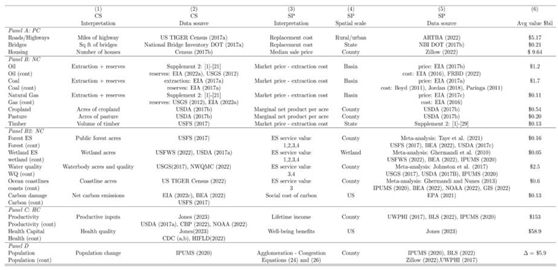
Table 1 details the data sources for [1]. Columns 1 and 2 include the capital stock (CS) quantity interpretation and data source, columns 3-5 list the shadow price (SP) interpretation, spatial scale, and data source, column 6 includes the average county value in $ billions. All capital stock quantities are measured at the county level, but depending on data availability the shadow value may be measured at a different spatial scale.
The majority of non-market NC is valued using meta-analyses which are cited in column 5 along with the data used for benefits transfer. Ecosystem (ES) benefits that are coded as provisioning including water and wood supply, genetic materials (1), regulating including air and water flow (2), cultural including recreation and knowledge (3), and non-use (4). ES are grouped in these categories for brevity. Additional detail on data sources and methods is provided in Jones (2023). Within Table 1, Panel A includes values for PC, Panel B includes NC split into market-based sources in B1 non-market based sources in B2, Panel C includes HC, and Panel D includes the regional population adjustment.
6. Empirical Results
Our empirical findings are reported in Figure 1, Figure 2 and Figure 3. Supplemental data are provide at -----.
Figure 1, per capita IW in 2017, exhibits a tendency for relatively low population counties in Appalachia, the great plains and the mountain west to rank highly in IW/capita, presumably driven by high NC per capita. However, as we see in Figure 2, not all of these counties were WS from 2010 to 2017: that is, high levels of NC/capita in the closing year is not necessarily conducive to WS status. High-NC counties may be exposed to declines in NC, losing key environmental services such as tree canopy cover.
Figure 3 displays the change in IW/capita from 2010 to 2017, calculated using the Arrow 2010 framework. IW includes the value of NC through oil, coal, natural gas, cropland, pasture, timber, non-timber forest benefits, and carbon damages. PC is proxied as the county’s net asset position through GDP. Productivity HC is calculated using a rate of return of 8.5% per year of education. The value of health HC is calculated as the expected discounted years of life remaining multiplied by the value of an additional year of life (assumed independent of age) of $6.3 million. The Arrow [2] methods assess 5 percent of US counties as not-WS.
Our frameworkand data [1] yield very different results. Thirty-two states were WS from 2010 to 2017, and 18 were not-WS. Seventy-five percent of national residents lived in the 32 WS states (i.e. a mean of 7.63 million residents per state), while 25% lived in the not-WS states (a mean of 4.51 million residents per state). There was one notable cluster of eight not-WS states in the great plains and the mountain states: Minnesota, North and South Dakota, Montana, Wyoming, Nebraska, Colorado and New Mexico. This cluster includes many of the high IW/capita counties identified in Figure 1. The remaining ten not-WS states were scattered. Further research may reveal attributes that are common among them.
Sixty-one percent of US counties were WS, and these counties accounted for 73% of the US population, whereas 39% of counties were not-WS accounting for 27% ofUS population. Clearly, WS counties support more than their numerical share of the national population, and not-WS counties support less than their numerical share of the population. It was common for WS states to have some not-WS counties and for not-WS states to have some WS counties. Thirty-seven percent of all the counties in WS states were not-WS, accounting for 16% of these states’ population. This implies that not-WS counties in WS states tend to be rural and with small populations, suggesting large and perhaps growing disparities between urban and rural economies. On the other hand, 27% of counties in not-WS states were WS, and these WS counties account for 56% of their states’ population. Clearly, WS counties play a major economic role in not-WS states. Just over half the people in not-WS states live in WS counties, which themselves comprise only about a quarter of all the counties in these states; that is, WS areas in not-WS states are mostly confined to urban areas while non-WS conditions prevail in many of the outlying counties. We are not political scientists, but it seems that the political consequences of these disparities are revealed in the legislatures of more than a few states.
Sixty-five percent of all counties are rural, and rural counties were under-represented (58%) among WS counties and over-represented (73%) among not-WS counties. This suggests a tendency to weakness in rural economies but, nevertheless, (i) 58% of WS counties nationwide were rural, suggesting that there are many success stories among rural counties that are sustainable, and (ii) 27% of not-WS counties were urban, demonstrating that urban counties are far from immune to sustainability challenges.
7. Conclusions and Discussion
We offer conceptual and empirical conclusions. Conceptually, we confirm that change in IW/capita is the correct measure for WS assessment, provided the effects of population agglomeration are properly captured. That is, population matters to the sustainability of regions, but the WS criterion focuses on how well the population is living and saving for the future, rather than how many people there are. However, we concede explicitly that (i) weak sustainability is not an optimization framework and (ii) that we have not resolved the long-standing ethical questions implicit in trade-offs between total IW and IW/capita.
We highlight a seldom-recognized dilemma in WS assessment that is left unresolved by the WS per capita criterion. It is customary in addressing intergenerational equity to posit generational-persons (unitary decision-makers for each generation,which renders irrelevant the distinction between mean and median welfare or wealth) and, assuming monotone IW trajectories, requires non-diminishing welfare for each generation. However, each generation in its turn will be attentive to equity criteria and, with right-skewed distributions, mean welfare and wealth lie outside the zone of equity: median and minimum welfare provide more plausible equity criteria.
We utilize the framework of Jones [1] to assess the WS of states and counties in the US, and compare our empirical results with those obtained with the Arrow et al [2} framework. The difference is striking: we conclude that 39% of US counties were not-WS from 2010 to 2017 whereas the Arrow methods find just 5% not-WS. The largest contributor to the difference in results of the Jones and Arrow frameworks is Jones’ accounting for migration & regional differences in productivity and health quality. These results underscore the role of health quality as an important input for productivity and that cross-county migration is selective, favoring the young and high-skilled.
Our WS assessments at state and county levels in the US confirmed some prior expectations. There is an urban tilt toward WS status, showing most prominently in the finding that WS urban counties in not-WS states support a majority of these states’ population. Nevertheless, 58% of WS counties are rural, suggesting that there are many avenues for success among rural counties.
Looking forward, we offer several suggestions for a research agenda.
Is WS a preferred, e.g. more cost-effective, measure of sustainability compared to the alternatives? WS offers a more comprehensive assessment than e.g. a battery of sustainability indicators but, due to its substantial data requirements, at potentially higher cost.
The more surprising results of our WS assessment – e.g. the relatively large number of rural counties among those that were WS, and the substantial role that WS cities play in the economies of not-WS states – suggest a large and potentially fruitful research agenda to dig a little deeper beneath the surface and identify the charcteristics favorable for weak sustainability at regional scale.
Does the WS status of states and counties based on the 2010-2017 assessment predict WS status going forward? A modest degree of reshuffling is to be expected, but we hypothesize that WS status in 2017 is a good predictor of WS status going forward and, as these more recent data become available, we foresee a rich research agenda to identify the conditions that enable or condemn, as the case may be, some counties to reverse their WS status.
What observable conditions tend to predict WS, but not-WS? And vice versa, are there conditions that predict the latter but not the former? This, it seems to us, implies a large and potentially fruitful research agenda.
How do the regional science and WS agendas compare? Can they converge into a sustainable regional growth agenda or are there persistent methodological differences in the two approaches? Are there additional adjustments to WS per capita that are necessary, or even possible, to more fully capture the external scale (dis)economies of population size and density?
Regardless of whether their agendas converge or not, what are the additional insights that can be gleaned by applying a WS framework to longstanding regional science questions of regional growth, competitiveness, and prosperity?
Author Contributions
Conceptualization, A.R., E.G.I., M.J.; investigation, the WS criterion, equity, population ethics, A.R.; investigation, regional economic development, E.G.I.: investigation, WS assessment for states and counties, methods and application, M.J., E.G.I.; interpretation of results, A.R., E.G.I, M.J.; funding and project direction, E.G.I.
Funding
Research support was provided by National Science Foundation Innovations at the Nexus of Food Energy Water Systems grant INFEWS #1739909 and the National Institute for Food and Agriculture award #2018-68002-27932. Data Availability Statement:.
Conflicts of Interest
The authors declare no conflict of interest.
References
- Jones, M. (2023). Three Essays on Inclusive Wealth and the Sustainability of Regions (Doctoral dissertation, The Ohio State University) https://library.ohio-state.edu/search~S7?/fthe%3AAGC/fthe+agc/751%2C793%2C799%2CE/frameset&FF=fthe+agc2023phdj664eb&1%2C1%2C.
- Arrow, K.J., Dasgupta, P., Goulder, L.H., Mumford, K.J., Oleson, K. (2010). Sustainability and the Measurement of Wealth, National Bureau of Economic Research, Working Paper 16599, http://www.nber.org/papers/w16599.
- Kuhlman, T. and Farrington, J. (2010) ‘What is sustainability?’, Sustainability, 2, pp. 3436–3448. [CrossRef]
- Randall, A. (2021) ‘Monitoring Sustainability and Targeting Interventions: Indicators, Planetary Boundaries, Benefits and Costs’, Sustainability, 13(6), p. 3181. [CrossRef]
- Yamaguchi, N.U., Bernardino, E.G., Ferreira, M.E.C., de Lima, B.P., Pascotini, M.R., Yamaguchi, M.U., 2023. Sustainable development goals: a bibliometric analysis of literature reviews. Environmental Science and Pollution Research 30, 5502–5515. [CrossRef]
- Bonnet, J., Coll-Martínez, E. and Renou-Maissant, P. (2021) ‘Evaluating Sustainable Development by Composite Index: Evidence from French Departments’, Sustainability, 13, p. 761. [CrossRef]
- Kwatra, S. et al. (2021) ‘Stakeholder participation in prioritizing sustainability issues at regional level using analytic hierarchy process (AHP) technique: A case study of Goa, India’, Environmental and Sustainability Indicators, 11, p. 100116. [CrossRef]
- Kwatra, S., Kumar, A. and Sharma, P. (2020) ‘A Critical Review of Studies Related to Construction and Computation of Sustainable Development Indices’, Ecological Indicators, 112, p. 106061. [CrossRef]
- Solow, R. (1974) ‘Intergenerational equity and exhaustible resources’, Review of Economic Studies, Symposium on Economics of Exhaustible Resources, 41, pp. 29–45. [CrossRef]
- Hartwick, J., (1977). Intergenerational Equity and the Investing of Rents from Exhaustible Resources. American Economic Review 67, 972–74.
- Turner, R.K. (1992). Speculations on Weak and Strong Sustainability; CSERGEWorking; Centre for Social and Economic Research on the Global Environment: London, UK, 1992.
- Pearce, D.; Atkinson, G. (1993). Capital Theory and the Measurement of Sustainable Development: An Indicator of Weak Sustainability. Ecological Economics. 1993, 8, 103–108. [CrossRef]
- Irwin, E.G.; Gopalakrishnan, S.; Randall, A. (2016) Wealth, Welfare, and Sustainability. Annu. Rev. Resour. Econ. 2016, 8, 77–98. [CrossRef]
- Hershey, R.D, Weinstein M.M. (2023). Robert M. Solow, Groundbreaking Economist and Nobelist, Dies at 99. New York Times. December 21, https://www.nytimes.com/2023/12/21/business/robert-solow-dead.html.
- Asheim, G.B., (1996). Capital gains and net national product in open economies. Journal of Public Economics 59, 419–434. [CrossRef]
- Vincent, J.R., (1997). Resource depletion and economic sustainability in Malaysia. Environment and Development Economics 2, 19–37.1. [CrossRef]
- World Bank. (2021) The Changing Wealth of Nations 2021: Managing Assets for the Future. Washington, DC: International Bank for Reconstruction and Development.
- Randall, A. (2022) ‘Driving with Eyes on the Rear-View Mirror—Why Weak Sustainability Is Not Enough’, Sustainability, 14(16), p. 10203. [CrossRef]
- McLaughlin, E., Ducoing, C., Hanley, N., 2024. Challenges of wealth-based sustainability metrics: A critical appraisal. Accountancy, Economics, and Finance Working Papers, Heriot-Watt University, Edinburgh. [CrossRef]
- Pezzey, J.C.V., 2024. Adjusted net savings needs further adjusting: Reassessing human and resource factors in sustainability measurement. Journal of Environmental Economics and Management 127, 102984. [CrossRef]
- Lane, M., 2006. Philosophical Perspectives on States and Immigration. Kings College, Cambridge, UK.
- Faggian, A., Rajbhandari, I., & Dotzel, K. R. (2018). The interregional migration of human capital and its regional consequences: a review. Transitions in Regional Economic Development, 227-256. [CrossRef]
- Andersson, H., Brandstedt, E., & Torpman, O. (2021). Review article: the ethics of population policies. Critical Review of International Social and Political Philosophy, 27(4), 635–658. [CrossRef]
- Helbling, M. and Kalkum, D. (2017) ‘Migration policy trends in OECD countries’, Journal of European Public Policy, 25(12), pp. 1779–1797. [CrossRef]
- Greenwood MJ, 1975 "Research on internal migration in the United States: a survey" Journal of Economic Literature 8 397-433.
- Glaeser, E.L. and Gottlieb, J.D. (2009) ‘The wealth of cities: Agglomeration economies and spatial equilibrium in the United States’, Journal of Economic Literature, 47(4), pp. 983–1028. [CrossRef]
- Chappell, R.Y., Meissner, D., and MacAskill, W. (2023). Population Ethics. In R.Y. Chappell, D. Meissner, W. MacAskill (eds.), Introduction to Utilitarianism, https://www.utilitarianism.net/population-ethics.
- Arrow, K., Dasgupta, P., Goulder, L., Daily, G., Ehrlich, P., Heal, G., Levin, S., Mäler, K.-G., Schneider, S., Starrett, D., others, 2004. Are we consuming too much? Journal of Economic Perspectives 18, 147–172. [CrossRef]
- Asheim, G.B., 2013. Hartwick’s rule. Encyclopedia of Energy, Natural Resource and EnvironmentalE, 2, pp.314-320.
- Piketty, T. 2014 Capital in the Twenty-First Century, Harvard University Press.
- Polasky, S., Bryant, B., Hawthorne, P., Johnson, J., Keeler, B., Pennington, D., 2015. Inclusive wealth as a metric of sustainable development. Annual Review of Environment and Resources 40, 445–466. [CrossRef]
- Randall, A. (2020) ‘Intergenerational commitment, weak sustainability, and safety’, Sustainability, 12(13), p. 5381. [CrossRef]
- Bruntland, G., 1987. Our common future. The world commission on environment and development, Oxfgord University Press.
- Mulgan, T., 2006. Future People. Oxford University Press, Oxford.
- Cafaro, Philip. (2021). Climate ethics and population policy: A review of recent philosophical work. Wiley Interdisciplinary Reviews: Climate Change. 13. [CrossRef]
- Barry, B. (1999) ‘Sustainability and Intergenerational Justice’, in A. Dobson (ed.) Fairness and Futurity. Oxford University Press, pp. 93–117.
- Zuber, S. (2018) ‘Population-adjusted egalitarianism’ https://shs.hal.science/halshs-01937766.
- Lee, A.Y., 2023. The neutrality of life. Australasian Journal of Philosophy, 101(3), pp.685-703. [CrossRef]
- Scovronick, N., Budolfson, M.B., Dennig, F., Fleurbaey, M., Siebert, A., Socolow, R.H., Spears, D. Wagner, F., 2017. Impact of population growth and population ethics on climate change mitigation policy. Proceedings of the National Academy of Sciences, 114(46), pp.12338-12343. [CrossRef]
- Bradshaw, C.J. and Brook, B.W., 2014. Human population reduction is not a quick fix for environmental problems. Proceedings of the National Academy of Sciences, 111(46), pp.16610-16615. [CrossRef]
- Bossert, W. Maximin welfare orderings with variable population size, Social Choice and Welfare, vol.7, pp.39-45, 1990. [CrossRef]
- Blackorby C., Bossert W., Donaldson D. (1996). Leximin population ethics, Mathematical Social Sciences 31, 115-131. [CrossRef]
- Berger, L., Emmerling, J. 2020 Welfare as Equity Equivalents. Journal of Economic Surveys, 34(4), 727-752. [CrossRef]
- Chen, Y., & Rosenthal, S. S. (2008). Local amenities and life-cycle migration: Do people move for jobs or fun? Journal of Urban Economics, 64(3), 519-537. [CrossRef]
- Malecki, E. J. (2004). Jockeying for position: What it means and why it matters to regional development policy when places compete. Regional Studies, 38(9), 1101–1120. [CrossRef]
- Meister, M., Niebuhr, A., Peters, J. C., & Stiller, J. (2023). Local attributes and migration balance–evidence for different age and skill groups from a machine learning approach. Regional Science Policy & Practice, 15(4), 794-826. [CrossRef]
- Acs, Z. J., Groot, H. L. F., & Nijkamp, P. (2002). Knowledge, innovation and regional development. In Z.J. Acs, H. L. F. Groot, & P. Nijkamp (Eds.), The emergence of the knowledge economy (pp. 1–14). Springer.
- Rodríguez-Soler, R., Uribe-Toril, J., and De Pablo Valenciano, J. (2020): “Worldwide trends in the scientific production on rural depopulation, a bibliometric analysis using bibliometrix Rtool”. Land Use Policy 97: 104787. [CrossRef]
- Duranton, G., and Puga, D. (2004). Micro-foundations of urban agglomeration economies. In Handbook of regional and urban economics (Vol. 4, pp. 2063-2117). Elsevier.
- Martin, P., and Ottaviano, G. I. (2001). Growth and agglomeration. International Economic Review, 42(4), 947-968.
- Ottaviano, G., & Thisse, J. F. (2004). Agglomeration and economic geography. In Handbook of Regional and Urban Economics 4, 2563-2608). Elsevier.
- Garcilazo, J. E., & Oliveira Martins, J. (2021). New trends in regional policy: Place-based component and structural policies. In Handbook of Regional Science (pp. 1031-1051). Springer, Berlin, Heidelberg.
- Brueckner, J.K. and Helsley, R.W., 2011. Sprawl and blight. Journal of Urban Economics, 69(2), pp.205-213. [CrossRef]
- Polèse, M., & Shearmur, R. (2006). Why some regions will decline: A Canadian case study with thoughts on local development strategies. Papers in Regional Science, 85(1), 23-46. [CrossRef]
- Morzillo, A. T., Colocousis, C. R., Munroe, D. K., Bell, K. P., Martinuzzi, S., Van Berkel, D. B., ... & McGill, B. (2015). “Communities in the middle”: Interactions between drivers of change and place-based characteristics in rural forest-based communities. Journal of Rural Studies, 42, 79-90. [CrossRef]
- Harberger, A. (1978) ‘Perspectives on Capital and Technology in Less Developed Countries’, in M.J. Artis and A.R. Nobis (eds) Contemporary Economic Analysis. London: Croom Helm.
- Camagni, R. (2009). Territorial capital and regional development. In Handbook of Regional Growth and Development Theories. Capello R, Nijkamp P (eds). Edward Elgar Publishing, pp. 118-132.
- Emery, M., & Flora, C. (2006). Spiraling-up: Mapping community transformation with community capitals framework. Community Development, 37(1), 19–35. [CrossRef]
- Rosen, S. (1974) ‘Hedonic prices and implicit markets: product differentiation in pure competition’, Journal of Political Economy, 82(1), pp. 34–55. [CrossRef]
- Roback, J. (1982) ‘Wages, rents, and quality of life’, Journal of Political Economy, 90(6), pp. 1257–1278.
- Diamond, R. (2016) ‘The determinants and welfare implications of us workers’ diverging location choices by skill: 1980-2000’, American Economic Review, 106(3), pp. 479–524. [CrossRef]
- Couture, V. et al. (2019) Income growth and the distributional effects of urban spatial sorting. Technical Report,. National Bureau of Economic Research.
- Zhang, B., Nozawa, W. and Managi, S. (2020) ‘Sustainability measurements in China and Japan: an application of the inclusive wealth concept from a geographical perspective’, Regional Environmental Change, 20(65). [CrossRef]
- Mumford, K. (2012) Measuring inclusive wealth at the state level in the United States. Inclusive Wealth Report. UNU IHDP and UNEP.
- Ghadimi, H., Harris, T. and Warner, T. (2015) ‘A geospatial approach to measuring regional and subregional inclusive wealth: the case of resource rich West Virginia, USA’, Regional Science Policy & Practice, 7(4), pp. 199–224. [CrossRef]
- Proost, S. and Thisse, J.-F. (2019) ‘What can be learned from spatial economics?’, Journal of Economic Literature, 57(3), pp. 575–643. [CrossRef]
- Gennaioli, N. et al. (2013) ‘Human capital and regional development’, Quarterly Journal of Economics, 128(1), pp. 105–164. [CrossRef]
- Pede, V.O., Florax, R.J. and Groot, H.L. (2007) ‘Technological leadership, human capital and economic growth: a spatial econometric analysis for us counties, 1969-2003’, Annales d’Economie et de Statistique. 103–124.
- Fan, J.-L. et al. (2022) Measuring sustainability: Development and application of the inclusive wealth index in China. Ecological Economics,195:107357. [CrossRef]
- Managi S, Kumar P. Inclusive wealth report 2018. Taylor & Francis.
- Gilleskie, D.B., Han, E. and Norton, E.C. (2017) ‘Disentangling the contemporaneous and dynamic effects of human and health capital on wages over the life cycle’, Review of Economic Dynamics, 25, 350–383. [CrossRef]
- Ezoji, A. et al. (2019) ‘The impact of human capital(health and education) on labor productivity; a composite model approach-a case study of Iran’, Iranian Economic Review, 23(2), 373–397. [CrossRef]
- Abel, J.R., Dey, I. and Gabe, T.M. (2012) ‘Productivity and the density of human capital’, Journal of Regional Science, 52(4), pp. 562–586. [CrossRef]
- Ciccone, A. (2002) ‘Agglomeration effects in Europe’, European Economic Review, 46(2), 213–227. [CrossRef]
- Marshall, A. (1890) Principles of economics. unabridged eighth edition. Cosimo, Inc.
- Moretti, E. (2004) ‘Workers’ education, spillovers, and productivity: evidence from plant-level production functions’, American Economic Review, 94(3), 656–690.
Figure 1.
Per cap IW in 2017 for all US Counties using the methods from Jones [1].
Figure 1.
Per cap IW in 2017 for all US Counties using the methods from Jones [1].
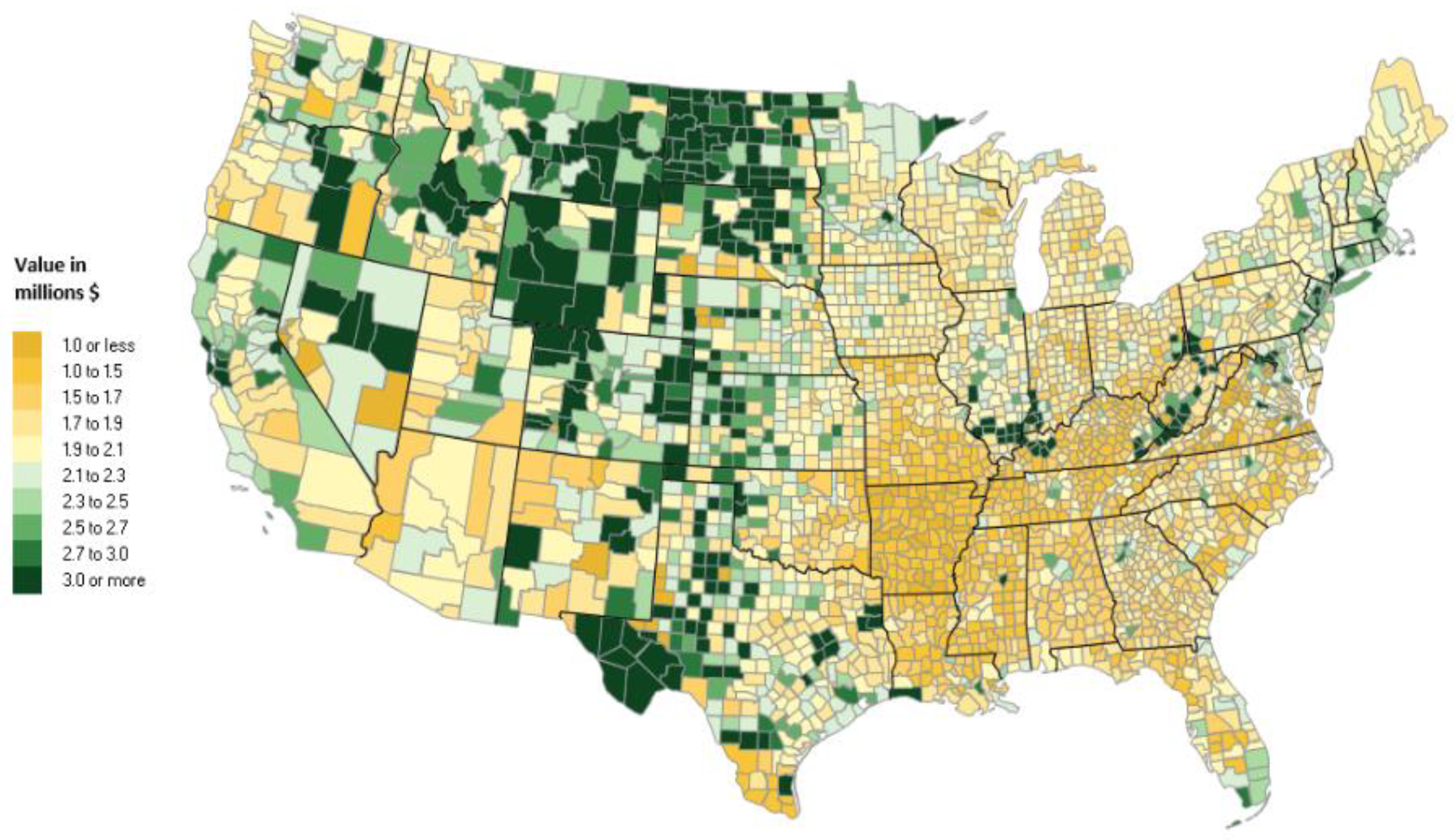
Figure 2.
Change in per cap IW for all US counties from 2010-2017 using the methods of Jones [1].
Figure 2.
Change in per cap IW for all US counties from 2010-2017 using the methods of Jones [1].
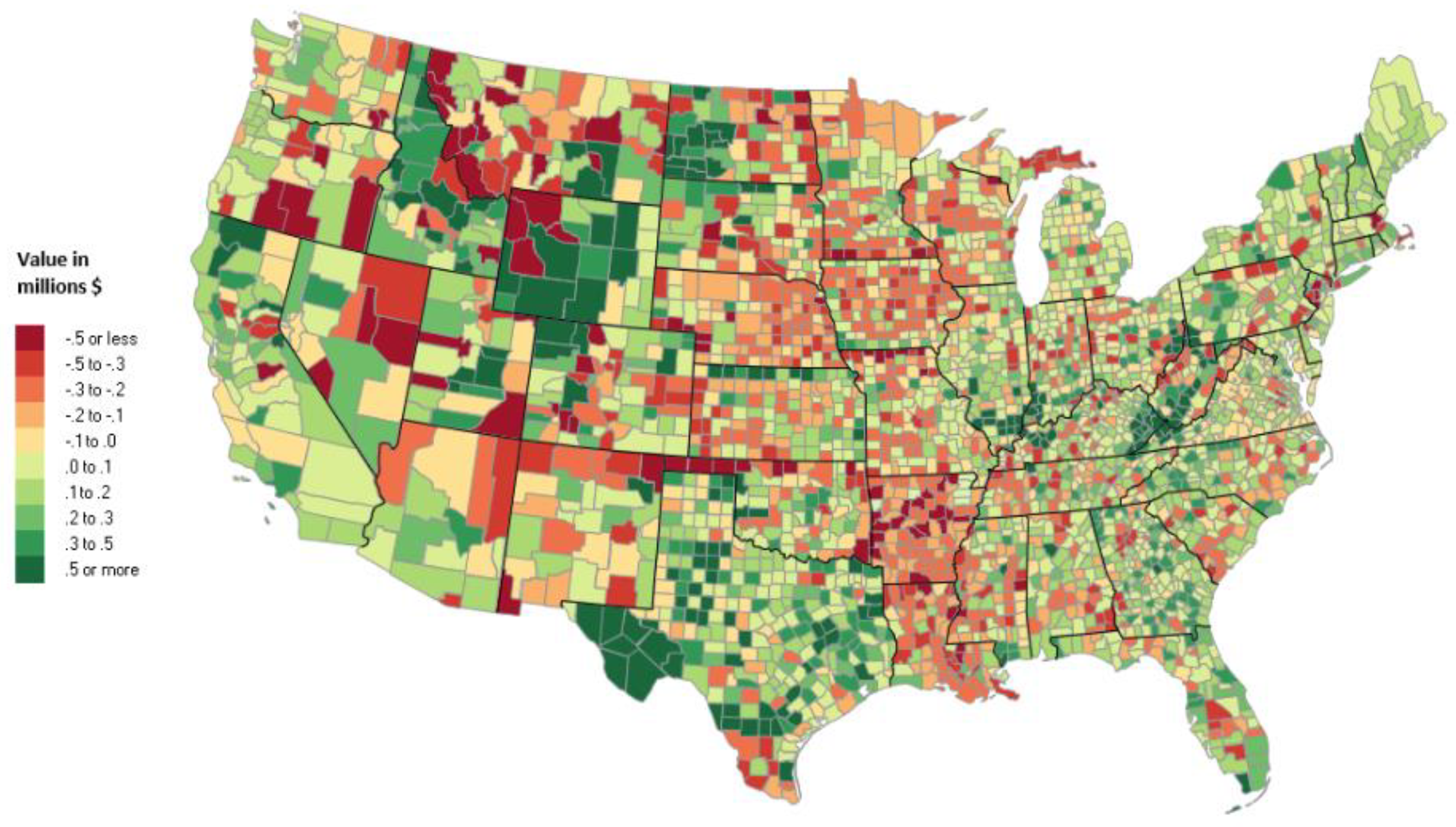
Figure 3.
Change in IW/cap following Arrow et al [2] framework for US Counties from 2010-2017.
Figure 3.
Change in IW/cap following Arrow et al [2] framework for US Counties from 2010-2017.
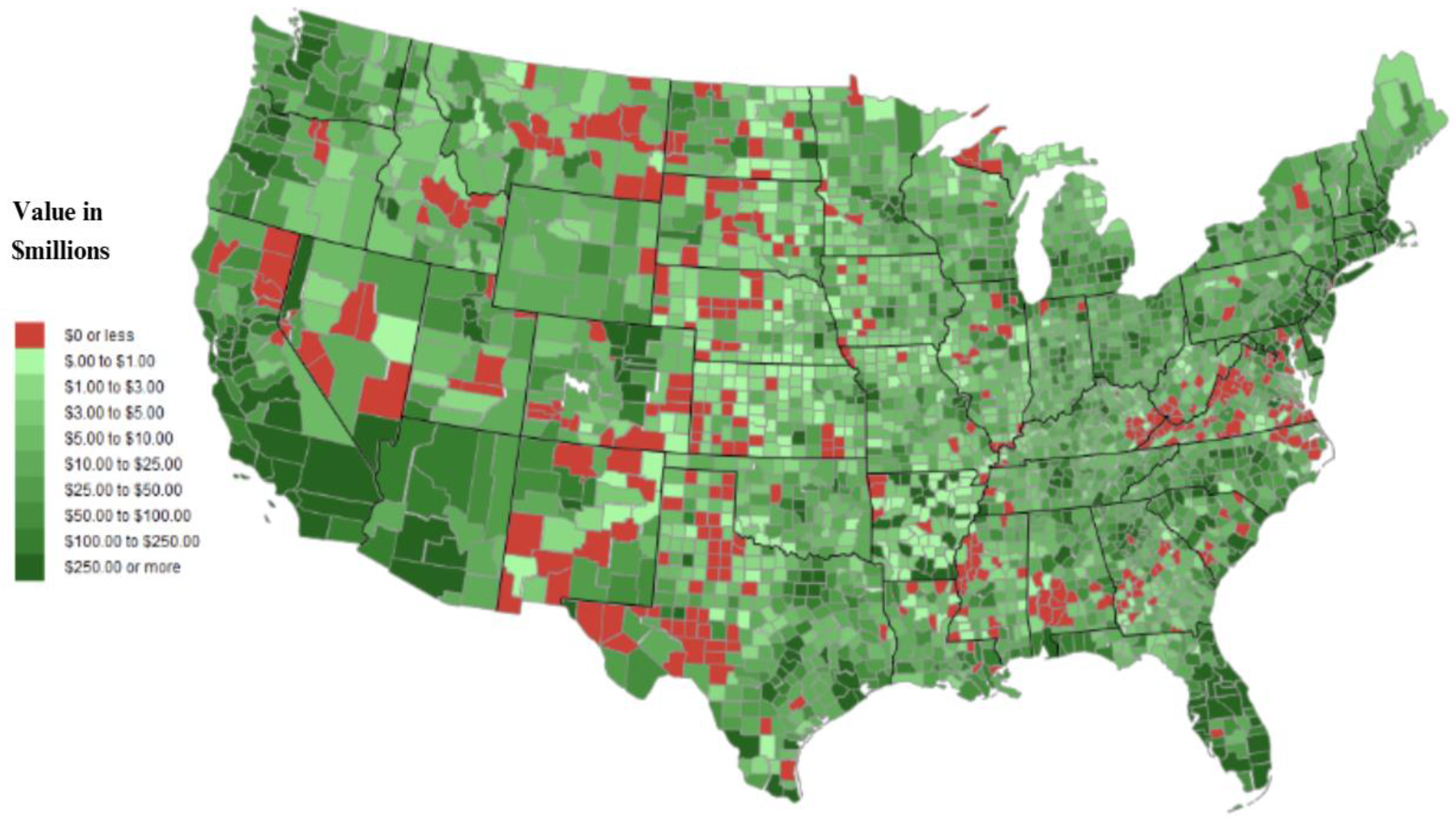

Table 1.
Jones (2023) Capital Stock Summary Statistics and Data Sources.
Disclaimer/Publisher’s Note: The statements, opinions and data contained in all publications are solely those of the individual author(s) and contributor(s) and not of MDPI and/or the editor(s). MDPI and/or the editor(s) disclaim responsibility for any injury to people or property resulting from any ideas, methods, instructions or products referred to in the content. |
© 2024 by the authors. Licensee MDPI, Basel, Switzerland. This article is an open access article distributed under the terms and conditions of the Creative Commons Attribution (CC BY) license (http://creativecommons.org/licenses/by/4.0/).
Copyright: This open access article is published under a Creative Commons CC BY 4.0 license, which permit the free download, distribution, and reuse, provided that the author and preprint are cited in any reuse.