

Submitted:
10 October 2024
Posted:
10 October 2024
You are already at the latest version
Abstract
The government of Laos has made significant efforts to halt deforestation and promote forest conservation in the Northern Uplands of Laos. However, there is no comprehensive assessment of the initiatives and factors that influence youth involvement in forest resource conservation. Our goal was to find sustainable forest management practices and understand the factors affecting young people's behaviors related to forest conservation. We conducted our study in 3 districts, covering 15 villages. We used multiple regressions to identify the factors influencing sustainable forest management behaviors, involving 330 youths who were systematically and randomly selected to participate in structured interviews. Our results showed that conservation knowledge and recognition are associated with demographic and socioeconomic factors, especially education. Factors related to forest conservation recognition included the amount of information available, gender, monthly income, land ownership, and distance from the forest to home. Most households rely on forest products for their livelihoods. We found that higher levels of education provide people with more job opportunities, which improves their job status and quality of life. Community members who received relevant information were more forward-thinking in their forest management behaviors and willing to contribute to related activities. Providing essential information to young people can help improve sustainable forest management behaviors.
Keywords:
conservation
; attitude
; recognition
; sustainable forest management behavior
; youth of Lao P.D.R
1. Introduction
Lao PDR covers 23.7 million hectares of total land area, with 70% of the land being mountainous. The country has three agricultural climate zones: the northern upland, plateau regions, and the southern part [1]. According to the Department of Forestry (DOF) report 2005, vegetation types and national land-use cover amounted to 23,680.0 hectares [2]. Since the 1940s, forest cover nationwide stands at 17 million hectares, accounting for 70% of the land area [3]. However, by the 1980s, forest cover had decreased to approximately 11 million hectares nationwide, marking a period of severe deforestation [4]. The state implemented three policies to manage forests: 1) preserving and improving the existing governance system, 2) using forests rationally to enhance economic benefits from forest resources, and 3) preserving, rehabilitating, and creating permanent economic activities for upland populations [5]. From 2002 to 2010, forest cover rapidly changed nationwide, reducing from 41.5% to 40.3% [6], primarily due to inappropriate forest management systems, shifting cultivation, uncontrolled logging, economic sector development, land use intensification, weak forest-related policies, and various development activities (e.g., road and dam construction, illegal trade in wood and non-timber forest products (NTFPs)). Consequently, the state has aimed to increase nationwide forest cover through numerous policies for sustainable forest management, including the Forest Strategy 2020, published in 2005, which targets achieving 70% forest cover by 2020 and focuses on reducing deforestation [5].
Forest resources are crucial for the livelihoods of rural people in Laos, as they provide food, fuelwood, medicine, fodder, and building materials. However, there has been a significant change in the utilization of forest products due to their overdependence by the rural people. Approximately 80% of people in rural areas depend on forest resources [5]. In 2009, the total population of Laos was about 6.38 million, comprising 49 ethnic groups. About 73% of the population lives in remote areas [1], with many families heavily dependent on forests for survival, leading to forest loss. Forest loss accelerates global warming by releasing carbon dioxide (CO2) into the atmosphere and reducing the ability of ecosystems to adapt to climate change. Research has shown that the overall village forest quality and wild resources are degrading, particularly timber and firewood, which will further diminish in years to come [7,8].
In Lao PDR, deforestation and forest degradation are caused by several factors, including unlawful logging, unsustainable timber extraction, agricultural expansion, plantation expansion, hydroelectric energy development, and mineral mining [9,10]. According to [12], forest area reduction in the northern uplands of Laos is due to poverty, agricultural land intensification, and logging owing to unregulated land use and insufficient natural forest management planning. Others have associated the reduction in forest area in Laos to subsistence living and market demand for timber [5]. Deforestation, caused by human activities, has become significant as people exploit forests for their needs. For example, the FAO (2001) reported that the net deforestation rate in many tropical countries is approximately 12.3 million hectares per year, while non-tropical countries experience a net increase in forest cover of approximately 29 million hectares annually [11]. Deforestation and forest degradation continue to deplete forest resources in Laos. Despite its small population size and limited natural resource usage, numerous issues have resulted from forest cover reduction, with a 6.8% decrease between 1990 and 2005. By the end of the 1990s, deforestation had increased moderately due to economic development pressures on forest resources [13].
Given the high deforestation rate in Laos, the government implemented the Land Forest Allocation Program (LFAP), which allows communities to exercise their customary rights under forestry laws to enhance local participation in forest management [14]. Since 1991, the state has allocated land under the Ministry of Agriculture and Forestry (MAF) to protect national forest resources and developed a national strategy covering 17 million hectares. This strategy includes 9.6 million hectares for forest protection, 2.4 million hectares for national parks and wildlife habitats, and five million hectares for forest production. These measures aim to mitigate issues arising from development activities. Despite these efforts, deforestation continues to be a critical issue that affects sustainable socioeconomic development. The state is making considerable efforts to control forests by establishing various forest management systems and improving forest policies to align them with legal frameworks. The government has identified three main models of participatory forest management for villagers, including forest production, forest village, and NTFP use. Villagers are involved in all steps of these models (e.g., planning, implementation, and monitoring). Local participation in forest management activities, especially the youth, is essential for sustainable forest management. Engagement of youths in forest resource conservation is an effective strategy to safeguard forests and ensure sustainable agricultural practices. By upholding rights to forest utilization, as defined by law, including delineating boundaries and classifying forest lands for conservation, communities can ensure responsible forest management led by villagers and youths.
So far, there is no comprehensive assessment of the government's efforts in tackling deforestation in Laos and what is influencing the youth in rural areas to participate in forest resource conservation. Forest conservation is crucial in the wake of climate change since it prevents the exploitation of forest resources, reducing carbon emissions into the atmosphere and global warming. The forests are vital because they sequester carbon and serve as carbon sinks, benefiting humans and the environment. Encouraging the youth to engage in the conservation of forest resources, which are affected by several factors stated above in Laos, is essential for ensuring the sustainability of these resources. This study assessed forest resource utilization and factors influencing forest resource conservation behavior of the youth in the Northern Uplands of Laos. The two central questions the study sought to address were:
How are forest resources being utilized in Northern Uplands of Laos?
What are the factors influencing the forest resource conservation behavior of the youth in the region?
Forest destruction exacerbates vulnerability to climate change and natural disasters, affecting agricultural productivity and livelihoods. Therefore, understanding the factors that influence youth engagement in sustainable forest management is crucial. Identifying these factors can inform policy recommendations for promoting forest conservation practices by utilizing established paradigms and models from previous forest strategies. The study aims to enhance awareness about forest conservation and sustainable forest utilization among youths and provide recommendations for mitigating deforestation and promoting sustainable agricultural production in designated areas of Laos.
2. Literature Review
2.1. Sustainable Behavior in Forest Management
Sustainable behavior is a priority for many regions, including the diverse landscapes of Europe, which have changed over time [15,16]. In Thailand, there is potential for sustainable community forest management (CFM) due to the motivation and interest of community members in protecting forests [17]. They show good awareness of their subsistence needs without resorting to deforestation.
The sustainable behavior of locals depends on various factors, such as education, community participation, methods of forest conservation extension, attitude, reducing forest dependency, increasing non-farm income sectors, resource utilization, capacity building, and information sources. These factors have a significant positive effect on sustainable forest management. For example, in Tanzania, community participation in forest management has the potential to improve forest resources and livelihoods despite existing limitations in institutional management practices [18]. Other studies have highlighted that non-settler groups in villages have a more forward-thinking approach to community forest conservation than settler groups, particularly with women playing key roles in the direct involvement of forest products and providing water for households. Addressing various issues, such as soil erosion affecting arable land, increasing local community awareness of forest degradation, and offering training programs can help improve livelihoods and reduce community pressure on forests. However, conflicting objectives among local communities could undermine efforts to conserve and manage biodiversity for human benefit, which is the case of communities in Indonesia [19]. According to [19], information regarding natural biodiversity conservation remains limited, emphasizing the need for more information to manage community forests effectively and sustainably.
2.2. Human Behavior in Forest Management
Modifying human actions using the theory of cognitive behavior emphasizes the crucial process of solving problems and the interaction between the external and internal cognitive environments. The main drivers of threats to biodiversity stem from human behavior affecting climate change, habitat loss, invasive species, and overuse. However, forest conservation behavior can enhance various activities, such as providing information on the benefits of forests, generating income, education, organizational officer involvement, women's participation, and village-level influences on forest conservation behaviors. Three main factors influence environmental behavior: habitual behavior, motivation, and contextual factors [20]. Evidence from one study shows that these factors impact future-oriented environmental behavior, affecting individual and social practices [Ref ??]. The positive outcomes of these practices affect not only individuals but also leaders' policies, political stability, and high-ranking decision-makers [21]. Other studies have highlighted differences in local community rights, security, and access to forest benefits in Tanzania, Mozambique, Laos, and Vietnam. Despite these differences, common issues include weak implementation of participatory forest management and the value of forest resources in these areas. Institutional weaknesses and economic conflicts have contributed to these challenges [22]. The stability of institutional organizations is needed to ensure that local people receive information and access forest benefits.
2.3. Recognition in Forest Conservation Behavior
Recognition in conservation extends beyond merely acknowledging plants and animals. It also involves understanding human behavior and its impacts. The implementation of social forestry has been affected by problematic state environments in the past, flawed land management processes, political-economic benefits for local individuals, and insufficient institutional participation. Recognizing human behaviors is crucial for conserving diverse species since they play a central role in species conservation by influencing survey techniques, habitat selection, breeding success, maintenance of genetic diversity, predator avoidance, and pest prevention and control. Studies have argued for recognition, including the tenure entitlements of local populations, the entitlements of indigenous peoples, and the role of women in natural resource governance and livelihoods [Ref??]. These issues have been recognized in many international conventions, highlighting the challenges and opportunities to preserve rights in practice. There are successful cases of community tenure reforms, although resistance and contention from the elites regarding natural resources and land persist (even when they have agreed on rights). Therefore, relevant strategies for securing tenure recognition are essential for effectively managing these issues. People and forests can improve and coexist if, beyond merely recognizing forest rights, there is a focus on broader incentive policies to promote community and smallholder involvement in forest management [23].
2.4. Knowledge in Forest Conservation Behavior
Recognizing indigenous knowledge of conservation and biodiversity enhancement is crucial for better integration into broader knowledge systems, beliefs, and practices. Environmental knowledge, attitudes, and behaviors can be both direct and indirect. Indirect environmental knowledge increases more than environmental attitudes, whereas direct knowledge and attitudes have the same growth rate. Interestingly, the indirect component of attitude is more strongly associated with behavior than knowledge, although the direct associations between behavior, attitudes, and knowledge are equally strong [24,25]. Environmental knowledge comprises three main aspects: declarative (understanding social and ecological system dynamics, impacts, and interactions), procedural (information on changing processes and local strategies), and effectiveness (a person's capability to act). Again, there are distinctions between subjective knowledge (information kept appropriately) and objective knowledge (individual knowledge or perception). Knowledge, understanding, and national context have different characteristics and influence behaviors in various ways. Individuals with positive environmental attitudes tend to act in ways that protect nature. Cognitive, affective, and behavioral components influence the concept of coexistence with nature. For example, natural resource management practices in the Cordillera reflect different behaviors shaped by beliefs, traditions, and cultures. Recognizing the diverse characteristics of knowledge is essential for realizing sustainable forest management, which varies according to diverse values across spatiotemporal scales.
2.5. Information in Forest Management Behavior
Information regarding natural resources in local communities, including their use, knowledge, and abundance, can be pivotal for developing conservation strategies and promoting sustainable use. Understanding the decision-making processes underlying forest policies highlights the critical role of information and legal tools. Internal sources, such as the internet, are crucial for accessing journals and databases, albeit limited by accessibility and cost. Research has underscored the importance of information in shaping user characteristics influenced by certain factors, such as gender, caste, ethnicity, education, and access to resources, particularly in community forest settings [26]. Studies on biodiversity emphasize the specific information needs of scientists and users and advocate for accessible and integrated information sources tailored to user preferences [27]. Public demand for information accessibility generally revolves around environmental impacts and government expenditure. Various formal and indigenous information sources contribute differently to our understanding of natural resources and their environments. Indigenous oral traditions and local leadership are vital in resource identification and conservation efforts. Indigenous wisdom remains crucial to local livelihoods. Studies on human information behavior have categorized users based on their information-seeking behavior, such as searching, seeking, and utilizing information for cognitive and practical outcomes [28,29,30].
2.6. Forest Resource Dependency Behavior
Gender significantly influences access to and management of forest resources, with women depending more on forests and forest products than men despite having less decision-making power in household and community livelihoods. Numerous communities depend on forests for their livelihoods, including income generation, energy provision, and the regulation of weather patterns. Forest resources constitute a significant portion of the income of poor households, with up to 65% of total income derived from forests [31]. Forest dependency varies across regions and influences household income, especially in occupations directly tied to forest resources. Predictors of forest dependency include agricultural land availability and livestock populations, as these factors significantly affect household demographic and socioeconomic factors, such as family size, academic attainment levels, agriculture income, and livestock income [32,33]. Household income sources are diverse, with agriculture contributing 60%, forests 38%, and off-farm activities 2% of the total rural household income, on average [34,35]. Forest product collection plays a crucial role in household economic status, underscoring the importance of community forest dependence on income generation and management [36,37]. Households that derive more income from forests have more opportunities to engage in community forest management practices.
2.7. Characteristics of Demographic and Socio-Economic Factors
Sex: gender differences influence participation in forest management. Studies have indicated that women are positively associated with economic benefits and participation in forest conservation [38,39]. Women often engage more in pro-social behaviors related to forest conservation than men [40]. Age: age influences participation levels in forest management. Older individuals, particularly men, are more inclined towards utilizing forest resources, whereas younger people show greater interest in participating in decision-making processes and forest-related activities [41,42]. Marital status: marital status plays a significant role in participatory forest conservation. Married individuals tend to exhibit higher willingness and involvement in activities aimed at conserving forests than individuals yet to be married [38], indicating that marital status can influence community-level forest protection. Educational attainment: higher levels of education positively affect participation in Sustainable Forest Management (SFM). Educated individuals often have more employment opportunities, reducing their dependency on forest resources [43], suggesting that education contributes to more informed decision-making in forest management. Family size: family size influences various aspects of forest activities, including decision-making, forest preservation, and utilization of forest products [44]. Larger families may participate differently in participatory forest management programs than smaller families, thus affecting community-level forest practices [45]. Main Occupation: forest-related occupations were positively associated with forest resource dependency [46]. Individuals whose livelihoods depend on forest resources are more likely to engage in forest management and conservation activities. Total family monthly income: household income is positively associated with forest dependence, highlighting a strong relationship between income level and reliance on forest resources [47]. Higher-income households may have more resources to invest in sustainable forest management practices [41,48]. Total owned land: land ownership influences the implementation of forest conservation and development interventions. Larger landholdings enable more extensive activities than smaller landholdings, thus impacting the scale of conservation and development initiatives [49]. However, landholding size can negatively affect community participation in some contexts [48]. Distance from forest to the home (km): distances of 300 meters from home to forest positively influence deforestation and forest degradation [43,50,51]. This proximity often leads to increased resource extraction and habitat disturbances. Distances ranging from 0.3 to 3 km from home to forests negatively influence deforestation rates [52]. Greater distances can act as buffers, reducing the direct human impact on forests. The closer proximity of homes to markets negatively influences forest resource utilization, likely due to increased accessibility and economic pressure [44]. Members of village forest committees: membership in forest committees significantly influences participation in forestry activities, such as Joint Forest Management (JFM), and enhances engagement in various forest management activities [53]. However, executive committee membership within forest user groups may negatively influence participation in specific forest protection activities [44]. Degree of information: access to information on Community Forest Management (CFM) positively influences community participation, and studies show that better information provision positively correlates with community participation levels in forest management [48,54]. Accessible and relevant information empowers communities to engage in decision-making processes. Degree of dependence on resources: dependence on forest resources is positively associated with community forest management; a higher dependency on forest resources correlates with increased involvement in managing community forests, reflecting economic reliance and livelihood needs [36,37]. Knowledge: knowledge about forest conservation and management positively influences participation. Understanding CFM practices and forest rights enhances participation in forest management groups [54,55]. This knowledge empowers communities to advocate for sustainable forest practices and conservation efforts. Recognition/attitude: positive attitudes and recognition of the importance of forest conservation drive participation; residents with positive attitudes toward forest conservation are inclined to participate actively in community-driven forestry [56,57]. Recognizing the benefits of forests motivates communities to engage in conservation activities.
2.8. Conceptual Framework of the research
Based on the literature review, we developed a conceptual framework showing the relationships between experience (forest resource dependency and access to information) and sustainable forest management, encompassing sustainable use, conservation, and policy acceptance behaviors (Figure 1). We argue that forest resource dependency and information on forest conservation will result in increased conservation recognition and knowledge, which could ultimately influence sustainable use, conservation, and policy acceptance behaviors. We also argue that the overall goal of sustainable forest management behavior could be affected by socio-demographic factors, including educational attainment, income, land ownership, occupation, member of village forest committee, sex, age, marital status, family size, and distance from forest to home).
3. Materials and Methods
3.1. Study Area
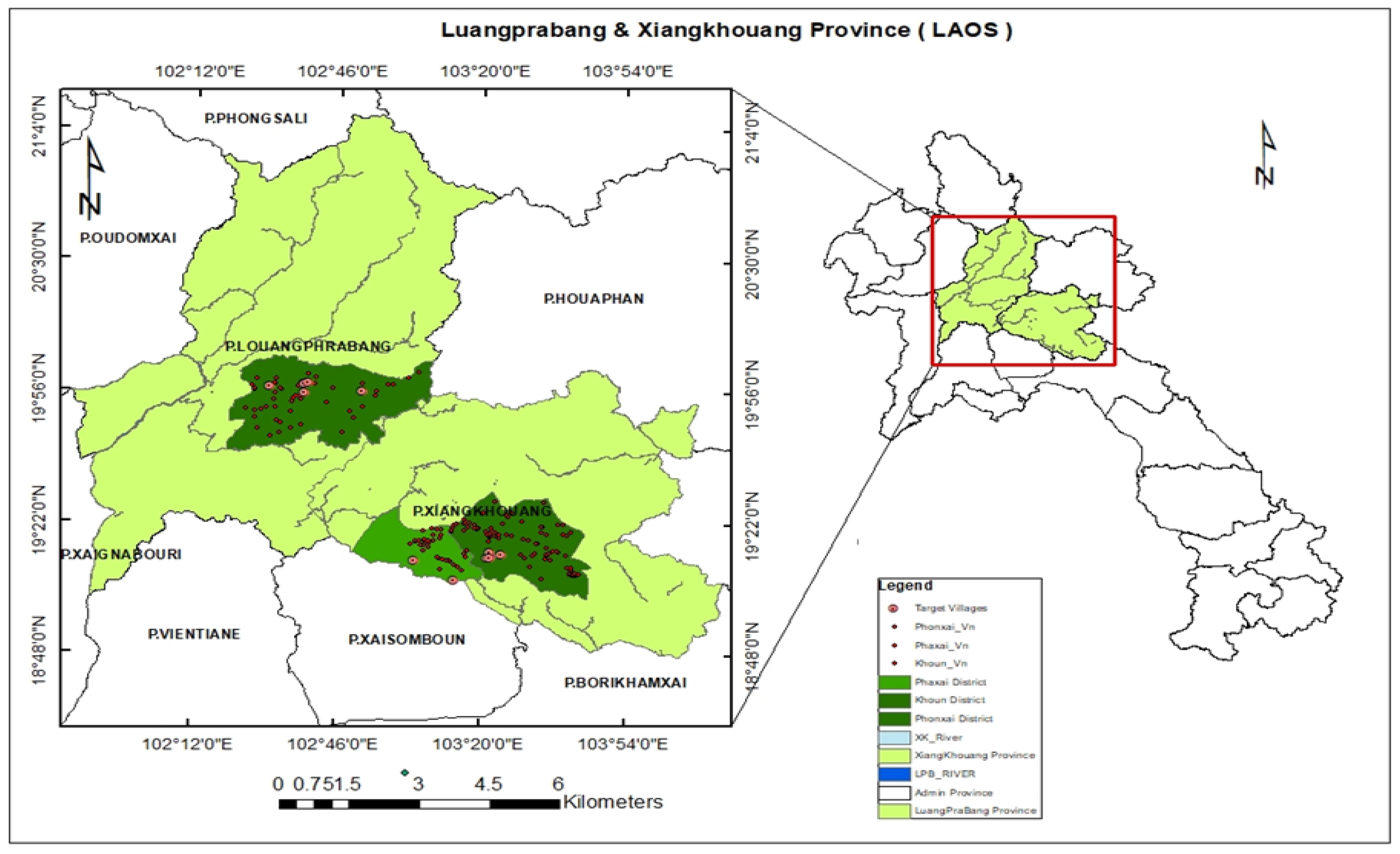
The target area for this research comprised 15 villages across three districts (Phonxai, Sunloung, and Phaxay) spanning two provinces (Luang Prabang and Xieng Khouang, Lao PDR). These villages are situated 2–3 km from the nearest forests. Among the 15 villages, we selected 5 near the forest in the Phonxai District (Luang Prabang Province), 5 in the Khoune District, and 5 in Phaxay District (Xieng Khouang Province). Specific details of the locations are as follows: Chobchia, a sub-district in Phonxai district, Luang Prabang Province, located in UTM Zone 48Q at latitude 19° 96’ 86.67” N and longitude 102° 60’ 08.01” E, covering a forest area of approximately 13.438 ha (55.2%); Sunlong, a sub-district in Khoun district, Xieng Khouang Province, situated in UTM Zone 48Q at latitude 19° 23’ 17.29” N and longitude 103° 37’ 20.51” E, with a forest area of about 27.573 ha (11.4%); Namsiem, a sub-district in the Phaxay district, Xieng Khouang Province, located in the UTM Zone 48Q at latitude 19° 21’ 17.56” N and longitude 103° 07’ 16.09” E and latitude 19° 12’ 50.03” N and longitude 103° 23’ 02.11” E, covering a forest area of approximately 22.673 ha (20.2%) (Report of district, 2016). Each district is categorized into three main types under forestry law, with specific areas allocated to protected forests: approximately 8,044,800 ha nationwide; conservation forests: approximately 4,409,700 ha; and production forests: approximately 3,146,800 ha [6]. The distribution of production forest areas across different regions is as follows: northern region: approximately 969,222 ha (39.0%); central region: approximately 1.3 million hectares (52.4%); southern region: approximately 217,100 ha (9%) [4]. The three subdistricts encompass 15 villages, totaling 1,104 households and approximately 6,868 inhabitants, including 3,378 females. The population comprises three ethnic groups: Lao Loum, Lao Soung, and Khumou. Human settlements are situated along roads, valleys, and rivers and face high risks of natural disasters, including flooding and soil erosion. This area suffers from poor road conditions that hinder accessibility, limited infrastructure development, and low education levels, contributing to slow economic growth. Due to the unavailability of land for food production and rice fields, many residents are impoverished and rely on forest resources for sustenance and income through activities including woodcutting and collecting non-timber forest products (NTFPs). The illegal encroachment on fruit and rubber plantations has exacerbated these challenges. Moreover, there is a lack of awareness among villagers, particularly the youth, regarding the importance of forest resource conservation.
Figure 2.
Study area on the map of the Phonxai district, LPB, Khoun & Phaxai district, XK. Note: Map created, March 2020.
Figure 2.
Study area on the map of the Phonxai district, LPB, Khoun & Phaxai district, XK. Note: Map created, March 2020.
3.2. Methods
3.2.1. Data Collection
Data was collected in 15 villages across three subdistricts using structured questionnaires and interview guidelines. We conducted interviews between October 15, 2016 and February 15, 2017. We systematically and randomly selected 330 youths (gender inclusive), ages 18–35 years, from the total population of 6,868 individuals across the 15 villages for the interviews based on recommendations from the village headmen and older committee members. Additionally, we had discussions with official staff, village headmen, and elderly village committee members to gather comprehensive information on forest resource conservation behavior. Specifically, we selected the respondents (youth) from the CHOPCHIA group, comprising five villages; the SUNLOUNG group (five villages); and the NAMSIEM group (five villages). We conducted the interviews in each of the 15 villages.
3.2.2. Description and Variables Measurement
The dependent variables considered for measuring sustainable forest management behavior includes (i) sustainable use behavior, (ii) conservation behavior, and (iii) policy acceptance behavior. We used independent variables to test sustainable forest management behavior, which consisted of knowledge of forest conservation (X13), recognition of forest conservation (X14), and experience related to the forest (indirect experience: information about forest conservation (X11), and direct experience: forest resource dependency (X12)). The control variables used to test sustainable forest management behavior included the following 11 variables: sex (X1), age (X2), marital status (X3), educational attainment (X4), number of family members (X5), main occupation (X6), total family income (X7), total land (X8), distance from the forest to the home (X9), and the village forest committee (X10).
We hypothesized that the effects on the predictors varied depending on the type of behavior in sustainable forest management. Many studies have identified knowledge and recognition as significant predictors of behavior. Information, as an indirect experience, and forest resource dependency, as a direct experience, can influence people’s knowledge, recognition, and behavior. We include sociodemographic factors (age, gender, educational attainment, relationship status, family size, economic occupation, income, and proximity to the forest) as control variables in the model.

Table 1.
Definitions and measurements of independent variables.
| Variables | Description | Hypothesis | Data source |
|---|---|---|---|
| Sex | The gender of the household head (male or female) | (+) | [38,39] |
| Age | Age is identified based on the age of the household head, whether they are adults or young (in years) | (-) | [41,42] |
| Marital status | Marital status indicates whether an individual is married, single, separated, widowed, or divorced | (+) | [38] |
| Educational attainment | The school grade of the household head | (+/-) | [43,48] |
| Number of family members | The number of household members (persons) | (+/-) | [44,45] |
| Main occupation | The activities typically practiced include farming, working as laborers, holding government positions, or working as businessmen | (+) | [46,48] |
| Total family monthly income (kip) | Sources of family income that are representative of total income obtained from household activities | (+) | [41,47,48] |
| Total land owned (ha) | The size of the farm (in hectares) depends on the landowner | (+) | [48,49] |
| Distance from forest to home (km) | The measurement of distance from one area to another area | (+/-) | [43,44,50,52] |
| Member of village forest committee | Participants of the community forest committee work on forest management units | (+/-) | [44,53] |
| Degree of information | Regarding availability and sources of information | (+) | [48,54] |
| Resource dependence | The majority of the household income comes from forest resources | (+) | [36,37] |
| Knowledge | It measures the level of scores | (+) | [54,55] |
| Recognition/attitude | It measures on a ranking scale of scores | (+) | [56,57] |
3.2.3. Data Analysis
The obtained data were processed and analyzed using STATA Version 14, focusing on descriptive and inferential statistics. We used descriptive statistics to present findings from the sociodemographic data of households, including mean, frequency, percentage, standard deviation, median, maximum, and minimum. We used inferential statistics, specifically multiple linear regression model (equation 2) to address the assumptions of linearity. Several empirical studies [58,59,60,61] employed multiple regressions to analyze similar studies. This study's findings are presented using adjusted mean differences with 95% confidence intervals to indicate the magnitude of the effects and p-values for statistical significance.
Where, Yi = Sustainable Forest management behaviors (sustainable use behavior, conservation behavior, and policy acceptance behavior); β0 = constants term; βi = (i = 1~ n) the estimated coefficients of the model for each independent variable; Xi = (i= 1~ n) the independent variables; and μ. = random error.
4. Results
4.1. Socio-Demographic Characteristics of Youth
The results showed that most of the respondents were male (66.67%), the average age of the respondents was x̄ = 27.98 ± 5.13 years, and more than half of all respondents had completed only primary education (34.55%) or were uneducated (27.27%) (Table 2). Most respondents were married (90.30%), with an average family size of x̄ = 6.30 ± 2.49 persons. Almost all respondents were engaged in farming (88.66%). Regarding community roles, 11.52% were part of the village forest committee. Approximately 30.1% reported a monthly household income of 400,000–700,000 KIP (exchange rate 2020:1 USD = 8860 KIP, equivalent to 45–79 USD). Most of the respondents derived their income from NTFPs (73.33%). The average distance between households and the forest was x̄ = 0.42 ± 0.87 km. A total of 47.27% of respondents owned land larger than 0.05 ha.
4.2. Utilization of Forest Resources by Youth
Most youths utilized wild plants for consumption (69.09%), particularly mushrooms (77.58%) and rattan (44.85%). The most commonly sold items were broom grass (29.70%), orchids (8.48%), and tubers and bamboo shoots (32.42%). Herbs, such as cardamother, medicine vine, Curcuma longa L, and Molineria latifolia (17.58%), were rarely sold. Almost all youths utilized wild animals for consumption, including muntjak deer (39.09%), wild boar (54.55%), common palm civets (46.06%), and other animals such as deer, tigers, monkeys, pangolins, king cobras, turtles, and squirrels (54.22%). However, these animals were rarely traded, used for medicinal purposes, or as instruments. Wood, such as Rosewood, Dalbergia cultrata Benth, Afzelia xylocarpa (Kurz) Craib, Alstonia scholaris (L.) R. Br, Maidaeng (local name), Mailongleng (local name), Maimanpa (local name), and Dalbergia cultrata Graham ex Benth (41.51%) were primarily used to build houses. Other types of wood were also used (69.70 %) (Table 3).
4.3. Impact of Socio-Demographic Factors on Forest Conservation Knowledge and Recognition.
In this study, we employed a multiple linear regression model to identify the factors influencing forest conservation knowledge and recognition among youth in the northern uplands of Lao PDR. These factors encompass information and forest resource dependency, along with socio-demographic variables. The results of this model are presented in Table 4, which indicates that certain independent variables were significantly associated with both the knowledge and recognition of forest conservation. Table 4 shows that educational attainment was significantly associated with forest conservation knowledge, with only this variable achieving statistical significance at the 5% significance level. In contrast, educational attainment showed a highly significant relationship with forest conservation recognition, reaching statistical significance at the 1% level. Additionally, the degree of information connected with forest conservation recognition is at the 1% level. Other variables, such as sex, family monthly income, land ownership, and distance from home to the forest, were statistically significant at the 5% significance threshold regarding forest conservation recognition.
From the results, educational attainment showed a significant positive association with forest conservation knowledge (β = 0.109, p = 0.026), suggesting that an increase in youth educational attainment leads to approximately a 0.139 times higher level of forest conservation knowledge. Similarly, educational attainment was positively associated with forest conservation recognition (β = 0.126, p = 0.005), indicating that higher educational attainment increases forest conservation recognition by 0.162 times. The variable “degree of information” was also positively associated with forest conservation recognition (β = 0.158, p = 0.000), implying that an increase in the degree of information among youth results in a 0.253 times higher forest conservation recognition. Additionally, “sex” showed a positive significant association with forest conservation recognition (β = 0.222, p = 0.026), suggesting that being male increases forest conservation recognition by approximately 0.127 times. Conversely, “family monthly income” had an inverse relationship with recognition of forest conservation (β = 0.000, p = 0.033), indicating that a decrease in family monthly income leads to a decline in forest conservation recognition by approximately -0.123 times. Contrary to previous research findings, household income positively influences decisions regarding NTFP harvesting, such as mopane worms [65]. Similarly, research has shown that a higher household income is positively associated with forest dependency [47], reflecting an increased reliance on forest resources for trading and livelihoods, especially among higher-income groups. The variable “own land” was negatively associated with forest conservation recognition (β = -0.042, p = 0.027), suggesting that a decrease in youth land ownership results in a decline in forest conservation recognition by approximately -0.123 times. Land tenure significantly affects participation in forest management programs; households without land are more likely to participate because of their economic benefits. Furthermore, landholdings are positively associated with participatory forest management. “Distance from home to forest” showed a positive significant association with forest conservation recognition (β = 0.098, p = 0.052), indicating that an increase in distance between youth homes and forests results in approximately 0.103 times higher forest conservation recognition. This finding aligns with previous studies where proximity to community forests increased the recognition of resource conservation [66]. However, the distance to harvested sites negatively impacted NTFP harvesting decisions [29], and an increase in distance from forest to home reduced active participation in forest governance, influencing deforestation rates.
4.4. Impact of Socio-Demographic Factors on Sustainable Forest Management Behavior
The results from the multiple regression model revealed significant relationships between socio-demographic characteristics and sustainable forest management behaviors, namely sustainable use behavior, conservation behavior, and policy acceptance behavior. Table 5 illustrates that certain variables significantly influence conservation and policy acceptance behavior rather than sustainable use behavior. These findings highlight the substantial variations in the analyzed factors. The results indicated that only two determinants significantly influenced the sustainable use behavior of youths: the degree of resource dependency and educational attainment, both at the 1% significance level. In contrast, other variables were not statistically significant. However, educational attainment showed a significantly positive association with forest conservation behavior at the 5% significance level.
Factors influencing the conservation behavior of youths included recognition, degree of information, and occupation, all significant at the 1% level. Additionally, knowledge and educational attainment were significant at 5%, whereas the other variables were not. Notably, the recognition and degree of information significantly influenced policy acceptance behavior at the 1% level. Regarding policy acceptance behavior among youths, sex, and marital status were significant at the 5% level, whereas the other factors did not show statistical significance.
The model incorporates numerous explanatory variables to predict the impact of sustainability on forest management. For instance, the degree of resource dependency was significantly positively associated with sustainable use behavior (β = 0.113, p = 0.000), indicating that an increase in youth resource dependency led to approximately 0.376 times increase in sustainable use behavior. Educational attainment was positively associated with sustainable use behavior (β = 0.084, p = 0.006) and conservation behavior (β = 0.102, p = 0.045), suggesting that higher educational attainment increased these behaviors by approximately 0.165 and 0.120 times, respectively. Knowledge was positively associated with conservation behavior (β = 0.132, p = 0.026), indicating that increased knowledge among youth led to approximately 0.121 times increase in forest conservation behavior. Conservation recognition was positively associated with conservation behavior (β = 0.209, p = 0.001) and policy acceptance behavior (β = 0.384, p = 0.000), suggesting that improved recognition increased these behaviors by approximately 0.191 and 0.409 times, respectively. Degree of information was positively associated with conservation behavior (β = 0.098, p = 0.015) and policy acceptance behavior (β = 0.081, p = 0.010), indicating that increased information among youth led to 0.143 and 0.139 times increase in these behaviors, respectively. Main occupation showed an inverse relationship with conservation behavior (β = -0.282, p = 0.004), indicating that certain occupations decreased conservation behavior by approximately -0.155 times. Sex was positively associated with policy acceptance behavior (β = 0.181, p = 0.039), suggesting that being male increased policy acceptance behavior by approximately 0.110 times. Conversely, marital status was negatively associated with policy acceptance behavior (β = -0.312, p = 0.028), indicating that a married individual will show a decrease in policy acceptance behavior by -0.118 times.
5. Discussion
As hypothesized, the results indicate that socio-demographic variables significantly influence youths’ sustainable use, conservation, and policy acceptance behaviors toward sustainable forest management. Multiple variables selected for the analysis showed significant effects on these behaviors, consistent with our hypotheses.
5.1. Sustainable Use Behavior
The variable “resource dependence” positively correlates with sustainable use behavior, supporting our hypothesis and underscoring its importance for youth who derive significant benefits from forests. This finding is consistent with that of research showing higher levels of forest dependence in areas experiencing high out-migration [59]. Households heavily reliant on forest products in community forests contribute more labor to forest patrolling than those less dependent on forests and also significantly affect successful collaborations in community forest management. Additionally, research has highlighted the factors influencing household participation in various livelihood activities [67], noting a positive association between participation in NTFP collection, cropping activities, and crucial areas. Conversely, a negative relationship exists with other income-generating activities, suggesting greater engagement in NTFP-related activities in critical areas than in buffer zones, where other income-generating activities are predominant.
Educational attainment significantly and positively associated with both sustainable use and conservation behaviors, confirming our hypothesis. The findings support a previous study [33], which mentioned that higher education among household heads correlates negatively with forest dependency, suggesting that increased education provides more employment opportunities. Similarly, report shows that education significantly reduces household participation in gathering forest resources, such as mopane worms, indicating that educated households scarcely engage in such activities compared to their less-educated counterparts [65]. This relationship is consistent with the findings of Baiyequnhi et al. [68], stating that higher educational attainment was associated with reduced poverty levels. Moreover, higher levels of education enhance various activities, such as awareness, self-reliance, and community participation in forest management. It suggests that higher educational attainment broadens employment opportunities, enhances occupational status, and improves household quality of life.
5.2. Conservation Behavior
The variable “knowledge” positively correlated with conservation behavior, confirming our hypothesis that higher levels of knowledge contribute to increased conservation efforts. This finding supports Nelson et al. [69] claim that knowledge influences participatory forest management in community forests. They argued that inadequate ecological knowledge hinders participation, underscoring the importance of understanding the characteristics and management processes. Additionally, Tadasse and Teketay [70] indicated that a significant portion of the population has knowledge about forest management [70], particularly in areas such as Wof-Washa Forests, where understanding the ecological importance of forests influences conservation efforts. Similarly, the variable “degree of information” positively correlates with conservation behavior, aligning with our hypothesis and previous research. Information on community forest management positively influenced participation, as observed by Poung-ngamchuen et al. [72]. They suggested that informed community members exhibit positive attitudes toward forest management and actively contribute to related activities. While local communities possess ecological knowledge, integrating scientific information enhances their engagement in conservation efforts. Furthermore, providing information regarding benefit-sharing mechanisms fosters policy acceptance and promotes active participation in conservation initiatives, underscoring the role of information dissemination in enhancing policy acceptance behaviors. Therefore, providing environmental information about community forests plays a crucial role in influencing the success and sustainability of forest management, both socially and environmentally.
In contrast, the “main occupation” variable negatively correlated with conservation behavior, contradicting our hypothesis. This finding suggests that individuals' primary occupations negatively affect their forest conservation efforts, highlighting the significant role of occupational status in forest resource management, albeit with different conclusions. Occupational commitments outside the community often prevent participation in crucial meetings, diminishing decision-making effectiveness in forest management. Furthermore, Coulibaly-Linganiet al. [72] emphasized that occupation significantly influenced access to forest products across various forest types. They noted that households farming as their primary occupation face higher poverty risks than other economic sectors, potentially perpetuating forest dependency. This highlights the complex relationship between occupation, poverty, and forest resource utilization, underscoring the need for nuanced approaches to sustainable forest management strategies.
5.3. Policy Acceptance Behavior
The variable “recognition” was positively associated with policy acceptance behavior, confirming our hypothesis. This finding indicates that increased recognition positively influences policy acceptance. The results align with those of Coulibaly-Lingani et al. [38], who found that policy and forest legislation significantly affect decision-making at the 5% significance level. They noted that policy changes enhance members' participation by promoting decision-making processes and capacity building during meetings. Similarly, Lestari et al. [48] highlighted that agreement fulfillment was significantly associated with policies at the 5% significance level. Their study suggests that the participation policy in Perum Perhutani effectively encourages active community involvement in forest management programs, whereas advisory measures have a limited impact on nominal participation levels. This study also found that managerial participation was positively influenced by policy type, indicating its effectiveness in promoting active community participation.
The variable “sex” is significantly positively associated with policy acceptance behavior, confirming our hypothesis that sex influences increased participation in policy acceptance. This finding resonates with Gashu and Aminu [73], who found that gender significantly affects contributions to forest management, enhances subsistence, and promotes women's integrated work in participatory forest management to improve gender equity and participation patterns. Similarly, Dolisca et al. [41] noted that female farmers could participate more in social and environmental activities, such as meeting attendance and involvement, reforestation, and firebreak construction, than male farmers. However, men tend to be more engaged in economically focused sectors due to their gender-based roles and higher levels of participation in rural Ethiopian society. Despite these dynamics, gender differences underscore the diverse roles within rural communities.
Conversely, “marital status” negatively correlated with policy acceptance behavior, contradicting our hypothesis. It suggests that marital status decreases participation in policy acceptance behaviors. This finding contrasts with some studies [38], which found that marital status positively influenced engagement in forest conservation activities. They suggested that married individuals are more likely to contribute to conservation efforts and forest protection due to their availability for workforce allocation and responsibilities within households. Other studies have also highlighted the role of marital status, noting that married women often bear significant household responsibilities that may influence their participation in community activities [74].
6. Conclusions
The research findings indicate that more young people in the study areas have limited educational attainment. Specifically, 27.27% have received no formal education, while 34.55% have completed only primary education. Most youth in these areas rely on wild plants and animals for food, with limited use for trade, medicinal purposes, or tools. The study also revealed that socio-demographic factors such as educational attainment, access to information, gender, family monthly income, land ownership, and distance from home to the forest significantly influence knowledge and recognition of forest conservation among youths. These factors, particularly resource dependency and educational attainment, influence youths' behaviors related to sustainable use, conservation, and acceptance of conservation policies. Higher educational attainment is crucial for enhancing job opportunities and improving household living standards. Lack of knowledge has been linked to lower participation in conservation efforts, emphasizing the importance of education. Increased information availability positively influences forest conservation behavior, and its association with policy acceptance behavior suggests informed decision-making. Recognition positively influenced conservation and policy acceptance behavior, enhancing positive attitudes towards forest conservation initiatives.
Author Contributions
P. Salimath conceived the study, designed the research, conducted data collection and field surveys, performed statistical analyses, interpreted the findings, and wrote the first draft of the manuscript. J.B. CHANG supervised the research, interpreted the findings, and J. Andoh and Y. Lee reviewed and revised the manuscript.
Funding
This study was carried out with the support of ‘R&D Program for Forest Science Technology (Project No. RS-2024-00402509)’ provided by Korea Forest Service (Korea Forestry Promotion Institute).
Acknowledgments
We are thankful to the District Agriculture and Forestry Office in Luangprabang Province and the District Agriculture and Forestry Office in Xiengkhoung Province, Laos, for their invaluable assistance during fieldwork data collection and for providing information within the district. Also, we are deeply grateful to all the respondents for their assistance and for generously sharing information and ideas with us during this research.
Conflicts of Interest
The authors declare no conflicts of interest regarding the funding sponsors, who had no impact on the data collection, analysis, interpretation of results, manuscript writing, or publication of this manuscript.
References
- Sophathilath, P. , Assessment of the contribution of forestry to poverty alleviation in Lao People’s Democratic Republic. Making forestry work for the poor: Assessment of the contribution of forestry to poverty alleviation in Asia and the Pacific. 2010, 175-208.
- Phongoudome, C. and K. Sirivong, Forest restoration and rehabilitation in Lao PDR. Keep Asia Green. 2007. 1.
- Chanthirath, K. Towards Sustainable Forest Management in Lao P.D.R. 1999; Available from: https://www.semanticscholar.org/paper/Towards-Sustainable-Forest-Management-in-Lao-Pd/faa348cb37fae92e6dfa2f73ab1c909a39861652#paper-header.
- Lao, P. , Production Forestry Policy. Status and issues for dialogue. 2001. [Google Scholar]
- Lao, P. , Forestry Strategy to the Year 2020 of Lao PDR. 2005, Vientiane, Lao PDR.
- Department of Forestry, Report of Forest cover in nationwide of Department of Forestry, Ministry of agriculture and forestry, D.o. Forestry, Editor. 2010.
- Thephavanh, M. , et al., Spatial changes in the use of non timber forest products in four villages of Viengkham district, Luang Prabang province, Lao PDR. Lao Journal of Agriculture and Forestry. 2011. [Google Scholar]
- Manivong, K. and P. Sophathilath, Status of community based forest management in Lao PDR. NAFRI and RECOFT. 2007. [Google Scholar]
- Lan, L. Ziegler, and T. Grever, Utilization of forest products and environmental services in Bach Ma National Park, Vietnam. German Development Service, Hanoi Vietnam. 2002.
- Costenbader, John, et al. Drivers affecting forest change in the greater mekong subregion (GMS): an overview. FAO: Rome, Italy. 2015.
- Lamb, D. and D. Gilmour, Rehabilitation and restoration of degraded forests. Issues in forest conservation. 2003, IUCN, Gland (Suiza) WWF, Gland (Suiza).
- Kim, S.B. and O. Alounsavath, Forest policy measures influence on the increase of forest cover in northern Laos. Forest science and technology. 2015, 11, 166–171. [Google Scholar] [CrossRef]
- Butler, R.A. Lao PDR: Environmental Profile - Rainforests – Mongabay. 1994 [cited 2016 15 December,]; Available from: https://rainforests.mongabay.com/20laos.htm.
- Mori, T. , Sustainable Forest Management in Laos. 2013.
- Kennedy, J.J., J. W. Thomas, and P. Glueck, Evolving forestry and rural development beliefs at midpoint and close of the 20th century. Forest Policy and Economics. 2001, 3, 81–95. [Google Scholar] [CrossRef]
- Hahn, W.A. and T. Knoke, Sustainable development and sustainable forestry: analogies, differences, and the role of flexibility. European Journal of Forest Research. 2010, 129, 787–801. [Google Scholar] [CrossRef]
- Salam, M.A., T. Noguchi, and R. Pothitan, Community forest management in Thailand: current situation and dynamics in the context of sustainable development. New Forests. 2006, 31, 273–291. [Google Scholar] [CrossRef]
- Saha, A.R., G. C. Muangirwa, and N.K. Tiwary, A review of the role of institutions in participatory forest management in Tanzania. International Journal of Society Systems Science. 2019, 11, 298–311. [Google Scholar] [CrossRef]
- Boedhidartono, A.K. , Can community forests be compatible with biodiversity conservation in Indonesia? Land 2017, 6, 21. [Google Scholar] [CrossRef]
- Steg, L. and C. Vlek, Encouraging pro-environmental behaviour: An integrative review and research agenda. Journal of environmental psychology. 2009, 29, 309–317. [Google Scholar] [CrossRef]
- Carmi, N. and S. Arnon, The role of future orientation in environmental behavior: Analyzing the relationship on the individual and cultural levels. Society & Natural Resources. 2014, 27, 1304–1320. [Google Scholar]
- Mustalahti, I. and J.F. Lund, Where and how can participatory forest management succeed? Learning from Tanzania, Mozambique, and Laos. Society & Natural Resources. 2009, 23, 31–44. [Google Scholar]
- Pacheco, P. , et al., The recognition of forest rights in Latin America: Progress and shortcomings of forest tenure reforms. Society & Natural Resources. 2012, 25, 556–571. [Google Scholar]
- Frisk, E. and K.L. Larson, Educating for sustainability: Competencies & practices for transformative action. Journal of Sustainability Education. 2011, 2, 1–20. [Google Scholar]
- Gotschi, E. , et al., The role of knowledge, social norms, and attitudes toward organic products and shopping behavior: Survey results from high school students in Vienna. The Journal of Environmental Education. 2009, 41, 88–100. [Google Scholar] [CrossRef]
- Banjade, M. Schanz, and C. Leeuwis, Discourses of information in community forest user groups in Nepal. International Forestry Review. 2006; 8, 229–240. [Google Scholar]
- Davis, M.L.S. , et al., Facilitating access to biodiversity information: A survey of users’ needs and practices. Environmental management. 2014, 53, 690–701. [Google Scholar] [CrossRef]
- Wilson, T.D. , Human information behavior. Informing science. 2000, 3, 49–56. [Google Scholar] [CrossRef]
- Belkin, N.J. , et al., Cases, scripts, and information-seeking strategies: On the design of interactive information retrieval systems. Expert systems with applications. 1995, 9, 379–395. [Google Scholar] [CrossRef]
- Quang, N.V. and S. Noriko, Forest allocation policy and level of forest dependency of economic household groups: a case study in Northern Central Vietnam. Small-scale Forestry. 2008, 7, 49–66. [Google Scholar] [CrossRef]
- 31.
- Jain, P. and H. Sajjad, Household dependency on forest resources in the Sariska Tiger Reserve (STR), India: Implications for management. Journal of Sustainable Forestry. 2016, 35, 60–74. [Google Scholar] [CrossRef]
- Ali, N., X. Hu, and J. Hussain, The dependency of rural livelihood on forest resources in Northern Pakistan's Chaprote Valley. Global Ecology and Conservation. 2020, e01001. [Google Scholar] [CrossRef]
- Appiah, M. , et al., Dependence on forest resources and tropical deforestation in Ghana. Environment, Development and Sustainability. 2009, 11, 471–487. [Google Scholar] [CrossRef]
- Yali, W., T. T. Htun, and A.C.K. Ko, Assessment of forest resources dependency for local livelihood around protected area: a case study in Popa Mountain Park, Central Myanmar. International Journal of Sciences. 2017, 6, 34–43. [Google Scholar]
- Adhikari, M., S. Nagata, and M. Adhikari, Rural household and forest: an evaluation of household’s dependency on community forest in Nepal. Journal of Forest Research. 2004, 9, 33–44. [Google Scholar] [CrossRef]
- Gatiso, T.T. , Households’ dependence on community forest and their contribution to participatory forest management: evidence from rural Ethiopia. Environment, Development and Sustainability. 2019, 21, 181–197. [Google Scholar] [CrossRef]
- Coulibaly-Lingani, P. , et al., Factors influencing people's participation in the forest management program in Burkina Faso, West Africa. Forest Policy and Economics. 2011, 13, 292–302. [Google Scholar] [CrossRef]
- Guthiga, P.M. , Understanding local communities’ perceptions of existing forest management regimes of a Kenyan rainforest. International Journal of Social Forestry. 2008, 1, 145–166. [Google Scholar]
- Ray, B., P. Mukherjee, and R.N. Bhattacharya, Attitudes and cooperation: does gender matter in community-based forest management? Environment and Development Economics. 2017, 22, 594. [Google Scholar] [CrossRef]
- Dolisca, F. , et al., Factors influencing farmers’ participation in forestry management programs: A case study from Haiti. Forest ecology and management. 2006, 236, 324–331. [Google Scholar] [CrossRef]
- Ali, A. and B. Behera, Household participation and effects of community forest management on income and poverty levels: Empirical evidence from Bhutan. Forest Policy and Economics. 2015, 61, 20–29. [Google Scholar]
- Adhikari, B., S. Di Falco, and J.C. Lovett, Household characteristics and forest dependency: evidence from common property forest management in Nepal. Ecological economics. 2004, 48, 245–257. [Google Scholar] [CrossRef]
- Chhetri, B.B.K. , et al., Community forestry in the hills of Nepal: Determinants of user participation in forest management. Forest Policy and Economics. 2013, 30, 6–13. [Google Scholar] [CrossRef]
- Tadesse, S., M. Woldetsadik, and F. Senbeta, Forest users’ level of participation in a participatory forest management program in southwestern Ethiopia. Forest science and technology. 2017, 13, 164–173. [Google Scholar] [CrossRef]
- Jannat, M., M. K. Hossain, and M. Uddin, Socioeconomic factors of forest dependency in developing countries: lessons learned from the Bandarban hill district of Bangladesh. Am. J. Pure Appl. Sci. 2020, 2, 77–84. [Google Scholar]
- Gunatilake, H. , Factors influencing peripheral villager dependency on forest resources use in the Knuckles forest range. Sri Lankan Journal of Agricultural Economics. 1994, 2, 23–34. [Google Scholar]
- Lestari, S., K. Kotani, and M. Kakinaka, Enhancing voluntary participation in community collaborative forest management: A case of Central Java, Indonesia. Journal of environmental management. 2015, 150, 299–309. [Google Scholar] [CrossRef]
- Mwembe, U.L. , Impact of conservation and development interventions on livelihoods and forest resources management in Pangani River Basin: a case of Muheza District, Tanzania. 2008, Sokoine University of Agriculture.
- Htun, N.Z., N. Mizoue, and S. Yoshida, Changes in determinants of deforestation and forest degradation in Popa Mountain Park, Central Myanmar. Environmental management. 2013, 51, 423–434. [Google Scholar] [CrossRef]
- Mon, M.S. , et al., Factors affecting deforestation and forest degradation in selectively logged production forest: A case study in Myanmar. Forest Ecology and Management. 2012, 267, 190–198. [Google Scholar] [CrossRef]
- Giliba, R.A. , et al., The influence of socio-economic factors on deforestation: a case study of the Bereku Forest Reserve in Tanzania. Journal of Biodiversity. 2012, 2, 31–39. [Google Scholar] [CrossRef]
- Togolai, P. , Factors influencing effectiveness of Joint Forest Management Approach in Conservation and Management of Forest Reserves: A Case of Kimboza Forest Reserve in Morogoro, Tanzania. 2015, The University of Dodoma.
- Apipoonyanon, C. , et al., Factors influencing household participation in community forest management: evidence from Udon Thani Province, Thailand. Journal of Sustainable Forestry. 2020, 39, 184–206. [Google Scholar] [CrossRef]
- Macura, B. , et al., Local community attitudes toward forests outside protected areas in India. Impact of legal awareness, trust, and participation. Ecology and society. 2011, 16, 10. [Google Scholar] [CrossRef]
- Ratsimbazafy, C.L., K. Harada, and M. Yamamura, Forest resources use, attitude, and perception of local residents towards community based forest management: Case of the Makira Reducing Emissions from Deforestation and Forest Degradation (REDD) Project, Madagascar. Journal of Ecology and the Natural Environment. 2012, 4, 321–332. [Google Scholar] [CrossRef]
- Ashley, M.V. , et al., Evolutionarily enlightened management. Biological Conservation. 2003, 111, 115–123. [Google Scholar] [CrossRef]
- Eneji, C. , et al., Factors Influencing Gender Participation in the Exploitation and Management of Forest Resources in the Protected Areas of Cross River National Park Enclave Communities, Nigeria. Journal of Resources Development and Management. 2015, 12, 1–13. [Google Scholar]
- Atmiş, E. , et al., Factors affecting women's participation in forestry in Turkey. Ecological Economics. 2007, 60, 787–796. [Google Scholar] [CrossRef]
- Atmiş, E. , et al., Factors affecting forest cooperative's participation in forestry in Turkey. Forest Policy and Economics. 2009, 11, 102–108. [Google Scholar] [CrossRef]
- Lise, W. , Factors influencing people’s participation in forest management in India. Ecological economics. 2000, 34, 379–392. [Google Scholar] [CrossRef]
- Van Sam, H., K. Nanthavong, and P.J. Kessler, Trees of Laos and Vietnam: A field guide to 100 economically or ecologically important species. Blumea-Biodiversity, Evolution and Biogeography of Plants. 2004, 49, 201–349. [Google Scholar] [CrossRef]
- Ketphanh, J.F.a.S. The Importance of Non-Timber ForestProducts in the Lao Uplands. 2005. Available online: http://lad.nafri.org.la/fulltext/LAD010320071064.pdf (accessed on 1 May 2021).
- Phounvisouk, L., Z. Ting, and N.C. Kiat, Non-timber forest products marketing: Trading Network of trader and market chain in Luang Namtha Province, Lao PDR. IOSR. Journal of Humanities and Social Science. 2013, 18, 48–57. [Google Scholar] [CrossRef]
- Baiyegunhi, L., B. Oppong, and M. Senyolo, Socio-economic factors influencing mopane worm (Imbrasia belina) harvesting in Limpopo Province, South Africa. Journal of forestry research. 2016, 27, 443–452. [Google Scholar] [CrossRef]
- Gunatilake, H. , The role of rural development in protecting tropical rainforests: evidence from Sri Lanka. Journal of Environmental management. 1998, 53, 273–292. [Google Scholar] [CrossRef]
- Dash, M. and B. Behera, Determinants of household collection of non-timber forest products (NTFPs) and alternative livelihood activities in Similipal Tiger Reserve, India. Forest Policy and Economics. 2016, 73, 215–228. [Google Scholar] [CrossRef]
- Baiyegunhi, L. and G. Fraser, Vulnerability and poverty dynamics in rural areas of Eastern Cape Province, South Africa. Ghana Journal of Development Studies. 2011, 8, 84–100. [Google Scholar]
- Nelson, H.W. , et al., Assessing the potential for forest management practitioner participation in climate change adaptation. Forest Ecology and Management. 2016, 360, 388–399. [Google Scholar] [CrossRef]
- Tadesse, S.A. and D. Teketay, Perceptions and attitudes of local people towards participatory forest management in Tarmaber District of North Shewa Administrative Zone, Ethiopia: the case of Wof-Washa forests. Ecological Processes. 2017, 6, 17. [Google Scholar] [CrossRef]
- Poung-ngamchuen, J. , et al., Development of indicators affecting sustainability of community forest management in upper northern Thailand. International Journal of Social Science and Humanity. 2017, 7, 172. [Google Scholar] [CrossRef]
- Coulibaly-Lingani, P. , et al., Determinants of access to forest products in southern Burkina Faso. Forest Policy and Economics 2009, 11, 516–524. [Google Scholar] [CrossRef]
- Gashu, K. and O. Aminu, Participatory forest management and smallholder farmers’ livelihoods improvement nexus in Northwest Ethiopia. Journal of Sustainable Forestry. 2019, 38, 413–426. [Google Scholar] [CrossRef]
- Eneji, C. , et al., Factors Influencing Gender Participation in Forest Resources Management in the Cross River National Park Enclave Communities, Nigeria. Journal of Environment Protection and Sustainable Development. 2015, 1, 234–244. [Google Scholar]
Figure 1.
Conceptual framework of the research.
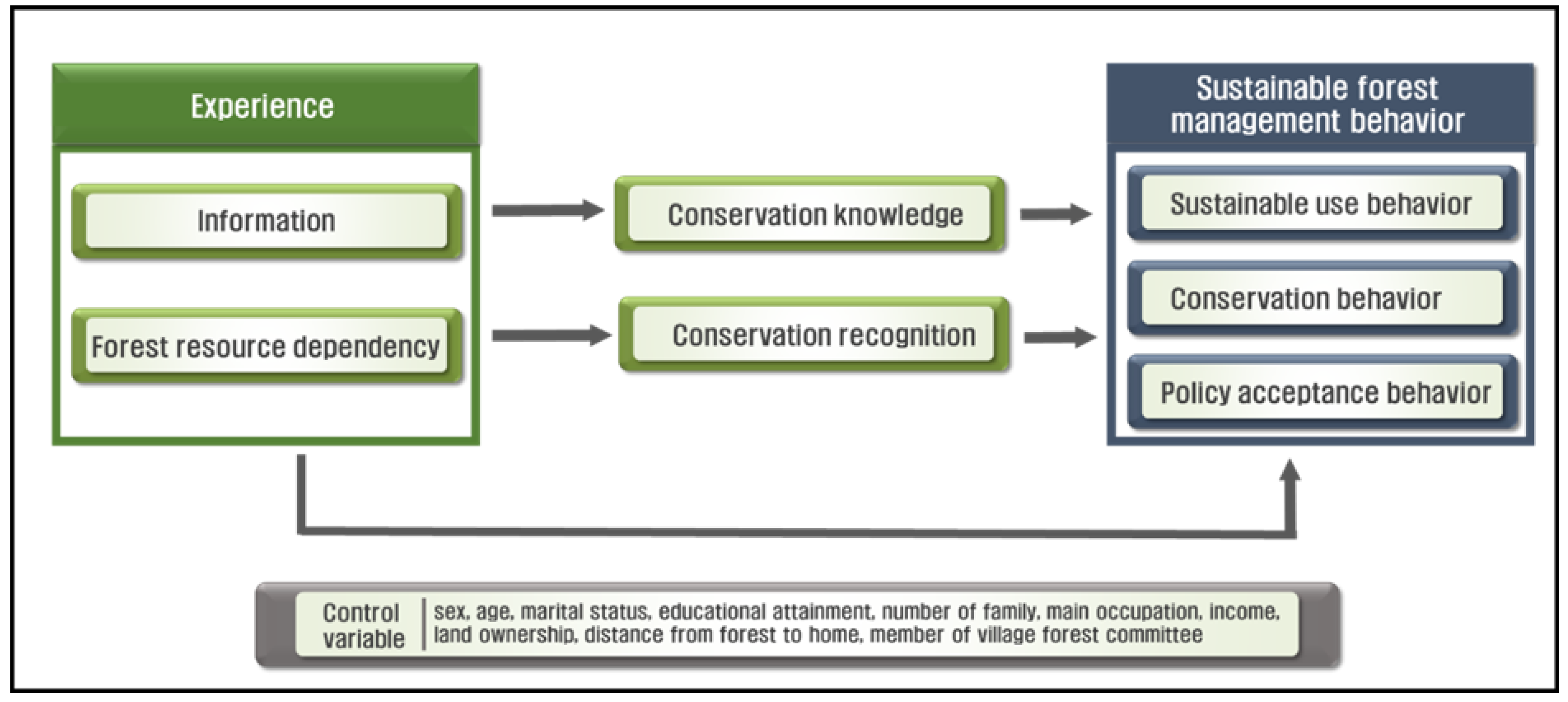
Table 2.
Socio-demographic characteristics of youth.
| Socio-demographiccharacteristics | Phonsay (n=110) | Khoun (n=110) | Phaxay (n=110) | Total (n=330) | ||||
|---|---|---|---|---|---|---|---|---|
| Frequency | % | Frequency | % | Frequency | % | Frequency | % | |
| Age | ||||||||
| < 20 | 5 | 1.52 | 3 | 0.91 | 12 | 3.63 | 20 | 6.06 |
| 20–29 | 41 | 12.42 | 65 | 19.70 | 61 | 18.48 | 167 | 50.61 |
| > 30 | 64 | 19.39 | 42 | 12.73 | 37 | 11.21 | 143 | 43.33 |
| Sex | ||||||||
| Male | 71 | 21.51 | 62 | 18.79 | 87 | 26.36 | 220 | 66.67 |
| Female | 39 | 11.81 | 48 | 14.54 | 23 | 6.97 | 110 | 33.33 |
| Educational attainment | ||||||||
| Uneducated | 21 | 6.36 | 45 | 13.64 | 24 | 7.27 | 90 | 27.27 |
| Primary school | 56 | 16.97 | 26 | 7.88 | 32 | 9.70 | 114 | 34.55 |
| Secondary school | 26 | 7.88 | 29 | 8.79 | 37 | 11.21 | 92 | 27.88 |
| Upper secondary and higher, diploma or equivalent and more than | 7 | 2.12 | 10 | 3.03 | 17 | 5.15 | 34 | 10.30 |
| Marital status | ||||||||
| Married, Widow | 103 | 31.21 | 103 | 31.21 | 93 | 28.18 | 299 | 90.61 |
| Single | 7 | 2.12 | 7 | 2.12 | 17 | 5.15 | 31 | 9.39 |
| Family members | ||||||||
| < 5 | 38 | 11.51 | 18 | 5.45 | 27 | 8.18 | 83 | 25.15 |
| 5–10 | 66 | 20.00 | 74 | 22.42 | 72 | 21.81 | 212 | 64.24 |
| >10 | 6 | 1.82 | 18 | 5.45 | 11 | 3.33 | 35 | 10.61 |
| Economic | ||||||||
| N0 | 0 | 0 | 0 | 0 | 0 | |||
| Yes | 110 | 33.33 | 110 | 33.33 | 110 | 33.33 | 330 | 100 |
| Monthly income (KIP) | ||||||||
| >1600001 | 14 | 4.24 | 40 | 12.12 | 8 | 2.42 | 62 | 18.78 |
| 1100001–1600000 | 21 | 6.36 | 13 | 3.94 | 7 | 2.12 | 41 | 12.42 |
| 700001–1100000 | 34 | 10.30 | 28 | 8.48 | 15 | 4.55 | 77 | 23.33 |
| 400000–700000 | 28 | 8.48 | 18 | 5.45 | 24 | 7.27 | 70 | 21.2 |
| < 400000 | 13 | 3.94 | 11 | 3.33 | 56 | 16.97 | 80 | 24.24 |
| Occupation | ||||||||
| Government officers, small businesses, and workers | 10 | 3.03 | 28 | 8.48 | 6 | 1.82 | 44 | 13.34 |
| Shifting cultivator | 59 | 17.88 | 40 | 12.12 | 47 | 14.24 | 146 | 44.24 |
| Distance | ||||||||
| < 0.025 | 20 | 6.06 | 8 | 2.42 | 28 | 8.48 | 56 | 16.97 |
| 0.025–0.5 | 48 | 14.54 | 67 | 20.30 | 81 | 24.54 | 196 | 59.39 |
| 0.51–1.0 | 1 | 0.30 | 30 | 9.09 | 1 | 0.30 | 32 | 9.70 |
| >1.0 | 41 | 12.42 | 5 | 1.52 | 0 | 0 | 46 | 13.94 |
| Member of village forest committee | ||||||||
| No | 90 | 27.27 | 95 | 28.79 | 103 | 31.21 | 288 | 87.27 |
| Yes | 20 | 6.06 | 15 | 4.55 | 3 | 0.91 | 38 | 11.52 |
| Total own land | ||||||||
| < 0.02 | 65 | 19.70 | 11 | 3.33 | 17 | 5.15 | 93 | 28.18 |
| 0.02–0.05 | 19 | 5.76 | 22 | 6.67 | 37 | 11.21 | 78 | 23.64 |
| 0.05-0.2 | 8 | 2.42 | 30 | 9.09 | 53 | 16.06 | 91 | 27.57 |
| > 0.2 | 15 | 4.55 | 47 | 14.24 | 3 | 0.91 | 65 | 19.7 |
Table 3.
Utilization of forest resources by youth.
| Species of NTFPs | Utilization (n=330) | |||||||
|---|---|---|---|---|---|---|---|---|
| Sell | Consumption | Medicine | Instruments/ Material | |||||
| Frequency | % | Frequency | % | Frequency | % | Frequency | % | |
| Plants | ||||||||
| Vegetables | 25 | 7.58 | 228 | 69.09 | 0 | 0 | 0 | 0 |
| Mushroom | 19 | 5.76 | 256 | 77.58 | 4 | 1.21 | 0 | 0 |
| Rattan | 43 | 13.03 | 148 | 44.85 | 1 | 0.30 | 27 | 8.18 |
| Broussonetia papyrifera Vent | 78 | 23.64 | 0 | 0 | 0 | 0 | 32 | 9.70 |
| Persea kurzii Kosterm | 75 | 22.73 | 0 | 0 | 0 | 0 | 9 | 2.73 |
| Dioscorea filiformis | 3 | 0.91 | 15 | 4.55 | 0 | 0 | 1 | 0.30 |
| Dioscorea hispida | 3 | 0.91 | 25 | 7.58 | 0 | 0 | 0 | 0 |
| Arenga westerhoutii Griff. | 47 | 14.24 | 43 | 13.03 | 0 | 0 | 2 | 0.61 |
| Brooms grass (Roxb) | 98 | 29.70 | 18 | 5.45 | 2 | 0.61 | 0 | 0 |
| Other (tubers; bamboo hoot) | 107 | 32.42 | 34 | 10.30 | 0 | 0 | 8 | 2.42 |
| Herbs | ||||||||
| Cardamom (Amomum sp.) | 30 | 9.09 | 12 | 3.64 | 18 | 5.45 | 2 | 0.61 |
| Medicine vine | 13 | 3.94 | 1 | 0.30 | 1 | 0.30 | 2 | 0.61 |
| Curcuma longa L. | 1 | 0.30 | 0 | 0 | 5 | 1.52 | 0 | 0 |
| Molineria latifolia | 2 | 0.61 | 1 | 0.30 | 5 | 1.52 | 2 | 0.61 |
| Others | 12 | 3.64 | 3 | 0.91 | 0 | 0 | 5 | 1.52 |
| Wild animals | ||||||||
| Tiger | 0 | 0 | 2 | 0.61 | 1 | 0.30 | 1 | 0.30 |
| Muntja deer | 3 | 0.91 | 129 | 39.09 | 0 | 0 | 2 | 0.61 |
| Wild boar | 15 | 4.55 | 180 | 54.55 | 0 | 0 | 2 | 0.61 |
| Deer | 2 | 0.61 | 8 | 2.42 | 0 | 0 | 2 | 0.61 |
| Monkey | 2 | 0.61 | 24 | 7.27 | 1 | 0.30 | 0 | 0 |
| Pangolin | 1 | 0.30 | 4 | 1.21 | 0 | 0 | 0 | 0 |
| Common palm civet | 12 | 3.64 | 152 | 46.06 | 0 | 0 | 2 | 0.61 |
| King cobra | 1 | 0.30 | 23 | 6.97 | 0 | 0 | 0 | 0 |
| Turtle | 6 | 1.82 | 44 | 13.33 | 0 | 0 | 0 | 0 |
| Squirrel | 2 | 0.61 | 74 | 22.42 | 0 | 0 | 3 | 0.91 |
| Wood | ||||||||
| Rosewood | 0 | 0 | 0 | 0 | 0 | 0 | 1 | 0.30 |
| Dalbergia cultrata Benth. | 3 | 0.91 | 0 | 0 | 0 | 0 | 33 | 10.00 |
| Afzeliaxylocarpa(Kurz) Craib | 1 | 0.30 | 0 | 0 | 0 | 0 | 21 | 6.36 |
| Alstoniascholaris (L.) R.Br. | 0 | 0 | 0 | 0 | 0 | 0 | 28 | 8.48 |
| Maidaeng (local name) | 0 | 0 | 0 | 0 | 0 | 0 | 38 | 11.52 |
| Mailongleng (local name) | 0 | 0 | 0 | 0 | 1 | 0.30 | 12 | 3.64 |
| Maimanpa (local name) | 0 | 0 | 0 | 0 | 0 | 0 | 6 | 1.82 |
| Dalbergiacultrata Grahamex Benth. | 0 | 0 | 0 | 0 | 0 | 0 | 4 | 1.21 |
| Other | 0 | 0 | 0 | 0 | 0 | 0 | 230 | 69.70 |
Table 4.
Model estimates of the socio-demographic variables association with conservation knowledge and recognition.
Table 4.
Model estimates of the socio-demographic variables association with conservation knowledge and recognition.
| Variables | Conservation knowledge | Conservation recognition | ||||
|---|---|---|---|---|---|---|
| B | Beta | p | B | Beta | p | |
| Sex | 0.103 | 0.059 | 0.334 | 0.222 | 0.127 | 0.026 |
| Age | -0.008 | -0.047 | 0.437 | -0.006 | -0.038 | 0.501 |
| Marital status | -0.023 | -0.008 | 0.895 | -0.130 | -0.046 | 0.420 |
| Educational attainment | 0.109 | 0.139 | 0.026 | 0.126 | 0.162 | 0.005 |
| Number of families | 0.009 | 0.026 | 0.650 | -0.005 | -0.014 | 0.790 |
| Main occupation | -0.041 | -0.025 | 0.657 | 0.119 | 0.072 | 0.168 |
| Total family monthly income (kip) | 0.000 | 0.009 | 0.886 | 0.000 | -0.123 | 0.033 |
| Total land owned (ha) | 0.001 | 0.003 | 0.953 | -0.042 | -0.123 | 0.027 |
| Distance from forest to home (km) | 0.049 | 0.052 | 0.365 | 0.098 | 0.103 | 0.052 |
| Member of village forest committee | 0.101 | 0.039 | 0.500 | 0.047 | 0.018 | 0.736 |
| Degree of information | 0.070 | 0.112 | 0.064 | 0.158 | 0.253 | 0.000 |
| Resource dependence | 0.013 | 0.028 | 0.614 | -0.038 | -0.083 | 0.113 |
| Constant | 3.174 | 0.000 | 3.346 | 0.000 | ||
| R square | 0.059 | 0.191 | ||||
| Adjusted R square | 0.023 | 0.161 | ||||
| F | 1.646 | 6.243 | ||||
| Sig | 0.078 | 0.000 | ||||
Mark * statistically significant at *: p<0.1; **: p<0.05; ***: p<0.01.
Table 5.
Model estimates of the socio-demographic variables association with sustainable use behavior, conservation behavior, and policy acceptance behavior.
Table 5.
Model estimates of the socio-demographic variables association with sustainable use behavior, conservation behavior, and policy acceptance behavior.
| Variables | Sustainable use behavior | Conservation behavior | Policy acceptance behavior | ||||||
|---|---|---|---|---|---|---|---|---|---|
| B | Beta | p | B | Beta | p | B | Beta | p | |
| Knowledge | -0.010 | -0.015 | 0.775 | 0.132 | 0.121 | 0.026 | 0.010 | 0.011 | 0.829 |
| Recognition | -0.040 | -0.061 | 0.296 | 0.209 | 0.191 | 0.001 | 0.384 | 0.409 | 0.000 |
| Degree of information | 0.015 | 0.036 | 0.534 | 0.098 | 0.143 | 0.015 | 0.081 | 0.139 | 0.010 |
| Resource dependence | 0.113 | 0.376 | 0.000 | 0.023 | 0.047 | 0.381 | -0.001 | -0.003 | 0.953 |
| Distance from forest to home (km) | 0.010 | 0.016 | 0.772 | 0.060 | 0.058 | 0.287 | 0.020 | 0.023 | 0.645 |
| Member of village forest committee | -0.010 | -0.006 | 0.916 | 0.019 | 0.007 | 0.902 | 0.212 | 0.088 | 0.082 |
| Sex | -0.031 | -0.027 | 0.643 | -0.058 | -0.031 | 0.598 | 0.181 | 0.110 | 0.039 |
| Age | -0.002 | -0.021 | 0.713 | -0.011 | -0.064 | 0.261 | 0.005 | 0.032 | 0.537 |
| Marital status | -0.066 | -0.035 | 0.540 | -0.031 | -0.010 | 0.864 | -0.312 | -0.118 | 0.028 |
| Educational attainment | 0.084 | 0.165 | 0.006 | 0.102 | 0.120 | 0.045 | 0.034 | 0.046 | 0.399 |
| Number of family members | 0.007 | 0.033 | 0.537 | 0.005 | 0.015 | 0.784 | 0.003 | 0.008 | 0.866 |
| Main occupation | 0.072 | 0.066 | 0.208 | -0.282 | -0.155 | 0.004 | -0.064 | -0.041 | 0.400 |
| Total family monthly income (kip) | 0.000 | -0.023 | 0.692 | 0.000 | -0.051 | 0.383 | 0.000 | -0.009 | 0.870 |
| Total land owned (ha) | 0.009 | 0.040 | 0.475 | 0.035 | 0.095 | 0.093 | 0.003 | 0.010 | 0.853 |
| Constant | 1.874 | 0.000 | 1.236 | 0.005 | 1.433 | 0.000 | |||
| R square | 0.181 | 0.176 | 0.301 | ||||||
| Adjusted R square | 0.145 | 0.139 | 0.270 | ||||||
| F | 4.985 | 4.809 | 9.698 | ||||||
| Sig | 0.000 | 0.000 | 0.000 | ||||||
Mark * statistically significant at *: p<0.1; **: p<0.05; ***: p<0.01.
Disclaimer/Publisher’s Note: The statements, opinions and data contained in all publications are solely those of the individual author(s) and contributor(s) and not of MDPI and/or the editor(s). MDPI and/or the editor(s) disclaim responsibility for any injury to people or property resulting from any ideas, methods, instructions or products referred to in the content. |
© 2024 by the authors. Licensee MDPI, Basel, Switzerland. This article is an open access article distributed under the terms and conditions of the Creative Commons Attribution (CC BY) license (http://creativecommons.org/licenses/by/4.0/).
Copyright: This open access article is published under a Creative Commons CC BY 4.0 license, which permit the free download, distribution, and reuse, provided that the author and preprint are cited in any reuse.


