

Submitted:
08 October 2024
Posted:
09 October 2024
You are already at the latest version
Abstract
Background/Objectives: Prospective cohort studies are useful for studying how biomolecular status affects risk of adverse health outcomes. Less well known is that the longer the follow-up time, the lower the apparent effect due to “regression dilution.” Here we evaluate how follow-up time affects the relationship between serum 25-hydroxyvitamin D [25(OH)D] concen-tration and incidence of stroke and major cardiovascular events (MCEs). Methods: Findings re-garding the relative risk (RR) of stroke and MCEs with respect to serum 25(OH)D concentrations at baseline from prospective cohort studies were plotted against mean follow-up time. Fifteen studies from mainly European countries and the United States were used for stroke, with nine studies for MCEs. Linear regression analyses were performed for follow-up periods of up to 10 years. Results: For stroke, the linear regression fit for 1–10 years is RR = 0.34 + (0.065 × follow-up [years]), r = 0.84, adjusted r2 = 0.67, p <0.001. No significant change was evident for studies with follow-up periods of 10–20 years. For MCEs, the linear fir for 1–8.1 years is RR = 1.61 ‒ (0.074 × follow-up [years]), r = 0.75, adjusted r2 = 0.49, p = 0.03. Discussion: The shorter the follow-up period, the greater the apparent effect of vitamin D in reducing risk of stroke and MCEs. In addition, the apparent effect of higher 25(OH)D concentration found for the shortest follow-up time is more than twice as high as the estimate based on averaging the results for all studies without considering follow-up time. Mechanisms have been found to explain how higher serum 25(OH)D concentrations could reduce risk of stroke and MCEs. Randomized controlled trials have not shown that vitamin D supplementation significantly reduces risk of either stroke or MCE, probably because risk of both outcomes increases rapidly below 15 ng/mL (38 nmol/L) and it is difficult in Western developed countries to enroll enough participants with concentrations that low. Nonetheless, vitamin D’s role in reducing risk of stroke and MCE can be considered causal on the basis of an evaluation of the evidence with respect to Hill’s criteria for causality in a biological system. Conclusions: Serum 25(OH)D concentrations above 20 ng/mL are associated with significantly reduced risk of stroke and MCEs in an apparent causal manner. Raising serum 25(OH)D concentrations to >20 ng/mL should be recommended for everyone likely to be at risk for stroke or MCE and indeed in the general population.
Keywords:
Cardiovascular disease
; causality
; follow-up period/time
; heart failure
; hemorrhagic
; hypertension
; ischemic
; prospective cohort study
; stroke
; vitamin D
1. Introduction
The prospective cohort study is a type of observational study commonly used to assess how dietary and lifestyle factors and biological variables affect health outcomes. Participants are recruited and enrolled, information relevant to the study is obtained from each participant, and participants are followed up for some period during which various health outcomes of interest are recorded. Afterward, health outcome rates are compared statistically with data obtained at enrollment. Most such studies do not remeasure any variables assessed during the follow-up period. Therefore, an underestimation of risk associations due to “regression dilution” generally occurs in long-term follow-up of prospective studies, as outlined by Clarke and colleagues in 1999 [1]. Those authors reported repeated measurements over 25 years for systolic and diastolic blood pressure and blood cholesterol for participants in the Framingham Study. The researchers showed that the range from high to low for the first and fifth quantile shrank by 65%, 75%, and 57%, respectively. Although the article had 897 citations by August 31, 2024, according to Google Scholar, the research seems not to have had much effect on conduct of prospective cohort studies or, more important, on meta-analyses of such studies. The concentration of 25-hydroxyvitamin D [25(OH)D] in serum changes over time. For example, a study in Norway reported that the correlation coefficient, r, for serum 25(OH)D concentrations measured in 2668 participants in 1994 and again in 2008 and adjusted for season of measurement was 0.42 [2]. In comparison, the correlation coefficients for systolic blood pressure, diastolic blood pressure, pulse, body mass index (kilograms per square meter of body surface area), serum total cholesterol, and triglycerides between 1994 and 2008 values were 0.47, 0.42, 0.46, 0.83, 0.37, and 0.49, respectively. The effect of changes in serum 25(OH)D has been known for cancer since 2011 [3] and for all-cause mortality rate since 2012 [4], yet that effect was overlooked in a highly cited meta-analysis of risk of colorectal cancer with respect to serum 25(OH)D concentration in 2019 [5], as Muñoz and Grant pointed out in 2022 [6].
Recently, researchers showed that the same effect (of changes in vitamin D status over time) is found for risk of cognitive impairment, dementia, and Alzheimer’s disease. The 2024 meta-analyses included 15 prospective studies regarding dementia and/or Alzheimer’s disease and nine regarding cognitive impairment [7]. As shown in plots of risk ratio for low versus high 25(OH)D concentration with different follow-up periods, linear decreases emerged in the regression fit to the data from near 2.0 for the shortest follow-up periods (near 4–5 years) to near 1.0 for follow-up periods near 13 years [8].
Stroke is an important cause of disability and death. In 2016, an estimated 13.7 million new incident strokes occurred globally, of which about 87% were ischemic strokes [9]. In 2017, an estimated 1.12 million incident strokes occurred in the European Union, with 9.53 million stroke survivors and 7.06 million disability-adjusted life years lost because of stroke [10]. A prospective study of 418,329 participants in the European Prospective Investigation into Cancer and Nutrition (EPIC) included an analysis of dietary risk factors for stroke [11]. Risk of ischemic stroke was inversely associated with consumption of fruit and vegetables, dietary fiber, and dairy foods, whereas risk of hemorrhagic stroke was positively associated with egg consumption.
2. Materials and Methods
The data used here are from the prospective cohort studies in Su and colleagues [12] and Xiong and colleagues [13]. Table 1 and Table 2 list the studies in ascending order of follow-up period. Table 1 includes the OR/RR from Su and colleagues [12] and Xiong and colleagues [13] and the follow-up period and 25(OH)D concentration comparison obtained from each article. We excluded four studies from the analysis: Two did not have enough information on follow-up period or on how 25(OH)D concentrations were compared, whereas two others were based on dietary vitamin D intake.
Table 3 and Table 4 list information from eight studies used to investigate the effect of follow-up period on risk of incidence of MCEs. The tables do not include studies regarding cardiovascular disease (CVD) mortality rate because mortality can be significantly affected by treatment, thereby obscuring the effect of serum 25(OH)D concentration. MCE incidence can also be lowered through intervention. For example, lowering blood pressure pharmacologically by 5 mmHg can lower incidence of MCEs by 5%‒15% depending on baseline blood pressure [33].
Data were analyzed using SigmaStat 4.0 (Grafiti, Palo Alto, CA, USA). Data plots were made using KaleidaGraph 4.5.4 (Synergy Software, Reading, PA, USA).
3. Results
Figure 1 shows a plot of the data from Table 1 along with the linear regressions calculated from those data. The data were analyzed after division into two groups of 1–10 years or >10-year follow-up periods between baseline vitamin D and determination of the incident events. Determination of the dividing year was made by inspecting the data plot. The graph shows a good linear fit to the data for follow-up periods of 1–10 years: RR = 0.34 + (0.065 × follow-up [years]), r = 0.84, adjusted r2 = 0.67, p < 0.001. The regression fit for data from >10-year follow-up periods shows no significant change with increasing follow-up periods. In addition, the 95% confidence interval (95% CI) values are smaller for shorter follow-up periods. That result may simply reflect the higher events-to-controls ratios in studies with shorter follow-up periods. Although most studies gave results for all strokes (hemorrhagic and ischemic), ischemic strokes are much more frequent than hemorrhagic strokes in the countries studied [9]. Some reports included in the present study, however, showed that hemorrhagic strokes had weaker associations with baseline serum 25(OH)D concentrations than did ischemic stokes [18,28].
4. Discussion
The meta-analysis of RRs for stroke in relation to serum 25(OH)D concentration, based on 21 prospective observational studies by Su and colleagues [12], reported an average value of 0.78 (95% CI, 0.70‒0.86), whereas that by Xiong and colleagues [13], based on a slightly different 21 prospective observational studies, showed an average value of 0.78 (95% CI, 0.70‒0.87). Those values are approximately half the reduction seen for the 1-year follow-up period and 44% of the regression found for the zero follow-up period in the present study. That finding offers more evidence that not considering the effect of follow-up period in meta-analyses of observational studies with long follow-up times can greatly underestimate the effect of the variable studied. As a result, public policy recommendations are not as strong as they could be.
In a 2020 article, Shi and colleagues [42] calculated the dose–response relationship for 25(OH)D concentration and stroke risk by using mostly the same observational studies as Su and colleagues [12]. The result, shown in Figure 2 in ref. [42], was that risk decreased by ~20% with increasing vitamin D status between zero and ~20 ng/ml, with no further risk reduction between 20 and 40 ng/ml. However, as a result of not having accounted for variation in follow-up period, that analysis underestimates the reduction actually achievable with better vitamin D status. By contrast, the study does show that the main risk reduction occurs with increases in serum 25(OH)D up to 15 ng/mL. Very few randomized controlled trials (RCTs) could enroll participants with mean 25(OH)D concentrations that low, for ethical reasons, unless conducted in a country where such low 25(OH)D concentrations commonly persist. For example, many Middle Eastern countries have diets low in animal products and where people often wear clothing that covers most of the body and stay indoors during the hot summers [43]. Results of a stratified randomized field trial of vitamin D supplementation in pregnant women in Iran reported that the mean baseline 25(OH)D concentration was 11 ng/mL [44]. By supplementing the women at one hospital with enough vitamin D to raise 25(OH)D concentrations to above 20 ng/mL, significant reductions occurred for gestational diabetes, preeclampsia, and preterm birth in comparison with outcomes in a comparable hospital where pregnant women stayed unsupplemented.
Comparing the differences in outcomes for stroke, CVD, and cancer is insightful. Cancer incidence and mortality rates used to have very large geographic variations in the United States [6], but stroke and CVD have not shown similar geographical variations. However, they do have more pronounced seasonal variations in mortality rates than cancer, with 20% higher mortality rates in winter than in summer in northern hemisphere countries [45]. The seasonal variation is due in part to the seasonal variations in serum 25(OH)D concentrations related to solar UVB doses [46,47]. Cancers have large geographical variations in midlatitude counties such as the United States [48] because serum 25(OH)D concentrations greater than 50 ng/mL reduce risk in comparison with lower concentrations, as shown for colorectal cancer [49] and breast cancer [50]. The differences in the 25(OH)D concentration–risk relationship also explain why the VITAL study—with a mean 25(OH)D concentration of 31 ng/mL for the participants in the vitamin D treatment arm whose serum 25(OH)D was measured—showed significantly reduced all-cancer incidence rates for participants with BMI < 25 kg/m2 and reduced all-cancer mortality rates for the entire treatment group, but no significant effects for cardiovascular disease [51]. In that RCT, MCEs occurred in 3.1% of the vitamin D treatment arm and in 3.2% of the placebo arm, whereas strokes occurred in 1.1% of the vitamin D treatment arm and 1.2% of the placebo arm.
An important question is how rapidly vitamin D might reduce risk of adverse brain and other health outcomes. As discussed in the analysis of follow-up period for cognitive function, an RCT showed significant beneficial effects in improving cognitive function during 1 year of vitamin D supplementation [52]. To examine that question, we searched Google Scholar for representative RCTs that reported a beneficial effect on brain health in less than 1 year (Table 5). Significant benefits were found for depression and cognitive function within a year. Those studies show evidence that raising serum 25(OH)D concentrations can yield significant improvements in brain health in less than a year. Three of those papers dealt with studies from China, India, and/or Iran, whose serum 25(OH)D concentrations are generally low. That situation allows RCTs in those communities to be more likely to show health benefits from supplementation than studies done in countries with higher mean 25(OH)D concentrations.
For many reasons, serum 25(OH)D concentrations change over time scales from months to years (Table 6).
Several mechanisms have been identified that help explain how higher 25(OH)D concentrations can reduce risk of stroke. For example, a 2014 review [67] stated that vitamin D influences neuronal function by binding to vitamin D receptors that can act as transcription factors and regulate gene expression [68]. Particularly in the nervous system, vitamin D’s biological effects appear to arise from stimulation of neurotrophic factors, quenching of oxidative hyperactivity, and regulation of autoimmune responses [69]. Increasing 25(OH)D concentrations through vitamin D supplementation causes more genes to be expressed (or, more rarely, fewer). Thirty healthy adults were randomized to receive 600, 4000, or 10,000 IU/day of vitamin D3 for 6 months. The study showed a dose-dependent 25(OH)D alteration in broad gene expression with 162, 320, and 1289 genes, respectively, upregulated or downregulated in white blood cells [70].
Evidence also exists that vitamin D supplementation in vitamin D–deficient subjects can reduce serum concentrations of matrix metalloproteinases MMP-2 and MMP-9, as well as of the inhibitor, TIMP-1, and C-reactive protein [71]. That finding is relevant because people who develop MCEs have raised MMP-9 concentrations, and MMP-9 is an important risk factor for vulnerable atherosclerotic plaque [72].
Hypertension is a risk factor for stroke. A dose–response meta-analysis showed that higher adherence to antihypertension medications reduced the risk of hemorrhagic stroke by 45% (RR = 0.55 [95% CI, 0.42‒0.72]) and ischemic stroke by 26% (RR = 0.74 [95% CI, 0.69‒0.79]) [73]. A meta-analysis of serum 25(OH)D concentration on risk of hypertension in the general population based on cohort studies reported a significant increase of 38% (RR = 1.38 [95% CI = 1.14‒1.64]) as 25(OH)D concentration decreased from 75 to 15 nmol/L [74]. The same paper showed no effect of vitamin D supplementation on systolic or diastolic blood pressure on the basis of 27 studies. However, three supplementation studies reported significant or near-significant reductions of systolic blood pressure [75,76,77]. Also, an open-label study in Canada in which participants took enough vitamin D3 to increase serum 25(OH)D concentrations above 40 ng/mL reported significant reductions in the prevalence of hypertension [78]. Thus, some evidence shows that vitamin D does lower blood pressure and reduces the risk of established hypertension.
Table 7 lists more mechanisms by which vitamin D can reduce risk of stroke and MCEs.
RCTs have not supported the role of better vitamin D provision in reducing risk of stroke. A 2020 systematic review and meta-analysis of vitamin D supplementation and incidence of stroke included 13 RCTs [89]. The mean age was 66 years and the mean follow-up time was 3.1 years. The mean baseline 25(OH)D concentration for studies that reported values was 19.4 ng/mL (range, 8.8‒25.4 ng/mL). The percentage of participants in those 13 trials who experienced a stroke was 2.1% in both the treatment and control arms, resulting in a RR for stroke of 1.00 (95% CI, 0.91‒1.10). Inspecting the baseline characteristics of participants in those trials (in Table 1 in Nudy 2021 [89]) shows that participants were being studied for various adverse health effects, including arthritis index pain, asthma exacerbations, progression to type 2 diabetes mellitus, falls and fractures, insulin sensitivity, and renal function. In other words, none of the trials was established specifically to evaluate the role of vitamin D supplementation, in deficiency, on the risk of stroke incidence.
A 2024 review included a different set of five vitamin D RCTs assessing the risk of ischemic strokes [90]. Mean baseline 25(OH)D concentrations were from 66 ± 23 to 77 ± 25 ng/mL in four trials and 38 ± 16 ng/mL in one trial. Follow-up duration ranged from 3.3 to 5.3 years. All those trials had CVD outcome as a primary outcome. Again, no significant difference in stroke risk was found between the vitamin D treatment and control arms, as could have been predicted from the baseline vitamin D status.
Even if the trials had been set up to test for stroke incidence, they probably would not have shown a beneficial effect for several reasons. First, nearly all vitamin D RCTs have been based on guidelines for pharmaceutical drugs. In such trials, the control arm does not receive the drug. That is not the case for vitamin D trials because vitamin D is a naturally occurring substance required for life. In 2014, Heaney outlined guidelines for trials regarding nutrients [91]. The main steps appropriate for vitamin D [92] are as follows:
- Measure 25(OH)D concentrations and include participants with low concentrations appropriate for the outcome of interest.
- Give a vitamin D dose large enough to raise 25(OH)D concentrations to levels at which beneficial effects are expected.
- Measure achieved 25(OH)D concentrations.
- Analyze results with respect to achieved vitamin D concentrations.
The second main reason for poor results from vitamin D RCTs is the enrollment of people with relatively high 25(OH)D concentrations. Other reasons include giving relatively low doses, too small to correct deficiency, and permitting participants in the control arms to take moderate vitamin D supplements; and analyzing results by intention to treat rather than by initial and achieved vitamin D status. Those common failures have been discussed in two 2022 reviews [93,94].
Risk of incidence of stroke and other CVD events increases rapidly as serum 25(OH)D concentrations fall below 20 ng/mL [23,95]. Thus, the large VITAL study [51], which enrolled participants whose mean baseline 25(OH)D concentration was 31 ng/ml in the vitamin D treatment arm, had no chance of finding any significant reduction of CVD from supplementation at 2000 IU/day of vitamin D3, The failure to recruit participants with deficiency and permitting those in the placebo arm to take up to 600 or, for those over 70 years, 800 IU/day of vitamin D, reduced the possibility of any significant findings being able to emerge from the VITAL trial.
A stratified randomized field trial of vitamin D supplementation for pregnant women in Iran [44] shows how to design and carry out a vitamin D RCT more appropriately, here for CVD and stroke. First, participants had mean 25(OH)D concentrations of about 11 ng/mL. Second, serum 25(OH)D concentrations for the vitamin D treatment arm were measured during the trial. Those readings were used to adjust vitamin D doses to ensure that 25(OH)D concentrations greater than 20 ng/mL were achieved throughout the trial, as shown by follow-up 25(OH)D values, whereas participants in the control arm received no vitamin D supplements. Outcomes for gestational diabetes, preeclampsia, and preterm delivery were then evaluated with respect to achieved 25(OH)D concentrations, and significant reductions in those outcomes were found. Those findings were in contrast with results from standard vitamin D RCTs for pregnant women that were used to prepare a recent Cochrane review [96].
The allopathic medical system relies on RCTs to show effectiveness and limited adverse effects before approving pharmaceutical drugs for general use. As discussed, vitamin D RCTs based on guidelines for pharmaceutical drugs are not appropriate for vitamin D. In addition, Hill in 1965 proposed another way to ascertain causality in a biological system [97]. The criteria appropriate for vitamin D include strength of association, consistent findings in different populations, temporality, biological gradient, plausibility (e.g., mechanisms known), coherence with known science of the day, experiment, and analogy. Necessary adjustment for confounding factors and bias were added later [98]. A 2024 review discussed how those considerations have influenced epidemiologic methods [99]. For vitamin D, examination of Hill’s criteria for causality of inadequate vitamin D provision for various health outcomes (diseases) [94], including cardiovascular disease [100], suggested that the criteria were generally satisfied. The main limitation was in finding reliable evidence from experimentation owing to the problems with RCTs as discussed above and as recently reviewed [87].
Table 8 uses Hill’s criteria to briefly outline the evidence that vitamin D reduces risk of stroke. As Hill noted, not all criteria need be satisfied for causality to be likely, though the more that are, the stronger the claim.
5. Conclusions
From our findings, the risks of stroke and of acute cardiovascular events could be minimized by keeping serum 25(OH)D concentrations above 20‒30 ng/mL in the population. In normal-weight people, that level can be achieved with supplementation of at least 1000 IU/day of vitamin D3. A more reliable dose would be 2000 IU/day [103]. Obese people, however, should take 2–3 times higher doses and overweight individuals should take 1.5 times as much [104].
Author Contributions
Writing—original draft preparation, W.B.G. Writing the final article and final editing, W.B.G. and B.J.B. All authors have read and agreed to the published version of the manuscript.
Funding
This research received no external funding.
Institutional Review Board Statement
Not applicable.
Data Availability Statement
The original contributions presented in the study are included in the article or in the references provided. Further inquiries can be directed to the corresponding author.
Conflicts of Interest
W.B.G. had funding in prior years from Bio-Tech Pharmacal Inc., (Fayetteville, AR, USA). The funder had no role in the design of the study; in the collection, analyses, or interpretation of data; in the writing of the manuscript; or in the decision to publish the results. B.J.B. has no conflicts of interest to declare.
References
- Clarke, R.; Shipley, M.; Lewington, S.; Youngman, L.; Collins, R.; Marmot, M.; Peto, R. Underestimation of risk associations due to regression dilution in long-term follow-up of prospective studies. Am J Epidemiol 1999, 150, 341–353. [Google Scholar] [CrossRef] [PubMed]
- Jorde, R.; Sneve, M.; Hutchinson, M.; Emaus, N.; Figenschau, Y.; Grimnes, G. Tracking of serum 25-hydroxyvitamin D levels during 14 years in a population-based study and during 12 months in an intervention study. Am J Epidemiol 2010, 171, 903–908. [Google Scholar] [CrossRef] [PubMed]
- Grant, W.B. Effect of interval between serum draw and follow-up period on relative risk of cancer incidence with respect to 25-hydroxyvitamin D level: Implications for meta-analyses and setting vitamin D guidelines. Dermatoendocrinol 2011, 3, 199–204. [Google Scholar] [CrossRef]
- Grant, W.B. Effect of follow-up time on the relation between prediagnostic serum 25-hydroxyvitamin D and all-cause mortality rate. Dermatoendocrinol 2012, 4, 198–202. [Google Scholar] [CrossRef]
- McCullough, M.L.; Zoltick, E.S.; Weinstein, S.J.; Fedirko, V.; Wang, M.; Cook, N.R.; Eliassen, A.H.; Zeleniuch-Jacquotte, A.; Agnoli, C.; Albanes, D. , et al. Circulating Vitamin D and Colorectal Cancer Risk: An International Pooling Project of 17 Cohorts. J Natl Cancer Inst 2019, 111, 158–169. [Google Scholar] [CrossRef]
- Munoz, A.; Grant, W.B. Vitamin D and Cancer: An Historical Overview of the Epidemiology and Mechanisms. Nutrients 2022, 14, 1448. [Google Scholar] [CrossRef]
- Zhang, X.X.; Wang, H.R.; Meng, W.; Hu, Y.Z.; Sun, H.M.; Feng, Y.X.; Jia, J.J. Association of Vitamin D Levels with Risk of Cognitive Impairment and Dementia: A Systematic Review and Meta-Analysis of Prospective Studies. J Alzheimers Dis 2024, 98, 373–385. [Google Scholar] [CrossRef]
- Grant, W.B. Follow-up period affects the association between serum 25-hydroxyvitamin D concentration and incidence of dementia, Alzheimer’s disease, and cognitive impairment. Nutrients 2024, 16, 3211. [Google Scholar] [CrossRef] [PubMed]
- Saini, V.; Guada, L.; Yavagal, D.R. Global Epidemiology of Stroke and Access to Acute Ischemic Stroke Interventions. Neurology 2021, 97, S6–S16. [Google Scholar] [CrossRef]
- Wafa, H.A.; Wolfe, C.D.A.; Emmett, E.; Roth, G.A.; Johnson, C.O.; Wang, Y. Burden of Stroke in Europe: Thirty-Year Projections of Incidence, Prevalence, Deaths, and Disability-Adjusted Life Years. Stroke 2020, 51, 2418–2427. [Google Scholar] [CrossRef]
- Tong, T.Y.N.; Appleby, P.N.; Key, T.J.; Dahm, C.C.; Overvad, K.; Olsen, A.; Tjonneland, A.; Katzke, V.; Kuhn, T.; Boeing, H. , et al. The associations of major foods and fibre with risks of ischaemic and haemorrhagic stroke: a prospective study of 418 329 participants in the EPIC cohort across nine European countries. Eur Heart J 2020, 41, 2632–2640. [Google Scholar] [CrossRef] [PubMed]
- Su, C.; Jin, B.; Xia, H.; Zhao, K. Association between Vitamin D and Risk of Stroke: A PRISMA-Compliant Systematic Review and Meta-Analysis. Eur Neurol 2021, 84, 399–408. [Google Scholar] [CrossRef] [PubMed]
- Xiong, J.; Zhao, C.; Li, J.; Li, Y. A systematic review and meta-analysis of the linkage between low vitamin D and the risk as well as the prognosis of stroke. Brain Behav 2024, 14, e3577. [Google Scholar] [CrossRef] [PubMed]
- Guo, J.; Cockcroft, J.R.; Elwood, P.C.; Pickering, J.E.; Lovegrove, J.A.; Givens, D.I. Vitamin D intake and risk of CVD and all-cause mortality: evidence from the Caerphilly Prospective Cohort Study. Public Health Nutr 2017, 20, 2744–2753. [Google Scholar] [CrossRef]
- Leu Agelii, M.; Lehtinen-Jacks, S.; Zetterberg, H.; Sundh, V.; Bjorkelund, C.; Lissner, L. Low vitamin D status in relation to cardiovascular disease and mortality in Swedish women - Effect of extended follow-up. Nutr Metab Cardiovasc Dis 2017, 27, 1143–1151. [Google Scholar] [CrossRef]
- Zittermann, A.; Morshuis, M.; Kuhn, J.; Pilz, S.; Ernst, J.B.; Oezpeker, C.; Dreier, J.; Knabbe, C.; Gummert, J.F.; Milting, H. Vitamin D metabolites and fibroblast growth factor-23 in patients with left ventricular assist device implants: association with stroke and mortality risk. Eur J Nutr 2016, 55, 305–313. [Google Scholar] [CrossRef]
- Anderson, J.L.; May, H.T.; Horne, B.D.; Bair, T.L.; Hall, N.L.; Carlquist, J.F.; Lappe, D.L.; Muhlestein, J.B.; Intermountain Heart Collaborative Study, G. Relation of vitamin D deficiency to cardiovascular risk factors, disease status, and incident events in a general healthcare population. Am J Cardiol 2010, 106, 963–968. [Google Scholar] [CrossRef]
- Judd, S.E.; Morgan, C.J.; Panwar, B.; Howard, V.J.; Wadley, V.G.; Jenny, N.S.; Kissela, B.M.; Gutierrez, O.M. Vitamin D deficiency and incident stroke risk in community-living black and white adults. Int J Stroke 2016, 11, 93–102. [Google Scholar] [CrossRef]
- Drechsler, C.; Pilz, S.; Obermayer-Pietsch, B.; Verduijn, M.; Tomaschitz, A.; Krane, V.; Espe, K.; Dekker, F.; Brandenburg, V.; Marz, W. , et al. Vitamin D deficiency is associated with sudden cardiac death, combined cardiovascular events, and mortality in haemodialysis patients. Eur Heart J 2010, 31, 2253–2261. [Google Scholar] [CrossRef]
- Bolland, M.J.; Bacon, C.J.; Horne, A.M.; Mason, B.H.; Ames, R.W.; Wang, T.K.; Grey, A.B.; Gamble, G.D.; Reid, I.R. Vitamin D insufficiency and health outcomes over 5 y in older women. Am J Clin Nutr 2010, 91, 82–89. [Google Scholar] [CrossRef]
- Perna, L.; Schottker, B.; Holleczek, B.; Brenner, H. Serum 25-hydroxyvitamin D and incidence of fatal and nonfatal cardiovascular events: a prospective study with repeated measurements. J Clin Endocrinol Metab 2013, 98, 4908–4915. [Google Scholar] [CrossRef] [PubMed]
- Kuhn, T.; Kaaks, R.; Teucher, B.; Hirche, F.; Dierkes, J.; Weikert, C.; Katzke, V.; Boeing, H.; Stangl, G.I.; Buijsse, B. Plasma 25-hydroxyvitamin D and its genetic determinants in relation to incident myocardial infarction and stroke in the European prospective investigation into cancer and nutrition (EPIC)-Germany study. PLoS One 2013, 8, e69080. [Google Scholar] [CrossRef] [PubMed]
- Welles, C.C.; Whooley, M.A.; Karumanchi, S.A.; Hod, T.; Thadhani, R.; Berg, A.H.; Ix, J.H.; Mukamal, K.J. Vitamin D deficiency and cardiovascular events in patients with coronary heart disease: data from the Heart and Soul Study. Am J Epidemiol 2014, 179, 1279–1287. [Google Scholar] [CrossRef]
- Afzal, S.; Nordestgaard, B.G. Vitamin D, Hypertension, and Ischemic Stroke in 116 655 Individuals From the General Population: A Genetic Study. Hypertension 2017. [Google Scholar] [CrossRef]
- Marniemi, J.; Alanen, E.; Impivaara, O.; Seppanen, R.; Hakala, P.; Rajala, T.; Ronnemaa, T. Dietary and serum vitamins and minerals as predictors of myocardial infarction and stroke in elderly subjects. Nutr Metab Cardiovasc Dis 2005, 15, 188–197. [Google Scholar] [CrossRef]
- Skaaby, T.; Husemoen, L.L.; Pisinger, C.; Jorgensen, T.; Thuesen, B.H.; Fenger, M.; Linneberg, A. Vitamin D status and incident cardiovascular disease and all-cause mortality: a general population study. Endocrine 2013, 43, 618–625. [Google Scholar] [CrossRef] [PubMed]
- Leung, R.Y.; Han, Y.; Sing, C.W.; Cheung, B.M.; Wong, I.C.; Tan, K.C.; Kung, A.W.; Cheung, C.L. Serum 25-hydroxyvitamin D and the risk of stroke in Hong Kong Chinese. Thromb Haemost 2017, 117, 158–163. [Google Scholar] [CrossRef]
- Berghout, B.P.; Fani, L.; Heshmatollah, A.; Koudstaal, P.J.; Ikram, M.A.; Zillikens, M.C.; Ikram, M.K. Vitamin D Status and Risk of Stroke: The Rotterdam Study. Stroke 2019, 50, 2293–2298. [Google Scholar] [CrossRef] [PubMed]
- Schierbeck, L.L.; Rejnmark, L.; Tofteng, C.L.; Stilgren, L.; Eiken, P.; Mosekilde, L.; Kober, L.; Jensen, J.E. Vitamin D deficiency in postmenopausal, healthy women predicts increased cardiovascular events: a 16-year follow-up study. Eur J Endocrinol 2012, 167, 553–560. [Google Scholar] [CrossRef]
- Sheerah, H.A.; Eshak, E.S.; Cui, R.; Imano, H.; Iso, H.; Tamakoshi, A.; Japan Collaborative Cohort Study, G. Relationship Between Dietary Vitamin D and Deaths From Stroke and Coronary Heart Disease: The Japan Collaborative Cohort Study. Stroke 2018, 49, 454–457. [Google Scholar] [CrossRef]
- Schneider, A.L.; Lutsey, P.L.; Selvin, E.; Mosley, T.H.; Sharrett, A.R.; Carson, K.A.; Post, W.S.; Pankow, J.S.; Folsom, A.R.; Gottesman, R.F. , et al. Vitamin D, vitamin D binding protein gene polymorphisms, race and risk of incident stroke: the Atherosclerosis Risk in Communities (ARIC) study. Eur J Neurol 2015, 22, 1220–1227. [Google Scholar] [CrossRef] [PubMed]
- Kojima, G.; Bell, C.; Abbott, R.D.; Launer, L.; Chen, R.; Motonaga, H.; Ross, G.W.; Curb, J.D.; Masaki, K. Low dietary vitamin D predicts 34-year incident stroke: the Honolulu Heart Program. Stroke 2012, 43, 2163–2167. [Google Scholar] [CrossRef] [PubMed]
- Blood Pressure Lowering Treatment Trialists, C. Pharmacological blood pressure lowering for primary and secondary prevention of cardiovascular disease across different levels of blood pressure: an individual participant-level data meta-analysis. Lancet 2021, 397, 1625–1636. [Google Scholar] [CrossRef]
- Grandi, N.C.; Breitling, L.P.; Brenner, H. Vitamin D and cardiovascular disease: systematic review and meta-analysis of prospective studies. Prev Med 2010, 51, 228–233. [Google Scholar] [CrossRef]
- Zhang, H.; Wang, P.; Jie, Y.; Sun, Y.; Wang, X.; Fan, Y. Predictive value of 25-hydroxyvitamin D level in patients with coronary artery disease: A meta-analysis. Front Nutr 2022, 9, 984487. [Google Scholar] [CrossRef]
- De Metrio, M.; Milazzo, V.; Rubino, M.; Cabiati, A.; Moltrasio, M.; Marana, I.; Campodonico, J.; Cosentino, N.; Veglia, F.; Bonomi, A. , et al. Vitamin D plasma levels and in-hospital and 1-year outcomes in acute coronary syndromes: a prospective study. Medicine (Baltimore) 2015, 94, e857. [Google Scholar] [CrossRef]
- Beska, B.; Chan, D.; Gu, S.; Qiu, W.; Mossop, H.; Neely, D.; Kunadian, V. The association between vitamin D status and clinical events in high-risk older patients with non-ST elevation acute coronary syndrome undergoing invasive management. PLoS One 2019, 14, e0217476. [Google Scholar] [CrossRef]
- Ng, L.L.; Sandhu, J.K.; Squire, I.B.; Davies, J.E.; Jones, D.J. Vitamin D and prognosis in acute myocardial infarction. Int J Cardiol 2013, 168, 2341–2346. [Google Scholar] [CrossRef]
- Verdoia, M.; Nardin, M.; Rolla, R.; Negro, F.; Gioscia, R.; Afifeh, A.M.S.; Viglione, F.; Suryapranata, H.; Marcolongo, M.; De Luca, G. , et al. Prognostic impact of Vitamin D deficiency in patients with coronary artery disease undergoing percutaneous coronary intervention. Eur J Intern Med 2021, 83, 62–67. [Google Scholar] [CrossRef]
- Wang, T.J.; Pencina, M.J.; Booth, S.L.; Jacques, P.F.; Ingelsson, E.; Lanier, K.; Benjamin, E.J.; D’Agostino, R.B.; Wolf, M.; Vasan, R.S. Vitamin D deficiency and risk of cardiovascular disease. Circulation 2008, 117, 503–511. [Google Scholar] [CrossRef]
- Grandi, N.C.; Breitling, L.P.; Vossen, C.Y.; Hahmann, H.; Wusten, B.; Marz, W.; Rothenbacher, D.; Brenner, H. Serum vitamin D and risk of secondary cardiovascular disease events in patients with stable coronary heart disease. Am Heart J 2010, 159, 1044–1051. [Google Scholar] [CrossRef] [PubMed]
- Shi, H.; Chen, H.; Zhang, Y.; Li, J.; Fu, K.; Xue, W.; Teng, W.; Tian, L. 25-Hydroxyvitamin D level, vitamin D intake, and risk of stroke: A dose-response meta-analysis. Clin Nutr 2020, 39, 2025–2034. [Google Scholar] [CrossRef]
- Grant, W.B.; Fakhoury, H.M.A.; Karras, S.N.; Al Anouti, F.; Bhattoa, H.P. Variations in 25-Hydroxyvitamin D in Countries from the Middle East and Europe: The Roles of UVB Exposure and Diet. Nutrients 2019, 11. [Google Scholar] [CrossRef]
- Rostami, M.; Tehrani, F.R.; Simbar, M.; Bidhendi Yarandi, R.; Minooee, S.; Hollis, B.W.; Hosseinpanah, F. Effectiveness of Prenatal Vitamin D Deficiency Screening and Treatment Program: A Stratified Randomized Field Trial. J Clin Endocrinol Metab 2018, 103, 2936–2948. [Google Scholar] [CrossRef]
- Marti-Soler, H.; Gonseth, S.; Gubelmann, C.; Stringhini, S.; Bovet, P.; Chen, P.C.; Wojtyniak, B.; Paccaud, F.; Tsai, D.H.; Zdrojewski, T. , et al. Seasonal variation of overall and cardiovascular mortality: a study in 19 countries from different geographic locations. PLoS One 2014, 9, e113500. [Google Scholar] [CrossRef] [PubMed]
- Hypponen, E.; Power, C. Hypovitaminosis D in British adults at age 45 y: nationwide cohort study of dietary and lifestyle predictors. Am J Clin Nutr 2007, 85, 860–868. [Google Scholar] [CrossRef]
- Kroll, M.H.; Bi, C.; Garber, C.C.; Kaufman, H.W.; Liu, D.; Caston-Balderrama, A.; Zhang, K.; Clarke, N.; Xie, M.; Reitz, R.E. , et al. Temporal relationship between vitamin D status and parathyroid hormone in the United States. PLoS One 2015, 10, e0118108. [Google Scholar] [CrossRef] [PubMed]
- Grant, W.B.; Garland, C.F. The association of solar ultraviolet B (UVB) with reducing risk of cancer: multifactorial ecologic analysis of geographic variation in age-adjusted cancer mortality rates. Anticancer Res 2006, 26, 2687–2699. [Google Scholar]
- Garland, C.F.; Gorham, E.D. Dose-response of serum 25-hydroxyvitamin D in association with risk of colorectal cancer: A meta-analysis. J Steroid Biochem Mol Biol 2017, 168, 1–8. [Google Scholar] [CrossRef]
- McDonnell, S.L.; Baggerly, C.A.; French, C.B.; Baggerly, L.L.; Garland, C.F.; Gorham, E.D.; Hollis, B.W.; Trump, D.L.; Lappe, J.M. Breast cancer risk markedly lower with serum 25-hydroxyvitamin D concentrations >/=60 vs <20 ng/ml (150 vs 50 nmol/L): Pooled analysis of two randomized trials and a prospective cohort. PLoS One 2018, 13, e0199265. [Google Scholar] [CrossRef]
- Manson, J.E.; Cook, N.R.; Lee, I.M.; Christen, W.; Bassuk, S.S.; Mora, S.; Gibson, H.; Gordon, D.; Copeland, T.; D’Agostino, D. , et al. Vitamin D Supplements and Prevention of Cancer and Cardiovascular Disease. N Engl J Med 2019, 380, 33–44. [Google Scholar] [CrossRef] [PubMed]
- Jia, J.; Hu, J.; Huo, X.; Miao, R.; Zhang, Y.; Ma, F. Effects of vitamin D supplementation on cognitive function and blood Abeta-related biomarkers in older adults with Alzheimer’s disease: a randomised, double-blind, placebo-controlled trial. J Neurol Neurosurg Psychiatry 2019, 90, 1347–1352. [Google Scholar] [CrossRef]
- Jamilian, H.; Amirani, E.; Milajerdi, A.; Kolahdooz, F.; Mirzaei, H.; Zaroudi, M.; Ghaderi, A.; Asemi, Z. The effects of vitamin D supplementation on mental health, and biomarkers of inflammation and oxidative stress in patients with psychiatric disorders: A systematic review and meta-analysis of randomized controlled trials. Prog Neuropsychopharmacol Biol Psychiatry 2019, 94, 109651. [Google Scholar] [CrossRef] [PubMed]
- Vellekkatt, F.; Menon, V.; Rajappa, M.; Sahoo, J. Effect of adjunctive single dose parenteral Vitamin D supplementation in major depressive disorder with concurrent vitamin D deficiency: A double-blind randomized placebo-controlled trial. J Psychiatr Res 2020, 129, 250–256. [Google Scholar] [CrossRef]
- Ghaderi, A.; Rasouli-Azad, M.; Farhadi, M.H.; Mirhosseini, N.; Motmaen, M.; Pishyareh, E.; Omidi, A.; Asemi, Z. Exploring the Effects of Vitamin D Supplementation on Cognitive Functions and Mental Health Status in Subjects Under Methadone Maintenance Treatment. J Addict Med 2020, 14, 18–25. [Google Scholar] [CrossRef]
- Castle, M.; Fiedler, N.; Pop, L.C.; Schneider, S.J.; Schlussel, Y.; Sukumar, D.; Hao, L.; Shapses, S.A. Three Doses of Vitamin D and Cognitive Outcomes in Older Women: A Double-Blind Randomized Controlled Trial. J Gerontol A Biol Sci Med Sci 2020, 75, 835–842. [Google Scholar] [CrossRef]
- Rooney, M.R.; Harnack, L.; Michos, E.D.; Ogilvie, R.P.; Sempos, C.T.; Lutsey, P.L. Trends in Use of High-Dose Vitamin D Supplements Exceeding 1000 or 4000 International Units Daily, 1999-2014. JAMA 2017, 317, 2448–2450. [Google Scholar] [CrossRef] [PubMed]
- Alhabeeb, H.; Kord-Varkaneh, H.; Tan, S.C.; Gaman, M.A.; Otayf, B.Y.; Qadri, A.A.; Alomar, O.; Salem, H.; Al-Badawi, I.A.; Abu-Zaid, A. The influence of omega-3 supplementation on vitamin D levels in humans: a systematic review and dose-response meta-analysis of randomized controlled trials. Crit Rev Food Sci Nutr 2022, 62, 3116–3123. [Google Scholar] [CrossRef]
- Perez-Lopez, F.R.; Chedraui, P.; Pilz, S. Vitamin D supplementation after the menopause. Ther Adv Endocrinol Metab 2020, 11, 2042018820931291. [Google Scholar] [CrossRef]
- Ikonen, H.; Lumme, J.; Seppala, J.; Pesonen, P.; Piltonen, T.; Jarvelin, M.R.; Herzig, K.H.; Miettunen, J.; Niinimaki, M.; Palaniswamy, S. , et al. The determinants and longitudinal changes in vitamin D status in middle-age: a Northern Finland Birth Cohort 1966 study. Eur J Nutr 2021, 60, 4541–4553. [Google Scholar] [CrossRef]
- Engelsen, O. The relationship between ultraviolet radiation exposure and vitamin D status. Nutrients 2010, 2, 482–495. [Google Scholar] [CrossRef] [PubMed]
- Chalcraft, J.R.; Cardinal, L.M.; Wechsler, P.J.; Hollis, B.W.; Gerow, K.G.; Alexander, B.M.; Keith, J.F.; Larson-Meyer, D.E. Vitamin D Synthesis Following a Single Bout of Sun Exposure in Older and Younger Men and Women. Nutrients 2020, 12. [Google Scholar] [CrossRef] [PubMed]
- Crowe, F.L.; Steur, M.; Allen, N.E.; Appleby, P.N.; Travis, R.C.; Key, T.J. Plasma concentrations of 25-hydroxyvitamin D in meat eaters, fish eaters, vegetarians and vegans: results from the EPIC-Oxford study. Public Health Nutr 2011, 14, 340–346. [Google Scholar] [CrossRef] [PubMed]
- Jorde, R.; Sneve, M.; Emaus, N.; Figenschau, Y.; Grimnes, G. Cross-sectional and longitudinal relation between serum 25-hydroxyvitamin D and body mass index: the Tromso study. Eur J Nutr 2010, 49, 401–407. [Google Scholar] [CrossRef] [PubMed]
- Maghfour, J.; Boothby-Shoemaker, W.; Lim, H.W. Evaluating the USA population’s interest in sunscreen: a Google Trends analysis. Clin Exp Dermatol 2022, 47, 757–759. [Google Scholar] [CrossRef]
- Ngoc, L.T.N.; Tan, V.V.; Moon, J.Y.; Chae, M.; Park, D.; Lee, Y.-C. Recent Trends of Sunscreen Cosmetic: An Update Review. Cosmetics 2019, 6, 64. [Google Scholar] [CrossRef]
- Makariou, S.E.; Michel, P.; Tzoufi, M.S.; Challa, A.; Milionis, H.J. Vitamin D and stroke: promise for prevention and better outcome. Curr Vasc Pharmacol 2014, 12, 117–124. [Google Scholar] [CrossRef]
- Haussler, M.R.; Haussler, C.A.; Jurutka, P.W.; Thompson, P.D.; Hsieh, J.C.; Remus, L.S.; Selznick, S.H.; Whitfield, G.K. The vitamin D hormone and its nuclear receptor: molecular actions and disease states. J Endocrinol 1997, 154 Suppl, S57–73. [Google Scholar]
- Kiraly, S.J.; Kiraly, M.A.; Hawe, R.D.; Makhani, N. Vitamin D as a neuroactive substance: review. ScientificWorldJournal 2006, 6, 125–139. [Google Scholar] [CrossRef]
- Shirvani, A.; Kalajian, T.A.; Song, A.; Holick, M.F. Disassociation of Vitamin D’s Calcemic Activity and Non-calcemic Genomic Activity and Individual Responsiveness: A Randomized Controlled Double-Blind Clinical Trial. Sci Rep 2019, 9, 17685. [Google Scholar] [CrossRef]
- Timms, P.M.; Mannan, N.; Hitman, G.A.; Noonan, K.; Mills, P.G.; Syndercombe-Court, D.; Aganna, E.; Price, C.P.; Boucher, B.J. Circulating MMP9, vitamin D and variation in the TIMP-1 response with VDR genotype: mechanisms for inflammatory damage in chronic disorders? QJM 2002, 95, 787–796. [Google Scholar] [CrossRef] [PubMed]
- Li, T.; Li, X.; Feng, Y.; Dong, G.; Wang, Y.; Yang, J. The Role of Matrix Metalloproteinase-9 in Atherosclerotic Plaque Instability. Mediators Inflamm 2020, 2020, 3872367. [Google Scholar] [CrossRef] [PubMed]
- Xu, T.; Yu, X.; Ou, S.; Liu, X.; Yuan, J.; Tan, X.; Chen, Y. Adherence to Antihypertensive Medications and Stroke Risk: A Dose-Response Meta-Analysis. J Am Heart Assoc 2017, 6. [Google Scholar] [CrossRef]
- Zhang, Y.; Tan, H.; Tang, J.; Li, J.; Chong, W.; Hai, Y.; Feng, Y.; Lunsford, L.D.; Xu, P.; Jia, D. , et al. Effects of Vitamin D Supplementation on Prevention of Type 2 Diabetes in Patients With Prediabetes: A Systematic Review and Meta-analysis. Diabetes Care 2020, 43, 1650–1658. [Google Scholar] [CrossRef] [PubMed]
- Pfeifer, M.; Begerow, B.; Minne, H.W.; Nachtigall, D.; Hansen, C. Effects of a short-term vitamin D(3) and calcium supplementation on blood pressure and parathyroid hormone levels in elderly women. J Clin Endocrinol Metab 2001, 86, 1633–1637. [Google Scholar] [CrossRef]
- Forman, J.P.; Scott, J.B.; Ng, K.; Drake, B.F.; Suarez, E.G.; Hayden, D.L.; Bennett, G.G.; Chandler, P.D.; Hollis, B.W.; Emmons, K.M. , et al. Effect of vitamin D supplementation on blood pressure in blacks. Hypertension 2013, 61, 779–785. [Google Scholar] [CrossRef]
- Sluyter, J.D.; Camargo, C.A., Jr.; Stewart, A.W.; Waayer, D.; Lawes, C.M.M.; Toop, L.; Khaw, K.T.; Thom, S.A.M.; Hametner, B.; Wassertheurer, S. , et al. Effect of Monthly, High-Dose, Long-Term Vitamin D Supplementation on Central Blood Pressure Parameters: A Randomized Controlled Trial Substudy. J Am Heart Assoc 2017, 6. [Google Scholar] [CrossRef]
- Mirhosseini, N.; Vatanparast, H.; Kimball, S.M. The Association between Serum 25(OH)D Status and Blood Pressure in Participants of a Community-Based Program Taking Vitamin D Supplements. Nutrients 2017, 9. [Google Scholar] [CrossRef]
- Latic, N.; Erben, R.G. Vitamin D and Cardiovascular Disease, with Emphasis on Hypertension, Atherosclerosis, and Heart Failure. Int J Mol Sci 2020, 21. [Google Scholar] [CrossRef]
- Della Nera, G.; Sabatino, L.; Gaggini, M.; Gorini, F.; Vassalle, C. Vitamin D Determinants, Status, and Antioxidant/Anti-inflammatory-Related Effects in Cardiovascular Risk and Disease: Not the Last Word in the Controversy. Antioxidants (Basel) 2023, 12. [Google Scholar] [CrossRef]
- Marek, K.; Cichon, N.; Saluk-Bijak, J.; Bijak, M.; Miller, E. The Role of Vitamin D in Stroke Prevention and the Effects of Its Supplementation for Post-Stroke Rehabilitation: A Narrative Review. Nutrients 2022, 14. [Google Scholar] [CrossRef] [PubMed]
- Kim, D.H.; Meza, C.A.; Clarke, H.; Kim, J.S.; Hickner, R.C. Vitamin D and Endothelial Function. Nutrients 2020, 12. [Google Scholar] [CrossRef] [PubMed]
- Contreras-Bolivar, V.; Garcia-Fontana, B.; Garcia-Fontana, C.; Munoz-Torres, M. Mechanisms Involved in the Relationship between Vitamin D and Insulin Resistance: Impact on Clinical Practice. Nutrients 2021, 13. [Google Scholar] [CrossRef]
- Surdu, A.M.; Pinzariu, O.; Ciobanu, D.M.; Negru, A.G.; Cainap, S.S.; Lazea, C.; Iacob, D.; Saraci, G.; Tirinescu, D.; Borda, I.M. , et al. Vitamin D and Its Role in the Lipid Metabolism and the Development of Atherosclerosis. Biomedicines 2021, 9. [Google Scholar] [CrossRef] [PubMed]
- Yarlagadda, K.; Ma, N.; Dore, S. Vitamin D and Stroke: Effects on Incidence, Severity, and Outcome and the Potential Benefits of Supplementation. Front Neurol 2020, 11, 384. [Google Scholar] [CrossRef]
- Legarth, C.; Grimm, D.; Kruger, M.; Infanger, M.; Wehland, M. Potential Beneficial Effects of Vitamin D in Coronary Artery Disease. Nutrients 2019, 12. [Google Scholar] [CrossRef]
- de la Guia-Galipienso, F.; Martinez-Ferran, M.; Vallecillo, N.; Lavie, C.J.; Sanchis-Gomar, F.; Pareja-Galeano, H. Vitamin D and cardiovascular health. Clin Nutr 2021, 40, 2946–2957. [Google Scholar] [CrossRef]
- Dawson-Hughes, B.; Staten, M.A.; Knowler, W.C.; Nelson, J.; Vickery, E.M.; LeBlanc, E.S.; Neff, L.M.; Park, J.; Pittas, A.G.; Group, D.d.R. Intratrial Exposure to Vitamin D and New-Onset Diabetes Among Adults With Prediabetes: A Secondary Analysis From the Vitamin D and Type 2 Diabetes (D2d) Study. Diabetes Care 2020, 43, 2916–2922. [Google Scholar] [CrossRef]
- Nudy, M.; Krakowski, G.; Ghahramani, M.; Ruzieh, M.; Foy, A.J. Vitamin D supplementation, cardiac events and stroke: A systematic review and meta-regression analysis. Int J Cardiol Heart Vasc 2020, 28, 100537. [Google Scholar] [CrossRef]
- Cui, P.; Hou, H.; Song, B.; Xia, Z.; Xu, Y. Vitamin D and ischemic stroke - Association, mechanisms, and therapeutics. Ageing Res Rev 2024, 96, 102244. [Google Scholar] [CrossRef]
- Heaney, R.P. Guidelines for optimizing design and analysis of clinical studies of nutrient effects. Nutr Rev 2014, 72, 48–54. [Google Scholar] [CrossRef] [PubMed]
- Grant, W.B.; Boucher, B.J.; Bhattoa, H.P.; Lahore, H. Why vitamin D clinical trials should be based on 25-hydroxyvitamin D concentrations. J Steroid Biochem Mol Biol 2018, 177, 266–269. [Google Scholar] [CrossRef] [PubMed]
- Pilz, S.; Trummer, C.; Theiler-Schwetz, V.; Grubler, M.R.; Verheyen, N.D.; Odler, B.; Karras, S.N.; Zittermann, A.; Marz, W. Critical Appraisal of Large Vitamin D Randomized Controlled Trials. Nutrients 2022, 14. [Google Scholar] [CrossRef]
- Grant, W.B.; Boucher, B.J.; Al Anouti, F.; Pilz, S. Comparing the Evidence from Observational Studies and Randomized Controlled Trials for Nonskeletal Health Effects of Vitamin D. Nutrients 2022, 14. [Google Scholar] [CrossRef]
- Wang, L.; Song, Y.; Manson, J.E.; Pilz, S.; Marz, W.; Michaelsson, K.; Lundqvist, A.; Jassal, S.K.; Barrett-Connor, E.; Zhang, C. , et al. Circulating 25-hydroxy-vitamin D and risk of cardiovascular disease: a meta-analysis of prospective studies. Circ Cardiovasc Qual Outcomes 2012, 5, 819–829. [Google Scholar] [CrossRef]
- Palacios, C.; Kostiuk, L.L.; Cuthbert, A.; Weeks, J. Vitamin D supplementation for women during pregnancy. Cochrane Database Syst Rev 2024, 7, CD008873. [Google Scholar] [CrossRef]
- Hill, A.B. The Environment and Disease: Association or Causation? Proc R Soc Med 1965, 58, 295–300. [Google Scholar] [CrossRef]
- Potischman, N.; Weed, D.L. Causal criteria in nutritional epidemiology. Am J Clin Nutr 1999, 69, 1309S–1314S. [Google Scholar] [CrossRef] [PubMed]
- Lesko, C.R.; Fox, M.P. An evolved interpretation of Austin Bradford Hill’s causal viewpoints and their influence on epidemiologic methods. Am J Epidemiol 2024. [Google Scholar] [CrossRef]
- Weyland, P.G.; Grant, W.B.; Howie-Esquivel, J. Does sufficient evidence exist to support a causal association between vitamin D status and cardiovascular disease risk? An assessment using Hill’s criteria for causality. Nutrients 2014, 6, 3403–3430. [Google Scholar] [CrossRef]
- Barbarawi, M.; Kheiri, B.; Zayed, Y.; Barbarawi, O.; Dhillon, H.; Swaid, B.; Yelangi, A.; Sundus, S.; Bachuwa, G.; Alkotob, M.L. , et al. Vitamin D Supplementation and Cardiovascular Disease Risks in More Than 83 000 Individuals in 21 Randomized Clinical Trials: A Meta-analysis. JAMA Cardiol 2019, 4, 765–776. [Google Scholar] [CrossRef] [PubMed]
- Quan, Q.L.; Yoon, K.N.; Lee, J.S.; Kim, E.J.; Lee, D.H. Impact of ultraviolet radiation on cardiovascular and metabolic disorders: The role of nitric oxide and vitamin D. Photodermatol Photoimmunol Photomed 2023, 39, 573–581. [Google Scholar] [CrossRef] [PubMed]
- Pludowski, P.; Kos-Kudla, B.; Walczak, M.; Fal, A.; Zozulinska-Ziolkiewicz, D.; Sieroszewski, P.; Peregud-Pogorzelski, J.; Lauterbach, R.; Targowski, T.; Lewinski, A. , et al. Guidelines for Preventing and Treating Vitamin D Deficiency: A 2023 Update in Poland. Nutrients 2023, 15. [Google Scholar] [CrossRef] [PubMed]
- Ekwaru, J.P.; Zwicker, J.D.; Holick, M.F.; Giovannucci, E.; Veugelers, P.J. The importance of body weight for the dose response relationship of oral vitamin D supplementation and serum 25-hydroxyvitamin D in healthy volunteers. PLoS One 2014, 9, e111265. [Google Scholar] [CrossRef]
Figure 1.
Plot of relative risk for stroke versus years of follow up (fu), with regression fits to studies of less than 10 years and for those carried out over more than 10 years. 95% CI, 95% confidence interval.
Figure 1.
Plot of relative risk for stroke versus years of follow up (fu), with regression fits to studies of less than 10 years and for those carried out over more than 10 years. 95% CI, 95% confidence interval.
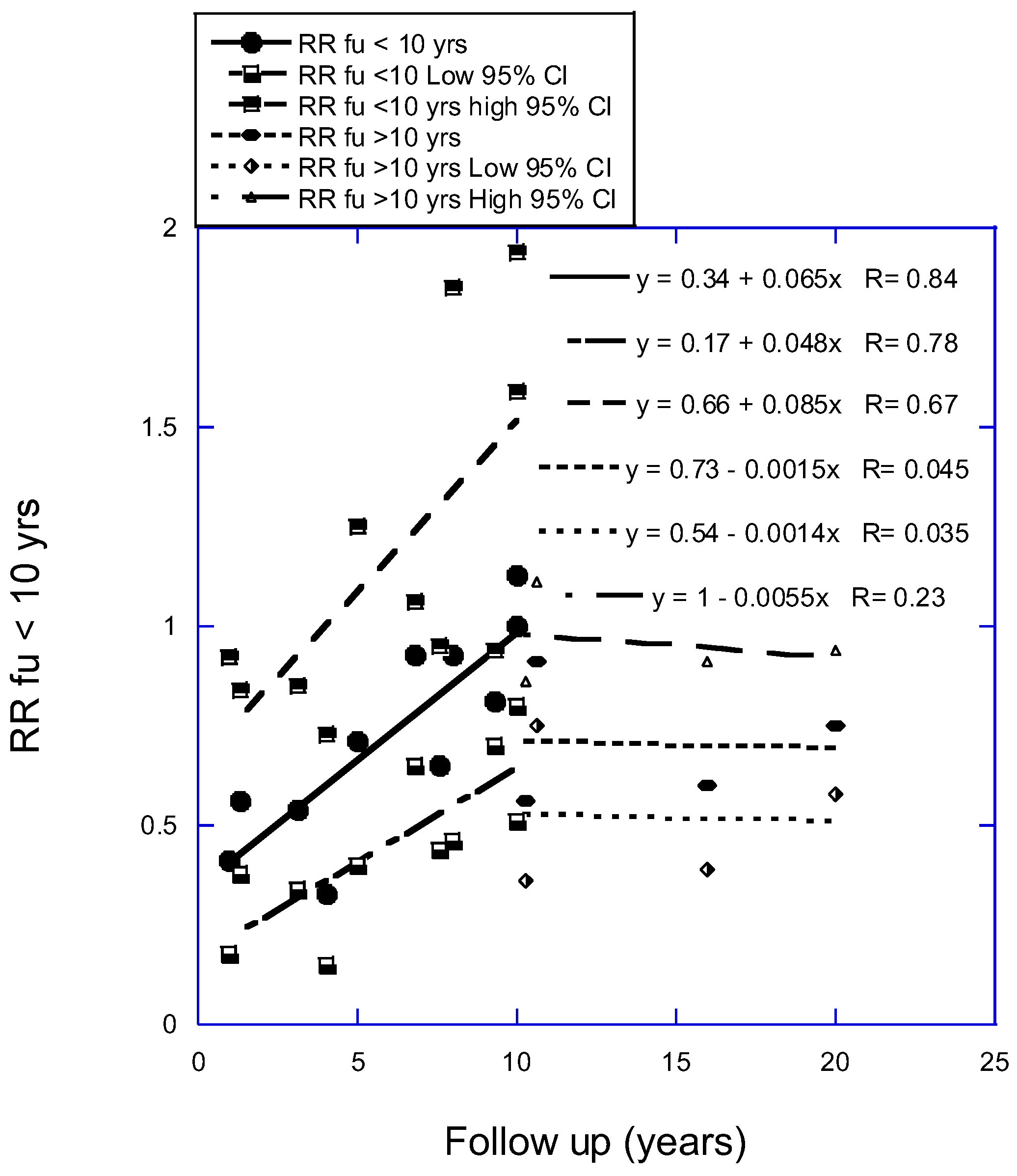
Figure 2.
Plot of relative risk of a major cardiovascular event (MCE) versus mean follow-up period. The regression for risk of MCEs versus baseline serum 25-hydroxyvitamin D is relative risk (RR) = 1.61 ‒ (0.074 × follow-up [years]), r = 0.75, adjusted r2 = 0.49, p = 0.03. 95% CI, 95% confidence interval.
Figure 2.
Plot of relative risk of a major cardiovascular event (MCE) versus mean follow-up period. The regression for risk of MCEs versus baseline serum 25-hydroxyvitamin D is relative risk (RR) = 1.61 ‒ (0.074 × follow-up [years]), r = 0.75, adjusted r2 = 0.49, p = 0.03. 95% CI, 95% confidence interval.
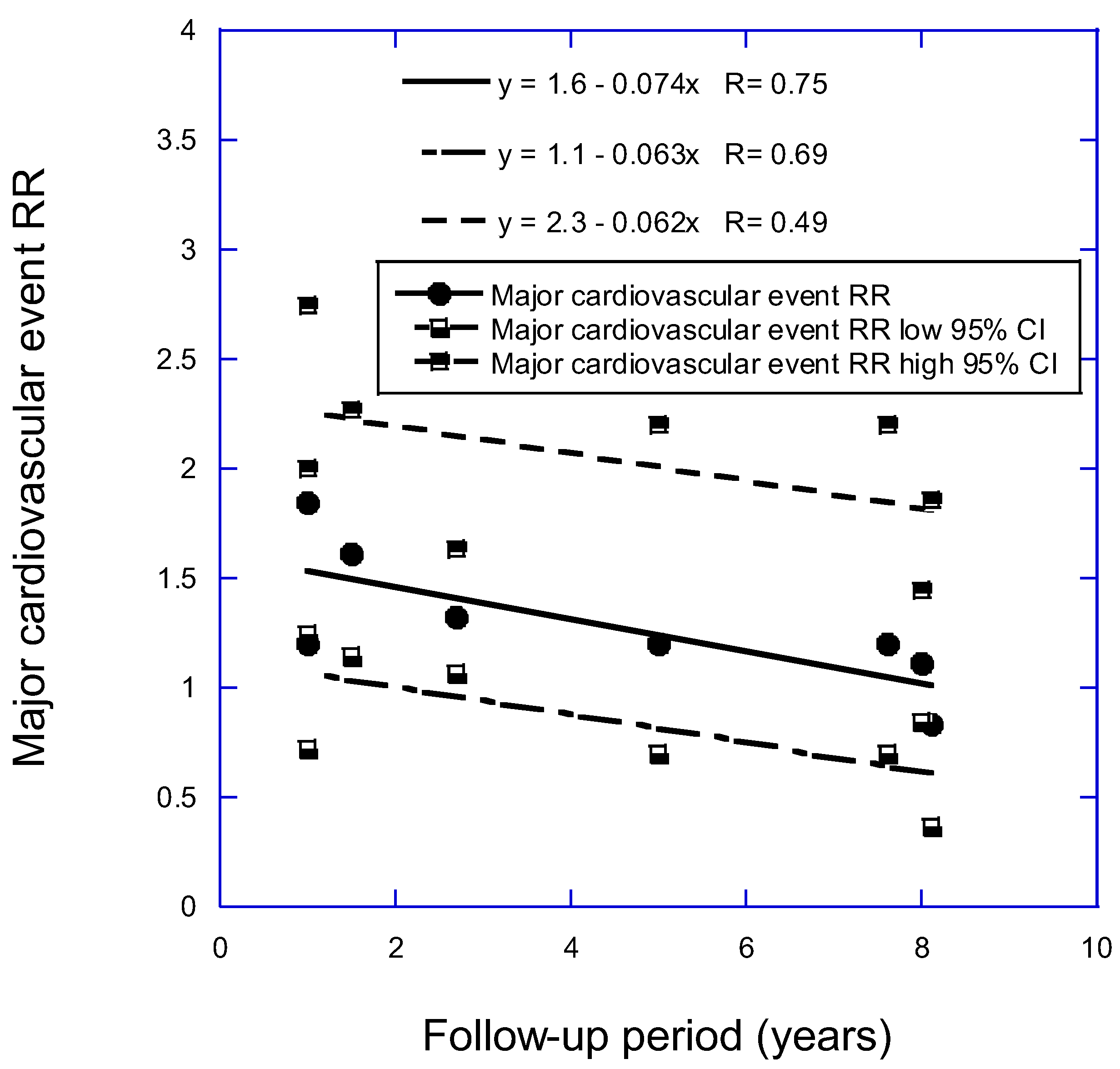

Table 1.
Findings for stroke studies from data listed in Su and colleagues [12] and Xiong and colleagues [13].
| Follow-up (yrs) | Type of stroke | Inc or mor | OR/RR (95% CI) | 25(OH)D comparison (ng/mL) | Ref. |
| NA | 1.41 (0.64‒3.13) | Guo 2017* [14] | |||
| NA | 1.19 (0.79‒1.79) | Leu Agelii 2017* [15] | |||
| 1 | Inc | 0.42 (0.14‒1.28) | ≥10 vs. <10 | Zittermann 2016 [16] | |
| 1.3 | Inc | 0.56 (0.38‒0.84) | >30 vs. ≤15 | Anderson 2010 [17] | |
| 3.1 | Inc | 0.54 (0.34‒0.85) | >30 vs. <20 | Judd 2016 [18] | |
| 4 | Inc | 0.33 (0.15‒0.73) | >30 vs. ≤10 | Drechsler 2010 [19] | |
| 5 | Inc | 0.71 (0.40‒1.25) | ≥20 vs. <20 | Bolland 2010 [20] | |
| 6.8 | Inc + mor | 0.91 (0.81‒1.02) | per +10* | Perna 2013 [21] | |
| 0.76 (0.55‒1.05) | <12 vs. ≥20 | ||||
| 7.6 | Inc | 0.60 (0.59‒1.09) | Q4 (27 median) vs. Q1 (12 median)* |
Kuhn 2013 [22] | |
| 0.65 (0.44‒0.95) | ≥20 vs. <10 | ||||
| 8.0 | Inc | 0.93 (0.46‒1.85) | ≥20 vs. <20 | Welles 2014 [23] | |
| 9.3 | I | Inc | 0.81 (0.70‒0.94) | ≥20 vs. <10 | Afzal 2017 [24] |
| 10 | Inc + mor | 1.00 (0.51‒1.94) | High vs. low tertile | Marniemi 2005 [25] | |
| 0.88 (0.49‒1.61) | Middle vs. low tertile | ||||
| 10 | Inc | 1.13 (0.80‒1.59) | Fourth vs. first quartile | Skaaby 2013 [26] | |
| 10.3 | All | Inc | 0.56 (0.36‒0.86) | Lowest vs. highest quintile | Leung 2017 [27] |
| I | 0.55 (0.35‒0.86) | Middle vs. highest quintile | |||
| 10.6 | Inc | 0.91 (0.75‒1.11) | One 25(OH)D SD increase | Berghout 2019 [28] | |
| 16 | Inc or mor | 0.60 (0.39‒0.91) | ≥20 vs. <20 | Schierbeck 2012 [29] | |
| 19.3 | 0.66 (0.49‒0.89) | >440 vs. <110 IU/day vitamin D |
Sheerah 2018* [30] | ||
| 20 | Inc | 0.75 (0.58‒0.94) | ≥31 vs. <17 | Schneider 2015 [31] | |
| 34 | 0.82 (0.68‒0.99) | >4 vs. <1.1 µg/day | Kojima 2012* [32] |
*, omitted from the analysis; 25(OH)D, 25-hydroxyvitamin D; 95% CI, 95% confidence interval; I, ischemic; Inc, incidence; mor, mortality; NA, not available; OR, odds ratio; RR, relative risk.
Table 2.
Baseline data for stroke studies listed in Su and colleagues [12] and Xiong and colleagues [13] used in this study.
| Country | Patient characteristics | Mean age (± SD) or range (yrs) | BMI (± SD) (kg/m2) | M, F (%) | Stroke type | NS | NC | Ref. |
| Germany | Left ventricular assist device implants | 62 (37‒81) | 23 ± 3 | 100, 0 | All | 25 | Zittermann 2016 [16] | |
| 57 (49‒66) | 26 ± 5 | 85, 15 | 129 | |||||
| USA | Community hospital | 55 ± 21 | NA | 25, 75 | All | 208 | 25,818 | Anderson 2010 [17] |
| USA | B and W community dwellers | I | 536 | 1069 | Judd 2016 [18] | |||
| Germany | Diabetic and on hemodialysis | 66 ± 8 | 60, 40 | All | 89 | 1019 | Drechsler 2010 [19] | |
| New Zealand | Healthy community-dwelling | 74 ± 4 | NA | 0, 100 | All | 59 | 1412 | Bolland 2010 [20] |
| Germany | Population-based | 65% 50‒65; 35% 65‒74 | 27 ± 5 | 41, 59 | All | 353 | 7356 | Perna 2013 [21] |
| Germany | Population-based | 51 | NA | 42, 58 | All | 471 | 1661 | Kuhn 2013 [22] |
| USA | Stable CVD | 66 ± 11 | 29 | 81, 19 | All | 49 | 897 | Welles 2014 [23] |
| Denmark | General population | 58 (48‒68) | 26 ± 3 | 48, 52 | I | 960 | ~115,000 | Afzal 2017 [24] |
| Finland | Population-based | 65-99 | NA | 48, 52 | All | 70 | 685 | Marniemi 2005 [25] |
| Denmark | General population | 49 (41–73) | 26 | 50, 50 | All | 316 | 8830 | Skaaby 2013 [26] |
| Hong Kong | Osteoporosis study, Chinese | 63 ± 10 |
37, 63 | All | 244 | 3214 | Leung 2017 [27] | |
| I | 205 | 3253 | ||||||
| Netherlands | Population-based | 65 ± 10 | 27 ± 4 | 43, 57 | All | 735 | 8603 | Berghout 2019 [28] |
| Denmark | Osteoporosis study | 50 ± 2 | 25 ± 5 | 0, 100 | All | 89 | 1924 | Schierbeck 2012 [29] |
| USA | Population-based | 57 | NA | 43, 57 | All | 804 | 11,354 | Schneider 2015 [31] |
*, data for participants with incident stroke: B, Black; BMI, body mass index (kilograms per square meter of body surface area); CVD, cardiovascular disease; F, female; I, ischemic; M, male; NA, not available; NC, number of controls; NS, number with incident stroke; SE, standard error; W, white.
Table 3.
Findings for MCE rates in prospective cohort studies from studies in Grandi and colleagues [34], and Zhang and colleagues [35].
| Follow-up (yrs) | RR (95% CI) | 25(OH)D comparison (ng/mL) |
Ref. |
| 1.0 | 1.85 (1.25‒2.75) | <9 vs. >9 | de Metrio 2015 [36] |
| 1.0 | 1.20 (0.72‒2.00) | <12 vs. >12 | Beska 2019 [37] |
| 1.5 | 1.61 (1.15‒2.27) | <7.3 vs. >7.3 | Ng 2013 [38] |
| 2.7 | 1.32 (1.07‒1.63) | <12.7; 12.7-21.59; ≥21.6 | Verdoia 2021 [39] |
| 5 | 1.2 (0.7‒2.2) | <20 vs. ≥20 | Bolland 2010 [20] |
| 7.6 | 1.62 (1.11‒2.36) | <15 vs. >15 | Wang 2008 [40] |
| 8.0 | 1.11 (0.85‒1.44) | ≥20 vs. <20 | Welles 2014 [23] |
| 8.1 | 0.83 (0.37‒1.86) | Quartiles | Grandi 2010 [41] |
25(OH)D, 25-hydroxyvitamin D; 95% CI, 95% confidence interval; MCE, major cardiovascular event; RR, relative risk.
Table 4.
Participant information for MCEs in prospective cohort studies from studies in Grandi and colleagues [34] and Zhang and colleagues [35].
| Country | Patient characteristics | Mean Age (± SD) or range (yrs) |
BMI (± SD) (kg/m2) | M, F (%) | Type of event | NMCDE | NC | Ref. |
| Italy | ACS | 67 ± 12 | 27 ± 4 | 72, 28 | MCE | 125 | 689 | de Metrio 2015 [36] |
| UK | After non–ST elevation ACS | 81 ± 5 | 27 ± 5 | 62, 38 | MCE | 76 | 224 | Beska 2019 [37] |
| UK | Acute MI | 66 ± 13 | NA | 72, 28 | Nonfatal MCE | 224 | 1035 | Ng 2013 [38] |
| Italy | CAD undergoing percutaneous coronary intervention | 68 ± 11 | 28 ± 5 | 73, 27 | MCE | 174 | 531 | Verdoia 2021 [39] |
| New Zealand | Healthy community-dwelling | 74 ± 4 | NA | 0, 100 | MI | 52 | 1419 | Bolland 2010 [20] |
| USA | General population | Incident CVD | Wang 2008 [40] | |||||
| USA | Stable CVD | 66 ± 11 | 29 | 81, 19 | CVD events | 49 | 897 | Welles 2014 [23] |
| Germany | Stable CHD | CVD events | 148 | 977 | Grandi 2010 [41] |
ACS, acute coronary syndrome; BMI, body mass index (kilograms per square meter of body surface area); CAD, coronary artery disease; CHD, coronary heart disease; CVD, cardiovascular disease; F, female; HF, heart failure; M, male; MCE, major cardiovascular event; MI, myocardial infarction; NA, not available; NMCDE, number with a major cardiovascular disease event; NC, number of controls.
Table 5.
Results of short-term vitamin D supplementation on brain health.
| Participants | Duration (wks) |
Condition | Intervention | Outcomes | Ref. |
| Meta-analysis of 9 clinical trials, China and Iran | 8‒52 | Mental health | 50,000 IU/wk or 2 wks or higher single dose | Beck Depression Inventory, weighted mean difference, –3.9 (95% CI, –5.2 to –2.7) | [53] |
| 46 patients, India; baseline 25(OH)D: N/A |
12 | Major depressive disorder | Usual treatment or usual treatment plus 3 million IU of vitamin D | Significantly greater improvement in depression score with vitamin D than placebo; also quality of life. | [54] |
| 64 patients under methadone maintenance treatment, Iran. Baseline 25(OH)D: 14 ± 4 ng/mL | 24 | Cognitive function | 50,000 IU or placebo/2 wks | Vitamin D treatment resulted in significant improvement in Iowa Gambling Task, Verbal Fluency Test, Reverse Digit Span, and visual working memory. | [55] |
| 42 women, USA mean age 58 ± 6 years, BMI, 30.0 ± 3.5 kg/m2; baseline 25(OH)D: 23 ± 6 ng/mL | 52 | Cognitive outcome | 600, 2000, or 4000 IU/day of vitamin D3 | 2000-IU/day group had improved visual and working memory and learning; the 4000-IU/day group had slower attention reaction time. | [56] |
25(OH)D, 25-hydroxyvitamin D; 95% CI, 95% confidence interval.
Table 6.
Why 25(OH)D concentrations may change over time.
| Reason | Ref. |
| For increases in 25(OH)D concentrations | |
| Increased awareness of overall benefits of vitamin D | [57] |
| Increase amount of omega-3 fatty acid supplementation | [58] |
| Increased vitamin D supplementation after menopause | [59] |
| Vitamin D fortification of food instituted countrywide | [60] |
| For variable changes in 25(OH)D concentrations | |
| Change geographic location | [61] |
| Retire from work | |
| Change in physical activity | [2] |
| Change in season from winter/spring to summer/autumn | [46,47] |
| For reductions in 25(OH)D concentrations | |
| Decline with age due to reduced production from solar UVB | [62] |
| Change in diet with reduced meat, fish consumption | [63] |
| Increase in body mass | [64] |
| Increase in use of sunscreen/sunblock, clothing when in sunlight | [65] |
| Increased use of sunscreen in cosmetics | [66] |
| Moving into residential care |
25(OH)D, 25-hydroxyvitamin D; UVB, ultraviolet-B.
Table 7.
Mechanisms by which vitamin D can reduce risk of stroke and MCEs.
| Mechanism | Ref. |
| Antifibrotic, antihypertrophic signaling | [79] |
| Anti-inflammatory, antioxidant effects | [80] |
| Atherosclerosis progression reduction | [81] |
| Reduces arterial stiffness and narrowing of the vessel lumen due to activation of the renin–angiotensin–aldosterone system | [81] |
| Cellular effects through effects on genes (cell cycle, proliferation, apoptosis, and angiogenesis) | [81] |
| Endothelial function maintenance | [82] |
| Insulin resistance risk reduction | [83] |
| Lipid metabolism regulation | [84] |
| MMP-2 and MMP-9 activity reduced, which reduces acute arterial event risk | [71,72] |
| Neuroprotective growth factor promotion | [85] |
| Reduced risk of plaque instability and acute arterial events | [86] |
| Reduction of blood pressure through vasodilation | [85] |
| Reduction of arterial pressure through effects on endothelial and muscle cells | [87] |
| Type 2 diabetes mellitus risk reduction | [88] |
MCE, major cardiovascular event; MMP, matrix metalloproteinase.
Table 8.
Evaluation of findings regarding serum 25(OH)D concentration and risk of stroke and major cardiovascular disease events with respect to Hill’s criteria for causality in a biological system [97].
Table 8.
Evaluation of findings regarding serum 25(OH)D concentration and risk of stroke and major cardiovascular disease events with respect to Hill’s criteria for causality in a biological system [97].
| Criterion | Strength of finding | Ref. |
|---|---|---|
| Strength of association | “Strong” as suggested by Figure 1 and Figure 2. | |
| Consistency | “Strong,” i.e., results from various European countries as well as the United States and Hong Kong were in general agreement with each other. | |
| Temporality | “Strong” as all the prospective cohort studies agreed. | |
| Biological gradient | “Strong” as the serum 25(OH)D concentration–risk relationship is well known across the literature on human health. | [42] |
| Plausibility | “Strong” as many mechanisms have been shown (see Table 7 and preceding text) | |
| Coherence | “Strong” because vitamin D has many mechanisms for maintaining good health, including affecting gene expression and downregulating adverse effects on immune and inflammatory processes in vivo. | [70] |
| Experiment | “Weak” as RCTs have not found that vitamin D supplementation reduces risk of stroke or CVD event, probably from not conducting RCTs of appropriate design (see Discussion). | [93,94,101] |
| Analogy | Similar findings are seen for Alzheimer’s disease, dementia, and cognitive decline. | [8] |
| Confounding factors | A possible confounding factor is release of nitric oxide from subcutaneous nitrate stores through the action of UV irradiation, though strong evidence for that effect is lacking. | [102] |
25(OH)D, 25-hydroxyvitamin D; CVD, cardiovascular disease; RCT, randomized controlled trial.
Disclaimer/Publisher’s Note: The statements, opinions and data contained in all publications are solely those of the individual author(s) and contributor(s) and not of MDPI and/or the editor(s). MDPI and/or the editor(s) disclaim responsibility for any injury to people or property resulting from any ideas, methods, instructions or products referred to in the content. |
© 2024 by the authors. Licensee MDPI, Basel, Switzerland. This article is an open access article distributed under the terms and conditions of the Creative Commons Attribution (CC BY) license (http://creativecommons.org/licenses/by/4.0/).
Copyright: This open access article is published under a Creative Commons CC BY 4.0 license, which permit the free download, distribution, and reuse, provided that the author and preprint are cited in any reuse.