

Submitted:
01 October 2024
Posted:
02 October 2024
You are already at the latest version
Abstract
Small and medium-sized enterprises (SMEs) are vital to economic growth, yet they face considerable competitive pressures. This systematic review evaluates the impact of Porter’s Five Forces on SME performance to provide actionable strategic insights for business sustainability using qualitative and quantitative methods. A thorough search of Scopus, Web of Science, and Google Scholar was conducted, focusing on literature published between 2014 and 2024. Search terms included "Porter’s Five Forces," "SME competitiveness," and "competitive advantage." Studies were selected based on predefined inclusion and exclusion criteria, resulting in 51 out of 126 initial studies meeting the inclusion standards. Prominently, industry rivalry and customer bargaining power were found to be the most influential forces, particularly in competitive sectors such as retail and telecommunications, where differentiation and cost leadership play crucial roles. The review concludes that strategically managing Porter’s Five Forces can significantly enhance SMEs' competitive advantage and sustainability. SMEs leveraging differentiation and innovation are better equipped to address rivalry and buyer power. In industries such as manufacturing and healthcare, managing supplier power is critical for cost control and quality. Moreover, sectors like renewable energy can capitalize on the low threat of substitutes by fostering innovation. Future research should focus on specific sectors such as technology, retail, and tourism to develop tailored strategies that help SMEs navigate unique competitive pressures more effectively.
Keywords:
porter’s five forces
; small medium enterprises (SMEs)
; performance
; market competition
; competitive advantage
; systematic review
1. Introduction
In today’s rapidly evolving business landscape, Small and Medium Enterprises (SMEs), like all businesses, must adopt strategies that provide competitive advantage, especially in the context of technology-driven competition. With ongoing technological advancements, businesses across all sectors are grappling with the challenge of staying competitive by integrating the latest technologies into their operations [1]. Technology has become a pivotal force, reshaping how firms compete and interact with customers. For SMEs, these technological shifts present both opportunities and challenges, especially in terms of industry rivalry and buyer bargaining power, two key forces from Porter’s Five Forces framework. While SMEs are vital for job creation and economic growth—particularly in developing countries, where they play a critical role in poverty alleviation—their ability to survive and thrive depends on how effectively they navigate competitive pressures. By leveraging technology, SMEs can enhance their differentiation and cost leadership strategies, thus improving their competitiveness in increasingly dynamic markets [2].
In marketing, technological marketing has sprouted as a discourse which deals with the planning and execution of conceptualizing, pricing, distributing, and promoting products, which occurs through technology. Technological marketing is the imperative center and extensive driver of business activities and competition since the superior goal for a firm is to satisfy the customer [3].
Technology and competition have become major challenges pervasively impacting on firms in contemporary markets. Increasingly, the industry structure and elements of competition seem to be detrimental, particularly in instances where businesses are lagging with advanced marketing technology systems. Conversely, from the customers’ side, opportunities exist which enhance switching mobility in the market for those customers who are acquainted with technology. As technological utilization continues to drive consumers in many industries, the fundamental problem driving this paper is the need to know whether technology (independent variable) constrains or strengthens the competitiveness and performance of SMEs in the business environments (dependent variables). Therefore, this paper investigates the compatibility and prevalence of technological marketing and Porter’s five competitive forces, by focusing and competitiveness on SMEs performances.
1.1. Theoretical Background
Porter’s Five Force model was first introduced in 1980 and subsequently updated in 2001 and 2008, Porter’s model identifies five key competitive forces: the bargaining power of suppliers, the bargaining power of customers, the threat of substitutes, the threat of new entrants, and rivalry among existing firms. However, with the rapid evolution of technology, the question arises: how have these forces been impacted, either positively or negatively, by technological advancements?
Technological evolution and increasing competition have significantly reshaped business practices and strategies, driving firms to adopt superior standards across all operational activities. For SMEs, which often operate with more limited resources than larger firms, the impact of technology on these competitive forces can be particularly pronounced. Although prior studies [4] have explored the effects of technology on competitive marketing, fewer have focused on how technology specifically alters Porter’s original model for SMEs. The redefinition of the model, so far, manifest in the addition of a sixth force known as the complementary relationships [5].
This model used herein generally entails that the ultimate impact of the five forces determines the level of competition in industry as well as the profitability thereof. The model is fraught of its criticisms; among other things, the question on the appropriateness of developing and analysing the corporate strategy at industry level rather than firm level, failure to consider the heterogeneity within an industry, capability of businesses to raise industry entry barriers individually or collectively, and the consistence of earning above-normal profits [6]. However, the model still commands substantive grounds as an instrument of assessing competition. For SMEs as in other industries, Porter’s model states that the weaker/stronger the forces are, the more/less attractive the industry becomes as a whole as well as its overall profits. The forces in Porter’s Five Forces Model are elaborated below:
1.1.1. Threat of New Entrants
Porter describes the threat of new entrants as the risk posed by new competitors entering the market and the protective barriers that shield existing firms from heightened competition [7]. For SMEs, new entrants can disrupt the market by driving down prices, reducing profit margins, and potentially displacing established firms [8]. For example, in the retail industry, the rise of e-commerce platforms has lowered entry barriers, allowing small players to easily enter the market with minimal physical infrastructure. This has intensified competition for traditional SMEs, who must now innovate to maintain their market positions.
The magnitude of this threat is determined by the strength of barriers to entry and the response of existing competitors. High entry barriers, such as significant capital requirements or intellectual property protections, reduce the threat. For SMEs, technology can either reduce or reinforce these barriers. For instance, while cloud computing lowers the capital barrier for startups by reducing the need for on-site infrastructure, SMEs in industries reliant on patented technologies (e.g., pharmaceuticals) may still find high entry barriers. Additionally, a strong response from incumbent firms, such as aggressive pricing or marketing strategies, can deter new entrants. SMEs can mitigate this threat by leveraging their local knowledge and niche markets where larger firms are less competitive [9].
1.1.2. Threat of New Substitutes
Substitutes are products or services that perform similar functions to existing offerings but through different means. For SMEs, the threat of substitutes can be particularly challenging in industries where innovation and technological advancements occur rapidly. For example, traditional taxi services have faced substantial disruption due to ride-hailing apps like Uber and Bolt, which offer consumers a more convenient and often cheaper alternative. This forces SMEs to continuously innovate to remain competitive.
Substitutes intensify competition by enabling customers to switch between products or services, pushing firms to maintain high standards in quality, performance, and pricing [10]. SMEs in the food and beverage sector, for instance, have seen increased competition from plant-based alternatives, compelling traditional meat producers to invest in developing new products or risk losing market share. Technology plays a crucial role in accelerating the development and adoption of substitutes, further heightening competition for SMEs.
1.1.3. Rivalry amongst Existing Competitors
Rivalry refers to the competition between businesses within an industry to gain market share. For SMEs, rivalry is particularly intense in industries where firms offer similar products or services and are closely matched in size and capabilities. An example is the highly competitive restaurant industry such as McDonald’s and Burger King, where SMEs often compete on price, service, and customer experience. High levels of rivalry can lead to price wars, reducing profitability, and increasing investments in non-price competitive strategies such as branding or customer service [11].
Technology further exacerbates this rivalry, as digital marketing tools allow businesses to reach wider audiences at lower costs, intensifying the competitive landscape. SMEs that do not adopt advanced marketing strategies, such as data analytics or social media campaigns, may struggle to differentiate themselves from competitors. In contrast, firms that leverage these technologies can improve their market position by offering personalized services and engaging more effectively with customers [12].
1.1.4. The Bargaining Power of Buyers
The bargaining power of buyers relates to their ability to influence prices and demand higher quality products or services. In markets where a few large customers dominate, such as in the B2B sector, SMEs may face strong buyer bargaining power, which can erode profit margins. For example, small manufacturers supplying to large retailers often have little negotiating power, as the buyers can demand lower prices or better terms [13].
The rise of digital platforms and e-commerce has further increased buyer power by providing consumers with access to a broader range of products and services, enabling them to compare prices and switch between suppliers with ease. SMEs must adapt by offering differentiated products or superior customer service to retain customer loyalty [14]. Additionally, the threat of backward integration—where buyers become their own suppliers—poses a significant challenge for SMEs. For example, large retailers like Amazon have moved into manufacturing their own products, bypassing smaller suppliers [15].
1.1.5. The Bargaining Power of Suppliers
The bargaining power of suppliers refers to their ability to influence the prices of raw materials or services provided to businesses. For SMEs, this can be particularly problematic when suppliers have significant control over the supply chain, as in industries where there are few alternatives. For example, small electronics manufacturers may face high supplier power due to the dominance of key component suppliers, such as those providing microchips [17].
Technology can both increase and decrease supplier power. On one hand, digital platforms have made it easier for SMEs to find alternative suppliers globally, reducing dependency on a few dominant players. On the other hand, suppliers that control access to crucial technologies—such as cloud computing services or specialized software—may hold significant bargaining power, increasing competition for SMEs reliant on these services [18]. Forward integration, where suppliers become direct competitors by entering the market themselves, also poses a risk. For example, in the fashion industry, some fabric manufacturers have expanded into producing finished clothing, intensifying competition for SMEs [19].
The introduction of new technologies can either mitigate or exacerbate these dynamics. For instance, SMEs that adopt cutting-edge marketing technologies can increase their competitiveness, but they may also face reduced profitability if the market becomes saturated with new entrants [21]. Figure 1 represents Porter’s Five Forces.
Table 1 compares different studies related to the impact of Porter’s Five Forces on SMEs. Each study is reviewed for its contribution to the topic and its pros and limitations. The papers are also categorized by the number of times they have been cited and the year of publication.
From the summarized review papers, it can be noted that several research gaps exist in the studies. For one, there’s a limitation in the geographic focus. Majority of the studies focus on specific regions such as Kenya and Japan. Meaning that the results may not be applicable to many regions. There’s also a lack of empirical data. Some of the studies cited are theoretical and lack empirical evidence. This then limits the practical applicability of the studies. Another research gap that has been identified is the fact that studies are limited to specific sectors. This implies that there is a limitation in applying the results across multiple sectors. There is minimal research that generalizes across multiple industries. The identified gaps highlight a need for new additional research that will be broad and applicable amongst many sectors.
1.2. Research Questions
Understanding how Porter’s Five Forces Impact SMEs play a vital role in the strategic management and improvement of enterprise performance. Porter’s Five Forces provides a framework for scrutinizing competition dynamics and pressures within an industry, and how they affect organizational performance. This systematic review evaluates how Porter’s Five Forces impact the performance of SMEs. To assist in critically analyzing the impact of the forces, the following research questions have been asked:
- How does the bargaining power of suppliers impact the performance of SMEs in various industries?
- What is the effect of buyer bargaining power on the competitive positioning and financial performance of SMEs?
- How do threats from substitute products or services influence innovation and strategic decisions in SMEs?
- To what extent do barriers to entry affect the growth and sustainability of SMEs in competitive markets?
- How does competitive rivalry within the Information Technology (IT) sector influence the strategic responses and performance outcomes of SMEs?
1.3. Research Motivation
The rationale of this review can be summarized as follows:
- SMEs are critical for economic growth, employment, and innovation in both developed and developing economies. However, they face distinct challenges such as limited resources, market volatility, and competition from larger firms. Thus, understanding the factors influencing their performance is vital for their sustainability and growth. For instance, research on SMEs in Nairobi highlights the significance of cost leadership, differentiation, and focus strategies on driving performance, although findings may be context-specific to the region.
- The Porter’s Five Forces Model, a widely recognized framework for analyzing industry structure and competition. Despite its extensive use in large corporations, its application to SMEs remains underexplored. Given SMEs’ unique characteristics—such as flexibility and resource constraints—this gap presents an opportunity for further study. Existing literature, such as research on Japanese SMEs integrating the Five Forces into business intelligence, offers insights but may not be generalizable to other cultural or industrial contexts.
- The systematic review seeks to fill the gap by synthesizing research on the application of Porter’s Five Forces to SMEs. While studies have focused on specific sectors, such as telecommunications in Kenya and technological innovations in SMEs, the broader impact of competitive forces on SME performance across various industries and regions remains underexplored. Moreover, the growing influence of digital platforms and e-commerce, which are reshaping the competitive landscape for SMEs, has not been adequately addressed. By examining these dynamics, this review aims to provide insights into strategic responses of SMEs and identify best practices to enhance their resilience in an increasingly globalized market. These insights are crucial for shaping business strategies, policy interventions, and future academic research aimed at improving SME performance.
1.4. Research Contribution
This review makes a significant contribution offering a comprehensive analysis of how Porter’s Five Forces Model impacts SMEs.
- It consolidates literature across various industries to reveal how competitive forces such as the threat of new entrants, bargaining power of suppliers and buyers, the threat of substitutes, and industry rivalry affect SMEs differently compared to larger firms. For example, while research on the apparel industry explores competitive strategies specific to that sector, the findings may not be broadly applicable to other industries.
- This review delves into how technological innovation, digital transformation, and globalization have reshaped competitive forces for SMEs. Studies show that digital platforms and marketing strategies are increasingly influencing SME performance. This review offers new insights into how SMEs adapt their strategies in response to these technological shifts, contributing to their strategic positioning in a rapidly changing market.
- Identifies key gaps in current research, particularly concerning the effects of emerging trends such as digital platforms and e-commerce on SMEs’ competitive strategies. By addressing these contemporary developments, the review not only advances theoretical understanding but also provides practical guidance for SME managers and policymakers. This enhanced perspective helps in better navigating the complex and evolving competitive landscape, offering actionable insights for improving SME performance and strategic positioning in a rapidly changing global market.
1.5. Research Novelty
This systematic review provides a novel contribution by examining how Porter’s Five Forces Model, which has been extensively applied to all types of businesses, with varying degrees of focus on SMEs across various industries and geo-graphic regions. The review synthesizes existing literature to investigate how emerging factors such as technological advancements, globalization, and digitalization have reshaped the competitive forces affecting SMEs. Unlike larger firms, SMEs have unique characteristics such as limited re-sources, agility, and innovation, which influence their responses to competitive pressures.
For instance, technological advancements like cloud computing and automation have allowed SMEs to scale operations with fewer resources, making them more competitive against larger firms with greater infrastructure. However, they also increase rivalry, as more small businesses can now enter the market and compete globally. Similarly, globalization has expanded market opportunities for SMEs, enabling them to access international markets and global supply chains, but it has also heightened the bargaining power of suppliers and buyers, as SMEs now face more global competitors and price-sensitive customers. Digitalization, particularly the rise of e-commerce and digital platforms, has transformed how SMEs interact with customers, often reducing barriers to entry but also exposing them to increased threats from new entrants and substitute products available online.
This study also identifies research gaps, particularly in relation to the impact of digital platforms, e-commerce, and global supply chains on SMEs’ competitive environment. By addressing these contemporary dynamics, the review offers a forward-looking perspective on how SMEs adapt their strategies to maintain competitiveness in an increasingly interconnected and volatile global market.
2. Materials and Methods
2.1. Eligibility
To ensure the quality and relevance of the research included in this review, specific eligibility criteria were established. The review focuses on literature that examines the impact of Porter’s Five Forces on the performance of SMEs, with a ten-year publication window from 2014 to 2024. This period was selected to capture recent developments and trends that reflect the current business environment and technological advancements affecting SMEs. To avoid potential bias and inaccuracies, only studies published in English were included. However, this decision may limit the review’s scope, as valuable insights from non-English studies are excluded. The review criteria emphasize studies that explicitly analyze the influence of the Five Forces framework on SME performance. The inclusion and exclusion criteria are outlined in Table 2, specifying the focus on relevant research while acknowledging potential limitations in scope and translation
2.2. Information Sources
For this systematic literature review, we consulted three online databases, namely, Google Scholar, Web of Science and Scopus. Using keywords, we were able to retrieve various articles, conference papers, literature reviews dissertations and theses that relate to the topic. We scanned through the title and abstract to further reaffirm relevancy of the extracted papers.
2.3. Search Strategy
We adopted a keyword search code strategy to maximize the search on online repositories. This search code comprises of a variation of terms that are in the research topic or are synonymous with the research topic. Acronyms were also expanded to broaden the search, for instance, “SME” was expanded into “Small and Medium Enterprises”. To ensure a thorough search of the previously mention databases, the code (“Porter’s Five Forces” OR “Five Forces” OR “Porter’s Model” OR “Five Forces Model”) AND (“SMEs” OR “Small and Medium Enterprises” OR “Small Businesses” OR “Medium Enterprises”) AND (“performance” OR “business performance” OR “competitiveness” OR “strategic performance” OR “sustainability”) AND (“systematic review” OR “literature review” OR “meta-analysis” OR “review of literature”) was employed. This code has all the possible terms related to the topic. Boolean operators “AND” and “OR” were utilized to combine the various search keys. To maintain a standard of relevancy, the inclusion criteria of papers that are within a 10-year range was highly considered.

Table 3.
Search Terms Used in SLR.
| Search Terms& Strategy | Data Bases | Fields | ||||
|---|---|---|---|---|---|---|
| Porter’s Five Forces OR Poter’s Model OR Five Forces Or Five Forces Model | AND | SMEs OR Small and Medium Enterprises OR Small Businesses OR Medium Enterprises |
AND | Performance OR business performance OR competitiveness OR strategic performance OR sustainability | Google Scholar Web of Science SCOPUS |
Title, Abstract Keywords |
2.4. Selection Process
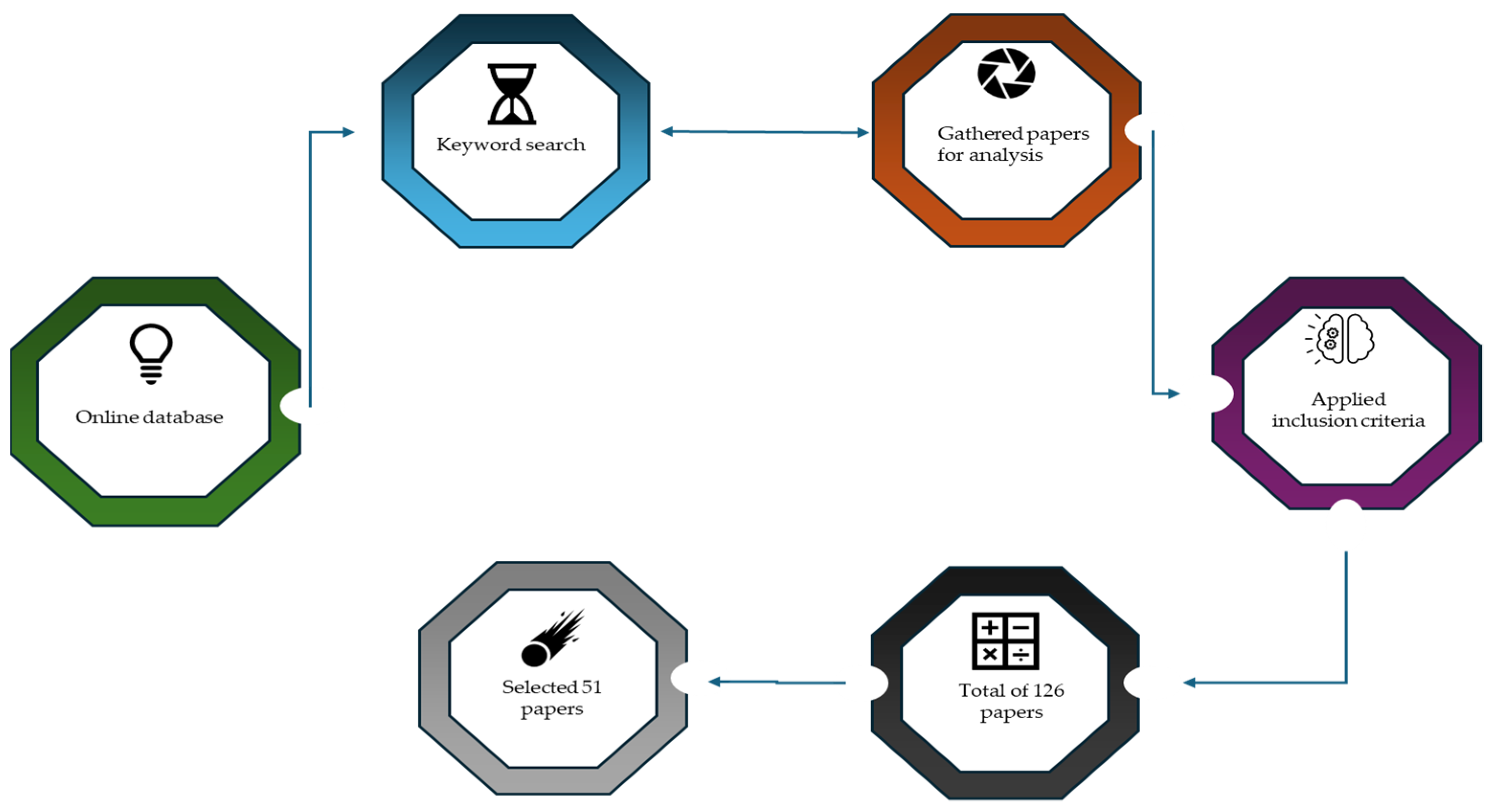
Initially, 483 records were retrieved based on the keyword search string (“Porter’s Five Forces” OR “Five Forces” OR “Porter’s Model” OR “Five Forces Model”) AND (“SMEs” OR “Small and Medium Enterprises” OR “Small Businesses” OR “Medium Enterprises”)
AND (“performance” OR “business performance” OR “competitiveness” OR “strategic performance” OR “sustainability”) AND (“systematic review” OR “literature review” OR “meta-analysis” OR “review of literature”). Inclusion and exclusion criteria were applied, such as limiting the search to publications from 2014 to 2024, focusing on English language-based articles and studies relevant to the impact of Porter’s Five Forces to SMEs. This elimination processed removed a total of 357 papers, leaving 126 for selection. Out of the 126 papers, 20 duplicates were removed, and an extra paper was eliminated due to the fact that it did not contain the full text.
The remaining 105 articles were further screened based on titles, abstract, keywords and on body text screening. 48 papers were removed due to a lack of focus on Porter’s Five Forces and its’ impact on SME performance. During full-text screening of the remaining 57 papers, 6 were removed for not providing sufficient quantitative data or not meeting the quality assessment threshold (e.g., those lacking peer-review status). In the final stage, 51 articles were selected for in-depth analysis. To minimize subjective bias, three independent reviewers evaluated each article, with discrepancies resolved through discussion or a fourth reviewer. This process ensured a transparent and replicable selection, focusing only on high-quality, relevant studies.
Figure 2.
Systematic Literature Review: Paper Selection Process.
2.5. Data Collection Process
The flow chart in Figure 3 outlines the data collection process used in the study, emphasizing a comprehensive secondary research approach. Various data sources, including journals, theses, conference papers, and systematic reviews, were analysed using both qualitative and quantitative methods. Three independent reviewers extracted the data to ensure thoroughness and minimize bias. In cases where disagreements arose, a consensus-building process was employed, involving discussion and deliberation among the reviewers. If consensus could not be reached, an arbitration method was used, where a fourth independent reviewer acted as a mediator to resolve any remaining disputes. This approach helped ensure accuracy, transparency, and reliability in the final results.
2.6. Data Items
Table 4 lists the key parameters used to examine the effects of Porter’s Five Forces on SMEs, including both performance indicators like profitability, market share, growth rate, innovation, and adaptability, as well as force-specific variables for each of Porter’s Five Forces. Metrics such as supplier concentration and switching costs (bargaining power of suppliers), barriers to entry and capital requirements (threat of new entrants), product differentiation and availability of substitutes (threat of substitutes), the number of competitors and intensity of competition (competitive rivalry), and customer concentration and price sensitivity (bargaining power of buyers) have been included. These metrics provide a focused analysis of how each of the forces influences SME performance.
To offer a comprehensive overview of the research analysed, Table 4 also highlights key variables like sample size, sample characteristics, geographic location, and economic context. Sample characteristics, such as the role of interviewees (e.g., CEOs, employees, industry experts), will be categorized based on their contribution to each force’s impact and treated as covariates in the analysis to explore their moderating effects. Geographic location and economic background will be categorized by region and economic status (developed or developing countries) and analysed to determine how these factors influence the forces’ effect on SMEs’ competitiveness in varying contexts.
2.7. Study Risk of Bias Assessment
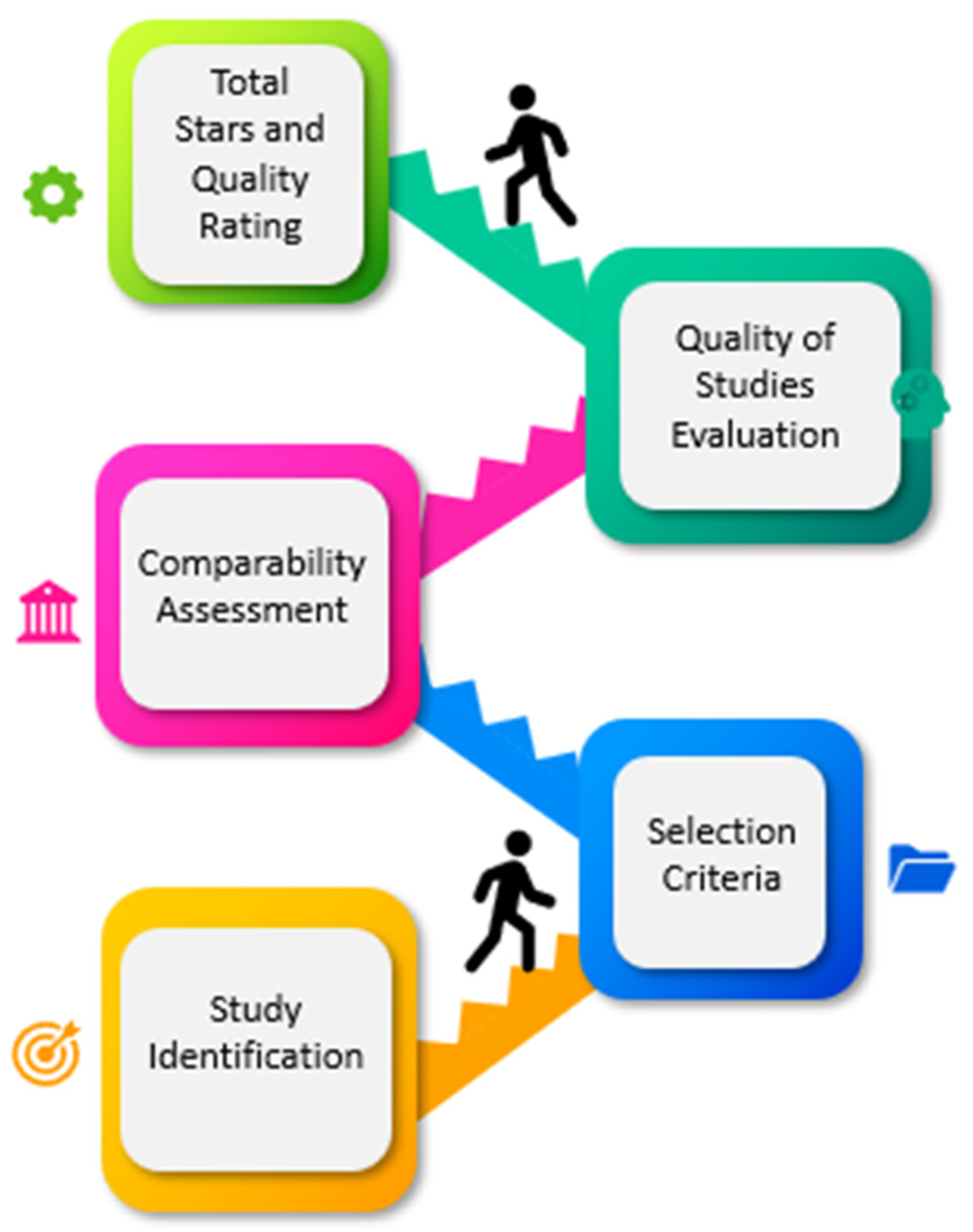
The Newcastle-Ottawa Scale (NOS) is a widely used tool for assessing the quality of non-randomized studies in meta-analyses, employing eight distinct criteria across three main categories: selection, comparability, and outcome assessment. The scale utilizes a star-rating system, where a score of 7 or higher indicates high-quality research, a score of 6 denotes moderate quality, and a score of 5 or below signifies low-quality research [35]. In this study, the NOS was used to evaluate the risk of bias in the selected research articles. The selection category allows for up to 4 stars, assessing the adequacy of the research strategy, the representativeness of the included studies in the SME context, the overall quality of studies (with an emphasis on peer-reviewed journal articles), and the clarity of inclusion criteria. In the comparability category, which allows for a maximum of 2 stars, the review examines whether the studies assessed for risk of bias and differences in methodology could impact the results, and whether consistent indicators of SME competitiveness were used across studies. For outcome assessment, which can earn up to 3 stars, the review evaluates the relevance of the results to the review’s objectives, particularly regarding Porter’s Five Forces and its application to SME competitiveness, the depth of discussion surrounding the implications of these findings for SME strategies, and whether the conclusions are well-supported by the presented data and findings.
While the star-rating system in the NOS provides a standardized approach to evaluating study quality, it is not without limitations. The system’s subjectivity can lead to inconsistencies, as individual reviewers may interpret criteria differently, resulting in variations in the number of stars assigned. Furthermore, the binary nature of assigning stars may oversimplify complex study characteristics, potentially overlooking subtle differences in study design or execution. Acknowledging these weaknesses is important when interpreting the results of a risk of bias assessment
Figure 4.
Risk of Bias Assessment and Evaluation Process.
2.8. Effect Measures
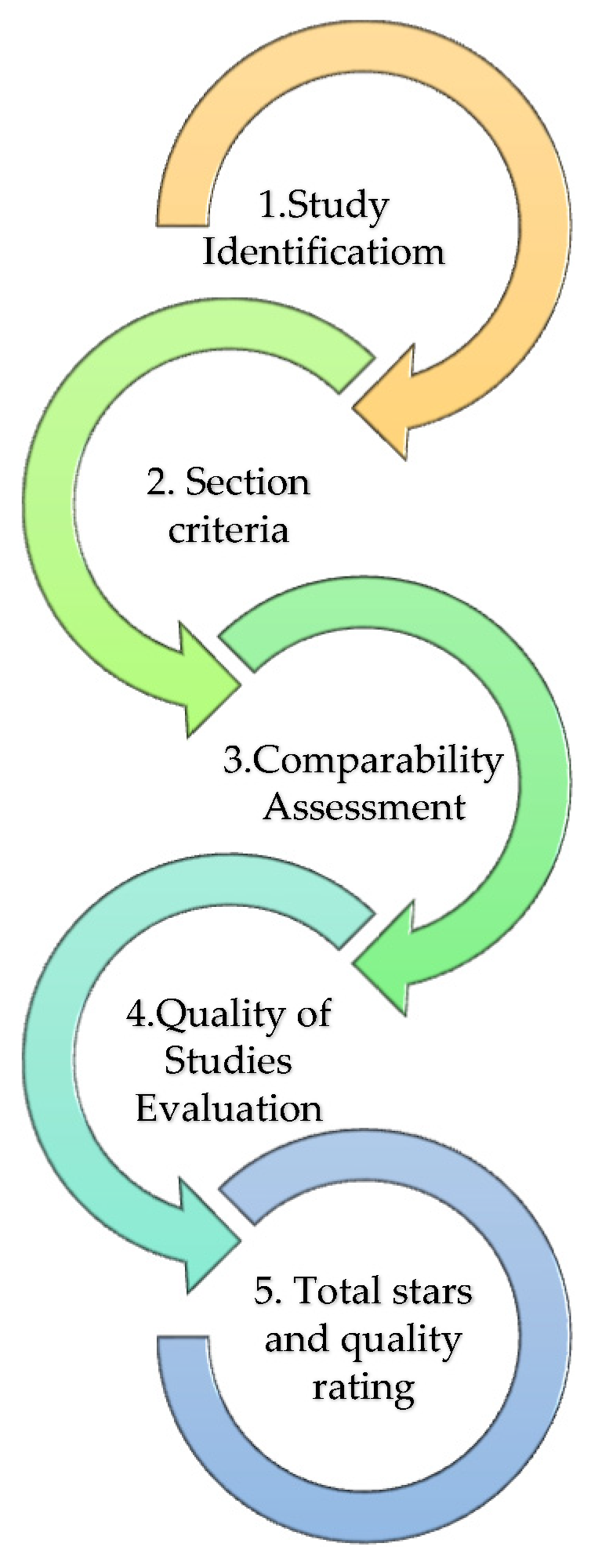
The flow chart outlines the process used to synthesize and present the effect measures for each outcome in the study. It begins with specifying the effect measures, followed by applying risk ratios to compare possible outcomes across groups. Mean differences are utilized for continuous outcomes like profit margins, while standardized mean differences address variations in measurement scales. For likelihood-based outcomes, odd ratios are applied, and hazard ratios are used for time-to-event data, such as the duration SMEs can sustain competitive advantage. Confidence intervals are presented to ensure the accuracy and consistency of the results, providing a precise analysis of the Five Forces’ impact on SME performance.
Figure 6.
A Cyclical Feedback Loop Illustrating the Iterative Process of Continuous Improvement.
2.9. Synthesis Methods
In the process of conducting a systematic review on the impact of Porter’s Five Forces on SME performance, a rigorous and multi-faceted approach was employed to ensure the accuracy and reliability of the findings. The following table outlines the comprehensive methodology used throughout the review process. It details how studies were selected and reviewed, the methods used for data preparation and analysis, the techniques for visualizing results, and the strategies employed to address heterogeneity among study results. This structured approach aimed to provide a thorough and systematic understanding of the research question and ensure the robustness of the conclusions drawn.
Table 5.
Methodology for Systematic Review on Porter’s Five Forces and SME Performance.
| Section | Description |
|---|---|
| Study Eligibility and Review | Determined study eligibility using inclusion and exclusion criteria for Five Forces and SMEs. |
| Data Preparation and Consistency | Unified coding of variables between studies for consistent labeling and analysis. |
| Data Tabulation and Visualization | Organized study information into data extraction tables. Visualization tools were chosen based on the data types: histograms for frequency distributions, pie charts for comparison between trends and tables. These visualizations were selected to provide clear and intuitive representations of both qualitative and quantitative data, enhancing the understanding of complex relationships between variables. |
| Qualitative and Quantitative Analysis | Thematic analysis was used for qualitative data to identify common themes, while narrative synthesis was applied to non-quantifiable findings. For quantitative data, meta-analysis techniques were employed where appropriate. |
| Heterogeneity Analysis | Subgroup analyses were conducted based on factors such as industry sector, geographical region, and SME size to explore differences across studies. Heterogeneity was assessed using the I² statistic, with values above 50% indicating significant heterogeneity, prompting random-effects models. Thresholds for acceptable heterogeneity were defined in line with PRISMA guidelines. |
2.10. Reporting Bias Assessment
In our examination, we carefully considered the potential of reporting bias, where select outcomes or findings may be disclosed while others could be omitted. This type of prejudice can skew conclusions by exaggerating the strength or consistency of certain effects.
To address this problem, we examined the methodology and results sections of every study to determine if the results were consistent with the initial objectives. We verified that all pertinent outcomes were incorporated. If data appeared to be lacking or not fully provided, we acknowledged these concerns and considered their potential impact on the overall assessment. We acknowledged the potential of publication bias, where studies showing positive results are more likely to be published than those with neutral or negative results. To reduce this risk, we ensured to encompass a diverse selection of studies from different sources and environments, guaranteeing a more comprehensive viewpoint. This assisted us in obtaining a more precise representation of the available evidence.
2.11. Certainity Assessment
To comprehensively assess and mitigate the effects of reporting bias in our study, we utilised a set of 5 Quality Assessment (QA) questions. The quality assessment questions were designed to evaluate the rigor, reliability and relevance of the research studies included in this review. The detailed QA process ensures that only studies meeting a certain threshold of methodological quality are considered in the analysis, thereby reducing the risk of bias, and ensuring that the findings are based on robust evidence. To determine Quality Assessment of the studies, we rated each study with a score of 0 or 0.5 or 1 as per the quality assessment questions. A score of 0 means that the criteria was not met, a scale of 0.5 indicates that the criteria was partially met whilst a score of 1 indicates that the criteria was fully met.
Despite the thoroughness of the QA process, there are still inherent limitations. Once again, a significant limitation is the subjective nature of the quality assessments, as different reviewers may interpret and apply the QA criteria inconsistently, leading to variations in judgments. Additionally, while the QA questions help identify methodological weaknesses, they do not fully account for publication bias, where studies with negative or null findings are less likely to be published. This could result in an over-representation of studies reporting positive outcomes. Lastly, the QA questions focus primarily on internal validity, which may overlook broader contextual factors or external validity issues that could affect the generalizability of the findings.
When it comes to Grey literature, we subjected it to the same rigorous quality assessment test to determine if it met the criterion to be included in the review. If the study met the same quality threshold as peer-reviewed studies, we included it. However, given the potential variability in quality, grey literature was scrutinized more closely for biases, especially since these sources may not undergo the same rigorous peer-review process. To ensure fairness, unpublished studies were evaluated with the same Quality Assessment (QA) tools but were assigned a slightly lower weight in the final analysis due to the potential for incomplete or less formalized review processes.
While the QA process strengthens the rigor of our review by filtering out lower-quality studies, it is important to acknowledge these limitations when interpreting the results. The quality assessment questions are tabulated in Table 6.
3. Results
3.1. Results of Study Selection
Figure 7 presents a PRISMA flow diagram that outlines the study selection process for a systematic review. Initially, 483 records were observed from the online sources through the use of the keyword search string. 471 from Google Scholar, 6 from Web of Science and 6 from Scopus. After the application of the inclusion and exclusion criteria, 357 papers were eliminated and a total of 126 were collected. Through a further evaluation, 20 duplicates were discovered and promptly removed. Leaving a total of 105 papers to be screened. 54 papers were then excluded because they did not meet the research eligibility criteria and 1 paper was excluded because it lacked the full text. Ultimately; 51 papers were used for the study.
Figure 7.
Proposed PRISMA Flowchart.
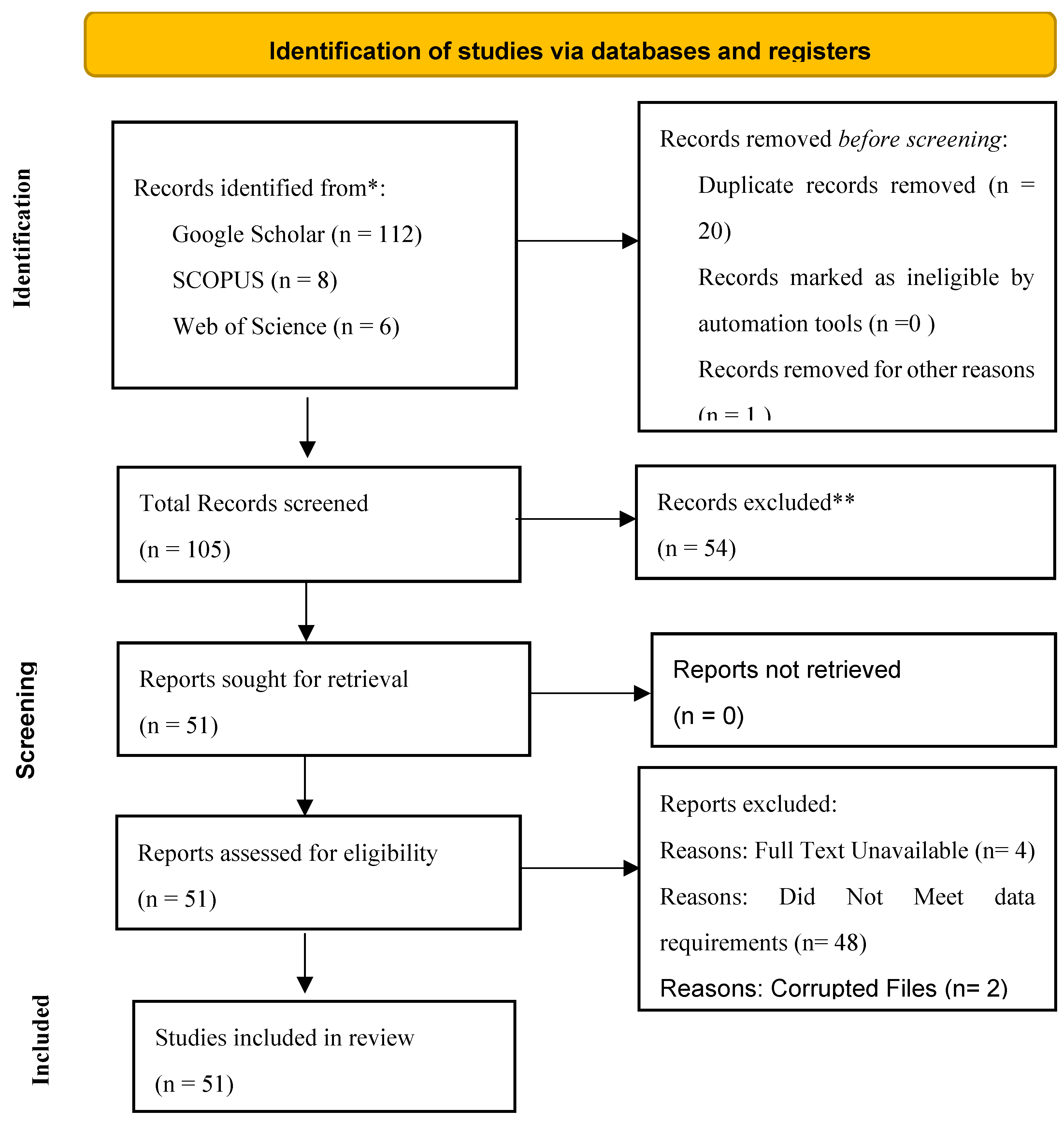
Figure 8 presents a pie chart illustrating the distribution of sources used for academic research, specifically from three platforms: Google Scholar, SCOPUS, and Web of Science. Google Scholar is the dominant source, accounting for 78% of the total, while SCOPUS is 12% and Web of Science contributes 10%. This distribution highlights the significant reliance on Google Scholar for sourcing research materials, likely due to its accessibility and comprehensive database. SCOPUS and Web of Science, though smaller in their contributions, are recognized for their credibility and indexing of high-quality, peer-reviewed articles. However, the relatively lower usage of these platforms may suggest limited access or familiarity among the researchers or the preference for broader, more diverse resources available through Google Scholar. The data implies a need for researchers to diversify their sources to ensure comprehensive literature coverage.
3.2. Eligible Studies Attributes
Table 7 highlights the distribution of conference papers, dissertations, and journal articles published from 2014 to 2024. Conference papers exhibit fluctuations, with peaks in 2014, 2017, 2021, and 2023, while some years, such as 2015, 2016, and 2018, recorded no publications. Dissertations were published sporadically, with 2 each in 2014, 2019, and 2020, indicating concentrated academic research during those years. In contrast, journal articles display a consistent upward trend, particularly from 2018 onwards, with significant increases in 2022 and 2023, reaching 7-8 articles per year. This suggests a growing preference for journal articles as the primary mode of research dissemination, reflecting the academic community’s emphasis on peer-reviewed publications.
Figure 9 presents a line graph depicting the number of publications from 2014 to 2024. The graph shows fluctuations in the number of publications across this period, with notable peaks and troughs. In 2014, there were 5 publications, followed by a significant drop to just 1 in 2015. The number of publications then rebounded in 2016 and remained stable in 2017 and 2018, with 5 publications each year. After another dip in 2019 (3 publications), the trend picks up again, peaking at 6 in 2020 and then fluctuating over the next few years. The highest number of publications occurred in 2023, with 8, before dropping again to 2 in 2024.
This pattern reflects variations in research output, with more intense periods of academic activity in 2014, 2017-2018, and 2022-2023. The sharp increase in 2022 and 2023 could be attributed to heightened research interest or increased publication opportunities. Conversely, the years with lower publication counts, such as 2015, 2019, and 2024, may indicate less research activity or delays in publishing.
Figure 10 illustrates the number of publications by country, showing significant variation across the 21 countries listed. The highest number of publications is observed in Indonesia and Japan, with 10 and 9 publications, respectively. Malaysia and Kenya also show notable contributions, with 3 and 2 publications each. Other countries like Bangladesh, China, Croatia, Finland, Ghana, India, and others have 1 or fewer publications, indicating lower research output.
The graph also shows that some countries, such as the USA and Italy, have more moderate research contributions, with 2 and 3 publications, respectively. The “Various Countries” category accounts for 2 publications, indicating collaborative work or multi-country studies. This distribution suggests that research output is highly concentrated in a few countries, with Indonesia and Japan leading significantly, while other regions contribute less frequently. This uneven distribution may reflect differences in research funding, academic focus, or available resources across the countries shown.
Table 8 presents a collection of research findings that analyze the relationship between Porter’s Five Forces and various aspects of business performance in SMEs across multiple sectors. It highlights how different competitive forces, such as the bargaining power of suppliers, industry rivalry, and the threat of new entrants, impact firm outcomes, including profitability, growth rate, market share, and employee experience. The table also outlines key contributions from the studies, showcasing strategies like digitalization, differentiation, and competitive innovation that enhance the performance and sustainability of SMEs.
The data analysis highlights how SMEs across different industries leverage Porter’s Five Forces and strategic responses like differentiation, cost leadership, and focus strategies to enhance performance. Digital transformation, innovation, and financial literacy play key roles in improving competitiveness, productivity, and market success. Geographic and economic contexts influence the effectiveness of these strategies, with studies from regions like Kenya and Croatia showing unique competitive challenges. While the framework proves valuable, many SMEs require further support in adopting it effectively, with calls for future research to integrate additional strategic tools and approaches for sustained competitiveness.
3.3. Risk of Bias in Studies
Table 9 summarizes a systematic assessment of multiple studies based on three key quality criteria: selection, comparability, and quality of studies. These criteria are rated on a star-based scale, with selection ranging from 0-4 stars, comparability from 0-2 stars, and the quality of studies from 0-3 stars. The studies are also assigned a total number of stars, reflecting their overall quality, and categorized as either low, moderate, or high quality based on their total star ratings. The purpose of this classification is to evaluate the robustness and reliability of the studies, providing a clear indication of their methodological rigor.
It becomes evident that most studies are of high quality, as indicated by the dominance of 8-9 total stars in many cases. Studies like [27,37,42,45,71], which received 9 total stars, exhibit strong selection, comparability, and study quality, suggesting comprehensive and reliable methodologies. In contrast, a smaller subset of studies, such as [25,26,62,65], falls under the low-quality category, with 5 stars, indicating weaker study designs and possibly limited comparability. Moderate-quality studies, which received 6 or 7 stars, bridge the gap, suggesting satisfactory but less rigorous methodologies compared to high-quality studies.
3.4. Results of Individual Studies
Figure 11 Shows The Distribution of Organizational Outcomes Influenced by Porter’s Five Forces And Highlights Key Areas of Focus Within Existing Literature. competitiveness represents the largest portion, accounting for 34.69% of the total. This suggests that a significant number of studies emphasize how competitive positioning within an industry is a primary outcome when applying Porter’s Five Forces. SMEs prioritize strategies that enhance their ability to compete effectively, which may include differentiation, cost leadership, and market adaptation. The emphasis on competitiveness reflects the crucial role of maintaining a strategic edge in rapidly evolving markets.
Table 9.
Classification of Studies by Selection, Comparability, and Overall Quality Rating.
| Study ID | Selection (0-4 stars) | Comparability (0-2 stars) | Quality of Studies (0-3 stars) | Total Stars | Quality Rating |
|---|---|---|---|---|---|
| [25,26,62,65] | ★★ | ★★ | ★ | 5 | Low Quality |
| [22,28,29,34] | ★★★ | ★★★ | 6 | Moderate Quality |
|
| [23,32,47,56,63,64,73] | ★★★ | ★ | ★★★ | 7 | High Quality |
| [24,30,31,36,40,41,43,44] | ★★★★ | ★ | ★★★ | 8 | High Quality |
| [27,37,38,39,42,45,46,52,53,54,59,60,67,71] | ★★★★ | ★★ | ★★★ | 9 | High Quality |
Profitability follows closely, making up 28.57% of the distribution. This highlights the strong connection between the use of Porter’s Five Forces and financial performance. Studies in this area focus on how SMEs can improve their profitability by responding to competitive pressures, managing supplier relationships, and optimizing their market strategies. Profitability remains a key indicator of success for SMEs, particularly in sectors where competition is fierce and margins are tight. The focus on profitability underscores its importance as a measure of business sustainability and growth.
Market Share, accounting for 18.37%, also plays a significant role as an organizational outcome. The studies suggest that gaining or retaining market share is a critical objective for SMEs, often driven by competitive strategies derived from the analysis of industry forces. The focus on market share reflects the importance of expanding a firm’s presence and influence within its industry. By addressing the competitive forces, SMEs can adjust their strategies to capture a larger portion of the market, ensuring long-term viability and success.
A smaller portion, 10.20%, falls under the category of Not Specified, indicating that in some studies, outcomes were not clearly defined or were too broad to categorize. This could reflect gaps in the research or the need for more precise metrics when applying Porter’s model in various sectors. The Business Improvement accounts for 8.16% of the distribution, representing the smallest section. While improving operational and strategic performance is a core goal for most SMEs, fewer studies explicitly link Porter’s Five Forces to overall business improvement, focusing instead on specific areas such as competitiveness or profitability.
3.5. Results of Syntheses
3.5.1. Study Characteristics and Bias Assessment
Figure 12 highlights the distribution of research methodologies used in the reviewed studies. Out of the total reviewed papers, 13 utilized case studies, providing in-depth, contextual analysis of specific SMEs. Surveys were the most popular method, used in 23 studies, allowing for a broader and more quantitative examination of SMEs’ responses to competitive forces. Similarly, interviews, also employed in 13 studies, offered qualitative insights into the perceptions and experiences of SME leaders regarding their competitive environments.
The prominence of survey-based research underscores the focus on obtaining quantifiable data to generalize the impact of Porter’s Five Forces across various SMEs. However, the balanced use of case studies and interviews suggests a continued interest in capturing more nuanced, real-world experiences alongside numerical data.
3.5.2. Statistical Synthesis Results
Figure 13 illustrates the distribution of three data analysis techniques used in research: Thematic Analysis, Structural Equation Modeling (SEM), and Statistical Analysis. Each technique is associated with a specific percentage that reflects its usage in the context of the study. Thematic Analysis shows the highest utilization, followed by SEM, while Statistical Analysis appears to be the least used method.
Figure 13.
Data Analysis Techniques.
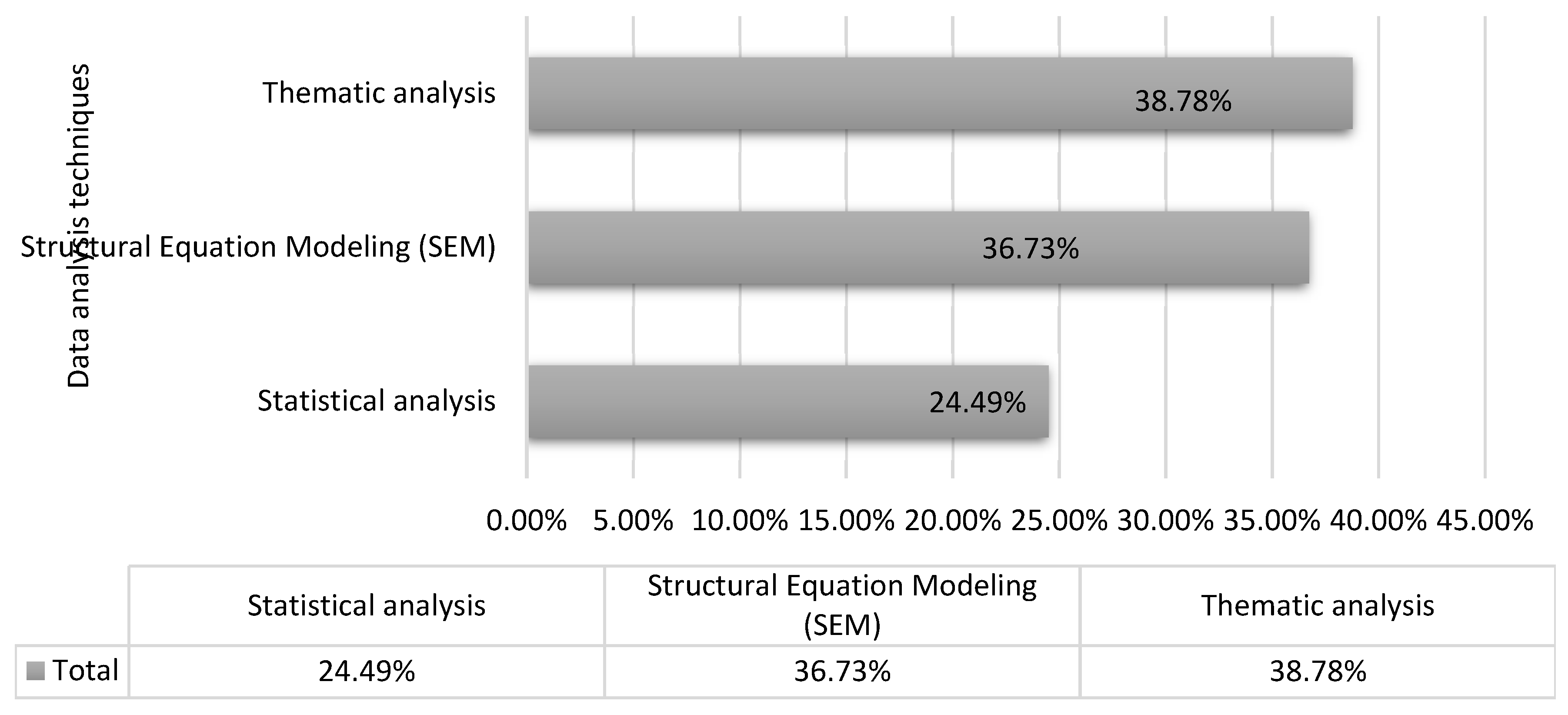
Thematic Analysis, representing 38.78% of the techniques used, highlights its importance in qualitative research, particularly in studies focused on identifying patterns and themes within data. SEM, with 36.73%, suggests a strong preference for modeling relationships between variables and testing hypotheses. Statistical Analysis, at 24.49%, reflects its role in providing numerical insights, though it is used less frequently compared to the other methods. This distribution suggests a balanced but qualitative-leaning approach in the research context.
3.6. Reporting Biases
Figure 13 provides a breakdown of the research methodologies used, categorized into three types: Quantitative, Qualitative, and Mixed-methods. The chart presents the relative usage percentages of each method, with Quantitative research having the largest share, followed by Qualitative, and Mixed-methods as the least employed approach.
Quantitative methods dominate the chart at 40.82%, emphasizing their importance in providing measurable and numerical data to support research findings. Qualitative methods follow closely at 36.73%, highlighting their role in exploring deeper, contextual insights. Mixed methods, combining both quantitative and qualitative approaches, account for 22.45%, reflecting the need for a balanced approach that integrates both data types in certain research scenarios. This distribution suggests a preference for quantitative research but also indicates a significant reliance on qualitative insights and mixed method approaches in research contexts.
3.7. Certainty of Evidence
According to the method used illustrated in Table 6 we conducted a certainty assessment which is shown on Table 10. This table provides a clear evaluation of the research quality of different studies on the impact of Poter’s five forces on SMEs. Most of the studies achieved high certainty, with several receiving 90% or higher, indicating strong and reliable findings. However, a few studies scored lower, highlighting potential limitations in data collection, analysis, or contribution to the field. These lower-scoring references should be interpreted with more caution as they may not provide as comprehensive or conclusive evidence as higher-scoring papers.
In terms of QA1 most studies received a score of 1, indicating that the research questions were clearly and explicitly stated across the majority of the papers. This shows that the studies were well-structured, with a clear focus on what they aimed to explore, particularly in relation to the impact of Porter’s Five Forces model on SMEs.
For QA2 a few studies, such as [25] and [34], scored lower. This indicates that these studies did not sufficiently detail their data collection methods, making it difficult for readers to assess the reliability and replicability of the research. Clear specification of data collection is crucial for ensuring transparency in the research process.
QA3 was a common area where some studies received lower scores, either 0.5 or 0. In particular, studies like [22] and [25] did not adequately describe their sampling techniques or had insufficient sample sizes. This raises concerns about the generalizability of their findings, as appropriate and clearly defined sampling methods are key to ensuring valid and reliable results.
QA4, most studies performed well, demonstrating that they utilized clear and appropriate research methodologies. Only a few studies presented partially developed or unclear methodologies, which impacted the overall contribution and clarity of their findings. A well-defined methodology is essential for guiding the research process and ensuring the rigor of the analysis.
QA5 showed a mix of results. While some studies contributed significantly to the existing literature, others, scoring 0.5 or 0, added less new insight. Studies with lower scores on this criterion may have lacked depth in their analysis or failed to provide meaningful advancements in understanding the role of Porter’s Five Forces model in SMEs.
4. Findings and Recommendations
4.1. Key Findings and Strategic Implications for Business Leaders
Understanding and effectively responding to the forces that shape the competitive environment is essential for business leaders in Small and Medium-Sized Enterprises (SMEs). Porter’s Five Forces model offers a framework to analyze competitive pressures, helping SMEs to develop strategies for growth, differentiation, cost leadership, and digital transformation. Table 9 outlines key findings and their strategic implications for SMEs, covering specific actions business leaders can take to address each force.
Table 9.
Key Findings and Strategic Implications for Business Leaders.
| Porter’s Five Forces | Key Findings | Subcategories | Strategic Drivers | Barriers | Opportunities | Strategic Implications for Business Leaders | Expected Outcomes |
|---|---|---|---|---|---|---|---|
| Industry Rivalry | SMEs utilizing differentiation and innovation outperform competitors in competitive markets. | Product Differentiation | Focus on developing unique products/services that offer value to customers. | High competition and market saturation. | Unique offerings can enhance customer loyalty and market share. | Leaders should prioritize continuous innovation and differentiation to remain competitive in high-rivalry industries. | Increased market share, improved brand positioning. |
| Service Innovation | Implement new customer service models or delivery channels to distinguish from competitors. | Limited resources for innovation. | Improved customer satisfaction and retention through superior service. | Invest in service innovations to meet evolving consumer needs and improve the customer experience. | Enhanced customer satisfaction, reduced churn. | ||
| Competitive Pricing | Implement competitive pricing strategies to drive market penetration. | Cost constraints, price wars. | Attract new customers, increase sales volumes. | Leaders should balance pricing with value creation to avoid price wars that can erode profitability. | Sustainable sales growth, price elasticity. | ||
| Threat of New Entrants | Cost leadership helps SMEs create jobs, improve performance, and maintain competitive pricing. | Cost Efficiency | Streamline operations to reduce costs and improve pricing strategies. | High capital requirements, economies of scale. | Low-cost models can act as entry barriers for new competitors. | Focus on cost optimization strategies to protect market share from new entrants. | Improved operational efficiency, lower costs. |
| Barriers to Entry | Invest in proprietary technologies or exclusive partnerships to create barriers for new entrants. | Regulatory hurdles, high capital investments. | Exclusive relationships and proprietary technologies create defensible market positions. | Leaders should strengthen barriers through innovation, intellectual property, and strategic partnerships. | Reduced vulnerability to new competitors. | ||
| Brand Loyalty | Enhance brand equity and customer loyalty to make it harder for new entrants to capture market share. | Difficulty in building brand identity. | Established brands have more control over market dynamics and customer retention. | Strengthen brand positioning through consistent quality and customer engagement. | Increased customer retention, lower acquisition costs. | ||
| Bargaining Power of Suppliers | Digital transformation enhances SME performance by improving productivity and customer experience. | Supply Chain Digitalization | Implement digital tools like ERP and SCM to enhance supply chain visibility and efficiency. | Resistance to change, high implementation costs. | Digital tools can streamline operations and improve supplier relationships. | Invest in digital supply chain solutions to reduce supplier dependency and improve operational resilience. | Streamlined operations, better supplier negotiations. |
| Supplier Relationship Management | Develop strategic partnerships with key suppliers to secure favorable terms and reliable supply. | Supplier dominance in key sectors. | Strong partnerships can lead to better pricing and priority supply. | Foster long-term supplier relationships through collaborative strategies and joint ventures. | Improved supply chain resilience, cost savings. | ||
| Bargaining Power of Buyers | Financial literacy improves SME sustainability and competitive advantage by enabling better decision-making. | Financial Management | Strengthen financial literacy and management to enhance decision-making and profitability. | Lack of access to financial education. | Improved financial management helps in strategic pricing and negotiations with buyers. | Leaders should invest in financial literacy programs for their teams to enhance competitive positioning. | Stronger financial performance, optimized pricing strategies. |
| Customer Relationship Management | Implement AI-driven CRM systems to enhance customer engagement and predict buyer needs. | Complexity of implementing AI systems. | AI-driven insights can improve customer targeting and retention. | Invest in AI technologies to better understand customer preferences and drive loyalty. | Enhanced customer retention, personalized experiences. | ||
| Threat of Substitutes | Differentiation and cost leadership improve market performance, especially in niche markets like Bali’s SMEs. | Product Innovation | Focus on continuous product innovation to stay ahead of substitutes. | High cost of innovation. | Constant product improvements reduce the threat of substitutes. | Leaders should drive R&D efforts to maintain a competitive edge over substitutes. | Increased market share, continuous product lifecycle. |
| Market Research | Conduct regular market research to stay informed of emerging substitutes and market shifts. | Difficulty in tracking market changes in real-time. | Proactive responses to market shifts can reduce the impact of substitutes. | Establish a continuous market research system to monitor competitor activities and substitute trends. | Early identification of market shifts, proactive strategy adjustment. | ||
| Strategic Opportunities Across Forces | Each of Porter’s Five Forces presents both challenges and opportunities for SMEs, depending on the industry context. | - | Leaders must track specific metrics and KPIs to make data-driven decisions. | Resource limitations, fast-changing environments. | Data-driven strategies enable rapid responses to competitive pressures. | Implement KPIs for continuous improvement, focusing on areas such as cost efficiency, customer engagement, and innovation. | Improved agility, better decision-making, stronger market positioning. |
For SMEs, the competitive forces outlined in Porter’s Five Forces framework offer both challenges and strategic opportunities. By understanding how to respond to these forces—whether through cost leadership, innovation, digital transformation, or financial literacy—business leaders can position their firms for sustained growth and competitiveness. The key to success lies in balancing these strategies with a data-driven approach, where tracking KPIs and responding to market signals in real-time will enable SMEs to outmaneuver competitors and capitalize on emerging opportunities. Leaders must continuously innovate, optimize, and align their business strategies with evolving market forces to ensure long-term profitability and resilience in an ever-changing business landscape.
4.2. Decision-Making Framework for Implementation
For SMEs to effectively compete and thrive in competitive markets, strategic decisions must account for the dynamics of Porter’s Five Forces—Industry Rivalry, Threat of New Entrants, Bargaining Power of Suppliers, Bargaining Power of Buyers, and Threat of Substitutes. As shown in Table 10, this section provides a comprehensive decision-making framework for SME leaders, grounded in the systematic review of the forces shaping SME performance and how technology plays a role in countering these.
Table 10.
Proposed Decision-Making Framework for Implementation.
| Porter’s Force | Key Decision Points | Sub-Decision Points | Technologies to Implement | Evaluation Metrics | Risks to Consider | Strategic Benefits | Long-term Implications |
|---|---|---|---|---|---|---|---|
| Industry Rivalry | Differentiation vs. Cost Leadership | Should SMEs prioritize innovation and differentiation or reduce costs to stay competitive? | AI-driven product customization, digital marketing platforms, ERP systems for cost optimization. | Customer engagement, cost-per-unit, market share. | High cost of technology adoption, risk of overspending on innovation. | Differentiation builds customer loyalty, while cost leadership reduces operational expenses. | Enhanced competitive edge, sustained market position. |
| Product Innovation vs. Process Innovation | Should the focus be on innovating products or optimizing business processes? | Cloud-based R&D systems for product innovation, AI for process automation. | Product development time, process efficiency, time-to-market. | Risk of focusing too much on one area, neglecting other business operations. | Product innovation meets evolving customer needs; process optimization increases efficiency. | Higher profitability and long-term competitiveness. | |
| Threat of New Entrants | Cost Leadership vs. Barriers to Entry | Should SMEs focus on building cost leadership or strengthening barriers to entry through innovation? | AI-driven process automation, blockchain for secure transactions, IoT-based operational efficiency. | Production costs, market entry rates, customer acquisition cost (CAC). | High initial investments in automation and technology. | Cost leadership and innovation discourage new entrants. | Market position security, increased efficiency, lower customer churn. |
| Pricing Strategy vs. Differentiation | Should SMEs focus on lowering prices or differentiating their products to maintain market share? | Dynamic pricing algorithms, CRM systems for personalized marketing. | Pricing elasticity, customer retention rate, sales growth. | Price wars can erode margins if not managed effectively. | Differentiation strengthens brand loyalty while dynamic pricing optimizes revenue streams. | Reduced threat from new competitors, increased customer loyalty. | |
| Bargaining Power of Suppliers | Supply Chain Digitization vs. Supplier Diversification | Should SMEs digitize supply chains or diversify suppliers to reduce supplier power? | AI-driven supply chain management, blockchain for supplier transparency. | Supplier concentration, supply chain efficiency, procurement costs. | Supply chain disruptions, high cost of digitization. | Digital supply chains reduce dependency and increase transparency. | Better supplier relationships, lower costs, increased bargaining power. |
| Long-term Contracts vs. Flexible Supplier Relationships | Should SMEs lock in long-term contracts with suppliers or maintain flexible relationships? | Contract management software, ERP systems for supplier management. | Supplier switching costs, contract performance, supplier dependency. | Risk of inflexible contracts that limit responsiveness to market changes. | Long-term contracts ensure price stability, flexible relationships allow for adaptability. | Enhanced supplier relationships and supply chain resilience. | |
| Bargaining Power of Buyers | Value Creation vs. Price Sensitivity | Should SMEs focus on creating more value or managing buyer price sensitivity? | AI-powered CRM for personalized customer experiences, cloud-based data analytics for market research. | Customer satisfaction scores (CSAT), repeat purchase rates, average order value (AOV). | Over-reliance on a few large buyers can lead to price pressures. | Value creation through innovation strengthens customer loyalty and mitigates buyer power. | Increased customer lifetime value, reduced reliance on price cuts. |
| Customization vs. Standardization | Should SMEs offer highly customized solutions or standardize offerings to appeal to a broader audience? | AI-driven product customization platforms, ERP for standardized product offerings. | Customization lead times, customer satisfaction, operational efficiency. | Risk of overcomplicating operations with too much customization. | Customization increases customer satisfaction, while standardization reduces costs. | Improved customer engagement and profitability. | |
| Threat of Substitutes | Product Development vs. Market Penetration | Should SMEs invest in developing new products or increase market penetration for existing offerings? | AI-driven market research for product development, digital marketing for market expansion. | Rate of product substitution, market share growth, innovation rate. | High R&D costs can reduce short-term profitability. | Product development reduces the threat of substitutes; market penetration increases brand visibility. | Long-term market expansion, reduced risk of losing customers to substitutes. |
| Niche Markets vs. Broad Market Focus | Should SMEs target niche markets to avoid substitutes or expand offerings for a broad market appeal? | AI-powered customer segmentation, data analytics for market targeting. | Market share in niche markets, customer acquisition cost (CAC), product uniqueness. | Focusing too much on niche markets may limit growth potential. | Niche markets reduce exposure to substitute products. | Greater customer loyalty in niche markets, higher profitability in targeted segments. |
The decision-making framework provides a structured approach for SMEs to navigate Porter’s Five Forces and effectively implement digital technologies that strengthen their competitive positioning. Each force presents unique challenges and opportunities, which can be addressed by adopting technologies such as AI, IoT, and blockchain. By strategically evaluating key decision points and considering long-term implications, SMEs can develop resilient business strategies that mitigate threats, capitalize on opportunities, and secure sustainable competitive advantage in their industries.
4.3. Best Practices for Successful Implementation of Porter’s Five Forces in SMEs
Introduction Implementing Porter’s Five Forces in SMEs requires strategic alignment, practical tools, and industry-specific customization to navigate the competitive landscape effectively. Success is contingent on not only understanding the framework but also translating it into actionable strategies that enhance competitive advantage, operational efficiency, and market positioning. As shown in Table 11, this section introduces the proposed best practices for implementing Porter’s Five Forces, grounded in the key findings from our proposed review and offers practical insights for business leaders in SMEs to deploy these strategies effectively.
Implementing Porter’s Five Forces successfully within SMEs requires a balance between strategy, innovation, and operational efficiency. This table outlines the key best practices that SMEs can adopt to counter competitive pressures while leveraging digital tools for sustainable growth. By following these best practices, SMEs can enhance their competitiveness, build stronger relationships with stakeholders, and position themselves for long-term success in their respective industries. The use of technology such as AI, IoT, and blockchain is integral to modernizing SME operations, reducing costs, and ensuring that they remain adaptable in dynamic markets.
4.4. Metrics and KPIs for Measuring Perfomance
To effectively measure the performance of SMEs in navigating the competitive dynamics outlined by Porter’s Five Forces, specific metrics, and Key Performance Indicators (KPIs) must be implemented. These provide critical insights into how SMEs are managing the forces of industry rivalry, threats from new entrants and substitutes, bargaining power of suppliers and buyers, and the overall sustainability of their competitive position. As shown in Table 12, this section provides a detailed breakdown of metrics and KPIs tied to each of the Five Forces, providing actionable insights for tracking and improving SME performance.
This table presents a comprehensive framework for SMEs to measure their performance in managing Porter’s Five Forces. Each metric and KPI is tied directly to the competitive forces shaping the business environment, providing actionable insights for tracking and adjusting strategies. By continuously monitoring these metrics, SMEs can better align their strategic actions with market realities, ensuring they remain competitive, innovative, and financially sustainable.
4.5. How Porter’s Five Forces Shape Competitive Dynamics for SMEs in Various Sectors
As shown in Table 13, the impact of Porter’s Five Forces on different industries varies depending on the specific competitive dynamics and market conditions that SMEs operate within. Understanding these nuances allows business leaders to adopt more tailored strategies, ensuring their firms can effectively respond to industry-specific challenges. This section uses the Five Forces framework to evaluate how competitive forces, including industry rivalry, the threat of new entrants, the bargaining power of suppliers and buyers, and the threat of substitutes, affect various industries. By analyzing these forces in key sectors such as telecommunication, retail, manufacturing, tourism, and more, SMEs can craft informed strategies that enhance their competitiveness, drive performance, and ensure sustainability in their respective industries.
The comparative analysis of Porter’s Five Forces across various industries reveals that each sector faces distinct competitive dynamics that require tailored strategies for SMEs. In high-rivalry industries like telecommunications, retail, and tech start-ups, innovation, digital transformation, and omnichannel strategies are critical to remaining competitive. Industries such as manufacturing, healthcare, and fishing face significant supplier power, necessitating strong supplier relationship management and operational efficiency. Sectors like tourism and renewable energy benefit from moderate rivalry but face high entry threats, making niche market development and innovation essential for maintaining a competitive edge. Finally, industries with strong buyer and supplier power, such as food and beverage, must focus on product differentiation and cost management to thrive.
4.6. Real Case Studies and How They Relate to Proposed Systematic Review
This section presents case studies across various industries that have applied Porter’s Five Forces Model to understand competitive dynamics and improve their market positioning. Each case highlights the forces most relevant to the industry and the outcomes of implementing strategies based on these competitive pressures. By summarizing these case studies as shown in Table 12, this review ties the empirical findings to the broader theoretical implications discussed in the systematic review.
Table 12.
Summary of Case Studies Applying Porter’s Five Forces Model.
| Case Study | Industry | Application of Porter’s Five Forces | Strategic Improvements | Challenges & Impacts |
|---|---|---|---|---|
| [28] | Manufacturing | Applied Porter’s Five Forces alongside the 9Ps of marketing mix to assess competition, pricing strategies, and distribution. | Enhanced competitiveness, improved market strategies, stronger supplier relationships, and expanded distribution channels. | Overcame price pressures through enhanced distribution but faced challenges with balancing warranty costs and competitive pricing strategies. |
| [68] | Retail & Manufacturing | Evaluated supplier power through supplier relationships’ impact on cost and quality. Assessed buyer power based on bargaining strength. | Strong supplier relationships reduced cost pressures and improved product quality. | High buyer power meant pricing was heavily influenced by buyers, demanding stringent quality controls and negotiations to maintain profitability. |
| [74] | Manufacturing | Intense rivalry, focusing on low-cost strategies and reactive marketing practices. | Managed to maintain market share with low-cost strategies. | Marketing practices were reactive, limiting the firm’s ability to innovate, and creating a dependency on low-cost strategies that restricted growth opportunities. |
| [75] | Culinary Industry | High competition among existing firms, necessitating product differentiation. | Differentiation in product presentation and services like delivery increased brand uniqueness. | Faced high pressure from competitors with similar offerings, forcing the firm to continuously adapt its services to maintain a competitive edge. |
| [76] | Food Manufacturing | Assessed buyer power based on strength in price negotiation. Evaluated threat of substitutes impacting pricing and competition. | Buyer power drove consistent improvements in quality and forced price competitiveness. | Threat from substitutes increased, requiring ongoing innovation in product offerings and pricing strategies to avoid loss of market share to alternatives. |
| [77] | Medical Equipment | Analyzed competitive environment; Five Forces were indirectly applied. Focused on market dynamics and competitive pressures. | Improved performance through frequent innovation and business model redesigns. | Constant market shifts required continuous adaptation, challenging the company to stay ahead in terms of product development and technology integration. |
| [78] | Clothing Industry | Buyer bargaining power increased due to the rise of online platforms, impacting pricing. | Shift toward e-commerce platforms improved sales reach and online presence. | Sales declined from 2017-2019 due to technological advancements and intense online competition, requiring a realignment of marketing and sales strategies. |
| [79] | Ceramic Manufacturing | Analyzed competitive forces, focusing on buyer and supplier power and industry trends. | Strengthened supplier negotiations and improved product variety to meet market trends. | Faced high pressure from buyers demanding cheaper, colorful products. Innovation was driven by the need to reduce costs and address short product lifecycles. |
The real-world case studies examined across various industries reinforce the critical role of Porter’s Five Forces Model in shaping competitive strategy. In industries such as manufacturing, food production, and retail, supplier and buyer power emerge as significant factors influencing pricing, cost structures, and product quality. The threat of substitutes, particularly in industries like food and ceramics, highlights the need for continuous innovation to remain competitive. Differentiation strategies, as seen in the culinary and clothing industries, are vital for firms operating in highly competitive markets. Finally, industries like medical equipment illustrate how innovation and strategic business model adjustments in response to competitive dynamics sustain long-term performance.
4.7. Roadmap for SMEs Businesses and Policy Recommendations
As shown in Table 13, to support the strategic growth and sustainability of SMEs across different industries, implementing Porter’s Five Forces model through a structured roadmap provides critical insights. This roadmap addresses industry-specific competitive dynamics and integrates targeted policies to help SMEs achieve a competitive advantage. By combining the forces with tailored recommendations, this comprehensive table allows business leaders to strategize, implement, and evaluate their business models effectively across different industries.
Table 13.
Proposed Industry-Based Roadmap for Implementing Porter’s Five Forces.
| Industry | Competitive Force | Roadmap Stage | Subcategories | Strategic Implications |
|---|---|---|---|---|
| Telecommunications | Industry Rivalry | Assessment | Market saturation, technological advancements | SMEs in this industry must differentiate through innovation and adopt digital platforms to manage high competition. |
| Threat of New Entrants | Strategy Development | Capital requirements, regulatory barriers | Invest in advanced technologies and develop unique service models to maintain a competitive edge against new market entrants. | |
| Bargaining Power of Suppliers | Planning | Dependence on key suppliers, digital infrastructure | Prioritize building relationships with multiple suppliers and reduce dependency on high-power providers. | |
| Bargaining Power of Buyers | Implementation | Price sensitivity, contract lengths | Develop personalized services and flexible pricing to retain customers in the face of high buyer power. | |
| Threat of Substitutes | Monitoring | Switching costs, availability of alternative technologies | Continuously innovate service offerings to reduce the threat of substitutes in the digital and communication services sector. | |
| Retail | Industry Rivalry | Assessment | High competition, market trends, customer loyalty | Constantly update product lines and enhance customer experience to stay ahead of rivals. |
| Threat of New Entrants | Strategy Development | Low barriers to entry, online retail expansion | Utilize brand differentiation and develop omnichannel strategies to outperform new entrants in both physical and online markets. | |
| Bargaining Power of Suppliers | Planning | Supplier diversity, bulk purchasing | Negotiate long-term contracts and optimize supply chain management to reduce supplier power. | |
| Bargaining Power of Buyers | Implementation | Customer satisfaction, price sensitivity | Use data analytics to understand buyer preferences and offer competitive pricing or loyalty programs to mitigate buyer power. | |
| Threat of Substitutes | Monitoring | Availability of alternative products, shifting consumer trends | Foster product innovation and invest in customer engagement to minimize the risk of substitute products overtaking market share. | |
| Manufacturing | Industry Rivalry | Assessment | Cost structures, production efficiency | Focus on operational excellence and cost leadership to maintain competitiveness in a high-rivalry market. |
| Threat of New Entrants | Strategy Development | High capital investment, specialized machinery | Leverage economies of scale and patents to create significant entry barriers for new competitors. | |
| Bargaining Power of Suppliers | Planning | Raw material dependency, logistical challenges | Diversify supplier base and develop strong contractual terms to limit supplier power. | |
| Bargaining Power of Buyers | Implementation | Customization demands, bulk orders | Offer customizable solutions or bulk pricing options to balance buyer power and ensure profitability. | |
| Threat of Substitutes | Monitoring | Innovations in product alternatives | Stay updated with industry innovations and continuously improve product quality to reduce the appeal of substitute products. | |
| Healthcare | Industry Rivalry | Assessment | Regulatory changes, healthcare demand | Differentiate through service quality and technological integration to remain competitive in a highly regulated environment. |
| Threat of New Entrants | Strategy Development | Healthcare standards, entry regulations | Innovate patient care technologies and adhere to stringent regulations to build competitive barriers for new entrants. | |
| Bargaining Power of Suppliers | Planning | Supplier concentration, critical medical equipment supplies | Develop partnerships with multiple suppliers and engage in long-term contracts to minimize the risk of supply chain disruptions. | |
| Bargaining Power of Buyers | Implementation | Patient service quality, price sensitivity | Enhance the patient experience and offer diverse payment structures to cater to buyer expectations and reduce buyer power. | |
| Threat of Substitutes | Monitoring | Technological advancements in treatment alternatives | Continuously invest in R&D and treatment innovation to stay ahead of emerging substitute technologies. | |
| Tourism | Industry Rivalry | Assessment | Seasonal demand fluctuations, customer experiences | Improve customer service, differentiate offerings, and leverage local experiences to stand out in a crowded market. |
| Threat of New Entrants | Strategy Development | Low capital requirements, increased tourism demand | Establish niche tourism services or exclusive travel experiences to reduce the impact of new entrants. | |
| Bargaining Power of Suppliers | Planning | Hospitality industry supply chains, service costs | Build strong partnerships with local suppliers and use exclusive contracts to manage costs effectively. | |
| Bargaining Power of Buyers | Implementation | Customer loyalty, pricing expectations | Offer tailored vacation packages and experiences to increase customer loyalty and mitigate the power of price-sensitive buyers. | |
| Threat of Substitutes | Monitoring | Alternative travel services, online travel agencies | Continuously enhance service quality and explore new tourism niches to reduce the impact of substitutes like Airbnb or low-cost travel agencies. | |
| Fishing Industry | Industry Rivalry | Assessment | Fish stock depletion, environmental regulations | Implement sustainable fishing practices and environmentally-friendly operations to gain a competitive advantage. |
| Threat of New Entrants | Strategy Development | Sustainability barriers, high equipment costs | Create entry barriers through sustainability certifications and proprietary technology. | |
| Bargaining Power of Suppliers | Planning | Fishing gear suppliers, licensing | Diversify sourcing and build long-term relationships with suppliers to manage costs effectively. | |
| Bargaining Power of Buyers | Implementation | Buyer preference for sustainability, price elasticity | Promote sustainable fishing to attract environmentally-conscious buyers and establish premium pricing. | |
| Threat of Substitutes | Monitoring | Alternative protein sources, aquaculture competition | Innovate within product lines (e.g., new seafood products) to stay ahead of emerging substitutes like plant-based seafood alternatives or farmed fish. | |
| Renewable Energy | Industry Rivalry | Assessment | Energy production technology advancements, government policies | Focus on innovation and partnerships to stay competitive in the fast-growing renewable energy sector. |
| Threat of New Entrants | Strategy Development | Low capital barriers, increasing demand for renewable energy | Build strong relationships with government and private stakeholders to maintain entry barriers through policy or patents. | |
| Bargaining Power of Suppliers | Planning | Solar panel and turbine technology suppliers | Reduce dependency on key suppliers by investing in in-house technology or diversifying supplier base. | |
| Bargaining Power of Buyers | Implementation | Government tenders, corporate energy buyers | Tailor energy production plans to meet corporate sustainability needs and government tenders. | |
| Threat of Substitutes | Monitoring | Fossil fuel alternatives, energy storage solutions | Invest in energy storage technologies to complement renewable energy offerings and reduce the threat of fossil fuel substitutes. |
This proposed roadmap outlines industry-specific strategies and insights for SMEs using Porter’s Five Forces as a guide to manage competitive pressures. By integrating strategic planning at each stage—assessment, strategy development, planning, implementation, and monitoring—SMEs can effectively mitigate risks and seize opportunities within their respective industries. Key policy interventions from stakeholders such as governments, financial institutions, and technology providers ensure SMEs have the resources necessary to navigate these competitive dynamics, driving both short- and long-term growth.
Table 14 outlines policy recommendations by stakeholders and industry, with a focus on how they address each of Porter’s Five Forces. This structure ensures SMEs in different sectors receive targeted support from governments, financial institutions, industry associations, and other key stakeholders. The goal is to equip SMEs with resources, partnerships, and strategies to manage competitive forces effectively.
This policy roadmap provides industry-specific recommendations for stakeholders aiming to help SMEs navigate competitive pressures through Porter’s Five Forces. By targeting key competitive challenges—industry rivalry, new entrants, supplier and buyer power, and substitutes—policymakers, industry associations, and financial institutions can support SMEs with customized solutions. These initiatives not only bolster competitiveness but also foster sustainable growth across different industries.
The application of Porter’s Five Forces model provides a robust framework for understanding the competitive dynamics that shape the performance of SMEs across various industries. Each of the five forces—bargaining power of suppliers, buyer power, threat of substitutes, threat of new entrants, and industry rivalry—has a unique impact depending on the industry context. By analyzing these forces, SMEs can identify key challenges and opportunities within their markets and develop strategic responses that enhance their competitiveness. This section explores how different industries, including manufacturing, retail, IT, and renewable energy, are affected by these forces and highlights insights from real case studies to provide a comprehensive understanding of how SMEs can navigate these competitive pressures.
- RQ1: How does the bargaining power of suppliers impact the performance of SMEs in various industries?
The bargaining power of suppliers is especially critical in sectors like manufacturing and healthcare, where SMEs depend heavily on key suppliers for essential inputs. In the manufacturing industry, as highlighted in the paper, the high bargaining power of suppliers drives up input costs, which can erode profitability if not managed properly. Digital platforms can mitigate this issue by providing alternative suppliers, but industries such as electronics manufacturing remain vulnerable due to limited options for critical components like microchips. Therefore, SMEs in these sectors must strategically manage their supplier relationships and explore digital solutions for supply chain flexibility.
- RQ2: What is the effect of buyer bargaining power on the competitive positioning and financial performance of SMEs?
In industries such as retail and food manufacturing, the bargaining power of buyers is significant. SMEs that sell to large retailers face constant pressure to lower prices, which can shrink their margins, as seen in the case studies of retail and food manufacturing. E-commerce platforms amplify this by allowing customers to easily switch suppliers. SMEs in these industries can counteract buyer power by differentiating their products and enhancing customer service to build loyalty. For instance, in the retail sector, firms that adopt digital marketing strategies and focus on customer experiences are better able to retain buyers, even when faced with intense price competition.
- RQ3: How do threats from substitute products or services influence innovation and strategic decisions in SMEs?
Substitute products pose a major threat to SMEs in sectors like the food industry and traditional services, where competition from innovative alternatives is constantly growing. The case study on food manufacturing, for instance, showed that SMEs face growing competition from plant-based alternatives, compelling them to innovate or risk losing market share. Similarly, traditional service providers such as taxi companies have been disrupted by ride-hailing apps like Uber. SMEs in such sectors must continuously innovate their offerings and maintain high standards of product quality to mitigate the impact of substitutes.
- RQ4: To what extent do barriers to entry affect the growth and sustainability of SMEs in competitive markets?
Barriers to entry play a crucial role in determining the level of new competition SMEs face. In sectors with high capital requirements, such as renewable energy, SMEs are shielded from new entrants, allowing them to focus on growth and sustainability. Conversely, in industries like retail and cloud-based services, where entry barriers are low, SMEs must continuously innovate and enhance operational efficiency to remain competitive. SMEs in niche markets, such as those identified in the case studies on renewable energy, can use their local knowledge and specialized offerings to defend against new entrants effectively.
- RQ5: How does competitive rivalry within the Information Technology (IT) sector influence the strategic responses and performance outcomes of SMEs?
Competitive rivalry in the IT sector is intense, particularly for SMEs offering similar software or digital services. As discussed in the case study on telecommunications and IT, SMEs in this industry often resort to non-price competitive strategies, such as improving their branding or customer service, to differentiate themselves. The growing importance of digital marketing tools like data analytics and social media campaigns helps SMEs reach a wider audience and improve market positioning. However, those SMEs that fail to adopt such strategies are often outcompeted by rivals who offer personalized, innovative services, emphasizing the need for constant adaptation and strategic differentiation.
The insights drawn from this analysis highlight that the bargaining power of suppliers can have a significant impact on industries like manufacturing and healthcare, where SMEs must carefully manage supply relationships to maintain profitability. In industries where buyer power is strong, such as retail and food manufacturing, differentiation and customer loyalty are critical strategies for countering price pressures. The threat of substitutes is particularly pronounced in traditional industries like food and transportation, where innovation is essential for survival in the face of disruptive alternatives. Barriers to entry serve as both a shield and a challenge; sectors with high entry barriers, such as pharmaceuticals and renewable energy, offer more protection to established SMEs, while low-barrier industries like cloud computing face constant disruption. Lastly, competitive rivalry in industries such as IT and telecommunications forces SMEs to adopt non-price competitive strategies, focusing on branding and customer service to distinguish themselves in saturated markets. By leveraging these insights, SMEs can develop targeted strategies that address the unique competitive challenges they face.
5. Conclusions
This systematic review has provided a comprehensive analysis of how Porter’s Five Forces framework impacts the performance of Small and Medium-Sized Enterprises (SMEs) across various industries. Through a detailed exploration of industry rivalry, the threat of new entrants, the bargaining power of suppliers, the bargaining power of buyers, and the threat of substitutes, this review has offered valuable insights for both academic and business audiences on how SMEs can strategically navigate competitive pressures to achieve sustainable growth.
The findings reveal that digital transformation, financial literacy, and innovation are critical drivers of SME competitiveness. By adopting these strategies, SMEs can mitigate the effects of intense competition, enhance customer engagement, and optimize their supply chains, leading to improved profitability and market positioning. For example, industries such as retail and telecommunications benefit significantly from digital tools like AI-driven marketing and predictive analytics, which allow for more personalized customer experiences and better inventory management. Meanwhile, in sectors like healthcare and manufacturing, the bargaining power of suppliers plays a crucial role, and the adoption of technologies like IoT and blockchain helps SMEs maintain operational efficiency and secure data transactions. One of the most significant challenges identified in the review is the barrier to entry in various industries, particularly in technology-driven sectors. High capital requirements and the need for specialized knowledge prevent new entrants from easily penetrating these markets, giving established SMEs a competitive advantage. However, for SMEs in industries with low entry barriers, such as e-commerce or renewable energy, cost leadership and differentiation become vital strategies for staying ahead of new competitors. The threat of substitutes also emerges as a major factor driving innovation in SMEs. The need to continuously improve product offerings and services, as seen in industries like food and beverage or ride-hailing services, forces SMEs to adapt to changing market demands to remain relevant. This constant innovation not only helps SMEs differentiate themselves from competitors but also ensures long-term customer loyalty and market expansion. This review also highlights several key policy recommendations for enhancing SME competitiveness. Government support through subsidies for digitalization, financial institutions providing tailored products, and industry associations promoting networking opportunities are crucial in helping SMEs overcome financial and strategic barriers. Additionally, educational institutions can play a pivotal role in improving managerial competencies by offering training in strategic frameworks and financial literacy, while technology providers must continue offering affordable and accessible solutions to SMEs.
Author Contributions
Z.Z.N., O.M. and T.V.B. S, carried out the data collection, and investigations, wrote, and prepared the article under supervision of B.AT. B.A.T. & L.M were responsible for conceptualization, reviewing, and editing the article. All authors have read and agreed to the published version of the manuscript.
Funding
This research received no external funding.
Informed Consent Statement
Not applicable.
Data Availability Statement
Not applicable.
Acknowledgments
The authors would like to thank all the researchers for their contribution in the database.
Conflicts of Interest
The authors declare no conflict of interest.
References
- S. Kraus, P. Jones, N. Kailer, A. Weinmann, N. C. Banegas, and N. R. Tierno, “Digital Transformation: an Overview of the Current State of the Art of Research,” SAGE Open, vol. 11, no. 3, pp. 1–15, 2021. Available: https://journals.sagepub.com/doi/10.1177/21582440211047576. [CrossRef]
- S. Das, A. Kundu, and A. Bhattacharya, “Technology Adaptation and Survival of SMEs: A Longitudinal Study of Developing Countries,” Technology Innovation Management Review, vol. 10, no. 6, pp. 64–72, Jun. 2020. Available: http://dx.doi.org/10.22215/timreview/1369. [CrossRef]
- C. D. Beaumont, D. Berry, and J. Ricketts, “Technology Has Empowered the Consumer, but Marketing Communications Need to Catch-Up: An Approach to Fast-Forward the Future,” Businesses, vol. 2, no. 2, pp. 246–272, Jun. 2022. Available: https://www.mdpi.com/2673-7116/2/2/17. [CrossRef]
- L. Blackmore, “Porter’s Five Forces (2024): the Definitive Overview (+ Examples),” Cascade, Dec. 05, 2023. Available: https://www.cascade.app/blog/porters-5-forces.
- W. Kenton, “Understanding the Six Forces Model,” Investopedia, Jul. 05, 2021. Available: https://www.investopedia.com/terms/s/six-forces-model.asp.
- Lucidity, “Introduction to the Six Forces Model | Resources | Get Lucidity,” getlucidity.com, 2022. Available: https://getlucidity.com/strategy-resources/introduction-to-the-six-forces-model/.
- Turan Paksoy, Mehmet Akif Gunduz, and S. Demir, “Overall competitiveness efficiency: A quantitative approach to the five forces model,” Computers & Industrial Engineering, vol. 182, p. 109422, 2023. Available: https://www.sciencedirect.com/science/article/pii/S0360835223004461. [CrossRef]
- A. Goyal, “A Critical Analysis of Porter’s 5 Forces Model of Competitive Advantage,” ResearchGate, Jul. 2020. Available: https://www.researchgate.net/publication/348550277_A_Critical_Analysis_of_Porter.
- C. Masinde Indiatsy, M. Mwangi, E. Mandere, J. Miroga Bichanga, and E. Gongera, “The Application of Porter’s Five Forces Model on Organization Performance: A Case of Cooperative Bank of Kenya Ltd.,” Online), vol. 6, no. 16, 2014, Available: https://core.ac.uk/download/pdf/234625548.pdf.
- S. Avgeropoulos and J. McGee, “Substitute Products,” Wiley Encyclopedia of Management, vol. 12, pp. 1–3, Jan. 2015. Available: https://www.researchgate.net/publication/280238256_Substitute_Products. [CrossRef]
- S. Khan, “A CONCEPTUAL FRAMEWORK FOR INTENSITY OF RIVALRY,” Sep. 2015. Available: https://www.researchgate.net/publication/317544139_A_CONCEPTUAL_FRAMEWORK_FOR_INTENSITY_OF_RIVALRY.
- N. Milstein, Y. Striet, M. Lavidor, D. Anaki, and I. Gordon, “Rivalry and performance: A systematic review and meta-analysis,” Organizational Psychology Review, vol. 12, no. 3, p. 204138662210821, Feb. 2022. Available: https://journals.sagepub.com/doi/pdf/10.1177/20413866221082128?casa_token=rK2kDaJ9xxgAAAAA:mgdLStPICetCz19s0yjlb1R2D0OUeImJaXacNVQ8t2QHgwBiZeNWgKkz9YV3KqwFFDiRl05Z133Y. [CrossRef]
- E. Parviziomran and V. Elliot, “The effects of bargaining power on trade credit in a supply network,” Journal of Purchasing and Supply Management, vol. 29, no. 1, p. 100818, Jan. 2023. Available: https://www.sciencedirect.com/science/article/pii/S147840922300002X?ref=pdf_download&fr=RR-2&rr=8c07c547fff60566. [CrossRef]
- F. Takacs, D. Brunner, and K. Frankenberger, “Barriers to a circular economy in small- and medium-sized enterprises and their integration in a sustainable strategic management framework,” Journal of Cleaner Production, vol. 362, p. 132227, Aug. 2022. Available: https://www.sciencedirect.com/science/article/pii/S0959652622018327. [CrossRef]
- K. Uhlenbruck, M. Hughes-Morgan, M. A. Hitt, W. J. Ferrier, and R. Brymer, “Rivals’ reactions to mergers and acquisitions,” Strategic Organization, vol. 15, no. 1, pp. 40–66, Jul. 2016. Available: https://epublications.marquette.edu/cgi/viewcontent.cgi?article=1266&context=mgmt_fac. [CrossRef]
- D. Plekhanov, H. Franke, and T. H. Netland, “Digital transformation: A review and research agenda,” European Management Journal, vol. 41, no. 6, Sep. 2022, Available: https://www.sciencedirect.com/science/article/pii/S0263237322001219. [Accessed: Sep. 09, 2024].
- W. Cho, J. F. Ke, and C. Han, “An Empirical Examination of the Use of Bargaining Power and Its Impacts on Supply Chain Financial Performance,” Journal of Purchasing and Supply Management, vol. 25, no. 4, p. 100550, Oct. 2019. Available: https://www.sciencedirect.com/science/article/abs/pii/S1478409218303169. [CrossRef]
- H. Badgujar, “Suppliers Bargaining Power | Porter’s Five Forces Analysis,” MaRS Startup Toolkit, 2019. Available: https://learn.marsdd.com/article/bargaining-power-of-suppliers-porters-five-forces/.
- C. H. Glock and T. Kim, “The effect of forward integration on a single-vendor–multi-retailer supply chain under retailer competition,” International Journal of Production Economics, vol. 164, pp. 179–192, Jun. 2015. Available: https://doi.org/10.1016/j.ijpe.2015.03.009. [CrossRef]
- M. Larry, S. Luis, and F. Johnson, “The 5 Competitive Forces Framework in a technology mediated environment. Do these forces still hold in the industry of the 21 st century?” 2014. Available: https://essay.utwente.nl/66196/1/Johnson_BA_MB.pdf.
- P. C. Verhoef et al., “Digital transformation: a Multidisciplinary Reflection and Research Agenda,” Journal of Business Research, vol. 122, no. 122, pp. 889–901, Jan. 2021. Available: https://www.sciencedirect.com/science/article/pii/S0148296319305478. [Accessed: Sep. 09, 2024]. [CrossRef]
- P.E. J. Jaya and N. N. Yuliarmi, “FACTORS INFLUENCING COMPETITIVENESS OF SMALL AND MEDIUM INDUSTRY OF BALI: PORTER’S FIVE FORCES ANALYSIS,” Russian Journal of Agricultural and Socio-Economic Sciences, vol. 89, no. 5, pp. 45–54, May 2019, [Accessed: Sep. 08, 2024]. [CrossRef]
- J. Jaroslava Kádárová, L. Lachvajderová, and D. Sukopová, “Impact of Digitalization on SME Performance of the EU27: Panel Data Analysis,” Sustainability, vol. 15, no. 13, pp. 9973–9973, Jun. 2023. Available: https://www.mdpi.com/2071-1050/15/13/9973. [Accessed: Sep. 08, 2024]. [CrossRef]
- T. A. Cravo and C. Piza, “The impact of business-support services on firm performance: a meta-analysis,” Small Business Economics, vol. 53, no. 3, pp. 753–770, Jun. 2018. Available: https://link.springer.com/article/10.1007/s11187-018-0065-x. [Accessed: Sep. 08, 2024]. [CrossRef]
- P. Mugo, “PORTER’S FIVE FORCES INFLUENCE ON COMPETITIVE ADVANTAGE IN TELECOMMUNICATION INDUSTRY IN KENYA,” European Journal of Business and Strategic Management, vol. 5, no. 2, p. 30, Sep. 2020. Available: https://www.iprjb.org/journals/index.php/EJBSM/article/view/1140. [Accessed: Sep. 08, 2024]. [CrossRef]
- N. N. O’Hara, L. E. Nophale, L. M. O’Hara, C. A. Marra, and J. M. Spiegel, “Tuberculosis testing for healthcare workers in South Africa: A health service analysis using Porter’s Five Forces Framework,” International Journal of Healthcare Management, vol. 10, no. 1, pp. 49–56, Jan. 2017. Available: https://www.tandfonline.com/doi/abs/10.1080/20479700.2016.1268814. [Accessed: Sep. 08, 2024]. [CrossRef]
- P. Lumbanraja, R. Dalimunthe, and B. K. Hasibuan, “Application of Porter’s Five Forces to Improve Competitiveness: Case of Featured SMEs in Medan,” Semantic Scholar, 2019. Available: https://www.semanticscholar.org/paper/Application-of-Porter%E2%80%99s-Five-Forces-to-Improve-Case-Lumbanraja-Dalimunthe/d13b0dceed8406d8fa4c270a6cd41a321fa0bcd9?p2df. [CrossRef]
- M. M. Ulkhaq et al., “Formulating a marketing strategy of SME through a combination of 9Ps of marketing mix and Porter’s five forces,” Proceedings of 2018 International Conference on Big Data Technologies - ICBDT ’18, 2018. Available: https://dl.acm.org/citation.cfm?id=3226136. [CrossRef]
- A. Abosede, Julius, K. Obasan, Agbolade, O. Alese, and Johnson, “R M B R Strategic Management and Small and Medium Enterprises (SMEs) Development: A Review of Literature,” International Review of Management and Business Research, vol. 5, no. 1, 2016, Available: https://www.irmbrjournal.com/papers/1460609149.pdf.
- Pontigga, A. Perri, and F. Casagranda, “The Chinese Online Market: opportunities and challenges for Italian SMEs,” 2020. Available: http://dspace.unive.it/bitstream/handle/10579/16580/871739-1231115.pdf?sequence=2.
- Charles and I. Uford, “COMPARATIVE ANALYSIS AND EVALUATION OF BUSINESS AND FINANCIAL PERFORMANCE OF AMAZON.COM: A THREE-YEAR PERIOD CRITICAL REVIEW OF EXCEPTIONAL SUCCESS,” European Journal of Business, Economics and Accountancy, vol. 11, no. 2056–6018, 2023, Available: https://www.idpublications.org/wp-content/uploads/2023/07/Full-Paper-COMPARATIVE-ANALYSIS-AND-EVALUATION-OF-BUSINESS-AND-FINANCIAL-PERFORMANCE-OF-AMAZON.com_.pdf. [Accessed: Sep. 08, 2024].
- L. Zheng and K. Iatridis, “Friends or foes? A systematic literature review and meta-analysis of the relationship between eco-innovation and firm performance,” Business Strategy and the Environment, Jan. 2022. [CrossRef]
- A. Annarelli, C. Battistella, F. Nonino, V. Parida, and E. Pessot, “Literature review on digitalization capabilities: Co-citation. analysis of antecedents, conceptualization and consequences,” Technological Forecasting and Social Change, vol. 166, p. 120635, May 2021. [CrossRef]
- G. G. Jadhav, S. V. Gaikwad, and D. Bapat, “A systematic literature review: digital marketing and its impact on SMEs,” Journal of Indian Business Research, vol. 15, no. 1, Feb. 2023. Available: https://www.emerald.com/insight/content/doi/10.1108/JIBR-05-2022-0129/full/html. [CrossRef]
- G. Wells et al., “The Newcastle-Ottawa Scale (NOS) for assessing the quality of nonrandomised studies in meta-analyses,” www.ohri.ca, 2021. Available: https://www.ohri.ca/programs/clinical_epidemiology/oxford.asp.
- R. R. H. Petter, L. M. Resende, P. P. de Andrade Júnior, and D. J. Horst, “Systematic review: an analysis model for measuring the coopetitive performance in horizontal cooperation networks mapping the critical success factors and their variables,” The Annals of Regional Science, vol. 53, no. 1, pp. 157–178, Aug. 2014. Available: http://dx.doi.org/10.1007/s00168-014-0622-4. [. [CrossRef]
- M. Nadir, S. Alam, M. Ali, and F. R. Rahim, “Financial Literacy as a Supporting Factor for Sustainability MSMEs in Samarinda City,” Advances in economics, business and management research/Advances in Economics, Business and Management Research, no. 2352–5428, pp. 487–502, Jan. 2023. Available: https://www.atlantis-press.com/proceedings/icame-7-22/125987458. [CrossRef]
- G. López-Pérez, I. García-Sánchez, and J. L. Gómez, “A systematic literature review and bibliometric analysis of eco-innovation on financial performance: Identifying barriers and drivers,” Business Strategy and The Environment, Aug. 2023. Available: https://onlinelibrary.wiley.com/doi/epdf/10.1002/bse.3550. [CrossRef]
- R. Graña-Alvarez, E. Lopez-Valeiras, M. Gonzalez-Loureiro, and F. Coronado, “Financial literacy in SMEs: A systematic literature review and a framework for further inquiry,” Journal of Small Business Management, vol. 62, no. 5, pp. 1–50, Apr. 2022. Available: https://www.researchgate.net/publication/360093607_Financial_literacy_in_SMEs_A_systematic_literature_review_and_a_framework_for_further_inquiry. [CrossRef]
- L. Kellen, K. Kabii, and G. Kinyua, “Managerial Competencies and Business Continuity: A Review of Literature,” International Journal of Education and Research, vol. 11, no. 2, 2023, Available: https://www.ijern.com/journal/2023/February-2023/06.pdf.
- M. Hossain, “Prospects and challenges of digital marketing - a report on Grey Dhaka,” Handle.net, 2023, doi: ID%2018304041. Available: http://hdl.handle.net/10361/18653.
- M. A. Hajar, A. A. Alkahtani, D. N. Ibrahim, M. R. Darun, M. A. Al-Sharafi, and S. K. Tiong, “The Approach of Value Innovation towards Superior Performance, Competitive Advantage, and Sustainable Growth: A Systematic Literature Review,” Sustainability, vol. 13, no. 18, p. 10131, Sep. 2021. Available: https://www.mdpi.com/2071-1050/13/18/10131. [CrossRef]
- Gonzales-Gemio, C. Cruz-Cázares, and M. J. Parmentier, “Responsible Innovation in SMEs: A Systematic Literature Review for a Conceptual Model,” Sustainability, vol. 12, no. 24, p. 10232, Dec. 2020. Available: https://www.mdpi.com/2071-1050/12/24/10232. [CrossRef]
- Chiripanhura and M. Teweldemedhin, “AGRODEP Working Paper 0021 An Analysis of the Fishing Industry in Namibia: The Structure, Performance, Challenges, and Prospects for Growth and Diversification Blessing Chiripanhura Mogos Teweldemedhin,” 2016. Available: http://www.agrodep.org/sites/default/files/AGRODEPWP0021_0.pdf.
- G. K. Rathnayake and C. N. Wickramasinghe, “Systematic Literature Review on Competitive Strategies in Apparel Industries,” Journal of Business and Technology, vol. 6, no. 2, p. 1, Oct. 2022. Available: https://doi.org/10.4038/jbt.v6i2.85. [CrossRef]
- G. Kinoti, “INFLUENCE OF PORTER’S FIVE FORCES ON THE COMPETITIVENESS OF SMALL AND MEDIUM-SIZED HARDWARE BUSINESSES IN IMENTI SOUTH SUB-COUNTY, MERU COUNTY, KENYA GEOFFREY KINOTI A THESIS SUBMITTED IN THE SCHOOL OF BUSINESS AND ECONOMICS IN PARTIAL FULFILLMENT FOR THE REQUIREMENTS OF DEGREE OF MASTER IN BUSINESS ADMINISTRATION OF KENYA METHODIST UNIVERSITY,” 2019. Available: http://repository.kemu.ac.ke/bitstream/handle/123456789/796/Geoffrey%20Kinoti.pdf?sequence=1&isAllowed=y.
- Sabihaini and J. Prasetio, “COMPETITIVE STRATEGY AND BUSINESS ENVIRONMENT ON SMEs PERFORMANCE IN YOGYAKARTA, INDONESIA,” International Journal of Management (IJM), vol. 11, no. 8, pp. 1370–1378, 2020. Available: http://eprints.upnyk.ac.id/23677/1/IJM_11_08_125.pdf. [CrossRef]
- S. K. Gatimu and J. Amuhaya, “EFFECT OF COMPETITIVE STRATEGIES ON THE PERFORMANCE OF SMEs IN KIAMBU COUNTY, KENYA,” Journal of Business and Strategic Management, vol. 7, no. 1, pp. 69–87, Apr. 2022. Available: https://carijournals.org/journals/index.php/JBSM/article/view/846#:~:text=Findings%3A%20The%20findings%20of%20the,Medium%20Enterprises%20in%20Kiambu%20County. [CrossRef]
- N. Andriyansah, G. Ginting, and A. R. Rahim, “Developing the competitive advantage of small and medium enterprises through an ergo-iconic value approach in Indonesia,” International Journal of Applied Economics Finance and Accounting, vol. 17, no. 2, pp. 436–444, Oct. 2023. Available: https://onlineacademicpress.com/index.php/IJAEFA/article/view/1196. [CrossRef]
- M. Karikari Appiah, “A simplified model to enhance SMEs’ investment in renewable energy sources in Ghana,” International Journal of Sustainable Energy Planning and Management, vol. 35, pp. 83–96, Sep. 2022. Available: https://doi.org/10.54337/ijsepm.7223. [CrossRef]
- W. Tongdaeng and C. Mahakanjana, “Thai SMEs’ Response in the Digital Economy Age: A Case Study of Community-Based Tourism Policy Implementation,” Social Sciences, vol. 11, no. 4, p. 180, Apr. 2022. Available: https://www.mdpi.com/2076-0760/11/4/180. [CrossRef]
- M. Pervan, M. Curak, and T. Pavic Kramaric, “The Influence of Industry Characteristics and Dynamic Capabilities on Firms’ Profitability,” International Journal of Financial Studies, vol. 6, no. 1, p. 4, Dec. 2017. Available: https://www.mdpi.com/2227-7072/6/1/4. [CrossRef]
- M. Awad and A. A. Amro, “The effect of clustering on competitiveness improvement in Hebron A structural equation modeling analysis,” Emerald Insight, Jul. 2023. Available: https://www.emerald.com/insight/content/doi/10.1108/JMTM-12-2016-0181/full/pdf?title=the-effect-of-clustering-on-competitiveness-improvement-in-hebron-a-structural-equation-modeling-analysis. [CrossRef]
- T. Tammi, J. Saastamoinen, and H. Reijonen, “Public procurement as a vehicle of innovation – What does the inverted-U relationship between competition and innovativeness tell us?,” Technological Forecasting and Social Change, vol. 153, no. https://www.sciencedirect.com/science/article/pii/S004016251831028X#:~:text=(2005)%20suggest%20that%20an%20inverted,highest%20level%20of%20innovation%20activity., p. 119922, Apr. 2020, . [CrossRef]
- M. Miyamoto, “Application of competitive forces in the business intelligence of Japanese SMEs,” International Journal of Management Science and Engineering Management, vol. 10, no. 4, pp. 273–287, Dec. 2014. Available: https://www.researchgate.net/publication/277818665_Application_of_competitive_forces_in_the_business_intelligence_of_Japanese_SMEs. [CrossRef]
- M. K. Appiah, B. T. Possumah, N. Ahmat, and N. A. Sanusi, “Do Industry Forces Affect Small and Medium Enterprise’s Investment in Downstream Oil and Gas Sector? Empirical Evidence from Ghana,” Journal of African Business, vol. 22, no. 1, pp. 42–60, Apr. 2020. Available: https://www.tandfonline.com/doi/full/10.1080/15228916.2020.1752599. [CrossRef]
- N. N. Kerti Yasa, P. G. Sukaatmadja, H. Rahyuda, and I. G. A. K. Giantari, “Effect of Industry Competıtıon and Entrepreneurıal Company to Implementatıon of Dıfferentıatıon Strategy, SME Performance, and Poverty Allevıatıon,” Asia Pacific Management and Business Application, vol. 3, no. 1, pp. 14–27, Aug. 2014. Available: https://www.researchgate.net/publication/308086390_Effect_of_Industry_Competition_and_Entrepreneurial_Company_to_Implementation_of_Differentiation_Strategy_SME_Performance_and_Poverty_Alleviation. [CrossRef]
- R. M. Utami and D. C. Lantu, “Development Competitiveness Model for Small-Medium Enterprises among the Creative Industry in Bandung,” Procedia - Social and Behavioral Sciences, vol. 115, pp. 305–323, Feb. 2014. Available: https://www.sciencedirect.com/science/article/pii/S1877042814019867. [CrossRef]
- N. D. Nte and N. K. Omede, “Competitive Intelligence and Resilience of Small Medium Enterprises (SMEs) in Developing Economies,” Jurnal Ekonomi Akuntansi dan Manajemen, vol. 20, no. 2, p. 112, Oct. 2021. Available: http://dx.doi.org/10.19184/jeam.v20i2.26653. [CrossRef]
- Y. Christianah Olorunshola, “ScholarWorks Small Business Sustainability Strategies in the Maritime Industry in Lagos, Nigeria,” 2019. Available: https://scholarworks.waldenu.edu/cgi/viewcontent.cgi?article=8212&context=dissertations.
- M. M. Makuthu, “INFLUENCE OF BUSINESS STRATEGIES AND INFORMATION SYSTEMS ON THE PERFORMANCE OF TOP 100 SMEs IN KENYA BY MUEMA, MARK MAKUTHU A RESEARCH PROJECT SUBMITTED IN PARTIAL FULFILMENT OF THE REQUIREMENT FOR AWARD OF THE DEGREE OF MASTER OF BUSINESS ADMINISTRATION OF THE UNIVERSITY OF NAIROBI 2016,” 2016. Available: http://erepository.uonbi.ac.ke/bitstream/handle/11295/97812/Muema_Influence%20of%20business%20strategies%20and%20information%20systems.pdf?sequence=1&isAllowed=y.
- V. N. Njuguna, “Effects of Generic Strategies on Competitive Advantage: Evidence from SMEEs in Nyahururu, Kenya,” SSRN Electronic Journal, 2015. Available: https://papers.ssrn.com/sol3/papers.cfm?abstract_id=2630770. [CrossRef]
- L. C. Leonidou, D. Palihawadana, B. Aykol, and P. Christodoulides, “EXPRESS: Effective Sme Import Strategy: Its Drivers, Moderators, and Outcomes,” Journal of International Marketing, vol. 30, no. 1, p. 1069031X2110642, Nov. 2021. Available: https://journals.sagepub.com/doi/10.1177/1069031X211064278. [Accessed: Sep. 08, 2024]. [CrossRef]
- M. Rubio-Andrés, J. Linuesa-Langreo, S. Gutiérrez-Broncano, and Miguel Ángel Sastre-Castillo, “How to improve market performance through competitive strategy and innovation in entrepreneurial SMEs,” International Entrepreneurship and Management Journal, Mar. 2024. Available: https://link.springer.com/article/10.1007/s11365-024-00947-9. [CrossRef]
- S. Y. M. Taneo, D. Hadiwidjojo, Sunaryo, and Sudjatno, “THE ROLES OF LOCAL GOVERNMENT IN MODERATING THE CORRELATION BETWEEN INNOVATION SPEED AND AND THE COMPETITIVENESS OF FOOD SMALL AND MEDIUM-SIZED ENTERPRISES (SMES) IN MALANG, INDONESIA,” Russian Journal of Agricultural and Socio-Economic Sciences, vol. 62, no. 2, pp. 42–54, Feb. 2017. Available: https://www.researchgate.net/publication/314070338_THE_ROLES_OF_LOCAL_GOVERNMENT_IN_MODERATING_THE_CORRELATION_BETWEEN_INNOVATION_SPEED_AND_AND_THE_COMPETITIVENESS_OF_FOOD_SMALL_AND_MEDIUM-SIZED_ENTERPRISES_SMES_IN_MALANG_INDONESIA. [CrossRef]
- H.-T. Yi, D. Oh, and Fortune Edem Amenuvor, “The effect of SMEs’ dynamic capability on operational capabilities and organisational agility,” South African Journal of Business Management, vol. 54, no. 1, p. 14, 2023, Available: https://sajbm.org/index.php/sajbm/article/view/3696/2547.
- J. W. Ong, H. Ismail, and P. F. Yeap, “Competitive advantage and firm performance: the moderating effect of industry forces,” International Journal of Business Performance Management, vol. 19, no. 4, p. 385, 2018. Available: https://www.researchgate.net/publication/328158017_Competitive_advantage_and_firm_performance_The_moderating_effect_of_industry_forces. [CrossRef]
- P. Hove and R. Masocha, “Interaction of Technological Marketing and Porter’s Five Competitive Forces on SME Competitiveness in South Africa,” Mediterranean Journal of Social Sciences, vol. 5, no. 4, Mar. 2014. Available: https://www.researchgate.net/publication/289271694_Interaction_of_Technological_Marketing_and_Porter’s_Five_Competitive_Forces_on_SME_Competitiveness_in_South_Africa. [CrossRef]
- O. Sondakh, B. Christiananta, and L. Ellitan, “Scholars Journal of Economics, Business and Management (SJEBM) Analyzing the Industrial Forces of Food Industry SMEs in Surabaya-Indonesia,” Scholars Journal of Economics, Business and Management (SJEBM), 2018. Available: https://www.saspublishers.com/media/articles/SJEBM_53_158-166_c.pdf. [CrossRef]
- S. Omsa, “Five Competitive Forces Model and the Implementation of Porter’s Generic Strategies to Gain Firm Performances,” Science Journal of Business and Management, vol. 5, no. 1, p. 9, 2021. Available: https://www.sciencepublishinggroup.com/article/10.11648/j.sjbm.20170501.12. [CrossRef]
- T. Kipruto Bensecilas, A. Kepha, Ombui, and I. Mike, “Influence of the Porter’s Five Forces Model Strategy on Performance of Selected Telecommunication Companies in Kenya,” International Journal of Scientific and Research Publications, vol. 6, no. 10, 2016, Available: https://www.ijsrp.org/research-paper-1016/ijsrp-p5877.pdf.
- S. Min and N. Kim, “Competitive imitation strategy for new product-market success,” Australasian Marketing Journal, vol. 31, no. 2, p. 183933492110479, Oct. 2021. Available: https://www.researchgate.net/publication/355431879_Competitive_Imitation_Strategy_for_New_Product-Market_Success. [CrossRef]
- A. M. Hussein, “Application of Strategic Planning Tools and Concepts in SMES in Nairobi CBD,” Usiu.ac.ke, 2015, doi: http://erepo.usiu.ac.ke/11732/2769. Available: https://erepo.usiu.ac.ke/handle/11732/2769.
- M. Mashingaidze, M. Bomani, and E. Derera, “Marketing practices for Small and Medium Enterprises: An exploratory study of manufacturing firms in Zimbabwe,” Journal of Contemporary Management, vol. 18, no. 1, pp. 482–507, Jan. 2021. Available: https://doi.org/10.35683/jcm20103.114.]. [CrossRef]
- Apriyanti, “Marketing Strategy Using Porter’s Five Force Model Approach: A Case Study of PT M-150 Indonesia,” Open Access Indonesia Journal of Social Sciences, vol. 4, no. 2, pp. 192–198, Apr. 2021. Available: http://dx.doi.org/10.37275/oaijss.v4i2.47. [CrossRef]
- W. Fauziah, W. Yusoff, L. Chee Jia, Z. Anim, A. Azizan, and Ramin, “Business Strategy of Small Medium Enterprises (SMEs): A Case Study among selected Chinese SMEs in Malaysia,” 2020. Available: https://core.ac.uk/download/pdf/42955857.pdf.
- Tafur, “Business model and business model sophistication: a case study in a SME,” Handle.net, 2020, doi: http://hdl.handle.net/10234/191884. Available: http://hdl.handle.net/10234/191884.
- M. Kapurubandara, “A Framework to e-Transform sMEs in developing countries,” The Electronic Journal of Information Systems in Developing Countries, vol. 39, no. 1, pp. 1–24, Oct. 2009. Available: https://web.archive.org/web/20170829012222id_/http://www.smmeresearch.co.za/SMME%20Research%20General/Reports/e-Business%20strategies%20for%20SMEs.pdf. [CrossRef]
Figure 1.
Porter’s Five Forces Model.
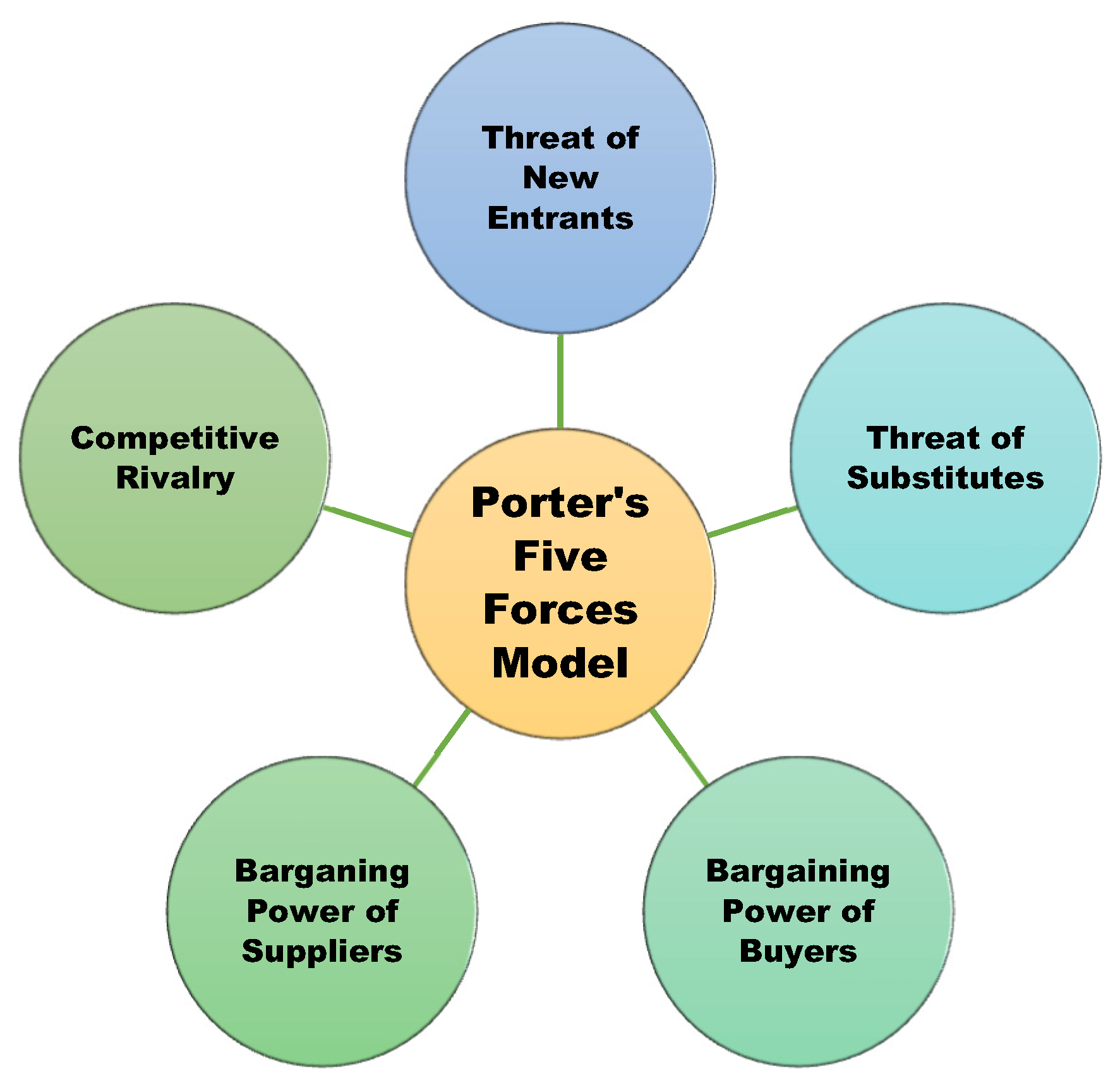
Figure 3.
Data Collection and Analysis Process.
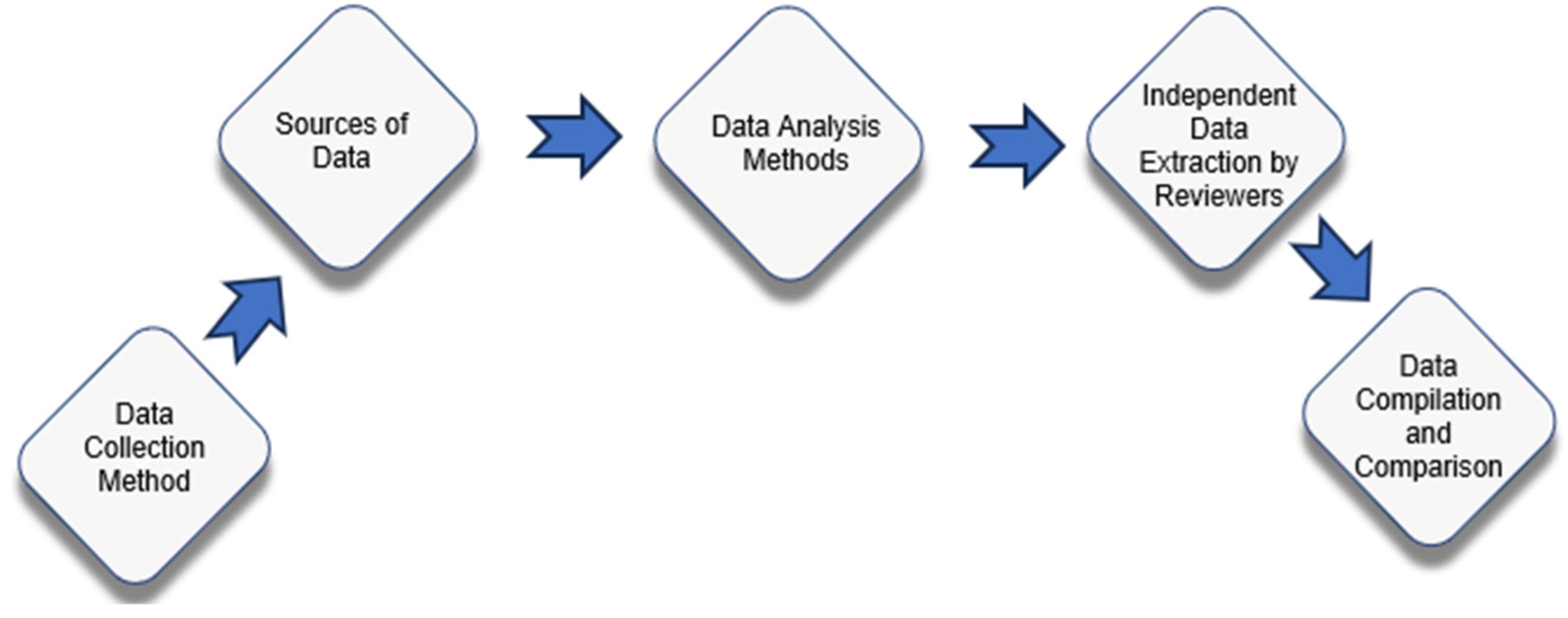
Figure 8.
Distribution of Online Data Sources.
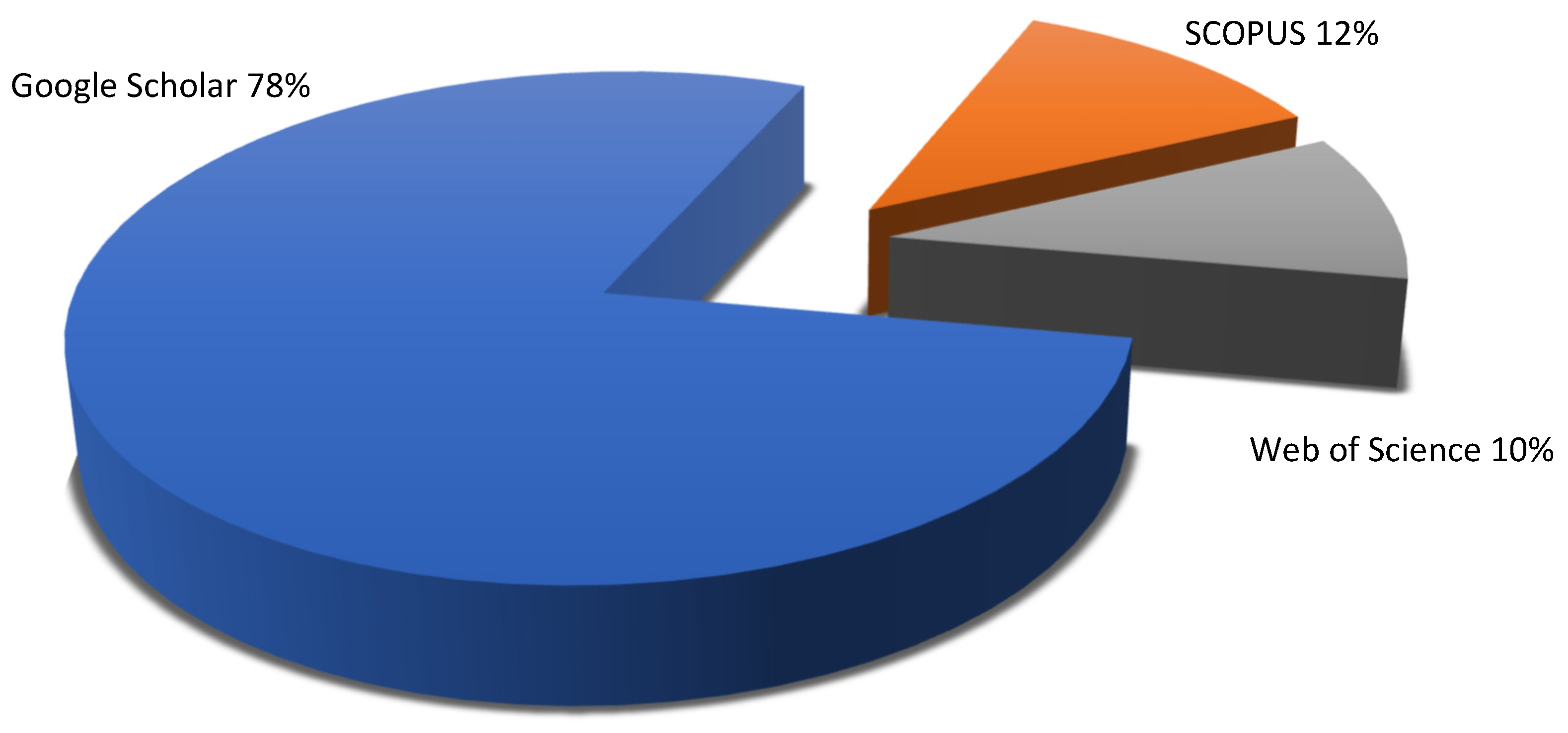
Figure 9.
Number of Publications Per Year.
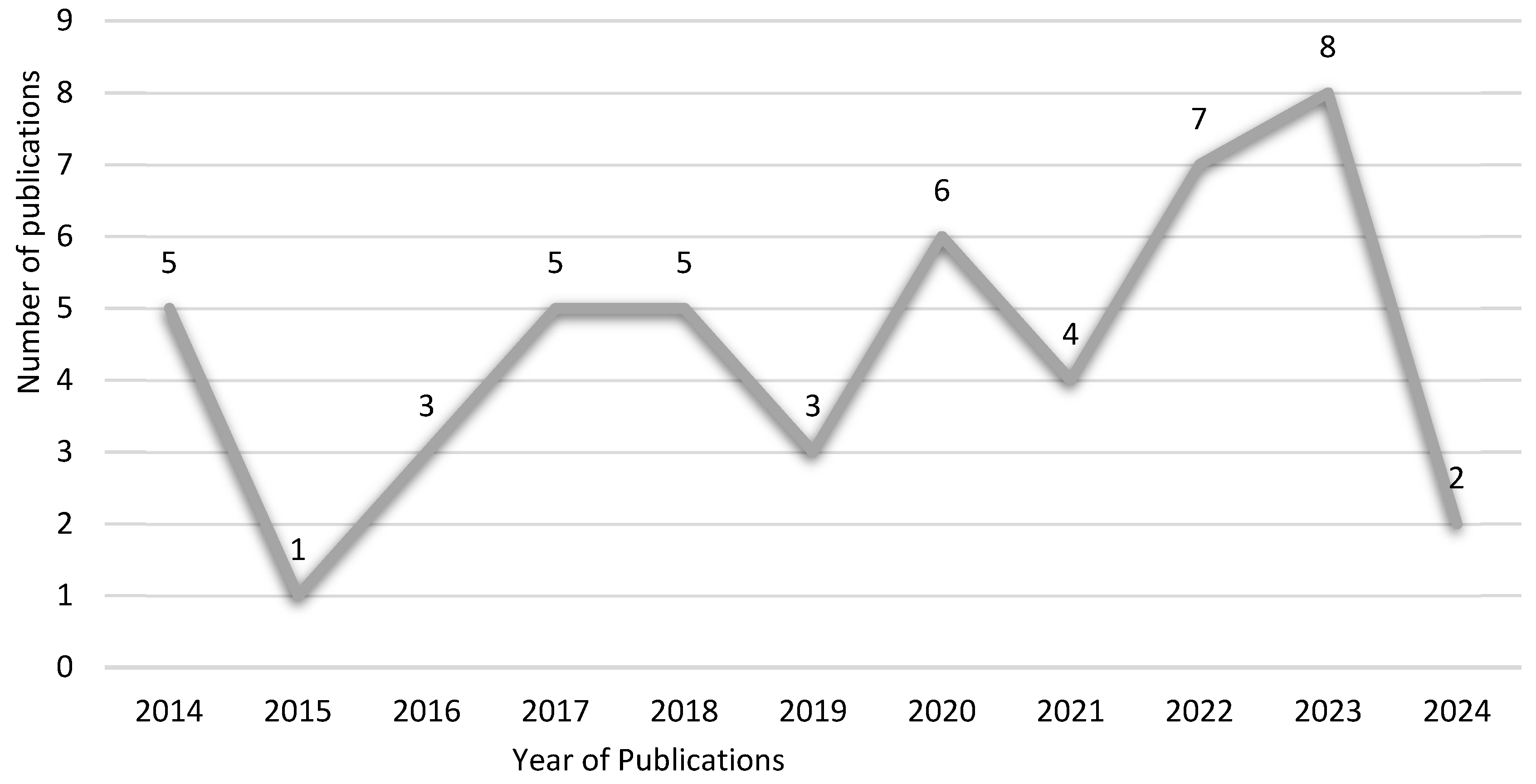
Figure 10.
The Share of Research Publication by Country Based on The Study Context.
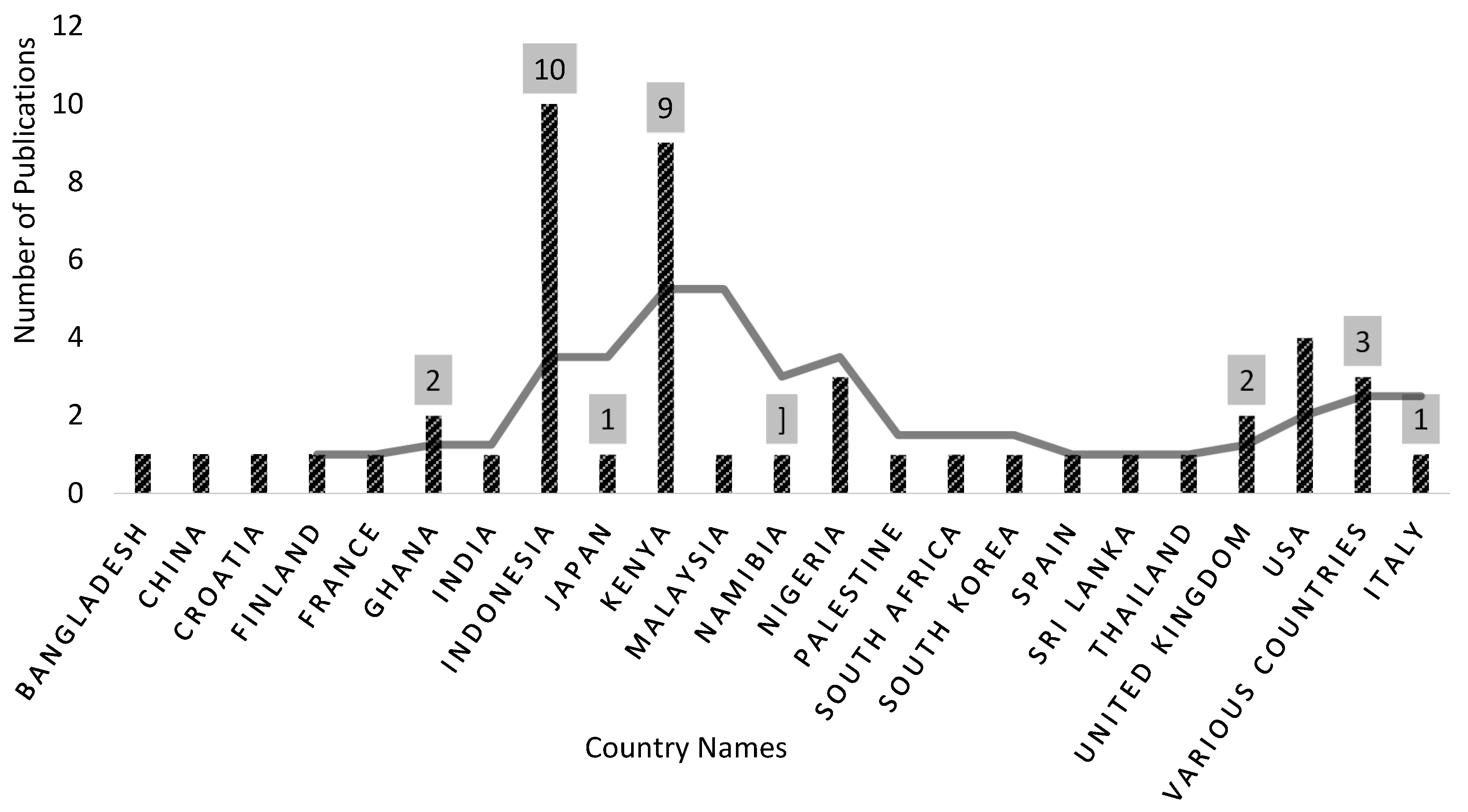
Figure 11.
Business Performances.
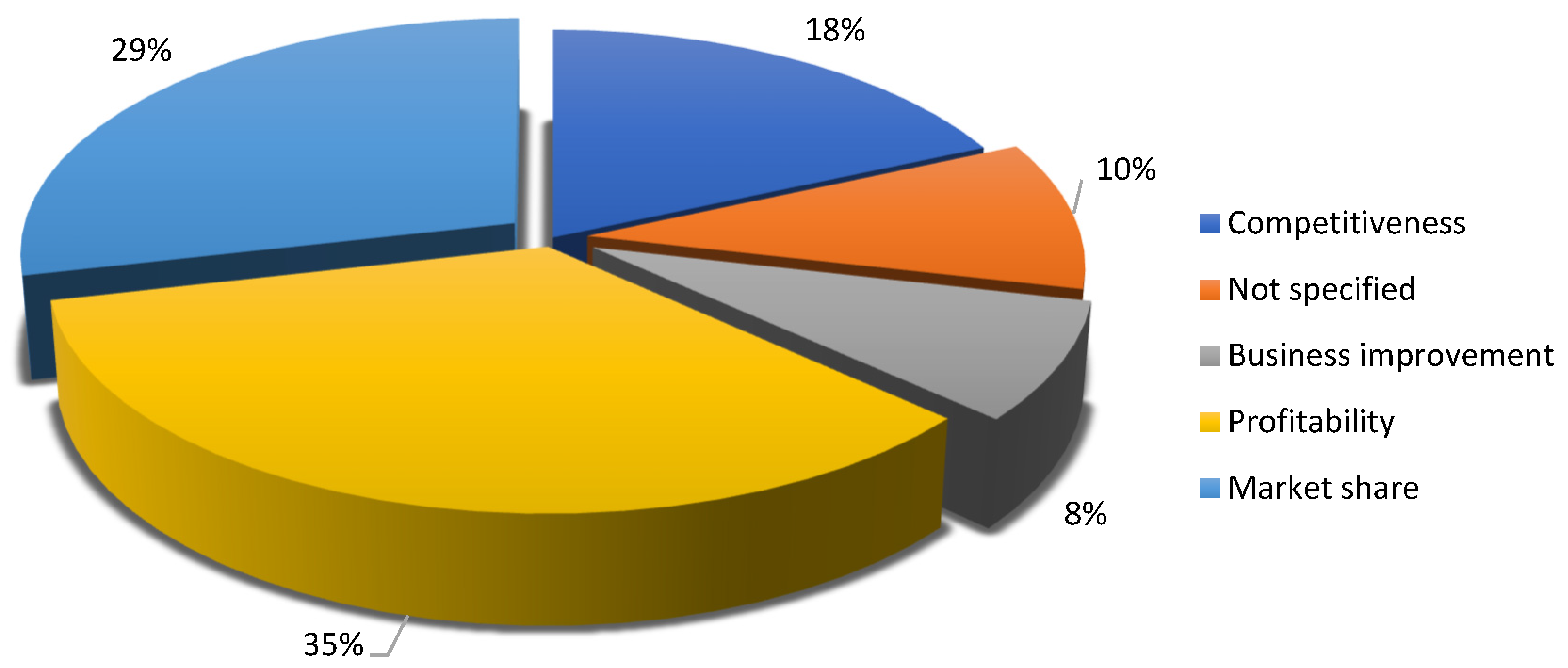
Figure 12.
Distribution of Research Methodologies in the Systematic Review.
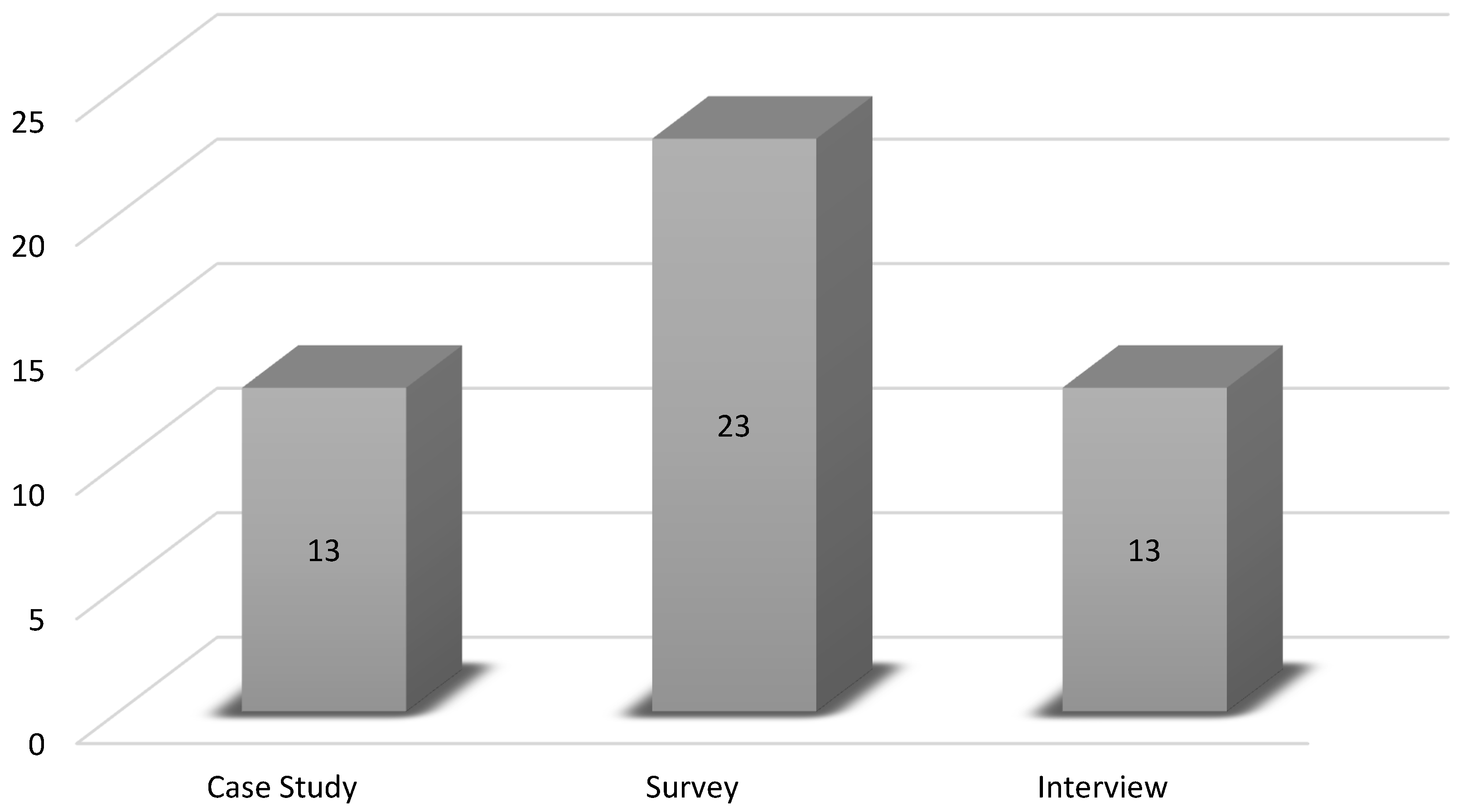
Figure 13.
Type of Study.
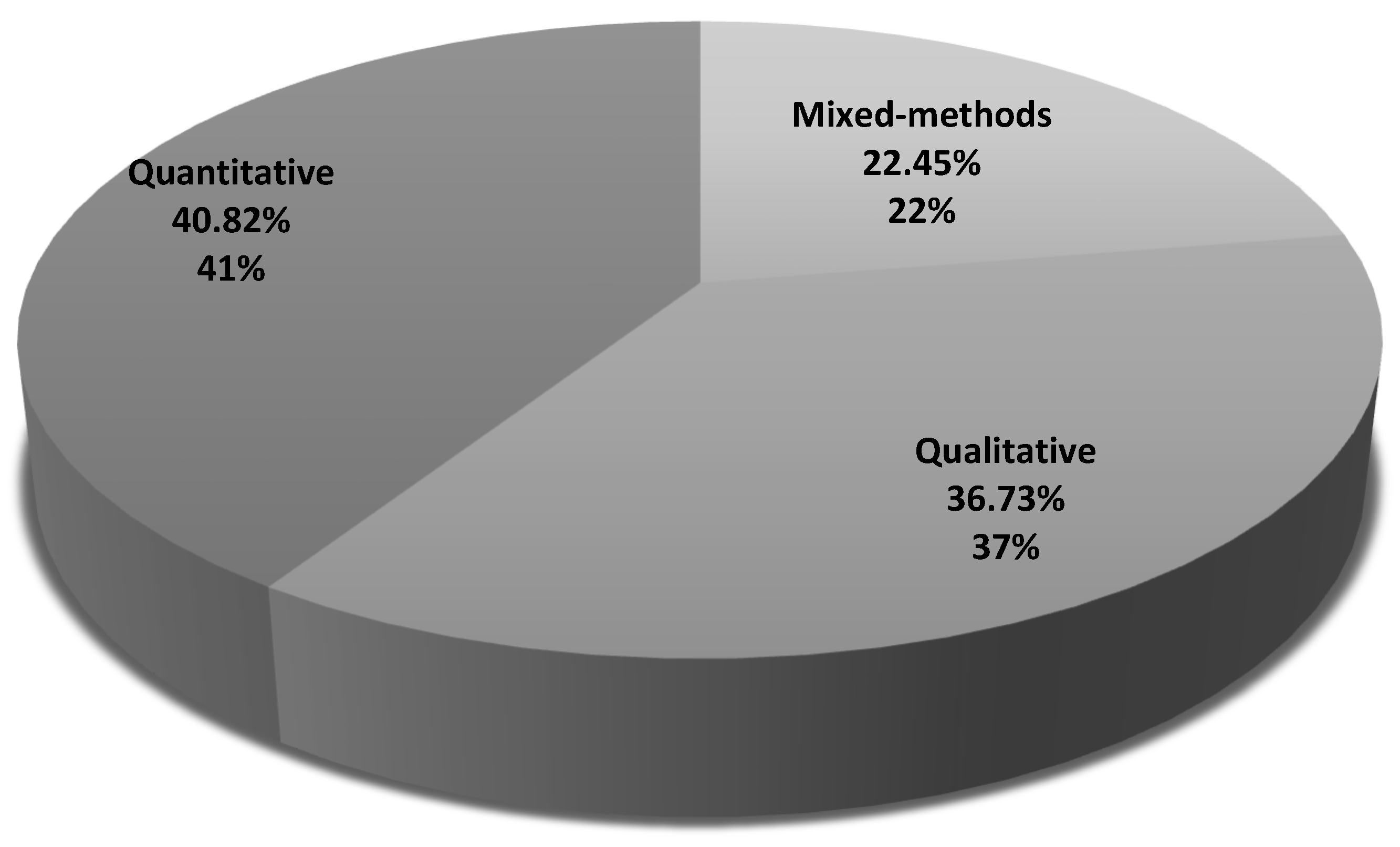
Table 1.
A comprehensive study of the current review literature and the suggested systematic review.
Table 1.
A comprehensive study of the current review literature and the suggested systematic review.
| Ref | Cites | Year | Contributions | Pros | Cons |
|---|---|---|---|---|---|
| [22] | 43 | 2014 | Reviews the use of cost leadership, differentiation, and focus strategies by SMEs in Nairobi and their impact on performance. | Provides relevant data on MSEs in a developing economy. | Findings limited to Nairobi and small-scale enterprises. |
| [23] | 2 | 2014 | Examines how Japanese SMEs apply Porter’s Five Forces in business intelligence to improve competitiveness. | Focuses on integration of competitive forces into business intelligence practices. | Limited to Japanese SMEs; may not apply to other cultural contexts. |
| [24] | 152 | 2016 | Provides a comprehensive review of strategic management theories and their relevance to SME growth and sustainability. | Summarizes diverse strategies applicable to SMEs, offering a broad theoretical foundation. | Lacks empirical evidence; more of a theoretical review than practical analysis. |
| [25] | 24 | 2017 | Analyses the competitive forces shaping the Kenyan telecommunications sector using Porter’s model | Applies Porter’s Five Forces to a specific industry, providing actionable insights. | Focuses only on one sector, limiting cross-industry application. |
| [26] | 8 | 2020 | Reviews how technological SMEs use an adapted version of Porter’s Five Forces to enhance the strategic accuracy of their innovations | Offers insights into the strategic management of technology-driven SMEs and innovation. | Focuses on technological SMEs, which may not apply to non-tech sectors |
| [27] | 49 | 2020 | Provides a systematic review of literature on responsible innovation in SMEs and proposes a conceptual model for integrating responsible innovation practices. | Offers a comprehensive overview of responsible innovation and practical implications for SMEs. | Focuses on conceptual models rather than empirical data, which may limit practical application. |
| [28] | 252 | 2021 | Analyses co-citation patterns to review the antecedents, conceptualization, and consequences of digitalization capabilities | Provides a detailed analysis of digitalization research trends and key concepts. | May lack practical applications for SMEs specifically; focuses on academic co-citation patterns. |
| [29] | 13 | 2022 | Reviews and meta-analyses the impact of eco-innovation on firm performance, exploring whether eco-innovation is a friend or foe to business success | Provides a comprehensive analysis of eco-innovation’s effects on firm performance, offering insights into its benefits and challenges. | May not focus specifically on SMEs; broad review could dilute applicability to smaller firms. |
| [30] | 2 | 2022 | Reviews various competitive strategies employed in the apparel industry, including cost leadership, differentiation, and innovation. | Offers insights into strategic practices specific to the apparel sector, providing a focused view on industry-specific strategies | Limited to the apparel industry, which may not apply to other sectors. |
| [31] | 16 | 2023 | Analyses Amazon’s business and financial performance over three years, evaluating factors contributing to its exceptional success. | Provides in-depth analysis of Amazon’s performance, offering valuable insights into its strategic success. | Focuses specifically on Amazon, which may limit generalizability to other companies or industries. |
| [32] | 65 | 2023 | Reviews the impact of digital marketing strategies on SME performance, highlighting key trends and outcomes. | Offers insights into how digital marketing affects SMEs, including benefits and challenges. | Focused on digital marketing; may not address other factors influencing SME performance. |
| [33] | 1 | 2023 | Investigates how financial literacy contributes to the sustainability and performance of MSMEs in Samarinda City. | Highlights the role of financial literacy in enhancing MSME sustainability, offering practical implications for business owners. | Focused on MSMEs in a specific geographic location; may not be generalizable to other areas |
| [34] | 8 | 2023 | Reviews literature on the role of managerial competencies in ensuring business continuity and resilience. | Provides a comprehensive overview of essential managerial skills for business continuity. | May lack specific empirical data; primarily theoretical review |
| Proposed Systematic Review | The review advances the understanding of Porter’s Five Forces in SMEs, offering valuable insights into how these forces affect small enterprises differently from large firms. It also identifies gaps in research, particularly in the impact of digital platforms and e-commerce on SME competitiveness, providing direction for future studies and policy recommendations. | This systematic review offers a comprehensive analysis of competitive forces affecting SMEs and provides practical guidance for leaders to enhance business performance. It also highlights how technological innovation and digital transformation reshape competitive dynamics, offering actionable strategies for SMEs to navigate these challenges. | |||
Table 2.
Proposals for Inclusion and Exclusion Criteria.
| Criteria | Inclusion Criteria | Exclusion Criteria |
|---|---|---|
| Topic | Articles focusing on the impact of Porter’s Five Forces on SMEs performance | Articles that do not focus on the impact of Porter’s Five Forces on SMEs performance |
| Research framework | Articles should include methodology for analyzing the Five Forces on SMEs performance | Articles that do not include a methodology for analyzing the Five Forces on SMEs performance |
| Language | Papers written in English | Papers written in other languages |
| Period | Publications between 2014 and 2024. | Publications outside 2014 and 2024. |
Table 4.
Parameters for Analyzing the Impact of Porter’s Five Forces on SMEs.
| Parameter | Description |
|---|---|
| Profitability | Financial gain and profit margin of the SME |
| Market Share | Total sales in an industry generated by a particular SME |
| Growth Rate | Percentage change in GDP, turnover, or wages from one period to another |
| Innovation | Ability of the SME to introduce new products or services |
| Supplier Concentration | Degree of dependence on a few suppliers (related to Bargaining Power of Suppliers) |
| Supplier Switching Costs | Costs incurred by SMEs when changing suppliers (Bargaining Power of Suppliers) |
| Barriers to Entry | Difficulty for new firms to enter the market (related to Threat of New Entrants) |
| Capital Requirements | Financial investment required to enter the industry (Threat of New Entrants) |
| Product Differentiation | Extent to which products or services differ from competitors (related to Threat of Substitutes) |
| Availability of Substitutes | Presence of alternative products or services in the market (Threat of Substitutes) |
| Competitive Rivalry | Level of competition among existing SMEs in the market (Competitive Rivalry) |
| Number of Competitors | Number of firms operating in the same industry (Competitive Rivalry) |
| Customer Concentration | Degree to which SMEs depend on a few large buyers (Bargaining Power of Buyers) |
| Buyer Price Sensitivity | Extent to which customers are price-sensitive (Bargaining Power of Buyers) |
| Adaptability | Ability to withstand and adjust to environmental changes |
| Sample Size | Number of interviewees, papers analyzed, or companies studied |
| Sample Characteristics | Defining traits of samples used (e.g., SME, employees, CEOs, experts) |
| Geographical Location | Location of where the studies were conducted |
| Economic Context | Status of countries studied (developing or developed) |
Table 6.
Proposed Research Quality Assessment Questions.
| Quality Assessment (QA) | Research Quality Assessment Questions |
|---|---|
| QA1 | Is the research question clearly stated? |
| QA2 | Does the research clearly specify the data collection methods? |
| QA3 | Was the sampling technique appropriate and clearly described and was the sample size sufficient? |
| QA4 | Does the research have a clear research methodology? |
| QA5 | Do the research findings contribute to existing literature on the topic of the impact of porter’s five forces model on SMEs? |
Table 7.
Momentary View of Research Works Contained Herein by Published Year.
| Published Year | Conference Paper | Dissertation | Journal Article |
|---|---|---|---|
| 2014 | 2 | 2 | 1 |
| 2015 | 0 | 0 | 1 |
| 2016 | 0 | 0 | 3 |
| 2017 | 3 | 1 | 1 |
| 2018 | 0 | 0 | 5 |
| 2019 | 0 | 2 | 1 |
| 2020 | 0 | 2 | 4 |
| 2021 | 2 | 0 | 2 |
| 2022 | 0 | 0 | 7 |
| 2023 | 2 | 0 | 8 |
| 2024 | 0 | 0 | 2 |
Table 8.
Summary of Competitive Forces, Strategic Responses, Organizational Outcomes, Business Performance, and Contribution.
Table 8.
Summary of Competitive Forces, Strategic Responses, Organizational Outcomes, Business Performance, and Contribution.
| Ref | Competitive Forces | Business Performance | Contribution |
|---|---|---|---|
| [36] | Bargaining power of suppliers | Firm performance, job creation, growth rate, profitability | The study found that digitalization significantly enhances SME performance, particularly in value-added growth and employment, within the EU27, especially during the COVID-19 pandemic. |
| [37] | Threat of new entrants | Firm performance, job creation | The study provides the effectiveness of various support programs and highlighting which interventions are most successful in improving SME performance |
| [38] | All Porter’s Five Forces | Employee experience, company recommendations | The study highlights that Porter’s Five Forces model helps managers in the telecommunication sector identify competitive strengths and weaknesses, with a call for further research to integrate additional factors influencing industry performance. |
| [39] | All Porter’s Five Forces | Employee experience, company recommendations | The study reveals that most SMEs in Medan are unaware of the Five Forces Analysis Model and its benefits, highlighting the need for academic support to help SMEs utilize the model to improve competitiveness. |
| [40] | All Porter’s Five Forces | Relationship with partners, Pricing strategy |
The study combines the 9Ps of marketing mix with Porter’s Five Forces to formulate a competitive strategy for SME Gandhis Manes, recommending future research to include SWOT analysis for better strategy formulation. |
| [41] | All Porter’s Five Forces | Employee experience, company recommendations | The paper highlights how SMEs can leverage their flexibility and focus on high-quality goods, particularly in Italy, to succeed in global markets by adapting to globalization trends and utilizing digitalization for competitive advantage. |
| [42] | Industry rivalry |
Continuous excellence, industry leadership |
The paper analyses Amazon’s exceptional business and financial performance over the past three years, highlighting its superior growth, profitability, and strategic advantages compared to Walmart. |
| [43] | Bargaining of suppliers |
Improved financial literacy, business sustainability |
The paper concludes that financial literacy, socialization, and daily accounting systems are critical strategies for enhancing MSME sustainability and competitiveness. |
| [44] | All Porters five forces | Improved financial literacy, business sustainability | Highlights how value innovation complements traditional competitive strategies as outlined in Porter’s Five Forces |
| [45] | All Porter’s Five Forces |
Employee experience, company recommendations |
The paper highlights how digital marketing helps businesses target niche markets, build trust with customers, and grow their reach, but emphasizes the need for improved training and adaptation to platforms like Instagram and TikTok for future success. |
| [46] | All Porter’s Five Forces |
Sustainable Growth |
This paper can serve as a foundational piece for understanding how Porter’s Five Forces model applies to SMEs in different contexts, and it can offer practical insights for enhancing competitiveness in similar settings. |
| [47] | Industry rivalry |
Market share, profitability, growth rate | The paper examines the structure, performance, and challenges of Namibia’s fishery sector, emphasizing the need for balanced value addition, sustainable stock management, market diversification, and improved policy coordination. |
| [48] | All Porter’s Five Forces |
Market share, profitability, growth rate | The study finds that hardware SMEs in Imenti South Sub- County, Meru County, experience significant competitive rivalry and price sensitivity, but the threat of new entrants, bargaining power of buyers and suppliers, and threat of substitute products have limited impact on their competitiveness. |
| [49] | Industry rivalry |
Market share achievement |
Competitive strategies (cost, differentiation, and innovation) significantly improve SME performance in Yogyakarta, while alliance strategy and environmental dynamism do not, and competitive pressure negatively impacts performance. |
| [50] | All Porter’s Five Forces |
Competitive performance |
In Kiambu County, SMEs effectively utilize Porter’s generic strategies, particularly differentiation, which has the strongest positive impact on performance, confirming the strategic practices’ link to superior performance. |
| [51] | All Porter’s Five Forces |
Enhanced competition and innovation | Implementing ergonomic service values (EISV) in SMEs enhances innovation and performance by improving service marketing, product values, and firm positioning, aligning with Porter’s competitive advantage theory. |
| [52] | All Porter’s Five Forces |
Market Response, Managerial Understanding |
The competency analysis of community-based tourism (CBT) using Porter’s Five Forces revealed that market competition, the threat of new entrants, substitutes, and varying bargaining powers of suppliers and customers significantly impact the survival and growth of CBT SMEs, with capital and marketing strategy being crucial for competitive advantage. |
| [53] | Industry rivalry, Bargaining power of buyers | Market Response, Managerial Understanding | The study found that industry characteristics negatively affect firm performance while dynamic capabilities, such as sensing and seizing opportunities, positively impact performance, emphasizing the need for Croatian manufacturing SMEs to adapt and invest in these capabilities. |
| [54] | Porter’s Five Forces, Inverted-U Relationship | Variability in innovation orientation by SME group and competition levels | The study empirically supports the inverted-U relationship between competition and innovation in public procurement, revealing that while low competition increases innovation, high competition decreases it, with variations across different SME groups. |
| [55] | All Porter’s Five Forces |
Competitive pressure, Technological development | The study finds that while IT and business strategies in Japanese SMEs are significantly influenced by primary value chain activities, the Porter’s Five Forces model shows mixed effects on IT strategy, with only threat of new entrants and buyer power positively impacting it. |
| [56] | All Porter’s Five Forces |
High earnings, employment opportunities, improvement in infrastructure, service extension |
The study finds that in Ghana’s downstream oil and gas sector, SMEs’ investment behaviour is influenced by the threat of entry, competitive rivalry, power of suppliers, and power of buyers, but not by the threat of substitutes, aligning with Porter’s Five Forces model. |
| [57] | All Porter’s Five Forces |
Performance improvements, contribution to poverty alleviation | The study concludes that increased industry competition and higher entrepreneurial activity drive SMEs in Bali to implement differentiation strategies, which in turn improve performance and reduce poverty. |
| [58] | Industry rivalry |
Competitiveness includes potential (internal capability, external environment, owner and company characteristics), process (operation and growth strategies), and performance (financial and non-financial). |
The study outlines the dimensions of competitiveness in SMEs—potential, process, and performance—and provides recommendations for enhancing SME competitiveness through passion, innovation, growth strategies, and government support, while emphasizing the role of mediators in providing training and access to resources. |
| [59] | Industry rivalry |
Enhanced business survival, Improved customer service |
The paper identifies ten key issues for small business sustainability beyond five years, including finance, government policy, flexibility, and customer retention, and emphasizes the importance of understanding these challenges and developing strategies to enhance long-term survival. |
| [60] | Threat of new entry |
Enhanced investment strategies, Improved participation in renewable energy sector |
The paper develops a simplified “RBV-Plus 5” model integrating RBV theory and Porter’s 5 Forces to explain SMEs’ investment behaviour in Ghana’s renewable energy sector, highlighting the significant influence of competitive resources and industry forces on investment decisions. |
| [61] | Threat of new entry |
Enhanced competitive advantage, improved productivity |
The study emphasizes that narrowing the gap between business and IT professionals is crucial for SMEs in Kenya to achieve positive growth, as knowledgeable staff and well-implemented business strategies and information systems significantly enhance firm performance. |
| [62] | Industry Rivalry |
Competitive Advantage, Enhanced Financial Performance |
The study highlights how SME importers’ use of dynamic capabilities, both generic and import-specific, enhances import strategy effectiveness, leading to competitive advantages in product differentiation and cost reduction, particularly in volatile global markets, thus improving financial performance. |
| [63] | Industry Rivalry |
Positive correlation between innovation speed and competitiveness; Enhanced by local government roles | The study concludes that innovation speed, supported by local government initiatives, significantly enhances the competitiveness of food SMEs in Malang, leading to higher profitability and productivity in a highly competitive market with short product life cycles. |
| [64] | All Porter’s Five Forces |
Organizational Structure, Entrepreneurial Orientation |
This study demonstrates that while SME dynamic capabilities positively impact non-financial performance in volatile environments, organizational inertia moderates this effect, weakening the relationship with both financial and non-financial outcomes. |
| [65] | Power of Buyers, Power of Suppliers, Threat of Rivalries | Improvement in firm performance based on strategy implementation | The study concludes that differentiation and focus strategies positively impact financial and market performance in the wooden furniture industry, while cost leadership strategy has no significant effect. |
| [66] | All Porter’s Five Forces |
Moderate Performance, High Industry Rivalry | The study highlights that Porter’s Five Forces framework significantly affects the performance of telecommunication firms in Kenya, while also demonstrating that strategic imitation, when managed effectively, can provide a competitive edge and product differentiation in new market entries. |
| [67] | Industry rivalry |
Superior performance through competitive imitation, Differentiation of new products, Successful mobilization of existing entry resources | This study demonstrates that competitive imitation, when strategically applied during new product development, can provide firms with a superior market edge and product differentiation, especially by leveraging existing resources and learning from competitors. |
| [68] | All Porter’s Five Forces | Competitiveness, Productivity |
This study highlights the importance of implementing Porter’s five forces and generic strategies, such as cost leadership, product differentiation, and focus, to enhance the competitiveness of small and medium industries (SMIs) in Bali, contributing to economic growth and job creation. |
| [69] | All Porter’s Five Forces | Employment generation, poverty reduction, local capacity building |
The study concludes that the use of strategic planning tools, such as financial analysis, SWOT, PEST, and Porter’s five forces, positively influences the performance of SMEs in Kenya, despite challenges like inadequate training and resistance to change. |
Table 10.
Proposed Risk of Bias Assessment.
| Ref. | QA1 | QA2 | QA3 | QA4 | QA5 | Total | Percentage (%) |
|---|---|---|---|---|---|---|---|
| [23,24,27,29,36,37,42,44,47,48,49,52,54,55,56,59,60,66,67,68,69,70,72] | 1 | 1 | 1 | 1 | 1 | 5 | 100 |
| [22] | 1 | 0.5 | 0 | 1 | 1 | 4.5 | 90 |
| [25] | 1 | 0.5 | 0 | 0 | 1 | 2.5 | 50 |
| [26,28]; | 0.5 | 1 | 1 | 1 | 1 | 4.5 | 90 |
| [30,32,50,57,58,61,62,63,64,71] | 1 | 1 | 1 | 1 | 0.5 | 4.5 | 90 |
| [31] | 1 | 1 | 0.5 | 1 | 0.5 | 4 | 80 |
| [33] | 0.5 | 1 | 0.5 | 1 | 1 | 4 | 80 |
| [34] | 0.5 | 0.5 | 0 | 1 | 1 | 3 | 60 |
| [38,39,40,43,45,46,53] | 1 | 1 | 0.5 | 1 | 1 | 4.5 | 90 |
| [41] | 1 | 1 | 0 | 1 | 1 | 4 | 80 |
| [50] | 1 | 1 | 1 | 1 | 0.5 | 4.5 | 90 |
| [51] | 1 | 1 | 1 | 0.5 | 1 | 4.5 | 90 |
| [65] | 0.5 | 1 | 1 | 1 | 0.5 | 4 | 80 |
Table 11.
Best Practices for Successful Implementation of Porter’s Five Forces in SMEs.
| Best Practice | Description | Strategic Rationale | Technologies/Tools to Support Implementation | Expected Outcomes | Challenges | Recommendations |
|---|---|---|---|---|---|---|
| Comprehensive Industry Analysis | Conduct detailed market and industry research to identify key players (competitors, suppliers, buyers). | Helps SMEs understand their competitive landscape and identify areas of opportunity or threat. | Market analysis tools, competitor analysis platforms (e.g., SEMrush, SWOT analysis tools). | Clear understanding of competitive dynamics, identification of threats/opportunities. | High cost and time involved in detailed analysis. | Use automated market analysis tools to streamline research and ensure accuracy. |
| Strategic Differentiation | Focus on product differentiation to stand out in highly competitive markets (Industry Rivalry). | Differentiation helps SMEs avoid price wars and compete on quality and innovation rather than cost. | AI-driven product customization, customer feedback platforms for continuous improvement. | Increased customer loyalty, improved market share. | Difficulty in maintaining innovation pace, high R&D costs. | Regularly collect customer feedback and invest in incremental innovations. |
| Building Barriers to Entry | Use cost leadership and innovation to create barriers that deter new entrants (Threat of New Entrants). | Establishes a competitive edge by lowering costs and offering innovative products. | Automation tools, cloud computing, IoT for operational efficiency, blockchain for security. | Reduced risk of new competitors, sustained market position. | Significant upfront investments in technology. | Focus on scalable technologies that provide long-term savings. |
| Supplier Relationship Management | Develop strong relationships with suppliers or diversify supplier base to reduce dependence (Bargaining Power of Suppliers). | Helps SMEs secure better pricing and terms, reducing supplier leverage. | Supply chain management platforms, blockchain for supplier transparency, AI for demand forecasting. | Lower procurement costs, enhanced supply chain resilience. | Resistance from suppliers, cost of integrating technology with suppliers. | Use digital contracts and negotiation tools to streamline supplier relationships. |
| Leverage Buyer Insights | Collect and analyze customer data to better understand buyer needs and reduce buyer power (Bargaining Power of Buyers). | Data-driven insights allow SMEs to anticipate buyer demands and adjust pricing or offerings. | AI-powered CRM systems, customer feedback platforms, cloud-based data analytics. | Improved customer satisfaction, higher customer retention. | High cost of data analytics tools, customer data privacy concerns. | Ensure compliance with data privacy regulations and invest in secure data collection methods. |
| Innovation and Product Development | Focus on continuous product innovation to combat the threat of substitutes (Threat of Substitutes). | Innovation helps SMEs stay ahead of market trends and substitute products. | AI-driven R&D platforms, IoT for smart product development, digital market research tools. | New revenue streams, reduced impact of substitute products. | High R&D costs, fast-changing market trends. | Implement agile product development strategies to reduce time-to-market. |
| Develop Niche Market Strategies | Target niche markets with specialized products to reduce exposure to intense competition and substitutes. | Niche markets allow SMEs to dominate smaller segments and reduce direct competition. | Customer segmentation tools, AI for targeting niche demographics. | Higher profitability in niche markets, stronger brand loyalty. | Limited market size, risk of market saturation. | Balance niche market strategies with broader market expansion plans. |
| Financial Literacy and Strategic Planning | Invest in financial literacy to improve decision-making and sustainability, particularly in negotiating with buyers (Bargaining Power of Buyers). | Informed financial decisions help SMEs manage pricing, cost structures, and profitability. | Financial management software, ERP systems for budget tracking, business intelligence tools. | Better financial health, improved negotiation power with buyers. | Lack of financial expertise within SME leadership. | Provide regular financial training for leadership teams. |
| Invest in Technology for Cost Leadership | Use technology to reduce operational costs and achieve cost leadership in industries with intense rivalry (Industry Rivalry). | Automation and efficiency improvements help SMEs reduce costs without sacrificing quality. | AI for process automation, ERP systems for cost control, IoT for monitoring efficiency. | Reduced operational costs, higher profit margins. | Initial technology costs, resistance to change from staff. | Gradually implement technology to manage transition costs and change management. |
| Foster a Culture of Innovation | Encourage continuous innovation across the organization to keep up with changing market demands and competitive pressures (Industry Rivalry, Threat of Substitutes). | A culture of innovation ensures SMEs remain adaptive and forward-thinking. | Innovation management platforms, cloud collaboration tools, AI-driven idea generation tools. | Long-term sustainability, market leadership in product innovation. | Risk of innovation not aligning with market demands. | Conduct regular market research to ensure innovations meet customer needs. |
| Adaptability to External Market Forces | SMEs must remain flexible and adaptable to external forces such as regulatory changes, economic shifts, and technological advancements. | Adaptability allows SMEs to pivot strategies in response to external pressures. | Business intelligence platforms, predictive analytics tools. | Resilience to market changes, reduced risk of business disruptions. | Difficulty in staying ahead of rapidly changing market forces. | Develop contingency plans and invest in tools for market forecasting. |
Table 12.
Metrics and KPIs for Measuring Porter’s Five Forces.
| Porter’s Five Forces | Metrics/KPIs | Description | Strategic Insights | Challenges | Recommendations |
|---|---|---|---|---|---|
| Industry Rivalry | Market Share | Percentage of total industry sales captured by the SME. | Indicates competitive positioning and market dominance. Growing market share signals successful competition, while a declining share indicates competitive threats. | High competition can make it difficult to increase market share. | Invest in differentiation and innovation strategies to stand out. |
| Customer Retention Rate | Percentage of repeat customers over time. | Tracks customer loyalty and satisfaction. Higher retention suggests customer satisfaction and lower susceptibility to competition. | Difficult to retain customers in saturated markets. | Develop personalized customer engagement strategies and loyalty programs. | |
| Sales Growth Rate | Percentage change in sales over a period. | Measures how well SMEs are responding to competitive pressures. Consistent growth indicates a strong market position. | Growth can stagnate in highly competitive markets. | Focus on product innovation and market expansion strategies. | |
| Competitive Pricing Index | Price comparison between the SME and its competitors. | Assesses whether the SME’s pricing strategy is competitive or at risk of being undercut by rivals. | Pricing wars can erode profit margins. | Maintain a balance between cost leadership and value differentiation. | |
| Threat of New Entrants | Number of New Competitors | Count of new competitors entering the market. | Helps SMEs assess how many new competitors are threatening their market share. | Markets with low entry barriers will attract more competitors. | Strengthen entry barriers through technology, brand loyalty, and unique offerings. |
| Barriers to Entry Strength | Measures the effectiveness of barriers such as capital requirements, regulatory compliance, or proprietary technology. | High barriers protect against new competitors entering the market. | Technological advancements can lower traditional entry barriers. | Innovate to maintain a cost advantage and continuously build brand loyalty. | |
| Customer Acquisition Cost (CAC) | Cost associated with gaining a new customer. | Higher CAC indicates difficulty in attracting new customers, possibly due to increased competition. | Rising CAC could signal inefficiency or ineffective marketing strategies. | Use digital marketing strategies and optimize customer journey to reduce CAC. | |
| Bargaining Power of Suppliers | Supplier Diversity Index | Number and variety of suppliers the SME relies on. | Greater diversity reduces supplier leverage and allows for better negotiation terms. | Over-reliance on a few suppliers can lead to increased bargaining power and costs. | Expand supplier base to include more diverse and competitive sources. |
| Cost of Goods Sold (COGS) | Direct costs attributed to the production of goods sold by the SME. | Increasing COGS suggests greater supplier power or inefficiency. | Rising supplier costs can erode margins. | Negotiate better terms with suppliers or find alternative suppliers to control COGS. | |
| Inventory Turnover Ratio | Number of times inventory is sold and replaced over a period. | High turnover indicates efficient supply chain management, while low turnover could signal supplier inefficiencies or poor demand forecasting. | Supplier delays or inefficiencies can affect turnover. | Implement real-time inventory management systems to improve turnover. | |
| Bargaining Power of Buyers | Customer Satisfaction Score (CSAT) | Measures customer satisfaction based on feedback surveys. | High CSAT suggests that buyers are satisfied and less likely to exert pressure on pricing or product offerings. | Low satisfaction increases buyer leverage. | Continuously gather customer feedback to improve product and service offerings. |
| Average Order Value (AOV) | The average amount spent per customer per transaction. | Higher AOV suggests less price sensitivity, allowing SMEs to capture greater value from each transaction. | Low AOV may indicate buyers are more price-conscious. | Bundle products or offer value-added services to increase AOV. | |
| Net Promoter Score (NPS) | Measures customer loyalty and likelihood of recommending the SME to others. | High NPS indicates strong brand loyalty and reduced buyer power. | Low NPS signals buyer dissatisfaction and vulnerability to substitutes. | Implement customer loyalty programs and enhance customer experience. | |
| Threat of Substitutes | Rate of Product Substitution | Percentage of customers switching to substitute products. | A high rate of substitution indicates competitors are offering better or cheaper alternatives. | Increasing substitution rates can erode market share. | Invest in continuous product innovation and differentiation to reduce substitution risk. |
| Innovation Rate | Frequency of new product introductions or improvements. | A higher innovation rate indicates that the SME is actively mitigating the threat of substitutes by offering novel solutions. | Slow innovation can lead to product obsolescence. | Maintain an agile product development strategy and foster a culture of innovation. | |
| Customer Switching Costs | Costs incurred by customers when switching to a substitute product. | Higher switching costs create barriers to substitution and increase customer loyalty. | Low switching costs make it easier for customers to move to competitors. | Enhance product ecosystems and offer bundled services to increase switching costs. | |
| Overall Performance | Profit Margins | Measures how much profit is made relative to revenue. | Indicates overall financial health and the SME’s ability to manage competitive pressures. | Decreasing margins may indicate inefficiencies or strong competition. | Focus on operational efficiency, pricing strategies, and cost control. |
| Return on Investment (ROI) | Measures the profitability of investments in strategies, products, or technology. | Higher ROI suggests that resources are being used effectively to combat competitive forces. | Low ROI may indicate poor investment decisions. | Regularly evaluate investment strategies and reallocate resources to high-impact areas. | |
| Market Penetration Rate | Percentage of target market captured by the SME. | A high penetration rate signals strong competitive positioning. | Low penetration may indicate weak market strategy or strong competition. | Reassess marketing and sales strategies to improve penetration. |
Table 13.
Comparative Analysis of Porter’s Five Forces Impact on Different SME Industries.
| Industry | Industry Rivalry | Threat of New Entrants | Bargaining Power of Suppliers | Bargaining Power of Buyers | Threat of Substitutes | Key Strategic Insights |
|---|---|---|---|---|---|---|
| Telecommunication | High | Moderate | Moderate | High | Low | SMEs must innovate in service delivery and adopt cost leadership to manage high competition. Strategic investment in digital platforms is essential. |
| Manufacturing | Moderate | Low | High | Moderate | Low | Supplier power requires strong supply chain management. Focus on product quality and operational efficiency to differentiate. |
| Retail | High | Moderate | Moderate | High | Moderate | Competitive pricing and customer retention are critical. Omnichannel retail strategies improve customer engagement. |
| Tourism | Moderate | High | Moderate | High | Moderate | Focus on customer service, personalized experiences, and niche markets to mitigate buyer power and new entrants. |
| Fishing Industry | High | Moderate | High | Moderate | Low | Supplier dependence on raw materials (fish stocks) necessitates efficient supply chain management and sustainability practices. |
| Renewable Energy | Moderate | High | Moderate | Moderate | Low | Innovating in energy technologies is critical. Policy and government support can mitigate new entrants. |
| Wooden Furniture | Moderate | Low | High | Moderate | Low | Focus on high-quality, customized products. Manage supplier costs and relationships to maintain competitiveness. |
| Healthcare | Low | Low | High | Moderate | Low | Strong supplier relationships are crucial. Differentiation through specialized services helps mitigate rivalry. |
| Food and Beverage | High | Moderate | High | High | High | Managing supplier and buyer power through cost control and product differentiation is essential for success. |
| Tech Startups | High | High | Low | High | Moderate | Continuous innovation and capturing early adopters are key to thriving in a fast-paced, low-supplier-power environment. |
| Logistics & Transport | High | Low | Moderate | High | Low | Investment in digital fleet management and cost-efficient operations is critical in a high-rivalry, high-buyer-power industry. |
Table 14.
Proposed Policy Recommendations Categorized by Industry, Force, and Stakeholder.
| Industry | Competitive Force | Stakeholder | Policy Recommendation | Purpose |
|---|---|---|---|---|
| Telecommunications | Industry Rivalry | Government | Provide subsidies for digital transformation and advanced technologies | Help SMEs invest in new technologies to compete in a high-rivalry environment. |
| Industry Associations | Foster collaborative platforms for sharing best practices in telecom innovation | Encourage knowledge sharing to help SMEs remain competitive in an evolving telecom market. | ||
| Threat of New Entrants | Financial Institutions | Create financial products supporting capital-intensive projects for new technologies | Help SMEs invest in innovative telecom infrastructure to raise barriers for new entrants. | |
| Bargaining Power of Suppliers | Technology Providers | Offer flexible, scalable digital services for smaller telecom players | Reduce dependency on large suppliers by offering flexible, tailored technology services. | |
| Bargaining Power of Buyers | Educational Institutions | Provide training in customer retention and digital marketing for telecom businesses | Empower SMEs to manage high buyer power by improving customer relationship management skills. | |
| Threat of Substitutes | Local Communities | Encourage local partnerships between telecom SMEs and other tech startups | Strengthen industry ties to reduce reliance on external substitutes. | |
| Retail | Industry Rivalry | Government | Offer tax incentives for retail SMEs investing in omnichannel platforms | Help retailers enhance their competitive advantage in a saturated market. |
| Industry Associations | Create retail innovation hubs to explore and develop differentiated business models | Drive innovation through industry-specific incubators and research labs. | ||
| Threat of New Entrants | Financial Institutions | Provide low-interest loans for SMEs to expand online retail platforms | Support SMEs in expanding into the digital retail space, increasing market entry barriers for new players. | |
| Bargaining Power of Suppliers | Government | Regulate fair supplier contracts and ensure equitable pricing policies for SMEs | Protect SMEs from unfair supplier practices by implementing strict regulations on supplier agreements. | |
| Bargaining Power of Buyers | Industry Associations | Host workshops on improving customer experience and loyalty programs | Help SMEs develop strategies to reduce buyer power by improving customer satisfaction and engagement. | |
| Threat of Substitutes | Educational Institutions | Offer courses on market research and product innovation | Equip SMEs with the skills needed to innovate and stay ahead of substitutes in the market. | |
| Manufacturing | Industry Rivalry | Government | Introduce R&D tax credits for manufacturing SMEs investing in advanced manufacturing technologies | Incentivize SMEs to improve operational efficiency and maintain a competitive edge. |
| Industry Associations | Facilitate cross-industry collaborations to drive innovation in manufacturing processes | Encourage knowledge exchange and innovation through partnerships across manufacturing sub-sectors. | ||
| Threat of New Entrants | Financial Institutions | Develop specialized loans for SMEs investing in proprietary manufacturing technology | Help SMEs create significant entry barriers by funding proprietary equipment or technologies. | |
| Bargaining Power of Suppliers | Educational Institutions | Provide training on supplier negotiation techniques for manufacturing firms | Empower SMEs with skills to reduce dependency on large suppliers by fostering negotiation skills. | |
| Bargaining Power of Buyers | Technology Providers | Implement flexible, on-demand manufacturing platforms to allow SMEs to customize production for specific buyers | Provide SMEs with the flexibility needed to manage buyer power through customized manufacturing services. | |
| Threat of Substitutes | Local Communities | Encourage collaboration between manufacturing SMEs and local innovators to stay ahead of substitutes | Strengthen innovation ties between local manufacturing SMEs and R&D centers. | |
| Healthcare | Industry Rivalry | Government | Provide healthcare-specific innovation grants to promote medical technology integration | Help healthcare SMEs invest in new medical technologies to maintain competitiveness in a highly regulated industry. |
| Industry Associations | Foster partnerships with universities and hospitals to create innovative healthcare solutions | Encourage collaboration between healthcare SMEs and academic institutions to drive innovation and service differentiation. | ||
| Threat of New Entrants | Financial Institutions | Offer long-term investment options for healthcare SMEs developing new medical technologies | Support healthcare SMEs by funding high-cost R&D projects that create significant barriers to new entrants. | |
| Bargaining Power of Suppliers | Government | Implement policies to control critical healthcare equipment prices | Protect SMEs from being over-reliant on large suppliers of essential healthcare products by enforcing fair pricing policies. | |
| Bargaining Power of Buyers | Educational Institutions | Offer training on patient-centered care models and flexible healthcare pricing strategies | Equip healthcare SMEs to manage high buyer power by improving patient satisfaction and service delivery models. | |
| Threat of Substitutes | Local Communities | Encourage local healthcare innovation incubators to address emerging medical substitutes | Promote collaboration between healthcare SMEs and local communities to develop innovative solutions that reduce substitutes. | |
| Tourism | Industry Rivalry | Government | Provide tourism-specific innovation grants to create niche market services | Help tourism SMEs develop unique experiences that stand out in a highly competitive industry. |
| Industry Associations | Facilitate tourism industry conferences for knowledge sharing on customer experience and service differentiation | Encourage collaboration among tourism SMEs to share best practices and explore service differentiation. | ||
| Threat of New Entrants | Financial Institutions | Offer low-interest loans for tourism SMEs to improve digital marketing and online booking systems | Support SMEs in enhancing their digital presence, creating a barrier for new entrants. | |
| Bargaining Power of Suppliers | Local Communities | Promote local supplier partnerships to ensure fair pricing for tourism-related services | Encourage local partnerships to strengthen tourism SMEs’ access to competitive supplier pricing. | |
| Bargaining Power of Buyers | Educational Institutions | Offer training on enhancing customer satisfaction and loyalty through customized vacation packages | Help SMEs improve customer engagement and reduce buyer power in the tourism sector. | |
| Threat of Substitutes | Technology Providers | Implement platforms for tourism SMEs to collaborate and improve service innovation | Help tourism SMEs develop innovative services that reduce the risk of losing customers to substitutes. | |
| Fishing Industry | Industry Rivalry | Government | Provide grants for sustainable fishing practices and eco-certification | Promote competitiveness through sustainable fishing certifications and eco-friendly practices. |
| Industry Associations | Facilitate knowledge-sharing platforms to explore sustainable practices in fishing | Encourage collaboration among SMEs to innovate and reduce environmental impact, improving their market positioning. | ||
| Threat of New Entrants | Financial Institutions | Create funding programs for eco-certified fishing SMEs to improve market positioning | Support SMEs that adhere to sustainability standards, creating barriers for new entrants in the fishing industry. | |
| Bargaining Power of Suppliers | Educational Institutions | Offer courses on sustainable supply chain management for the fishing industry | Equip SMEs with skills to negotiate better deals with suppliers by implementing sustainable practices. | |
| Bargaining Power of Buyers | Local Communities | Promote local partnerships between fishing SMEs and buyers to prioritize sustainable seafood practices | Encourage local buyers to source sustainably, helping SMEs manage buyer power by offering eco-friendly options. | |
| Threat of Substitutes | Government | Promote research into alternative seafood solutions to help SMEs adapt to changing market demands | Help fishing SMEs innovate and stay ahead of alternatives like plant-based seafood. | |
| Renewable Energy | Industry Rivalry | Government | Offer R&D tax credits for renewable energy SMEs investing in advanced storage technologies | Help renewable energy SMEs innovate in a highly competitive and rapidly evolving market. |
| Industry Associations | Host renewable energy conferences to foster industry collaboration on technological advancements | Encourage SMEs to share and explore innovations in renewable energy technologies. | ||
| Threat of New Entrants | Financial Institutions | Provide funding for renewable energy SMEs focused on solar and wind technology innovation | Support SMEs developing cutting-edge renewable energy technologies, increasing entry barriers for new competitors. | |
| Bargaining Power of Suppliers | Technology Providers | Offer affordable, scalable renewable energy solutions to support SME growth | Provide flexible technology solutions that allow SMEs to manage supplier power more effectively. | |
| Bargaining Power of Buyers | Government | Implement policies that support government-corporate partnerships in energy production contracts | Help renewable energy SMEs secure long-term contracts with governments or large buyers. | |
| Threat of Substitutes | Local Communities | Encourage community partnerships to expand renewable energy solutions that meet local needs | Promote local collaboration to reduce the risk of substitutes such as fossil fuels. |
Disclaimer/Publisher’s Note: The statements, opinions and data contained in all publications are solely those of the individual author(s) and contributor(s) and not of MDPI and/or the editor(s). MDPI and/or the editor(s) disclaim responsibility for any injury to people or property resulting from any ideas, methods, instructions or products referred to in the content. |
© 2024 by the authors. Licensee MDPI, Basel, Switzerland. This article is an open access article distributed under the terms and conditions of the Creative Commons Attribution (CC BY) license (http://creativecommons.org/licenses/by/4.0/).
Copyright: This open access article is published under a Creative Commons CC BY 4.0 license, which permit the free download, distribution, and reuse, provided that the author and preprint are cited in any reuse.