

Submitted:
30 September 2024
Posted:
02 October 2024
You are already at the latest version
Abstract
Water scarcity presents one of the greatest challenges of our time. Especially in naturally water scarce regions, the need of additional water resources is rising, requiring innovative and site-adapted technologies. In this review, selected non-conventional water technologies for sustainable water management are strategically evaluated. Focused on a matrix-based assessment incorporating key indicators, the study discusses the availability, applicability, environmental impact, scalability, and economic viability of the selected technologies. Based on a comprehensive literature review, the methodology involves a systematic comparison of technologies for desalination, water reuse, groundwater utilization, agricultural reuse, and unconventional approaches like cloud seeding, dew water, and fog water harvesting. The indicators covering the respective categories are presented in the results. On this basis, the different technologies are analyzed by matrix-based evaluation, highlighting various strengths and weaknesses and providing insights into technology selection based on regional needs. The discussion interprets the findings, deriving implications for dry environments, acknowledging limitations and suggesting pathways for future research. Through a rigorous analytical framework, this study contributes to the discourse on sustainable water solutions, offering valuable insights for policymakers, researchers and industries during a decision-making progress.
Keywords:
non-conventional water technologies
; arid regions
; sustainable water management
; matrix-based assessment
; technology evaluation
1. Introduction
The increasing water scarcity in arid regions poses a formidable challenge to sustainable development, necessitating innovative solutions to augment water resources. This study aims to address this pressing issue through a strategic assessment of non-conventional water technologies [1], focusing on their availability, applicability, environmental impact, scalability, and economic viability [2]. The objective of this study is to systematically evaluate the non-conventional water technologies using a matrix-based approach with previously defined indicators. Based on these assessments, insights are provided with the goal to inform policymakers, researchers, and practitioners navigating the complexities of water management in arid environments.
The importance of non-conventional water technologies in this context cannot be overstated [3,4]. As traditional water sources are gradually being exhausted, these technologies show alternative means to secure a reliable water supply as the example of Italy shows [5]. Desalination (thermal or membrane-based) [6,7,8], water reuse [9,10,11], and unconventional approaches such as cloud seeding [12,13], dew water harvesting [14,15], and fog water collection [16] represent potential solutions for sustainable water management. Understanding their strengths and weaknesses is decisive for the selection of the appropriate technology under the contraints of a certain location. This study discusses the applicability and feasibility of these technologies by taking into account location-specific factors, such as energy costs or the chemical composition of seawater, particularly of the MENA region as it is an especially arid area. Valuable knowledge is contributing to the broader discourse on water resource management and is supporting the decision-making process to find the optimal solution.
2. Methodology
The methodology section outlines the structured approach adopted to ensure the reliability and objectivity of the analysis. The study leverages a matrix-based evaluation framework, integrating key indicators such as applicability, environmental impact, scalability, and economic viability. The developed indicators have been discussed and checked during an expert workshop with representatives in this field. The following Figure 1 shows the general approach of this study.
2.1. Literature Review
The literature review is the foundation of this study, presenting an overview of the research on the topics of non-conventional water technologies and water management practices in arid regions. The sources reviewed are articles from diverse scientific journals and provide insights on latest technology advancements, key challenges and successful case studies in specific countries and environments with a focus on the MENA region. These sources give the context for the methodological approach of this study, which allows the definition of specific indicators and the subsequent analysis with a matrix based approach.
Most of the sources cited in this study have a country-specific point of view, often combined with a particular technology applied in this region. More general papers provide an overview of the technologies for non-conventional water technologies, especially [1,4], as well as [11,17,18] and [19,20,21]. The different technologies are discussed in detail, including the site-specific conditions and socio-economic factors of the MENA region. Other articles [22,23,24] set the focus on the remaining contaminants of concern and trace metals during the non-conventional water application, addressing agricultural as well as municipal aspects of water reuse. Several articles specify the water reuse approaches and safety issues for the irrigation of certain crops [25,26,27,28,29]. In the following subsections, literature treating a specific country is being shortly reviewed. The technologies applied are predominantly desalination (namely reverse-osmosis, RO), greywater, water reuse, agricultural drainage water and rainwater harvesting. Water reuse must be distinguished from water recycling, as the latter involves the application of additional technology, while the former involves the direct reuse of water.
2.1.1. MENA and the Mediterranean Region
In these articles and studies, the centre of attention lays on the Mediterranean region [30,31], Italy in specific [5,19], the MENA region in general [2,9,18,32,33,34] or the GCC countries [2]. The desalination of seawater [6,35] is the most widespread technology, but is associated with high operational costs (OPEX) due to the electricity demand. The combination of renewable energy with desalination is an attractive topic addressed in many studies, i.e. [34,36,37,38,39,40]. Given the high solar radiation in this area, photovoltaic systems would be an especially efficient solution [41,42], and possible ways of enhancing their efficiency are already under development [43]. Environmental impacts originating from various desalination technologies are assessed in this study [44], as well as sustainability aspects [8]. Some reviewed publications discuss innovative process combinations to improve desalination processes [35,45]: forward-osmosis (FO) and ultra-filtration (UF) [46], centrifugal RO [47] and nano-filtration reverse-osmosis (NF-RO) [48,49]. The latest developments use a closed-cycle RO (CCRO) allowing for better scale control and higher recovery rates [50,51], also used for brackish water desalination [52].
2.1.2. Jordan
The water scarcity in Jordan is more extreme compared to other countries in the MENA region due to limited surface waters and limited seawater access, which is only given in the city of Aqaba. The available surface waters are mostly stored rainwater in high-dams in the mountainous North of Jordan but often polluted by local uncontrolled discharge of wastewater or generally over-exploited. All other literature are subject to desalination units [42]. Some other sources include groundwater [53] and water treated by solar desalination systems [42,54]. The high energy consumption of desalination plants is discussed here [55,56]. Wastewater reuse in general is presented in these studies [57,58], and the use of treated wastewater for irrigation specifically is considered in [59].
2.1.3. Egypt
As Egypt is experiencing water scarcity since many decades, there has been extensive research conducted in field of non-conventional water technologies, including both agricultural and municipal water use. A general overview is given by Bakr et al. [60], who mentions the Nile river as the primary water resource for human supply. As the river does not fully covers the irrigation needs, non-conventional resources are added, namely agricultural drainage, groundwater and treated wastewater. Other resources/technologies are more specifically detailed in the following papers: greywater in [61,62], water reuse in [63,64,65], or rainwater harvesting in [66,67]. Several papers have a distinct local relation, e.g. [63,65,68,69]. One of the most widely used technologies, the desalination, is described in general in [70,71], in the context of irrigation in [70], and Rayan et al. present the installed desalination units in the Sinai peninsula specifically, as well as potential future sites in Egypt [68].
2.1.4. Tunisia and Morocco
Tunisia started early with water-reuse approaches [27] in the agricultural sector, a general outline of the national perspective of water in Tunisia can be found here [72]. Several other publications see the technological solution in desalination plants [73,74,75], partly supplied with geothermal energy [76] or desalination using solar energy (PV) [37,39,77]. Morocco has a desalination strategy explained in this study [78].
2.2. Selection of Non-Conventional Water Technologies
The initial phase of the study involves a selection process to identify non-conventional water technologies [19] with a particular emphasis on the site-specific conditions, namely the arid climate. Table 1 shows the selected technologies with its abbreviation based on [4], which are the foundation of the following analysis. The technology readiness level (TRL) gives its development level and its market maturity on a scale from 1 (first idea) to 10 (market ready). More information about the TRL concept and the maturity stages of a technology can be found in Figure 2.
This selection is not required to include every possible technology, as it would go beyond the aim of this review which is to give a comprehensible and clearly-arranged overview. It also neglects the origin of the water, i.e. municipal, industrial or agricultural. The most common technologies, namely desalination [7] and water reuse [10], and more unconventional approaches like cloud seeding [13], dew water [15] harvesting and fog water [16] collection are chosen based on their potential significance in the Mediterranean region. Each of these non-conventional water technologies present distinctive advantages and challenges, and their suitability depends on the specific conditions and requirements of the target region.
2.3. Development of Indicators
An indicator is a parameter designed to assess progress, effectiveness, and performance within a given context. Following the SMART criteria [89], indicators should meet specific criteria in order to establish a clear frame for the evaluation [90].
Figure 3 shows the SMART concept and gives some examples that can be applied for the respective technology indicator. In order to make them more meaningful in the context of non-conventional water technologies, it is important to understand that the chosen indicators should fulfill the SMART criteria.
After the definition of the technologies, the development of applicable indicators in the framework of non-conventional water resources is made. These indicators are reviewed by experts and stakeholders, jointly discussed during a workshop of the AGREEMed project with all participants. In a second step, the indicators are grouped in five categories. The categories listed in Table 2 provide a structured framework for the analysis of diverse set of indicators in order to derive a comprehensive evaluation of the non-conventional water technology’s performance and impact in arid regions.
2.4. Matrix-Based Evaluation Framework
The criteria chosen for each category should be customized to account for the site-specific conditions, including factors such as the local availability of raw water sources, region-specific economic considerations, and environmental impact assessments. Assigning weights to these criteria, based on stakeholder input and expert insights, helps in prioritizing their significance. A numerical or qualitative scoring system facilitates the systematic assessment of each technology based on the identified criteria. Subsequently, relevant data is collected as part of a comprehensive site assessment in order to complete the matrix, considering aspects such as climate, water quality, and socio-economic conditions. The scoring matrix is then utilized to calculate total scores for each technology, incorporating both the assigned weights and the actual scores. This approach facilitates the ranking and prioritization of technologies, with the highest total score indicating suitability for the specific site conditions. The entire process should be thoroughly documented and reported to ensure transparency and to provide a dynamic tool for informed decision-making in water resource management. Regular updates and reviews further enhance the framework’s adaptability to changing conditions and evolving technologies.
Stakeholders and experts collaboratively determine the significance of each indicator in contributing to the success of the technology in a given context. The applicability framework involves assigning relative weights to indicators, reflecting their relevance and influence on the effectiveness. Factors such as the adaptability to local water quality requirements, the consideration of the climate, its alignment with economic considerations, and its acceptance within the community are considered during this weighting process. The goal is to create a balanced and relevant system where indicators decisive for the success of the technology receive higher weights. This tailored approach ensures that the matrix-based evaluation adequately addresses the unique requirements and challenges of each non-conventional water technology.
3. Results and Analysis
A matrix-based evaluation of non-conventional water technologies is presented in the following section, focusing on aforementioned site-specific conditions. This section introduces the developed indicators, their weights, and the scoring matrix. The results are analyzed to reveal insights into each technology’s performance, emphasizing their suitability for the unique challenges posed by the site. Beyond presenting scores, the analysis explores the interactions between indicators, leading to a solid foundation for the ensuing discussion and conclusions.
3.1. Development of Indicators for the Selected Technologies
This subsection details the systematic selection and formulation of indicators, aligning them with the defined categories. Each indicator is carefully customized to capture the nuanced aspects of the chosen technologies. This concise paragraph highlights the rationale behind indicator selection, setting the stage for the subsequent matrix-based evaluation.
3.1.1. Availability
The "Availability" category evaluates the reliability of the non-conventional water technology when it comes to harnessing existing water sources in arid regions. It considers factors such as water availability for desalination, groundwater accessibility, meteorological conditions and atmospheric moisture for dew and fog water harvesting. This category is relevant for ensuring a consistent and dependable water supply, fundamental for the success of these technologies in water-scarce environments. The following Table 3 summarizes the indicators and its units.
3.1.2. Applicability
In the "Applicability" category, the focus shifts to evaluating the suitability and adaptability of non-conventional water technologies to diverse environmental and operational contexts. This category assesses how well these technologies can be practically implemented in arid regions, considering factors such as compatibility with local conditions and ease of integration into existing infrastructures, like the plant footprint. In addition, the social acceptance, water accessibility and inequalities of the usage outlines the importance of estimating the applicability of these solutions. Table 4 shows the developed indicators.
3.1.3. Environmental Impact
In the "Environmental impact" category, the evaluation is centered around key indicators aiming for the recognition of the ecological ramifications of non-conventional water technologies in arid regions. This examination considers critical factors such as electrical and thermal energy consumption, the usage and generation of chemicals and byproducts, life cycle assessment, toxicity of applied chemicals, freshwater consumption for mixing, presence of hazardous water compounds in runoff water, and the efficiency of contaminants removal. It is important to mention that the time frame for such an evaluation is short term based and cannot predict future developments. By focusing on these indicators, the evaluation aims to offer a detailed understanding of the environmental implications of the technology, enabling a thorough consideration of their sustainability and ecological compatibility within the designated areas. Table 5 shows the developed indicators of this subsection.
3.1.4. Scalability
In the "Scalability" category, the assessment revolves around two key indicators that determine the adaptability and extensibility of non-conventional water technologies in arid environments. The first indicator, "Capacity restrictions, processing limits," focuses on understanding the constraints and limitations regarding the maximum water treatment capacity and processing capabilities of the technology. The second indicator, "Plant modularity," evaluates the degree to which the technology can be designed modularly and scaled, allowing for flexible adjustments to varying capacities. Both indicators address effectively a range of water treatment needs across different scales within arid regions. The following Table 6 explains the indicators in detail.
3.1.5. Economy
In the "Economy" category, the evaluation centers on the financial aspects that govern the implementation and sustainability of non-conventional water technologies in arid regions. This category encompasses critical indicators that directly influence economic considerations, presented in Table 7. Capital Expenditure (CAPEX) examines the initial investment required for technology establishment, while Operational Expenditure (OPEX) assesses ongoing operational costs, e.g. energy demand. Water product costs scrutinize the expenses associated with the produced water, and life cycle costs enable a comprehensive view of the overall financial impact throughout the technology’s life cycle. Logistics consider the efficiency of resource utilization, and profitability evaluates the economic viability of the technology. Given the pivotal role of financial considerations, this category plays a crucial role in determining the feasibility and long-term success of implementing these technologies in arid environments.
3.2. Analysis by Matrix-Based Evaluation
In this section, the focus shifts to the examination of the chosen non-conventional water technologies (see Table 1) by applying the previously described indicators to the respective technologies. This analytical approach considers the applicability of each technology to specific indicators, allowing a systematic comparison of their performance and suitability. By employing a matrix-based framework, this evaluation aims to elucidate the interactions between the selected technologies and the diverse array of indicators across the five chosen categories. The goals of this assessment are mainly the identification of the strengths and weaknesses of each technology in order to simplify of the decision-making process for their deployment in arid regions.
In Table 8, the suitability of the indicators from the category "Availability" for the different technologies is shown. Only one indicator, namely No. 1.2 (usable volume produced), is suitable for every technology. Although it is the largest category, there is a recognisable trend in the division of the indicators; the different water properties (1.4 - 1.6) are relevant to the technologies using already existing water resources (D, WR, G and AR) with given water quality aspects.
The others rely on the meteorological conditions with limited predictability, which are important for the methods condensing the water from the air and utilising the different weather conditions. AR and G also depend on a longer timescale on the local rainfall and precipitation, determining the available water for those applications.
In Table 9, the indicators of the category "Applicability" are shown, in analogy to the table previously mentioned. The suitability of each one varies way less than in the category "Availability", every single one being applicable on nearly every technology. The reason for that is that only CS does not require any plant space, as chemicals are dispersed by aeroplanes to initiate rainfall.
In Table 10, the analysis for the environmental impact aspects is presented. Being the second-largest category, the weights of the indicators vary quite significantly, No. 3.3 (LCA) being the only one applicable for every technology. Every indicator is suitable only for two processes (WR and AR), while only two indicators are applicable to the more innovative/less wide-spread technologies (CS, DW and FW).
In Table 11, the matrix for the scalability indicators is pictured, the smallest of the categories. The processing limits are applicable to every technology, while the plant modularity is only applicable to D, DW and FW. The two latter ones require large land areas, due to relatively low water production volume per area of condensing surface. It is notable that the applicable areas can be in remote locations, which are difficult to access.
In Table 12, the category "Economy" is shown. This is the only category where all indicators are applicable on every single technology, despite the relatively large number of the indicators.
The assessment of the respective technologies should be done explicitly for the special boundary requirements of a distinct location. The best solution may vary and there are always several options to consider, while the indicators from the "Economy" category are mostly the basis for an investment decision.
4. Discussion
In this section, an analysis of the findings is presented, derived from the matrix-based evaluation of non-conventional water technologies and their corresponding indicators. In order to enable a better understanding for the interpretation, there is given a small example of the matrix-based evaluation for a specific site in Jordan. The strengths and weaknesses of each technology concerning the diverse set of indicators are critically discussed, while highlighting their performance in the discussed categories.
4.1. Interpretation of the Analysis
4.1.1. Desalination
This technology is widely used for the production of drinking water and for agricultural purposes [32]. The significant operational costs (OPEX) are associated with the high electricity demand, representing around 80 % of the costs. The economic viability heavily relies on the local electricity price, impacting the overall cost-effectiveness of desalination projects [52]. Useful indicators to estimate the impact of these issues are the following: Energy consumption (3.1), Life cycle costs (5.4) and OPEX (5.2). Additionally, environmental aspects have to be taken into consideration, e.g. brine discharge and water intake construction. It is recommendable to set up an LCA for this purpose (3.3). The brine has significant environmental impacts, mostly regulated by a legal framework and technical limitations. Especially if the brine disposed improperly in the sea, it can cause serious damage to the aquatic ecosystem. The reasons are not only the high salinity, but also the possible accumulation of hazardous chemicals such as antiscaling agents, chemicals from CIP processes, and heavy metals [44] [49]. Nevertheless, a complete brine treatment would multiply the water price from desalination and is mostly not applied. All indicators of the category "Economy" and some of the category "Environmental impacts" (3.1), (3.2) and (3.4) describe the associated costs and limitations of the technology.
4.1.2. Water Reuse
While technically and economically feasible, water reuse and recycling encounters economic challenges related to upgrading processes, particularly when intended for human consumption [11]. Therefore, it is important to consider the economy-related indicators. Also, there is sometimes the need for freshwater used for mixing (3.5), which can be minimized by appropriate plant operation. Depending on the intended purpose of the reused water, there might be stricter regulations regarding the water quality (2.2). Cultural and social aspects (2.3) can further affect the economic viability of widespread deployment, necessitating careful consideration of associated costs. The concentration of certain compounds of concern (e.g. pharmaceutics, pesticides) as well as biological parameters like COD and BOD5 should be considered (3.2, 3.6), as the origin of the raw water and the containing substances can be unknown (1.1, 1.3) [63]. However, the energy requirements are significantly lower compared to other technologies (3.1) [91].
4.1.3. Groundwater
Groundwater utilization is subject to availability and economic constraints, with post-treatment costs being a factor (5.2), especially for brackish water. A treatment is often necessary due to the salinity and the possibility of contamination with e.g. agricultural substances like pesticides or fertilizers (3.2, 3.6), also depending on the location of the groundwater extraction (1.1) [22] [92]. The economic feasibility of the direct usage for irrigation (5.4, 5.6) depends on factors such as deep aquifer accessibility, its management to prevent over exploitation and the potential risk of increasing salinization [72]. Additionally, the depleting groundwater level has to be taken into account, especially in arid regions, therefore uncontrolled groundwater extraction may contribute to this problem [53].
4.1.4. Cloud Seeding
Cloud seeding, although dependent on local weather conditions (1.7, 1.8), faces serious economic and environmental challenges due to the costs associated with the applied chemicals (5.2, 5.3, 5.4), additional costs for the spreading using small airplanes and unforeseeable environmental impacts. Secondly, the increase of rainfall can reach from not measurable to up to 30 %, but is hard to predict and measure exactly. Due to the toxicity of the chemicals (3.4) e.g. silver iodide (AgI), it may necessitate additional measures contributing to economic considerations [13]. Due to the known hazardous potential of AgI on agricultural lands, it may lead to safety concerns within the society (2.3). Furthermore, the prevailing local meteorological conditions need to be strictly taken into account, as special cloud formations and humidity levels are the basis for this technology. The wind direction can lead to rainfall in areas, where it is not intended to rain [12]. Despite the advantage of this technology concerning its footprint and flexibility regarding the location (4.1), it cannot be considered nowadays as sustainable water technology due to unpredictable environmental impacts and high associated costs.
4.1.5. Dew and Fog Water
Dew and fog water technologies are entirely dependent on meteorological conditions respecting indicators (1.7, 1.8) [15,16]. Economic and logistical challenges are caused by the need for large installation areas, which are often remote and challenging-to-access (2.1) areas like mountains and elevations. The economic feasibility is further impacted by the costs associated with maintaining the plant and transporting water from the remote locations (5.3, 5.4). Concerning the energy demand (3.1), this technology needs only very low resources, mostly depending entirely on the post-treatment and transportation logistics.
4.2. Implications for Water Management in Arid Environments
The evaluation of the non-conventional water technologies by matrix-based analysis showed that several key indicators emerged as pivotal factors, carrying the highest impact in the technology selection process. The usable volume produced, assigned a weight of 7, highlights the practicality and effectiveness of each technology, emphasizing the need for a substantial water output to meet diverse demands. The stringent water quality requirements depending on the application underscore the significance of ensuring that the usage of treated water is safe and sustainable, without creating further environmental problems such as soil contamination. Social acceptance reflects the intricate interplay between technological solutions and societal perceptions, highlighting the importance of aligning innovations with community values. All indicators are summarized in Table 13 and have been assigned in the prior analysis a weight of 7.
Furthermore, the life cycle assessment describes a comprehensive extent of the environmental impact, encompassing factors from raw material extraction to end-of-life considerations (cradle-to-grave). It is also useful to avoid problem shifting when considering one technology against another, given the fact that the LCA highlights potential issues which would otherwise remain unrecognized. Capacity restrictions and processing limits focus on the scalability of the technology, addressing the critical aspect of accommodating varying water demand scenarios efficiently.
The economic considerations, represented by CAPEX, OPEX, water product costs, life cycle costs, logistics, and profitability, emphasise the great importance of financial performance and long-term sustainability. These indicators encapsulate the entire economic landscape of implementing and maintaining each technology, highlighting the need for cost-effectiveness, efficient logistics, and positive financial outcomes.
4.3. Example Scenario
In order to give a more precise idea of how to work with the indicators, the following subsection presents a scenario of a possible decision-making process for a plant location in Jordan. For better clarity, only a few indicators are selected in this example. The goal is to compare the implementation of different technologies within the frame of a given set of parameters for a specific location.
4.3.1. Parameters
The example location and the respective parameters are chosen because an operational plant for the water supply of a date farm has been implemented at this location 12 years ago. The plant is a reverse osmosis desalination plant for brackish water desalination of deep well water, entirely powered by solar PV panels. It has a design capacity of 2 m³/h and is operated in an island configuration with solar electricity only. This allows a runtime up to 12 h operation per day during the summer months. The following Table 14 shows some of the exemplary boundary conditions. The meteorological data have been obtained by a local weather station using averaged data of the year 2019, because there are no other data available.
4.3.2. Selection of Indicators
4.3.3. Comparison of Technological Options
In order to assess the performance and the applicability of the selected technologies, the respective indicators are assigned certain points by a specific scheme. This ensures the comparability of the technologies and simplifies the decision-making progress for a specific water treatment technology. The scheme is based on a scoring system following the most important points:
- 2: Technology is fully suitable to meet the requirements of the indicator;
- 1: Technology is still appropriate under certain conditions;
- 0: Indicator is not applicable or missing information;
- -1: Technology is applicable, but not suitable in the given location;
- -2: Technology is not applicable.
Table 16 compares the seven technologies are assessed according to the proposed scoring system with certain value for every indicator. Given the fact that five indicators are selected and can amount to 2 points each, a total of 10 points is the highest value achievable. In order to understand the scoring system of the matrix based comparison, the following explanations are helpful:
Concerning the usable volume produced, desalination (D) can be easily scaled up depending on the feedwater and availability of the electricity, while cloud seeding (CS), dew water (DW) and fog water (FW) are not suitable for the selected locations. These technologies are not reliable in the selected environment and cannot meet the water demand for the irrigation. Especially CS is too unreliable for irrigation as the average humidity and temperature do not support the formation of clouds.
The water quality of the ground water does not meet the irrigation water requirements of date palms. The reduction of the water salinity is the main goal of the technology, which makes water reuse (WR) and groundwater (G) not applicable. All other technologies are able to reduce the salinity to a level, which allows irrigation after water treatment. So the desalination (D) is the best suitable technological option.
Focusing on energy consumption, the water reuse (WR) does not require any energy and is therefore the best option here. Cloud seeding (CS) depends on suitable meteorological conditions with a certain humidity to initiate rainfall, but has no direct energy consumption and several unknown environmental impacts by the applied chemicals. The electricity demand of desalination (D) is generally high, but due to the strong solar irradiation, it can be also realized by a solar PV field. In this example, this is the case, resulting in very low operational costs (OPEX).
Concerning capacity restrictions, dew and fog water (DW, FW) have strong requirements for the local meteorological conditions, treatment capacity and plant footprint, associated with the available space as they use large webs to condense the fog directly. All other technologies have a smaller plant footprint per m³ water produced and are easier to scale. In contrast to cloud seeding (CS), it can be applied everywhere and has no required land use for a plant.
Lastly, the product costs have a significant impact on the financial performance of a respective technology. Here, the water reuse (WR) is the most beneficial technology, as there there can be assigned the lowest capital and operational expenditures. Under the assumed boundary conditions, cloud seeding (CS) can be hardly predicted, as the applied chemicals and the facility for an effective distribution require significant efforts (e.g. fuel for an airplane). The desalination with reverse osmosis technology is highly commercialized and due to further membrane development, the plants are standardized and comparably low installation costs. During the operation, the electricity price per kWh have the greatest impact on the product price. Solar PV can reduce this costs significantly, but requires higher capital expenditures compared to grid-connected plants.
4.3.4. Results of Matrix-Based Evaluation
As a result from Table 16, the desalination achieves the highest points (7) for this specific example. This also meets with the real situation of the selected location in the Jordan valley, as the local brackish water desalination plant runs there since many years. As the date palm trees have a certain tolerance concerning the irrigation with brackish water, the permeate is mixed with the feedwater to a tolerable salinity for the palm trees in order to increase the availability of the irrigation water. Secondly, the water reuse also scores with the second best option, which is due to the low electricity consumption and the attractive product costs. This would be tolerable, if the groundwater quality would meet the irrigation requirements in terms of salinity.
4.4. Limitations and Future Research Directions
Despite the robustness of the matrix-based evaluation, it is essential to acknowledge certain limitations which introduce complexities into the technology selection process. The gap between theoretical assessments and real-world implementation poses a significant challenge, as practical considerations often deviate from idealized scenarios. Local conditions including climate variations, geological diversity, and ecosystem intricacies, play a pivotal role, impacting the applicability and effectiveness of non-conventional water technologies in different regions.
Furthermore, the technological availability and readiness present a notable limitation (see also the TRL in Section 2, Figure 2). Not all regions may have equal access to advanced technologies, creating disparities in the feasibility and implementation of certain solutions. Additionally, the legal environment, covering e.g. regulatory frameworks like discharge limits and policy support, can either facilitate or impede the deployment of non-conventional water technologies.
Social acceptance remains a multifaceted challenge, as community perceptions, cultural norms, and awareness influence the success of technology adoption due to the fact that a technology viewed with concern by the consumers could be rejected. Bridging the gap between innovative solutions and societal expectations requires a nuanced understanding of local contexts and effective communication strategies.
While considering the future of non-conventional water technologies, it appears that the refinement of the matrix-based assessment concept is an important starting point for research. Further development and optimization of the indicators, in consideration of emerging scientific insights and technological advancements, can enhance the accuracy and relevance of the evaluation framework for an effective decision-making progress. Robust methodologies for indicator weighting, especially taking into account regional variations and evolving environmental standards, can contribute to a more precise technology selection process.
For future research, it is necessary to carry out an examination of site-specific conditions, involving diligent site assessments, accounting for geological, climatic, and socio-economic factors. The nuanced intricacies of each location significantly impact the performance and viability of non-conventional water technologies. Identifying potential biases and understanding the contextual relevance of indicators within different environments is critical to achieve reliable and applicable results.
Moreover, additional research should integrate predictive modeling and artificial intelligence (AI) to forecast the long-term performance and adaptability of selected technologies under changing environmental conditions. By harnessing the power of advanced analytics, researchers can develop predictive tools that offer insights into the dynamic behavior of non-conventional water technologies over time.
Finding solutions for these specific future challenges can pave the way for a more resilient, adaptable, and sustainable approach to address water scarcity through non-conventional water technologies. In Table 17, an overview of limitations and possible solutions are shown.
5. Conclusion
This paper presents a comprehensive exploration of selected non-conventional water technologies, utilizing a matrix-based evaluation framework to assess their applicability using various indicators. Some key technologies are analyzed, namely desalination, water reuse, groundwater utilization, cloud seeding, dew and fog water harvesting. The indicators, categorized into availability, applicability, environmental impact, scalability and economic viability, are thoroughly examined, each receiving specific weights based on their significance and applicability to the different technologies.
Desalination has emerged as a viable option for drinking water production, but concerns are raised due to the environmental impacts, e.g. the unresolved issue of appropriate brine management, options for brine treatment and high operational costs (OPEX), particularly in regions with high electricity prices. Water reuse technologies demonstrate sufficient maturity, especially for agricultural purposes, but face challenges regarding the social acceptance of reusing water for human consumption purposes, especially in the MENA region. Groundwater usage depends on local availability and necessitates careful aquifer management to avoid over-exploitation and over-salinization risks. Cloud seeding, dew, and fog water technologies show a strong dependence on the region-specific site conditions like topography and meteorology, several challenges related to the effectiveness, (partly unknown) environmental impacts, accessibility, and transportation still remain.
The matrix-based evaluation emphasizes the importance of technical indicators such as usable volume produced, water quality requirements, social acceptance, and life cycle assessment, each carrying varying weights. Economic indicators, including CAPEX, OPEX, and profitability, have emerged as critical factors in the selection of the technology.
However, the analysis presents some constrains which should not be neglected. The gap between theoretical evaluations and real-world implementation highlights the need for future research to address diverse local conditions, geological complexities, aquifer management, technological constraints, legal considerations, and social acceptance factors. The outlook for future research points towards the refinement of the evaluation framework, incorporating predictive modeling and site-specific assessments.
Overall, this paper provides an understanding of non-conventional water technologies, presenting a structured evaluation including the different capabilities of the technologies and environmental, social, and economic considerations. The various site-specific aspects are taken into account as well. As the challenges of water scarcity are addressed, this analysis lays the groundwork for informed decision-making in the selection of sustainable water solutions applicable to diverse contexts.
Funding
This research has been conducted in the framework of the EU project "Innovative Aquifers Governance for Resilient Water Management and Sustainable Ecosystems in Stressed Mediterranean Agricultural Areas" (AGREEMed). More information can be found here https://agreemed.eu/. This project is part of the PRIMA program, supported by the European Union. The APC was funded by the "Open-access funds" of TU Berlin.
Conflicts of Interest
The authors declare no conflicts of interest and the founders had no role in the design of the study or its results; in the collection, analyses, or interpretation of data; in the writing of the manuscript; or in the decision to publish the results.
Abbreviations
The following abbreviations are used in this manuscript:
| AR | Agricultural reuse |
| BOD | Biological oxygen demand |
| CAPEX | Capital Expenditure |
| CCRO | Closed loop reverse osmosis |
| COD | Chemical oxygen demand |
| CS | Cloud Seeding |
| D | Desalination |
| DW | Dew Water |
| FO | Forward osmosis |
| FW | Fog Water |
| G | Groundwater |
| GCC | Gulf Cooperation Countries |
| GHI | Global Horizontal Irradiation |
| LCA | Life Cycle Assessment |
| LD50 | Lethal Dose 50 |
| MENA | Middle East and North Africa |
| NF | Nano filtration |
| OPEX | Operational Expenditure |
| PV | Solar Photovoltaics |
| RO | Reverse Osmosis |
| TDS | Total dissolved solids |
| TD50 | Toxic Dose 50 |
| TRL | Technology readiness level |
| TSS | Total suspended solids |
| UF | Ultra filtration |
| WR | Water Reuse |
References
- UN-Water. Analytical Brief on Unconventional Water Resources; United Nations, 2020. [Google Scholar]
- Murad, A.A. An Overview of Conventional and Non-Conventional Water Resources in Arid Region: Assessment and Constrains of the United Arab Emirates (UAE). Journal of Water Resource and Protection 2010, 02, 181–190. [Google Scholar] [CrossRef]
- Pereira, L.S.; Cordery, I.; Iacovides, I. Using Non-conventionalWater Resources. In Coping with Water Scarcity; Springer: Netherlands, 2009; pp. 175–220. [Google Scholar] [CrossRef]
- Beithou, N. Beithou, N. Non-Conventional Water Resources: Review and Developments. Department of Mechanical and Industrial Engineering, Applied Science Private University 2020.
- Rossi, G.; Benedini, M. Water Resources of Italy; Springer International Publishing, 2020. [Google Scholar] [CrossRef]
- Darre, N.C.; Toor, G.S. Desalination of Water: A Review. Current Pollution Reports 2018, 4, 104–111. [Google Scholar] [CrossRef]
- Li, Y.; Thomas, E.R.; Molina, M.H.; Mann, S.; Walker, W.S.; Lind, M.L.; Perreault, F. Desalination by membrane pervaporation: A review. Desalination 2023, 547, 116223. [Google Scholar] [CrossRef]
- Nair, A.V.; Gude, V.G. Desalination and sustainability. In Water and Climate Change; Elsevier, 2022; pp. 197–213. [Google Scholar] [CrossRef]
- Hussain, M.I.; Muscolo, A.; Farooq, M.; Ahmad, W. Sustainable use and management of non-conventional water resources for rehabilitation of marginal lands in arid and semiarid environments. Agricultural Water Management 2019, 221, 462–476. [Google Scholar] [CrossRef]
- Mannina, G.; Gulhan, H.; Ni, B.J. Water reuse from wastewater treatment: The transition towards circular economy in the water sector. Bioresource Technology 2022, 363, 127951. [Google Scholar] [CrossRef]
- Chen, C.Y.; Wang, S.W.; Kim, H.; Pan, S.Y.; Fan, C.; Lin, Y.J. Non-conventional water reuse in agriculture: A circular water economy. Water Research 2021, 199, 117193. [Google Scholar] [CrossRef]
- Bruintjes, R. A Review of Cloud Seeding Experiments to Enhance Precipitation and Some New Prospects. Bulletin of the American Meteorological Society 1999, 80, 805–820. [Google Scholar] [CrossRef]
- Shaista Malik Haleema Bano, R.A.R.; Ahmad, S. Cloud Seeding Its Prospects and Concerns in the Modern World - A Review. International Journal of Pure and Applied Bioscience 2018, 6, 791–796. [Google Scholar] [CrossRef]
- Khalil, B.; Adamowski, J.; Shabbir, A.; Jang, C.; Rojas, M.; Reilly, K.; Ozga-Zielinski, B. A review: Dew water collection from radiative passive collectors to recent developments of active collectors. Sustainable Water Resources Management 2015, 2, 71–86. [Google Scholar] [CrossRef]
- Tomaszkiewicz, M.; Najm, M.A.; Beysens, D.; Alameddine, I.; El-Fadel, M. Dew as a sustainable non-conventional water resource: A critical review. Environmental Reviews 2015, 23, 425–442. [Google Scholar] [CrossRef]
- Farnum, R. Fog harvesting. In Unconventional Water Resources; Springer, 2022; pp. 51–71. [Google Scholar]
- Karimidastenaei, Z.; Avellán, T.; Sadegh, M.; Kløve, B.; Haghighi, A.T. Unconventional water resources: Global opportunities and challenges. Science of The Total Environment 2022, 827, 154429. [Google Scholar] [CrossRef] [PubMed]
- Djuma, H.; Bruggeman, A.; Eliades, M.; Lange, M. Non-conventional water resources research in semi-arid countries of the Middle East. Desalination and Water Treatment 2016, 57, 2290–2303. [Google Scholar] [CrossRef]
- Rossi, G.; Cirelli, G.L. Assessment of Non-conventional Water Resources; World Water Resources; Springer International Publishing: Cham, Switzerland, 2020; pp. 125–141. [Google Scholar] [CrossRef]
- SALGOT, M.; TAPIAS, J. Non-conventional water resources in coastal areas:a review on the use of reclaimed water. Geologica Acta 2004, 2(2), 121–133. [Google Scholar]
- Li, J.; Song, S.; Ayantobo, O.O.; Wang, H.; Jiaping, L.; Zhang, B. Coordinated allocation of conventional and unconventional water resources considering uncertainty and different stakeholders. Journal of Hydrology 2022, 605, 127293. [Google Scholar] [CrossRef]
- Fries, E.; Mahjoub, O.; Mahjoub, B.; Berrehouc, A.; Lions, J.; Bahadir, M. OCCURRENCE OF CONTAMINANTS OF EMERGING CONCERN (CEC) IN CONVENTIONAL AND NON-CONVENTIONAL WATER RESOURCES IN TUNISIA. Fresenius Environmental Bulletin 2016, 25(9), 3317–3339. [Google Scholar]
- Ezzat, S.M.; Elkorashey, R.M. Wastewater as a Non-conventional Resource: Impact of Trace Metals and Bacteria on Soil, Plants, and Human Health. Human and Ecological Risk Assessment: An International Journal 2020, 26, 2245–2265. [Google Scholar] [CrossRef]
- Khan, Z.I.; Hussain, M.I.; Zafar, A.; Ahmad, K.; Ashraf, M.A.; Ahmed, M.; ALrashidi, A.A.; ALHaithloul, H.A.S.; Alghanem, S.M.; Khan, M.I.; Hamid, Y.; Hussain, H. Ecological risk assessment and bioaccumulation of trace element, copper, in wheat varieties irrigated with non-conventional water resources in a semi-arid tropics. Agricultural Water Management 2022, 269, 107711. [Google Scholar] [CrossRef]
- Khan, M.M.; Al-Haddabi, M.H.; Akram, M.T.; Khan, M.A.; Farooque, A.A.; Siddiqi, S.A. Assessment of Non-Conventional Irrigation Water in Greenhouse Cucumber (Cucumis sativus) Production. Sustainability 2022, 14, 257. [Google Scholar] [CrossRef]
- Mendoza, I.C.; Luna, E.O.; Pozo, M.D.; Vásquez, M.V.; Montoya, D.C.; Moran, G.C.; Romero, L.G.; Yépez, X.; Salazar, R.; Romero-Peña, M.; León, J.C. Conventional and non-conventional disinfection methods to prevent microbial contamination in minimally processed fruits and vegetables. LWT 2022, 165, 113714. [Google Scholar] [CrossRef]
- Daghari, O.K.O. Réutilisation des eaux usées épurées dans le secteur agricole en Tunisie: Situation actuelle et perspectives. 1992. [Google Scholar]
- Yazdandoost, F.; Noruzi, M.M.; Yazdani, S.A. Sustainability assessment approaches based on water-energy Nexus: Fictions and nonfictions about non-conventional water resources. Science of The Total Environment 2021, 758, 143703. [Google Scholar] [CrossRef]
- Salcedo, F.P.; Cutillas, P.P.; Aziz, F.; Escabias, M.L.; Boesveld, H.; Bartholomeus, H.; Tallou, A. Soil Salinity Prediction Using Remotely Piloted Aircraft Systems under Semi-Arid Environments Irrigated with Salty Non-Conventional Water Resources. Agronomy 2022, 12, 2022. [Google Scholar] [CrossRef]
- Antonakopoulou, M.; Toli, K.; Constantianos, V.; Scoullos, M. The Non-Conventional Water Resources (NCWR) programme in north Mediterranean. Technical Report building, 2017.
- Saurí, D.; Garcia, X. Non-conventional resources for the coming drought: The development of rainwater harvesting systems in a Mediterranean suburban area. Water International 2020, 45, 125–141. [Google Scholar] [CrossRef]
- Awaad, H.A.; Mansour, E.; Akrami, M.; Fath, H.E.S.; Javadi, A.A.; Negm, A. Availability and Feasibility of Water Desalination as a Non-Conventional Resource for Agricultural Irrigation in the MENA Region: A Review. Sustainability 2020, 12, 7592. [Google Scholar] [CrossRef]
- Mualla, W. Water Demand Management is a Must in MENA Countries….. But Is It Enough? WSTA 12th Gulf Water 2017, 39–45. [Google Scholar]
- Sayed, E.T.; Olabi, A.; Elsaid, K.; Radi, M.A.; Alqadi, R.; Abdelkareem, M.A. Recent progress in renewable energy based-desalination in the Middle East and North Africa MENA region. Journal of Advanced Research 2022. [Google Scholar] [CrossRef] [PubMed]
- Shahrim, N.A.; Abounahia, N.M.; El-Sayed, A.M.A.; Saleem, H.; Zaidi, S.J. An overview on the progress in produced water desalination by membrane-based technology. Journal of Water Process Engineering 2023, 51, 103479. [Google Scholar] [CrossRef]
- Yousef, M.S.; Hassan, H. Solar desalination with energy storage. In Energy Storage for Multigeneration; Elsevier, 2023; pp. 221–249. [Google Scholar] [CrossRef]
- Bhagwati, A.; Shah, M.; Prajapati, M. Emerging Technologies to Sustainability: A comprehensive Study on Solar Desalination for Sustainable Development. Sustainable Manufacturing and Service Economics 2023, 100007. [Google Scholar] [CrossRef]
- Qiblawey, H.M.; Banat, F. Solar thermal desalination technologies. Desalination 2008, 220, 633–644. [Google Scholar] [CrossRef]
- Bourouni, K.; Chaibi, M. Solar Energy For Application To Desalination In Tunisia: Description of A Demonstration Project. In Renewable Energy in the Middle East; Springer: Netherlands; pp. 125–149. [CrossRef]
- Kalogirou, S. Survey of solar desalination systems and system selection. Energy 1997, 22, 69–81. [Google Scholar] [CrossRef]
- Lienhard, J.; Antar, M.A.; Bilton, A.; Blanco, J.; Zaragoza, G. SOLAR DESALINATION. Annual Review of Heat Transfer 2012, 15, 277–347. [Google Scholar] [CrossRef]
- Siefan, A.; Rachid, E.; Elashwah, N.; AlMarzooqi, F.; Banat, F.; van der Merwe, R. Desalination via solar membrane distillation and conventional membrane distillation: Life cycle assessment case study in Jordan. Desalination 2022, 522, 115383. [Google Scholar] [CrossRef]
- Kapoor, V.; Rufuss, D.D.W.; Arulvel, S.; Akinaga, T.; Davies, P. Nanoparticles-enhanced energy storage materials in solar thermal desalination. In Energy Storage for Multigeneration; Elsevier, 2023; pp. 197–220. [Google Scholar] [CrossRef]
- Nasrollahi, M.; Motevali, A.; Banakar, A.; Montazeri, M. Comparison of environmental impact on various desalination technologies. Desalination 2023, 547, 116253. [Google Scholar] [CrossRef]
- Abba, S.; Benaafi, M.; Aljundi, I.H. Intelligent process optimisation based on cutting-edge emotional learning for performance evaluation of NF/RO of seawater desalination plant. Desalination 2023, 550, 116376. [Google Scholar] [CrossRef]
- Pazouki, P.; Sidhu, J.; Ipe, D.; Pype, M.; Wohlsen, T.; Helfer, F.; Bertone, E.; Stewart, R. Seawater dilution desalination with hybrid FO-RO and UF-RO: Characterisation and assessment of pathogen removal efficacy. Desalination 2022, 525, 115509. [Google Scholar] [CrossRef]
- Krantz, W.B.; Chong, T.H. Centrifugal reverse osmosis (CRO) - a novel energy-efficient membrane process for desalination near local thermodynamic equilibrium. Journal of Membrane Science 2021, 637, 119630. [Google Scholar] [CrossRef]
- Elazhar, F.; Elazhar, M.; Filali, N.E.; Belhamidi, S.; Elmidaoui, A.; Taky, M. Potential of hybrid NF-RO system to enhance chloride removal and reduce membrane fouling during surface water desalination. Separation and Purification Technology 2021, 261, 118299. [Google Scholar] [CrossRef]
- Hacıfazlıoğlu, M.; Tomasini, H.; Bertin, L.; Pek, T.; Kabay, N. Concentrate reduction in NF and RO desalination systems by membrane-in-series configurations-evaluation of product water for reuse in irrigation. Desalination 2019, 466, 89–96. [Google Scholar] [CrossRef]
- Gu, H.; Plumlee, M.H.; Boyd, M.; Hwang, M.; Lozier, J.C. Operational optimization of closed-circuit reverse osmosis (CCRO) pilot to recover concentrate at an advanced water purification facility for potable reuse. Desalination 2021, 518, 115300. [Google Scholar] [CrossRef]
- Futterlieb, M.; Panglisch, S. CCRO als innovative Betriebsweise der Umkehrosmose. Wasserwirtschaft Wassertechnik 2020, 6, 27–29. [Google Scholar]
- Nayar, K.G.; V, J.H.L. Brackish water desalination for greenhouse agriculture: Comparing the costs of RO, CCRO, EDR, and monovalent-selective EDR. Desalination 2020, 475, 114188. [Google Scholar] [CrossRef]
- Tahboub, A. Impact of Global Warming on Groundwater Water Resources of Jordan. Biosciences, Biotechnology Research Asia 2015, 12, 2201–2207. [Google Scholar] [CrossRef]
- Olwig, R.; Hirsch, T.; Sattler, C.; Glade, H.; Schmeken, L.; Will, S.; Ghermandi, A.; Messalem, R. Techno-economic analysis of combined concentrating solar power and desalination plant configurations in Israel and Jordan. Desalination and Water Treatment 2012, 41, 9–25. [Google Scholar] [CrossRef]
- Poul Albert Ostergaard, Henrik Lund, B.V.M. Energy system impacts of desalination in Jordan. International journal of Sustainable Energy Planning and Management 2014, 1, 29–40. [Google Scholar]
- Banat, F.; Jwaied, N.; Rommel, M.; Koschikowski, J.; Wieghaus, M. Performance evaluation of the "large SMADES" autonomous desalination solar-driven membrane distillation plant in Aqaba, Jordan. Desalination 2007, 217, 17–28. [Google Scholar] [CrossRef]
- Alfarra, A.; Kemp-Benedict, E.; Hötzl, H.; Sader, N.; Sonneveld, B. A Framework for Wastewater Reuse in Jordan: Utilizing a Modified Wastewater Reuse Index. Water Resources Management 2011, 25, 1153–1167. [Google Scholar] [CrossRef]
- Ammary, B.Y. Wastewater reuse in Jordan: Present status and future plans. Desalination 2007, 211, 164–176. [Google Scholar] [CrossRef]
- Abu-Sharar, T.M.; Hussein, I.A.; Al-Jayyousi, O.R. THE USE OF TREATED SEWAGE FOR IRRIGATION IN JORDAN: OPPORTUNITIES AND CONSTRAINTS. Water and Environment Journal 2003, 17, 232–238. [Google Scholar] [CrossRef]
- Bakr, N.; Bahnassy, M.H. Egyptian Natural Resources; World Soils Book Series; Springer International Publishing: Cham, Switzerland, 2019; pp. 33–49. [Google Scholar] [CrossRef]
- Batisha, A.F. Greywater in Egypt: The sustainable future of non-conventional water resources. Environmental Science and Pollution Research 2020, 27, 35428–35438. [Google Scholar] [CrossRef]
- gamal; Lamaddalena; Bogliotti; Gelloubi, H.E. Reuse of low quality water in Egypt. Non-conventional water use: WASAMED project 2005.
- El-Bahrawy, E.G.H. Assessment of water reuse as a non-conventional water resource in Egypt case study: Gharbia drain, Nile delta. 13th International Water Technology Conference 2009. [Google Scholar]
- Barnes, J. Mixing waters: The reuse of agricultural drainage water in Egypt. Geoforum 2014, 57, 181–191. [Google Scholar] [CrossRef]
- Khairy, S.; Shaban, M.; Negm, A.; Eldeen, O.; Ramadan, E.M. Drainage water reuse strategies: Case of El-Bats drain, Fayoum Governorate, Egypt. Ain Shams Engineering Journal 2022, 13, 101681. [Google Scholar] [CrossRef]
- Gado, T.A.; El-Agha, D.E. Feasibility of rainwater harvesting for sustainable water management in urban areas of Egypt. Environmental Science and Pollution Research 2020, 27, 32304–32317. [Google Scholar] [CrossRef] [PubMed]
- Omran, E.S.E. Cloud-Based Non-conventional Land and Water Resources for Sustainable Development in Sinai Peninsula, Egypt; The Handbook of Environmental Chemistry; Springer International Publishing: Cham, Switzerland, 2019; pp. 339–374. [Google Scholar] [CrossRef]
- Rayan, M.A.; Djebedjian, B.; Khaled, I. Water supply and demand and a desalination option for Sinai, Egypt. Desalination 2001, 136, 73–81. [Google Scholar] [CrossRef]
- Abdelzaher, M.A.; Awad, M.M. Sustainable Development Goals for the Circular Economy and the Water-Food Nexus: Full Implementation of New Drip Irrigation Technologies in Upper Egypt. Sustainability 2022, 14, 13883. [Google Scholar] [CrossRef]
- El-Kady, M.; El-Shibini, F. Desalination in Egypt and the future application in supplementary irrigation. Desalination 2001, 136, 63–72. [Google Scholar] [CrossRef]
- El-Sadek, A. Water desalination: An imperative measure for water security in Egypt. Desalination 2010, 250, 876–884. [Google Scholar] [CrossRef]
- Horchani, A. Water in Tunisia: A national perspective. Agricultural Water Management: Proceedings of a Workshop in Tunisia 2007. [Google Scholar]
- Jaouen, W.A.Q. DÉMINÉRALISATION DES EAUX SAUMATRES DU SUD TUNISIENPAR ÉLECTRODIALYSE OU PAR OSMOSE INVERSE. Journal de la Société Chimique de Tunisie 2007, 9, 133–142. [Google Scholar]
- Fethi, K.; Habib, C. Performances de la Station de Dessalement de Gabès (22,500 m3/j) apres cinq ans de fonctionnement. Desalination 2001, 136, 263–272. [Google Scholar] [CrossRef]
- BenJemaa, F.; Houcine, I.; Chahbani, M.H. Desalination in Tunisia: Past experience and future prospects. Desalination 1998, 116, 123–133. [Google Scholar] [CrossRef]
- Chekir, N.; Hassen, D. Tunisian Geothermal Potential for Desalination. In Advances in Science, Technology & Innovation; Springer International Publishing, 2022; pp. 237–240. [Google Scholar] [CrossRef]
- Roboam, T.B. Analyse des performances d’un processus de dessalement par« osmose inverse » alimenté par un système hybride (PV-Eolien) sans stockage électrochimique. The 1st Maghreb Conference on Desalination and Water Treatment (CMTDE) 2007.
- Ennouhi, M.; Aggadi, S.E.; Ennouari, A.; Hasnaoui, L.; Elhourch, A. Desalination process and perspectives in Morocco. DESALINATION AND WATER TREATMENT 2022, 257, 110–116. [Google Scholar] [CrossRef]
- Charitar, D.; Madhlopa, A. Integration of waste heat in thermal desalination technologies: A review. Journal of Energy in Southern Africa 2022, 33, 68–84. [Google Scholar] [CrossRef]
- Navarro, T. Water reuse and desalination in Spain – challenges and opportunities. Journal of Water Reuse and Desalination 2018, 8, 153–168. [Google Scholar] [CrossRef]
- Bosela, R.; Eissa, M.; –Stash, O.S.; Ali, M.E.; Shawky, H.A.; Soliman, E.A. Potential aquifer mapping for cost-effective groundwater reverse osmosis desalination in arid regions using integration of hydrochemistry, environmental isotopes and GIS techniques. Groundwater for Sustainable Development 2022, 19, 100853. [Google Scholar] [CrossRef]
- Custodio, E.; Albiac, J.; Cermeron, M.; Hernandez, M.; Llamas, M.R.; Sahuquillo, A. Groundwater mining: Benefits, problems and consequences in Spain. Sustainable Water Resources Management 2017, 3, 213–226. [Google Scholar] [CrossRef]
- I Gale, I.N.; Calow, R. The effectiveness of Artificial Recharge of groundwater: A review. British geological survey 2002. [Google Scholar]
- Amali, A.A.; Mersha, A.N.; Nofal, E.R.; Murray, K.; Norouzi, S.; Saboory, S.; Salo, H.; Chevuru, S.R.; Sarai Tabrizi, M.; Reddy, P.K.; Abdullahi, A.O.; Farahani, H.; Kolhe, P.; Dowlati Fard, R.; Salik, A.W.; Hussein, A.H.; Najafi, H.; Poormoghadam, M.; Adiaha, M. Non-conventional sources of agricultural water management: Insights from young professionals in the irrigation and drainage sector*. Irrigation and Drainage 2021, 70, 524–540. [Google Scholar] [CrossRef]
- Riaz, F.; Riaz, M.; Arif, M.S.; Yasmeen, T.; Ashraf, M.A.; Adil, M.; Ali, S.; Mahmood, R.; Rizwan, M.; Hussain, Q.; Zia, A.; Ali, M.A.; Arif, M.; Fahad, S. Alternative and Non-conventional Soil and Crop Management Strategies for Increasing Water Use Efficiency; Springer International Publishing: Cham, Switzerland, 2020; pp. 323–338. [Google Scholar] [CrossRef]
- Tomaszkiewicz, M.; Abou Najm, M.; Zurayk, R.; El-Fadel, M. Dew as an adaptation measure to meet water demand in agriculture and reforestation. Agricultural and Forest Meteorology 2017, 232, 411–421. [Google Scholar] [CrossRef]
- Smedley. How to drink from the enormous lakes in the air, 2018.
- Toutonghi, P. Could Harvesting Fog Help Solve the World’s Water Crisis? 2016.
- Bjerke, M.B.; Renger, R. Being smart about writing SMART objectives. Evaluation and Program Planning 2017, 61, 125–127. [Google Scholar] [CrossRef]
- Shahin, A.; Mahbod, M.A. Prioritization of key performance indicators: An integration of analytical hierarchy process and goal setting. International Journal of Productivity and Performance Management 2007, 56, 226–240. [Google Scholar] [CrossRef]
- Smith, K.; Liu, S.; Hu, H.Y.; Dong, X.; Wen, X. Water and energy recovery: The future of wastewater in China. Science of The Total Environment 2018, 637-638, 1466–1470. [Google Scholar] [CrossRef]
- Bahadir, H.M.M.B. LES HYDROCARBURES AROMATIQUES POLYCYCLIQUES DANS LES EAUX CONVENTIONNELLES ET NON CONVENTIONNELLES DESTINEES A L’IRRIGATION EN TUNISIE. Larhyss Journal 2016, 29, 227–247. [Google Scholar]
Figure 1.
General approach of this study.
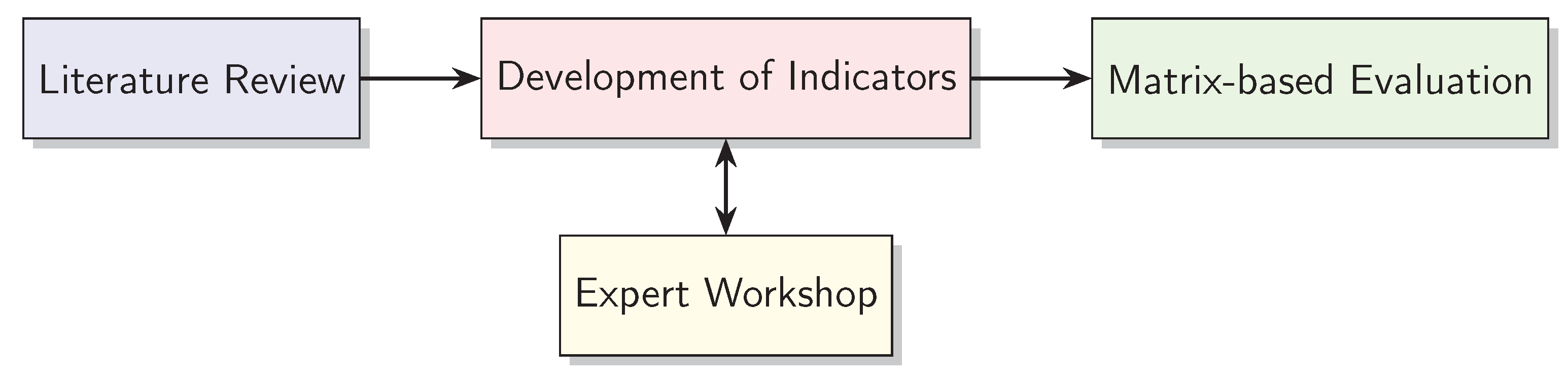
Figure 2.
Technology Readiness Levels (TRL).
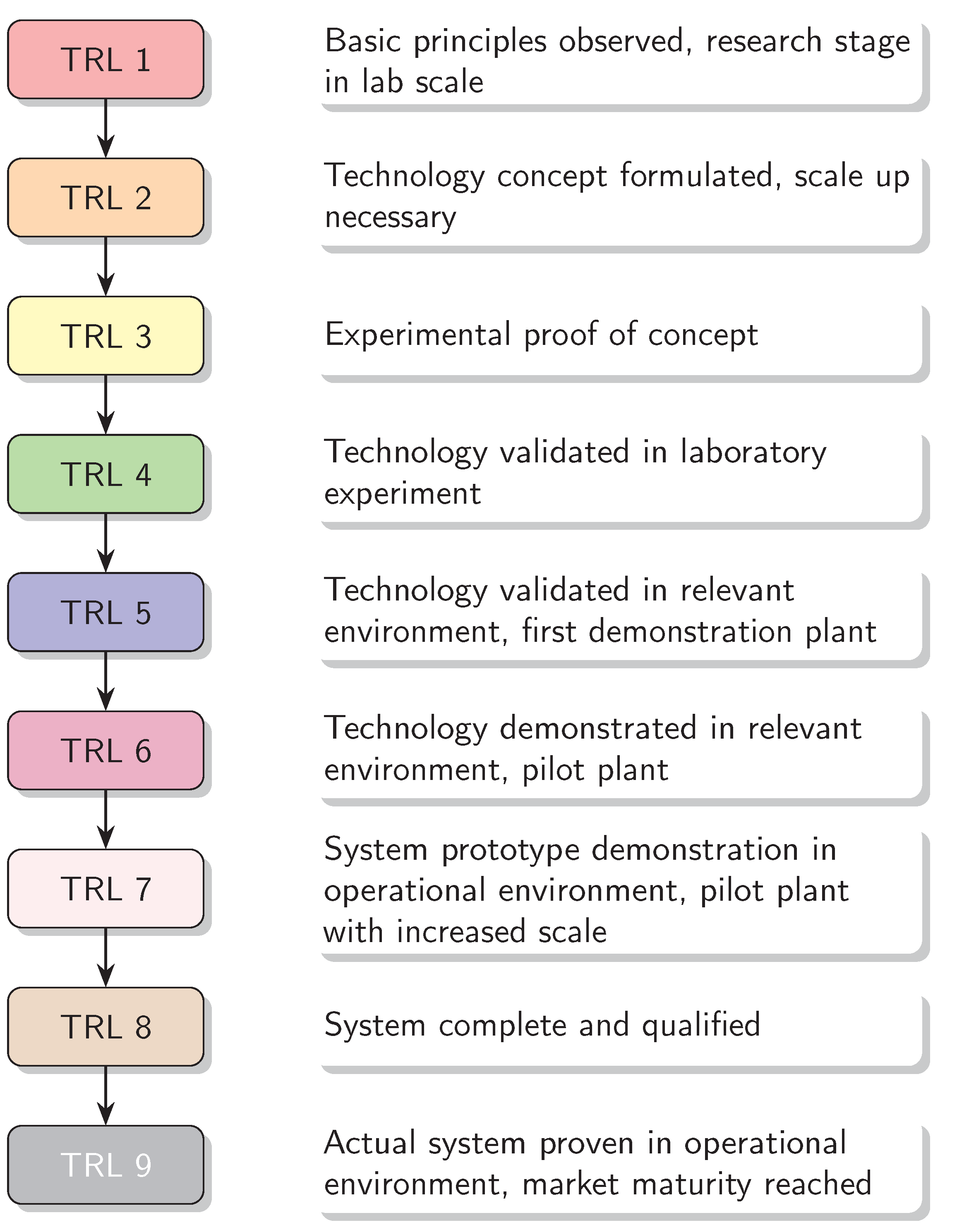
Figure 3.
SMART indicators for technologies.
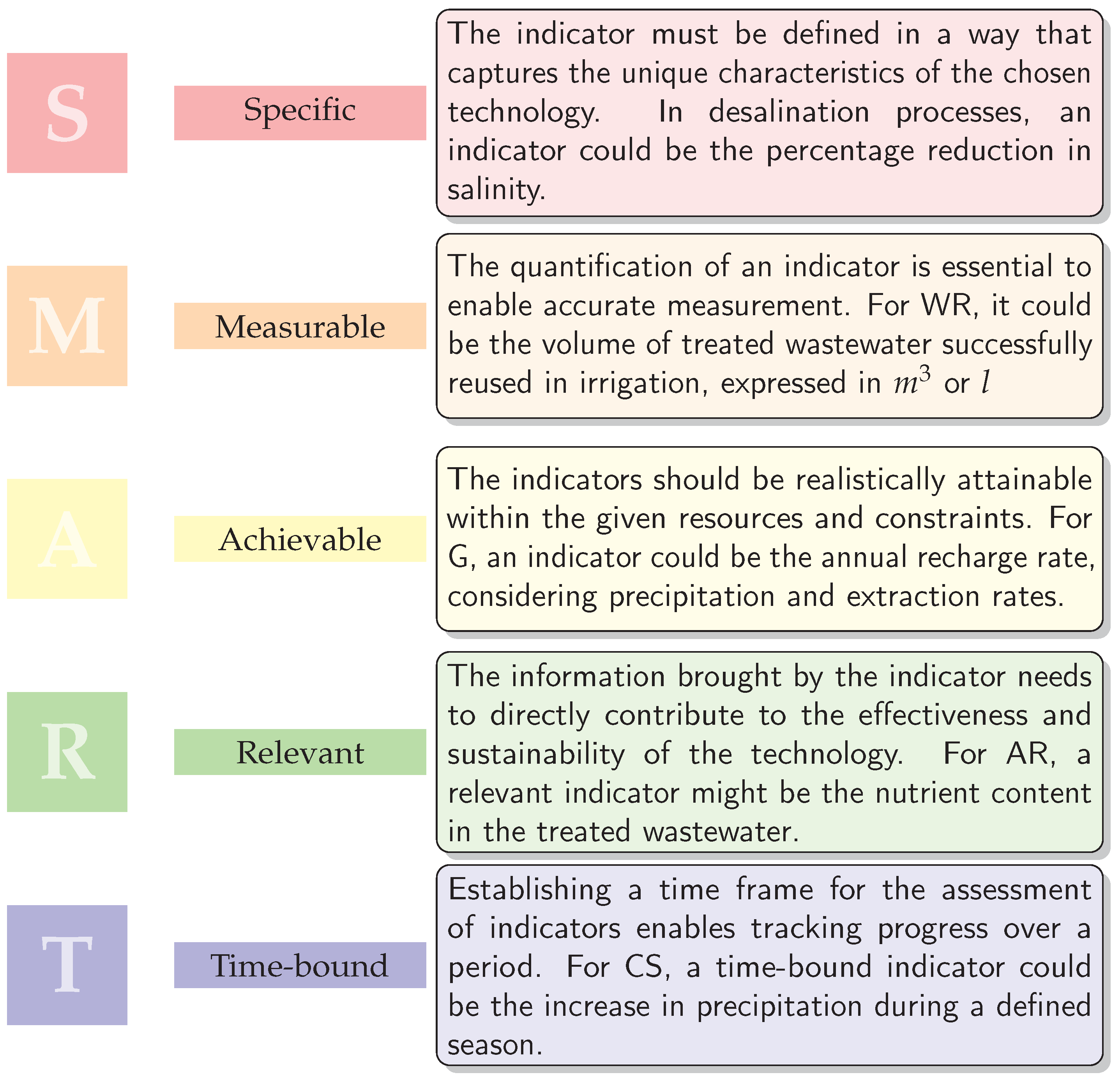

Table 1.
Selected non-conventional water technologies and descriptions.
| Technology | Description | TRL |
|---|---|---|
| Desalination (D) | Desalination involves the process of removing salt and other impurities from seawater, groundwater [53] and brackish water, making it suitable for various uses, including portable use and irrigation. Depending on the applied technology, desalination units use vast amounts of thermal [79] or electrical energy [6], but are mostly the only solution in arid regions where traditional freshwater sources are limited. | 10 |
| Water reuse (WR) | Water reuse [11,80], is the direct re-utilization of wastewater. If an additional treating step is included, e.g. dilution with freshwater, this technology is referred as water recycling. The treatment can be adjusted as required to meet specific quality standards for various applications like discussed in [58]. This sustainable approach helps in conserving freshwater resources by treating wastewater for non-potable purposes such as irrigation or industrial processes. | 9-10 |
| Groundwater (G) | Groundwater [81,82,83] refers to water stored beneath the earth’s surface in aquifers. In arid regions, sustainable management of groundwater resources is crucial [9,81]. This involves assessing extraction rates, recharge mechanisms, and addressing potential issues of over-extraction and contamination. | 9-10 |
| Agricultural reuse (AR) | Agricultural reuse [11,84] focuses on utilizing treated wastewater for irrigation purposes in agriculture. This approach is mostly associated with adapted irrigation systems like drip irrigation to increase the water use efficiency [84,85]. | 8-9 |
| Cloud seeding (CS) | Cloud seeding [13] is a weather modification technique that involves dispersing substances into the air to encourage cloud condensation or ice crystal formation. This process aims to enhance precipitation [12], potentially increasing water availability in targeted regions, but heavily depends on meteorological conditions and has not understood environmental impacts. | 7-8 |
| Dew water (DW) | Dew water harvesting [14,15] involves collecting moisture from the air as dew. This method is particularly useful in arid climates where humidity levels fluctuate, providing an additional source of water for various applications [86]. The structures and shapes can greatly vary, one example can be found in [87]. | 6-7 |
| Fog Water (FW) | Fog water harvesting [16] captures water droplets from foggy air using specialized nets or structures. An example of this construction can be found in [88]. This method is similar to DW, but is less suited for arid climates as it is most effective in coastal areas with frequent fog and high relative humidity, offering a unique way to supplement water resources in regions facing water scarcity. | 6-7 |
Table 2.
Categories and explanations of indicators.
| Categories | Explanations |
|---|---|
| Availability | This category sets the focus on the accessibility and availability of water resources, considering aspects such as the source and supply of raw water, usable volume produced, and previous usage of the water. |
| Applicability | Applicability assesses the suitability and relevance of the non-conventional water technology in a given context. It includes indicators such as the effectiveness of the technology in meeting specific water quality requirements for water use and social factors, e.g. the acceptance of the technological solution in the society. |
| Environmental impact | Environmental impact reviews the ecological consequences of the non-conventional water technology, caused directly or indirectly. Indicators in this category include meteorological conditions, plant footprint, chemicals and byproducts, life cycle assessment, and toxicity of chemicals applied. |
| Scalability | Scalability assesses the potential for the non-conventional water technology to adapt and expand based on demand. This category includes indicators such as plant modularity, capacity restrictions, and efficiency of contaminants removal. |
| Economy | Economy evaluates the economic aspects of the non-conventional water technology, encompassing indicators like energy consumption, CAPEX, OPEX, water product costs, life cycle costs, and logistics. |
Table 3.
Indicators in the "Availability" category.
| No. | Indicator | Unit | Description |
|---|---|---|---|
| 1.1 | Origin and supply of raw water | m³/h | Groundwater, sea water, drainage water, dew, fog |
| 1.2 | Usable volume produced | m³/h | Typical plant capacity |
| 1.3 | Previous usage of the water | — | Greywater, drainage water |
| 1.4 | Water quality properties, physical | — | pH, T |
| 1.5 | Water quality properties, chemical | mg/l | Water quality analysis, parameters COD, BOD, TSS, DO |
| 1.6 | Water quality properties, ion composition | mg/l, ppm | Total dissolved solids (TDS), dissolved ion composition |
| 1.7 | Meteorological conditions | °C, m/s, °, kWh/m²·a | Temperature, relative humidity, presence of clouds, wind speed, wind direction, solar radiation (GHI) |
| 1.8 | Meteorological conditions, rainfall precipitation | mm/a | Millimeters of water column |
Table 4.
Indicators in the "Applicability" category.
| No. | Indicator | Unit | Description |
|---|---|---|---|
| 2.1 | Plant footprint, available space | m² | Space requirements, housing, land use |
| 2.2 | Water quality requirements for water use | mg/l | Drinking water, process water, irrigation water |
| 2.3 | Social acceptance of technological solution | — | Water access and inequalities in use, welfare differences |
Table 5.
Indicators in the "Environmental Impact" category.
| No. | Indicator | Unit | Description |
|---|---|---|---|
| 3.1 | Energy consumption, electrical and thermal | kWh/m³ | Specific energy consumption per water volume, both electrical and thermal |
| 3.2 | Chemicals and byproducts | — | Examining the substances used and brine discharge, antiscalants, CIP and blowdown water treatment |
| 3.3 | Life cycle assessment | — | Evaluating the environmental impact throughout the life cycle of the technology |
| 3.4 | Toxicity of chemicals applied | LD50 / TD50 | Assessing the potential harm of chemicals used in the process e.g. silver iodide for cloud seeding |
| 3.5 | Freshwater required for mixing | m³/h | Quantifying the amount of freshwater needed for the technology’s operation |
| 3.6 | Hazardous water compounds, runoff water | mg/l | Fertilizers, soil salinity, soil conditioners, agricultural chemicals |
| 3.7 | Efficiency of contaminants removal | mg/l | Measuring the effectiveness of removing contaminants from water |
Table 6.
Indicators in the "Scalability" category.
| No. | Indicator | Unit | Description |
|---|---|---|---|
| 4.1 | Capacity restrictions, processing limits | m³/h | Constraints on maximum water treatment capacity and processing capabilities |
| 4.2 | Plant modularity | — | Degree of modular design and scalability for adjusting to varying capacities |
Table 7.
Indicators in the "Economy" category.
| No. | Indicator | Unit | Description |
|---|---|---|---|
| 5.1 | CAPEX | EUR | Initial investment required for establishing plant technology |
| 5.2 | OPEX | EUR | Ongoing operational and maintenance costs for plant technology |
| 5.3 | Water product costs | EUR/m³ | Cost associated with treating one cubic meter of water, dependent on plant size |
| 5.4 | Life cycle costs | EUR/m³ | Total cost of water treatment throughout the operational lifetime of the plant |
| 5.5 | Logistics | EUR | Expenses related to plant transport, mass, and required piping |
| 5.6 | ROI | EUR | Return of invest and assessment of plant’s economic viability under local conditions and water pricing |
Table 8.
Matrix analysis for the "Availability" category.
| No. | Desalination | Water reuse | Groundwater | Agricultural reuse | Cloud seeding | Dew water | Fog Water | Indicator | Weight |
|---|---|---|---|---|---|---|---|---|---|
| 1.1 | √ | √ | √ | √ | Origin and supply of raw water | 4 | |||
| 1.2 | √ | √ | √ | √ | √ | √ | √ | Usable volume produced | 7 |
| 1.3 | √ | √ | Previous usage of the water | 2 | |||||
| 1.4 | √ | √ | √ | Water quality properties, physical | 3 | ||||
| 1.5 | √ | √ | √ | √ | Water quality properties, chemical | 4 | |||
| 1.6 | √ | √ | √ | √ | Water quality properties, ion composition | 4 | |||
| 1.7 | √ | √ | √ | Meteorological conditions | 3 | ||||
| 1.8 | √ | √ | √ | √ | √ | Meteorological conditions, rainfall precipitation | 5 |
Table 9.
Matrix Analysis for the "Applicability" category.
| No. | Desalination | Water reuse | Groundwater | Agricultural reuse | Cloud seeding | Dew water | Fog Water | Indicator | Weight |
|---|---|---|---|---|---|---|---|---|---|
| 2.1 | √ | √ | √ | √ | √ | √ | √ | Plant footprint, available space | 6 |
| 2.2 | √ | √ | √ | √ | √ | √ | √ | Water quality requirements for water use | 7 |
| 2.3 | √ | √ | √ | √ | √ | √ | √ | Social acceptance of technological solution | 7 |
Table 10.
Matrix Analysis for the "Environmental Impact" category.
| No. | Desalination | Water reuse | Groundwater | Agricultural reuse | Cloud seeding | Dew water | Fog Water | Indicator | Weight |
|---|---|---|---|---|---|---|---|---|---|
| 3.1 | √ | √ | √ | √ | √ | Energy consumption, el. and th. | 5 | ||
| 3.2 | √ | √ | √ | Chemicals and byproducts | 3 | ||||
| 3.3 | √ | √ | √ | √ | √ | √ | √ | Life cycle assessment | 7 |
| 3.4 | √ | √ | √ | √ | Toxicity of chemicals applied | 4 | |||
| 3.5 | √ | √ | Freshwater required for mixing | 2 | |||||
| 3.6 | √ | √ | Hazardous water compounds | 2 | |||||
| 3.7 | √ | √ | √ | √ | Efficiency of contaminants removal | 4 |
Table 11.
Matrix Analysis for the "Scalability" category.
| No. | Desalination | Water reuse | Groundwater | Agricultural reuse | Cloud seeding | Dew water | Fog Water | Indicator | Weight |
|---|---|---|---|---|---|---|---|---|---|
| 4.1 | √ | √ | √ | √ | √ | √ | √ | Capacity restrictions, processing limits | 7 |
| 4.2 | √ | √ | √ | Plant modularity | 3 |
Table 12.
Matrix Analysis for the "Economy" category.
| No. | Desalination | Water reuse | Groundwater | Agricultural reuse | Cloud seeding | Dew water | Fog Water | Indicator | Weight |
|---|---|---|---|---|---|---|---|---|---|
| 5.1 | √ | √ | √ | √ | √ | √ | √ | CAPEX | 7 |
| 5.2 | √ | √ | √ | √ | √ | √ | √ | OPEX | 7 |
| 5.3 | √ | √ | √ | √ | √ | √ | √ | Water product costs | 7 |
| 5.4 | √ | √ | √ | √ | √ | √ | √ | Life cycle costs | 7 |
| 5.5 | √ | √ | √ | √ | √ | √ | √ | Logistics | 7 |
| 5.6 | √ | √ | √ | √ | √ | √ | √ | Profitability | 7 |
Table 13.
Key indicators for decision-making progress.
| No. | Indicator | Unit |
|---|---|---|
| 1.2 | Usable volume produced | m³/h |
| 2.2 | Water quality requirements for water use | mg/l |
| 2.3 | Social acceptance of technological solution | — |
| 3.3 | Life cycle assessment | — |
| 4.1 | Capacity restrictions, processing limits | m³/h |
| 5.1 | CAPEX | EUR |
| 5.2 | OPEX | EUR |
| 5.3 | Water product costs | EUR/m³ |
| 5.4 | Life cycle costs | EUR/m³ |
| 5.5 | Logistics | EUR |
| 5.6 | ROI | EUR |
Table 14.
Parameters of example site in Jordan.
| Parameter | Description | Value | Unit |
|---|---|---|---|
| Location | Jordan | Jordan Valley | — |
| GPS Coordinates | 31°54’38.7"N 35°34’40.8"E | — | — |
| Water purpose | Irrigation of a date farm | — | — |
| Water origin | Groundwater from deep well | 80 | m |
| Water quality | Brackish water | 3150 | mg/l TDS |
| Water use | Irrigation | 25 | m³/d |
| Operational costs | Electricity price | 0.09 | $/kWh |
| Meteorological data | Temperature (av.) | 26.3 | °C |
| Meteorological data | Rainfall | 1.69 | mm/year |
| Meteorological data | Solar irradiance | 3683 | kWh/m²·a |
Table 15.
Summary of key indicators.
| No. | Category | Indicator |
|---|---|---|
| 1.2 | Availability | Usable volume produced |
| 2.2 | Applicability | Water quality requirements for water |
| 3.1 | Environmental impact | Energy consumption |
| 4.1 | Scalability | Capacity restrictions |
| 5.3 | Economy | Water product cost |
Table 16.
Comparison of the different technologies.
| Indicator | D | WR | G | AR | CS | DW | FW |
|---|---|---|---|---|---|---|---|
| 1.2 Usable volume | 2 | 1 | 1 | 1 | -2 | -1 | -1 |
| 2.2 Water quality requirements | 2 | 0 | 0 | 1 | 1 | 1 | 1 |
| 3.1 Energy consumption | 1 | 2 | 1 | 1 | 0 | 1 | 1 |
| 4.1 Capacity restrictions | 1 | 1 | 1 | 1 | 2 | 0 | 0 |
| 5.3 Product cost | 1 | 2 | 1 | 1 | 0 | 1 | 1 |
| Total (max. 10) | 7 | 6 | 4 | 5 | 1 | 2 | 2 |
Table 17.
Limitations and solutions of the matrix-based assessment.
| Limitation | Possible solution |
|---|---|
| Idealized assumptions may not reflect reality | Include more factors for realistic results |
| TRL varies by region | Consider the TRL for each location |
| Legal frameworks may hinder technology implementation | Research regional legislation limitations in advance |
| Society may not accept water from non-conventional sources | Create a transparent communication strategy, e.g., use NCW for non-drinking purposes initially |
| Locations differ in climate, solar intensity, culture, etc. | Conduct a detailed site assessment, covering geological, climatic, socio-economic, cultural, and legal aspects |
| Modeling is static and ignores climate change and variable shifts | Use AI for predictive modeling to account for dynamic changes |
Disclaimer/Publisher’s Note: The statements, opinions and data contained in all publications are solely those of the individual author(s) and contributor(s) and not of MDPI and/or the editor(s). MDPI and/or the editor(s) disclaim responsibility for any injury to people or property resulting from any ideas, methods, instructions or products referred to in the content. |
© 2024 by the authors. Licensee MDPI, Basel, Switzerland. This article is an open access article distributed under the terms and conditions of the Creative Commons Attribution (CC BY) license (https://creativecommons.org/licenses/by/4.0/).
Copyright: This open access article is published under a Creative Commons CC BY 4.0 license, which permit the free download, distribution, and reuse, provided that the author and preprint are cited in any reuse.