

Submitted:
28 September 2024
Posted:
01 October 2024
You are already at the latest version
Abstract
Background: Nanotechnology has emerged as a promising field of study, aiming to revolutionize healthcare through the innovative development of drugs, diagnostic tools, and medical devices. As a result, healthcare professionals in training are constantly faced with the challenge of understanding and applying these emerging technologies. The objective of this study is to determine the factors to consider for including the teaching of nanotechnological tools in medical specialty postgraduate programs. Methods: A study based on the Nominal Group Technique (NGT) was conducted to identify the factors that promote and hinder the implementation of nanotechnology in certain postgraduate programs where nanotechnology is employed, such as Internal Medicine, Critical Care Medicine, Family Medicine, and Clinical Pharmacology at the School of Medicine of Universidad de La Sabana. A framework analysis was used to analyze the collected data. Results: Based on the two research questions, several aspects were identified for the inclusion of nanotechnology in the medical practice of specialties. Key challenges include lack of knowledge and resource availability, misinformation, and lack of knowledge, as well as paradigmatic analysis as the main obstacles to the use of nanotechnology. Conclusions: The findings provide a first-time study on nanotechnology curricula within medical specialty programs in Colombia, with potential extrapolation to similar situations in other medical schools.
Keywords:
1. Introduction
2. Materials and Methods
2.1. Participants
2.2. Data Collection
3. Results
4. Discussion
4.1. Category 1: Quality Construction of Knowledge and Its Application
4.1.1. Subcategory: Relevance of Nanotechnology in Specialist Medical Training
4.1.2. Subcategory 2: Teaching Expertise
4.2. Category 2: Resource Availability
4.3. Category 3: Cost-effectiveness of Implementation
4.4. Category 4: Policies for Implementation
4.5. Category 5: Interdisciplinary and Interprofessional Teamwork
4.6. Category 1: Misinformation and Lack of Knowledge
4.6.1. Subcategory: Need for Nanoeducators
4.6.2. Subcategory: Nano-Literacy
4.6.3. Subcategory: Challenges for Educators
4.7. Category 2: Paradigmatic Paralysis
4.7.1. Subcategory: Resistance to Change
4.8. Category 3: Structure and Reassurance of the Health System
4.9. Category 4: Curriculum Articulation in Practice
4.10. Category 5: Approval of the Nanotechnology System
4.11. Category 6: Influence of Industry
4.12. Category 7: Conflict of Interest
4.13. Category 8: Critical Judgment
5. Conclusions
Supplementary Materials
Author Contributions
Funding
Institutional Review Board Statement
Informed Consent Statement
Acknowledgments
Conflicts of Interest
References
- National Nanotechnology Initiative. What Is So Special about “Nano”? Available online: https://www.nano.gov/about-nanotechnology/what-is-so-special-about-nano (accessed on 3th March, 2023).
- Staggers, N.; McCasky, T.; Brazelton, N.; Kennedy, R. Nanotechnology: the coming revolution and its implications for consumers, clinicians, and informatics. Nurs Outlook 2008, 56, 268-274. https://doi.org/10.1016/j.outlook.2008.06.004. [CrossRef]
- Huertas, J.D.; Fuentes, Y.V.; Garcia, J.C.; Bustos, R.H. The Role of Education in Nanomedicine as a Current Need for Academic Programs Related to the Healthcare Field: A Scoping Review. Adv Med Educ Pract 2024, 15, 65-74. https://doi.org/10.2147/amep.s431359. [CrossRef]
- Nasser, J.S.; Chung, K.C. Recommendations for the reform of medical education in China: A SWOT analysis. Health Policy Open 2020, 1, 100018. https://doi.org/10.1016/j.hpopen.2020.100018. [CrossRef]
- Sweeney, A.E. Nanomedicine concepts in the general medical curriculum: initiating a discussion. Int J Nanomedicine 2015, 10, 7319-7331. https://doi.org/10.2147/ijn.s96480. [CrossRef]
- Alfonso, M.T.; García, M. The social accountability of medical schools. An urgent requirement to adapt to the needs of the population. Dialnet 2021, 22, 99-105.
- Malik, S.; Muhammad, K.; Waheed, Y. Emerging Applications of Nanotechnology in Healthcare and Medicine. Molecules 2023, 28. https://doi.org/10.3390/molecules28186624. [CrossRef]
- Colombo, S. Chapter 4 - Applications of artificial intelligence in drug delivery and pharmaceutical development. In Artificial Intelligence in Healthcare, Bohr, A., Memarzadeh, K., Eds.; Academic Press: 2020; pp. 85-116.
- Nance, E. Careers in nanomedicine and drug delivery. Adv Drug Deliv Rev 2019, 144, 180-189. https://doi.org/10.1016/j.addr.2019.06.009. [CrossRef]
- Singh, A.; Amiji, M.M. Application of nanotechnology in medical diagnosis and imaging. Curr Opin Biotechnol 2022, 74, 241-246. https://doi.org/10.1016/j.copbio.2021.12.011. [CrossRef]
- Ho, D.; Quake, S.R.; McCabe, E.R.B.; Chng, W.J.; Chow, E.K.; Ding, X.; Gelb, B.D.; Ginsburg, G.S.; Hassenstab, J.; Ho, C.M.; et al. Enabling Technologies for Personalized and Precision Medicine. Trends Biotechnol 2020, 38, 497-518. https://doi.org/10.1016/j.tibtech.2019.12.021. [CrossRef]
- Mele, C. Nanotechnology in pediatrics: science fiction or reality? J Pediatr Nurs 2011, 26, 379-382. https://doi.org/10.1016/j.pedn.2011.04.028. [CrossRef]
- das Neves, J. Nanotechnology Inclusion in Pharmaceutical Sciences Education in Portugal. Am J Pharm Educ 2018, 82, 6403. https://doi.org/10.5688/ajpe6403. [CrossRef]
- Friedman, A.; Nasir, A. Nanotechnology and dermatology education in the United States: data from a pilot survey. J Drugs Dermatol 2011, 10, 1037-1041.
- Gómez López, A. Nanomedicina y su impacto en la práctica médica. Repertorio de Medicina y Cirugía 2017, 26, 129-130. https://doi.org/10.1016/j.reper.2017.06.003. [CrossRef]
- Sunshine, J.C.; Paller, A.S. Which Nanobasics Should Be Taught in Medical Schools? AMA J Ethics 2019, 21, E337-346. https://doi.org/10.1001/amajethics.2019.337. [CrossRef]
- Alghamdi, M.A.; Fallica, A.N.; Virzì, N.; Kesharwani, P.; Pittalà, V.; Greish, K. The Promise of Nanotechnology in Personalized Medicine. J Pers Med 2022, 12. https://doi.org/10.3390/jpm12050673. [CrossRef]
- Vélez, J.; Vélez, J. The eminent need for an academic program in universities to teach nanomedicine. . Int J Nanomedicine 2011, 6, 1733-1738.
- Muthulingam, D.; Bia, J.; Madden, L.M.; Farnum, S.O.; Barry, D.T.; Altice, F.L. Using nominal group technique to identify barriers, facilitators, and preferences among patients seeking treatment for opioid use disorder: A needs assessment for decision making support. J Subst Abuse Treat 2019, 100, 18-28. https://doi.org/10.1016/j.jsat.2019.01.019. [CrossRef]
- Olsen, J. The Nominal Group Technique (NGT) as a Tool for Facilitating Pan-Disability Focus Groups and as a New Method for Quantifying Changes in Qualitative Data. International Journal of Qualitative Methods 2019, 18, 1609406919866049. https://doi.org/10.1177/1609406919866049. [CrossRef]
- McMillan, S.S.; Kelly, F.; Sav, A.; Kendall, E.; King, M.A.; Whitty, J.A.; Wheeler, A.J. Using the Nominal Group Technique: how to analyse across multiple groups. Health Services and Outcomes Research Methodology 2014, 14, 92-108. https://doi.org/10.1007/s10742-014-0121-1. [CrossRef]
- Sav, A.; McMillan, S.S.; Kelly, F.; King, M.A.; Whitty, J.A.; Kendall, E.; Wheeler, A.J. The ideal healthcare: priorities of people with chronic conditions and their carers. BMC Health Serv Res 2015, 15, 551. https://doi.org/10.1186/s12913-015-1215-3. [CrossRef]
- Clark, J.P. How to peer review a qualitative manuscript. In Peer review in health sciences, 2nd ed. ed.; Godlee F, J.T., editors., Ed.; BMJ Books: London, 2003; pp. 219-235.
- Jones, M.G.; Blonder, R.; Gardner, G.E.; Albe, V.; Falvo, M.; Chevrier, J. Nanotechnology and Nanoscale Science: Educational challenges. International Journal of Science Education 2013, 35, 1490-1512. https://doi.org/10.1080/09500693.2013.771828. [CrossRef]
- Haleem, A.; Javaid, M.; Singh, R.P.; Rab, S.; Suman, R. Applications of nanotechnology in medical field: a brief review. Global Health Journal 2023, 7, 70-77. https://doi.org/10.1016/j.glohj.2023.02.008. [CrossRef]
- Universidad de La Sabana. Modelo Académico de MEDICUS. Available online: https://www.unisabana.edu.co/programas/carreras/facultad-de-medicina/medicina/modelo-academico-de-medicus/ (accessed on 21 September 2024).
- Shariati, K.; Peikani, S.; Karimi Moonaghi, H.; Ghazanfarpour, M. Application of Spiral Programming Model in Medical Education: A Review. Medical Education Bulletin 2021, 2, 233-241. https://doi.org/10.22034/meb.2021.293383.1007. [CrossRef]
- Kouz, K.; Eisenbarth, S.; Bergholz, A.; Mohr, S. Presentation and evaluation of the teaching concept “ENHANCE” for basic sciences in medical education. PLoS One 2020, 15, e0239928. https://doi.org/10.1371/journal.pone.0239928. [CrossRef]
- Spencer, A.L.; Brosenitsch, T.; Levine, A.S.; Kanter, S.L. Back to the basic sciences: an innovative approach to teaching senior medical students how best to integrate basic science and clinical medicine. Acad Med 2008, 83, 662-669. https://doi.org/10.1097/ACM.0b013e318178356b. [CrossRef]
- Woods, N.N.; Neville, A.J.; Levinson, A.J.; Howey, E.H.; Oczkowski, W.J.; Norman, G.R. The value of basic science in clinical diagnosis. Acad Med 2006, 81, S124-127. https://doi.org/10.1097/00001888-200610001-00031. [CrossRef]
- Basma El, Z.; Ali, E.; Mohanad, D.; Ahmed Al, J.; Ghassan, J. Perspective Chapter: Nano and Society 5.0 – Advancing the Human-Centric Revolution. In Industry 4.0 Transformation Towards Industry 5.0 Paradigm, Ibrahim, Y., Amjad, A., Eds.; IntechOpen: Rijeka, 2024; p. Ch. 5.
- Malik, S.; Muhammad, K.; Waheed, Y. Nanotechnology: A Revolution in Modern Industry. Molecules 2023, 28. https://doi.org/10.3390/molecules28020661. [CrossRef]
- Rambaran, T.; Schirhagl, R. Nanotechnology from lab to industry – a look at current trends. Nanoscale Advances 2022, 4, 3664-3675. https://doi.org/10.1039/D2NA00439A. [CrossRef]
- Bosetti, R.; Jones, S.L. Cost–Effectiveness of Nanomedicine: Estimating the Real Size of Nano-Costs. Nanomedicine 2019, 14, 1367-1370. https://doi.org/10.2217/nnm-2019-0130. [CrossRef]
- Pokrajac, L.; Abbas, A.; Chrzanowski, W.; Dias, G.M.; Eggleton, B.J.; Maguire, S.; Maine, E.; Malloy, T.; Nathwani, J.; Nazar, L.; et al. Nanotechnology for a Sustainable Future: Addressing Global Challenges with the International Network4Sustainable Nanotechnology. ACS Nano 2021, 15, 18608-18623. https://doi.org/10.1021/acsnano.1c10919. [CrossRef]
- Herrera Sandoval, Ó.L.; Vásquez Ochoa, Y. Ciencias y tecnologías convergentes (NBCI): fundamentación teórica de la Maestría en Bioingeniería y Nanotecnología. Ingeciencia 2021, 4, 120-123.
- Urquilla, A. Impacto de la nanotecnología como revolución industrial a nivel mundial. Realidad y Reflexión 2019, 49, 66-78. https://doi.org/10.5377/ryr.v49i49.8063. [CrossRef]
- Aguirre Echavarría, F.J.; López Gómez, M.D.s.; Durango Yepes, C.M. Desarrollo de las capacidades nanotecnológicas en las Instituciones de Educación Superior en Antioquia-Colombia. Ciencia y Academia 2020, 0, 22-46. https://doi.org/10.21501/2744838X.3722. [CrossRef]
- Huang, Z.W.; Huang, Y.Q. Research on nanosciences involvement in pharmaceutical education should be reinforced. World J Exp Med 2023, 13, 156-160. https://doi.org/10.5493/wjem.v13.i5.156. [CrossRef]
- Azorín, C.; Fullan, M. Leading new, deeper forms of collaborative cultures: Questions and pathways. Journal of Educational Change 2022, 23, 131-143. https://doi.org/10.1007/s10833-021-09448-w. [CrossRef]
- Schmid, J.M.; Veith, J.M.; Truong, M.H.; Straulino, M.; Winkler, B.; Hennig, F.; Bitzenbauer, P. Nanoscience and technology in secondary education: A systematic literature review. Eurasia Journal of Mathematics, Science and Technology Education 2023, 19, em2361.
- Ling, L. Methods and Paradigms in Education Research. In Methods and Paradigms in Education Research, Global, I., Ed.; 2017; pp. 19-41.
- Dr. Vivekananth, P. Nanolearning: A New Paradigm Shift in Teaching and Learning. International Journal of Engineering and Management Research 2022, 12, 112-114. https://doi.org/10.31033/ijemr.12.1.14. [CrossRef]
- McBride, K. Leadership in Higher Education: Handling Faculty Resistance to Technology through Strategic Planning. Academic Leadership: The Online Journal 2010.
- Córica, J.L. Resistencia docente al cambio: Caracterización y estrategias para un problema no resuelto. RIED-Revista Iberoamericana de Educación a Distancia 2020, 23, 255-272.
- Jürgen, S. Pharmacodynamic Evaluation: Endocrinology. In Drug Discovery and Evaluation: Methods in Clinical Pharmacology, Vogel, H., Maas, J., Gebauer, A., Eds.; Springer Berlin: Berlin, Heidelberg, 20; pp. 489-521.
- Garzón, V.; Pinacho, D.G.; Bustos, R.-H.; Garzón, G.; Bustamante, S.J.B. Optical biosensors for therapeutic drug monitoring. 2019, 9, 132.
- Orozco, J. Nanociencia, nanotecnología y tecnologías disruptivas en el contexto de la medicina de precisión. Revista de la Academia Colombiana de Ciencias Exactas, Físicas y Naturales 2023, 47, 221-241. https://doi.org/10.18257/raccefyn.1895. [CrossRef]

| Participant’s voices | Categories | Thematic analysis | Votes |
| Question 1 | |||
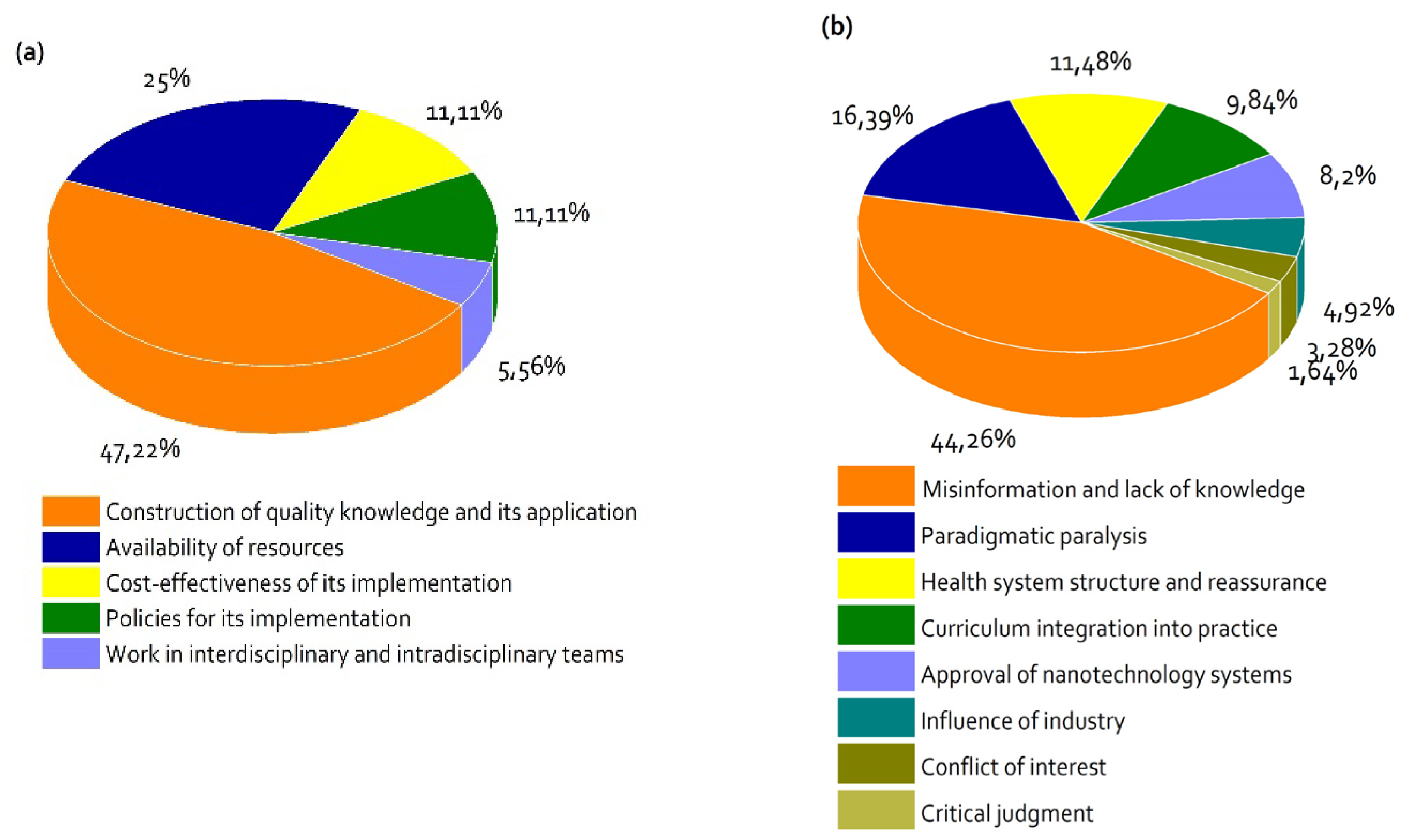
| “I have heard very little about nanotechnology, especially as it applies to medicine, but I believe that what is fundamental here is that it is part of what is known as translational medicine. From basic medicine to applied medicine, to surveillance, which is what we are doing right now, and I think this point is vital for the transition to what we now know as personalized medicine, which I believe is the future." | Quality Construction of Knowledge and its application | Relevance of Nanotechnology in Specialist Medical Training | 17 |
| "Actually, I had never heard of nanotechnology until we were sent the articles." | Teaching expertise | ||
|
"I believe that what the article mentioned is very, very close to our reality. Both professors, whether at the undergraduate or graduate level, lack knowledge about nanotechnology, even though it is used in everyday life. What they propose is that we need environments where people can learn about the basis of nanotechnology and what it can achieve. This way, individuals can start to create or innovate things where I can gradually begin to apply it, aiming to develop different avenues—whether for treatment, diagnosis, or other applications—that can be implemented." |
|||
|
"I also mentioned that, since we are more clinical in this field, the time allocated for assistance activities may sometimes overshadow these types of activities, and I believe that could also be a limitation. Furthermore, many times, budget constraints at the different faculties significantly limit research in these areas, so I think that should also be taken into account." |
Resource Availability | 9 | |
|
"In diabetes, nanotechnology is also being used for early diagnosis and timely treatments. If you have knowledge of what exists, then great, you can use it. But in my view, I don’t just want to know that it exists and use it; I want to know how I can help my patients in other ways. If I can conduct more research on this, then I would really like to know. I believe that in both undergraduate and graduate programs, we can provide this range of possibilities for doctors so they can decide. For example, they might choose to be clinical and only know about it, applying it as needed. Alternatively, they could also gain an understanding of how it works, which allows them to approach it in a better way and maximize the benefits of that process. So, in reality, both points are valid. If someone just wants to use it because it exists, that’s fine." |
Cost-effectiveness of implementation | 4 | |
|
“There are certainly doctors who are not very interested in the applicability of this; they simply want the knowledge to practice professionally based on what they learned. However, I believe in the importance of this topic in education, starting from undergraduate studies, to provide tools for doctors. We are doctors, but we are also researchers, and we can each choose our own path and decide how we want to shape our professional focus and profile. I think it’s very useful for medical schools to provide these tools and this education so that in the future, all these resources can support each individual’s approach, especially since we don't fully understand the concept yet." |
Policies for implementation | 4 | |
| "It’s important to emphasize multidisciplinarity and change it to interdisciplinarity. We cannot remain isolated; honestly, I am not particularly interested in understanding those machines or in engineering and mathematics. However, it is essential to understand that there are processes that exist. Just as some people learn in different ways—through kinesthetic channels or more visual ones—there are others who need to understand things differently." | Interdisciplinary and interprofessional Teamwork | 2 | |
| Total | 36 | ||
| Question 2 | |||
| "Perhaps this is something that will be the next step, and in a few years, everyone will know about it." | Misinformation and Lack of Knowledge | Need for Nanoeducators | 27 |
| "People lack knowledge about nanotechnology, even though it is used in everyday life. What they propose is to create environments where people can understand the basis of nanotechnology and the potential it holds. This way, individuals can start to create or innovate things that they can gradually apply to develop different avenues—whether for treatment, diagnosis, or other applications—that can be implemented." | Nano-Literacy | ||
| "Well, I had also seen it more in subspecialties, for example, in gastroenterology and other specialties where there is ongoing work based on nanotechnology. In subspecialties like pathology, it wasn’t something we perceived as being so close." | Challenges for Educators | ||
| "In total, the specialties that form the basic sciences are super important for countries to achieve better adherence. Now, they are bringing the concept into universities, so if we can incorporate it at some point into our research, that would be great.” | |||
| "We often don't realize how we sometimes start to adjust our understanding of what should be because we are presented with benefits and shown very promising results. It’s almost like brainwashing, as they tell us that this new thing is the best of the best. That’s why we need to be very critical. As young people, we often fall into this trap of being influenced too easily.” | Paradigmatic Paralysis | Resistance to change | 10 |
| This is one factor, reassurance, which is independent of the approval of technology by regulatory entities." | Structure and Reassurance of the Health System | 7 | |
| "The articulation of the curriculum in the practical environment, utilizing technological resources to educate in practice spaces." | Curriculum Articulation in Practice | 6 | |
|
"Comparatively, I would add two things directed at the university, which is the one managing my academic curriculum. The university has the capacity—or how should I put it?—the academic arm to guide these projects. Yes, and if the university were to have a greater presence in my practice area, it would be easier to implement nanotechnology as a basic concept, not just for you but for everyone. I mean, I thought of it as directed towards us, the ICU staff." | |||
|
"So that they can have, as you’ve mentioned, I’m not sure if you can implement these concepts and introduce them into training programs, both in basic information for undergraduate studies. Creating spaces such as discussions and open talks initially would ensure that the basic concepts are included within a program as minimum common requirements. Additionally, there should be opportunities for anyone who wants to delve deeper into the topic." |
Approval of the Nanotechnology System | 5 | |
| "But how much does the industry, beyond just pharmaceuticals, particularly in industrial sales, influence us not only to learn about it but also to use it" | Influence of Industry | 3 | |
| "We can address that point as well. Yes, as you mentioned from experiences, it could also become compact, which could hinder the process. How many clinical trials are needed to prove that nanotechnology is effective? For example, I won't look into anything else because I already know that mechanical ventilation driven by neural impulses works. On the other hand, evidence-based medicine is influenced by what the pharmaceutical companies present." | Conflict of Interest | 2 | |
| "I believe that the problem here is related to that, but the disaster is a factor in the sense that I’m not sure if it relates to access to technology on that front." | Critical Judgment | 1 | |
| Total | 60 | ||
Disclaimer/Publisher’s Note: The statements, opinions and data contained in all publications are solely those of the individual author(s) and contributor(s) and not of MDPI and/or the editor(s). MDPI and/or the editor(s) disclaim responsibility for any injury to people or property resulting from any ideas, methods, instructions or products referred to in the content. |
© 2024 by the authors. Licensee MDPI, Basel, Switzerland. This article is an open access article distributed under the terms and conditions of the Creative Commons Attribution (CC BY) license (http://creativecommons.org/licenses/by/4.0/).