

Submitted:
30 September 2024
Posted:
30 September 2024
You are already at the latest version
Abstract
As traditional cultural heritage education gradually reduces students' exposure to the physical environment, it is more difficult to stimulate students' awareness of and interest in local culture. The concepts of cultural preservation and sustainable development have not yet been effectively integrated into teaching. Therefore, this study developed an alternative reality game (ARG) combined with a learning scaffold to enable students to gain a deeper understanding of the history and cultural heritage of Taiwan during the Japanese rule period through an immersive learning experience, and to explore and solve real-world problems in an interactive environment, which helped students understand the concepts of cultural preservation and sustainable development.
The results of the study showed that the experimental group of students using the ARG integrated learning scaffold significantly outperformed the control group in terms of learning effectiveness and engagement. Students in the experimental group not only had a deeper understanding of the curriculum content, but also showed higher behavioral and emotional engagement. In addition, students' awareness of cultural preservation and sustainable development increased, which indicates that the materials developed in this study are effective in promoting their deeper understanding of local educational development and cultural identity. This study confirms that the combination of innovative technology and gamified instruction not only enhances students' learning effectiveness, but also promotes their understanding of cultural heritage. Future research should further optimize the use of technology to reduce the impact of operational difficulties on students' learning experience and explore how alternative reality game (ARG) technology can be used in more subject areas.
Keywords:
Immersive Learning
; Gamification
; Alternative Reality Gaming (ARG)
; Cultural Heritage Education
; Local Education
; Sustainability
1. Introduction
The process of globalization and the rapid development of science and technology have brought about many challenges, in particular the erosion of cultural identity. In the United Nations Sustainable Development Goals (SDGs), education is one of the core ways to achieve a sustainable future. Taiwan's cultural heritage education not only focuses on cultural heritage, but also emphasizes the connection between local and global sustainability. 17 of the SDGs cover a wide range of aspects such as reducing inequality, promoting cultural preservation, and sustainable economic development, all of which are highly compatible with the core concepts of cultural heritage education.
Most cultural heritage education is based on experiential education and tourism in addition to classroom lectures (Chen et al., 2021; Mir et al., 2024; Zhu et al., 2024), which can cultivate students' awareness of local culture, but the changes in modern society have gradually reduced students' contact with the real environment. Technological advances have made various immersive learning technologies possible as innovative solutions (Kleftodimos et al., 2023; Shabalina et al., 2019; Zhang et al., 2024). These techniques allow students to experience local culture and further motivate their learning through contextualized learning.
Several studies have shown that teaching modes that utilize digital games and immersive learning technologies can significantly enhance students' learning outcomes and cultural identity (Innocente et al., 2023; Kleftodimos et al., 2023; Mendoza et al.,2023; Shabalina et al., 2019; Zhang et al., 2024). However, past studies have also pointed out that the cost of equipment and the lack of teachers' digital literacy (AlGerafi et al.,2023; Araiza-Alba et al., 2022; Di Natale et al., 2020) may lead to variable results in the integration of technology into the curriculum. In addition, the diversity of students' learning needs and how to effectively integrate different technological tools with the curriculum remains a major challenge for cultural heritage education.
This study suggests that the combination of learning scaffolds and puzzles with Alternative Reality Games (ARG) is an effective tool for integrating learning and gaming; ARG is a form of immersive gaming that combines real and virtual elements, and the combination of learning scaffolds and puzzles allows students to connect with the characters in the storyline, engage in learning in a more directional way, and understand the content in depth through the interactions between the virtual and real worlds. The interaction between the virtual and the real allows students to deeply understand the content of the study. This learning method can better solve the students' alienation from traditional learning methods, and strengthen their awareness and identification with local culture through immersion experience.
Combined with the aforementioned objectives, this study aims to utilize innovative technology and game-based teaching to enhance the fun and engagement of cultural heritage education, and to promote students' understanding of cultural preservation and local sustainable development. Through the development of related teaching materials and activities, the SDGs can be specifically integrated into the learning process of students, thus realizing the win-win goal of education and sustainable development. The objectives of this study are shown in Figure 1.
Therefore, in this study, we developed an ARG immersive digital learning system that combines a learning scaffold and a puzzle game. In addition, this study was conducted in an elementary school social studies program to evaluate the effectiveness of the proposed methodology by answering the following research questions:
(1) Do students who learn with the ARG immersive digital learning system, which combines learning scaffolds and puzzle solving games, significantly outperform students who learn with the ARG immersive digital learning system?
(2) Is there a significant difference in the engagement level of students who learn by these two different methods?
2. Literature Review
2.1. Immersive Learning
Immersive Learning has gradually become an important teaching mode in the field of education, especially with the advancement of Extended Reality (XR) technologies such as Virtual Reality (VR), Augmented Reality (AR), and Mixed Reality (MR), which have brought a brand-new experience to teaching. Early immersive learning relied heavily on experiential teaching where students learned through real-life interactions (Fu et al., 2019; Knutson, 2003; Marpaung & Hambandima, 2018; Mystakidis & Lympouridis, 2023; Wurdinger, 2005). In recent years, with the development of digital technology, immersive learning has become more reliant on digital technology techniques, especially the use of virtual or virtual-integrated environments to enhance students' learning experience (Beck, 2019; Damaševičius & Sidekerskienė, 2024; Dengel, 2022; Kuhail et al., 2022; Lock & MacDowell, 2023; Suzanna & Gaol, 2021).
According to the Cognitive-Affective Model of Immersive Learning (CAMIL), the environmental characteristics of immersive learning induce a sense of presence and agency in the learner, which in turn affects learning through emotional and cognitive factors such as situational interest, intrinsic motivation, self-efficacy, embodiment, cognitive load, and ego, etc. CAMIL's theoretical position is that the medium interacts with the method, and therefore, learning can be viewed as a result of the interaction between the learning strategies and the technical characteristics of the medium (Makransky et al., 2022; Suzanna & Gaol, 2021). Therefore, learning can be viewed as the result of the interaction between learning strategies and the characteristics of the media technology (Makransky & Petersen, 2021; Petersen et al., 2022). Learning takes place in a multi-sensory immersive environment through the provision of concrete situations or simulations. This mode of learning goes beyond the use of technological tools to supplement teaching and learning; it stimulates students' motivation and interest in learning by simulating challenges and situations in the real world(Alnagrat et al., 2022; Chen, 2020; Ho et al., 2019; Huang et al., 2022; Min & Yu, 2023; Shen et al., 2022; Thomann et al., 2024). In addition, the use of immersive technologies in education demonstrates their broad potential; for example, immersive learning has been shown to be effective in supporting architectural heritage education by enabling students to explore historical reconstruction (Innocente et al., 2023; Mendoza et al., 2023 ), whereas other studies have emphasized its role in facilitating active learning and Humanities & Arts, medical and health sciences, and STEM disciplines more broadly (AlGerafi et al., 2023; Bacca et al., 2014; Banjar et al., 2023; Huang et al., 2021; Lian & Xie, 2024; Theodoropoulos & Lepouras, 2021; Zhang et al. 2022).
Immersive technologies in K-12 education have been shown to help promote self-directed and interactive learning among students. Through Extended Reality XR technologies such as Virtual Reality (VR), Augmented Reality (AR), and Mixed Reality (MR), learning content can be visualized so that students can better understand abstract concepts such as natural phenomena in scientific inquiry. Studies have shown that these technological applications can significantly enhance students' academic achievement and other learning performances. (Araiza et al., 2022; Beheshti et al., 2024; Di Natale et al., 2020; Maas & Hughes, 2020; Pellas et al., 2020; Pellas et al., 2021; Tilhou et al., 2020; Zhang & Wang, 2021; Zhang et al., 2022).
However, studies have shown that although immersive learning environments can help enhance students' learning experience, resource and content constraints remain barriers to the promotion of these technologies. For example, some schools lack sufficient funding to introduce advanced VR equipment, and teachers face inadequate training in the use of these technologies (Suzanna & Gaol, 2021; Kuhail et al., 2022). Additionally, the limited abundance of AR content that meets educational standards makes it difficult for educators to find high-quality AR resources that are appropriate for specific learning objectives (Pellas et al., 2020).
Therefore, when designing immersive learning activities, it is important to provide a learning support that incorporates multiple platforms, is easy to maintain, and can be flexibly adapted depending on the learning objectives in order to realize learning adaptability and sustainable education.
2.2. Alternate Reality Game
Alternative Reality Game (ARG) is a type of immersive game that combines real and virtual worlds, usually across multiple media platforms (e.g., web pages, social media, physical locations, etc.), and engages participants through a variety of interactions.The storylines of ARG is mostly non-linear, and participants need to find clues from real life to solve puzzles and advance the story. The appeal of ARG is in its integration of the real world with the fictional world of the game, blurring the boundaries between game and reality and enabling participants to experience deeper levels of immersion (Szulborski, 2005; Bonsignore et al., 2013; Jerrett et al., 2017; Martinez, 2013).
ARG has been used in many fields, including education, marketing and cultural preservation. In education, ARGs have been shown to be effective in increasing students' engagement and motivation in learning. For example, Deterding (2011) showed that gamified contextual human-machine applications can be used in teaching to enhance students' motivation and participation. And in the field of cultural preservation, ARGs have been applied to enhance the fun of history learning, where students gain a deeper understanding of cultural contexts and historical events through ARGs (Chen et al., 2021; Hall, 2009; Hu et al., 2016; Lynch et al.,2014; Lynch et al., 2015; Montola, 2009; Watson & Salter, 2016). Other studies have pointed out that ARG is effective in helping students in STEM subjects, especially in combining abstract concepts with real-world applications (Serrano-Ausejo & Mårell-Olsson, 2024; Nurhayati & Arif 2023; Valladares R et al., 2023; Zheleva & Zhelev, 2011).
Several studies have shown that the use of ARG in education can significantly enhance students' interest in learning, academic performance, and cross-disciplinary understanding. For example, Voreopoulou et al. (2024) emphasized the effectiveness of ARGs in promoting students' deeper understanding of language learning, while Hou et al. (2023) found that the design of ARG not only helped to improve spatial logic, but also enhanced students' motivation and teamwork. In addition, studies by Strada et al. (2023) and Tan & Nurul-Asna et al. (2023) showed that ARG was effective in enhancing students' digital literacy and critical thinking skills, as well as enhancing immersion and engagement in learning through multimedia design. These studies suggest that the cross-media design of ARG and the immersion it brings can promote students' active learning and problem solving skills.
However, there are some challenges in the implementation of ARG. Since ARG involve multiple sources of information, students can easily get lost in the game, resulting in a high cognitive load (Montola, 2012; Szulborski, 2005). For young learners, this sense of disorientation may lead to dissatisfaction and affect learning outcomes. To address these issues, academics have proposed combining ARGs with augmented reality (AR) or virtual reality (VR) technologies to support the needs of different learners through the design of real-time feedback and learning scaffolds to minimize cognitive load and enhance learning outcomes (Elsom al., 2023; Hou et al., 2023; Väljataga & Pata , 2024).
Therefore, this study develops an immersive ARG learning environment based on the CAMIL theory, integrating learning scaffolds and innovative technologies to help students enhance their understanding of cultural heritage education and sustainable development, and effectively organize and utilize the learning content in a virtually and practically integrated context.
3. ARG Immersive Learning Environment
Based on the Cognitive-Affective Model of Immersive Learning (CAMIL), this study systematically develops and designs teaching materials and knowledge content based on the ADDIE model, and combines the MDA framework theory (Mechanics-Dynamics-Aesthetics Framework) to develop a mobile learning system, using tablet PCs as the teaching vehicle. This study utilizes the Unity and Blurring frameworks to develop a mobile learning system using tablet computers as the teaching vehicle. This study utilizes Unity and Blender as the system and animation development engine to create a highly interactive and realistic game-based learning environment, and integrates technologies such as detection module, localization module, AI recognition module, 3D sensing module, content management module, teaching material database, user interface, and WIFI network in order to realize a virtual-reality integrated learning scenario. The learning scaffold is presented in the form of a puzzle game guidebook, and combined with the real-world experience game design methodology proposed by Chen et al. (2021), the game is designed in such a way that students can explore and solve practical problems in the process of solving the puzzles, and strengthen their understanding of cultural heritage education, local education and sustainable development issues. To ensure the quality and relevance of the teaching materials, two senior university professors in the field of digital learning and information technology and two experts in cultural heritage education reviewed and advised on the development of the teaching materials. Rhinoceros 3D modeling and 3D printing technology were used to recreate the cultural scenes to enhance students' immersion in learning.
The ARG immersive learning environment is shown in Figure 2. The external environment relies on WIFI network and cloud storage and services, and the technical layer includes capture technology, recognition technology, and sensing technology to create a virtual and real integrated learning environment through the learning scaffold (game guidebook).
The background of this research material is set in the period of Japanese rule in Taiwan between 1895 and 1945. Students play the role of a time traveler to return to that period, and use the action learning system developed by this research institute in conjunction with the social studies curriculum to observe and learn about five monuments and scenes, in order to learn about important events and people in Taiwan and the world, the development of urban and rural cultures and economies, and historical changes during that period, as well as to enhance cultural Cultural Understanding. After logging into the system, students will be provided with relevant learning backgrounds according to the scene models corresponding to the positioning points. By clicking on the interface icons or triggering the audio-visual animation of a specific area according to the positioning points for interaction, the system will provide instructions on how to operate the functions in a graphic message, so that students can follow the prompts to learn and operate, and they will be rewarded by the system for completing the learning (1 star/each point of learning, a total of 5 points). The learning scaffolding is integrated into the learning activities in a sequential manner by means of a real-life puzzle game guiding the manual, which is connected and corresponds to the learning activities in the form of a story, with a total of seven chapters, the first chapter of which is a pre-story to stimulate the students' interest and link them to the characters of the plot, and the second to the sixth chapters correspond to the five scenarios modeled to carry out two to three tasks to solve the puzzles, and the final chapter is the end of the story, and at the same time guides the students to rethink what they have learned. The last chapter is the conclusion of the story and leads students to rethink what they have learned. The puzzle format includes tasks such as exploration (to find specific clues and answers), reasoning (to solve crossword puzzles), and manipulation (commands), etc. Completion of the puzzles for each scene will result in a reward (1 small crystal/each Learning Point, 5 points in total), and students can choose whether or not to go back to their own time period after completing the collection. The physical teaching materials are shown in Figure 3, (a) Chikan Building, (b) Red Building, (c) Taiwan Literature Center, (d) Tainan Weather Station, (e) Lin Department Store, the construction or building age in the order of (a) > (d) > (b) > (c) > (e); (f) is the guidebook and accessories.
Figure 4 shows the interface and operation screen of the learning system. Figure 4(a) is the main interface, the five monument scenes are positioned according to the actual geographic location, and clicking on the character icon in the upper-left corner can read the functional operation instructions; Figure 4(b) is the sub-interface of the system, after students select the topic to be explored in the main interface, students can view a series of learning contents related to the topic on the middle screen, and the “Time Traveler” icon in the upper-right corner of each scene sub-interface provides the background of the scene and operation instructions. The “Time Traveler” icon in the upper right corner of each sub-interface provided the background of the scene and instructions for operation. The interface was connected to three sub-interfaces, where students were guided by the teacher to read multimedia teaching materials related to the social studies curriculum, 3D digital models of architectural scenes (Figure 4(c)), and scanned cards, QR Codes, or triggered AR animations (Figure 4(d)). After completing the learning of sub-interface contents, the avatar of the sub-interface will change from a smile to a happy smile. After completing the learning of 3 sub-interfaces, the student will get 1 star exclusive to that scene to encourage the student to continue learning; after learning all the contents of all the scenes, the student will get 5 stars and complete the learning task. When used in conjunction with the Real-World Puzzle Guide, the above features and content provide students with the opportunity to select, extract, analyze, and organize information, and to further reflect on and discuss the relevance and usefulness of the content in order to carry out the puzzles. Students can review and validate the knowledge they have gathered and learned, and consolidate important concepts and interconnections in the knowledge they have learned.
This material features an immersive learning environment that integrates technology and education through innovative technology and gamification.
Students access the mobile learning system through tablets, and utilize positioning and AI recognition technologies to interact with the monument scene and acquire knowledge. They will also be able to explore, reason and manipulate multiple tasks in a real-world puzzle game. The learning scaffolds are linked in the form of stories to enhance the continuity and immersion of learning, stimulate students' interest and recognition of cultural heritage and local education, and cultivate their understanding of cultural preservation and sustainable development of cities and countryside. This makes the learning process more lively and interesting.
4. Method
This study aims to inject new energy into cultural heritage education and sustainable development through innovative technology and game-based teaching, and to promote students' deep understanding of cultural preservation and sustainable development in urban and rural areas. In order to investigate the application of alternative real-life games in cultural heritage education and to evaluate their impact on learning engagement and learning outcomes, a mixed experimental study was conducted with primary school students in southern Taiwan over an eight-week period, with three 40-minute sessions each week, in conjunction with the social studies course, “Cultural, Social and Economic Development of Taiwan during the Japanese Rule Era”.
4.1. Participants
In this study, students from two classes were divided into a control group of 28 students and an experimental group of 30 students, totaling 58 students, aged 11 to 12 years old, all of whom were proficient in operating tablet computers. None of the students had studied the subject before the experiment.
4.2. Instruments
The questions were developed and reviewed by two cultural heritage education experts and three senior social studies teachers in elementary schools to ensure good content validity. The questions were based on Bloom's teaching objectives and were categorized into six different abilities: remembering, comprehending, applying, analyzing, evaluating, and creating. Based on Bloom's teaching objectives, the test questions were categorized into six different levels of ability: memory, comprehension, application, analysis, evaluation, and creativity, and a bi-directional itemized list was created and analyzed as a set of questions for this study. The questions were analyzed and reviewed as a set of questions for this study. The questions consisted of 10 non-trivial questions, 10 multiple-choice questions, and 5 compound questions, with a total score of 100 points. As for the measurement of students' learning engagement, the Engagement Versus Disaffection With Learning (EvsD) scale proposed by Skinner et al. (2008) was used to analyze the learning engagement of the experimental group and the control group after the study, which consists of four components: behavioral engagement, behavioral satisfaction, and behavioral engagement. The EvsD consists of four dimensions: behavioral engagement, behavioral disaffection, emotional engagement, and emotional disaffection. Each dimension has five questions, with a total of 20 questions, and is scored on a five-point Likert-type scale. A total of 20 questions were asked and scored on a five-point Likert-type scale, with 1, 2, 3, 4, and 5 representing “strongly disagree”, “disagree”, “neutral”, “agree”, and “strongly agree” respectively. 1, 2, 3, 4, and 5 represent “strongly disagree”, “disagree”, “neutral”, “agree”, and “strongly agree” respectively, and the Cronbach's alpha value of the scale is 0.781.
4.3. Experimental Procedure
Figure 5 shows the experimental procedure of this study. Prior to the learning activities, students were given a description of the teaching activities, a pre-interview questionnaire, and a pre-test in the first week to assess whether the prior knowledge of the two groups could be considered equal, and a practice session on equipment operation was conducted in the last class of the first week.
In the learning activities, both groups of students used the ARG system with the social curriculum, and the experimental group of students also added the puzzle game to guide them to solve and answer a series of questions after understanding the relevant knowledge concepts. In other words, students in the experimental group were guided to learn knowledge, understand knowledge, organize knowledge, and apply knowledge to solve related puzzles, while students in the control group were considered to have completed the learning activities after learning knowledge, understanding knowledge, and organizing knowledge.
At the end of the learning experiment, the teacher provided summative feedback to both groups of students to help them correct any misconceptions they might have had. Afterwards, students participated in a post-test and semi-structured questionnaire, and five randomly selected students from both groups were interviewed.
5. Results and Discussion
5.1. Analysis of Learning Performance
The purpose of this study was to find out whether there was any difference in learning effectiveness between the experimental group and the control group. The pre-test scores were used as the covariate, the dependent variable as the post-test scores, the teaching method as the independent variable, and different groups of subjects as independent samples. After deducting two persons who did not participate in the pre-test and post-test, the control group consisted of 26 persons, and the experimental group consisted of 30 persons, and the analysis of the learning effectiveness was carried out.
According to the independent t-test, the pre-test scores of the two groups did not reach a significant level (t=-1.741, p=0.87>0.05), which indicated that the two groups had equal knowledge of social sciences before the learning activity. The homogeneity of the within-group regression coefficients was then examined as shown in Table 1 and Table 2, indicating that the homogeneity test met the assumption of homogeneity of the within-group regression coefficients of the covariates, and the analysis of covariates (ANCOVA) could be continued.
Following this, covariate analysis was used to analyze the posttest scores of the two groups after excluding the effect of the pretest scores. As shown in Table 3, after excluding the effect of pretest scores, there was a significant difference between the two groups in terms of academic achievement (F = 9.495, p = 0.003<0.05). In terms of performance on learning effectiveness, there was a significant difference between the two groups due to the different learning styles of the two groups.
5.2. Analysis of Learning Engagement
In order to recognize the difference in learning engagement between the experimental group and the control group, the learning engagement and dissatisfaction scores of the experimental group and the control group were analyzed after converting the scores of the reverse questions. Table 4 shows the results of the t-test analysis of the two groups: there was a significant difference in the mean of the engagement scores between the experimental group and the control group, t = -2.755, p = 0.008. The scores of the experimental group (M = 3.550, SD = 0.531) were compared with the scores of the control group (M = 3.206, SD = 0.378). It can be seen that the subjects in the experimental group significantly outperformed the subjects in the control group in terms of their engagement in learning.
Following this, the scale was analyzed for the four components: behavioral engagement, behavioral dissatisfaction, emotional engagement, and emotional dissatisfaction as shown in Table 5. The two groups showed significant differences in the behavioral engagement component ( t = -2.029, p=0.047), emotional engagement component (t = -2.755, p=0.008), and behavioral dissatisfaction component (t = -1.987, p=0.050), and the difference between the two groups fell below the critical values, and the dissatisfaction construct (t = -.140, p = 0.889) was not significantly different.
Further Pearson's correlation analysis was conducted between the constructs as shown in Table 6, where behavioral engagement was highly positively correlated with emotional engagement (r = .882, p<.000), behavioral dissatisfaction was moderately positively correlated with emotional dissatisfaction (r = .594, p<0.000), and behavioral engagement was significantly negatively correlated with emotional dissatisfaction (r = -.318, p=0.017), and emotional engagement was also significantly negatively correlated with emotional dissatisfaction (r = -.397, p=0.002). ), and Emotional Engagement also showed a significant negative correlation with the Emotional Dissatisfaction construct (r = -.397, p=0.002).
5.3. Interview Analysis
The study was qualitatively analyzed based on verbatim transcripts of interviews with five students (C1~C5) from the control group and five students (E1~E5) from the experimental group. The results showed that students in the experimental group were more receptive to the use of technology in the curriculum and demonstrated stronger learning outcomes and emotional engagement. These students mentioned that the use of alternative reality technology helped them to understand the course content such as historical buildings, indicating the potential of technology-assisted teaching in enhancing learning interest and effectiveness (E1) (E2) (E5). However, the difficulties in the operation of the technology, such as the poor running of the equipment, led to some students' current dissatisfaction and affected their learning experience (E5).
The response of students in the control group was more neutral and did not show strong emotions or learning outcomes. Some students reported that the program was not effectively linked to their daily learning, and even considered that “games are games and classes are classes”, making it difficult for them to gain learning benefits from the activities (C4). These students also had lower behavioral engagement in the activities and were less emotionally responsive, which indicated that the curriculum design failed to arouse their learning motivation and emotional resonance (C2) (C5).
Based on the interviews with the control group students, some details could still be found to indirectly support the improvement in their performance. For example, some students mentioned that the use of technology helped them to understand the lesson content even though the activity itself did not stimulate a high level of emotional response or engagement. Students reported that the use of tablets and live scenes “worked well”, suggesting that these technological tools helped to enhance learning even if they did not elicit a strong emotional response (C1). In addition, some students mentioned that some parts of the activity made them interested in future technologies, although they did not indicate that they would actively participate in similar activities, which may mean that these students benefited from the use of technology to supplement their teaching even though they were not feeling it (C5).
In addition, students also expressed that their recognition of and interest in local historical buildings and culture had increased after the course activities, and that they would like to learn more about the relevant local cultural and historical buildings (E1, E2, E5, C1, C2, C3), and would be willing to share them with their friends and relatives (E1, E2, E3, E5, C1, C2, C3, C5), and some demonstrated an understanding of group work, saying that the course provided them with the opportunity to learn how to work with their friends and family. Some students also demonstrated their understanding of group work, saying that the course gave them the opportunity to learn how to share knowledge with others and work together to solve problems: I was like the military advisor who helped to think of ways and find information, and those who were good at operation were responsible for operation (E4).
5.4. Discussion
The results of the study showed that the experimental group that used Alternative Reality Game (ARG) and puzzle games for learning performed significantly better than the control group in terms of learning outcomes. The experimental group significantly outperformed the control group in posttest scores, which suggests that learning through immersive gamified instruction combined with scaffolding allows students to better understand and apply the content (Beck, 2019; Elsom al., 2023; Hou et al., 2023; Innocente et al., 2023; Väljataga & Pata , 2024). In terms of learning engagement analysis, both experimental and control students showed high levels of behavioral and emotional engagement, but the experimental group showed significantly higher levels of learning engagement than the control group, which is consistent with the results revealed in the previous literature that immersive learning environments are able to enhance the students' motivation and interest in learning, and thus promote higher learning engagement (Chen et al., 2021; Dengel, 2022;Hall, 2009; Hu et al., 2016; Lynch et al.,2014; Lynch et al., 2015; Makransky & Petersen, 2021; Montola, 2009; Watson & Salter, 2016). This study found that students in the experimental group showed higher behavioral engagement, which suggests that the immersive learning system can effectively stimulate students' intrinsic motivation through interactive design and puzzle solving process, and further promote active learning. In addition, students in the experimental group were generally positive during the interviews that the use of alternative reality game (ARG) in combination with puzzle solving helped them understand the course content and showed interest in local historical buildings and culture. In contrast, students in the control group had a more neutral response to the course and did not show a high level of emotional or behavioral engagement. However, some students in the control group still mentioned that alternative reality games (ARG) helped them to better understand the course content, suggesting that technology-assisted instruction can be beneficial even when emotional responses are low.
In conclusion, immersive teaching using ARG in combination with scaffolding demonstrated significant advantages in terms of learning effectiveness and engagement, especially in enhancing students' motivation and recognition of cultural heritage education. However, there are still challenges in the operation of the technology that need to be noted, such as poor operation of the equipment that may lead to students' dissatisfied behavior and affect the learning experience.
6. Conclusions and Suggestions
The purpose of this study is to utilize innovative technology and game-based teaching to enhance the interest and engagement of students in cultural heritage education, and to promote their understanding of cultural preservation and sustainable development of urban and rural areas. The results of the study showed that the experimental group of students significantly outperformed the control group in terms of learning effectiveness and learning engagement. This suggests that the combination of immersive Alternative Reality Gaming (ARG) and learning scaffolding in the instructional design is effective in improving students' learning outcomes, especially in the cultural heritage related courses.
Students were able to solve real-world problems in game situations through interactive learning processes designed by ARGs, which greatly enhanced their motivation and emotional engagement. Students are actively engaged in the immersive environment, and the learning scaffolding helps them to organize and apply their knowledge, which further enhances the learning effect. This approach helps to strengthen students' understanding of cultural heritage and enhance their problem-solving skills.
Research by Beck (2019) and Innocente et al. (2023) has also pointed out that immersive teaching techniques are able to enhance students' learning effectiveness and engagement through contextualized learning. Gamification enables students to learn better through immersive experiences and facilitates the integration of long-term memory with real-world applications.
In addition, the teaching activities in this study not only enhanced students' learning effectiveness, but also simultaneously realized many of the SDGs (Sustainable Development Goals). For example, SDG 4.7 “Cultivating Students' Attitudes and Knowledge of Sustainable Development” was effectively practiced in the experiment, and students not only improved their knowledge of cultural conservation, but also strengthened their understanding of the importance of sustainable development through learning. This is also reflected in SDG 11.4 “Raise students' awareness of cultural and natural heritage conservation”, where students better recognize the link between cultural conservation and community development.
This is also echoed by many scholars' research that the use of augmented reality and alternative reality games can be effective in enhancing students' understanding of cultural heritage preservation and sustainable development. Such techniques have been used in curriculum design to make the importance of cultural heritage more tangible to students and to enhance their motivation to learn and cultural identity, (Chen et al., 2021; Hall, 2009; Hu et al., 2016; Lynch et al.,2014; Lynch et al., 2015; Montola, 2009; Watson & Salter, 2016).
Combining the previous results, it can be inferred that ARG's instructional design incorporating multiple sustainability goals not only enhanced students' learning outcomes, but also effectively promoted their deeper understanding of social and environmental sustainability issues. The high level of student engagement and interest in the teaching process can be attributed to this strategy of combining game-based learning with the SDGs.
Through the integration of innovative technology and game-based teaching, this study has successfully promoted students' learning effectiveness and engagement, and simultaneously achieved a number of sustainable development goals. Particularly in the areas of cultural heritage education and education for sustainable development, this study confirms that the application of ARGs has great potential to enhance students' cultural identity and awareness of sustainability issues.
Future research should consider how to further optimize the use of technology to minimize the negative impact of technological issues on students' learning experience. At the same time, the application of ARG technology in more subject areas should be explored to promote students' awareness and practice of different sustainability goals, especially how to maximize the learning effect among students of different age groups.
References
- AlGerafi, M.A.; Zhou, Y.; Oubibi, M.; Wijaya, T.T. Unlocking the potential: A comprehensive evaluation of augmented reality and virtual reality in education. Electronics 2023, 12, 3953. [Google Scholar] [CrossRef]
- Alnagrat, A.; Ismail, R.C.; Idrus, S.Z.S.; Alfaqi, R.M.A. A review of extended reality (XR) technologies in the future of human education: Current trend and future opportunity. Journal of Human Centered Technology 2022, 1, 81–96. [Google Scholar] [CrossRef]
- Araiza-Alba, P.; Keane, T.; Kaufman, J. Are we ready for virtual reality in K–12 classrooms? Technology Pedagogy and Education 2022, 31, 471–491. [Google Scholar] [CrossRef]
- Bacca Acosta, J.L.; Baldiris Navarro, S.M.; Fabregat Gesa, R.; Graf, S. Augmented reality trends in education: A systematic review of research and applications. Journal of Educational Technology and Society 2014, 17, 133–149. [Google Scholar]
- Banjar, A.; Xu, X.; Iqbal, M.Z.; Campbell, A. A systematic review of the experimental studies on the effectiveness of mixed reality in higher education between 2017 and 2021. Computers & Education: X Reality 2023, 3, 100034. [Google Scholar] [CrossRef]
- Beck, D. Augmented and virtual reality in education: Immersive learning research. Journal of Educational Computing Research 2019, 57, 1619–1625. [Google Scholar] [CrossRef]
- Beheshti, M.; Shah, S.A.; Zhang, H.; Barnett, M.; Hira, A. Affordances of Technology for Sustainability-Oriented K–12 Informal Engineering Education. Sustainability 2024, 16, 6719. [Google Scholar] [CrossRef]
- Bonsignore, E.; Hansen, D.; Kraus, K.; Ruppel, M. Alternate reality games as platforms for practicing 21st-century literacies. International Journal of Learning and Media 2012, 4, 25–54. [Google Scholar] [CrossRef]
- Chen, C.H. AR videos as scaffolding to foster students’ learning achievements and motivation in EFL learning. British Journal of Educational Technology 2020, 51, 657–672. [Google Scholar] [CrossRef]
- Chen, L.H.; Yeh, W.L.; Lin, Y.M.; Cheng, C.Y.; Fan, H.M. Using Reality Games in Off-Campus Teaching to Deepen Students’ Engaged Learning and Understanding: The Case of Inquiring After Mackay’s Footprints. Bulletin of Educationak Research 2021, 67, 65–106. [Google Scholar] [CrossRef]
- Damaševičius, R.; Sidekerskienė, T. Virtual worlds for learning in metaverse: A narrative review. Sustainability 2024, 16, 2032. [Google Scholar] [CrossRef]
- Dengel, A. (2022, May). What is immersive learning? In 2022 8th international conference of the immersive learning research network (iLRN), 1-5. IEEE.
- Deterding, S. (2011, May). Situated motivational affordances of game elements: A conceptual model. In Gamification: Using game design elements in non-gaming contexts, a workshop at CHI (Vol. 10, No. 1979742.1979575).
- Di Natale, A.F.; Repetto, C.; Riva, G.; Villani, D. Immersive virtual reality in K-12 and higher education: A 10-year systematic review of empirical research. British Journal of Educational Technology 2020, 51, 2006–2033. [Google Scholar] [CrossRef]
- Elsom, S.; Stieler-Hunt, C.; Marshman, M. Supporting learning in higher education with a curriculum-embedded alternate reality game. Interactive Learning Environments 2023, 1–12. [Google Scholar] [CrossRef]
- Fu, Q.K.; Lin, C.J.; Hwang, G.J.; Zhang, L. Impacts of a mind mapping-based contextual gaming approach on EFL students’ writing performance, learning perceptions and generative uses in an English course. Computers & Education 2019, 137, 59–77. [Google Scholar] [CrossRef]
- Hall, A.C.O. 'I am Trying to Believe': Dystopia as Utopia in the Year Zero Alternate Reality Game. Eludamos: Journal for Computer Game Culture 2009, 3, 69–82. [Google Scholar] [CrossRef]
- Ho, L.H.; Sun, H.; Tsai, T.H. Research on 3D painting in virtual reality to improve students’ motivation of 3D animation learning. Sustainability 2019, 11, 1605. [Google Scholar] [CrossRef]
- Hou, H.T.; Fang, Y.S.; Tang, J.T. Designing an alternate reality board game with augmented reality and multi-dimensional scaffolding for promoting spatial and logical ability. Interactive Learning Environments 2023, 31, 4346–4366. [Google Scholar] [CrossRef]
- Hu, X.; Zhang, H.; Rhea, Z.M. Alternate reality game in education: A literature review. AARE 2016, 1–16. [Google Scholar]
- Huang, X.; Zou, D.; Cheng, G.; Xie, H. A systematic review of AR and VR enhanced language learning. Sustainability 2021, 13, 4639. [Google Scholar] [CrossRef]
- Huang, Y.M.; Silitonga, L.M.; Wu, T.T. Applying a business simulation game in a flipped classroom to enhance engagement, learning achievement, and higher-order thinking skills. Computers & Education 2022, 183, 104494. [Google Scholar] [CrossRef]
- Innocente, C.; Ulrich, L.; Moos, S.; Vezzetti, E. A framework study on the use of immersive XR technologies in the cultural heritage domain. Journal of Cultural Heritage 2023, 62, 268–283. [Google Scholar] [CrossRef]
- Jerrett, A.; Bothma, T.J.; de Beer, K. Exercising library and information literacies through alternate reality gaming. Aslib Journal of Information Management 2017, 69, 230–254. [Google Scholar] [CrossRef]
- Kleftodimos, A.; Moustaka, M.; Evagelou, A. Location-based augmented reality for cultural heritage education: Creating educational, gamified location-based AR applications for the prehistoric lake settlement of Dispilio. Digital 2023, 3, 18–45. [Google Scholar] [CrossRef]
- Kuhail, M.A.; ElSayary, A.; Farooq, S.; Alghamdi, A. Exploring immersive learning experiences: A survey. Informatics 2022, 9, 75. [Google Scholar] [CrossRef]
- Knutson, S. Experiential learning in second-language classrooms. TESL Canada Journal 2003, 52–64. [Google Scholar] [CrossRef]
- Lian, Y.; Xie, J. The Evolution of Digital Cultural Heritage Research: Identifying Key Trends, Hotspots, and Challenges through Bibliometric Analysis. Sustainability 2024, 16, 7125. [Google Scholar] [CrossRef]
- Lock, J.; MacDowell, P. (2023). Introduction: Meaningful immersive learning in education. In Immersive education: Designing for learning (pp. 1-12). Cham: Springer International Publishing.
- Lynch, R.; Mallon, B.; Connolly, C. (2014, October). Revisiting History: Using Alternate Reality Games to Tell a Century-old Tale. In European Conference on Games Based Learning (Vol. 1, p. 321). Academic Conferences International Limited.
- Lynch, R.; Mallon, B.; Connolly, C. The pedagogical application of alternate reality games: Using game-based learning to revisit history. International Journal of Game-Based Learning (IJGBL) 2015, 5, 18–38. [Google Scholar] [CrossRef]
- Maas, M.J.; Hughes, J.M. Virtual, augmented and mixed reality in K–12 education: A review of the literature. Technol. Pedagog. Educ. 2020, 29, 231–249. [Google Scholar] [CrossRef]
- Makransky, G.; Petersen, G.B. The cognitive affective model of immersive learning (CAMIL): A theoretical research-based model of learning in immersive virtual reality. Educational Psychology Review 2021, 33, 937–958. [Google Scholar] [CrossRef]
- Marpaung, T.; Hambandima ES, N. Collaborative experiential learning. Int. J. Linguist. Lit. Cult. 2018, 4, 55–67. [Google Scholar] [CrossRef]
- Martinez, S.L. (2013). Invent to learn: Making, tinkering, and engineering in the classroom. Constructing Modern Knowledge.
- Mendoza, M.A.D.; De La Hoz Franco, E.; Gómez, J.E.G. Technologies for the preservation of cultural heritage—A systematic review of the literature. Sustainability 2023, 15, 1059. [Google Scholar] [CrossRef]
- Min, W.; Yu, Z. A bibliometric analysis of augmented reality in language learning. Sustainability 2023, 15, 7235. [Google Scholar] [CrossRef]
- Mir MA, M.; Shelley, B.; Ooi, C.S. Uses of tourism resources for educational and community development: A systematic literature review and lessons. Tourism Management Perspectives 2024, 53, 101278. [Google Scholar] [CrossRef]
- Montola, M. (2009). Pervasive Games: Theory and Design.
- Mystakidis, S.; Lympouridis, V. Immersive Learning. Encyclopedia 2023, 2023, 396–405. [Google Scholar] [CrossRef]
- Nurhayati, H.; Arif, Y.M. Math-VR: Mathematics serious game for madrasah students using combination of virtual reality and ambient intelligence. International Journal of Advanced Computer Science and Applications (IJACSA) 2023, 14, 233–239. [Google Scholar] [CrossRef]
- Pellas, N.; Kazanidis, I.; Palaigeorgiou, G. A systematic literature review of mixed reality environments in K-12 education. Education and Information Technologies 2020, 25, 2481–2520. [Google Scholar] [CrossRef]
- Pellas, N.; Mystakidis, S.; Kazanidis, I. Immersive Virtual Reality in K-12 and Higher Education: A systematic review of the last decade scientific literature. Virtual Reality 2021, 25, 835–861. [Google Scholar] [CrossRef]
- Petersen, G.B.; Petkakis, G.; Makransky, G. A study of how immersion and interactivity drive VR learning. Computers & Education 2022, 179, 104429. [Google Scholar] [CrossRef]
- Serrano-Ausejo, E.; Mårell-Olsson, E. Opportunities and challenges of using immersive technologies to support students’ spatial ability and 21st-century skills in K-12 education. Education and Information Technologies 2024, 29, 5571–5597. [Google Scholar] [CrossRef]
- Shen, Y.; Wang, Z.; Li, M.; Yuan, J.; Gu, Y. An empirical study of geography learning on students’ emotions and motivation in immersive virtual reality. Frontiers in Education 2022, 7, 831619. [Google Scholar] [CrossRef]
- Shabalina, O.; Timofeev, G.; Davtian, A.; Zheltukhina, M.; Moffat, D. (2019, October). Investigating regional heritage through the development and playing of AR games. In European Conference on Games Based Learning (pp. 631-XXII). Academic Conferences International Limited.
- Strada, F.; Lopez, M.X.; Fabricatore, C.; dos Santos, A.D.; Gyaurov, D.; Battegazzorre, E.; Bottino, A. Leveraging a collaborative augmented reality serious game to promote sustainability awareness, commitment and adaptive problem-management. International Journal of Human-Computer Studies 2023, 172, 102984. [Google Scholar] [CrossRef]
- Suzanna, S.; Gaol, F.L. Immersive learning by implementing augmented reality: Now and the future. Journal of Computer Science and Visual Communication Design 2021, 6, 22–28. [Google Scholar]
- Szulborski, D. (2005). This is not a game: A guide to alternate reality gaming. Incunabula.
- Tan, C.K.; Nurul-Asna, H. Serious games for environmental education. Integrative Conservation 2023, 2, 19–42. [Google Scholar] [CrossRef]
- Theodoropoulos, A.; Lepouras, G. Augmented Reality and programming education: A systematic review. International Journal of Child-Computer Interaction 2021, 30, 100335. [Google Scholar] [CrossRef]
- Thomas, M.C.; Mark, S.; Thomas, H. An alternate reality game for language learning: ARGuing for multilingual motivation. Comput. Educ 2011, 57, 1389–1415. [Google Scholar] [CrossRef]
- Tilhou, R.; Taylor, V.; Crompton, H. 3D virtual reality in K-12 education: A thematic systematic review. Emerging technologies and pedagogies in the curriculum 2020, 169–184. [Google Scholar] [CrossRef]
- Thomann, H.; Zimmermann, J.; Deutscher, V. How effective is immersive VR for vocational education? Analyzing knowledge gains and motivational effects. Computers & Education 2024, 220, 105127. [Google Scholar]
- Valladares Ríos, L.; Acosta-Diaz, R.; Santana-Mancilla, P.C. Enhancing self-learning in higher education with virtual and Augmented Reality Role Games: Students’ perceptions. Virtual Worlds 2023, 2, 343–358. [Google Scholar] [CrossRef]
- Väljataga, T.; Pata, K. (2024). Interactivity and scaffolding in practice based learning with disruptive technologies. In INTED2024 Proceedings, 3039-3047. IATED.
- Voreopoulou, A.; Mystakidis, S.; Tsinakos, A. Augmented reality escape classroom game for deep and meaningful English language learning. Computers 2024, 13, 24. [Google Scholar] [CrossRef]
- Watson, K.; Salter, A. Playing art historian: Teaching 20th century art through alternate reality gaming. International Journal for Scholarship of Technology Enhanced Learning 2016, 1, 100–111. [Google Scholar]
- Wurdinger, S.D. (2005). Using experiential learning in the classroom: Practical ideas for all educators. Scarecrow Education.
- Zhu, L.; Wu, L.; Xu, X.; Chen, X. Exploring Pathways for Stimulating Cultural Services in Rural Ecosystems through Experiential Learning Education. Sustainability 2024, 16, 8117. [Google Scholar] [CrossRef]
- Zhang, R.; Huang, Q.; Luo, J.; Xu, J.; Pan, Y. Enhancing User Participation in Cultural Heritage through Serious Games: Combining Perspectives from the Experience Economy and SOR Theory. Sustainability 2024, 16. [Google Scholar] [CrossRef]
- Zhang, J.; Li, G.; Huang, Q.; Feng, Q.; Luo, H. Augmented reality in K–12 education: A systematic review and meta-analysis of the literature from 2000 to 2020. Sustainability 2022, 14, 9725. [Google Scholar] [CrossRef]
- Zhang, W.; Wang, Z. Theory and practice of VR/AR in K-12 science education—A systematic review. Sustainability 2021, 13, 12646. [Google Scholar] [CrossRef]
- Zheleva, S.; Zhelev, T. Integrating Alternate Reality Games and Social Media in Engineering Education. Computer Aided Chemical Engineering 2011, 29, 1150–1154. [Google Scholar]
Figure 1.
Research Objectives and SDGs Integration.
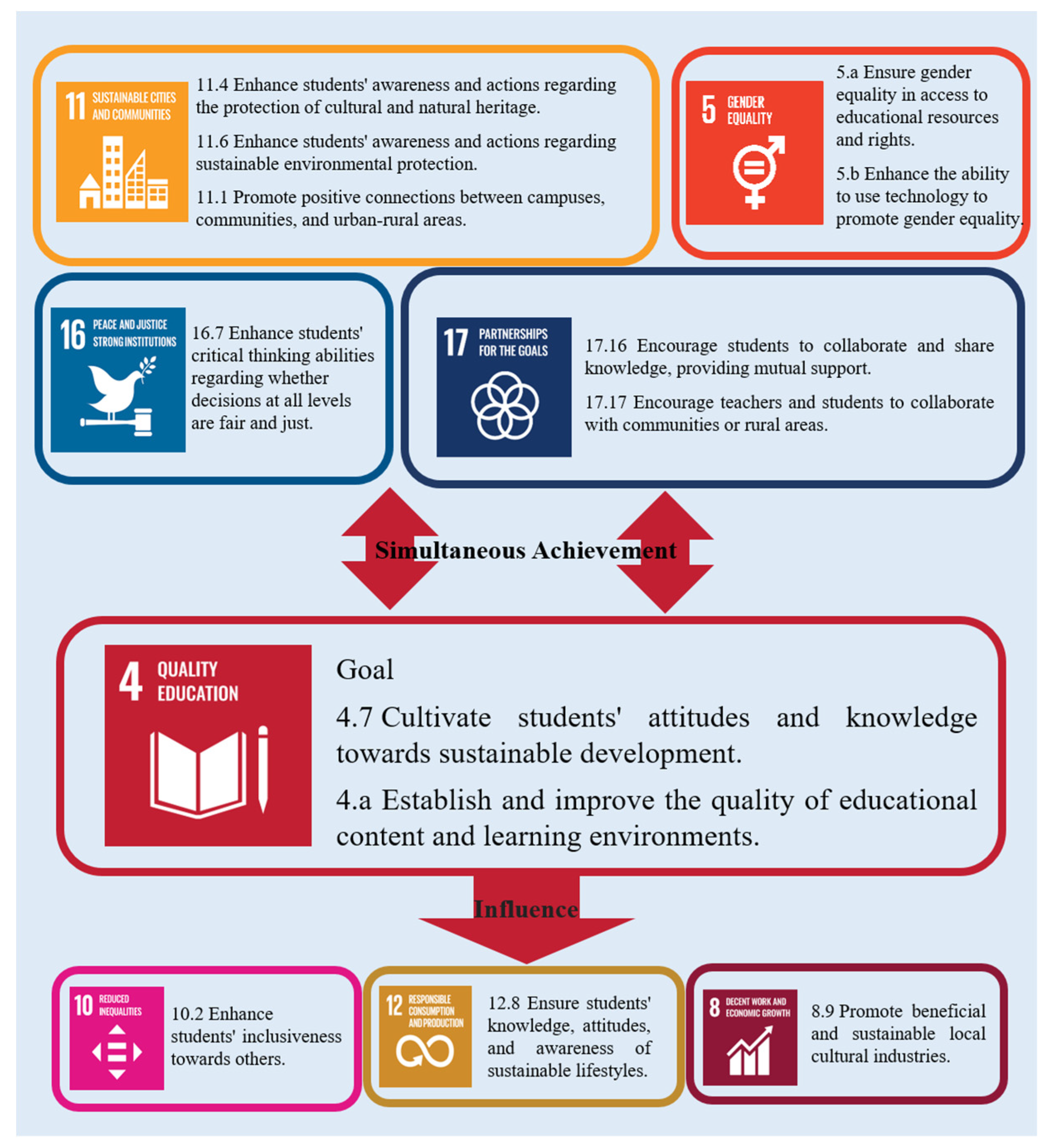
Figure 2.
ARG immersive learning environment.
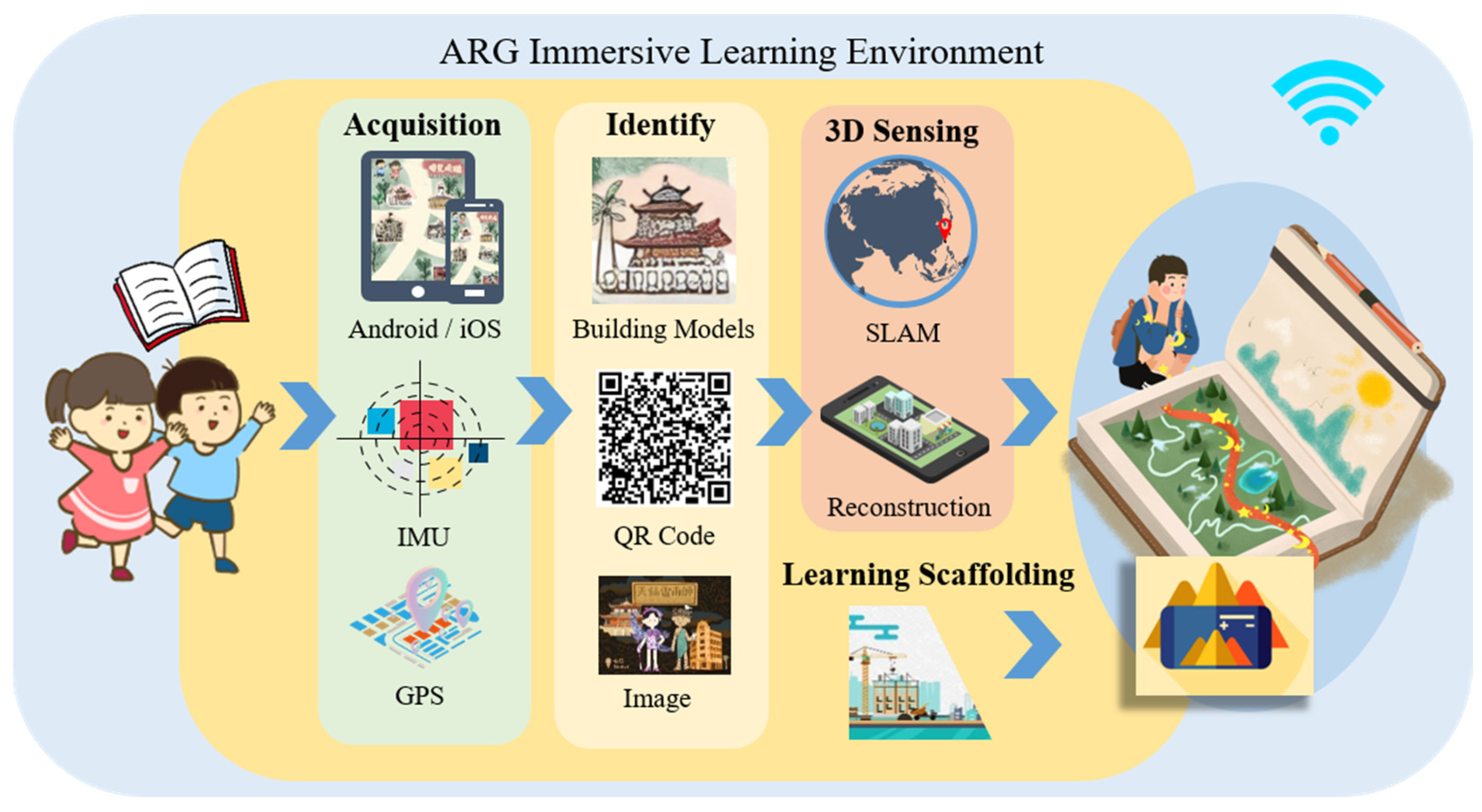
Figure 3.
The physical teaching materials.
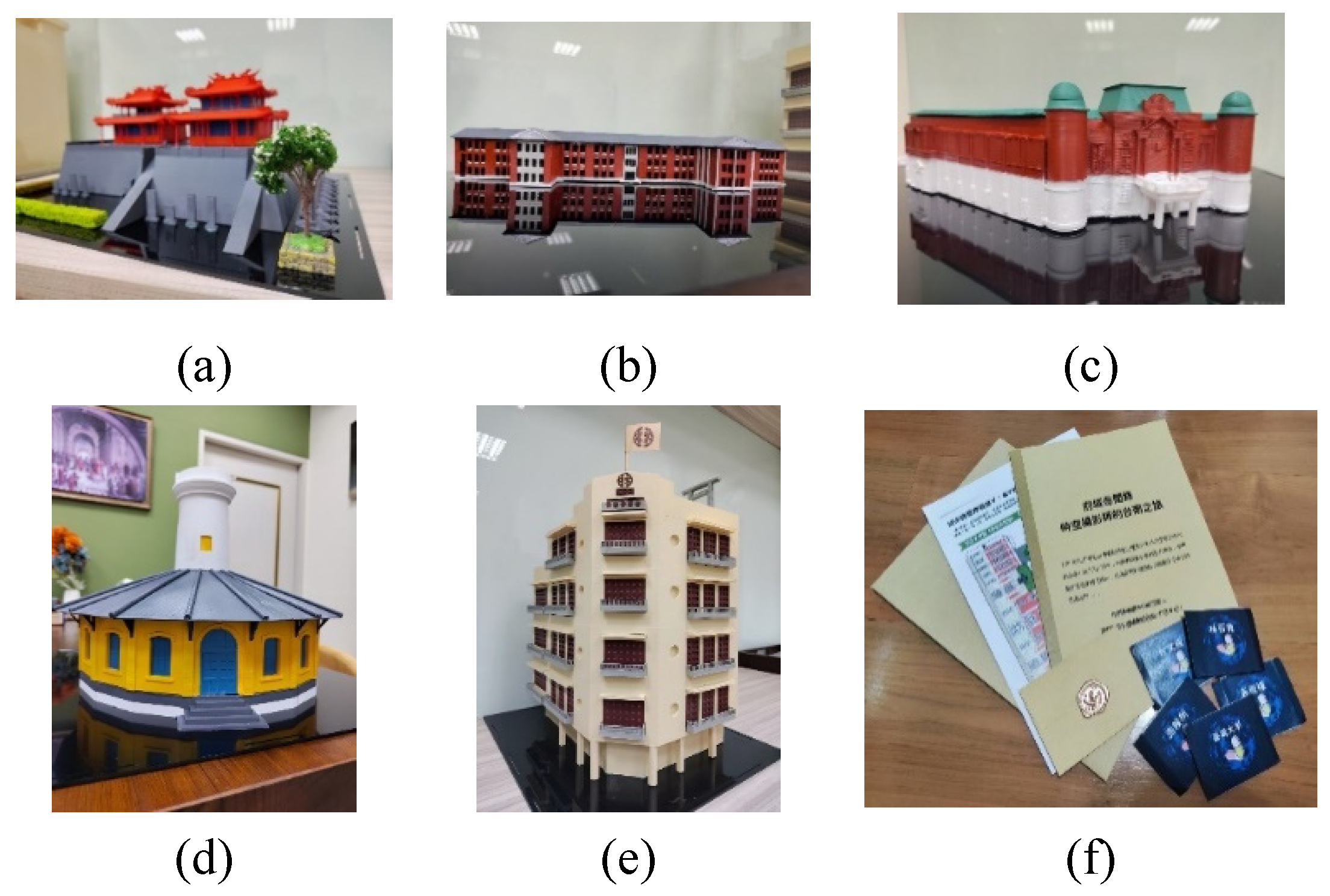
Figure 4.
System functions and operation screen.
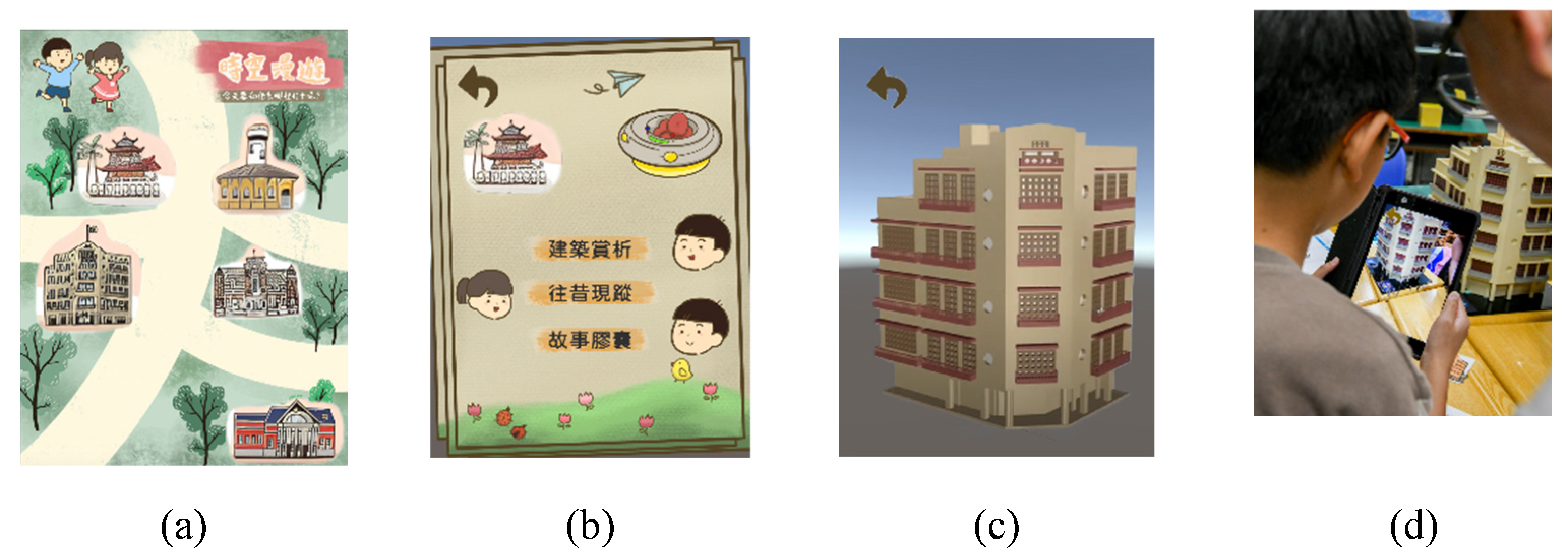
Figure 5.
Experimental procedure of the study.
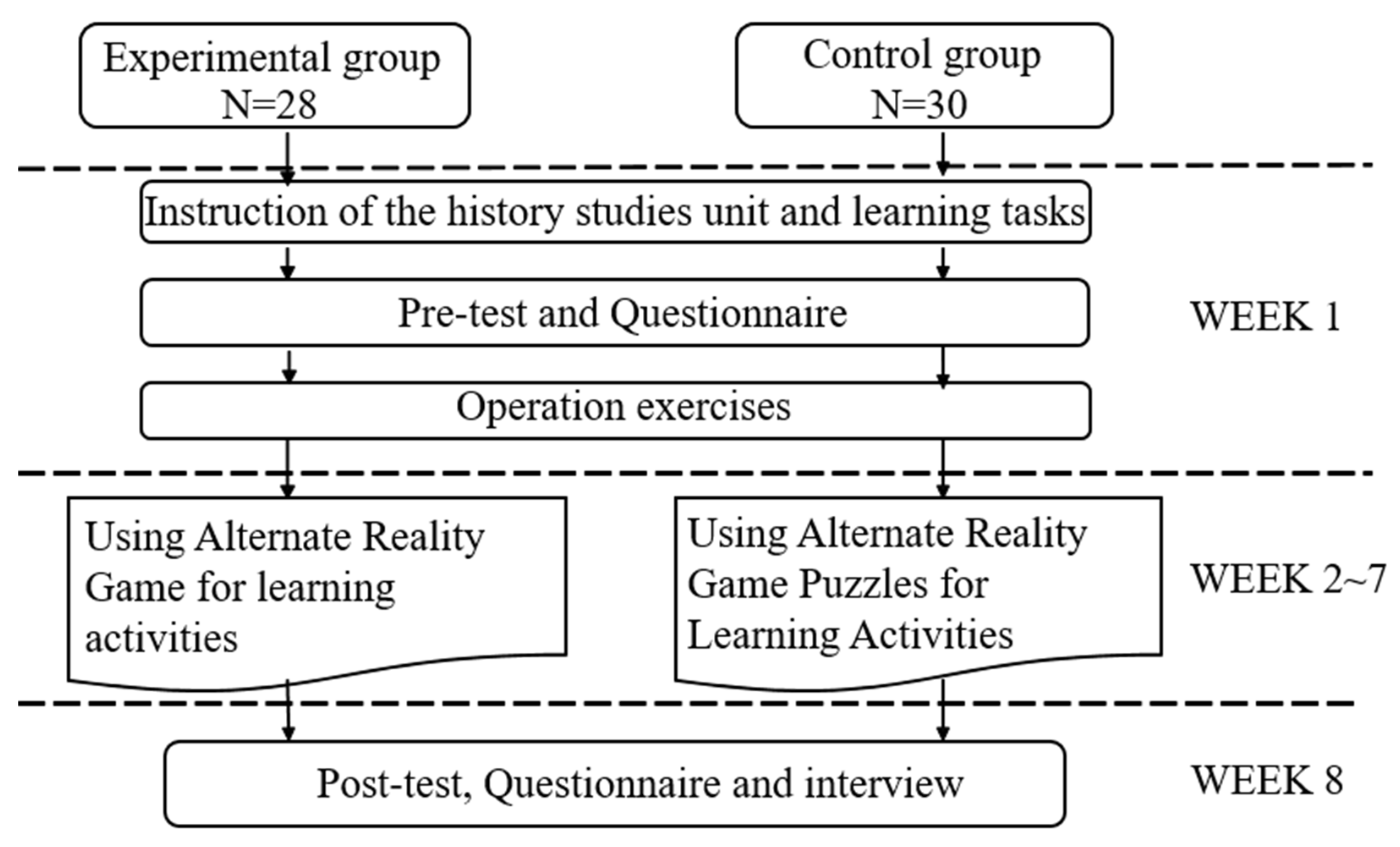

Table 1.
Test of Levene's Homogeneous Variables for Different Groups of Learning Effectiveness.
| F | df1 | df2 | P |
|---|---|---|---|
| 3.793 | 1 | 54 | 0.57 |
Table 2.
Results of homoscedasticity coefficients for within-group regression coefficients of learning effectiveness.
Table 2.
Results of homoscedasticity coefficients for within-group regression coefficients of learning effectiveness.
| Source of Variation | SS | df | MS | F | p |
|---|---|---|---|---|---|
| Group | .885 | 1 | .885 | .005 | .942 |
| Pre-test | 537.905 | 1 | 537.905 | 3.277 | .076 |
| Group * Pre-test | 30.420 | 1 | 30.420 | .185 | .669 |
| Error (between groups) | 8534.987 | 52 | 164.134 |
Table 3.
Results of covariate analysis of learning effectiveness.
| Source of Variation | SS | df | MS | F | p |
|---|---|---|---|---|---|
| Group | 1558.525 | 1 | 1558.525 | 9.495 | .003** |
| Pre-test | 535.383 | 1 | 535.383 | 3.313 | .074 |
| Error (between groups) | 8534.987 | 52 | 164.134 |
**p<0.005.
Table 4.
Independent sample t test of learning engagement between the two groups.
| M(SD) | df | t | p | ||
| Control(N=26) | Experimental(N=30) | ||||
| LearningEngagement | M=3.206(SD=0.378) | M=3.550(SD=0.531) | 54 | -2.775 | .008* |
*P<0.05.
Table 5.
Independent sample t test of components and questions between the two groups.
| Components and Questions | Group | M | SD | t | p |
|---|---|---|---|---|---|
| Behavioral Engagement | Control | 4.031 | 0.796 | -2.029 | 0.047* |
| Experimental | 4.420 | 0.640 | |||
| 1. I try hard to do well in school. | Control | 4.308 | 0.788 | ||
| Experimental | 4.633 | 0.718 | |||
| 2. In class, I work as hard as I can. | Control | 4.115 | 1.071 | ||
| Experimental | 4.400 | 0.932 | |||
| 3. When I’m in class, I participate in class discussions. | Control | 3.846 | 1.190 | ||
| Experimental | 4.200 | 0.961 | |||
| 4. I pay attention in class. | Control | 3.962 | 0.916 | ||
| Experimental | 4.500 | 0.682 | |||
| 5. When I’m in class, I listen very carefully. | Control | 3.923 | 0.845 | ||
| Experimental | 4.367 | 0.964 | |||
| Emotional Engagement | Control | 3.977 | 0.764 | -2.775 | 0.008* |
| Experimental | 4.500 | 0.647 | |||
| 6. When I’m in class, I feel good. | Control | 4.000 | 0.894 | ||
| Experimental | 4.400 | 0.894 | |||
| 7. When we work on something in class, I feel interested. | Control | 3.731 | 1.041 | ||
| Experimental | 4.433 | 0.774 | |||
| 8. Class is fun. | Control | 4.154 | 1.047 | ||
| Experimental | 4.500 | 0.820 | |||
| 9. I enjoy learning new things in class. | Control | 4.077 | 0.744 | ||
| Experimental | 4.667 | 0.606 | |||
| 10. When we work on something in class, I get involved. | Control | 3.923 | 1.093 | ||
| Experimental | 4.500 | 0.731 | |||
| Behavioral Disaffection | Control | 2.738 | 0.752 | -1.987 | 0.050 |
| Experimental | 3.160 | 0.825 | |||
| 11. When I’m in class, I just act like I’m working. (-) | Control | 2.692 | 1.192 | ||
| Experimental | 3.800 | 1.297 | |||
| 12. I don’t try very hard at school. (-) | Control | 1.962 | 1.113 | ||
| Experimental | 2.133 | 1.224 | |||
| 13. In class, I do just enough to get by. (-) | Control | 3.308 | 1.158 | ||
| Experimental | 3.900 | 1.296 | |||
| 14. When I’m in class, I think about other things. (-) | Control | 3.077 | 1.383 | ||
| Experimental | 3.667 | 1.124 | |||
| 15. When I’m in class, my mind wanders. (-) | Control | 2.654 | 1.413 | ||
| Experimental | 2.300 | 1.418 | |||
| Emotional disaffection | Control | 2.077 | .884 | -.140 | .889 |
| Experimental | 2.120 | 1.339 | |||
| 16. When we work on something in class, I feel bored. (-) | Control | 2.308 | 1.408 | ||
| Experimental | 2.067 | 1.363 | |||
| 17. When I’m in class, I feel worried. (-) | Control | 2.115 | 1.243 | ||
| Experimental | 2.267 | 1.484 | |||
| 18. When we work on something in class, I feel discouraged. (-) | Control | 2.000 | 1.166 | ||
| Experimental | 2.267 | 1.574 | |||
| 19. Class is not all that fun for me. (-) | Control | 2.115 | 1.033 | ||
| Experimental | 1.933 | 1.337 | |||
| 20. When I’m in class, I feel bad. (-) | Control | 1.846 | 0.784 | ||
| Experimental | 2.067 | 1.311 |
*P<0.05.
Table 6.
The Pearson's correlation analytical results for each component.
| Components | Behavioral Engagement | Emotional Engagement | Behavioral Disaffection | Emotional disaffection | |
| Behavioral Engagement | r | 1 | .882 | 0.030 | -.318 |
| p | 0.000** | 0.824 | 0.017* | ||
| Emotional Engagement | r | .882 | 1 | -0.048 | -.397 |
| p | 0.000** | 0.724 | 0.002** | ||
| Behavioral Disaffection | r | 0.030 | -0.048 | 1 | .594 |
| p | 0.824 | 0.724 | 0.000** | ||
| Emotional disaffection | r | -.318* | -.397 | .594 | 1 |
| p | 0.017 | 0.002** | 0.000** | ||
**P<0.005.
Disclaimer/Publisher’s Note: The statements, opinions and data contained in all publications are solely those of the individual author(s) and contributor(s) and not of MDPI and/or the editor(s). MDPI and/or the editor(s) disclaim responsibility for any injury to people or property resulting from any ideas, methods, instructions or products referred to in the content. |
© 2024 by the authors. Licensee MDPI, Basel, Switzerland. This article is an open access article distributed under the terms and conditions of the Creative Commons Attribution (CC BY) license (http://creativecommons.org/licenses/by/4.0/).
Copyright: This open access article is published under a Creative Commons CC BY 4.0 license, which permit the free download, distribution, and reuse, provided that the author and preprint are cited in any reuse.


