

Submitted:
18 September 2024
Posted:
20 September 2024
You are already at the latest version
Abstract
Background/Objectives: This review examines the evolution of lyotropic liquid crystals (LLCs) in ocular drug delivery, focusing on their ability to address the challenges associated with traditional ophthalmic formulations. The study aims to underscore the enhanced bioavailability, prolonged retention, and controlled release properties of LLCs that significantly improve therapeutic outcomes; Methods: The review synthesizes data from various studies on both bulk-forming LLCs and liquid crystal nanoparticles (LCNPs). It also considers advanced analytical techniques, including the use of machine learning and AI-driven predictive modeling, to forecast the phase behavior and molecular structuring of LLC systems. Emerging technologies in biosensing and real-time diagnostics are discussed to illustrate the broader applicability of LLCs in ocular health; Results: LLCs are identified as pivotal in promoting targeted drug delivery across different regions of the eye, with specific emphasis on the tailored optimization of LCNPs. The review highlights principal categories of LLCs used in ocular applications, each facilitating unique interactions with physiological systems to enhance drug efficacy and safety. Additionally, novel applications in biosensing demonstrate LLCs' capacity to improve diagnostic processes; Conclusions: Lyotropic liquid crystals offer transformative potential in ocular drug delivery by overcoming significant limitations of conventional delivery methods. The integration of predictive technologies and biosensing applications further enriches the utility of LLCs, indicating a promising future for their use in clinical settings. This review points to continued advancements and encourages further research in LLC technology to maximize its therapeutic benefits.
Keywords:
Ocular drug delivery
; Lyotropic liquid crystals
; Liquid crystal nanoparticles
; Cubosomes
; Bulk-forming
; Machine learning
; Biosensing applications
1. Introduction
The World Health Organization estimates that at least 2.2 billion people suffer from visual impairment globally, with nearly half of these cases being preventable or undertreated. This burden is exacerbated by limitations in accessibility and quality of vision care, particularly in low-income and middle-income countries [1]. Despite the prevalence of these conditions, the efficient delivery of drugs to ocular tissues remains a significant challenge due to the eye's complex anatomy and protective barriers, as shown in Figure 1, such as the corneal epithelium, blood-retinal barrier, and rapid tear turnover [2].
These barriers among others shown in Table 1, result in the low bioavailability of conventional ophthalmic formulations, typically less than 5%, which necessitates frequent dosing and leads to reduced patient compliance [3].
To address these limitations, there has been a growing interest in advanced drug delivery systems, particularly LLCs. LLCs exhibit a unique mesophase that combines the ordered structure of crystalline solids with the fluidity of liquids, making them highly suitable for drug delivery applications [14].
Their ability to self-assemble into various mesophases, including lamellar, hexagonal, and cubic structures, allows for the encapsulation and controlled release of a diverse array of therapeutic agents [15]. These properties are particularly advantageous for ocular drug delivery, where sustained release and prolonged retention time are critical for enhancing therapeutic efficacy [16].
Recent advancements have expanded the application of LLCs beyond traditional pharmaceutical uses. The integration of predictive modeling, enhanced by machine learning (ML) techniques, has revolutionized the design and optimization of LLC-based drug delivery systems [17]. This approach allows for more accurate predictions of phase behavior and molecular ordering, thereby reducing the need for extensive experimental trials and accelerating the development of optimized formulations [18]. Additionally, LLCs have shown significant promise in biosensing, where their unique optical properties, coupled with AI-driven analysis, have markedly improved the sensitivity and specificity of biosensors used in medical diagnostics, environmental monitoring, and food safety [19, 20].
This review aims to provide a comprehensive examination of recent advancements in LLC technology, with a particular emphasis on their application in ocular drug delivery. It explores the potential of both bulk-forming LLCs and LCNPs, highlighting innovative approaches that have emerged in recent years. Additionally, the review addresses novel methodologies extending beyond traditional LLC techniques, such as predictive modeling, automated analysis, and enhanced biosensing capabilities, which have significantly optimized drug delivery systems. By analyzing these developments, the review aims to offer insights into the potential of LLC-based therapies to improve therapeutic outcomes for patients with ocular diseases and other related conditions.
2. Ocular Administration Routes
Given the unique physiological barriers of the eye, various administration routes have been developed to optimize drug delivery and therapeutic efficacy [21]. Each route offers distinct advantages and limitations, depending on the targeted ocular segment and the type of disease being treated [21]. Table 2 provides an overview of these administration routes, highlighting their mechanisms, applications, and associated challenges.
3. Advancements in Ocular Drug Delivery Systems
Over the years, significant advancements have been made in ocular drug delivery systems, addressing the limitations of traditional methods [30]. Innovations such as drug-loaded contact lenses, punctum plugs, implants, microneedles, and in situ gelling systems have expanded the possibilities for sustained and targeted drug delivery, improving therapeutic outcomes [30]. Alongside these developments, nanoparticle-based systems have emerged as a crucial tool in enhancing ocular drug delivery [31]. Nanoparticles, including nanomicelles [32], polymeric nanoparticles [33], and cubosomes [34], offer unique benefits, such as the ability to cross ocular barriers, improve drug solubility, and provide controlled release, thereby increasing bioavailability and therapeutic efficacy [34]. Recent advancements in nanoparticle-based drug delivery systems have further enhanced the therapeutic potential in ocular applications by improving drug bioavailability, targeting, and sustained release across various eye regions. Figure 2 provides a comprehensive overview of these nanoparticle systems and their targeted delivery sites within the ocular anatomy.
Chitosan-based nanoparticles, with their mucoadhesive properties, enhance drug retention on the corneal surface and the optic nerve by facilitating binding with negatively charged ocular tissues [35]. Polymeric nanoparticles are particularly versatile, targeting the cornea, iris, sclera, and optic nerve while offering controlled and sustained drug release [36]. Solid lipid nanoparticles (SLNs), used in corneal, scleral, and retinal applications, improve drug stability and provide prolonged release [37]. Liposomes are effective in retinal drug delivery, where their phospholipid bilayer allows for direct drug fusion with retinal cells [38]. Nanoemulsions and nanomicelles increase the solubility and bioavailability of hydrophobic drugs, ensuring sustained release to the retina [39, 40]. Dendrimers, due to their high drug-loading capacity and targeted delivery, are suitable for applications targeting deep ocular tissues like the choroid [41]. Additionally, albumin nanoparticles demonstrate effective crossing of the blood-retinal barrier, enhancing drug delivery to the optic nerve and posterior ocular structures [42]. These advancements underscore the potential of nanoparticle-based systems to overcome traditional challenges in ocular drug delivery, offering new avenues for targeted and sustained treatment of various eye conditions.
These advancements are also shown in Table 3, which details both the innovative ocular drug delivery systems and the various nanoparticle-based approaches, along with their mechanisms and the potential benefits they offer for improving ocular drug delivery.
4. Liquid Crystals for Drug Delivery
Recent progress in pharmaceutical formulations has brought attention to the possibility of LCs dosage forms for delivering drugs that are soluble in both water and oil. LCs possess a unique mesophase that allows them to exhibit properties that are characteristic of both crystalline solids and genuine liquids. Their ability to both maintain a structured arrangement and demonstrate fluidity makes them highly beneficial for pharmacological applications [55]. The mesophase of LCs is an intermediate state that combines the structural order of solid phases with the fluidity of liquid phases [56]. This state plays a crucial role in pharmaceutical sciences as it enables the accurate arrangement and positioning of molecules, which is essential for the controlled release and targeted distribution of medications [57]. In addition, LCs have the ability to spontaneously arrange themselves into intricate and enduring formations that exhibit a high degree of organization across one, two, or three dimensions [58]. The structural arrangement of medications is not only a physical characteristic but also has a significant impact on improving their pharmacokinetic qualities [55]. The structured and adaptable nature of these formations facilitates the efficient dispersion of active medicinal ingredients, leading to enhanced solubility, improved stability, and optimized bioavailability of the pharmaceuticals [59].
Within the realm of drug delivery devices, LCs can be categorized into two primary types, thermotropic and lyotropic. Thermotropic LCs arise from the self-assembly of pure drug molecules at different temperatures without the use of a solvent [60]. This specific type of LCs is especially advantageous for medications that necessitate accurate heat regulation in order to enable effective administration at the intended location [61]. LLCs are formed when amphipathic lipids or surfactants interact with water. These systems depend on the creation of micelles or comparable structures through the addition of a surfactant to a solvent, usually water. LLCs are very adaptable for creating aqueous drug delivery systems that may effectively transport pharmaceuticals with different solubilities, such as hydrophilic, hydrophobic, or amphiphilic medications [61]. Both categories of LCs present unique benefits in drug formulation, offering a flexible foundation for improving drug stability and delivery. As ongoing research progresses, LCs are increasingly recognized for their potential in revolutionizing pharmaceutical development by enabling the development of more efficient and precise drug delivery systems.
5. Classification of Lyotropic Liquid Crystals
Recent advancements have highlighted the important function of LLCs in improving the delivery of medication through mucosal surfaces. These systems are highly appreciated for their exceptional capacity to efficiently penetrate biological barriers and sustain long-term presence at the site of administration, which has the potential to enhance therapeutic effectiveness [62]. LLCs are created through the manipulation of the concentration of specific substances, such as surfactants, within a specific range of temperatures. As the solute concentration increases, distinct mesophases become apparent, indicating varied structural and functional properties [63]. The mesophases, namely the lamellar, hexagonal, and cubic phases shown in Figure 3, result from the self-organization of amphiphilic lipids due to variations in temperature and composition.
The self-assembly process is primarily driven by hydrophobic interactions that take place when these lipids are exposed to water, resulting in the formation of organized aggregates [64]. The reverse cubic and reverse hexagonal phases are highly suitable as delivery systems for a wide range of medicinal applications among the LLCs [65]. The internal composition of these stages enables the inclusion and secure containment of different therapeutic molecules, including those that are water-loving, fat-loving, and both water-loving and fat-loving in nature [66]. This provides possibilities for precise and regulated release mechanisms [67]. The cubic phase LC structures display a distinct duality in their structural formation. They can either appear as typical micellar aggregates with continuous water channels and fragmented hydrocarbon regions or as reversed aggregates with the opposite configuration [68]. Their ability to adapt structurally contributes to their ability to control the release of drugs. In addition, cubic phase LLCs exhibit notable mechanical rigidity in comparison to lamellar and hexagonal LCs, thereby impeding the unregulated movement observed in these mesophases [69]. When there is too much water added, the cubic phase changes into a clear gel that is thick and stretchy [70]. This gel is stable and has the same properties in all directions. These gels, although stiff, are difficult to detect using conventional polarized electron microscopy, emphasizing their distinctive physical properties [59]. The hexagonal phase is distinguished by the arrangement of cylindrical micelles into a three-dimensional hexagonal lattice. When exposed to organic solvents, this structure can undergo reversal, resulting in the formation of the reverse hexagonal phase. When adequately mixed with water, these hexagonal structures exhibit a unique fan-like texture that is visible when observed under polarized light microscopy [57]. Ultimately, the lamellar LCs, also known as neat phases, expand significantly, creating substantial structures resembling sheets that are interspersed with channels of water. The presence of a bilayer structure in these phases reduces the interaction between the oil and aqueous phases, which is advantageous for the encapsulation and preservation of drugs. The arrangement can be observed using polarized light microscopy, which reveals a unique streaky or mosaic-like texture, indicating its anisotropic characteristics [59]. LLCs possess a wide range of physicochemical properties and structural dynamics, which make them extremely beneficial for pharmaceutical purposes. Their capacity to generate diverse structured arrangements offers a flexible foundation for drug administration, offering improved durability, effectiveness, and precise therapeutic results.
Aside from their structural adaptability, LLCs demonstrate a range of physiological impacts that go beyond their function in drug administration. The effects are observed in several physiological systems, therefore enhancing their therapeutic capacity in a diverse array of applications [71].
Figure 4 depicts the diverse effects of LLCs on different physiological systems, emphasizing their possible impact on eye health, immune system activities, and cardiovascular stability, among other related areas.
LLCs for ocular drug delivery are categorized into two main types based on their formulation strategy, bulk-forming liquid crystals and LCNPs. Bulk-forming liquid crystals are extensively studied for their capacity to create sustained-release systems. These bulk phases, including hexagonal and cubic structures, are engineered to maintain therapeutic levels of drugs over extended durations [72], whether applied locally or intravitreally, thereby enhancing the treatment efficacy for various ocular conditions. Conversely, liquid crystal-based nanoparticles, such as cubosomes, represent a significant advancement in ocular drug delivery by improving drug targeting, controlled release, and bioavailability [73]. Formulated with amphiphilic lipids, these nanoparticles effectively deliver therapeutic agents to the eye, overcoming traditional barriers and ensuring sustained therapeutic effects. Both bulk-forming and LCNPs exemplify innovative approaches in ocular drug delivery, offering substantial improvements in treatment outcomes for a range of eye diseases.
5.1. Bulk Forming Liquid Crystals for Ocular Drug Delivery
Glycerol monooleate (GMO) is currently a highly researched amphiphilic lipid due to its potential use in the development of LLC medication formulations [74]. GMO, which is included in the FDA Inactive Ingredients Guide, is known for its non-toxic, biodegradable, and biocompatible properties. It is classified as Generally Recognized as Safe (GRAS) [75]. This approval highlights the potential appropriateness of using it in pharmaceutical applications, specifically for delivering therapeutics like vancomycin, as investigated by Milak et al. (2019) [64]. Milak et al. conducted extensive research on the utilization of GMO to create bulk hexagonal and cubic phases that are specifically tailored for ocular drug delivery systems [64]. These systems are designed to maintain therapeutic levels of Vancomycin HCl either locally in the eye or intravitreally for long periods of time. Their innovative method utilized melted homogenization and solvent evaporation techniques to create these phases, which effectively regulated the release rate of Vancomycin HCl [64]. The hexagonal phase, characterized by closed water channels, was found to considerably delay the release of Vancomycin HCl in comparison to the reverse cubic phase, which has open water channels [64]. Milak et al. conducted additional research in 2020 to examine the structural and release properties of liquid crystalline phases made from GMO/Paraffin oil/Vancomycin HCl. The liquid crystalline phases were altered by incorporating additives like polyglycerol ester or a triblock copolymer to assess and improve their capacity to sustain therapeutic Vancomycin HCl concentrations over prolonged durations [76], whether applied topically or injected intravitreally. The objective of this study was to enhance the compositions for long-term treatment of eye infections, demonstrating encouraging prospects for both localized and systemic ocular uses [76]. phytantriol (PHY) is another notable example of amphiphilic lipids that has been recognized for its non-toxic, mucoadhesive, and biocompatible characteristics. It is commonly used as a secure and efficient framework in LLC formulations [77]. Wang et al. (2019) utilized PHY to create a reversed bicontinuous cubic phase carrier for the transportation of pilocarpine nitrate, a medication frequently employed in the treatment of glaucoma [77]. The team aimed to reduce ocular irritancy and improve the bioavailability of pilocarpine nitrate by using a vortex method to mix PHY and water in a specific ratio. The LC gels produced were evaluated against conventional eye drops and exhibited a sustained release pattern, reduced corneal irritation, and prolonged drug retention in the ocular environment. These findings indicate a substantial enhancement over conventional delivery techniques [77]. Building upon this study, Xingqi et al. further examined the capability of PHY-based LC gels that contain both cubic and hexagonal phases for delivering pilocarpine nitrate to the eye [67]. Their research showed that these gels can effectively keep therapeutic levels of pilocarpine nitrate in the liquid part of the eye for at least 12 hours after being given, which significantly improves the drug's ability to be absorbed by the body and offers a more efficient treatment for glaucoma [67]. Additionally, Wu et al. created a novel in situ LC gel specifically formulated for the ophthalmic administration of dexamethasone [78]. This system was specifically designed to improve the retention of dexamethasone in the eye, resulting in higher levels of dexamethasone available in the eye and proving especially effective in treating DR [78]. Their research confirmed that the in situ formed liquid crystal gel (ISLG) is capable of releasing substances over an extended period, its high compatibility with living organisms, and its overall safety. This positions the ISLG as a promising foundation for future treatment approaches in managing ocular diseases [78]. Li et al. developed a new type of gel called resveratrol-loaded ocular lamellar crystalline gel (ROLG) with the specific purpose of treating corneal neovascularization [62]. The research team employed advanced imaging techniques, such as polarized light microscopy and small-angle X-ray scattering, to confirm the presence of lamellar crystalline structures in the ROLGs. These gels exhibited strong retention properties on the surface of the eye, outstanding capacity to load drugs, and improved drug permeability through the tissues of the cornea. In addition, the gels were recognized for their simplicity of application and ability to provide a sustained release, making them an optimal vehicle for delivering resveratrol and a potentially effective new treatment option for managing corneal neovascularization [62]. Also, Tarsitano et al. investigated the use of LLCs as a novel ocular drug delivery system for the delivery of Acyclovir [79]. The study successfully demonstrated the use of a lamellar phase LC that transitions to a cubic phase in situ on the corneal surface, allowing for controlled drug release while overcoming issues with the physicochemical properties and limited precorneal retention time of many ophthalmic medications. The cubic phase exhibited constant viscosity and degradation kinetics across a variety of circumstances, indicating a significant potential for improving drug delivery efficacy. Ex vivo investigations on pig eyeballs and isolated corneas further proved the system's stability and safety, with no deleterious alterations identified in corneal tissue structures [79]. The wide range of research highlights the powerful ability of LLCs to transform ocular drug delivery. Table 4 provides a summary of bulk-forming LLCs utilized in ocular drug delivery.
5.2. Liquid Crystal-Based Drug Nanoparticles (LCNP) for Ocular Drug Delivery
The application of LCNPs in ocular drug delivery has made remarkable progress, demonstrating improvements in therapeutic targeting, controlled and sustained release, stability, bioavailability, and the solubility of poorly soluble drugs. Research in this field over the past decade has established a strong foundation for ongoing and future innovations, confirming LCNPs as a transformative approach in ocular pharmacotherapy.
In the presence of water, lamellar phase LC structures commonly produce liposomes, which are spherical vesicles made up of one or more lipid bilayers. On the other hand, cubic and hexagonal phases can retain their unique geometric structures, resulting in the formation of cubosomes and hexosomes, which are nanoparticles with a well-defined internal architecture that is suitable for encapsulating and releasing drugs [63]. A pioneering study by Gan, Li et al., marked the inception of self-assembled LCNPs (cubosomes) for ocular dexamethasone delivery, demonstrating significantly enhanced aqueous humor pharmacokinetics compared to conventional eye drops. This study revealed that low viscosity cubosomes containing 10% oil remained in the preocular region longer, leading to an eightfold increase in the area under the curve (AUC) for dexamethasone compared to standard formulations [34].
Building on this foundation, Chen et al. (2012) developed LCNPs for cyclosporine A delivery, utilizing a combination of GMO and poloxamer 407 [75]. This formulation markedly improved corneal penetration and retention, surpassing the performance of oil solutions and offering a promising approach for treating ocular conditions with reduced irritation.
Similarly, Li et al. (2013) investigated LCNPs for pilocarpine nitrate delivery in glaucoma treatment. Their formulation, characterized by uniformly dispersed nano-sized particles, exhibited minimal ocular irritation, enhanced bioavailability, and sustained intraocular pressure reduction, presenting a significant advancement over commercial eye drops [80].
Further refining the application of LCNPs, Achouri et al. (2015) employed a design of experiments methodology to optimize nanoparticle formulations for keratoconus treatment. Their research identified critical parameters such as temperature, emulsification length, and homogenization, which are essential for achieving optimal particle size and drug encapsulation efficiency [81].
Hartnett et al. (2015) highlighted the stability of cubosomes derived from amphiphiles like PHY and GMO, which are well-suited for prolonged drug release [82]. This stability is crucial for maintaining consistent therapeutic levels in treatments that require sustained medication release.
In 2016, Liu et al. introduced an innovative ocular delivery method using tetrandrine-loaded LCNPs [83]. This formulation demonstrated significantly improved ocular bioavailability and pharmacological benefits, suggesting a novel approach for enhancing drug retention and efficacy in eye treatments. Concurrently, Verma and Ahuja (2016) evaluated cubic LCNPs for tropicamide delivery, finding that these nanoparticles provided a faster onset of action and increased potency, offering potential improvements in eye care procedures [84].
Ali et al. (2016) developed a cubosomal system for ketorolac delivery, which improved transcorneal permeability and retention, highlighting the potential of cubosomes as a more effective alternative to traditional eye drops [85]. Younes et al. (2018) further advanced this field by creating a cubosomal delivery system for sertaconazole nitrate, enhancing the drug's permeability and effectiveness in treating fungal keratitis—a significant challenge in ocular pharmacotherapy [86].
Recent studies have continued to push the boundaries of LCNP applications. Silva et al. (2019) designed a pirfenidone-loaded LCNP system that accelerated corneal healing, demonstrating the potential of LCNPs in treating corneal injuries [87]. Eldeeb et al. (2019) explored brimonidine tartarate-loaded cubosomes, which significantly improved the efficacy and permeability of the drug, offering a more effective and long-lasting treatment for glaucoma [88]. The promise of cubosomes in the treatment of glaucoma was highlighted by the findings of the study, which showed a 4.6-fold increase in AUC and a 1.6-fold enhancement in permeability in comparison to any commercially available products [88].
El-Gendy et al. (2020) investigated the inclusion of penetration enhancers in cubosome formulations, finding that these customized liquid crystalline nanostructures enhanced ocular drug delivery without causing irritation, thereby expanding their potential applications [89]. Kaul et al. (2021, 2022) studied the use of LCNPs for delivering tobramycin and vancomycin, showing improvements in preocular residence time and drug permeability, which could reduce dosing frequency and enhance treatment efficacy [90, 91].
In 2021, Bessone et al. advocated the use of cubic LCs for latanoprost delivery, demonstrating their ability to release the drug continuously over an extended period, potentially revolutionizing glaucoma treatment by reducing dosing frequency and limiting adverse effects [92]. Elfaky et al. (2021) developed a ketoconazole cubosomal gel that enhanced drug penetration and retention while displaying strong antifungal activity, highlighting the therapeutic potential of cubosomal formulations [93].
Recent advancements include Shoman et al. (2023) exploration of hyaluronan-based cubosomes loaded with bromfenac sodium, which improved corneal permeability and retention, potentially enhancing treatment outcomes for pterygium and cataract [94]. Nasr et al. (2023) revealed that fluconazole combined with cubosomal nanoparticles exhibited superior penetration and safety profiles, offering a more efficient topical therapy for keratomycosis [95]. According to the findings of both the ex vivo and in vivo trials, the corneal penetration was significantly higher, and the therapeutic effects were superior to those of aqueous solutions [95].
Further innovations in 2023 by El-Gendy et al. focused on improving the ocular bioavailability and therapeutic efficacy of Travoprost using liquid crystalline nanostructures [96]. Priya et al. (2023) developed a Loteprednol Etabonate-loaded LCNP gel, which demonstrated improved ocular retention and efficacy, marking a significant advance in treating inflammatory eye conditions [97]. Similarly, Malaekeh-Nikouei et al. (2023) produced fluorometholone-loaded cubosomes, providing insights into efficient steroid delivery for ocular inflammation [98]. The formulation that was optimized did not exhibit any major changes in terms of physical characterization or in-vitro release, which is evidence that the formulation showed perfect stability.
In a study by Sharadha et al. (2023), triamcinolone-loaded cubic LCNPs outperformed typical suspensions in drug delivery and therapeutic outcomes, suggesting the potential for improved nanocarriers for retinal therapeutics [99]. Omran et al. (2024) introduced a phytocubosomal system coated with chitosan and loaded with luteolin, demonstrating significant success in reducing intraocular pressure and inflammation in glaucoma treatment [100]. Those phytocubosomes exhibited sustained drug release, enhanced antioxidant activity, and increased ex vivo transcorneal penetration in comparison to the luteolin suspension.
Iyer et al. (2024) investigated an extended-release cubogel formulation of moxifloxacin hydrochloride, showing potential for continuous release and enhanced bioavailability, positioning it as a promising alternative to traditional eye drops [101]. Chakorkar et al. (2024) optimized fluorometholone-loaded cubosomal vesicles using a quality by design approach, demonstrating improved drug release and ocular bioavailability [102]. Aher et al. (2024) examined acetazolamide-loaded cubosomes, highlighting enhanced corneal penetration and prolonged drug release, which could improve glaucoma treatment efficacy and patient compliance [103].
Finally, Nemr and Adel (2024) developed a fenticonazole-loaded cubosomal formulation that significantly improved corneal absorption and permeation, offering a transformative approach to treating fungal eye infections [104]. Bhageerathy and Prasanth (2024) furthered this research by demonstrating that a prolonged-release cubogel formulation of moxifloxacin hydrochloride could provide sustained drug release and increased bioavailability, potentially improving bacterial conjunctivitis therapy [105].
The enormous body of research that has been conducted over the course of more than a decade highlights the revolutionary potential of drug nanoparticles based on LCs in the context of ocular drug delivery. The aforementioned developments shed light on the capability of licensed clinical practitioners (LCNPs) to boost patient compliance, reduce the frequency of doses, and improve therapeutic outcomes, thereby paving the way for future innovations in ocular pharmacotherapy. In order to fully grasp the benefits of these advanced delivery methods in treating a wide variety of ocular disorders, it will be necessary to conduct additional research and clinical validation as the area continues to undergo development. Table 5 provides a summary of LCNPs utilized in ocular drug delivery.
6. Beyond Traditional Lyotropic Techniques
The field of LLCs has witnessed remarkable advancements that go beyond traditional techniques. These developments span predictive modeling, automated analysis, and novel applications, significantly broadening the scope of research and application of LLCs.
6.1. Predictive Modeling and Molecular Ordering
Advances in predictive modeling have significantly impacted the study of LLC, particularly through the use of ML techniques [111]. For instance, artificial neural networks (ANNs) have been successfully applied to predict the phase behavior of LLC systems, a crucial factor in designing drug delivery mechanisms [111]. Understanding and controlling phase transitions in LLCs is essential for ensuring the stability and efficient release of therapeutic agents. By using ANNs, researchers can simulate and predict how various compositions and environmental conditions influence the phase transitions of LLCs, reducing the need for extensive experimental trials and accelerating the development of optimized drug delivery systems [111].
In addition to phase behavior, molecular ordering within LLCs is another critical factor in their application, particularly in fields such as optical materials and nanotechnology. The ML has been utilized to predict and control the molecular ordering of LLCs, which directly influences their optical properties and functionality [112]. For example, precise molecular alignment is vital in creating materials with specific refractive indices or other optical characteristics, making this predictive capability invaluable for developing advanced optical devices [112].
Moreover, ML techniques have also been employed to estimate physical properties from the textures of LLCs. By analyzing images of LLC textures, ML models can predict properties such as the average order parameter and cholesteric pitch length with high precision, providing a non-invasive method for assessing the physical characteristics of LLCs [113].
6.2. Enhanced Biosensing Capabilities
The application of AI and machine learning to LLC-based biosensors has led to significant improvements in their sensitivity and specificity [114]. Biosensors leveraging LLCs are particularly effective in detecting biological molecules, pathogens, and biomarkers due to the unique optical properties of these LCs [115, 116]. AI-driven algorithms have been employed to analyze the optical responses of LLCs when exposed to various biological targets, enabling more accurate and rapid detection.
One such advancement is the use of convolutional neural networks (CNNs) to process and classify the optical images generated by LLC biosensors. These networks can detect subtle changes in the optical patterns that indicate the presence of specific pathogens or biomarkers, significantly improving the sensor’s performance [114]. This approach is crucial in medical diagnostics, environmental monitoring, and food safety, where accurate and timely detection is critical [114].
Moreover, the use of AI in optimizing LLC biosensors has expanded their applications in detecting a broader range of substances, enhancing their utility in various fields. For example, researchers have demonstrated the capability of LLC-based sensors to detect entire microorganisms, which can be vital in detecting bacterial contamination in water or food sources [115].
6.3. Automated and Real-Time Analysis
Automated analysis using deep learning, particularly CNNs, has revolutionized how data from lyotropic LC-based sensors is processed. Traditionally, analyzing optical data from these sensors required manual interpretation, which was time-consuming and prone to human error. However, deep learning models have automated this process, significantly improving both the speed and accuracy of detection.
In practical terms, CNNs are trained on large datasets of optical images to recognize and classify different patterns corresponding to the presence of various biological molecules or environmental changes [117]. This automation is particularly valuable in real-time applications, such as continuous monitoring systems in healthcare or environmental sensing, where quick and accurate detection is essential [117].
Furthermore, ML techniques have been employed to monitor the structural evolution of LLCs in real-time under dynamic conditions, such as shear flow or temperature variations [118]. By analyzing how LLC structures change over time, these models provide insights into the material's behavior during processing, allowing researchers to optimize conditions for desired outcomes. This real-time monitoring is crucial for applications in materials science and engineering, where maintaining specific structural properties during processing can significantly impact the final product's performance [118].
6.4. Designing Light-Responsive Systems
Significant advances have been made in the design of light-responsive LLCs systems. These systems act as molecular switches that can be triggered by light to control the release of drugs or other molecules. The ability to use light as a non-invasive and precise trigger is particularly beneficial in therapeutic applications, where controlled release is critical for treatment efficacy [119].
Researchers have developed light-responsive LLC systems that incorporate photoactive units, such as azobenzene derivatives, into the liquid crystal matrix [119]. Upon exposure to light, these units undergo a conformational change, altering the LLC’s structure and triggering the release of encapsulated molecules. This method provides exquisite control over the timing, dosage, and spatial distribution of the release, making it an ideal candidate for applications such as targeted drug delivery or responsive materials [119].
6.5. Exploring Nonlinear Optical Properties
In the realm of optical materials, LLCs have also been explored for their nonlinear optical properties, particularly in DNA-based LLCs, which represents a crucial advancement in the development of materials with tailored optical responses, which are highly sought after in fields such as biophotonics and telecommunications [120-122].
The nonlinear optical properties of DNA-based LLCs stem from their unique molecular structure, which can be manipulated to achieve specific optical effects, such as second-harmonic generation or optical limiting [123]. These properties are essential for applications in advanced optical devices, where precise control over light-matter interactions is required. By understanding and harnessing these nonlinear optical behaviors, researchers can develop new materials with applications in photonic circuits, sensors, and other optical technologies [123].
7. Conclusion
Ultimately, this study provides a thorough analysis of the most recent advances in LLCs applications for delivering drugs to the eye, highlighting its revolutionary potential to overcome the inherent challenges of conventional ophthalmic formulations. This work demonstrates how LLCs, by incorporating their distinctive characteristics including mesophase structures and self-assembling capabilities, can increase medication bioavailability, extend retention durations, and promote patient adherence in the treatment of several eye diseases. The article also examines the novel application of LCNPs, which represent notable progress in the precise and controlled release of drugs for ocular treatments. This review also emphasizes the integration of LLC technology with machine learning and AI-powered predictive modeling. By minimizing the need for long experimental trials and clearing the door for more precise and successful therapeutic techniques, these technologies have accelerated the design and optimization of LLC-based drug delivery systems. Moreover, this review explores innovative uses of LLCs in biosensing and real-time analysis, thus expanding the range of their possibilities in medical diagnostics and other fields. These findings highlight the potential of LLCs in ocular drug delivery and pave the way for future discoveries that could transform the field by offering more effective, centered, and patient-friendly therapy alternatives.
Author Contributions
Conceptualization, supervision, and writing of the original draft, Samer Adwan. Data curation, software, Madeiha Qasmieh. Conceptualization, Formal analysis, validation of results, Faisal Al-Akayleh. Data curation, software, Ahmed S. A. Ali Agha. All authors have read and agreed to the published version of the manuscript.
Funding
The authors gratefully acknowledge the funding and support provided by the Deanship of Scientific Research at Zarqa University, which was instrumental in conducting this research.
Institutional Review Board Statement
Not applicable.
Informed Consent Statement
Not applicable.
Data Availability Statement
The data that support the findings of this study are available from the corresponding author, (Samer Adwan).
Acknowledgments
This work was supported by the Deanship of Scientific Research at Zarqa University. We express our gratitude for their continued support and resources, which greatly facilitated the completion of this research.
Conflicts of Interest
The authors declare that there are no competing interests regarding the publication of this paper.
References
- Redd, T.K.; Al-Khaled, T.; Chan, R.M.P.; Campbell, J.P. Technology and Innovation in Global Ophthalmology: The Past, the Potential, and a Path Forward. Int. Ophthalmol. Clin. 2023, 63, 25–32. [CrossRef]
- Suri, R.; Beg, S.; Kohli, K. Target strategies for drug delivery bypassing ocular barriers. J. Drug Deliv. Sci. Technol. 2020, 55, 101389. [CrossRef]
- Acharya, A.; Goudanavar, P.; Joshi, V. Development and characterization of prolonged release Timolol maleate cubosomal gel for ocular drug delivery. Adv. Pharm. J. 2019, 4, 1–14. [CrossRef]
- Chen, Y.-Z.; Chen, Z.-Y.; Tang, Y.-J.; Tsai, C.-H.; Chuang, Y.-L.; Hsieh, E.-H.; Tucker, L.; Lin, I.-C.; Tseng, C.-L. Development of Lutein-Containing Eye Drops for the Treatment of Dry Eye Syndrome. Pharmaceutics 2021, 13, 1801. [CrossRef]
- Wang, F.; Song, Y.; Huang, J.; Wu, B.; Wang, Y.; Pang, Y.; Zhang, W.; Zhu, Z.; Ma, F.; Wang, X.; et al. Lollipop-Inspired Multilayered Drug Delivery Hydrogel for Dual Effective, Long-Term, and NIR-Defined Glaucoma Treatment. Macromol. Biosci. 2021, 21, 2100202. [CrossRef]
- Liu, Y.-C.; Lin, M.T.-Y.; Ng, A.H.C.; Wong, T.T.; Mehta, J.S. Nanotechnology for the Treatment of Allergic Conjunctival Diseases. Pharmaceuticals 2020, 13, 351. [CrossRef]
- Haghjou, N.; Soheilian, M.; Abdekhodaie, M.J. Sustained Release Intraocular Drug Delivery Devices for Treatment of Uveitis. Journal of Ophthalmic & Vision Research 2011, 6, 317–329.
- Korneeva, A.V.; Strakhova, S.S.; Loskutov, I.A. Clinical features of dry eye syndrome and evaluation of the effectiveness of artificial tear therapy in patients with anxiety and depression after cataract and keratorefractive surgery. Med Counc. 2023, 220–228. [CrossRef]
- Wong, C.W.; Wong, T.T. Posterior segment drug delivery for the treatment of exudative age-related macular degeneration and diabetic macular oedema. Br. J. Ophthalmol. 2019, 103, 1356–1360. [CrossRef]
- Silva, M.; Peng, T.; Zhao, X.; Li, S.; Farhan, M.; Zheng, W. Recent trends in drug-delivery systems for the treatment of diabetic retinopathy and associated fibrosis. Adv. Drug Deliv. Rev. 2021, 173, 439–460. [CrossRef]
- Wang, F.; He, S.; Chen, B. Retinoic acid-loaded alginate microspheres as a slow release drug delivery carrier for intravitreal treatment. Biomed. Pharmacother. 2018, 97, 722–728. [CrossRef]
- Wei, D.; Pu, N.; Li, S.-Y.; Wang, Y.-G.; Tao, Y. Application of iontophoresis in ophthalmic practice: an innovative strategy to deliver drugs into the eye. Drug Deliv. 2023, 30, 2165736. [CrossRef]
- Yamada N, Olsen TW. Routes for Drug Delivery to the Retina: Topical, Transscleral, Suprachoroidal and Intravitreal Gas Phase Delivery. Retinal Pharmacotherapeutics. 55. S.Karger AG; 2015:0.
- Waheed, A.; Aqil, M. Lyotropic liquid crystalline nanoparticles: Scaffolds for delivery of myriad therapeutics and diagnostics. J. Mol. Liq. 2021, 338, 116919. [CrossRef]
- Phan, S.; Fong, W.-K.; Kirby, N.; Hanley, T.; Boyd, B.J. Evaluating the link between self-assembled mesophase structure and drug release. Int. J. Pharm. 2011, 421, 176–182. [CrossRef]
- Wu W, Cao W, Cai Y, Zhang M, Chen T, Zhang N et al. In Situ Liquid Crystal Gel as a New Ophthalmic Drug Delivery System for Pilocarpine Nitrate: Improving Preocular Retention and Ocular Bioavailability. 2021.
- Le, T.C.; Tran, N. Using Machine Learning To Predict the Self-Assembled Nanostructures of Monoolein and Phytantriol as a Function of Temperature and Fatty Acid Additives for Effective Lipid-Based Delivery Systems. ACS Appl. Nano Mater. 2019, 2, 1637–1647. [CrossRef]
- Inokuchi, T.; Okamoto, R.; Arai, N. Predicting molecular ordering in a binary liquid crystal using machine learning. Liq. Cryst. 2020, 47, 438–448. [CrossRef]
- Zhang, Y.; Xu, S.; Zhang, R.; Deng, Z.; Liu, Y.; Tian, J.; Yu, L.; Hu, Q.; Ye, Q. Automated Calculation of Liquid Crystal Sensing Images Based on Deep Learning. Anal. Chem. 2022, 94, 12781–12787. [CrossRef]
- Cao, Y.; Yu, H.; Abbott, N.L.; Zavala, V.M. Machine Learning Algorithms for Liquid Crystal-Based Sensors. ACS Sensors 2018, 3, 2237–2245. [CrossRef]
- Wang, R.; Gao, Y.; Liu, A.; Zhai, G. A review of nanocarrier-mediated drug delivery systems for posterior segment eye disease: challenges analysis and recent advances. J. Drug Target. 2021, 29, 687–702. [CrossRef]
- Wan, K.H.; Chen, L.J.; Young, A.L. Efficacy and Safety of Topical 0.05% Cyclosporine Eye Drops in the Treatment of Dry Eye Syndrome: A Systematic Review and Meta-analysis. Ocul. Surf. 2015, 13, 213–225. [CrossRef]
- Gupta, M.P.; Koenig, L.R.; Doubrovina, E.; Hasan, A.; Dahi, P.B.; O’reilly, R.J.; Koehne, G.; Orlin, A.; Chan, R.V.P.; D’amico, D.J.; et al. Ocular Outcomes after Treatment of Cytomegalovirus Retinitis Using Adoptive Immunotherapy with Cytomegalovirus-Specific Cytotoxic T Lymphocytes. Ophthalmol. Retin. 2021, 5, 838–849. [CrossRef]
- Kim, S.J. Intravitreal Injections and Endophthalmitis. Int. Ophthalmol. Clin. 2015, 55, 1–10. [CrossRef]
- Sen HN, Vitale S, Gangaputra SS, Nussenblatt RB, Liesegang TL, Levy-Clarke GA et al. Periocular corticosteroid injections in uveitis: effects and complications. Ophthalmology 2014; 121 (11): 2275-2286.
- Melega MV, Alves M, Lira RPC, da Silva IC, Ferreira BG, Filho HLGA et al. Safety and efficacy of intracameral moxifloxacin for prevention of post-cataract endophthalmitis: Randomized controlled clinical trial. J Cataract Refract Surg 2019; 45 (3).
- Lee, T.W.-Y.; Robinson, J.R. Drug Delivery to the Posterior Segment of the Eye: Some Insights on the Penetration Pathways after Subconjunctival Injection. J. Ocul. Pharmacol. Ther. 2001, 17, 565–572. [CrossRef]
- Alhassan, M.B.; Kyari, F.; Ejere, H.O. Peribulbar versus retrobulbar anaesthesia for cataract surgery. Cochrane Database Syst. Rev. 2015, 2015, CD004083. [CrossRef]
- Lai MM, Lai JC, Lee W-H, Huang JJ, Patel S, Ying HS et al. Comparison of Retrobulbar and Sub–Tenon's Capsule Injection of Local Anesthetic in Vitreoretinal Surgery. Ophthalmology 2005; 112 (4): 574-579.
- Gote V, Sikder S, Sicotte J, Pal D. Ocular drug delivery: present innovations and future challenges. Journal of Pharmacology and Experimental Therapeutics 2019; 370 (3): 602-624.
- Janagam, D.R.; Wu, L.; Lowe, T.L. Nanoparticles for drug delivery to the anterior segment of the eye. Adv. Drug Deliv. Rev. 2017, 122, 31–64. [CrossRef]
- Cholkar, K.; Patel, A.; Vadlapudi, A.D.; Mitra, A.K. Novel Nanomicellar Formulation Approaches for Anterior and Posterior Segment Ocular Drug Delivery. Recent Patents Nanomedicinee 2012, 2, 82–95. [CrossRef]
- Nagarwal, R.C.; Kant, S.; Singh, P.N.; Maiti, P.; Pandit, J.K. Polymeric nanoparticulate system: A potential approach for ocular drug delivery. J. Control. Release 2009, 136, 2–13. [CrossRef]
- Gan, L.; Han, S.; Shen, J.; Zhu, J.; Zhu, C.; Zhang, X.; Gan, Y. Self-assembled liquid crystalline nanoparticles as a novel ophthalmic delivery system for dexamethasone: Improving preocular retention and ocular bioavailability. Int. J. Pharm. 2010, 396, 179–187. [CrossRef]
- Ameeduzzafar; Ali, J.; Bhatnagar, A.; Kumar, N.; Ali, A. Chitosan nanoparticles amplify the ocular hypotensive effect of cateolol in rabbits. Int. J. Biol. Macromol. 2014, 65, 479–491. [CrossRef]
- Swetledge, S.; Jung, J.P.; Carter, R.; Sabliov, C. Distribution of polymeric nanoparticles in the eye: implications in ocular disease therapy. J. Nanobiotechnology 2021, 19, 1–19. [CrossRef]
- Balguri S, Adelli GR, Majumdar S. Topical ophthalmic lipid nanoparticle formulations (SLN, NLC) of indomethacin for delivery to the posterior segment ocular tissues. European journal of pharmaceutics and biopharmaceutics : official journal of Arbeitsgemeinschaft fur Pharmazeutische Verfahrenstechnik eV 2016; 109: 224-235.
- Lee, J.; Goh, U.; Lee, H.-J.; Kim, J.; Jeong, M.; Park, J.-H. Effective Retinal Penetration of Lipophilic and Lipid-Conjugated Hydrophilic Agents Delivered by Engineered Liposomes. Mol. Pharm. 2017, 14, 423–430. [CrossRef]
- Preeti, R.; Sambhakar, S.; Malik, R.; Bhatia, S.; Al Harrasi, A.; Rani, C.; Saharan, R.; Kumar, S.; Geeta; Sehrawat, R. Nanoemulsion: An Emerging Novel Technology for Improving the Bioavailability of Drugs. Scientifica 2023, 2023, 1–25. [CrossRef]
- Vaishya R, Khurana V, Patel S, Mitra AK. Controlled ocular drug delivery with nanomicelles. Wiley interdisciplinary reviews Nanomedicine and nanobiotechnology 2014; 6 5: 422-437.
- Abedi-Gaballu, F.; Dehghan, G.; Ghaffari, M.; Yekta, R.; Abbaspour-Ravasjani, S.; Baradaran, B.; Ezzati Nazhad Dolatabadi, J.; Hamblin, M.R. PAMAM dendrimers as efficient drug and gene delivery nanosystems for cancer therapy. Appl. Mater. Today 2018, 12, 177–190. [CrossRef]
- Radwan, S.E.-S.; El-Kamel, A.H.; I Zaki, E.; Burgalassi, S.; Zucchetti, E.; El-Moslemany, R.M. Hyaluronic-Coated Albumin Nanoparticles for the Non-Invasive Delivery of Apatinib in Diabetic Retinopathy. Int. J. Nanomed. 2021, 16, 4481–4494. [CrossRef]
- Carvalho, I.; Marques, C.; Oliveira, R.; Coelho, P.; Costa, P.; Ferreira, D. Sustained drug release by contact lenses for glaucoma treatment—A review. J. Control. Release 2015, 202, 76–82. [CrossRef]
- Ervin, A.-M.; Law, A.; Pucker, A.D. Punctal occlusion for dry eye syndrome. Cochrane Database Syst. Rev. 2017, 2017, CD006775. [CrossRef]
- Jaffe, G.J.; Ben-Nun, J.; Guo, H.; Dunn, J.P.; Ashton, P. Fluocinolone acetonide sustained drug delivery device to treat severe uveitis. Ophthalmology 2000, 107, 2024–2033. [CrossRef]
- Singh, R.R.T.; Tekko, I.; McAvoy, K.; McMILLIAN, H.; Jones, D.; Donnelly, R. Minimally invasive microneedles for ocular drug delivery. Expert Opin. Drug Deliv. 2017, 14, 525–537. [CrossRef]
- Shah, P.; Thakkar, V.; Anjana, V.; Christian, J.; Trivedi, R.; Patel, K.; Gohel, M.; Gandhi, T. Exploring of Taguchi Design in the Optimization of Brinzolamide and Timolol Maleate Ophthalmic in-situ Gel Used in Treatment of Glaucoma. Curr. Drug Ther. 2020, 15, 524–542. [CrossRef]
- Franca, J.R.; Foureaux, G.; Fuscaldi, L.L.; Ribeiro, T.G.; Castilho, R.O.; Yoshida, M.I.; Cardoso, V.N.; Fernandes, S.O.; Cronemberger, S.; Nogueira, J.C.; et al. Chitosan/hydroxyethyl cellulose inserts for sustained-release of dorzolamide for glaucoma treatment: In vitro and in vivo evaluation. Int. J. Pharm. 2019, 570, 118662. [CrossRef]
- Liu, D.; Wu, Q.; Chen, W.; Lin, H.; Zhu, Y.; Liu, Y.; Liang, H.; Zhu, F. A novel FK506 loaded nanomicelles consisting of amino-terminated poly(ethylene glycol)-block-poly(D,L)-lactic acid and hydroxypropyl methylcellulose for ocular drug delivery. Int. J. Pharm. 2019, 562, 1–10. [CrossRef]
- Imperiale, J.C.; Acosta, G.B.; Sosnik, A. Polymer-based carriers for ophthalmic drug delivery. J. Control. Release 2018, 285, 106–141. [CrossRef]
- Jacob, S.; Nair, A.B.; Shah, J.; Gupta, S.; Boddu, S.H.S.; Sreeharsha, N.; Joseph, A.; Shinu, P.; Morsy, M.A. Lipid Nanoparticles as a Promising Drug Delivery Carrier for Topical Ocular Therapy—An Overview on Recent Advances. Pharmaceutics 2022, 14, 533. [CrossRef]
- Huang, J.; Peng, T.; Li, Y.; Zhan, Z.; Zeng, Y.; Huang, Y.; Pan, X.; Wu, C.-Y.; Wu, C. Ocular Cubosome Drug Delivery System for Timolol Maleate: Preparation, Characterization, Cytotoxicity, Ex Vivo, and In Vivo Evaluation. Aaps Pharmscitech 2017, 18, 2919–2926. [CrossRef]
- Marano, R.J.; Toth, I.; Wimmer, N.; Brankov, M.; Rakoczy, P.E. Dendrimer delivery of an anti-VEGF oligonucleotide into the eye: a long-term study into inhibition of laser-induced CNV, distribution, uptake and toxicity. Gene Ther. 2005, 12, 1544–1550. [CrossRef]
- Marcano, D.C.; Shin, C.S.; Lee, B.; Isenhart, L.C.; Liu, X.; Li, F.; Jester, J.V.; Pflugfelder, S.C.; Simpson, J.; Acharya, G. Synergistic Cysteamine Delivery Nanowafer as an Efficacious Treatment Modality for Corneal Cystinosis. Mol. Pharm. 2016, 13, 3468–3477. [CrossRef]
- Rajabalaya, R.; Musa, M.N.; Kifli, N.; David, S.R. Oral and transdermal drug delivery systems: role of lipid-based lyotropic liquid crystals. Drug Des. Dev. Ther. 2017, 11, 393–406. [CrossRef]
- Marriott, M.; Lupi, L.; Kumar, A.; Molinero, V. Following the nucleation pathway from disordered liquid to gyroid mesophase. J. Chem. Phys. 2019, 150, 164902. [CrossRef]
- Rapalli, V.K.; Waghule, T.; Hans, N.; Mahmood, A.; Gorantla, S.; Dubey, S.K.; Singhvi, G. Insights of lyotropic liquid crystals in topical drug delivery for targeting various skin disorders. J. Mol. Liq. 2020, 315, 113771. [CrossRef]
- Tschierske, C.; Nürnberger, C.; Ebert, H.; Glettner, B.; Prehm, M.; Liu, F.; Zeng, X.-B.; Ungar, G. Complex tiling patterns in liquid crystals. Interface Focus 2011, 2, 669–680. [CrossRef]
- Silvestrini, A.V.P.; Caron, A.L.; Viegas, J.; Praça, F.G.; Bentley, M.V.L.B. Advances in lyotropic liquid crystal systems for skin drug delivery. Expert Opin. Drug Deliv. 2020, 17, 1781–1805. [CrossRef]
- Liu, K.; Chen, D.; Marcozzi, A.; Zheng, L.; Su, J.; Pesce, D.; Zajaczkowski, W.; Kolbe, A.; Pisula, W.; Müllen, K.; et al. Thermotropic liquid crystals from biomacromolecules. Proc. Natl. Acad. Sci. 2014, 111, 18596–18600. [CrossRef]
- Shoaib, A.; Mangla, B.; Javed, S.; Sultan, M.H.; Alqahtani, S.S.; Shakeel, F. Vicissitudes of liquid crystals for solubility enhancement of poorly soluble drugs. J. Mol. Liq. 2021, 321, 114924. [CrossRef]
- Li, M.; Yu, X.; Zhu, L.; Jin, Y.; Wu, Z. Ocular lamellar crystalline gels for sustained release and enhanced permeation of resveratrol against corneal neovascularization. Drug Deliv. 2021, 28, 206–217. [CrossRef]
- Blanco-Fernández, G.; Blanco-Fernandez, B.; Fernández-Ferreiro, A.; Otero-Espinar, F.J. Lipidic lyotropic liquid crystals: Insights on biomedical applications. Adv. Colloid Interface Sci. 2023, 313, 102867. [CrossRef]
- Milak, S.; Chemelli, A.; Glatter, O.; Zimmer, A. Vancomycin ocular delivery systems based on glycerol monooleate reversed hexagonal and reversed cubic liquid crystalline phases. Eur. J. Pharm. Biopharm. 2019, 139, 279–290. [CrossRef]
- Libster, D.; Aserin, A.; Garti, N. Interactions of biomacromolecules with reverse hexagonal liquid crystals: Drug delivery and crystallization applications. J. Colloid Interface Sci. 2011, 356, 375–386. [CrossRef]
- Guo, C.; Wang, J.; Cao, F.; Lee, R.J.; Zhai, G. Lyotropic liquid crystal systems in drug delivery. Drug Discov. Today 2010, 15, 1032–1040. [CrossRef]
- Xingqi, W.; Yong, Z.; Xing, L.; Yang, W.; Jie, H.; Rongfeng, H.; Shuangying, G.; Xiaoqin, C. Cubic and hexagonal liquid crystal gels for ocular delivery with enhanced effect of pilocarpine nitrate on anti-glaucoma treatment. Drug Deliv. 2019, 26, 952–964. [CrossRef]
- Rodríguez-Abreu, C.; Shrestha, L.K.; Varade, D.; Aramaki, K.; Maestro, A.; Quintela, A.L.; Solans, C. Formation and Properties of Reverse Micellar Cubic Liquid Crystals and Derived Emulsions. Langmuir 2007, 23, 11007–11014. [CrossRef]
- Dieterich, S.; Sottmann, T.; Giesselmann, F. Gelation of Lyotropic Liquid-Crystal Phases—The Interplay between Liquid Crystalline Order and Physical Gel Formation. Langmuir 2019, 35, 16793–16802. [CrossRef]
- Alam, M.M.; Shrestha, L.K.; Aramaki, K. Glycerol effects on the formation and rheology of cubic phase and related gel emulsion. J. Colloid Interface Sci. 2009, 329, 366–371. [CrossRef]
- de Souza JF, Pontes KdS, Alves TFR, Amaral VA, Rebelo MdA, Hausen MdA et al. Spotlight on Biomimetic Systems Based on Lyotropic Liquid Crystal. Molecules : A Journal of Synthetic Chemistry and Natural Product Chemistry 2017; 22.
- Martiel, I.; Baumann, N.; Vallooran, J.J.; Bergfreund, J.; Sagalowicz, L.; Mezzenga, R. Oil and drug control the release rate from lyotropic liquid crystals. J. Control. Release 2015, 204, 78–84. [CrossRef]
- Gupta V. AN OVERVIEW ON CUBOSOMES AS REMARKABLE NANOCARRIER FOR DRUG DELIVERY. Malaysian Journal of Pharmaceutical Sciences 2023.
- Gagliardi, A.; Cosco, D.; Udongo, B.P.; Dini, L.; Viglietto, G.; Paolino, D. Design and Characterization of Glyceryl Monooleate-Nanostructures Containing Doxorubicin Hydrochloride. Pharmaceutics 2020, 12, 1017. [CrossRef]
- Chen, Y.; Lu, Y.; Zhong, Y.; Wang, Q.; Wu, W.; Gao, S. Ocular delivery of cyclosporine A based on glyceryl monooleate/poloxamer 407 liquid crystalline nanoparticles: preparation, characterization,in vitrocorneal penetration and ocular irritation. J. Drug Target. 2012, 20, 856–863. [CrossRef]
- Milak, S.; Chemelli, A.; Glatter, O.; Zimmer, A. Vancomycin Loaded Glycerol Monooleate Liquid Crystalline Phases Modified with Surfactants. Pharmaceutics 2020, 12, 521. [CrossRef]
- Wang X, Zhang Y, Huang J, Tian C, Xia M, Liu L et al. A novel phytantriol-based lyotropic liquid crystalline gel for efficient ophthalmic delivery of pilocarpine nitrate. AAPS PharmSciTech 2019; 20: 1-14.
- Wu, W.; Cao, W.; Chen, J.; Cai, Y.; Dong, B.; Chu, X. In Situ Liquid Crystal Gel as a Promising Strategy for Improving Ocular Administration of Dexamethasone: Preparation, Characterization, and Evaluation. Aaps Pharmscitech 2021, 23, 1–13. [CrossRef]
- Tarsitano, M.; Mancuso, A.; Cristiano, M.C.; Urbanek, K.; Torella, D.; Paolino, D.; Fresta, M. Perspective use of bio-adhesive liquid crystals as ophthalmic drug delivery systems. Sci. Rep. 2023, 13, 1–12. [CrossRef]
- Li, J.; Wu, L.; Wu, W.; Wang, B.; Wang, Z.; Xin, H.; Xu, Q. A potential carrier based on liquid crystal nanoparticles for ophthalmic delivery of pilocarpine nitrate. Int. J. Pharm. 2013, 455, 75–84. [CrossRef]
- Achouri, D.; Hornebecq, V.; Piccerelle, P.; Andrieu, V.; Sergent, M. Self-assembled liquid crystalline nanoparticles as an ophthalmic drug delivery system. Part I: influence of process parameters on their preparation studied by experimental design. Drug Dev. Ind. Pharm. 2015, 41, 109–115. [CrossRef]
- E Hartnett, T.; O’connor, A.J.; Ladewig, K. Cubosomes and other potential ocular drug delivery vehicles for macromolecular therapeutics. Expert Opin. Drug Deliv. 2015, 12, 1513–1526. [CrossRef]
- Liu, R.; Wang, S.; Fang, S.; Wang, J.; Chen, J.; Huang, X.; He, X.; Liu, C. Liquid Crystalline Nanoparticles as an Ophthalmic Delivery System for Tetrandrine: Development, Characterization, and In Vitro and In Vivo Evaluation. Nanoscale Res. Lett. 2016, 11, 1–12. [CrossRef]
- Verma, P.; Ahuja, M. Cubic liquid crystalline nanoparticles: optimization and evaluation for ocular delivery of tropicamide. Drug Deliv. 2016, 23, 3043–3054. [CrossRef]
- Ali, Z.; Sharma, P.K.; Warsi, M.H. Fabrication and Evaluation of Ketorolac Loaded Cubosome for Ocular Drug Delivery. J. Appl. Pharm. Sci. 2016, 6, 204–208. [CrossRef]
- Younes, N.F.; Abdel-Halim, S.A.; Elassasy, A.I. Corneal targeted Sertaconazole nitrate loaded cubosomes: Preparation, statistical optimization, in vitro characterization, ex vivo permeation and in vivo studies. Int. J. Pharm. 2018, 553, 386–397. [CrossRef]
- Silva RO, da Costa BL, da Silva FR, da Silva CN, De Paiva MB, Dourado LFN et al. Treatment for chemical burning using liquid crystalline nanoparticles as an ophthalmic delivery system for pirfenidone. Int J Pharm 2019; 568: 118466.
- Eldeeb, A.E.; Salah, S.; Ghorab, M. Formulation and evaluation of cubosomes drug delivery system for treatment of glaucoma: Ex-vivo permeation and in-vivo pharmacodynamic study. J. Drug Deliv. Sci. Technol. 2019, 52, 236–247. [CrossRef]
- El-Gendy, M.A.; Mansour, M.; El-Assal, M.I.; Ishak, R.A.; Mortada, N.D. Delineating penetration enhancer-enriched liquid crystalline nanostructures as novel platforms for improved ophthalmic delivery. Int. J. Pharm. 2020, 582, 119313. [CrossRef]
- Kaul S, Nagaich U, Verma N. Investigating nanostructured liquid crystalline particles as prospective ocular delivery vehicle for tobramycin sulfate: Ex vivo: and: in vivo: studies. J Adv Pharm Technol Res 2021; 12 (4): 356-361.
- Kaul, S.; Nagaich, U.; Verma, N. Preclinical assessment of nanostructured liquid crystalline particles for the management of bacterial keratitis: in vivo and pharmacokinetics study. Drug Deliv. Transl. Res. 2022, 12, 1719–1737. [CrossRef]
- Bessone, C.D.V.; Akhlaghi, S.P.; Tártara, L.I.; Quinteros, D.A.; Loh, W.; Allemandi, D.A. Latanoprost-loaded phytantriol cubosomes for the treatment of glaucoma. Eur. J. Pharm. Sci. 2021, 160, 105748. [CrossRef]
- Elfaky, M.A.; Sirwi, A.; Tolba, H.H.; Shaik, R.A.; Selmi, N.M.; Alattas, A.H.; Albreki, R.S.; Alshreef, N.M.; Gad, H.A. Development, Optimization, and Antifungal Assessment of Ocular Gel Loaded With Ketoconazole Cubic Liquid Crystalline Nanoparticles. J. Pharm. Sci. 2021, 110, 2210–2220. [CrossRef]
- Shoman, N.A.; Gebreel, R.M.; El-Nabarawi, M.A.; Attia, A. Optimization of hyaluronan-enriched cubosomes for bromfenac delivery enhancing corneal permeation: characterization, ex vivo, and in vivo evaluation. Drug Deliv. 2023, 30, 2162162. [CrossRef]
- Nasr, M.; Teiama, M.; Ismail, A.; Ebada, A.; Saber, S. In vitro and in vivo evaluation of cubosomal nanoparticles as an ocular delivery system for fluconazole in treatment of keratomycosis. Drug Deliv. Transl. Res. 2020, 10, 1841–1852. [CrossRef]
- El-Gendy, M.A.; Mansour, M.; El-Assal, M.I.A.; Ishak, R.A.H.; Mortada, N.D. Travoprost Liquid Nanocrystals: An Innovative Armamentarium for Effective Glaucoma Therapy. Pharmaceutics 2023, 15, 954. [CrossRef]
- Priya, S.; Srividya, G.; Chandra, N.S.; Singh, P.P.; Saha, R.N.; Sathe, P.; Nirmal, J.; Singhvi, G. Loteprednol etabonate loaded lyotropic liquid crystalline nanoparticles in-situ ophthalmic gel: Qbd driven optimization and in-vitro, ex-vivo evidence of sustained precorneal residence time. J. Drug Deliv. Sci. Technol. 2023, 89. [CrossRef]
- Malaekeh-Nikouei B, Vafaei F, Karimi M, Nosrati R, Kamali H. Preparation and in-vitro evaluation of fluorometholone cubosomes for ocular delivery. Nanomedicine Journal 2023; 10 (4).
- Sharadha, M.; Gupta, N.V.; Rahamathulla, M.; Ahmed, M.M.; Farhana, S.A.; Osmani, R.A.M.; Veeranna, B.; Koteshwara, K. Subconjunctival therapy by cubic liquid crystalline nanoparticles to deliver Triamcinolone acetonide for the management of diabetic Retinopathy: In vivo evidences. Int. J. Pharm. 2023, 646, 123443. [CrossRef]
- Omran, S.; Elnaggar, Y.S.; Abdallah, O.Y. Controlled release, chitosan-tethered luteolin phytocubosomes; Formulation optimization to in-vivo antiglaucoma and anti-inflammatory ocular evaluation. Int. J. Biol. Macromol. 2024, 254, 127930. [CrossRef]
- Iyer, B.A.N.; Vasantha, P.V. Development and Characterization of Moxifloxacin Hydrochloride Cubogel for Enhanced Ocular Drug Delivery. Int. J. Pharm. Investig. 2024, 14, 472–481. [CrossRef]
- Chakorkar, S.S.; Mulla, J.A.S.G. Cubosome-based Corticosteroidal Drug Delivery System for Sustained Ocular Delivery: A Pharmacokinetic Investigation. Indian J. Pharm. Educ. Res. 2024, 58, s502–s514. [CrossRef]
- Aher S, Nimase B. Cubosomes; An Approach to Sustain and Improve the Ocular Delivery for Glaucoma Treatment: Box Benhken Optimization, Formulation, In Vitro Characterization and Ex Vivo Permeation Study. Journal for Research in Applied Sciences and Biotechnology 2024; 3 (3): 209-222.
- Nemr, A.A.; Ahmed, S.; Adel, I.M. Limonene-enriched ultra-structural cubosomes to augment ocular delivery of a poorly water soluble anti-fungal drug: Fabrication, characterization, statistical optimization, in vivo corneal uptake and histopathological evaluation in rabbits. J. Drug Deliv. Sci. Technol. 2024, 98. [CrossRef]
- Bhageerathy, A.; Prasanth, V.V. Formulation and Evaluation of Moxifloxacin Hydrochloride Loaded Cubosomal Gel for Ocular Delivery. J. Drug Deliv. Ther. 2024, 14, 88–99. [CrossRef]
- Teba, H.E.; Khalil, I.A.; El Sorogy, H.M. Novel cubosome based system for ocular delivery of acetazolamide. Drug Deliv. 2021, 28, 2177–2186. [CrossRef]
- Han S, Shen J-q, Gan Y, Geng H-m, Zhang X-x, Zhu C-l et al. Novel vehicle based on cubosomes for ophthalmic delivery of flurbiprofen with low irritancy and high bioavailability. Acta Pharmacol Sin 2010; 31 (8): 990-998.
- Gaballa, S.A.; El Garhy, O.H.; Moharram, H.; Abdelkader, H. Preparation and Evaluation of Cubosomes/Cubosomal Gels for Ocular Delivery of Beclomethasone Dipropionate for Management of Uveitis. Pharm. Res. 2020, 37, 1–23. [CrossRef]
- Ding, Y.; Chow, S.H.; Chen, J.; Le Brun, A.P.; Wu, C.-M.; Duff, A.P.; Wang, Y.; Song, J.; Wang, J.-H.; Wong, V.H.; et al. Targeted delivery of LM22A-4 by cubosomes protects retinal ganglion cells in an experimental glaucoma model. Acta Biomater. 2021, 126, 433–444. [CrossRef]
- El-Emam, G.A.; Motawea, A.; El Hady, W.E.A.; Saber, S.; Mourad, A.A.; Ramadan, H.A.; El-Baz, A.M. Salutary influence of gemifloxacin mesylate nanocubosomes based-in situ ocular gel as a novel approach for the management of experimental keratitis induced by MRSA. J. Drug Deliv. Sci. Technol. 2023, 89. [CrossRef]
- Le, T.C.; Tran, N. Using Machine Learning To Predict the Self-Assembled Nanostructures of Monoolein and Phytantriol as a Function of Temperature and Fatty Acid Additives for Effective Lipid-Based Delivery Systems. ACS Appl. Nano Mater. 2019, 2, 1637–1647. [CrossRef]
- Inokuchi, T.; Okamoto, R.; Arai, N. Predicting molecular ordering in a binary liquid crystal using machine learning. Liq. Cryst. 2020, 47, 438–448. [CrossRef]
- Sigaki, H.Y.D.; de Souza, R.T.; Zola, R.S.; Ribeiro, H.V. Estimating physical properties from liquid crystal textures via machine learning and complexity-entropy methods. Phys. Rev. E 2019, 99, 013311. [CrossRef]
- Cao, Y.; Yu, H.; Abbott, N.L.; Zavala, V.M. Machine Learning Algorithms for Liquid Crystal-Based Sensors. ACS Sensors 2018, 3, 2237–2245. [CrossRef]
- Otón, E.; Otón, J.M.; Caño-García, M.; Escolano, J.M.; Quintana, X.; Geday, M.A. Rapid detection of pathogens using lyotropic liquid crystals. Opt. Express 2019, 27, 10098–10107. [CrossRef]
- Wang, Z.; Xu, T.; Noel, A.; Chen, Y.-C.; Liu, T. Applications of liquid crystals in biosensing. Soft Matter 2021, 17, 4675–4702. [CrossRef]
- Zhang, Y.; Xu, S.; Zhang, R.; Deng, Z.; Liu, Y.; Tian, J.; Yu, L.; Hu, Q.; Ye, Q. Automated Calculation of Liquid Crystal Sensing Images Based on Deep Learning. Anal. Chem. 2022, 94, 12781–12787. [CrossRef]
- Rodriguez-Palomo, A.; Lutz-Bueno, V.; Cao, X.; Kádár, R.; Andersson, M.; Liebi, M. In Situ Visualization of the Structural Evolution and Alignment of Lyotropic Liquid Crystals in Confined Flow. Small 2021, 17, 2006229. [CrossRef]
- Aleandri, S.; Speziale, C.; Mezzenga, R.; Landau, E.M. Design of Light-Triggered Lyotropic Liquid Crystal Mesophases and Their Application as Molecular Switches in “On Demand” Release. Langmuir 2015, 31, 6981–6987. [CrossRef]
- Klimusheva GV, Garboskiy Y, Bugaychuk S, Tolochko AS, Melnik DA, Tokmenko II et al. Nonlinear Optics of Electrochromic and Photosensitive Cells of Ionic Liquid Crystals and Mesomorphic Glasses. Mol Cryst Liq Cryst 2011; 541: 142/[380] - 151/[389].
- Deniset-Besseau A, De Sa Peixoto P, Mosser G, Schanne-Klein M-C. Nonlinear optical imaging of lyotropic cholesteric liquid crystals. Opt Express 2010; 18 2: 1113-1121.
- Lucchetti, L.; Fraccia, T.P.; Nava, G.; Turiv, T.; Ciciulla, F.; Bethge, L.; Klussmann, S.; Lavrentovich, O.D.; Bellini, T. Elasticity and Viscosity of DNA Liquid Crystals. ACS Macro Lett. 2020, 9, 1034–1039. [CrossRef]
- Lucchetti, L.; Fraccia, T.P.; Ciciulla, F.; Simoni, F.; Bellini, T. Giant optical nonlinearity in DNA lyotropic liquid crystals. Opt. Express 2017, 25, 25951–25959. [CrossRef]
Figure 1.
Schematic illustrating the anatomical regions of the eye, the physiological barriers impeding ocular drug delivery, and the various methods employed for ocular drug administration.
Figure 1.
Schematic illustrating the anatomical regions of the eye, the physiological barriers impeding ocular drug delivery, and the various methods employed for ocular drug administration.
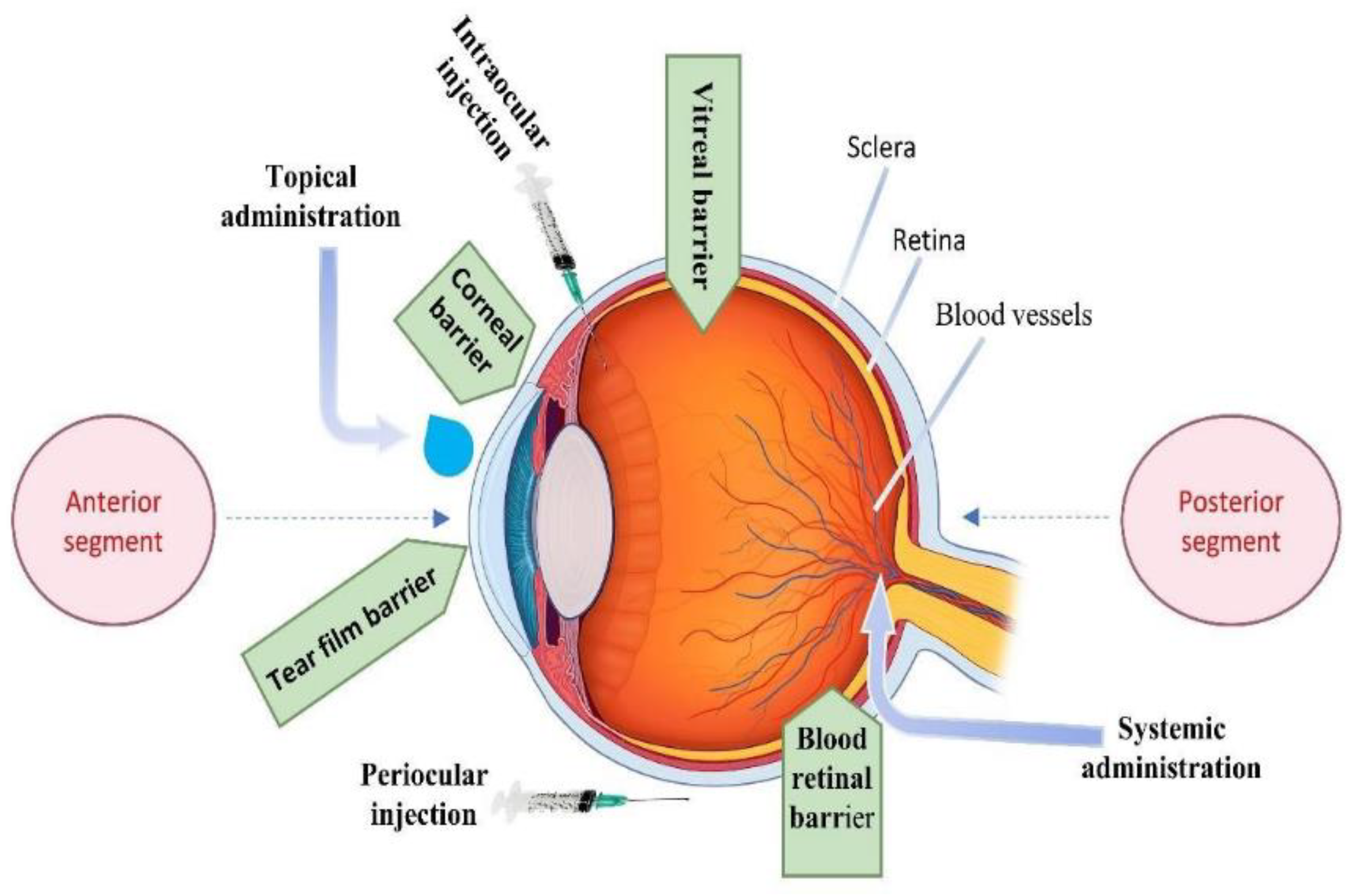
Figure 2.
Nanoparticle-based systems for targeted ocular drug delivery across various eye regions.
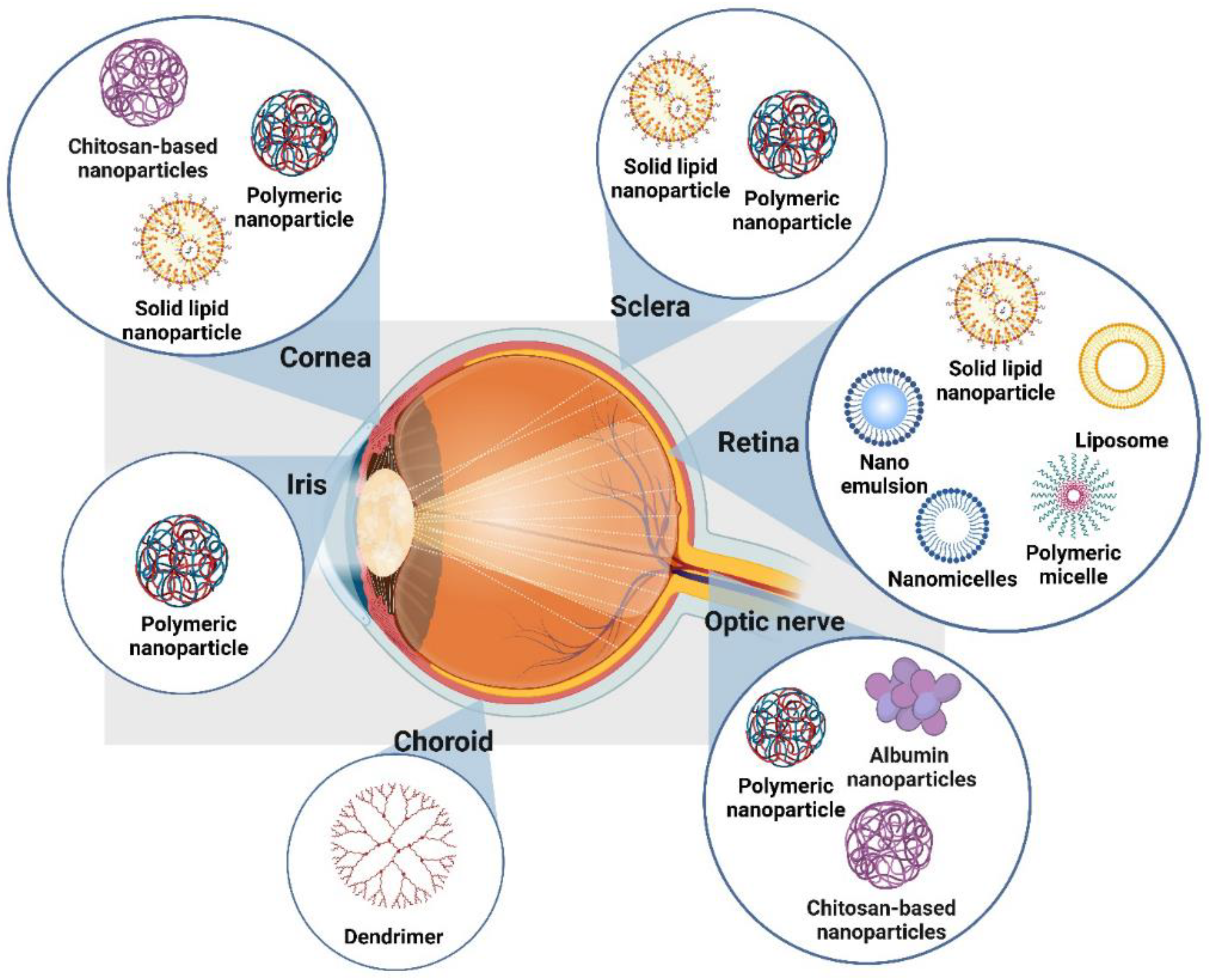
Figure 3.
Key types of LLCs and their structural characteristics relevant to ocular applications.
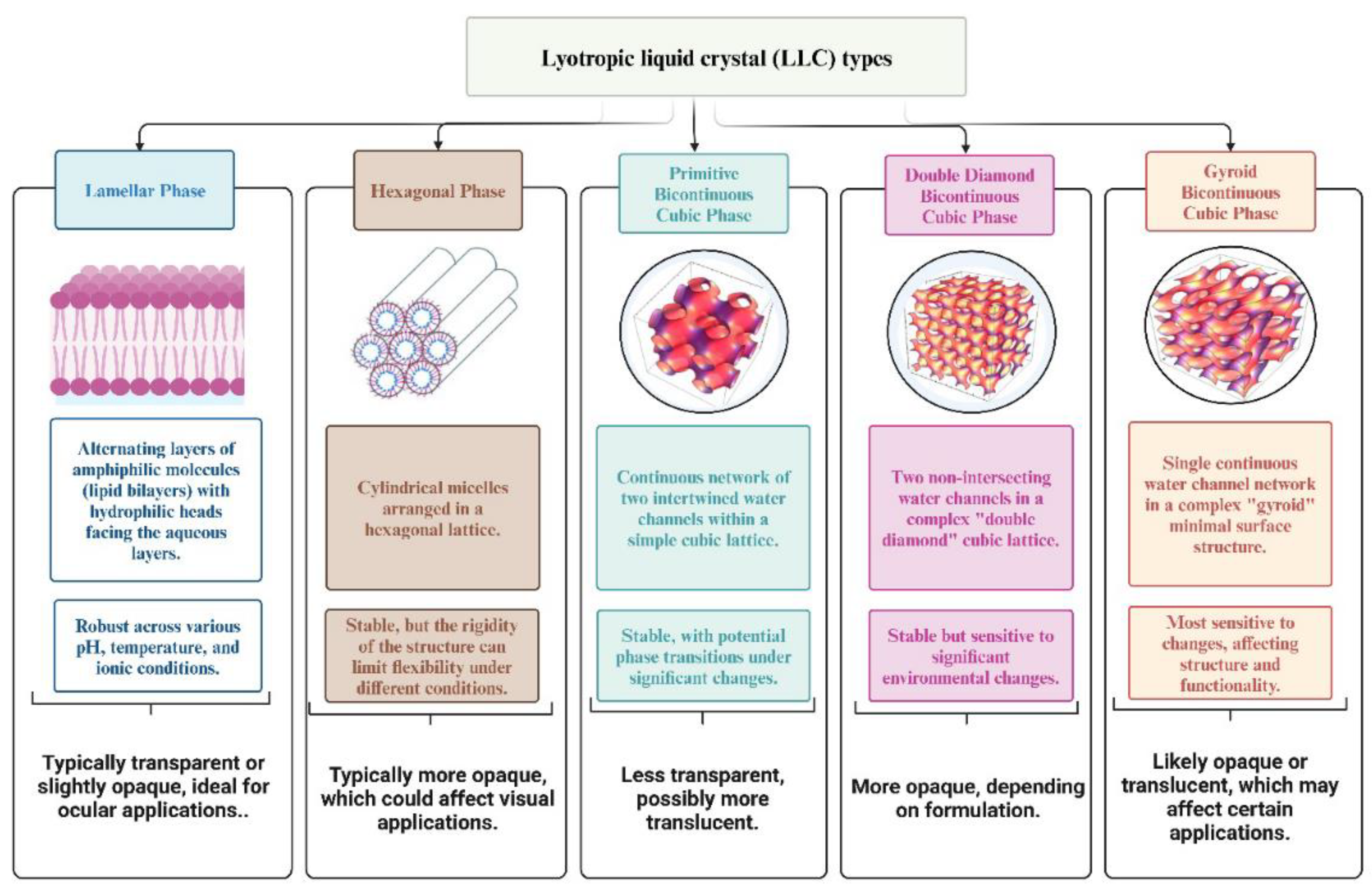
Figure 4.
Overview of the systemic effects of LLCs across various organs and systems, highlighting their potential therapeutic applications.
Figure 4.
Overview of the systemic effects of LLCs across various organs and systems, highlighting their potential therapeutic applications.
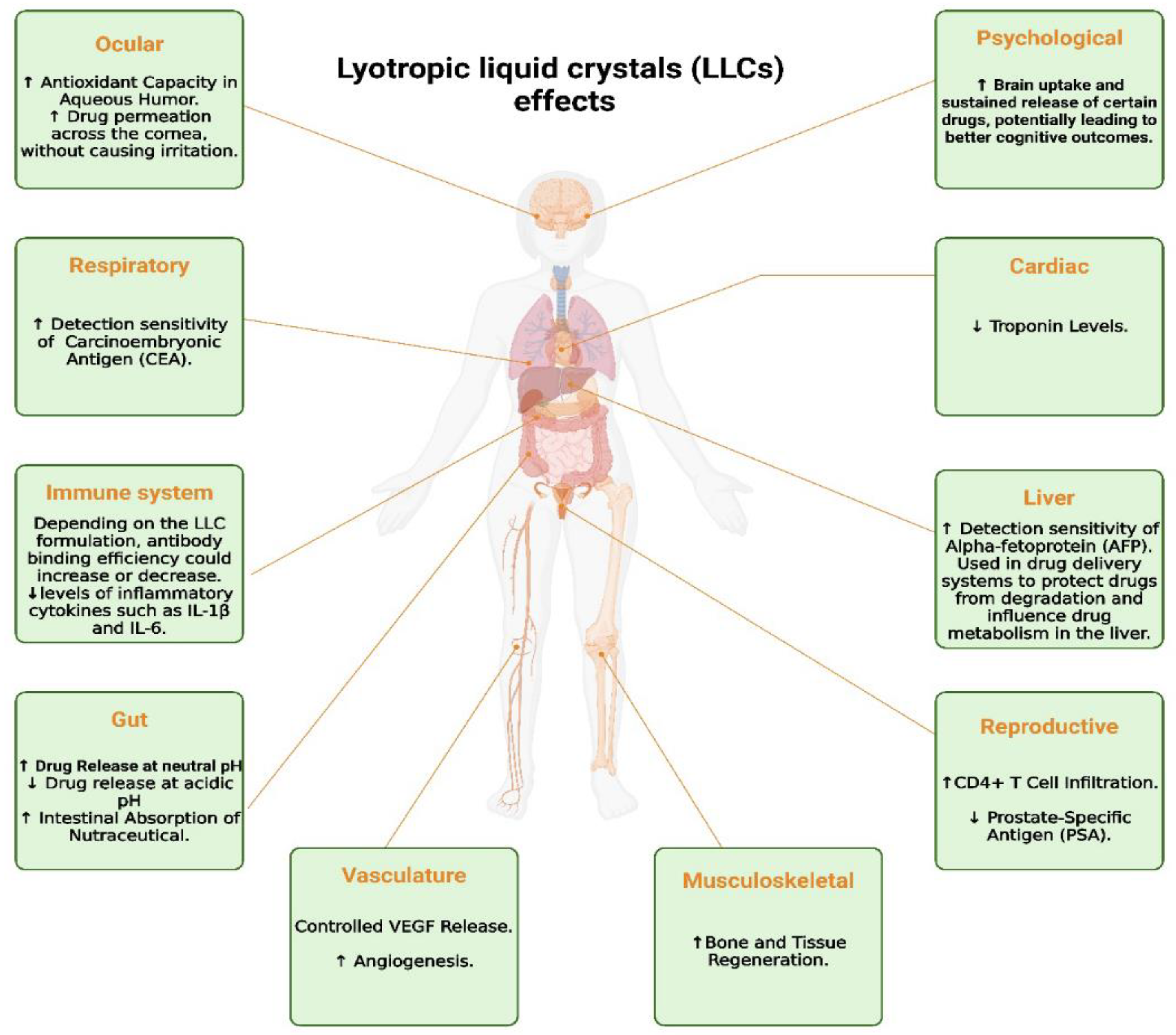

Table 1.
Ocular Diseases and Challenges.
| Segment | Disease | Challenges in Drug Delivery | References |
|---|---|---|---|
| Anterior Segment | Dry Eye Syndrome | High tear turnover leads to rapid drug clearance and low corneal penetration. | [4] |
| Glaucoma | Need for sustained IOP control; low bioavailability of topical agents; frequent dosing required. | [5] | |
| Allergic Conjunctivitis | Requires rapid action with minimal systemic absorption; barriers like the conjunctival epithelium. | [6] | |
| Anterior Uveitis | High risk of systemic side effects with oral therapy; low penetration with topical steroids. | [7] | |
| Cataract | Requires precise drug delivery post-surgery to prevent infection and inflammation. | [8] | |
| Posterior Segment | Age-Related Macular Degeneration (AMD) | Poor penetration of drugs to the retina; risk of damage with repeated injections. | [9] |
| Diabetic Retinopathy (DR) | Sustained delivery needed to reduce frequent IVT injections; blood-retinal barrier limits drug access. | [10] | |
| Diabetic Macular Edema (DME) | Requires precise targeting to avoid damage to the retina; high systemic absorption risks with systemic therapy. | [9] | |
| Proliferative Vitreoretinopathy | High recurrence rate necessitates long-term therapy; limited options for effective drug penetration. | [11] | |
| Cytomegalovirus Retinitis | Often requires systemic treatment with significant side effects; local delivery challenging due to retinal barriers. | [12] | |
| Retinal Vein Occlusion | Requires sustained anti-VEGF therapy; risks associated with repeated intraocular injections. | [13] |
Table 2.
Ocular Administration Routes.
| Route | Application | Pros | Cons | References |
|---|---|---|---|---|
| Topical (Eye Drops) | Dry Eye Syndrome, Glaucoma, Conjunctivitis | Easy administration; high patient compliance; direct application to the eye. | Low bioavailability (<5%); frequent dosing required; low posterior segment delivery. | [22] |
| Systemic | Severe Infections, CMV Retinitis, Uveitis | Bypasses ocular barriers; effective for widespread or severe infections. | Low ocular bioavailability; significant systemic side effects; poor targeting. | [23] |
| Intraocular (IVT) | AMD, DR, Retinal Vein Occlusion, DME | Direct delivery to posterior segment; high drug concentration at target site. | Invasive; risks of endophthalmitis, retinal detachment, cataracts; repeated injections needed. | [24] |
| Periocular | Posterior Uveitis, DR, DME | Direct targeting of posterior segment; reduces systemic exposure. | Risk of local complications; requires technical expertise; may cause discomfort. | [25] |
| Intracameral (IC) | Post-Cataract Surgery | High local drug concentration; effective prevention of post-surgical infections. | Invasive; risks include increased IOP, corneal edema, or endothelial cell loss. | [26] |
| Subconjunctival (SC) | Posterior Uveitis, DME, DR | Enhanced drug penetration to the posterior segment; reduced dosing frequency. | Potential for local irritation or fibrosis; requires careful injection technique. | [27] |
| Retrobulbar (RB)/Peribulbar (PB) | Anesthesia for Cataract or Retinal Surgery | Effective anesthesia for surgical procedures; long-lasting anesthetic effects. | Risks include optic nerve injury, globe perforation, or hematoma formation. | [28] |
| Sub-Tenon (ST) | Uveitis, DME, Surgical Anesthesia | Safer than RB/PB injections; avoids sharp needles; effective for anti-inflammatory delivery. | Less effective for deep retinal conditions; potential for discomfort and patient anxiety. | [29] |
Table 3.
Summary of Innovative Ocular Drug Delivery Systems and Nanoparticle-Based Approaches.
| System Type | Mechanism | Applications | Benefits | Limitations | Reference |
|---|---|---|---|---|---|
| Contact Lenses | Sustained drug release through the cornea | Glaucoma | Prolong contact with corneal tissues increases bioavailability and reduces dosing frequency. | Limited to certain drug types may require patient adaptation. | [43] |
| Punctum Plugs | Inhibit tear drainage; sustained drug release | Dry Eye Syndrome | Prolong drug retention on the ocular surface reduces the need for frequent dosing. | May cause discomfort; potential for blockage or infection. | [44] |
| Ocular Implants | Long-term, controlled drug release at targeted sites | Uveitis | Provides consistent therapeutic levels; minimizes systemic exposure; long-lasting effects. | Invasive procedure; risk of local complications; potential for device migration. | [45] |
| Microneedles | Minimally invasive drug delivery through ocular barriers | AMD, Retinal Disorders | Direct drug delivery to the retina or vitreous reduces systemic exposure and is less invasive than IVT. | Requires skilled application; potential for local irritation or damage. | [46] |
| In Situ Gels | Liquid-to-gel transformation upon contact with ocular fluids | Glaucoma, Uveitis | Prolonged drug release; improved patient compliance; reduced dosing frequency. | Limited to specific formulations; potential for discomfort during gel formation. | [47] |
| Ocular Inserts | Controlled drug release from solid or semi-solid inserts | Glaucoma, Dry Eye Syndrome | Sustained drug release; improves patient adherence; reduces systemic side effects. | It may cause discomfort or foreign body sensation, and it has the potential for dislodgement. | [48] |
| Nanomicelles | Self-assembly of amphiphilic block copolymers in aqueous environments | Glaucoma, Uveitis | Enhanced solubility of hydrophobic drugs; improved corneal penetration; sustained release. | Limited size capacity for drug encapsulation; potential for polymer-related toxicity. | [49] |
| Polymeric Nanoparticles | Biodegradable polymer-based nano-carriers | AMD, Glaucoma, Ocular Infections | Prolonged drug retention; biocompatible and biodegradable; potential for targeted delivery. | Potential immunogenicity; complex manufacturing process; stability issues. | [50] |
| Lipid-Based Nanoparticles | Solid and liquid lipids | Post-Surgical Inflammation, Retinal Disorders | Improved drug loading, sustained release profiles, and better patient tolerance. | Risk of lipid crystallization affecting drug release; challenges in large-scale production. | [51] |
| Cubosomes | Nanostructured particles with cubic symmetry | Uveitis, Retinal Disorders | Efficient encapsulation of both hydrophilic and hydrophobic drugs; enhanced stability. | Opaque appearance might limit visual applications; complex formulation process. | [52] |
| Dendrimers | Hyperbranched polymer-based carriers | Anti-VEGF Therapy | High surface area for drug conjugation; controlled release. | Expensive to produce; potential toxicity due to surface charge; complex synthesis. | [53] |
| Nanowafers | Dissolvable wafer that releases drugs over time | Ocular Infections | Sustained release; enhances therapeutic efficacy; reduces systemic exposure. | Limited by the types of drugs that can be loaded; potential for irritation. | [54] |
Table 4.
Summary of bulk-forming LLCs used in ocular drug delivery, highlighting the drug, carrier system, amphiphilic lipid, and significant outcomes.
Table 4.
Summary of bulk-forming LLCs used in ocular drug delivery, highlighting the drug, carrier system, amphiphilic lipid, and significant outcomes.
| Drug | Carrier System | Amphiphilic Lipid | Significant Outcome | Reference |
|---|---|---|---|---|
| Vancomycin HCl | Bulk hexagonal and cubic phases | GMO | GMO-based liquid crystalline phases were able to increase the bioavailability and effectiveness of vancomycin in the eye. | [64] |
| Vancomycin HCl | Bulk LC phases modulated with tuning agents | GMO | Effectively delivering Vancomycin HCl in vivo intravitreally for 2880 minutes. | [76] |
| Pilocarpine Nitrate | Reversed bicontinuous cubic (QII) phase | PHY | Pilocarpine nitrate could maintain sustained release from the gels for 12 hours. | [77] |
| Pilocarpine Nitrate | Cubic (Q2) and hexagonal (H2) phases | PHY | LC gels exhibited sustained release behavior for pilocarpine nitrate and more cumulative drug penetration across the cornea. | [67] |
| Dexamethasone | ISLG | PHY | Significant enhancement of corneal penetration. | [78] |
| Resveratrol | ROLG | GMO | ROLGs demonstrated strong retention on the ocular surface and a high capacity for drug loading. | [62] |
| Acyclovir | The lamellar phase transitions into a cubic phase in situ | GMO or PHY | The enhanced bio-adhesion and extended residence time of the LC systems led to improved ocular drug bioavailability. | [79] |
Table 5.
Summary of LCNPs used in ocular drug delivery, highlighting the drug, carrier system, amphiphilic lipid, stabilizer, and significant outcomes.
Table 5.
Summary of LCNPs used in ocular drug delivery, highlighting the drug, carrier system, amphiphilic lipid, stabilizer, and significant outcomes.
| Drug | Carrier System | Amphiphilic Lipid | Stabilizer | Significant Outcome | Reference |
|---|---|---|---|---|---|
| Dexamethasone | Cubosome | GMO | Poloxamer 407 | Significant improvement in dexamethasone ocular bioavailability | [14] |
| Pilocarpine nitrate | Cubosome | GMO | Poloxamer 407 | Improved bioavailability superior to commercial eye drops | [80] |
| Pirfenidone | Cubosome | GMO | Poloxamer 407 | Sustained release profile compared to drug solution | [87] |
| Cyclosporine A | Cubosome | GMO | Poloxamer 407 | Enhanced penetration and retention compared to oil solution | [75] |
| Tropicamide | Cubosome | GMO | Poloxamer 407 | Faster onset and higher intensity of mydriatic action than conventional ophthalmic solution | [84] |
| Brinzolamide | Cubosome | GMO | Poloxamer 407 | Prolonged drug release compared to commercial product | [78] |
| Riboflavin | Cubosome | Peceol® | Poloxamer 407 | Improved preocular retention and ocular bioavailability | [81] |
| D-Mannitol | Cubosome | GMO | Poloxamer 407 | Effective as potential carriers for improved ocular delivery | [89] |
| Tetrandrine | Cubosome | GMO | Poloxamer 407, Gelucire 44/14 | Prolonged release profile compared to drug solution | [83] |
| Tobramycin | Cubosome | GMO | Poloxamer 407 | Improved effectiveness over marketed tobramycin eye drops | [90] |
| Bromfenac | Cubosome | GMO | Poloxamer 407 | Longer duration of action and higher bioavailability than drug solution | [94] |
| Acetazolamide | Cubosome | GMO | Poloxamer 407, Transcutol P | Greater therapeutic efficacy than commercial products | [106] |
| Brimonidine | Cubosome | GMO | Poloxamer 407 | Sustained IOP-lowering effect for 17.6 hours, compared to 1.9 hours with Alphagan®P | [88] |
| Ketorolac | Cubosome | Peceol® | Poloxamer 407 | Significantly increased transcorneal penetration | [85] |
| Flurpiprofen | Cubosome | GMO | Poloxamer 407 | Enhanced transcorneal permeation | [107] |
| Beclomethasone | Cubosome | GMO | Poloxamer 407 | Increased bioavailability and improved ocular permeability | [108] |
| Vancomycin | Cubosome | GMO | Poloxamer 407 | Considerable decrease in severity of keratitis | [90] |
| LM22A-4 | Cubosome | PHY | Pluronic 127 | Successfully targeted posterior retina and optic nerve head in vivo | [109] |
| Latanoprost | Cubosome | PHY | Poloxamer 407 | Persisted IOP reduction for at least 9 days, compared to 24h with commercial formulation | [92] |
| Sertaconazole | Cubosome | GMO | Poloxamer 407, Poloxamer 188 | Excellent in vivo corneal absorption and tolerability | [86] |
| Fluconazole | Cubosome | GMO | Poloxamer 407 | More effective and safer for treating keratomycosis than aqueous drug solution | [95] |
| Travoprost | Cubosome | GMO | Poloxamer 407, Tween®80 | Decrease in intraocular pressure lasting 48-72 hours compared to commercial formulation | [96] |
| Ketoconazole | Cubosome | GMO | Poloxamer 407 | Boosted antifungal activity in rabbit-induced fungal keratitis | [93] |
| Loteprednol Etabonate | Cubosome | Lipoid S 75 | Poloxamer 407, Poloxamer 338, Transcutol P | Improved ocular retention, efficacy, and patient compliance | [97] |
| Fluorometholone | Cubosome | GMO | Poloxamer 407 | Sustained release and increased permeability | [98] |
| Triamcinolone | Cubosome | GMO | Poloxamer 407 | Superior drug delivery and therapeutic outcomes | [99] |
| Luteolin | Cubosome | GMO | Poloxamer 407 | Remarkable efficacy in reducing intraocular pressure and inflammation | [100] |
| Gemifloxacin mesylate | Cubosome | GMO | Poloxamer 407 | Greater potency, significant reductions in corneal opacity and inflammation | [110] |
| Moxifloxacin Hydrochloride | Cubosome | GMO | Poloxamer 407 | Sustained drug release and increased bioavailability | [101] |
| Fluorometholone | Cubosome | GMO | Poloxamer 407 | Improved ocular bioavailability and drug release | [102] |
| Acetazolamide | Cubosome | GMO | Poloxamer 407, Polyvinyl alcohol | Increased corneal penetration and extended drug release | [103] |
| Fenticonazole Nitrate | Cubosome | GMO | Poloxamer 188, Poloxamer 407 | Enhanced corneal absorption and permeation | [104] |
| Moxifloxacin Hydrochloride | Cubosome | GMO | Poloxamer 407 | Increased permeability and sustained drug release | [105] |
Disclaimer/Publisher’s Note: The statements, opinions and data contained in all publications are solely those of the individual author(s) and contributor(s) and not of MDPI and/or the editor(s). MDPI and/or the editor(s) disclaim responsibility for any injury to people or property resulting from any ideas, methods, instructions or products referred to in the content. |
© 2024 by the authors. Licensee MDPI, Basel, Switzerland. This article is an open access article distributed under the terms and conditions of the Creative Commons Attribution (CC BY) license (http://creativecommons.org/licenses/by/4.0/).
Copyright: This open access article is published under a Creative Commons CC BY 4.0 license, which permit the free download, distribution, and reuse, provided that the author and preprint are cited in any reuse.


