
Submitted:
12 September 2024
Posted:
19 September 2024
You are already at the latest version
Abstract
The learning system is primarily based on teaching, and teaching through digital resources is referred to as e-learning. As the world progresses towards success day by day, the use of technology, digital devices, and modern techniques is becoming increasingly prevalent. The global shift from traditional paperwork to digital learning is one of the most significant changes in the education sector. However, many factors have created numerous hurdles during the online setup. The Covid-19 pandemic has led to serious problems all over the world, with the education sector being one of the most affected. One of the greatest challenges students face during online education is the lack of digital infrastructure, especially in remote areas of Pakistan. The biggest challenge is connecting students with teachers due to limited internet access. Without proper internet connectivity, both students and teachers cannot access educational materials. In this context, the government plays a crucial role in providing adequate facilities to students, particularly in primary schools. If proper infrastructure is not made available during this pandemic, students will be deprived of a good quality education. Therefore, good infrastructure is essential for effective online education. With the proper resources in place, students will be able to receive a quality education.
Keywords:
Online Learning
; Digital Education
; E-Learning
; Barriers to E-Learning
; Digital Divide
Introduction
The learning system is based on teaching, and teaching using digital resources is known as e-learning. The world is progressing towards success day by day, with increasing use of technology, digital devices, and modern techniques. The global shift has changed the domain from traditional paper-based learning to digital learning. Initially, knowledge and information were shared face-to-face in the classroom. But now, everything has shifted online; you can send materials, share ideas, and knowledge at any time on digital platforms. Last year, Covid-19 broke out globally, and everything shifted to a digital platform. The Covid-19 pandemic has become a critical challenge for the higher education sector since 2020. Nowadays, e-learning is a popular approach to obtaining education. The use of electronic devices such as computers, laptops, tablets, and mobile phones increased significantly after the pandemic. Previously, we followed the traditional face-to-face system of education, but during the Covid-19 pandemic, all educational institutions transitioned to e-learning. Unfortunately, Pakistan is lagging behind in e-learning. The country lacks the systems, gadgets, e-learning platforms, and proper internet services necessary for digital education. Pakistan, as a developing country, has limited internet access, especially outside of major cities. Many students from remote areas have to relocate to access internet facilities and attend classes. There is no proper learning channel to educate students in these regions, leading to numerous challenges for both students and teachers.
Given the current situation, Pakistan is unable to compete with the world in terms of technology. The education system has made zero progress in adopting e-learning, and as a result of Covid-19, many students have dropped out of school. Students are struggling to receive an education due to the lack of facilities. The shift from physical to online learning has also been a source of mental stress for students, and teachers have suffered from this abrupt change as well.
Research Question
It’s important to highlight the issue for both students and teachers. What Kind of challenges faced during online education/ learning?
Literature Review
Definitions and Importance of Key Concepts
These key concepts are used in this research.
Lack of Infrastructure
“Infrastructure is the basic physical and organizational structures and facilities. It is the set of fundamental systems that support the sustainable functioning of households and firms, including communication networks, sewage, and electric systems" (Dictionary).
The Covid-19 pandemic has caused serious problems worldwide, with the education sector being one of the most affected. One of the greatest challenges students face during online education is the lack of proper infrastructure. Certain studies indicate that online education could be as effective as face-to-face learning (Lack, 2013; Wu, 2015). However, for it to be truly effective, proper internet resources must be available. The availability of key infrastructure, such as internet access, is crucial for successful e-learning. In Pakistan, particularly in remote areas, the biggest challenge is connecting students with teachers due to a lack of digital infrastructure. Without internet access, students and teachers cannot connect or access educational materials.
Adaptability
“Adaptability is the ability to adjust to new conditions. To adapt means to adjust yourself according to the demands of a situation" (Dictionary).
It is not easy to adapt to new situations, especially in Pakistan, where there is a lack of technical and IT skills. This is one of the main reasons why adapting to the online learning environment has been difficult. Students with greater exposure to technology or those with time-management and self-directed learning skills tend to adapt more readily to online learning (Glorieux & Swail, 1999; Jun 2005). In our country, and particularly among our students, the lack of IT skills has hindered quick adaptation to this new mode of education. However, over time, we are gaining experience in time management and computer skills, and we are gradually adapting to the situation.
Time Management
“Time management refers to the way you organize and plan how long you spend on specific activities. With effective time management, the effectiveness, efficiency, and productivity of your work and tasks improve, especially for activities you have already organized or planned” (Baker, R., Evans, B., Li, Q., & Cung, B., 2019).
Regardless of our age, gender, or working status, time is the most important resource we have. Everything we hope to accomplish in our lifetime requires some amount of time. This is especially relevant to those studying online. Since we control our own learning and pace in an online environment, we must understand how to manage our time well to ensure we can dedicate enough to our courses.
Time management is crucial for online learning. It requires a dedicated space and scheduled time for online classes. However, the sudden shift from face-to-face learning to online education has made it very difficult to manage time effectively. This has been one of the significant challenges during e-learning.
If we want to manage our time effectively, it is a skill we can develop. Self-motivation plays a vital role in the development of time management. Setting goals that push you toward better time management practices is key. The completion of online learning tasks can also motivate better time management. Due to the abrupt transition, both teachers and students have struggled to manage their time effectively. These challenges have been a common experience in e-learning.
Financial Issues
Finance refers to money and expenditures required to meet daily needs. When we lack the financial resources to fulfill these necessities, we face financial issues. In online learning, many students who are not financially stable have faced significant difficulties. Pakistan already has the world’s second-highest number of out-of-school children (OOSC), with an estimated 22.8 million children aged 5-16 not attending school, representing 44 percent of the total population in this age group. Financial difficulties have contributed to this educational gap, and many students struggle to access education due to these challenges.
During e-learning, many students faced financial constraints that limited their ability to participate effectively. They lack knowledge about IT and computers, and many cannot afford essential tools like computers, tablets, or laptops for online education. As a result, these financial barriers have significantly impacted their learning experience.
Lack of Resources
“Resources are a stock or supply of money, materials, staff, and other assets necessary for fulfilling life’s necessities” (Dictionary).
Many studies have revealed that a lack of resources is one of the major issues in the online education system. Students in remote areas, in particular, often do not have access to the internet. Remote learning resources include access to electricity, a stable internet connection, and a suitable device, such as a laptop or tablet. The availability of these resources largely determines the quality of education students receive during remote learning. As a result, these challenges disproportionately affect the most vulnerable students.
Literature Review
During the COVID-19 pandemic, everything shifted from face-to-face to online learning. Several researchers have explored the challenges of online education, and many studies have analyzed its impact on higher education. The rapid evolution of information and communication technology has significantly affected academic discourse, research, and teaching practices. For instance, the impact of traditional vs. online learning on student performance and attitudes has been a key area of study. One study aimed to understand how online learning affects students' performance (Nahid Khalil, Itedal Abdulrahim & Rashida Abdulrahim, 2019).
The COVID-19 outbreak presents an opportunity for educational institutions to learn from the rapid changes and adaptations during this unexpected time. It is a moment to reconsider the extent to which many courses rely on face-to-face teaching on campus. Focusing on the learning experience is critical when integrating traditional and online forms of education and implementing blended learning (Exley, K.; Dunnick R., 2004). Online learning takes place over the internet, providing access to materials and resources for study, while traditional learning requires physical presence and face-to-face interaction. The shift from traditional to online education represents a significant transformation.
Several studies have examined the effects of e-learning on students, gathering data on their views. Many students appreciate the flexibility of online education and the motivation it gives them to work independently. These studies suggest a generally positive impact of e-learning platforms on student experiences. However, the rapid increase in online education also brings challenges, particularly concerning delivery methods for both students and instructors.
Research shows that students in online settings are less likely to engage in collaborative learning, participate in discussions, or interact with teachers compared to face-to-face learning environments (Dunford, A.D.; Miller, A.L., 2018). Other challenges include issues related to time, space, internet connectivity, financial difficulties, and inadequate infrastructure. These challenges negatively impact the effectiveness of online education. Students may attend online classes, but the learning outcomes often fall short compared to traditional learning.
The online education system's success largely depends on student satisfaction and learning outcomes. However, factors like accessibility, quality of education, and infrastructure pose significant challenges. In regions with poor internet access and inadequate resources, particularly in remote and rural areas, students face greater difficulties in achieving meaningful learning outcomes.
This exploratory research found that the online education system, as the independent variable, greatly influences students and learning outcomes. The quality of education and infrastructure act as moderator variables. When both are robust, online education becomes more effective, leading to higher student satisfaction and better learning outcomes.
As e-learning continues to emerge as a significant trend and technology in the education sector, institutions must continue to innovate and improve the online learning experience, even beyond the pandemic. A critical issue identified is that the digital platforms provided by universities were not always capable of handling the workload of all students. Institutions must offer better facilities and platforms, guide students in technical skills, and consider integrating artificial intelligence, as these technologies will be valuable for students in the future.
In conclusion, online learning has allowed students to remain connected with institutions, but there is room for improvement. Educational institutions need to enhance their digital platforms, train students in technology use, and prepare them for future challenges. This will ensure that, if another similar situation arises, students and institutions are better equipped to handle the demands of online education.
Conceptual framework:
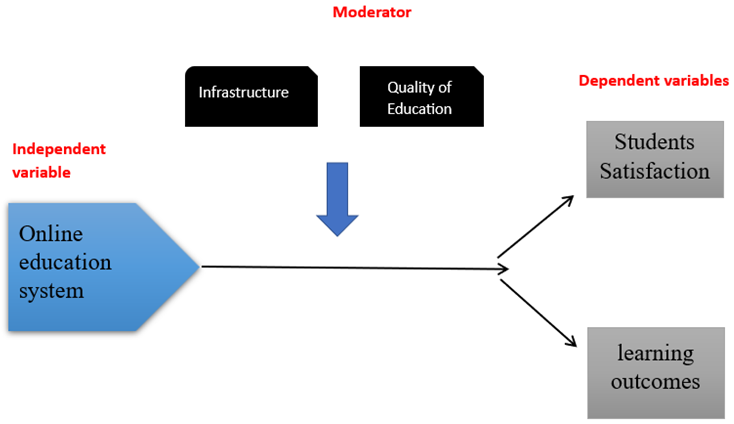
Online education relies on several variables, with student satisfaction and learning outcomes being the most crucial dependent variables (DVs). When student satisfaction increases, the online education system tends to improve. Similarly, with higher-quality education, learning outcomes also improve naturally. In this context, the online education system is the independent variable (IV), while student satisfaction and learning outcomes depend on its effectiveness.
Moreover, infrastructure acts as a moderator (or catalyst) between the DV and IV. A well-established infrastructure enhances the relationship between the online education system and its dependent variables, resulting in better student satisfaction and improved learning outcomes. Therefore, for the online education system to perform optimally, a strong infrastructure is critical.
Research Approach/Aim
An explanatory approach will be employed in this research. The primary aim is to identify and highlight the challenges faced by students, particularly those from remote areas, in adapting to online learning. Additionally, the research will address the difficulties faced by teachers during the pandemic, including the challenges of educating students through online platforms. Administrative hurdles encountered by educational institutions will also be examined, as well as the teaching and learning experiences of both students and teachers during this period.
The research will gather suggestions from students, teachers, and administrative personnel and convey these insights to relevant authorities. By doing so, the study will offer valuable recommendations for improving the online education system and making it more flexible and effective for both teachers and students. It will also help educational administrators identify the most suitable modern technologies for online exams and learning.
Our research aims to share experiences and exchange best practices among students and educators, ultimately promoting a more effective e-learning environment, which has become a necessity in today’s educational landscape.
Hypotheses
- H1: If the online education system is effective, the level of student satisfaction will be high.
- H2: The quality of the online education system is directly proportional to student learning outcomes.
- H3: The more effective the online education system, the higher the student outcomes will be.
Data Collection and Analysis
The study utilized a semi-structured interview guide to address key aspects of the online education experience. The guide focused on several critical areas: the challenges faced during online learning, participants' perceptions of online education, their stance on whether they favor online learning, their views on the effectiveness of online education as a method of instruction, and their reasons for why online education may not be reliable for students.
Interviews, which lasted between one and one-and-a-half hours, were audiotaped for accuracy. These recordings were subsequently transcribed, and a qualitative thematic analysis was conducted to develop a preliminary coding scheme. This scheme facilitated the systematic identification of analytical patterns and theoretically significant concepts that emerged from the data.
To accommodate participants' linguistic preferences, two out of three interviews with both students and teachers were conducted in Urdu, as they articulated more effectively in this language. All participants were cognitively functional, and transcripts of these interviews were prepared in both English and Urdu to ensure consistency and clarity.
The thematic analysis provided valuable insights into the challenges and perceptions surrounding online education, highlighting both recurring themes and significant concepts relevant to the study.
Challenges Faced During online education:
| CODINGS | THEMES |
| 1: In physical classes, we have face-to-face interaction with students and teachers is better than in online classes. | Perspective about Online classes. |
| 2: They are not in favor of online education. But if a given condition is not suitable for physical classes, then online education is better than nothing. | View about online classes. |
| 3: Online education is not effective. There are two main things in it. We do not have face-to-face interaction. Lack of participation. | Effectiveness of online classes. |
| 4: Teachers can understand the situation easily as compared to the students. | Adaptability. |
| 5:Wi-Fi connection or laptop so in the far-flung areas and government primary schools, where there is a lot of problems regarding internet connectivity then online education will not effective for them. | Lack of infrastructure. |
| 6: If anyone having extra skills like Adobe Photoshop, advanced excel, PowerPoint, and other modern application then he/she can easily work as a freelancer and can earn money online | Technical Skills. |
IN3:
| CODINGS: | THEMES: |
| 1: Online education is quite handy we can get more material and content as compared to psychical classes. | Effectiveness of online education. |
| 2: Online education is transparent and easier for students as compared to physical classes | Reliability. |
| 3: Online education is effective. Because in physical classes we only have classes we don’t have analytical thinking. | Develop critical thinking in online education. |
Results
Analysis of interview transcripts revealed eight main themes.
Theme 1:
Perspective About Online Classes
Different individuals hold varied perceptions of the online education system. In traditional physical classrooms, face-to-face interaction between students and teachers is considered superior to online classes. Many believe there is no adequate substitute for physical classrooms. However, in situations like the Covid-19 pandemic, when in-person learning is not possible, online education serves as a valuable alternative. While online classes have shown effectiveness in universities, they face challenges at the primary school level due to insufficient resources provided by the government.
Theme 2: Opinion about Online Classes
The general consensus among many participants is that they are not in favor of the online education system. A primary concern is the reduced interaction between students and teachers, which negatively impacts socialization and leads to decreased student participation. This lack of engagement is viewed as a significant drawback of online education.
Theme 3: Effectiveness of Online Classes
Online classes are often deemed less effective compared to physical classes. Students frequently encounter issues such as Wi-Fi connectivity problems and inadequate infrastructure. The absence of face-to-face interaction contributes to diminished confidence among students. Additionally, the lack of participation and engagement further exacerbates this issue. While traditional classroom environments offer a rich, multidimensional learning experience, online education tends to provide a more limited perspective. Both students and teachers play crucial roles in overcoming these challenges.
On the other hand, one participant (ST1) expressed a positive view of online education, noting its convenience and the extensive availability of material and content compared to physical classes. They emphasized the need for reforms in the education system, pointing out that the traditional setup is not competitive with more developed countries. For online education to be more effective, access to digital devices is essential. However, in many areas of Pakistan, people lack smartphones and other digital devices, which hampers the efficacy of online learning.
Theme 4: Adaptability
Adaptability to online education is feasible in areas with adequate infrastructure and resources. As a developing nation, Pakistan faces challenges related to the scarcity of resources, which significantly affects the adaptability to online learning. This lack of infrastructure and resources is a major obstacle to the widespread adoption and effectiveness of online education.
Theme 5: Lack of Infrastructure
Infrastructure is crucial for the success of online education. Without essential resources such as smartphones, Wi-Fi connections, or laptops, continuing education online becomes extremely challenging. In remote and far-flung areas, as well as in government primary schools with inadequate internet connectivity, the effectiveness of online education is significantly compromised. The absence of proper infrastructure in these regions makes it difficult for students to access online learning platforms and educational materials, thus hindering their ability to continue their education effectively.
Theme 6: Technical Skills
Technical skills are essential for navigating online education. During the Covid-19 pandemic, various sectors, including education, experienced significant disruptions, particularly in developing countries. In Pakistan, many individuals lacked both the necessary infrastructure and technical skills, making them especially vulnerable to the impacts of the pandemic. For some, online education represents a better alternative than having no education at all. As noted by ST2, who expressed mixed feelings about online learning, “I don’t like this mode of learning.” He emphasized that physical interaction in traditional classrooms is more effective and engaging. In his view, physical classes allow for better use of time and reduce feelings of laziness, which are more prevalent in online settings. Despite his personal preference for physical classes, ST2 acknowledged the necessity of online education during the pandemic, highlighting its role as a crucial but imperfect solution during such unprecedented times.
Theme 7: Development of Critical Thinking in Online Education
One perspective is that online education fosters critical thinking more effectively than traditional classroom settings. According to ST1, online education offers a significant advantage in developing critical thinking skills. Unlike physical classes, where teachers often provide condensed notes and focused material, online learning allows students to explore a broader range of resources. Students can access extensive research materials and information through online platforms, which encourages them to engage in independent research and critical analysis. This expanded access to diverse sources of information enables students to develop a more nuanced and critical approach to learning, making online education a valuable tool for enhancing critical thinking skills.
Theme 8: Reliability of Online Education
Online education is considered a reliable alternative for many students, particularly those in remote or underserved areas, where attending physical classes daily is not feasible. The flexibility of online education addresses several problems inherent in traditional systems, such as overcrowded classrooms and limited course availability. For students who face logistical challenges or lack access to physical educational institutions, online learning provides a viable and accessible solution. It represents a significant shift in contemporary education, offering new opportunities for learning and engagement that were previously unavailable to many. This reliability and adaptability of online education highlight its importance in bridging educational gaps and providing opportunities for a diverse range of learners.
Quantitative Part
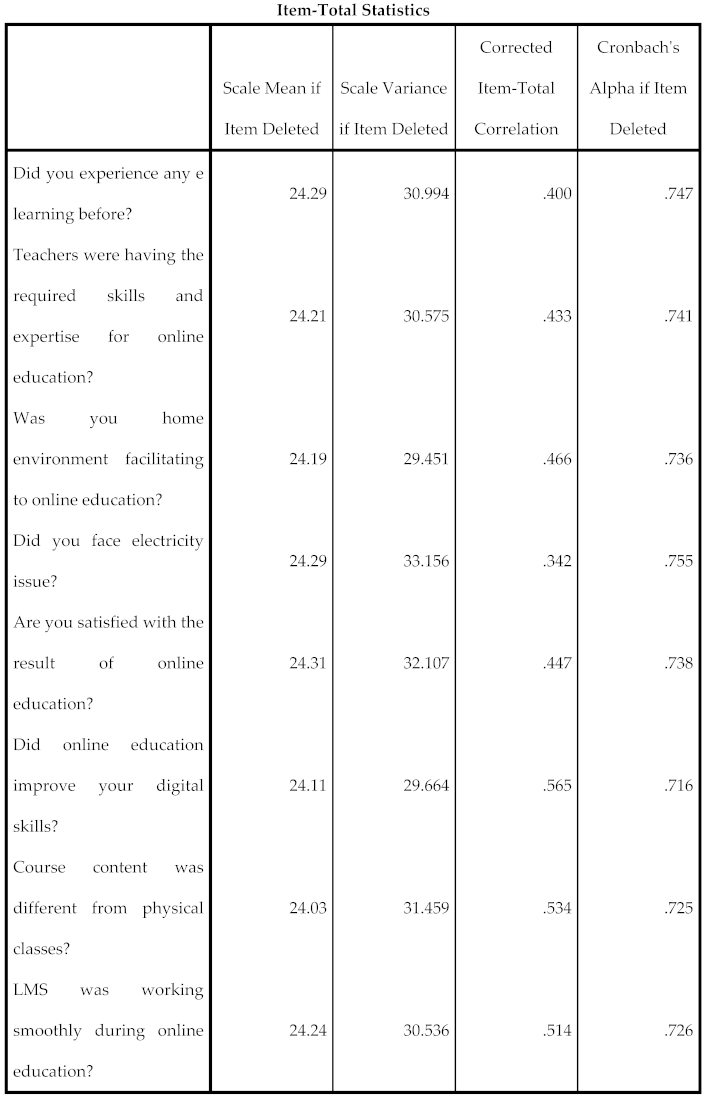
Quantitative was collected through online questionnaires by using sample random sampling. Online questionnaires were distributed among the students of various departments and genuine data was recorded by ensuring confidentiality. The questionnaire consists of two parts the first part was related to demographics and the second part covers the questions regarding the variables. There were 24 questions which measure the dependent and independent variable as well as the demographics. The data was ensured to be reliable before the analysis. The following section will explain the reliability of the data, characteristics of the sample and descriptive statistics followed by correlation analysis. Reliability test: Before running the different tests and analyzing the data, reliability test is applied in order to check the consistency of the data. So Cronbach alpha’s test was applied to check the reliability of the data. It is a test of reliability rather than statistics. There are various viewpoints about the reliability value, but high the value of reliability it means that it measures the construct.
Normally it is said that data having reliability value of 0.7 and greater are considered as good data. The rules for reliability of the Cronbach’s Alpha are: 1. If value is > 0.9 2, it is considered excellent 2. If alpha > 0.8 3, it is deemed good 3. If value is > 0.7 4, it is considered acceptable 4. Questionable if value >0.6.
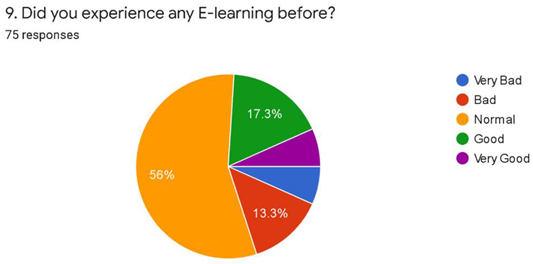
In this question we asked about E leaning was normal. This sample data was collected from different departments of NUML. Most of the data collected from undergrad students. They experienced the online education. 56% responses are Normal, 17.3% are good, and 13.3% responses are against the E-learning.
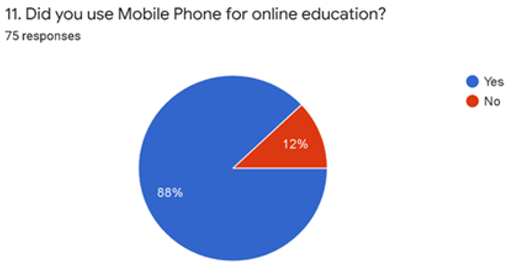
In next question: question about the gadgets used during online education. Mostly students used their own phone. 88% responses are “Yes” and 12% are “No”.
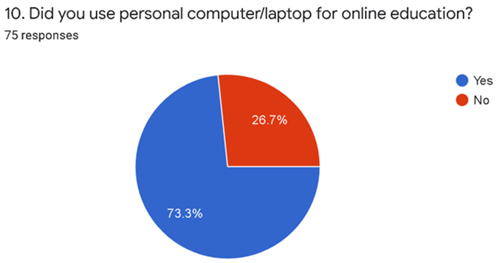
73.3% students were using their own laptop during the Covid pandemic, for online eduaction. There were very little students who were using other laptopts 26.6% .
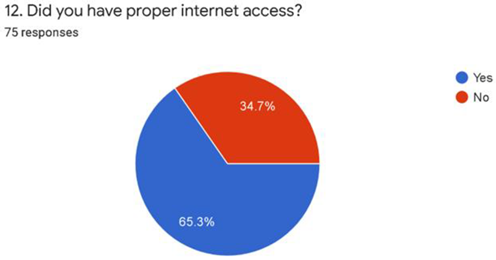
According this question of survey 65.5% are agreed on proper internet access. And 34.4% did not have the proper accessibility of the internet.
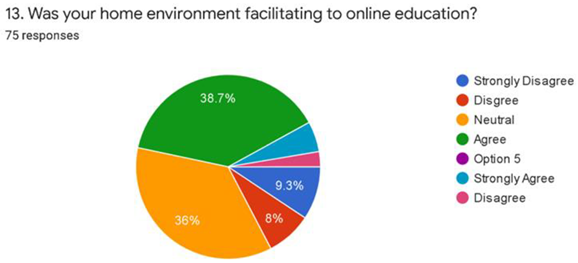
38.7% are strongly agreed about home environment for online class.36% stay nuteral
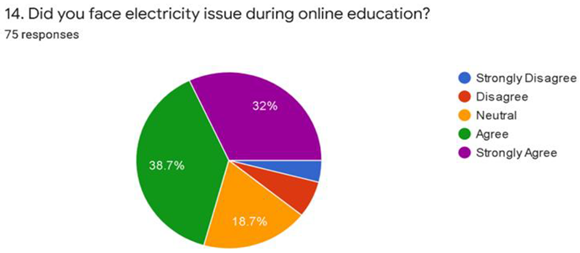
The above result show that 38.7% were facing electric issues in Pakistan and 18% remain nuteral
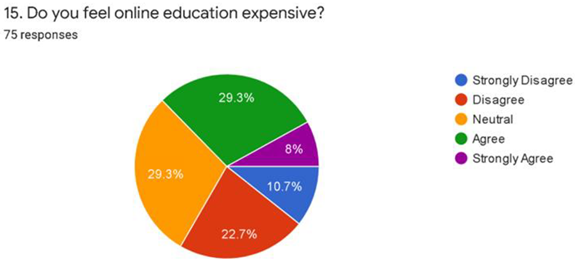
The above result show that 22.7 % did not feel online education expensive and 29.3% feel online education expensive while 29.3 remain nuteral
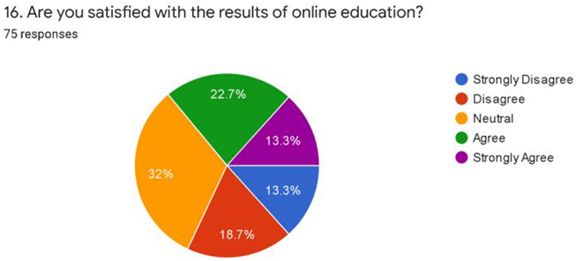
The above result show that 22.7 %agree with the results of online education 18.7%disagree
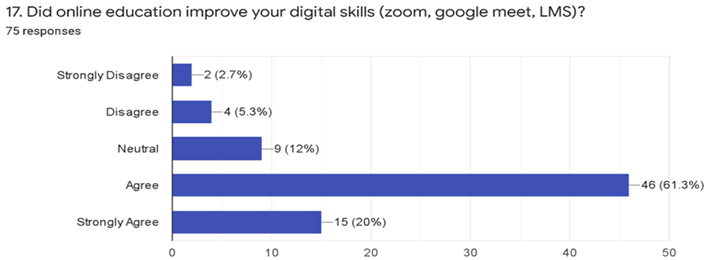
The above result show that 61.3 are agree with that online education improve there digital skills 20% were strongly disagree
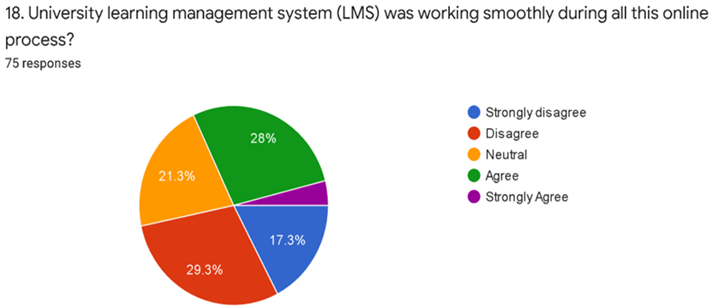
The above result show despict the student view point regarding the university learning management system LMS that is one of the key tool in this online learing when they were asked about either the LMS was working smoothly during online classes to 29.3%disagree with the statement while 21.3% remain nuteral and 28% agree with the statemeent
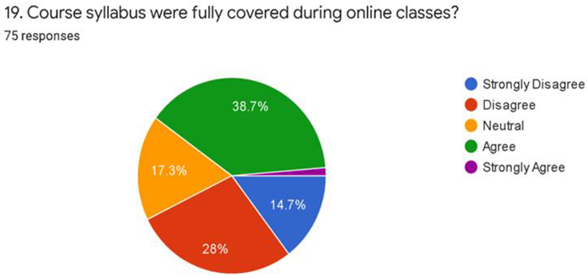
The above result show that the 38.7% agree that the course was fully covered during online classes 28% were disagree with the statement
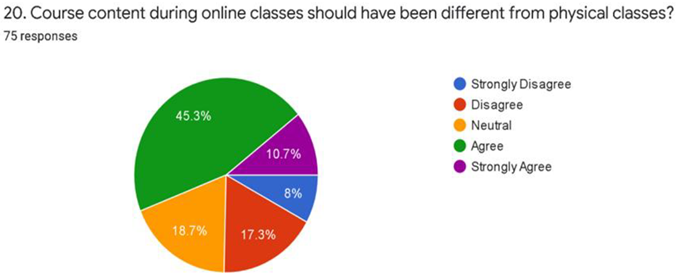
The above results show that 17% disagree with the statement that course content during online classes should have been different from physical classes while 45% agree with the statement and 18 % remain nuteral
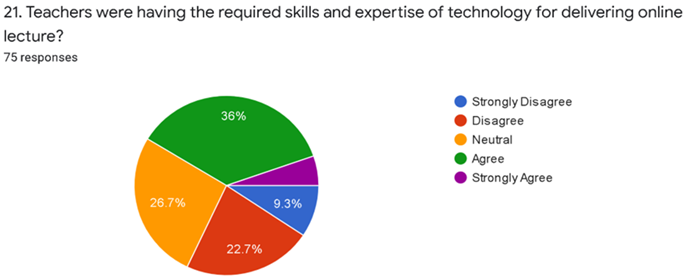
The above table include that 22.7 % student disagree with the statement that the teacher were having the required skills and expertise of technology for delivering online lecture while 36 % agree with the statement
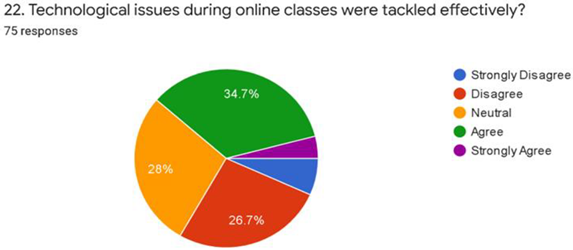
The above table describe that 26.7% disagree with the statement that technological issues were tackle effectively while 34.7% agree with the statement.
Online survey was conducted mostly from NUML. Mostly students were against like “totally disagree”.
This survey is giving clear sign about the online education. Most results received from students were against the online education, including the teachers. According to the teacher’s perspective about online education are, Students did not take classes properly and especially many students faced problems of electricity, internet and mismanagement. The interaction of students during online education with teachers has been totally decreased. Physical classes one major benefit students interacted with each other learn and grow in the midst of diversity.
Reliability Analysis
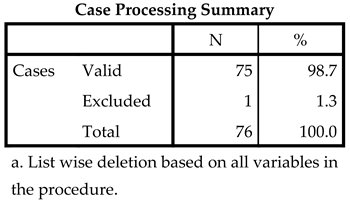
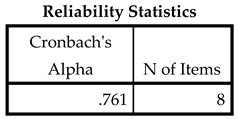
Cronbach’s Alpha
Reliability is .761. Its mean data was reliable enough to work on that. So, we done our further analysis on the research.
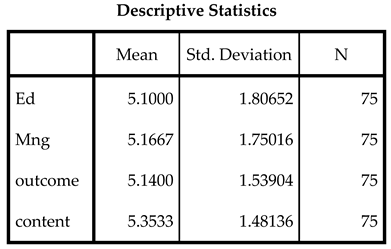
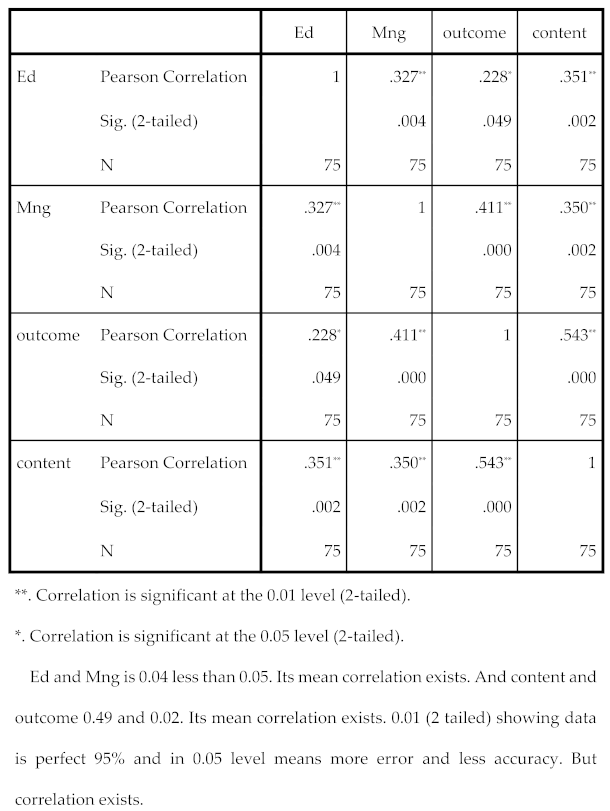
Correlation
Conclusion
The world is continuously advancing, with a significant shift from traditional physical methods to digitalization. As researchers strive to enhance educational systems to make them more reliable and flexible, Pakistan's education system is struggling to keep pace with these global changes. Historically, online learning was a foreign concept in Pakistan, but it has now become a necessity.
Previous research has often overlooked critical issues such as internet connectivity problems, financial constraints, technology access issues, and communication barriers between students, teachers, and administrators in Pakistan. This research aims to address these gaps by emphasizing the importance of good infrastructure, resources, financial stability, and time management for effective online education.
Despite the critical role of online education during the pandemic, many people in Pakistan remain dissatisfied with the current setup. This dissatisfaction is influenced by a lack of infrastructure and resources, which are essential for an effective online learning experience. To match the standards of developed countries, Pakistan requires substantial reforms in its education system.
In developed nations, online education has been established for many years, supported by robust infrastructure and government provision. This has enabled them to adapt more easily to online learning environments. In contrast, many regions in Pakistan still lack basic technological resources, such as smartphones and reliable internet access, which hinders the quality of education during the pandemic.
The role of the government is crucial in addressing these deficiencies. Providing adequate facilities and support to primary schools and ensuring that students have access to the necessary technology is essential for improving the quality of education. Developed countries' success in online education highlights the importance of infrastructure and resource availability.
In summary, the research underscores that good infrastructure, adequate resources, and financial stability are vital for successful online education. Addressing these issues is imperative for improving the online education system in Pakistan. By focusing on these areas, Pakistan can enhance its online education setup to better meet the needs of its students and align with global standards.
References
- Paudel, P. (2021). Online education: Benefits, challenges, and strategies during and after COVID-19 in higher education. International Journal on Studies in Education, 3(2), 70-85.
- Shuey, S. Assessing Online Learning in Higher Education. J. Instr. Deliv. Syst. 2002, 16, 13–18. [Google Scholar]
- Owoc, M. L., Sawicka, A., & Weichbroth, P. (2021). Artificial Intelligence Technologies in Education: Benefits, Challenges, and Strategies of Implementation. arXiv preprint arXiv:2102.09365.
- Mahmood, S. (2021). Instructional strategies for online teaching in COVID-19 pandemic. Human Behavior and Emerging Technologies, 3(1), 199-203. [CrossRef]
- (Nahid Khalil, Itedal Abdulrahim & Rashida Abdulrahim. (2019).
- Koi-Akrofi, G. Y., Owusu-Oware, E., & Tanye, H. CHALLENGES OF DISTANCE, BLENDED, AND ONLINE LEARNING: A LITERATURE-BASED APPROACH. [CrossRef]
- Online Education and the COVID-19 Outbreak: A Case Study of Online Teaching during Lockdown Nastaran Peimani 1,* and Hesam Kamalipour 2. [CrossRef]
- Challenges and opportunities facing e-learning for the higher education sector in pune during covid19 Prof. Vijayashri Machindra Gurme Assistant Professor MIT School of Management, Pune, India.
Disclaimer/Publisher’s Note: The statements, opinions and data contained in all publications are solely those of the individual author(s) and contributor(s) and not of MDPI and/or the editor(s). MDPI and/or the editor(s) disclaim responsibility for any injury to people or property resulting from any ideas, methods, instructions or products referred to in the content. |
© 2024 by the authors. Licensee MDPI, Basel, Switzerland. This article is an open access article distributed under the terms and conditions of the Creative Commons Attribution (CC BY) license (http://creativecommons.org/licenses/by/4.0/).
Copyright: This open access article is published under a Creative Commons CC BY 4.0 license, which permit the free download, distribution, and reuse, provided that the author and preprint are cited in any reuse.