

Submitted:
18 September 2024
Posted:
18 September 2024
Read the latest preprint version here
Abstract
Timor-Leste, since its independence in 2002, has faced challenges in managing the growing number of civil servants, currently numbering over 13,000. Civil servants are classified under two regimes: General (GCR) and Special (SCR). This classification leads to disparities in salary, benefits, promotions, and performance evaluations, creating dissatisfaction among employees in both regimes. GCR employees enjoy regular salary increases and promotions based on performance, whereas SCR employees, despite earning higher salaries, do not receive the same opportunities for career advancement. This policy paper analyses these differences and recommends abolishing the dual regime structure. It proposes a unified system where salary progression, benefits, and promotions are based on education level, service length, and performance evaluations. Additional allowances should be provided to those working in rural areas to encourage retention and equitable service delivery. Regular external monitoring and audits are essential for effective performance management. Evidence from Indonesia supports these recommendations, showing that additional allowances and strong leadership improve employee performance and discipline.
Keywords:
performance management
; public management
; public policy
; civil servant
; Timor-Leste civil servant
I. Introduction
Timor-Leste gained independence in 2002 after achieving self-determination in a 1999 UN referendum. Now, the infrastructure and economic conditions of Timor-Leste have been destroyed. As the government began from scratch, since then, there have always been changes and improvements to regulations and laws for public servants. Every year, there is an increase in the number of civil servants through recruitment by government agencies. Nowadays, there are 13,142 civil servants working in all territories of the country; this has the "special regime." The difference can be seen in salary, work benefits, level advancement, job placement, and promotions. Overall, the "special regime" earns arguably higher salaries than those in the "general regime," even though they are at the same level. However, in the "special regime," they will not receive a promotion or an increase in the level of their performance appraisal, even though they get an excellent evaluation every year. This is different from the "general regime," where they will get an automatic increase in their salary and the opportunity to get promoted in their career if they obtain an excellent result in their performance evaluation two years in a row. This triggers dissatisfaction from both sides, such as when those from the "special regime" work as they please and lack motivation to work hard. This leads to many of them abandoning their jobs in rural areas to work and live in cities. In the "general regime," even though the salary is not as big as in the "special regime," they always have level and salary increases, as well as other benefits. Thus, in this policy paper, this problem will be analyzed, and there will be recommendations of policies that can be implemented by the government to ensure good and equal performance management for Timor-Leste’s civil servants.
resulted in a new problem where the central government finds it difficult to control the performance of these civil servants. Therefore, one of the Civil Servant Commissions’ (CFP) responsibilities is to ensure the registration of the performance evaluation of civil servants in SIGAP and process the step changes and employee progression (CFP, 2021).
There are differences in performance appraisals for civil servants in Timor-Leste that have resulted in dissatisfaction from many parties. In this case, the government, through the CFP, classifies civil servants into two groups, namely, the "general regime" and the "special regime." The difference can be seen in salary, work benefits, level advancement, job placement, and promotions. Overall, the "special regime" earns arguably higher salaries than those in the "general regime," even though they are at the same level. However, in the "special regime," they will not receive a promotion or an increase in the level of their performance appraisal, even though they get an excellent evaluation every year. This is different from the "general regime," where they will get an automatic increase in their salary and the opportunity to get promoted in their career if they obtain an excellent result in their performance evaluation two years in a row. This triggers dissatisfaction from both sides, such as when those from the "special regime" work as they please and lack motivation to work hard. This leads to many of them abandoning their jobs in rural areas to work and live in cities. In the "general regime," even though the salary is not as big as in the "special regime," they always have level and salary increases, as well as other benefits. Thus, in this policy paper, this problem will be analyzed, and there will be recommendations of policies that can be implemented by the government to ensure good and equal performance management for Timor-Leste’s civil servants.
II. Methodology
This policy paper used an in-depth review and secondary data analysis of government reports and publications, especially from Timor-Leste Civil Servant Commissions related to the country’s civil servants’ performance.
III. Policy Context
A. Classification of Civil servant in Timor-Leste
Both permanent and non-permanent civil servants fall under the category of "public servants," having the right to earn significant benefits even after retirement (pensions). While the remuneration structure for permanent civil officials is uniformly controlled throughout all administrative organizations, it varies for non-permanent civil servants and public administration agents depending on the job description, that is determined at the time of recruitment. Therefore, some public servants could be paid more than others.
There are two career classifications for government servants: general career regime (GCR) and special career regime (SCR). GCRs are frequently used to describe public servants who work for ministries in both central and local government. Faculty at National University, as well as nurses, physicians, and other technical experts, are referred to as SCRs. Even in SCR, there is a career route whereby physicians and university professors who have worked in professional jobs like teachers and doctors are really elevated to government officials.
A legislation titled "Regime for the Careers and the Senior and Middle Management Positions in Public Administration No. 27/2008" defines the civil servant remuneration structure in Timor-Leste. The legislation is applicable to SCRs as well; however, the remuneration structure of SCRs is occasionally subject to different regulation depending on professions like those of physicians, elementary and secondary school instructors, and university faculty members. For instance, Timor-Leste National University (UNTL) faculty members are public workers under the Ministry of Education and Culture, although under Article 46 of "Decree Law No. 16/2010 Status of UNTL," they are subject to a separate pay scheme than GCR (INAP & JICA, 2022).
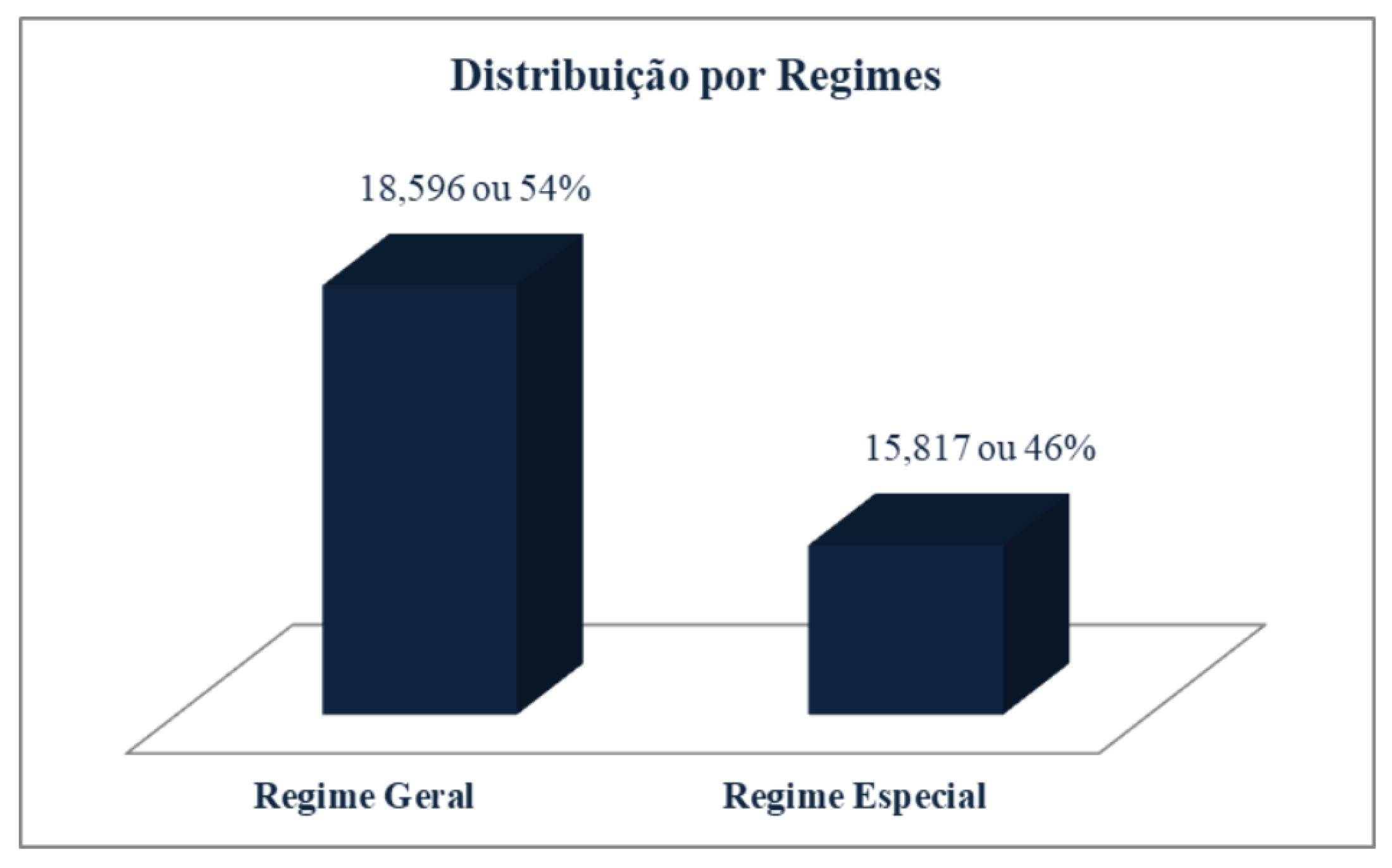
In the graph, there are 34,413 employees that were assigned to GCR and SCR. Employees of the GCR in the Civil Service account for 18,596 (F: 5,937, or 32%; and M: 12,659, or 68%) of the total of 34,413 employees, while those of SCR account for 15,817 (F: 6,324 or 40%; and M: 9,493, or 60%).
Figure 1.
(Graphic source: INAP & JICA, 2022).
B. Performance Management
There are seven grades (from A to G) in the GCRs, which are further split into the four following groups: The highest grades, A and B, are for senior technicians, followed by grades C and D for professional technicians, E for administrative technicians, and F and G for assistants. Grades B and C need bachelor's degrees, while the highest grade, A, requires a master's degree (INAP & JICA, 2022). However, in SCRs specially in the Ministry of Health, they used “Junior” and “Senior” as a grading.
In 2020, the CFP (Civil Servant Commission, in Portuguese) received from 53 state institutions, 12 municipalities, and RAEOA (Autonomous Region of Oecussi) the performance evaluation sheets of the employees of the General Regime. The total is 12,343, with 3003 females and 9,340 males. However, in the submission of the forms, the CFP registered that 94% of the employees had performance evaluations, and 6%, or 504 people, did not (CFP, 2021).
C. Special Regime Workforce
In 2020, the CFP registered the submission of the Work Framework Map of the Special Regime, which totaled 19,588 people, with 8,572 women (44%), and 11,016 men (56%). These totals include personnel with specialized services in the areas of health and education. Although, the total civil servants of the Ministry of Health as of 2020 are 3,895, they are categorized as "special regime."
In the CFP, regarding the Special Regime at the national level, a total of 19,588 vacancies were registered in the Personnel of the Year Map 2020. Of these, there are 44%, or 8,572 for the female gender, and 56%, or 11,016 for the masculine gender. In short, the total number of staff in the two regimes of public administration was 33,321 (INAP & JICA, 2022).
D. Performance Evaluation, Career Path, and Promotion
Timor-Leste’s public servants’ basic wage increases on an increment in a grade's rank and yearly personal evaluations. A civil servant essentially has to do the work that was assigned to them at the time of hiring, but they are free to shift to another department if they want. However, "screening for internal recruiting" must first authorize the move. Another illustration is that when a post at an upper level becomes available, civil servants who want to fill it occasionally quit their existing positions and apply for the position through the "screening for external recruitment" process. A Timor-Leste statute named "Regime for Evaluating the Performance of Civil Workers No. 14/2008" defines the civil servant assessment system.
The IV Constitutional Government issued a regulation titled "Regime for Evaluating the Performance of Civil Servant" in 2008. Performance evaluation also aids in creating the environment needed to encourage greater professional motivation, qualification, and training of human resources. Therefore, performance evaluations are conducted with the intention of enhancing employees' output and helping them reach higher performance levels. The following goals are also pursued through performance evaluation: to inspire government employees and agents; to enhance their professional performance; to promote relationships between managers and their subordinates; to enhance integrated management of human resources; and to advance the provision of high-quality public services (GovTL, 2008).
Performance evaluation, according to article 7, is done on an annual basis between January and February. In Article 11, this performance evaluation is a requirement for obtaining scale or level progression, career promotion, job placement, and the renewal of work contracts. A very good performance assessment rating in two straight years will shorten the two-year lawful advancement term by one year. The evaluation factor in the 13th article is based on the evaluation results, which are: a) very good (33 points or more); b) good (24 to 32 points); c) satisfactory (15 to 23 points); and d) unsatisfactory (up to 14 points). The evaluation is based on criteria such as: (1) sense of responsibility; (2) continuous improvement; (3) relations with coworkers and the public; (4) regularity and assiduity in the workplace; (5) innovation, creativity, and flexibility; (6) initiative and autonomy; (7) teamwork; (8) leadership and team management; and (9) coordination and articulation. Each public servant starts by evaluating themselves based on the assessment criteria and then reporting their findings to their immediate supervisors. However, based on the author's own experience working as a general practitioner in the health sector, there is no self-evaluation from employees, only evaluation by the chiefs or directors. After examining each subordinate's self-evaluation that was provided, the supervisors perform evaluations for each of their reports (GovTL, 2008).
The top assessment point of "Very Good" for two consecutive years qualifies a civil servant for a year-earlier pay rise with an advance in a salary rank to the next level in two years. Salaries typically increase every three years with an increase in the salary rank (INAP & JICA, 2022). However, this type of career path and promotion did not apply to the Special Career Regime (SCR). As stated in the government’s law, the SCR’s civil servants have a fixed and permanent amount of salary and will not be affected by a good performance evaluation. Consequently, there are a lot of social jealousy among civil servants. For example, when doctors who are in a special regime with a slightly higher salary than their colleagues in the general regime work in the administration department at the Ministry of Health, they still receive the salary that has been determined for the special regime. While other civil servants who work there have always received salaries for the general regime. Those GCR will receive a level and salary increase every three years, whereas those in SCR will not. Actually, the President Republic approved a law to remove 13th salary (end of the year bonus) for SCR civil servants. That is why a massive discontent appears on social networks recently (de Deus, 2022).
The Council of Ministers (CoM) adopted the Public Administration Reform Program 2019–2023 in February 2020. All government institutions are now applying compensation and remuneration in line with the new list of remote, very remote, and extremely isolated areas of public service. A total of 1,354 public officers were promoted in the general career regime's first round of merit-based promotions. Out of the 9350 qualified civil servants who took the test, 1354 were promoted. The design of a promotion round for the Special Career Regime did not move forward and will now be dependent upon priorities decided upon under the next government mandate (GfD, 2020).
E. Employee Service Performance Control Management
Within the scope of performance management for human resources, the CFP (Civil Servant Commission) produced some mechanisms in the form of deliberation, decision, and implementation. Guidance and manuals are direct tools for administration institutions and indirect methods of controlling employees and Public Administration Agents in the performance of their duties. However, at the implementation level, the CFP noticed that the managers did not supervise their subordinates as much as possible. The team found that when there is no service description or script, employees do not comply.
Normal working hours for public servants in Timor-Leste are 8 hours (40 hours a week). Despite the fact that there is no control over the attendance list in some cases and even evidence of manipulation in the signature of the attendance list. Therefore, it requires superiors to implement rigorous improvements in the system of control. It was verified in the field that there is still no full control, efficiency, or effectiveness in the service management of civil servants. Even so, it was also observed that there are some practices chosen by the superiors of the municipalities that can be considered "good practices" within the scope of control over service discipline and ensuring employee and agent performance in public administration. In the municipality of Lautém, for example, all employees are required to attend the morning meeting every day (at 8:00 a.m.) to check or confirm the attendance list and receive service instructions. In Manufahi, in the Directorate of Health, the list of doctors who are present at the health posts must have the signatures of the local authority as acknowledgement of their attendance at the workplace.
F. Policy Option for Solution
With the problems that have been described previously, the author suggests not categorizing civil servants into two categories (general and special regime), instead only one category. The basic salary must be determined by a person's education level. Level progression and promotion must also be based on length of service and positive performance evaluations. Subsidies or allowances, such as holiday subsidies, family subsidies, housing subsidies, etc. must be provided. One important point is the implementation of job placement subsidies, where those who work in rural areas receive subsidies or additional salaries to motivate them to work and to motivate other civil servants to move and work there in order to avoid civil servants who run away from their workplaces. Monitoring and auditing by external parties must be carried out regularly. Legal regulations must be strictly enforced for those who leave their workplaces.
IV. Evidence
To confirm the policy proposed previously, the following empirical case study result will serve as evidence to support the proposed policy. The empirical case is "The Effect of Additional Benefits, Leadership, and Work Motivation on Employee’s Performance Through Discipline (Empirical Study on District Social Service Civil Servants of Anambas Islands, Indonesia)" by Dwi Arief Laksono (2017).
The main problem facing the Social Service Department of the Anambas Islands Regency, Riau Archipelago Province, is unsatisfactory performance, even though various ways have been taken to improve it. Thus, this study aims to examine the effect of additional allowances, leadership, and work motivation on employee performance through discipline. The population in this study is 43 employees who were all employees at the Social Service of Anambas Islands Regency.
Giving an award to employees is considered acceptable and can improve employee performance. Awards given can be in the form of praise, financial rewards, or material gifts. In this case, the Anambas Islands Regency Government has also made donations for employee welfare benefits to encourage them to work harder. However, following the reduction of welfare benefits to civil servants at the end of 2014, had an impact on the decline in employee performance (BatamNews.co.id, 28 January 2015).
The author of this research stated the following hypothesis to test:
H1: There is an effect of additional allowances on service discipline.
H2: Leadership has an impact on the discipline.
H3: Work motivation has an effect on discipline.
H4: The discipline has an effect on performance.
H5: There is an effect of additional allowances on employee performance.
H6: Leadership has an impact on performance.
H7: Work motivation has an effect on performance.
H8: There is an effect of additional allowances on employee performance through the discipline of employees.
H9: There is an influence of leadership on employee performance through the discipline of employees.
H10: There is an effect of work motivation on employee performance through the discipline of employees.
Employee performance and discipline were used as dependent variables in this study. While the independent variables are additional benefits, leadership, and work motivation. The total sample consists of 43 employees from different categories. Primary data (questionnaire) is obtained directly in the field by the researcher. The variables in this study were measured on a Likert scale of 1-5, the answer is: a. Strongly Agree score of 5; b. Agree score of 4; c. Neutral score of 3; d. Disagree score of 2; e. Strongly Disagree score of 1.
The result showed that most respondents, employees of the State Civil Apparatus at the Anambas Islands District Social Service of Riau Archipelago Province, rated Additional Allowances in the "good" category (mean 4.14). Most respondents rated employee leadership in the "very good" category (mean 4.21). Of the 43 respondents who became the sample, it is known that most respondents assess employee discipline in the "good" category (mean 3.93). It is known that most respondents assess the performance of civil servants in the "good" category (mean 3.95). Among these four variables, the most noteworthy are: additional benefits have the highest influence on employee performance.
Based on the research findings described in previously, the following conclusions can be drawn from the findings of this study for Anambas Archipelago Social Service employees of the Archipelago Province Riau: additional allowances have proven to have a significant effect on discipline; Leadership is proven to have a significant effect on discipline; Work motivation is proven to have a significant effect on employee discipline; Discipline has been proven to have a significant effect on the performance of department employees; Additional allowances are proven to have a significant effect on performance; Leadership is not proven to have a significant effect on performance; Work motivation is not proven to have a significant effect on employee performance; Employee discipline has been shown to have an impact on employee performance; Leadership is proven to influence employee performance through employee discipline; Work motivation is proven to influence employee performance through employee discipline (Laksono, 2017).
To summarize this empirical case, the study's findings indicate that the variable that has a direct or indirect effect on employee performance is an additional allowance. They can also improve employee performance by paying attention to discipline in government. Good discipline can improve the performance of social service employees in the Archipelago District of Anambas, Riau Archipelago Province (Laksono, 2017).
V. Policy Recommendation
Based on the research evidence collected by Laksono (2017) in Indonesia, it strengthens my recommendation that, in order to improve employees' performance, the government should pay attention to the additional allowances given to employees. Also, improve employee performance by paying attention to discipline in government. Good discipline can improve the performance of employees in Timor-Leste. Performance management for civil servants should apply to all, and it is not recommended that there be a classification of civil servants that results in discrimination between them. There must be a clear mission and goal for all civil servants, so they know they are on the right path. Inspection, monitoring, and auditing must be strictly enforced to control, supervise, and evaluate the performance of civil servants. Remuneration for civil servants must be based on their own good performance. Additional levels, promotions, and salaries must be balanced with their performance. Performance appraisals must also be equal for all civil servants.
VI. Conclusion
With the increasing number of civil servants in Timor-Leste from year to year, as well as the actual regime differences between civil servants, which are divided into general and special regimes, it is difficult to control the performance and evaluation of civil servants. Because of the differences between these two regimes, some parties in each are unmotivated to work harder. Therefore, the authors provide recommendations for the government to prioritize performance appraisal and increase salaries to trigger the spirit of civil servants from both the general and special regimes to work harder. This recommendation also suggests to Timor-Leste's government that it implement only one type of civil servant and provide allowances for them. This recommendation is reinforced by an empirical case from Indonesia, which shows that the effectiveness and performance of civil servants increase when there are additional salaries or financial rewards as well as good leadership for them.
Acknowledgments
This policy paper was written during the author’s study in the field of Public Management & Policy Analysis.
References
- Young, G. O. Synthetic structure of industrial plastics (Book style with paper title and editor). In Plastics, 2nd ed.; Peters, J., Ed.; McGraw-Hill: New York, 1964; vol. 3, pp. 15–64. [Google Scholar]
- Chen, W.-K. Linear Networks and Systems (Book style); Wadsworth: Belmont, CA, 1993; pp. 123–135. [Google Scholar]
- Poor, H. An Introduction to Signal Detection and Estimation; ch. 4; Springer-Verlag: New York, 1985. [Google Scholar]
- Smith, B. An approach to graphs of linear forms (Unpublished work style). unpublished.
- Miller, E. H. A note on reflector arrays (Periodical style—Accepted for publication). IEEE Trans. Antennas Propagat. to be published.
- Wang, J. Fundamentals of erbium-doped fiber amplifiers arrays (Periodical style—Submitted for publication). IEEE J. Quantum Electron. submitted for publication.
Disclaimer/Publisher’s Note: The statements, opinions and data contained in all publications are solely those of the individual author(s) and contributor(s) and not of MDPI and/or the editor(s). MDPI and/or the editor(s) disclaim responsibility for any injury to people or property resulting from any ideas, methods, instructions or products referred to in the content. |
© 2024 by the authors. Licensee MDPI, Basel, Switzerland. This article is an open access article distributed under the terms and conditions of the Creative Commons Attribution (CC BY) license (http://creativecommons.org/licenses/by/4.0/).
Copyright: This open access article is published under a Creative Commons CC BY 4.0 license, which permit the free download, distribution, and reuse, provided that the author and preprint are cited in any reuse.


