
Submitted:
29 August 2024
Posted:
30 August 2024
You are already at the latest version
Abstract
With the rapid advance in quantum computing, quantum security is now an indispensable property for any cryptographic system. In this paper, we study how to prove the security of a complex cryptographic system in the quantum random oracle model. We first give a variant of Zhandry’s compressed quantum random oracle (CStO), called compressed quantum random oracle with adaptive special points (CStOs). Then, we extend the on-line extraction technique of Don et al (EUROCRYPT’22) from CStO to CStOs. We also extend the random experiment technique of Liu and Zhandry (CRYPTO’19) for extracting the CStO query that witnesses the future adversarial output. With these preparations, a systematic security proof in the quantum random oracle model can start with a random CStO experiment (that extracts the witness for the future adversarial output) and then convert this game to one involving CStOs. Next, the on-line extraction technique for CStOs can be applied to extract the witness for any on-line commitment. With this strategy, we give a security proof of our recent compact multi-signature framework that is converted from any weakly secure linear ID scheme. We also prove the quantum security of our recent lattice realization of this linear ID scheme, by iteratively applying the weakly collapsing protocol technique of Liu and Zhandry (CRYPTO 2019). Combining these two results, we obtain the first quantum security proof for a compact multi-signature.
Keywords:
Compressed quantum random oracle
; ring-LWE
; multi-signature
; identification scheme
1. Introduction
A multi-signature scheme allows a group of signers to jointly generate a signature while any subset of them can not represent the group. This mechanism was introduced by Itakura and Nakamura [22] with the motivation to reduce the signature size. In the blockchain application [41], it is also demanded that the aggregated public-key that represents the group should also have a small size, as it will be part of the transaction and the network storage. The blockchain has no control over a user and hence one should be able to freely decide his public-keys. Accordingly, we must make sure that it is secure against a rogue key attack: the attacker might choose his public-key after seeing other signers’ public-keys. In a poorly designed scheme, an attacker could manage to decide the secret key of the aggregated public-key. In addition, with the advance of quantum computer, the quantum attack places a major threat to any cryptographic system. Especially, the RSA based multi-signature (such as [5]) is no longer secure [45]. In this paper, we investigate the multi-signature security in the quantum random oracle model, where the attacker has an internal quantum computer and also can access to the quantum random oracle. We aim to develop quantum random oracle techniques that enable a security proof of a complex cryptographic system. We then apply it to prove the security of our recent compact multi-signature.
1.1. Related Works
A multi-signature scheme [22] is a special case of aggregate signature [8] where each signer of the latter can sign a possibly different message. Since it was introduced by Itakura and Nakamura [22], it has been intensively studied in the literature [2,3,5,7,32,36,38,39,42,46]. However, most of schemes are based on some variants of discrete logarithm assumption which does not hold under a quantum attack [45]. There are multi-signatures that are based on quantum mechanics only (i.e., without a computational hardness assumption) [21,25]. However, their schemes are certainly not what is understood in the crypto community: (1) signers need to share a private key with a trusted party; (2) the verification is completely done by the trusted party; (3) signer has no public-key.
Constructions from lattice assumptions such as (ring-)LWE are potentially the solutions for the quantum secure multi-signature problem. However, currently there are only very few schemes [10,19,26,27,31,37] from this. In addition, some schemes [26,27] are known insecure [23,31]. Schemes [10,14,17–19,23,37] did not consider a quantum attacker. Fukumitsu and Hasegawa [20] is the only previous scheme that considered the quantum security. Their construction is based on Dilithium signature [28]. However, their scheme only allows a constant number of signers and the verification requires all signers’ public-keys. Their proof technique (also that of Dilithium [28]) seems to rely on the statistical lossy property of the underlying ID scheme and is unclear if it can be generally usable in other security analysis. In this paper, we investigate general quantum random oracle techniques that are useful in proving a wide class of random oracle based systems. With this, we prove the quantum security of our recent multi-signature framework [23].
The random oracle basically models a hash function as a completely random function. It was first proposed by Bellare and Rogaway [4]. This methodology has a heuristic assumption: when the random oracle is replaced by a cryptographic hash function, the security will preserve. This generally is not true [11]. However, the counter example does not seem realistic. So the crypto community still widely believes that this methodology is practically meaningful. Furthermore, it greatly simplifies the construction of many cryptographic systems and the proof in the classic random oracle is usually amazingly simple. However, it is not true for the quantum world. The great advantage of a classic random oracle is that the simulator can easily record the attacker’s query history. In the quantum setting, this is difficult as an attacker can query a superposition. If the simulator makes a measurement on the query, it will destroy the quantum state. Zhandry [49] proposed new techniques to record the oracle query which is called compressed random oracle (). Essentially, if the oracle is only queried q times, then the oracle can be compactly represented into a superposition of database with the basis record only containing at most q non-trivial values. Don et al. [15] showed a simulation that can extract an oracle query of a (classic) commitment on the fly. The impact of this feature is that if an adversary outputs a commitment value, we can immediately extract his query input that matches this commitment. This will not destroy the quantum state essentially because when an attacker outputs his classic commitment, he must have already made the measurement. Hence, this gives us a very useful tool, especially when a simulator needs to know the query in order to continue the simulation. However, this is not enough in some proofs. For example, in our multi-signature scheme, the adversary will receive a honest user’s public-key and then generate two public-key . At the end, he will try to forge a signature w.r.t. a combined public-key that is computed from for and H is the random oracle. The problem is that will reveal only at the end of the game. If the simulator wishes to know it in advance, it is impossible using the techniques in [15]. Liu and Zhandry [30] presented a measurement technique to extract during the game involving . Essentially, it chooses a random query and measures it. Then, the outcome is for some i with a good probability. Further, the adversary success probability for the forgery will be degraded only by a polynomial fraction. For technique reasons, it is desired that the simulator can set the random oracle value of the measure outcome (called special point) to a value of his favorite. To take the advantage of both extraction techniques, one might consider the simulation of [15] with the measurement techniques in [30]. However, there are two issues. First, Some verification measurements in [30] will be done on the random oracle database and hence the extraction theorems in [15] will no longer hold. Second, the special input measurement [30] is operated only once. This sometimes is insufficient to produce a witness for the final adversary output. Our work in this paper is to propose an improved that addresses the two issues and then apply the improved random oracle techniques to prove the security of our recent compact multi-signature scheme [23].
1.2. Contribution
In this paper, we study how to improve so that it still has a simulator (similar to [15]) that allows to extract a query input of any given commitment on the fly but additionally also allows to adaptively specify a small number of special points and set their random oracle values to our own choices. The improved random oracle is called compressed random oracle with adaptive special points (). We generalize the simulator and extraction theorem in [15] to the setting. We also generalize the experiment sampling technique in [30] to allow samplings for several times. This allows us to extract the witness of the final adversary output, where this witness might depend on several random oracle queries (that are measured during the game). This random experiment can be easily converted to an interaction with oracle and hence the foregoing on-line extraction technique can be applied. With this improved random oracle technique, we show that our recent multi-signature framework (which is converted from any weakly secure linear identification) is provably secure in the quantum random oracle model. The proof strategy is to use the sequence of game technique. It starts the adversary with a standard quantum random oracle and then continues with the compressed quantum random oracle (CStO) while preserving the same adversary success probability. It next applies the random experiment sampling techniques which degrades the adversary success only by a polynomial fraction but it can extract the witness for the final adversary output. Then, we convert the random experiment (with ) to one involving . Finally, the online extraction technique is used to simulate the interaction without the knowledge of the secret of an ID scheme. This allows to reduce the adversary success to the security of the ID scheme. We also prove the quantum security of the JAK ID scheme in [23]. The main tool to achieve this is to use the collapsing sigma protocol technique in [30] that was originally proposed by Unruh [47]. Our security proof essentially is to formulate the JAK ID security game into two public-coin protocols, each of which uses the collapsing property to guarantee the non-negligibility of the adversary success probability. This two-step analysis allows us to reduce the adversary success probability in attacking the JAK ID scheme to break the underlying ring-SIS assumption.
2. Preliminaries
Notations. We will use the following notations.
- samples x uniformly random from a set S.
- For a randomized algorithm A, denotes the output of A with input x and randomness r, while denotes the random output (with unspecified randomness).
- Min-entropy .
- A concatenating with B is represented by and also by (if the context is clear).
- negl is negligible: for any polynomial
- denotes set
- is the Euclidean norm:
- denotes the set of vector . We use to denote
2.1. Ring and Module
In this section, we review math concepts: ring and module (for details, see [29]). A ring A is a set, associated with multiplication and addition operators, respectively written as a product and a sum, satisfying the following conditions:
- -
- R-1. A is a commutative group under addition operator + with identity element 0.
- -
- R-2. A is associative under multiplication operator: for , (ab)c=a(bc). Also, it has a unit element 1: 1a=a.
- -
- R-3. It satisfies the distributive law: for , and
In this paper, we only consider a commutative ring: if , then . When we say ring, it always means a commutative ring. If A is a commutative ring with and every non-zero element in A has an inverse, then A is a field.
Definition 1.
Let R be a ring. An Abelian group M (with group operator ⊞) is a R-module , if (1) it has defined a multiplication operator • between R and M: for any , ; (2) the following conditions are satisfied: for any and ,
- 1.
- ;
- 2.
- 3.
- 4.
- , where is the multiplicative identity of R.
Note that if R is a field, then R-module M in fact is the well-understood concept - vector space, where M consists of vectors and R is the coefficient field.
2.2. Elements in Quantum Computing
In this section, we give a brief introduction to quantum computing. Details can be found in [43]. A quantum system is a finite-dimensional complex Hilbert space with an inner product . We use standard bra-ket notations to denote vectors in and its dual space. The state of a quantum system is a unit vector . Let be a finite Abelian group. We use to represent an orthonormal basis for . We also write this as to emphasize that is expanded by . For two quantum systems and , the joint system is a tensor product . For and , their product state is For an ordered set , represents the tensor product of copies of with the ith copy labeled by A quantum system has an orthonormal basis . With this, a quantum state can be represented as with Quantum operations on consist of unitaries and measurements. A unitary U on is an operator from to with , where is the conjugate of U. Measurement on a quantum state is the operator for extracting the classic information from , where each must be Hermitian (i.e., ) and satisfies the completeness condition After the measurement, the post-measurement state will be , which occurs with probability . A quantum algorithm A is represented by a list of unitaries/measurements. Due to deferred measurement principle [43, pp. 186], the measurement can be deferred to the end of operations of A. Hence, whenever applicable, we assume that A before the final measurement is represented by a list of unitaries
Let denote the linear operator from to . For , their commuter is defined as The norm of linear operator A on is defined as , where goes over all the possible unit vectors in By the singular value decomposition theorem, we can write , where and are respectively a set of orthonormal vectors in and is the set of positive singular values of A. Hence, . The trace distance between two states is defined as where .
2.3. Multi-Signature
In this section, we introduce the multi-signature and its security model. A multi-signature scheme is a protocol that allows a group of signers to jointly generate a signature. The signature should be valid against an aggregated public-key determined from all signers’ public-keys. The protocol proceeds in rounds. Signers are pair-wise connected but the channel is not secure. The target is to generate a short signature. It is desired that the aggregated public-key should be short too.
Definition 2.
A multi-signature scheme is a quadruple of algorithms (Setup, KeyGen, Sign, Verify), described as follows.
Setup. Given , it generates a system parameter param. Note: param should be part of the input for KeyGen, Sign, Verify. But we usually omit it for brevity.
KeyGen. It takes param as input and generates a private key and a public-key .
Sign. Given public-keys and a message user i has the private key w.r.t. . Then, they interact with each other and finally output a signature σ, with respect to an aggregated public-key , where F is called an aggregation function.
Verify. Upon and an aggregated public-key , verifier outputs either 1 (for accept) or 0 (for reject).
Remark 1.
The aggregated key carries the information of the signers’ public-keys. It is desired that it has a size independent of n. But this is not enforced in the definition.
2.3.1. Security Model
In the following, we define the existential unforgeability of a multi-signature in the quantum random oracle model. Essentially, it says that no quantum adversary can forge a valid signature on a new message as long as the signing group contains an honest member. Toward this, the attacker can access to a signing oracle and quantum random oracle and create fake public-keys at will. The security is defined through a game between a challenger and a quantum attacker that has oracle access to quantum random oracle maintained by CHAL.
Initially, CHAL generates param and a challenge public-key with a private key . It then provides to who has an initial state , where represents query register, response register and working register respectively. Next, interacts with CHAL through signing oracle and random oracle and finally generates a forgery.
Sign. Here is a set of distinct public-keys with . Upon this query, CHAL represents the signer of and represents signers of to run the signing protocol on message M. Finally, it outputs the multi-signature (if it succeeds) or ⊥ (if it fails).
RO. can query random oracle by providing his registers to who applies on so that where H is the random function and D is the random oracle register. Finally, it returns registers back to . See Section 4.1 for details.
Forgery. Finally, outputs a signature for a message , w.r.t. a set of distinct public-keys s.t. for some i. succeeds if (a) and (b) was not issued to oracle. Denote a success forgery event by .
Definition 3.
A multi-signature scheme (Setup, KeyGen, Sign, Verify) is existentially unforgeable against chosen message attack (or EU-CMA for short) in the quantum random oracle model, if the following holds.
- Correctness.For generated by KeyGen, the signature generated by signing algorithm on a message M will pass the verification, except for a negligible probability.
- Existential Unforgeability.For any quantum polynomial time adversary in the above forgery game, is negligible.
2.4. Canonical Linear Identification
A canonical identification system is a 3-round public coin protocol where the first round message has a super logarithmic min-entropy. It is formally defined as follows (also see Figure 1).
Definition 4.
A canonical identification scheme with parameter is a quadruple of algorithms , where Setup takes security parameter λ as input and generates a system parameter param; KeyGen is a key generation algorithm that takes as input and outputs a public key and a private key ; P is an algorithm, executed by prover; is an algorithm parameterized by τ, executed by Verifier. is a three-round protocol, where Prover starts with a committing message with , and then Verifier replies with a challenge and finally Prover finishes with a response which will be either rejected or accepted by .
The domains of , , CMT, Rsp are respectively denoted by We are interested in a canonical ID scheme with linearity [23] and simulability in the following sense.
Linearity. A canonical ID scheme is linear if it satisfies the following conditions.
- i.
- are -modules for some ring with (as a set);
- ii.
-
For any and public/private pairs (), we have that is a private key of .Note: Operator • between and (resp. ) might be different. But we will use the same symbol • as long as it is clear from the context.
- iii.
-
Let and for If is a faithfully generated transcript of the ID scheme w.r.t. , thenwhere and .Note: we require Equation (1) to hold only if the keys and transcripts are faithfully generated. If some are contributed by attacker, this equality might fail.
Simulability. is simulatable if there exists a polynomial time algorithm SIM s.t. for , and , it holds that is indistinguishable from a real transcript, even if the quantum distinguisher is given and has access to oracle , where acts as follows: ; ; ; output
Now we define the security for a linear ID scheme. Essentially, it is desired that an attacker is unable to impersonate a prover w.r.t. an aggregated public-key, where at least one of the participating public-keys is not generated by attacker. Here we use the aggregated public-key as the challenge public-key in order to relate it to the security of the multi-signature later.
Definition 5.
A canonical identification scheme with linearity and is secure if it satisfies correctness and security below.
Correctness. When no attack presents, Prover will convince Verifier.
Soundness. For any quantum polynomial time algorithm , is negligible, where is defined below with for and .
Experiment
param;
;
;
; ;
;
output
3. Basic Properties in Quantum Computing
In this section, we give some fundamental properties in quantum computing. The first result is trivial and can be verified by simple calculations. We thus state it without a proof.
Lemma 1.
Let Then, the following holds.
- 1.
- ;
- 2.
- 3.
The next lemma was stated in [15] with a proof omitted. We give a proof for completeness.
Lemma 2.
Let Then, the following holds.
- 1.
- If , then
- 2.
- If and , then Especially, if , then
Proof. 1. Let and for with and unitary . Then, Hence, as and are unitary.
2. By the singular value decomposition theorem, we can write and , where are respectively orthonormal sets of vectors in and . Then, from , we have As , we know that for and Similarly, from , we have Hence, are disjoint and together orthonormal states. They together can be extended to an orthonormal basis. Let be any normalized state represented under this basis with coordinate vector Then, Its norm is upper bounded by desired! This result implies the second claim as for any □
Definition 6.
Register D is a control register for operator B which works on registers , if B can be written as for an orthonormal basis , where works on W.
Remark 2.
This definition is very loose. If B does not operate on D, by default, it is understood as for a basis and so D is a control register for B. The following lemma is shown by simple verifications.
Lemma 3.
Let be three quantum registers. The following properties hold.
- 1.
- If A operates on while B operates on with D being a control register in the same basis for both A and B, then
- 2.
- If A is a projector on D in basis and B operates on with D being a control register in the same basis, then
Lemma 4.
Let be a joint state for register with orthonormal basis of register Y. Let be the projective measurement on register Y. Let be the measurement on register X. Let be a unitary on register X, labelled with . Consider procedure A: apply to and then apply measurement Q on X to output x. Also consider procedure which starts with measurement P on Y and continues with procedure A with the final output denoted by . Then, the distributions of x and are identical.
Proof. Procedure A outputs x with probability The procedure outputs y, resulting in the collapsed state with probability . Following the measurement Q, it outputs x with probability . So the overall probability to output x with probability as is orthogonal, desired. □
Remark 3.
There are two points to clarify.
(1) In Lemma 4, it is important that projective measurement uses the same basis as as in . That is, the unitary needs to use register Y as a control register in the basis of the projective measurement P. Otherwise, the result will be incorrect. For example, let where and Define and Let on register X and but on register Y. Let . Then, for procedure A, the state before measurement Q is and hence the outcome of Q is 1 with probability 1. But procedure , after measurement P, the state is or , each with probability 1/2. Since and , after applying U, the result is (± depending 1 or 0 on Y register) and next the measurement Q on register X gives the outcome 1 with probability This is different from the procedure A.
(2) This counter example can also be regarded as the evidence that starting with a different projective measurement on the same register will result in a different final output distribution. Indeed, Procedure A in our example can also be regarded as starting with a projective measurement as it does not change , while procedure remains unchanged (starting with measurement P). But x and are distributed differently.
Summarizing the example, if we insert a measurement into the quantum algorithm, the output could be disturbed. But the following result states that the probabilities w/o a measurement are actually related. This result was given by Boneh and Zhandry [9] but it seems only valid for the case where M is a projective (instead of general) measurement.
Lemma 5.
Let A be a quantum algorithm and be the probability that A outputs x. Let be the algorithm that runs A till some stage and then performs a projective measurement M which gives an outcome m (out of k possible choices) and next continues the execution of A with post-measurement state. Let be the probability that outputs x. Then,
Proof. Let be the measurement. Let be the state right before this measurement. Then, the probability of partial measurement outcome m occurs with probability and the post-measurement has the state By deferred measurement principle, we can assume that A after this consists of a unitary U and a final projective measurement be the final measurement. Then
where the inequality follows from Cauchy-Schwarz inequality and Equation (4) uses the fact that M is the projective measurement so . □
Lemma 6.
Let be two states for a quantum system.
Proof. Let and take as a unit orthogonal state of so that with , by absorbing the complex unit factor (if any) into where is a complex unit factor. By calculation, On the other hand, Since the result follows. □
The following property states that an intermediate measurement by a quantum algorithm is not necessary (in the sense that we can replace it with a certain unitary) if we are only concerned with the final output. This is essentially the deferred measurement principle [43].
Lemma 7.
Let be a quantum state. We apply the following operators on register A: first a unitary U, then a measurement that results in y, next a unitary and finally a measurement that results in x. Then, there exist a unitary W on A and additional registers and a projective measurement P on C that results x with the same probability.
Proof. It can be seen that the original procedure outputs x with probability Then, define a unitary operator so that ([43]). Also define unitary V on with Also define unitary so that Finally, define P to be the projective measurement Then, consider followed by P on C. Then, the probability of outcome x, by first applying , followed by measurement P on C, is
Remark 4.
In this lemma, register B is a control register in the basis for other operators; register C is a control register in the basis for other operators. Hence, the projective measurement on B commutes with other operators and so can be moved to the end of the operations (especially, after measurement P on C) and hence does not affect the distribution of outcome x of P, and hence it can be removed. This justifies the proof idea of the above lemma. With this in mind, the following generalization corollary of the lemma is straightforward.
Corollary 1.
Let be a quantum state of register A. For , run a unitary measurement that results in , followed by unitary , where represents the sequence . Finally, it applies measurement that results in x. Then, there is unitary W and projective measurement P that applies to the initial state and results in x with the same probability.
4. Quantum Random Oracle
In this section, we will introduce the quantum random oracle. We use bold font to represent the random oracle (e.g., ) and the italic font (e.g., ) to represent the operator for the random oracle query. We distinguish an oracle and its operator because some oracle could offer more operators.
4.1. Standard Random Oracle
In the random oracle model, a cryptographic hash function is treated as an external oracle so that whenever one needs to compute , he queries x to this oracle and receives . We assume has a finite bit-length. The oracle uses a random function from to to answer the queries. Let be an ordered set with Function H can be represented by its truth table . In the quantum random oracle model, H is represented by state (using its truth table). An algorithm can query a superposition to random oracle . For query , maps to .
The standard random oracle has an initial state in a uniform superposition For query , maps to . Notice that can be obtained from by starting with a projective measurement on oracle register (resulting in ). Even though and are different, no adversary can distinguish them. This can be seen from Lemma 3(2) by observing that oracle register is a control register in the computational basis for adversarial operators (which do not operate on oracle register) and . Hence, the projective measurement on oracle register can be moved to after makes the final measurement.
Fact 1.
Let be a quantum algorithm with oracle access to the quantum random oracle. Then, .
4.2. Compressed Random Oracle
The compressed random oracle was introduced in [49] and our exposition mainly follows [15]. It is a powerful tool for security proof in the quantum random oracle model (QROM). Let and . Let H be the quantum Walsh-Hadamard transform over . Define for . Since is orthonormal and , is orthonormal either. Then, we define an unitary operator F over such that
It is Hermitian (i.e., ) because Further, notice that This implies that
We consider the multi-register for the random oracle, where has a state space , spanned by the computational basis The initial state of D is . We assume that the adversary has a query register X, response register Y and a work register To query the oracle, adversary provides registers to oracle who then applies unitary
on , where and Then, the following result holds. It must be pointed out that the result holds only if no operator other than (resp. ) is applied on D; otherwise, the result might fail.
Lemma 8.
[49] Let be a quantum algorithm with oracle access to the quantum random oracle. Then,
4.3. Compressed Random Oracle with Adaptive Special Points
Compressed random oracle with adaptive special points (denoted by ) is a natural generalization of . Liu and Zhandry [30] briefly introduced CStO with non-adaptive special points. But we believe that (which has adaptive special points) is very useful in applications. It allows to register special points on the fly. In fact, it seems the Fiat-Shamir based signature proof in [30] also seems to require this adaptivity as the adversary’s signing query can not be guessed or predicted before the query. The oracle has the initial state We maintain two initially empty set and to record the special points at different stages. We also allow the oracle to abort after certain measurements and the motivation will be discussed later. The oracle can be accessed through three types of queries below.
- PointReg0 Query. One can send a new point to oracle. If , it does nothing; otherwise, the oracle updates
-
Random Oracle Query. One can issue a random oracle query by providing a query register X and a response register Y to oracle. If this is the ith random oracle query, the oracle applies a projective measurement in the computational basis to oracle register ( can be determined by i and some parameters that are determined before the oracle starts). If the outcome is 1, it aborts; otherwise, it applies to registers, whereFinally, it returns register .
- PointReg1 Query. One can send to oracle. If , it does nothing. Otherwise, it measures with , where . If the outcome is 1, it aborts; otherwise, it updates with for a random (this can be done as is now classic; or, we can apply unitary ). Finally, it updates and
Remark 5.
It is time to justify this strange random oracle. It is in fact motivated by the requirements in the security proof. The main motivation is to find a modified random oracle so that the randomly sampled experiment (with ) in Section 5 can be easily converted into a game with this modified random oracle. The idea is that we want to define some special points and set their random oracle values to our own choices, just as I can do in the classical random oracle.
- In the classic random oracle, a simulator can set the random oracle values of special queries to his own choices. In the , a special point will be first recorded in and later set to a planned value (when a PointReg1 query on this point is issued). We handle special points in two stages for technical reasons (See the remark after Theorem 5) only. Essentially, if we define the random oracle value of a special point early (e.g., at the time of adding into ), it could make the previously selected experiment change to a different one.
- is to formulate the selected experiment in Section 5 as a well-defined random oracle model. Especially, measurement in a random oracle query is to make sure the interaction with oracle follows the restriction of the selected experiment. If the measurement outcome is 1, it indicates that the game is not consistent with the selected experiment and hence it can stop now; otherwise, it continues. This randomly selected but consistent experiment can guarantee the adversary to have a good success probability, compared with the original game.
- In the classic random oracle, a simulator can pay attention to each query to make sure that each special point is not queried before it is set to the designated value. In the quantum setting, recording each query is difficult as one can query which indicates that every x is actually queried. To overcome this, we need to confirm that is not defined by measurement Π on . If measurement is successful, then will have now and non-⊥ components in the superposition are pruned and we can define the random oracle value for this x; if the measurement fails, we have no way to set the random oracle value for x and so abort.
We define to be a variant of so that in the random oracle query is replaced by and also in PointReg1 query, in case the measurement outcome 0, it leaves as it is (instead of replacing it by ). Essentially, is the same as , except it applies and measurements on D. The following lemma shows that is perfectly indistinguishable from , conditional on that the abort event in the oracle does not occur.
Lemma 9.
Let be a quantum algorithm with access to quantum random oracle and be the oracle abortion event. Then,
Proof. We use the hybrid argument with a variant of to bridge and .
Oracle . We modify to so that upon PointReg1 query x with measured with outcome 0 (i.e., ), it updates to (instead of for a random r), where (which is well defined as ) is the vector with at index and r at index x. Notice that right after this, . Further, for this x is a control register (Def. 6) in the computational basis for adversary operations, and . To see this, it suffices to check only as other cases are clear (e.g., for does not operate on at all). Since , we know that which obviously can be written as a format of . Further, is obtained from by projective measurement on in the computational basis for every (right after x is put in ). By Lemma 3(2), the projective measurement on can be moved to the end of the interaction (after outputs). Thus, the output of with access to is the same as with access to .
Oracle . We show that under the event , if the final (unnormalized) state after interacting with is , then the final state (unnormalized) after interacting with will be This can be shown by induction on the query. It is correct initially, as initially and hence is identity. Then, if it is correct after query , consider query Before query i, will operate on registers (for simplicity, assume it is a unitary). But since adversary does not operate on D, if the state right before query i (when interacting with ) is , then the state right before query i (when interacting with ) will be .
If query i is a PointReg0 query, then the claim still holds after the query as no operation on the quantum state is executed.
If query i is a PointReg1 query x, then it suffices to consider . Since and the outcome of is 0 (otherwise, occurs, contradiction to the probability condition) so x will be added to , the conclusion holds after the query as (while, after the query, in case of will have and in case of will ).
If query i is a random oracle query, we show that the induction still holds. First, for both as only operates on register . Thus, after the measurement (with the same outcome), the relation still holds. Second, the relation still holds after operator (in case of ) and operator (in case of ): for query with , both oracles use to respond and hence their states after the query maintain the same relation (as is untouched); for query with , uses and uses but two applications of in will cancel out. So after the query the relation still holds. The induction holds too.
Let be the final unnormalized state under and the final measurement of be with corresponding to outcome 1. Then, is , while is . However, as commute with (since they operate on disjoint registers) and . □
The following lemma essentially states that if has large min-entropy and we measure of the adversary-oracle joint state, then, with high probability, the post-measurement state with outcome ⊥ is close to the original state.
Lemma 10.
Let the current adversary-oracle joint state be after q queries to (or CStO ). Let and is a random variable over with min-entropy at least μ. Then, with probability (over ), .
Proof. Let Then, Consider . Let be the number of x so that in . Then, given , appears in for exactly possible x’s. Thus, Since each in has at most q possible non-⊥ entries, it follows that and hence Hence, there are at most choices for x so that Since has min-entropy , we have that with probability at least . The lemma follows. □
4.4. Measurement
Let be a fixed and efficiently verifiable relation with if and only if . Especially, for any . We assume that and so . Further, as . Let We define function so that
where is an ordered set with In other words, is the smallest so that It is easy to verify that
Here we emphasize that we do not require itself to be a group but we implicitly assume that it can be regarded as a subset of an Abelian group (e.g., can be regarded as a subset of ). Next, we define to be a unitary on for register so that
where . Let
Notice that our is an alternative specification but identical to in [15]. The following lemma was proved in [15] (we can obtain the same bound by a proof for our specification).
Lemma 11.
For any ,
Lemma 12.
Proof. It can be seen that and also that . Therefore, D is a control register for and in the computational basis. By Lemma 3(1), they commute. □
Theorem 1.
Proof. Notice that and for , . Hence, by Lemma 12, where we also use By Lemma 1(3) and Lemma 2(2),
By Lemma 11 and Lemma 12, the result follows. □
4.5. Bounding the Probability for Relation Search through Oracle Queries
We are interested in finding an entry for some x in the oracle (through oracle queries) so that for a relation R. The following lemma upper bounds the probability for this. The proof idea is that can be detected by applying and measuring P register with outcome If we apply and measure P at the beginning of the interaction, then because the initial oracle state is dummy. Hence, the success probability with at the end of interaction, is bounded by the squared norm of the commuter of operators (throughout the interaction) with .
Lemma 13.
Let be a quantum algorithm with access to , incurring random oracle queries and PointReg1 queries. The final state goes through of relation R and a projective measurement on register P in the computational basis with outcome . Then,
Proof. Let be the initial state of with registers . The joint initial state with oracle is then (after register P added). Then, has access to , incurring random oracle queries with intermediate operator , where, for simplicity, we assume that remains unchanged throughout the game. Finally, oracle applies on and projective measurement on P, outputting the outcome . The final state before measurement is for some L, where is PointReg0 query or PointReg1 query or random oracle query. If the query is PointReg0, it does not operate on the state and so commutes with ; if it is PointReg1, then we only consider the case . Under , it consists of projector and for uniformly random r over . We notice that . Further, it is not hard to verify that in PointReg1 commutes with if (as ). If it is a random oracle query, we notice that as D is control register for both and in the computational basis. Therefore,
where the last inequality follows from the calculation with the observation: is the result of Bernouli trial with probability for times; ; and . The lemma follows. □
4.6. Simulating with Extraction
In this section, we adapt the simulation of with the extraction capability in [15] to the setting. Essentially, the simulator simulates the oracle and also provides an interface for extracting the attacker’s oracle query x that, together with y in , is a witness of a target “commitment”. Let be an arbitrary but fixed function from to For , define relation and denotes unitary . Then, the simulator is described in Figure 2.
In the following, we prove that if uses x and to generate t, then the extracted from will equal to x. This is useful in a security proof where an attacker generates an output and we need to find out the witness of this output. We first prove a weaker version of this: if is extracted at the end of game, the claim is true. Then, we extend to the case that is extracted on-the-fly (i.e., right after outputs t).
4.6.1. Extraction at the End of Game
We begin with a collision event in a computational basis in the oracle state w.r.t. a function f in the sense that for some . We give a result which says that after q oracle queries, the probability of collision in the oracle is small. It is extended from [49] in the setting of to (see Appendix C for details).
Lemma 14.
Let . Then, for any quantum algorithm with access to , incurring q oracle queries of either PointReg1 or random oracle,
where is the collision event in the final state and .
Now we give an extraction theorem, where is extracted at the end of oracle access. It states that if attacker computes t from x so that , then at the end of game will most likely have . The idea is as follows. Assume . After attacker’s oracle access to , we apply a classical oracle query on x with result . Assume this state (right before ) is . Further, notice that . If in the sum measures with outcome (i.e., after ), then it has a collision (since ). This probability is small (by Lemma 15) and we can ignore it. If for under gives , then must come from . However, is very small. So this is unlikely too. This idea is from [15] in the case and can be generalized to prove a vector case.
Theorem 2.
Consider quantum algorithm with access to (via interfaces other than ), including q random oracle queries or PointReg1 queries and outputting and Let be the output for an additional classical query to and . Then,
Proof. Let the adversary-oracle joint state be after queries to (including q random oracle queries or PointReg1 queries). In the following, we always assume that random oracle query does not abort. Then, measures and outputs . Each is then classically queried to and results in a joint state . We assume that (the other case is similar). Hence, can be written as where is a decomposition of
Finally, it applies the projective measurement in the computational basis on D and applies followed by (projective) measurement on register P as well as measurement to the resulting state (assuming the collision measurement writes the result in a new register C), where is a projection into a space spanned by with satisfying for some and Notice that D is a control register in the computational basis for , and collision measurement, where is the projective measurement on P. Hence, by Lemma 3, they all commute. Hence, both collision probability and will remain the same as the original game. For collision probability, it is the same as we move and to after collision measurement; for , it is similar by keeping while moving other two operators to the end of game. Let be the output 0 of measurement . Notice that
Notice that register in is Since , it follows that under condition, implies that after measurement on P (that results in in the ith component on register P), the post-measurement joint state must have content different from (that is, ). Since has in , this has a probability There are at most ℓ possible i’s. So the first item in Equation (15) is at most . On the other hand, is obtained by measurements. Averaging over the choices of satisfying (due to intermediate measurements) gives . By Lemma 14, . Thus, □
4.6.2. Extraction on the Fly
We have showed the extraction result where the extractions occur only at the end of the game. To be useful, it is expected that we can extract them “on-the-fly" (i.e., right after each commitment is given during the game). In the following, we consider this. The result is extended from [15] from the setting to the setting.
Let us consider a function with some special set so that and . Consider the following games, where is or or .
Game , with queries to , outputs and then with queries to , outputs and auxiliary output Finally, x is classically issued to with response h.
Game . , with queries to , outputs and is executed to output . Then, continues queries to and finally outputs and auxiliary output W. Finally, x is classically issued to with response h.
Let be the number of random oracle queries or PointReg1 queries in the first queries to . Similarly, we can define The pair denotes in game . Define (a partial sum in the statistical distance), where (resp. is the joint distribution of in (resp. ).
In the following, we show that adversarial outputs from and are close. Also, the extraction from in will be mostly identical to x. The idea is that can be regarded as the simulated game with extraction occurring at the end because the extraction at the end does not affect the adversarial output. Then, we try to shift toward the end of game step-by-step and quantify the change of the quantum state. We find that the change throughout this shift process is small. The second claim follows from the foregoing argument and Theorem 2.
Theorem 3.
Let be the random variable α w.r.t. game Let be a quantum algorithm with access to s.t. . Let Then,
Proof. Let be the unitary measurement on , following which, the projective measurement on register P is applied, resulting in . Assume that is the measurement for t. Let be the unitary operator of between queries, and be the measurement for The initial state is Then, the final unormalized state in is
where the last in Equation (19) is a random oracle query and . Further, if makes a random oracle query, then under , is ; if makes PointReg1 query x and , then oracle applies and then to . A PointReg0 query does not impact on the quantum state and hence does not occur in the above equation but it is implicit to maintain . We assume that the operators other than the measurements mentioned are unitary (which can be made up with some auxiliary registers). Then, the probability of with in (denoted by ) is . Further, since can be moved to the end of game (as variable and register P are not related to operators currently on the left to ), , where
If we remove from Equation (19), then becomes the final state of . Then, the probability of in with (denoted by ) is (if further applying and projective measurement at the end of ), where
By triangle inequality, Equation (17) is bounded by
where is the variant of with relocated (starting from the leftmost) to right after the ith operator in (that is either random oracle query or PointReg1 query) and thus and .
We consider the inner summation at Equation (23) for a fixed i. We can separate as , where A is the subset of variables obtained by measurements in after and B is the remaining variables. Denote be the state right before and be the product of operators after and the ith in . Then, and, as . It is well-known that the measurement can be made at the end of operation without changing the measurement outcome distribution. Hence, we can assume for projection of A and unitary S. That is, we can assume that and . Let be the normalized . Then,
If is a random oracle query, then the inner sum is the statistical distance between measurement outcomes from and (note: Here is some and ). By [43], it is no more than their trace distance. Further, by Lemma 6, trace distance of two states is no more than their Euclidean distance which is further bounded by Hence, by Theorem 1,
If is PointReg1 query with , this will apply and to register . Note that commutes with if (that is, replaced by will not change ). By Lemma 3, Thus, (i.e., PointReg1) commutes with if . By our assumption, satisfies . Hence, and so will never hold. Hence, PointReg1 commutes with Hence, Equation (24) is 0 for this query.
Finally, since there are at most random oracle queries after t is measured, Equation (22) is bounded by
Now we consider the second claim. Notice that Z is defined as boolean variable of . We still use to denote the distribution in and to denote the distribution of Z in . Then, by the forgoing argument, Then, by Theorem 2, The result follows. □
The above theorem can be extended to the vector case, where are replaced with several at location Then, we switch with each after is measured as in the above theorem. Denote the number of this kind of (that is either random oracle query or PointReg1 query) by . Then, . For each i, we obtain the similar bound as the above theorem. Summarizing the argument for , the extension of the first claim can be obtained. For the extension of the second claim is very similar to the second claim of the above theorem.
Corollary 2.
Let q be the total number of random oracle queries or PointReg1 queries and . If with vector length ℓ is the vector corresponding to in Theorem 3, then
Remark 6.
Theorem 3 requires . If this is not satisfied, then the proof can not get through. However, this condition is only used in the PointReg1 query to guarantee that . Since r is taken uniformly randomly after x is fixed, this condition holds for choices of Since there are at most PointReg1 queries, this holds for every PointReg1 query with probability at least When this holds, the proof of Theorem 3 remains valid. Furthermore, this argument extends to the vector case in Corollary 2 with further observation that Equation (26) holds with q replaced by as that is the bound from the number of the random oracle queries. Notice that Hence, with this tighter analysis, we have the following corollary that preserves the same bound.
Corollary 3.
Let q be the number of random oracle queries or PointReg1 queries. If with vector length ℓ is the vector corresponding to in Theorem 3. Let be a quantum algorithm with access to with at most PointReg1 queries. Then,
4.7. Efficient Encoding of and
Notice that so far the oracle state is represented via basis states with at most q non-⊥ entries. However, we need to show how operators used so far can be efficiently implemented. Zhandry [49] showed how to efficiently encode and compute . In our work, more operators on D are introduced. It is necessary to show that Zhandry’s encoding can be extended. In Appendix B, we detail how these operators can be efficiently executed on the encoded oracle state.
5. Extracting Queries to that Witness the Future Adversarial Output
In this section, we introduce and extend the techniques of Liu and Zhandry [30] for extracting an adversarial query that matches the adversary’s final output which is unknown at the time of the extraction. This extraction technique is very useful in a security proof when the final adversary output is the final solution of the attack while the query input to be extracted is a certain witness of this solution. In the classical world, we can find this witness query by guessing, which has the polynomial fraction of the success probability. In the quantum world, this guessing strategy does not quite work as the query could be a superposition. Liu and Zhandry [30] showed that we can randomly guess which superposition query will contain the witness and then measure it. Then, the measurement outcome is the witness to the final output with a good probability. In the following, we adapt their technique to the setting of multiple extractions (but still interacting with ). This modified game can be used to extract multiple queries that are collectively used to derive a witness for the final adversary output. This game can be easily converted to one where the random oracle is and so our extraction theorems in the previous sections can be used.
Assume that adversary makes at most q oracle queries to oracle. In the end, we measure the adversary-oracle joint state and obtain so that D has the collapsed state (i.e., measuring the final state on D using basis). Let denote the probability of outcome We define game (with either or for ). Before this, we define as an equivalence class (which is a subset of , including x and also determined by x) in the sense that for any We assume that the cardinality of is polynomially bounded. For , denotes that for
: In this game, it proceeds normally until the ith oracle query. Assume the attacker-oracle state is where we remind that Y register is represented using Fourier basis . Then, we measure1 the query input to output and further we measure to test (by two measurements) whether it holds: before the oracle query2but after the oracle query3. If both test measurements succeed, then the resulting state before applying oracle will be
In this case, the state after the query will become
Then, the game proceeds normally. If one or both measurements fails, the game aborts.
with : In this game, it proceeds normally until the ith oracle query. Let the attacker-oracle state be Then, we measure the query input to output and further we measure (similar to that in ) to test whether the followings are satisfied throughout the ith oracle query to the kth oracle query (using footnotes 2 and 3):
- right before the ith query, ; but after it, .
- after ith query and before the jth query, it remains that .
- after jth query and before the kth query,
- right after the kth query,
If the test measurement fails, the game aborts; otherwise, it proceeds normally. It should be emphasized that we do not care if after any other query than those listed above.
We remark that in fact is a special case of with as “after ith query and before the j query" and “after jth query and before the k query" in are both null statements in this setting.
Further, although is defined in the game between adversary and , by inspecting its definition, we can see that in is also well-defined (as the conducted measurements are well-defined). It is not hard to see that the game in and the game in are the same. By iteration, we can define as game in , where is the sequence Let be the distribution of that is uniformly random in Further, is the product distribution of of c copies.
The following is the main result in this section. This is an extension of [30, Corollary 6] with the proof mainly extending [30, Theorem 9]. The details can be found in Appendix D.
Theorem 4.
Let be a constant. Take . Let S be a subset of the possible output in the game with oracle. Define the measurement with (where we use the basis for the consistency with the measurement at the beginning of this section) and Let for be representatives for c (possibly repeating) classes, determined by with . Let λ be the probability in the random game that gives for some from the measurement on the th oracle query for and the final measurement gives outcome 0. Let γ be the probability that the final measurement in the normal game gives outcome 0. Then,
6. Quantum Security of the JAK Multi-Signature Framework
Jiang et al. [23] proposed a framework that converts a linear ID scheme into a compact multi-sinagure scheme and proved its security in the classic random oracle model. In this section, we prove its security in the quantum random oracle model.
6.1. Review of JAK Mutli-Signature Framework
Let
be a canonical linear ID with parameter . Let be two random oracles from to with , where is the ring defined for the linearity property of . The JAK multi-signature scheme is as follows.
Setup. Sample and output .
KeyGen. Sample ; output a public-key and private key .
Sign. Assume that signers with public-keys want to jointly sign message M. Let and , where They execute the following.
- R-1. Signer i takes and sends to all signers.
- R-2. Upon for all j (we don’t restrict for brevity), signer i sends to all signers.
- R-3. Upon , signer i checks if for all j. If no, it rejects; otherwise, it computes , and . Finally, it sends to all signers.
- Output. Upon , signer i computes , and outputs the aggregated public-key and multi-signature .
Verify. Upon signature on message M with the aggregated public key , it outputs , where
6.2. Security Theorem
In this section, we prove the security of the JAK framework in the quantum random oracle model. Our proof strategy is to use the sequence of game techniques. We first replace two random oracles and with a single one so that and Since the distributions of and are identical, adversary success does not decrease. Then, we replace by and this will not change the adversary success by Fact 1 and Lemma 8. Next, we sample experiment so that the th query has measurement outcome with where is the signature group in the attacker’s forgery and the measurement outcome for the th query is with being the attacker’s input to compute in its forgery. By Theorem 4, the adversary success in this experiment is degraded only by a polynomial fraction. Then, we consider the signing oracle in . We will try to confirm (by measurement) that the query input to compute , is not recorded in (so that we can set this by ourselves). Since contains the challenger’s committing message (that has super-logarithmic min-entropy), this confirmation measurement will succeed with high probability (Lemma 10). Then, we reformulate as the game with and further change to a game with . The format of is very compatible with and so this switch is just a simple formatting problem. Now under the game with , we can use the extraction technique to extract the committing messages from adversary in a signing oracle and treat as a special point. We also treat as special points. We can set the random oracle value of these special points by ourselves. With this benefit, we use the ID simulator to simulate the honest signer’s messages in a signing oracle without its secret. Finally, we can reduce the adversary success to break the ID scheme by setting the CH in attacker’s forgery as the challenge from the ID challenger. So the attacker’s forgery will help us to break the ID security.
Theorem 5.
Assume that is invertible in with probability . Let be a secure ID scheme with linearity and simulability. Then, the JAK multi-signature scheme is EU-CMA secure in the quantum random oracle model.
Proof. Our proof follows the sequence of game strategy. The game consists of quantum polynomial time adversary and a challenger who maintains the quantum random oracle and the signing oracle that jointly signs a message M with We use to denote the adversary success probability in game
Game This is the real forgery game. Challenger runs Setup to generate and executes to generate a challenge key pair . Then, it provides to and maintains two quantum random oracles and signing oracle to interact with . Finally, outputs a forgery with a set of public keys where He succeeds if and no query was issued to
Game We modify to so that and for a random oracle This does not reduce the adversary success probability as the tables for and the tables for jointly are identically distributed (i.e., purely random in both cases). Any query to is a special case of query to . Thus, .
Game We modify to so that the random oracle is implemented using By Fact 1 and Lemma 8, the success probabilities of in and are identical.
Game We modify to so that it selects the game (involving ) for . Let the measurement at the th oracle query be for some for At the end of game, let be the measurement output, where w is the forgery measured by on register and is the measurement outcome on D (which represents the quantum state and hence satisfies ). Define for . Further, define and (for any x that can not be written in with ). Hence, the equivalence class is well-defined. In addition, define . We consider the case for . Define S in Theorem 4 as the set of all pairs so that w is a valid forgery under random oracle assignments . Since the probability is the success probability of in , by Theorem 4, the success probability of in will be at least
Game We modify to so that in the signing oracle, right before the classic oracle query to generate it does a measurement to the register of the oracle. If it gives the outcome 0, it aborts with (indicating the failure of the simulation); otherwise, it continues normally. By Lemma 11, this Fail occurs only with a negligible probability (recall that is super-logarithmic for randomly generated ) and hence the success probability in is at least
Game We re-format as a game between an adversary and challenger that has oracle access to (ref. Section 4.3) so that in has the success probability exactly identical to that of in The code of as follows. It follows to set up to invoke with the public parameters and then interacts with . also follows to choose the random game .
- Whenever a random oracle query is issued, does as follows. Assume this is the ℓth random oracle query. If or , then (like challenger in ) will apply a projective measurement on X register in the computational basis and results in or and then it issues a PointReg0 query with each or to . If (for or 2), it issues a query with (which does measurement on like challenger in ). Then (no matter what is ℓ), recall that, in , the challenger will conduct a projective measurement (determined by ℓ and ) on D and another projective measurement (still determined by on D. These measurements are described in and can be seen that they are only applied on as desired by . These two measurements can be combined into one projective measurement in the computational basis on . Then, to be consistent with , in issues the random oracle query with its register to which will handle it first with measurement and then with (if it does not abort). Under this reformatting, the action on the joint state is the same as in .
- When issues a signing query so that contains , in computes , and normally as in , with possibly random oracle access to as in the previous item. Next, it issues query and then query both with x to , and finally a classic random oracle query with x (if it does not abort), where the random oracle queries are handled as the above reformatting. In turn, if does not abort, receives the reply and it continues normally as in to generate the signature. Note that together with acts the same as together with in . Thus, this does not change the view of and the joint quantum state.
From our description, we can see that in and has the same view, as it is just a reformatting of . Hence, in has the same success probability as in
Game We modify to s.t. is replaced by . By Lemma 9, the success probability of in is the same as in by checking the output of which is defined as 1 if and only if succeeds ( can be removed in the lemma as outputting 1 indicates ).
Game We modify to so that is now simulated by . Since is not used, the adversary success probability is identical to
Game We modify to so that in the signing query , after receiving , challenger extracts and later in round R-3, when it receives , if but , it terminates with Fail. By Corollary 2, this occurs negligibly. Thus, the success probability of in is negligibly close to that in
Game We modify to so that in with for some t, it generates , where . It does the same as : measure on (specified since ), issues query, then queries with to , where will define r in for (if it does not abort) as the random oracle value for x. In , it defines this r as . By the simulability of ID, this has the same distribution as . So the adversary success probability remains the same as in (specifically, any non-negligible difference in this success probability can be straightforwardly reduced through hybrid argument on in the signing queries to break the ID simulability; details are omitted). We remind that the secret key is no longer used in .
Game We modify to so that it will embed the ID challenges into the attack. Specially, sets up the game so that is the ID challenge key. In addition, after obtaining (by measuring the th random oracle query) with , it sends as its response of group keys to its own ID challenger and in turn will receive . Upon queries (from ), sets its random oracle value4 as (), provided by ID challenger. In addition, later for , in query , it sets the hash value , provided by ID challenger. This will not change the distribution of the game because for any u as well as this are all uniformly random and hence remains the same distribution as in . When outputs its forgery, if the output , then it sends the response in w to ID challenger as its response. Obviously, succeeds in its ID challenge session if and only if succeeds with (that is, the forgery is valid). Thus, the adversary success probability is the same as in and hence has a success probability negligibly close to . This contradicts the security of ID scheme. □
Remark 7.
In , we convert the game with to the game with , where we register to at the th oracle random oracle query while it registers to only at the th random oracle query. This generally is the routine to convert to a game with . One might wonder why we register twice. The issue in fact comes from the switch from to in . requires that after registration in , no measurement for testing will be performed. If we register it once, this should happen at the th query for . But in this case, we can not guarantee that (with ) will be indistinguishably switched to with : after the th query, we still need to measure if . But in , this will never be true as is replaced by , while in (with ), it is still possible. This distinguishing event does not violate Lemma 9 because this test is no longer performed in after updating by
7. Quantum Security of The JAK ID Scheme
In this section, we prove the quantum security of the lattice-based ID scheme in [23] (which we call it the JAK ID scheme). Together with Theorem 5, it gives a secure lattice-based multi-signature in the quantum random oracle model. We will use the following notations.
- As a convention for lattice over ring, the security parameter is denoted by n (a power of 2);
- q is a prime with mod 8;
- ; ; is the set of invertible elements in ;
- A vector is implicitly a column vector and the ith component is or ;
- for a matrix or vector X, is its transpose;
- denotes the all-1 vector of dimension clear only in the specific context;
- for ,
- always uses the default representative with and similarly, for , each coefficient of u by default belongs to this range;
- is the Euler’s number;
- .
7.1. Ring-LWE and Ring-SIS
In the following, we introduce the ring-LWE and ring-SIS assumptions (see [33,35,44] for details). For , distribution assigns the probability proportional to for any and 0 for other cases. As in [1], samples from R by taking
The Ring Learning With Error () problem over R with standard deviation is defined as follows. Initially, it takes as secret. It then takes and outputs . The problem is to distinguish from a tuple for The assumption [16,34] is to say that no quantum polynomial time algorithm can solve problem with a non-negligible advantage.
The Small Integer Solution problem with parameters over ring R () is as follows: given m uniformly random elements over , find so that and . We consider the case . We assume that mod 8, in which case, by [6], for irreducible polynomials of degree . So by Chinese remainder theorem, is invertible, except for probability . Hence, ring-SIS is equivalent to the case of invertible which is further equivalent to problem , as we can multiply it by . The quantum hardness of ring-SIS can be found in [13,33].
7.2. The JAK ID Scheme
We now review the JAK ID scheme [23]. Initially, take and compute . The system parameter is ; the public key is u and the private key is The ID scheme is as follows (also see Figure 3).
- 1.
- Prover generates and computes and sends to Verifier, where
- 2.
- Receiver samples and sends it to Prover.
- 3.
- Upon c, Prover computes
- 4.
- Upon , Verifier checks if and for where and t is a positive integer (that represents the number of signers when converted to a signature scheme) and recall that (as a convention) is the ith component of . If all are valid, it accepts; otherwise, it rejects.
The above specification uses the public-key while the original protocol uses This change is only for convenience for our proof for Lemmas A3 (that is needed for the ID security). It will not affect other properties: correctness, simulatability, linearity and classical security, as if we define , the current version is different from the original one only by a scaling factor and all the proofs go through. Further, Step 3 in the above specification is a simplified but equivalent version of the original protocol (see the remark after the scheme description in [23]). The proofs of the correctness and linearity do not involve the adversary and hence remain unchanged as in [23]. The simulability given in [23] holds statistically. It hence holds against a quantum attacker, where the model is the same except that the attacker can also internally run the quantum operations.
It remains to prove the quantum security of this ID scheme under Definition 5. The idea is to implement the classic rewinding technique in the quantum world. We start with the security game below with the honest signer’s public key. We first make the change that are provided by attacker (which will increase the attacker A’s success probability only).
;
;
; ;
6. Check: ?
In the classic proof, we first obtain a valid transcript and then rewind A to line 5 and produce another valid transcript . This allows us to derive a short solution for equation In the quantum world, this rewinding strategy is not quite working because when A produces , it might do a measurement which is not reversible. If it only uses unitary (e.g., U), then the rewinding can be done by applying Unruh [47] introduced a notion of collapsing property for a protocol: even with the measurement, the rewinding still can produce a successful new transcript with a good probability. In our quantum security proof, we will guarantee this property is satisfied. Next, we rewind A to step 3 with a new challenge and repeat the above procedure to obtain a new solution satisfying , where is updated as Combining these two solutions allows us to derive a short solution for If is uniformly random in , this is the solution for Ring-SIS. However, even though is sampled as , it is indistinguishable from the uniformly random by Ring-LWE assumption. Since the secret is never used in the above game, if we use the uniformly random in the game, we can obtain the solution with the similar probability. This contradicts the Ring-SIS assumption. The detailed implementation of this strategy is given Appendix A.
Theorem 6.
Under and assumptions, the JAK ID scheme is secure (under Definition 5), where .
Applying the compiler theorem to the JAK ID scheme, it gives a quantum-secure multi-signature scheme (denoted by RLWE-Multisig scheme). For a complete description of this scheme, see [23]. The following is a summary of its security.
Corollary 4.
Under and assumptions,RLWE-MultiSigis EU-CMA secure in the quantum random oracle model, where .
8. Conclusions
In this paper, we investigated the security analysis techniques in the quantum random oracle model. We combined and extended three existing techniques to form a model called compressed random oracle with adaptive special points (). We extended the query extractions from previous models to . We can simulate this random oracle so that we can extract the query for a given commitment and we can also extract a query that is a witness for the future (unknown) adversary output. To see the power of this simulated oracle, we proved the security of our previous compact multi-signature scheme. This gives the first compact mult-signature provable secure in the quantum random oracle model. We hope that this oracle technique will be useful to prove the post-quantum security of many cryptographic systems.
Funding
This research received no external funding
Institutional Review Board Statement
not applicable
Informed Consent Statement
not applicable
Data Availability Statement
not applicable
Acknowledgments
Conflicts of Interest
The author declares no conflict of interest.
Appendix A. Proof of Theorem 6
In the following, we first introduce the notion of a public-coin protocol, which is a straightforward generalization of a sigma protocol.
Definition A1.
A n-round public-coin protocol Σ is a tuple of algorithms that executes as follows.
- Initially, is executed to generate a public-key for and and a private key for . has an initial state while has an initial state Let .
- The protocol proceeds in n rounds. In round , executes and sends it to . For , replies with a challenge . For , runs and outputs 0 (for reject) or 1 (for accept).
Appendix A.1. Collapsing Public-Coin Protocol
For any quantum polynomial time distinguisher , we define a collapsing game between and a challenger with respect to a n-round public-coin protocol .
- Initially, Chal generates and gives it to .
- Then, (in the role of ) and Chal (in the role of ) executes the protocol except for round n. At round n, generates a quantum superposition (over the response ) which might be entangled with states in extra registers. He then provides to Chal.
- Upon , uses a measurement to check if in is a valid response for . If the verification fails, Chal aborts; otherwise, let be the superposition containing all the valid ’s. Then, flips a coin . If , it does nothing; otherwise, it measures in the computational basis. Finally, it sends the resulting superposition back to
- Finally, outputs a guess bit for b, which is also set as the output of the game.
We use to denote the game with challenge bit
Definition A2.
A Σ-protocol is collapsing if
It is γ-weakly collapsing if
Remark. This definition was extended from [30] for the Sigma protocol to a general public coin protocol. In this definition, the collapsing property states that no attacker can detect whether the final round is a superposition or a classic response by measuring the former. This property is concerned only with the last round and all the previous prover messages are still classic.
Appendix A.2. Two Public-Coin Protocols from Our ID Scheme
We define two public-coin protocols and between quantum algorithm A and challenger, which are derived from the JAK ID protocol. We keep the notations in Section 7.2 unless specified.
Appendix A.2.1. Protocol Σ 1 .
Let . A interacts with challenger as follows.
- 1.
- A sends to challenger and holds a state , where .
- 2.
- Challenger sends to A.
- 3.
- A applies a unitary to and results in . It measures in the computational basis and sends it to challenger.
- 4.
- Challenger accepts if and for , where .
Appendix A.2.2. Protocol Σ 2 .
Let . A interacts with challenger as follows.
- 1.
- A sends to challenger, where .
- 2.
- Challenger sends to A.
- 3.
- A sends to challenger and prepares a state .
- 4.
- Challenger replies with .
- 5.
- A applies a unitary to its state and results in , where, although not stated, also depends on the previous messages. It measures in the computational basis and sends it to challenger.
- 6.
- Challenger accepts if and .
Appendix A.3. Security of the JAK ID Scheme when Σ 1 and Σ 2 are Weakly Collapsing
In the following we prove that the JAK ID is secure (w.r.t. Def. 5) based on the assumptions that and are both weakly collapsing. This proof is threaded by two observations.
First, in , if we can rewind the execution to the beginning of Step 4, then we can obtain two tuples ( and with short, satisfying
This gives a solution with short (as are also short) so that If A executes Step 5 by unitary operator on its state (i.e., without measuring ), then the rewinding is just to apply . The weakly collapsing property of assures that even if it measure , the rewinding technique by still produces two accepting tuples and with a good probability.
Second, in , if we can rewind the execution to the beginning of Step 2, we obtain two solutions and so that
where . This allows us to derive a short solution for , contradiction to the ring-SIS assumption. Again, due to the weakly collapsing property of , this rewinding with measuring can still succeed with good probability, compared with the rewinding without measuring .
With these observations, we can now return the ID security game (Def. 5). We notice that this game can be formulated as . On the other hand, can be regarded as the internal execution of after step 2, the rewinding of which gives a solution This leads to an attack for ring-SIS: the attacker runs A to run to produce and with rewinding, it produces another As seen above, this gives a solution to the ring-SIS problem.
Lemma A1.
If is -weakly collapsing and is -weakly collapsing, then under and assumptions, the JAK ID scheme is secure, where .
Proof. Assume that A has a success probability in the security game of an ID scheme (see Definition 5). We revise the game so that is uniformly random over (instead of which is indistinguishable from uniformly random over under ring-LWE assumption, as is invertible in except for a negligible probability). Then, by ring-LWE assumption, the success of A is changed only negligibly. Further, we change the game so that A chooses . This will only increase the success of A. Finally, we change the game so that A is unitary (whenever operating on its quantum state) except when it needs to measure its state to produce a protocol message (in the computational basis). This does not change the success probability of A as any A can always be made into this kind without changing its output distribution by adding more ancilla registers and also applying the deferred measurement principle. Now the security game is simply . For brevity, we still assume A can succeed with probability Let be the partial transcript . Let be the probability of For fixed , let be the projection to the subspace from all so that is accepting. Further, let be the accepting probability (over c), given the partial transcript . We modify to so that A does not measure and instead it only measures It is not hard to see that A in and has the same success probability (by Lemma 3(2)). Let be the normalized state after A sending . Then, and Define Before moving on, we give a claim from [47, Lemma 7].
Claim 1.
Let E be a set. Let be orthogonal projectors on Hilbert space . Let be a unit vector. Let and Then,
From this claim, we have that This is the probability that we rewind A in , after projection, to produce a second response using challenge . If we require , then this probability will change to , as when .
Now consider this success probability in (not ) when , where the projective measurement for after and the projective measurement for after will be applied. By -weakly collapsing property of , it is easy to show that this probability is at least (similar to [30, Lemma 5] and the analysis right after it). Therefore, rewindings produce two accepting transcripts and for , with probability at least Notice that these two accepting transcripts will result in a witness so that When is fixed, this occurs with probability at least by Cauchy-Schwarz inequality, where and marginal probability is the occurrence of .
We then modify A in to an attacker for : in , follows A to prepare Step 1 message and after receiving , it makes use of A in in the above rewinding technique (where the challenge are sampled randomly) to produce We then modify so that it defers the measurements (after receiving ) other than measuring to the end of the game (where has already produced ). This does not change the success probability of by the deferred measurement principle (with some ancilla registers as in Corollary 1, extended from Lemma 7). Next, we modify so that does not do the deferred measurements mentioned above. This does not change the success probability of as the deferred measurements are done after are obtained. Let be the success probability of this that produces with short so that with . By our foregoing argument, Let be the state right before the projective measurement that results in and be the test measurement on to check if Let be the variant of so that projective measure resulting in is not made and instead it makes only the test measurement Under this, still has the success probability . Let the unitary that produces be . Then, using Claim above, we similarly have that where Further, if we require , then Again, by applying weakly-collapsing property of , if does the measurement for after and the measurement for after , then the success probability producing successful and with probability at least Since , averaging over and using Cauchy-Schwarz inequality, the success probability to produce two accepting and with is at least Since and are all non-negligible, this lower bound is non-negligible either. However, and with leads to a solution for Ring-SIS problem (see Eqs (36)-(38) in [23] where our length bound for is summarized from there). This contradicts the assumption! □
Appendix A.4. Σ 2 and Σ 1 are Weakly Collapsing
We introduce the notation of compatible lossy function of a n-round public-coin protocol (as a straightforward generalization of the same notion in [30] for a sigma protocol).
Definition A3.
A compatible lossy function for a n-round public-coin protocol is an efficiently computable function generator which takes λ (security parameter), partial transcript in Σ and mode (either constant or injective) and outputs an efficiently computable function f so that
- constantmode: Let the domain of f be all r with being a valid transcript when . Then, the probability that f has an image of size at most p, is at least That is, , for .
- injectivemode: for , f is injective over all r s.t. is a valid transcript when , except for a negligible probability.
-
indistinguishability. We first define game for
- -
- is given and challenge has .
- -
- (in the role of ) andChal(in the role of ) execute Σ in the first rounds, resulting in the partial transcript .
- -
- If let ; otherwise,mode=injective. Then, challenger samplesand provides it to Then, outputs a guess bit for b, which is also defined as the output of the game.
The function generator is -compatible w.r.t. Σ if for any polynomial time quantum algorithm and for , we have
The following lemma is adapted from Liu and Zhandry [30], which shows that the existence of a compatible function for implies that is weakly collapsing. The result is stated with respect to a quantum secure sigma protocol. But their proof does not require the quantum security of the sigma protocol and can also be trivially extended to a n-round public-coin protocol. Thus, we state it without a proof.
Lemma A2.
If A n-round public-coin protocol Σ has a -compatible lossy function, then Σ is -weakly collapsing.
In the following, we prove that has a compatible lossy function.
Lemma A3.
Let and w.r.t. in be two distributions of function families: for each valid (w.r.t. ),
where and for rounds each coefficient (when representing as a vector in ) using the function: it first repsents with and and then outputs . Then, and are -compatible w.r.t. .
Proof. First, we show that is a constant function family; second, we show that is an injective function family; finally, we show that they are indistinguishable. In , the message flows in order are , , , c and . The transcript is valid if and and , where .
To show is a constant function family, we first show that
is a constant function family for . Indeed, since transcript is valid, (invariant). Then, we continue to show that is a constant function family. The strategy is to show that there is a constant probability that
Since the left side is constant, is a constant family. Now we implement this strategy.
Claim. Let . For and with , then
Proof. Notice that ith component of is , where means mod n and the sign is - when and is + otherwise. By [40, Lemma 4.4], The union bound on i gives the result. □
Back to our proof, the above claim implies that
The space of with has a size at most . Since and , has at most choices. By union bound, for some only has an exponentially small probability (over ), as . Assume that holds for any . Notice that is uniformly random in (as is). For , we use to denote the coeffient vector of x over . Similarly, for a vector , we still use to denote the concatenated vector from for all and use to denote the jth coordinate in Then, is uniformly random over If all mod belong to , then for all i. By a simple calculation, the statistical distance between mod and the uniform distribution over is at most Hence, mod is in that interval for all i with probability at least , which is at least by our assumption on due to the fact that is increasing when . This indicates that does not change the value of . In addition, is unchanged over all valid (as seen in ). Hence, f is constant, which occurs with probability at least
Next, we prove that is injective. That is, is injective. Indeed, is invertible if is invertible in , where B is for some i while . Let . Represented using Chinese Remainder basis, , where ⊙ is the coordinate-wise multiplication over and x is the coordinate vector of under Chinese Remainder basis (for background on this, see [24,35]). Notice that is invertible if and only if each coordinate of x is non-zero. Since is uniformly random over , a calculation shows that is invertible with probability and so is not invertible with probability at most . Thus, the statement that no is invertible, has a probability at most negligible.
Finally, we prove that and are indistinguishable. This directly follows from ring-LWE assumption as for is indistinguishable from for . This concludes our proof. □
Next, we consider the compatible function families and for .
Lemma A4.
Assume that . Let and be the two families of function distributions w.r.t. in defined as follows.
where and . Then, and are -compatible w.r.t. .
Proof. The proof is very similar to Lemma A3. We only sketch the main changes: (1) we use (fixed) instead of (fixed), and hence consists only of a constant function r; (2) is replaced by . Further, the injective property of is reduced to the invertibility of (instead of order 2 matrix) when is random in . By Gaussian elimination, if is invertible, then we make the entries (1, 2) and (1, 3) in B as zero. This updates to and to while and are still uniformly random in . If is invertible, then we can make zero similarly that updates to while preserving its uniformity. So B is invertible if and are all invertible, which has a probability at least . So for , is invertible if some is invertible. This is violated with probability at most , negligible. □
From Lemmas A2, A3 and A4, we can immediately conclude the following corollary.
Corollary A1.
is -weakly collapsing and is -weakly collapsing.
Proof of Theorem 6. From Corollary A1, we know that and are both weakly collapsing. Then, Lemma A1 gives our desired result. □
Appendix B. Encoding of CStO or CStO s and Efficient Operations on Oracle State
In this section, we detail how to efficiently encode (or ) and efficiently implement operations (such as and projective measurements) on oracle register. Since is a special case of , we only need to consider . Let q be a polynomial upper bound on the number of random oracle queries to . Let be an ordered set with and , with Let be the set of that contains at most q non-⊥ entries, where . For , represents . We can encode it as (denoted it by and in this case the number of records in the encoded D as ) where are all the indices in with . Denote this encoding by . Let be the set of all the possible pairs of cardinality at most q (sorted according to the first coordinate). Since represents for with and , is a unitary between and (indeed, is one-one and onto mapping between the two sets of orthonormal basis states).
With in mind, we claim that our results in this paper holds when the quantum state in D is encoded (via ). Specifically, if originally an operator O is applied (with the state on D not encoded), it now applies (with the state on D encoded), where operates on D. Since , the final (adversary-oracle) state with or without encoding on D are related by unitary. This will not change the final adversary output (from measurement, say ), as (recall that adversary does not operate on D and so and operate on disjoint registers and commute and also that is unitary).
However, this is not enough as we need an efficient implementation of . Our next step is to deal with this. We first introduce some notations. If D has a state with , define with for any , as sorted pairs (w.r.t. the first coordinate), updated from with inserted. This operation is undefined for . Similarly, we can define as removing from D and sorting the remaining pairs. Next, we introduce the encoding operator COD on . For , is a unitary from to , where is similar to , except that means (instead of ). For basis state with and , we use to denote and if for any . Essentially, operates on (by trying to clean up or adding entry ) and then sorts the updated on D. Specifically, it operates as follows.
- -
- If , then .
- -
- If , then (this implies after the operation).
- -
- If (i.e., x is not in D) and , then
- -
- If and , then .
Note that is unitary as it maps from orthonormal basis to orthonormal basis in Further, is obviously Hermitian. Finally, we define Note this can be implemented in a polynomial size of quantum gates as it can be described in polynomial and hence the known techniques (e.g., [48]) can be applied.
We know that without encoding, the initial state of D is and hence after encoding, the initial state is In the following, we show for any original operator O in this paper can be implemented in polynomial time. This can be seen through the following cases.
- 1.
- O does not operate on D. For example, attacker’s operator and projective measurements on P belong to this category. In this case, since and O operates on disjoint registers and . So instead of , it suffices to apply O.
- 2.
- . Recall that and for and for . We implement with . The validity of this implementation can be verified through the basis state The verification is tedious but straightforward and hence omitted here.
- 3.
- . Recall that for , there exists so that and for for any Then, is encoded as , where . Define where and for We remind that Define unitary so that Then, can be implemented by by directly operating on without decoding D.
- 4.
- Measurement on (in PointReg1 query). In this case, we implement as . For any , let . It suffices to verify This can be checked for cases for . Tedious details are omitted.
- 5.
- Measurement on D. In this paper, measurement property on D with only depends on the non-⊥ entries. That is, the property equals to for some , where Hence, measurement on uncompressed D for property f can be done on compressed D for property . For example, f is a collision property on for non-⊥ is equivalent to the collision property on encoded (i.e., ). Since on the encoded D can be implemented efficiently, measurement of property f can be done efficiently.
Based on the analysis above, we can conclude that our computation with the oracle state un-encoded can be implemented by applying efficient operations with oracle state encoded, preserving the same adversary success probability and the resulting joint-state related only by the unitary encoding on the oracle state.
Appendix C. Proof of Lemma 14
Proof. Our strategy is to relate the collision probabilities before and after one oracle query, when the event does not happen. Since there are at most q queries of either or to and the initial state has no collision, this will allow us to bound the collision probability in the final state. We use to represent the collision probability after the next operation and to the collision probability before the query. We will show for some We assume that the current state is a pure state (the mixed state will be handled later), where we use basis on response register Y for the ease of adapting the phase oracle based proof in [49] to . If the next query is , then the state is unchanged and hence Then, we consider the other two cases: random oracle query and PointReg1 query.
Next operation is random oracle query. We classify basis into four sets:
- P: It consists of the basis states so that contains a collision.
- Q: It consists of the basis states satisfying: (1) has no collision; (2) ; (3) .
- R: It consists of the basis states satisfying: (1) has no collision; (2) ; (3) .
- S: It consists of the basis states satisfying: (1) has no collision; (2) .
We also use to denote the projection into the space spanned by the basis states in the respective category. Then, Since the attacker only makes at most q random oracle queries, D contains at most q non-⊥ entries. In this case, the square root of collision probability (when abort does not occur) is , which is at most
Notice that has two cases: if , then ; if , then Let’s write where .
We first consider the case . In this case, .
Case . In this case,
Case . on (in Q) gives as . Hence, further after operator P, it has a norm of at most , as and the collision implies that for some (recall that has no collision) because each collides with for at most possible w’s. Since distinct (in Q) gives orthogonal images, it follows that has a norm at most (as are projectors on D in the computational basis).
Case . For category R, consider that D has a state with and . By a tedious calculation (also in [49, Theorem1]), we can show that is
After applying P, since is in R and so is in Q, it becomes
Now we relate the different states of form in category R . If they have different tuples, then their results in (A9) are orthogonal (as they all have by definition and thus their tuple are different). So we only need to consider the setting of the same for the norm in this category. In this case, there are at most choices of w. By Chauchy-Schwardz inequality, the norm of the superposition of Equation (A9) over w, is at most times of its maximum over It remains to upper bound the norm of Equation (A9) for a given In this case, notice that for each with non-⊥, there are at most possible in Equation (A9) so that . There are at most q non-⊥ in . Equation (A9) has a norm of at most . Hence, the superposition of Equation (A9) has a norm at most Thus,
(as are projectors on D in the computational basis).
Case . In this case, , which has no collision.
Summarizing the four cases, we have
Second, we consider case and so . In this case, notice that , as P commutes with and . Further, as is unitary and is a projector in the computational basis (as is for P).
Summarizing both and cases and noticing that their images are orthogonal (as will remain unchanged after the operation), we have
For the mixed state, suppose has the probability . Then averaging the square of the above inequality and expanding the right side and using the Cauchy-Schwarz inequality with and we have
Next operation is PointReg1. Still we assume the current adversary-oracle joint state is a pure state . In this case, under event , projection on is applied and is replaced by . Since r is random, the resulting state is the mixed state (over r) and so the collision probability is . We write the current state We classify the basis states into 3 categories , similar to the case. But different from , here respectively removes condition 2 (the restriction on y). It is not hard to show5 that for any mixed state that starts from and through some quantum algorithm, can be upper bounded by
where is the mixed state with the input state (instead of ).
Case . In this case, after applying , only the basis states in , with and containing a collision, are left and after the query, this state becomes for a uniformly random r. Note for any r still contains a collision. Therefore, , where . Thus the collision probability of after the query is at most
Case . In this case, since in this category always has ⊥, , which, after applying and P, changes the basis state in (where ) to (if collides with (for some )) or 0 (if does not collide with any ). Notice that for different , in this category will be orthogonal to each other. Therefore,
as there are at most q choices of in and that itself has no collision by definition.
Case . In this case, since , under event, (no collision).
Summarizing the three cases, we have that
If the current state is a mixed state so has a probability and is from , then which is upper bounded by
where the first part of Equation (A16) uses This gives
Let be the collision probability of the final state. Since there are at most q queries (either PointReg1 or random oracle query) to , This gives our lemma. □
Appendix D. Proof of Theorem 4
For constant , define to be the probability that the measurement in the th oracle query in has outcome (for ) and the final measurement outcome is , where For , we use to denote the vector in so that the coordinate at index x is v and the remaining coordinates are all 0 (do not confuse with where it is v at coordinate x and ⊥ otherwise). For , we use to denote the oracle state with . Then, oracle has the following property (which is an alternative description of Fourier oracle’s essential property in [49] but in the language of ).
Fact 1. under oracle will be mapped to
The following lemma is extended from [30, Theorem 9] through translating their proof on compressed Fourier oracle using oracle and generalizing it from to .
Lemma A5.
For any with () and is the probability in the normal game with output . Then, there exists so that .
Proof. Let be the state of the adversary before the first query. Let be the transition function from to , starting from the ith query to but right before th query, where the is represented under basis . By Fact 1 above, this is well-defined for a fixed adversary quantum algorithm (as adversarial algorithm is not acting on D). For any vector and w, let
Then, we can write the final adversary-oracle joint state as
(Note: here the oracle uses basis and will switch to later). For any with at most q non-zero coordinates, define set : it contains so that , where the addition is the coordinate-wise addition in group .
If we measure D using basis for and measure w normally, then the measurement outcome has a probability , where
Next, starting with , we iteratively define as a subset of . For vector and x, we say that is in the database after the tth query, we mean is orthogonal to at some coordinate (i.e., at coordinate u, it is for some ). We fix with Then, is defined as follows.
-
Case : It contains all in so that1. is not in (i.e., every index has coordinate ).2. and
-
Case : It contains all in so that1. is not in the database before the th query2. is in the database after the th query and befire th query3. is not in the database after the th query and befire th query4. is in the database after the th query.
Then, we define
where we remind is fixed and implicit in and S variables. Then, we have the following claim.
Claim. For any with (), it holds that
Proof. Given and , consider the first queries in the process toward . Assume that is inserted ℓ times into the database (i.e., the change from not in the database to being in the database). Then, ; otherwise, (contradiction). On the left side, will appear in for ℓ times (by the meaning of insertion: before it, it is not in while it is in after it) while appearing in for times (as each in in this sum requires at least two insertions). This can be seen from the specification of . So on the left side appears exactly once. By definition of , it appears on the right side exactly once. Finally, for every on the left or right side, it must have , by definition of for . The foregoing argument applies again. The claim follows. ▪
Back to our lemma proof, Equation (A20) for can be combined into one equation with right side while the left side being a sum of over all possible . Notice that over has a dependency in a tree structure. Therefore,
where ± can only be one of + and − but is not important to be precise here. Either of the two sides of Equation (A21) is the coefficient of
Let the superposition before the final measurement be . Let be at for while it is 0 at any other index. Thus, by definition of Walsh-Hadamard transform, can be expanded as
where for is ⊥. Thus, in has coefficient
Let be the coefficient of in from . Then,
From Equation (A21), we have
Hence, at least one Since and , the lemma follows. □
Proof of Theorem 4. We take the implicit Let be for a random . There are possible in the support of . Then, by Lemma A5, Hence,
desired! □
References
- Michel Abdalla, Pierre Alain Fouque, Vadim Lyubashevsky, Mehdi Tibouchi, Tightly-Secure Signatures from Lossy Identification Schemes. EUROCRYPT 2012, 572-590.
- H. K. Alper and J. Burdges. Two-round trip schnorr multi-signatures via delinearized witnesses. In T. Malkin and C. Peikert, editors, CRYPTO 2021, Part I, volume 12825 of LNCS, pages 157-188, Virtual Event, Aug. 2021. Springer, Heidelberg.
- Ali Bagherzandi, Jung Hee Cheon and Stanislaw Jarecki, Multisignatures secure under the discrete logarithm assumption and a generalized forking lemma. CCS 2008, pp. 449-458, 2008.
- Mihir Bellare, Phillip Rogaway: Random Oracles are Practical: A Paradigm for Designing Efficient Protocols. CCS 1993: 62-73, 1993.
- Mihir Bellare, Gregory Neven: Multi-signatures in the plain public-Key model and a general forking lemma. CCS 2006: 390-399.
- Ian F. Blake, Shuhong Gao and Ronald C. Mullin, Explicit Factorization of x2k+1 over Fp with Prime p≡3 mod 4. Appl. Algebra Eng. Commun. Comput. 4:89-94 (1993).
- Alexandra Boldyreva, Threshold Signatures, Multisignatures and Blind Signatures Based on the Gap-Diffie-Hellman-Group Signature Scheme. Public Key Cryptography 2003: 31-46.
- D. Boneh, C. Gentry, B. Lynn, and H. Shacham. Aggregate and verifiably encrypted signatures from bilinear maps. In E. Biham, editor, EUROCRYPT 2003, volume 2656 of LNCS, pages 416-432. Springer-Verlag, 2003.
- Dan Boneh, Mark Zhandry, Secure Signatures and Chosen Ciphertext Security in a Quantum Computing World. CRYPTO (2) 2013: 361-379.
- Cecilia Boschini, Akira Takahashi, and Mehdi Tibouchi. Musig-L: Lattice-based multi-signature with single-round online phase, CRYPTO’22.
- Ran Canetti, Oded Goldreich, Shai Halevi: The Random Oracle Methodology, Revisited. STOC 1998: 209-218.
- Kai-Min Chung, Serge Fehr, Yu-Hsuan Huang, Tai-Ning Liao: On the Compressed-Oracle Technique, and Post-Quantum Security of Proofs of Sequential Work. EUROCRYPT (2) 2021: 598-629.
- Ronald Cramer, Léo Ducas, and Benjamin Wesolowski. Short stickelberger class relations and application to ideal-svp. Eurocrypt 2017.
- Ivan Damgård, Claudio Orlandi, Akira Takahashi, and Mehdi Tibouchi. Two-round n-out-of-n and multisignatures and trapdoor commitment from lattices. PKC 2021, LNCS 12710, pages 99-130, 2021.
- Jelle Don, Serge Fehr, Christian Majenz, Christian Schaffner: Online-Extractability in the Quantum Random-Oracle Model. EUROCRYPT’22.
- Léo Ducas and Alain Durmus. Ring-lwe in polynomial rings. In PKC 2012, LNCS 7293, pages 34-51. Springer, 2012.
- Rachid El Bansarkhani and Jan Sturm. An efficient lattice-based multisignature scheme with applications to bitcoins, CANS’16, pages 140-155.
- Nils Fleischhacker, Mark Simkin, Zhenfei Zhang: Squirrel: Efficient Synchronized Multi-Signatures from Lattices. CCS 2022, papges 1109-1123, 2022.
- Masayuki Fukumitsu and Shingo Hasegawa. A tightly-secure lattice-based multisignature. The 6th Asia Public-Key Cryptography Workshop 2019, page 3-11, 2019.
- Masayuki Fukumitsu and Shingo Hasegawa. A lattice-based provably secure multisignature scheme in quantum random oracle model, ProvSec 2020.
- Qianqian He, Xiangjun Xin and Qinglan Yang, Security analysis and improvement of a quantum multi-signature protocol, Quantum Information Processing, 20:26, 2021.
- K. Itakura and K. Nakamura, A public-key cryptosystem suitable for digital multisignatures. NEC Research & Development, 71:1-8, 1983.
- S. Jiang, D. Alhadidi and H. F. Khojir, Key-and-Signature Compact Multi-Signatures for Blockchain: A Compiler with Realizations, IEEE Transactions on Dependable and Secure Computing, accepted, 2024. [CrossRef]
- S. Jiang, G. Gong, J. He, K. Nguyen and H. Wang, PAKEs: New Framework, New Techniques and More Efficient Lattice-Based Constructions in the Standard Model, The International Conference on Practice and Theory in Public-Key Cryptography (PKC’20), A. Kiayias, M. Kohlweiss, P. Wallden, V. Zikas (Eds.), LNCS 12110, IACR, pp. 396-427, 2020.
- D. H. Jiang, Q. Z. Hu, X. Q. Liang, G. B. Xu, A novel quantum multi-signature protocol based on locally indistinguishable orthogonal product states. Quantum Inf. Process. 18(9), 268 (2019). [CrossRef]
- Meenakshi Kansal, Amit Kumar Singh, Ratna Dutta, Efficient Multi-Signature Scheme Using Lattice. Comput. J. 65(9): 2421-2429 (2022).
- Meenakshi Kansal and Ratna Dutta, Round Optimal Secure Multisignature Schemes from Lattice with Public Key Aggregation and Signature Compression. AFRICACRYPT 2020, pages 281-300, 2020.
- Eike Kiltz, Vadim Lyubashevsky, and Christian Schaffner. A concrete treatment of Fiat-Shamir signatures in the quantum random-oracle model, J. B. Nielsen and V. Rijmen (Eds.), EUROCRYPT 2018, Springer, pages 552-586, 2018.
- Serge Lang, Algebra, GTM 211, Springer-Verlag, 2002.
- Qipeng Liu and Mark Zhandry, Revisiting Post-quantum Fiat-Shamir. CRYPTO (2) 2019: 326-355.
- Zi-Yuan Liu, Yi-Fan Tseng, and Raylin Tso. Cryptanalysis of a round optimal lattice-based multisignature scheme. Cryptology ePrint Archive, Report 2020/1172, 2020.
- Steve Lu, Rafail Ostrovsky, Amit Sahai, Hovav Shacham, Brent Waters: Sequential Aggregate Signatures and Multisignatures Without Random Oracles. EUROCRYPT 2006: 465-485.
- Vadim Lyubashevsky and Daniele Micciancio, Generalized Compact Knapsacks Are Collision Resistant. ICALP 2006, part 2, pages 144-155, 2006.
- Vadim Lyubashevsky, Chris Peikert, and Oded Regev. On ideal lattices and learning with errors over rings. J. ACM, 60(6):43:1-43:35, 2013.
- Vadim Lyubashevsky, Chris Peikert, and Oded Regev. A toolkit for Ring-LWE cryptography. In EUROCRYPT 2013, volume 7881 of LNCS, pages 35–54. Springer, 2013.
- Changshe Ma, Jian Weng, Yingjiu Li, Robert H. Deng: Efficient discrete logarithm based multi-signature scheme in the plain public key model. Des. Codes Cryptogr. 54(2): 121-133 (2010).
- Changshe Ma, Mei Jiang, Practical Lattice-Based Multisignature Schemes for Blockchains. IEEE Access 7: 179765-179778 (2019).
- Maxwell, G., Poelstra, A., Seurin, Y., Wuille, P.: Simple schnorr multi-signatures with applications to bitcoin. Cryptology ePrint Archive, Report 2018/068 (2018).
- Silvio Micali, Kazuo Ohta, Leonid Reyzin: Accountable-subgroup multisignatures: extended abstract. CCS 2001: 245-254.
- D. Micciancio and O. Regev. Worst-case to average-case reductions based on gaussian measures. SIAM J. Comput., 37(1): 267-302, 2007.
- Satoshi Nakamoto. Bitcoin: A Peer-to-Peer Electronic Cash System, 2008. Available at http://bitcoin.org/bitcoin.pdf.
- J. Nick, T. Ruffing, and Y. Seurin. MuSig2: Simple two-round Schnorr multi-signatures. CRYPTO 2021, Part I, LNCS 12825, pp. 189-221, Springer, 2021.
- Michael A. Nielsen and Isaac L. Chuang, Quantum Computation and Quantum Information, Cambridge University Press, New York, 2010.
- Chris Peikert, Alon Rosen, Efficient Collision-Resistant Hashing from Worst-Case Assumptions on Cyclic Lattices. TCC 2006, pages 145-166, 2006.
- Peter W. Shor, Algorithms for Quantum Computation: Discrete Logarithms and Factoring. FOCS 1994, pp. 124-134.
- Ewa Syta, Iulia Tamas, Dylan Visher, David Isaac Wolinsky, Philipp Jovanovic, Linus Gasser, Nicolas Gailly, Ismail Khoffi, and Bryan Ford. Keeping authorities “honest or bust” with decentralized witness cosigning. IEEE Symposium on Security and Privacy 2016, pp. 526-545. IEEE Computer Society Press, May 2016.
- Dominique Unruh, Quantum Proofs of Knowledge. EUROCRYPT 2012: 135-152.
- John Watrous, Quantum Computing, Lecture notes, 2006. Available at https://cs.uwaterloo.ca/ watrous/QC-notes/.
- Mark Zhandry, How to Record Quantum Queries, and Applications to Quantum Indifferentiability, CRYPTO 2019, part II, pages 239-268.
| 1 | Let be the representative of and assume that it can be efficiently computed from any . Let be a unitary with ; measuring register C in the computational basis gives . |
| 2 |
can be tested by a projective measurement with , which can be implemented by writing bit onto a new register and measuring it. |
| 3 | If before the oracle query, then it remains after the oracle query (i.e., after applying ) if and only if Y register is currently . Thus, to test if after the oracle query, we can simply apply the unitary and measure if Q register has 0. That is, we can make the test without applying the operation. |
| 4 | Recall that in -, PointReg1 query for occurs when issues the th random oracle query, where the test measurement has outcome (since it does not abort) and hence . |
| 5 |
Figure 1.
Canonical Identification Protocol.
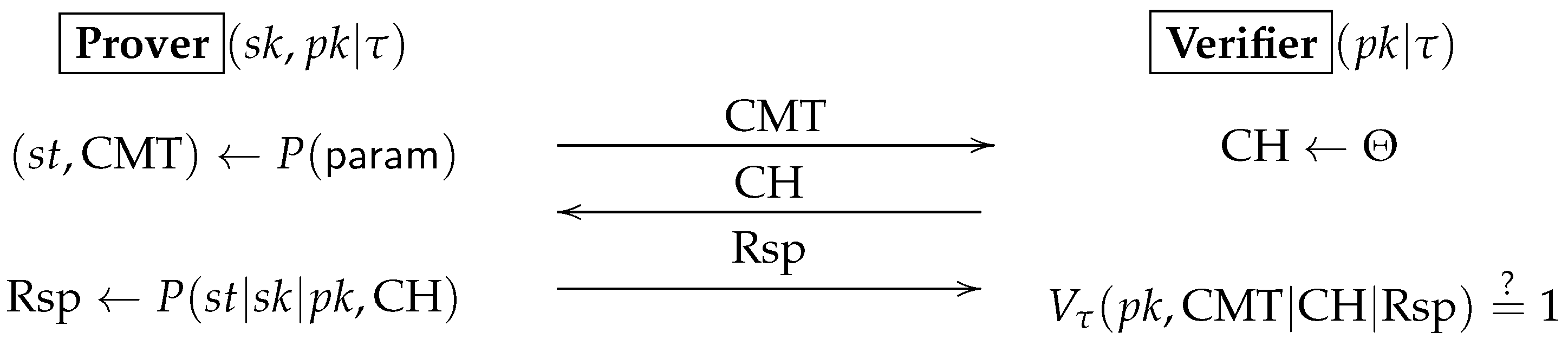
Figure 2.
Simulator .
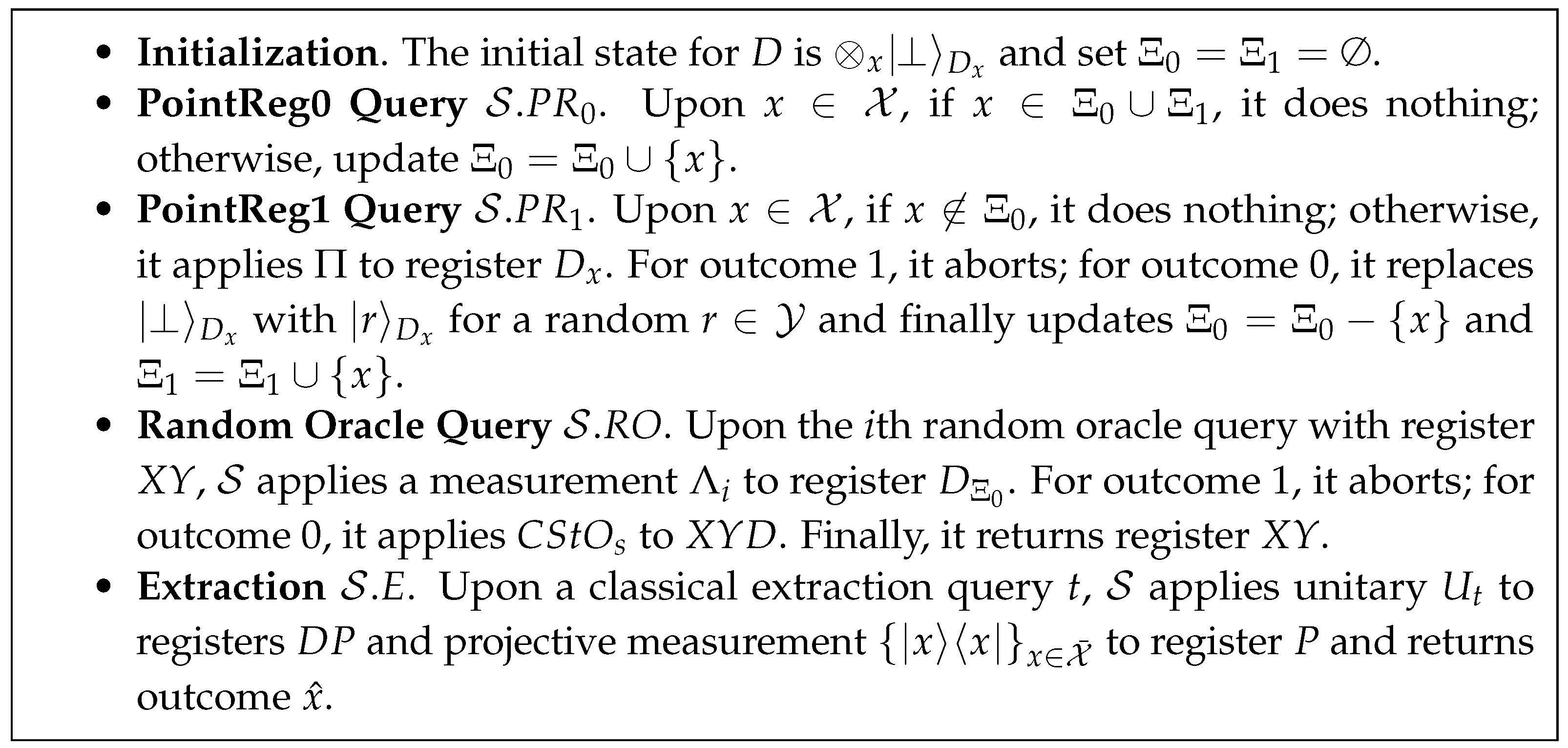
Figure 3.
The JAK ID Scheme
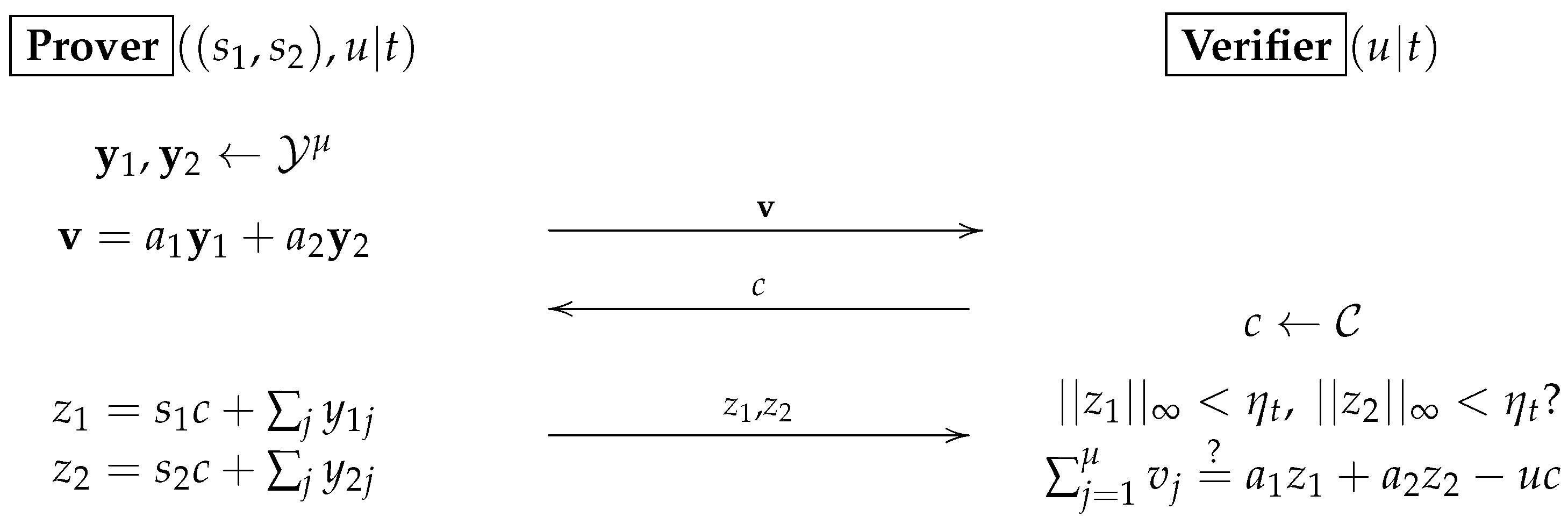
Disclaimer/Publisher’s Note: The statements, opinions and data contained in all publications are solely those of the individual author(s) and contributor(s) and not of MDPI and/or the editor(s). MDPI and/or the editor(s) disclaim responsibility for any injury to people or property resulting from any ideas, methods, instructions or products referred to in the content. |
© 2024 by the authors. Licensee MDPI, Basel, Switzerland. This article is an open access article distributed under the terms and conditions of the Creative Commons Attribution (CC BY) license (http://creativecommons.org/licenses/by/4.0/).
Copyright: This open access article is published under a Creative Commons CC BY 4.0 license, which permit the free download, distribution, and reuse, provided that the author and preprint are cited in any reuse.