

Submitted:
28 August 2024
Posted:
28 August 2024
Read the latest preprint version here
Abstract
Let an odd integer \(\mathcal{X}\) be represented as \(\sum \limits_{M > m} 2^M + 2^m - 1\) for $m \geq 1$, where \(2^m - 1\) is called the Governor. The general dynamics is such that applying the Collatz-type function iteratively lead to \(\sum \limits_{N > 1} 2^N + 2^{\mathcal{T}} - 1\), where \(2^{\mathcal{T}} - 1\) is referred to as the Trivial Governor. For the \(3\mathcal{Z} + 1\) sequence, the Trivial Governor is \(2^1 - 1\), while for the \(5\mathcal{Z} + 1\) sequence, the Trivial Governors are \(2^2 - 1\) and \(2^1 - 1\). It is demonstrated that for \(\mathcal{X}\) to reappear in a Collatz-type sequence, its Governor must be the Trivial Governor. Specifically, in the \(3\mathcal{Z} + 1\) sequence, ancestor mapping shows that odd integers in a repeating cycle are separated by two even integers. Successor mapping further indicates that there are no auxiliary cycles, as the Trivial Governor is transformed into a Governor with a different index. Similarly, in the \(5\mathcal{Z} + 1\) sequence, successor mapping reveals that the smallest odd integers that form an auxiliary cycle are found between \(2^2\) and \(2^5\). Finally, attempts to construct integers that diverge in the \(3\mathcal{Z} + 1\) sequence suggest that no such integers exist.
Keywords:
Collatz
; 3x+1
; 5x+1
; collatz conjecture
1. Introduction
- If is odd, multiply it by an odd integer, and add 1.
- If is even, it is divided by 2.
The associated conjecture for the Collatz-type sequence states that every integer ultimately reduces to 1. To prove this conjecture, it must be shown not only that the sequence eventually cycles through 1, 4, 2, 1, but also that no integer diverges to infinitely larger values [5,6].
While a complete proof may be elusive, this article attempts to understand the workings of Collatz-type sequences. For this, odd integers are expressed as modified binary expressions for . Ancestor and successor maps are constructed based on this form. The ancestor map provides insight into the odd integers that a repeating sequence can have. The successor map helps in exploring the possibilities of an auxiliary cycle.
The following list of definitions will be used throughout this article:
Definition 1
(Governor). Given an odd integer represented in the modified binary form , where m is the smallest index of 2, the term is called the Governor as it governs the sequence of odd and even steps. The index m is called the Governor index.
Definition 2
(Trivial Governor). The Governor appearing in the trivial cycle of a Collatz-type sequence and is denoted by . For the Collatz-type , the Trivial Governor is while for the Collatz-type it is and .
Definition 3
(Governor evolution). It is the changes that the Governor goes through as the Collatz-type sequences progresses.
Definition 4
(Trivial cycle). A trivial cycle is a sequence of repeating integers in which the evolution of the Governor is uninfluenced by other terms.
Definition 5
(Auxiliary cycle). The sequence of repeating integers obtained when other terms interact with the Governor and alter its evolution.
2. General Dynamics of the Collatz-Type Sequences
Theorem 1
(General). The general dynamics of Collatz-type sequences are such that each odd integer has a progressively smaller Governor index, ultimately leading to the Trivial Governor.
Proof.
Consider the evolution of the Governor for the Collatz-type and sequences shown in the Table 1.
Let denote the resulting integer at the end of the odd step while denote the resulting integer at the end of the even step.
Table 1 demonstrates that, once a Collatz-type sequence begins, the Governor of each new odd integer is smaller than that of the previous odd integer. The following corollaries are deduced:
Corollary 1 (Generalized)
Once the Collatz-type sequence is initiated, the Governor index keeps decreasing.
Corollary 1 (Generalized)
The Governor index is singular.
Table 2 shows the dynamics when the Governor is transformed into the Trivial Governor. In this case, is the next smallest index term in the expression of the odd integer. The observations from Table 2 are summarized in the following corollaries:
Corollary 3 ()
The integer obtained at the step is followed by two even steps. If the Trivial Governor is uninterrupted, the Collatz sequence starts to shrink as the Trivial Governor enters the trivial cycle.
Corollary 4 ()
If m is odd then the integer obtained at is odd and is followed by an odd step.
Corollary 5 ()
If m is even then the integer obtained at is even and additional even steps are followed until an odd integer is obtained.
Further, Table 2 shows that an uninterrupted trivial cycle of the Trivial Governor causes the indices of other terms to decrease. Eventually, the term will either have the same index as the Governor or a lower index (applicable only to the sequence). Consequently, Corollary 2 may be invalidated if the Trivial Governor is present.
□
Corollary 6 (Generalized)
The Governor index is shared by another term only if the Governor is the Trivial Governor.
Lemma 1
(Generalized). In the Collatz-type sequences, the odd integer repeats if the odd integer appears.
Proof.
Let the integer repeats. The repetition is possible only when the term reappears as the ending term of an odd integer.
Theorem 1 and Corollary 1 state that the Collatz function produces a sequence where the Governor index of each new odd integer is smaller than that in the previous odd integer. Corollary 2 further asserts that the Governor index is singular.
These results imply that the odd integer cannot reappear as . Instead, for to reappear while satisfying the constraints of Theorem 1 and Corollary 2, it must be structured as follows when it reappears:
□
Lemma 2
(). The structure of the odd integer when it reappears, given by , is possible only when is the Trivial Governor.
Proof.
When reappears, its Governor is . This Governor index is also shared by another term. Corollary 2 prohibits this situation. However, Corollary 6 allows sharing of Governor index if and only if the Trivial Governor is present. Therefore, for the odd integer to repeat, the Governor must be the Trivial Governor.
□
3. Generation Mapping for Sequence
3.1. Ancestor Map
Theorem 3
(). All the odd integers in the repeating cycle end in . Additionally, these odd ancestors in the repeating sequence are separated by two even integers.
Proof.
To trace the ancestors of the integer upon its reappearance, the generation map is constructed. The ancestors are listed in Table 3.
Given that there can be a maximum of three terms in the product , the conditions for existence of an odd ancestor are tabulated in Table 4.
The odd ancestor according to the solution obtained in Table 4 and depicted with blue arrows in Table 3 is:
From the structure of this odd ancestor, it is evident that the Governor of the odd ancestor is the Trivial Governor. Similarly, all ancestors end in the Trivial Governor. Therefore, unless also ends with the Trivial Governor, it cannot be part of the repeating cycle. Additionally, two even integers are found to be present between all odd integers in a repeating cycle.
□
3.2. Successor Map
Theorem 4
(). There exists no auxiliary cycle.
Proof.
Assume there is an auxiliary cycle with at least two distinct odd integers and where . Additionally, let end in . The relation between and is given by:
For to be odd, P must be 1. Substituting into the expression of , the Governor of changes to . Therefore, cannot be part of the repeating cycle, according to Theorem 3.
Thus, no auxiliary cycle exist.
□
4. Generation Mapping for Sequence
4.1. Ancestor Map
Theorem 5
(). All the odd integers in the repeating cycle end in either or .
Proof.
The odd integer upon reappearance can end in either or according to Theorem 1. The ancestor map for ending in is shown in Table 5.
Given that there can be a maximum of three terms in the product , the conditions for existence of an odd ancestor are tabulated in Table 6.
One of the odd ancestor is depicted with blue arrows in Table 5. The odd ancestors according to the solution obtained in Table 6 are:
It is seen that all the odd integers either end in or . Therefore, unless also ends with the Trivial Governor of , it cannot be part of the repeating cycle.
□
4.2. Successor Map
Lemma 6
(). The smallest odd integer that is part of a repeating cycle has the Trivial Governor .
Proof.
Consider a repeating cycle with two odd integers, and , where . Suppose ends with the terms . Since is smaller than , the odd step is followed by at most two even steps.
If , then , and the Trivial Governor of is . If , then , and the Governor of is . According to Theorem 5, this does not form a repeating cycle.
Thus, if is the smallest odd integer in a repeating cycle, it must have the Trivial Governor .
□
Theorem 7
(). The smallest odd integers that form an auxiliary cycle are found between and .
Proof.
Let be the smallest odd integer in an auxiliary cycle, expressed as , where . The successor map, shown in Table Section 4.2, is constructed according to Theorem 5 and based on the fact that is the smallest odd integer.
The successor map in Table Section 4.2 can be interpreted as follows: Successor maps for and do not fail and may continue indefinitely while following Theorem 5 and ensuring that remains the smallest odd integer. However, whether and actually form an auxiliary sequence is uncertain without actual calculation or prior knowledge, as is the case here. In contrast, the successor maps for , , and definitely fail.
Thus, if forms an auxiliary cycle, it must be greater than but smaller than .
□
5. Integers That `May’ Diverge
Theorem 8
(). The integers may take a long time to converge to 1, but they cannot escape this convergence indefinitely.
Proof.
Consider the dynamics of the Collatz-type sequences shown in Table 2. For the sequence, integers may avoid shrinking in value if m is odd, if the trivial cycle is interrupted, or if the Trivial Governor is avoided. In contrast, the sequence always experiences a shrinking phase, regardless of whether m is even or odd.. Additionally, there is only one Trivial Governor, and, as discussed in Theorem 1, all Governors eventually lead to the Trivial Governor. This leaves the following options to avoid convergence to 1:
- An infinite value of m.
- Alternatively, each time the Trivial Governor appears, it is interrupted and transformed into a higher index Governor.
Consider the second approach for . The Trivial Governor is obtained when
If , the Trivial Governor can be transformed into a higher index Governor:
The Governor obtained is higher than the original Governor in . However, this method requires an infinite number of carefully chosen terms to indefinitely avoid the Trivial Governor.
Thus, while an infinitely large integer may prolong the convergence to 1, it cannot avoid it entirely.
□
6. Conclusions
It is shown that for an odd integer to reappear in any Collatz-type sequence, its Governor must be the Trivial Governor of that sequence. Applied to the sequence, it is observed that the repeating cycle consists of odd integers that end in and are separated by two even integers, forming the trivial cycle. No auxiliary cycles are found in this case.
In the sequence, the odd integers in any repeating cycle either have the Trivial Governor or . Furthermore, the smallest odd integers forming an auxiliary cycle are found to be between and .
Finally, attempts to construct an integer that may diverge in the sequence reveal that such an integer might not be possible.
Data Availability Statement
Data availability is not applicable to this article as no new data were created or analysed in this study.
References
- J. C. Lagarias, “The 3x+ 1 problem: An annotated bibliography (1963–1999),” The ultimate challenge: the 3x, vol. 1, pp. 267–341, 2003.
- J. C. Lagarias, “The 3x+ 1 problem: An annotated bibliography,” preprint, 2004.
- J. C. Lagarias, “The 3x+ 1 problem: An annotated bibliography, ii (2000-2009),” arXiv preprint math/0608208, 2006.
- J. C. Lagarias, The ultimate challenge: The 3x+ 1 problem. American Mathematical Soc., 2010.
- R. Terras, “A stopping time problem on the positive integers,” Acta Arithmetica, vol. 3, no. 30, pp. 241–252, 1976.
- T. Tao, “Almost all orbits of the collatz map attain almost bounded values,” in Forum of Mathematics, Pi, vol. 10, p. e12, Cambridge University Press, 2022.
Table 3.
Ancestor map of upon reappearance for the Collatz-type 3+1 sequence. Only a few indices are shown.
Table 3.
Ancestor map of upon reappearance for the Collatz-type 3+1 sequence. Only a few indices are shown.
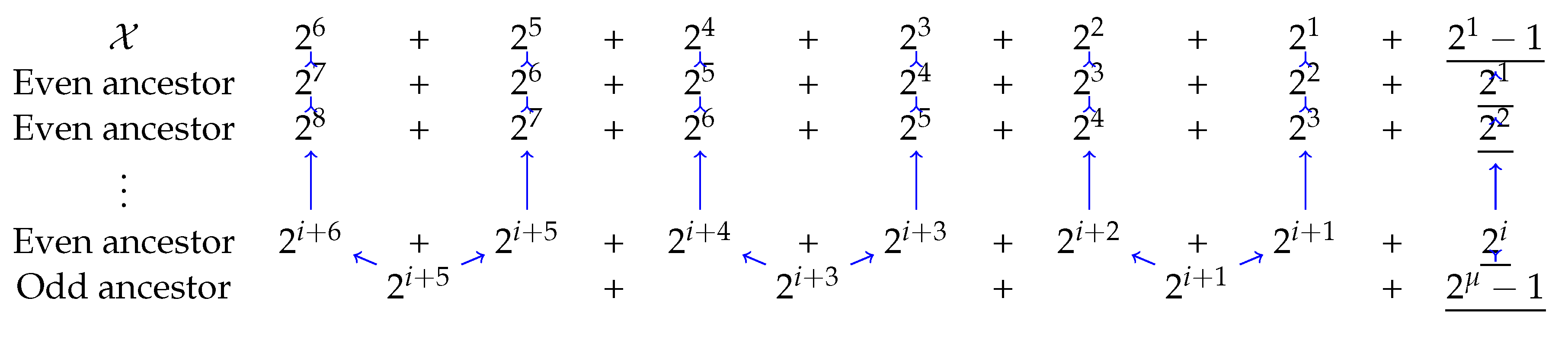
Table 5.
Ancestor map of upon reappearance for the Collatz-type 5+1 sequence. Only a few indices are shown.
Table 5.
Ancestor map of upon reappearance for the Collatz-type 5+1 sequence. Only a few indices are shown.
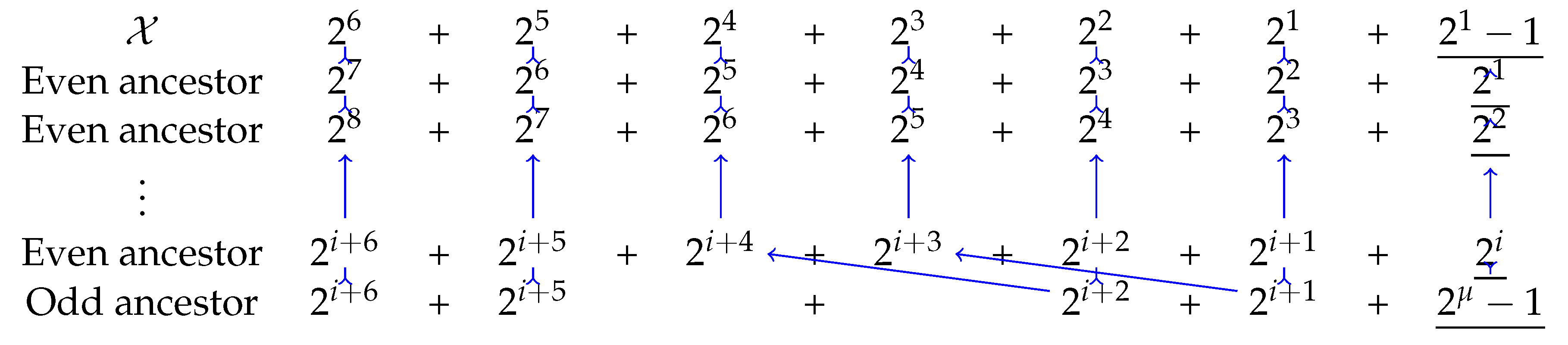

Table 1.
Governor index reduction with the progress of Collatz sequences
Table 2.
Dynamics of the Collatz-type sequences when the Governor term vanishes.
Table 4.
Conditions for an odd ancestor to exist. The solution depicted in column 3 is shown with blue arrows in Table 3.
Table 4.
Conditions for an odd ancestor to exist. The solution depicted in column 3 is shown with blue arrows in Table 3.
| Three terms | Two Terms | One term |
|---|---|---|
| No solution | No solution | and |
Table 6.
Conditions for an odd ancestor to exist. The solution depicted in column 3 is shown with blue arrows in Table 5.
Table 6.
Conditions for an odd ancestor to exist. The solution depicted in column 3 is shown with blue arrows in Table 5.
| Three terms | Two Terms | One term |
|---|---|---|
| No solution | and | and |
Table 7.
Successor map for sequence.
| R must be 2, 3 or 4 to make sure is the smallest odd integer. | |||
| and are identical if is disregarded | If or , it violates . Otherwise, it violates Theorem 5 | and are identical if is disregarded. Otherwise, Q must be 5 or 6. | |
| If or , it violates . Otherwise, it violates Theorem 5 | If or , it violates . Otherwise, it violates Theorem 5 | ||
Disclaimer/Publisher’s Note: The statements, opinions and data contained in all publications are solely those of the individual author(s) and contributor(s) and not of MDPI and/or the editor(s). MDPI and/or the editor(s) disclaim responsibility for any injury to people or property resulting from any ideas, methods, instructions or products referred to in the content. |
© 1996 by the author. Licensee MDPI, Basel, Switzerland. This article is an open access article distributed under the terms and conditions of the Creative Commons Attribution (CC BY) license (https://creativecommons.org/licenses/by/4.0/).
Copyright: This open access article is published under a Creative Commons CC BY 4.0 license, which permit the free download, distribution, and reuse, provided that the author and preprint are cited in any reuse.