
Submitted:
21 August 2024
Posted:
22 August 2024
You are already at the latest version
Abstract
This paper explores a novel approach to establishing the topological equivalence of manifolds embedded in ℝ
Keywords:
novel approach
; topological equivalence
; manifolds embedded in ℝ
1. Introduction
The study of manifolds in higher-dimensional spaces is a central topic in both differential geometry and topology. Manifolds, which can be intuitively understood as spaces that locally resemble Euclidean space, form the foundation for understanding complex structures in mathematics and physics. The concept of topological equivalence, where two manifolds are considered equivalent if they can be continuously deformed into each other without tearing or gluing, is a fundamental notion in topology.
1.1. Historical Background and Motivation
The idea of topological equivalence is closely linked to homeomorphism, a concept formalized by Henri Poincaré in the late 19th century. Poincare's work laid the groundwork for modern topology by introducing the idea that two spaces are topologically equivalent if there exists a continuous bijection between them, with a continuous inverse (Poincaré, 1895). Later, the concept of diffeomorphism extended this idea to differentiable manifolds, where the transformation between manifolds is smooth and has a smooth inverse (Whitney, 1936).
In the mid-20th century, the Whitney Embedding Theorem provided a significant advancement by proving that any smooth -dimensional manifold can be embedded in (Whitney, 1944). This theorem ensures that manifolds can be represented in higher-dimensional Euclidean spaces while retaining their topological properties. Building on this, the concept of isotopy, which refers to a continuous deformation of one manifold into another within without self-intersection, has been extensively studied, particularly in the context of knot theory (Milnor, 1958).
2. Methodology
2.1. Problem Statement
- Formalize the problem of determining whether manifolds in are topologically equivalent under small perturbations (Montgomery, 2024) that respect continuity and non-intersection.
- Specify the constraints that perturbations must not cause any intersections between manifolds and must maintain continuity, ensuring that the manifolds remain embedded in .
2.2. Assumptions
- Assume that all manifolds are smooth (infinitely differentiable) and are embedded in in such a way that they initially do not intersect.
- Assume that the space represents the smallest possible deviation within which the manifold's topological structure is preserved.
2.3. Compensating Partial Derivatives in
2.3.1. Derivation of Partial Derivatives
- Compute the partial derivatives for each manifold and each coordinate in .
- Define the perturbation in and derive the corresponding changes in the partial derivatives.
2.3.2. Compensation Mechanism
- Develop the mechanism by which perturbations in one direction (e.g., ) are compensated by corresponding adjustments in other directions (e.g., , where ).
- Formulate the compensatory condition:ensuring that this compensation preserves the non-intersection and continuity of the manifolds.
2.4. Ensuring Continuity and Non-Intersection Continuity Preservation
- Analyze how small perturbations maintain the continuity of each manifold .
- Ensure that the perturbation results in a smooth (continuous) manifold without introducing any gaps or discontinuities.
2.5. Non-Intersection Maintenance
- Develop criteria to ensure that perturbations do not reduce the minimum distance between any two manifolds and , thus preventing intersections.
- Use geometric and topological constraints to formulate a condition:where and are points on and , respectively.
2.5. Proving Topological Equivalence
- Show that despite infinite possible perturbations within the minimal space, the topological invariants (e.g., genus, Euler characteristic, homology groups) of the manifolds remain unchanged.
2.5.1. Discussion of Infinite Structures
- Discuss how the derived compensatory mechanism allows for infinite variations of the manifolds within that preserve the same topological structure.
- constraints in the study of manifold equivalence. These constraints are essential for ensuring that the manifolds remain well-defined and physically meaningful in .
- Continuity ensures that the manifolds do not develop gaps or discontinuities, which is crucial in applications where the manifolds represent real-world objects or processes. For instance, in the modeling of smooth surfaces in computer graphics or in the analysis of continuous data sets, maintaining continuity is non-negotiable.
- Non-intersection, on the other hand, is vital for ensuring that the manifolds do not overlap or intersect, which would compromise their distinct identities. This is particularly relevant in fields like knot theory or when analyzing the embeddings of different manifolds in higher-dimensional spaces. The conditions developed in this study to prevent intersection while allowing for infinite perturbations represent a significant advancement in understanding how to maintain distinct, yet topologically equivalent, structures in .
3. Discussion
The results of this study provide a novel approach to understanding the topological equivalence of manifolds in RN, particularly under the strict constraints of continuity and non-intersection. By integrating the principle of compensating partial derivatives with the concept of minimal E space, we demonstrate that manifolds can undergo infinite perturbations while preserving their topological invariants. This discussion addresses the implications of these findings within the context of abstract mathematics, their theoretical significance, and potential directions for future research.
3.1. Implications for Topology and Differential Geometry
The approach presented in this paper has significant implications for the fields of topology and differential geometry. The classical notions of homeomorphism and diffeomorphism, as outlined in foundational texts by Milnor (1965) and Hirsch (1976), provide the basis for understanding manifold equivalence. However, the introduction of compensatory partial derivatives as a tool for maintaining manifold equivalence under perturbations extends these concepts in a novel direction.
In this framework, the concept of minimal E space is critical. It formalizes the idea that small perturbations within this space do not alter the manifold's topological structure, even though the manifolds may exhibit infinite variations. This aligns with the work on general position and transversality, which ensures that small perturbations in RN do not lead to significant topological changes (Guillemin and Pollack, 1974).
3.2. Continuity and Non-Intersection as Central Constraints
A key contribution of this work is the emphasis on continuity and non-intersection as constraints in the study of manifold equivalence. These constraints are essential for ensuring that the manifolds remain well-defined within RN.
Continuity, as preserved through the smoothness of the functions defining the manifolds, ensures that there are no breaks or singularities in the manifold. This requirement is fundamental in differential topology, where the smooth structure of a manifold is crucial to its classification and properties (Milnor, 1965).
The non-intersection condition prevents the manifolds from overlapping or intersecting, which is particularly relevant in the study of embeddings and immersions in higher-dimensional spaces. The conditions developed in this study to prevent intersection while allowing for infinite perturbations are consistent with classical results in the theory of embeddings, such as those discussed by Whitney (1944) and Haefliger (1962).
3.3. Theoretical Challenges and Considerations
While the methodology and results presented are mathematically sound, several theoretical challenges and considerations warrant discussion.
Complexity of the Compensatory Mechanism: The compensatory partial derivatives mechanism, while theoretically robust, may involve intricate calculations, particularly for manifolds of high dimensionality or those with complex geometric structures. This complexity is compounded by the need to ensure that compensations are smooth and do not introduce new intersections, a challenge that aligns with the broader difficulties in high-dimensional differential topology (Hirsch, 1976).
Generalization to Other Spaces: The principles developed in this study focus on RN, which is a well-understood and tractable space in topology. However, the generalization of these principles to non-Euclidean spaces, spaces with singularities, or other exotic structures presents a significant challenge. The applicability of compensatory partial derivatives in such spaces may require further development, potentially drawing on concepts from algebraic topology or homotopy theory (Hatcher, 2002).
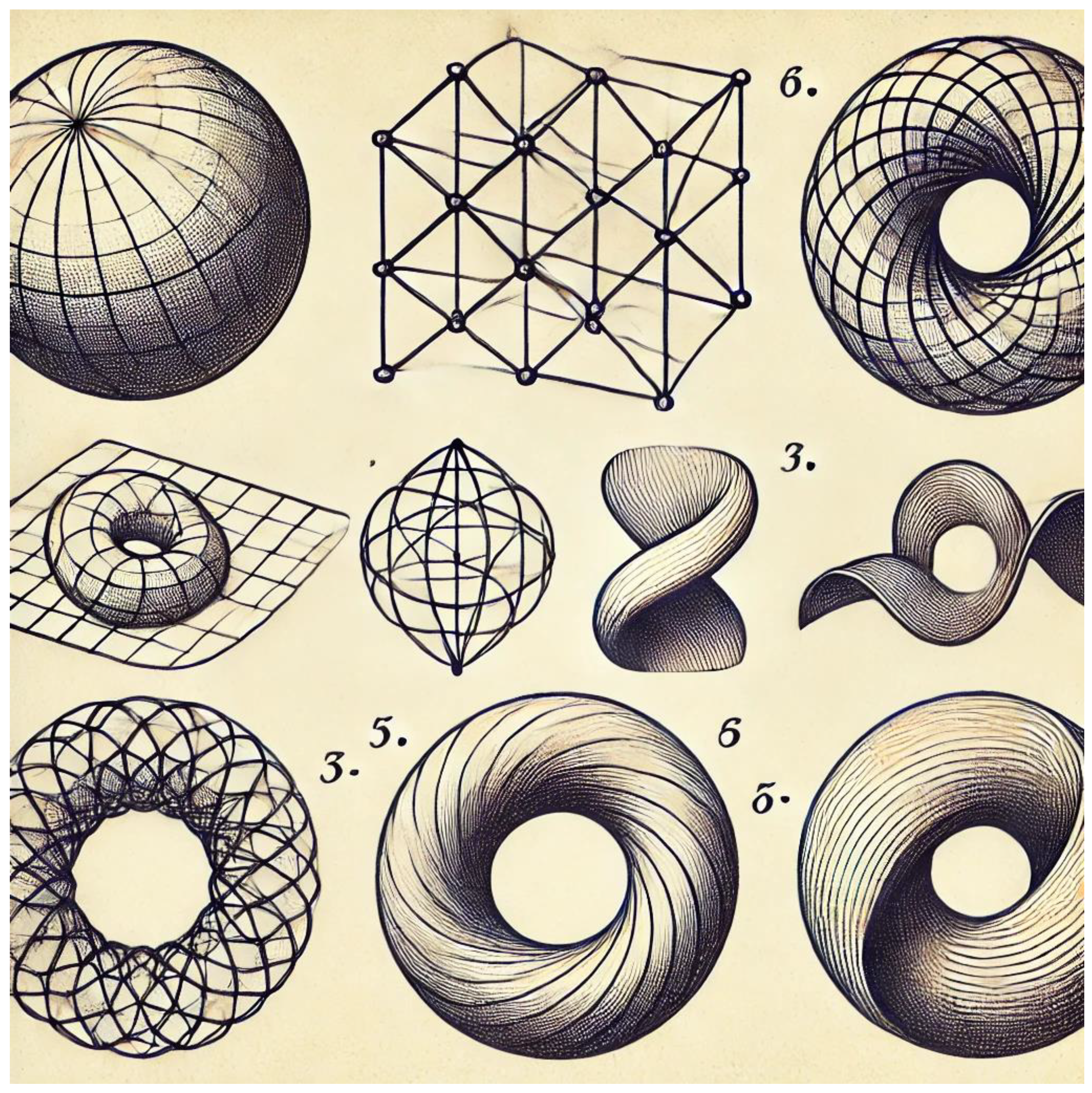
Figure 1.
Illustration of Differential Potential forms remembers diversity of Life.
3.4. Future Research Directions
- The findings of this study open several avenues for future research within the realm of abstract mathematics.
- Extension to Higher-Dimensional Manifolds: Future research could explore the application of compensatory partial derivatives to more complex and higher-dimensional manifolds, particularly in the context of exotic smooth structures or higher homotopy groups. The interplay between these concepts and higher-dimensional topology remains an open area of inquiry (Milnor and Stasheff, 1974).
- Deepening the Study of Non-Intersection: The conditions developed here for maintaining nonintersection during perturbations could be further refined and generalized. This may involve a deeper exploration of the role of intersection theory and its applications in the study of complex embeddings in (Fulton, 1998).
- Algebraic and Homotopical Extensions: Since the minimal space concept is closely related to stability under small perturbations, future research might explore its connections to stability phenomena in homotopy theory and algebraic topology. This could involve studying the role of compensatory mechanisms in preserving the homotopy type or algebraic invariants of manifolds (May, 1999).
4. Conclusion
This study introduces a novel methodology for establishing the topological equivalence of manifolds in under the constraints of continuity and non-intersection. By leveraging the principle of compensating partial derivatives and the concept of minimal space, we have shown that infinite variations of manifolds can exist while preserving their topological structure. These findings have significant implications for the theoretical study of topology and differential geometry, though challenges remain in generalizing these concepts to more complex spaces. Future research in this area holds the potential to deepen our understanding of manifold theory and expand its applications within the domain of abstract mathematics.
Conflicts of Interest
The authors declare no conflict of interest.
References
- Milnor, J.W. Topology from the Differentiable Viewpoint. University Press of Virginia, 1965. [Google Scholar]
- Hirsch, M.W. Differential Topology. Springer-Verlag, 1976. [Google Scholar]
- Guillemin, V.; Pollack, A. Differential Topology. Prentice-Hall, 1974. [Google Scholar]
- Whitney, H. The self-intersections of a smooth n-manifold in 2 n-space. Annals of Mathematics 1944, 45, 220–246. [Google Scholar] [CrossRef]
- Haefliger, A. Knotted (4k-1)-spheres in 6k-space. Annals of Mathematics 1962, 75, 452–466. [Google Scholar] [CrossRef]
- Hatcher, A. Algebraic Topology. Cambridge University Press, 2002. [Google Scholar]
- Montgomery, R.M. Topological Dynamics in Ecological Biomes and Toroidal Structures: Mathematical Models of Stability, Bifurcation, and Structural Failure. August 2024. [Google Scholar] [CrossRef]
- Milnor, J.W.; Stasheff, J.D. Characteristic Classes. Princeton University Press, 1974. [Google Scholar]
- Fulton, W. Intersection Theory. Springer-Verlag, 1998. [Google Scholar]
- May, J.P. A Concise Course in Algebraic Topology. University of Chicago Press, 1999. [Google Scholar]
- Resilience and Breakage in Proteomic Topological Structures: A Dynamic Analysis of Network Evolution Under Genomic Mutations.
Disclaimer/Publisher’s Note: The statements, opinions and data contained in all publications are solely those of the individual author(s) and contributor(s) and not of MDPI and/or the editor(s). MDPI and/or the editor(s) disclaim responsibility for any injury to people or property resulting from any ideas, methods, instructions or products referred to in the content. |
© 2024 by the authors. Licensee MDPI, Basel, Switzerland. This article is an open access article distributed under the terms and conditions of the Creative Commons Attribution (CC BY) license (http://creativecommons.org/licenses/by/4.0/).
Copyright: This open access article is published under a Creative Commons CC BY 4.0 license, which permit the free download, distribution, and reuse, provided that the author and preprint are cited in any reuse.


