

Submitted:
19 August 2024
Posted:
21 August 2024
You are already at the latest version
Abstract
Climate change presents an urgent global challenge, manifesting in rising temperatures and extreme weather events with severe societal impacts. The Eastern Mediterranean, warming faster than the global average, faces immediate repercussions. Climate literacy emerges as pivotal, empowering individuals to comprehend climate science and act accordingly. This study delves into climate literacy, attitudes, and 'greening' behaviours in the Eastern Mediterranean hotspot of Greece, based on a survey of 1,962 citizens. Findings indicate high climate literacy but lower adoption of 'greening' behaviours, especially those involving financial costs. Regression analyses highlight the significant role of climate literacy, concerns about personal impacts, coping appraisal and trust in institutions in promoting 'greening' behaviours. The study underscores the need for multifaceted strategies emphasizing financial motivation, trust-building, and societal norm shifts. Socio-demographic disparities, including gender and occupation, highlight areas for targeted interventions. The emphasis on the mental health impacts of climate-related events underscores the need for holistic disaster management. Policy implications are discussed, highlighting the potential of expanded climate literacy to catalyze collective action toward sustainability.
Keywords:
climate literacy
; climate change
; greening behaviour
; Eastern Mediterranean
1. Introduction
Climate change (CC) profoundly affects every region globally, with the Mediterranean region warming faster than the average, exacerbating societal impacts [1]. In this context, the Eastern Mediterranean is a CC hotspot, where the unmitigated climate change scenario includes prolonged heatwaves, more frequent extreme rainfall and slow-progressing risks such as sea level rise.
The European Climate Law enriches the ambitious goal of the European Green Deal for climate neutrality by 2050. Adopted in 2022 by the EU countries, this landmark legislation is a clarion call to every stratum of society, namely governments, industries, communities, and individuals, to embrace 'greening' behaviours and support adaptation measures. In this regard, citizens embody the potential for profound impact through their daily choices and behaviours. Beyond personal actions, they can collectively influence policy by voicing concerns and steering policymakers towards ambitious climate action [2].
Scholars have underscored the significance of an informed public in driving pro-environmental attitudes and 'greening' behaviour [3]. As such, climate literacy can empower citizens to understand Earth's climate system, the causes, risks and effects of CC, and the role of human activities in shaping our climate [4] and act on it [5].
Most studies focus on educational settings, assessing school or college students' level of climate literacy and methods to improve it [6,7,8,9]. Interestingly, there is no absolute agreement among the studies that formal education necessarily causes pro-environmental behaviours, as there seem to be other factors involved in the result that may or may not be directly observable, such as psychological factors, social influence, and personal values [10,11,12,13]. For that, recent interest extends to the general population, indicating the need to explore the means to enhance the behaviour of the people who are already decision-makers in their households, workplaces, and communities.
In a broader geographical context, several studies have examined how other factors may affect public views and, eventually, pro-environmental behaviours. For example, there is evidence that media coverage affects individual concern about CC and climate policy support [14,15]. Other studies indicate how misunderstanding CC issues can lead to scepticism in the sense of a negative attitude diminishing engagement in pro-environmental actions [5]. Direct experience [16] and individual and population age [17] have been suggested to affect the understanding of CC and its solutions. Indifference and the prioritization of other problems also seem to reduce real engagement with the CC issue [18]. Moreover, institutional trust has been associated with concern about CC [15].
Few studies have assessed climate literacy and pro-environmental attitudes and behaviours among the general population of Eastern Mediterranean countries. This region, characterized by its distinct socio-cultural and environmental dynamics, warrants focused investigation. Recently, entities such as the Allianz Foundation [18,19] and the European Commission [20] have conducted relevant surveys addressing the European population. However, these efforts have limitations, as either they exclude Eastern Mediterranean countries [18,19] or, although informative, lack the depth of statistical analyses typical of scientific studies. A recent study [21] has assessed the macroeconomic effects and public health benefits of climate mitigation actions in Greece, highlighting a crucial gap in public awareness and perception regarding the broader societal benefits of climate mitigation.
Our study aims to assess citizens' climate literacy and 'greening' behaviour within the unique context of Greece, a CC hotspot region of the Eastern Mediterranean. The objective is to explore the critical role of individuals' climate literacy in fostering 'greening' behaviours while also to shed light on the intricate interplay between literacy, attitudes and concerns, adverse experiences, and socio-demographic factors to unravel whether and to what extent these factors influence 'greening' behaviours among citizens. We benchmark our findings against global studies to identify best practices and areas for improvement.
2. Materials and Methods
2.1. Questionnaire
We conducted a survey using an online questionnaire distributed via Greece's most popular weather website, www.meteo.gr, which provides weather warnings, observations and forecasts produced by the METEO unit at the Institute for Environmental Research, National Observatory of Athens [22,23]. The average number of daily visitors to the site exceeds 350,000. The questionnaire received 1,962 valid responses on November 12-13, 2023. The answers were anonymous, which was emphasized in the introductory text of the questionnaire. Depending on the sample we received in real-time, we directed the questionnaire through the website's pages by region to ensure the best possible geographical representation. The questionnaire included questions on climate literacy, attitudes and concerns, adverse experiences, 'greening' behaviours, and socio-demographic characteristics. It is available as Supplementary Material, translated into English.
2.2. Measures
Climate Literacy
We used Likert-type questions to measure climate literacy [7,24], namely the extent of the respondent's consensus on the issue raised in the context of each question. This approach provides additional insights into their level of climate literacy, preventing respondents from guessing or searching for the correct answer if questions were multiple-choice type. A five-level scale, from very low to very high, was used for all questions on literacy, attitudes, concerns and behaviours, with a few exceptions noted below.
To assess critical thinking, we measured climate literacy with 12 questions on global and local climate change topics, including false premise questions (FPQs) [25]. We expressed the FPQs in such a way as to ensure they did not mislead respondents. The final variable was derived as the average of the 12 questions, with the scales of FPQs reversed.
To further assess people's outlook when answering the online questionnaire, we measured two more variables: (a) the self-evaluation of their literacy in two dimensions, i.e., with two questions regarding CC at the global and local level, that of the Eastern Mediterranean region, and (b) their climate policy literacy, using four binary questions to receive a clear indication of whether the respondents knew or not international policies and definitions used to raise awareness on CC policies (the Conference of the Parties (COP) and its decision-making role, the adaptation of the European Climate Law, the EU's Climate neutrality goals, and the definition of the carbon footprint).
'Greening' Behaviours
'Greening' behaviours were assessed using two variables. The first is the 'greening' level, which accounts for behaviours respondents systematically and consciously adopt. The respondents could select among seven behaviours that do not have a direct financial burden. However, this assessment is not absolute as some may require more time, and the cost-benefit evaluation varies individually. The 'greening' level, as the sum of the selected 'greening' behaviours, is exceptionally measured at a seven-scale. Relevant international surveys have used this approach to measuring 'greening' behaviour [18,19]. The second is the 'willingness to pay', measured with three questions about the intention to personally implement or accept economically demanding measures to adapt to CC. It reflects the respondents' commitment to addressing climate-related challenges, even if those actions come with moderate to high costs.
Attitudes
We treated multiple questions as items to produce the variables of attitudes and concerns. Specifically, we measured 'disbelief' in the existence and severity of CC with four questions about the respondent's agreement that (a) CC does not exist, (b) concern about CC is exaggerated, (c) CC is mainly due to natural causes, (d) nature and people can easily adapt to higher temperatures.
Regarding concerns, we measured the 'adaptation concern' about possible adverse effects of the adaptation measures taken at a central level in their lives with three questions about how much they fear that such measures may (a) burden the country's economy in the immediate future, (b) bring a reduction of jobs in the country, (c) harm the country's ecosystem. We also measured 'personal impact concern' about the possible short-term effects of CC on themselves, with three questions pointing to (a) overall adverse personal and family effects, (b) significant financial losses, (c) the need to take radical measures to adapt to CC (change of residence, occupation etc.).
We measured the 'coping appraisal' of the participants with two questions regarding the ability (a) to adapt to CC without adverse effects on their lives and (b) to meet the associated financial demands. Finally, we measured 'trust' in three catalysts for mitigating climate change: the state, polluting industry, and science. We posed two questions, respectively. Regarding the state, we asked the participants how much they trust it (a) implements mitigation policies and (b) effectively takes adaptation measures. Regarding industry activated in Greece, we asked how much they believe it (a) responsibly adopts measures to reduce GHG emissions and (b) is transparent as to its 'greening' actions. Finally, we asked how much they believe that (a) science has proved CC threat and criticality and (b) scientific recommendations on measures to tackle and adapt to CC are compelling.
We applied principal factor analysis (PFA) and Cronbach's alpha (α) measurement to validate and assess the internal reliability of the psychometric scales of the multi-item attitude variables. Factor item loadings above 0.60 are accepted in PFA to ensure good fitness [26]. The final variables were derived as the average of the items approved by the PFA and Cronbach's α test [26]. Scale reliability is considered excellent for α above 0.70 [27].
Adverse Experience
Regarding the adverse experience, we asked the participants if they had experienced severe weather events that affected them, their family or their property. A positive answer guided them to a section asking when it last happened, what phenomena (co)occurred, and how they would rate the extent of the effects they suffered financially, on health, on mental health and if they were obliged to radical changes in their lives (professional, place of residence, etc.). We constructed the dichotomous' experience' and the 5-level 'extent' of effects by averaging the four relevant questions.
Table 1 presents the statistical description of the examined variables, their scale reliability, and item factor loadings where PFA is applicable.
Socio-Demographics
We collected information about gender, age (generation), education level, place of residence at the prefecture level and whether it is in an urban environment. In addition, we asked the respondents about their preferred sources of information (media, social media, websites of organizations related to the environment, webpages or podcasts with scientific content). Finally, participants could choose from seven categories regarding the profession sector. Six of these categories are particularly sensitive to the effects of CC in the target area or may enhance awareness of climate change. The seventh category includes all other sectors. Table A1 of the Appendix A section provides the demographic characteristics of the sample population.
2.3. Statistical Methods
In this study, we employed various statistical methods to analyze the data and answer our research questions. Firstly, we used Spearman's correlation to account for variables without normal distribution. We also applied Analysis of Variance (ANOVA) to compare the means of different groups. After obtaining statistically significant results from the ANOVA, we proceeded to post hoc pairwise comparisons by applying the Bonferroni test.
We then conducted multiple linear regression analyses. The dependent variables were the 'greening' behaviours, namely the existing 'greening' level and the 'willingness to pay'. For each regression model, we post-estimated the Variance Inflation Factor (VIF) to detect any presence of multicollinearity, which occurs when two or more independent variables in a regression model are highly correlated. A VIF value lower than 5 indicates negligible multicollinearity [28]. Regarding the level of statistical significance, we adhered to the conventional threshold, accepting p-values lower than 0.05 as statistically significant.
Furthermore, we performed an economic significance analysis to evaluate the practical importance of our findings beyond just their statistical significance [29]. This analysis aims to quantify the practical implications of the relationships observed in regression models and elucidate the real-world relevance of our results. Specifically, we assessed the impact of each predictor variable on the 'greening' behaviours by calculating the percentage change in 'greening' associated with one standard deviation increase in the specific predictor variable.
In our analyses, we were mindful of the representativeness of our sample. Specifically, our sample showed a significant deviation regarding gender representativeness since females constituted only one-quarter of the respondents. To address this issue, we conducted additional analyses on sub-samples of our data where the gender distribution was balanced (50-50). We used statistical methods that produce random samples automatically. Notably, neither correlation and regression results nor the average ratings of variables changed significantly (in any case, at the 2nd decile of the coefficient values at the most), suggesting that the gender imbalance does not compromise our findings. Moreover, we treat gender as a control variable in the regression analyses. Controlling regressions for sociodemographics and sub-sampling techniques are well-established methods in statistical analysis to account for potential biases and ensure the robustness of findings. It's important to note that these methods can help mitigate but not eliminate potential biases related to sample representativeness.
3. Results
3.1. Evaluation of Response Accuracy
We assessed participants' attention and critical thinking by analyzing the climate literacy questions' mean scores (Table 2) and correlations (Table A2 of Appendix A). The mean values of the FPQs are much lower than the rest of the CL items, while the correlations of the 12 items (Table A1) prove the tendency of non-acceptance of the FPQs. Therefore, there is evidence that the respondents read the CL questions carefully and responded accordingly.
Further assessing literacy responses, CL was found, on average, higher than the 'self-evaluation' (Table 1), although with a positive correlation (Table A2, rho=0.28, p<0.001). No statistically significant correlation was found between CL and 'policy literacy' (Table A2). Exceptionally, the ANOVA test of means showed that participants who are aware of the carbon footprint and its implications (one of the policy literacy items) have a statistically higher mean CL (F=26.18, p<0.001).
3.2. 'Greening' Behaviours vs Climate Literacy and Attitudes
Figure 1 presents the responses to the questions of the two 'greening' behavioural variables in detail. Responsible water consumption and recycling are the most common 'green' habits. 85% of participants stated that they systematically do these actions. 79% consciously limit their energy consumption. Less than half use alternatives to driving transportation means (47%), consume less (40%) or adopt 'green' food practices (38%). About 20% said they support local actions related to CC mitigation and adaptation. Willingness to spend on insurance coverage and accept environmental charges is low, while it is higher for building adaptation measures.
On average, CL was found high (mean=3.75 at a 1-5 scale), while GL was lower (mean=2.96 if rescaled at a 1-5 scale) and WP even lower (mean=2.58) (Table 1). Results (Table A2) show a statistically significant and positive correlation of CL with GL (rho=0.24, p<0.001) and a stronger positive correlation with WP (rho=0.40, p<0.001).
'Disbelief' was found to be low (mean=2.01, Table 1) but also with negative correlations with GL (rho=-0.21, p<0.001), WP (rho=-0.27, p<0.001) and especially with CL (rho=-0.70, p<0.001). 'Adaptation concern' and 'personal concern' were found to be moderate (mean=2.89 & 2.81, accordingly), and the two variables show an opposite relationship with CL, GL and WP. Namely, the 'adaptation concern' for possible adverse consequences from the adaptation measures is negatively correlated with CL (rho=-0.21, p<0.001), GL (rho =-0.09, p<0.001) and WP (rho=-0.12, p<0.001). In contrast, the 'personal impact concern' is positively correlated with CL (rho=0.53, p<0.001), GL (rho=0.22, p<0.001) and WP (rho =0.30, p<0.001).
'Coping appraisal' was found to be low to moderate (mean=2.44). The variable negatively correlates with CL (rho=-0.25, p<0.001). Further exploring the variable items, we find that as the CL increases, the participants' assessment that they can adapt to CC without significantly impacting their lives decreases more strongly (rho=-0.36, p<0.001). The relationship of CL with the participants' evaluation that they can meet the financial demands of this adjustment is very weak (rho=-0.05, p<0.05). However, this financial dimension is positively related to WP (rho=0.15, p<0.001), while it is not statistically associated with GL, i.e. the adoption of measures without a direct financial impact.
'Trust in science' was found to be moderate (mean=3.35), while trust in those responsible for managing and dealing with CC issues (state, industry) was found to be low (mean=1.82 and 1.69, respectively).
3.3. Socio-Demographic Issues
The ANOVA test showed a statistically significantly higher mean GL for females (F=45.52, p<0.001). The difference in mean WP values is not statistically significant between genders. CL is statistically higher for females (F=60.64, p<0.001). Females were also found to have lower 'disbelief' (F=80.72, p<0.001), lower' adaptation concern' (F=48.85, p<0.001) and higher levels of 'personal impact concern' (F=41.83, p<0.001). Regarding trust, females were found to have a higher' trust in science' (F=41.39, p<0.001) but lower 'trust in state' (F=45.56, p<0.001) and 'trust industry' (F=33.14, p<0.001). Finally, females were found to have lower confidence in their level of literacy ('self-evaluation') (F=11.24, p<0.001) and 'coping appraisal' (F=31.56, p<0.001) than males.
Differences among generations are less prominent. Still, correlation (Table A2) and ANOVA test results show that younger generations have statistically higher CL levels and lower 'disbelief'. However, the older the generation, the higher the GL and the lower the WP level.
'Education' presented insignificant to weak correlations (Table A3 of Appendix A). Positive is the correlation with 'trust in science' (rho=0.13, p<0.001) and negative with 'disbelief' (rho=-0.10, p<0.001). Note that our sample has, in proportion to the country's population, a higher level of education, with 40% having attained tertiary education, compared to the 32% corresponding to Greece for ages over 18, according to Eurostat for the year 2023 [30].
Regarding 'infos', most participants (71%) use up to two sources. 60% of them get information from social media, while 1/3 are being informed, among others, from websites of organizations with environmental content. The relatively strongest positive correlation (Table A3) was found between 'infos' and GL (rho=0.27, p<0.001), while a statistically significant but weak negative correlation was found between 'infos' and 'disbelief' (rho=-0.12, p<0.001).
Correlations with urbanization were mostly statistically insignificant (Table A3). The mean CL in urban areas is 5% higher than in non-urban (F=17.76, p<0.001). Note that 70% of participants live in urban areas, a percentage consistent with the demographic profile of the Greek population [31].
Regarding profession (Table A1), we collected a sufficient sample for all sectors listed in the questionnaire. The smallest sample corresponds to the tourism sector (83). The rest ranged from 135 (agricultural sector) to 279 (education sector). 46% of the sample (899 participants) corresponds to the 'other sectors' category. The categorical variable 'sector' was examined with ANOVA and Bonferroni post-hoc tests regarding its relationship with the other variables. In summary, focusing on the most notable results, we found a statistically significant difference in the mean values of CL and GL, with the agriculture sector having the lowest value of CL (3.56) and the tourism sector the lowest value of GL (2.86 in a 1-5 scale). No statistically significant difference was found in terms of WP. Regarding the attitude variables, we found a statistically significant difference in the mean values of 'disbelief' and 'adaptation concern', with the agriculture sector having the highest values (2.30 and 3.28, respectively). Finally, the results regarding 'trust in science' were also statistically significant, with the lowest mean value (3.02) attributed to the agricultural sector.
Figure 2 shows by sector the mean literacy on the risks associated with CC in the Eastern Mediterranean (6 out of 12 CL items), where the effects are directly felt. Literacy about sea level rise was found to be the lowest across all sectors (F=3.49, p<0.005). The tourism sector sample showed significantly higher literacy for heatwaves and wildfires (mean=4.10 and 4.06, respectively), and the agricultural sector showed lower literacy for the heatwaves (mean=3.56), (F=3.65 p<0.005 and F=3.28 p<0.005 the ANOVA results for heatwaves and wildfires, respectively).
3.4. Featuring Adverse Experience
40% of the respondents stated that they had been affected by severe weather events, 88% of whom in the last five years. Of the adverse experiences, 52% involve floods, 27% heatwaves, 24% forest fires, 21% strong winds, and a small fraction (3%-9%) include droughts, snow/frost, and landslides. 22% of adverse experiences were related to coexisting phenomena, mainly floods with strong winds and landslides or heatwaves with drought. Regardless of the phenomenon, those affected have increased CL (rho=0.11, p<0.001) and 'personal impact concern' (rho=0.19, p<0.001) and lower 'coping appraisal' (rho=-0.13, p<0.001) and 'trust in state' (rho=-0.08, p<0.001) (Table A3).
Compared to having an adverse experience, the 'extent' of it showed stronger correlations with the examined variables (Table A3). The greater the magnitude of the impacts they suffered, the greater the CL, GL and WP (rho=0.19, 0.17, 0.16, respectively, p<.001). Stronger were also the correlations of 'extent' with 'personal impact concern' (rho=0.49, p<0.001), 'coping appraisal' (rho=-0.28, p<0.001), 'disbelief' (rho=-0.17, p<0.001) and 'trust in state' (rho=-0.10, p<0.001). Finally, the stronger the impact, the higher the 'trust in science' (rho=0.15, p<0.001). The correlation between 'adverse experience' and 'trust in science' is not statistically significant.
Figure 3 shows the mean rate of the impact suffered without considering any coexistence of phenomena. Overall, the affected sample population emphasized mental health more. Statistical analysis showed that wildfires and heatwaves were significantly associated with more severe effects on physical health (F=15.55, p<0.001 for wildfires and F=63.12, p<0.001 for heatwaves), mental health (F=41.98, p<0.001 for wildfires and F=8.43, p<0.005 for heatwaves) and radical changes (F=9.38, p<0.005 for wildfires and F=5.27, p<0.05 for heatwaves) compared to those who did not report these phenomena. Drought and landslides were significantly associated with more severe financial impacts (F=13.94, p<0.001 for drought and F=9.31, p<0.005 for landslides). The respective statistical results were not found to be significant for floods and windstorms.
3.5. Regression Analyses
Table 3 shows the results of the linear multiple regression analyses used to examine the effects of CL, attitudes and concerns, and socio-demographic variables on GL and WP. Two of the four models consider the entire sample population and two only those affected by a severe weather-related phenomenon, thus including the 'extent' variable. The adjusted R-squared values range from 0.17 to 0.24. These values indicate that our models explain between 17% to 24% of the variance in our dependent variables, GL and WP. It's important to note that in social science research, such levels of explained variance are not uncommon due to the complex nature of human behaviour. Most social science research modelling aims not to predict human behaviour but to assess whether specific explanatory variables significantly affect the dependent variable [32]. The models are statistically significant at the 5% level. The VIF values for each predictor in the models and the overall models' VIF are well below the acceptable threshold. Therefore, we can confidently state that multicollinearity does not pose a concern in the interpretation and reliability of our regression model's results.
In the models considering the entire sample population, CL, 'personal impact concern', generation, and 'infos' were found to have significant positive effects on GL. However, the CL effect on GL was statistically insignificant when considering only the population affected by severe weather-related phenomena. For WP, CL, 'personal impact concern', 'coping appraisal', 'trust in state', and 'trust in science' were the most influential variables across the two models, all with positive coefficients. The negative coefficient for gender indicates that being male has a negative effect on GL. However, the effect of gender on WP was insignificant.
A particularly interesting observation is that despite the statistically significant and, in some cases, relatively strong negative correlations of 'disbelief' or 'adaptation concern' with GL and WP (Table A3), their effects were not found to be statistically significant in the regression models. Namely, these negative attitudes are overshadowed by other explanatory variables considered in the models.
The economic (practical) significance of the statistically significant variables in the regression models for the entire sample population is summarised in Table 4. The results show that a one standard deviation increase in CL is associated with a 3.2% increase in GL and a 9.2% increase in WP for the entire sample. For GL, 'personal impact concern' and 'infos' have an even higher economic significance, of 5.1% and 8.6%, respectively. For WP, the highest economic significance is attributed to CL. For the rest of the predictors, the economic significance ranged from 1.6% to 6.1%.
4. Discussion
The findings of this study shed light on various aspects of climate literacy, attitudes and concerns, 'greening' behaviours, and their relationships with socio-demographic factors in the context of an Eastern Mediterranean CC hotspot. These insights are crucial for understanding public responses to CC, significantly impacting mitigation and adaptation efforts.
4.1. Methodological Implications for Literacy-Related Survey
First, assessing how participants answered climate literacy questions suggests attention and critical thinking, as shown by the lower mean values and negative correlations associated with FPQs, enhancing the reliability of the analyses and conclusions.
Interestingly, respondents' literacy self-evaluation was lower than their climate literacy, regardless of gender. This finding may imply that individuals tend to be cautious or critical about their level of knowledge or suggest they tend to underestimate their understanding of climate change. Furthermore, we found there was no correlation between climate and policy literacy. This result indicates that citizens may know the policy's name or existence but not its details or implications.
Overall, the above findings suggest that when interpreting responses to a literacy-related survey, researchers should be mindful of the potential for discrepancies between self-reported knowledge levels and actual understanding. It also highlights the importance of considering multiple dimensions of knowledge when assessing respondents' overall understanding of climate change. In this case, the lack of correlation between climate literacy and policy knowledge underscores the need for targeted communication efforts to ensure that individuals comprehensively understand CC science and policy aspects.
4.2. The Literacy - Behaviour Gap
The results showed that citizens in Greece have relatively high climate literacy. However, 'greening' behaviour is still weak, even if it does not burden the citizens financially. In our survey, as in the European one [20], low on the list are measures that theoretically save money, such as using alternative means of transport instead of the car or limiting the consumption of, at least first-hand, goods. Surveys in European countries other than Greece [19] suggest that most respondents underestimate the urgency of the adaptation measures.
The gap between awareness or knowledge and behaviour is a recognized [33] and well-documented phenomenon [34,35], often referred to as the 'attitude-behaviour' or 'mind-behaviour' gap. This gap can be attributed to several factors, such as psychological barriers hindering knowledge translation into action. These barriers include finding change unnecessary, conflicting goals, and tokenism. Scholars have also indicated how local authorities' incompetence can affect individuals' determination to take action [36]. A typical example is the failure of major Greek cities to design and promote sustainable mobility [37], which is very likely to discourage citizens from leaving their cars.
Our analyses indicate that financial burdens may deter individuals from adopting 'greening' behaviours, even if they know their benefits [38]. Proposed measures to address such barriers include financial incentives, e.g. for nature- and technology-based solutions to decarbonize and adapt buildings [39,40]. Considering all the above, we can conclude that despite a relatively high climate literacy, the psychological barriers, economic burden, and inefficient policies may discourage citizens from acting on this knowledge.
4.3. The Climate Literacy Significance
Given the disparity between climate literacy and behaviour highlighted above, the regression analyses point out interesting findings. According to the model results (Table 3), increasing climate literacy is necessary to enhance 'greening' behaviours. This finding is in broader agreement with the Allianz survey [19], which concluded that those with high climate literacy are more than three times as likely to actively try reducing their carbon footprints. Relevant studies targeting regions around the globe have reached a similar conclusion [23] or have associated literacy with greater awareness of climate change, which may, in turn, mobilize pro-environmental behaviour [41].
We showed evidence that climate literacy affects 'greening' behaviours when considering attitudes/concerns and socio-demographic factors, enhancing its potential as an influential parameter. An exception is the weakening of the effect of climate literacy on the 'greening' level of citizens who have suffered severe impacts from severe weather events. In this population, personal concern and broadness in information uptaking play a decisive role in strengthening the 'greening' level. In this case, the behavioural studies' suggestion of reduced interest in lifestyle change, possibly due to their trauma, is likely to fit [34,35]. It is also interesting to note that climate literacy significantly influences individuals' willingness to pay for 'green' initiatives regardless of their adverse experiences.
Regarding the economic significance of the results, we're essentially discussing how the findings of our study translate into tangible changes in people's actions and behaviours in their everyday lives. The analysis showed that increasing climate literacy, thus having a better understanding of climate-related issues, leads to a 3.2% increase in the 'greening' level and a 9.3% increase in the willingness to pay for 'greening' measures. When adopted by many people, these behaviours can collectively contribute to reducing carbon emissions, mitigating the effects of CC, and conserving natural resources. Thus, promoting climate literacy can inspire positive pro-environmental actions on a broader scale.
4.4. Other Than Climate Literacy Variables Affecting (or not) 'Greening' Behaviours
Results showed that individuals concerned about the consequences they may suffer due to CC are more likely to engage in a 'greening' lifestyle and willing to pay for 'greening' initiatives. This evidence highlights the importance of communicating CC implications to individuals.
Coping appraisal, trust in the state, and trust in science influence the willingness to pay but not the 'greening' level. A possible explanation is that these variables reflect the belief that to contribute financially, firstly, they must have the ability to do so; secondly, the state will effectively use citizens' money to combat climate change; and thirdly, there is scientific evidence about the necessity of accepting the associated costs. The results showing that these variables do not affect the 'greening' level (non-costly measures) indicate that these actions are considered less related to financial demands or third-party actions. In contrast, adopting new behaviours implies awareness of the need to change habits, often driven by social norms. The significant effect of the broadness in information uptaking and the socio-demographic profile on the 'greening' level reinforces this point of view.
Of particular note are the low levels of disbelief in the existence and severity of CC observed in the surveyed population, which align with broader trends indicating widespread recognition of CC across populations. For example, according to the 2021 Yale Climate Opinions Maps, approximately 72% of Americans believe that CC is occurring [42], and approximately 77% of Europeans think CC is a severe problem [20]. It is also noteworthy that neither disbelief nor concern for adaptation measures taken centrally, two attitudes that we can characterize as negative towards the acceptance of the problem and the need for broader solutions, appeared to affect 'greening' behaviours in the regression analysis, even though the respective correlations were statistically significant and negative (Table A3). This finding suggests that while these negative attitudes are related to forming beliefs and behaviours at first sight, other factors ultimately moderate their effect on final behaviour. It again highlights the importance of investigating the interplay between literacy, attitudes/concerns and socio-demographic characteristics when assessing responses to environmental challenges.
4.5. Socio-Demographic Issues to Address
The results showed a statistically significant higher climate literacy among females by 9% compared to males, in contrast to similar surveys. In particular, Allianz's survey found the opposite regarding gender [19]. Still, the authors were surprised as they considered that aspects like the levels of education and interest in CC issues should rather speak for a higher climate literacy among women. They further attributed this unexpected result to the higher percentage of 'don't know' answers (to the multiple choice questions of knowledge) due to the greater confidence of males in their own knowledge, which increases the likelihood of correct answers. Based on this suggestion, we measured the mean self-evaluation of females and males, and the results confirmed the Allianz survey's hypothesis and explanations for their opposite finding. Namely, we found that males were by 5% more confident (mean=3.44 for males and 3.27 for females), and the difference is statistically significant (F=11.24, p<0.001). Social implications of these findings may be related to addressing stereotypes and social norms that undermine women's confidence in the expression and effective use of their knowledge, especially since our results emphasize that females have higher literacy and a more positive attitude regarding the seriousness of CC and scientific contribution. The positive attitude also applies to the younger generations, who, however, are characterized by the already highlighted gap between climate literacy and actual 'greening' behaviour.
Regarding occupation, lower literacy among those employed in the agricultural sector, with higher disbelief and more negative attitudes towards central adaptation decisions and the contribution of science, indicates room for targeted strategies. Since people involved in this sector are directly affected by CC in many ways, they can provide first-hand observations of climate change impacts and adaptation options [43]. Therefore, an effective strategy should involve them in dialogue and collaboration with local authorities and the scientific community, with two-way benefits. That is, understanding the specific impacts suffered by the agricultural sector and the long-term impacts of CC and identifying reliable applications and technologies focused at the crop and regional level [44,45]. Farmers' scepticism has been highlighted and combined with a lack of interest in investing in insurance coverage in other regions as well [46], with scientists pointing to the impact of understanding the CC risks and the utility of insurance coverage as an adaptation measure.
4.6. Issues Regarding the Adverse Experience and Damage Extent
What is most worth commenting on is the emphasis participants gave to the mental health impacts they suffered, an underrated parameter of natural disasters' societal impacts. Recently, scholars have emphasized the seriousness of the issue, the need to be recognized by professionals in the management of emergencies and especially the need to care for affected people with a distinction between population groups with different needs [47].
5. Conclusions
In summary, the analysis and obtained findings suggest that efforts to promote 'greening' behaviours and willingness to pay for 'green' initiatives should focus on improving climate literacy, communicating and specifying the impacts of CC one may suffer, building trust in scientific and state institutions, and ensuring access to diverse and reliable information sources. These efforts could significantly impact the promotion of environmentally friendly behaviours among citizens.
The literacy and behaviour gap found, especially among younger people, suggests that knowing the risks and what is environmentally friendly may not be enough. This finding aligns with the literature, which indicates that the solution is to create social pressure through education, following the argument that environmentally friendly habits should become a 'social norm' [18].
Ultimately, the present study highlights the importance of expanding the scope of climate literacy to include the general population to foster collective pro-environmental behaviours for a sustainable future. Eventually, a more informed population is more inclined to advocate for the significance of taking action against climate change. This advocacy can accelerate the shift towards a climate-neutral future, especially when acting synergistically with legislative measures.
Supplementary Materials
The following supporting information can be downloaded at the website of this paper posted on Preprints.org.
Author Contributions
"Conceptualization, all authors.; methodology, all authors; formal analysis, K.P.; data curation, K.P.; writing—original draft preparation, K.P.; writing—review and editing, V.K., K.L; supervision, K.P.; project administration, K.P.; funding acquisition, K.P. All authors have read and agreed to the published version of the manuscript.
Data Availability Statement
The datasets generated during and/or analyzed during the current study are not publicly available as they are part of the authors' ongoing research project, and their release to the public at this stage could affect the authenticity of the research and subsequent analysis. However, data may be made available by the corresponding author upon reasonable request, subject to ethical approval and confidentiality agreements.
Acknowledgments
The authors would like to express their gratitude for the support provided by the Rosa Luxembourg Stiftung Office in Greece under the project 'Climate Literacy' framework.
Conflicts of Interest
The authors declare no conflicts of interest. The funders had no role in the design of the study, in the collection, analysis, or interpretation of data, or in the writing of the manuscript.
Appendix A

Table A1.
Demographic characteristics of the survey sample and coding of the respective variables.
| Demographic variables and coding | Percentage (rounded-off values) | Demographic variables and coding | Percentage (rounded-off values) |
|---|---|---|---|
| Gender (dichotomous1 or categorical) | Urban (residence environment, dichotomous) | ||
| 1. Female | 24 | Non-urban | 22 |
| 2. Male | 74 | Urban | 78 |
| 3. Other | 1 | Occupational sector (categorical) | |
| 4. Unspecified (in the questionnaire: don't want to say) | 1 | Other | 46 |
| Generation (ordinal) | Education | 14 | |
| 1. Gen-Z (<25 yrs old) | 6 | Research / Technology / Innovation | 13 |
| 2. Millennials (25-40) | 24 | Energy / Construction | 9 |
| 3. Gen-X (41-60) | 55 | Agriculture/Livestock/Fishing/Forestry | 7 |
| 4. Boomers (61-75) | 15 | Health | 7 |
| 5. Oldest (>75) | 1 | Tourism | 4 |
| Education (ordinal) | Prefecture2 (categorical) | ||
| 1. Elementary | 1 | Attica | 46 |
| 2. Secondary | 11 | Thessaloniki | 11 |
| 3. Post-high school qualification | 12 | Rest 49 (out of 51 in total) (all Prefectures were represented) | 43 |
| 4. University degree | 40 | ||
| 5. Postgraduate | 36 |
1. Some statistical analyses considering gender took into account females & males (thus, gender was coded as a dichotomous variable in these cases) due to the difficulty in clarifying/discussing the results when including the other options (other/don’t want to reply) that constitute a sample share of 2%. 2. 11 out of the 51 Prefectures were over-represented, considering the % official Census-provided population, by 2% to 64%. The remaining 40 were under-represented by 7% to 71%. Attica and Thessaloniki, the most populated Prefectures, were over-represented by 34% and 9%, respectively.
Table A2.
Correlation (Spearman's rho) of the 12 climate literacy items (FPQs in italics).
| 1. role of greenhouse effect on CC | 2. role of fossil fuel combustion on CC | 3. role of CO2 concentration on CC | 4. CC impact on extreme weather events | 5. CC role in temperature rise | 6. rate at which Europe is heating up | 7. heatwave duration | 8. drought duration | 9. extreme rainfall occurrence | 10. forest fire severity | 11. sea level | 12. sea surface temperature | |
| 1. role of greenhouse effect on CC | 1.00 | |||||||||||
| 2. role of fossil fuel combustion on CC | 0.77 | 1.00 | ||||||||||
| 3. role of CO2 concentration on CC | 0.77 | 0.84 | 1.00 | |||||||||
| 4. CC impact on extreme weather events | 0.63 | 0.66 | 0.66 | 1.00 | ||||||||
| 5. CC role in temperature rise | 0.65 | 0.69 | 0.70 | 0.79 | 1.00 | |||||||
| 6. rate at which Europe is heating up | 0.11 | 0.11 | 0.15 | 0.20 | 0.17 | 1.00 | ||||||
| 7. heatwave duration | 0.64 | 0.65 | 0.64 | 0.70 | 0.73 | 0.12 | 1.00 | |||||
| 8. drought duration | -0.18 | -0.17 | -0.17 | -0.16 | -0.17 | 0.22 | -0.21 | 1.00 | ||||
| 9. extreme rainfall occurrence | 0.54 | 0.57 | 0.56 | 0.66 | 0.61 | 0.17 | 0.72 | -0.12 | 1.00 | |||
| 10. forest fire severity | 0.56 | 0.60 | 0.60 | 0.67 | 0.66 | 0.16 | 0.75 | -0.15 | 0.74 | 1.00 | ||
| 11. sea level | 0.50 | 0.57 | 0.55 | 0.61 | 0.60 | 0.19 | 0.62 | -0.07 | 0.62 | 0.65 | 1.00 | |
| 12. sea surface temperature | -0.10 | -0.10 | -0.08 | -0.05 | -0.09 | 0.23 | -0.12 | 0.45 | -0.06 | 0.06 | 1.00 |
Notes: The relevant questions are accessible in the translated questionnaire in the Supplementary Material. FPQs 6, 8 & 12 implied that the EU is heating at a lower rate than the global average, drought events become shorter in the East Mediterranean, and the sea surface temperature is decreasing in the same region. Only statistically significant results are shown (p-value < 0.05).
Table A3.
Correlation (Spearman's rho) of the examined variables.
| ‘greening’ level (GL) | willingness to pay (WP) | climate literacy (CL) | self-evaluation | policy literacy | disbelief | adaptation concern | personal impact concern | coping appraisal | trust in state | trust industry | trust in science | experience1 | gender2 | generation3 | education4 | urban5 | infos6 | extent7 | |
| ‘greening’ level (GL) | 1.00 | ||||||||||||||||||
| willingness to pay (WP) | 0.20 | 1.00 | |||||||||||||||||
| climate literacy (CL) | 0.24 | 0.40 | 1.00 | ||||||||||||||||
| self-evaluation | 0.16 | 0.11 | 0.28 | 1.00 | |||||||||||||||
| policy literacy | 0.10 | 0.05 | 0.28 | 1.00 | |||||||||||||||
| disbelief | -0.21 | -0.27 | -0.70 | -0.06 | 0.07 | 1.00 | |||||||||||||
| adaptation concern | -0.09 | -0.12 | -0.21 | 0.06 | 0.08 | 0.31 | 1.00 | ||||||||||||
| personal impact concern | 0.22 | 0.30 | 0.53 | 0.13 | -0.42 | 1.00 | |||||||||||||
| coping appraisal | -0.09 | -0.25 | 0.07 | 0.08 | 0.33 | -0.43 | 1.00 | ||||||||||||
| trust in state | 0.11 | -0.05 | 0.10 | 0.12 | 0.17 | 0.11 | -0.10 | 0.17 | 1.00 | ||||||||||
| trust industry | -0.05 | 0.08 | -0.10 | 0.06 | 0.16 | 0.06 | -0.10 | 0.15 | 0.49 | 1.00 | |||||||||
| trust in science | 0.22 | 0.37 | 0.71 | 0.16 | -0.60 | -0.28 | 0.40 | -0.19 | 1.00 | ||||||||||
| experience1 | 0.11 | 0.09 | -0.07 | 0.19 | -0.13 | -0.08 | 1.00 | ||||||||||||
| gender2 | -0.15 | -0.17 | 0.08 | 0.11 | 0.21 | 0.16 | -0.15 | 0.13 | 0.15 | 0.13 | -0.14 | 1.00 | |||||||
| generation3 | 0.16 | -0.06 | -0.05 | 0.05 | 0.07 | -0.09 | 0.06 | -0.10 | 1.00 | ||||||||||
| education4 | 0.05 | 0.10 | 0.10 | 0.12 | 0.10 | -0.10 | -0.08 | 0.09 | 0.13 | -0.07 | 1.00 | ||||||||
| urban5 | 0.08 | -0.06 | 0.05 | 0.08 | -0.07 | 0.09 | 1.00 | ||||||||||||
| infos6 | 0.27 | 0.13 | 0.16 | 0.13 | 0.14 | -0.12 | 0.15 | -0.06 | 0.18 | 0.05 | 0.11 | 0.08 | 1.00 | ||||||
| extent7 | 0.17 | 0.16 | 0.19 | 0.10 | -0.17 | 0.49 | -0.28 | -0.10 | -0.10 | 0.15 | -0.10 | 1.00 |
Notes: Only statistically significant results are shown (p-value < 0.05). 1. 'experience' is dichotomous (0=no, 1=yes). 2. ‘gender’ coding is 1=female, 2=male, 3=other, 4=don't want to reply. Correlations with gender include only codes 1 & 2 (thus, it becomes a dichotomous variable). 3 & 4 correspond to a minimal number of respondents (43, 2% of the sample). 3. ‘generation’ (ordinal) coding is 1=Gen-Z (<25 yrs old), 2=Millennials (25-40), 3=Gen-X (41-60), 4=Boomers (61-75), 5=oldest (>75). 4. 'education' (ordinal) coding is 1-5 (from elementary to the highest level). 5. 'urban' is dichotomous (0=no, 1=yes). 6. 'infos' (continuous), 0-4, where 0=no use of information sources & 4= use of all the optional information sources. 7. Correlations with impact 'extent' accounts only for the sample population with experience (n=972).
References
- IPCC (2023) Climate Change 2023: Synthesis Report. Contribution of Working Groups I, II and III to the Sixth Assessment Report of the Intergovernmental Panel on Climate Change [Core Writing Team, H. Lee and J. Romero (eds.)]. IPCC, Geneva, Switzerland, pp. 35-115. [CrossRef]
- Wynes S, Motta M, Donner SD (2021) Understanding the climate responsibility associated with elections. One Earth 4(3):363-371. [CrossRef]
- Johnston JD (2020) Climate Change Literacy to Combat Climate Change and Its Impacts. In: Leal Filho, W., Azul, A.M., Brandli, L., Özuyar, P.G., Wall, T. (eds) Climate Action. Encyclopedia of the UN Sustainable Development Goals. Springer, Cham. [CrossRef]
- NOAA (2024) https://www.climate.gov/teaching/what-is-climate-science-literacy. Accesses 1 June 2024.
- Azevedo J, Marques M (2017) Climate literacy: a systematic review and model integration. International Journal of Global Warming 12:414 – 430. [CrossRef]
- Leve AK, Michel H, Harms U. (2023) Implementing climate literacy in schools — what to teach our teachers?. Climatic Change 176,134. [CrossRef]
- Powdthavee N (2020) The Causal Effect of Education on Climate Literacy and Pro-Environmental Behaviours: Evidence from a Nationwide Natural Experiment. IZA Discussion Paper No. 13210, Available at SSRN: https://ssrn.com/abstract=3596676. [CrossRef]
- Cooper O, Keeley A, Merenlender A (2019) Curriculum gaps for adult climate literacy. Conservation Science and Practice 1:e102. [CrossRef]
- De Silva DG, Pownall RAJ (2013) Going green: does it depend on education, gender or income?. Applied Economics 46(5):573–586. [CrossRef]
- Sheasby J, Smith A (2023) Examining the Factors That Contribute to Pro-Environmental Behaviour between Rural and Urban Populations. Sustainability 15(7):6179. [CrossRef]
- Díaz MF, Charry A, Sellitti S, Ruzzante M, Enciso K, Burkart S (2020) Psychological Factors Influencing Pro-environmental Behavior in Developing Countries: Evidence From Colombian and Nicaraguan Students. Front Psychol 11:580730. [CrossRef]
- Unesco (2019) Country progress on Climate Change Education, Training and Public Awareness. Online open access at: https://unesdoc.unesco.org/ark:/48223/pf0000372164?posInSet=1&queryId=efe0bfe8-3d41-4b29-816b-fbf18a14f86d. Accessed 1 June 2024.
- Allen M (2016) Understanding Pro-Environmental Behavior: Models and Messages. In: Strategic Communication for Sustainable Organizations. CSR, Sustainability, Ethics & Governance. Springer, Cham. [CrossRef]
- Zafar S, Ammara S (2024) Variations in climate change views across Europe: An empirical analysis. Journal of Cleaner Production. 42. [CrossRef]
- Pan WL, Fan R, Pan W, Ma X, Hu C et al. (2023) The role of climate literacy in individual response to climate change: evidence from China. J. Clean. Prod., 405. [CrossRef]
- Alenda-Demoutiez J (2022) Climate change literacy in Africa: the main role of experiences. International Journal of Environmental Studies,79:981-997. [CrossRef]
- Wang, Y.; Hao, F.; Liu, Y. Pro-Environmental Behavior in an Aging World: Evidence from 31 Countries. Int. J. Environ. Res. Public, Health 2021, 18, 1748. [CrossRef]
- Allianz (2023) Allianz Climate Literacy Survey 2023. https://www.allianz.com/en/economic_research/insights/publications/specials_fmo/2023_11_29-Climate-Literacy.html Accessed 1 June 2024.
- Allianz (2021) Allianz Climate Literacy Survey 2021. https://www.allianz.com/content/dam/onemarketing/azcom/Allianz_com/economic-research/publications/specials/en/2021/october/2021_10_27_Climate-literacy.pdf Accessed 1 June 2024.
- EC (2023) Eurobarometer 2023. https://ec.europa.eu/commission/presscorner/api/files/document/print/en/ip_23_3934/IP_23_3934_EN.pdf Accessed 1 June 2024.
- Sarafidis Y, Demertzis N, Georgopoulou E, Avrami L, Mirasgedis S et al. (2024) Socioeconomic Impacts of Climate Mitigation Actions in Greece: Quantitative Assessment and Public Perception. Atmosphere 15(4):454. [CrossRef]
- Lagouvardos K, Kotroni V, Bezes A, Koletsis I, Kopania T et al. (2017) The automatic weather stations NOANN network of the National Observatory of Athens: Operation and database. Geosci. Data J. 4:4–16. [CrossRef]
- Lagouvardos K, Kotroni V, Koussis A, Feidas H, Buzzi A et al. (2003) The meteorological model BOLAM at the National Observatory of Athens: Assessment of two-year operational use. J. Appl. Meteorol. 42:1667–1678.
- Masud MM, Akhtar R, Afroz R, Al-Amin AQ, Kari FB (2015) Pro-environmental behavior and public understanding of climate change. Mitigation and Adaptation Strategies for Global Change 20(4):591-600. [CrossRef]
- Hu S, Luo Y, Wang H, Cheng X, Liu Z et al. (2023) Won't Get Fooled Again: Answering Questions with False Premises. In Proceedings of the 61st Annual Meeting of the Association for Computational Linguistics (Volume 1: Long Papers), pages 5626–5643, Toronto, Canada. Association for Computational Linguistics.
- Robinson MA (2018) Using multi-item psychometric scales for research and practice in human resource management. Hum. Resour. Manage. 57, 739–750.
- Nunnally JC (1994) Psychometric Theory. 3rd ed., TataMcGraw-Hill Education, The McGraw-Hill Companies: NY, USA.
- Miles J (2014) Tolerance and variance inflation factor. Encycl. Stat. Behav. Sci. [CrossRef]
- Holgersson S (2013) In the quest for economic significance: Assessing variable importance through mean value decomposition. Working Paper Series in Economics and Institutions of Innovation 326, Royal Institute of Technology, CESIS - Centre of Excellence for Science and Innovation Studies. Thomas & Norman, Therese & Tavassoli.
- Eurostat (2024) 'Population by educational attainment level, sex and age (%)'. https://ec.europa.eu/eurostat/databrowser/view/edat_lfs_9903/default/table?lang=en. Accessed 1 June 2024.
- Eurostat (2021) 'Statistics explained - Urban-rural Europe. https://ec.europa.eu/eurostat/statistics-explained/index.php?title=Urban-rural_Europe_-_introduction. Accessed 1 June 2024.
- Ozili PK (2022) The Acceptable R-Square in Empirical Modelling for Social Science Research. Social Research Methodology and Publishing Results, Available at SSRN: https://ssrn.com/abstract=4128165. [CrossRef]
- Estoque RC, Ooba M, Togawa T. Yoshioka A, Gomi K et al. (2022) Climate impact chains for envisaging climate risks, vulnerabilities, and adaptation issues. Reg Environ Change 22, 133. [CrossRef]
- Hoydis J, Bartosch R, Gurr JM (2023). Climate Change Literacy. Cambridge University Press.
- Vieira J, Castro SL, Souza AS (2023) Psychological barriers moderate the attitude-behavior gap for climate change. PLoS ONE 18(7): e0287404. [CrossRef]
- Metzger MJ, Murray-Rust D, Houtkamp J, Jensen A, La Riviere I et al. (2018) How do Europeans want to live in 2040? Citizen visions and their consequences for European land use. Reg Environ Change 18, 789–802. [CrossRef]
- Makri A, Petraki V, Yannis G (2023) Critical travel time impact factors at the implementation of the Athens Great Walk, Transportation Research Procedia 72(2):3324-3331. [CrossRef]
- Zhou X, Tang X, Zhang R (2020) Impact of green finance on economic development and environmental quality: a study based on provincial panel data from China. Environ Sci Pollut Res 27, 19915–19932. [CrossRef]
- Xiao Z, Ge H, Lacasse MA, Wang L, Zmeureanu R (2023) Nature-Based Solutions for Carbon Neutral Climate Resilient Buildings and Communities: A Review of Technical Evidence, Design Guidelines, and Policies. Buildings , 13, 1389. [CrossRef]
- IEA (2022) Technology and Innovation Pathways for Zero-carbon-ready Buildings by 2030. IEA, Paris https://www.iea.org/reports/technology-and-innovation-pathways-for-zero-carbon-ready-buildings-by-2030. Accessed 1 June 2024.
- Lee TM, Markowitz EM, Howe PD, Ko C, Leiserowitz AA (2015) Predictors of public climate change awareness and risk perception around the world. Nature Clim Change 5:1014–1020. [CrossRef]
- Sill TE, Ayala JR, Rolf J, Smith S, Dye S (2023) How Climate Literacy and Public Opinion Are the Driving Forces Behind Climate-Based Policy: A Student Perspective on COP27. ACS Omega, 8, 4430-4435. [CrossRef]
- Ricart S, Gandolfi C, Castelletti A (2023) Climate change awareness, perceived impacts, and adaptation from farmers' experience and behavior: a triple-loop review. Reg Environ Change 23, 82. [CrossRef]
- Ma W, Rahut DB (2024) Climate-smart agriculture: adoption, impacts, and implications for sustainable development. Mitig Adapt Strateg Glob Change 29, 44. [CrossRef]
- Metcalfe SE, Schmook B, Boyd DS, De la Barreda-Bautista B, Endfield GE et al. (2020) Community perception, adaptation and resilience to extreme weather in the Yucatan Peninsula, Mexico. Reg Environ Change 20, 25. [CrossRef]
- Akter S, Krupnik TJ, Khanam F (2017) Climate change skepticism and index versus standard crop insurance demand in coastal Bangladesh. Reg Environ Change 17:2455–2466. [CrossRef]
- Hieronimi A, O'Reilly F, Schneider M, Wermuth I, Schulte-Körneet G et al. (2024) A Germany-wide survey of caregiving professionals on climate change and mental health of children and adolescents - factors influencing their relevance rating of extreme weather event associated mental health impairments. BMC Public Health 24, 120. [CrossRef]
Figure 1.
(a) Number of positive responses to the 'greening' measures that GL accounts for. (b) Distribution of responses (1-5 scale level) to the individual questions that WP accounts for.
Figure 1.
(a) Number of positive responses to the 'greening' measures that GL accounts for. (b) Distribution of responses (1-5 scale level) to the individual questions that WP accounts for.
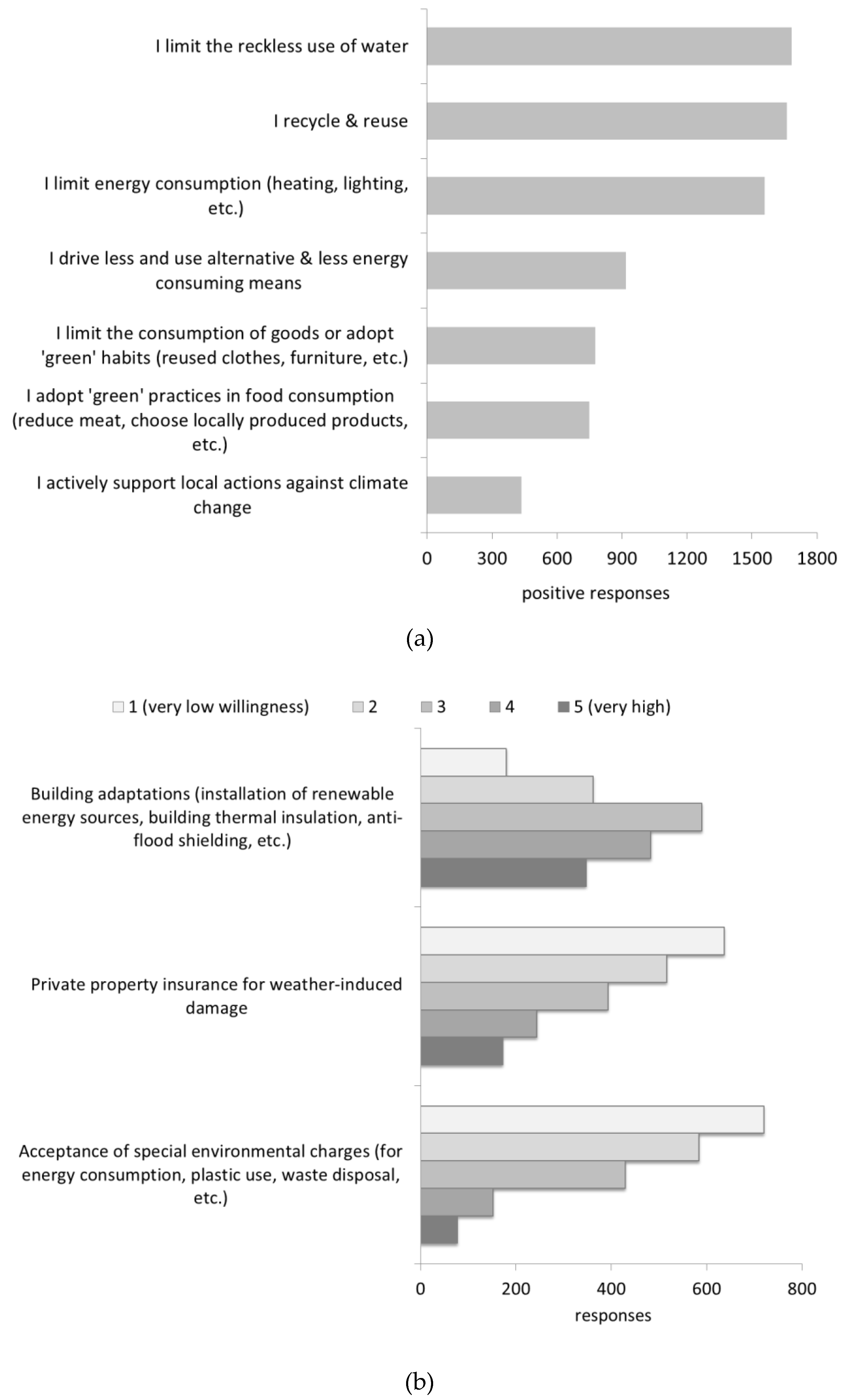
Figure 2.
Mean literacy on the risks associated with CC in the Eastern Mediterranean (6 out of 12 CL items) by the professional sector.
Figure 2.
Mean literacy on the risks associated with CC in the Eastern Mediterranean (6 out of 12 CL items) by the professional sector.
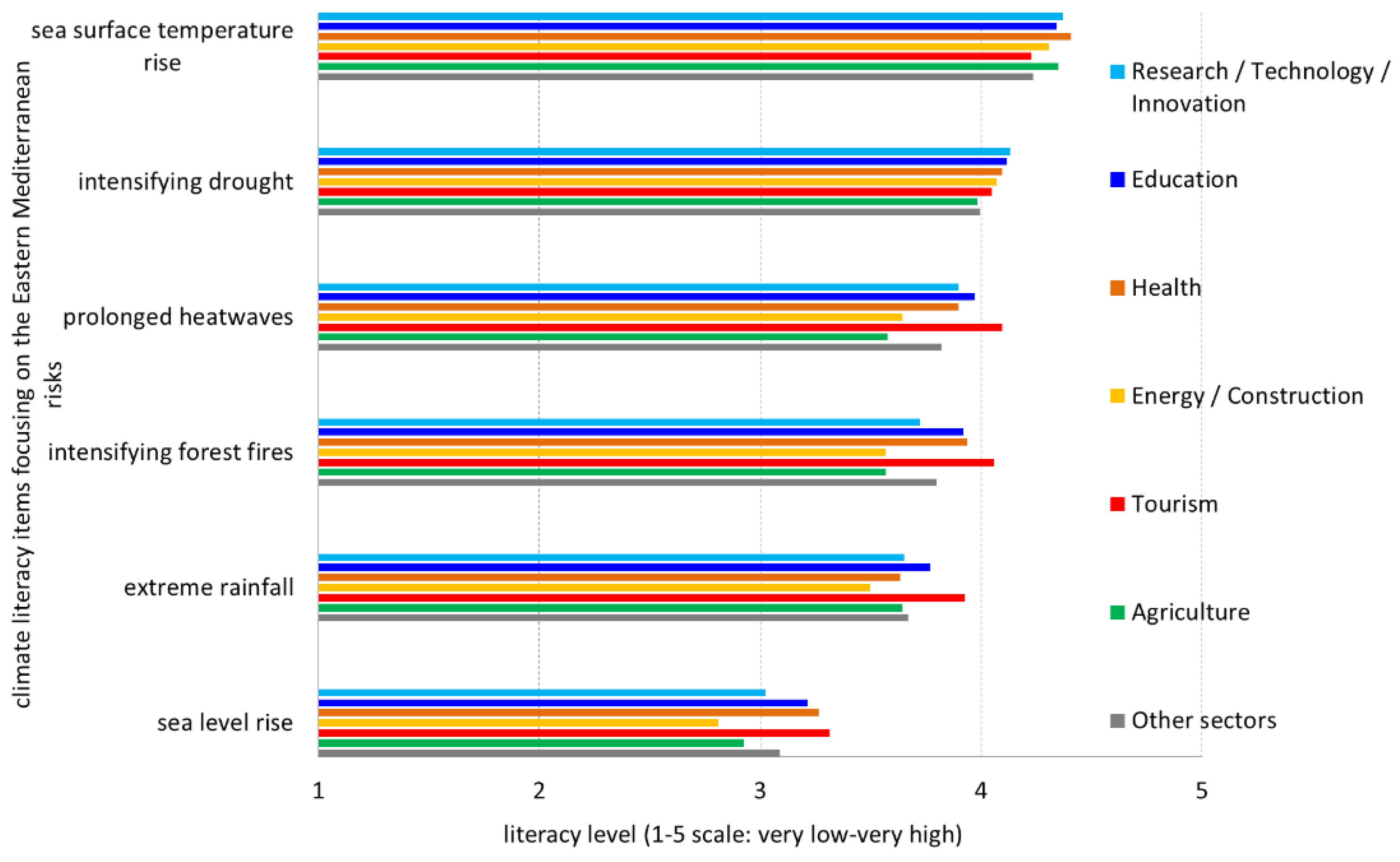
Figure 3.
Mean impact suffered by the affected sample population by phenomenon (coexistence of phenomena is not considered).
Figure 3.
Mean impact suffered by the affected sample population by phenomenon (coexistence of phenomena is not considered).
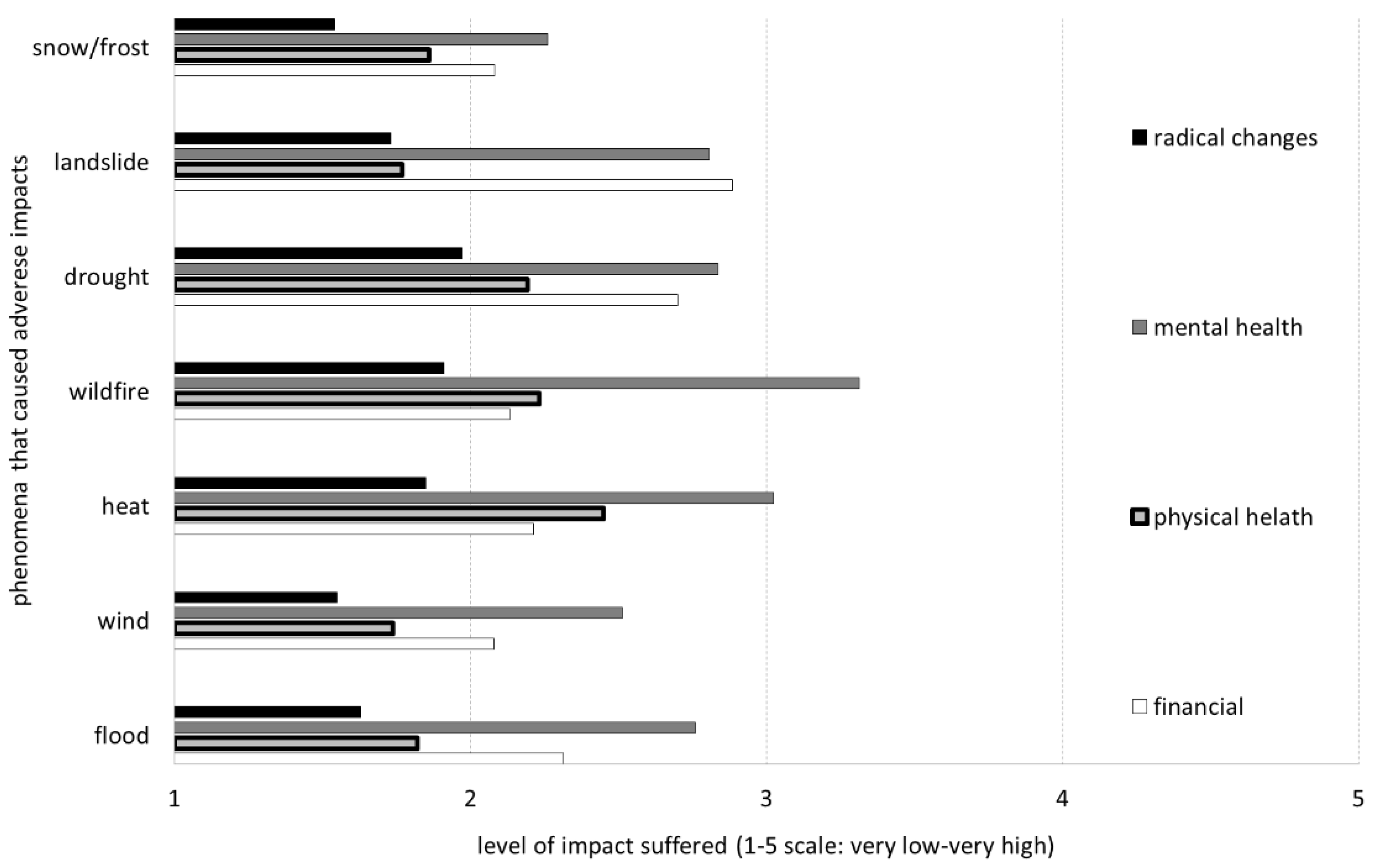
Table 1.
Statistics (n, mean, standard deviation (SD), min, max and psychometric scales reliability).
Table 1.
Statistics (n, mean, standard deviation (SD), min, max and psychometric scales reliability).
| Variable (n) | Mean | SD | min | max | Cronbach's a 1/ Factor item loadings 2 |
|---|---|---|---|---|---|
| Literacy-related (1962) | |||||
| climate literacy3 (CL) | 3.75 | 0.77 | 1 | 5 | N/A |
| self-evaluation | 3.40 | 0.97 | 1 | 5 | N/A |
| policy literacy4 | 2.93 | 1.12 | 0 | 4 | N/A |
| Attitudes (1962) | |||||
| disbelief | 2.01 | 0.90 | 1 | 5 | 0.77/(4 items: 0.60-0.77) |
| adaptation concern | 2.89 | 1.22 | 1 | 5 | 0.85/(3 items: 0.74-0.85) |
| personal impact concern | 2.81 | 1.04 | 1 | 5 | 0.88/(3 items: 0.75-0.86) |
| coping appraisal | 2.44 | 0.82 | 1 | 5 | 0.68/(2 items) |
| trust in state | 1.82 | 0.78 | 1 | 5 | 0.82/(2 items) |
| trust industry | 1.69 | 0.68 | 1 | 5 | 0.86/(2 items) |
| trust in science | 3.35 | 1.20 | 1 | 5 | 0.93/(2 items) |
| Adverse Experience | |||||
| experience (1962) | 0.40 | 0.49 | 0 | 1 | N/A |
| extent (792)5(average of the four items:) | 2.18 | 0.81 | 1 | 5 | N/A |
| financial | 2.25 | 1.08 | 1 | 5 | N/A |
| health | 1.97 | 1.07 | 1 | 5 | N/A |
| mental health | 2.81 | 1.25 | 1 | 5 | N/A |
| radical changes | 1.71 | 1.06 | 1 | 5 | N/A |
| ‘Greening’ behaviours (1962) | |||||
| 'greening' level (GL) | 3.96 | 1.52 | 1 | 7 | N/A |
| willingness to pay (WP) | 2.58 | 0.89 | 1 | 5 | N/A |
1. Cronbach’s α > 0.7 shows a highly reliable scale. 2. Loadings > 0.60 are accepted. N/A if PFA is not applicable. 3. Measured as the average of 12 items (literacy questions), with the scales of FPQs reversed 4. Measured as the sum of the relevant dichotomous items (4 policy-related questions). 5. The 'extent' of the effects concerns the sample that answered positively regarding 'experience', i.e. 792 participants.
Table 2.
Statistics (mean, standard deviation (SD), and scale) and type of question (True or FPQ) for the climate literacy items (12 questions) (n = 1,962).
Table 2.
Statistics (mean, standard deviation (SD), and scale) and type of question (True or FPQ) for the climate literacy items (12 questions) (n = 1,962).
| Climate literacy items | Mean | SD | Min | Max | Type |
|---|---|---|---|---|---|
| At the global level, about the: | |||||
| 1. role of greenhouse effect on CC | 3.65 | 1.16 | 1 | 5 | TRUE |
| 2. role of fossil fuel combustion on CC | 3.71 | 1.2 | 1 | 5 | TRUE |
| 3. role of CO2 concentration on CC | 3.76 | 1.21 | 1 | 5 | TRUE |
| 4. CC impact on extreme weather events | 3.52 | 1.19 | 1 | 5 | TRUE |
| 5. CC role in temperature rise | 3.71 | 1.26 | 1 | 5 | TRUE |
| 6. rate at which Europe is heating up | 2.19 | 0.95 | 1 | 5 | FPQ |
| On the East Mediterranean and the observed changes in: | |||||
| 7. heatwave duration | 3.84 | 1.14 | 1 | 5 | TRUE |
| 8. drought duration | 1.95 | 1 | 1 | 5 | FPQ |
| 9. extreme rainfall occurrence | 3.67 | 1.13 | 1 | 5 | TRUE |
| 10. forest fire severity | 3.79 | 1.25 | 1 | 5 | TRUE |
| 11. sea level | 3.08 | 1.23 | 1 | 5 | TRUE |
| 12. sea surface temperature | 1.71 | 0.93 | 1 | 5 | FPQ |
Notes: The exact questions are accessible in the Supplementary Material. FPQs 6, 8 & 12 implied that the EU is heating at a lower rate than the global average, drought events become shorter in the East Mediterranean, and the sea surface temperature is decreasing in the same region, respectively.
Table 3.
Regression results for 'greening' behavioural variables.
| Sample population (considering only females & males) | Affected population (i.e., ‘experience’ = 1) | |||
| ‘Greening’ level (GL) | Willingness to pay (WP) | ‘Greening’ level (GL) | Willingness to pay (WP) | |
| climate literacy (CL) | 0.16(0.08)* | 0.32(0.04)*** | 0.23(0.12) | 0.24(0.07)** |
| disbelief | -0.06(0.06) | -0.01(0.03) | 0.01(0.10) | 0.02(0.06) |
| adaptation concern | -0.03(0.03) | -0.03(0.02) | 0.02(0.04) | -0.02(0.03) |
| personal impact concern | 0.19(0.04)*** | 0.15(0.02)*** | 0.24(0.07)*** | 0.20(0.04)*** |
| coping appraisal | 0.08(0.04) | 0.16(0.03)*** | 0.03(0.07) | 0.13(0.04)** |
| trust in state | 0.01(0.05) | 0.11(0.03)*** | 0.02(0.08) | 0.10(0.04)* |
| trust industry | -0.03(0.05) | 0.05(0.03) | -0.08(0.09) | 0.05(0.05) |
| trust in science | 0.07(0.04) | 0.09(0.02)*** | 0.03(0.06) | 0.14(0.04)*** |
| experience | 0.05(0.07) | -0.02(0.04) | extent: 0.12(0.07) | extent: 0.04(0.04) |
| gender | -0.36(0.08)*** | 0.05(0.04) | -0.38(0.13)** | 0.08(0.07) |
| generation | 0.39(0.04)*** | -0.03(0.02) | 0.37(0.07)*** | -0.02(0.04) |
| education | -0.01(0.03) | 0.03(0.02) | 0.01(0.05) | 0.01(0.03) |
| infos | 0.37(0.04)*** | 0.04(0.02)* | 0.37(0.06)*** | -0.01(0.03) |
| urban | -0.07(0.08) | -0.07(0.04) | 0.03(0.12) | -0.07(0.07) |
| constant | 1.47(0.41)*** | -0.09(0.23) | 0.83(0.68) | -0.07(0.39) |
| R-squared | 0.18 | 0.25 | 0.19 | 0.22 |
| Adjusted R-squared | 0.18 | 0.24 | 0.17 | 0.21 |
| VIF | 1.58 | 1.58 | 1.53 | 1.53 |
| No. observations | 1919 | 1919 | 773 | 773 |
Table 4.
Economic significance of the statistically significant variables in the regression models considering the entire sample population.
Table 4.
Economic significance of the statistically significant variables in the regression models considering the entire sample population.
| Predictor variable | Economic significance for GL | Economic significance for WP |
|---|---|---|
| climate literacy (CL) | 3.2% | 9.3% |
| personal impact concern | 5.1% | 6.1% |
| coping appraisal | N/A | 5.1% |
| trust in state | N/A | 3.4% |
| trust in science | N/A | 4.3% |
| infos | 8.6% | 1.6% |
Note: N/A signifies ‘not applicable’ due to non-significant regression results.
Disclaimer/Publisher’s Note: The statements, opinions and data contained in all publications are solely those of the individual author(s) and contributor(s) and not of MDPI and/or the editor(s). MDPI and/or the editor(s) disclaim responsibility for any injury to people or property resulting from any ideas, methods, instructions or products referred to in the content. |
© 2024 by the authors. Licensee MDPI, Basel, Switzerland. This article is an open access article distributed under the terms and conditions of the Creative Commons Attribution (CC BY) license (http://creativecommons.org/licenses/by/4.0/).
Copyright: This open access article is published under a Creative Commons CC BY 4.0 license, which permit the free download, distribution, and reuse, provided that the author and preprint are cited in any reuse.


