

Submitted:
20 August 2024
Posted:
20 August 2024
You are already at the latest version
Abstract
Kagoshima Prefecture, Japan, is highly vulnerable to natural disasters, and requires effective disaster response and rehabilitation measures, particularly for vulnerable populations. This study aimed to investigate the current state of disaster preparedness in municipalities and identify gaps in support for vulnerable populations during disasters. A cross-sectional survey was conducted from January to March 2023, targeting officers in disaster countermeasures-related municipal departments. The survey assessed municipality awareness of vulnerable populations, understanding of their support needs, and the status of support systems during emergency evacuations. Overall, 51.2% of municipalities responded, of whom 86.4% were aware of vulnerable populations in their areas. However, only 54.5% had a clear understanding of their support needs. A small proportion of municipalities (18.2%–36.4%) had comprehensive support systems in place for vulnerable populations during emergency evacuations. Only 4.5% of municipalities were familiar with the concept of disaster rehabilitation, but 63.6% expressed interest in discussing evacuation plans with medical professionals. The findings reveal significant gaps in municipalities’ awareness and preparedness on disaster rehabilitation measures for vulnerable populations. This highlights the need for increased training, resources, and collaboration between local governments and healthcare professionals to ensure the safety and well-being of vulnerable populations during disasters.
Keywords:
Disaster Rehabilitation
; Vulnerable Populations
; Disaster Preparedness
; Local Govern
1. Introduction
Japan’s susceptibility to natural disasters, highlighted by events such as the Great Hanshin-Awaji Earthquake and the Great East Japan Earthquake, has emphasized the urgent need for comprehensive disaster response mechanisms, including for evacuation and rehabilitation [1,2]. These disasters, especially the Great East Japan Earthquake in 2011, revealed significant vulnerabilities in disaster preparedness, particularly on the evacuation of vulnerable populations and the subsequent need for long-term rehabilitation services [3]. These events underscore the critical role of effective disaster rehabilitation programs in fostering recovery and resilience among affected communities.
Kagoshima Prefecture is in a region fraught with geological and industrial hazards, including active volcanoes and nuclear power facilities [4]. It epitomizes the need for a robust disaster response and rehabilitation framework. The presence of the Sendai Nuclear Power Plant, juxtaposed with the volcanic activity of Sakurajima, presents a unique set of challenges and risks, necessitating specialized disaster response and rehabilitation approaches tailored to the prefecture’s distinct landscape and potential hazards [5]. For instance, the eruption of Sakurajima in 2013 resulted in the evacuation of over 3,000 residents and caused significant damage to infrastructure [6]. The prefecture has also experienced numerous earthquakes, such as the 2016 Kumamoto Earthquake, which led to widespread destruction and displaced thousands of people [7].
Disaster rehabilitation, a key component of a comprehensive disaster response, extends beyond immediate medical care to physical, psychological, and social rehabilitation to restore the well-being and functionality of disaster-affected individuals [8,9]. It involves multidisciplinary interventions to address the complex needs arising in the aftermath of disasters, facilitating the reintegration of individuals into their communities and reducing long-term dependency on aid [10]. This requires a wide range of activities, including providing mobility aids, offering mental health support, and assisting in the restoration of livelihoods [11]. Disaster rehabilitation plays a crucial role in helping individuals and communities recover from the traumatic experiences and losses caused by disasters, enabling them to rebuild their lives and enhance their resilience to future problems [12].
The importance of disaster rehabilitation is therefore clear, but there is a notable gap in its integration and implementation at the municipal level within Kagoshima Prefecture. This gap reflects a broader issue within Japan’s disaster response framework, where the focus is predominantly on immediate rescue and relief efforts, often at the expense of long-term recovery and rehabilitation strategies [13]. In this study, we used a descriptive research approach to provide a detailed examination of the current state of disaster response and rehabilitation efforts within Kagoshima Prefecture. This approach allowed a comprehensive understanding of the practical applications, challenges, and effectiveness of disaster response and rehabilitation strategies at the municipal level. This approach is considered appropriate to achieve a comprehensive understanding of the existing conditions, practices, and challenges related to disaster response and rehabilitation in the prefecture.
This study aimed to investigate the preparedness of Kagoshima Prefecture’s municipalities for the rehabilitation needs following disasters. It examined the current status of disaster relief efforts, the extent of municipal awareness, and the readiness of administrative personnel and healthcare professionals to support affected individuals.
The significance of this study lies in its potential to enhance our understanding of disaster rehabilitation needs and capacities within Kagoshima Prefecture. By using a descriptive research methodology, the study aimed to document the existing conditions, identify gaps in disaster rehabilitation work, and provide a basis for the development of more effective strategies. It identified existing gaps and challenges, and therefore contributes to the development of more effective and resilient disaster rehabilitation strategies, ultimately improving the recovery of affected populations and promoting sustainable community resilience in the face of future disasters.
2. Materials and Methods
2.1. Study Design and Setting
This cross-sectional study targeted disaster countermeasures-related departments of municipalities in Kagoshima Prefecture, Japan. This prefecture was chosen as the study site because of its high risk of natural disasters, such as volcanic eruptions and earthquakes, as well as its experience with past disasters, including the Sakurajima volcanic eruption in 2013 and the Kumamoto earthquake in 2016. These experiences highlighted the need for effective disaster response and rehabilitation measures in the prefecture.
This study was conducted from January to March 2023.
2.2. Participants
A survey request document, a consent form, and a letter with the URL and QR code of the survey were mailed to all 43 municipalities in Kagoshima Prefecture. The online survey was created using Google Forms. After the participants responded to the web-based survey, the data were collected by the researcher.
In total, 22 out of the 43 municipalities (51.2%) completed the questionnaire. All respondents were included in the analysis.
2.3. Variables
The survey questionnaire items included geographic area segmentation and identification of people requiring support for evacuation action, such as those needing evacuation support in the community, and assessing the necessary support for people requiring assistance during evacuation. Questions were also asked about the status of the support system for people requiring evacuation assistance at the start of an emergency evacuation, during transportation, and upon arrival at evacuation centers. The survey also inquired about understanding of evacuation routes to evacuation centers, evacuation means, and necessary support and considerations for people requiring evacuation assistance. It also assessed the status of advance preparations to ensure that municipalities will be able to provide the support and care required at evacuation centers for those needing assistance with evacuation actions. These items were selected to comprehensively assess the current state of disaster response and rehabilitation measures for vulnerable populations in the prefecture. For disaster rehabilitation, respondents were asked about their understanding of the term, their interest in discussing evacuation routes and shelters with medical professionals in the future, and the specifics of such discussions. This item was included to gauge the understanding and interest of municipal officers in integrating disaster rehabilitation into their disaster response plans.
2.4. Statistical Analysis
We tabulated descriptive statistics for each questionnaire item, and the percentages for nominal variables were calculated. We analyzed the relationship between the response rate and regional characteristics using QGIS [14]. QGIS is a cross-platform, open-source software GIS (Geographic Information System) application that provides functions for viewing, editing, and analyzing geospatial data. In the GIS, the locations of the Sendai Nuclear Power Plant and volcanoes were plotted, and the response rates were color-coded by their values.
3. Results
3.1. Response Rate and Geographical Distribution of Participating Municipalities
Figure 1 shows the response rate and geographical distribution of the participating municipalities, with darker colors representing higher recovery rates. The overall response rate was 51.2% (22 out of 43 municipalities). The response rates varied across different regions of Kagoshima Prefecture: 40% in the Kagoshima region (including Kagoshima City, Hioki City, Ichiki-Kushikino City, Mishima Village, and Toshima Village), 50% in the Minami-Satsu region (including Makurazaki City, Ibusuki City, Minamikyushu City, and Minamisatsuma City), 60% in the Hoku-Satsu region (including Akune City, Izumi City, Satsuma-Sendai City, Satsuma Town, and Nagashima Town), 50% in the Aira-Isa region (including Kirishima City, Isa City, Aira City, and Yusui Town), 25% in the Osumi region (including Kanoya City, Tarumizu City, Soo City, Shibushi City, Osaki Town, Higashikushira Town, Kinko Town, Minamiosumi Town, and Kimotsuki Town), 25% in the Kumage region (including Iriomote City, Nakatane Town, Minamitane Town, and Yakushima Town), and 67% in the Oshima region (including Amami City, Yamato Village, Uken Village, Setouchi Town, Tatsugo Town, Kikai Town, Tokunoshima Town, Amagi Town, Isen Town, Wadomari Town, China Town, and Yoron Town).
3.2. Awareness of Support Requirements for People Requiring Evacuation Assistance
Nineteen municipalities (86.4%) were aware of people requiring evacuation assistance in more than 50% of their areas. However, only 12 municipalities (54.5%) had an understanding of the necessary support for these individuals in more than 50% of their areas (Table 1).
Only five municipalities (22.7%) reported having more than 50% of the necessary support system for people requiring evacuation assistance during an emergency in place for the start of evacuation, four municipalities (18.2%) during transportation, and five municipalities (22.7%) upon arrival at evacuation centers (Table 1). Eight municipalities (36.4%) had more than 50% understanding of evacuation routes, means of evacuation, and necessary support and consideration for people requiring evacuation assistance (Table 1). Only four municipalities (18.2%) were more than 50% prepared to provide the required support and care at evacuation centers for those needing assistance with evacuation activities (Table 1).
3.3. Current Disaster Response and Rehabilitation Measures for Vulnerable Populations
Only one municipality (4.5%) reported familiarity with the term “disaster rehabilitation” and its implications. Nine municipalities (40.9%) indicated that this survey was the first time that they had heard of disaster rehabilitation (Table 2). This suggests a low level of awareness of disaster rehabilitation among the participating municipalities.
Fourteen municipalities (63.6%) expressed interest in discussing evacuation routes and shelters with medical professionals in the future (Table 2). This highlights the potential for collaboration between municipalities and the medical community in enhancing disaster response and rehabilitation measures.
4. Discussion
This cross-sectional study aimed to investigate the current state of disaster response and rehabilitation measures for vulnerable populations in Kagoshima Prefecture, Japan. The survey targeted officers in disaster countermeasures-related municipal departments, and achieved a response rate of 51.2%. The findings underscore the need for increased awareness and understanding of disaster rehabilitation among municipalities in Kagoshima Prefecture. The low level of preparedness in providing support for people requiring evacuation assistance, coupled with the limited familiarity with disaster rehabilitation, suggests significant room for improvement in the current disaster response and rehabilitation measures for vulnerable populations. These results align with the broader challenges identified in Japan’s disaster response framework. A previous study emphasized the need for a more comprehensive approach to disaster risk reduction, including a focus on vulnerable populations [15].
Figure 1 shows the differences in the response rates to this study across different regions. Kagoshima Prefecture has 11 active volcanoes. Of these, five—Kirishima, Sakurajima, Satsuma-Iojima, Kuchinoerabu-jima, and Suwanosejima—are designated as “continuously monitored volcanoes” by the Japan Meteorological Agency, which conducts 24-hour observation and monitoring of volcanic activities [16]. The presence of the Sendai Nuclear Power Plant in the prefecture suggests a need for heightened awareness of not only natural disasters such as volcanic eruptions but also nuclear disasters. Our survey showed relatively high response rates in the mainland areas that face these risks. However, there was a significant difference in the response rates between the island regions of Kumage and Oshima. The low response rate in the Kumage region may be attributed to the ease of evacuation to the mainland. However, other factors such as population composition and differences in disaster prevention systems should also be considered. Oshima region is a long way from the Kagoshima Prefecture mainland, and may have a higher level of disaster awareness due to the need to handle its own disaster response. Past disaster experiences and the strength of community ties may also contribute to heightened awareness of disaster prevention. However, it is important to note that the differences in response rates may be influenced by a complex interplay of various factors, including geographical characteristics, disaster risks, the disaster prevention policies of each municipality and the characteristics of the residents. Future research should consider a multifaceted analysis to clarify the characteristics of disaster prevention awareness and systems in each region. It is also necessary to consider the impact of the differences in response rates on the interpretation of our results. The study may not adequately reflect the actual state of disaster rehabilitation in regions with low response rates, and caution should be exercised when generalizing the results.
These findings provide important insights into the current status and challenges of disaster rehabilitation in Kagoshima Prefecture. However, further investigations and analyses are needed to gain a deeper understanding of the characteristics of each region. Future research should explore the factors contributing to the differences in response rates and examine in detail the disaster prevention systems, residents’ awareness, and rehabilitation initiatives in each region. The survey showed that a high percentage of municipalities (86.4%) were aware of people requiring evacuation assistance in their areas, but only about half (54.5%) had a clear understanding of the support required by these individuals. This discrepancy suggests that even when municipalities recognize the presence of vulnerable populations, they may lack the knowledge or resources to provide adequate support during emergency evacuations. Similar findings were reported in a previous study, highlighting the gap between awareness and preparedness in local governments’ support for vulnerable populations during disasters [17]. The authors of that study argued that this gap could be attributed to a lack of comprehensive guidelines and training programs for local officials.
We found that only a small proportion of municipalities (ranging from 18.2% to 36.4%) had comprehensive support systems in place for people requiring evacuation assistance during different stages of an emergency evacuation. This result underscores the need for municipalities to develop and implement more robust support mechanisms to ensure the safety and well-being of vulnerable populations during disasters. The importance of these mechanisms has been emphasized in several studies examining the challenges faced by vulnerable populations in past disasters [18,19,20]. For instance, a previous study conducted interviews with older people who survived the Great East Japan Earthquake and found that many faced difficulties during evacuation due to limited support from local authorities [19,20].
Another notable finding in our study was the low level of familiarity with the concept of disaster rehabilitation among the surveyed municipalities. Only one municipality (4.5%) reported a clear understanding of the term and its implications. A significant proportion (40.9%) indicated that the survey was the first time that they had heard of disaster rehabilitation. This lack of awareness suggests that the concept of disaster rehabilitation has not yet been widely integrated into the disaster management plans and practices of municipalities in Kagoshima Prefecture. A similar finding was reported in a study that surveyed disaster relief workers and found a limited understanding of the role of rehabilitation in disaster response [11]. The authors argued that this lack of awareness could lead to an underutilization of rehabilitation services in post-disaster settings.
We found that a majority of municipalities (63.6%) expressed an interest in discussing evacuation routes and shelters with medical professionals in the future. This willingness to engage with the medical community presents an opportunity for collaboration and knowledge exchange, which could lead to the development of more comprehensive and effective disaster response and rehabilitation measures. The importance of collaboration between local governments and healthcare professionals in disaster preparedness and response has been highlighted in previous research [11,12]. For example, a previous study proposed a framework for integrating medical rehabilitation into disaster response plans, emphasizing the need for close coordination between rehabilitation professionals and local authorities [12].
Our findings have important implications for policy and practice on disaster management in Kagoshima Prefecture and potentially other regions of Japan. The results suggest that there is a need for increased training and resources for municipal officers to enhance their understanding of the needs of vulnerable populations and the importance of disaster rehabilitation. The development of standardized guidelines and protocols for supporting people requiring evacuation assistance could help to ensure a more consistent and effective response across municipalities. These recommendations are in line with those made by previous studies, which have called for the development of evidence-based guidelines and training programs to improve disaster preparedness and response for vulnerable populations [21,22].
One of the strengths of our study was its focus on the often-overlooked issue of disaster rehabilitation in the context of local government preparedness. By highlighting the current gaps in awareness and preparedness, it provides valuable insights that can inform future research and policy initiatives. However, the study also has some limitations that should be acknowledged. First, the response rate of 51.2%, although acceptable for a survey of this nature, may limit the generalizability of the findings. Second, the study relied on self-reported data from municipal officers, which may be subject to response bias. Future research could employ additional data collection methods, such as interviews or observations, to triangulate the findings.
5. Conclusions
This study found significant gaps in the awareness and preparedness of municipalities in Kagoshima Prefecture on disaster response and rehabilitation measures for vulnerable populations. The findings highlight the need for increased training, resources, and collaboration between local governments and healthcare professionals to ensure the safety and well-being of people requiring evacuation assistance during disasters. By addressing these gaps, Kagoshima Prefecture could become a model for other regions in Japan and beyond, promoting a more inclusive and resilient approach to disaster management.
Author Contributions
Conceptualization, F.M and N.Y.; methodology, F.M. and Y.M; validation, T.Y.; formal analysis, F.M.; investigation, F.M; resources, F.M; data curation, F.M; writing—original draft preparation, F.M. and T.Y; writing—review and editing, T.Y.; visualization, T.Y.; supervision, T.Y. and Y.M; project administration, Y.M.; funding acquisition, Y.M. All authors have read and agreed to the published version of the manuscript.
Funding
This research was funded by JSPS KAKENHI, grant number 21K11113 and the Research and Education Center for Natural Hazards, Kagoshima University.
Institutional Review Board Statement
This survey targeted individual municipalities and investigated their preparedness and systems related to evacuation. Therefore, the Kagoshima University Ethics Review Committee determined that it was not ethically reviewable (Project No. 240056 Epid). However, we took careful measures to ensure the non-identifiability of individual municipalities. Participation in the survey was considered as implied consent upon completion and submission of the questionnaire. We did not collect any information that could link the responses to the respondents. Therefore, we informed the participants that it would not be possible to identify or withdraw (destroy) their submitted questionnaires later and requested their responses accordingly.
Informed Consent Statement
Informed consent was obtained from all of the participants involved in the study.
Data Availability Statement
All data are available from the corresponding author upon reasonable request.
Acknowledgments
We thank all of the study participants. We also thank Melissa Leffler, MBA, from Edanz (https://jp.edanz.com/ac) for editing a draft of this manuscript.
Conflicts of Interest
The authors declare no conflict of interest.
References
- Okada, N.; Tao, Y.; Kajitani, Y.; Shi, P.; Tatano, H. The 2011 Eastern Japan Great Earthquake Disaster: Overview and Comments. International Journal of Disaster Risk Science 2011, 2, 34–42. [Google Scholar] [CrossRef]
- Sugimoto, A.; Krull, S.; Nomura, S.; Morita, T.; Tsubokura, M. The Voice of the Most Vulnerable: Lessons from the Nuclear Crisis in Fukushima, Japan. Bull. World Health Organ. 2012, 90, 629–630. [Google Scholar] [CrossRef] [PubMed]
- Kawachi, I.; Aida, J.; Hikichi, H.; Kondo, K. Disaster Resilience in Aging Populations: Lessons from the 2011 Great East Japan Earthquake & Tsunami. J. R. Soc. N. Z. 2020, 50, 263–278. [Google Scholar] [CrossRef] [PubMed]
- Gomez, C. Digital Photogrammetry and GIS-Based Analysis of the Bio-Geomorphological Evolution of Sakurajima Volcano, Diachronic Analysis from 1947 to 2006. J. Volcanol. Geotherm. Res. 2014, 280, 1–13. [Google Scholar] [CrossRef]
- Deguchi, K. Development of a Ventilation System against Volcanic Ash Fall in Kagoshima. Energy Build. 1991, 16, 663–671. [Google Scholar] [CrossRef]
- Japan Meteorological Agency Volcanic activity of Sakurajima Volcano - September 2013. Available online: https://www.data.jma.go.jp/svd/vois/data/tokyo/STOCK/monthly_v-act_doc/fukuoka/13m09/506_13m09.pdf (accessed on 11 March 2023).
- Cabinet Office, Government of Japan Summary of damage situation in the Kumamoto Earthquake. Available online: https://www.bousai.go.jp/updates/h280414jishin/pdf/h280414jishin_39.pdf (accessed on 11 March 2024).
- World Health Organization WHO’s Six-Year Strategic Plan to Minimize the Health Impact of Emergencies and Disasters: 2014-2019. Available online: https://www.socialscienceinaction.org/resources/whos-six-year-strategic-plan-to-minimize-the-health-impact-of-emergencies-and-disasters-2014-2019/ (accessed on 6 March 2024).
- Amatya, B.; Lee, S.Y.; Galea, M.P.; Khan, F. Disaster Rehabilitation Response Plan: Now or Never. Am. J. Phys. Med. Rehabil. 2020, 99, 170–177. [Google Scholar] [CrossRef] [PubMed]
- Cordero-Reyes, A.M.; Palacios, I.; Ramia, D.; West, R.; Valencia, M.; Ramia, N.; Egas, D.; Rodas, P.; Bahamonde, M.; Grunauer, M. Natural Disaster Management: Experience of an Academic Institution after a 7.8 Magnitude Earthquake in Ecuador. Public Health 2017, 144, 134–141. [Google Scholar] [CrossRef] [PubMed]
- Reinhardt, J.D.; Li, J.; Gosney, J.; Rathore, F.A.; Haig, A.J.; Marx, M.; DeLisa, J.A. International Society of Physical and Rehabilitation Medicine’s Sub-Committee on Rehabilitation Disaster Relief Disability and Health-Related Rehabilitation in International Disaster Relief. Glob. Health Action 2011, 4, 7191. [Google Scholar] [CrossRef] [PubMed]
- Rathore, F.A.; Gosney, J.E.; Reinhardt, J.D.; Haig, A.J.; Li, J.; DeLisa, J.A. Medical Rehabilitation after Natural Disasters: Why, When, and How? Arch. Phys. Med. Rehabil. 2012, 93, 1875–1881. [Google Scholar] [CrossRef] [PubMed]
- Kumar, S.; Havey, T. Before and after Disaster Strikes: A Relief Supply Chain Decision Support Framework. Int. J. Prod. Econ. 2013, 145, 613–629. [Google Scholar] [CrossRef]
- QGIS. Available online: https://www.qgis.org/en/site/ (accessed on 12 March 2024).
- Aitsi-Selmi, A.; Egawa, S.; Sasaki, H.; Wannous, C.; Murray, V. The Sendai Framework for Disaster Risk Reduction: Renewing the Global Commitment to People’s Resilience, Health, and Well-Being. International Journal of Disaster Risk Science 2015, 6, 164–176. [Google Scholar] [CrossRef]
- Kagoshima Prefecture Volcano Disaster Preparedness. Available online: https://www.pref.kagoshima.jp/aj01/bosai/sonae/sonae/c-sonae-kazan.html (accessed on 13 March 2024).
- Gowan, M.E.; Sloan, J.A.; Kirk, R.C. Prepared for What? Addressing the Disaster Readiness Gap beyond Preparedness for Survival. BMC Public Health 2015, 15, 1139. [Google Scholar] [CrossRef] [PubMed]
- Ngo Ehren, B. When Disasters and Age Collide: Reviewing Vulnerability of the Elderly. Nat. Hazards Rev. 2001, 2, 80–89. [Google Scholar] [CrossRef]
- Marshall, J.; Wiltshire, J.; Delva, J.; Bello, T.; Masys, A.J. Natural and Manmade Disasters: Vulnerable Populations. In Global Health Security: Recognizing Vulnerabilities, Creating Opportunities; Masys, A.J., Izurieta, R., Reina Ortiz, M., Eds.; Springer International Publishing: Cham, 2020; pp. 143–161. ISBN 9783030234911. [Google Scholar]
- Nomura, S.; Blangiardo, M.; Tsubokura, M.; Nishikawa, Y.; Gilmour, S.; Kami, M.; Hodgson, S. Post-Nuclear Disaster Evacuation and Survival amongst Elderly People in Fukushima: A Comparative Analysis between Evacuees and Non-Evacuees. Prev. Med. 2016, 82, 77–82. [Google Scholar] [CrossRef] [PubMed]
- Phibbs, S.; Kenney, C.; Severinsen, C.; Mitchell, J.; Hughes, R. Synergising Public Health Concepts with the Sendai Framework for Disaster Risk Reduction: A Conceptual Glossary. Int. J. Environ. Res. Public Health 2016, 13. [Google Scholar] [CrossRef] [PubMed]
- Hsu, E.B.; Thomas, T.L.; Bass, E.B.; Whyne, D.; Kelen, G.D.; Green, G.B. Healthcare Worker Competencies for Disaster Training. BMC Med. Educ. 2006, 6, 19. [Google Scholar] [CrossRef] [PubMed]
Figure 1.
Relationship between response rate and geographic information Diamond symbol: Sendai Nuclear Power Plant, Triangle symbol: Volcano.
Figure 1.
Relationship between response rate and geographic information Diamond symbol: Sendai Nuclear Power Plant, Triangle symbol: Volcano.
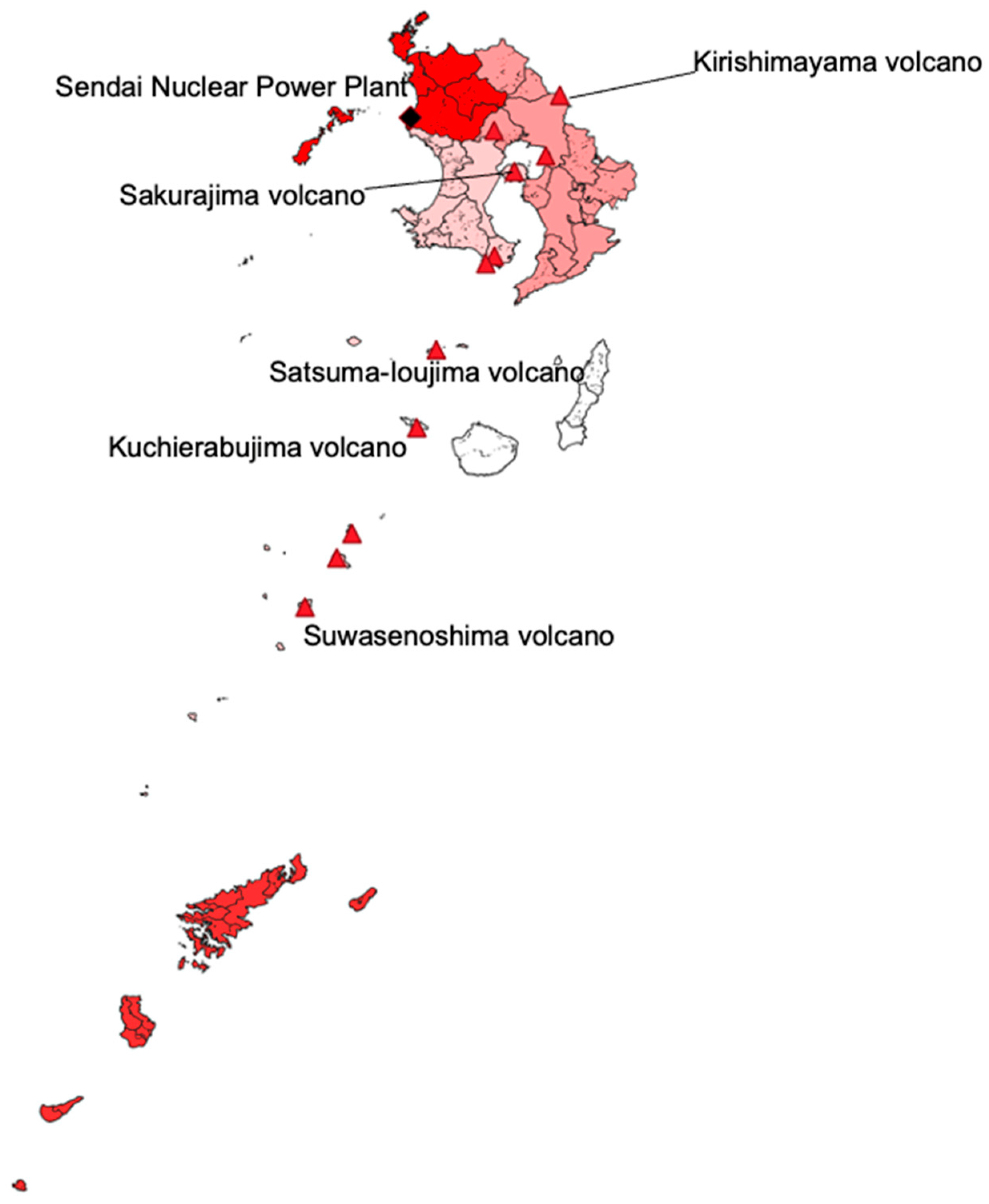

Table 1.
Actual conditions and state of development of support for people with special needs in municipalities.
Table 1.
Actual conditions and state of development of support for people with special needs in municipalities.
| Questions | Options | n | % |
|---|---|---|---|
| Are you aware of people requiring evacuation assistance in your area? | We are aware of almost all of them (90%–100%) | 8 | 36.4 |
| We are aware of most of them (70%–90%) | 9 | 40.9 | |
| We are aware of some of them (50%–70%) | 2 | 9.1 | |
| We are aware of a few (20%–50%) | 1 | 4.5 | |
| We do not know about many (0–20%) | 2 | 9.1 | |
| Do you have an understanding of the necessary support for people requiring evacuation assistance? | We are aware for almost all of them (90%–100%) | 2 | 9.1 |
| We are aware for most of them (70%–90%) | 7 | 31.8 | |
| We are aware for some of them (50%–70%) | 3 | 13.6 | |
| We are aware for a few of them (20%–50%) | 8 | 36.4 | |
| We do not have much information about this (0–20%) | 2 | 9.1 | |
| Do you have a support system in place for people requiring evacuation assistance in the event of an emergency? | |||
| At the start of movement | Yes, for almost all (90%–100%) | 1 | 4.5 |
| Yes, for most (70%–90%) | 2 | 9.1 | |
| Yes, for more than half (50%–70%) | 2 | 9.1 | |
| Yes, for some (20%–50%) | 9 | 40.9 | |
| No, not really (0–20%) | 8 | 36.4 | |
| On the move | Yes, for almost all (90%–100%) | 0 | 0 |
| Yes, for most (70%–90%) | 1 | 4.5 | |
| Yes, for more than half (50%–70%) | 3 | 13.6 | |
| Yes, for some (20%–50%) | 10 | 45.5 | |
| No, not really (0–20%) | 8 | 36.4 | |
| Shelter arrival | Yes, for almost all (90%–100%) | 0 | 0 |
| Yes, for most (70%–90%) | 0 | 0 | |
| Yes, for more than half (50%–70%) | 5 | 22.7 | |
| Yes, for some (20%–50%) | 8 | 36.4 | |
| No, not really (0–20%) | 9 | 40.9 | |
| Do you know the evacuation route to the evacuation site for people requiring evacuation support? | Yes, for almost all (90%–100%) | 1 | 4.5 |
| Yes, for most (70%–90%) | 4 | 18.2 | |
| Yes, for more than half (50%–70%) | 3 | 13.6 | |
| Yes, for some (20%–50%) | 6 | 27.3 | |
| No, not really (0–20%) | 8 | 36.4 | |
| Do you have an understanding of the means of evacuation to the evacuation center for people requiring evacuation assistance? | Yes, for almost all (90%–100%) | 1 | 4.5 |
| Yes, for most (70%–90%) | 2 | 9.1 | |
| Yes, for more than half (50%–70%) | 5 | 22.7 | |
| Yes, for some (20%–50%) | 5 | 22.7 | |
| No, not really (0–20%) | 9 | 40.9 | |
| Do you have an understanding of the necessary support and consideration for people requiring evacuation support at evacuation shelters? | Yes, for almost all (90%–100%) | 1 | 4.5 |
| Yes, for most (70%–90%) | 1 | 4.5 | |
| Yes, for more than half (50%–70%) | 6 | 27.3 | |
| Yes, for some (20%–50%) | 9 | 40.9 | |
| No, not really (0–20%) | 5 | 22.7 | |
| Are you prepared in advance to provide the support and care required at evacuation centers for those who need assistance with evacuation activities? | Yes, for almost all (90%–100%) | 0 | 0 |
| Yes, for most (70%–90%) | 1 | 4.5 | |
| Yes, for more than half (50%–70%) | 3 | 13.6 | |
| Yes, for some (20%–50%) | 10 | 45.5 | |
| No, not really (0–20%) | 8 | 36.4 | |
Table 2.
Recognition of disaster rehabilitation and consideration of evacuation routes and shelters with medical professionals.
Table 2.
Recognition of disaster rehabilitation and consideration of evacuation routes and shelters with medical professionals.
| Question Items | Options | n | % |
|---|---|---|---|
| About disaster rehabilitation | Know the word and know what it means | 1 | 4.5 |
| I know the term, but I don’t know what it actually means | 12 | 54.5 | |
| This is the first time I have heard of disaster rehabilitation | 9 | 40.9 | |
| Are there any evacuation routes or shelters that you would like to discuss with medical professionals in the future? | Yes | 14 | 63.6 |
| No | 8 | 36.4 |
Disclaimer/Publisher’s Note: The statements, opinions and data contained in all publications are solely those of the individual author(s) and contributor(s) and not of MDPI and/or the editor(s). MDPI and/or the editor(s) disclaim responsibility for any injury to people or property resulting from any ideas, methods, instructions or products referred to in the content. |
© 2024 by the authors. Licensee MDPI, Basel, Switzerland. This article is an open access article distributed under the terms and conditions of the Creative Commons Attribution (CC BY) license (http://creativecommons.org/licenses/by/4.0/).
Copyright: This open access article is published under a Creative Commons CC BY 4.0 license, which permit the free download, distribution, and reuse, provided that the author and preprint are cited in any reuse.


