

Submitted:
14 August 2024
Posted:
15 August 2024
You are already at the latest version
Abstract
The digital transformation of the global economy presents new challenges and opportunities for businesses and nations. With the growing role of digital technologies and the dynamic changes in the structure of the economy, there is a need for a better understanding of the processes shaping contemporary enterprises. This article analyzes the impact of digital transformation on businesses and the global economy, identifying key areas where these changes are most evident. As part of this discussion, a modification of the “9 Pillars of Industry 4.0” concept is proposed, incorporating solutions that have emerged since its inception. The resulting model, “11 Pillars of Industry 4.0,” enabled the analysis of the “born digital” and “born global” concepts, highlighting their numerous common features in the context of the digital transformation of economies. This became the basis for proposing a new concept: “born digibal” — enterprises that from the outset operate in multiple markets, with their main sphere of activity based on digital solutions.The conclusions of the article provide an assessment of the changes occurring in businesses and the global economy in the digital age. They suggest that the dynamics of globalization in the 21st century will be shaped by complex interactions between digital transformation and the actions of businesses and nations, requiring flexibility and innovation in adapting to new economic realities.
Keywords:
digitalization
; internationalization
; globalization
; born digital
; born global
; born digibal
Introduction
In the 21st century, the global economy is experiencing a digital revolution that significantly impacts the ways business is conducted worldwide. With the development of information and communication technologies (ICT), an increasing number of enterprises face the necessity of adapting to the digital world to remain competitive in international markets. The concept of "born digital" has become a key term in studies on the internationalization of enterprises, reflecting the growing importance of digital transformation in business processes and global expansion strategies.
The purpose of this article is to explore the relationship between the concepts of "born digital" and “born global” and the internationalization of enterprises in the context of the digital transformation of the global economy. Through the analysis of existing theories and the proposal of modifications to selected concepts, this article aims to understand how businesses utilize digital tools to expand into international markets and the challenges and opportunities this dynamic process entails. We propose a new term, “born digibal,” which refers to enterprises that enter international markets while simultaneously leveraging technological developments by offering services such as online platforms, digital solutions, e-commerce, and digital content. These considerations apply both to the micro (individual enterprise) and macro (entire economy) scales.
1. Digital Transformation as a Harbinger of Changes in Business Operations and the Global Economy
Digitalization is understood as the transformation of an increasing number of processes, actions, and behaviors carried out in the physical world into their virtual counterparts (UNCTAD 2019). This process includes the adaptation of digital technologies in various fields of life and the development of infrastructure enabling the use of these technologies. Digitalization plays a particularly important role in business operations, international trade, and global supply chains.
One of the main distinguishing features of digital transformation is the exponential growth of machine-readable information and digital data transmitted via the internet. This is since the computing power of transistors has grown exponentially over the past few decades, doubling every 24 months according to Moore's Law (Mack 2015). Data, a byproduct of computing power, has become the foundation of all rapidly developing digital technologies, such as data analytics, AI, blockchain, and the Internet of Things (IoT) (UN 2021). The ubiquity of data has led to it being referred to as the "oil of the 21st century," emphasizing its growing impact on many aspects of reality, such as national security, the economy, and human rights (I&JPN 2021). Between 2005 and 2021, the total global cross-border digital data bandwidth increased nearly 400-fold, from 5 Tbps to 1900 Tbps, enabling the dynamic development of digital technologies based on it (UN 2021).
Digitalization refers not only to the evolution and development of digital technologies but also to social, economic, and cultural changes. It is a process in which the use of digital technologies by individuals, companies, governments, and public institutions becomes the driving force behind the entire digital transformation. Thanks to the development of digital technologies, people can not only make purchases and conduct banking transactions but also actively participate in cultural and social life and engage in communication with a wide audience. This technological development also impacts the diversity of forms of learning and acquiring information, both nationally and globally. The beginnings of digitalization were marked by the emergence of the first computers, information systems, and communication networks. The 21st century, therefore, represents a dynamic development of digital technologies, mainly through the expansion of the internet and related services, allowing for the collection, processing, and transmission of information (UNCTAD 2019).
Digital transformations in the social sphere can be illustrated by "milestones" that accompanied this process, including:
- 2001: The bursting of the dot-com bubble, after which capital flowing to companies involved in digital technology development became more specialized, enabling the success of companies like Facebook, Amazon, and Apple.
- 2004: The launch of the social networking service Facebook.
- 2006: The launch of Amazon Web Service's first cloud computing platform.
- 2007: The introduction of one of the first smartphones (iPhone), comparable to contemporary computers.
- Industry 4.0: Automation of work, simulation, system integration, Internet of Things, cybersecurity, cloud computing, additive manufacturing (3D printing), augmented reality, big data.
- The implementation of 5G technology allowing participation in a quasi-real world focused on automated control processes (Bondyra, Zagierski, 2019).
These milestones are just a few examples that indicate how reality is perceived in the 21st century. The emergence of specific technological achievements influences the autonomy of social decisions, which create new needs related to, among others, social relationships, local, national, and international business, which in turn shape opinions and evaluate new opportunities arising from changes.
2. The Concept of 9 Pillars of Industry 4.0 and Its Modification - 11 Pillars of Industry 4.0
In the economic aspect, digital transformation allows for the uniform, exponential development of the internet, which enables the simultaneous growth of enterprises and economies through the network effect (Mack 2015). The dynamic development of new technologies also contributes to the transformation of the nature of enterprises and entire economies.
Considering this, many researchers believe that the world is currently on the verge of significant changes associated with the fourth industrial revolution, suggesting that a significant portion of these changes may occur by around 2030 (Brynjolfsson & McAfee 2014; Schwab 2015; Bughtin, Seong, Manyika, Chui & Joshi 2018). It is also worth noting that the issue of the fifth industrial revolution is already being discussed, which is expected to concern the "harmonious cooperation of humans with machines" (Noble, Mende, Grewal & Parasuraman 2022). However, for most businesses, the challenge still lies in incorporating solutions from the previous iteration. Therefore, in the coming decades, the global economy may undergo significant transformations through the integration of Industry 4.0-related solutions, which will influence both the process and the nature of the participating entities.
The concept that captures the most important issues related to Industry 4.0 is the “9 Pillars of Industry 4.0” (Table 1).
This concept emerged organically during industry conferences in the mid-2010s (MITI 2017) and entered the scientific discourse in 2017 (Erboz 2017). However, it was developed based on issues from the preceding decade (2005-2015), such as Big Data, cybersecurity, cloud computing, which were slowly gaining traction at the time. Considering the recent development of digital technologies in the 2020s, as well as the impact of the pandemic on the rapid adoption of remote work solutions (de Vet, Nigohosyan, Ferrer, Nucciarelli, Maselli & Vanhercke 2021), the “9 Pillars of Industry 4.0” concept no longer fully reflects the reality of modern businesses.
A modification of the 9 Pillars of Industry 4.0 is proposed below, integrating two additional technologies that have significantly impacted the operation of businesses and international supply chains.

Table 2.
11 Pillars of Industry 4.0.
| Technologies | Description |
|---|---|
| Automation | Replacing manual processes with new technologies, enabling faster work while minimizing resource usage. |
| Simulation | The approximate reproduction of processes or behaviors of an element using a defined model and its environment. |
| System Integration | Network connectivity and connection between individual production elements, as well as between traditional levels of production hierarchy. |
| Internet of Things | The concept that any objects can collect, process, and exchange information either indirectly or directly via the Internet. This concept significantly facilitates automation but also business process analysis within the enterprise. |
| Cybersecurity | All protection of data and internal systems from threats arising from cyberattacks, as well as from potential network connectivity, e.g., the Internet. |
| Cloud Computing | The service of providing computing resources over the Internet or a network on the infrastructure of another company. It is characterized by on-demand availability and high scalability. |
| Additive Manufacturing (3D Printing) | The process of producing three-dimensional, physical objects based on a computer model, having a wide range of applications in many fields of science: medicine, construction, prosthetics. |
| Augmented Reality | A system combining the real world with a computer-generated one, often used in modern enterprises for process planning or employee training, and even for training future doctors in complex surgeries. |
| Big Data | A term referring to large datasets, which may not be uniform and whose quantity can change significantly over time (usually increasing). It supports businesses in advanced situation or business analysis. |
| Remote Work | The work of employees outside the physical office of the company, based on modern digital technologies, such as videoconferencing or cloud computing. It gained special significance during the pandemic and became an important component of modern enterprises. |
| Robotics and Autonomous Machines | Various mechanical devices equipped with sensors and control algorithms, capable of performing tasks without direct human intervention. |
[Source: Own elaboration based on Leong, Chuah & Tee 2021; de Vet, Nigohosyan, Ferrer, Nucciarelli, Maselli & Vanhercke 2021].
The first new pillar reflects the rise of remote work as an essential element of modern business. Businesses must be equipped to support remote work efficiently, particularly in a world increasingly reliant on digital technologies and communication tools. The second new pillar, robotics, and autonomous machines, reflect the growing importance of advanced automation solutions in industry and services.
The modification of the “9 Pillars of Industry 4.0” concept to the “11 Pillars of Industry 4.0” allows for a more accurate representation of the current state of digital transformation, which directly impacts the internationalization process of modern enterprises.
3. The Evolution of Internationalization in the Digital Age
The process of enterprise internationalization, originally based on expanding activities in stages across foreign markets, has been modified significantly in recent years due to digital transformation. The traditional model of internationalization assumes that a company first consolidates its position in its home market before gradually expanding to other regions (Johanson & Vahlne 1977). However, as the role of digital technologies has grown, new models of internationalization have emerged.
The concept of "born global" describes companies that, from the very beginning, operate in multiple foreign markets, bypassing the traditional stages of international expansion. These companies often start international operations within a few years of their establishment, often due to the nature of their product or service, as well as the availability of modern digital tools (Knight & Cavusgil 2004).
On the other hand, "born digital" companies are enterprises that rely on digital technologies from the outset to create and deliver products or services. These companies often base their business model on digital platforms, e-commerce, or digital content, making them well-suited to rapid internationalization. However, despite their digital focus, born digital companies do not necessarily operate globally from the outset (Onetti, Zucchella, Jones & McDougall-Covin 2012).
The dynamic development of digital technologies, along with the simultaneous expansion of international markets, has led to the emergence of a new category of enterprises: “born digibal.” These companies combine the characteristics of born global and born digital enterprises, operating from the outset in multiple markets with a strong emphasis on digital solutions. Born digibal enterprises are not only able to operate globally but are also characterized by a high degree of flexibility and adaptability to changing market conditions (Gabrielsson & Gabrielsson 2011).
Born digibal companies often leverage digital platforms to reach customers in different regions, with their primary activities based on online services, cloud computing, data analytics, and other digital technologies. They benefit from the scalability of digital tools, allowing them to expand rapidly into new markets while maintaining a relatively low cost of entry.
Digital transformation is reshaping the global economy and the ways enterprises operate. The rise of born digibal companies represents a significant shift in the internationalization process, driven by the integration of digital technologies and the global nature of modern business.
The modification of the “9 Pillars of Industry 4.0” concept to include remote work and robotics reflects the changing reality of digital transformation, providing a more accurate representation of the factors influencing contemporary enterprises.
The future of globalization will be shaped by the complex interplay between digital transformation, the internationalization strategies of businesses, and the actions of nations. Enterprises must be flexible and innovative in adapting to these new realities, leveraging digital tools to expand into international markets and remain competitive in a rapidly changing world. The rise of born digibal companies highlights the need for a new approach to internationalization in the digital age, one that embraces the opportunities and challenges of operating in a global, digitally interconnected economy.
4. The Impact of Digitalization on Business Operations and Internationalization - Born Global, Born Digital …Born Digibal?
The development of new technologies in the economic context is a significant and influential element at the micro, mezzo, and macro levels. According to theories of internationalization, a company’s entry into a new market is characterized by a process involving various stages. An example of such a sequence is the Uppsala model, proposed in the 1970s, which suggests a four-stage process for entering new markets: (1) sporadic export, (2) export through an independent agent, (3) establishing a foreign sales subsidiary, foreign production/processing, and (4) direct establishment of a subsidiary in the host country (Johanson, Vahlne 1977). The authors of the model did not ignore the changes accompanying the evolution of business approaches and, importantly, digitalization, proposing an updated model 40 years later. Despite presenting internationalization as a phased, gradual theory (the Uppsala model and its further modifications), with technological advancement, researchers recognized the need to include newly emerging technological factors, especially concerning small and medium-sized enterprises (Limański, Drabik, 2017).
In the context of internationalization and its contemporary trends, the concepts of born globals and born digital should be mentioned. Born globals, literally translated as "globally born" companies, describe the phenomenon of entering/presence in multiple markets from the start of operations, internationalizing within a few years of founding, or entering multiple new markets simultaneously. This stands in stark opposition to the classical approach, which assumes market entry like “ripples in water,” considering numerous factors such as geographical, psychological, cultural, and institutional distance. The significant number of companies expanding their operations in foreign markets under the born global trend may be due to (1) new market conditions, (2) technological advancements in production, and (3) the developed capabilities of business owners (Madsen, Servais 1997). Some of the first companies representing this approach include Google (internet search engine, founded in 1998), Skype (internet communicator, beta version launched in 2003, official version in 2004), Spotify (Swedish music distribution service, founded in 2006), and Airbnb (online lodging search engine, founded in 2008). For example, Skype can be characterized as a globally born company due to its bypassing of the processual elements of internationalization and starting globally by developing a foreign expansion strategy. The service recorded a significant number of (free) program downloads in its first year of operation, with the idea of Skype being to connect people worldwide, thus inherently defining a presence in multiple markets simultaneously. The mentioned examples of companies were founded after 2000, during the internet era, and entered several markets simultaneously. Born globals begin globally and non-locally, gradually gaining experience in the markets they intend to enter.
The second term under consideration is born digital, describing companies that are digital from their inception or are transformed into digital entities. Examples of products or services characterized by this trend include e-books, online document archives, websites, apps, and online music and movies. Companies that have excellently leveraged contemporary technological opportunities include (previously mentioned) Google, Amazon (initially an online bookstore that evolved into a platform selling various products, founded in 1994), Uber (a mobile app for car transport, founded in 2009), and Facebook (a social networking site, founded in 2004). Born digital companies are internally diverse and can be categorized as shown in Table 3:
The table shows four types of digital activities, each further divided into subcategories corresponding to their operational directions. However, this division does not imply that a company's activities can be matched to just one category/subcategory. Some companies flexibly change their business profile or can simultaneously be assigned to a specific type/subgroup (Ye, Kang, Scott-Kennel, 2022).
In the context of internationalization for born globals and born digital companies, differences and similarities related to the presence in multiple markets from inception and the use of digital technologies should be compared. In our considerations, we propose the following comparison described in Table 4:
The comparison of born global and born digital companies allowed for the following conclusions: digital companies, according to their definition and development direction, usually inherently aim to operate globally. We propose a new term, "born digibal," combining the two previous concepts for companies that are digital from the start and operate on an international scale. The combination of these terms can be seen as a complement or expansion of the mutual relations involved in entering or being present in multiple markets while operating digitally. Examples of born digibal companies are:
- Alibaba (Aliexpress) - e-commerce platform (China)
- Facebook - social networking service (United States)
- Displate - poster production company (Poland)
Figure 1.
Born Digibal. [Source: Own elaboration].
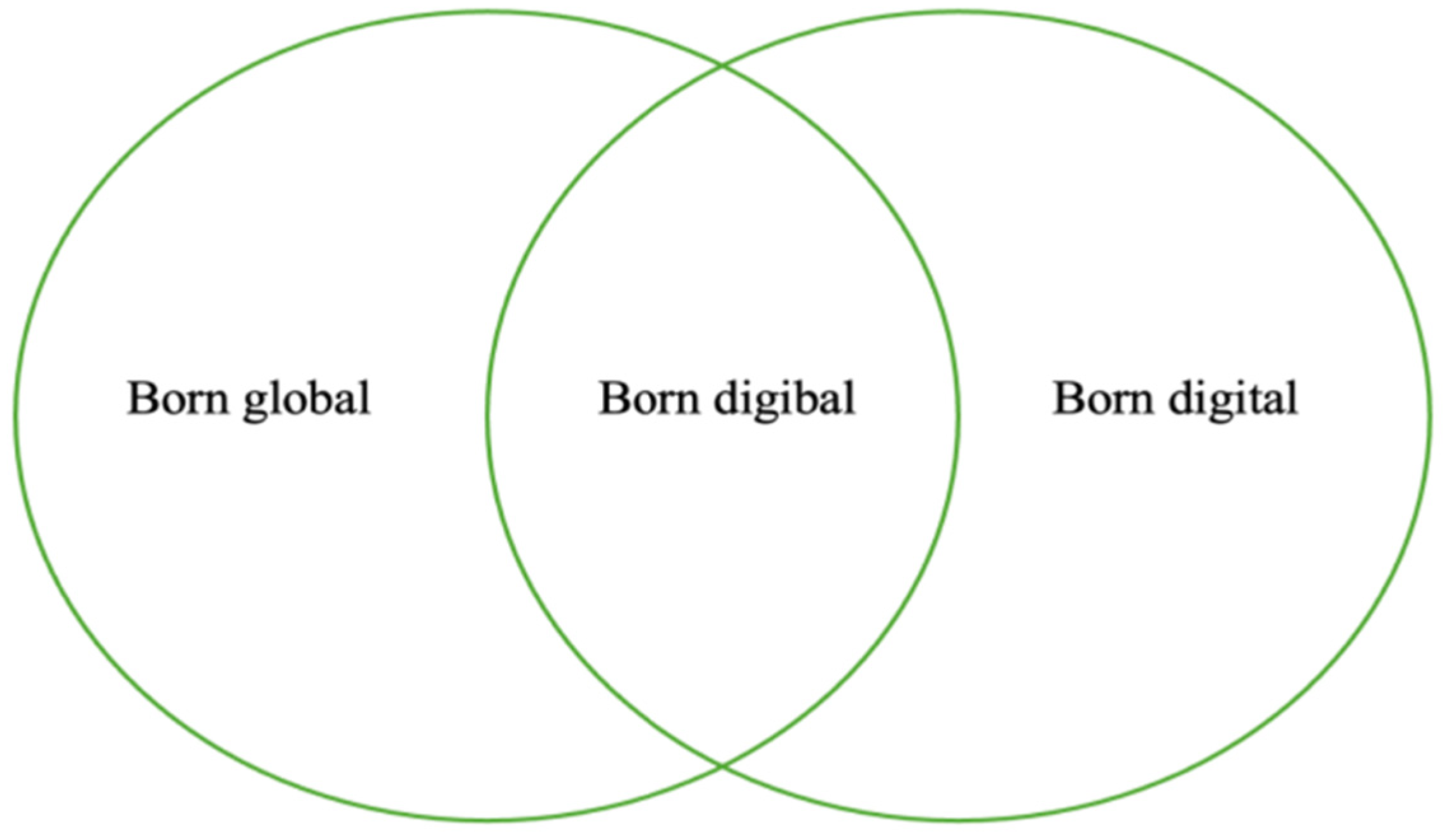
The characteristics of the born global and born digital approaches include the presence in multiple markets from the start of operations and conducting business digitally, offering internet services, digital products, having a digital sales model, or offering a digital product (e.g., apps). Not every global company is digital, just as not every company offering digital solutions needs to operate internationally. However, we suggest that digital companies are more likely to propose standardized products that can be accepted in the global market.
5. Consequences of Digital Transformation for the Global Economy
The dynamic development of digital technologies will significantly impact the existing business model of enterprises and transnational corporations (TNCs), nation-states, and the entire global economy over the coming decades. For international companies, it can be assumed that they will increasingly rely less on outsourcing production in industrializing countries. This is due to growing geopolitical tensions, a desire to reduce supply chain risks, and the opportunities offered by telemigration, work automation, and 3D printing (Wohlers et al., 2020). The growing potential of the Internet of Things will, in turn, encourage deeper cooperation among highly integrated regional states, facilitating the introduction of necessary regulations and standards, contributing to the creation of local clusters. On the other hand, as more activities move to the virtual world, there will be increased use of telemigrants, and blockchain technology will encourage a shift in the fundamental form of foreign investment. Instead of foreign direct investment (FDI) traditionally tied to production activities, portfolio investments and other intangible assets that facilitate tax avoidance by TNCs will gain importance (Trentini 2021). Born digibal companies will also follow many of these trends. Thanks to their flexibility regarding adaptation and standardization, they will be able to skip most of the previous internationalization sequences by starting operations in multiple markets simultaneously, and their close connection to digital technologies will allow them to grow dynamically in scale.
The consequences for nation-states will largely depend on their current level of development, although many patterns will be common to most of them. Work automation and telemigration will pose greater challenges for developed countries than for industrializing and developing countries. Considering the lower labor costs in developing countries, telemigrants from these regions will be able to compete with robots on price for longer than workers in developed countries, who will face the issue of technological unemployment. To avoid increasing social unrest, developed countries will be forced to expand their social safety nets, which will, in turn, require higher taxation of TNCs—further fueling their efforts to avoid taxation (Rodrik & Stantcheva 2021). 3D printing, on the other hand, may deprive many developing countries of their competitive advantage in the form of low production costs, which has attracted numerous FDIs since the 1990s. The Internet of Things threatens to deepen technological inequalities as its efficient functioning requires highly developed digital infrastructure, which is absent in most catching-up economies (Gillpatrick, Boga & Aldanmaz 2022). These solutions, however, will provide an attractive niche in which new-born digibal enterprises can develop, based on the 11 pillars of Industry 4.0.
This will lead to significant changes in the entire global economy. The reduction of international activity by traditional TNCs will likely result in stagnation or a decline in aggregates considered indicators of the globalization process, particularly concerning goods exports and FDI flows (Javorcik 2022). On the other hand, the importance of digital services will increase, facilitating the scale-up of smaller enterprises without the necessity of establishing an extensive foreign presence, traditionally associated with entering new markets. The share of digitally delivered services in global trade already reached nearly 30% in 2020, but further growth will require reducing existing non-tariff barriers, particularly those related to digital protectionism (UNCTAD 2023). While the trend towards increased protectionism will likely continue in the physical world, many developing countries will try to create an open environment to take advantage of telemigration and Industry 4.0. These trends will favor born digibal companies that already have a clear advantage over traditional enterprises in scale, scope, and speed of operations. However, they will also require the adoption of more comprehensive regulations on digital activity, including those on personal data security and cybersecurity, ensuring the benefits of born digibal companies' activities are not confined solely to shareholders and can be shared with other participants in the economy (Rymarczyk, Nowara & Kamińska 2022).
Summary
The globalization process, despite its gradual retraction in favor of digitalization, will continue to shape the world economy for the foreseeable future. Digital solutions will increasingly replace traditional business models, both in the context of traditional companies and enterprises classified as born global, born digital, or born digibal. Enterprises that enter multiple markets from the start and operate primarily digitally will play a significant role in the digital transformation of the global economy. Their development will be shaped by the impact of new technologies and the changing rules of international trade, including the increase in digital protectionism. At the same time, work automation and 3D printing will significantly reduce the benefits of international division of labor, especially in industrialized countries. With the growing potential of telemigration and work automation, we propose a new category of enterprises born digibal. This term, combining born global and born digital, is meant to describe companies that are digital from their inception and operate on an international scale. Their development, flexibility in adaptation and standardization, and focus on global markets from the start position them as a new generation of enterprises driving the future digital economy. Their success will depend on their ability to navigate an increasingly complex and regulated global digital landscape, where the benefits of their innovations must be balanced against the needs of society at large.
References
- Altman, S.A.; Bastian, C.R. DHL Global Connectedness Index 2022. DHL Deutsche Post: Bonn, 2022. [Google Scholar]
- Bondyra, K.; Zagierski, B. Przemysł 4.0: na jakim etapie przemysłowej rewolucji znajduje się województwo wielkopolskie? Publikacja na podstawie ekspertyzy wykonanej na zlecenie Wielkopolskiego Regionalnego Obserwatorium Regionalnego. Wielkopolskie Regionalne Obserwatorium Terytorialne. Departament Polityki Regionalnej. Urząd Marszałkowski Województwa Wielkopolskiego. 2019. [Google Scholar]
- Brynjolfsson, E.; McAfee, A. The Second Machine Age: Work, Progress, and Prosperity in a Time of Brilliant Technologies. Norton & Company: New York, 2014. [Google Scholar]
- Bughtin, J.; Seong, J.; Manyika, J.; Chui, M.; Joshi, R. Notes from the AI frontier: Modeling the impact of AI on the world economy. McKinsey Global Institute Discussion Paper; September 2018. [Google Scholar]
- Casella, B.; Bolwijn, R.; Moran, D.; Kanemoto, K. Improving the analysis of global value chains: the UNCTAD-Eora Database. Transnational Corporations 2019, 26, 115–142. [Google Scholar] [CrossRef]
- Cieślik, J. Internacjonalizacja polskich przedsiębiorstw. Aktualne tendencje–implikacje dla polityki gospodarczej. Akademia Leona Koźmińskiego: Warszawa, 2010. [Google Scholar]
- Dingel, J.I.; Neiman, B. How Many Jobs Can be Done at Home? Becker Friedman Institute White Paper. 2020. [Google Scholar]
- Erboz, G. How To Define Industry 4.0: Main Pillars Of Industry 4.0. Slovak University of Agriculture in Nitra: Nitra, 2017. [Google Scholar]
- European Union. Informal meeting of the Heads of State or Government: Versailles Declaration. European Union: Versailles, 2022. [Google Scholar]
- Gillpatrick, T.; Boga, S.; Aldanmaz, O. How Can Blockchain Contribute to Developing Country Economies? A Literature Review on Application Areas. Economics 2022, 105–128. [Google Scholar] [CrossRef]
- International Monetary Fund. World Economic Outlook: A Rocky Recovery. International Monetary Fund: Washington, DC, 2023. [Google Scholar]
- Internet & Jurisdiction Policy Network. We Need to Talk About Data: Framing the Debate Around the Free Flow of Data and Data Sovereignity. Internet & Jurisdiction Policy Network: Paris, 2021; 16. [Google Scholar]
- Javorcik, B. Globalisation, digitalisation and the green transition. 2022. Available online: https://www.undp.org/eurasia/blog/globalisation-digitalisation-and-green-transition (accessed on 24 April 2024).
- Johanson, J.; Vahlne, J.E. The Internationalization Process of the Firm—A Model of Knowledge Development and Increasing Foreign Market Commitments. 1977. [Google Scholar]
- Johanson, J.; Vahlne, J.E. The Uppsala internationalization process model revisited: From liability of foreignness to liability of outsidership. Journal of international business studies 2009, 40, 1411–1431. [Google Scholar] [CrossRef]
- Leong, W.Y.; Chuah, J.H.; Tee, B.T. (Eds.) The Nine Pillars of Technologies for Industry 4.0. The Institution of Engineering and Technology: London, 2021. [Google Scholar]
- Limański, A.; Drabik, I. Koncepcja born globals a etapowa internacjonalizacja przedsiębiorstwa. Zeszyty Naukowe Politechniki Poznańskiej. Organizacja i Zarządzanie 2017, 181–195. [Google Scholar]
- Mack, C. The Multiple Lives of Moore's Law. 2015. Available online: https://spectrum.ieee.org/the-multiple-lives-of-moores-law (accessed on 23 April 2024).
- Madsen, T.K.; Servais, P. The internationalization of small and medium- sized enterprises: a policy perspective. International Business Review 1997, 6, 561–583. [Google Scholar] [CrossRef]
- Ministry of Investment, Trade and Industry. Industry 4.0 Seminar. 2017. Available online: https://www.miti.gov.my/index.php/pages/view/4172 (accessed on 23 April 2024).
- Noble, S.M.; Mende, M.; Grewal, D.; Parasuraman, A. The Fifth Industrial Revolution: How Harmonious Human–Machine Collaboration is Triggering a Retail and Service Revolution. Journal of Retailing 2022, 98, 199–208. [Google Scholar] [CrossRef]
- Osuna, J.; Gutiérrez, C.; Llorente-Cejudo, C.; Valencia-Ortiz, R. Difficulties in The Incorporation of Augmented Reality in University Education: Visions from the Experts. Journal of New Approaches in Educational Research 2019, 8, 126. [Google Scholar] [CrossRef]
- Rodrik, D.; Stantcheva, S. A Policy Matrix for Inclusive Prosperity. NBER Working Paper 28736. 2021. [Google Scholar]
- Ruta, M. How the war in Ukraine is reshaping world trade and investment. 2022. Available online: https://blogs.worldbank.org/developmenttalk/how-war-ukraine-reshaping-world-trade-and-investment17 (accessed on 24 April 2024).
- Schwab, K. The Fourth Industrial Revolution: What It Means and How to Respond. 2015. Available online: https://www.foreignaffairs.com/articles/2015-12-12/fourth-industrial-revolution (accessed on 23 April 2024).
- Trentini, C. A reassessment of UNCTAD’s transnationality indices in the digital economy. Transnational Corporations 2021, 28, 201–216. [Google Scholar] [CrossRef]
- United Nations. Digital Economy Report 2021. Cross-border data flows and development: For whom the data flow. United Nations Conference on Trade and Development: New York, 2021. [Google Scholar]
- United Nations Conference on Trade and Development. Digital Economy Report 2019: Value Creation and Capture: Implications for Developing Countries. United Nations Conference on Trade and Development: New York, 2019. [Google Scholar]
- Wenzel, H.; Smit, D.; Sardesai, S. A literature review on machine learning in supply chain management. Artificial Intelligence and Digital Transformation in Supply Chain Management: Innovative Approaches for Supply Chains 2019, 27, 413–441. [Google Scholar]
- Wohlers, T.T.; Campbell, I.; Diegel, O.; Huff, R.; Kowen, J. Wohlers Report 2020. 3D Printing and Additive Manufacturing: Global State of the Industry. Wohlers Associates: Fort Collins, 2020. [Google Scholar]
- World Trade Organization. World Trade Statistical Review 2022. World Trade Organization: Geneva, 2022. [Google Scholar]
- Ye, M.S.; Kang, Y.; Scott-Kennel, J. Born-digital: The Internationalisation path of digital firms. 2022. [Google Scholar]
Table 1.
9 Pillars of Industry 4.0.
| Technologies | Description |
|---|---|
| Automation | Replacing manual processes with new technologies, enabling faster work while minimizing resource usage. |
| Simulation | The approximate reproduction of processes or behaviors of an element using a defined model and its environment. |
| System Integration | Network connectivity and connection between individual production elements, as well as between traditional levels of production hierarchy. |
| Internet of Things | The concept that any objects can collect, process, and exchange information either indirectly or directly via the Internet. This concept significantly facilitates automation but also business process analysis within the enterprise. |
| Cybersecurity | All protection of data and internal systems from threats arising from cyberattacks, as well as from potential network connectivity, e.g., the Internet. |
| Cloud Computing | The service of providing computing resources over the Internet or a network on the infrastructure of another company. It is characterized by on-demand availability and high scalability. |
| Additive Manufacturing (3D Printing) | The process of producing three-dimensional, physical objects based on a computer model, having a wide range of applications in many fields of science: medicine, construction, prosthetics. |
| Augmented Reality | A system combining the real world with a computer-generated one, often used in modern enterprises for process planning or employee training, and even for training future doctors in complex surgeries. |
| Big Data | A term referring to large datasets, which may not be uniform and whose quantity can change significantly over time (usually increasing). It supports businesses in advanced situation or business analysis. |
[Source: Own elaboration based on Leong, Chuah & Tee 2021].
Table 3.
Categories of "Born Digital" Companies.
| Type | Subcategory | Example Companies |
|---|---|---|
| Online Platforms | Search engines, social networks, other platforms | Facebook, eBay, LinkedIn |
| Digital Solutions | Electronic payments, other digital solutions | PayPal, NetApp, GoDaddy |
| E-commerce | Online retailers, other e-commerce | Amazon, Alibaba |
| Digital Content | Digital media, game information, and data | Tencent, Netflix |
[Source: Ye, Kang, Scott-Kennel, 2022].
Table 4.
Comparison of the Concepts of Born Global and Born Digital.
| Concept | Born Global | Born Digital |
| Short Definition | Companies that engage in international operations shortly after launch. | Companies that are digital from the start, through activities described in Table X. |
| Market Scope | Global | Usually global, due to minimal entry barriers. |
| Technology Impact | Technology can support international operations. | Technology forms the operational foundation. |
| Adaptation/Standardization | Defined from the start for adaptation or standardization of products/services concerning presence in specific markets or initially conceived to function in multiple markets. | Adaptation to the digital environment, usually offering standardized functions in produced products/services. |
Concept Born Global Born Digital [Source: Own elaboration based on: Madsen & Servais, 1997; Cieślik, 2010; UNCTAD, 2019; Ye, Kang & Scott-Kennel 2022]
Disclaimer/Publisher’s Note: The statements, opinions and data contained in all publications are solely those of the individual author(s) and contributor(s) and not of MDPI and/or the editor(s). MDPI and/or the editor(s) disclaim responsibility for any injury to people or property resulting from any ideas, methods, instructions or products referred to in the content. |
© 2024 by the authors. Licensee MDPI, Basel, Switzerland. This article is an open access article distributed under the terms and conditions of the Creative Commons Attribution (CC BY) license (http://creativecommons.org/licenses/by/4.0/).
Copyright: This open access article is published under a Creative Commons CC BY 4.0 license, which permit the free download, distribution, and reuse, provided that the author and preprint are cited in any reuse.


