
Submitted:
23 July 2024
Posted:
08 August 2024
You are already at the latest version
Abstract
While the concept of a circular economy offers the solutions necessary to enable economies to move away from consumptive, wasteful practices and towards more sustainable alternatives, in practise, few economies have been able to transition to circularity. The purpose of this paper is to investigate the feasibility of a circular economy on a small-scale university campus, leveraging both research by sustainability-focused academics, and attitudes of students who generally care more about sustainability than older cohorts [1]. It begins with a literature review based on five identified pillars of circularity [2]: waste management; data management; business operations and infrastructure; policy and regulation; and education and collaboration. A qualitative methodology was adopted, involving a series of interviews with campus representatives either working or researching some element of sustainable circularity. By bringing together dedicated scholars with knowledge and capacity and a motivated consumer target, all in one location, we present a framework for a Campus Circular Economy (CCE) with potential for replication to advance sustainable consumption in campus environments and beyond.
Keywords:
Circularity
; Sustainability
; Campus Circular Economy
; Stakeholder Analysis
Introduction *Cut & Paste new Abstract*
The concept of a circular economy offers the requirements necessary to enable economies to move away from consumptive, wasteful practices and towards more sustainable alternatives. A circular economic model offers a system whereby waste products are repurposed into secondary use products that feed into the production of other products (Lange et al., 2021). The circular model presents opportunity for repurposing waste for further use while the linear system produces futile waste that invites environmental concern (Lange et al., 2021). The purpose of this paper is to investigate the feasibility of circular economy implementation on a small-scale university campus. It begins with an academic literature review based on five identified pillars of circularity: waste management, data management, business operations and infrastructure, policy and regulation,collaboration and education. To expand from the literature, a qualitative methodology was adopted, involving a series of personalized interviews with campus representatives either working or researching some element applicable to circularity.
This paper is based on the feasibility of an approach by Lange et al. (2021), who proposed a pillar system as the most effective method for circular economy implementation, adapted here for a campus context. The feasibility of the five pillars is explored through an analysis of the University of Guelph as an economic unit, its academic stakeholders, and their interactions. Together, they comprise what has the potential to become a Campus Circular Economy (CCE), “leveraging community of researchers ... genz being more open to advancing sustainaility” (gen z reference). specifically for the University of Guelph.
Literature Review
Twenty scholarly journal articles were amassed to compose a literature review. Each article selected contained information relevant to one of the five pillars that compose the framework for the University of Guelph’s campus circular economy. The purpose of deriving information from the journal articles was to assess how circularity has been integrated into working initiatives for organizations in multiple sectors, then to assess the feasibility of applying those concepts to innovate similar initiatives relevant to operations within the University of Guelph.
Pillar 1: Waste Management
Efficient waste management is undoubtedly one of the most crucial components of a successfully operating circular economy. In an environment such as a university campus, food waste and wastewater make up the majority of waste products generated and thus are crucial elements by which to innovate circular initiatives on campus. The Ellen MacArthur Foundation, an organization focused on circularity, describes two pillars relevant to microbiological and biotechnology in a circular economy: biological and technical (O’Connor, 2021). The biological pillar applies to the development of bio-based materials and products, while the technological pillar applies to biotechnological methods applied to increase their durability and longevity (O’Connor, 2021).
The field of biotechnology presents many applications fit to advance the concept of circularity with regard to food waste management. This literature proposes that in order to achieve successful circular waste management, by-products of food waste should be used and coupled with microbial anaerobic digestion techniques to help generate bio-based and degradable materials, that can be used in the pursuit of bio-product development (Cecchi and Cavinato, 2019).
When applied to food waste management, biotechnology delivers the potential to transform waste into valuable resources and sustainable products that support a circular framework. Certain food waste products can be used to generate useful secondary product. For example, the inner membrane of chicken eggshells possesses the correct physical, biological, and chemical properties to be used in animal bone graph development, new tissue generation and 3D printing (Torres-Mansilla et al., 2023).
Further research explored the feasibility of using food waste and wastewater sludge as substrate material for microorganisms whose metabolic activity involves anaerobic digestion and whose metabolic products include biomaterial type substances (Cecchi and Cavinato, 2019). The necessary advancements with this technique are aluminum vessel facilities for sorting and storage (Cecchi and Cavinato, 2019). It was found that the presence of food and water waste in the same vessel was inducing contamination in each simultaneously (Cecchi and Cavinato, 2019). This rendered them useless in regard to their potential as microbial substrates (Cecchi and Cavinato, 2019). The separation of these wastes allows for the extraction of viable liquid fermentation products that can be used to enhance biological nutrient removal (Cecchi and Cavinato, 2019). This ability eliminates the cost of purchasing externally sourced carbon sources for purifying and metabolizing food waste product (Cecchi and Cavinato, 2019).
The Ellen MacArthur Foundation organized a report on waste collection and the management company DeClique; a European start-up who sells the waste it collects from urban environments to third party businesses and manufacturers who transform that waste into new products (Ellen MacArthur Foundation, n.d.). Examples of industry partnerships DeClique has acquired are Rotterzwam which uses old coffee grounds to grow oyster mushrooms, Peelpioneers which uses orange peels to make hand soaps, and De Leckere which uses orange peels to brew orange beer (Ellen MacArthur Foundation, n.d.).
Enzymatic hydrolysis of food waste can be used in a multi-step process for PHA derivation. This introduces different enzymes and lipases that help with the conversion of food and wastewater to viable PHA products that can be used to engineer bioplastics (Tsang et al., 2019). Batch culture treatment is possible to treat compost food waste depending on the types of food ways that there are and carbon sources available for the bacteria (Tsang et al., 2019).
Researchers at the University of Guelph involved in the Guelph Food Waste Project suggest that there are two main food sustainability concerns on campus; food waste and plastic waste management, and the fact that the two can be managed simultaneously (Guelph Food Waste, n.d.). The article explores methods in which these processes can be maximized (Guelph Food Waste, n.d.). Certain bacteria have the ability to decompose and metabolize food waste using its available carbon source to produce a biodegradable plastic material component that can be used to engineer biodegradable plastics (Guelph Food Waste, n.d.).
Pillar 2: Data Management
The importance of data analysis in a shift towards a circular economy is essential in tracking progress, identifying barriers, and facilitating a forward shift. Leader in the sustainability industry, the Ellen MacArthur Foundation, has recommended AI technology, IoT, and machine learning techniques to improve supply chain waste generation analysis (Gonçalves and Maximo, 2022). These technologies function through conducting trend analysis of waste types over time and work to inform businesses on where the majority of their impact originates within their current supply chain (Gonçalves and Maximo, 2022).
To promote true sustainability, the way resources are acquired, used, and managed must reflect a circular regulatory framework (Iacovidou et al., 2020). A system-based approach holds the capacity to recognize trends in the linear economy at a level high enough to facilitate a forward-thinking, sustainable shift towards circularity (Iacovidou et al., 2020). This suggests that once an in-depth product management analysis is conducted on any linear model, waste production hubs can be identified and altered to inititate the shift towards a more circular model(Iacovidou et al., 2020).
Technologies are not only relevant in the analysis of business models and organizational frameworks. From a biotechnological perspective, AI technology has great potential to aid in the development of cutting-edge scientific innovation (Ellen MacArthur Foundation, n.d.). For example, climate-smart fertilizer company; CCm technologies. CCm utilizes AI technology to analyze the nutrient requirements of client’s crops, and engineers a soil recipe containing a nutrient profile parallel to the needs of the crop using waste products from industrial waste streams (Ellen MacArthur Foundation, n.d.).
The Ellen MacArthur foundation uses a measurement tool called Circulytics, which allows for the integration of circularity metrics in existing frameworks such as the Task Force on Climate Related Financial Disclosures (TCFD) and Sustainable Accounting Standards Board (SASB) (Ellen MacArthur Foundation, 2020.). It is important to consider, however, that prior to the adoption of this tool, the majority of the business framework must reflect circularity in order to yield accurate results (Ellen MacArthur Foundation, 2020).
Winnow Solutions is a waste management company that provides a customizable artificial intelligence system that weighs, scans, and gathers food waste data in industrial kitchens (Winnow Solutions, n.d.). Once collected, the data is used in a trend analysis that aims to provide kitchen staff and resource management with the information necessary to cut costs and decrease food waste generated by their facilities (Winnow Solutions, n.d.). UofG has not adopted a technology of this sort to date, however, could benefit from it when financial resources and benefits are available to support and justify its implementation.
Pillar 3: Business Operations & Infrastructure
The success of a circular economy is defined by the efficiency of the system on which it operates. In a university campus, multiple players need to work cohesively to deliver the necessary functions and to facilitate the processes unique to university campuses.
In a recent overview of the EU bioeconomy, the goal to produce extended value from existing feedstock was found to be most attainable through a pillar framework structure (Lange et al., 2021). Achieving this goal through this structure is projected to strengthen feedstock producer? competitiveness and profitability through a multi-disciplinary approach.
Challenges in circular economy implementation are most prominent in closing material and component product loops (Iacovidou et al., 2020). In order to promote true sustainability, the way resources are acquired, used, and managed throughout the organization must be addressed (Iacovidou et al., 2020). Given the various departments involved in a university campus, the pillar-based system approach to circularity is an attractive model to categorize departments and strengthen the collaboration between them in the pursuit of advancing sustainability on campus.
At a national level, Spain launched its own strategy on bioeconomy implementation In January 2018 (Lainez et al., 2018). It maintained an emphasis on global and societal challenges surrounding agri-food, biotech, and biomass sectors (Lainez et al., 2018). Their strategic, long-term objectives are based on three main principles; enhancing competitiveness and internationalization of Spanish companies operating in the area of biological resources, the maintenance of the bioeconomy, and the development of the bio economy based on technological organizational and management innovation tools for resolving problems and entering new markets (Lainez et al., 2018).
In recent years there has been a slight shift in perceptions of the circular economy from a daunting task to an opportunity in the financial sector. By mid 2020, 10 public equity funds with a focus on the circular economy, had been launched by leading financial providers in the industry (Ellen MacArthur Foundation, 2020.). Large institutions are now recognizing the benefit that the circular economy can create for asset managers, banks, and other financial service firms (Ellen MacArthur Foundation, 2020). They are primarily focusing on its potential to attract inflows. However, research is still being conducted to confirm results (Ellen MacArthur Foundation, 2020).
Pillar 4: Policy & Regulation
In any economic context, the public sector is recognized as the enabler to the implementation of circular economies. This usually involves governmental interventions and multiple policy initiatives (Klein et al., 2022). All these systems are subject to political influence. The relevant influences should be assessed depending on the type of circular initiative that is desired to be implemented (Klein et al., 2022).
Lange et al., 2021 highlighted the benefit of the development of public-private partnerships between public institutions and forward-thinking industries in order to mitigate the challenges in policy regulation with regard to circular initiative development and commercialization. The BBI-JU Research and Innovation Program; a public-private partnership between the European Union and the Bio-based Industries Consortium, was established in 2014 and designed to accelerate a transition to bioeconomic practice in Europe through research, innovation, and facilitating collaboration between academia and industry (Lange et al., 2021). This partnership’s endeavors yielded tremendous success. The products of its initiatives yielded 2 trillion euros in annual turnover, 18 million jobs, and 621 billion euros in added value, which came to be 4.2% of the European Union’s GDP and 76% of employment (Lange et al., 2021).
Pillar 5: Collaboration & Education
In some cases, partnerships with shared-goal organizations can replace current supply chain partners (Gonçalves and Maximo, 2022). The concept of a CCE does not present the normal competition that exists in a linear economy. A campus environment usually houses a community of researchers, and an emphasis on internal collaboration. This is not to say that there is no possibility of extending externally or a lack potential for economic growth. These opportunities remain present and could be pursued once the establishment of new framework is stable.
Declique food waste collection company have been excellent pioneers in beneficial industry partnerships (Ellen MacArthur Foundation, n.d.). There is around 50 EU organizations that are a part of De Clique. Example organizations are Peelpioneers (hand soap from orange peels), Rotterzwam (coffee grounds to grow oyster mushrooms to make vegetarian bitterballen a Dutch bar snack) and De Leckere (orange beer from orange peel) (Ellen MacArthur Foundation, n.d.). De Clique took a data driven approach to measure the environmental impacts of the products that they make and use to drive sales and operations. They focused on developing a solid business and financial plan and ensure that their results were scalable so they could apply them to businesses across the world (Ellen MacArthur Foundation, n.d.). Their most significant barriers right now are cost, and that they require the same permits as large international companies (Ellen MacArthur Foundation, n.d.). This model could be replicated in an environment that supports innovativeness and a transition towards a circular economy, as well as the commitment to continuous education and maintenance of relationships with regulators and policymakers (Ellen MacArthur Foundation, n.d.).
It is known that engaging local communities in multi stakeholder initiatives is a crucial part of implementing an effective circular economy. However, doing so can present many challenges. Local communities can play a larger role than just being consumers throughout the development of the circular economy. It put a large emphasis on the inclusion of a social oriented perspective in circular economy initiatives (Eikelenboom and Long, 2019). A trial study conducted to identify a method whereby organizations could involve local communities in their initiatives was modeled upon the idea of a circular neighborhood; where stakeholders engaged with social housing associations, municipality buildings, local communities, and nearby universities (Eikelenboom and Long, 2019). It was found that the main challenges in the project revolved around varying stakeholder perspectives about the concept of a circular economy and difficulties involving the local communities, suggesting that proper education and communication surrounding the topic is crucial (Eikelenboom and Long, 2019).
Further, an example of attempted collaboration between economic players with a shared goal of implementing circularity was observed in a sustainability trial conference between Finland and Argentina. Twenty-six participants from both countries participated in the event. Their origins were from a range of fields; academia, research organizations, ministry of agriculture, cooperatives, extension agents, and students (Raheem et al., 2022). To accommodate both English and Spanish speaking participants, interpretations were provided, and a broad range of cross-disciplinary issues were covered (Raheem et al., 2022). The result was a uniquely connected network of professionals whose research and experience were shared amongst individuals and organizations that had the ability to collectively advance circularity, additional opportunity for research and innovation, and an accessible platform for future collaboration (Raheem et al., 2022).
Methodology
To consider the feasibility of the development of a Campus Circular Economy (CCE), the University of Guelph (UofG) was selected as an ideal test subject. The University of Guelph, considered Canada’s food university, is a logical setting for this research because of its resourceful abundance of researchers, professors, and field pioneers pertaining to some aspect of circularity and its commitment to societal progression through improving life.
Academic and business components of the University of Guelph campus were identified and categorized into pillars representing their potential level of involvement with circularity. This was carried out through an adapted approach, mimicking that recommended by Lange et al. (2021), which discussed a pillar-based systematic approach to circular economy implementation. The selected pillars are 1) Waste Management, 2) Data Management, 3) Business Operations and Infrastructure, 4) Policy and Regulation, and 5) Education and Collaboration each representing a cohort of disciplines on campus whose work is relevant to implementing circularity on campus.
Research Design
This study employs a qualitative methodology to investigate the feasibility of a Campus Circular Economy (CCE). The objective of the study is to determine whether or not implementing circular initiatives that contribute to the development of a circular economy on the University of Guelph Campus using its current resources is a feasible aspiration. This study explores the potential of a CCE at the University of Guelph using information, thoughts, and opinions from various campus professionals. Its method of data collection was through a series of online and in-person interviews. Its findings can be used by sustainability advocates and researchers who wish to advance sustainability in any organization who wishes to advance sustainability in their practice through the adoption of a circular economic system.
Participant Selection
A series of 6 personalized interviews with campus representatives either researching, working, or involved in some element applicable to circularity on the University of Guelph campus. The interviewees chosen were selected based on their involvement in and relevance to one or more of the five above-mentioned pillars. The participants were recruited through word of mouth and were invited via email to participate in the study. Upon acceptance, an interview date and time was arranged. A total of 6 participants were interviewed with varying backgrounds. Each participant’s interview duration varied and was dependent on their availability and the information they had to offer about the subject.
A
Research Process
***Prior to interview conduction, each participant was researched and assigned to one or more of the five circularity pillars. Their roles at the university, departments, and pillar relevance were recorded. This information is presented in Table 1***. There was much overlap between pillar relevance and interviewee application, hence the categorization of multiple relevant pillars for each interviewee.
D During each interview, each participant was asked about their role at the University of Guelph, any current or planned initiatives they knew about in their field relevant to circularity, the challenges of implementation, and the opportunities implementation would provide. This information was collected and is represented in Table 1. *How does other paper describe process*
- exploratory nature of conducting interviews
- applied research to improve practice of circularity
- purposeful sampling (not random, intentionally recruited participants) inclusion criteria were... (ex at UofG & connected to circularity)
- Semi structured interviews... flexibility to customize for each stakeholders
- thematic analysis = code findings -->
- in this case, interest was in capturing diversity of opinions/perspectives from different stakeholders for insight by pillar.
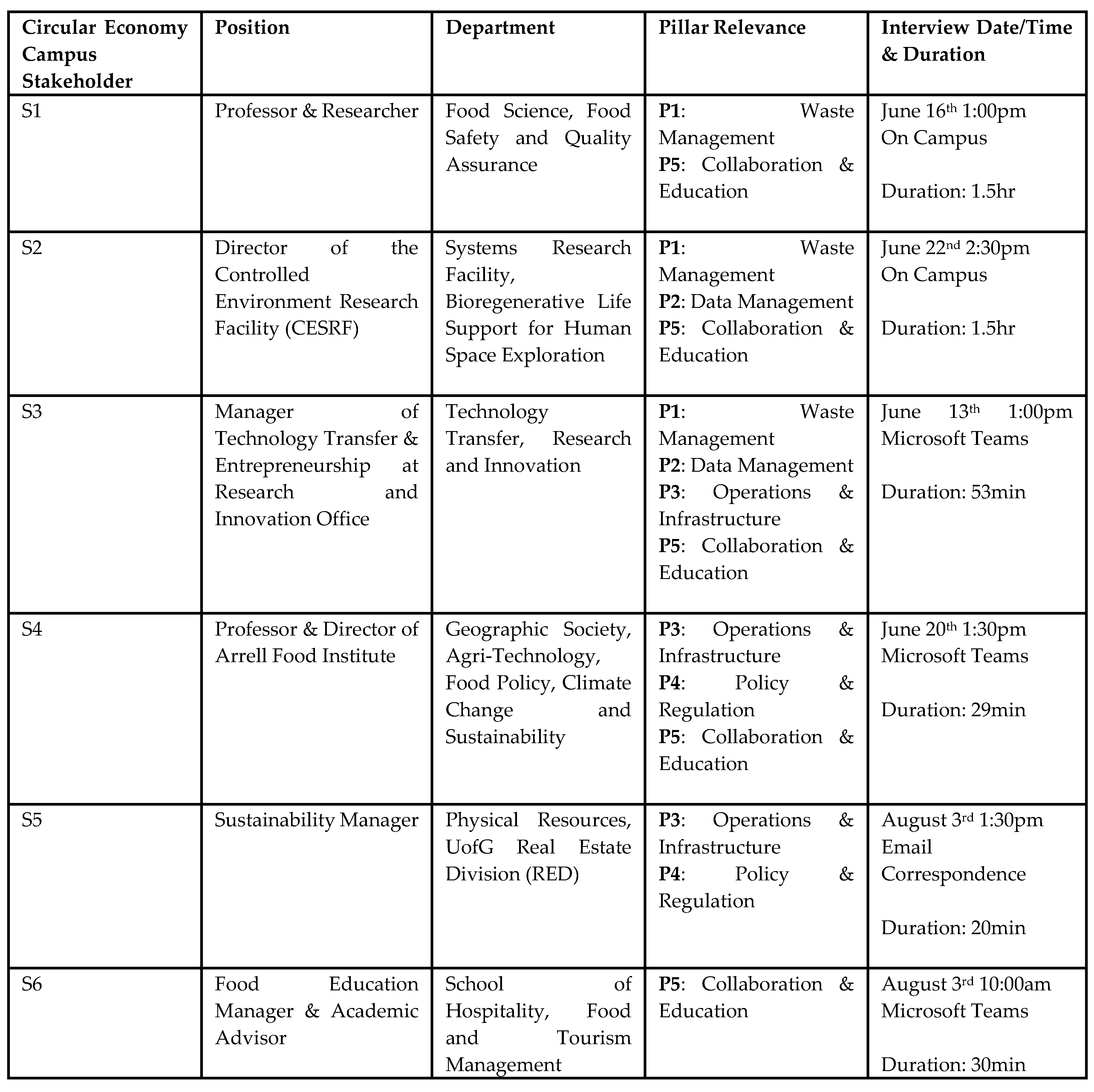
In total, 6 interviews were conducted representing approximately 8 hours of time. 2 hours and 40 minutes were spent on interviewee research and interview customization, and 5 hours and 20 minutes were spent as interview time. Three interviews were conducted in person where manual notes were taken, two were conducted via video where calls were recorded, and one was conducted via written email correspondence. Each record of interview data was analyzed individually and refined for relevance. The relevant information from each was then recorded in Table 2 for further analysis.
Results
The information provided by each interviewee during their interviews was recorded. The transcripts and notes were analyzed to capture key themes emerging from the data. The key themes from the data were analyzed and categorized by their relevance to one or more campus circular economy pillars. Table 1 captures the insights from interviewees by pillar, presented as a Framework for a CCE.
It is evident that there is a wide range of experts working in all the areas necessary for these advancements to be made and for a circular economy to emerge. These are resourceful individuals who turn research into commercial opportunities, food waste into secondary products, sustainability programs and hospitality partnerships. Interviewees all shared approaches to advance circularity, summarized in the opportunity column, with a strong focus on collaboration.
The following provides a summary of their insights by pillar.
P1: Waste Management
Food science, microbiology, and bio-engineering researchers were very knowledgeable on initiatives on campus relevant to circularity such as food waste valorization through controlled greenhouse management, the development of bioplastics from food waste material, water recycling system development, wastewater treatment plants, and plastics alternatives. However, when asked about the possibility of extending this research for the purpose of advancing the concept of a circular economy, was thought-provoking.
They indicated that the main challenges of extending the application of their research towards circular initiatives were cost, funding partners, and/or a lack of standardization of food waste product. Many indicated that those issues were too significant to undertake on top of their responsibility to enrich their research, especially with no incentive or reward. Knowledge transfer and commercialization specialists indicated that a lack of industry and commercial interest for certain innovations is the greatest challenge in using research to advance circularity.
Nonetheless, they were aware of the opportunities that would be available should the challenges be mitigated. These were identified, in regard to waste management, as increased food quality and security, nutrient optimization, and competitive market advantage.
Through employing the systems that have been innovated on campus, a higher quality of food would be produced, thus offering an attractive product to retailers as its marketability is higher than food that isn’t as nutrient dense. The issue is short term cost for long term benefit. Few investors are willing to finance this type of initiative until it has proven to elicit financial gain and social benefit for competitors.
P2: Data Management
Food source supply chain analysis is also being conducted on campus. Managers of hospitality are working with supply chain partners on analyzing the complexity of waste production throughout different stages in the chain, in hopes of curating more sustainability within it. This endeavour has resulted in the development of circular food programs in the community. These programs work to make secondary use out of waste product with the aim of providing social benefit, strengthened community partnerships, and the development of additional industry partnerships.
The challenges with this analysis are mainly regarding the operations of campus food suppliers. It is possible to determine the impact of their production on the environment, but not a simple operation to change their processes. The secondary impact that UofG makes on the environment as a result of their supply chain partners could be mitigated through the use of on-campus sustainably grown food supply.
AI computer software technology, specifically Argus AI, is being used to track and manage the data accumulated through research advances at the Controlled Environment Systems Research Facility (CESRF) on campus S2). It serves the function of collecting and storing data relevant to set controlled growth conditions of lab-grown vegetables and their accuracy over time. The AI component of this system eliminated the need for most manual adjustments of growing conditions. It possesses the intelligence to respond to the growing conditions of crops and adjust them based on their growth response to maximize resource return.
This type of system provides the benefit of self-sufficient and intelligent crop growing for sustainable food source. Such system could be used to ensure a reliable food supply source for on-campus hospitality locations, which would be provided at a low cost both in supply and labor. Further, the system’s ability to alter the output of resources to grow the crops offers a reduction in resource consumption and a wealth of highly accurate information regarding crop growth cycle. The challenges with the system include its high up-front cost, however, it has already been installed and is operating on campus, and therefore provides more reason to make additional use out of it for campus benefit.
P3: Business Operations & Infrastructure
Circular economy and sustainability advocates on campus are working to develop community programs alongside the City of Guelph that increase the opportunity for and acceptance of circularity within the community. These programs are ‘Our Food Future’ and ‘Super Cool’. The advantage of these programs are the opportunities they provide for education and communication between partnerships, with the added benefit of food waste reduction for community partners. The challenge with bringing these concepts inwards toward the UofG community is a lack of collaboration and eliciting a sense of priority for it from upper management.
As a university campus, UofG possesses an abundance of facilities such as labs, land, access to education, eager students, engaged partners, and a wealth of academic knowledge. The UofG Real Estate Division (UofG RED) is in charge of managing the multiple properties owned by the university and has the ability to develop it in whatever ways bring the highest benefit to the university and the community. There has been discussion around the development of green infrastructure and the introduction of EV chargers and electric transport vehicles on campus.
Such initiatives contribute to circularity through targeting some of the most prominent waste streams, specifically energy consumption. These systems offer long-term reduced CO2 emission and carbon footprint, eliminate the cost of fuel, increase brand recognition and social responsibility, encourage more sustainable behaviour in and around the campus, and provide its residents the ability to make sustainable improvements to their consumption habits and behaviour. The challenge associated with this type of change includes cost, and the acceptance of the idea by upper management that could be mitigated through efficient communication and educational reception of its importance.
P4: Policy & Regulation
As a university campus, UofG possesses its own board of policy and regulation makers. This is an advantage to the individuals on campus trying to implement circular initiatives as the operations are largely internal. With the exception of municipal, provincial, and federal policies and regulations, others could be altered to support circular initiatives that are accepted to be implemented on campus.
Entrepreneurial opportunity is also a large focus of the Research and Innovation office on campus. The office works alongside graduate students and researchers at the university whose research produces innovative ideas. It helps these individuals to market their innovations to industry partners who would be interested in purchasing or adopting the products that result from their research. There is huge benefit for this type of interaction for campus circularity if its motivation was to engineer innovation aimed for use by the university.
P5: Education & Collaboration
Sustainability educators on campus are running active educational programs with the intent of educating students on the importance of sustainable change. The goal of these programs is to encourage sustainable consumer behaviour from students. The challenge with these programs is to elicit long-term sustainable behaviour. However, one benefit that the UofG student population presents is their values. UofG has a reputation of attracting students who value the environment, and who care about preserving the planet. These students are more receptive to this type of information due to personal beliefs. However, for those who do not feel as strongly as others,l incentives to drive sustainable behaviour may be more effective.
Circular events are being organized by on-campus representatives in coordination with the City of Guelph to increase awareness of the importance of circularity in and amongst the community. These events provide the opportunities to strengthen relationships with industry partners and to deepen their understanding of the concept. Challenges in this area include recruiting supportive attendees who have the influence and leadership necessary to initiate more regular events, and who are willing to fund them.
Lastly, there are managers of knowledge transfer working at UofG who are responsible for managing the relationships between innovative researchers on campus and industry partners. There is so much potential that could occur in the collaboration between these researchers, industry, and campus stakeholders. The challenge is that the benefit is aimed primarily towards industry. If that same motivation and drive was employed towards creating sustainable and circular solutions intended for campus use, the opportunities could be endless. The challenge in this regard is the need to show financial benefit, most cases in the form of cost reduction from these innovations, for researchers and for the university.
Discussion
The main advantage of considering circularity on campus is the range of experts and activities that exist within it. The overlap of relevance between pillars and professionals is indicative of the benefit of foreseen collaboration between them. This type of collaboration between researchers, department managers, partnership managers, and economic specialists would introduce opportunities to advance the concept of a CCE at University of Guelph.
A relevant starting point for the collaboration between all professionals on campus whose work can be categorized under one or more of the UofG circularity pillars would be the development of a circular sustainability committee and the initiation of a conversation. This conversation would best be between a representative from each circularity-relevant department, lead by a steward in circular sustainability. This steward would be appointed the responsibility of bridging the gaps between academia and its application to implementing circular economic initiatives on campus.
The birth of a circularity committee would be a critical starting point for collaboration to spark innovation. It would allow for the facilitation of ideas and the planning of their implementation. Recent strategic plan titled ‘Our Time’, released by the University of Guelph, identifies sustainability as one of five strategic priorities for the time period of 2023-2027 (University of Guelph, 2023). The development of a committee whose main priority is to advance sustainability through the introduction of circularity presents some promising opportunities to achieve this goal.
The challenge with introducing this type of committee would be the incentives for faculty members to join. Currently, at UofG, researchers and members of academia are rewarded in performance evaluations primarily for the depth of their research, their teaching accomplishments, and somewhat for their involvement in community service. If involvement in the circular sustainability committee could be considered as part of the community service contribution, faculty may be more inclined to contribute to advancing campus circularity.
Conclusions
The main advantages of considering circularity on campus are the range of experts it houses and the activities that are already taking place within it. However, there is no current system present to connect the pieces. As summarized in Table 1 and Table 2, there was much overlap between all pillars. Interviewees shared similar perspectives on the topic of advancing circularity, summarized in the opportunity column, with a strong focus on the benefit of collaboration.
Table 2 considers the challenges, most frequently identified as cost and complexity, and opportunities, which were primary to do with long-term benefit through partnerships, financial benefit through cost reduction, reputation, and further research opportunity, associated with the current or planned sustainability initiatives that exist on campus.
The idea of advancing circularity on campus to the point of a fully functioning circular economy was found to be a very complex, ambitious and multidisciplinary endeavour. Different professionals on campus had varying levels of knowledge about the circular initiatives that exist on campus already as well as the extent to which their work could be applied to circularity.
Professionals on campus were very aware of many endeavours within their field but had not directed their thought to the application of that research to sustainable development. When prompted about applying their knowledge to advancing campus circularity, they were provoked. Their main focus seemed to be enriching their research, and its application to industry and commercialization, with little consideration of the application their research had to sustainability on campus and doubt in commercial application due to cost.
Overall, embracing circularity on campus at UofG holds immense potential for advancing sustainability through promoting the collaboration among a range of experts and stakeholders. The convergence of their various disciplines corroborates the importance of combining their joint efforts to advancing sustainability through implementing circular economic initiatives. Through capitalizing from the collaboration of expertise facilitated by the development of a circular sustainability committee, the concept of a Campus Circular Economy (CCE) could be advanced significantly. Provided its abundance of benefit and deemed feasibility, the CCE model presents a promising approach as the next step forward to improving life through advancing sustainability.
Gen z mention
Explain weak links
References
- Fontecha, M.,Arrell Food Institute. (n.d.). Sustainable Food Systems for Canada Innovation: the key behind transitioning to sustainable and climate resilient agri-food systems. https://arrellfoodinstitute.ca/sustainable-food-systems-for-canada-innovation/.
- Cecchi, F., Cavinato, C. (2019). Smart Approaches to Food Waste Final Disposal. Int J Environ Res Public Health. 2019 Aug 10;16(16):2860. PMID: 31405093; PMCID: PMC6720882. [CrossRef]
- Eikelenboom, M., Long, TB. (2022). Breaking the Cycle of Marginalization: How to Involve Local Communities in Multi-stakeholder Initiatives? J Bus Ethics. 2022 Sep 22:1-32. Epub ahead of print. PMID: 36187729; PMCID: PMC9510282. [CrossRef]
- Ellen MacArthur Foundation. (2022). A climate-smart fertilizer that serves each farm’s needs: CCm technologies. Circular Economy Examples. https://ellenmacarthurfoundation.org/circular-examples/a-climate-smart-fertiliser-that-serves-each-farms-needs.
- Ellen MacArthur Foundation. (2021). Making new products from urban organic waste streams: De Clique. Circular Economy Examples. https://ellenmacarthurfoundation.org/circular-examples/de-clique.
- Ellen MacArthur Foundation, Financing the Circular Economy: capturing the opportunity (2020) https://emf.thirdlight.com/file/24/Om5sTEKOn0YUK.Om7xpOm-gdwc/Financing%20the%20circular%20economy%20-%20Capturing%20the%20opportunity.
- Gonçalves MLMBB, Maximo GJ. (2022). Circular Economy in the Food Chain: Production, Processing and Waste Management. Circ Econ Sustain. 2022 Dec 14:1-19. Epub ahead of print. PMID: 36531659; PMCID: PMC9747261. [CrossRef]
- Guelph Food Waste Project. (2019). Guelph Food Waste Project. https://guelphfoodwaste.com/.
- Iacovidou, E., Hahladakis, JN., Purnell, P. (2020). A systems thinking approach to understanding the challenges of achieving the circular economy. Environ Sci Pollut Res Int. 2021 May;28(19):24785-24806. Epub 2020 Dec 7. PMID: 33289042; PMCID: PMC8144154. [CrossRef]
- Klein, N., Deutz, P., Ramos, TB. (2022). A survey of Circular Economy initiatives in Portuguese central public sector organisations: National outlook for implementation. J Environ Manage. 2022 Jul 15;314:114982. Epub 2022 Apr 15. PMID: 35436711. [CrossRef]
- Lainez, M., González, JM., Aguilar, A., Vela, C. (2018). Spanish strategy on bioeconomy: Towards a knowledge based sustainable innovation. N Biotechnol. 2018 Jan 25;40(Pt A):87-95. Epub 2017 May 25. PMID: 28552816. [CrossRef]
- Lange, L., et al. (2021). Developing a Sustainable and Circular Bio-Based Economy in EU: By Partnering Across Sectors, Upscaling and Using New Knowledge Faster, and For the Benefit of Climate, Environment & Biodiversity, and People & Business. Front Bioeng Biotechnol. 2021 Jan 21;8:619066. PMID: 33553123; PMCID: PMC7860146. [CrossRef]
- Nielsen, PH. (2017). Microbial biotechnology and circular economy in wastewater treatment. Microb Biotechnol. 2017 Sep;10(5):1102-1105. Epub 2017 Aug 22. PMID: 28834251; PMCID: PMC5609238. [CrossRef]
- O'Connor, KE. (2021). Microbiology challenges and opportunities in the circular economy. Microbiology (Reading). 2021 Jan;167(1):001026. Epub 2021 Jan 25. PMID: 33493102; PMCID: PMC8116777. [CrossRef]
- Raheem, D., Soltermann, AT., Tamiozzo, LV., Cogo, A., Favén, L., Punam, NJ., Sarmiento, CR., Rainosalo, E., Picco, F., Morla, F., Nilson, A., Stammler-Gossmann, A. (2022). Partnership for International Development: Finland-Argentina Conference on Circular Economy and Bioeconomy with Emphasis on Food Sovereignty and Sustainability. Int J Environ Res Public Health. 2022 Feb 4;19(3):1773. PMID: 35162793; PMCID: PMC8835696. [CrossRef]
- Torres-Mansilla, A., et al. (2023). Eggshell Membrane as a Biomaterial for Bone Regeneration. Polymers (Basel). 2023 Mar 8;15(6):1342. PMID: 36987123; PMCID: PMC10057008. [CrossRef]
- Tsang, YF., Kumar, V., Samadar, P., Yang, Y., Lee, J., Ok, YS., Song, H., Kim, KH., Kwon, EE., Jeon, YJ. (2019). Production of bioplastic through food waste valorization. Environ Int. 2019 Jun;127:625-644. Epub 2019 Apr 13. PMID: 30991219. [CrossRef]
- University of Guelph. (2023). Our Time: University of Guelph Strategic Plan 2022-2027. https://www.uoguelph.ca/strategic-plan/.
- Winnow Solutions. (n.d.). Winnow – Winnow Sense: Plate Waste. https://www.winnowsolutions.com/product/sense-plate-waste.

Table 1.
Circular Economy Knowledge and Insights from Interviews with Campus Experts .
| Circular Economy Pillar | Campus Stakeholders | Current or Planned Initiatives | Challenges | Opportunities |
|---|---|---|---|---|
|
Food Science Researchers “S” |
Food waste valorization through greenhouse management (i.e., LED light stimulation) | Funding | Food Security & Quality Assurance, Nutrient Optimization, Competitive Market Advantage |
| Bio-Engineering Researchers “S” |
Bioplastic materials from mushrooms | Lack of microbially produced equivalents (BHA for flexibility), Cost | Plastics Alternative with Secondary use application | |
| Managers of Knowledge Transfer and Commercialization | Water Recycling System Development | Finding Industry people who want to purchase and use it or buy the idea and sell it as a product to other industry partners, obtaining license to sell innovations | Financial benefit, Industry partners, Researcher recognition and University Reputation | |
| Microbiology Researchers | Wastewater Treatment | Complexity of required treatment, specificity of type of treatment, complex microbial makeup | Private sector partnership | |
| Plastic Alternatives | Most plastic is not recycled, difficult to maintain a consistent microbial base to derive a bioplastic from | Economic Opportunity (if we can change consumer behaviour through education programs) plastics sorting facility | ||
| Managers of Hospitality Services | Community Partners, Availability of Sustainable Product Alternatives | Consumer Convenience, Cost of alternative resources (washing reusable containers) | Reduction of single use products, long term cost benefit | |
|
Computer Science Researchers | Software or AI systems to track crop growth condition/resource optimization efficiency | Funding and consumer need | Innovation – applicable information/data source |
| Food System Researchers | Supply chain analysis | Complexity of waste at different stages | Community initiatives (i.e., Our Food Future) | |
|
Circular Economic opportunists & advocates | Community Programs to increase CE opportunity (Our Food Future, Super Cool) | Education to get internal members on board, communicating the cost benefit of the programs | Intent of creating Canada’s first Circular Food Economy within Guelph |
| Sustainability Managers | Green/Sustainable Infrastructure | Funding, Financing, Construction Internal acceptance for this type of transition |
Cost savings, Social Responsibility & Reputation, | |
| EV chargers & Electric Transport Vehicles | Cost of installation, Costs additional energy resources | Long term benefit of lowered CO2 emissions/carbon footprint | ||
|
Research & Innovation Managers | Offering research or innovations to Industry | Licenses, Intellectual property rights | Financial benefit (break-even), Reputation, Industry Partners, Potential of shared stock for financial gain |
| Entrepreneurial encouragement for research innovators | Funding and approval to get start-ups moving | Financial benefit, economic benefit, application to circularity depending on the innovation | ||
|
Educators | Educational Programs on campus to teach sustainable consumer behaviour. | Eliciting sustainable consumer behaviour further than personal beliefs (financial incentives which incur additional costs for UofG), lack of incentives to support sustainable behaviour | Decreased use of single-use plastics on campus, resource efficiency and optimization, drive long-term sustainability conscious behaviour |
| Department Managers | Circular Meal Event at The Wooly Pub to increase circular initiative awareness | Cost of the event, recruiting supportive attendees with influence | Increased awareness, deepens relationship with industry partners that have power to explore further change | |
| Knowledge Transfer Experts | Knowledge Mobilization (from researchers to lay people or economic specialists) | Policy and regulation (Intellectual property rights) | Potential to profit from research and innovations discovered at UofG, Industrial Partnerships | |
| Food Waste Managers | Community Partnerships, Sustainable food programs | Counsel willingness to participate and facilitate programs | Increased communal awareness, exposure & motivation to drive change |
Disclaimer/Publisher’s Note: The statements, opinions and data contained in all publications are solely those of the individual author(s) and contributor(s) and not of MDPI and/or the editor(s). MDPI and/or the editor(s) disclaim responsibility for any injury to people or property resulting from any ideas, methods, instructions or products referred to in the content. |
© 2024 by the authors. Licensee MDPI, Basel, Switzerland. This article is an open access article distributed under the terms and conditions of the Creative Commons Attribution (CC BY) license (http://creativecommons.org/licenses/by/4.0/).
Copyright: This open access article is published under a Creative Commons CC BY 4.0 license, which permit the free download, distribution, and reuse, provided that the author and preprint are cited in any reuse.


