

Submitted:
30 July 2024
Posted:
31 July 2024
You are already at the latest version
Abstract
Artificial intelligence harbors significant, unrealized promise for educational reformers, adding benefit to low-resource settings, particularly in the Least Developed Nations where access to quality learning remains most acute. The purpose of the introduction is to summarize how AI can reduce the educational gap and increase the effectiveness of education in poor resource environments. This paper, in a critical way, reviews the existing literature on the integration of AI in the education systems of developing countries concerning the benefits and challenges. This is achieved by reviewing a cross-section of literature from MDPI, Taylor & Francis, Springer, Wiley Online Library, Science Direct, and IEEE Xplore databases. Much emphasis within the selection criteria is given to those studies that had either empirically or theoretically demonstrated the influence of AI on educational practices within developing countries. Key findings: AI has the potential to greatly improve learning outcomes; it somewhat increases access to education but bodes well for the personalization agenda. These, however, will be surmounted upon adoption if it is to be effective: there exist huge challenges such as limited access to the internet, infrastructural deficit, and socio-cultural barriers. This study can, therefore, give inference to the fact that AI can change education and further enhance new equity in developing countries if there are corresponding proper policy interventions, building the capacity of teachers, and involvement of the community. More research is required to inform the long-term implications of AI and new uses being developed for AI applications in many diverse educational contexts, on which to base strategies for more equitable and more inclusive global education.
Keywords:
artificial intelligence
; education
; developing countries
; learning outcomes
; educational equity
1. Introduction
Globally, artificial intelligence (AI) presents a transforming potential that will impact pedagogical approaches and improve learning outcomes (Aderibigbe et al., 2023). Although artificial intelligence has immense potential, it also presents significant challenges for underdeveloped countries whose educational systems occasionally struggle greatly (Akgun & Greenhow, 2022; Alonso-Secades et al., 2022). The dual character of artificial intelligence’s influence demands a rigorous assessment of its ability to revolutionize education, especially in locations with distinct socioeconomic dynamics and educational inequalities (Alammari, 2024).
Artificial intelligence offers various advantages in education that help to address significant gaps including accessibility and personalization. Adaptive learning systems driven by artificial intelligence can customize instructional content to fit individual student needs, so allowing different learning speeds and approaches especially in areas with limited resources and high-class sizes (Bahroun et al., 2023; Bhardwaj & Sudan, 2024). This will be resolved if the government ensures that strong legislative systems and cultural acceptance policies are in place to solve ethical issues like data privacy, algorithmic biases, and possible worsening of current inequality (Fazil et al., 2024).
Notwithstanding these positive advances, some challenges limit the effective integration of artificial intelligence into educational systems all throughout emerging countries (Chisom et al., 2023; Elhajji et al., 2020). Moreover, there is a clear skills gap between managers and teachers that restricts the effective implementation of artificial intelligence technology in teaching strategies (Jafari & Keykha, 2024).
Societal and ethical issues, alongside other economic problems, act as hurdles to the adoption of artificial intelligence in education. This will be resolved if the government ensures that strong legislative systems and cultural acceptance policies are in place to solve ethical issues like data privacy, algorithmic biases, and possible worsening of current inequality (Kiemde & Kora, 2022; Knox, 2020). These components underline the necessity of addressing socio-cultural as well as technological problems in order to completely use artificial intelligence in transforming education all around.
Basically, artificial intelligence has so much potential to transform lives in education within underdeveloped countries, with such benefits highly optimized and the promise of fair access to quality education emerging greatly assured through due considerations of infrastructural, skills development, and ethical implications (Melweth et al., 2024; Pedro et al., 2019). By means of strategic infrastructure, capacity building, and regulatory frameworks, bridge the digital divide and support inclusive educational practices leveraging artificial intelligence technologies.
Research objective
- To assess how AI technologies influence learning outcomes, accessibility, and personalized learning in educational settings within developing countries.
- To analyse the primary obstacles, including technological, infrastructural, and socio-cultural barriers, that hinder AI implementation in education in developing regions.
- To propose evidence-based strategies for policymakers, educators, and stakeholders to overcome challenges and optimize AI use in educational practices, ensuring equitable and inclusive education.
Research questions
- What is the impact of AI technologies on learning outcomes, accessibility, and personalized learning in educational settings within developing countries?
- What are the primary obstacles, including technological, infrastructural, and socio-cultural barriers, that hinder the adoption of AI in education in developing regions?
- What evidence-based strategies can policymakers, educators, and stakeholders employ to overcome challenges and optimize the use of AI in educational practices, ensuring equitable and inclusive education?
Significance of study
Relevance for which seeing the integration of AI into education in the developing world points to this very potential that the process bears to actually address hitherto outstanding challenges and change the outcome of education. Therefore, this study will try to find out how AI can help to improve the teaching and learning processes for places that are short of resources or have constraints in their infrastructure, making a useful contribution to educational policy, practice, and research at large.
It will give insight into how AI in personalized learning and adaptive educational technologies can be of supreme assistance in scaling up solutions to reach out to various learning needs and styles, ensuring their educational equity and inclusiveness. Research could further inform targeted interventions and capacity-building activities by exploring gaps in infrastructure and deficiencies in teacher skills that hinder the diffusion of AI. Thirdly, the local context-related different dimensions of considering the ethical issues of AI—such as data privacy and algorithmic bigotry—require comprehensive regulatory frameworks and ethical guidelines.
Ultimately, the study seeks to inform decision-making relative to harnessing AI in education for the attainment of sustainable development goals, particularly in the empowerment of the educators and students of developing countries to succeed in the digital age. It aspires to contribute to global efforts toward inclusive and quality education for all by bridging the gap between potential and practice in using AI in educational settings.
2. Literature Review
Artificial intelligence (AI) is likely to be very much transforming in nature for education: this sector is particularly true for poor countries where access to excellent education has always been a challenge. By operationalizing a variety of scholarly publications and studies, this literature review will help to identify the advantages and challenges of the possible integration of artificial intelligence into an educational environment (Aderibigbe et al., 2023).
One of the promises made by Aderibigbe et al. (2023), for example, is the multifarious possibility of artificial intelligence in the field of education. More crucially, AI may thus bridge any gaps—rich-poor and urban-rural—while delivering a tailored learning experience for every student and so will have an impact on finally increasing the final learning outcome. As Akgun and Greenhow, (2022) cover, AI is influenced by the ethical considerations an Aderibigbe d relevance of tackling privacy and prejudice concerns on educational technologies. Alammari, (2024) used the mixed-method technique to evaluate its success by including artificial intelligence in Saudi Arabian education.
In elementary education research, for example, Alonso-Secades et al. (2022) proposed intelligent virtual systems to increase instructional efficiency, which corresponds with that done in environments with limited resources. Alotaibi and Alshehri, (2023) thought about the possibilities for artificial intelligence-based practices in Saudi Arabia’s higher education institutions that might aid in raising learning results. In line with this, Bahroun et al. (2023) thoroughly investigated the disruptive character of generative artificial intelligence in educational practices and its impact on environments.
Bhardwaj and Sudan, (2024) explain that thanks to its capacity to change pedagogical approaches, artificial intelligence has become crucial to next educational implementations. Some of the moral conundrums, as embodied in Borenstein and Howard, (2021), offer the foundation for AI ethics instruction in curricula to help maintain responsible use of technology. Using AI, Chisom et al. (2023) examined how learning settings in Africa might be enhanced and gave instances of how AI would help to close education gaps.
In the Middle East, Elhajji et al. (2020) advocate a strategic approach in artificial intelligence for higher education, Saudi Arabia, and that it may help to increase the accessibility and quality of education. Faresta, (2024) investigates the dimension of personalized learning through AI in Indonesian educational institutions talking about its efficacy in trying to meet the several needs the students present with. Another Fazil et al. (2024) research on the effects of artificial intelligence on student involvement and performance found favorable results from their Afghanistan-based project.
Predicting great changes in the approach of education, Hoseini Moghadam, (2023) has explored the future of AI application in Iranian University education. About both learning and teaching, Jafari and Keykha, (2024) carried out qualitative research on the possibilities and difficulties of artificial intelligence in improving higher education. In line with this, Jaiswal and Arun, (2021) investigated possible AI developments that can improve Indian educational results.
Applied worldwide, these AI breakthroughs have had successes and setbacks in striving to reach Sustainable Development Goal 4 using quality education. To raise student success rates, Khan et al. (2021) further suggest the use of artificial intelligence to monitor student performance and create proactive educational interventions. Closer home in Africa, Kiemde and Kora, (2022) recently released an essay aiming to draw attention to the ethical concerns on the application of artificial intelligence in education and suggested a set of ethical rules that would direct the usage of AI.
Knox, (2020) claims that artificial intelligence has affected the Chinese educational system since it has encouraged invention and the realization of improvements. Melweth et al. (2024) in their assessment of the teaching anxiety of instructors and quality education in Saudi Arabia believe that artificial intelligence favorably influences the teacher-student interaction role of the teacher. Pedro et al. (2019) highlighted yet another research on the successes of artificial intelligence in sustainable development and its creative teaching strategies.
Pham and Sampson, (2022) discuss how the awareness of the developmental trajectory of artificial intelligence in education depends on its growing importance to improve the learning experience of the students. Various degrees of integration were shown as Ponera and Madila, (2024) performed their research to investigate the awareness and practices of AI use with professors chosen from higher education institutions in Tanzania. Priyahita, (2020) did his share in e-learning and artificial intelligence research toward a symbiotic contribution in improving Indonesia’s educational system. Actually, he raises the very important issue of thorough integration policies for artificial intelligence.
The writers specifically discuss the possibilities for artificial intelligence transformation in Indonesian education and point out both difficulties and opportunities in connection with curricular change. Renz and Hilbig’s (202) study point out factors influencing the acceptance of artificial intelligence in technology; the background fits well to provide strong and environmentally friendly business models for AI application. Salas-Pilco and Yang’s, (2022) works systematically reviewed AI applications within the framework of Latin American higher education.
Emphasizing the manner in which artificial intelligence is evolving the educational practices, Zhang and Aslan (2021) further elaborate on recent AI technologies integrated in the educational area and their future research prospects. Alqahtani et al. (2023) have also observed that reflecting the great transforming potential invested in them, solutions based on AI, NLP, and massive language models have lately appeared in higher education and research.
3. Methods
Method of Data Collection
One of the methodologies to carry out the literature review is called critical literature review, which is the one that addresses a specific research question and synthesizes already existing evidence through a standardized, systematic process in lines to identify patterns, trend movements, and gaps of knowledge. These gaps guide the development of evidence-based instructional interventions using AI in education.
A critical literature review on the subject under reference, hence, is informed with the motive to make a contribution to evidence on potential applications of AI in advancing education. Such a review also enhances an understanding in this area for educators, researchers, educational stakeholders, and policymakers regarding opportunities that exist for bettering the delivery of educational practice. Current reviews consolidate knowledge critically, thus taking further knowledge down new research lines and promoting evidence-based decision-making in educational policy and practice.
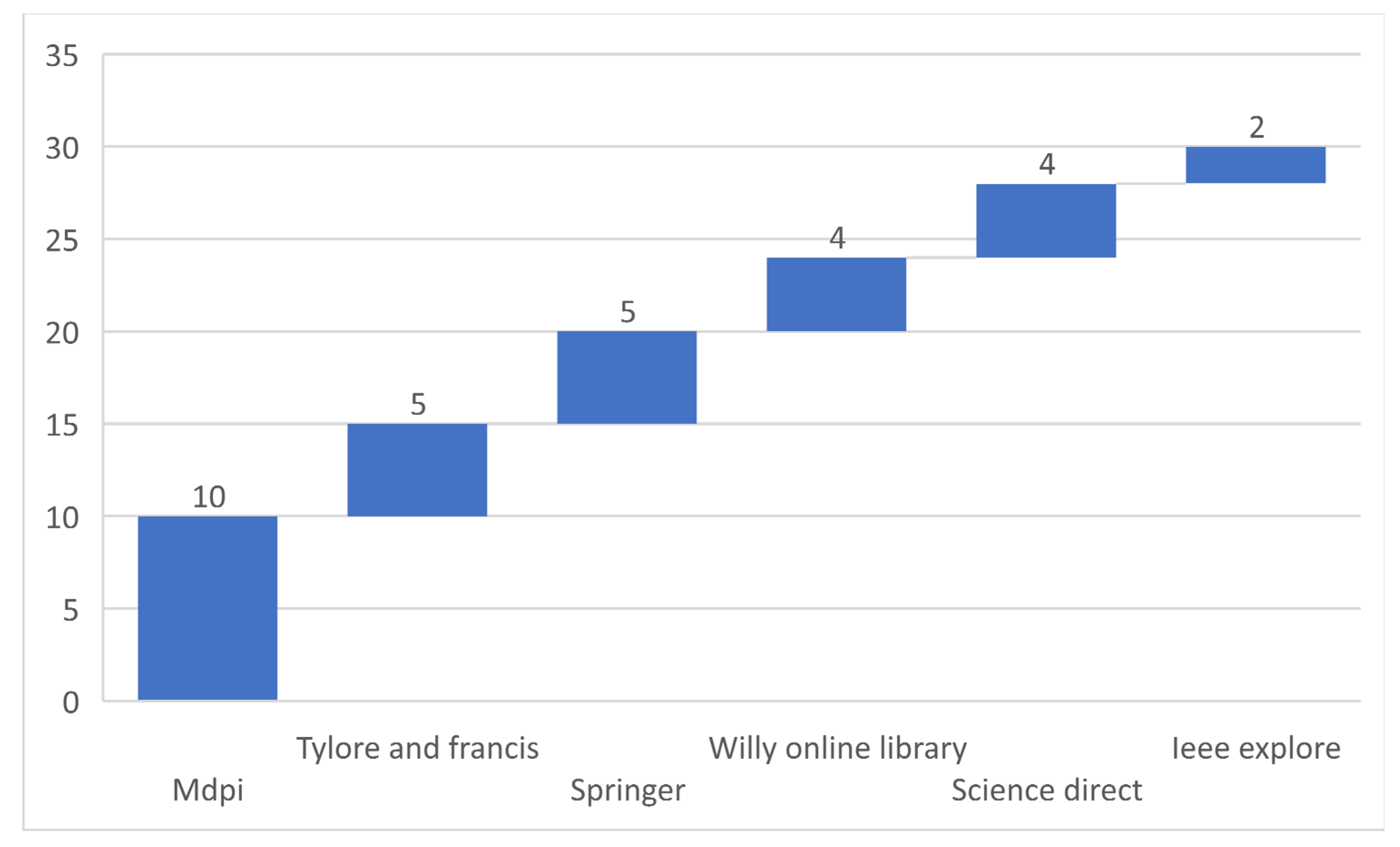
The academic sources referred to for the literature review have been distributed across a range of databases and publishers, as shown in Figure 1. The prominent source is MDPI, with as many as 10 references. This shows better evidence of a strong inclination to this open-access publisher, which has a very large number of peer-reviewed journals in diverse scientific disciplines. Taylor and Francis contribute with 5 references and point at a good mix of journals known for their quality in editorial standards, particularly in the fields of social sciences and humanities. Springer also contributes 5 citations, well above average, and provides significant content for this publisher known for its scientific, technical, and medical publications. The Wiley Online Library adds 4 references to other major sources of research with a large impact in most disciplines. On that same pattern, Science Direct bears 4 references, thus unmasking it as a great well of scientific and technical research articles. In the 2 references from IEEE Xplore, the fact that it includes engineering and technology is revealed. Such a distribution signals a good level of comprehensiveness and interdisciplinarity for the sources that will be consulted for this work, translating related to high quality.
Figure 1.
Distribution of Academic Sources in the Literature Review.
Inclusion and Exclusion Criteria
In this study, the selection criteria include literature regarding the integration of artificial intelligence into education to be specific within the developing world; this includes papers and reports relevant to studies, design, or assessment of tools and methodologies utilized by AI. The paper is based on both theoretical and empirical research, including works referring to a broad range of classroom, online, and educational software settings. Targeted literature herein constructs a description of potential benefit, constraints, and opportunities available with the use of AI in education in contributing to improved learning outcomes, student engagement, and teaching methodologies. This review also incorporates studies that have centered on the involvement of AI in enhancing educational equity, accessibility, and digital divide within developing countries. Information pertaining to the design of the study, characteristic of sample, types of AI interventions employed, measurements made in the study, and the results are systematically documented during data extraction on educational improvements in developing countries.Literature that is not directly applicable to the use of the AI in education of the developing countries is excluded based on the following exclusion criteria: articles that are focusing on AI applications in developed countries only; AI and technology applied to industrial automation, financial technology, other than in an educational environment, will not count. Other studies not possessing empirical evidence, such as opinion pieces, editorials, or pure theoretical discussion without practical implementation and evaluation, are out. Moreover, a literature that does not treat this area by specifically talking about the challenges and opportunities in applying AI in the educational systems in developed countries is not considered.
Figure 2.
PRISMA Flowchart of Article Selection Process.
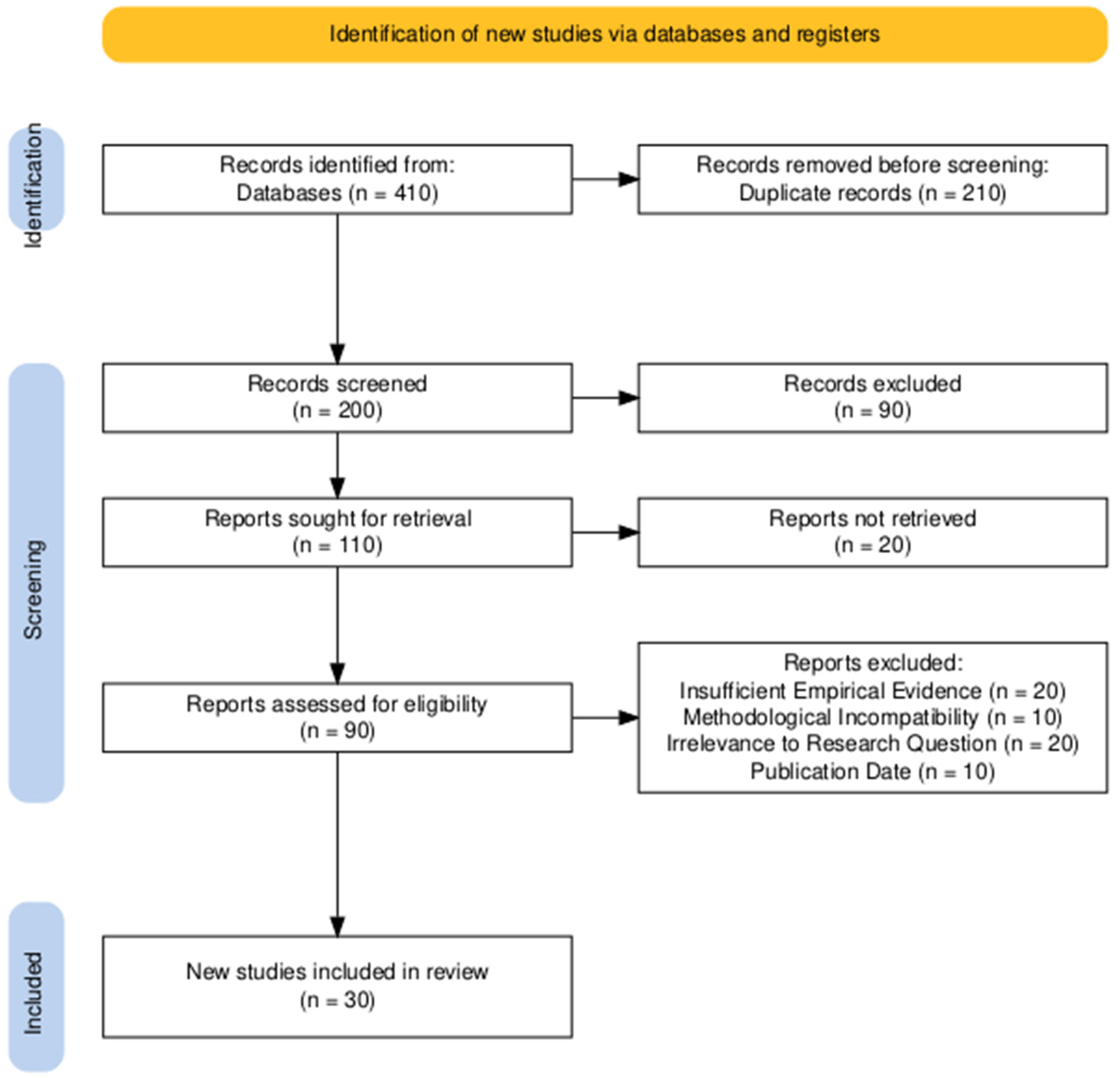
The PRISMA flowchart describes a systematic approach for selecting articles that describe the integration of AI into education in developing countries. Firstly, 410 records were identified from different databases. After removing 210 duplicate records, this number was further reduced to 200 unique records, all of which were carried forward for further examination.
After the screening, 90 records were excluded based on pre-defined exclusion criteria, leaving 110 reports to be searched for retrieval. Of those, 20 reports could not be retrieved for further assessment. Ninety reports ended up being assessed for their eligibility, with 60 of those excluded on grounds such as insufficient empirical evidence, methodological incompatibility with the review, irrelevancy, and publication date.
The inclusion criteria were ultimately met by 30 new studies, which entered the review. The use of such a systematic approach ensures that the selected studies generate power in empirical evidence and are methodologically strong, which, in turn, increases the reliability and validity of the findings regarding the impact of AI on current educational practices in developing countries.
Method of Data Analysis
In conducting the literature review, the study adopted a mixed-method approach to investigating the involvement of artificial intelligence in education in developing countries. The methods employed in using qualitative literature included thematic and document analysis, the synthesis of findings from chosen studies, and the drawing of the overall themes, patterns, and implications for educational practice, as well as the future research agenda. It is such an analysis of a qualitative review that would avail an all-encompassing understanding of the impact of AI to the outcomes of education, more specifically with respect to the effectiveness of learning and engagement of students.
Its methodological approach by the inclusion of qualitative synthesis results enabled a nuanced exploration of educational transformation by AI practices to take place in developing countries, which otherwise would have not allowed this. It aided a deeper investigation into how AI technologies affect educational outcomes in different contexts, contributing to more informed discussion into how AI can be harnessed to drive improved education across the world.
4. Result and Discussion
Results
In the results section, the synthesized findings from a systematic literature review of 30 selected articles underscore AI’s transformative potential in enhancing educational outcomes and addressing challenges in developing countries.
What is the impact of AI technologies on learning outcomes, accessibility, and personalized learning in educational settings within developing countries?

Table 1.
Impact of AI Technologies on Learning Outcomes, Accessibility, and Personalized Learning in Educational Settings within Developing Countries.
Table 1.
Impact of AI Technologies on Learning Outcomes, Accessibility, and Personalized Learning in Educational Settings within Developing Countries.
| Impact on Learning Outcomes | Impact on Accessibility | Impact on Personalized Learning | Citation |
|---|---|---|---|
| Demonstrates significant improvement | Moderate enhancement | Substantial advancement | Aderibigbe et al., 2023 |
| Significant positive impact | Considerable improvement | Effective adaptation | Alammari, 2024 |
| Positive influence | Challenges in widespread access | Promising results | Alonso-Secades et al., 2022 |
| Modest impacts | Limited accessibility | Challenges in personalization | Alotaibi & Alshehri, 2023 |
| Substantial improvement | Enhances accessibility | Facilitates personalized learning | Bahroun et al., 2023 |
This will be important in studies that aim at finding out whether AI technologies can transform learning outcomes or accessibility and personalized learning in the educational contexts of developing countries. In this perspective, Aderibigbe et al. (2023) reported an improvement in learning outcomes and increased personalized learning, showing that AI can and will enhance educational effectiveness by personalizing the learning experience to suit the needs of a particular, individual student. This is supported by by Alammari, (2024) and Bahroun et al. (2023), who further suggest that AI will play a substantial role in scaling up accessibility for personalized learning environments in which customized learner requirements.
However, other studies Alotaibi & Alshehri (2023) have supposed rather modest effects of these solutions attributed to infrastructure deficiencies and sociocultural particularities of developing countries, which affect the accessibility level and personalization of learning. For example, Alonso-Secades et al., (2022) displayed that AI positively affects learning outputs but, at the same time, argued that the persisting issues of the deprived students under threat from the AI technologies in the educational settings, or who do not have access to them at all, still remain.
All this reviewed literature underlines how AI should be vital for significantly improving learning performance and enabling personalized learning experiences within developing countries. The fact that different studies have shown varying impacts underlines that contextual factors are very important; technological infrastructure, as well as cultural acceptance in the approach, really matters in the determination of how effective AI can be within the educational setup. These insights are useful for policymakers and educators in guiding the implementation of AI strategies that would minimize barriers and maximize its impacts on education according to local contexts.
What are the primary obstacles, including technological, infrastructural, and socio-cultural barriers, that hinder the adoption of AI in education in developing regions?
Table 2.
Primary Obstacles to AI Adoption in Education in Developing Regions.
| Technological Barriers | Infrastructural Challenges | Socio-cultural Factors | Citation |
|---|---|---|---|
| Limited access to high-speed internet | Inadequate electricity supply | Cultural resistance to technology | Aderibigbe et al., 2023 |
| Lack of technical expertise | Insufficient ICT infrastructure | Language barriers | Alammari, 2024 |
| High costs of AI implementation | Remote or rural location challenges | Lack of awareness and training | Alonso-Secades et al., 2022 |
| Compatibility issues with existing systems | Transportation and logistics barriers | Gender disparities | Alotaibi & Alshehri, 2023 |
| Data privacy and security concerns | Limited funding and resources | Educational policy constraints | Bahroun et al., 2023 |
The adoption of artificial intelligence in education in developing regions is surrounded by the challenges of widespread technological, infrastructural, and sociocultural domains. Besides, Aderibigbe et al. (2023) points out technological barriers, including sensitivities such as a lack of reliable access to high-speed internet and those relating to technical expertise that limit the operationalization of AI tools within educational settings. These challenges are accentuated by infrastructural problems as highlighted by Alammari, (2024), which include inadequate supply of electricity, inadequate ICT infrastructure, and challenges in remote/rural location where connectivity and infrastructure are poorly provided.
Majorly influencing the level of utilization of AI for learning, socio-cultural factors are discussed, in terms of cultural resistance to technology, an influence needing awareness, and training interventions, which are a must by Alonso-Secades et al. (2022). Alotaibi & Alshehri (2023) also discuss gender inequalities and policy-related educational constraints that are important to consider, as they affect whether AI technologies are used and deployed in education in an equitable way.
High associated costs of AI implementation emerge as a critical barrier in the studies to affect the affordability and the scalability of AI solutions in resource-constrained settings (Bahroun et al., 2023). The situation is even made more complex by compatibility issues that many stakeholders are worried about, including data privacy and data security in educational practices.
Overcoming these barriers needs a nuanced approach that would actually involve policy interventions, capacitation, and infrastructural development in consideration of local contexts. Policymakers and educators must invest in digital infrastructure, availing targeted training programs in a supportive socio-cultural environment, so as to facilitate effective adoption and carry out sustainable integration of AI in education. This way, the developing regions have the opportunity to face their challenges in a comprehensive manner and harness AI’s transformative potential to improve educational outcomes in ways that promote inclusive and just learning environments.
What evidence-based strategies can policymakers, educators, and stakeholders employ to overcome challenges and optimize the use of AI in educational practices, ensuring equitable and inclusive education?
Table 3.
Evidence-Based Strategies to Optimize AI Use in Educational Practices.
| Policy Level | Educational Strategies | Stakeholder Engagement | Citation |
|---|---|---|---|
| Establish AI-friendly policies | Integrate AI into curriculum | Collaborate with communities | Aderibigbe et al., 2023 |
| Allocate funding for AI projects | Provide AI training for educators | Engage parents and guardians | Alammari, 2024 |
| Support research on AI in education | Foster AI literacy among students | Involve industry partners | Alonso-Secades et al., 2022 |
| Develop guidelines for AI ethics | Implement AI-based assessments | Consult with policymakers | Alotaibi & Alshehri, 2023 |
| Promote open access to AI tools | Use AI for personalized learning | Advocate for inclusive practices | Bahroun et al., 2023 |
Technologies of AI incorporation in the learning environment require evidence-behaved strategies that are relevant at the policy, educational, and stakeholder levels in the process of AI development nature. The policy level comprises, Aderibigbe et al. (2023) suggest AI-friendly policies that shall motivate schools and learning institutions to acquire AI technologies. Such policies should prioritize funding designated for AI projects so that the resources channeled toward the implementation and sustainability of AI projects in diverse educational setups are put in place. This approach is confirmed by Alammari (2024), who highlights that there is a need for substantial AI instruction to be given to teachers in order to develop capacity as well as confidence in effectively using AI tools in classrooms.
Some of the various ways of really getting the most out of AI with the use of different educational strategies include infusing it within the curriculum to develop digital literacy and prepare students for the realm of technological change that is yet to come. Meanwhile, using the idea of AI-based assessment, there will be instant feedback available to the students to help understand their learning abilities better and help them have a better learning experience based on their needs (Alotaibi & Alshehri, 2023). These strategies not only are supporting a continuous improvement culture with the educators working in tandem but also allow the educators to make the best use of AI in enhancing the practices followed and engagement of students.
Stakeholder engagement can help create a setting for the adoption of AI technology in education. Bahroun et al. (2023) will go a step further by calling for the involvement of communities, parents, and even industrial stakeholders in order to make the technologies more inclusive and equally acceptable. Discussing issues around the benefits of AI in facilitated education with stakeholders and ethical concern leads to trust and will promote sustainable practice adoption.
Furthermore, ethical guidelines for AI and the openness of AI tools would help to address more troubling concerns regarding data privacy, security, and algorithmic bias (Bahroun et al., 2023). In adding to that, a call for an inclusive practice and continuous conversation with policymakers will enable stakeholders to share in an environment inseparable from educational innovations driven by AI and characterized by critical factors, such as equity, accessibility, and student-centered learning outcomes.
In the final analysis, the policy design for reform and educational design, in collaboration with other stakeholders, go hand in hand in the implementation of best practices of AI in educational practices within developing regions. It is only by implementing evidence-based strategies that policymakers, educators, and other stakeholders will add up efforts to surmount obstacles while at the same time harnessing the transformative potential of AI toward assuring an equitable and inclusive opportunity for all learners.
Discussion
AI will go great lengths for the potential education, more so in weak countries in access to quality education. The present discussion synthesized findings from the review on the benefits, challenges, and evidence-based strategies that are central for ensuring maximal use of AI in educational practice in developing regions.
As demonstrated by Aderibigbe et al. (2023), the potentiality of AI with the development it portends to education is to reduce the gaps that exist between learners through personalized learning. The manipulation of learning content and pace to fit individual student needs becomes an important role that AI plays in trying to enhance learning outcomes and student engagement with more productivity in education (Aderibigbe et al., 2023). This is a capacity that is particularly very relevant in the settings where the traditional style of teaching sometimes fails to accommodate students’ differentiated learning styles and needs (Alammari, 2024).
However, effective adoption in education remains challenged due to the technological, infrastructural, and socio-cultural domains. Technological challenges are majorly underpinned by poor internet access and the lack of technical know-how, which hampers the realization of AI tools within classroom settings (Alonso-Secades et al., 2022; Alotaibi & Alshehri, 2023). This is further hindered, more in remote or rural areas, by the problem of insufficient electricity supply and ICT infrastructure—more so in areas where the majority of populations remain in darkness.
Socio-cultural features have also played an important role in the development of an adoption landscape for AI in education. Additional barriers include cultural resistance, especially to technological practices, and gender inequalities in access to educational resources. Other than these, the large costs for setting up AI systems, together with concerns of data safety, have been notable concerns when it comes to the adoption of AI in education (Bahroun et al., 2023).
Evidence-based approaches become central in dealing with these problems. Policy makers can also play a significant role in ameliorating the situation through developing and implementing policies which are friendly to AI in educational organizations. This would be assured of government incentives in adopting AI in their curricula and AI project funding. This will ensure and set the right environment with the laying of AI infrastructure underneath to innovate and experiment with practices (Alonso-Secades et al., 2022; Alotaibi & Alshehri, 2023).
And educators can use the same to fine-tune their methodologies and shape their learning experience for students themselves. AI-loaded courses and AI-assisted evaluation characteristics could put students in a position to get lots of information on the platter of their performance, put up the results, and spell out the supposed steps to be performed as an intervention to keep up with learning further (Alonso-Secades et al., 2022; Alotaibi & Alshehri, 2023).
The involvement of stakeholders will become part of this success story once artificial intelligence is integrated into the education sector. The collaboration with communities, parents, and industry partners would ensure that the different AI initiatives are inclusive and pertinent to a particular area while, at the same time, creating an environment that allays concerns from equity, privacy, and bias in AI-driven educational environments through open access to AI tools and ethical guidelines as advocated for by the stakeholders’ projects (Aderibigbe et al., 2023; Alammari, 2024).
In a word, AI holds unimaginable opportunities for improving educational practices in developing countries. Success in integrating it can meaningfully happen only through a concerted effort across the policy, educational, and stakeholder domains. There remains an urgency to apply evidence-based strategies that address the barriers of technology and infrastructural challenges with a view to the socio-cultural realities so that policymakers, educators, and stakeholders take advantage of the potential of AI to transform it into an enabler for all learners Alammari, 2024).
In conclusion, while AI offers unprecedented opportunities to enhance educational practices in developing countries, its successful integration requires a coordinated effort across policy, educational, and stakeholder domains. By implementing evidence-based strategies that address technological barriers, infrastructural challenges, and socio-cultural factors, policymakers, educators, and stakeholders can harness AI’s transformative potential to ensure equitable and inclusive education for all learners.
5. Conclusion
In conclusion, the integration of AI in educational practices in developing countries presents both promising opportunities and imposing challenges. Reviewed literature has underlined the potential of value added to the learning outcomes, enhancement of accessibility by students to educational processes, and ability to personalize the processes. Research studies found that AI was effective in adjusting learning environments to individual students’ needs, thereby fostering more effective and inclusive educational practices.
However, there are big barriers to the extensive use of AI in educational contexts. Some of them involve technological constraints, low internet access, and poor infrastructure. Moreover, embedding AI within diverse educational contexts becomes increasingly difficult due to factors related to technology resistance among educational stakeholders, as well as a lack of digital literacy.
Tackling these challenges calls for a multidimensional approach: policymakers, educators, and all concerned stakeholders huddle together to work on AI-informed policies to infuse AI into curricula and on AI literacy of educators and students. Giving priority to these strategies will assist institutions to use AI technologies in methodologies to improve teaching, increase engagement, and promote lifelong learning.
Second, stakeholders must work toward creating an enabling environment for accepting AI, where interaction with communities, industry partners, and policymakers builds a trusting relationship and alleviates their ethical and private concerns about AI. This, in turn, ensures that innovations through AI equally benefit all learners.
In summary, though the potential is promising in transforming education within developing countries, the barriers of technology, infrastructures, socio-culture need to be transcended in order for the full realization of AI. Evidence-based strategies, then, by stakeholders, would bring forth collaborative partnerships towards the creation of inclusive and equitable educational ecosystems that prepare learners for success in a fast-changing digital world.
Recommendations and future research
Recommendations for fostering stakeholder partnerships in the implementation of AI for educational practices that are equitable and ethical: Increases in investments by policymakers must include funding for the infrastructure and resources needed, not only for AI but also for training educators to be AI-literate. Future research on how AI impacts marginalized communities, scales across diverse educational settings, and ethical considerations at the time of AI adoption is warranted. Such an understanding of the effects that AI would have on its long-term educational outcomes, along with the social and economic development of entire regions in the developing world, underscores the need for both informed policy-making and sustainable implementation.
As such, there is a need to design AI solutions according to local contexts for subsequent research developments, with a view to the variety of educational needs and infrastructural challenges present in society. Policymakers should also prioritize financing AI projects and promoting sector-wide collaborations that will deepen AI in education, making it sustainable and inclusive.
Acknowledgments
We acknowledge and appreciate our colleagues and collaborators for their valued support and insights during this research endeavor. These are the people who have added value to the discussion topic of AI in education in the body of knowledge that generates a call for action from best-practice experiences.
References
- Aderibigbe, A. O., Ohenhen, P. E., Nwaobia, N. K., Gidiagba, J. O., & Ani, E. C. (2023). Artificial intelligence in developing countries: bridging the gap between potential and implementation. Computer Science & IT Research Journal, 4(3), 185-199. [CrossRef]
- Akgun, S., & Greenhow, C. (2022). Artificial intelligence in education: Addressing ethical challenges in K-12 settings. AI and Ethics, 2(3), 431–440. [CrossRef]
- Alammari, A. (2024). Evaluating generative AI integration in Saudi Arabian education: a mixed-methods study. PeerJ Computer Science, 10, e1879. [CrossRef]
- Alonso-Secades, V., López-Rivero, A. J., Martín-Merino-Acera, M., Ruiz-García, M. J., & Arranz-García, O. (2022). Designing an intelligent virtual educational system to improve the efficiency of primary education in developing countries. Electronics, 11(9), 1487. [CrossRef]
- Alotaibi, N. S., & Alshehri, A. H. (2023). Prospers and obstacles in using artificial intelligence in Saudi Arabia higher education institutions—The potential of AI-based learning outcomes. Sustainability, 15(13), 10723. [CrossRef]
- Alqahtani, T., et al. (2023). The emergent role of artificial intelligence, natural language processing, and large language models in higher education and research. Research in Social and Administrative Pharmacy, 19(9), 1236–1242. [CrossRef]
- Bahroun, Z., Anane, C., Ahmed, V., & Zacca, A. (2023). Transforming education: A comprehensive review of generative artificial intelligence in educational settings through bibliometric and content analysis. Sustainability, 15(17), 12983. [CrossRef]
- Bhardwaj, K., & Sudan, S. (2024). Artificial Intelligence’s Role and Future Implementation in Education. In AI-Enhanced Teaching Methods (pp. 160-175). IGI Global. https://www.igi-global.com/chapter/artificial-intelligences-role-and-future-implementation-in-education/345061.
- Borenstein, J., & Howard, A. (2021). Emerging challenges in AI and the need for AI ethics education. AI and Ethics, 1(1), 61–65. [CrossRef]
- Chisom, O. N., Unachukwu, C. C., & Osawaru, B. (2023). Review of AI in education: transforming learning environments in Africa. International Journal of Applied Research in Social Sciences, 5(10), 637-654. [CrossRef]
- Elhajji, M., Alsayyari, A. S., & Alblawi, A. (2020, March). Towards an artificial intelligence strategy for higher education in Saudi Arabia. In 2020 3rd International Conference on Computer Applications & Information Security (ICCAIS) (pp. 1-7). IEEE. [CrossRef]
- Faresta, R. A. (2024). AI-Powered Education: Exploring the Potential of Personalised Learning for Students’ Needs in Indonesia Education. Path of Science, 10(5), 3012-3022. [CrossRef]
- Fazil, A. W., Hakimi, M., Shahidzay, A. K., & Hasas, A. (2024). Exploring the Broad Impact of AI Technologies on Student Engagement and Academic Performance in University Settings in Afghanistan. RIGGS: Journal of Artificial Intelligence and Digital Business, 2(2), 56-63. [CrossRef]
- Hoseini Moghadam, M. (2023). Artificial intelligence and the future of university education in Iran. Quarterly Journal of Research and Planning in Higher Education, 29(1), 1-25. [CrossRef]
- Jafari, F., & Keykha, A. (2024). Identifying the opportunities and challenges of artificial intelligence in higher education: a qualitative study. Journal of Applied Research in Higher Education, 16(4), 1228-1245. [CrossRef]
- Jaiswal, A., & Arun, C. J. (2021). Potential of Artificial Intelligence for transformation of the education system in India. International Journal of Education and Development using Information and Communication Technology, 17(1), 142-158. https://eric.ed.gov/?id=EJ1285526.
- Kabudi, T. M. (2022, May). Artificial intelligence for quality education: Successes and challenges for AI in meeting SDG4. In International Conference on Social Implications of Computers in Developing Countries (pp. 347-362). Cham: Springer International Publishing. [CrossRef]
- Khan, I., Ahmad, A. R., Jabeur, N., & Mahdi, M. N. (2021). An artificial intelligence approach to monitor student performance and devise preventive measures. Smart Learning Environments, 8(1), 17. [CrossRef]
- Kiemde, S. M. A., & Kora, A. D. (2022). Towards an ethics of AI in Africa: rule of education. AI and Ethics, 2(1), 35-40. [CrossRef]
- Knox, J. (2020). Artificial intelligence and education in China. Learning, Media and Technology, 45(3), 298–311. [CrossRef]
- Melweth, H. M. A., Alkahtani, A. S., & Al Mdawi, A. M. M. (2024). The Impact of Artificial Intelligence on Improving the Quality of Education and Reducing Future Anxiety Among a Sample of Teachers in Saudi Arabia. Kurdish Studies, 12(2), 5741-5758. http://kurdishstudies.net/menu-script/index.php/KS/article/view/2755.
- Pedro, F., Subosa, M., Rivas, A., & Valverde, P. (2019). Artificial intelligence in education: Challenges and opportunities for sustainable development. https://hdl.handle.net/20.500.12799/6533.
- Pham, S. T., & Sampson, P. M. (2022). The development of artificial intelligence in education: A review in context. Journal of Computer Assisted Learning, 38(5), 1408-1421. [CrossRef]
- Ponera, J. M., & Stephen Madila, S.(2024). Instructors’ Awareness of the Use of Artificial Intelligence Among Higher Education Institutions in Tanzania. Edukasiana: Jurnal Inovasi Pendidikan, 3(3), 269–279. [CrossRef]
- Priyahita, R. (2020, August). The utilization of e-learning and artificial intelligence in the development of education system in Indonesia. In 2nd Jogjakarta Communication Conference (JCC 2020) (pp. 263-268). Atlantis Press. [CrossRef]
- Rakuasa, H., Faris, D. A., & Hidayatullah, M. (2024). Transforming Education in the Age of Artificial Intelligence: Challenges and Opportunities in Indonesia, A Literature Review. Journal Education Innovation (JEI), 2(1), 180-186.
- Renz, A., & Hilbig, R. (2020). Prerequisites for artificial intelligence in further education: Identification of drivers, barriers, and business models of educational technology companies. International Journal of Educational Technology in Higher Education, 17(1), 14. [CrossRef]
- Salas-Pilco, S. Z., & Yang, Y. (2022). Artificial intelligence applications in Latin American higher education: A systematic review. International Journal of Educational Technology in Higher Education, 19(1), 21. [CrossRef]
- Zhang, K., & Aslan, A. B. (2021). AI technologies for education: Recent research & future directions. Computers and Education: Artificial Intelligence, 2, 100025. [CrossRef]
- Haddaway, N. R., Page, M. J., Pritchard, C. C., & McGuinness, L. A. (2022). PRISMA2020: An R package and Shiny app for producing PRISMA 2020-compliant flow diagrams, with interactivity for optimised digital transparency and Open Synthesis Campbell Systematic Reviews, 18, e1230. [CrossRef]
Disclaimer/Publisher’s Note: The statements, opinions and data contained in all publications are solely those of the individual author(s) and contributor(s) and not of MDPI and/or the editor(s). MDPI and/or the editor(s) disclaim responsibility for any injury to people or property resulting from any ideas, methods, instructions or products referred to in the content. |
© 2024 by the authors. Licensee MDPI, Basel, Switzerland. This article is an open access article distributed under the terms and conditions of the Creative Commons Attribution (CC BY) license (http://creativecommons.org/licenses/by/4.0/).
Copyright: This open access article is published under a Creative Commons CC BY 4.0 license, which permit the free download, distribution, and reuse, provided that the author and preprint are cited in any reuse.