

Submitted:
19 July 2024
Posted:
22 July 2024
You are already at the latest version
Abstract
Falls are a frequent and serious problem for older adults and especially those living with Parkinson’s. The relationship between falls and physical activity is complex and people often restrict activity following a fall. Exercise is an important aspect of re-ducing further risk of a fall and a key component of the management of Parkinson’s. The aim of this study was to understand the types of activity that are engaged in, the environments in which they take place and the experience of people with and without Parkinson’s who have fallen. 17 people with Parkinson’s and 13 older adults, who had experienced at least one fall in the previous year, were recruited to this mixed methods study. Activity levels were captured over one week using accelerometers and body worn cameras, allowing the type and location of activity to be recorded and analysed. This information informed an interview. Findings showed that although both groups often achieved up to 10,000 steps per day, this was in very short bouts of activity. Sedentary activity such as watching television dominated the findings. Participants were aware of the benefits of being active but described many barriers to achieving the level of activity they would like to.
Keywords:
Parkinson’s
; falls
; physical activity
; exercise
; mixed methods
1. Introduction
Falls are a frequent and serious problem for many people with Parkinson’s (PwP) contributing to reduced quality of life and mobility [1]. On average, people with Parkinson’s fall at least once per year [2]. Primary disease processes including motor symptoms such as bradykinesia and postural instability leading to changes in gait and balance, cognitive dysfunction and affective disorders can all contribute to falls. Falls risk is further increased by secondary complications due to deconditioning (muscle weakness, inactivity) or diminished confidence and fear of falling [3]. There are many generic and Parkinson’s specific, as well as intrinsic and extrinsic factors which potentially contribute to falls risk [1,4].
There is a complex association between falls and physical activity (PA) in PwP, with fallers more likely to lead a sedentary lifestyle [5]. Falls are less frequent in early disease when symptoms are more subtle and activity levels tend to be less effected, although it has been shown that less active individuals are more likely to fall in this early stage [6]. Falls risk increases with disease progression and severity, but as symptoms become more complex in later stages, and perhaps due to the loss of confidence seen after a fall, activity levels often reduce with an associated reduction in falls risk [7]. This creates a tension for professionals who promote exercise and remaining physically active as an important factor in managing motor and non-motor complications of Parkinson’s [6]. The nature of the fall varies considerably for those in early stage disease who are active and mobile but have diminished postural control and therefore increased exposure to more challenging activities compared to those in later stage disease who have more limited mobility; as the disease progresses there may initially be a reduction in falls due to a restriction of movement and therefore risk, but this eventually leads to a further increase in falls as individuals become deconditioned and fall during lower level activities such as transfers [8,9]. Falls are not exclusively associated with moderate or severe disease; a study examining pre-fall events and activity levels in a group of early stage PwP found falls are indeed common and associated with reduced levels of ambulatory activity [6]. The study emphasises the importance of understanding the context of the fall (for example during transitions or while walking) in targeting appropriate management strategies.
Wearable technology provides a promising approach to understanding ambulatory behaviour and changes in movement pattern and quality outside of the clinic or laboratory [10]. Macro and micro gait characteristics have shown an association between fall history, activity pattern and variability of walking bouts which enhance our understanding of falls risk [11]. We hoped to extend this understanding through exploring the context within which the PA and ambulation was taking place in order to further understand the complexity of falls in PwP.
Current guidance for addressing falls emphasise the importance of a personalised, multi-dimensional model [12]. It is important to acknowledge that simply advising an increase in physical activity may actually put people at increased risk of falls, meaning it is important that any exercise or physical activity-based intervention is designed to address the complex picture associated with falls in Parkinson’s [10]. Whilst the importance of exercise is increasingly recognised due to the benefits for motor and non-motor symptoms [13,14], it remains challenging for many PwP to engage with, and/or maintain PA due to a range of barriers including physical discomfort, low self-efficacy and lack of social support [15].
The relationship between falls and PA warrants further investigation. Having more insight into the types of activities PwP engage with and the environments in which they spend time, will allow us to better tailor our advice around maintaining PA while reducing falls risk. The aim of this study, therefore, was to explore the types of activities and environments of PwP who have fallen to identify barriers and facilitators to PA.
2. Materials and Methods
2.1. Design and Ethical Considerations
A mixed methods study design incorporating assessment of gait and balance, quantitative measurement of community-based activity using activity monitors, body worn cameras and semi structured interviews, was employed to gain a detailed and rich understanding of factors relating to PA and falls. PwP were consulted during design of the research to confirm the relevance of the issues relating to falls and PA. Feedback was given on the acceptability of the design and appropriateness of information sheets. The research team also involved three PwP who sat on the project steering group.
Ethical approval was granted by the NRES Committee North East (ref 16/NE/0296). The main ethical issue arising from this study related to the use of body worn cameras, which take images as the participant moves around in their day-to-day life and therefore has the potential to include images of individuals who have not consented to take part in the research. This issue has been addressed in previous studies and literature around the specific ethical issues was used to inform the current study design [16,17]. The participants were encouraged to wear the camera at all times (with specific exceptions, for example, in the bathroom).
The privacy of other people in the images, known as 'secondary participants', was of great importance and a number of steps were taken to minimise the intrusion to these individuals. Firstly, the participants were informed in the Participant Information Sheet and verbally that they must remove the camera in specific places where sensitive images may be captured; GP's office, schools, or swimming pools. When other people entered the participant’s home or when they entered the homes of others, the participants were told to inform other people of the camera and offer to remove it if they prefer, a brief information card was provided to support this. The behaviour of other individuals was not analysed within this study.
2.2. Recruitment and Study Sample
Purposeful sampling methods were employed to recruit PwP and older adults without Parkinson’s (OA) through a local multidisciplinary Parkinson’s service and via adverts in relevant community groups.
Inclusion criteria for PwP were diagnosis of idiopathic PD, independently mobile with or without a walking aid, self-report of at least one fall in the previous 12 months, adequate sight, hearing and cognition to tolerate the initial assessment and interview and to be able to operate the body worn camera, living in their own home (not in a residential home or inpatient in hospital). Inclusion criteria for OA were; independently mobile with or without a walking aid, self-report of at least one fall in the previous 12 months, adequate sight, hearing and cognition to tolerate the initial assessment and interview, living in their own home (not in a residential home or inpatient in hospital). Potential participants were excluded if presence of dementia or cognitive difficulty which would limit the ability to provide informed consent and to participate fully in the study (complete the assessments, manage the equipment, tolerate the interview).
2.3. Data Collection
All data collection took place in the participant’s own home with a registered Physiotherapist (with over 15 years clinical experience and qualitative research training) (JD). After written informed consent was given, an initial assessment of walking and balance was carried out including 10 metre walk test to measure gait speed, Timed Up and Go [18], Mini BESTest [19] and the Falls Efficacy Scale [20]. In addition, the Geriatric Depression Scale [21] was used to indicate presence and severity of depression. Participants with Parkinson’s were also assessed for disease severity with the Hoehn and Yahr scale [22], and severity of motor symptoms with the UPDRS Part III (motor subsection) [23] and New Freezing of Gait Questionnaire [24].
Participants were then asked to wear the Axivity (AV3) monitor and an Autographer body worn camera which automatically takes photographs from the point of view of the person wearing the camera every 30 seconds, for 7 days. The Axivity monitor was secured in place on the lower back with tape, the participants were advised to leave it in place and provided with additional tape and instructions should it need to be replaced (see Figure 1a). The body worn camera was worn on a lanyard around the neck and therefore captured forward facing images from mid-chest level (see Figure 1b). While participants were encouraged to wear the camera for as much of the 7 days period as possible, it was also made clear that they could pause the camera or simply conceal it under their clothes any time during the 7 days and they were given a brief written explanation to show to other people to explain why they were wearing the camera.
The researcher returned 7 days later to collect the equipment, at which point the participant had the opportunity to remove any images they did not wish to be included.
Following preliminary analysis of the Axivity and camera data, the researcher returned for a third visit, within one week of the recording, to carry out a semi structured interview with the participant. The data from both the Axivity monitor and camera provided an overview of the amount, type and location of activity the person had taken part in and was used to form the basis of the interview. Influences on daily routines and any circumstances which either limit or facilitate PA were explored. If any falls occurred during the recording period, the circumstances were discussed with the participant. In addition, if the participant had adapted their activity because they considered themselves to be at risk or had a fear of falling, the photographs were used to explore these issues.
2.4. Outcomes
2.4.1. Activity Data
Activity data were captured using the validated Axivity (AV3) monitor which is a small and lightweight (23 x 32.5 x 7.6 (mm), 11g) accelerometer worn on the lower back (Figure 1a). Activity is recorded at a sampling frequency of 100Hz (16-bit resolution) and at a range of ±8g. Recorded signals are stored locally on the sensor’s internal memory (512MB) as a raw binary file and downloaded upon the completion of each 7-day participant recording period. Raw data were uploaded and the following outcomes used to describe the volume, pattern and variability of ambulatory activity.
- Total walk time (hours)
- Total walk time per day (minutes)
- Steps per day
- Mean bout length
- Percentage of walking time per day
2.4.2. Body Worn Camera Data
Images from the body worn camera were uploaded to viewing software, with each image time stamped. The images were manually coded according to type of activity and location (e.g. indoors – home, indoors – not home, outdoors, in vehicle) to provide important contextual information about the participant’s activity. These codes were then used to quantify time spent in each category. In order to normalise the data against the amount of time the cameras were active for each participant, these codes are expressed as percentages of the overall number of images for each participant.
2.5. Data Analysis
2.5.1. Quantitative Data
Demographic, clinical and accelerometry and camera data were described for those with and without Parkinson’s. After examining distribution, between group differences were compared using the paired t test, or Mann Whitney where assumptions for parametric testing were not met.
2.5.2. Interview Data
Interviews were transcribed verbatim. Data was anonymised at transcription. The Framework approach was used to guide the analysis [25,26]. Framework analysis consists of a matrix based method which assists with the ordering and synthesising of qualitative data [27]. This approach sits broadly within thematic analysis [28]. The Framework approach involves interrelated steps, which include familiarisation; identifying a thematic framework; applying this framework through indexing; charting and mapping and interpretation [25,29]. Due to the series of stages framework is considered to be credible as it demonstrates a clear audit trail of the steps of data analysis and how the raw data became the final presentation of findings [29]. Two members of the research team (JN and JD), who are both physiotherapists, were involved with the data analysis process. These members independently familiarized themselves with the data through reading transcripts, listening to audio recordings, and developing a coding framework. Initial codes were developed to begin construction of a thematic framework. This was done independently with the first three transcripts and then the researchers met to discuss codes allocated. Following discussion, a thematic framework was constructed, and this index was applied to the transcripts. The development and refinement of the thematic framework occurred throughout analysis of the transcripts, with discussions of these refinements between the two members of the research team. No further themes were found towards the end of the analysis, indicating data saturation. An audit trail of the analysis process was kept through charts of initial themes and decisions regarding refinement of the analysis process.
3. Results
3.1. Participants
Thirty people took part in the study (n = 17 PwP, n=13 OA) took part in the study. Table 1 shows the demographic characteristics of participants with and without participants. The mean age of PwP was significantly lower than those without. In both groups there were more people living with a spouse than living alone, and more people not receiving support from carers. All participants had at least one comorbidity, most commonly arthritis, joint replacements, diabetes, depression and previous cancer. These were evenly spread between the groups except diagnosed depression which was more prevalent in the Parkinson’s group. GDS scores were similar between groups which might suggest that depression was better diagnosed in the Parkinson’s group. The Parkinson’s specific measures are indicative of mild to moderate disease severity. 10 PwP experienced freezing of gait.
3.2. Gait and Balance Measures
Table 2 shows that gait speed in both groups was above the suggested indicator of frailty (0.8 m/sec) [30]. Results of the Timed Up and Go test are indicative of high falls risk in both groups, with the Parkinson’s groups being significantly higher. In contrast while results of the Mini BESTest agree that both groups are at high risk of falls, the OA scored significantly worse on this test, this could be indicative of the slow movement initiation for the PwP impacting on the time taken to complete the Timed Up and Go test. Walking aids were more commonly used by the OA.
3.3. Use of Activity Monitor and Body Worn Camera
Wearing of the axivity monitors was consistent across participants and groups with good compliance with leaving the monitor in situ. The body worn camera usage was more variable, one participant (OA) felt uncomfortable with the camera and therefore did not wear it all, for the remaining participants there was a mean image capture time of 10.3 (SD 3.6) hours per day. Participants were advised to remove the camera overnight, so no nighttime activity was recorded.
3.4. Interview Data and Camera Coding
Quotes from older adults without Parkinsons are indicated with ‘OA’, quotes from people with Parkinsons are indicated with ‘PD’. Table 3 summarises the key themes and subthemes that were generated from the interview data. The role of past activity was a prominent point of discussion among many participants. Whilst some participants could clearly see the benefits of PA, often informed by past PA, this could be met with frustration based on the physical, psychological and environmental limitations. Alongside this, the need and priority of PA differed among individuals. This could be influenced by the perceived capability, influenced by physical limitations as well as fear and confidence.
Almost all participants acknowledged the importance of PA. Many felt that they were not doing sufficient levels of exercise, but were unable to articulate what level they should be aiming to achieve. With the exception of one older adult with Parkinson’s, none of the participants were able to recall the recommended activity guidelines of 150 minutes of moderate PA per week [31]. When questioned, many of the respondents had no plan in place as to how they were going to increase the amount of PA they were doing and those that did, articulated extrinsic reasons for not being able to do so, for example, bad weather or ill health.
3.5. Priority of Physical Activities
3.5.1. Past Experience of Physical Activity
For individuals who considered themselves to be active and sporty in their younger life, coming to terms with their reduced levels of PA was associated with feelings of frustration. For others there was a sense of inevitability or resignation. Past activity was a prominent point of discussion, particularly among the PwP. Their perception of their current level of activity was strongly linked with what they had participated in in the past. There was a definite distinction between those who considered themselves to have “always been active” to those who described themselves as “not a sporty person” or “never been one for exercise”. For those who claimed to have always been active, many of those attributed their longevity or good health to their level of past activity. The role of past experience of PA could serve as a facilitator or barrier to PA. Whilst, those who had participated in activity in the past understood the potential benefits and aimed to adapt to their current ability, there were others where this was not an option. There was the opinion of, if individuals could not do what they used to in relation to PA, then they did not want to do something that felt inferior or less than that.
“I can’t do what I used to in the garden, that bugs me” (OA006)
“I want to do everything…But I know inside I can’t” (PD004)
Overall, the OA expressed desire to be doing more exercise whereas the PwP tended to be more matter of fact when discussing their limitations in relation to PA. They made statements like “I used to exercise in the house, I don’t anymore” or “I can’t swim…I can hardly swim now.” The OA appeared to show more hope for the future, with comments such as “I’d like to be able to walk more” and “I’d like to be able to do more than I’m doing”. The PwP referred a lot to the fact that they were “slowing down” as a reason for not being as active as they once were but rarely related this directly to their diagnosis of Parkinson’s. Overall, there was a clear consensus amongst all participants that exercise was important, although the amount and type of PA differed greatly between individuals.
3.5.2. Activities of Daily Living and Exercise
There were no key differences between the type of daily activities that those with and without Parkinson’s were undertaking. The coded activities are shown in Table 4 with sedentary leisure activities, including watching TV, being the greatest proportion of daily activity for all participants. Both groups recognised that housework was a form of PA with people striving to keep up with jobs such as cleaning and dusting. Others noted that they had always considered themselves to be house proud, but they were unable to carry out the tasks that they once did. Despite this, there was little mention of seeking paid help for these tasks, although support from family members was a matter of discussion, along with the frustration of having to wait for family to carry out these jobs.
3.5.3. Walking
Walking was an activity that was discussed by all but four participants in the study. For many OA, a walk around the supermarket or local shops would constitute the bulk of PA undertaken during a week. The PwP appeared to actively try and incorporate walking into their daily activities by opting to travel on foot rather than drive or take public transport, although the camera and axivity data showed no significant difference between groups. These individuals also talked about the value of walking as a form of exercise. There was a sense of regularity and routine of walking for the PwP who mentioned the importance of getting out every day and being aware of the benefits of this on general health as well as their Parkinson’s. Very few however referred to the nature of their walking in relation to whether their speed, distance and length of time spent walking was sufficient to raise their resting heart rate. Some were dismissive of their daily walk, saying it was ‘just a walk to the bus stop – that’s nothing that’ whilst an OA wouldn’t describe his walk as a ‘proper walk’ because they kept stopping to look at things.
Table 5 demonstrates that participants in both groups were achieving around 10000 steps per day on average and spending around 10% of their day walking although it should be noted that there was wide variation between individuals. The types of activities shown previously in Table 4 confirm that little of the daily walking total is accumulated through walking outdoors for the purpose of exercise, but rather seems to be accumulated through the day, for example during domestic tasks or in moving around inside the house.
The subject of organised walking groups and walking with friends/spouse was touched upon by some individuals with benefits noted around the social aspects of walking with others. However, it was the PwP who voiced concerns about not being able to keep up with other people or having to drop out of groups because they were not strong enough to keep up. There was also a sense from some individuals that their dependence on a walking aid would preclude them from taking part in organised walks as they could only manage on flat ground. Others were reluctant to take part in organised walks because they either considered themselves too able or felt that they didn’t want to have to drop down in to a slower group. There was a sense of pride with some participants who, having been strong walkers in the past, couldn’t then bring themselves to admit that they now belonged in the less able groups.
“I was a keen walker… I don’t walk far now…I walk, you know, like erm well you’ll see us going to the shops at x, I don’t know, a mile maybe…Maybe. I would walk but now I get the bus” (PD011)
“Because I can’t do a lot of the walking like we used to, because we used to walk a hell of a lot.” (PD016)
Participation in organised exercise classes (outside the NHS groups) was relatively uncommon, although for those who did exercise regularly, dance groups appeared to be most commonly attended (by the female participants) on a regular basis.
3.5.4. Shopping
The routine and necessity of grocery shopping meant that for many participants, walking as part of shopping trips formed the basis of their regular exercise regimes, whether as a short daily walk to get a paper, or a weekly shop with family at a larger store. Within this theme, issues specific to the PD population arose in relation to anxieties around managing money and packing – these related to perceived “slowness” of activity and problems arising from physical symptoms such as upper limb tremor. As a result, PwP often mentioned the need for friend, family or staff support at the supermarket specifically when reaching the tills. The need for physical support to actually negotiate the supermarket isles was more of an issue for the dependent OA.
“I mean I’m responsible for the shopping, right. I do it every Thursday.” (PD007)
“I enjoyed the bit shopping…Oh I’m…that’s the trouble. I’m not steady. But yes, if I went with [companion] well I could hang on to him…So I bought myself some bits.” (OA010)
3.5.5. Differing Purposes and Values Related to Physical Activity
The value or priority participants placed on exercise was dependent on their expectation of what the purpose of this exercise was. For those who just wanted to “get out and about”, their expectation was that this would allow them to keep going and perhaps not to “lose power” in their legs. These individuals were satisfied if they achieved a walk to the local shop and back, or perhaps an hour spent vacuuming the house. They regularly achieved these goals and were therefore satisfied with the outcome. For others, there was a strong sense that exercise would make them better; one OA felt he would be better with “continuous physiotherapy” whilst a person with Parkinson’s wanted to make himself better by doing exercises every day.
“If you don’t move you’ll lose it, you know.” (OA006)
“One of the things I was hoping, that I could train my way out of it. I was hoping that by doing this thing at the pool I’d be able to get back to where I was, and I can’t.” (PD017)
For those OA that were undertaking regular PA, a number talked about the need to push (or ‘force’) themselves to be more active. They mentioned setting themselves personal challenges or projects to make them work harder or walk faster. This was less apparent amongst the PwP, although several participants did discuss the need to fight their desire to stay in and read/look out the window.
“…it’s very easy to not bother to go…out in the evening for example” (PD003)
The concept of what constituted exercise seemed to differ amongst the participants largely dependent on their level and involvement in activity in the past as well as their current state of health. For some, ‘anything and everything’ was considered PA: getting up and down in the house, getting in and out of bed, vacuuming or simply walking around. For others, the concept of PA and exercise was based around attendance at a gym or participation in sport.
[Would you regard Thai Chi as physical activity?] “Well not the sitting Thai Chi. Well, I suppose… well she always says by the time we’re finished the exercises we’ve done a total workout. So I suppose er… the muscle groups have been used without you being aware of it.” (PD002)
3.6. Influence of the Environment
3.6.1. Safe at Home
For some respondents, there was a definite sense of their house being a safety zone. Table 6 shows that for both groups, a significant proportion of the week was spent at home which aligns with the common activity types seen in Table 4. Both groups talked about feeling more secure and more confident in their own homes. Part of this was related to the environment with priorities placed on flat walking surfaces and things to hold on to; many reported to not need their walking aids indoors due to use of furniture or walls for support. Others discussed the fact that they were happy in their own homes, and found it easier not to bother going out or didn’t want to spend time in family member’s houses. One person with Parkinson’s described having to fight the desire to stay in.
“I’m more safe in there than I am anywhere else in the house… it’s small and most confined area of the house.” (PD003)
“But not in and around the house because I’m in my safety zone here.” (OA005)
3.6.2. Weather
Given that the majority of participants regarded walking to be their main source of PA, the effects of seasonal weather changes is an important area for consideration when discussing barriers to participation and was frequently discussed. For those who were interviewed during the winter months, snow and ice causing slippery conditions caused significant anxiety:
“…it was that slippy here. It was terrifying I would slip on the path.”(OA010)
“But I was a bit nervous about going to the class during the winter because it gets very icy out here…And I get nervous about walking when it’s icy…And just the pavements get so slippery.” (PD001)
Poor weather conditions were stated as reasons for not venturing out the house or activity avoidance. Others discussed that their PA levels were low due to it being winter and made reference to plans to increase exercise participation when the weather improved.
Both groups expressed concerns about reduced balance and gait abnormalities. They made reference to insufficient step height and/or length as weaknesses in their walking ability and this was closely linked to the surface on which they were moving. A large number of respondents cited the state of the pavements as a limiting factor on the quality of their walking outside, with concerns about uneven paving resulting in shuffling gait and walking with heads down, which was not specific to those with Parkinson’s.
“…all the flagstones going up…are badly placed…And I tend to walk with my head down watching where I’m putting my feet.” (PD009)
“…as soon as I hit the pavement idea the shuffle becomes more distinct” (OA006)
3.6.3. ‘Getting Out of the House’ and ‘Keeping Going’
In contrast to those individuals discussing safety at home, particularly for the PwP, the desire to “get out the house” was as strong a motivation to remain active as the physical benefits of PA although participants did refer to factors such as not losing power in their legs and becoming steadier on their feet, the importance of “just keeping going” was emphasised in terms of being able to maintain continuity in everyday life
“Well if anybody’s got the beginnings of Parkinson’s I would advise them to go dancing…Because I think it’s kept me going.” (PD004)
“…the gym or something like that, that keeps you going as well, I think.” (PD005)
There was a strong feeling amongst both OA and PwP that if they were not being active then they would likely just be sat around in the house all day. While a couple of participants alluded to the principle “use it or lose it”, for many, the value of being able to get out the house, either simply for some fresh air or to interact with other people and relieve boredom, was their motivation to go out for a walk. There was a feeling that participants felt they had to or needed to be doing something, but were often unable to articulate exactly what that something actually was. One OA mentioned the risk of being stuck in a rut watching TV and doing nothin” whilst another talked about not wanting to be a “couch potato” – they then struggled to describe what constituted being active other than just getting out the house
“I just feel as though I’ve got to be out doing something.” (PD016)
“because there’s no doubt unless you’re going to keep yourself active by doing some form of exercise you’re not going to be able to get out and about.” (OA007)
3.6.4. Falls
At the forefront of a number of individuals minds is the concern of falling again and individuals being worried about this. Going outdoors was often perceived riskier than indoors and a fear of outdoors and feeling nervous of going out alone reflected in Table 6 by the small proportion of the week spent outdoors.
“I’ve got…I’m very conscious the back is paving stones and I tripped a couple of times in there.” (PD011)
The issue of using stairs was particularly prevalent amongst the OAs. The overwhelming feeling was that participants were very wary on the stairs, whether they had had a trip or fall on them or not. Some opted to only going up once a day for bed whilst others talked about having to take extra care and not taking any chances when negotiating them. The OAs also referred to their use of bannisters and rails to assist them on the stairs as well as techniques such as non-reciprocal stepping and backwards descent. The issue of knees/legs giving way was mentioned by several OAs as a factor in their fear on the stairs.
Several of the PwP described trips or falls they had had on the stairs. One occurred whilst a participant was hoovering, whilst another participant tripped whilst carrying food on a tray. Another PwP fell down a full flight having tripped on the landing first thing in the morning. This fall was attributed to the participant still being under the influence of sleeping pills. Unlike with the OA, none of these falls resulted in those affected showing any fear avoidance behaviours around use of the stairs.
“My knee just gives out when it feels like it” (OA012)
“And I missed the bottom step and fell into this banister here and the wall here and I hit my head” (OA005)
“I remember. I did. I came down the stairs one morning… [fell] By the radiator…Yeah. I think one of my knees gave away.” (PD016)
The physical impact of falls was not discussed in detail by either group of participants. There was discussion by some individuals of their previous falls. Interestingly, the limited severity and impact of falls was discussed. The physical impact includes broken ribs and stiches in the head. However this was not a large focus in the interviews. This group discuss the perceived cause of falls but have less focus on the impact. The perceived cause of falls has similarities among both groups. Discussion of not lifting feet, tripping and uncertainty is reflected in both groups. Whilst freezing is mentioned by some participants in the PD group, PD does not appear to be the main focus of discussion around perceived causes of falls.
“Aye… I’ve fallen a lot, but I don’t tell anyone [laughs]… I mean, he often hears us thud, you know - I’ve had black eyes, and all sorts, you know, bruises up me arms… It’s terrible…” (PD001)
“I lost my balance and cracked a couple of ribs on the toilet. So that woke me up to falls because I hadn’t really had a fall until a couple of years ago.” (OA007)
3.7. Physical Limitations and Their Management
3.7.1. Physical Limitations and Physical Deterioration
Participants from both groups were very open about their physical health in relation to PA, with lower limb musculoskeletal complaints forming many issues limiting participation. Other illnesses such as previous cancer diagnosis and treatment and cardiovascular disease also featured as barriers, with reference to prolonged hospital stays and post-operative recovery times contributing to reduced levels of fitness and participation.
“Just my knees. I wish I could be more active…You know, I wish…I wish it didn’t hold us back.” (OA005)
“I think it was the breast cancer slows you down. Well an operation takes some of your strength away doesn’t it?” (PD004)
While several PwP alluded to PD specific problems, only one participant in this group talked in any great detail about the effects of freezing :
“There are more thoughts in my mind when I’m going out about freezing than falling over. I don’t ever see myself falling over although I do see myself freezing and that’s a problem.”(PD010)
3.7.2. Perceptions of Aging
Reference to age was a theme that emerged strongly from both OA and PwP, despite the significant difference in age between groups (Table 1). The construct of age in itself was deemed to be a limiting factor by some participants, whilst for others it was the physical limitations associated with age that presented the barrier to exercise participation. For some there was a strong sense of negativity around the ageing process whilst others were more accepting of what they perceived to perhaps be as more inevitable decline in function with age. Reduced motivation to exercise was a theme that emerged in relation to ageing for both groups whilst it was mainly the OA who made reference to the effect of an ageing social network on their PA levels (although this may be attributable to the older demographic of this group).
There was a definite sense that some participants dissociated themselves from certain activities that they deemed to be for “younger people”. This may be linked to self-efficacy, as well as social norms and expectations:
“these er gyms that you talk of er…they’re for younger people that are trying to, you know, impress some…with their muscle at the ready. I’m not too bothered.” (OA007)
One PwP even disclosed that he was planning to stop participating in PA at a certain age, suggesting a preconceived notion that there is an age when exercise stops becoming a priority or a necessity:
“So I had this thing, I’ve never said this to [wife]…that I might sort of keep going till I’m 80 and then call it a day.” (PD007)
Interlinked with physical limitations emerged the theme of general bodily deterioration and age-related barriers. Particularly for the OAs (whose average age was 82 years) there was a sense that it was their bodies that were letting them down
“Well I hobble now because of my age, I think.” (OA007)
For the PwP, there was a struggle to differentiate between what was age-related and what was PD-related decline
“The biggest barrier I find is that the body’s just wearing down…and we’re just getting old…and I’m also slowing down because of the Parkinson’s.” (PD006)
“I mean I don’t know if this is the Parkinson’s or age as well.” (PD011)
3.7.3. Management of Physical Problems
Interestingly, whilst the physical impact of falls received limited attention, the focus on management of physical limitations was the predominant category of strategies discussed. Strategies regarding taking care and walking slowly to negate the risk of falling was a common finding. Other strategies to reduce the likelihood of future falls are adopted by some individuals, these include home modifications, standing up slowly, thinking about walking, walking with head down, slowing down, getting bus, previous experience.
A number of participants reported the use of a walking aid such as stick or walker, or in one instance, trekking poles, with these individuals reporting the aid in a positive sense of supporting better mobility or that they were unable to walk without it. In contrast, some individuals discussed being self-conscious regarding the use of a walking aid and avoided this). Holding on to furniture/surroundings was reported by some individuals. All of the OA used a form of mobility aid or assistance at times. A number of individuals used a walking stick or a zimmer or wheeled walker. Some individuals were concerned how aids such as wheeled walkers and wheelchairs looked, with this making some individuals self conscious. Often aids were viewed as invaluable to be able to go out, and increase confidence with a stick being favoured over other aids. Wheelchairs were mentioned but one individual did not want to use this yet, and another acknowledged whilst it was easier, it restricted the amount of exercise they would get:
“I walk with my stick…If I was to walk into the middle I would be all over the shop…So I take my stick with me wherever I go” (OA006)
Frequently discussed among the PD individuals was the need to watch their feet or to take care/’be careful’ with regards to moving and a focus on being aware of the placement of feet and speed of movement was important to these individuals. Other approaches used by individuals were to modify the home environment to reduce impact if they were to fall and modify how they were able to get around the house and do ADLs.
“And I tend to walk with my head down watching where I’m putting my feet.” (PD009)
For a number of participants, a lot of concentration and focus was required in order to partake in any form of PA, due to the focus on ‘being careful’ and mantras related to picking up feet and being aware of this.
“But erm I just have to be careful when I’m on the move, concentrating on what I’m doing.” (PD002)
3.8. Psychological Factors
3.8.1. Fear of the Future
There was no difference between groups in the Falls Efficacy Scale, with both groups scoring in the ‘high concern’ bracket (Table 2). People with Parkinson’s disease noted the impact of falls on their confidence, stating that concern over falling again limited their daily PA Uncertainty regarding the cause of falls contributed to fear with participants commenting on the uncertainty surrounding why they fell.
“I’m afraid it’s going to happen again. The legs scared me. It’s more outside that I worry about.” (PD003)
“It has [affected my activity levels] because I very rarely go out on my own now… or walk anywhere on my own. It has left me feeling [pause] rather nervous.” (PD005)
There were similar findings within the OA group, with some individuals reporting being concerned and fearful of falling due to their previous fall and one feeling unable to go out due to the risk. In contrast one individual reports not being fearful, however taking greater care. Strategies as per PD group were discussed as going slowly and taking time. One individual who reported being active found exercising in the gym more accessible than going outdoors due to risk of falls.
Feeling self-conscious regarding falling was also discussed among some participants in both groups. Some PwP described increased levels of anxiety as a trigger for their parkinsonian symptoms. For these participants, their perceived slowness made trips to the supermarket particularly challenging because they felt under pressure to move through the check out quickly. Knowing they couldn’t do this, the anxiety associated with fear of holding people up subsequently worsened their PD symptoms.
“Well, actually packing the stuff at the till I usually get to ask the lady on the till to do it…Because I used to get anxious and start shaking, now this is silly, I’ll just ask…It’s erm…the speed, you sort of feel as if your speed’s gone…You know, so much slower and there’s a whole queue behind me sort of…why doesn’t she hurry up…You know and you sort of feel a bit pressurised” (PD002)
“I used to be in a bit of a knot because I’d try to get the money out and I was conscious of the tremor, and trying to get the shopping and the change and the- and I always used to get in a panic then.” (PD005)
In contrast, there is strong sense of several PwP not letting this restrict activities they wish to undertake, from household tasks to skydives. Individuals highlighted they were doing activities despite Parkinson’s disease and putting this to the back of their mind. Whilst this was often the case, one individual felt emotions can take over and make this approach difficult. In contrast however, it was discussed that Parkinson’s disease is often in the back of their minds, along with falling
“I’ve done things that I wouldn’t have done possibly, if I hadn’t had Parkinson’s.” (PD005)
“I read a book, actually, about Parkinson’s that said the best thing to do is forget about…forget you’ve got Parkinson’s, put it out your mind and get on with your life…And that’s what I’d done.” (PD004)
3.8.2. Confidence/Embarrassment
The psychological impact of not being able to keep up or requiring extra help was mentioned in relation to gym-based exercise. One PwP described how he struggled to get to grips with equipment in his local gym and felt embarrassed to repeatedly must ask for help. Other participants reported not attending classes due to feeling self-conscious.
“quite often I was pressing the wrong buttons…You’d have to get Fred Blogs to come and help you…And after about three times they seemed to think I’m an absolute idiot…So I stopped going” (PD007)
“but when you get older you think everybody’s looking at you…oh have you seen that old wife on that bike” (OA010)
Whilst exploring the concept of stigma as it manifested within the interviews, there was a strong sense of some PwP that their negative self-perception in relation to their physical symptoms impacted on their confidence to go out in public. For example, one participant described an incident where she was stopped by a police officer whilst waiting to cross a road:
“But, you know, straight away I’m thinking am I…is it the way I’m walking. Why’s he stopped? Does he think there’s something wrong with us? You know, it’s in my mind” (PD011)
Another lady was so conscious of her motor symptoms that she made the decision not to leave the house:
”But like last night I was twitching like mad and I said…I’m not going anywhere. I’m not having people looking at us” (PD014)
One individual in particular was negative about his self-worth within a group situation:
“if I’m in a group…then I don’t really think I’m contributing any more…I think my brain’s slowly disappearing” (PD017)
4. Discussion
The aim of this study was to explore the types of activities and the time spent in different environments of people with and without Parkinson’s who have fallen. The results showed similar levels of activity between the groups. While the number of steps per day was relatively promising, time spent doing structured exercise, and time spent out of the home was low with both groups citing numerous barriers to being active.
Both groups showed high concern around falling, as measured with the FES-I and through qualitative comments describing an awareness of falls risk, avoidance of certain activities and preference for the home environment for most participants, in agreement with previous research [32]. While freezing of gait was discussed by some PwP, many of the reasons for adapting activity, or not being as active as they would like to be or feel the need to be, were shared between the groups.
While the average step count per day was around 10000 for both groups, which is high compared to average step count measured in previous studies for older adults [33], the average bout length was around 14 seconds for both groups. This indicates that the stepping activity was accumulated in very short bursts of activity, with the location codes showing us that the vast majority of this activity took place in the home. Through the interviews, participants in both groups described the importance of keeping active through daily tasks, such as housework or simply avoiding sitting too long.
Participants tended not to talk about the impact their PD symptoms had directly on their PA levels, but rather their resulting social disengagement and isolation. This suggests it is likely that the effects of stigma for PwP, impacting significantly on their engagement in PA and exercise, particularly within group or public settings. The issue of ‘slowing down’ was something that influenced both OA and PwP in their decision making when going out in public as well as their participation within group settings.
While guidance for both reducing falls risk and managing Parkinson’s emphasises the importance of exercise [34], it appears that most of the participants found it challenging to engage with any kind of structured exercise programme. While some people described walking regularly, and others did have an exercise programme, most were aware of the benefits of exercise but were unclear on how to navigate various barriers, including physical limitations associated with multimorbidities, concern about being outside or attending exercise venues and fear of stigma.
This emphasises the importance of a personalised approach when encouraging physical activity and exercise [13]. Health professionals supporting people with Parkinson’s or older adults who have fallen need to acknowledge that knowledge of the benefits of physical activity and exercise is not enough to fully address sedentary behaviour. Influences on activity levels are complex and these must be taken into account in order to provide options that are achievable, accessible and desirable to the person.
4.1. Strengths and Limtations
Some important limitations need to be acknowledged in relation to this study. While body worn cameras provide a different perspective and important contextual information not possible to capture using other methods of wearable technology, they create some not insignificant challenges for both the researcher and the participant. While compliance and wear time was generally good, for all participants the camera was deliberately or accidentally obscured for significant portions of the day meaning a full picture of habitual activity was not collected. Cameras are also more obtrusive than other forms of wearable monitors meaning we cannot discount the possibility that wearing the camera influenced participants behaviour. It is also possible that use of the camera and Axivity monitor may have positively influenced participants' levels of physical activity and exercise, which could go some way towards explaining the unexpectedly high step counts that were recorded by individuals during the study period.
In addition, the groups with and without Parkinson’s were not matched for age, with the Parkinson’s group being significantly younger. Experiences may change for people living with Parkinson’s as they age and we may have found different qualitative and quantitative findings with an older sample.
The interviewer (JD) is a registered physiotherapist with a clinical expertise in Parkinson’s which may have led to better iterative questioning and credibility. However, while all participants were encouraged to be open and honest during the interviews, an existing researcher–participant relationship between the interviewer and participants may have affected open dialogue and participant responses. Every attempt was made to minimise this, and use of the camera images aided focused discussions. The interviewer also completed a reflective diary between interviews.
This paper has not addressed the social aspects of physical activity and falls in any detail. Body worn camera coding was used to indicate the proportion of the day spent in the company of others and this was a theme explored at interview. Due to the complexity of the issues raised this will be reported on separately.
Author Contributions
Conceptualization, KB, JD, JN, LR, SD.; methodology, KB, JD, JN, LR, SD.; formal analysis, JD, JN, SD.; investigation, JD.; resources, KB.; data curation, JD.; writing—original draft preparation, KB, JD, JN; writing—review and editing, KB, JD, JN, LR, SD.; funding acquisition, KB, JN, LR. All authors have read and agreed to the published version of the manuscript.
Funding
This research was funded by Parkinson’s UK, grant number K-1505.
Institutional Review Board Statement
The study was conducted in accordance with the Declaration of Helsinki, and approved by the NRES Committee North East (ref 16/NE/0296).
Informed Consent Statement
Informed consent was obtained from all subjects involved in the study.
Data Availability Statement
Data is unavailable due to privacy or ethical restrictions, this was not granted in the ethical approval for this study.
Conflicts of Interest
KB has received grant funding from Parkinson’s UK. JD none to declare. JN receives funding from the Medical Research Foundation for a mid career fellowship. LR receives consultancy from MJ Fox Foundation and grants from the EU, NIHR, Cure Parkinson’s Trust, Dunhill Medical Trust, PDUK, EPSRC, MRC. SDD was supported by the Mobilise-D project that has received funding from the Innovative Medicines Initiative 2 Joint Undertaking (JU) under grant agreement No. 820820. This JU receives support from the European Union's Horizon 2020 research and innovation program and the European Federation of Pharmaceutical Industries and Associations (EFPIA). SDD was also supported by the Innovative Medicines Initiative 2 Joint Undertaking (IMI2 JU) project IDEA-FAST, NIHR Newcastle Biomedical Research Centre (BRC), NIHR/Wellcome Trust Clinical Research Facility (CRF) infrastructure at Newcastle upon Tyne Hospitals NHS Foundation Trust, UKRI Engineering and Physical Sciences Research Council (EPSRC). All opinions are those of the authors and not the funders. The content in this publication reflects the authors’ view, and neither IMI nor the European Union, EFPIA, NHS, NIHR or any associated partners are responsible for any use that may be made of the information contained herein. S. Del Din reports consultancy activity with Hoffmann-La Roche Ltd. outside of this study. The funders had no role in the design of the study; in the collection, analyses, or interpretation of data; in the writing of the manuscript; or in the decision to publish the results
References
- Fasano, C. G. Canning, J. M. Hausdorff, S. Lord, and L. Rochester, "Falls in Parkinson's disease: a complex and evolving picture," Movement disorders, vol. 32, no. 11, pp. 1524-1536, 2017.
- N. E. Allen, A. K. Schwarzel, and C. G. Canning, "Recurrent falls in Parkinson’s disease: a systematic review," Parkinson’s disease, vol. 2013, 2013.
- S. Lord et al., "Natural history of falls in an incident cohort of Parkinson’s disease: early evolution, risk and protective features," Journal of Neurology, vol. 264, no. 11, pp. 2268-2276, 2017/11/01 2017. [CrossRef]
- M. A. van der Marck, M. P. Klok, M. S. Okun, N. Giladi, M. Munneke, and B. R. Bloem, "Consensus-based clinical practice recommendations for the examination and management of falls in patients with Parkinson's disease," (in eng), Parkinsonism Relat Disord, vol. 20, no. 4, pp. 360-9, Apr 2014. [CrossRef]
- Y. H. Hiorth et al., "Impact of Falls on Physical Activity in People with Parkinson’s Disease," Journal of Parkinson's Disease, vol. 6, pp. 175-182, 2016. [CrossRef]
- K. Mactier, S. Lord, A. Godfrey, D. Burn, and L. Rochester, "The relationship between real world ambulatory activity and falls in incident Parkinson's disease: influence of classification scheme," (in eng), Parkinsonism Relat Disord, vol. 21, no. 3, pp. 236-42, Mar 2015. [CrossRef]
- R. M. Pickering et al., "A meta-analysis of six prospective studies of falling in Parkinson's disease," (in eng), Mov Disord, vol. 22, no. 13, pp. 1892-900, Oct 15 2007. [CrossRef]
- R. Bloem, J. M. Hausdorff, J. E. Visser, and N. Giladi, "Falls and freezing of gait in Parkinson's disease: A review of two interconnected, episodic phenomena," Movement Disorders, vol. 19, no. 8, pp. 871-884, 2004/08/01 2004.
- G. Canning, S. S. Paul, and A. Nieuwboer, "Prevention of Falls in Parkinson’s Disease: A Review of Fall Risk Factors and the Role of Physical Interventions," Neurodegenerative Disease Management, vol. 4, no. 3, pp. 203-221, 2014/06/01 2014. [CrossRef]
- S. Del Din et al., "Falls Risk in Relation to Activity Exposure in High-Risk Older Adults," The Journals of Gerontology: Series A, vol. 75, no. 6, pp. 1198-1205, 2020. [CrossRef]
- S. Del Din et al., "Analysis of Free-Living Gait in Older Adults With and Without Parkinson’s Disease and With and Without a History of Falls: Identifying Generic and Disease-Specific Characteristics," The Journals of Gerontology: Series A, vol. 74, no. 4, pp. 500-506, 2019. [CrossRef]
- S. Hulbert et al., "“Staying safe” – a narrative review of falls prevention in people with Parkinson’s – “PDSAFE”," Disability and Rehabilitation, vol. 41, no. 21, pp. 2596-2605, 2019/10/09 2019. [CrossRef]
- T. Ellis and L. Rochester, "Mobilizing Parkinson's Disease: The Future of Exercise," (in eng), Journal of Parkinson's disease, vol. 8, no. s1, pp. S95-S100, 2018. [CrossRef]
- L. M. Radder et al., "Physiotherapy in Parkinson’s Disease: A Meta-Analysis of Present Treatment Modalities," Neurorehabilitation and Neural Repair, vol. 34, no. 10, pp. 871-880, 2020/10/01 2020. [CrossRef]
- S. Schootemeijer et al., "Barriers and Motivators to Engage in Exercise for Persons with Parkinson's Disease," (in eng), Journal of Parkinson's disease, vol. 10, no. 4, pp. 1293-1299, 2020. [CrossRef]
- R. Doherty et al., "Using wearable cameras to categorise type and context of accelerometer-identified episodes of physical activity," International Journal of Behavioral Nutrition and Physical Activity, vol. 10, pp. 1-11, 2013.
- P. Kelly et al., "An ethical framework for automated, wearable cameras in health behavior research," American journal of preventive medicine, vol. 44, no. 3, pp. 314-319, 2013.
- Podsiadlo and, S. Richardson, "The timed "Up & Go": a test of basic functional mobility for frail elderly persons," (in eng), J Am Geriatr Soc, vol. 39, no. 2, pp. 142-8, Feb 1991. [CrossRef]
- Franchignoni, F. Horak, M. Godi, A. Nardone, and A. Giordano, "Using psychometric techniques to improve the Balance Evaluation Systems Test: the mini-BESTest," (in eng), J Rehabil Med, vol. 42, no. 4, pp. 323-31, Apr 2010. [CrossRef]
- L. Yardley, N. Beyer, K. Hauer, G. Kempen, C. Piot-Ziegler, and C. Todd, "Development and initial validation of the Falls Efficacy Scale-International (FES-I)," Age and ageing, vol. 34, no. 6, pp. 614-619, 2005.
- E. O'Connor et al., "U.S. Preventive Services Task Force Evidence Syntheses, formerly Systematic Evidence Reviews," in Screening for Depression in Adults: An Updated Systematic Evidence Review for the U.S. Preventive Services Task Force. Rockville (MD): Agency for Healthcare Research and Quality (US), 2016.
- G. Goetz et al., "Movement Disorder Society Task Force report on the Hoehn and Yahr staging scale: status and recommendations the Movement Disorder Society Task Force on rating scales for Parkinson's disease," Movement disorders, vol. 19, no. 9, pp. 1020-1028, 2004.
- G. Goetz et al., "Movement Disorder Society-sponsored revision of the Unified Parkinson's Disease Rating Scale (MDS-UPDRS): scale presentation and clinimetric testing results," (in eng), Mov Disord, vol. 23, no. 15, pp. 2129-70, Nov 15 2008. [CrossRef]
- Nieuwboer et al., "Reliability of the new freezing of gait questionnaire: agreement between patients with Parkinson's disease and their carers," Gait & posture, vol. 30, no. 4, pp. 459-463, 2009.
- J. Ritchie and L. Spencer, "Qualitative data analysis for applied policy research," in Analyzing qualitative data: Routledge, 2002, pp. 173-194.
- J. Ritchie, J. Lewis, C. M. N. Nicholls, and R. Ormston, Qualitative Research Practice: A Guide for Social Science Students and Researchers. SAGE Publications, 2013.
- J. Ritchie, L. J. Ritchie, L. Spencer, and W. O’Connor, "Carrying out qualitative analysis," Qualitative research practice: A guide for social science students and researchers, vol. 2003, pp. 219-62, 2003.
- N. K. Gale, G. Heath, E. Cameron, S. Rashid, and S. Redwood, "Using the framework method for the analysis of qualitative data in multi-disciplinary health research," BMC medical research methodology, vol. 13, pp. 1-8, 2013.
- N. Mays and C. Pope, "Assessing quality in qualitative research," BMJ, vol. 320, no. 7226, p. 50, 2000. [CrossRef]
- Middleton, S. L. Fritz, and M. Lusardi, "Walking speed: the functional vital sign," (in eng), J Aging Phys Act, vol. 23, no. 2, pp. 314-22, Apr 2015. [CrossRef]
- NHS. "Physical activity guidelines for older adults." https://www.nhs.uk/live-well/exercise/physical-activity-guidelines-older-adults/ (accessed 14 June, 2024).
- Schoene, C. Heller, Y. N. Aung, C. C. Sieber, W. Kemmler, and E. Freiberger, "A systematic review on the influence of fear of falling on quality of life in older people: is there a role for falls?," (in eng), Clin Interv Aging, vol. 14, pp. 701-719, 2019. [CrossRef]
- E. Paluch et al., "Daily steps and all-cause mortality: a meta-analysis of 15 international cohorts," (in eng), Lancet Public Health, vol. 7, no. 3, pp. e219-e228, Mar 2022. [CrossRef]
- M. H. Rafferty, L., "Parkinson's Foundation Exercise Convening Summary Report," 2021.
Figure 1.
1a. Axivity monitor situated on lower back; Figure 1b. Body worn camera.
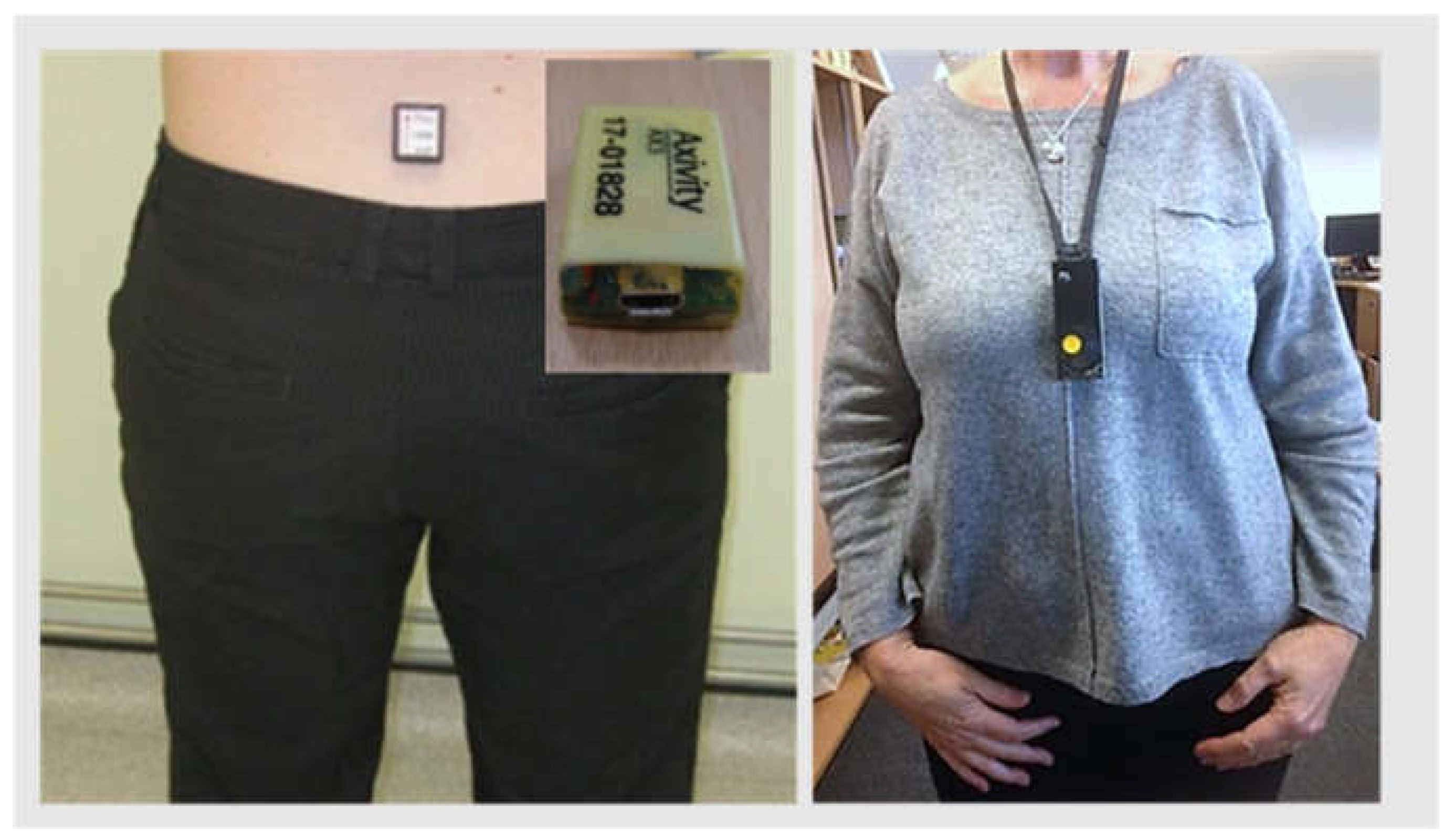

Table 1.
Demographic characteristics of participants with and without Parkinson’s.
| Older adults without Parkinson’s (OA) | People with Parkinson’s (PwP) | |
|---|---|---|
| n | 13 | 17 |
| Gender F/M | 6/7 | 7/10 |
| Age, years Mean (SD) | 81.8 (8.1)* | 72.5 (5.1)* |
|
Living situation n (% of group) |
6 (46%) living alone, 7 (54%) living with spouse | 5 living alone (29%), 12 (71%) living with spouse |
|
Support from carers n (% of group) |
None: 8 (62%) Informal (family/friends): 3 (23%) Formal (paid) domestic: 1 (7.5%) Formal (paid) personal care: (7.5%) |
None: 12 (70%) Informal (family/friends): 2 (12%) Formal (paid) domestic: 2 (12%) Formal (paid) personal care: 1 (6%) |
|
Geriatric Depression Scale n (% of group) |
No depression: 7 (54%) Mild: 3 (23%) Moderate: 3 (23%) Severe: 0 |
No depression: 9 (53%) Mild: 5 (29%) Moderate: 2 (12%) Severe: 1 (6%) |
|
Hoehn & Yahr Median (IQR) |
N/A | 3 (0.5) |
|
Time since diagnosis, years Mean (SD) |
N/A | 15.78 (10.12) |
|
Unified Parkinson’s Disease Rating scale, UPDRS, motor part 3 Median (IQR) |
N/A | 24.01 (21.5) |
|
Freezing of Gait Questionnaire Median (IQR) |
N/A | 10 freezers 21.0 (11.5) |
| *Indicates significant difference between groups; N/A – not applicable, Parkinson’s specific outcome measure | ||
Table 2.
Gait and balance measures of participants with and without Parkinson’s.
| Older adults without Parkinson’s (OA) | People with Parkinson’s (PwP) | |
|---|---|---|
|
Gait speed (m/sec) Mean (SD) |
1.9 (1.1) | 2.0 (2.8) |
|
Timed up and go (sec) (low score suggests better performance) Mean (SD) |
19.3 (10.3)* | 28.6 (67.4)* |
|
Mini BESTest (high score suggest better performance) Median (IQR) |
10 (7.5)* | 17.0 (10.5)* |
| Falls Efficacy Scale Median (IQR) | 37 (21.5) | 39 (24.5) |
|
Use of walking aids n (% of group) |
None: 4 (31%) Stick: 5 (38%) Wheeled walking frame: 4 (31%) |
None: 11 (65%) Stick: 4 (23%) Wheeled walking frame: 2 (12%) |
| *Indicates significant difference between groups | ||
Table 3.
Key themes and subthemes.
| Key themes | Subthemes |
|---|---|
| Priority of physical activities |
|
| Influence of the environment |
|
| Physical limitations and management |
|
| Psychological factors |
|
Table 4.
Types of activities captured on body worn cameras. No significant differences between groups.
Table 4.
Types of activities captured on body worn cameras. No significant differences between groups.
| Older adults without Parkinson’s (OA) | People with Parkinson’s (PwP) | |||
|---|---|---|---|---|
| Mean % of captured time | SD | Mean % of captured time | SD | |
| Sedentary leisure (computer/tablet/phone, reading, craft,games) | 21.36 | 8.32 | 34.08 | 7.88 |
| Watching TV | 18.42 | 13.23 | 18.99 | 17.81 |
| Mobility inside house | 11.21 | 1.45 | 19.16 | 2.40 |
| Domestic tasks | 9.32 | 1.07 | 11.49 | 1.25 |
| Eating and drinking | 1.89 | 5.79 | 2.93 | |
| Talking | 3.63 | 4.56 | 7.01 | 7.15 |
| Self-care (washing, dressing, taking medication) | 1.77 | 0.54 | 2.62 | 1.06 |
| Admin and paperwork (mail etc) | 1.01 | 0.84 | 2.87 | 1.97 |
| With children | 0.05 | 0.12 | 1.32 | 1.29 |
| With pets | 0.00 | 0.00 | 0.94 | 1.48 |
| Resting | 3.47 | 9.61 | 3.89 | 5.84 |
| With carer | 0.08 | . | 0.00 | |
| Transport (driving, passenger, public transport) | 14.43 | 2.60 | 12.04 | 2.09 |
| Walking outside | 2.58 | 2.23 | 3.94 | 3.74 |
| Activities outside of house (hairdresser, cinema, restaurant) | 2.47 | 0.34 | 2.33 | 0.13 |
| Gardening/DIY | 3.12 | 1.79 | 3.60 | 1.47 |
| Dancing | 0.53 | . | 1.48 | 1.34 |
| Shopping | 0 | 0 | 3.35 | 1.69 |
| Illustrative quotes | “I haven’t got much else to do – bet a couple of horses, put the television on – I’m a horsey fan you know” (OA001) | “I just get my nose in a book….Or a puzzle or I started doing some knitting” (PD002) | ||
| “And the afternoon is watching the telly again and it’s sport that I watch more than anything else…Passes the day.” (OA007) | “I tend to have my meals…And then erm I watch a bit television…Then that’s about it really.” (PD009) | |||
| “I like reading” (OA006) | “I’m always on the computer” (PD013) | |||
Table 5.
Comparison of Axivity data between groups.
| Older adults without Parkinson’s (OA) Mean (SD) |
People with Parkinson’s (PwP) Mean (SD) |
|
|---|---|---|
| Total walk time (hours) | 16.84 (6.72) | 16.74 (7.21) |
| Total walk time per day (minutes) | 144.37 (57.62) | 151.75 (56.48) |
| Steps per day | 9825.04 (4033.78) | 10374.73 (4051.69) |
| Mean bout length (sec) | 14.71 (3.52) | 14.73 (3.00) |
| Percentage of Walking Time per day | 10.03 (4.00) | 10.54 (3.92) |
| Illustrative quotes | “I’ll walk around the shops and I’ll walk around the corner, walk to the bus” (OA013) “We’ll walk through the shopping centre, right the way back round” (OA005) |
“Well, of course, if you don’t go walking you’d take no exercise at all” (PD007) “Well, I think its active just cleaning the house…and changing the bed upstairs” (PD004) |
Table 6.
Percentage time indoors and outdoors and qualitative quotes relating to weather and safe at home.
Table 6.
Percentage time indoors and outdoors and qualitative quotes relating to weather and safe at home.
| Older adults (OA) Mean (SD) |
People with Parkinsons’s (PwP) Mean (SD) |
|
|---|---|---|
| Indoors – home (% of captured time) | 78.6 (14.1) | 79.6 (13.7) |
| Indoors – not at home (% of captured time) | 9.8 (9.1) | 10.5 (6.9) |
| Outdoors (% of captured time) | 8.6 (8.2) | 10.1 (7.6) |
| In vehicle (% of captured time) | 5.0 (3.1) | 6.3 (7.6) |
| Illustrative quotes | “So I keep saying when the weather gets a bit warmer [laughs] I’ll do it and I think that’s silly because I am putting it off-“ (OA006) | “The pavements are bad” (PD011) |
| “I would like to go to the baths, but it’s still too cold for me to go” (OA010) | “We walk when we can don’t we. If we get decent weather we’ll go out” (PD016) |
Disclaimer/Publisher’s Note: The statements, opinions and data contained in all publications are solely those of the individual author(s) and contributor(s) and not of MDPI and/or the editor(s). MDPI and/or the editor(s) disclaim responsibility for any injury to people or property resulting from any ideas, methods, instructions or products referred to in the content. |
© 2024 by the authors. Licensee MDPI, Basel, Switzerland. This article is an open access article distributed under the terms and conditions of the Creative Commons Attribution (CC BY) license (http://creativecommons.org/licenses/by/4.0/).
Copyright: This open access article is published under a Creative Commons CC BY 4.0 license, which permit the free download, distribution, and reuse, provided that the author and preprint are cited in any reuse.