

Submitted:
19 July 2024
Posted:
19 July 2024
You are already at the latest version
Abstract
In the last few years, the agricultural field has undergone a digital transformation, incorporating artificial intelligence systems to make good employment of the growing volume of data from various sources and derive value from it. Within artificial intelligence, machine learning is a powerful tool for confronting the numerous challenges of developing knowledge-based farming systems. This study aims to comprehensively review the current scientific literature from 2017 to 2023, emphasizing machine learning in agriculture, especially viticulture, to detect and predict grape infections. Most of these studies (88%) were conducted within the last five years. A variety of machine learning algorithms were used, with those belonging to the neural network (CNN) standing out having the best results most of the time. Out of the list of diseases, the ones most researched were Grapevine Yellow, Flavescence Dorée, Esca, Downy mildew, Leafroll, Pierce’s, and Root Rot. Also, some other fields were studied which are water management, plant deficiencies, and classification. Because of the difficulty of the topic, it was collected all datasets that were available about grapevines, and it is described each dataset with the type of data (e.g., statistical, images, type of images), along with the number of images where it was mentioned. This work provides a unique source of information for a general audience comprising AI researchers, agricultural scientists, wine grape growers, and policymakers. Among others, its outcomes could be effective at curbing diseases in viticulture, which in turn will drive sustainable gains and boost success. Additionally, it could help build resilience in related farming industries such as winemaking.
Keywords:
artificial intelligence
; machine learning
; grapevine
; diseases
; vineyards
; smart sensors
; smart agriculture
1. Introduction
In the last few years, there has been a high increase in population growth, with more diverse dietary choices and a rapid switch to a more healthy lifestyle. These social transitions, with climatic change, have a direct impact on the agricultural field, which has to overcome these trends by increasing production but also by increasing quality. In this part, smart farming and precision agriculture try to assist the farmer and modernize agriculture.
Vine production is important for agriculture because of its long history and its contribution to the culinary arts, but it comes with several challenges that may affect farmers and consumers. Agricultural challenges are certainly not new to the world; however, they have now taken on a new scope. This is due to everything change, changeable and unpredictable weather conditions, pests, diseases, and resource constraints, make growing grapes challenging. Growing vines can have a mainly positive impact on the economic development of a region, but also creates certain problems regarding precise management or reproduction in the event of the dying of the plants. Expert advice is very expensive and is also of low accuracy to help with these issues. The uncertainty of drought, flood, and pests has farmers at their wit’s end, trying to adapt their techniques to climate change.
The cultivation of vines faces obstacles that need creative solutions, marrying human ingenuity with the power of technology. Machine learning is one of the technologies that can optimize vine production. Making very accurate predictions for the guidance of farmers’ decisions is achievable, for instance, by using weather and soil condition data combined with image recognition. Detecting disease and infestation early enough may save the entirety of a crop, and proper irrigation and nutrient management with ML recommendations ensure the resources are used in the best possible fashion. Essentially, machine learning is the way forward and is positively impacting the face of agriculture in improving the health, productivity, and economic viability of grape growing while reducing pesticide use.
Grapevine research has changed seriously in the past few years with the increased use of AI tools to analyze data and find trends. This review attempts to provide a comprehensive evaluation of AI techniques in the area of grapevine research by comparing the different datasets, diseases, and techniques approaches. Some of the topics that will be included are grapevine diseases, data format techniques, and machine learning algorithms from image format to capturing tools like UAVs. It is designed to deduce the most efficient methods in the evaluation of grapevine data by comparing current methodologies and organizing them for future researchers. On the same note, it promotes the study of new methods by supporting the study of previous best-performing algorithms or the less researched algorithms in the field of grapevine research. The above is focused on the areas of prediction for grapevine diseases, water management techniques, plant nutrition, and grapevine classification, amongst other studies that have already been conducted in recent years using Machine Learning algorithms. This review supplies a valuable resource for grapevine researchers and practitioners interested in incorporating AI techniques into their work.
1.1. Aim of the Study
This kind of paper would probably attract a large scope of readers comprising AI researchers, scientists of production agriculture, and land policy experts. It can be used for a variety of purposes, such as conducting superior and sustainable grapevine management research that has effects on the development of the wine industry as well as many other sectors that depend on grapevines. More specifically, the aim of our research is highlighted as follows:
- Knowing that the majority of the research (88%) had been done in the last 5 years, it needed to be organized in one place where they will be compared together.
- Moreover, we organize all the technologies used, the applications of ML in Grapevine research, and correlate them together. As a result, it becomes more likely that researchers will look at the general picture and all perspectives.
- Knowing the current studied ML topics in Grapevine research and comparing them with the ML topics studied in General Agriculture, it’s easier to understand the topics that haven’t been thoroughly studied yet in Grapevine.
- The datasets are organized in the same place so that future researchers can easily utilize them, while hopefully, future works could arise using the same data for comparison reasons.
2. Materials and Methods
We conducted a systematic review, with the use of VOSviewer [1], while also carefully selecting the papers to be reviewed and outlining their techniques and methods in tables and an overview for each one. The Google Scholar query that we executed was ALL=(("Machine Learning" OR "Artificial Intelligence") AND ("Grapevine" OR "Vineyard")) AND (year 2017-01-01 AND year 2023-01-01) and we carefully chose the results because many of them were essentially citing grapevine research but was not analyzing them or being dedicated to it. We then did the same query to WebOfScience and passed it to VSOviewer. Finally, each paper has been described with a paragraph outlining the major features, and the results are then compared using papers based on their techniques and applications.
In WebOfScience we had 158 results, while we also changed the year to "all" and the results increased to 178 (meaning 88% of the research was made last 5 years). Lastly, we passed it to VOSviewer and chose "Title and abstract fields", "full counting" and at least 8 occurrences in each paper, the result had 56 terms, while we removed non-relevant like "number".
Figure 1 shows all the subject areas about the overall keywords of scientific literacy. VOSviewer can display three different mapping visualizations for the bibliometric analysis, and Figure 3 shows the density visualization.
Figure 3 illustrates the breadth of research on the subject. Essentially, the visualization of Figure 3 serves as a heatmap for unveiling the trends that researchers are working on more frequently. Consequently, on the findings of the literature, it can be concluded that there is a lot of discussion about the model, vineyard, disease, data, and vine classification.
2.1. Outline of the Paper
The rest of the paper is structured as follows:
In Section 3 the general field of Machine Learning in Agriculture is described. Following, in Section 4, an overview of the different diseases that affect grapevine is presented from a biological perspective, while Section 5 includes a variety of grapevine datasets, that are mostly classified depending on diseases. Section 6 gathers a short description of all the techniques utilized in any paper we included in this study. The techniques are divided concerning the capture and modification of the datasets, as well as the ML techniques used to analyze them. In Section 7 all the reviewed papers are briefly summarised and separated by their application in Grapevine. Finally, in Section 8 the general deductions of our review are concluded.
3. Background
3.1. Machine Learning in Agriculture
The need for smart farming is becoming more and more vital as the population of the earth rises and while people try to shift to different and more healthy choices of lifestyle. When smart farming reaches each peak, with the use of various machines along with algorithms or systems able to replace or work along with farmers, the next important movement in Agriculture is the use of AI to help farmers optimize their outcomes. Many studies have been conducted on the use of Artificial intelligence in Agriculture [2,3] as well as some surveys [4,5,6] to compare and describe them compactly as the increase of studies in this field is extremely rising. In particular, Agriculture is a subset of AI namely Machine Learning with various techniques, and more popular seems to be Neural Networks. As it has been described in various surveys [6], most research is focused on four general fields,
- Crop Management
- Water Management
- Soil Management
- Livestock Management
Where in crop management also lies yield production, disease and weed detection, and cultivation recognition and quality. More information about the above can be found in [6] as also a comparative study in the general problem, while in this paper we focus on the subcategory of Grapevines. In Grapevine research, the most studied category is crop management and especially disease detection, as it is the most important field of study, while less studied categories are soil management and crop quality.
In general, an ML technique needs 4 things, a good dataset that describes appropriately the general problem, pre-processing of those data for better applicability, a learning phase using the appropriate algorithms that fit the problem, and a testing phase. What has been observed is that it is hard to find an open dataset and most studies create their own which can massively affect the accuracy of the designed system.
According to the research, ML may be classified based on the type of learning:
- Supervised learning: The input and output are known, and the machine attempts to find the best path to an output given an input; [2];
- Unsupervised learning: No labels are provided, leaving the learning algorithm to generate structure within its input [5];
- Semi-supervised learning: A mixture of labeled and unlabeled data constitute the input data [4];
- Reinforcement learning: Decisions are made towards finding out actions that can lead to the more positive outcome, while it is solely determined by trial and error method and delayed outcome [3].
3.2. Supervised Learning
These models are trained on labeled data and then used to predict future events. The training approach takes as input a known training data set with its associated labels, and the learning procedure develops an inferred function that in turn makes predictions about any new unknown observations that could be added to the model.
Supervised models are characterized beyond as regression or classification problems:
- Classification: Classification problems arise when the output variable is categorical such as “disease” or “no disease”.
- Regression: Regression problems occur when the output variable is a true continuous value such as stock price prediction.
This family includes models like SVC, LDA, SVR, regression, and random forests.
3.3. Unsupervised Learning
In unsupervised learning, the data are unlabeled. It studies the way that computers can infer a function from these data to explain a hidden structure. Rather than anticipating the proper outcome, the system explores the data and may make inferences from them to define hidden patterns in unlabeled data.
Unsupervised models include clustering and association cases.
- Clustering: A clustering problem is one in which you want to disclose the underlying groupings in the data, such as grouping animals based on particular characteristics/features such as leg count.
- Association: Here you want to identify association rules, such as those who buy X also buy Y.
Among the models in this family are PCA, K-means, DBSCAN, and mixed models.
3.4. Semi-supervised Learning
This group combines supervised and unsupervised learning settings. Semi-supervised models may be trained using both labeled and unlabeled input.
3.5. Reinforcement Algorithms
This model family consists of algorithms that use estimated errors as incentives or penalties. If the mistake is serious, the penalty is harsh and the reward is insignificant. When the fault is little, the penalty is mild and the reward is significant.
The two most important characteristics of reinforcement learning are the trial-and-error search and delayed reward. This model family automates the determination of optimal behavior within a given environment to achieve desired performance.
To learn which behavior is ideal, the model requires reward feedback, often known as "the reinforcement signal."
This family of models includes the Q-learning model.
In the laboratory, a remote sensing technique was designed and verified on the orchard using an unmanned aerial vehicle (UAV). It is only for citrus fruits, not grapevines.
4. Diseases in Grapevine
Grape plants are generally affected by infections caused by bacteria, viruses, nematodes, and parasites worldwide. The most common diseases are black rot, mold, yellow spot, and esca. Early diagnosis and treatment are necessary for such infections. Grapes, leaves, and fruits are generally infected by bacteria, infectious, and viral diseases. Fungal infections are generally judged by appearance, but the most common are bacterial infections. Bacteria generally reproduce by binary fission, whereby one cell divides into two. Black spots, rot, and blight are some of the general diseases found on grape leaves. The researchers approach disease management with generally applicable solutions and specific treatments. Some seek general strategies that can be used across many diseases while others focus on treating individual diseases. Additional studies were conducted for each disease listed below were performed for each disease listed below.
Research shows that the scope of the diseases is quite far and may have an impact on the world economy on a big scale. However, the wide application of pesticides while dealing with crop diseases brings about another issue: the health of those living near the places where these pesticides are applied. The technological advancement of remote sensing data for example hyperspectral and drones on multiphotonic sensors allows catching and monitoring rapid outbreaks of vineyard diseases. For example, an expert lacks the practice precision that could protect or mitigate this transmission of disease. Using scientific research, technological advancement and precise disease control tools are to be thought of as the driving forces for the provision of the best vineyard services around the globe.
4.1. Grapevine Yellow (GY)
A variety of grapevine yellow diseases are associated with grape growing sites across the world. The main varieties include Flavescence dorée (FD), Bois noir (BN), and Palatinate grapevine yellows (PGY). These diseases are numerous and caused by a variety of phytoplasma groups. The phytoplasma Candidatus Phytoplasma solani causes BN infection, which is seldom spread by the planthopper Hyalesthes obsoletus. On the other hand, PGY is a health problem related to the Elm yellows group, and the majority of them are transmitted by the leafhopper Oncopsis alni. Candidatus Phytoplasma vitis distinguishes FD, which is spread via Scaphoideus tetanus, a leafhopper. These diseases have similar symptoms, such as desiccation of flowers, stunted growth, uneven ripening of wood berries, wrinkled leaves, and discolorations indicative of specific varieties. Leaves can change their colors, from chlorotic yellow to red and purple-reddish, depending on the varietal of the grape. There would also be non- or partial woodiness (at the end of summer) and black pustules on the interveinal portions of the stems. One of the primary reasons we may consider "Grapevine Yellow disease" to be present is because it can cause various manifestations and symptoms that are very similar to those of the other grapevine disease(s), such as leaf roll and/or injury created by leafhopper. Leaf problems can also have colors that are similar to esca and grapevine leafroll diseases. Phenomenal analysis of the Grapevine Yellow Disease diagnosis by specialists is the way to obtain the correct result.
Flavescence Dorée Flavescence Dorée (FD) is a specific type of Grapevine Yellow and is usually caused by a bacterial infection that causes it to turn yellow and the same cause is restricted by the Phytoplasma group of bacteria. It is the way this bacteria is being carried by Scaphoideus tetanus, a pest that is transferring bacterium through its bloodstained saliva. FD has an economically important effect in wine-growing countries, and, the emergence of the condition should be expected, caused by the time delay and individuality manifestation. Symptoms of FD comprise dull yellow on white varieties, rubra-red on red varieties, defective lignification on young shoots, flower wilting, fruit drop, and weak shoot development. The problem is that FD symptoms are very similar to those of other grape-yellow viruses such as Bois noirs (BN), so it is easy to mistake them. PCR-based chemical ways of discrimination between typhus and Bacillus Nigra are possible. Present control means are use of such measures as the trenches digging and the using of pesticides which are harmful to the environment. Earlier detection approaches are mandatory for highly efficient prevention and containment strategies.
4.2. Esca
The grapevine trunk diseases (GTD)[7] are a highly dangerous threat to viticulture and Esca is the most harmful disease among them. Esca as seen normally results in major economic losses all over the world and dealing with this problem is further complicated by the insufficient availability of both preventive and curative therapies. GTDs include a complex group of fungi causing mildew and rot such as Eutypa and Botryosphaeria that infect grapes through cuts in the field and from nurseries. Transmission of the GTDs by offshoots from young grafted vines is also possible. There is no type of vine, split into two types: cultivated and wild, that cannot be affected by this disease. The usual Esca wood that affects the old vines shows itself in various discolorations, necrosis processes, vascular infections, and white rot. Conversely, it is the outward symptoms that later appear which may take months and may be years after infection due to the slowness and slow progression of the illness. Often, the plants look sick or have chronic intervascular necrosis, yellow or red chlorosis, and tiger stripes on leaves or shoots. The degree of tree symptoms slips short of the sign of leaf symptoms in certain cases. Since chronic symptoms do not develop consistently, annual monitoring is crucial for accurately assessing the disease’s incidence in a vineyard.
4.3. Downy mildew
Downy mildew [8], known as a disease of grapevines caused by the oomycete pathogen Plasmopara viticola, is one of the major diseases. It is well known to result in a heavy harvest reduction, in addition to affecting the quality of fruit during several growing seasons. The disease was coincidentally transmitted to Europe towards the end of the 19th century and has since resulted in a destructive effect on grape yields. In the primary phase, the germinated oospores develop into macrosporangia in the spring, and then they begin to release zoospores under moist conditions. The early stages of downy mildew infection are followed by boosting the transpiration coefficient and the decrease of leaf temperature. During the later stages of the disease, the bark turns chlorotic and necrotic, causing moisture loss and reduced stomata control. Treatments with fungicides are employed to stop downy mildew of the grapevines, but excess fungicide application is not economical, environmentally friendly, and safe for human health. In the case of downy mildew identification, it is necessary to distinguish its symptoms from the other pests or missing symptoms. In the early stage of the infection, small yellowish-brownish oil patches may occur on the leaves of grapevines, which can resemble symptoms caused by pests, such as spider mites. The increasing growth of spider mites usually occurs in the form of yellow or red strokes along the veins of the leaves. Making differences between the types of yellowing is a key feature for a diagnostician who is trying to diagnose the cause of aging correctly and provide proper control measures. An adequate diagnosis gives commercial vineyards a chance to tailor specific pest (spider mite) or disease (downy mildew) control interventions or explore other options.
4.4. Leafroll
The grapevine leafroll disease (GLD) [9] is a viral disease that negatively impacts wine grapes production worldwide. It impacts grapevine vigor, physiology, and the final grape quality. GDL is subject to the following problems: ripening is uneven, and bunches bear less fruit with lower sugar content. Several viral species of grapevine leafroll-associated virus (GLRaV) are being identified in grapevines, such as GLRaV-3, the most prominent and the main pathogen of grapevine leafroll disease. When herbicides penetrate the leaves, photosynthesis is reduced, and that may impair the level of chlorophyll and carotenoids [10]. This slowdown in photosynthetic processes can be a critical step in the weakening of the overall health and productivity of the vine. The economic consequence concerning GLD, including other well-known virus diseases such as the Grapevine Leafroll-associated Virus Complex 3 (GLRaV-3), is huge which leads to a great number of revenue losses of about USD billions annually within the US wine and grape industry. Amongst the GLD management and control measures are items like using virus-free planting material, exercising correct sanitation measures, and improving the cultural practices that minimize the spread of the disease. An early diagnosis of GLD and identification of a spectrum of infectious viral species is paramount for the implementation of functioning management in a vineyard.
4.5. Pierce‘s
Pierce’s disease (PD) [11]) has become a major threat to wine grapes, especially in the US and specifically California. Downy mildew is very deadly, as there is no cure for it and diseased grapevines can die from it in five years. PD is found to have a significant economic impact on the same measures yielding huge losses that could overpass the 100 million dollars for the state of California annually. PD is a disease which if not found and discovered on time, can affect commodity grape productions hence the need to continuously find a PD throughout. The PD manifestations may be observed 3- 6 months and up to 18 months after the infection has started. They give signals that tell whether there is any danger or not. In contrast, one can confuse the powdery mildew’s symptoms with those of some other vine diseases and disorders, so exact diagnosis is vitally required. The earliest detection of PD is advisable for the application of necessary management strategies and thus, prevents the disease from becoming more severe. Among other economic consequences of the loss of grape and wine PD by California State grape and table grape growers, this total has dropped dramatically by about 104%. The number was 4 billion in 2014 and in 2018 it increased dramatically to 5.6 billion. Many preventive activities are being carried out to mitigate this problem and find appropriate solutions to maintain good health, which in turn ensures the sustainability of viticultural activities [12].
4.6. Root Rot
Another elm pathogen is Armillaria Root Rot [13] which is an ubiquitous, chronic problem for ornamental and other woody plants, including grapevines. Recognizing plants infected in the earliest stages is a principal step in the right handling of the pathogen. Across the globe, among several pathogenic fungi, the Armillaria is the most studied and analyzed genus. The contamination is transported via the soil particles, mainly by way of the rhizomes or specialized hypha commonly called rhizomorphs. They are the fastest-growing living bridges among existing fungi in the world, up to 100 meters long or more, and can penetrate the phloem of host plants. Armillaria molds are a group of opportunistic parasites, some of which are regarded by many primary pathogens of stressed trees, like in the case of changing climate conditions. The pervasiveness of monocultures and intensification of crop cultivation provide a suitable occupational niche for Armillaria, the fungus known to cause considerable yield losses. Many plants undergo contamination like larch, spruce, pine, fir, or other conifers as well as broadleaf trees, garden trees, shrubs, and fruit bushes including apples, blueberries, pears, peaches, and kiwifruits which may be infected by Armillaria. It is very difficult to diagnose Honey mouth stem rot just based on foliar population, as they give a general kind of symptoms. Visual studies of stem bases will help doctors to improve their diagnostic image. Nevertheless, the above-ground symptomatology of the disorder commonly becomes noticeable at the later or terminal stages when the host plant has lost a significant proportion of its health. A sensitive and speedy early identification is a must to devise the right control measures for the abatement of Armillaria root rot in grapevines and other plants.
5. Datasets
From our study, we acknowledged the difficulty of finding datasets about vineyards, which led many researchers to create their own datasets. To address this issue, we collected all datasets we could find we describe them in the next paragraphs. They consisted mostly of datasets mentioned in the papers we reviewed, but we also researched on our own to have an overview of the field. Following, we describe each dataset by its data type (e.g. statistical, images, type of images) and the number of images existing in each category (if it is mentioned).
- GrapeCS-ML database: https://researchoutput.csu.edu.au/en/datasets/grape-image-database [14] The GrapeCS-ML database consists of images of grape varieties at different stages of development together with the corresponding ground truth data (e.g., pH and Brix) obtained from chemical analysis. The database consists of five datasets for 15 grape varieties taken at several stages of development and includes size and/or Macbeth color references. Altogether, the database contains a total of 2078 images.
- In the paper LDD: A Dataset for Grape Diseases Object Detection and Instance Segmentation [15] The authors created a grapevine disease database with images from Horta’s internal databases, the competition Grapevine Disease Images and from the web, and manual segmentations. It contains 1,092 RGB images of grapes and 17,706 annotations (instances) for the tasks of Object Detection and Instance Segmentation. More specifically, it contains the categories Black Rot with 1180 instances, Esca (Black measles) with 1383 instances, Leaf blight (Isariopsis Leaf Spot) with 1076 instances, and Healthy with 423 instances.
- Grapes-Leaf-Disease-detection repository https://github.com/shreyansh-kothari/Grapes-Leaf-Disease-detection consists of images about grapevine diseases, to be exact, it includes Esca (240 images), Black Rot (210 images), Healthy (220 images), Leaf Blight (210 images).
- In [16] https://github.com/cu-cairlab/iros2022-OnlineDMSeg.git there is a dataset with 282 raw images, classifying them in healthy or with Downey Mildew disease.
-
PlantVillage:A collection of datasets augmented with plantVillage dataset for grapevine diseases. It consists of the categories Black rot (1180 images), Esca (1383 images), Grapevine Yellow (134 images), Healthy (84 images), and Leaf blight (1076 images). They also have edited versions of the images with various operations increasing the total number of them.
- http://dx.doi.org/10.17632/89cnxc58kj.1: A dataset [18] specific about Esca disease in Grapes, consists of 881 healthy RGB images and 887 Esca images.
-
For the paper [19], they also created a dataset using hyperspectral imaging under laboratory lighting, their dataset consisted of 496 images of 248 plants. Also, this dataset distinguishes between symptomatic and asymptomatic leaves.The images in the collection were captured on grapevine leaves from five different varieties: Ak, Ala Idris, Büzgülü, Dimnit, and Nazli each kind of grapevine species has 100 images. This dataset is available to researchers at https://www.kaggle.com/datasets/muratkokludataset/grapevine-leaves-image-dataset https://www.muratkoklu.com/datasets/. The same dataset has been used in [20].
- Some research used also statistical data for grapevine disease (e.g [21]), some statistical data for diseases can be found on the following pages based on grapevines located in Italy http://www.agroambiente.info/ https://agroambiente.info.regione.toscana.it/.
The previously described datasets are compared in Table 1.
6. Techniques in Grapevine
6.1. Data Format Techniques
Here, we briefly introduce the techniques used in the data aspect, so we can concentrate on how the data can be captured and in which form. Also, in Table 2, we summarise the data formatting techniques used in various research and categories of the diseases, along with the relevant notes.
6.1.1. RGB Images
One of the most common options for machine learning applications for capturing detailed color information and providing rich visual data is RGB images. [22]. The RGB color model is a way of displaying colors in images using Red, Green, and Blue as the three primary colors in the additive color system and represents a wide range of colors using different intensities. Therefore, RGB images are well-established to capture image data for disease detection, and plant species distinction. This digital image analysis is a useful and non-destructive method. The RGB system is representative of high spatial resolution with limited spectral analysis. In spatial analysis, we can have pixel resolutions where the order is a few millimeters or smaller and it can be done in separate measurements. After, features like morphology or texture can be extracted from the digital image analysis. Texture refers to visual patterns and the spatial arrangement of the pixels that constitute a photo. Using texture, we gain more information than can be obtained from color or intensity analysis separately. The variation and the relationship between the pixels that form the surface and the structure of the objects in the image can be captured from the texture. So, the objects can easily be separated and identified. For instance, in grapevine disease detection, texture can detect different plant differentiations that are related to the disease symptoms like spots and discoloration. Thus, we will have a more accurate prediction.
Spectroscopy Spectroscopy is a technique used to analyze the interaction between matter and electromagnetic radiation. It acquires information over a broad spectrum range, detecting vibrations at certain frequencies corresponding to bonds or a group’s transition energy. Spectral resolution refers to the spectral measurement bandwidth. The spectral analysis systems have narrow measurement bandwidth; hence they resolve spectral features to very high quality. One of the noninvasive sensing technologies is visible/infrared spectroscopy, which, by spectral information in the VIS or IR spectral range, opens up the rapid determination of the objects without sample preparation. The VIS region is a portion of the electromagnetic spectrum visibly perceived by the human eye and contains information about color features we can perceive. IR falls between visible and microwave regions of the electromagnetic spectrum and hence is not visible to the human eye. IR region contains information about chemical compounds and their structures. This spectrum is divided into three main regions: Near InfraRed (NIR), Mid-InfraRed (MIR), and Far-InfraRed (FIR). The NIR is beyond the Visible spectrum, can activate overtones or harmonic vibrations, and offers information undetectable to the human eye. NIR spectroscopy finds its uses in agricultural monitoring, like evaluating plant health, soil properties, etc. Afterward, MIR is beyond the NIR and associated with basic and rotational vibration structures. It comprises information related to chemical functional groups, such as the detection of chemical changes associated with diseases. It is utilized in applications, for example, natural and biomedical applications. FIR is arranged just before the microwave region, is related to warmth radiation, and is generally utilized for thermal imaging and temperature measurement applications. Besides, the Sort-Wave Infrared (SWIR) is a portion of the infrared spectrum that is among the regions of NIR and MIR. Monitoring vegetation health, soil moisture, and chemical analysis are some examples of its uses. Moreover, the Visible and Near-InfraRed (VNIR) portion is a combined spectral range that shares the spectrum of VIS and NIR. This spectral range can be used in both hyperspectral imaging and environmental monitoring. VNIR sensors have valuable use in agricultural management and environmental science.
One of the major spectrometers is the Airborne Visible/Infrared Imaging Spectrometer, AVIRIS, designed to extend spectroscopy to Earth remote sensing. It was designed and developed for NASA’s research and its applications. This spectrometer aims to provide access to high-quality spectral images acquired in multitemporal conditions over all regions of the Earth. NASA’s Airborne Visible/Infrared Imaging Spectrometer Next Generation (AVIRIS-NG) is one of AVIRIS’s family, which collects hyperspectral data across both visible and infrared portions of the spectrum. Examples where we can use this spectrometer are the following:
- Classification and Mapping: The valuable spectral information gained from the AVIRIS-NG can be used with machine learning algorithms for classification and mapping applications. This may include the mapping of vegetation, surface and open water, and crop types. They can also use the labeled AVIRIS-NG data in other images to automatically classify objects or features.
- Environmental Monitoring: We can use AVIRIS-NG images to estimate environmental parameters such as vegetation health, water quality, pollution, etc. Machine learning algorithms permit the examination of the spectral patterns and correlations in AVIRIS-NG data for the detection and observation of anomalies or changes over time, which is greatly helpful in identifying environmental hazards or changes in ecosystems.
- Disease Detection: Early detection of plant diseases is feasible by training machine learning models on the AVIRIS-NG images. The algorithms detect even minor changes in vegetation health since AVIRIS-NG captures the spectral signatures of vegetation. Thus, farmers and researchers make informed decisions to control the spread of diseases and protect crops.
- Mineral Exploration: AVIRIS-NG data can be used in machine learning applications for mineral exploration and mapping. In the reflectance spectra, there are unique absorption features for rocks and minerals that can be observed from the spectral signatures obtained from the AVIRIS-NG images. By training machine learning algorithms it may be allowed to identify and detect minerals, and hence locate and map deposits of various minerals.
6.1.2. Hyperspectral Images
Spectral techniques have proved to enhance accuracy in many instances and also are quick, nondestructive, repeatable, and economical. [23].
Hyperspectral images (HSI) are useful in machine learning and precision agriculture for detecting and monitoring plant diseases. Several congruent images constitute the hyperspectral image data. These images capture a large amount of spectral and spatial information and provide a wide range of wavelengths that the human eye cannot see. Also, they can identify and distinguish spectrally similar materials and compare them with other types of remotely sensed data, we can extract more accurate and detailed information. These data represent different wavelength bands of vector pixels (voxels) containing two-dimensional spatial and spectral information. Continually, from HSI we can obtain reflectance values allowing us to identify anomalies and potential risks to plant development, facilitating early detection and reduction of economic impacts. Spectral measurements, including spectral reflectance and vegetation indices, are important in attendance to plant health. They assess biophysical, biochemical, and geometric observations of size orientation, shape color, texture, pigment change, water content, and tissue functionality. They have been evaluated for their potential in detecting and differentiating crop diseases. In conclusion, hyperspectral imaging, spectral measurements, and machine learning algorithms provide relevant information for disease detection, monitoring plant health, and implementing variable rate technology in precision agriculture.
6.1.3. Multispectral images
Multispectral imaging captures image data within specific wavelength ranges across the electromagnetic spectrum, such as visible or near-infrared regions. In addition, multispectral imaging measures light in a small number of spectral bands. Each region captures the intensity of radiation within that specific range of wavelengths. We can extract information that the human eye fails to capture. These images can be used in various remote sensing applications like satellite imagery and aerial photography for mapping and analyzing details of the Earth related to landforms, coastal boundaries, vegetation health, and identification of certain features. [24]
The main difference between multispectral and hyperspectral images is that multispectral capture a limited number of spectral bands, while in hyperspectral hundreds of continuous spectral bands are captured. Also, hyperspectral images provide more detailed and exact spectral information, and as a result, the analysis is more accurate. On the other hand, Hyperspectral data are computationally demanding and require different, specific algorithms for processing and analysis.
6.1.4. Thermal Images
Infrared thermography (IRT), often known as thermal imaging, is a process where a thermal camera records and produces a picture of an item by utilizing infrared radiation emitted from the object in a process, which are examples of infrared imaging science. It is a useful technique since we can analyze and detect the health of plants. Leaf stomatal closure is related to surface temperature and transpiration. The canopy or leaf temperature can be an indicator of several physiological parameters such as stomatal conductance. Advances in thermal imaging technology offer new ways to explore the plant’s thermal response to water status.
Leaf temperature measured by infrared thermography [25], may be an early measure of crop disease and stress before the appearance of visual symptoms. Among all the electronic imaging sensors, thermal sensors appear to be more efficient than others to detect disease-related changes. For instance, we can tell that infrared cameras have been used to differentiate between biotic and abiotic stresses in cotton. In leaves, the maximum temperature difference can be increased during pathogenesis. Thermal imaging has also been employed to monitor the horizontal spread of infection in rose and cucumber before any visual symptom development. However, ambient temperature and other environmental variables such as sunlight radiance cause fluctuations in leaf temperature and may obscure the infection-caused changes. Therefore, it is difficult to interpret thermal images and discriminate variations due to infection from those due to environmental variables. Thermal imaging for assessing cotton water status variability was determined midday.
Overall, infrared thermography offers a fast and non-invasive method for plant health assessment and for detecting stress or infection by measuring leaf surface temperature changes.
6.1.5. Unmanned Aerial Vehicle (UAV) Images
Unmanned Aerial Vehicles (UAVs), commonly known as drones, were originally developed for military missions. Over the years, as technologies improved their use expanded to many applications such as aerial photography, site surveying, agricultural work, and more. The visible and infrared spectra contribute greatly to disease detection in agriculture and their combination improves this detection capability according to research that has been done. However, the use of two separate sensors for this visible and infrared imaging in UAVs creates a problem and there is a spatial mismatch therefore the simultaneous processing of data, from both sensors, is difficult. To solve this problem multimodal alignment or logging techniques can be used to merge the data. These techniques often use deep learning methods to achieve this.
In agriculture, UAVs have proven to be valuable tools for many applications. Some of these applications include calculating fertilization rates, monitoring biomass production, and detecting weeds and plant diseases. However, automatic symptom detection remains difficult even though technological advances have been made.
Machine learning techniques can significantly improve the usefulness of agricultural data obtained from UAVs. For example, to be able to identify specific diseases in crops or detect anomalies in plant health, we can train deep learning algorithms based on aerial images captured by UAVs. The algorithms can learn from large data sets, resulting in accurate and efficient disease detection and monitoring. Also, through machine learning models, the huge amount of data obtained from UAVs can be analyzed to extract valuable information and patterns to improve decision-making in agriculture.
Therefore, this combination of UAVs and machine learning has several advantages. First, it offers great potential for increasing productivity, optimizing agricultural practices and making precise and targeted interventions. Still, farmers and researchers can have timely and high-resolution data at their disposal. This enables them to detect diseases early, monitor crops better, and manage resources more efficiently.
6.2. Machine Learning Techniques
In the following paragraphs, we give some brief information about the ML techniques used in the studied papers from the agricultural scope of view. In Table 3 we summarize the Machine Learning Techniques used in each disease separately, water management, plant deficiencies, and classification. In each of these parts, we reviewed the effective techniques and ranked them as superior (✓) or inferior (✗). In the field "Best ACC", we retained the highest score of the superior method of each paper by providing some useful information about each study in the "Notes" field. Finally, we constructed a bar chart as shown in Figure 4, where each bar represents the number of papers that have as superior method the corresponding Machine Learning Technique.
6.2.1. Statistical Measures
Statistical approaches that take into consideration features such as grapevine location, proximity to the ocean, weather, and certain dates are employed in many aspects of grapevine cultivation and wine production. The statistical analysis aids in the early detection and treatment of diseases by detecting disease outbreaks, calculating incidence rates, and studying geographical patterns [57]. It provides knowledge about grapevine growth and maturity period through phenological investigation. Statistical measures can help determine the impact of climatic and environmental conditions on grapevine health and fruit growth [58].
6.2.2. K-Nearest Neighbour (KNN)
KNN is a machine learning algorithm that is used to classify samples based on how near they are to nearby data points. KNN may be used to recognize and categorize sick grapes in a setting of grapevines by comparing their traits to those of surrounding healthy and diseased plants, while closeness can be counted both as a proximity metric or as a comparison. By considering factors such as leaf symptoms, the severity of the disease, and environmental circumstances, KNN can rapidly evaluate the health of grapevines. This approach enables vineyard managers to implement prompt interventions to cut crop losses and implement specialized disease management techniques. The KNN algorithm is a useful tool for improving disease detection in grapevines and enabling proactive management techniques. [35,59].
6.2.3. Naive Bayes (NB)
Bayesian methods are well-known as a straightforward and efficient supervised learning strategy for accurate and speedy classification tasks. The Naive Bayes classifier is based on the idea that the impacts of other features do not influence the impact of a single feature on a class. This assumption simplifies the algorithm and enables more efficient categorization. Although the independence assumption is not always accurate, Naive Bayes has demonstrated continuous performance in a range of grapevine research applications, being also a popular choice in the field due to its ability to manage large datasets and provide quick forecasts [36].
6.2.4. Support Vector Machine (SVM)
SVMs are well-known supervised machine learning algorithms that excel in data classification [36]. The main objective of SVM is to draw a boundary in the data, such as a line or a hyperplane, that effectively divides two groups and thus creating the support vectors. To find the optimum hyperplane, a maximal-margin classifier maximizes the margin, which is given as the perpendicular distance from the border to the support vectors. When total separation is not possible, a soft-margin classifier, which allows some data points to fall between the margins or on the incorrect side of the decision boundary, can be employed [60]. To handle data that is not linearly separable, SVM adds non-linear kernels such as polynomial or radial kernels. The Radial Basis Function (RBF) kernel is widely utilized among the various kernel options due to its adaptability and we have also seen it in agriculture applications[46]. SVM model training, particularly when utilizing the Sequential Minimal Optimization (SMO) technique, has been said to result in exceptionally accurate disease detection models, transforming SVM into a robust non-probabilistic binary linear classifier [38,44,59].
6.2.5. Decision Trees
Decision trees are widely used and helpful in inference and classification procedures due to their simplicity and ease of grasp. They are useful for making predictions since they do not rely on the statistical features of the data [50]. A major problem of Decision trees is overfitting when results in significantly complicated trees with many layers, to address this, the maximum number of splits is typically limited to decrease the risk of overfitting and maximize the generalizability of the decision tree model [36].
Random Forest
In remote sensing, notably in viticulture, the random forest has been utilized for a range of purposes, including monitoring soil water levels and displaying grapevine water consumption [19]. A random forest is basically an ensemble model composed of multiple decision trees constructed using a modified bagging technique. Decision trees are rule-based models, continuously splitting the dataset into homogeneous groups based on a response variable. Their structure is particularly sensitive to small changes in the supplied data, and ensemble approaches like bagging exploit this trait [21]. Bagging is the process of creating several trees from different parts of the original dataset obtained using resampling approaches. The random forest model has been said to outperform individual learners through the ensemble because each tree has a distinct structure and learns different regions of the dataset [39].
C5.0
C5.0 is a robust machine-learning model that uses a single binary decision tree or a set of rules combined with a boosted approach. It is designed specifically to deal with complex nonlinear interactions, making it useful also in disease detection applications, and has been found to beat other machine learning algorithms in some grapevine research, indicating its ability to understand complex data relationships and patterns. [21].
6.2.6. Artificial Neural Networks (ANN)
ANNs (Artificial Neural Networks) have been widely used for classification and regression tasks, with applications also in grapevine research[51]. ANNs seek to mimic the behavior of biological neural networks by using connected fundamental components known as neurons that are organized into one or more layers. With a backpropagation method, ANNs change the weights of neurons from the final layer to the first, allowing for efficient learning. In grapevine research, ANNs have been employed for a range of applications such as leaf area index computation [59], rootstock genetics, and disease diagnostics, while it has been also used with hyperspectral data [54].
MultiLayer Perceptron (MLP)
MLP is a feedforward ANN made up of many layers of connected neurons. A non-linear activation function is used at each neuron to take the weighted sum of its inputs, resulting in complex mapping between input and output data. In grapevine research, the MLP approach has been utilized for disease diagnosis, yield computation, and grapevine classification [61]. Based on input inputs such as images, climatic data, soil conditions as well as statistical measures, MLP models may give accurate predictions and classifications regarding grapevine health, yield, and disease risk. It is believed also that, by training on historical data, MLP models may identify complex correlations and patterns in grapevine-related data, assisting in better decision-making and sustainable grapevine farming approaches [35].
Convolutional Neural Network (CNN)
Convolutional Neural Networks (CNNs) [32,42] are a subset of ANNs that is widely used in machine learning tasks that involve image data, while they have been highly successful in pattern recognition and computer vision tasks. Their structure consists of several types of layers, including convolutional, normalizing, nonlinear, and fully connected layers [46]. CNNs get an advantage in image processing as they can isolate smaller parts of an image, reducing the amount of data being processed at once, while the depth of CNN models allows them to handle nonlinear data. A fully connected layer adapts to the nonlinearity and classifies the information, with the activation function (e.g ReLU) providing the predicted class label as the output [12,19,37,48]. The UnitedModel for grape leaf disease identification combines GoogLeNet and ResNet architectures, which have been designed to reduce computational costs and address the degradation problem of CNNs, respectively [42,52]. In the case of leaf viral status prediction, a CNN can take an image or a hyperspectral image as input, where each matrix is representing the image at different wavelengths as done in[33].
Single Shot Multibox Detector
SSD (Single Shot MultiBox Detector) is a feed-forward Convolutional Neural Network (CNN) architecture for object detection. It detects objects by employing a specified number of bounding boxes and scores, which are based on a typical Neural Network (NN). The basic modules of SSD are made up of convolutional feature layers that continually diminish in size, allowing the detection of objects of varying sizes. Convolutional filters generate a fixed number of detection predictions per feature map cell, and each feature map cell contains a set of bounding boxes. This design allows for the recognition of objects of varying sizes in images of varying resolutions [41]. Based on the SSD architecture, MobileNets, and Inception-V2 are two approaches that have also been used in grapevine research.
- MobileNets are lightweight convolutional neural network models designed to perform deep learning tasks on resource-constrained devices. They are attempting to strike a balance between model size and processing efficiency while maintaining acceptable levels of accuracy. MobileNets do this by the use of depthwise separable convolutions, which divide regular convolutions into two different layers: depthwise and pointwise. Depthwise apply a single filter to each input channel, and thus minimize computational complexity. Pointwise convolutions employ 1x1 convolutions to combine the outputs of depthwise convolutions to capture channel-wise interactions, which results in a reduced number of parameters and calculations required making it suitable for resource-constrained devices. MobileNets offer flexibility through the use of hyperparameters like width multiplier () or resolution multiplier (), which allows for extra trade-offs between model size, processing costs, and accuracy [62].
- Inception-V2 is a deep neural network model designed to deal better with objects that change size across images instead of having to find the optimal kernel. Inception-V2 improves on the original Inception model by reducing computational complexity through the use of factorized convolution techniques. By reducing the number of individual convolutions, Inception-V2 improves runtime performance while maintaining a comparable level of accuracy [63].
6.2.7. Genetic Algorithm (GA) in feature selection
Feature selection aims to identify the most relevant and informative characteristics required for categorization jobs, which is a key stage, particularly in grapevine analysis. The Genetic Algorithm (GA) is one of the most complex feature selection algorithms [64]. Although GA is a computationally expensive technology, it outperforms traditional selection methods. What separates GA is its ability to handle massive datasets without a prior understanding of the subject under examination. GA explores and manipulates the feature space using natural selection and evolution concepts to find the best subsets of features to contribute to the classification process [29].
7. Machine Learning Applications to Grapevine
In Figure 5, we present the field of application of each reviewed paper, observing that most of them are about diseases. Moreover, in Figure 6, we overview the geographical locations of each research.
7.1. Diseases
Diseases affect grape vines in varying seasons, temperatures, and humidity conditions. For example, in extended hot and humid weather, black rot causes major harm to the grape industry, but it seldom occurs in dry summer. Grape Leaf Blight is most severe in September when the tree is frail, the temperature is low, and the rain is abundant.
7.1.1. Grapevine Yellow Disease
Detection of grapevine yellows symptoms in Vitis vinifera L. with artificial intelligence
[17] Location of experiment/dataset: Tuscany (Central Italy)
This research aims to demonstrate that by using Deep Learning, automatic detection is now achievable, and this can be used for other pests and diseases through transfer learning. Herein, the authors focus on the detection of Grapevine Yellow disease (GY) in red grapevine using convolutional neural networks (CNN) and color pictures of leaf cuttings. They compare six neural network architectures with the best overall accuracy (ACC) of 99.33% obtained by using ResNet-101 followed by ResNet-50, Inception v3, AlexNet, GoogLeNet, and SqueezeNet in that order. There was a concern that the ResNet-101 may have a diminishing return due to its increased complexity, so they concluded that the ResNet-50 provides the optimum balance of accuracy and training cost, which has no significant difference from the ResNet-101. Two data sets are combined for this investigation. The first was from field surveys in Tuscany and the second was from the PlantVillage dataset. These datasets were verified using DNA extraction and real-time PCR tests. Finally, they compare their method to a system that does not employ deep learning and to a traditional method of human recognition. They conclude that the machine learning system is the best option.
Using Image Texture and Spectral Reflectance Analysis to Detect Yellowness and Esca in Grapevines at Leaf-Level
[26] Location of experiment/dataset: Aquitaine, Burgundy (France)
The authors in this research have the purpose of detecting Yellowing and Esca diseases of grapevines utilizing spectral and texture data with the use of Neural Networks as a classification tool to predict the health status of the leaf. In Neural Networks, they used the mathematical model Back Propagation Neural Networks (BPNN). More specifically, to collect data from infected and healthy leaves, they use texture parameters estimated from Red-Green-Blue (RGB) digital image, and hyperspectral reflectance data. As it has been observed, the symptoms appear in the leaves during all the periods but mostly in the summer, July and August. In their study, on one side, they execute the empirical PROSPECT model inversion using different models and functions to calculate the biophysical parameters, which are the spectral data. On the other side, they compare how efficient is the texture and spectral analyses in classification. After combining these two datasets, they had an accuracy of 99% for both diseases.
Detection of Two Different Grapevine Yellows in Vitis vinifera Using Hyperspectral Imaging
[27] Location of experiment/dataset: Middle Rhine (Germany)
The study of this paper is about the Grapevine Yellow disease with its major agents: Bois Noir (BN) and Palatinate Grapevine Yellows (PGY) that was made for data of greenhouse plants of two white grapevine varieties and for data of different red and white varieties that collected in the field. Disease management is difficult as it does not exist in some treatments. So, it is based on prophylactic measures. The authors use hyperspectral images to detect phytoplasma-infected greenhouse plants and shoots collected in the field. For the differentiation of symptomatic and healthy plants, they tried multiple techniques (LDA, PLS, MLP, rRBF) while also testing in the field and Greenhouse. This had as a result highlighted the true positive and false positive accuracy. Their best accuracy for the classification of the greenhouse plants was 96% with the rRBF model that was applied to the hyperspectral data recorded for PGY, but the results were worse for Boir Noir (BN). From the shots taken in the field, the classification accuracy ranged from 96% to 100% using the MLP model.
7.1.2. Flavescence Dorée Disease
Automatic detection of Flavescense Dorée grapevine disease in hyperspectral images using machine learning
[28] Location of experiment/dataset: France, Portugal
The purpose of this work is the detection of Flavescense Dorée (FD) disease in vineyards using hyperspectral images and it investigates the use of Autoencoders (AEs) with the aim of dimensionality reduction of these images. Also, the researchers assess the use of the gained-trained encoder as a related feature extractor for the detection of vine diseases. Two methodologies are examined: a patched approach and a full image approach. The dataset was 35 hyperspectral leaf images of Vinhão vineyard where 10 samples of them identified with FD. Results showed that with the patched approach, it is observed that using AEs for the feature extraction of hyperspectral images, the problem of high dimensionality can be faced. For instance, in this case, the patched approach had a 0,2 accuracy increase and a 0,34 increase in AUC, along with an important reduction in computational burden, compared to a common CNN model.
Development of Spectral Disease Indices for ‘Flavescence Dorée’ Grapevine Disease Identification
[29] Location of experiment/dataset: Provence-Alpes Côte d’Azur French
The goal of this work was to create spectral disease indicators (SDIs) for detecting Flavescence Dorée (FD) disease in grapevines. This paper, in particular, identifies disease-specific single wavelengths and wavelength differences using the Spectral Disease Indices (SDIs), combines these specific wavelengths with spectral disease indices, and compares the accuracy of the developed indices to common SVIs. Spectral reflectance was measured in the field under production conditions. Furthermore, unlike previous studies that evaluated just one grapevine variety, this study investigated four distinct grapevine types (2 red-berried grapevines and 2 white-berried grapevines). Finally, it was proved that utilizing vegetative indices was better than using whole spectrum data in most circumstances. Particularly, SDIs developed for FD using a genetic algorithm (GA) and with the SVM outperformed typical SVIs with a classification accuracy precision of 96%.
Assessment of the optimal spectral bands for designing a sensor for vineyard disease detection: the case of ‘Flavescence dorée’
[30] (continue of previous research) Location of experiment/dataset: Provence-Alpes Côte d’Azur French
This study aimed to define a specialized high-resolution multispectral camera through the exploration of the optimal spectral bands. This camera will be incorporated into an Unmanned Aerial Vehicle (UAV) to identify the parts of the field that are infected with Flavescence Dorée (FD) disease. The benefit of this technique is that it may also be used, for other diseases even in a different farming yield. For this spectrometry investigation, the authors used four grapevine varieties (2 red and 2 white) with two spectral analysis strategies to distinguish the healthy leaves from the sick ones. The first method was a feature selection strategy based on the Successive Projection Algorithm (SPA) where some pre-processing techniques were tested and combined with it. The SG1, SG2, and MSC were some of them. The second method focused on Vegetation Indices (VI) to highlight a specific property of the vegetation. Consequently, two classifiers were employed in this paper: Support Vector Machine (SVM) and Discriminant analysis (DA). In general, the SPA approach with the preprocessing technique was better and outperformed common VIs, achieving an overall classification accuracy higher than 96%. The authors conclude that this methodology can be generalized for detecting other plant diseases.
7.1.3. Esca Disease
Evaluating the suitability of hyper- and multispectral imaging to detect foliar symptoms of the grapevine trunk disease Esca in vineyards
[31] Location of experiment/dataset: JKI Geilweilerhof located in Siebeldingen, Germany.
This research is connected with the previous paper for GY [27]. This study investigates the detection of Esca disease using hyperspectral and multispectral imaging techniques, with field datasets consisting of symptomatic and asymptomatic leaves, over three continuous years from 2016 to 2018. Hyperspectral imaging utilizes a new phenotyping platform called Phenoliner and Multispectral imaging uses a UAV platform, capturing VNIR and SWIR data. In most cases, for VNIR data, the best model was the MLP, and for SWIR the rRBF. The authors achieved the best accuracy of 95% with hyperspectral models regarding annotated field data. This dataset was the original field data considering only symptomatic leaves. Finally, the authors mention that this technology is also a good approach for other disease detection. (The Creative Commons Public Domain Dedication waiver http://creativecommons.org/publicdomain/zero/1.0/ applies to the data made available in this article unless otherwise stated in a credit line to the data).
A grapevine leaves dataset for early detection and classification of esca disease in vineyards through machine learning
[32] Location of experiment/dataset: Osimo, Ancona, Marche, Italy.
This article presents a dataset and methodology that could be valuable for researchers who intend to occupy with the early detection and classification of Esca disease in grapevines using machine learning methods. While these methods ensure the early detection of Esca disease, this is helpful for the prevention of its diffusion and for the minimization of financial loss to wine producers. In this study, the dataset includes 1770 images of healthy and unhealthy leaves that are affected by Esca. The Esca disease appears during the July-September period only, so all the images were taken during this period, with three different devices, two smartphones and a tablet. After that, the researchers accrete the data, because is a useful training technique to increase the diversity of the training set, using the ImageDataGenerator class. In addition, they used a simple CNN architecture for the Classification, with the augmentation data used in CNN training, validation, and testing. The augmented dataset was disaggregated as 60% training, 15% validation, and 25% testing. Finally, they achieved an accuracy of 99.96%, 99.57%, and 99.48% in the respective fields.
Deep learning approach with colorimetric spaces and vegetation indices for vine diseases detection in UAV images
[33] Location of experiment/dataset: Region Centre-Val de Loire (France).
In this study, the authors explore a method for diagnosing grapevine diseases based on UAV pictures captured by an RGB sensor combined with Convolutional Neural Networks (CNNs). They used a combination of different patch sizes, color spaces (RGB, HSV, LAB, YUV), and vegetation indices (ExG, ExR, ExGR, GRVI, NDI, RGI) to compare them to CNN performance. The dataset consisted partially of Esca disease. The results demonstrate that CNNs with a mix of ExG, ExR, and ExGR vegetation indices produce the best results, with an accuracy of 95.8%. Also, similar results had the combination of YUV color space with ExGR vegetation indices.
7.1.4. Mildew Disease
Predicting symptoms of downy mildew, powdery mildew, and gray mold diseases of grapevine through machine learning
[21] Location of experiment/dataset: Tuscany (Italy)
In this paper, the authors conduct research to predict three grapevine diseases using machine-learning approaches. The diseases that are being studied are downy mildew, powdery mildew, and gray mold. To begin with, they collected data from 2006-2019, except from 2011. The data of downy and powdery mildew are divided into 80% training and 20% testing (“test1”) from 2006-2017, and the data from 2018 and 2019 were tested as separate years (“test2”). For the gray mold disease, only a single test set was used (“test1”) with 80% training and 20% testing within the period from 2006-2019. In each dataset, the observations were classified as “inf” for the appearance of disease symptoms or “no” when symptoms were absent. Machine learning models that were used for comparison were random forest (RF) and C5.0. Overall, the C5.0 outperformed RF in sensitivity and balanced accuracy across all the test sets for all three diseases. They achieved in “test 1” a balanced accuracy of 80% for downy mildew, 70% for powdery mildew, and 90% for gray mold. In “test 2”, the prediction accuracy was around 70%. Data on disease symptoms were obtained from Agroambiente.info (http://www.agroambiente.info/).
Near Real-Time Vineyard Downy Mildew Detection and Severity Estimation
[16] Location of experiment/dataset: Geneva, NY
The present study focused on symptomatic downy mildew (DM) infection, which appears as discoloration on the axillary surface of leaves and can be detected without physical contact. Thus, in this research, the authors developed a modified DeepLabv3 network for near real-time segmentation of DM in high-resolution images, using ResNet18 for efficient multi-scale feature extraction and merging. With the model optimization based on TensorRT developed by NVIDIA to provide high-performance model inference, they achieved with the modified ASPP an optimal balance of speed and comparable accuracy in TensorRT implementations. The dataset was high-resolution images collected using a stereoscopic camera-based stroboscopic light imaging system in the vineyard. The accuracy was measured by the percentage of mean Intersection over Union (%mIoU). Finally, the experimental results showed that the developed model achieved the optimal efficiency accuracy balance of about 83% in DM, supporting effective treatment and precision disease management in the field.
All of the training and testing codes are open-source and available at https://github.com/cu-cairlab/iros2022-OnlineDMSeg.git.
Deep Learning for the Differentiation of Downy Mildew and Spider Mite in Grapevine under Field Conditions
[34] Location of experiment/dataset: Spain
The current study provided a methodology for detecting spider mites and downy mildew on the grapevine and differentiating their symptoms. RGB images of three classes of grapevine leaves were captured with a handheld camera in a commercial vineyard under field and natural light conditions: leaves with downy mildew, spider mite symptoms, and leaves without symptoms. Computer vision techniques (image cropping and GrabCut segmentation in OpenCV) were used to prepare these images for classification. Deep learning techniques such as data augmentation and CNNs were demonstrated to differentiate the leaf images of the three classes (multiclass classification), achieving accuracy and an F1 score of up to 94%. The researchers additionally used binary classification, which provides the best results in differentiating downy mildew symptoms from spider mite symptoms with high accuracy and F1 score (89%-91%). Even though most studies have focused on a single symptom or different diseases with significantly different visual symptoms, this study tried to make progress by discriminating two important diseases, overcoming the challenge of dealing with symptoms with very similar visual features.
Artificial Intelligence and Novel Sensing Technologies for Assessing Downy Mildew in Grapevine
[35] Location of experiment/dataset: Spain
This research investigates the use of artificial intelligence and non-invasive imaging technologies to assess Downy Mildew (DM) in grapevines, a significant disease that is evaluated under laboratory conditions. The researchers specifically used RGB and Hyperspectral images and applied computer vision and machine-learning techniques to evaluate the severity of the disease and accomplish early detection. The machine learning models used in this research were Convolutional Neural Network (CNN), K-Nearest Neighbour (KNN), MultiLayer Perception (MLP), and Partial Least Square-Discriminant Analysis (PLS). They achieved an accuracy of 82%, using the CNN model with hyperspectral imaging.
Early Detection of Grapevine (Vitis Vinifera) Downy Mildew (Peronospora) and Diurnal Variations Using Thermal Imaging
[36] Location of experiment/dataset: Naan, Road, Israel
The aim of this study, is the early detection of Downy Mildew disease in grapevines, using thermal imaging technology. It is assumed that plant disease generates major changes in leaf temperature. The researchers used a dataset that contained thermographic measurements of the leaves, meteorological measurements gathered concurrently, calculated features from raw data, and manual disease severity evaluation. In addition, five classification models were trained to classify infected and healthy leaves: Decision tree, Logistic regression, Naive Bayes (NB), Support vector machine (SVM), Ensemble (a combination of machine learning techniques), with K-fold cross-validation (K = 5). The best model was an SVM model built on a balanced dataset with cross-validation. The model outperformed all other models evaluated by 10% with 81.6% accuracy, 77.5% F1 score, and 0.874 AUC. They observed that the best time of the day for recording images for downy mildew detection was between 10:40 a.m. and 11:30 a.m., yielding 80.7% accuracy, 80.5% F1 score, and 0.895 AUC.
Vine Disease Detection in UAV Multispectral Images Using Optimized Image Registration and Deep Learning Segmentation Approach
[37] Location of experiment/dataset: Centre Val de Loire region in France
In this work, a novel technique for identifying vine disease utilizing multimodal UAV images (visible and infrared ranges) based on enhanced image registration and a deep learning segmentation algorithm was developed. Data were obtained on grapevine plots under actual conditions using the quadcopter UAV drone equipped with two sensors: the visible light sensor (RGB) set and the infrared light sensor (NIR, Red, and NDVI). The method consists of three phases. The first is image alignment, for which an iterative technique based on an interest points detector was created. The second phase separates visible and infrared pictures using a fully convolutional neural network approach (SegNet architecture) to detect four classes: shadow, ground, healthy, and symptomatic vine. Finally, the last phase is to generate a disease map by fusing the segmentations from the visible and infrared images. At the grapevine level, the suggested method obtained more than 92% accuracy of detection at the grapevine level and 87% at the leaf level. One of the disadvantages of this study is the small size of the training sample, which limited deep learning segmentation performance.
7.1.5. Leafroll Disease
Phenotyping grapevine red blotch virus and grapevine leafroll-associated viruses before and after symptom expression through machine-learning analysis of hyperspectral images
[19] Location of experiment/dataset: California, USA.
In this study, they tried to use hyperspectral images to classify grapevine leaves as red blotch or leafroll infected or healthy leaves and compared two ML techniques Random Forest classifier and Convolution Neural Networks, more specifically 3D-CNN with RELU and ADAM. Other studies have been conducted using hyperspectral imaging, but their difference relies on that they compare eases, the techniques used, and that they created a small dataset of 496 images. The dataset created is under laboratory lighting and one important difference they used in training, is they duplicated images and applied various transformations (rotations, scaling shifts, etc.) to reduce overfitting and amplify the performance of their models. At first, they tried binary classification, but their best results were from a "two-leaf adjustment" method that if one leaf is classified as infected, both leaves and the plant are classified as infected. Their best accuracy results were 87% and 77.7% for infected vs non-infected leaves and multi-classification respectively.
Early Detection of Grapevine Leafroll Disease in a Red-Berried Wine Grape Cultivar Using Hyperspectral Imaging
[38] Location of experiment/dataset: Prosser, USA.
This research was conducted to examine the potential use of hyperspectral imaging for non-destructive detection of Grapevine leafroll-associated virus 3 (GLRaV-3) during asymptomatic and symptomatic stages of grapevine leafroll disease (GLD). To do so, they used a three-season dataset and pre-processed it to remove outliers as well as extract the feature wavelengths that can be used for classification. For the second part they used the LASSO technique, while also ANOVA was used to evaluate the sensitivity of feature wavelength, lastly, the LS-SVM classifier was used to evaluate accuracy. After the previous steps, they selected the salient wavelengths (690, 715, 731, 1409, 1425, 1582 nm) and used them to identify GLD-infected leaves during asymptomatic stages with accuracy in stage S1 in the range of 66.67% up to 89.93%.
Scalable Early Detection of Grapevine Virus Infection with Airborne Imaging Spectroscopy
[39] Location of experiment/dataset: California, USA.
In this research, they had the idea to use Airborne imaging spectroscopy for early-detection models of grapevine leafroll-associated virus complex 3 (GLRaV-3). They tried to do so by using the NASA AVIRIS dataset while at the same time scouting the grapevines and testing for leafroll disease. The model they used is Random Forest combined with SMOTE. At their research, they used a combination of techniques, including SMR, Savitzky-Golay filter (SG), and PCA before Random Forest with up to 87% accuracy. Also, one observation made is that non-infected and asymptomatic vines have different average reflectance from each other across the spectrum.
Their code is open-source https://github.coecis.cornell.edu/GoldLab-GrapeSPEC).
7.1.6. Pierce’s Disease
Vision-Based Grapevine Pierce’s Disease Detection System Using Artificial Intelligence
[12] Location of experiment/dataset: USA augmented with online images.
This work details a system to detect Pierce‘s Disease (PD) automatically with images, preliminary results with a prototype deep learning system (AlexNet) have a sensitivity of 98.99%. As a dataset, they collected their own data with 597 images of leaves and combined them with control images from plantvillage.org, from publicly available healthy data, and preprocessed them with augmentations. Lastly, they used deep learning algorithms and most specifically, convolutional neural networks and achieved accuracy up to 99% for PD while also training it for Black Rot disease, Esca, and Leaf Spot.
7.1.7. Root Rot Disease
Early Identification of Root Rot Disease by Using Hyperspectral Reflectance: The Case of Pathosystem Grapevine/Armillaria
[40] Location of experiment/dataset: Piana Rotaliana, Italy.
In this study, they tried to predict healthy, asymptomatic, symptomatic plants with root rot disease with the use of hyperspectral imaging. They tried 5 machine learning models with the best results given from the Naive Bayes algorithm combined with statistical evaluation beforehand to find sufficient parameters, the accuracy achieved was 90% for healthy vs diseased and 75% when they included also asymptomatic. They created their own dataset and used ENVI software for analyzing the images and also made statistical analysis using ANOVA to find variables of interest and use them at a later stage at the classifiers.
7.1.8. General Disease Detection System
Some detection systems don’t focus on a specific disease, but either focus on multiple disease classification or in the general classification of healthy vs unhealthy.
Bringing Semantics to the Vineyard: An Approach on Deep Learning-Based Vine Trunk Detection
[41] Location of experiment/dataset: Portugal.
This study suggests using DL algorithms to detect vine trunks in a rapid and precise way. The main purpose is to compute reliable semantic landmarks to use in Simultaneous Localization and Mapping (SLAM) pipelines of agricultural robots. To achieve this the authors use a vine trunk dataset called VineSet which contains RGB images of four different vineyards, and thermal images of a single one, with corresponding annotations for each image. The cameras were contained in their robotic platform AgRob V16. After using also augmentation techniques, the dataset was more than 9000 images. They used the MobileNets and Inception-V2 which are models based on the state-of-the-art Single Shot Multibox Detector (SSD). These models were deployed using an Edge-AI approach and they achieve high frame rate execution. They used some object detection metrics, and the results show that their detectors present an Average Precision of up to 84.16% and an F1 score of up to 84.8%.
Automatic Grape Leaf Diseases Identification via United Model Based on Multiple Convolutional Neural Networks
[42] Dataset: PlantVillage.
This paper presents a deep learning-based approach to automatically identify grape leaf diseases i.e., black rot, esca, and fusariosis leaf spot. The proposed approach is called UnitedModel and is a united Convolutional Neural Networks (CNNs) architecture based on InceptionV3 and ResNet50. The dataset, of their study, is 1619 RGB images of arbitrary size and comes from PlantVillage which focuses on plant health. They assume several CNN models and concluded that the UnitedModel is the best on various evaluation metrics such as Precision, recall, and average F1-score and achieves a validation accuracy of 99.17% and a test accuracy of 98.57%.
Early Detection of Plant Viral Disease Using Hyperspectral Imaging and Deep Learning
[43] Location of experiment/dataset: Columbia, USA.
The potential of employing hyperspectral remote sensing imaging as a non-destructive way to identify grapevines injected with grapevine vein-clearing virus (GVCV) in the early asymptomatic stages was studied in this study. A SPECIM IQ 400-1000 nm hyperspectral sensor (Oulu, Finland) was used to acquire images of each vine. The study aimed to utilize statistical tests to differentiate reflectance spectra between healthy and GVCV grapevines at different stages of infection progression, perform an exploratory analysis to determine the importance of disease-centric vegetation indices and classify healthy and GVCV grapevines using three approaches, namely vegetation-index-based, pixel-based, and image-based approaches, using handcrafted and automated deep learning feature extractors and machine learning. The researchers found that reflectance spectra were beneficial in identifying ideal wavelengths for distinguishing between healthy and GVCV-affected vines in the asymptomatic stage. The exploratory research revealed the significance of vegetation indices related to pigment, physiological, and canopy water changes, and the classification performance of the VI-based and pixel-based models was comparable across datasets. The SVM classifier, which is used for prepossessing, performed better in VI-wise classification with smaller feature spaces, but the RF classifier performed better in pixel-wise and image-wise classification with bigger feature spaces. In terms of feature learning from hyperspectral data cubes with a limited number of samples, the automated 3D-CNN feature extractor outperformed the 2D-CNN extractor at the image level, combining with RF and achieving an accuracy of 75%.
Entropy-Controlled Deep Features Selection Framework for Grape Leaf Diseases Recognition
[44] Dataset: PlantVillage.
The focus of this study was on vine diseases, and it provided a new framework for recognizing and classifying selected diseases in their early stages. The proposed framework included several steps, such as feature extraction after applying transfer learning to pre-trained deep models using two pre-trained CNN architectures (AlexNet and ResNet101), selection of the best features using the proposed Yager entropy along with the Kurtosis technique (YEaK), and use of a proposed parallel approach to generate robust feature fusion, which is then classified in one step using five different state-of-the-art classifiers (LS-SVM, Linear SVM (LSVM), QSVM, Cubic SVM (CSVM) and cosine KNN (CKNN). On contaminated vine leaves from the plant village dataset, simulations were conducted, and LS-SVM provided the best classification results with 99% accuracy.
Grape Leaf Disease Detection and Classification Using Machine Learning
[45] Location of experiment/dataset: USA.
In this study, the authors present an effective machine learning-based approach for the detection and classification of grape leaf diseases. They present four deep learning models for grape leaf disease detection and classification based on a developed grape leaf dataset, to generate a comparative analysis and evaluation results to assess their accuracy and performance. These models are Vanilla CNN and the VGG16, MobileNet, and AlexNet with transfer learning. Their dataset includes images from four grape diseases which are: black rot, black measles, leaf blight, phylloxera, and healthy grape plants. After augmentation, the images were more than 5000. They had 97% Average Accuracy for the selected disease samples and the Classification Accuracy was 90% for all of the diseases except for the leaf-blight and healthy leaves which was 100%. The best classification results were achieved by Vanilla CNN with an accuracy of 98%.
A Smart Agricultural Application: Automated Detection of Diseases in Vine Leaves Using Hybrid Deep Learning
[46] Location of experiment/dataset: Turkey/PlantVillage.
This paper describes a study that uses deep learning to detect symptoms in vine leaves. The purpose of this research is to improve early disease detection accuracy in vine leaves and to give agricultural engineers a strategy to preserve grape production quality. For this experiment, almost 1000 images of vine leaves from vineyards were gathered. These images were processed using MATLAB 2018B, Deep Learning Toolbox, AlexNet, GoogleNet, and ResNet-18 convolutional neural networks (CNNs). Although CNNs use a normal transfer learning (TL) technique, AlexNet employs a multiclass support vector machine (SVM), while GPU and CUDA are used to speed up the disease diagnosis operation for vine leaves. A software system for the automatic and efficient detection of nine distinct types of leaf diseases, as well as the identification of healthy leaves, was developed. When AlexNet+TL, ResNet-18+TL, GoogleNet+TL, and AlexNet+SVM are used, the overall detection accuracy of this system is 92.5%, 87.4%, 85.0%, and 85.1%, respectively.
A Deep-Learning-Based Real-Time Detector for Grape Leaf Diseases Using Improved Convolutional Neural Networks
[47] Location of experiment/dataset: China.
This article proposes a deep-learning-based detector based on improved CNNs to monitor four grape leaf diseases in real-time (Black Rot, Black Measles/ Esca, Leaf Blight/Leaf Disease, and Mites), achieving up to 81% accuracy and 15 FPS. To achieve that, they introduce the Inception module and Squeeze-and-Excitation Blocks (SE-blocks) and thodify ResNet with the resulting model DR-IACNN which is said to be faster than the SoA. They also create their own grape leaf disease dataset (GLDD) with combined images from the laboratory and from the grape field. The resulting dataset has 4449 images from different seasons and applied image augmentation to reduce overfitting (rotations, symmetry, Gaussian noise, etc.) which expanded the dataset 14 times.
VddNet: Vine Disease Detection Network Based on Multispectral Images and Depth Map
[48] Location of experiment/dataset: France.
In this paper, they present a new deep-learning architecture called Vine Disease Detection Network (VddNet). It uses multispectral images captured from a UAV and trained at a deep learning architecture for segmentation designed by the authors named VddNet, which is inspired by other segmentation tools and is based on the VGG encoder. They also created their own dataset using the MAPIR survey2 camera, with a focus on correctly capturing and processing the multispectral images using different algorithms and eventually creating a depth map. They had different accuracy results based on each test, but in all cases, VddNet achieved more than 91% accuracy.
UAS-Based Hyperspectral Sensing Methodology for Continuous Monitoring and Early Detection of Vineyard Anomalies
[49] Location of experiment/dataset: Douro, Portugal.
This study tries to find diseases, plagues, and other threats capable of putting at risk vine, with the use of a general model trying to do anomaly detection and lay out a general methodology for early detection of disease using UAS and hyperspectral imaging.
7.2. Water Status Assessment
Vineyard Water Status Assessment Using on-the-go Thermal Imaging and Machine Learning
[50] Location of experiment/dataset: Tudelilla, La Rioja, Spain.
This study presents an on-the-go approach for the estimation of vineyard water status using thermal imaging and machine learning algorithms. The dataset they used was created during 7 weeks of summer with three states for each region of interest. A thermal camera was mounted in an all-terrain vehicle and while from one point there might not be enough data, from the other point is the time the vineyards need more water. Two regression models were developed using a combination of rotation forests and decision trees for the development yielding satisfactory results.
Vineyard water status estimation using multispectral imagery from a UAV platform and machine learning algorithms for irrigation scheduling management
[51] Location of experiment/dataset: Yunnan, China.
In this research, the authors tried to assess the water status by estimating the midday stem water potential (Psi) of grapevines. The experiment was carried out in a vineyard in the Shangri-La region, located in Yunnan province in China, using multispectral imaging and UAV technology. They created their dataset for testing using a UAV and tried two machine-learning models, to evaluate the correlations between Psi and VIs. One of the models was ANN with 10 layers while the other was a pattern recognition model ANN. The classification was made between Non-Stressed vines, moderate stressed, and severe stressed vines while the second model managed to reach an accuracy of up to 83%.
7.3. Plant Deficiencies
A study of the plant deficiencies in various agricultural contexts in [65] was reviewed, while a previous work, especially about grapevine deficiencies, was published in [66]. However, we didn’t include the latter in our evaluation because our target of the research was carried out after 2017.
A deep learning algorithm for detection of potassium deficiency in a red grapevine and spraying actuation using a raspberry pi3
[52] Location of experiment/dataset: South Africa.
This study used machine learning to determine if red grapes contained specific nutrients. Firstly, a different number of iterations of the CNN model were trained and their accuracies were compared with the SVM model. It was observed that the CNN model outperformed the SVM model, which was proven to be a better choice as a tool to detect the impairments. They tested their particular CNN model with Raspberry Pi 3 and a camera. They processed the images and also evaluated the model using Python’s OpenCV library. The SVM model was trained on just a few images and made use of the HOG scalar descriptor, radial RBF function, and principal component analysis, respectively.
7.4. Classification
The literature provides so many classifiers that it is very difficult for researchers to find the perfect model for certain tasks. An intelligent solution is to try out many classifiers and finally choose one with the highest prediction accuracy, as reported in [29].
In-field high throughput grapevine phenotyping with a consumer-grade depth camera
[53] Location of experiment/dataset: Switzerland.
This research presents an in-field high throughput grapevine phenotyping platform based on an Intel RealSense R200 depth camera placed on the back of an agricultural vehicle. There were two issues addressed: canopy volume estimate and grape bunch detection. As an interesting idea, they used a 3D model to represent the environment, before starting the classification. They made classifications for different parts of the grapevine and external factors, specifically the Background, Leaves, Wood, Pole, and Bunch. In addition, four deep learning frameworks (AlexNet, VGG16, VGG19, and GoogLeNet) were used to classify visual pictures obtained by the RGB-D sensor and distinguish grape bunches. Despite the poor quality of the input images, all techniques properly identified fruits, with a maximum accuracy of 91.52% attained by the VGG19.
A CNN-SVM study based on selected deep features for grapevine leaves classification
[20] Location of experiment/dataset: Turkey.
Deep learning-based classification is used in this study on images of grapevine leaves. Images of 500 vine leaves from five different species were obtained for this purpose using specific self-illuminating equipment. The classification was carried out using a cutting-edge CNN model fine-tuned MobileNetv2. The second strategy retrieved features from the pre-trained Logits layer of MobileNetv2 and classified them using different SVM kernel functions, i.e. CNN-SVM structure. The third technique selects and classifies features collected from the Logits layer of the MobileNetv2 model using the Chi-Square method. Cubic was the most successful SVM kernel. The system’s classification success rate has been determined to be 97.60%. Even though the number of features used in classification decreased, feature selection improved classification success.
On-the-go hyperspectral imaging under field conditions and machine learning for the classification of grapevine varieties
[54] Location of experiment/dataset: Logroño, La Rioja, Spain.
This research presents a unique method for classifying a large number of grapevine (Vitis vinifera L.) cultivars in the field using hyperspectral in-motion images and a range of machine-learning algorithms. The dataset was created by mounting a hyperspectral camera to an all-terrain vehicle and imaging in natural light while on the go. Spectra were collected on the canopy of 30 different cultivars in a commercial vineyard during two distinct leaf phenological phases. With the purpose of testing with alternative algorithm settings and spectral preparation processes, a large number of models were generated using support vector machines (SVMs) and artificial neural networks (multilayer perceptrons, MLPs). Both classifiers worked magnificently, allowing them to train models with F1 recall scores and area values under receiver operating curves of the order of up to 0.99. The most significant addition of this work was that no previous research had been done on the classification of plant varieties in the field, either on the fly or by ground-based hyperspectral imaging.
Image classification for detection of winter grapevine buds in natural conditions using scale-invariant features transform, a bag of features, and support vector machines
[55] Location of experiment/dataset: Lujan de Cuyo branch, Mendoza, Argentina.
This study describes a method for classifying images of grapevine buds with a diameter of 100 to 1600 pixels taken outdoors, in a natural environment, in winter (i.e. without grapes, with few leaves and dormant buds), with no artificial background and with the minimum number of tools. The recommended method uses well-known computer vision technologies such as scale-invariant feature transformation to generate low-level features and support vector machines to train the classifier. When testing images with buds of at least 100 pixels in diameter, the method achieves a recognition rate of more than 0.9 and an accuracy of 0.86 for windowed regions covering the entire bud and up to 60% of it, scaled to the windowed areas containing a proportion of 20-80% bud versus background pixels.
Automated grapevine cultivar identification via leaf imaging and deep convolutional neural networks: a proof-of-concept study employing primary Iranian varieties
[56] Location of experiment/dataset: Malayer, Iran.
This paper presents a convolutional neural network (CNN) framework for identifying grapevine cultivars by using leaf images in the visible spectrum (400–700 nm) and achieving 99% accuracy. Their difference is that instead of focusing on classification between different species, they focus on classifying different variants of the same species. To achieve this, they created their small dataset, to classify 6 grapevine cultivars in Iran, and also used the imageNet dataset for fine-tuning. As key points in their model, they used RELU, SoftMax, and Adam optimizer, while for their architecture, they modified VGG16, by replacing the last three dense layers with a classifier block.
7.5. Others
Geographical and cultivar features differentiate grape microbiota in Northern Italy and Spain vineyards
[67] Location of experiment/dataset: Northern Italy, Italian Alps, Northern Spain.
The work is mainly from the biological perspective and explores the grapevine microbiome and its relationship with geographical origin and cultivar. The study used high-throughput sequencing to analyze the microbiomes of three grape cultivars from different regions in Northern Italy and Spain. It found that though specific bacterial taxa are shared in all the samples, specific microbial signatures may point to geographic origin and cultivar. The study further supported that the main source of grape-associated bacteria is vineyard soil and showed the possibility of machine learning to predict grape origin and cultivars with a high degree of accuracy from microbiome composition at a smaller scale.
Detection of single grapevine berries in images using fully convolutional neural networks
[68] Location of experiment/dataset: Siebeldingen, Germany.
This study employs fully convolutional neural networks to examine images captured from the field phenotyping system, Phenoliner. More specifically, they count grapevine berries in an attempt to improve the identification of clusters. By reframing instance segmentation to semantic segmentation through the differentiation of classes berry and edge, they can accurately count and locate berries in the cluster for phenotypic analysis, berry size, for instance. The research of the 60 images analysis limited to Riesling plants on several trellis constructions exhibits encouraging accuracy: particularly, 94.0% for vertical shoot positioned trellis and 85.6% for semi-minimum pruned hedges.
Insect classification and detection in field crops using modern machine learning techniques
[69] Location of experiment/dataset: Tiruchirappalli, Tamil Nadu, India/Deng, IP102 datasets.
This study makes a case study of classifying and identifying various insect datasets using insect detection methodology and machine learning and analyzes the results achieved. However, it is impossible to classify insects accurately in real-time agricultural conditions because of factors such as shadows and foliage. The study considers the method using several machine learning algorithms, where the model CNN recorded the highest classification accuracy of 91.5% and 90% for 9 and 24 classifications of the insects in the Wang and Xie datasets, respectively. As such, the increased accuracy helps to reduce the time taken during computations for insect classification. The insect pest detection system also classifies insects well across several datasets with less processing effort.
Path Planning Algorithms Benchmarking for Grapevines Pruning and Monitoring
[70] Location of experiment/dataset: Douro, Portugal.
This work benchmarks six algorithms from the open manipulation planning library when using a cost-effective six-degree freedom manipulator operating in the simulated vineyard, selecting the most difficult path planning case, the pruning task, to evaluate the performance of all the path planning algorithms. In general, the OMPL planners showed low performance under taxing pruning. The most favorable and future-looking data is performed and acquired by the BiTRRT algorithm. This benchmark will allow the reader to understand the ability of each of the algorithms and their best operating environment.
A robot system for pruning grape vines
[71] Location of experiment/dataset: New Zealand.
The present paper presents a robot system for the automatic pruning of grapevines. Over the row of vines moves a mobile platform equipped with a trinocular stereo camera to image the vines along its path. A three-dimensional model of the vines is constructed using a computer vision system. The artificial intelligence design to determine which canes to prune from the vines is used. The robot arm with six degrees of freedom finally makes the necessary cut.
Assessment of Smoke Contamination in Grapevine Berries and Taint in Wines Due to Bushfires Using a Low-Cost E-Nose and an Artificial Intelligence Approach
[72] Location of experiment/dataset: Australia.
This paper is about using e-nose sensors on wines to detect bushfires as well as assisting vintners in alleviating smoke taint. E-nose measurements were taken as input in deriving a classification model through machine learning algorithms with seven neurons targeting the treatments. The winemakers could utilize these models, which enable them to know the levels of smoke contamination near real-time and develop measures for alleviation of smoke taint in wines after bushfires.
VineInspector: The Vineyard Assistant
[73] Location of experiment/dataset: Vila Real, Portugal.
In this study, VineInspector is a tool that helps monitor conditions, collect images with cameras, and detect prevalent pests and diseases. This method utilizes modern artificial intelligence and computer vision techniques to recognize, categorize, and discernible traits in captured images over time, which are accessible via an Internet of Things (IoT) enabled cloud platform. The VineInspector is developed, tested, and field-validated for accuracy and functionality, automating tasks previously performed by the viticulturists, including assessment of grapevine shoot size and the counting of pests. This will make the monitoring of health in vineyards more efficient and responsive to pests and diseases. One example said to counter is mildew.
8. Discussion
Comparisons in this field should be made with extreme caution because several factors influence the accuracy mentioned. The most important ones regard the datasets that are used, the way of capturing them, the different geographical locations that are being tested, or how the algorithms generalize. For instance, it has been observed that if a dataset contains just a single disease, it’s easier to get better-performing models compared with techniques applied in datasets with multiple diseases.
The study compared a lot of AI techniques used in grapevine research, including computer vision, deep learning, and machine learning, and evaluated their effectiveness, accuracy, and use in diverse contexts. Most of the research on grapevine focuses on the topic of diseases, where we contrast methods of identification and prediction of grape infections based on symptoms, environment, or other factors. This helps in the early diagnosis of different diseases, enabling early pest management, and facilitates researchers and grape growers in choosing the best techniques for their particular needs, hence improving crop health and productivity. Water management and plant nutrition are less investigated, while other themes can be considered as open problems for grapevine or dealt with ML techniques by generalized agricultural methods. Moreover, by reviewing current datasets relevant to grapevine research, the paper identifies data gaps, indicates trends for future data collection, and puts forward recommendations on how existing datasets could be merged or complemented.
Funding
The publication fees of this manuscript have been financed by the Research Council of the University of Patras.
References
- Van Eck, N.; Waltman, L. Software survey: VOSviewer, a computer program for bibliometric mapping. scientometrics 2010, 84, 523–538. [Google Scholar] [CrossRef] [PubMed]
- Vishnoi, V.K.; Kumar, K.; Kumar, B. Plant disease detection using computational intelligence and image processing. Journal of Plant Diseases and Protection 2021, 128, 19–53. [Google Scholar] [CrossRef]
- Abdulridha, J.; Batuman, O.; Ampatzidis, Y. UAV-based remote sensing technique to detect citrus canker disease utilizing hyperspectral imaging and machine learning. Remote Sensing 2019, 11, 1373. [Google Scholar] [CrossRef]
- Ouhami, M.; Hafiane, A.; Es-Saady, Y.; El Hajji, M.; Canals, R. Computer vision, IoT and data fusion for crop disease detection using machine learning: a survey and ongoing research. Remote Sensing 2021, 13, 2486. [Google Scholar] [CrossRef]
- Sharma, A.; Jain, A.; Gupta, P.; Chowdary, V. Machine learning applications for precision agriculture: A comprehensive review. IEEE Access 2020, 9, 4843–4873. [Google Scholar] [CrossRef]
- Benos, L.; Tagarakis, A.C.; Dolias, G.; Berruto, R.; Kateris, D.; Bochtis, D. Machine learning in agriculture: A comprehensive updated review. Sensors 2021, 21, 3758. [Google Scholar] [CrossRef] [PubMed]
- Fontaine, F.; Gramaje, D.; Armengol, J.; Smart, R.; Nagy, Z.A.; Borgo, M.; Rego, C.; Corio-Costet, M.F. Grapevine trunk diseases. A review, 2016.
- Gessler, C.; Pertot, I.; Perazzolli, M. Plasmopara viticola: a review of knowledge on downy mildew of grapevine and effective disease management. Phytopathologia Mediterranea 2011, 50, 3–44. [Google Scholar]
- Naidu, R.A.; Maree, H.J.; Burger, J.T. Grapevine leafroll disease and associated viruses: a unique pathosystem. Annual Review of Phytopathology 2015, 53, 613–634. [Google Scholar] [CrossRef] [PubMed]
- Martinez-Luscher, J.; Plank, C.M.; Brillante, L.; Cooper, M.L.; Smith, R.J.; Al-Rwahnih, M.; Yu, R.; Oberholster, A.; Girardello, R.; Kurtural, S.K. Grapevine red blotch virus may reduce carbon translocation leading to impaired grape berry ripening. Journal of agricultural and food chemistry 2019, 67, 2437–2448. [Google Scholar] [CrossRef]
- Hopkins, D.; Purcell, A. Xylella fastidiosa: cause of Pierce’s disease of grapevine and other emergent diseases. Plant disease 2002, 86, 1056–1066. [Google Scholar] [CrossRef]
- Cruz, A.C.; El-Kereamy, A.; Ampatzidis, Y. Vision-based grapevine pierce’s disease detection system using artificial intelligence. 2018 ASABE Annual International Meeting. American Society of Agricultural and Biological Engineers, 2018, p. 1.
- Langenhoven, S.D.; Halleen, F.; Spies, C.F.; Stempien, E.; Mostert, L. Detection and quantification of black foot and crown and root rot pathogens in grapevine nursery soils in the Western Cape of South Africa. Phytopathologia Mediterranea 2018, 57, 519–537. [Google Scholar]
- Seng, K.P.; Ang, L.M.; Schmidtke, L.M.; Rogiers, S.Y. Computer vision and machine learning for viticulture technology. IEEE Access 2018, 6, 67494–67510. [Google Scholar] [CrossRef]
- Rossi, L.; Valenti, M.; Legler, S.E.; Prati, A. LDD: A Grape Diseases Dataset Detection and Instance Segmentation. Image Analysis and Processing–ICIAP 2022: 21st International Conference, Lecce, Italy, –27, 2022, Proceedings, Part II. Springer, 2022, pp. 383–393. 23 May. [CrossRef]
- Liu, E.; Gold, K.; Cadle-Davidson, L.; Combs, D.; Jiang, Y. Near Real-Time Vineyard Downy Mildew Detection and Severity Estimation. 2022 IEEE/RSJ International Conference on Intelligent Robots and Systems (IROS), 2022, pp. 9187–9194. [CrossRef]
- Cruz, A.; Ampatzidis, Y.; Pierro, R.; Materazzi, A.; Panattoni, A.; De Bellis, L.; Luvisi, A. Detection of grapevine yellows symptoms in Vitis vinifera L. with artificial intelligence. Computers and electronics in agriculture 2019, 157, 63–76. [Google Scholar] [CrossRef]
- Falaschetti, L. ESCA-dataset, 2021.
- Sawyer, E.; Laroche-Pinel, E.; Flasco, M.; Cooper, M.L.; Corrales, B.; Fuchs, M.; Brillante, L. Phenotyping grapevine red blotch virus and grapevine leafroll-associated viruses before and after symptom expression through machine-learning analysis of hyperspectral images. Frontiers in Plant Science 2023, 14. [Google Scholar] [CrossRef] [PubMed]
- Koklu, M.; Unlersen, M.F.; Ozkan, I.A.; Aslan, M.F.; Sabanci, K. A CNN-SVM study based on selected deep features for grapevine leaves classification. Measurement 2022, 188, 110425. [Google Scholar] [CrossRef]
- Volpi, I.; Guidotti, D.; Mammini, M.; Marchi, S. Predicting symptoms of downy mildew, powdery mildew, and gray mold diseases of grapevine through machine learning. Italian Journal of Agrometeorology.
- Castleman, K.R. Digital image processing; Prentice Hall Press, 1996.
- Rajendran, S.; Aravindan, S.; Rajakumar, T.; Sivakumar, M.; Mohan, K. Hyperspectral Remote Sensing and Spectral Signature Applications; 2009. [CrossRef]
- Kettig, R.L.; Landgrebe, D. Classification of multispectral image data by extraction and classification of homogeneous objects. IEEE Transactions on geoscience Electronics 1976, 14, 19–26. [Google Scholar] [CrossRef]
- Wiecek, B. Review on thermal image processing for passive and active thermography. 2005 IEEE Engineering in Medicine and Biology 27th Annual Conference. IEEE, 2006, pp. 686–689. [CrossRef]
- Al-Saddik, H.; Laybros, A.; Billiot, B.; Cointault, F. Using image texture and spectral reflectance analysis to detect Yellowness and Esca in grapevines at leaf-level. Remote Sensing 2018, 10, 618. [Google Scholar] [CrossRef]
- Bendel, N.; Backhaus, A.; Kicherer, A.; Köckerling, J.; Maixner, M.; Jarausch, B.; Biancu, S.; Klück, H.C.; Seiffert, U.; Voegele, R.T.; others. Detection of two different grapevine yellows in Vitis vinifera using hyperspectral imaging. Remote Sensing 2020, 12, 4151. [Google Scholar] [CrossRef]
- Silva, D.M.; Bernardin, T.; Fanton, K.; Nepaul, R.; Pádua, L.; Sousa, J.J.; Cunha, A. Automatic detection of Flavescense Dorée grapevine disease in hyperspectral images using machine learning. Procedia Computer Science 2022, 196, 125–132. [Google Scholar] [CrossRef]
- Al-Saddik, H.; Simon, J.C.; Cointault, F. Development of spectral disease indices for ‘Flavescence Dorée’grapevine disease identification. Sensors 2017, 17, 2772. [Google Scholar] [CrossRef]
- Al-Saddik, H.; Simon, J.C.; Cointault, F. Assessment of the optimal spectral bands for designing a sensor for vineyard disease detection: the case of ‘Flavescence dorée’. Precision Agriculture 2019, 20, 398–422. [Google Scholar] [CrossRef]
- Bendel, N.; Kicherer, A.; Backhaus, A.; Klück, H.C.; Seiffert, U.; Fischer, M.; Voegele, R.T.; Töpfer, R. Evaluating the suitability of hyper-and multispectral imaging to detect foliar symptoms of the grapevine trunk disease Esca in vineyards. Plant methods 2020, 16, 1–18. [Google Scholar] [CrossRef] [PubMed]
- Alessandrini, M.; Rivera, R.C.F.; Falaschetti, L.; Pau, D.; Tomaselli, V.; Turchetti, C. A grapevine leaves dataset for early detection and classification of esca disease in vineyards through machine learning. Data in Brief 2021, 35, 106809. [Google Scholar] [CrossRef] [PubMed]
- Kerkech, M.; Hafiane, A.; Canals, R. Deep leaning approach with colorimetric spaces and vegetation indices for vine diseases detection in UAV images. Computers and electronics in agriculture 2018, 155, 237–243. [Google Scholar] [CrossRef]
- Gutiérrez, S.; Hernández, I.; Ceballos, S.; Barrio, I.; Díez-Navajas, A.M.; Tardaguila, J. Deep learning for the differentiation of downy mildew and spider mite in grapevine under field conditions. Computers and Electronics in Agriculture 2021, 182, 105991. [Google Scholar] [CrossRef]
- Hernández, I.; Gutiérrez, S.; Ceballos, S.; Iñíguez, R.; Barrio, I.; Tardaguila, J. Artificial intelligence and novel sensing technologies for assessing downy mildew in grapevine. Horticulturae 2021, 7, 103. [Google Scholar] [CrossRef]
- Cohen, B.; Edan, Y.; Levi, A.; Alchanatis, V. Early detection of grapevine (Vitis vinifera) downy mildew (Peronospora) and diurnal variations using thermal imaging. Sensors 2022, 22, 3585. [Google Scholar] [CrossRef] [PubMed]
- Kerkech, M.; Hafiane, A.; Canals, R. Vine disease detection in UAV multispectral images using optimized image registration and deep learning segmentation approach. Computers and Electronics in Agriculture 2020, 174, 105446. [Google Scholar] [CrossRef]
- Gao, Z.; Khot, L.R.; Naidu, R.A.; Zhang, Q. Early detection of grapevine leafroll disease in a red-berried wine grape cultivar using hyperspectral imaging. Computers and Electronics in Agriculture 2020, 179, 105807. [Google Scholar] [CrossRef]
- Romero Galvan, F.E.; Sousa, D.; Pavlick, R.; Aggarwal, S.; Trolley, G.R.; Forrestel, E.J.; Bolton, S.L.; Dokoozlian, N.; Alsina, M.D.M.; Gold, K.M. Scalable early detection of grapevine virus infection with airborne imaging spectroscopy. bioRxiv, 2022. [Google Scholar] [CrossRef]
- Calamita, F.; Imran, H.A.; Vescovo, L.; Mekhalfi, M.L.; La Porta, N. Early identification of root rot disease by using hyperspectral reflectance: The case of pathosystem grapevine/armillaria. Remote Sensing 2021, 13, 2436. [Google Scholar] [CrossRef]
- Aguiar, A.S.; Monteiro, N.N.; Santos, F.N.d.; Solteiro Pires, E.J.; Silva, D.; Sousa, A.J.; Boaventura-Cunha, J. Bringing semantics to the vineyard: An approach on deep learning-based vine trunk detection. Agriculture 2021, 11, 131. [Google Scholar] [CrossRef]
- Ji, M.; Zhang, L.; Wu, Q. Automatic grape leaf diseases identification via UnitedModel based on multiple convolutional neural networks. Information Processing in Agriculture 2020, 7, 418–426. [Google Scholar] [CrossRef]
- Nguyen, C.; Sagan, V.; Maimaitiyiming, M.; Maimaitijiang, M.; Bhadra, S.; Kwasniewski, M.T. Early detection of plant viral disease using hyperspectral imaging and deep learning. Sensors 2021, 21, 742. [Google Scholar] [CrossRef] [PubMed]
- Adeel, A.; Khan, M.A.; Akram, T.; Sharif, A.; Yasmin, M.; Saba, T.; Javed, K. Entropy-controlled deep features selection framework for grape leaf diseases recognition. Expert Systems 2022, 39, e12569. [Google Scholar] [CrossRef]
- Huang, Z.; Qin, A.; Lu, J.; Menon, A.; Gao, J. Grape leaf disease detection and classification using machine learning. 2020 International Conferences on Internet of Things (iThings) and IEEE Green Computing and Communications (GreenCom) and IEEE Cyber, Physical and Social Computing (CPSCom) and IEEE Smart Data (SmartData) and IEEE Congress on Cybermatics (Cybermatics). IEEE, 2020, pp. 870–877. [CrossRef]
- Alkan, A.; Abdullah, M.U.; Abdullah, H.O.; Assaf, M.; Zhou, H. A smart agricultural application: automated detection of diseases in vine leaves usinghybrid deep learning. Turkish Journal of Agriculture and Forestry 2021, 45, 717–729. [Google Scholar] [CrossRef]
- Xie, X.; Ma, Y.; Liu, B.; He, J.; Li, S.; Wang, H. A deep-learning-based real-time detector for grape leaf diseases using improved convolutional neural networks. Frontiers in plant science 2020, 11, 751. [Google Scholar] [CrossRef] [PubMed]
- Kerkech, M.; Hafiane, A.; Canals, R. VddNet: Vine disease detection network based on multispectral images and depth map. Remote Sensing 2020, 12, 3305. [Google Scholar] [CrossRef]
- Adão, T.; Peres, E.; Pádua, L.; Hruška, J.; Sousa, J.J.; Morais, R. UAS-based hyperspectral sensing methodology for continuous monitoring and early detection of vineyard anomalies. Proceedings of the Small Unmanned Aerial Systems for Environmental Research, Vila Real, Portugal.
- Gutiérrez, S.; Diago, M.P.; Fernández-Novales, J.; Tardaguila, J. Vineyard water status assessment using on-the-go thermal imaging and machine learning. PLoS One 2018, 13, e0192037. [Google Scholar] [CrossRef] [PubMed]
- Romero, M.; Luo, Y.; Su, B.; Fuentes, S. Vineyard water status estimation using multispectral imagery from an UAV platform and machine learning algorithms for irrigation scheduling management. Computers and electronics in agriculture 2018, 147, 109–117. [Google Scholar] [CrossRef]
- Ukaegbu, U.; Tartibu, L.; Laseinde, T.; Okwu, M.; Olayode, I. A deep learning algorithm for detection of potassium deficiency in a red grapevine and spraying actuation using a raspberry pi3. 2020 international conference on artificial intelligence, big data, computing and data communication systems (icabcd). IEEE, 2020, pp. 1–6. [CrossRef]
- Milella, A.; Marani, R.; Petitti, A.; Reina, G. In-field high throughput grapevine phenotyping with a consumer-grade depth camera. Computers and electronics in agriculture 2019, 156, 293–306. [Google Scholar] [CrossRef]
- Gutiérrez, S.; Fernández-Novales, J.; Diago, M.P.; Tardaguila, J. On-the-go hyperspectral imaging under field conditions and machine learning for the classification of grapevine varieties. Frontiers in plant science 2018, 9, 1102. [Google Scholar] [CrossRef] [PubMed]
- Pérez, D.S.; Bromberg, F.; Diaz, C.A. Image classification for detection of winter grapevine buds in natural conditions using scale-invariant features transform, bag of features and support vector machines. Computers and electronics in agriculture 2017, 135, 81–95. [Google Scholar] [CrossRef]
- Nasiri, A.; Taheri-Garavand, A.; Fanourakis, D.; Zhang, Y.D.; Nikoloudakis, N. Automated grapevine cultivar identification via leaf imaging and deep convolutional neural networks: a proof-of-concept study employing primary iranian varieties. Plants 2021, 10, 1628. [Google Scholar] [CrossRef] [PubMed]
- Oerke, E.C.; Herzog, K.; Toepfer, R. Hyperspectral phenotyping of the reaction of grapevine genotypes to Plasmopara viticola. Journal of Experimental Botany 2016, 67, 5529–5543. [Google Scholar] [CrossRef] [PubMed]
- Pouzoulet, J.; Scudiero, E.; Schiavon, M.; Rolshausen, P.E. Xylem vessel diameter affects the compartmentalization of the vascular pathogen Phaeomoniella chlamydospore in grapevine. Frontiers in Plant Science 2017, 8, 1442. [Google Scholar] [CrossRef] [PubMed]
- Shruthi, U.; Nagaveni, V.; Raghavendra, B. A review on machine learning classification techniques for plant disease detection. 2019 5th International conference on advanced computing & communication systems (ICACCS). IEEE, 2019, pp. 281–284. [CrossRef]
- Padol, P.B.; Yadav, A.A. SVM classifier-based grape leaf disease detection. 2016 Conference on Advances in signal processing (CASP). IEEE, 2016, pp. 175–179. [CrossRef]
- Gutierrez, S.; Tardaguila, J.; Fernandez-Novales, J.; Diago, M.P. Support vector machine and artificial neural network models for the classification of grapevine varieties using a portable NIR spectrophotometer. PloS one 2015, 10, e0143197. [Google Scholar] [CrossRef] [PubMed]
- Tang, Z.; Yang, J.; Li, Z.; Qi, F. Grape disease image classification based on lightweight convolution neural networks and channelwise attention. Computers and Electronics in Agriculture 2020, 178, 105735. [Google Scholar] [CrossRef]
- Ghoury, S.; Sungur, C.; Durdu, A. Real-time diseases detection of grape and grape leaves using faster r-cnn and ssd mobilenet architectures. International conference on advanced technologies, computer engineering and science (ICATCES 2019), 2019, pp. 39–44.
- Chuanlei, Z.; Shanwen, Z.; Jucheng, Y.; Yancui, S.; Jia, C. Apple leaf disease identification using genetic algorithm and correlation-based feature selection method. International Journal of Agricultural and Biological Engineering 2017, 10, 74–83. [Google Scholar]
- Barbedo, J.G.A. Detection of nutrition deficiencies in plants using proximal images and machine learning: A review. Computers and Electronics in Agriculture 2019, 162, 482–492. [Google Scholar] [CrossRef]
- Rangel, B.M.S.; Fernandez, M.A.A.; Murillo, J.C.; Ortega, J.C.P.; Arreguín, J.M.R. KNN-based image segmentation for grapevine potassium deficiency diagnosis. 2016 International Conference on Electronics, Communications and Computers (CONIELECOMP). IEEE, 2016, pp. 48–53. [CrossRef]
- Mezzasalma, V.; Sandionigi, A.; Guzzetti, L.; Galimberti, A.; Grando, M.S.; Tardaguila, J.; Labra, M. Geographical and cultivar features differentiate grape microbiota in Northern Italy and Spain vineyards. Frontiers in microbiology 2018, 9, 946. [Google Scholar] [CrossRef]
- Zabawa, L.; Kicherer, A.; Klingbeil, L.; Milioto, A.; Topfer, R.; Kuhlmann, H.; Roscher, R. Detection of single grapevine berries in images using fully convolutional neural networks. Proceedings of the IEEE/CVF conference on computer vision and pattern recognition workshops, 2019, pp. 0–0.
- Kasinathan, T.; Singaraju, D.; Uyyala, S.R. Insect classification and detection in field crops using modern machine learning techniques. Information Processing in Agriculture 2021, 8, 446–457. [Google Scholar] [CrossRef]
- Magalhães, S.A.; dos Santos, F.N.; Martins, R.C.; Rocha, L.F.; Brito, J. Path planning algorithms benchmarking for grapevines pruning and monitoring. Progress in Artificial Intelligence: 19th EPIA Conference on Artificial Intelligence, EPIA 2019, Vila Real, Portugal, –6, 2019, Proceedings, Part II 19. Springer, 2019, pp. 295–306. 3 September. [CrossRef]
- Botterill, T.; Paulin, S.; Green, R.; Williams, S.; Lin, J.; Saxton, V.; Mills, S.; Chen, X.; Corbett-Davies, S. A robot system for pruning grape vines. Journal of Field Robotics 2017, 34, 1100–1122. [Google Scholar] [CrossRef]
- Fuentes, S.; Summerson, V.; Gonzalez Viejo, C.; Tongson, E.; Lipovetzky, N.; Wilkinson, K.L.; Szeto, C.; Unnithan, R.R. Assessment of smoke contamination in grapevine berries and taint in wines due to bushfires using a low-cost E-nose and an artificial intelligence approach. Sensors 2020, 20, 5108. [Google Scholar] [CrossRef] [PubMed]
- Mendes, J.; Peres, E.; Neves dos Santos, F.; Silva, N.; Silva, R.; Sousa, J.J.; Cortez, I.; Morais, R. VineInspector: The Vineyard Assistant. Agriculture 2022, 12. [Google Scholar] [CrossRef]
Figure 1.
Full Network Visualization
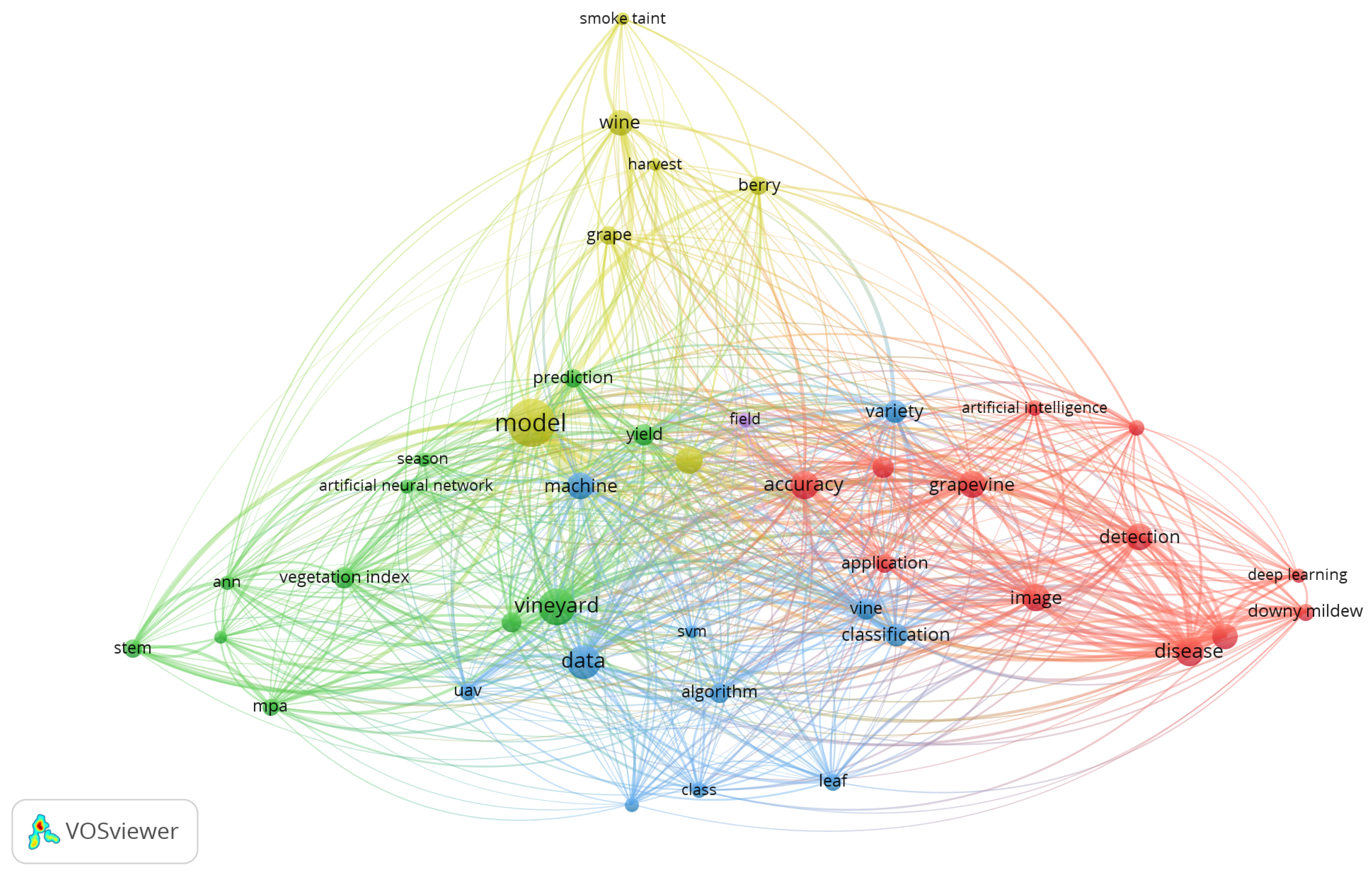
Figure 2.
Overlay Visualization
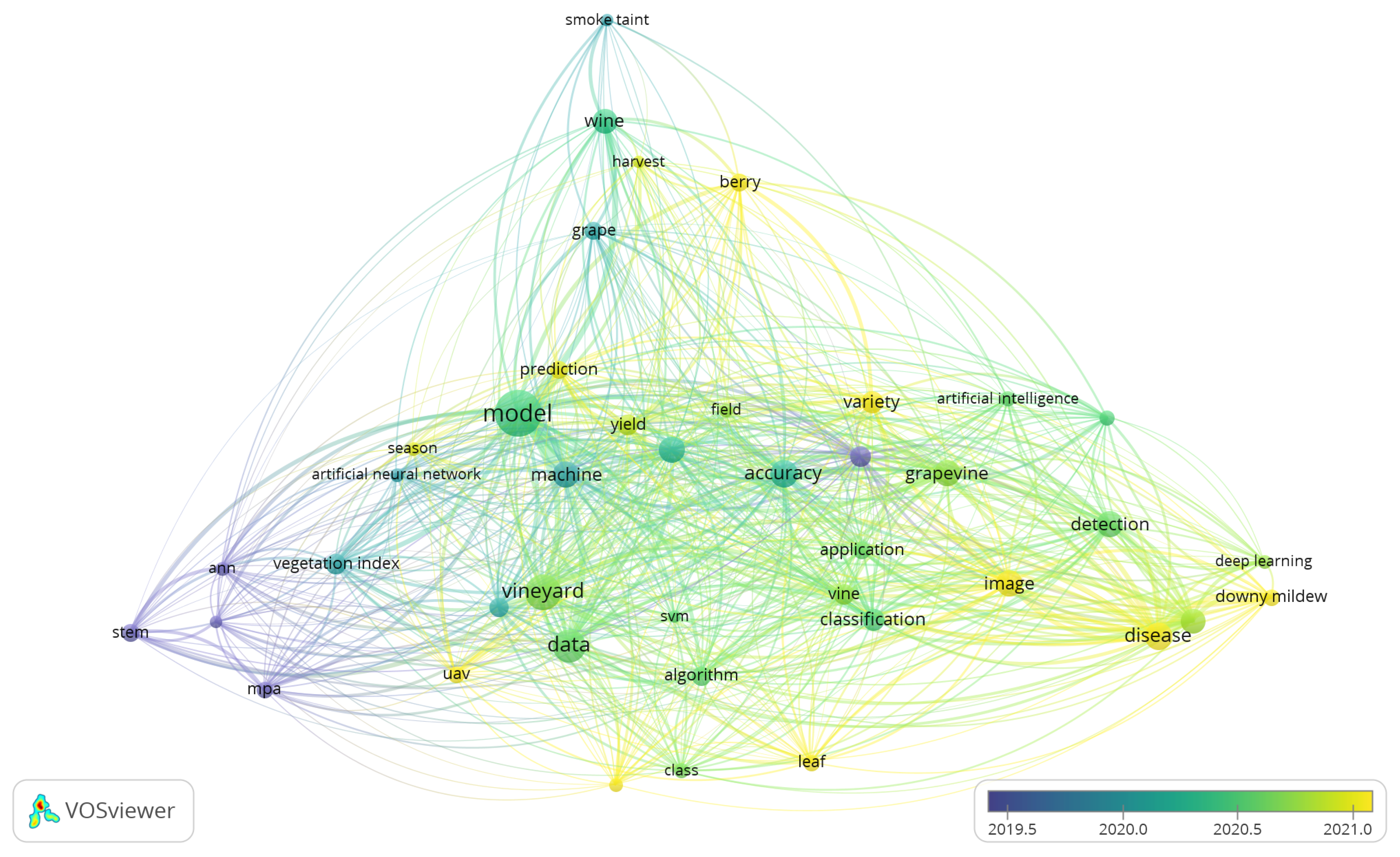
Figure 3.
Density Visualization
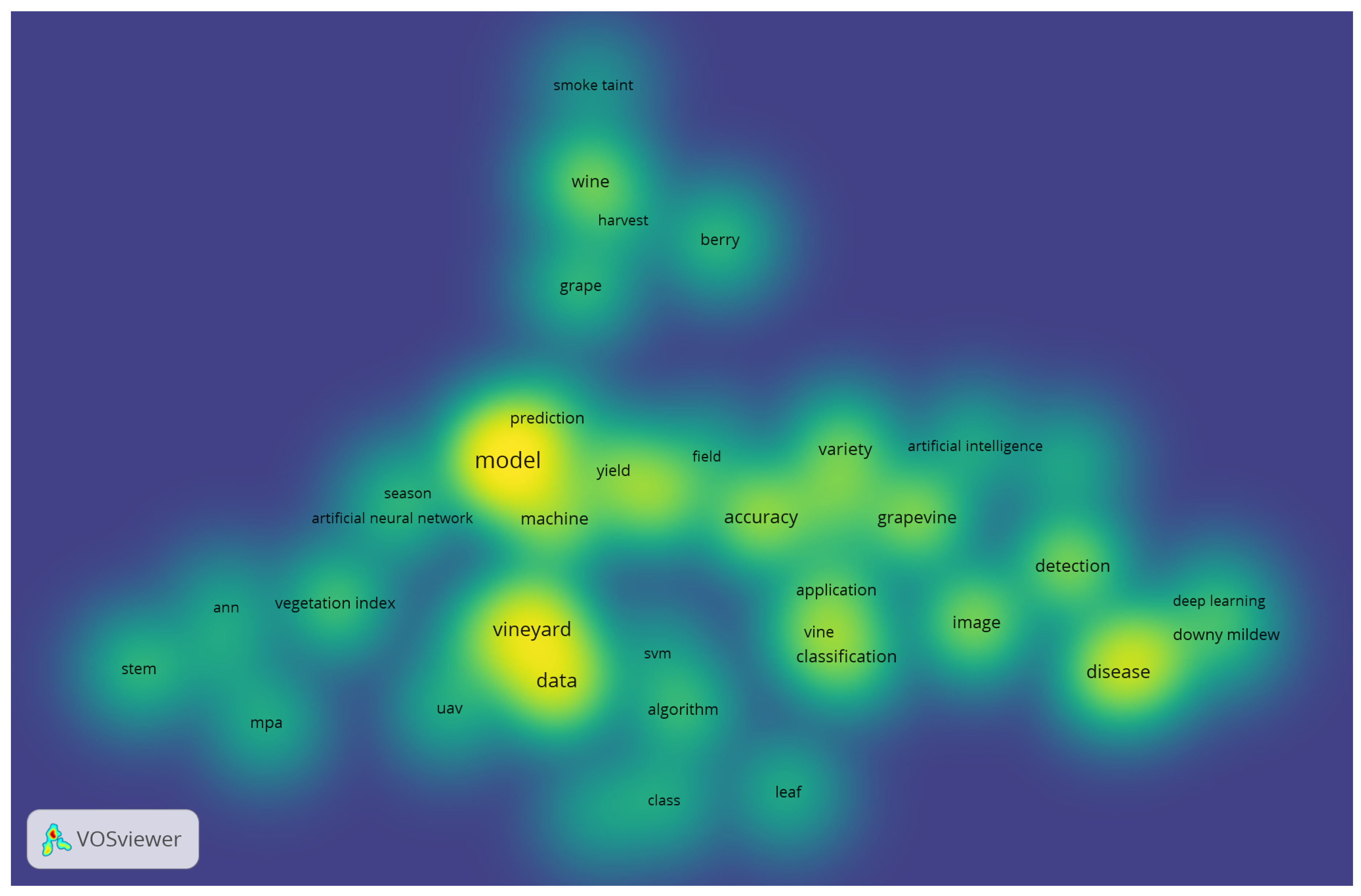
Figure 4.
The Dominant Machine Learning Techniques
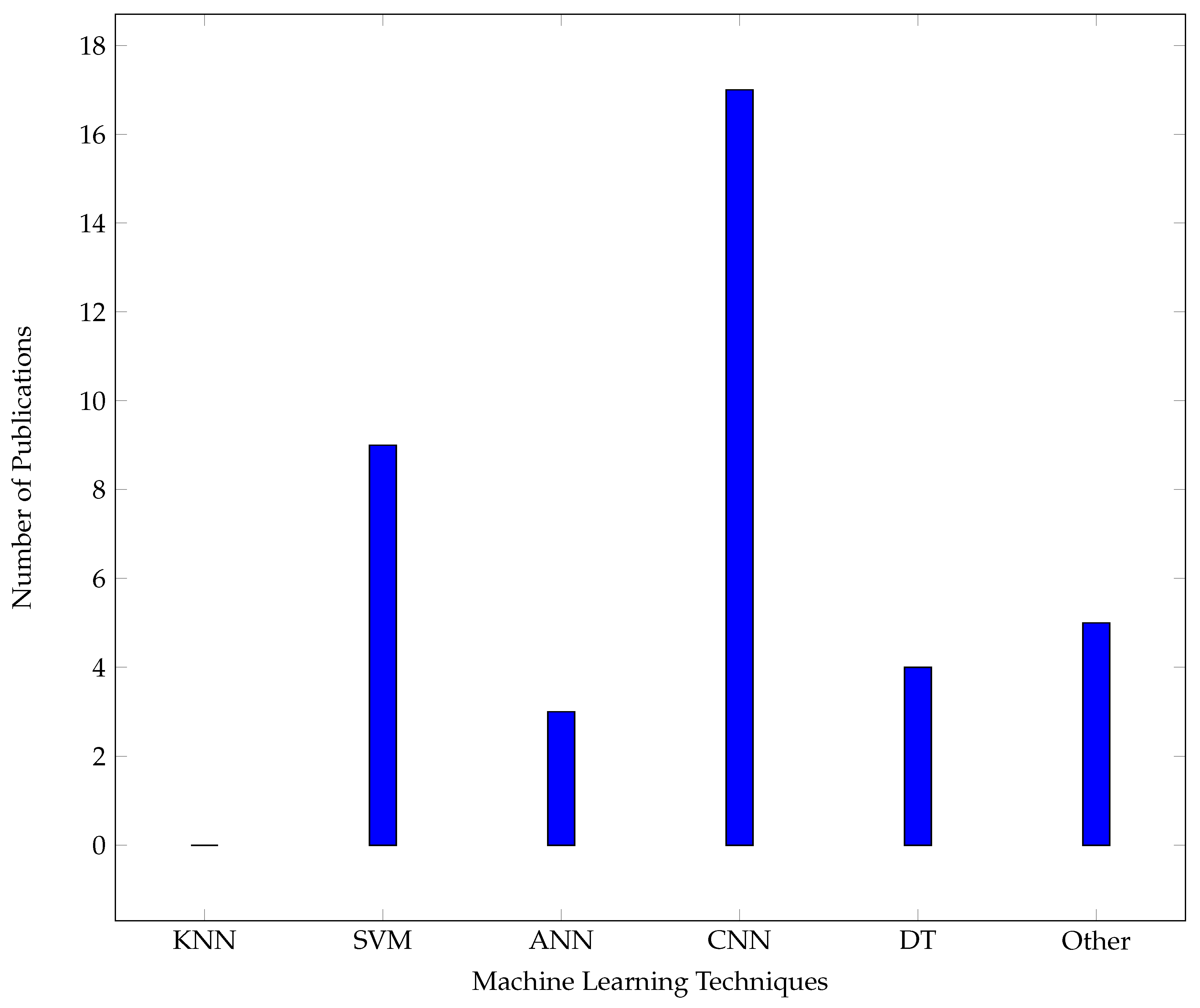
Figure 5.
An overview of the reviewed papers according to the field of application
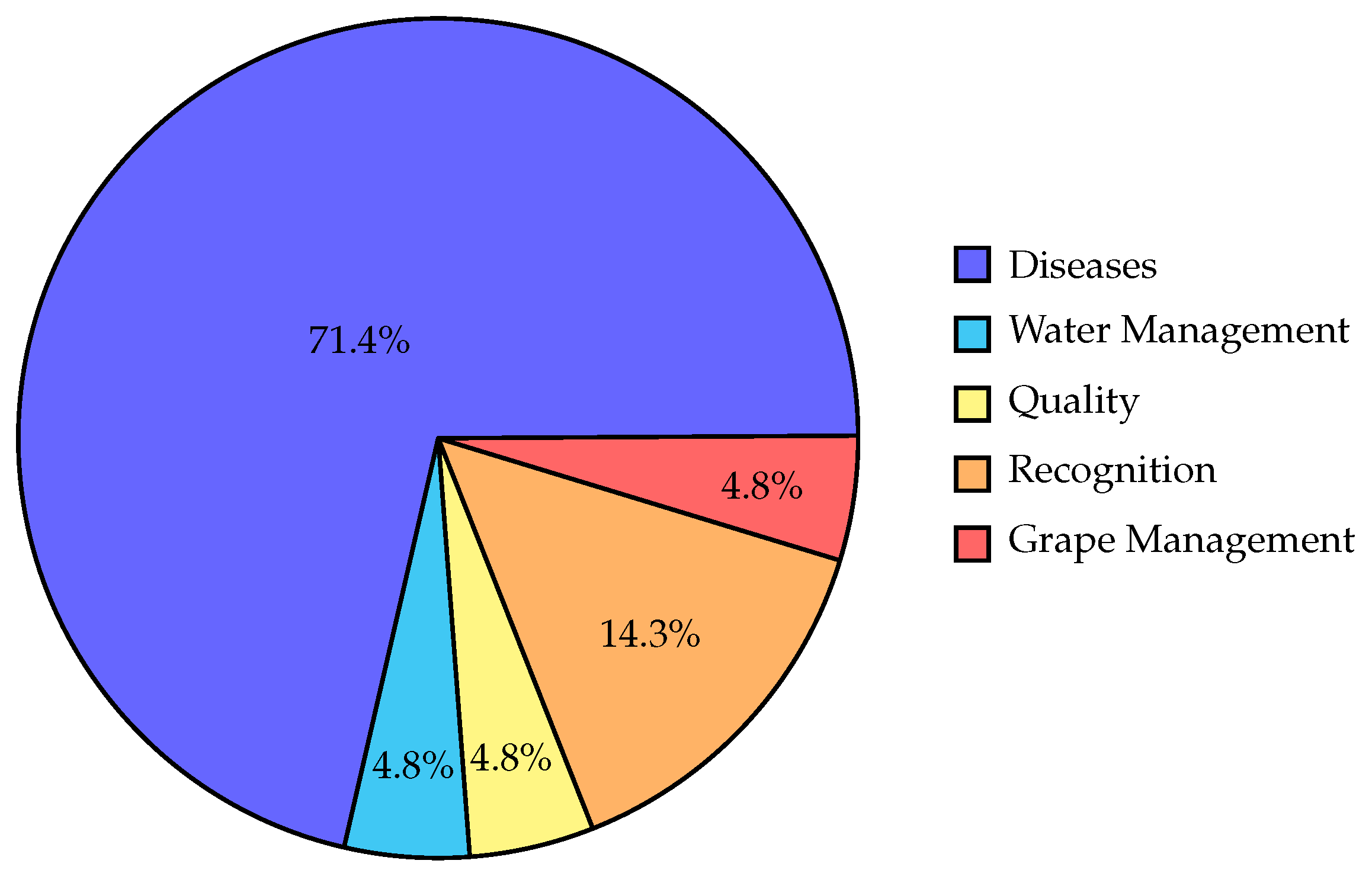
Figure 6.
Map of research conducted on vineyards per country
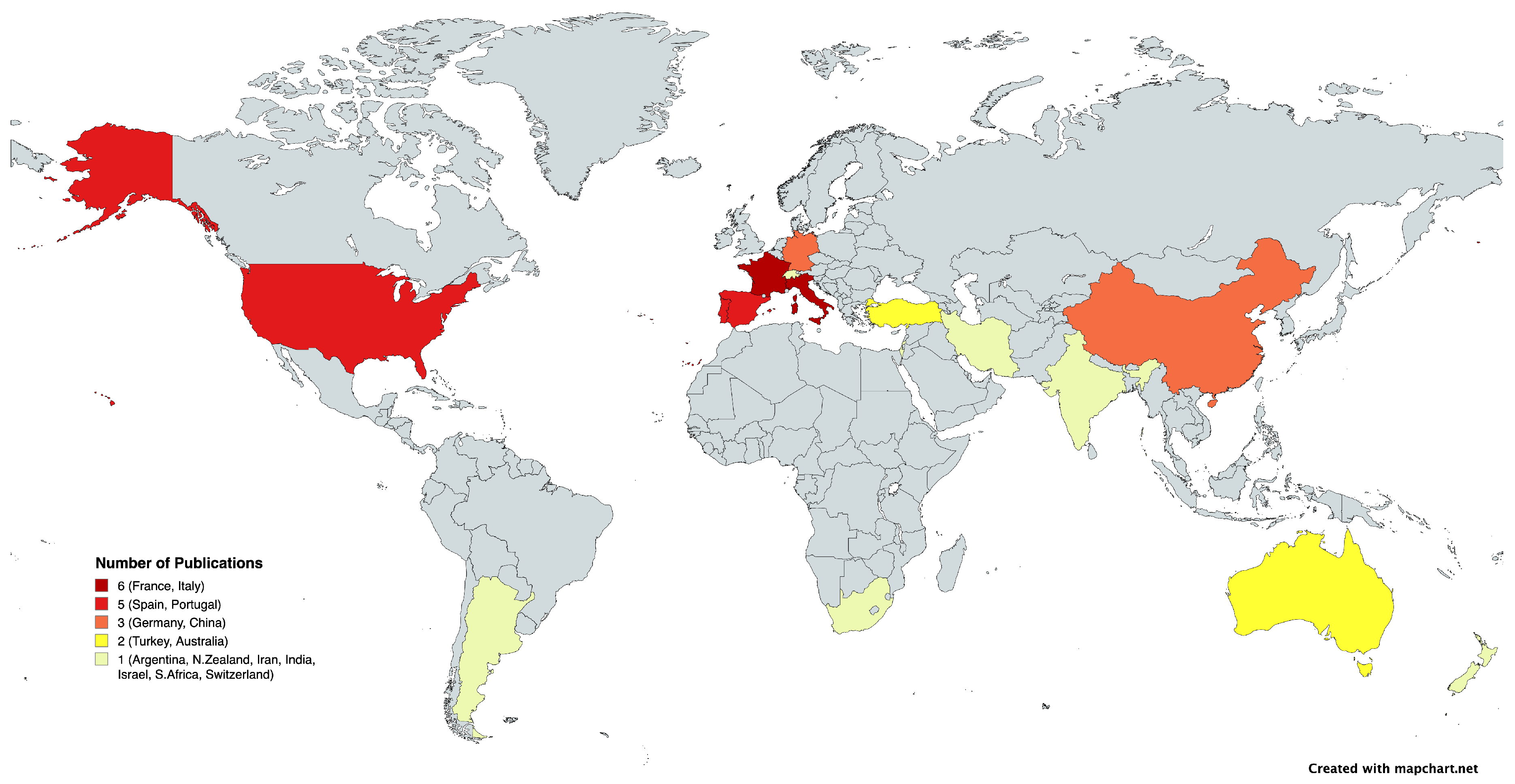

Table 1.
The "Datasets" column references the datasets mentioned below. The "Diseases" columns depict the number of raw images used in each dataset for each disease. The "Class" column contains image data used for classification. The "Info" column includes some comments for each dataset.
Table 1.
The "Datasets" column references the datasets mentioned below. The "Diseases" columns depict the number of raw images used in each dataset for each disease. The "Class" column contains image data used for classification. The "Info" column includes some comments for each dataset.
| DATASETS | DISEASES | CLASS | INFO | |||||
| HEALTHY | GY | ESCA | MILDEW | LEAFROLL | OTHERS | |||
| 1 | 2078 | Grape Varieties + Chemical Data) |
||||||
| 2 | 423 | 1383 | 1180+1076 | Black Rot + Leaf-blight | ||||
| 3 | 220 | 240 | 210+2010 | Leaf-blight + Black Rot | ||||
| 4 | 282* | *Mentioned the total number of images regardless of healthy or diseased) |
||||||
| 5 | 84 | 134 | 1383 | 1180+1076 | Expanded version of 2 | |||
| 6 | 881 | 887 | ||||||
| 7 | 135 | 156 | 108 + 97 | Red Blotch images and combined Red Blotch and Leafroll images. |
||||
| 8 | Statistical Data | |||||||
Table 2.
Depiction of how data is acquired, and in what format, for each reviewed paper with the corresponding application
Table 2.
Depiction of how data is acquired, and in what format, for each reviewed paper with the corresponding application
| Cite | Data Format Techniques | Notes | ||||||
| RGB | Spectral | Thermal | UAV | |||||
| Hyper | Multi | |||||||
| DISEASE | GY | [17] | ✓ | |||||
| [26] | ✓ | ✓ | PROSPECT model | |||||
| [27] | ✓ | |||||||
| DOREE | [28] | ✓ | Autoencoders - dimensionality reduction |
|||||
| [29] | ✓ | |||||||
| [30] | ✓ | |||||||
| ESCA | [31] | ✓ | ✓ | VNIR and SWIR cameras (from RGB) | ||||
| [32] | ✓ | ImageDataGenerator | ||||||
| [33] | ✓ | ✓ | ||||||
| MILDEW | [21] | Geographical data analysis (statistics) | ||||||
| [16] | ✓ | |||||||
| [34] | ✓ | |||||||
| [35] | ✓ | ✓ | ||||||
| [36] | ✓ | Meteorological data | ||||||
| [37] | ✓ | ✓ | ||||||
| LEAFROLL | [19] | ✓ | Laboratory lighting | |||||
| [38] | ✓ | |||||||
| [39] | ✓ | Airborne imaging (NASA AVIRIS) | ||||||
| PIERCE’S | [12] | ✓ | ||||||
| ROOT ROT | [40] | ✓ | ||||||
| GENERAL | [41] | ✓ | ✓ | |||||
| [42] | ✓ | |||||||
| [43] | ✓ | |||||||
| [44] | ✓ | |||||||
| [45] | ✓ | |||||||
| [46] | ✓ | |||||||
| [47] | ✓ | |||||||
| [48] | ✓ | ✓ | ||||||
| [49] | ✓ | ✓ | Anomaly detection | |||||
| WATER - STATUS | [50] | ✓ | ||||||
| [51] | ✓ | ✓ | ||||||
| PLANT DEFICIENCIES | [52] | ✓ | Raspberry Pi 3 | |||||
| CLASSIFICATION | [53] | ✓ | 3D Depth Camera | |||||
| [20] | ✓ | |||||||
| [54] | ✓ | In motion images | ||||||
| [55] | ✓ | In natural conditions | ||||||
| [56] | ✓ | |||||||
Table 3.
Representation of machine learning techniques utilized in each reviewed research, with the corresponding best accuracy
Table 3.
Representation of machine learning techniques utilized in each reviewed research, with the corresponding best accuracy
| Cite | Machine Learning Techniques | Best ACC |
Notes | |||||||
| KNN | SVM | ANN | CNN | Decision Trees |
Other | |||||
| DISEASE | GY | [17] | ✓ | 99.33% | ResNet101 | |||||
| [26] | ✓ | 99% | Back Propagation Neural Network |
|||||||
| [27] | rRBF, MLP | 96% | Varies between tests (e.g field, BN-GY) |
|||||||
| DOREE | [28] | ✓ | 83% | |||||||
| [29] | ✓ | 96% | ||||||||
| [30] | ✓ | 96+% | ||||||||
| ESCA | [31] | rRBF | 95% | Varies depending on the type of data and the year |
||||||
| [32] | ✓ | 99.48% | ||||||||
| [33] | ✓ | 95.8% | ||||||||
| MILDEW | [21] | ✗ | C5.0 | 70+% | Better Accuracy when tested diseases separately |
|||||
| [16] | ✓ | 83% | Modified ResNet | |||||||
| [34] | ✓ | 94% | ||||||||
| [35] | ✗ | ✓ | 82% | |||||||
| [36] | ✓ | ✗ | 81.6% | |||||||
| [37] | ✓ | 92+% | SegNet Architecture | |||||||
| LEAFROLL | [19] | ✓ | ✗ | 87% | 3D-CNN, Binary classification on a symptomatic dataset |
|||||
| [38] | ✓ | 89.93% | Least-squares SVM | |||||||
| [39] | ✓ | 87% | Random Forest | |||||||
| PIERCE’S | [12] | ✓ | 99.2% | AlexNet Architecture | ||||||
| ROOT ROT | [40] | NB | 90% | Healthy vs Diseased plants | ||||||
| GENERAL | [41] | ✓ | 84.16% | Average precision, MobileNets, Inseption-V2 |
||||||
| [42] | ✗ | 99.17% | UnitedModels based on 4 models |
|||||||
| [43] | ✓ | ✓ | ✓ | 75% | Preprocessing: SVM Prediction: 3D-CNN, RF |
|||||
| [44] | ✗ | ✓ | 99% | LS-SVM, cosine KNN Several steps from preprocessing to prediction |
||||||
| [45] | ✓ | 98% | Vanilla CNN 100% accuracy with ensemble model |
|||||||
| [46] | ✓ | 92.5% | AlexNet + Transfer Learning |
|||||||
| [47] | ✓ | 81.1% | Focused in speed and multiple Disease Detection |
|||||||
| [48] | ✓ | 93.72% | VddNet | |||||||
| [49] | - | |||||||||
| WATER - STATUS | [50] | ✓ | 65% | Regression models, for prediction |
||||||
| [51] | ✓ | 82.9% | Pattern recognition ANN | |||||||
| PLANT DEFICIENCIES | [52] | ✗ | ✓ | 80% | ||||||
| CLASSIFICATION | [53] | ✓ | 91.52% | VGG19 | ||||||
| [20] | ✓ | ✗ | 97.6% | Cubic SVM | ||||||
| [54] | ✗ | MLP | 99% | |||||||
| [55] | ✓ | 90.8% | ||||||||
| [56] | ✓ | 99.11% | Modified VGG16 | |||||||
Disclaimer/Publisher’s Note: The statements, opinions and data contained in all publications are solely those of the individual author(s) and contributor(s) and not of MDPI and/or the editor(s). MDPI and/or the editor(s) disclaim responsibility for any injury to people or property resulting from any ideas, methods, instructions or products referred to in the content. |
© 2024 by the authors. Licensee MDPI, Basel, Switzerland. This article is an open access article distributed under the terms and conditions of the Creative Commons Attribution (CC BY) license (http://creativecommons.org/licenses/by/4.0/).
Copyright: This open access article is published under a Creative Commons CC BY 4.0 license, which permit the free download, distribution, and reuse, provided that the author and preprint are cited in any reuse.