

Submitted:
11 July 2024
Posted:
11 July 2024
You are already at the latest version
Abstract
The paper addresses the energy consumption minimization problem in wireless powered communication networks (WPCNs) and proposes a DT-SWIPT-assisted time allocation scheme, named DaTA, such that the wireless station can share the remaining energy after transmission to the HAP to those who have not transmitted to the HAP to minimize the energy consumption of the network. In addition to proposing a new frame structure, the paper also considers the SNR (Signal-to-Noise) constraint to guarantee that the HAP can successfully receive data from wireless stations. In the paper, the energy consumption minimization problem is formulated as a nonlinear programming model. We employ the SQP (Sequential Quadratic Programming) algorithm to figure out the optimal solution. Moreover, a heuristic method is proposed as well to obtain a near-optimal solution in a shorter time. Simulation results showed that the proposed scheme can have better performance than the related work in terms of energy consumption and energy efficiency.
Keywords:
Harvest Then Transmit (HTT) Protocol
; Simultaneous Wireless Information and Power Transfer (SWIPT)
; SNR Constraint
; Wireless Energy Transfer
; Wireless Powered Communication Networks (WPCNs)
1. Introduction
In wireless networks, including but not limited to wireless sensor networks and wireless body area networks, it is typically necessary for a wireless station to be equipped with at least one battery for power. However, it is widely recognized that batteries pose significant environmental pollution issues and should ideally be recycled. Yet, the retrieval of these batteries is often challenging due to the substantial costs associated with their widespread deployment and inaccessible locations. Moreover, battery-related issues consistently present operational challenges within the network. While battery replacement or recharging may offer a potential solution to prolong the network’s lifespan, such measures are often impractical in many real-world scenarios.
Recently, a novel technology known as Wireless Energy Transfer (WET) has been explored, which employs radio frequency (RF) to transmit energy to wireless stations [1,2,3]. With the evolution of WET and antenna capabilities, a new paradigm of networks, termed Wireless Powered Communication Networks (WPCNs), has emerged in the current communication networks. In WPCNs, batteries are substituted by capacitors to alleviate the burden induced by battery usage. In conventional communication networks, wireless stations are powered by batteries. However, in WPCNs, wireless stations gain energy through WET technology. Thus, the wireless station in WPCNs does not require a battery but a capacitor for energy storage. With the attributes of WPCNs, wireless stations can circumvent the pollution and consumption issues instigated by the large-scale usage of batteries. With the escalating consciousness of green communication [4], the issues in WPCNs have become pivotal and significant. WPCNs can be implemented in a broad spectrum of applications, such as Wireless Sensor Networks (WSNs), Internet of Things (IoT), and Wireless Body Area Networks (WBANs), among others. Typical scenarios of WPCNs encompass smart homes, remote surgery, hazardous areas like volcanoes, and so forth.
Generally, a WPCN is composed of a Power Provider (PP), an Access Point (AP), and several wireless stations. The PP is responsible for providing energy by WET technology to wireless stations, while AP is responsible for receiving data from wireless stations. A wireless station needs to be charged from the PP until the energy harvested from the PP is enough for the wireless station to transmit data to the AP. Then the wireless station transmits data to the AP. The transmission protocol is called Harvest-Then-Transmit (HTT) protocol, which is mainly divided into two phases: ET (Energy Transfer) and IT (Information Transmission) phases. The phase that the PP transfers energy to the wireless stations is the ET phase and the phase that wireless stations transmit data to the AP is the IT phase. The device playing the two roles, PP and AP, simultaneously is called an HAP (Hybrid AP).
Recently, many researches focus on the WPCNs, such as [5,6,7,8,9,10,11,12,13,14,15,16,17]. Different network models and scenarios of WPCNs have been investigated. Among them, most of the studies adopt the HTT protocol and focus on how to allocate transmission time of wireless stations and HAP or allocate transmission power of the HAP to address the problems. In general, the problems can be divided into 3 categories.
In the STM problem, [13,14] considered the PP and the AP in the network and introduce the backscatter technology so that wireless stations can receive energy signals from the PP during the ET phase, modulate them, and reflect to the AP. [13,14] considered how to maximize the sum-throughput of the network by allocating the backscatter time and transmission time of each wireless station. In addition, [9,15] considered that the HAP not only transfers energy but also transmits information to wireless stations. Therefore, the goal of [9,15] is to allocate the ET and IT time of the HAP and the transmission time of each wireless station to maximize the sum-throughput of the network. [6] considered a WPCN-based WSN. Through centralized management, all wireless sensors are scheduled by the HAP. [6] considered a dual-hop network model. The wireless sensors are divided into groups. Each group will select a wireless sensor as the group header. The group header is responsible for summarizing the information of all wireless sensors in the same group. Moreover, [6] introduced the Simultaneous Wireless Information and Power Transfer (SWIPT) technology to allow wireless sensors to transmit information and transfer excess energy to the group header to relieve the group header’s burden on energy demand to summarize and transmit information to the HAP.
The STM problem is to consider how to maximize the sum-throughput of the network. However, only considering the sum-throughput of the network will cause excessive energy consumption and result in low energy efficiency. Therefore, two different types of research focusing on maximizing energy efficiency or minimizing energy consumption are proposed instead of only considering sum-throughput maximization. The research on maximizing energy efficiency is termed the EEM problem [5,10,12] and that on minimizing energy consumption is termed the ECm problem [7,11,16,17]. The EEM problem aims at maximizing the sum of the ratio of throughput to the energy consumption of each wireless station. On the other hand, the ECm problem aims at minimizing the energy consumption of the network while meeting the throughput requirements of each wireless station when the HAP has the energy limitations.
In the EEM problem, [12] considered a network model with a PP and an AP. The wireless stations adopt the FDMA (Frequency Division Multiple Access) protocol, which allows the wireless stations to transmit information to the AP at the same time. Therefore, [12] achieves energy efficiency maximization by controlling the transmission power of the PP. The network model considered by [5,10] contains an HAP. The wireless stations use the TDMA (Time Division Multiple Access) protocol, which allows the wireless stations to transmit information to the HAP sequentially and achieve the goal through time allocation and power control of the HAP.
In the ECm problem, [11] considered a centralized wireless sensor network with an energy-limited HAP. In this network model, wireless sensors are divided into two groups: a group of collaborators that are responsible for transmitting data to the HAP and a group of enjoyers that only receive energy from the HAP. In addition to the throughput requirements of collaborators, [11] also considered the energy requirements of enjoyers. [17] took the full-duplex HAP into account, in which the HAP will transfer energy continuously, and wireless stations harvest energy not only in the ET phase but also in the IT phase until the wireless stations start to transmit information to the HAP. [16] focused on a wireless body area network and follows the network model of [11]. [16] introduces the SWIPT technology in the ET phase so that the HAP can transmit energy and information to wireless stations simultaneously. [7] considered a large-scale WPCN which contains several PPs and wireless stations. The wireless stations will be divided into several groups. Each group will have a sub-sink responsible for collecting information from its members. Since [7] considered multiple PPs, wireless stations used the FDMA protocol to transmit information to the AP at the same time. [7] also controls the power of each PP to minimize energy consumption.
However, in wireless communication, the SNR (Signal-to-Noise Ratio) value of a received signal should be larger than a certain value to be recognized as legitimate information, which is also known as the SNR constraint [18]. Nevertheless, all the above-mentioned studies did not take the SNR constraint into account. Therefore, this paper will consider the SNR constraint to ensure that the SNR of the received signal of the HAP is greater than a certain threshold such that the HAP can successfully receive the information from the wireless stations. Moreover, with more and more applications of WPCNs, mobile phones, and even smart bracelets can act as HAP. Therefore, in most cases, the energy of the HAP is limited. Due to the energy limitation of the HAP, when the wireless station meets the throughput demand, saving the energy of the HAP becomes more important than increasing the energy efficiency of the wireless stations. Consequently, the goal of this paper is to minimize the energy consumption of the network under the condition that wireless stations meet their throughput demands.
Different from the SWIPT scheme [6], the paper proposes a new scheme, called Different Target SWIPT (DT-SWIPT), which relieves the constraint that the receiver of the information transfer should be the same station of the power transfer. In DT-SWIPT, a wireless station finished information transmission can still transfer energy to other stations to share the excess energy. That is, DT-SWIPT is not limited that the information receiver and the power receiver are the same. Based on the above, we formulate a minimization problem based on the DT-SWIPT scheme into a nonlinear programming model. The model is termed the DT-SWIPT assisted Time Allocation (DaTA) for the ECm problem. We adopt a Sequential Quadratic Programming (SQP) [19] algorithm to solve the problem. Since the optimization problem may take much time to solve, the paper also proposes a heuristic method, called DaTA-H to fast approach the results.
The contributions of the paper are summarized as follows.
- Different from the general SWIPT, in this paper, we propose a new DT-SWIPT mechanism, which allows wireless stations that finish information transmission to share their excess energy to other wireless stations that have not yet transmitted, thereby reducing energy consumption in the network.
- Ensure that the SNR value of the received signal of the HAP can meet the SNR threshold so that the HAP can decode the signals from wireless stations.
- The optimization model, named DaTA, is proposed to obtain the best solution for the ECm problem. In addition, the DaTA-H scheme is also proposed so that an approximate solution can be obtained in a reasonable time.
- Two scenarios, special scenarios and general scenarios are conducted in the simulation to verify the advantages of the proposed schemes. We compare the DaTA and the DaTA-H schemes proposed in this paper against the STM, EEM, and ECm models of the related works. From the simulation results, it can be concluded that the DaTA scheme has better performance in the energy consumption and the energy efficiency in both general and special scenarios. In special scenarios, when the SNR threshold reaches a certain value, the energy consumption and the energy efficiency of the DaTA-H scheme are also better than those of the related works.
The remaining of the paper is structured as follows. Section 2 will introduce the network model, the DT-SWIPT operation method, and the frame structure in detail. Section 3 will introduce the optimization model established in this paper. Section 4 describes the heuristic approach, the DaTA-H scheme. Performance evaluations are shown in Section 5. Finally, Section 6 concludes the summary and contribution of this paper and points out the future works.
2. Preliminaries
In this section, Section 2.1 introduces the network model of this paper. Section 2.2 introduces the differences between the DT-SWIPT scheme proposed in this paper and the general SWIPT scheme. The frame structure is also described in this section. Section 2.3 introduces the SNR constraint of a received signal, which is not considered in the related works.
2.1. Network Model
In general, a WPCN includes a HAP and n wireless stations, denoted as , , each equipped with a single antenna, as shown in Figure 1. Without loss of generality, the HAP is denoted as . Since the HAP may be a mobile device, such as a mobile phone or a smart bracelet, therefore, it is assumed that the HAP is energy limited. The network follows the HTT protocol [8] and adopts the TDMA protocol for access control. By the HTT protocol, time is divided into periods. The duration of a period is denoted as T. A period contains an ET phase and an IT phase. All wireless stations harvest energy during the ET phase and use the obtained energy for information transmission in the IT phase. The duration in the ET phase is denoted as , and the IT phase is divided into n slots, each for a wireless station. The duration of each time slot is denoted as . On the other hand, the transmission order of wireless stations is still an open issue and is out of the scope of the paper. The paper assumes the transmission order of wireless stations is according to the distance of the wireless station from the HAP. The closer, the earlier. Without loss of generality, the transmission order of wireless stations is assumed to be . In addition, we assume that the HAP and each wireless station have the Channel State Information (CSI) [5]. In the ET phase, the channel gain coefficient between the HAP () and is denoted as . In the IT phase, the channel gain coefficient between and the HAP () is denoted as , and the channel gain coefficient between and is denoted as . We also assume that the channels in the ET and IT phases are quasi-static fading channels [20]. That is, the channel coefficients and will not be changed during a period and can be regarded as a constant [16,17].
The wireless stations in the network can only obtain energy through the energy harvesting technology and will not have an additional internal energy supplement. In addition to the energy used for transmission during each period, wireless stations will also reserve a certain amount of energy to maintain basic operations, such as receiving beacons and modulating information. In addition, each wireless station, say , has its throughput requirement, say .
2.2. SWIPT vs. DT-SWIPT
With the advancement of antennas, a technology called SWIPT (Simultaneous Wireless Information and Power Transfer) [21,22] has emerged, which allows the sender to simultaneously transmit the energy signals and the information signals to the receiver. For example, in the ET phase, the HAP can transmit both the energy and information signals to the wireless stations at the same time, and the wireless stations can harvest energy and decode information. The SWIPT scheme can be mainly classified into two types: Time Switching (TS) and Power Splitting (PS), which are shown in Figures 2(a) and 2(b), respectively. When the antenna receives the signal, TS can switch the circuit to direct the signal to the charging circuit or the information receiving circuit by the time. On the other hand, when the antenna receives signals, in the PS type, the signals are directed to the power splitter, and the received signals are directed to the charging circuit and the information receiving circuit according to different proportions through the power splitter.
In the SWIPT scheme, the transmitter transmits the energy and information signals to the same receiver. This paper proposes another scheme called Different Target SWIPT (DT-SWIPT). In the DT-SWIPT scheme, the information and the energy transmitted by () can be received by different receivers. That is, the information can be transmitted to the HAP, and the energy can be transferred to ( and ). Since needs not to receive data from , we adopt the TS type in our DT-SWIPT scheme. For example, suppose that there is a HAP and two wireless stations, say and in the network, as shown in Figure 3(a). first transmits information to the HAP. When completes the information transmission, it can share the excess energy to , as shown in Figure 3(b).
Figure 4 is the timing diagram of the transmission of in the above example. Assume that is the transmission time of . In , there will be a ratio of for information transmission, and the remaining is used to share excess energy to other stations which have not transmitted to the HAP.
According to the above examples, the frame structure proposed in this paper is different from that of the general HTT protocol. The difference is that the wireless station will share its energy during . Figure 5 is the frame structure proposed in this paper. Before a period starts, the HAP will first allocate its own transmission time (), the transmission time of () and the proportion of time that used to transmit information (). Then, the HAP will send a beacon containing these parameters to all wireless stations. At the beginning of a period, the HAP will first transfer the energy to all wireless stations. At the end of the ET phase, all wireless stations will transmit information to the HAP sequentially. When the time of has passed, will switch the signal circuit and start sharing the energy. The wireless station must consume all of its energy for transmission at the end of the period. Therefore, the wireless station in an earlier transmission order will not get the additional energy shared by other wireless stations that transmit later. As a result, the last transmitted station, , will not share the energy. That is, .
2.3. SNR Constraint
In a general communication network, if the SNR value of a received signal is too low, it may affect the transmission speed and even cause decoding problems. Therefore, a successful transmission requires that the SNR value of the received signal should be larger than or equal to a certain SNR threshold. If the SNR value of the received signal is smaller than the SNR threshold, the signal may be regarded as a noise [23,24]. In a general data network, the SNR value of a received signal needs to be larger than 20dB [18].
In summary, when a station receives a signal, the SNR value of the received signal must be larger than or equal to a certain threshold so that the signal can be decoded correctly. Nevertheless, none of the related works considers this issue. Therefore, it is impractical to apply the related works in real situations. Thus, in this paper, we take the SNR constraint of the HAP into account.
3. DT-SWIPT Assisted Time Allocation for the ECm Problem
The goal of this paper is to minimize the network energy consumption with the aid of the DT-SWIPT scheme. This problem is termed D-ECm in the paper. In this section, we will construct a non-linear programming model for the D-ECm and use an SQP algorithm to solve this optimization problem.
3.1. Problem Formulation
According to the HTT protocol, at the beginning of a period, the HAP will transfer energy to all wireless stations. The power used by the HAP is denoted as . There is an upper limit, , for the transmission power. The constraint of is shown in Eq. (1).
In the ET phase, the channel gain between the HAP () and is denoted as , which can be expressed in Eq. (2).
where is the distance between the HAP () and . Other parameters, such as antenna gain, antenna height of the HAP, etc., are neglected in the paper and termed . For simplicity, is assumed to be a constant in the paper [23]. is the path loss exponent [25].
With the channel gain in Eq. (2), when the HAP transfers energy in the ET phase, the received signal power of is denoted as , which can be expressed in Eq. (3).
By Eq. (3), the energy that can obtain in the ET phase is denoted as , which can be expressed in Eq. (4).
where is the energy conversion efficiency of when receiving energy during energy harvesting, and . is the duration of the ET phase.
In addition to the energy required to transmit information to the HAP, wireless stations also need the energy for basic operations, such as receiving beacons, modulating information, and maintaining basic circuits. Therefore, among the obtained energy , the energy of will have a proportion of for transmission, and the remaining energy will be used for basic operations, where . Thus, through Eq. (4), the transmission power of , denoted as , can be expressed as Eq. (5).
According to the DT-SWIPT scheme, completes the information transmission during , and then shares the energy to other wireless stations during the remaining time, that is, . Let be the channel gain coefficient from to (assume that is transmitted earlier than ), which can be expressed in Eq. (6).
where is the distance between and . is a constant and stands for the other parameters, such as the antenna gain, antenna height of , like in Eq. (2).
Therefore, with the channel gain coefficient , the additional energy shared from and obtained by is denoted as , which can be expressed as Eq. (7).
By TDMA protocol, wireless stations transmit information to the HAP sequentially. Therefore, each wireless station receives a different amount of energy shared by previously transmitted wireless stations. For this situation, let be the transmission order of , and be the index of the wireless station whose transmission order is k. That is, if is the kth transmitting wireless station, then and . If is the mth transmitting wireless station (), then will obtain the energy shared by . Therefore, the total additional energy obtained by , which is shared from the previously transmitted wireless stations, is denoted as , which can be expressed in Eq. (8).
Besides the energy obtained from the HAP, also obtains additional energy shared by previously transmitted wireless stations. Therefore, the total energy obtained by is denoted as , which can be expressed in Eq. (9).
Since the first transmitting wireless station does not obtain additional energy, the wireless station with does not need to calculate the additional energy. As a result, the transmission power of will be replaced from Eq. (5) to Eq. (10).
Let be the channel gain coefficient from to the HAP (), which can be expressed in Eq. (11).
While starts to transmit information to the HAP, with the channel gain coefficient , the received signal strength of the HAP from is denoted as , which can be expressed in Eq. (12).
To ensure that the HAP can decode the signal transmitted from , the ratio of the received signal power to the noise power N must be larger than or equal to a certain threshold, which is denoted as . The relationship is shown in Eq. (13).
According to the Shannon’s Capacity Theorem [26], the channel capacity of , which is denoted as , can be expressed in Eq. (14).
Obviously, will be affected by and the bandwidth B. According to Eq. (14), the throughput of during the period T is denoted as , which can be expressed in Eq. (15).
Since the work performed by each wireless station may be different, has its own throughput demand, . The throughput of must be larger than or equal to . The relationship between the and is shown in Eq. (16).
This paper aims to minimize the energy consumption of the network under the conditions of Eqs. (13) and (16), for i from 1 to n. Since the energy source of wireless stations is harvested from the HAP, which can be considered as the energy consumption of the network. The energy consumption of the network is denoted as , which can be expressed in Eq. (17).
From [20], it shows that when , the energy consumption of the network will be the lowest. Therefore, let be . By Eq. (17), the goal will be to minimize the WET time, that is, .
Based on the goal and constraints, a non-linear programming model for the D-ECm problem can be formulated in Model 1.
Optimization Model 1 (D-ECm Problem).
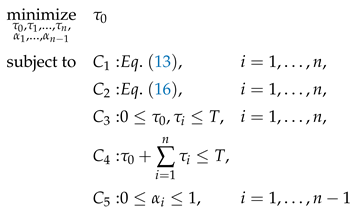
In Model 1, denotes the SNR constraint. That is, the ratio of the received signal power to the noise power N must be greater than to ensure that the HAP can decode the signal transmitted from . denotes the throughput constraint, which requires that the throughput of must meet its throughput demand . denotes that the transmission time of the HAP and can not be longer than T and should be larger than 0. denotes that the sum of the transmission time of the HAP and wireless stations can not be longer than T. denotes that the DT-SWIPT ratio of during the transmission phase should be smaller than 1.
Since Model 1 is a nonlinear optimization problem, we use an SQP (Sequential Quadratic Programming) method [27] to obtain the optimal solution.
3.2. SQP-Based Algorithm for Finding the Optimal Solution of the D-ECm Problem
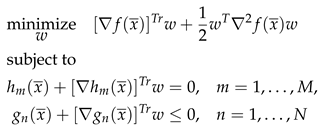
SQP [27] is an iterative method for solving constrained nonlinear optimization problems. SQP obtains the optimal solution by solving a sequence of QP subproblems. The standard form of the QP problem is formulated in Model 2. In Model 2, and represent the gradients of the function and the transpose matrix of , respectively. M and N represent the numbers of constraints of the equations and inequalities, respectively. The QP problem can get the corresponding optimal solution w according to the input . We can then take into the original QP problem to form a new QP problem and obtain another optimal solution . Therefore, w can be regarded as the iterative step in SQP. When approaches 0, the corresponding is the optimal solution of the SQP problem.
Optimization Model 2 (Standard Form of the QP Problem).
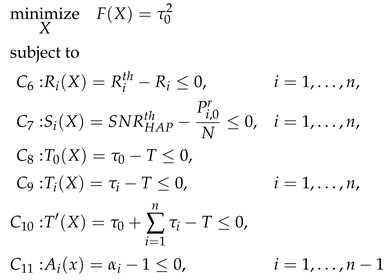
To satisfy the standard form of the QP problem, we turn the objective function of Model 1 into minimize , and let , where and represents the set of non-negative real numbers. As a result, we rewrite Model 1 as Model 3.
Optimization Model 3 (Reduced D-ECm Problem).
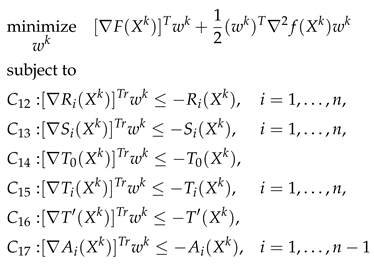
Model 3 can be converted into a QP problem, called QP-ECm, shown in Model 4. In Model 4, is the optimal solution corresponding to , . k is an iteration counter of the SQP.
Optimization Model 4 (QP-ECm Problem).
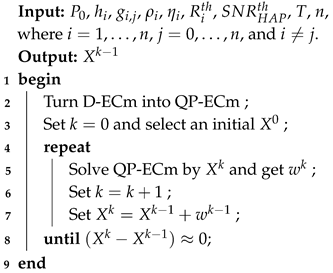
To solve the D-ECm problem, a SQP-based algorithm is proposed, called DaTA (DT-SWIPT assisted Time Allocation), which is shown in Algorithm 1. In line 2, we convert the ECm problem into a QP-ECm problem. In line 3, set the iterative counter k and select an initial point that meets all constraints. In line 5, solve the QP-ECm problem according to and get the optimal solution . In lines 6 and 7, increase the iterative counter k, and let . If approaches 0, return the optimal solution ; otherwise, return to line 5 to solve a new QP problem again.
In this section, we have formulated a nonlinear optimization problem, called D-ECm, and found the optimal solution through a SQP-based algorithm, named DaTA. However, it costs much time to find the optimal solution. However, to our best knowledge, there is no heuristic method proposed in the literature to find a plausible solution. Therefore, we propose a heuristic method, called DaTA-H, and describe it in the following section.
| Algorithm 1: DaTA: a SQP-based Algorithm for the D-ECm Problem |
 |
4. DaTA-H: The Heuristic Method
In this section, we introduce the concept and the algorithm of the proposed heuristic method, named DaTA-H. In Section 3, we use SQP to solve the non-linear optimization problem to obtain the optimal solution. However, the number of wireless stations, n, will affect the number of variables to be figured out. Moreover, a large n results in too many SQP iterations and causes long calculation time. Therefore, we simplify the D-ECm problem by reducing the number of variables and make the result close to the optimal solution obtained by the SQP.
4.1. Problem Formulation of the Simplifying D-ECm Problem
In Section 3.1, we can know that the transmission time of , , is related to through Eqs. (4) and (10). To simplify the D-ECm problem, we only take into account. The remaining time, , is evenly distributed to all wireless stations. Therefore, in DaTA-H, the transmission time of , i.e. , can be expressed as Eq. (18).
By Eq. (18), we can simplify the variables such as into a function containing .
In addition, we further simplify by means of changing the transmission order. According to Eqs. 2, 3, and 4, the distance between the HAP () and will directly affect the energy obtained by . The wireless station closest to the HAP can obtain the most energy, while the wireless station farthest from the HAP harvests the least. Therefore, we rearrange the order of the wireless stations according to . The wireless station closest to the HAP is marked as , the next is , and so on. The farthest one is . In DaTA-H, we let the wireless station that obtains the most energy from the HAP (i.e. ) be the first one to transmit information and share the energy to other stations for the longest time. The wireless station that obtains the second most energy (i.e. ) is the second one to transmit information and share energy for the second-longest time, and so on. The farthest wireless station (i.e. ) is the last one to transmit information and needs not to share energy. In summary, the time ratio of the DT-SWIPT can be allocated by an arithmetic sequence, which can be expressed as Eq. (19).
where is a base value of the DT-SWIPT. Since behaves differently due to the different SNR thresholds of the HAP, we assume that is known in advance. Section 5 will discuss the impact of on the performance.
According to the above summary, we can rewrite the D-ECm problem as an S-ECm (Simplified D-ECm) problem and is shown in Model 5.
Optimization Model 5 (S-ECm: Simplified D-ECm Problem).
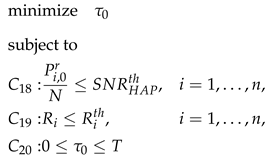
Model 5 is still a non-linear programming problem due to . Since the variable to be optimized is only , we can use a linear search method to iteratively find an approximate solution of .
4.2. DaTA-H Algorithm for S-ECm
The DaTA-H algorithm is shown in Algorithm 2. In addition to the inputs used in Algorithm 1, the inputs also include the and the step size . Algorithm 2 is divided into two steps: the initialization step and the iterative step.
| Algorithm 2: DaTA-H Algorithm for the S-ECm Problem |
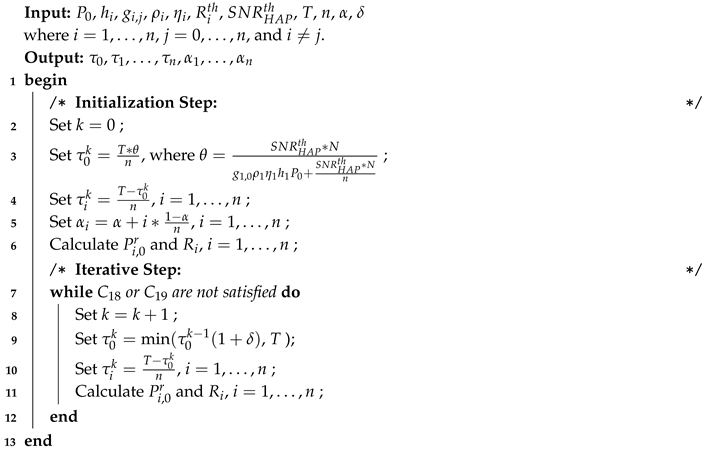 |
In the Initialization Step, because we need to find an approximate solution of , we first set a variable k to count the number of iterations (line 2) and set the WET time in line 3.
Lemma 1.
Let be the minimum of the WET time and . Then can be obtained as follows.
Proof.
To simplify the D-ECm problem, we have proposed a simplified model, S-ECm. There we have assumed that the wireless station closest to the HAP is , followed by , and so on. Therefore, the minimum WET time should at least satisfy the energy requirement of . As a result, can be regarded as the WET time required for . By , we can obtain Eq. (20).
By Eq. (12), Eq. (20) can be rewritten as below.
Since is the first wireless station to transmit information to the HAP (i.e. ), the energy obtained by is totally from the HAP, no additional energy from any other wireless station. By Eq. (10), Eq. (21) is turned as follows.
Furthermore, by Eqs. (3) and (4), Eq. (22) is turned as follows.
is the minimum value of . By Eq. (18), . As a result, we have the following equation.
Since , N, n , , , , , and are all known parameters, let
. We simplify Eq. (24) as below.
which concludes the proof of the lemma. □
According to Lemma 1, we can know that if satisfies , must be equal to . To avoid starting from 0 and causing too many iterations, therefore, in the initialization step, we let iterates from . According to Eq. (18), line 4 is to evenly set for all wireless stations. Based on , line 5 sets the DT-SWIPT time ratio . Therefore, we can derive and , for .
In the Iterative Step, we first check whether all wireless stations satisfy the constraints of and based on the derived and in the initialization step (line 7). If one of the constraints is not satisfied, the iterative step starts. Firstly, line 8 increases the iteration index k. Line 9 increases by adding a step size . According to Eq. (18), line 10 sets a new transmission time for all wireless stations. Line 11 recalculates the and , . Finally, go back to line 7 to recheck whether the constraints of and are satisfied for all wireless stations or not.
In the iterative step, there is an upper limit for the number of iterations. That is, the WET time must be smaller than or equal to T after several iterations. Therefore, we derive the upper bound of the number of iterations by Lemma 2.
Lemma 2.
In Algorithm 2, the number of iterations in the iterative step is not greater than .
Proof.
Since the increase of the must be smaller than or equal to T, it bounds the number of iterations in the iterative step. In other words, we can have the following inequality.
According to Lemma 1, . As a result,
which concludes the proof of the lemma. □
Furthermore, the time complexity of Algorithm 2 is analyzed in Theorem 1.
Theorem 1.
The time complexity of Algorithm 2 is .
Proof.
In the Initialization Step, the time to calculate , , , and is and the numbers of calculations of and are respectively n. Therefore, the time complexity of the Initialization Step is . In the Iterative Step, according to Lemma 2, the number of iterations of the while loop is . The time to calculate lines 8 and 9 is respectively and that to calculate lines 10 and 11 is n, respectively. Therefore, the time complexity of the Iterative Step is . As a result, the time complexity of Algorithm 2 is , which concludes the theorem. □
In this section, we have simplified the S-ECm problem and proposed a heuristic method, called DaTA-H. Based on the result of Lemma 1, we avoid iterating from 0 to cause too many iterations. We use a linear search method to find an approximate solution of . In addition, we also prove that the time complexity of Algorithm 2 is ) in Theorem 1 based on Lemma 2. In the following section, We will compare the efficiency of DaTA and DaTA-H and show the advantages against the related work.
5. Performance Evaluations
In this section, we will assess the efficacy of the proposed techniques by comparing them with the corresponding studies. The SQP module in Matlab [27] is utilized to identify the best solutions for the associated studies and the techniques introduced in the paper. Moreover, we evaluate these methods’ performance by considering factors such as energy consumption, sum throughput, and energy efficiency of the network.
The parameters used in the simulations are shown in Table 1. For ease of discussion, we assume that the energy harvest efficiencies, , and the proportions of the energy for transmission, , of each wireless station are the same in the simulations. Moreover, we also assume that , , and are the same for all wireless stations. The throughput demands for all wireless stations are the same. The period time, T, is normalized to 1 second.
In the simulations, a general scenario is designed to observe the efficiency of the proposed methods against the related works in terms of the energy consumption, sum throughput, and energy efficiency of the network. In addition, we further design a special scenario to observe the effect of the DT-SWIPT scheme. For both scenarios, the HAP is located at the center of the network. The coordinate of the HAP is (0, 0). The differences between the general and the special scenarios are the placements of the wireless stations. In the general scenario, 10 wireless stations are randomly deployed within 4 to 10 meters from the HAP. On the other hand, in the special scenario, the 10 wireless stations are arranged in the same quadrant. In other words, suppose the coordinate of is (, ), . In the general scenario, the requirement of the and is , while, in the special scenario, it requires the coordinate of is (,). In both scenarios, wireless stations transmit information to the HAP from near to far according to the distance to the HAP. The results are the average of 30 sets of data.
In the simulation, four different metrics are compared, including the network energy consumption, the total network throughput, the network energy efficiency, and the number of failed decoded signals. To observe the effects of the DT-SWIPT scheme, the methods proposed in the paper, DaTA and DaTA-H, are compared. In addition, the schemes proposed in the related work [8,10,16] are also compared, namely Sum-Throughput Maximization (STM) [8], Energy Efficiency Maximization (EEM) [10], and Energy Consumption minimization (ECm) [16].
5.1. Comparisons of the Network Energy Consumption
Figures 6(a) and 6(b) are the comparisons of the network energy consumption in the general and the special scenarios, respectively. In these two figures, it can be found that the energy consumption of the STM is the highest because the STM only considers how to maximize the throughput. As a result, wireless stations obtain higher energy to transmit and the signals transmitted to the HAP are strong. Therefore, the STM has a good performance in the metric of failed transmissions, which will be illustrated later. On the other hand, the energy consumption of the EEM and the ECm are almost the same respectively either in the general or in the special cases because both the two methods take the energy consumption into consideration. In addition, both the DaTA and the DaTA-H use the DT-SWIPT scheme to allow wireless stations sharing excess energy to others. Therefore, the DaTA performs better than the EEM and the ECm in terms of the energy consumption. Since the DaTA-H is a heuristic method and the transmission time of each wireless station is equal, in the general scenario, the energy consumption of the DaTA-H is not as good as those of the EEM and the ECm. However, in the special case, due to the wireless stations are close to each other, the DaTA-H that use the DT-SWIPT scheme has better results than the EEM and the ECm in the energy consumption when the SNR threshold is 25 dB. Moreover, in the DaTA-H, there is no change in energy consumption when the SNR threshold is between 20 and 25 dB in both the general and the special scenarios. The reason is that when the wireless station meets the throughput demand, its transmission power also meets the SNR threshold. As the SNR threshold increases, the power demanded by wireless stations increases and the network energy consumption also increases.
In Section 4, to simplify the D-ECm problem, we have introduced a variable to ease the calculation of the time ratio for information transmission, , when using the DT-SWIPT scheme. To observe the impact of on the performance of the DaTA-H scheme, Figure 7 is the comparisons of the network energy consumption of the DaTA-H scheme in the general (Figure 7(a)) and the special (Figure 7(b)) scenarios when is 0.5, 0.7, and 0.8, respectively. When is 0.5, the wireless station spends more time to share energy than those when are 0.7 and 0.8. Therefore, the proportion of transmission time it takes to transmit data is decreased. In addition, when are 0.7 and 0.8, if the SNR threshold reaches a certain value, the energy consumption begins to increase. When is 0.7, the time ratio of data transmission by the wireless station is less than that when is 0.8. Therefore, the wireless station needs more energy to meet the throughput demand. With the increase of the SNR threshold, the energy consumption when is 0.7 will be less than that when is 0.8. The reason is that when is 0.7, wireless stations farther away from the HAP will get more energy than that when is 0.8. Even more, the received signal power from the wireless station to the HAP is easier to reach the SNR threshold, so it consumes more energy when is 0.8.
5.2. Comparisons of the Network Sum-Throughput
Figures 8(a) and 8(b) are comparisons of the network sum-throughput in the general and the special scenarios, respectively. In these two figures, STM has the highest sum-throughput because the purpose of this model is to maximize the sum-throughput of the network. In Figures 6(a) and 6(b), the energy consumption of the ECm and the EEM is almost the same, but in Figures 8(a) and 8(b), the sum-throughput of the ECm is the highest. The reason is that the EEM considers the energy efficiency of wireless stations. Therefore, to maximize the total energy efficiency of wireless stations, the throughput of some wireless stations will be less. Therefore, the sum-throughput of the EEM is lower than that of the ECm. In the DaTA scheme, the sum-throughput of the general scenario is better than that in the special scenario. The reason is that, in the general scenario, the deployment of wireless stations is relatively scattered. Therefore, the proportion of time that wireless stations share energy will be less than that in the special scenario due to the poor efficiency. In the special scenario, the sum-throughput of the DaTA scheme is quite close to the throughput demand. The wireless stations in DaTA-H have the same transmission time. As a result, the sum-throughput of the DaTA-H scheme is directly affected by the network energy consumption. In addition, Figures 8(a) and 8(b) also show that the sum-throughput of the DaTA scheme is irregular. The reason is that the goal of the DaTA scheme is to minimize the ET (energy transfer) time of the HAP. Therefore, there may be multiple sets of optimal solutions that can obtain the same ET time.
Figures 9(a) and 9(b) illustrate the comparisons of the network sum-throughput of the DaTA-H scheme with different values in the general and the special scenarios, respectively. When is 0.8, the sum-throughput of equal to 0.8 is higher than that when is 0.5 and 0.7. It is because, in the case of is 0.8, the time ratio of the wireless station to transmit data is longer than that when is 0.5 and 0.7. Even though the wireless station can obtain more energy when , its sum-throughput is still lower than that when equals 0.7 or 0.8 due to a larger proportion of time for energy sharing. In addition, when the SNR threshold is within a certain range, the sum-throughput of the DaTA-H scheme is almost the same. The reason is that all the wireless stations share the energy with a fixed proportion of the transmission time. The wireless stations farther from the HAP can better meet the SNR threshold. Therefore, the wireless stations only need to meet the throughput demand. In Figure 9(b), wireless stations are close to each other in the special case, wireless stations can obtain more extra energy from others. However, the DaTA scheme uses an optimized method to obtain the result of time allocation. Therefore, the IT time allocated for the wireless station far from the HAP is just enough for the station to transmit the data in demand. As a result, the sum-throughput of the DaTA scheme is not as good as that of the DaTA-H scheme.
5.3. Comparisons of the Network Energy Efficiency
Figures 10(a) and 10(b) illustrate the comparisons of the network energy efficiency (EE) in the general and the special scenarios, respectively. Regarding the EE, we consider the ratio of the network sum-throughput to the network energy consumption, instead of considering the energy efficiency from the wireless station viewpoint [10]. The calculation of the energy efficiency is as follows.
In Figure 10, the STM has the worst energy efficiency. Although the STM has the best network throughput, the energy consumption of the STM is quite high. Therefore, its energy efficiency is poor. Besides, the energy efficiency of the ECm is slightly better but close to that of the EEM. Although the EEM is aimed at energy efficiency [10], the EEM considers the energy efficiency of the wireless station itself rather than the entire network. Thus, according to Figure 6 and Figure 8, the energy efficiency of the ECm is slightly better than that of the EEM. On the other hand, the sum-throughput of the DaTA is worse than those of the ECm and the EEM. However, through the DT-SWIPT scheme, the energy consumption of the DaTA is less than those of the ECm and the EEM. Therefore, the DaTA is superior in terms of the energy efficiency. Since wireless stations are close to each other in the special scenario, even though the sum-throughput of the DaTA is not the highest, the energy efficiency of the DaTA is much better than those of the ECm and the EEM due to the benefits of the DT-SWIPT scheme. In the general scenario, the placement of wireless stations is scattered and the transmission time of the wireless stations is the same. Therefore, the energy consumption of the DaTA-H is the highest, which leads to a poor energy efficiency. However, in the special scenario, wireless stations can obtain more energy shared by others through the DT-SWIPT scheme. Therefore, as the SNR threshold increases, the energy efficiency of the DaTA-H is gradually better than those of the ECm and the EEM.
Figures 11(a) and 11(b) are the comparisons of the energy efficiency of the DaTA-H scheme with different in the general and the special scenarios, respectively. The energy efficiency is the worst in the case of equal to 0.5 because the energy consumption when is 0.5 is much higher than those when are 0.7 and 0.8. In the general scenario, the energy consumption and the sum-throughput in the case of equal to 0.8 perform better than those when . Therefore, the energy efficiency when is better than that when . However, in the special scenario, since wireless stations can share much energy with others when , even the sum-throughput is not as good as that when , the energy efficiency when performs better than that when as the SNR threshold increases.
5.4. Comparisons of the Failed Decoded Signals
Figure 12 is the comparisons of the number of failed decoded signals. In Figure 12, the DaTA and the DaTA-H schemes both take the SNR threshold into account, but the STM, the EEM, and the ECm schemes do not. For the schemes considering the SNR threshold, the number of failed decoded signals of these schemes are 0. However, since the goal of the STM scheme is to maximize the network sum-throughput, therefore, the power used by the wireless station of the STM scheme is large enough to satisfy the SNR constraint. As a result, the STM scheme is less susceptible to the changes in the SNR threshold.
The goals of the EEM and the ECm schemes consider energy efficiency [10] and the minimization of the energy consumption, respectively. Therefore, in terms of the time allocation, the ET time for the HAP to transmit energy will be short and wireless stations will receive less energy. Therefore, the number of failed decoded signals of the EEM and the ECm schemes will gradually increase as the SNR threshold increases. This figure also verifies the effect of the model considering the SNR constraint.
To summarize the above, the DaTA scheme has good performance in both the special and the general scenarios in terms of energy consumption and energy efficiency. On the other hand, although the heuristic method, DaTA-H, performs not good in the general scenario, the DaTA-H scheme performs well in the special scenario in terms of energy consumption and energy efficiency. By the evaluation of the DaTA scheme, the advantages of the DT-SWIPT mechanism are verified. In the special scenario, the superiority of the DT-SWIPT scheme is more evident. Furthermore, the energy consumption of the DaTA scheme compared with the ECm scheme is 20% less in the general scenario and is more than 60% less in the special scenario. The heuristic method, DaTA-H, has better results than the ECm and the EEM schemes in the special scenario when the SNR threshold is getting large. This phenomenon also reveals the benefit of applying the DT-SWIPT scheme to wireless powered communication networks. From the simulation results, it is critically important that the SNR threshold must be taken into consideration when establishing the optimization model. Otherwise, even if the optimal result can be obtained, it will fall into the dilemma of not being able to decode the received signal in reality. Consequently, the paper is the first to consider this issue and the schemes proposed in the paper have better performance than the related work.
6. Conclusions
This paper studied the DT-SWIPT assisted wireless powered communication network and solved the energy consumption minimization problem through time allocation. According to the HTT protocol, we proposed a new frame structure and, based on the frame structure, established an optimization model. To solve the non-linear programming problem, we used the SQP algorithm to obtain the optimal solution. In addition, this paper also proposed a heuristic method to obtain a feasible solution by simplifying the variables in the original problem. In performance evaluation, the DaTA scheme proposed in this paper can effectively save the network energy consumption in both the general and the special scenarios due to the DT-SWIPT scheme. If wireless stations are deployed closely, the DaTA-H scheme can perform quite well. This result shows that the DT-SWIPT scheme can improve energy efficiency effectively. Furthermore, in the optimization model, we take the SNR constraint into account. The performance results also verify the importance of the effect of the SNR constraint, which was not considered by the previous work.
Author Contributions
Conceptualization and methodology, K.S. and Y.T.; software, Y.T.; validation, K.S., Y.C. and S.W.; formal analysis, K.S.; investigation, K.S. and Y.T.; writing—original draft preparation, Y.T.; writing—review and editing, K.S.; visualization, Y.T.; supervision, K.S.; project administration, K.S.; funding acquisition, K.S. All authors have read and agreed to the published version of the manuscript.
Funding
This research was supported in part by the National Science and Technology Council of Taiwan under grant number NSTC 113-2221-E-032-031.
Data Availability Statement
The data presented in this study are available on request from the corresponding author. The data are not publicly available due to legal restrictions.
Conflicts of Interest
The authors declare no conflicts of interest.
References
- Alsaba, Y.; Rahim, S.K.A.; Leow, C.Y. Beamforming in Wireless Energy Harvesting Communications Systems: A Survey. IEEE Communications Surveys and Tutorials 2018, 20, 1329–1360. [Google Scholar] [CrossRef]
- Parida, S.; Majhi, S.; Das, S.K. Wireless Powered Microwave and mmWave based Communication Networks–A Survey. Proceedings of the International Conference on Inventive Computation Technologies (ICICT), 2020, pp. 98–102.
- Zhang, Z.; Pang, H.; Georgiadis, A.; Cecati, C. Wireless Power Transfer–An Overview. IEEE Transactions on Industrial Electronics 2019, 66, 1044–1058. [Google Scholar] [CrossRef]
- Mahapatra, R.; Nijsure, Y.; Kaddoum, G.; Hassan, N.U.; Yuen, C. Energy Efficiency Tradeoff Mechanism Towards Wireless Green Communication: A Survey. IEEE Communications Surveys and Tutorials 2016, 18, 686–705. [Google Scholar] [CrossRef]
- Azarhava, H.; Niya, J.M. Energy Efficient Resource Allocation in Wireless Energy Harvesting Sensor Networks. IEEE Wireless Communications Letters 2020, 9, 1000–1003. [Google Scholar] [CrossRef]
- Choi, H.; Ron, D.; Sengly, M.; Lee, J. Energy-Neutral Wireless Sensor Network Based on SWIPT in Wireless Powered Communication Networks. Proceedings of the IEEE International Conference on Communications (ICC), 2020.
- Ge, H.; Yu, Z.; Chi, K.; Mao, K.; Shao, Q.; Chen, L. Energy Provision Minimization in Large-scale Wireless Powered Communication Networks with Throughput Demand. IET Communications 2020, 14, 458–465. [Google Scholar] [CrossRef]
- Ju, H.; Zhang, R. Throughput Maximization in Wireless Powered Communication Networks. IEEE Transactions on Wireless Communications 2014, 13, 418–428. [Google Scholar] [CrossRef]
- Kwan, J.C.; Fapojuwo, A.O. Sum-Throughput and Fairness Optimization of a Wireless Energy Harvesting Sensor Network. Proceedings of the IEEE Vehicular Technology Conference (VTC), 2019.
- Lim, H.; Hwang, T. Energy-Efficient MISO Wireless Powered Communications. Proceedings of the IEEE Annual Consumer Communications and Networking Conference (CCNC), 2019.
- Liu, J.; Xiong, K.; Fan, P.; Zhong, Z. Resource Allocation in Wireless Powered Sensor Networks With Circuit Energy Consumption Constraints. IEEE Access 2017, 5, 22775–22782. [Google Scholar] [CrossRef]
- Pu, Q.; Wang, Z.; Fan, Z.; Wan, X.; Wan, H. Energy Efficient Resource Allocation for Wireless Power Transfer Enabled Massive MIMO Systems with Proportional Fairness. In Proceedings of the IEEE International Conference on Communication Technology (ICCT); 2020. [Google Scholar]
- Ramezani, P.; Jamalipour, A. Throughput Maximization in Backscatter Assisted Wireless Powered Communication Networks. In Proceedings of the IEEE International Conference on Communications (ICC); 2019. [Google Scholar]
- Ramezani, P.; Jamalipour, A. Optimal Resource Allocation in Backscatter Assisted WPCN with Practical Energy Harvesting Model. IEEE Transactions on Vehicular Technology 2019, 68, 12406–12410. [Google Scholar] [CrossRef]
- Syam, M.S.; Che, Y.L.; Luo, S.; Wu, K. Joint Downlink-Uplink Throughput Optimization in Wireless Powered Communication Networks. In Proceedings of the IEEE/CIC International Conference on Communications in China (ICCC); 2019; pp. 852–857. [Google Scholar]
- Wang, T.; Shen, Y.; Gao, L.; Jiang, Y.; Ma, T.; Zhu, X. Energy Consumption Minimization with Throughput Heterogeneity in Wireless-Powered Body Area Networks. IEEE Internet of Things Journal 2021, 3369–3383. [Google Scholar] [CrossRef]
- Yu, Z.; Chi, K.; Hu, P.; Zhu, Y.; Liu, X. Energy Provision Minimization in Wireless Powered Communication Networks with Node Throughput Requirement. IEEE Transactions on Vehicular Technology 2019, 68, 7057–7070. [Google Scholar] [CrossRef]
- Signal-to-Noise Ratio (SNR) and Wireless Signal Strength, 2020.
- Nocedal, J.; Wright, S. Numerical Optimization; Springer, 2006; chapter 18.
- Boyd, S.; Vandenberghe, L. Convex Optimization; Cambridge Univ. Press: Cambridge, U.K., 2004. [Google Scholar]
- Perera, T.D.P.; Jayakody, D.N.K.; Sharma, S.K.; Chatzinotas, S.; Li, J. Simultaneous Wireless Information and Power Transfer (SWIPT): Recent Advances and Future Challenges. IEEE Transactions on Communication Surveys and Tutorials 2017, 20, 264–302. [Google Scholar] [CrossRef]
- Hossain, M.A.; Noor, R.M.; Yau, K.A.; Ahmedy, I.; Anjum, S.S. A Survey on Simultaneous Wireless Information and Power Transfer with Cooperative Relay and Future Challenges. IEEE Access 2019, 7, 19166–19198. [Google Scholar] [CrossRef]
- Shih, K.P.; Chen, Y.D.; Chang, C.C. A Physical/Virtual Carrier-Sense-based Power Control MAC Protocol for Collision Avoidance in Wireless Ad Hoc Networks. IEEE Transactions on Parallel and Distributed Systems 2011, 22, 193–207. [Google Scholar] [CrossRef]
- Sinha, K.; Ghosh, S.C.; Sinha, B.P. Wireless Networks and Mobile Computing; Chapman and Hall/CRC, 2015. [Google Scholar]
- Fontan, F.P.; Espineira, P.M. Modeling the Wireless Propagation Channel: A Simulation Approach with MATLAB; John Wiley & Sons, Ltd, 2008. [Google Scholar]
- Taub, H.; Schilling, D.L. Principles of Communication Systems; McGraw-Hill, 1986. [Google Scholar]
- Optimization Toolbox: Solve Linear, Quadratic, Conic, Integer, and Nonlinear Optimization Problems, 2022. MATLAB R2022a.
Figure 1.
The network model.
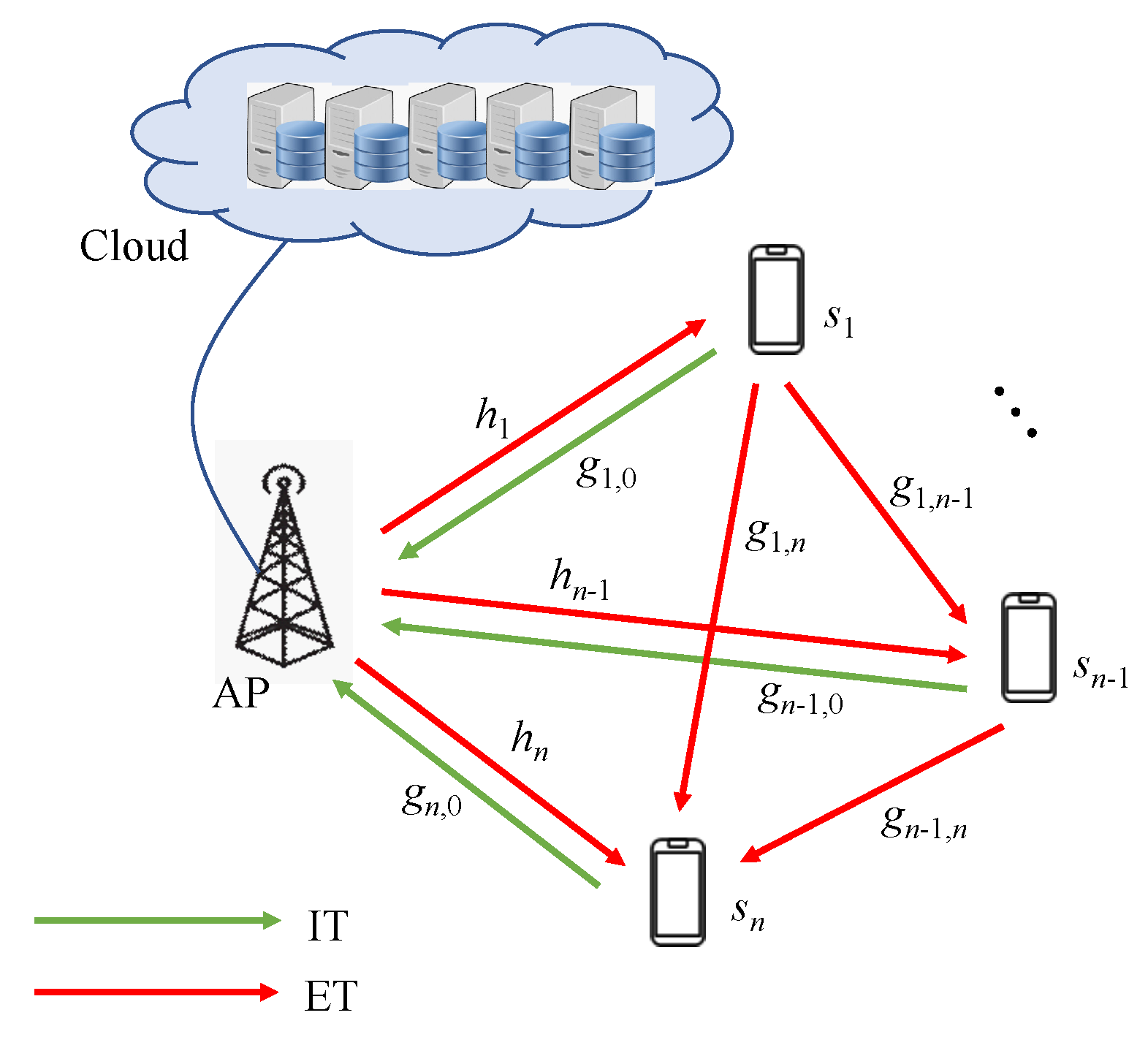
Figure 2.
Different types of the SWIPT technology. (a) Time Switching. (b) Power Splitting.
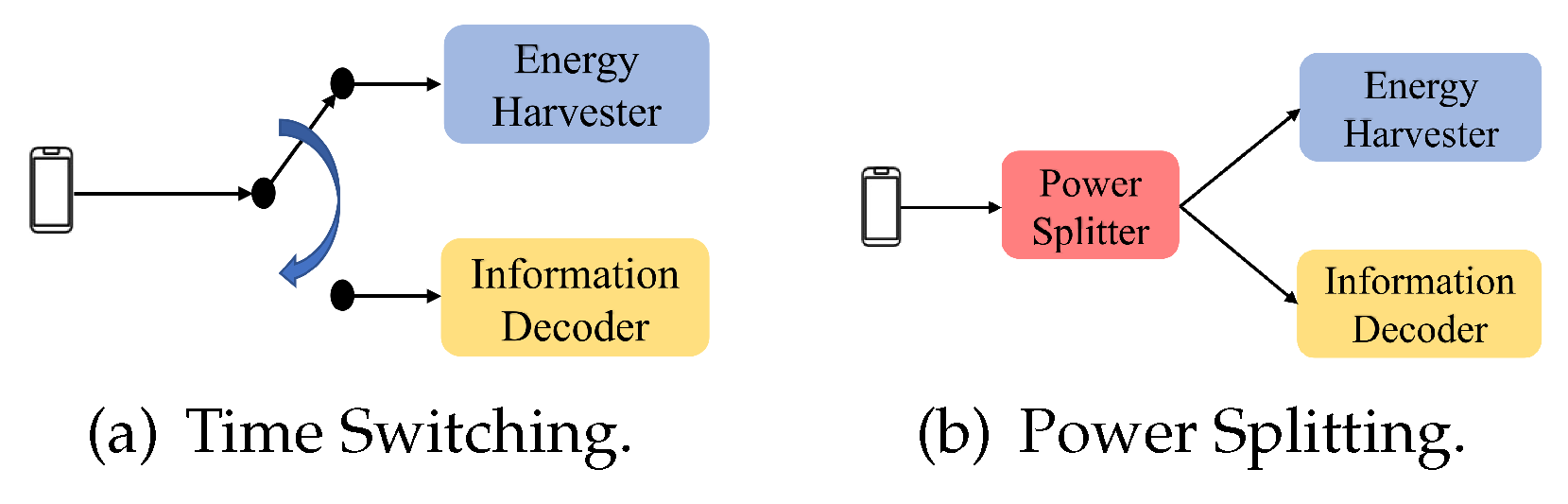
Figure 3.
DT-SWIPT scheme switches between different receivers.
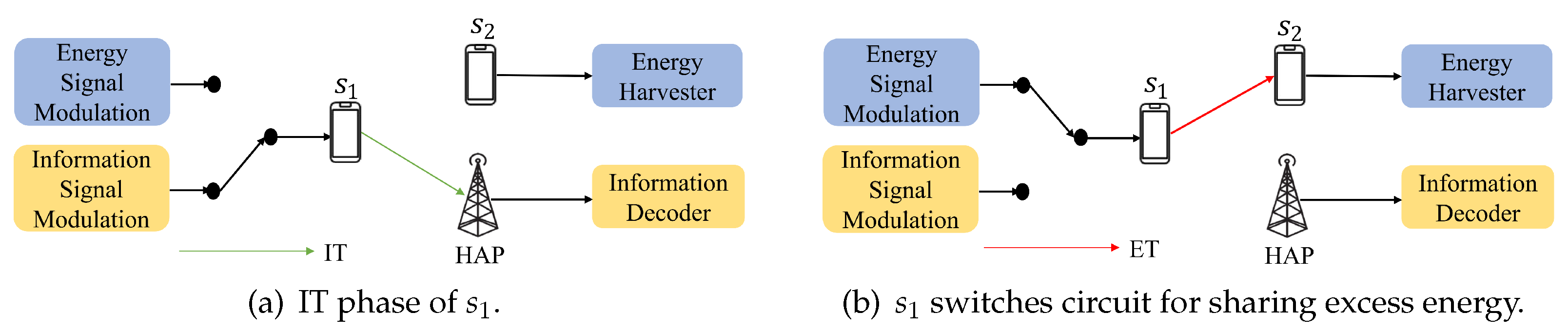
Figure 4.
The timing diagram of .
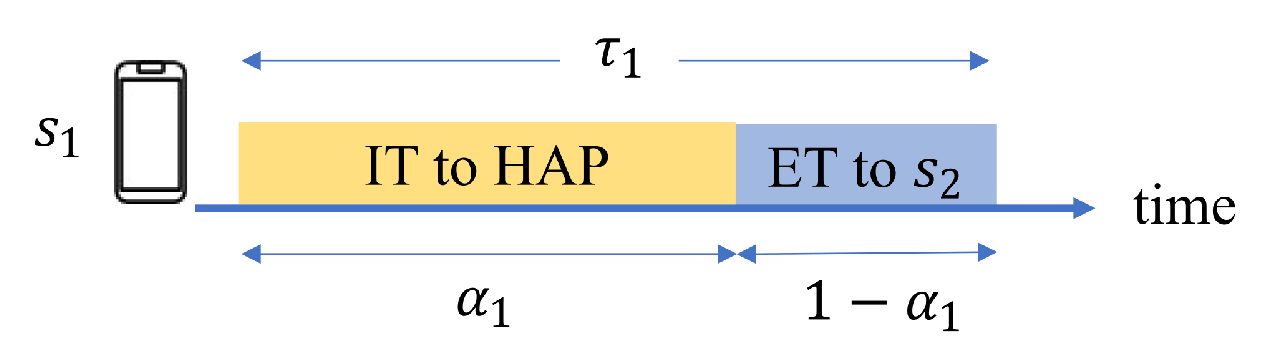
Figure 5.
The frame structure.
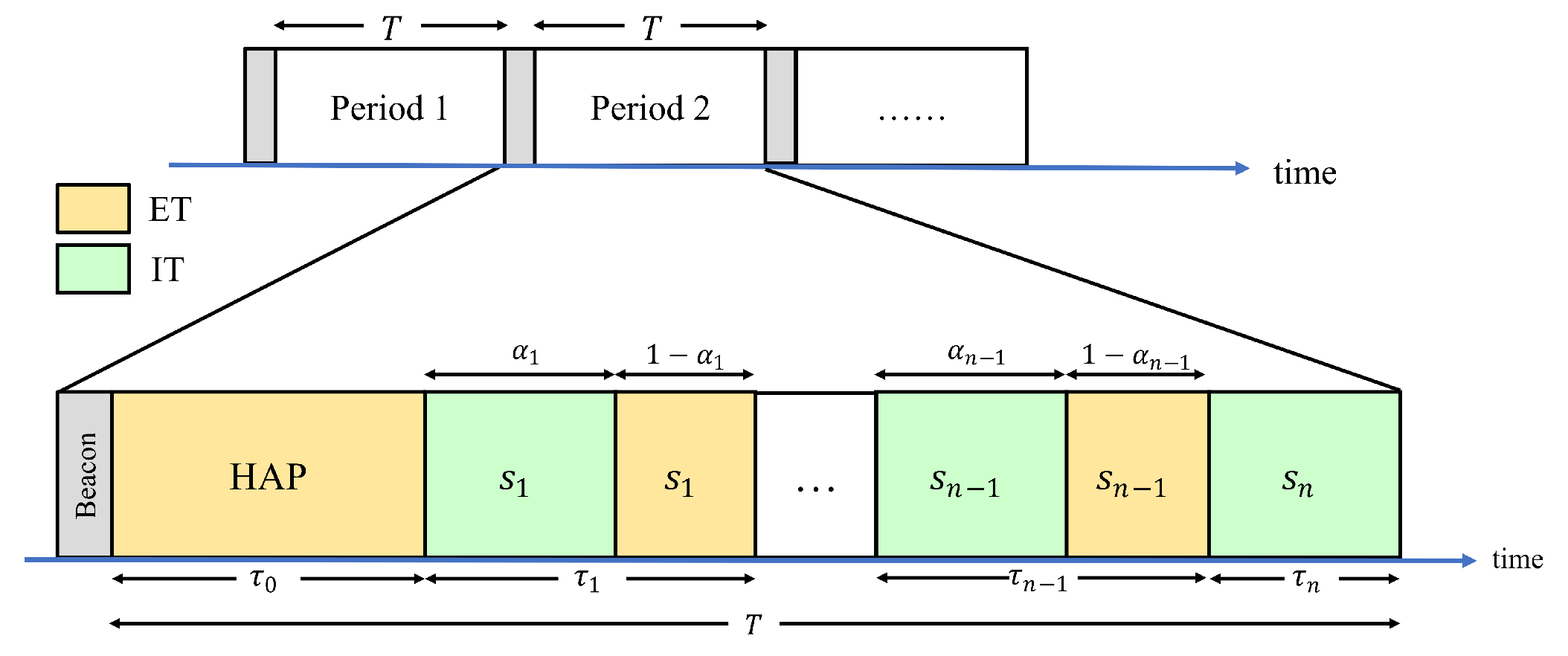
Figure 6.
Comparisons of the network energy consumption. (a) The general scenario. (b) The special scenario.
Figure 6.
Comparisons of the network energy consumption. (a) The general scenario. (b) The special scenario.
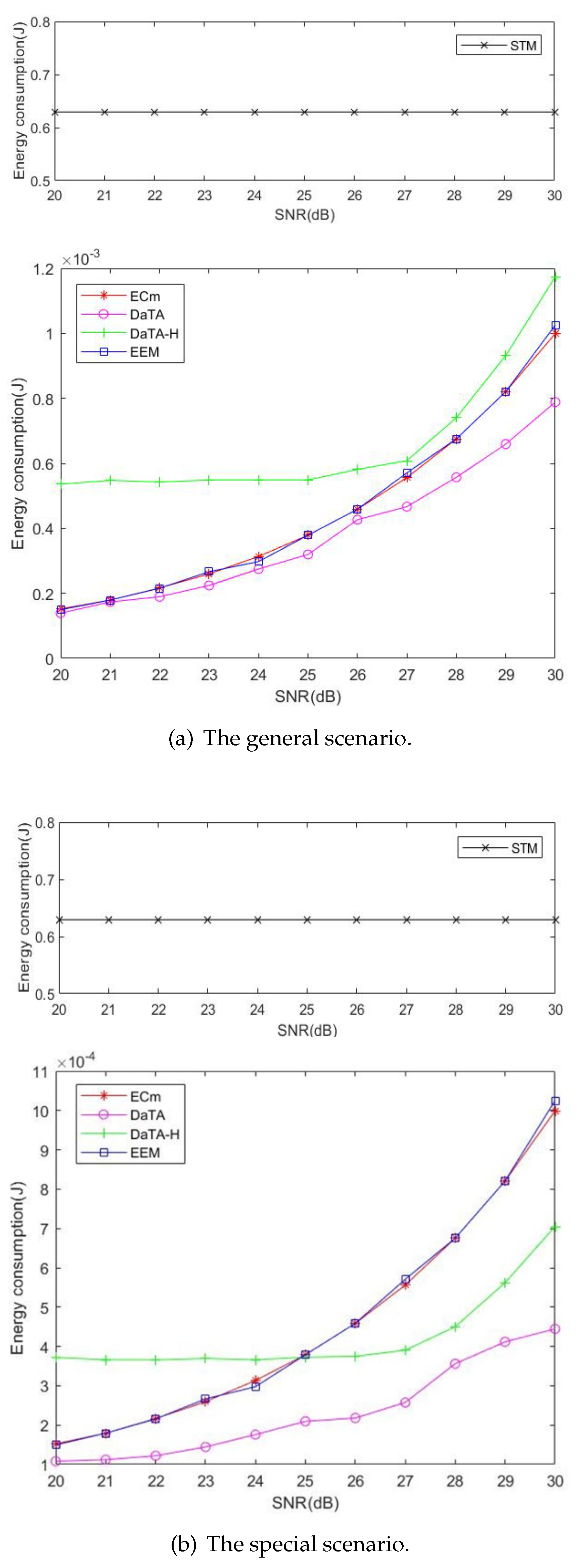
Figure 7.
Comparisons of network energy consumption of the DaTA-H scheme with different . (a) The general scenario. (b) The special scenario.
Figure 7.
Comparisons of network energy consumption of the DaTA-H scheme with different . (a) The general scenario. (b) The special scenario.
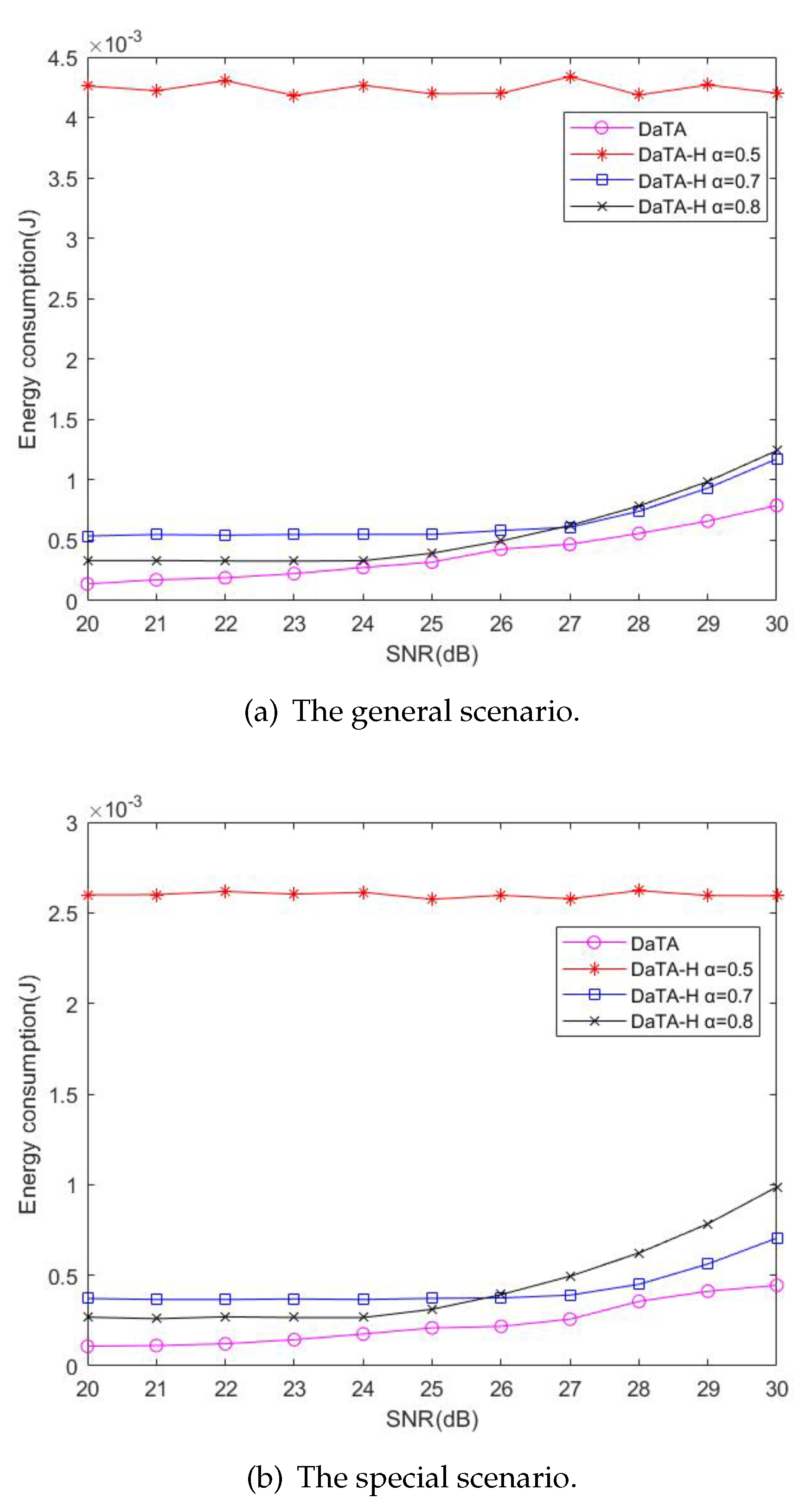
Figure 8.
Comparisons of the network sum-throughput. (a) The general scenario. (b) The special scenario.
Figure 8.
Comparisons of the network sum-throughput. (a) The general scenario. (b) The special scenario.
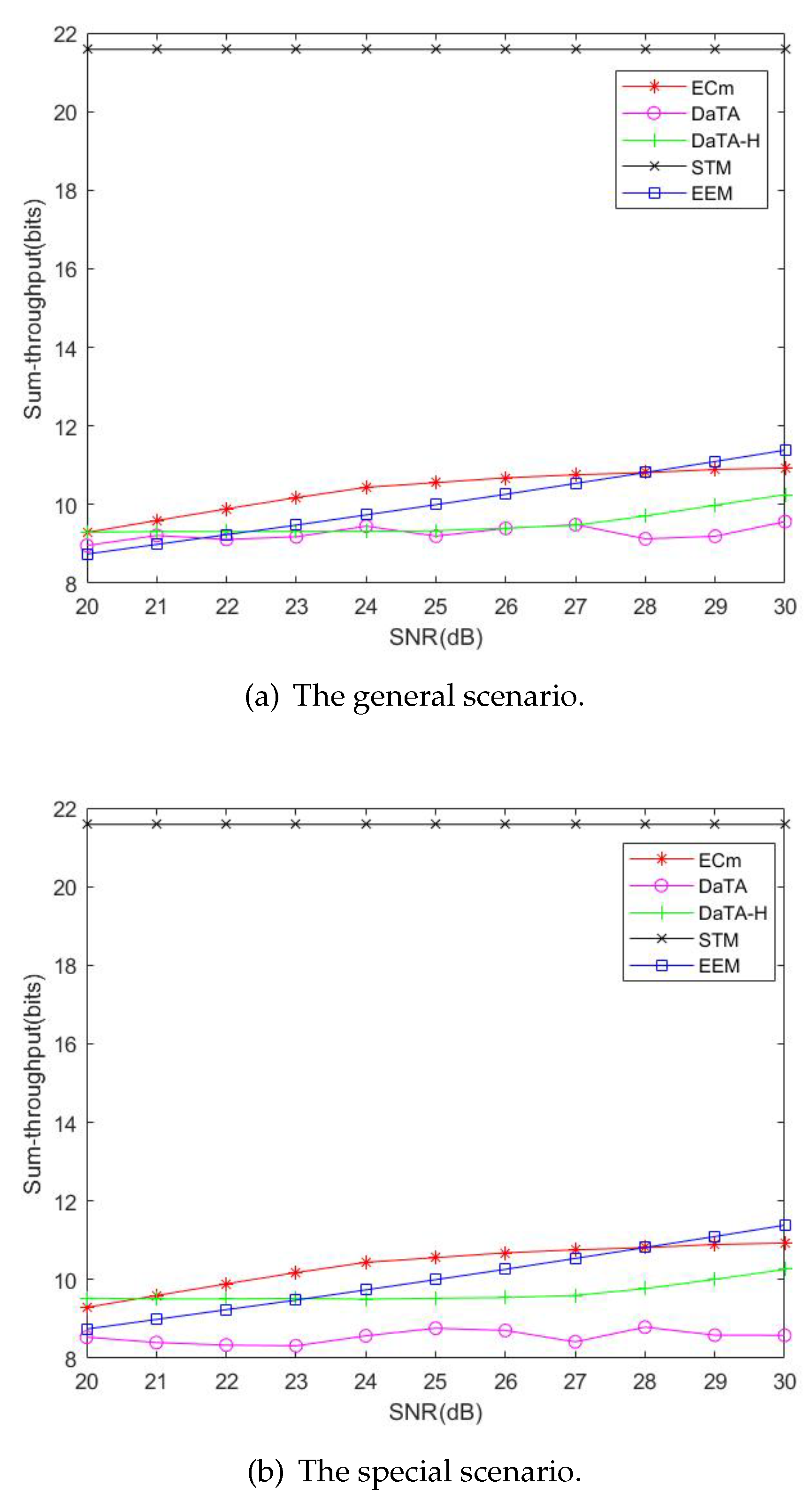
Figure 9.
Comparisons of the network sum-throughput of the DaTA-H scheme with different . (a) The general scenario. (b) The special scenario.
Figure 9.
Comparisons of the network sum-throughput of the DaTA-H scheme with different . (a) The general scenario. (b) The special scenario.
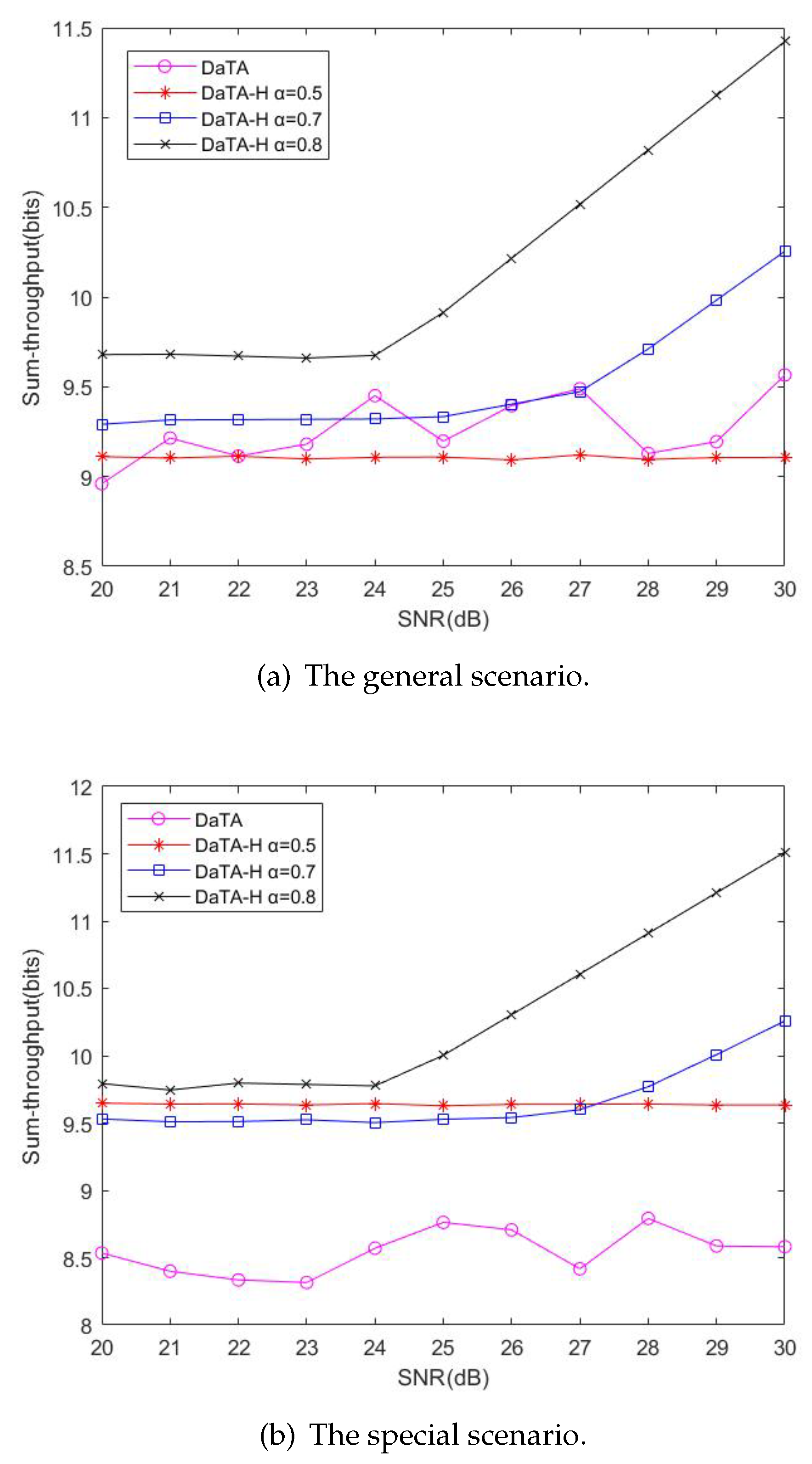
Figure 10.
Comparisons of the network energy efficiency. (a) The general scenario. (b) The special scenario.
Figure 10.
Comparisons of the network energy efficiency. (a) The general scenario. (b) The special scenario.
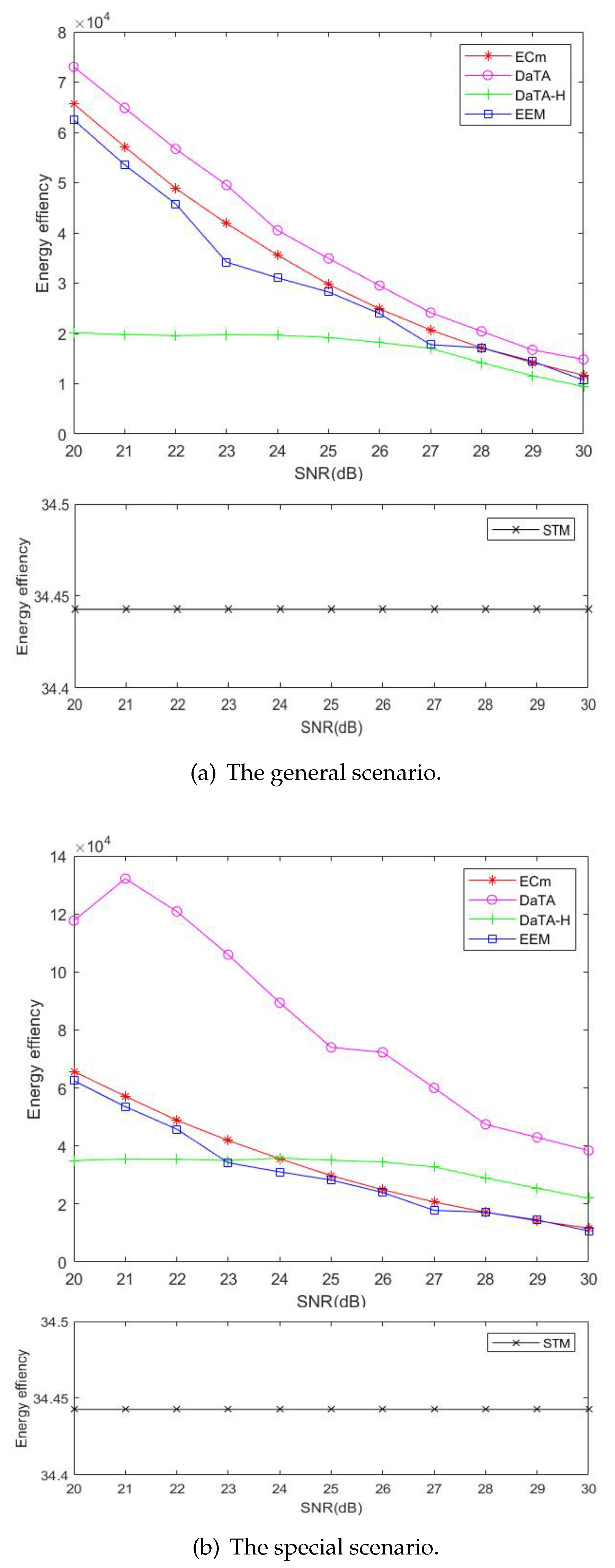
Figure 11.
Comparisons of the network sum-throughput of the DaTA-H scheme with different . (a) The general scenario. (b) The special scenario.
Figure 11.
Comparisons of the network sum-throughput of the DaTA-H scheme with different . (a) The general scenario. (b) The special scenario.
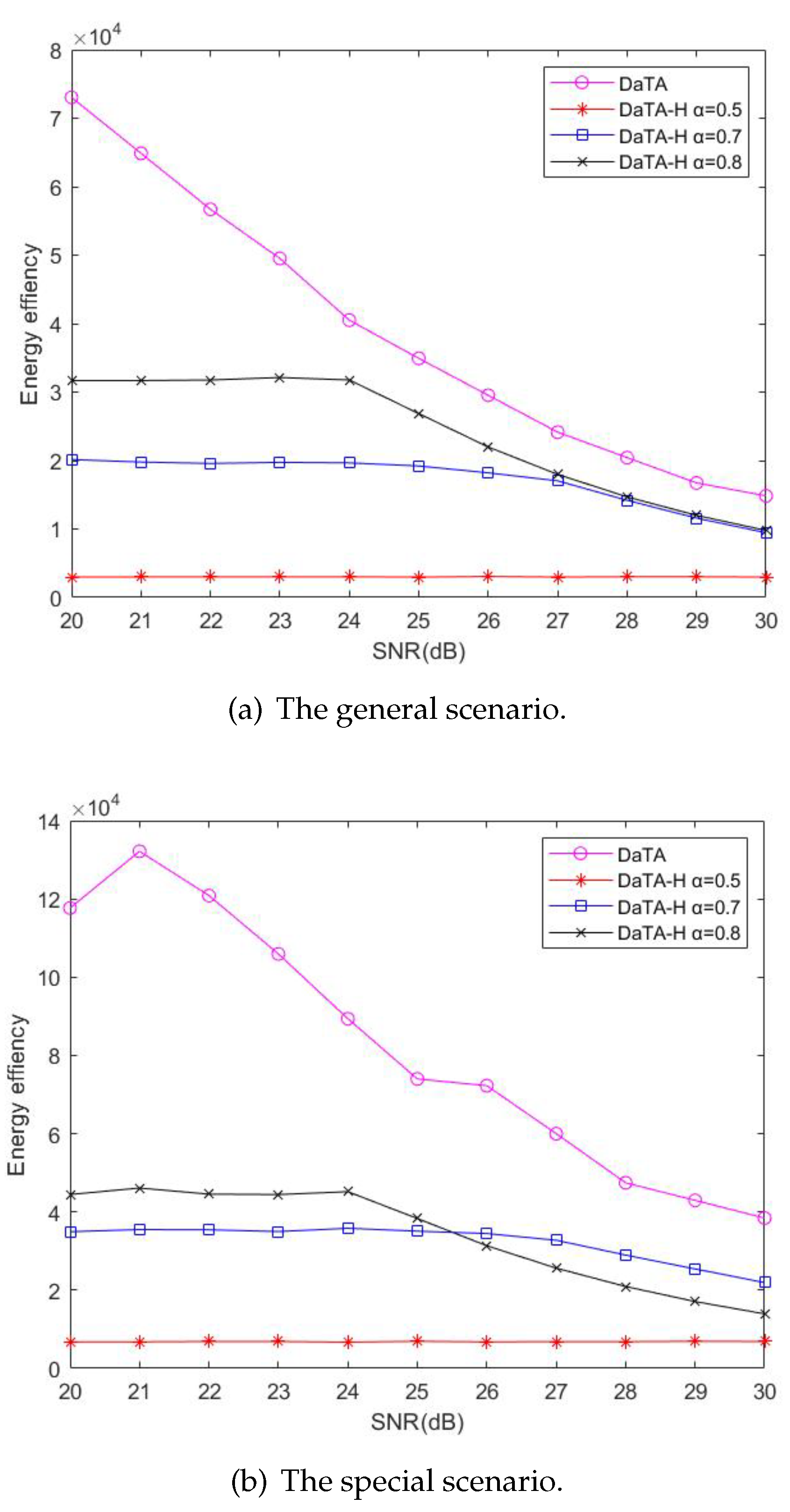
Figure 12.
Comparisons of the number of failed transmissions.
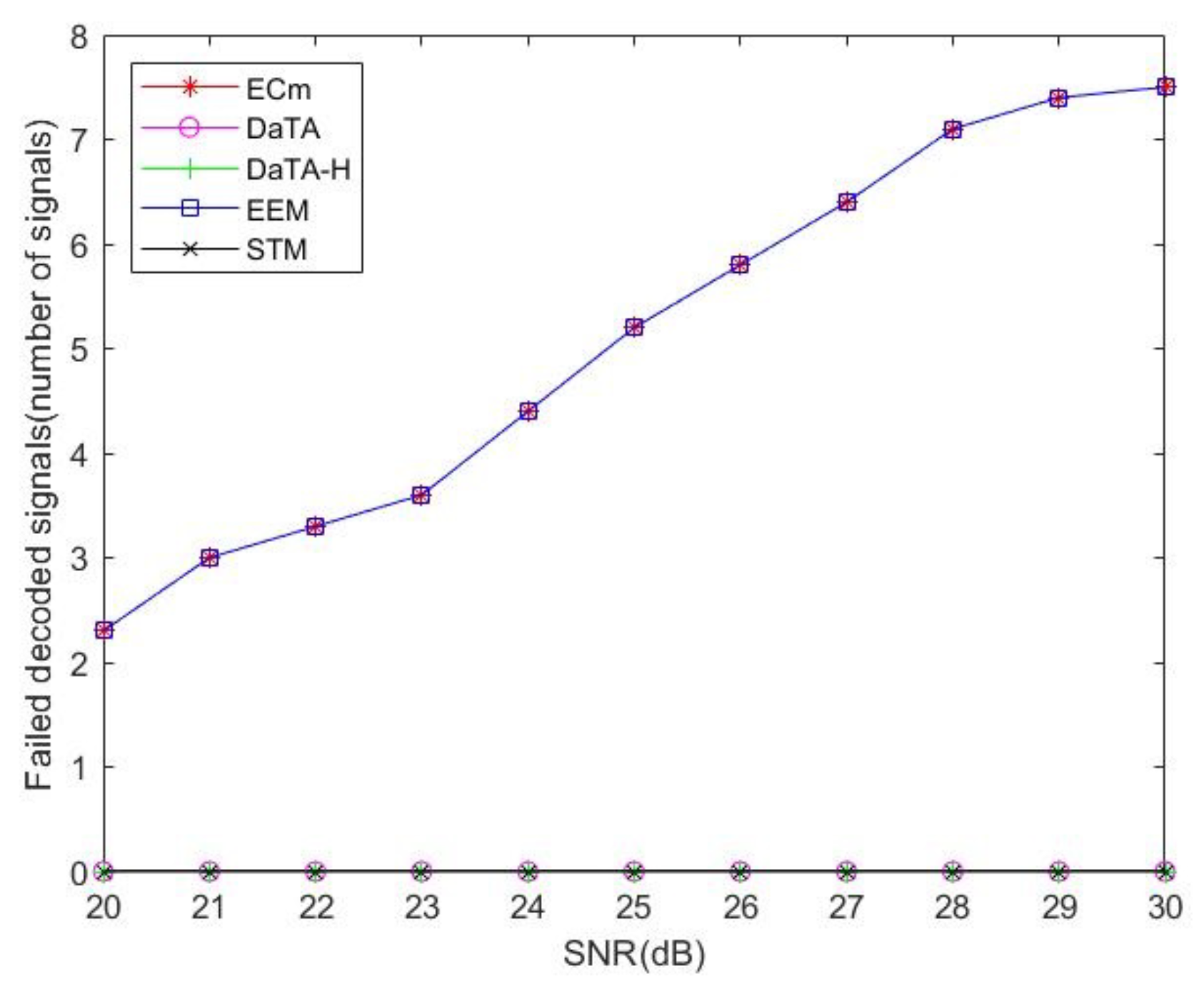

Table 1.
Simulation Settings.
| Parameter | Value |
|---|---|
| , energy harvest efficiency | 1 [14] |
| , the portion of energy for IT | 1 |
| , the transmission power of the HAP | 30 dBm [20] |
| N, noise power | -70 dBm [14] |
| , path loss exponent | 3 [14] |
| , throughput demand | 0.8 bps |
| (in DaTA-H) | 0.7 |
| (in DaTA-H) | 0.1 |
| T, duration of a period | 1 (s) |
Disclaimer/Publisher’s Note: The statements, opinions and data contained in all publications are solely those of the individual author(s) and contributor(s) and not of MDPI and/or the editor(s). MDPI and/or the editor(s) disclaim responsibility for any injury to people or property resulting from any ideas, methods, instructions or products referred to in the content. |
© 2024 by the authors. Licensee MDPI, Basel, Switzerland. This article is an open access article distributed under the terms and conditions of the Creative Commons Attribution (CC BY) license (http://creativecommons.org/licenses/by/4.0/).
Copyright: This open access article is published under a Creative Commons CC BY 4.0 license, which permit the free download, distribution, and reuse, provided that the author and preprint are cited in any reuse.


