

Submitted:
08 July 2024
Posted:
10 July 2024
You are already at the latest version
Abstract
There is a lot of pressures from organizations to continually redesign the business processes and the technology infrastructure to support the organization, but to also help organizations manage competing stakeholder needs, changing objectives and behaviour, and so on. A key part of this is making sure that all their activities in the different components of the business are interconnected and that they are moving in the same direction. Enterprise Architecture (EA) is an effective way of dealing with the challenge of designing business activities and supporting IT. This paper will summarize the organization of EA and look more closely at some major components of EA: governance architecture, business architecture, information architecture and technical architecture and consider the overlap and constructive interaction involved. Enterprise Architecture can be best understood through business process redesign. So, it is useful to briefly review the leading frameworks for business process redesign, including COBIT from ISACA, LEAN from the Toyota Group, TOGAF from the Object-Management Group, and the Capgemini Integrated Architecture Framework (IAF). All these frameworks allow us to more successful transformation, to return to the central idea of this paper.
Keywords:
Enterprise Architecture (EA)
; Governance Architecture
; Business Architecture
; Information Architecture
; Technical Architecture
; Business Process Redesign (BPR)
; COBIT Framework
; Lean Methodology
; TOGAF Framework
; Capgemini
; Integrated Architecture Framework (IAF)
; IT Governance
; Risk Management
; AI in Enterprise Architecture
; Human-Computer Interaction (HCI)
; Virtual Reality (VR)
; Augmented Reality (AR)
; Digital Transformation
; Strategic Alignment
; Organizational Efficiency
Introduction
Today’s business environment is undergoing tremendous dynamic transformations that are occurring in real time. Such transformation involves redesigning business processes, aligning strategy to our tactical and day-to-day processes as well as technology infrastructure for effective accomplishment of the strategy, business goals and objectives. Enterprise Architecture (EA) is a meaningful approach that provides organizations with a context to design and manage their needed business processes and supporting technology infrastructure in a united and culturally acceptable way from a holistic perspective. Enterprise architecture plays a significant role in structuring information and strategizing of the organization to ensure its objectives are reached. According to TOGAF, the official framework for EA, enterprise architecture represents a reflection of any business enterprise and contains components like governance architecture, business architecture, information architecture, and technical architecture. Each of these components that make up enterprise architecture is a unique and different process that contributes to the efficiency and effectiveness of business operations. Understanding these components helps in reinforcing their structures and especially the establishment and maintenance of their inter-relationships. Successful organizations are ensuring that these components are in existence and achieving their potential to ensure their ultimate success in their chosen industry. Organizations that strike a balance or get it right by putting components of enterprise architecture in existence and doing the needful in terms of aligning the components effectively achieve strategic objectives for sustainable growth and profitability as well as joyful and refreshing business experiences. In this paper, four key components of enterprise architecture namely, Governance architecture, Business architecture, Information architecture and Technical Architecture would be discussed and the relevance of these components to business process redesign and achievement of enterprise architectural objectives will be x-rayed.
Methodology
This case study utilizes a qualitative research design to assess which EA frameworks provide the most effective representation of the business strategy according to the business executives. Since an industry specific survey data for this purpose is not accessible, this study will focus on reviewing the literature on this topic, analyzing a couple of the case studies, and also conducting indicative interviews with the authorities in this field.
-
Literature Review – The study has a systematic literature review. This includes:
- Sources of Identification: Research Papers/Industry Reports/White Papers/Recent Publications (within the last 5 years)/eBooks/International Standards/Books/IC/CC/DC can be used. Synonyms and terms used are Enterprise Architecture, COBIT, LEAN, TOGAF, IAF, business process redesign, strategic alignment.
- Selection Criteria: Relevancy, recency (published within the past five years) and credibility Criteria: Research on the field that offers insights on the application and impact of EA frameworks on performance and strategic alignment.
- Critical Analysis: Each source is more deeply assessed to identify main themes, dynamics, and gaps existing within current research. Special attention is devoted to studies that explore the perspectives of business managers, and the practical use of EA frameworks.
-
Case Study Analysis - several case studies of organizations successfully introducing consistent frameworks against which EA can be assessed and steered –– namely.
- Selection of Case Studies: Case studies are chosen because they relate to the goals of the research. Sources have been collected that report on the implementation of EA initiatives and their outcomes, including company reports and press releases and articles in academic publications.
- Collection: Information on how, when, why and what happens during implementation; what are the problems that occur, are there any solutions offered, what has been done about restoring normal order; what changes to technology is the organization putting in place, and what measures is it taking to ensure the success of the change initiative. Key performance indicators (KPIs) such as efficiency, agility, customer satisfaction, strategic alignment are part of the ‘as is’ state.
- Comparative Analysis: The case studies are compared to identify factors that are important for the success or failure of EA and generate insights about the practical impacts of different EA frameworks and the relevance of these frameworks to business executives.
-
Framework Justification - COBIT, LEAN, TOGAF and IAF are the core EA frameworks considered and compared for this research because of their recognition and applicability.
- COBIT: COBIT is an IT governance and management framework which offers best practices for aligning IT activities with business objectives and ensuring regulatory compliance (The State of Enterprise Architecture Report 2023 – Enterprise Architecture Professional Journal [online publication date n.d)
- LEAN: Focuses on improving waste and eliminating variability. Perfect for optimizing business processes and improving efficiency (The State of Enterprise Architecture Report 2023 – Enterprise Architecture Professional Journal, n.d.)
- TOGAF: A method and framework for developing and managing enterprise architecture in a systematic manner that involves multiple and diverse stakeholders to generate strategy alignment (The Open Group, 2018)
- IAF: Augments the Zachman Framework with additional perspectives focused on governance, policy, and strategy to create a concept of enterprise architecture across the enterprise (Gøtze and Truex, 2013).
By adopting this qualitative methods approach, the study aims to deliver a rich descriptive picture of the nature and essence of EA frameworks as perceived by business executives, drawing practical lessons and recommendations for the more effective design and deployment of enterprise architecture practices.
Literature Review
Over the past decade, Enterprise Architecture (EA) has been through several iterations. What started as a mere description of the technological infrastructure of an organization increasingly became a means to ensure the alignment of processes, people, and the technology behind them. While either of these perspectives on EA is important in its own right, the future promise of EA lies in ensuring seamless alignment between a company’s strategic objectives and operational outcomes. In this light, here are some of the key areas where EA is already making a difference, as well as some of the gaps in the current literature where additional research may be needed.
Recent Studies and Trends
- Adaptability and Agility
Adaptability became a core requirement in the wake of the COVID-19 pandemic when the pace and magnitude of change had to be intensified throughout the value chain, as businesses were forced to make dramatic adjustments to their business models and the way they deliver value. EA was identified as a key enabler of such agility. Modern approaches for EA take decentralization and adaptability as core requirements and embrace this dynamism by providing tools to manage systems and applications that deliver and sustain such organizational change and strategic goals. (Enterprise Architecture Trends: 2023 and Beyond, n.d.)
- 2.
- AI and Machine Learning Integration
AI and ML will increasingly be applied within EA (greatly improving the quality of architecture documents and data) and, more importantly, AI within the EA context will be used to perform automated impact analysis to improve its strategic planning capabilities in analysis and planning. Harnessing AI and ML (‘the 4th Wave’ as defined by Hurwitz Group) can form the basis for EA of deep learning networks such as generative adversarial networks (GANs), or convolutional neural networks (CNNs). In short, as previously suggested in Forbes, AI can assist in streamlining architectural processes. As the ‘frictionless’ speeds of data and processes increase, it naturally becomes vital to eliminate friction in the architectural processes themselves. AI and ML will significantly enhance the quality of architecture documents and data and help organizations better determine their future-oriented enterprise architectures. Within both individual and corporate contexts, EA without ‘smart’ technology will become rare in just the next few years. (Adapted from The EA Journey Second Edition, 2023. 7 Enterprise Architecture Trends to Watch in 2024 | News, EACMS.)
- 3.
- Sustainability and Compliance
Besides, EA is becoming one of the driving forces for sustainability across organizations, enabling them to define and measure sustainability indicators. Moreover, ongoing compliance is much faster and easier to achieve through real-time compliance, a concept that becomes possible through mature EA practices (7 Enterprise Architecture Trends to Watch in 2024 | News, n.d.), for example, around data privacy and security.
- 4.
- Resource Challenges and Strategic Insights
In spite of the increasing recognition of value for EA, many organizations continue to report a lack of resources, and changing the perception of value to business is listed as a top goal: EA teams, who are typically expected to deliver strategic insights to support decision-making and investment prioritization, should highlight their value and secure resources accordingly (The State of Enterprise Architecture 2023, 2023)
- 5.
- Customer Experience (CX) and Emerging Technologies
Improving the customer experience is the new holy grail for EA and here enterprise architects are designing systems that both support the creation of new apps that enhance customer-facing experience, and tools that augment and optimize customer-facing process systems. This focus on the client provides the main rationale for using new or emerging technologies like machine learning, cognitive computing or advanced data analytics tools that allow companies to better collect and interpret customer data. It helps organizations truly comprehend their clients (7 Enterprise Architecture Trends to Watch in 2024 | News, n.d.)
Critical Evaluation and Gap Identification
While currently available data and trends shed light on how the donation community is adapting to the changing needs of EA, significant gaps persist, which explain our focus on this pressing issue.
- Business Executive Perspective - There remains a strong tendency in today’s literature to emphasize solely the technical aspects of EA. There are many opportunities for more research that explains EA from the perspective of the business executive, demonstrating how they can use EA to drive business strategy and how EA can enhance executive decision-making.
- Practical Application of AI in EA - While there is a lot of discourse around how AI and ML can be implemented in EA, there is limited research and little literature review about practical applications and case studies that demonstrate the actual usage and real impact of these technologies on different areas of EA practices.
- Sustainability Metrics and EA - The role of EA in promoting sustainability is acknowledged only in theory, and detailed frameworks and methodologies that describe how an organization’s EA practice can be used to integrate sustainability metrics are scarce.
- Resource Optimization and Strategic Insights - What could EA teams do to increase their strategic sustainability or further enable them to infuse strategic insights to support business needs?
These gaps will be filled by this paper’s contribution aiming to provide an integrated EA perspective from a business executive, giving concrete suggestions and recommendations for using EA to help business achieve its strategic objectives.
- A.
- Enterprise Architecture Framework Diagram
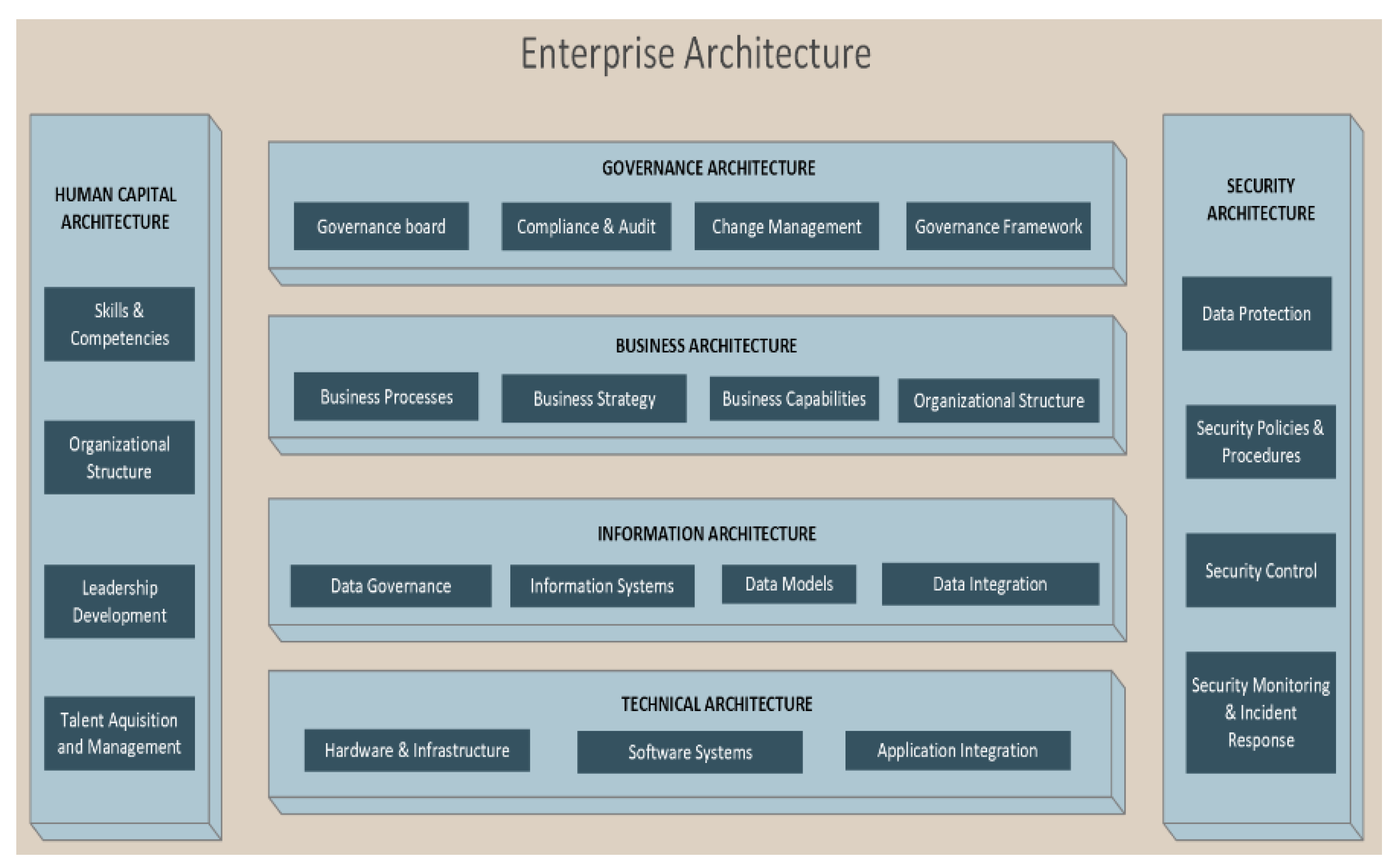
Enterprise Architecture (EA) is a strategic ‘discipline of course’ (our distinctive characterization) that provides organizations with the ability to organize, orchestrate and sustain their business processes, information assets and IT infrastructure in a manner that achieves their goals and targets. Introducing three main components in EA, covering governance architecture, business architecture, information architecture and technical architecture, ensures that its foundations are solid and that it governs effectively, designs efficiently, manages information assets, and maintains technical infrastructure. Now let us take a look at three specific components for each of governance architecture, business architecture, information architecture and technical architecture.
Figure 1.
This diagram illustrates the core components of an Enterprise Architecture framework, highlighting the interconnectedness of governance, business, information, and technical architectures. It highlights how these components collaboratively ensure the alignment of an organization's processes, technology, and strategic objectives.
Figure 1.
This diagram illustrates the core components of an Enterprise Architecture framework, highlighting the interconnectedness of governance, business, information, and technical architectures. It highlights how these components collaboratively ensure the alignment of an organization's processes, technology, and strategic objectives.
-
Governance Architecture:
- Governance Framework: This is a continuous effort whereby the principles, policies and guidelines of EA development, implementation and governance are formulated. It details the processes of decision making, roles and responsibilities, as well as accountability of the different functions concerned within the governance structure.
- Governance Board: Includes stakeholders who oversee EA activities. Responsible for setting strategic direction, authorizing architectural decisions, ensuring EA is on track with the business, and to function as a neutral arbiter in conflicts.
- Compliance and Audit: it consists of checking if technological operations comply with relevant legal regulations and industry standards; if there are any present risks; if they are controlled; regulating access to the system; and ensuring the protection of data (Whitman & Mattord, 2019).
- Change Management: Keeps track of all changes to the EA, laying down rules for how such changes will be made and keeping change requests, impact assessments, maintenance decisions and their changes under control.
-
Business Architecture:
- Business Strategy: Describes the organization’s respective strategic direction and objectives; used to determine how business processes should be designed, and which capabilities should be fulfilled.
- Business Processes: Activities, workflows, and interactions that define and enable an organization’s operation. Describe how work is completed and whom, what, where, when, why, and which relate to that process. Business architecture seeks to map and enhance business processes for improved efficiency, productivity, and customer value (Ross, Weill, & Robertson, 2006).
- Business Capabilities: Capture the organization’s abilities to carry out its strategy and achieve its goals, as described above. Include which competencies, assets, technologies, and knowledge the organization possesses to perform certain business tasks.
- Organizational Structure: Defines the hierarchical structure, reporting relationships, and responsibilities of the organization to facilitate the execution of business processes. Organizational Structure: Categorizes the design of organizational environments based on roles, responsibilities, and tasks to enable decision making, coordination, and collaboration within the organization (Laudon and Laudon, 2020). (Laudon & Laudon, 2020).
-
Information Architecture:
- Data Governance: Policies, processes, and procedures related to management of corporate data assets such as data quality management, data security, data integration, and data lifecycle management.
- Data Models: Data model specifications of the conceptual/scheme model and the logical/physical data model, specify the structure (attributes of an entity), relationship, and constraints to be enforced for the respective functional model of a respective system. This is a conceptual and logical representation of the organization’s data, which allows for uniform maintenance of data.
- Information Systems: Applications, systems, and technologies that support information capture, retrieval, and processing. Examples include databases, data warehouses, content management systems, and other information management tools.
- Data Integration: Ensures seamless integration of data between two systems and applications. Data integration technologies, interfaces, and exchange protocols ensure interaction between different systems and produce a consistent and accurate reflection of the information landscape in the enterprise. It involves integration of data from all sources and systems and produces a unified view of information across the enterprise. (Ross, Weill, & Robertson, 2006).
-
Technical Architecture:
- Hardware and Infrastructure: The physical infrastructure of the organization consists of servers, networks, storage, and other hardware components required to support IT operations. Technical architecture: hardware, software, networks, and other infrastructure components required to support technology operations (Laudon & Laudon, 2020).
- Software Systems: Applications, platforms, and software components that enable and support business processes and information management. These software components include enterprise resource-planning (ERP) systems, customer-relationship-management (CRM) systems, and other specialized software. It refers to the selection, integration and management of application systems that enable process and information management. (From Ross, Weill, Robertson, 2006, reprinted in IT Governance Handbook, Rosemann, 2008 - Ross, Weill, & Robertson, 2006).
- Application Integration: Application-to-application or system-to-system integration to allow data communication and process automation. Examples include middleware, application programming interfaces (APIs), and service-oriented architecture (SOA) policies. This layer also manages selection, integration, and management of application systems to support business processes and data management (Ross, Weill, & Robertson, 2006).
-
Security Architecture:
- Security Policies:Governs the rules and procedures to be followed to protect an organization’s platform or critical infrastructure for information and technology assets. This can include details such as access controls, data privacy requirements, risk management methodologies, incident response protocols and compliance processes.
- Security Controls:Refers to the technical and procedural controls used to protect the organization’s assets. These are typically firewalls, intrusion detection and prevention systems, data, and configuration encryption mechanisms, as well as authentication and authorization mechanisms, and security awareness training programs.
- Data Protection:Data protection is required for defending the confidentiality of information from unauthorized access, or disclosure. This element acts like a shield towards third parties where information is encrypted, access controls are in place, as is data loss prevention, backup, and recovery (Kizza, 2016).
- Security Monitoring and Incident Response: Security monitoring and auditing typically entails reviewing systems and networks for any signs of disturbance. This component comprises of real-time log analysis, intrusion detection systems, security event correlation, and frequent security audits (Whitman & Mattord, 2019).
-
Human Capital Architecture:
- Skills and Competencies:Assessment and development of needed skills and competencies to support the organization’s strategic goals, which entails defining the needs for job roles, assessing employees’ skill sets and competencies, and offering training and development programs to develop and enhance employee capabilities.
- Organizational Structure:Establishes the hierarchical structure, reporting lines and roles of the organization. It also formalizes job descriptions, roles, and responsibilities: this allows for coordination and collaboration.
- Talent Acquisition and Management:Talent development refers to building skills, knowledge, and capabilities among employees through training, coaching, mentoring, developmental assignments, and different career development opportunities. This component safeguards employee growth and engagement while rationalizing their competencies along organizational needs (Noe et al., 2019).
- Leadership Development:Focuses on identifying and developing leadership strengths internally, through leadership development programs, mentoring, succession planning and any other mechanisms to ensure the development of a strong pipeline for leadership.
These parts together produce the interlinked infrastructure for organizing enterprise architecture – from the principles governing how and what the enterprise does, to the people and processes that execute the business practices, to how information is made, distributed, and processed, to the tools and technologies used to implement digital organizational capabilities. Each of these constituents, in turn, can be sliced and diced into the specific parts that all contribute to the delivery of value to users.
- B.
- Enterprise Architecture Frameworks for Business Process Redesign
Enterprise Architecture frameworks offer a systematic way to integrate business process redesign into broader enterprise architectural design. They provide principles, methodologies, and tools, which an organization can use to analyze, design, and implement business process change, and integrate the results of process change into the organization’s broader enterprise architecture. In this section, we will highlight the leading Enterprise Architecture frameworks that support business process redesign.
1. COBIT Framework
COBIT or Control Objectives for Information and Related Technologies is a framework presented by the Information Systems Audit and Control Association (ISACA), to provide principles and practices for the governance and management of enterprise information and technology. COBIT acts as a set of controls that seek to achieve the right balance between the requirements of business operations based on agreed key objectives.
COBIT supports business process re-design. It is a high level ‘please’ that forms a framework for the evaluation and improvement of the IT-focused processes in the organization; it consists of a set of control objectives and management guidance applicable to most common business processes (e.g., processes that focus on the implementation of new technology, the usage and storage of information, etc., and the risk identification and management); through its process assessment and improvement techniques, it helps organizations identify process gaps, identify target processes, and implement the changes in order to improve the efficiency, effectiveness and the adherence to the business objectives. (Adapted from V Grembergen et al (2017), Risk IT: COBIT5 and the Time for Business-Driven Information Security, IIBA (3rd edn, AMACOM) 2017 by International Information System Audit and Control Association)
To provide some specific examples, COBIT can provide much-needed technical support in Business Process Redesign (BPR) and Enterprise Architectural Design (EAD) processes and similar activities. Here is a quick overview of how COBIT is effective in those situations.
- Process Alignment: COBIT offers a standardized collection of processes and control objectives, which could serve as a baseline for determining how business processes are mapped to IT activities. For example, an organization’s current processes could be mapped to COBIT’s process coverage matrix to identify deficiencies, redundancies, and inefficiencies. Furthermore, the COBIT processes and related control objectives could be used during process redesign to make sure that processes are aligned with best practice.
- Governance and Control: COBIT stresses effective governance and control of the IT function and provides a governance framework, which includes management guidelines, control objectives and performance indicators, that can assist organizations to identify clearly who is accountable for what, who makes decisions regarding people, processes and technology, and how these decisions are implemented through effective controls to achieve efficient operations.
- Risk Management: BPR and EAD initiatives mandate process, system, and technology architecture changes. COBIT can help organizations identify, assess, and monitor these risks. Reviewing COBIT risk management practices, and implementing these controls where needed, helps mitigate new risks that could arise due to redesign.
- Performance Measurement: Since COBIT promotes the development of performance indicators to gauge the adequacy of IT processes, the framework allows an organization from a process perspective to define performance metrics for enhancements in BPR and EAD, followed by implementation of a performance measurement framework to measure initiatives taken to meet the overall business strategy and business process goals. This approach enables them to monitor critical processes, diagnose issues, track performance, provide meaningful feedback to synergize actions, effect improvements and enhance efficiency.
- Compliance and Standards: COBIT utilizes industry standards and regulatory obligations such as ISO 27001, COSO and ITIL. Through its integration with these standards, organizations can promote adherence to the required regulations and industry best practices in BPR and EAD initiatives. Doing so can instill a level of assurance and security within IT systems.
- Continuous Improvement: COBIT promotes a feedback loop for the Plan-Do-Check-Act (PDCA) cycle, effectively encouraging a state of continuous improvement to IT governance and management. Through the PDCA approach, organizations are ‘always on’ and continuously monitor, measure, evaluate and adjust their BPR and EAD efforts. COBIT’s feedback engineering, where the Design step (analyze current processes, identify, and design future processes) is repeated after Do (deploy and measure), provides for refinement of the PDCA cycle.
By way of summary then, COBIT should be able to serve as a supportive framework for redesigning business processes and designing enterprise architectures because of its ability to ensure process alignment, governance and control, risk management, performance measurement, compliance, and continuous improvement. By following its guidelines then, an organization should be able to run their IT activities more effectively and efficiently by better aligning them with strategic goals.
Real-Life Case Study: Implementing IT Governance Using the COBIT Framework
By including a robust case study on the use of COBIT in practice (COBIT 5, 2019), we provide additional depth to our study. A case study is included on the use of COBIT within a real financial institution in Georgia that adopted COBIT 2019 to gain better IT governance and better link IT activities with objectives for the business (CIO Portal. 2023).
Case Study: Financial Institution in Georgia
Background: In 2022, a major financial institution in Georgia sought to enhance its IT governance and ensure alignment with its strategic goals. The organization faced challenges in managing its IT resources effectively, particularly considering increasing regulatory requirements and the need for improved risk management.
Implementation Process: To tackle the stated challenges, the institution implemented COBIT 2019. The implementation process involves the steps outlined below:
| Step | Description |
| Assessment and Planning | Performed an in-depth assessment of current IT governance level and practices. Documented existing situation, aligned with COBIT's governance and management principles. Defined gaps, opportunities for improvement, and planned a detailed implementation roadmap, prioritised by institution’s strategic objectives. |
| Governance Framework Establishment | Establish established a formal governance framework that included key representatives from line-of-business (LOB) units and IT functions. Create roles and responsibilities owners with decisions and authority, making it clear for holding accountable governance and control. |
| Risk Management and Compliance | Aligned with ITIL processes for identifying, assessing, and managing IT-based risks. Implemented measures to gain status as Information Security Management System (ISMS) in alignment with ISO 27001 Requirements, along with COSO (an internal control framework for organisations to assess risk). Integrated sustainability considerations throughout the COBIT framework and implemented alignment with ISO 26000 framework. |
| Performance Measurement | Designed performance metrics and a monitoring framework to gauge the effectiveness and efficiency of IT processes. Reviewed the functional operations and procedures on an ongoing basis to improve processes based on feedback and performance metrics. |
Results - The adoption of COBIT 2019 resulted in significant improvements for the financial institution:
- Enhanced IT Governance: Greater understanding of the IT/business nexus = better decision-making for strategy-making.
- Improved Risk Management: Risk management approaches helped mitigate potential IT risks and to respond to obligations under the law.
- Operational Efficiency: The performance measurement framework enabled the institution to track performance, identify areas for improvement and optimise IT processes.
- Business Value: COBIT 2019 helped the company realise business value by improving the governance and management of IT resources.
It showcases how COBIT 2019 can create a more agile structure around the IT governance and IT activities that are governable, to ensure they are supporting the strategic business purposes – and provides some valuable insights for any other organisation following a similar route.2.
LEAN Framework
The Lean method of work and the Lean philosophy, sometimes referred to as Lean Manufacturing or Lean Management, are often credited with entering the world of manufacturing in the mid-1990s. But the Lean mindset and mind-mapping – the process of task-mapping through which Lean Thinking is accomplished – technically predate the Lean methodology by a considerable amount of time. Nonetheless, Lean can help you mitigate waste, improve efficiency, and serve the customer better. Let us break down all three.
- Waste Reduction: Lean thinking aims to reduce so-called ‘eight kinds of waste’ (known as the ‘8 Wastes’): overproduction; waiting; unnecessary transportation; excess inventory; motion; over-processing; ‘defects’ (by which is meant product waste, such as rejects, reworks, etc.); and unused employee creativity. To identify areas for improvement, organizations currently following a specific process map out all their steps and then apply Lean principles: because of this mapping, they can identify which tasks in the process are wasteful, and the process can be modified and refined to reduce or remove waste.
- Value Stream Mapping: A key Lean technique involves the use of value stream mapping to visualize and analyze flows of materials, information and other process activities in order to identify and eliminate ‘muda’ (waste), or the progress of goods through a process that does not directly contribute to the creation of value from the customer perspective.
- Standardized Work: ‘Lean’ stresses the importance of standardized work. Essentially, this encourages consistent approaches to performing work tasks, namely those processes variations likely to introduce error. By documenting and implementing standardized workflows, organizations can create much-needed design leverage – the ability to scale up changes in design – through architectural design that is capable of redesign, and the continuous improvement of practice.
- Continuous Improvement: Lean emphasizes a ‘constant improvement’ (kaizen) mindset. Empowering staff at all levels to surface opportunities for kaizen leads to ever-improving work processes, a business philosophy that extends to improving business processes and the architecture to support them.
- Customer Focus: Lean stresses responding to customer needs. By using techniques like customer value analysis, it is possible to distil the value chain to the truly relevant, genuinely appreciated parts. This helps to direct the process of evaluating redesign efforts, setting priorities, and aligning architectural choices in support of basic customer requirements.
- Just-in-Time (JIT): This is a Lean concept. Just-in-Time refers to the practice of producing or delivering goods or services exactly when they are required and is another key principle of Lean. If you are using JIT, you consistently time all inputs and outputs at the instant when they are needed by the next process to minimize inventory and lead times, so as to maximize value and minimize non-value-adding activities such as redundant storage.
- Cross-Functional Collaboration: Lean promotes collaborative working across functional areas. Cross-functional collaboration enables better stakeholder involvement during business process redesign and enterprise architectural design, for those involved can bring expertise from different areas (both within and outside the IT department), share knowledge, and design better and more efficient processes and systems.
Lean presents a collection of principles and methods to assist in the design of both business processes as well as that of an enterprise architecture. Lean thinking helps companies eliminate waste, map value streams, implement standardized work, improve processes through kaizen, focus on the customer, employ JIT, and work cross functionally. Since Lean provides a systematic framework for process optimization, organizations are provided a method for achieving their goals of higher performance and better enterprise architectural design.
Real-Life Case Study: Implementing Lean Framework for Efficiency Improvement
In order to grasp a full picture of the Lean systematisation, let us examine a specific case study of the active implementation of Lean in Deutsche Bahn, the largest transport company in Europe, which effectively used Lean principles to enhance efficiency and performance of business operations (Şişman, 2022).
Case Study: Deutsche Bahn (DB)
Background: One of the largest companies in a particular domain, Deutsche Bahn (DB), provides major services in the transportation region (Case Study – Deutsche Bahn – Scaled Agile Framework, 2019). The company has around 298,000 employees working for 35 subsidiaries to furnish their services.
In 2015, DB introduced a Lean-Agile transformation to its business to address two of its main issues, operational efficiency and customer satisfaction. Using Lean principles, the company managed to improve the value-creation for their customers. (Case Study - Deutsche Bahn - Scaled Agile Framework, 2019)
Implementation Process: Implementation of Lean at DB was carried out through a number of important steps, as depicted in the tabulated format given below
| Step | Description |
| Training and Coaching | Training and coaching were provided to the entire staff population by KEGON, a Scaled Agile Partner. The performed SAFe® Scrum Master and SAFe® Product Owner/Product Manager training on a role-based basis. |
| Value Stream Analysis | Performed a Value Stream analysis resulting in four Value Streams covering vertical products and horizontal services. |
| Program Increment (PI) Planning | Held the first Agile Release Train (ART) with a PI planning event. Report produced Value Stream analysis resulting in clarified incremental release strategy, prioritized business epics, and planned teams’ work. |
| Governance and Budgeting | Moved from the old authority-based governance to Lean budgeting. Adopted a ‘Turnaround Operating Model’ (TOM) to achieve holistic integration into the organisation. |
| Performance Measurement | Leveraged Agile metrics to manage Portfolios and ARTs, ensuring continuous improvement and alignment with strategic goals. |
Results: The adoption of Lean principles resulted in significant improvements for Deutsche Bahn:
- Faster Time-to-Market: Reduced lead time from 12 months to 3-4 months.
- Increased Test Automation: Improved test automation coverage from 30% to 80%.
- Better Employee Engagement: Achieved 90% greater collaboration among teams, raising employee satisfaction levels.
- Clearer Fiscal Visibility: Enhanced forecasting for financial requirements and resource allocation.
- Greater Transparency: Achieved a crisper view on portfolio roadmap, work in progress, and financial resources allocation.
The case study is a good example of how applying Lean principles can improve operational efficiency and align the business process with strategic plans, which could be useful for other organisations adopting the global Lean framework.
3. TOGAF Framework
TOGAF is an internationally accepted certification for Enterprise Architecture (EA) development and management. It is a blueprint for defining, planning, implementing, and governing enterprise architectures. TOGAF provides a clear approach for establishing an EA that can support Business Process Redesign (BPR) and Enterprise Architectural Design.
TOGAF facilitates process reengineering by providing a systematic method for the analysis and redesign of business processes in the context of the enterprise architecture, focusing on the identification of the key business processes, their interactions and dependencies with others, and their consistency with the business goals and strategies. In the Architecture Development Method (ADM) proposed by TOGAF, every process is written and managed in a step-by-step manner, starting from understanding the business processes until documenting them and then redesigning them. This is done to find inefficiencies within the processes of an organization, identify redundancies, and consider possibilities for improvement. (Buckl et al, 2009; The Open Group, 2018)
TOGAF stresses the role of stakeholder management as well and it describes how the business process architect should engage the entire enterprise with stakeholders from different business units and the IT function to create the architecture that helps businesses achieve their goals (Hofmann et al, 2013). Because of the collaborative architecture process, alignment between different perspectives as to what the business processes and data models should look like increases (Lankhorst, 2013). This allows for better decisions by involving all stakeholders, greater stakeholder buy-in and better implementation success of process changes – win-win-win. Let us see how TOGAF might help in these respects:
- Architecture Vision: TOGAF stresses the importance of creating an Architecture Vision, which represents the future desired state of the enterprise, which mediates between the business strategy and the goals and defines a space representing the future operating environment of the enterprise into which the business wants to migrate.
- Business Architecture: TOGAF’s Business Architecture domain is all about looking at the organization as a business, with the aim of understanding what happens within it and how successful it is. It attempts to comprehend the business strategy, organizational structure, its activities – also known as business ‘as-is,’ ‘to-be’ and ‘out of’ perspective, and its business capabilities – either how it is performing now or how it wants to perform, and so on. Based on this understanding, the business processes can be redesigned so that the business operations are more in line with the organization’s strategic intentions, and the workflows are designed to leverage the latter to deliver the former.
- Process and Information Architecture: TOGAF provides guidance for Process Architecture, how processes are designed, kept coordinated and work together. In addition, users build Information Systems Architecture, which outlines the infrastructure for business processes and the information requirements of users. After upending and redecorating the various buildings on campus, the final step to secure this organization’s future success is to take advantage of TOGAF’s Process and Information Architecture components. This becomes an opportunity to redesign processes, which are well-organized, cost-effective, and automated, and then build critical infrastructure to support them.
- Governance and Change Management: TOGAF defines governance mechanisms and change-management processes and is important for good business process redesign as well as EA design. TOGAF’s governance framework is needed to make transformation projects successful and ensure that the redesigned processes stay in line with the EA strategy. Moreover, its change-management approaches can facilitate the necessary change of attitudes and skills of employees, ensuring that processes work after the transformation.
- Integration with Other Frameworks: TOGAF can be integrated with other frameworks and methods with the purpose of enhancing the effectiveness of BPR activities. A natural complement to TOGAF is a service assurance framework such as ITIL or COBIT – although Lean and any other streamlined method also can be integrated with the TOGAF framework. The purpose is to allow the combination of the best practices available with the EA approach, and, thus, make TOGAF a wider set of tools and techniques in order to achieve process improvement and organizational goals.
- Iterative Approach: TOGAF is iterative and phased, and therefore adopts an iterative approach toward implementing EA through the Architecture Development Method (ADM). This iterative process helps the BPR process, allowing the organization to analyze, design, build and implement changes to business processes in an incremental manner. Since technology is integral to most business processes, this iterative nature of TOGAF allows the management of BPR activities, enabling the organization to evaluate and validate changes and incrementally evolve its EA. Therefore, TOGAF provides a set of guidelines for a BPR initiative and helps in outlining a structured roadmap for implementing a BPR process, ensuring that the EA is on track. This cyclic approach enables organizations to constantly reflect and learn from each iteration of a business process design, avoid potential errors, and plan for future enhancements in a progressive manner.
In summary, TOGAF supports a systematic and comprehensive approach to develop and manage the creation of an Enterprise Architecture, in support of a business process redesign aiming at optimized processes and the goals of aligned enterprise architectural design. Using TOGAF’s architecture vision, and supported by its business architecture, process and information architecture, its governance mechanisms, change management processes, integration with other frameworks, and its iterative approach, organizations can continue to deliver on the benefits of an enterprise architecture framework. TOGAF plays a vital role in guiding organizations to reform and redefine themselves.
Real-Life Case Study: Challenges in Implementing TOGAF Framework
We’ll examine in detail a leading-edge case study of the use of TOGAF for EA transformation to illustrate why TOGAF is so hard to describe well, why EA is so hard, and why EA is risky without attention to the soft or cognitive issues we cover above. The case is from a large multinational corporation that tried to reform its IT department.
Case Study: Multinational Corporation's Struggles with TOGAF
Context: A multinational corporation wanted to use the architectural framework TOGAF to support its digital transformation: creating, running and maintaining a technological infrastructure that is aligned with the goals of the business, and orchestrating technology use across its different global units. Due to the complexity of TOGAF and the corporation’s failure to effectively adapt it to its business needs, it encountered different kinds of challenges and ultimately failed to achieve its important digital transformation objectives.
Implementation Process: The implementation process of TOGAF at this multinational corporation is outlined in the table below:
| Step | Description |
| Preliminary Phase | Defined the scope and customised TOGAF methodology to fit organisational goals. Hosted series of workshops with stakeholders to align on project goals. |
| Architecture Vision | Provided an initial architecture vision that described the desired future state and the fundamental design constructs or elements for the transformation. |
| Business Architecture | Created detailed models for business processes and operations. Faced difficulties in standardizing processes across diverse global units. |
| Information Systems Architecture | Developed models for data flows and application integration. Encountered issues with data consistency and integration challenges. |
| Technology Architecture | Identified required hardware and software components. Struggled with legacy system integration and technology alignment. |
| Opportunities and Solutions | Identified potential improvements and solutions. Many proposed solutions were not feasible due to resource constraints. |
| Migration Planning | Planned the migration steps, dependencies, and timelines. Faced significant delays due to unforeseen complexities. |
| Implementation Governance | Put in place governance structures to ensure implementation in the absence of buy-in from all sides. Lack of stakeholder engagement required governance approaches that addressed impact. |
| Architecture Change Management | Controlled changes and adaptations. As the implementation progressed, changes took place, challenging the fit of the original idea, and had to be controlled. |
Challenges and Negative Outcomes:
- Complexity and Customization Issues Steffensma states that ‘the problem with TOGAF was that it was just too complex for many people. This inherent complexity was combined with the well-known drawback of frameworks: Frameworks are once again frameworks, but the business is quite different.’ TOGAF is challenging to customise, and the customisation done by the organisation ended up introducing a misalignment between the framework and the realities of its operationality. Steffensma adds: ‘Neither management nor the involved teams had enough commitment to the framework and didn’t drive the use of TOGAF enough. There were not enough incentives, and not enough people felt accountable for making it work.’ All these issues appear to relate to the notion that there was a lack of understanding about how the framework would be properly used and about who would have used it, lying behind these and other issues. (LeanIX, 2023).
- Stakeholder Engagement: Insufficient engagement with important stakeholders and resulting resistance to change and LOE support during implementation (CIO Portal, 2023).
- Resource Constraints: As mentioned earlier, the aim for the project was grand and difficult to achieve with the budget and available personnel they had. They were not able to complete and deliver everything within schedule (CIO Portal, 2023).
- Integration Challenges: Integrating legacy systems with new architecture was more complex than anticipated, resulting in severe turbulence and data and operations integrity issues (LeanIX, 2023).
Lessons Learned:
- Tailoring TOGAF: It is key that enterprises make TOGAF work for them (within the ‘architect the enterprise’ proposition), rather than forcing themselves to adhere slavishly to the TOGAF framework in the hope of perfectly implementing enterprise architecture. Trying to use TOGAF ineffectively can lead to poor matching during the process of tailoring. Enterprises must draw on their existing capabilities – whether modernising legacy systems or cultivating new ones. They need to focus both on the necessary as well as the newly proposed elements and must prioritise stakeholders who are not represented in the business driven itself.
- Stakeholder Engagement: Stakeholders’ expectations need to be managed throughout the implementation process, entailing continuous and effective engagement to ensure compliance and support.
- Realistic Planning: Realistic goal setting and proper allocation of resources main the realities of the EA transformation process.
- Flexibility and Adaptation: Greater flexibility and adaptability within an EA framework may help retain normative stability over time in response to continuous disruptions.
This case study provides a cautionary tale regarding the obstacles that can hinder TOGAF adoption if the framework is ‘not customised to meet the company culture’. It should be useful to other organisations considering TOGAF as a direction for their enterprise architecture foray since the case study highlighted (through hindsight) how the planning process could have been better if they had engaged with various stakeholders, built a plan and assessed the needed resources more thoroughly.
4. Capgemini Integrated Architecture Framework (IAF)
The Integrated Architecture Framework (wider planes) is an evolution of the Zachman Framework (inner planes). The IAF goes beyond the Zachman model by adding additional perspectives and elements to help promote business process redesign and to support the goals of enterprise architectural design.
Business process re-design tasks are performed by the IAF, which ‘provides an organized framework for modelling business processes within an enterprise architecture. It aids business analysts and other stakeholders in identifying process inefficiencies, redundancies, and bottlenecks, as well as aligning business processes with business architecture to support the achievement of business goals and objectives.’ (Adapted from Tran, 2012)
IAF provides an overview of organization’s structure, processes and systems that can support the objectives of an enterprise architectural design. It helps an organization to orchestrate integration of its business strategies, IT capabilities and operational processes, which in turn better informs its decisions to invest in technology, integrate systems, and improve business processes (Gøtze and Truex, 2013). Herein, let us explore how can IAF help in that.
- Wider Perspective: IAF adds enterprise vision and process perspectives to those of the Zachman Framework – Governance, Policy, Strategy, Motivation, besides the classic Zachman Framework’s six perspectives of What, How, Where, Who, When and Why. This sets up a wider aperture for developing an enterprise view or understanding, not only of what the enterprise does and how it does it, but also why it does what it does, at what time, and for whom, which can help determine the current and future direction of the enterprise.
- Alignment with Organizational Goals: IAF truly emphasizes alignment of Enterprise Architecture with business objectives. It encourages deriving business goals, strategies, and policies to be the driver for design and optimization of business processes. With strategic goals set in IAF, organizations can constantly align their business process redesign objectives with their higher business goals.
- Layered Approach: IAF provides a layered approach to enterprise architecture, which allows organizations to represent the enterprise in a hierarchical and structured fashion. A layered approach can decompose complex processes into smaller units to be studied and modified in a stepwise process. This layered approach is essential for analyzing dependencies between layers, such as optimizing the process between the business, application, and technology layers of enterprises.
- Traceability and Impact Analysis: Traceability between architectural elements and business processes, and between different architectural elements, is a key concern for IAF, to understand how a change to one part of a system would affect other parts of it. These traces are associated to business processes, applications, data, and infrastructure components. For example, when mapping out detailed business processes, the interested stakeholders will analyze which applications, data and components within the infrastructure are part of the processes.
- Governance and Control: IAF provides idealized approaches for the establishment of governing and controlling structures of the Enterprise Architecture practice. In other words, IAF provides guidelines for the establishment of processes, rules, roles and responsibilities, and review mechanism to ensure proper decision making, use of right use mechanisms or IT applications, and provision of feedback to the decision makers. Governance requirements are more crucial in the context of business processes redesign because they guide who can, how and from where the enterprise processes can be designed in conformity with the architecture principles, standards and guidelines contained in IAF.
- Iterative and Phased Approach: Like the Zachman Framework, but again using a different name, IAF denotes an iterative and phased approach to the development of Enterprise Architecture. This simply means that organizations can progressively develop models of their business operations, such as application designs to support business processes. This approach enables organizations to assess and determine how to change those business processes to conform with the overall enterprise architectural design and apply the changes in a controlled and manageable manner.
All in all, IAF enriches the Zachman Framework by adding more perspectives and elements to support business process redesign, and closely align with the criteria and governance of enterprise architectural design. With the richness of its perspective, goal alignment, layered approach, traceability and impact analysis capability, governance and control, iterative approach, IAF set the stage to optimize business processes and attain desired architectural results. IAF is a comprehensive approach to enable meaningful and strategic changes to the enterprise.
Real-Life Case Study: Implementing Capgemini Integrated Architecture Framework (IAF)
We will illustrate its potential with a real-world, in-depth case study of a large-scale financial corporation, Swedbank, that used IAF to transform their IT infrastructure and business processes.
Case Study: Swedbank's Implementation of IAF
Context: Swedbank is one of the major financial groups in the Nordic and Baltic region. Its mission was to modernise IT systems and align them with strategic business goals. However, controlling a complex IT landscape is a challenge for Swedbank. Therefore, the Group needed a structured way to integrate cross-enterprise business and IT processes.
Implementation Process: The process of how they implemented IAF at Swedbank is explained in the table below:
| Step | Description |
| Preliminary Analysis | Carried out an analysis of the IT and business processes and found inefficiencies and ways to improve the situation. |
| Architecture Vision | Definition of the target state of enterprise architecture that is congruent with Swedbank’s strategic intent |
| Business and Information Architecture | Designed and formalized organizational processes and information flows. Provided technical taxonomy for data management and information system optimization. |
| Technology Architecture | Developed a unified technology infrastructure to enable lean business operations. Installed technologically advanced solutions in place of inefficient legacy systems. |
| Opportunities and Solutions | Identified and prioritized opportunities for improvement. Developed actionable plans for technology and process enhancements. |
| Governance and Control | Established governance structures to oversee the implementation. Defined roles and responsibilities for effective management |
| Continuous Improvement | Introduced a structured approach to continuous improvement, ensuring we set aside time to regularly review, and refresh processes based on observations and performance metrics. |
Results: The adoption of IAF resulted in significant improvements for Swedbank:
- Enhanced IT Infrastructure: Modernized IT systems and improved integration across various business units.
- Improved Business Processes: Streamlined business processes leading to increased efficiency and reduced operational costs.
- Better Alignment with Business Goals: Making sure that IT projects were tightly coupled to specific business goals.
- Effective Governance: Established robust governance mechanisms that facilitated better decision-making and risk management.
Here is a case study grounded in IAF principles and practices that shows how they are practically applied to improve IT infrastructure and business processes and realign them to strategic goals: the collaborative platform that developed these insights, serves as a nice example for other organizations considering adaptation of the framework.
- C.
- Analysis and Discussion
- 1.
- Comparative Analysis of EA Frameworks
The following table provides a comparative analysis of the selected EA frameworks—COBIT, LEAN, TOGAF, and IAF—based on their strengths, applicability, and impact on organizational performance.
| Framework | Strengths | Applicability | Impact on Organizational Performance |
| COBIT | Comprehensive approach to IT governance and management. Detailed guidelines for risk management and value delivery (ISACA, 2019) | Useful for enhancing IT governance frameworks and ensuring compliance with regulatory requirements. | Improved IT governance, risk management, and value delivery. Clear IT control objectives and performance metrics (Van Grembergen et al., 2017) |
| LEAN | Emphasizes waste reduction and continuous improvement (Tran, 2012) | Versatile and applicable across various industries. Ideal for streamlining operations and improving process efficiency (Management Events, 2023) | Significant improvements in operational efficiency and customer value delivery. Effective value stream mapping and standardized work processes. |
| TOGAF | Systematic method for developing and managing enterprise architectures. Strong emphasis on stakeholder engagement and strategic alignment (The Open Group, 2018) | Ideal for comprehensive and structured EA implementation, particularly for organizations requiring detailed architectural frameworks (Buckl et al., 2009) | Enhanced strategic planning and alignment, better decision-making, and resource allocation (Hofmann et al., 2013) |
| IAF | Extends the Zachman Framework with additional perspectives such as governance, policy, and strategy (Gøtze & Truex, 2013) | Suitable for organizations needing a holistic and multi-dimensional view of EA. Integrates business processes, technology infrastructure, and strategic goals (Lankhorst, 2013) | Improved alignment between business strategies and IT capabilities. Supports comprehensive impact analysis and decision-making processes. |
- 2.
- Gaps and Future Research
Business Executive Perspective:
- Gap: Most current studies focus on the technical aspects of EA, with limited research examining the perspective of business executives.
- Future Research: Investigate how business executives perceive the value of EA frameworks and their impact on strategic decision-making. Research should explore how executives can leverage EA to drive business transformation and achieve strategic objectives.
Practical Application of AI in EA:
- Gap: There is a lack of practical case studies demonstrating the real-world application of AI and machine learning in EA practices.
- Future Research: Conduct detailed case studies and pilot projects to showcase the implementation of AI-enabled EA tools. Research should focus on the benefits, challenges, and best practices for integrating AI into EA processes.
Sustainability Metrics and EA:
- Gap: EA has an important role in driving sustainability, but specific frameworks and methodologies on how to integrate sustainability metrics into EA practice are lacking.
- Future Research: Develop and validate metrics-based frameworks incorporating sustainable development indicators into EA. Assess how EA can help organisations achieve their sustainability agenda and enable them to track and monitor progress.
Resource Optimization and Strategic Insights:
- Gap: How can EA teams better articulate their value to secure both resources and enhance their lines of sight for strategic value?
- Future Research: ‘Dialling down’ may be a big ask, but it would be useful to investigate the forms of communication and tools for demonstrating the role of EA in organisational performance, as well as ways for EA to enhance the provision of strategic insight.
Customer Experience Enhancement:
- Gap: EA can enhance the shopping experience, but we need more case studies to show exactly how.
- Future Research: Investigate how EA can aid in designing processes that enhance customer-facing processes and improve customer satisfaction. Better practices for using EA to support customer experience programmes should be identified.
Addressing some of these gaps might help future research to provide a fresher account of the strategic contribution of EA frameworks and a better live understanding of how fit-for-purpose EA frameworks can be applied and contribute effectively to today’s complex organisations. Besides enriching theoretical accounts of EA, this may also lead to more practical prescriptions for business executives and practitioners who seek to improve their enterprise architecture practices.
Conclusion
Overall, the four essential pillars of governance architecture, business architecture, information architecture and technical architecture play a vital role in creating and maintaining effective enterprise architecture (EA). Governance architecture provides robust decision-making and standards enforcement. Business architecture defines how an organization operates, while information architecture concentrates on more cost-effective management of data assets and supporting information systems. Technical architecture focuses on the technology required to set up and run an organization. These complementary components work together to establish a cohesive and agile structure between operations, information management and technology which, in effect, brings efficiency, agility, and strategic alignment to the enterprise.
The key takeaway from this study provides an understanding of the importance of finding structure and focusing on these components to enhance business processes and support organization’s objectives. The introduction of EA frameworks such as COBIT, IAF, LEAN, and TOGAF allows structured methods for enterprise architecture planning as well as redesigning business processes. COBIT is the most used commercial framework in the IT governance, enterprise risk management and IT service management domains, providing a structured approach to the governance and management of enterprise IT. It helps the IT systems, processes, and employees to be aligned with the goals and objectives of the organization in a predictable and reliable manner that is sensitive and responsive to risks and opportunity. Expanding the Zachman Framework further, IAF assists in structuring enterprise architecture development, including the redesign of business processes. IAF helps to correct the bureaucratic nature of business too. The LEAN method focuses on waste elimination and continuous improvement. LEAN is the widely used business process method emphasizing waste elimination (muda) and continuous improvement (kaizen) throughout all processes in an organization. It leads to optimized integrated and effective business operations. TOGAF, the Open Group Architecture Framework, is a method used for developing and maintaining an enterprise architecture. TOGAF helps guide business processes, information systems and IT infrastructure development within an organization.
The major contributions of this study to the areas of enterprise architecture are:
- It can help organizations to leverage from these frameworks to bring out transformations.
- It can aid organizations to create organizational operations efficiently and accomplish desired architectural outcome; and
- It can function as a checklist on the importance of EA to be structured well for effective strategic decision, resource pool management and innovation.
Further, this study can serve as a guide for organizations to understand how this EA framework can be effectively applied to redesign business processes and put together an entire enterprise architecture effectively. It is hoped that there will be broad application and use of EA framework and references provided by this research to build a competitive enterprise entity as well as a resilient and responsive enterprise, which can be ready to adapt to the emerging, rapidly changing business environment.
Acknowledgements
I would like to express my deepest gratitude to Dr. Christopher Barret and Dr. Rolando Nueda de Leon for their invaluable guidance and support throughout this research. I am also grateful to my colleagues at the American Intercontinental University for their encouragement and insightful discussions. Special thanks to the School of Information Technology at AIU for providing additional resources, including the Writing Support Center and the APA Referencing website, which significantly contributed to the success of this study.
References
- Capgemini. (2023). The journey from regeneration to renewable enterprise – part 2. Retrieved from https://www.capgemini.com/news/the-journey-from-regeneration-to-renewable-enterprise-part-2/.
- Capgemini. (2023). Case Study: Capgemini’s Enterprise Architecture method helps Swedbank identify business process hotspots. Retrieved from https://www.capgemini.com/service/case-study-capgeminis-enterprise-architecture-method-helps-swedbank-identify-business-process-hotspots/.
- Cascio, W. F., & Aguinis, H. (2019). Applied psychology in human resource management (8th ed.). Pearson.
- CIO Portal. (2023). Case Study – Implementing IT Governance Using the COBIT Framework. Retrieved from https://cioindex.com/reference/case-study-implementing-it-governance-using-cobit-2/.
- Enterprise Architecture Trends: 2023 and Beyond. (n.d.). Retrieved from https://www.valueblue.com/blog/enterprise-architecture-trends-2023-and-beyond.
- Gøtze, J., & Truex, D. P. (2013). Enterprise architecture: An emerging discipline with a common foundation. Journal of Enterprise Architecture, 9(3), 28-45.
- Harris, S. (2019). CISSP All-in-One Exam Guide (8th ed.). McGraw-Hill Education.
- ISACA. (2019). COBIT 2019 Framework: Introduction and Methodology. ISACA.
- Kendall, K. E., & Kendall, J. E. (2018). Systems Analysis and Design (10th ed.). Pearson Education (US). Retrieved from https://aiu.vitalsource.com/books/9780134817378.
- Kizza, J. M. (2016). Guide to Computer Network Security (4th ed.). Springer International Publishing.
- Lankhorst, M. (2013). Enterprise Architecture at Work: Modelling, Communication and Analysis (3rd ed.). Springer.
- Laudon, K. C., & Laudon, J. P. (2020). Management Information Systems: Managing the Digital Firm (16th ed.). Pearson.
- Noe, R. A., Hollenbeck, J. R., Gerhart, B., & Wright, P. M. (2019). Fundamentals of Human Resource Management (7th ed.). McGraw-Hill Education.
- Ross, J. W., Weill, P., & Robertson, D. C. (2006). Enterprise Architecture as Strategy: Creating a Foundation for Business Execution. Harvard Business Review Press.
- Şişman, G. (2022). Implementing Lean Six Sigma methodology to reduce the logistics cost: a case study in Turkey. International Journal of Lean Six Sigma, 14(3), 610–629. [CrossRef]
- Society for Human Resource Management. (2020). SHRM Body of Competency and Knowledge. SHRM Publishing.
- The Open Group. (2018). TOGAF® 9.2. The Open Group Standard. Retrieved from https://pubs.opengroup.org/architecture/togaf9-doc/arch/.
- The State of Enterprise Architecture 2023. (2023, June 27). Bizzdesign. Retrieved from https://bizzdesign.com/blog/the-state-of-enterprise-architecture-report-reveals-enterprise-architectures-top-priorities-for-2023/.
- The State of Enterprise Architecture Report 2023 – Enterprise Architecture Professional Journal. (n.d.). Retrieved from https://eapj.org/the-state-of-enterprise-architecture-report-2023/.
- Tran, Y. (2012). Frameworks for business process redesign: A proposed integrated framework. International Journal of Business and Social Science, 3(23), 76-84.
- Van Grembergen, W., De Haes, S., & Guldentops, E. (2017). COBIT 5 and Enterprise Governance of IT: Building Blocks and Research Opportunities. Journal of Information Systems Management, 34(4), 307-322.
- Weill, P., & Ross, J. W. (2004). IT Governance: How Top Performers Manage IT Decision Rights for Superior Results. Harvard Business School Press.
- Whitman, M. E., & Mattord, H. J. (2019). Principles of Information Security (6th ed.). Cengage Learning.
- 7 Enterprise Architecture Trends to Watch in 2024 | News. (n.d.). Retrieved from https://managementevents.com/news/enterprise-architecture-trends-2024/.
- 1 Case Study - Deutsche Bahn - Scaled Agile Framework. (2019, February 4). Retrieved from https://v5.scaledagileframework.com/case-study-deutsche-bahn/.
Disclaimer/Publisher’s Note: The statements, opinions and data contained in all publications are solely those of the individual author(s) and contributor(s) and not of MDPI and/or the editor(s). MDPI and/or the editor(s) disclaim responsibility for any injury to people or property resulting from any ideas, methods, instructions or products referred to in the content. |
© 2024 by the authors. Licensee MDPI, Basel, Switzerland. This article is an open access article distributed under the terms and conditions of the Creative Commons Attribution (CC BY) license (http://creativecommons.org/licenses/by/4.0/).
Copyright: This open access article is published under a Creative Commons CC BY 4.0 license, which permit the free download, distribution, and reuse, provided that the author and preprint are cited in any reuse.


