

Submitted:
05 July 2024
Posted:
09 July 2024
You are already at the latest version
Abstract
This study aimed to develop a state-of-the-art method for assessing chemical risks. The method combined desk research findings and the authors' practical knowledge to identify the major shortcomings in performing risk assessments at the workplace. Data were collected from nine SMEs across three sectors: agriculture, laboratory research, and conservation and restoration laboratories. The results of the discussions with the workers and on-site observations were used to develop the method to assess chemical risks. The method uses numerical factors to account for the level of conformity and the duration of exposure to support an estimation of the probability of an incident. The developed method was designed to enhance risk assessment practices and tackle common issues encountered by enterprises, including SMEs.
Keywords:
chemical hazards
; occupational safety and health
; risk assessment method workers
1. Introduction
Despite their many useful applications, environmental risks and occupational diseases can arise from mishandling chemical substances [1,2]. Many chemicals commonly used in industry, agriculture, or even daily have been classified as hazardous or harmful to both human health and the environment [3]. Studies have shown a relationship between the presence of harmful chemicals in the work environment and the risk of developing a large variety of acute and chronic illnesses, ranging from dermatitis, to nasal septum perforation [4], lethal intoxication and cancer. As a part of their overall responsibilities set by the EU Directive [5,6,7], employers must ensure the safety and well-being of their employees by evaluating and managing the risks of occupational injuries and illnesses for all hazards in their enterprise. This involves applying methods to identify hazards and assess risks, and implementing measures to prevent or minimize their effects. Employers can now use risk appraisal methods and tools that have been developed recently [8,9]. The great diversity of the working systems cannot be easily be reflected in a single methodology, which might explain the continuous research and the growth of the related literature. This growth is also influenced by other factors, such as the need to align with technical and scientific progress. In addition to what differentiates one method from another at the level of detail, some differences have a rather general character [10,11]. For example, reaching a balance between specific and general methods remains a challenge. An alternative could be to use methods that are able to harmonize/unify risk specific approaches for an overall image of all risks. Such an alternative is proposed by this study. Another important factor in risk assessment is the user’s experience. Some methods are very simple, and user-friendly even for SMEs, but they might lead to oversimplifying. Other methods are highly sophisticated and can only be used by experienced specialists [12]. There are also methods that lie between these extremes in terms of complexity and user friendliness, such as the method that is the subject of this study.
The definition of risk also has some variations. Some sources [13] have focused on the probability of a harmful effect. The expression generally used is “the chance” that harm will occur. Many assessment methods use the definition of risk as the combination of the severity of the consequence of an effect and the probability of the event leading to that effect [14]. The method developed in this study uses this definition. Starting from a method that was developed by the Institute in which some of the authors activate [14], the current upgrades maintain their strong points while providing support for improving the way probability is estimated. Chemical risks are the focus of these developments. However, the results can easily be extended to other types of risks. Chemical risks were chosen to test the additions to the initial method [15], specifically because of the difficulties encountered when addressing these risks. Although the method is not expressly designed for a certain enterprise type, a group of SMEs were used to collect information and opinions. The same SMEs were used to apply it. Using SMEs was justified because of their high proportion in EU economies [16,17] and because they are known to have problems with OSH in general [18].
Many SMEs do not see the value of investing in OSH, as they believe it to be unprofitable, not only because of a lack of responsibility from management and inadequate incentives but also because they do not fully comprehend the risks of chemicals. Numerous studies from different countries have reported that SMEs face unique challenges in terms of OSH compared to larger corporations. These include a greater susceptibility to occupational hazards and a lower level of control over these risks [19,20]. Furthermore, studies have shown that SMEs are more likely to encounter chemical hazards than are larger businesses [21,22]. Encouragement of employers to appropriately manage occupational hazards depends on streamlining the risk assessment process.
In this context, the study aimed to correlate authors’ expertise and opinions for several SMEs to develop a risk assessment method that has general applicability and offers support where needed. The example presented below is for chemicals, but the applicability is general.
2. Materials and Methods
This study used desk research information and the authors’ practical experience to identify the major shortcomings in performing risk assessments at the workplace. Short empirical research was also conducted in several SMEs through on-site observations, OSH documents textual content analysis, focus group discussions, and chemical risk analysis. The information collected in these ways was used to propose a state-of-the-art version of an existing risk assessment method [15] that will address those shortcomings. The participating SMEs implemented the method and provided feedback.
The definition set out by the Commission Recommendation of May 6, 2003 was used to identify small and medium enterprises for the case studies [23]. The sectors were chosen to reflect the diversity of processes as well as the level of knowledge and type of attitude of the enterprises regarding chemicals, which are closely related to conducting risk assessments in SMEs with limited resources. On-site observations and group discussions were conducted, gathering data from nine SMEs across three sectors: agriculture, research activities in laboratories, and conservation and restoration laboratories. Table 1 presents an overview of the Romanian SMEs that were investigated.
The SMEs were selected from the existing professional contacts of the authors based, on their willingness to participate in the study. This study had no material or financial implications for any of the parties. Both parties observed confidentiality and anonymity at the institutional level and for the individuals’ participation. Before the on-site visits, the researchers were allowed by the managers to conduct a textual content analysis of the main OSH documentation at the SME headquarters. The dates of the on-site visits were established by mutual agreement. The research teams consisted of 2-3 members and were accompanied by SME representatives. The aim of on-site observations was to examine the workplaces and activities conducted in real time, as well as to gather information on the chemical risks to which workers are exposed. On-site observations were conducted before the focus group discussions. Direct observations were made by the researchers during the visits and the short discussions immediately afterwards.
The results of the discussions with the workers, on-site observation and textual content analysis of the main OSH documentation were used to develop a cutting-edge method for evaluating chemical risks. The goal of this approach was to delve into and comprehend workers’ perspectives in the workplace. The use of focus group discussions for data collection allowed for the exploration of different perspectives and the deepening of the understanding of risks and their perception through worker interaction [24]. Nine focus groups were formed, with one assigned to each SME that was studied. Among the employees of the SMEs, a simple random sample was chosen. The selection of groups achieved a mix of work sectors. The focus group sessions were dedicated to exploring workers’ encounters with chemical risks while working and the influence of the work environment on their job conditions. Discussions with workers were specifically directed toward the diverse aspects of occupational safety initiatives, and viewpoints, examining their awareness and requisites in the domain of occupational health, along with the significance and practical application of safety standards in the SMEs under review. Anonymity was maintained during the discussions based on its ability to allow respondents to freely and accurately express their opinions without any external influence. Discussion-based questions were used to evaluate the understanding of occupational health and safety, specifically focusing on facts and information sources in OSH with the goal of developing a chemical risk assessment tool. The company meeting rooms hosted the focus groups for an average of 60 min per session. The characteristics of the participats in the focus groups are presented in Table 2.
The purpose of using focus groups was to generate data through group interaction, enabling participants to openly express their opinions and experiences. Rather than simply sharing their thoughts with the research team, participants engaged in discussions with each other. This collaborative setting led to a wider range of feedback. Additionally, relevant OSH documents, such as risk assessments, safety procedures, safety records, incidents, and accident investigations, were assessed to support the information obtained from the discussions. The use of research tools such as on-site observations, focus groups, and textual content analysis of the main OSH documentation allowed to obtain a comprehensive understanding of the hazards posed by chemical substance handling in SMEs and to quantify these risks. To evaluate chemical exposure in different industry sectors and establish a specific risk assessment method, chemical occupational hazard analyses were conducted.
The research methods presented previously helped identify important information for developing a chemical risk assessment method suitable for SMEs. This method is a tool that connects health issues with different risk levels. By using this method, SMEs can efficiently handle and reduce chemical risks in the workplace, leading to a safer and healthier environment for workers.
3. Results
Significant variations were identified among SMEs in relation to their procedures and documentation for OSH. Even for things such as the registrations of OSH training, which all nine SMEs had, there were differences in keeping up to date those registrations (which are individual and have a standardized format). The documents show that chemicals with carcinogenic, and reproductive toxicity were used in some of the SMEs (research, labs and restoration labs), as well as chemicals with hazards that have acute effects, such as irritation.
The discussions with managers and OSH representatives confirmed that establishing the probability during the risk assessment is indeed difficult. They all agreed that the lack of data was the cause. Discussions led to less extensive agreement regarding the preference for a unique, integrated assessment method or for several specialized methods. Managers tended to prefer a unified method (8 of 9 with one having no opinion). The OSH representatives initially appreciated both approaches equally well but admitted that there might be problems when integrating the results of different methods.
An on-site observation approach was used to collect the data. An overview of the activities in the selected SMEs, focusing on OSH and chemical exposure risks to workers, was obtained through direct and unstructured observations. The main components of a working system were considered in structuring information: work equipment and facilities, tasks, work environment, and operator/worker. The research allowed for the observation of tasks being performed in a real work environment. This approach has proven to be highly effective in understanding the experiences of workers in the workplace by providing an insider’s perspective, considering the possibility that employees may not recall all the specifics of their actions or may act differently from what they communicate during discussions. On-site observation revealed that five SMEs have adopted “banding control” as a new approach to managing chemical exposure risks, focusing on a single control measure for specific types of exposure, such as ventilation, maintaining good hygiene, or using of personal protective equipment [25].
Permission to analize the textual content of the main OSH documentation provided by SMEs showed differences between sectors in terms of both quantity and quality. By conducting a textual content analysis of specific documents, this study aimed to understand how organizational vision and strategy demonstrate a commitment to safety and safety culture. The examination reveals that the approach to occupational safety and health in the SMEs studied is shaped by managers’ attitudes toward accountability and their understanding of the importance of safety and health in the workplace, which is linked to their level of experience.
Focus group discussions involved direct interactions with nine participating groups. In every focus group, there were between three and four workers. The answers were scrutinized to uncover the workers’ perceptions and attitudes toward chemical risks and to investigate the essential conditions for developing a method for assessing chemical risks. The outcomes highlighted the significant influence of various factors on how workers perceive and respond to chemical risks.
In this study, participants from all groups assessed a hazard by integrating empirical data from their own or their colleagues’ experiences with sensory feedback (such as skin irritation and product odor). Furthermore, they generally find it challenging to differentiate between hazards and risks. For instance, the presence of hazardous materials in the workplace seemed to be enough to worry even if they were not directly exposed (groups A2, R3, C1). Some workers mentioned that they were not receiving sufficient toxicological information (groups A1, A2, A3, C1, and C2). They were particularly concerned about the long-term health effects of chemical agents (groups R1, R2, C2, and C3). Nevertheless, they were more inclined to ask their colleagues for information (informal source) rather than seeking advice from an OSH advisor. Workers often did not use formal information sources because the instructions they offer are usualy complex and not user-friendly. Groups A1 and A2 raised the concern that without clear information on the substances used in the activity, workers might perceive a situation as either less or more hazardous.
The common practice declared by agricultural workers not following safety protocols for chemical risks, such as wearing personal protective equipment (PPE), may be attributed to the difficulty of maintaining constant awareness of potential hazards. The importance of personal safety in pesticide spraying was rated low by a majority of workers (53%). The discomfort of wearing PPE was a significant reason why 55% of the participants choose not to wear it.
The perception of safety in the work environment was shared by 62% of the respondents. According to 2 out of 3 respondents in groups A1–A3, the risk of injury was attributed to a combination of inexperienced staff, inadequate training in chemical safety, and excessive work demands. The majority of participants indicated working with at least one, and often several, carcinogenic and mutagenic compound. Additionally, it is important to highlight that some workers (10%) stated that they eat at the workplace to oversee operations.
Discussions and on-site observation showed that SMEs have general problems in identifying, characterizing and managing OSH risks in general and chemical risks in particular. This led to the conclusion that it would be beneficial to provide them with a method that could integrate all types of risks, with the possibility of integrating more specific elements, such as those for chemicals.
Various chemicals, such as pesticides, solvents, acids, alkalis, metals, pigments, and preservatives, were utilized in the activities analyzed in this study. Table 3 displays specific risk factors associated with the handling of chemicals, structured according to four components of a work system.
Discussions and visits showed that the SMEs have general problems in identifying, characterising and managing OSH risks in general and chemical risks in particular. It led to the conclusion that it would be beneficial to provide them witht a method that could integrate all type of risks, with the possibility to integrate more specific elements, like those for chemicals.
Similar to other types of exposures, chemical risks are influenced by several factors, including the toxicity of the chemicals, the extent of exposure, the duration and frequency of exposure, and the combined effects of exposure to multiple chemicals or high-risk groups, such as persons with disabilities and those taking medications [26]. Moreover, substances may have physical or environmental effects as well.
By considering the complex nature of the factors discussed, a state-of-the-art method for assessing chemical risks was developed with a focus on SMEs but with the versatility of addressing other types of workplace hazards. The core concept of the method involves identifying all chemical risk factors within the analyzed system (work station/job) using predetermined checklists and evaluating the level of risk based on the severity and probability of each risk factor.
Risk assessment for activities involving chemical substances that are hazardous to workers’ health involves a methodical approach consisting of the following main steps: identification of risk factors, estimating their consequences and probability, assessment of the risk level, and establishing preventive measures. Identifying risk factors consists of identifying the concrete way in which a chemical hazard can manifest in the considered work system. This phase is supported by four comprehensive checklistsm [15], specific to the four components of the work system. The work system components and chemical risk factor examples are detailed in Table 4.
The process of identifying risk factors in the system includes determining the substances that workers may come into contact with for each job assessed. When dealing with chemical hazards related to production means or the work environment, risk factor identification refers to the physicochemical properties of the chemicals and the operations in which they are used. With regard to the task, the lists exemplify deficiencies in conceiving and documenting the tasks as well as workers’ mistakes and potential errors with regard to their assigned tasks. This includes their failure to act and incorrect actions and how they may affect their personal well-being and safety.
For each identified risk factor, possible consequences must be also identified.
The method does not provide a checklist for this phase, but refers the evaluator to reliable existing databases, such as the European Chemicals Agency [27] and Centers for Disease Control and Prevention [28]. The method provides a scoring board that allows structuring of the enormous variety of effects, converting them into types of consequences and severity classes, as shown in Table 5.
The severity of the consequences determined in this way should be further combined with the probability to establish the risk level.
As mentioned, the probability is quite difficult to establish. The method advises the use of actual data, especially internal data, if available and reliable. It also recommends careful use of statistics if, they are not specific enough to the assessed work system. Moreover, the method uses numerical factors to account for the level of conformity and the duration of exposure to support an estimation of the likelihood of an event. Conformity and duration were considered easier to estimate by average users of the method, compared to probability. These might be used if actual data is not available or reliable, or if the assessment is done a priori. The method estimates the probability as a combination of conformity and duration of exposure (including exposure to physical risks of chemicals, such as fire or explosion).
A conformity factor (CF) is proposed that reflects the extent to which each of the four components of the working system are provided with risk control measures that respect the applicable legal provisions and the rules, standards, and procedures established by the company itself. The method provides a comprehensive list of legal provisions and mentions what other types of enterprise-specific documents sould be added. Several levels of compliance were preset to help the evaluator estimate compliance.
The method has four conformity checklists, one for each element of the work system. Sheet A, “Production means”, covers indicators related to the employer’s responsibilities concerning OSH (chemical risk factors from production means). Sheet B, “Working environment”, includes indicators related to the employer’s responsibilities concerning OSH, (chemical risk factors from the work environment). Sheet C, “Task”, contains indicators related to risk factors from the tasks. Finally, Sheet D, “Worker”, includes indicators related to chemical risk factors from the worker’s way of performing tasks. All checklists display different manifestations of risk factors on the rows, with the frequency levels of implementing measures against these risks shown on the columns. The points of convergence indicate the partial level of compliance for each form of risk factor manifestation. The excerpt from Sheet B “Working environment” is displayed in Table 6.
As seen bellow, five compliance indicators have been preset, to help the evaluator estimate the level of compliance with each legal provision. The the compliance indicators were established in relation to the degree in which the legal provisions were implemented. A particulare case is the requirement regarding complying with the ocupational exposure limits (OELs) for 15 minutes or 8 hours. This requirement is assessed as part of Sheet B -”Working environment”. The way compliance indicators are estimated for legal compliance, in general, and for complying with OELs, in particular, is presented in Table 7. The measured exposure can be substituted by the estimated exposure, if the risk assessment is done a priori.
The scoring system allows for evaluating each indicator as follows: N/A—the indicator’s requirement does not apply to the evaluated objective, UC—the indicator’s requirement is completely unmet (0%), DC—the indicator’s requirement is in the interval 0%<DC<25%, OC—the indicator’s requirement is met between 25% and 75%, CC—the indicator’s requirement is partially met, more than 75% but met, and C—the indicator’s requirement is fully met (100%). Each indicator is assigned a weighting coefficient rank: UC—5, DC—4, OC—2, CC—1, C—0.
The conformity factor (CF) is computed for each component of the work system, using the following formula (Eq. 1):
where C—controlled (100%), CC—commonly controlled (75% <OC < 100%), OC—occasionally controlled (25% <UC < 75%), DC—difficult to control (0% < DC < 25%) and UC—uncontrolled 0%.
Once the CF is calculated, three frequency classes are associated with it, as shown in Table 8.
The exposure time (T) represents the average duration of exposure to a particular risk throughout a typical workday and is expressed as a percentage of regular daily working hours (usually eight hours). Table 9 lists the exposure time classes.
The probability (P) of risk factor manifestation is estimated as a combination of frequency (F) and exposure time (T). Table 10 illustrates the probability scale.
The outcome of the previous steps is indicated in the risk assessment grid. For each risk factor, the severity-probability combination is determined from the risk assessment grid (see Table 11) and documented in the job sheet. The risk/security level classification scale is utilized to determine the levels for each individual risk factor. The risk assessment grid displays severity classes on the rows and probability classes on the columns. Through the use of the grid, the analyzed system can express the existing risks effectively, via severity-probability format.
The working environment considered the measured values when using approach B. Four classes were established based on the level of the measured exposure compared to the oculaptional exposure limit (OEL) for eight hours od for 15 minutes. Using the data from Table 11 and the results of the work environment sheet, the levels of chemical risk in the workplace were evaluated and are illustrated in Table 12.
The chemical risk levels of the work environment are calculated by considering the value measured class and the frequency determined using the Sheet “Work environment” (see Table 13).
The workplace’s global risk level (Ngr) is determined by computing the risk levels of the risk factors identified in that workplace. The risk factor’s rank, which has the same value as the risk level, is used as a weighting element to ensure that the obtained result reflects reality undistorted by the possibility that numerous low risk factors oveshadow those that have higher levels but are less numerous [15].
According to this approach, the factor with the highest risk is also the one with the highest risk level. Through this process, we can rule out the influence of a compensation effect between the extremes, which may conceal the factor with the highest risk level. The calculation for the global risk level is outlined in the following formula (Eq. 2) [15]:
where Ngr—is the global risk level at the workplace, ri—is the rank of risk factor “i”, Ri—is the risk level for risk factor “i”, and n—is the number of risk factors identified at the workplace.
The workplace’s security level (Ns) is established using the risk/security level classification scale, which follows the principle that risk and security levels are inversely proportional [15].
Following its finalization, SMEs were demonstrated of the method and put it into practice. The application of the chemical assessment approach developed in this study is illustrated in Table 14, which displays an excerpt from a chemical risk assessment form.
The NPRRL demonstrates the level of risk once the recommended measures have been taken. These findings indicate the effectiveness of these measures in mitigating the risk of injury or disease.
The feedback from users has been compiled and displayed in Figure 1. According to the data, the tools’ performance was satisfactory for the majority of users.
The feedback from the SMEs involved in the study was important for assessing the effectiveness of the method. Their input on checklists, applications, and user-friendliness helped us pinpoint method’s usability and performance. Moreover, their comments on the usefulness of the results highlighted the practicality and relevance of the method in real-world situations. While SME feedback is valuable for improving the approach, it is important to acknowledge that it cannot be generalized because SMEs’ insights may be limited to their specific expertise and might not cover and represent all SMEs’ needs and expectations.
4. Discussion
This approach provides solutions tailored to specific chemical risks (which can be adapted for other risks), focuses on general assessment issues, and can be integrated into a versatile method. The subject matter experts in this research valued the method’s well-organized information flow. They particularly valued its supportive components checklists, further resource links) that inform and guide in the same time. This aligns with the conclusions of previous studies [29,30], indicating that SMEs, despite grasping OSH principles, face challenges in implementing them practically.
A key benefit of the method introduced in this study is its ability to address the defining components of risk, such as consequences and probability. To identify the consequences, the method considered sufficient to provide links to reliable sources of chemicals and their hazards. These sources are typically in English, which could be a limitation for some users. Nonetheless, certain information is partially translated and available in official translations by using specific numeric identifiers for chemicals or coded hazard statements. Despite these efforts, many SMEs may find it challenging to navigate this entire process, facing interruptions that could be disruptive and discouraging.
Unlike consequences, where existing information sources are available, there is generally a long-term lack of probability data. More sophisticated methods and experts may estimate it, but for the average evaluator, this is generally difficult. Users of assessment methods may intuitively consider factors that influence probability in practice. This method focuses on two such factors: conformity and duration. The longer the process takes and the more nonconformity it has, the more likely harmful events are to occur. The method considers a linear relation between the occurrence of an event and time, which is a methodological limitation. A practical drawback is that assessing conformity is not easy, even for one type of risk. However, a compliance audit should be conducted for all risk factors, as they may be interconnected in various ways. Moreover, simply complying with the law is usually insufficient. Legal requirements often lack the necessary technical specifics. It is important to consider specific technical standards and internal company specifications as well. By offering a checklist for legal compliance, this approach assists SMEs in evaluating their adherence to regulations. This not only aids in assessing the likelihood of risks, as mentioned above but also, contributes positively to overall risk management by systamtising information. The method suggests to us various sources beyond legal requirements and encourages users to create and update their own records of incidents, including near misses.
The effects of exposure to chemicals in workplace air, can be caused by a continuous state rather than a specific event. Many diseases resulting from daily chemical exposure are linked to daily contact. The method offers a solution for evaluators to address this issue by assessing confotmity to exposure limits. This approach can be applied to various types of risks and can be combined with existing tools for assessing workplace exposure [31,32] or environmental risks [33], including accidents that may impact workers. The compliance assessed against the occupational exposure limits does not address specifically the situation when there is a sinergism between substances to which exposure occurs simultaneously. However, the way the compliance levels are defined for the work environmant (e.g., considering 100% compliance for levels well below the OELs) covers to some extent the situation of exposure to several chemicals. Since evaluating exposure to several substances is still debatable, the version in this paper was considered more appropriate for average users, at least till clearer standardised approaches will evolve.
Risk assessment should be followed by the implementation of control measures to reduce risks to an acceptable level. Employers must take all necessary actions and measures to keep risks under control. Table 15 shows the hierarchy of preventive measures for occupational safety and health, starting with eliminating risk, if possible, then using substitution, engineering controls, administrative controls, and PPE. Employers need to prioritize measures at the top of the hierarchy to effectively minimize workplace risks. Several possible measures to consider include the use of PPE, compliance with safe work procedures, and proper training for all workers. OSH knowledge can be effectively shared through microlearning, peer-to-peer training, on-the-job training, and on-the-job demonstrations, which also help individuals understand risks and their control and promote good work practices.
The study results, along with related research, offer valuable insights and guidance for creating a strategy to reduce workplace accidents and illnesses [34]. Previous studies support our findings, highlighting the importance of risk assessment for a safe work environment and the need for individuals to identify vulnerabilities and plan risk mitigation strategies accordingly [35,36]. However, Jensen et al. (2001) [37] and Walker and Tait (2004) [38] have shown that small companies may need help to conduct risk assessments effectively. This supports our findings and the initiative to improve the evaluation process for SMEs, but not only. Previous studies on this subject have identified cost-effective strategies and enhancements to decrease risks and their impacts, such as labeling cabinets and containers, establishing collaborative systems, and using portable shelving [39,40]. However, recent studies revealed that even with these measures in place, there was still a significant increase in workplace accidents and injuries due to human error and a lack of proper training. This suggests that simply implementing safety protocols without training workers, may not be sufficient to fully mitigate workplace risks [41,42].
There are strengths and weaknesses to consider in this study. The study’s generalizability is limited as only nine focus groups were included. Despite their unique characteristics, these focus groups all worked on tasks involving chemical handling, indicating shared traits. Therefore, this study may be relevant to other groups working under similar conditions, such as those in the textile industry. The authors encountered challenges in scheduling focus group participation and recruiting participants, leading to a relatively small number of attendees.
5. Conclusions
This study focuses on improving workplace safety and health, and helping employers enhance their management practices by using effective assessment methods. The developed method supports risk assessment for addressing the common issues faced by enterprises, including SMEs. It is also important to integrate the chemical risks into a unifying assessment that will allow a better prioritization of all risks. By providing support for estimating the probability of harmful consequences it compensates for the lack of data, and it helps in performing the risk assessment a priori. It is important to properly assess chemical risks for the safe use and handling of chemicals in various industries. Each organization must tailor its approach based on specific circumstances. By conducting thorough risk assessments, organizations can proactively identify and mitigate potential risks, thus creating a safer work environment for workers. This not only protects workers and prevents costly accidents and legal issues but also cultivates a safety culture within the organization, promoting workers’ well-being and productivity. Effective risk assessment is a vital aspect of any comprehensive workplace safety program.
Author Contributions
Conceptualization, D.O.B., D.C.D., I.I. and V.C.; methodology, D.O.B., D.C.D., I.I. and V.C.; vali-dation, D.O.B. and D.C.D.; formal analysis D.O.B., D.C.D., I.I., V.C., R.A.S. and O.R.C.; investigation, D.O.B., D.C.D., I.I., V.C., and O.R.C.; resources, D.O.B., D.C.D., I.I. and V.C.; writing—original draft preparation, D.O.B., D.C.D., I.I., V.C., R.A.S. and O.R.C., review and editing, D.O.B., D.C.D., I.I., V.C., R.A.S. and O.R.C. All authors have read and agreed to the published version of the manuscript.
Funding
This research received no external funding.
Institutional Review Board Statement
The study was approved by the Ethics Committee of the National Research and Development Institute on Occupational Safety—I.N.C.D.P.M. ”Alexandru Darabont” Bucharest (Decision no. 1 of 2024).
Informed Consent Statement
Not applicable.
Data Availability Statement
All data generated or analyzed during this study are included in this published article.
Acknowledgments
Not applicable.
Conflicts of Interest
The authors declare no conflicts of interest.
References
- Damalas CA, Eleftherohorinos IG. Pesticide exposure, safety issues, and risk assessment indicators. Int J Environ Res Public Health. 2011 May;8(5):1402-19. Epub 2011 May 6. PMID: 21655127; PMCID: PMC3108117. [CrossRef]
- Lee, K.S.; Lee, H.J.; Lee, J.H. A study on the provide of CMR substances information for Threshold Limit Values (TLVs) chemicals in KMoEL. J. Korean Soc. Occup. Environ. Hyg. 2012, 22, 82–90.
- Adeola, F.O. (2021). Global Impact of Chemicals and Toxic Substances on Human Health and the Environment. In: Kickbusch, I., Ganten, D., Moeti, M. (eds) Handbook of Global Health. Springer, Cham. [CrossRef]
- Hanane Tounsadi, Yousra Metarfi, M. Taleb, Karima El Rhazi, Zakia Rais, Impact of chemical substances used in textile industry on the employee’s health: Epidemiological study, Ecotoxicology and Environmental Safety, Volume 197, 2020, 110594, ISSN 0147-6513. [CrossRef]
- Council Directive 89/654/EEC of 30 November 1989 concerning the minimum safety and health requirements for the workplace (first individual directive within the meaning of Article 16 (1) of Directive 89/391/EEC).
- Commission Directive 2000/39/EC of 8 June 2000 establishing a first list of indicative occupational exposure limit values in implementation of Council Directive 98/24/EC on the protection of the health and safety of workers from the risks related to chemical agents at work.
- Directive 2004/37/EC of the EUROPEAN PARLIAMENT AND OF THE COUNCIL of 29 April 2004 on the protection of workers from the risks related to exposure to carcinogens or mutagens at work (Sixth individual Directive within the meaning of Article 16(1) of Council Directive 89/391/EEC).
- Smidu, E., Chivu, O.R., Suciu, O., Dumitrescu, S., EVA-Risk method of risk assessment of injury and professional illness, Acta Technica Napocensis, Series: Vol. 66, Nr. 1, 2023.
- Koçali, Kaan. (2022). How To Perform A Risk Assessment Step By Step For Occupational Health And Safety. 2. 1-19. [CrossRef]
- Cioca, M., Cioca L.I., Duță, L., Web Technologies and Multi-Criteria Analysis Used in Enterprise Integration, Studies in Informatics and Control, Vol.20, Nr. 2, 2011.
- Moraru, R. I. General Model of the Occupational Health and Safety Management Process and Risk Assessment Tools: A Brief Outline. In Occupational Health and Safety; Rotaru, M., Cioca, L.-I., Eds.; Publisher: Bentham Science Publishers Pte. Ltd., Singapore, 2024; pp. 84–106.
- Biyikli, Ömer & Aydogan, Emel. (2016). A New Model Suggestion to Estimate the Probability Value in Occupational Health and Safety Risk Assessment. Applied Mathematics & Information Sciences. 10. 663-671. [CrossRef]
- Occupational risk. (n.d.). Safety and health at work EU-OSHA. https://osha.europa.eu/en/tools-and-resources/eu-osha-thesaurus/term/70194i.
- Ansell, Jake & Wharton, Frank. (1992). Risk: analysis, assessment, management / edited by Jake Ansell and Frank Wharton. Chichester; New York: Wiley.
- Pece St. Method of assessing work safety at the level of micro-systems (workplace). Risk and safety at work, ICSPM Bucharest, nr. 3-4/1994.
- EESC study: “Assessment of the effectiveness of the EU’s SMEs policies 2007-2015” (January 2017); EESC study: “Access to finance for SMEs and midcaps in the period 2014-2020: opportunities and challenges” (May 2015), referred herein as “EESC studies”.
- Batrancea, L.M. Determinants of Economic Growth across the European Union: A Panel Data Analysis on Small and Medium Enterprises. Sustainability 2022, 14, 4797. [CrossRef]
- Hasle P., Limborg, H.J., Occupational health and safety in small enterprises: the need for a diversity of strategies, Guest editorial, International Journal of Workplace Health Management 4 (2), 2011.
- Choi, M.-K.; Choi, D.-M. A study on the safety management measures efficient chemical substances. J. Korea Saf. Manag. Sci. 2013, 15, 37–50. [CrossRef]
- Ji, Z.; Pons, D.; Su, Z.; Lyu, Z.; Pearse, J. Integrating Occupational Health and Safety Risk and Production Economics for Sustainable SME Growth. Sustainability 2022, 14, 14565. [CrossRef]
- Costantino, F.; Falegnami, A.; Fedele, L.; Bernabei, M.; Stabile, S.; Bentivenga, R. New and Emerging Hazards for Health and Safety within Digitalized Manufacturing Systems. Sustainability 2021, 13, 10948. [CrossRef]
- Sørensen, Ole & Hasle, Peter & Bach, Elsa. (2007). Working in small enterprises – Is there a special risk? Safety Science. 45. 1044-1059. [CrossRef]
- Commission Recommendation of 6 May 2003 concerning the definition of micro, small and medium-sized enterprises (Text with EEA relevance) (notified under document number C (2003) 1422). Official Journal L 124, 20/05/2003 P. 0036 – 0041.
- Kitzinger, J. Qualitative research. Introducing focus groups. BMJ. 1995; 311:299–302. [CrossRef]
- National Institute for Occupational Safety and Health [NIOSH] (2009). Qualitative risk characterization and management of occupational hazards: Control banding (CB). NIOSH Publication no. 2009-152. Department of Health and Human Services (NIOSH), http: www.cdc.gov/nioshdocs/2009-152/.
- Makos K. 2001. Hazard identification and exposure assessment related to handling and use of contaminated collection materials and sacred objects. Collection Forum 17(1-2):93-112.
- Homepage - ECHA. (n.d.). https://echa.europa.eu/.
- Centers for Disease Control and Prevention. (n.d.). CDC. https://www.cdc.gov/.
- Masi, Donato & Cagno, Enrico. (2014). Barriers to OHS interventions in Small and Medium-sized Enterprises. Safety Science. 71. [CrossRef]
- Kavouras, S.; Vardopoulos, I.; Mitoula, R.; Zorpas, A.A.; Kaldis, P. Occupational Health and Safety Scope Significance in Achieving Sustainability. Sustainability 2022, 14, 2424. [CrossRef]
- ECETOC Human Exposure Assessment Tools Database (heatDB) - ECETOC. (2022, June 1). ECETOC. https://www.ecetoc.org/tools/ecetoc-heat-db/.
- EV, D. G. U. (2023, November 27). IFA - Hazardous substances: GESTIS-Stoffenmanager®. https://www.dguv.de/ifa/gestis/gestis-stoffenmanager/index-2.jsp.
- Chemicals and climate change in the world of work: Impacts for occupational safety and health, International Labour Organization 2023, ISBN: 9789220392126 (print), 9789220392065 (web PDF).
- Ho C-C, Chen M-S. Risk assessment and quality improvement of liquid waste management in Taiwan University chemical laboratories. Waste Manag. (2018) 71:578–588. [CrossRef]
- Harms-Ringdahl, L., 2001. Safety Analysis: Principles and Practice in Occupational Safety, second ed. Taylor & Francis, London.
- Dehdashti, A., Fatemi, F., Jannati, M. et al. Applying health, safety, and environmental risk assessment at academic settings. BMC Public Health 20, 1328 (2020). [CrossRef]
- Jensen, P. L., Alstrup, L., Thoft, E., Workplace assessment: a tool for occupational health and safety management in small firms? Applied Ergonomics, Volume 32, Issue 5, 2001, Pages 433-440, ISSN 0003-6870. [CrossRef]
- Walker, D., Tait, R., Health and safety management in small enterprises: an effective low cost approach, Safety Science, Volume 42, Issue 1, 2004, Pages 69-83, ISSN 0925-7535. [CrossRef]
- Abd Ali, A., Shaalan, N., Al-Dahhan, W., Hairunisa, N., Yousif, E. A. Technical evaluation of a chemistry laboratory: a step forward for maintaining safety measures. Orient J Phy Sci. (2017) 2:68–71. [CrossRef]
- Kogi, K. (2006). Low-cost risk reduction strategy for small workplaces: How can we spread good practices? La Medicina del lavoro. 97. 303-11.
- Adhikari, Pralhad. (2015). Errors and accidents in the workplaces. Sigurnost. 57. 127-137.
- Bęś, P.; Strzałkowski, P. Analysis of the Effectiveness of Safety Training Methods. Sustainability 2024, 16, 2732. [CrossRef]
Figure 1.
Feedback on the method provided by the SMEs participating in the study.
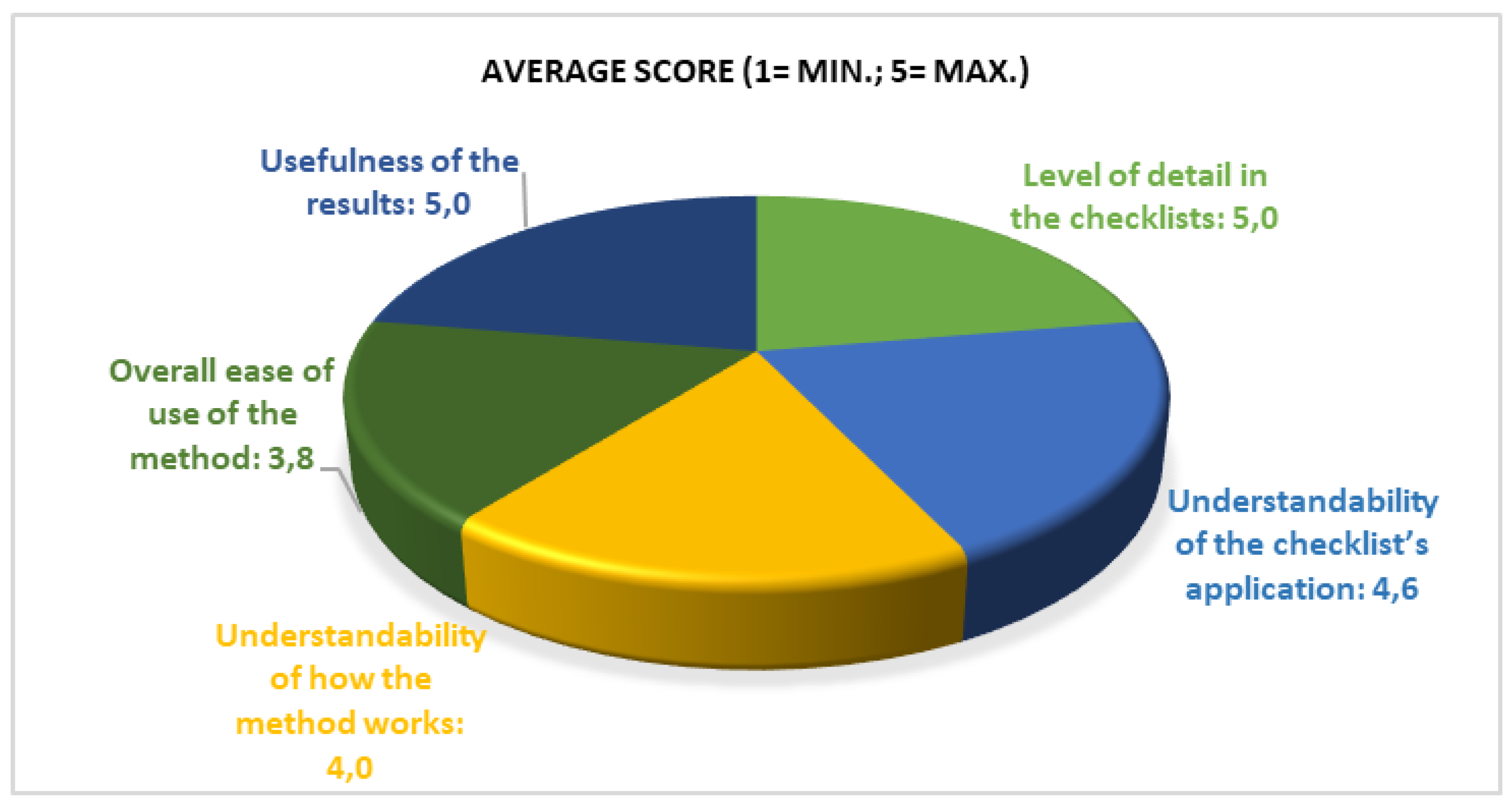

Table 1.
Summary of the participating SMEs.
| Sector | No. of SMEs |
Main Characteristics |
Data Collection Methods |
|---|---|---|---|
| Agriculture | 3 | No. of employees: 6-25 Profile: 1 cereal planting, 1 fruit growing, and 1 vegetable growing OSH: 2 had external services and 1 had a designated worker All three were rural |
On-site observations, OSH documents textual content analysis, focus group discussions and chemical risks analysis |
| Research activities in laboratories | 3 | No. of employees: 25-80 OSH: 2 had internal services and 1 had external services All three were urban |
|
| Conservation and restoration laboratory | 3 | No. of employees: 6-25 OSH: 2 had internal services and 1 had external services All three were urban |
Table 2.
Profile of the focus groups involved in the study.
| Activity of Participating SMEs | Focus Group no. | Focus Group Code | No. of Participant/Group |
|---|---|---|---|
| Agricultural | 3 | A1, A2, A3 | 4 |
| Research activities in laboratories | 3 | R1, R2, R3 | 3 |
| Conservation and restoration laboratory | 3 | C1, C2, C3 | 3 |
Table 3.
Examples of chemical risks associated with handling toxic substances [14].
Table 3.
Examples of chemical risks associated with handling toxic substances [14].
| Component of the Work System | Chemical Risk Factors |
|---|---|
| Production process | Exposure to toxic, caustic, or carcinogenic substances through injection, ingestion, or contact with the skin or eyes can result in harmful effects. |
| Working environment | Inhaling may result in harmful effects when exposed to gasses, vapors, airborne particles of toxic, carcinogenic or caustic aerosols. Airborne flammable substances increase the risk of chemical fires. Explosive atmosphere may be formed when mixing flammable substances with ambient air. |
| Task | Potential risks arising from operations, regulations, incorrect protocols, absence of established procedures, incorrect order of procedures, inadequate personal protective equipment, and improper marking of containers. |
| Workers | Mistakes resulting from mishandling, unsynchronized operations, delays, halts in hazardous locations, neglecting tasks, and failure to use personal protective equipment. Chemical fires can occur due to mishandling and failure to follow safe work practices. |
Table 4.
Chemical risk factors associated with the components of the work system.
| Component of the Working System | Chemical Risk Factors |
|---|---|
| Production means | Exposure to hazardous substances used as raw or auxiliary materials through ingestion or, contact with the skin or eyes; possibility of substances being involved in hazardous reactions; possibility of accidents caused by pressurized gasses or hot liquids. |
| Working environment | Gasses and liquid or solid aerosols as well as airborne particles can cause health problems (by inhalation) or by generating fire and explosion accidents. |
| Task | Risks arising from e.g., incorrect, or incomplete OSH protocols, absence of established working procedures. |
| Workers | Risks resulting from mishandling, unsynchronized operations, delays, halts in hazardous locations, neglecting tasks, or not using personal protective equipment (PPE). |
Table 5.
Degree of severity and probability rating system for the impact of risk factors on the human body [15].
Table 5.
Degree of severity and probability rating system for the impact of risk factors on the human body [15].
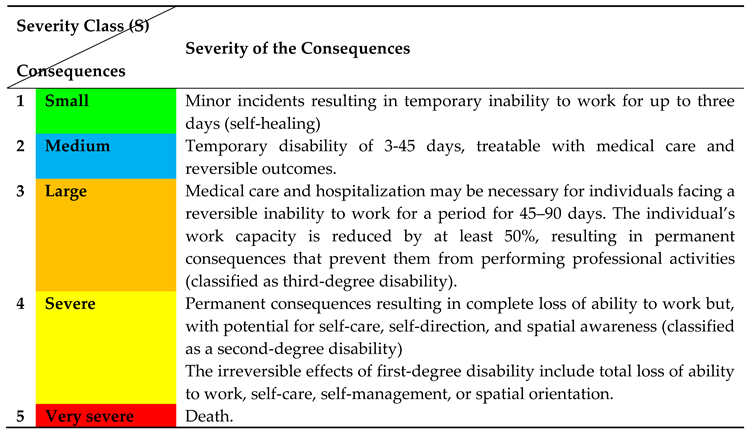
Table 6.
Excerpt from Sheet B “Working environment”.
| No. crt. | Description | Controlled (C) | Commonly Controlled (CC) | Occasionally Controlled (OC) | Difficult to Control (DC) | Uncontrolled (UC) | Not Applicable (N/A) |
|---|---|---|---|---|---|---|---|
| 100% | 75%<OC<100% | 25%<UC<75% | 0%<DC<25% | 0% | |||
| 1 | |||||||
| TOTAL | |||||||
| C | CC | OC | DC | UC |
Table 7.
Compliance indicator for legal provisions, including occupatinal exposure limits (OELs).
| No. | Compliance Indicator | Definition | |
|---|---|---|---|
| Legal Compliance other than OELS | Compliance of Measured/Estimated Exposure Compared to OELs | ||
| 1. | C—compliant | C=100% | C < 30% of OEL |
| 2. | CC—commonly compliant | 75% ≤ CC < 100 | 30% OEL ≤ CC < 50% OEL |
| 3. | OC—occasionally compliant | 25% ≤ OC < 75 | 50% OEL ≤ OC < 75% OEL |
| 4. | DC—deficient compliance | 0% ≤ DC < 25% | 75% OEL ≤ DC < 100% OEL |
| 5. | UC—uncompliant | UC = 0%. | UC > 50% OEL |
Table 8.
Correspondence between the conformity factor (CF) and frequency classes (F).
| CF | F |
|---|---|
| FC < 0,15 | 1 |
| 0,15 < FC < 0,50 | 2 |
| FC > 0,50 | 3 |
Table 9.
Exposure time (as percentage of an eight hours workday) and related time classes (T).
| Texp (%) | 0-20% | 20%-40% | 40%-60% | 60%-80% | 80%-100% |
|---|---|---|---|---|---|
| Time Class (T) | 1 | 2 | 3 | 4 | 5 |
Table 10.
Scale of probability classes (P).
| Occurrence | Probability Class | Frequency Class x * Exposure Time Class (Fx,T) |
|---|---|---|
| Very rare | 1 | (1,1); (1,2); (2,1) |
| Rare | 2 | (1,3); (1,4); (2,2); (3,1) |
| Uncommon | 3 | (1,5); (2,3); (3,2) |
| Common | 4 | (2,4); (2,5); (3,3) |
| Very common | 5 | (3,4); (3,5) |
Table 11.
Risk assessment grid [15].
Table 11.
Risk assessment grid [15].
| Probability Classes | |||||||
| 1 | 2 | 3 | 4 | 5 | |||
| Very Rare | Rare | Uncommon | Common | Very Common | |||
| Severity Classes | Consequences | (1,1) (1,2) (2,1) | (1,3) (1,4) (2,2) (3,1) | (1,5) (2,3) (3,2) | (2,4) (2,5) (3,3) | (3,4) (3,5) | |
| 5 | Very severe | Death | (5,1) | (5,2) | (5,3) | (5,4) | (5,5) |
| 4 | Severe | Disablement | (4,1) | (4,2) | (4,3) | (4,4) | (4,5) |
| 3 | Large | Medical care and hospitalization for a period of 45-90 days | (3,1) | (3,2) | (3,3) | (3,4) | (3,5) |
| 2 | Medium | Medical care and hospitalization for a period of 3-45 days | (2,1) | (2,2) | (2,3) | (2,4) | (2,5) |
| 1 | Small | Medical care and hospitalization for < 3 days | (1,1) | (1,2) | (1,3) | (1,4) | (1,5) |
Table 12.
Correspondence between measured exposure levels (MV), as percentages of OELs and MV classes.
Table 12.
Correspondence between measured exposure levels (MV), as percentages of OELs and MV classes.
| Measured Value (MV) |
MV<30% | 30%≤ MV < 70% | 70%≤ MV < 100% | MV ≥ 100% |
|---|---|---|---|---|
| MV classes | 1 | 2 | 3 | 4 |
Table 13.
Risk/security level classification scale.
| Risk Level | Couple Frequency-*Measured Value Class Chemical Risk (F x Rcm, MV) |
Security Level | ||
|---|---|---|---|---|
| 1 | Small | (1,1) (1,2) | 5 | Maxim |
| 2 | Medium | (1,3) (2,1) (2,2) | 4 | Very large |
| 3 | Large | (3,1) (3,2) | 3 | Large |
| 4 | Very large | (1,4) (2,3) | 2 | Medium |
| 5 | Maxim | (2,4) (3,3) (3,4) | 1 | Small |
Table 14.
Excerpt from a chemical risk assessment form.
| Workplace: | EVALUATION SHEET no. | Working Time: 8 h | ||||||
|---|---|---|---|---|---|---|---|---|
| Nrg = 3 | Nrgr = 2,09 | |||||||
| Risk factor | S | P | NPRL | Recommended Measures | S | P | NPRRL | |
| MEANS OF PRODUCTION | ||||||||
| Working with toxic substances | 2 | 2 | 2 | Workers are not allowed to use toxic substances if they have skin injuries or mucous membrane issues | 2 | 1 | 1 | |
| Working with flammable substances | 3 | 2 | 2 | Toxic or flammable substances that spill on the floor will be neutralized using materials specified by the manufacturer for each substance and will be disposed of at the designated garbage collection site | 3 | 1 | 1 | |
| WORKING ENVIRONMENT | ||||||||
| Vapours, aerosols, dusts—carcinogens: gasses, toxic vapours from varnishes and paints | 4 | 2 | 3 | Ensuring an effective ventilation; Conducting measurements of chemical gases in the workplace | 4 | 1 | 2 | |
| Particulate matter in air, gasses or vapours — explosives: gases, flammable vapors from used substances | 5 | 2 | 3 | Ensuring an efficient ventilation system to eliminate harmful gasses; Proper airing, ventilation, and mandatory gas checks; Providing workers with appropriate PPE | 5 | 1 | 2 | |
| TASK | ||||||||
| Insufficient training | 5 | 2 | 3 | Periodic training of workers on the European systems for classifying and labeling chemical substances | 5 | 1 | 2 | |
| WORKER | ||||||||
| Wrong actions (incorrect handling of containers containing substances) | 5 | 3 | 4 | Storing chemicals in labeled and chemical-resistant containers; Using handling equipment like pumps and valves to minimize direct contact with substances; Providing training on the proper handling of the substances used | 5 | 2 | 3 | |
NPRL—Partial risk level; NPRRL—Partial risk level; Acceptable risk; Tolerable risk; Unacceptable risk.
Table 15.
Preventive measures for occupational safety and health.
| Typology | Measures | Actions |
|---|---|---|
| Primary measures | Risk elimination | The measures must directly impact the source of risk factors (intrinsic prevention). |
| Secondary measures | Risk isolation | While risk factors may persist, taking collective protection measures can prevent or reduce their impact on workers. |
| Tertiary measures | Risk avoidance | Organizational measures and regulations on behavior act as barriers to the interaction between risk factors and workers. |
| Quaternary measures | Isolation of the worker | Individual protection can be achieved by wearing personal protective equipment to limit the impact of risk factors. |
Disclaimer/Publisher’s Note: The statements, opinions and data contained in all publications are solely those of the individual author(s) and contributor(s) and not of MDPI and/or the editor(s). MDPI and/or the editor(s) disclaim responsibility for any injury to people or property resulting from any ideas, methods, instructions or products referred to in the content. |
© 2024 by the authors. Licensee MDPI, Basel, Switzerland. This article is an open access article distributed under the terms and conditions of the Creative Commons Attribution (CC BY) license (http://creativecommons.org/licenses/by/4.0/).
Copyright: This open access article is published under a Creative Commons CC BY 4.0 license, which permit the free download, distribution, and reuse, provided that the author and preprint are cited in any reuse.


