

Submitted:
05 July 2024
Posted:
09 July 2024
You are already at the latest version
Abstract
Although there are numerous available immunomodulators, those of natural origin would be preferable based on their safety profile and effectiveness. The research and clinical interest in immunomodulators have increased in the last decades, especially in the immunomodulatory properties of plant-based therapies. Innovative technologies and extensive study on immunomodulatory natural products, botanicals, extracts, and active moieties with immunomodulatory potential could provide us with valuable entities to develop as novel immunomodulatory medicines to enhance current chemotherapies. This review focuses on plant-based immunomodulatory drugs that are currently in clinical studies. However, further studies in this area are of utmost importance to obtain complete information about the positive effects of medicinal plants and their chemical components and molecules as an alternative to combatting various diseases and/or prevention.
Keywords:
plant immunomodulator
; medicinal plant
; immunomodulation
; resveratrol
; curcumin
; quercetin
; capsaicin
; andrographolide
; colchicine
1. Introduction
Plants and their essential chemical ingredients have been used since ancient times because of their enormous therapeutic potential. Natural products have also been utilized for immunomodulatory activities. Polysaccharides, flavonoids, alkaloids, glycosides and other phytochemicals are reported to be mainly responsible for the immunomodulatory activity of plants [1]. They can act as lead molecules for developing safe and effective immunomodulators for disease prevention and treatment.
Immunity is the natural defense system against various infections and agents that efficiency is influenced by exogenous and endogenous factors associated with immunostimulation or/and immunosuppression. The agents that can help to normalize or modulate immune mechanisms and pathophysiological immune processes are called immunomodulators [1]. They are chemical synthetic and biological biomolecules capable of modulating, suppressing or/and stimulating innate or adaptive immunity components, therefore known as immunomodulators, immunoaugmentors, immunorestoratives, or other modifiers of biological response [2,3]. All of them have specific activities and can be useful in increasing the effectiveness of a vaccine, preventing allergies and infections or controlling the pathological immune response after organ transplantation. Monoclonal antibodies and chemically synthesized compounds/drugs are also used as immunomodulators. However, there are side effects and major limitations to their general use [4,5,6]. Because of these effects, natural immunomodulators can potentially replace them in treatments.
The prevention or/and treatment of different diseases using plant-based drugs have been reported throughout human history. In all cultures and throughout all ages, parts of different plants or whole plants have been used as medicines to treat a wide range of ailments [7,8,9,10].
Not enough studies show the distribution of specific medicinal plants in specific geographical areas and how they are implemented and used in medicine. Therefore, systematic reviewing of published studies can help identify the central geographical regions of medicinal plants used to alleviate various diseases. Moreover, further studies on them and their compounds are needed.
This review focuses on current literature on selected medicinal plants and single plant chemicals with immunomodulatory activity, studied in clinical trials, and their therapeutic potential and effects in various diseases. The search was conducted from the most commonly used scientific databases, and the crucial aspects of the scientific topic were summarized.
2. Immunity, Immune System and Immunomodulators
The immune system maintains the organism`s homeostasis together with other systems, where numerous exogenous and endogenous factors affect immune function and mechanisms and can either inhibit or stimulate them. In line with this, immunomodulators can normalize or modify immunological processes [11].
Plant immunomodulating properties have received increased research attention in recent years owing to a growing awareness of the importance of immune system modulation in immune-mediated diseases therapy and prevention. Several well-known plant remedies in traditional medicine have not only direct effects on the pathogens but also can stimulate the host’s innate and adaptive defense mechanisms [12].
Immunomodulators can come from different sources and serve to alter various immune mechanisms [13]. In clinical practice, immunomodulators are classified as immunoadjuvants, immunostimulants, and immunosuppressants. As immunoadjuvants are particular immune stimulators that improve vaccine effectiveness, immunostimulants are agents that activate or induce immune system mediators or components. Immunostimulants can boost resistance to cancer, allergies, infections, etc. Immunosuppressants, which are chemicals that inhibit the immune system, on the other hand, can be utilized to control the abnormal immunological reaction that occurs after organ transplantation, autoimmune disorders, infection-related immunopathology, hypersensitivity reactions, etc. [11]. As a result, immunomodulatory agents with antioxidant and anti-inflammatory activity have received much attention as potential chemopreventive agents because of their ability to counteract chronic inflammation, creating favorable conditions for the transition from normal to the cancer cell [14]. However, most synthetic immunomodulators have substantial toxicity or other adverse effects; thus, plant-derived immunomodulators are being discussed as safer substitutes [15].
A recent evidence-based review demonstrated the multiple and pleiotropic effects of essential plant-derived nutraceuticals on the immune system [13]. Di Sotto et al. focused on the adjuvant use of plant-derived immunomodulators, such as polysaccharides, fatty acids and labdane diterpenes, which are usually more tolerable than pharmacological treatments. Furthermore, they provided basic and clinical evidence to support their use in the practice [13]. We present the most common plant immunomodulators and their effects on the immune system in Figure 1.
Currently, the research is focused on plant biochemicals, biologics, or single molecules as lead compounds that target specific targets associated with a disease.
In contrast, single-molecule compounds with high selectivity, efficacy, and low toxicity for particular molecular/cellular targets and illnesses are difficult to obtain. As a result, the discovery and development of therapeutic candidates from various conventional, complementary, and alternative plant sources are on the rise [16].
3. Selected Medicinal Plants with Immunomodulatory Activity
Plants have been used to prevent and treat external and internal diseases for centuries. They are rich in phytochemicals such as polysaccharides, flavonoids, terpenoids, alkaloids, glycosides, saponins and lactones [11] which form the basis for scientific research of their immunomodulatory properties for the treatment of numerous diseases [17,18].The phytochemical immunomodulatory potency is mainly through modulation of the functions of the macrophages, B and T lymphocytes, dendritic cells, etc. For example, the carbohydrate-binding protein Concanavalin A lectin from Canavalia ensiformis (f. Fabaceae) can activate T lymphocytes by cross-linking the TCR/CD3 glycoproteins. At the same time, the catechins, epigallocatechin-3-gallate, and epigallocatechin, from Camellia sinensis suppressed cytokine secretion and T-lymphocyte proliferation by activator protein 1 (AP-1) inactivation through the extracellular signal-regulated kinases (ERK) and c-Jun N-terminal kinase (JNK) pathways [19,20].
Some of the medicinal plants that attracted the attention of scientists are Withania somnifera (ashwagandha), Tinospora cordifolia (guduchi), Piper longum (pippali), Ocimum sanctum (tulsi), Camellia sinensis (green tea), Andrographis paniculata, Carthamus tinctorius (safflower), Sophora alopecuoides (Kudouzi), Sinomenium acutum, Astragalus membranaceus, Panax ginseng, Lycium barbarum, etc. [11,17,18]. They are used mainly in the Indian traditional system, known as Rasayana and the traditional Chinese systems. Their analyses demonstrate different immunomodulatory activity and antioxidant, anti-inflammatory, antiasthmatic, antiarrhythmic, hepatoprotective, antifungal, and many other medicinal activities. For example, Withania somnifera (f. Solanaceae) is widely used alone or in combination with other herbs in the Indian Ayurvedic and the Chinese medicinal system to treat numerous conditions in humans. Pharmacological analyses have shown it is a reservoir of steroidal lactones known as withanolides which are found to stimulate immunological activity and phagocytic activity by mobilizing and activating macrophages and inducing the proliferation of spleen cells in mice [21,22]. Also, they, along with other W. somnifera phytochemicals like anaferine and β-sitosterol, have neuroprotective protentional which can be useful in treating Alzheimer’s disease by blocking the production of amyloid beta (Aβ) by inhibiting the nuclear factor-kB, restoring synaptic function, and improving antioxidant effects through the migration of erythroid 2-related factor 2 (Nrf2) [23]. Another folk medicine plant, Tinospora cordifolia (f. Menispermaceae), which is a deciduous climbing shrub indigenous to India, is used to combat acute and chronic inflammation. Plant extracts have been isolated from over 200 phytochemicals with immunomodulatory protection on key signaling pathways related to cell proliferation and inflammation [21,24,25]. For example, its polysaccharide G1-4A induces in vitro surface expression of MHC-II and CD-86 in mice macrophages. Thus they significantly increased the levels of proinflammatory cytokines tumor necrosis factor-α (TNF-α), interleukin 1β (IL-1β), interleukin 6 (IL-6), interleukin 12 (IL-12), interferon-gamma (IFN-γ) and nitric oxide (NO) and decreased levels of Th2 cytokines like interleukin 4 (IL-4) [26]. The other family member – Tinospora crispa, has been shown to contain more than 65 different compounds, including flavonoids, lactones, furanoditerpenes, alkaloids, lignans, and steroids, such as magnoflorin, syringin, cardioside, quercetin, eicosenoic acid, boldine, that have antioxidant potential higher than ascorbic acid, and are responsible for activating the immune system by increasing the expression of IL-6, interleukin 8 (IL-8), and INF-γ [20]. The pharmacological studies of the whole plant, root, and seed extracts of Sophora alopecuroides (f. Fabaceae), a subshrub-like desert plant widely distributed across west and middle Asia, have shown a wide variety of activities as anti-inflammatory, antibacterial, antiviral, antioxidant, cardioprotective, and neuroprotective [27]. Also, they show the antitumor effect by modulating the cancer signaling and molecular pathways or targeting various cancerous cells and inhibiting the cell growth, arresting the cell cycle, enhancing the apoptosis and cellular differentiation, and inhibiting cancer metastasis and invasion [28]. It was shown that the main chemicals and active components of S. alopecuroides, the alkaloids aloperine, matrine, oxymatrine, sophoridine, and sophocarpin, at high doses, exert an immunosuppressive effect and at low doses – immunostimulation [28,29]. One of the most representative Chinese herbs with great therapeutic potential is the liana Tripterygium wilfordii (f. Celastraceae). Although it is poisonous and shows acute toxicity when consumed, the plant’s root extract has excellent anti-inflammatory and immunosuppressive properties. It is widely used for treating various inflammatory and autoimmune disorders [30]. More than 100 compounds have been isolated from its root extract, mainly alkaloids, and terpenoids, that show great effectiveness in treating rheumatoid arthritis [28]. As lipids play an important role in the pathogenesis of rheumatoid arthritis, some research suggested the T. wilfordii extract modulates the formation of lipid mediators in the innate immune cells [31]. Panax ginseng (f. Araliaceae) is a perennial herb native to Korea and China and one of the most extensively studied. Its clinical analyses demonstrate that it improves immune function and has anti-inflammatory, antioxidant, and anticancer effects. Although all parts of the plant contain pharmacologically active compounds, the roots are the richest in them. The main compound – polysaccharide ginseng, enhances the production of cytokines, including TNF-α, IL-1β, IL-6, and IFN-γ and reactive oxygen/nitrogen components such as NO and hydrogen peroxide (H2O2) and thus stimulates the phagocytic activity of macrophages [32,33].
The modern pharmacological analyses on the immunomodulating activity of the herbs from plant-based African and American-Indian medicines are focused on Catharanthus roseus, Acacia senegal, AMahonia aquifolium, Centella asiatica, Aspalathus linearis (Rooibos), Harpagophytum procumbens, Kalanchoe pinnatas, Pelargonium sidoides, Capsicum species, Taxus brevifolia, Psidium guajava, Uncaria tomentosa (cat’s claw), Cordia species and many more. Catharanthus roseus (f. Apocynaceae), a native and endemic to Madagascar, but grown worldwide as an ornamental plant, is well-known for its variety of beneficial activities as an antioxidant, antibacterial and antifungal. Its most attractive compounds – the bisindole alkaloids vinblastine, vincristine, and vindesine, show antidiabetic and anticancer activity [17,34]. These alkaloids are highly toxic and block the metaphase of mitosis by binding to tubulin and preventing the microtubule assembly of the spindle [35]. Centella asiatica (f. Apiaceae) is a tropical plant used for wound healing in many cultures, including Ayurvedic, Chinese, Japanese (Kampo), and African. Its healing effect is due to the anti-inflammatory potential of its main phytochemicals asiaticoside, and madecassoside [35]. As scientific research demonstrates, these triterpene glycosides inhibit the proinflammatory mediators and cytokines, as well as reactive oxygen species (ROS), NO, TNF-α, and IL-1β in macrophages and keratinocytes in vitro [36]. Another tropical herb Uncaria tomentosa (f. Rubiaceae), from the highlands of the Peruvian Amazon has been reported to be effective as an immune system rejuvenator, antioxidant, antimicrobial, and anti-inflammatory. It is rich in many phytoconstituents with immunomodulatory properties such as glycosides, organic acids, sterols, triterpenes, and spiroindole alkaloids (isopteropodine and rynchophylline) and has been used to treat knee and rheumatoid arthritis in humans [11,37]. One of the most recognized medicinal plants worldwide is Echinacea purpurea (f. Asteraceaeis), a flowering plant native to North America. Its products are commercially sold worldwide as a general health promoter and for its preventive actions against cold and flu [38]. The scientific analyses of the plant demonstrate significant immunostimulatory and anti-inflammatory, antioxidant, hypoglycemic, and antiproliferative activities. Its phytochemical constituents as glycoproteins, polysaccharides, phenolic compounds, caffeic acid derivatives, and alkylamides stimulate the antiviral activity and the body’s immune system by influencing macrophages, dendritic cells, monocytes, and NK cells [20].
Nigella sativa, Glycyrrhiza glabra, Hypericum perforatum, Achillea millefolium, Mentha piperita (peppermint), Colchicum autumnale, Galanthus nivalis, Chamomilla recutita, Primula officinalis, Cotinus coggygria, Plantago major, etc. are among the European herbs with immunomodulatory and anti-infection potential [39]. One of the most popular and widely used is Mentha piperita (f. Lamiaceae), a native to Europe but cultivated and naturalized in all European countries and North America. Its pharmacological research demonstrated a wide range of properties, including antioxidant, antitumor, antiallergenic, antimicrobial activities, antiparasitic, and immunomodulatory [40,41]. In vitro assay with an M. piperita ethanol extract has shown a decreased production of TNF-α, IL-6, NO, and prostaglandin E-2 (PGE-2) in a mice macrophage cell culture [39]. Another plant, native to Europe and Southwest Asia, is Galanthus nivalis (f. Amaryllidaceae), whose abundance of bioactive compounds such as flavonoids, phenols, terpenoids, and alkaloids is attractive for scientific research because of their wide range of pharmacological potential. One of the main active compounds, the alkaloid galantamine, has antimicrobial, antioxidant, and anticancer activity and is used (as the drug Nivalin) for the symptomatic treatment of Alzheimer’s disease and other memory impairments [42]. The smoke tree or Cotinus coggygria (f. Anacardiaceae), a shrub growing wildly in Southeast Europe and the Caucasus to central China, is rich in various bioactive secondary metabolites such as flavonoids, aurones, chalcones, anthocyanins, and catechins, and is an important source of essential oils and extract with different health-promoting properties [43]. In vitro and in vivo analyses on the phytochemistry and bioactivity of the extracts from different plant parts revealed their wound-healing, anti-inflammatory, immunostimulatory, antimicrobial, cytotoxic, antioxidative, hepatoprotective, and antidiabetic effects [44].
Many plants under high throughput screening for an assessment of pharmacologically important molecules are spices used in culinary worldwide. Allium sativum (garlic), Thymus species (thyme), Origanum vulgare (oregano), Ocimum basilicum (basil), Petroselinum crispum (parsley), Anethum graveolens (dill), Salvia rosmarinus (rosemary), as well as Piper nigrum (black pepper), Cinnamomum zeylanicum (cinnamon), Curcuma species (turmeric), Zingiber officinale (ginger) and many more are known to be natural immune boosters. The presence of more than 200 bioactive constituents, including organosulfur, saponins, and polysaccharides, gave Allium sativum (f. Amaryllidaceae) significant therapeutic potential like antioxidant, anti-inflammatory, anticancer, and immunostimulant [45]. The high polysaccharide contents give garlic a strong immunomodulation activity by the expression and proliferation of cytokine genes and by enhancing the cytotoxicity of macrophages and lymphocytes [20,45]. Salvia rosmarinus, Salvia officinalis, Origanum vulgare, Ocimum basilicum, and Thymus species, all from the family Lamiaceae, have good to moderate immunomodulation and antiviral activities as well as antioxidant, anti-inflammatory, antidiabetic, antimicrobial, and anticancer [46,47]. For instance, oleanolic acid in S. rosmarinus, safficinolide, α-pinene, and β-myrcene in S. officinalis, and carvacrol from O. vulgare has been proven to have a good effect against viruses, O. basilicum shows antioxidants and anti-inflammatory properties and P. crispum (f. Apiaceae) has antioxidants and antibacterial properties [18,47]. Curcuma species (f. Zingiberaceae) are a popular dietary spice and are widely used in traditional medicine to treat diverse immune-related disorders. The scientific studies on its main polyphenolic compound, curcumin, reveal its antioxidant, antibacterial, and anti-inflammatory activity [11]. Curcumin has shown remarkable efficacy in treating cerebral malaria through immunomodulation mechanisms [48]. It inhibits NF-κB activation and reduces pro-inflammatory cytokine production in endothelial cells [11,18,48]. Cinnamomum zeylanicum (f. Lauraceae) is an evergreen tropical bush native to Sri Lanka, West India, Sumatra, and South America, and its immunomodulatory phytoconstituents cinnamaldehyde, eugenol, phellandrene, benzaldehyde, cumin aldehyde, and terpenes, modulate the immunoglobulin levels, and both cell-mediated and humoral immunity [18].
Many more plants not discussed above have immunomodulatory potential. The more popular among them, along with their regional sources, bioactive constituents, and other reported biological activities, are given in Table 1.
4. Selected Plant Chemicals with Immunomodulatory Activity in Clinical Trials
Most research still focuses on biochemicals or individual plant compounds for specific diseases. It is challenging to use only one plant compound with high selectivity, efficacy and safety for many illnesses. A part of them have been tested in vitro and in vivo [11], but more studies are needed before they can be approved and used as primary and adjunctive therapy for many diseases. In this section, we focused on some selected plant-derived anti-inflammatory compounds that have also been tested in clinical trials.
4.1. Resveratrol
Resveratrol is known as (5-[(E)-2-(4-hydroxyphenyl) ethenyl] benzene-1,3-diol). It was first isolated and identified in 1940 from the roots of Veratrum grandiflorum O. Loes [79]. It is found in various foods and plants such as grapes, red wine, peanuts, blueberries, bilberries, cranberries, pomegranates, soybeans, dark chocolate etc. [80]. It has anti-inflammatory, antimicrobial, antiangiogenic, antidiabetic, chemopreventive, anti-cancer, anti-neurological and antioxidant properties [81,82,83,84,85,86,87,88]. Resveratrol has been shown to reduce lipid synthesis in the liver [89]. It inhibits the platelet aggregation thereby potently blocking reactive oxygen species (ROS) by human polymorphonuclear leukocytes [90]. Resveratrol immunomodulatory activity is associated with the inhibition of NF-κB cells, epithelial (HeLa) cells, TNF-α-mediated macrophage, myeloid (U-937), Jurkat, and dendritic cells [91,92,93,94,95]. Resveratrol decreases COX-2 expression and iNOS levels in cytokine-stimulated human airway epithelial cells [95], as well as COX-2 expression in melanocytes by attenuating the ERK1/2 and PI3K/AKT pathways [96] In addition, the IL-1, IL-6, IL-12 and TNF-α production in lymphocytes and macrophages was also inhibited by resveratrol [97,98]. Inhibition also occurs in the expression of adhesion molecules, such as ICAM-1 [99].
The resveratrol mechanisms are described by Zhang et al. [100]. They show the pathways of its action and which functions/processes it has irreplaceable effects. Resveratrol’s use as a therapeutic agent has been widely researched in preclinical studies (in vitro models and animal models) [101,102,103,104,105,106]. Research conducted on in vivo animal models has also increased over the years. The most important of them are associated with preventing and delaying cancer, neurodegenerative diseases, cardiovascular diseases and aging [107,108,109,110,111,112,113,114]. A search for “resveratrol and cancer” in PubMed returns over 4,439 results as of December 2022. However, if we limit the search only to clinical trials, only 28 results have been shown. In 2019, Singh et al. discuss the clinical trials from the published articles [115].
In addition, the available clinical trials with resveratrol are about 192 on https://www.clinicaltrials.gov/ct2/results?cond=&term=resveratrol&cntry=&state=&city=&dist= . They show the benefits of resveratrol in different types of cancer, cardiovascular and neurological diseases, diabetes, metabolic syndrome, hypertension, kidney diseases, nonalcoholic fatty liver syndrome, polycystic ovary syndrome, obesity and inflammation, etc.
4.2. Curcumin
Curcumin (1,6-heptadiene-3,5-dione-1,7-bis(4-hydroxy-3-methoxyphenyl)-(1E,6E)), a natural polyphenol extracted from the rhizomes of Curcuma longa, has long been in the center of researchers’ attention due to its therapeutic and pharmacological properties. For the first time, the molecule exhibited antibacterial activity in 1949 [116]. Furthermore, it has been proven to have anti-inflammatory, antiviral antimicrobial, antiatherosclerotic, antiarthritic, antioxidant, antidepressant and wound-healing effects [117,118,119,120,121].
Curcumin interacts with Toll-like receptors (TLR) [122] and regulates the production of MAPK, AP-1 and NF-κB [123,124]. It also regulates the JAK/STAT signaling and reduces inflammatory responses by blocking the production of COX-2, iNOS, IFN-γ and lipoxygenase in NK cells [125,126,127,128]. Another way to reduce inflammation is by regulating inflammatory mediators such as interleukin-1 (IL-1), IL-17, IL-27, IL-6, IL-8, IL-1β [125,129]. Nuclear factor erythroid 2 p45-related factor (Nrf2) overactivation is seen in neoplasms [130]. A study has shown that curcumin could suppress protein Keap1, which interacts with Nrf2, thus regulating its overexpression. The transcription factor Nrf2 controls pathways involved in oxidative-stress defense. It is a potential target for treating chronic diseases [121,131].
In several preclinical studies, curcumin has shown positive effects on the reduction of inflammatory and catabolic markers in osteoarthritis rat models [132,133]. Оther studies showed similar findings with an intraperitoneal injection of curcumin [134,135]. Oral administration of curcumin in rats with osteoarthritis show decreased serum levels of COX-2, 5-lipoxygenase and matrix metalloproteinase-3 (MMP-3) levels [136].
Clinical trials with curcumin have also shown promising results. Several studies have shown benefits on osteoarthritis pain following the administration of oral curcumin alone or as an adjunct [137,138,139,140]. Curcumin reduces prostaglandin E2 levels [141] and Coll2-1, a novel osteoarthritis marker, after curcumin administration [142]. Diseases studied include cancer, rheumatoid arthritis, neurological disorders, and cardiovascular and other inflammatory conditions.
Currently, over 250 studies on the therapeutic effects of curcumin are registered (https://www.clinicaltrials.gov/ct2/results?cond=&term=curcumin&cntry=&state=&city=&dist= ). However, this shows that curcumin is still undergoing extensive clinical research.
4.3. Quercetin
Quercetin is a flavonoid plant pigment chemically known as 2-(3,4-dihydroxyphenyl)3,5,7-trihydroxychromen-4-one. It belongs to the polyphenol family and is found in broccoli, tea, capers, berries, red onions, grapes and apples. Quercetin has many beneficial properties like anti-cancer, anti-inflammatory, antioxidant and anti-hyperglycemic actions [143].
Quercetin can inhibit eukaryotic translation by activating different kinases [144]. It scavenges ROS, inhibits the NF-κB, MAPK, STAT1 and the replication of many viruses [145,146,147]. Quercetin reduces the expression levels of COX-2 and NOS2 by suppressing AP-1 and STAT1 [148]. Administration of quercetin resulted in the inhibition of ICAM-1 expression in PMA endothelial cells [149] and in lung epithelial cells [150]. Quercetin decreases serum TNF-α, prostaglandin E2 (PGE2), IL-4, IL-5, and IFN-α levels in rodents [151,152]. Quercetin leads to reduced activation and migration of T cells by downregulating CD83 expression, downregulating immunoglobulin-like transcripts 3-5, ectonucleotidase of CD39 and CD73, and IL-12 [153]. Beneficial effects of quercetin have also been shown in rat studies [154,155,156]. Quercetin inhibits inflammation, oxidative stress and apoptosis in diabetic animals [157,158,159].
About 110 trials are registered at http://www.clinicaltrials.gov/ for quercetin. In addition, there are active, completed and recruiting trials (https://www.clinicaltrials.gov/ct2/results?cond=&term=quercetin&cntry=&state=&city=&dist= ). They all study the effects of quercetin in inflammatory diseases, chronic obstructive pulmonary disease, diabetes, various types of cancer, cardiovascular diseases, children with Fanconi anemia, etc.
4.4. Capsaicin
Capsaicin is chemically known as (E)-N-[(4-hydroxy-3-methoxyphenyl) methyl]-8-methylnon-6-enamide. It is an alkaloid found in chili peppers (Solanaceae). In traditional medicine, this plant is a natural way to relieve pain in the joints and muscles and is an anti-irritant agent. After clinical trials, a capsaicin cutaneous patch has been approved by the European Union because of its effectiveness in neuropathic pain [160].
Capsaicin is an agonist for the transient receptor potential cation channel subfamily V member 1 (TRPV1) [161], which is a nonselective cation channel sensitized from noxious stimuli, leading to inflammatory conditions and pain [162]. Capsaicin activates and depolarizes TRPV1 receptors, initially causing a burning sensation. After the TRPV1 receptors are completely depolarized, the nociceptive areas are desensitized and reduce the pain signals in neurons [163,164].
A study has shown that capsaicin can reduce the iNOS, NF-κB, and COX-2 expression in macrophages [165]. There is one exception, which shows that capsaicin increases COX-2 in primary sensory neuron cells [166]. Capsaicin blocks activation of Jurkat cells [167] as well as proliferation in T leukemic cells [168] and in T cells in pancreatic lymph nodes [169]. In addition, it inhibits the production of TNF-α. It reduces the levels of IL-10, IL-4, and TGF-β1 [170].
About 311 trials are registered at http://www.clinicaltrials.gov/ for capsaicin (https://www.clinicaltrials.gov/ct2/results?cond=&term=capsaicin&cntry=&state=&city=&dist= ). They all study the effects of capsaicin in chronic pain, various types of cancer, cardiac ischemia, osteoarthritis, rhinitis, etc.
4.5. Epigallocatechin-3-Gallate
Epigallocatechin-3-gallate (EGCG) is chemically known as [(2R,3R)-5,7-dihydroxy-2-(3,4, 5-trihydroxyphenyl)-3,4-dihydro-2H-chromen-3-yl]3,4,5-trihydroxybenzoate]. EGCG has in vivo and in vitro chemoprotective, anti-oxidant, anti-angiogenic, anti-cancer and anti-inflammatory effects [171,172,173,174]. Studies have shown that EGCG blocked NF-κB activation by inhibiting IκBα [175,176] and also inhibited the proliferation of tumor cells and MAPK pathways [177,178].
EGCG has anti-apoptotic activity by reducing the expression of bax and caspase 3 [179,180,181]. Treatment with EGCG decreases TNF-α production [182], reduces serum IFN-γ, IL-17, IL-6, and IL-1β levels [183], attenuates activation of STAT3 to promote T cell responses [184] and may regulate epigenetic modifications of FoxP3, enhancing regulatory T cell responses [185]. EGCG inhibited the enzymes topoisomerase II, DNA methyltransferase and telomerase and affected DNA structure and function [186,187,188]. Treatment with EGCG also decreases the levels of MMP-9, iNOS, CCL-2, NADPH oxidase-4 mRNA etc. [189], but increase CD3, CD19, and Mac-3 which changes the number of B-, T-cells, and macrophages [190].
EGCG has been tested in different clinical trials. Over 100 clinical trials are registered for epigallocatechin-3-gallate alone or in combination with other substances (https://www.clinicaltrials.gov/ct2/results?cond=&term=Epigallocatechin-3-gallate&cntry=&state=&city=&dist= ). They all study its effects on neurodegenerative diseases, Duchenne muscular dystrophy, chronic pain, cancer, obesity, acne, diabetes, etc.
4.6. Andrographolide
Andrographolide is chamicaly known as (3-[2-[decahydro-6-hydroxy-5-(hydroxymethyl)-5, 8-dimethyl-2-methylene-1-napthalenyl] ethylidene] dihydro- 4-hydroxy-2(3H)-furanone). Studies performed on the abilities of andrographolide to modulate the Wnt/β-Catenin, JAK-STAT, mTOR and VEGF/VEGFR signaling pathways are described [191]. They are all related to cancer progression, tumor growth or/and cancer activation and development.
Andrographolide decreases levels of TNF-α, IL-12, PGE2, COX-2, NO and iNOS in macrophages and microglia [192,193]. In addition, it regulates the IFN-γ, TNF-α, IL-2 and IL-6 production [194], reduces the proliferation of endothelial cells and the ICAM-1 adhesion molecule [195]. In 2011, Lee et al. showed that andrographolide downregulated iNOS and COX-2 by inhibiting the expression of NF-κB and STAT3 [196]. Antigrapholide activity and its potential therapeutic role have also been observed in diabetes, cardiovascular diseases, hyperlipidemia, hypertension, and obesity [197].
Only 20 clinical trials are found for andrographolide. Some trials are completed, others are unknown, and there are trials recruiting volunteers (https://www.clinicaltrials.gov/ct2/results?cond=&term=Andrographolide&cntry=&state=&city=&dist= ). They all study the effects of andrographolide in migraine disorders, arthritis, rheumatoid, respiratory infection, cancer, etc.
4.7. Genistein
Genistein is a natural phytoestrogen and chemical known as 4,5,7-trihydroxyisoflavone. It is a compound found in soybeans and has various health benefits. It inhibited COX-2 and iNOS expression [198], induced apoptosis [199], regulates vascular function [200] and inhibited the expression of CD106 and CD62E adhesion molecules [201]. Genistein reduces the risk of neurodegenerative diseases, chronic colitis, rheumatoid arthritis, metabolic disorders, and diabetes [202,203,204,205].
Only 76 clinical trials are found for genistein. Although almost all of them are completed, there are several withdrawn and terminated, two active, and several still unknown (https://www.clinicaltrials.gov/ct2/results?cond=&term=Genistein+&cntry=&state=&city=&dist= ). They all study the effects of genistein on different types of cancer, cardiovascular diseases, neurodegenerative diseases, asthma, osteopenia, etc.
4.8. Colchicin
Colchicine is the primary alkaloid of the Colchicum autumnale plant, and its chemical structure is N-[(7S)-1,2, 3,10-tetramethoxy-9-oxo-6,7-dihydro-5H-benzo(a)heptalen-7]-ylacetamide. Extensive research has been conducted on how it affects microtubule dynamics and damages it [206,207]. Over the past ten years, researchers have conducted several trials with colchicine that have shown positive outcomes in acute pericarditis [208,209]. Colchicine can be used for prevention in patients after radiofrequency ablation [210] and also for post-pericardiotomy syndrome prevention [211].
Colchicine has a dual role in T-cell immunity. First, it inhibits T cell activation by downregulating IL-2 expression [213] and can induce ovalbumin-induced T cell responses if used as an adjuvant [214]. It has also been found to activate erythroid 2-related factor 2 in hepatocytes, thereby impairing myeloid cell activation and their anti-inflammatory function [215].
Colchicine has anti-fibrotic effects and inhibits tubulointerstitial fibrosis by activation of Bcl-2 and suppression of caspase-3 [216]. A study shows that colchicine inhibits TGF-β1 activity [217], suppresses smooth muscle cell proliferation and increases cell apoptosis [218].
Colchicine has been approved by the FDA (Federal Drug Administration) as a drug for Mediterranean fever and acute gout flares [219].
About 242 clinical trials are found and registered for colchicine (https://www.clinicaltrials.gov/ct2/results?cond=&term=colchicine&cntry=&state=&city=&dist= ). Its potential therapeutic effects continue to be actively investigated. Over 25 clinical trials that are currently recruiting are listed at http://www.clinicaltrials.gov/. They aim to study colchicine’s effects on kidney diseases, myocardial infarction, cardiovascular diseases, inflammatory responses, gout, different types of cancer, diabetes, COVID-19 etc.
5. Conclusions
The immune system is modulated broadly and nonspecifically by medicinal herbs, including effects on various immune cells, including macrophages, NK cells, granulocytes, and T cells. Therefore, a deeper comprehension of the immunomodulatory functions of plants, their mechanisms of action, and phytoconstituents would allow us to pinpoint natural-source lead compounds to create innovative, secure immunomodulators that can strengthen existing therapies. Since a considerable amount of plant-based medicines have shown their therapeutic effect, we covered the therapeutic action of some of the more important and most frequently studied plant-based immunomodulators. Unfortunately, this area is still not fully explored, as many plant extracts and components are still very poorly researched. Further study and elucidation are also needed for the precise cellular and molecular mechanisms underlying their action.
There are some conducted clinical studies related to the immunomodulatory activity of plants and their components, but also some limitations that need to be overcome before they are safe and effective for clinical use. For example, adequate/standard protocols for microbial contamination control, appropriate dosage and initiation stage of treatment/prevention should be implemented. In addition, it must be classified all immunomodulators of plant origin in specific classes according to the inherent risk according to the condition of the patients using the data from national registries, physicians and clinical trials. Another limitation is the low bioavailability of some of these substances and the cost optimization of their extraction. Production, delivery and quality control strategies must be improved before they reach people. This will ensure their safety and effectiveness for future clinical applications. If these obstacles are improved and overcome, their application will be very beneficial for preventing and managing chronic diseases
Author Contributions
Conceptualization, D.M and T.V.; investigation, D.M, M.K., resources, D.M, M.K.; writing—original draft preparation, D.M, M.K.; writing—review and editing, T.V.; visualization, T.V, D.M.; supervision, T.V.; funding acquisition: T.V.; project management: T.V. All authors have read and agreed to the published version of the manuscript.
Funding
This research received no external funding.
Conflicts of Interest
The authors declare no conflict of interest.
References
- Puri A., Saxena R., Saxena R. P., Saxena K. C., Srivastava V., Tandon J. S. (1994). Immunostimulant activity of Nyctanthes arbor-tristis L. J. Ethnopharmacol. 42 31–37. [CrossRef]
- Liu L., Li Y. (2014). The unexpected side effects and safety of therapeutic monoclonal antibodies. Drugs Today 50 33–50. [CrossRef]
- Golan D. E. (2008). Principles of Pharmacology. The Pathophysiologic Basic of Drug Therapy, 2nd Edn Pennsylvania, PA: Lippincott Williams & Wilkins, 795–809.
- Hansel T. T., Kropshofer H., Singer T., Mitchell J. A., George A. J. (2010). The safety and side effects of monoclonal antibodies. Nat. Rev. Drug Discov. 9 325–338. [CrossRef]
- Bartelds G. M., Krieckaert C. L., Nurmohamed M. T., Van Schouwenburg P. A., Lems W. F., Twisk J. W., et al. (2011). Development of antidrug antibodies against adalimumab and association with disease activity and treatment failure during long-term follow-up. JAMA 305 1460–1468. [CrossRef]
- Auffenberg C., Rosenthal L. J., Dresner N. (2013). Levamisole: a common cocaine adulterant with life-threatening side effects. Psychosomatics 54 590–593. [CrossRef]
- Oberlies N. H., Kroll D. J. (2004). Camptothecin and taxol: historic achievements in natural products research. J. Nat. Prod. 67 129–135. [CrossRef]
- Rakotoarivelo NH, Rakotoarivony F, Ramarosandratana AV, Jeannoda VH, Kuhlman AR, Randrianasolo A, Bussmann RW. Medicinal plants used to treat the most frequent diseases encountered in Ambalabe rural community, Eastern Madagascar. J Ethnobiol Ethnomed. 2015 Sep 15;11:68. [CrossRef]
- Mintah S., Asafo-Agyei T., Archer M., Atta-Adjei P., Boamah D., Kumadoh D., Appiah A., Ocloo A, Duah Boakye Y. and Agyare C., 2019, Medicinal Plants for Treatment of Prevalent Diseases, Ch 9 from Perveen, S., & Al-Taweel, A., Pharmacognosy - Medicinal Plants, IntechOpen, 978-1-83880-611-8. [CrossRef]
- Aschale Y, Wubetu M, Abebaw A, Yirga T, Minwuyelet A, Toru M. A Systematic Review on Traditional Medicinal Plants Used for the Treatment of Viral and Fungal Infections in Ethiopia. J Exp Pharmacol. 2021;13:807-815. [CrossRef]
- Jantan I, Ahmad W, Bukhari SN. Plant-derived immunomodulators: an insight on their preclinical evaluation and clinical trials. Front Plant Sci. 2015 Aug 25;6:655. Erratum in: Front Plant Sci. 2018 Aug 13;9:1178. [CrossRef] [PubMed]
- Shukla, S., Bajpai, V.K. & Kim, M. Plants as potential sources of natural immunomodulators. Rev Environ Sci Biotechnol 13, 17–33 (2014). [CrossRef]
- Di Sotto, A.; Vitalone, A.; Di Giacomo, S. Plant-Derived Nutraceuticals and Immune System Modulation: An Evidence-Based Overview. Vaccines 2020, 8, 468. [CrossRef]
- Mohamed, S.I.A.; Jantan, I.; Haque, M.A. Naturally occurring immunomodulators with antitumor activity: An insight on their mechanisms of action. Int. Immunopharmacol. 2017, 50, 291–304. [Google Scholar] [CrossRef] [PubMed]
- Nair A, Chattopadhyay D, Saha B. Chapter 17 – Plant-derived immunomodulators. In: New lokk to phytomedicine, Advancements in Herbal products as novel drugs Leads 2019; 435-499.
- Pathak S, Fialho J, Nandi D. Plant-based Immunomodulators and Their Potential Therapeutic Actions. J Explor Res Pharmacol. Published online: Aug 12, 2022. [CrossRef]
- Kumar S, Arya V, Kaur R, Ali Bhat Z, Gupta VK, Kumar V. A review of immunomodulators in the Indian traditional health care system. Journal of Microbiology, Immunology and Infection, 2012; 45 (3): 165-184. [ISSN 1684-1182. [CrossRef]
- Acharya P, Mohanty S, Mohanty M ImmunoProtective Role of Medicinal Herbs as Phytotherapeutic Drugs in Ayurveda – A Prospective Approach for Defending COVID19. J Nat Ayurvedic Med 2022; 6(2): 000342. [CrossRef]
- Huang S-C, Kao Y-H, Shih S-F, Tsai M-C, Lin C-S, Chen LW, Chuang Y-P, Tsui P-F, Ho L-J, Lai J-H, Chen S-J Epigallocatechin-3-gallate exhibits immunomodulatory effects in human primary T cells. Biochemical and Biophysical Research Communications 2021; 550: 70-76. [ISSN 0006-291X] (https://www.sciencedirect.com/science/article/pii/S0006291X21003594). [CrossRef]
- Alhazmi HA, Najmi A, Javed SA, Sultana S, Al Bratty B, Makeen HA, Meraya AM., Ahsan W, Mohan S, Taha MME, Khalid A. Medicinal Plants and Isolated Molecules Demonstrating Immunomodulation Activity as Potential Alternative Therapies for Viral Diseases Including COVID-19. Frontiers in Immunology 2021; 12. [ISSN 1664-3224] https://www.frontiersin.org/articles/10.3389/fimmu.2021.637553. [CrossRef]
- Singh N, Tailang M, Mehta.CS A review on herbal plants as immunomodulators. International Journal of Pharmaceutical Sciences and Research 2016; 7(9): 3602-3610 [E-ISSN: 0975-8232; P-ISSN: 2320-5148].
- Tharakan A, Shukla H, Benny IR, Tharakan M, George L, Koshy S. Immunomodulatory effect of Withania somnifera (Ashwagandha) Extract-A Randomized, Double-Blind, Placebo Controlled Trial with an Open Label Extension on Healthy Participants. J Clin Med. 2021; 10(16): 3644. [CrossRef] [PubMed]
- Dar NJ, Hamid A, Ahmad M. Pharmacologic overview of Withania somnifera, the Indian Ginseng. Cell Mol Life Sci. 2015; 72(23): 4445-4460. [CrossRef] [PubMed]
- Saha S, Ghosh S. Tinospora cordifolia: One plant, many roles. Anc Sci Life. 2012; 31(4): 151-159. [CrossRef] [PubMed]
- Yates CR, Bruno EJ, Yates MED. Tinospora Cordifolia: A review of its immunomodulatory properties. J Diet Suppl. 2022; 19(2): 271-285. [CrossRef] [PubMed]
- Gupta PK, Chakraborty P, Kumar S, Singh PK, Rajan MGR, Sainis KB, Kulkarni S. G1-4A, a Polysaccharide from Tinospora cordifolia Inhibits the Survival of Mycobacterium tuberculosis by Modulating Host Immune Responses in TLR4 Dependent Manner. PLoS ONE 2016; 11(5): e0154725. [CrossRef]
- Wang R, Deng X, Gao Q, Wu X, Han L, Gao X, Zhao S, Chen W, Zhou R, Li Z, Bai C. Sophora alopecuroides L.: An ethnopharmacological, phytochemical, and pharmacological review. J Ethnopharmacol. 2020; 248: 112172. [CrossRef] [PubMed]
- Zhang R, Wang R, Zhao S, Chen D, Hao F, Wang B, Zhang J, Ma Y, Chen X, Gao X, Han L, Bai C. Extraction, Separation, Antitumor Effect, and Mechanism of Alkaloids in Sophora alopecuroides: A Review. Separations. 2022; 9(11): 380. [CrossRef]
- Zhang et al. 2022). Zhang L-H, Huang Y, Wang L-W, Xiao P-G. Several Compounds from Chinese Traditional and Herbal Medicine as Immunomodulators. Phytotherapy Research 1995; 9: 315-322.
- Dinesh P, Rasool M. Chapter 22. Herbal Formulations and Their Bioactive Components as Dietary Supplements for Treating Rheumatoid Arthritis. In: Bioactive Food as Dietary Interventions for Arthritis and Related Inflammatory Diseases. Editor(s): Watson RR, Preedy VR (Second Edition), Academic Press, 2019, pp. 385-399. [ISBN 9780128138205;] (https://www.sciencedirect.com/science/article/pii/B9780128138205000222). [CrossRef]
- Zhu Y, Zhang L, Zhang X, Wu D, Chen L, Hu C, Wen C, Zhou J. Tripterygium wilfordii glycosides ameliorates collagen-induced arthritis and aberrant lipid metabolism in rats. Frontiers in Pharmacology 2022; 13. [ISSN=1663-9812] (https://www.frontiersin.org/articles/10.3389/fphar.2022.938849). [CrossRef]
- Coon JT, Ernst E. Panax ginseng. Drug-Safety 2002; 25, 323–344. [CrossRef]
- Shin J-Y, Song J-Y, Yun Y-S, Yang H-O, Rhee D-K, Pyo S. Immunostimulating Effects of Acidic Polysaccharides Extract of Panax Ginseng On Macrophage Function. Immunopharmacology and Immunotoxicology 2002; 24(3): 469-482. [CrossRef]
- Pham HNT, Vuong QV, Bowyer MC, Scarlett CJ. Phytochemicals Derived from Catharanthus roseus and Their Health Benefits. Technologies 2020; 8(4): 80. [CrossRef]
- Mahomoodally MF. Traditional medicines in Africa: an appraisal of ten potent african medicinal plants. Evid Based Complement Alternat Med. 2013; 2013: 617459. [CrossRef] [PubMed]
- Tawinwung S, Junsaeng D, Utthiya S, Khemawoot Ph. Immunomodulatory effect of standardized C. asiatica extract on a promotion of regulatory T cells in rats. BMC Complement Med Ther 2021; 21, 220. [ISSN: 2662-7671; [CrossRef]
- Batiha GE-S, Alqahtani A, Ojo OA, Shaheen HM, Wasef L, Elzeiny M, Ismail M, Shalaby M, Murata T, Zaragoza-Bastida A, Rivero-Perez N, Magdy Beshbishy A, Kasozi KI, Jeandet P, Hetta HF. Biological Properties, Bioactive Constituents, and Pharmacokinetics of Some Capsicum spp. and Capsaicinoids. International Journal of Molecular Sciences. 2020; 21(15): 5179. [CrossRef]
- Manayi A, Vazirian M, Saeidnia S. Echinacea purpurea: Pharmacology, phytochemistry and analysis methods. Pharmacogn Rev. 2015; 9(17): 63-72. [ PMCID: PMC4441164; [CrossRef] [PubMed]
- Pelvan E, Karaoğlu Ö, Fırat EÖ, Kalyon KB, Ros E, Alasalvar C. Immunomodulatory effects of selected medicinal herbs and their essential oils: A comprehensive review. Journal of Functional Foods 2022; 94, 105108. [ISSN 1756-4646; [CrossRef]
- Cosentino M, Bombelli R, Conti A, Maria C, Azzetti A, Bergamaschi A, Franca M, Lecchini S, Antioxidant properties and in vitro immunomodulatory effects of peppermint (Mentha x piperita l.) essential oils in human leukocytes. J. Pharm. Sci. & Res. 2009; 1(3): 33-43. (https://www.sciencedirect.com/science/article/pii/S1756464622001785).
- Ogaly HA, Eltablawy NA, Abd-Elsalam RM. Antifibrogenic Influence of Mentha piperita L. Essential Oil against CCl4-Induced Liver Fibrosis in Rats. Oxid Med Cell Longev. 2018; 4039753. [CrossRef] [PubMed]
- Kong CK, Low LE, Siew WS, Yap W-H, Khaw K-Y, Ming LCh, Mocan A, Goh B-H, Goh PH. Biological Activities of Snowdrop (Galanthus spp., Family Amaryllidaceae). Frontiers in Pharmacology 2021; 11: 552453. [ISSN=1663-9812] (https://www.frontiersin.org/articles/10.3389/fphar.2020.552453). [CrossRef]
- Matić S, Stanić S, Mihailović M, Bogojević D. Cotinus coggygria Scop.: An overview of its chemical constituents, pharmacological and toxicological potential. Saudi J Biol Sci. 2016; 23(4): 452-461. [CrossRef] [PubMed]
- Antal D, Ardelean F, Jijie R, Pinzaru I, Soica C, Dehelean C. Integrating Ethnobotany, Phytochemistry, and Pharmacology of Cotinus coggygria and Toxicodendron vernicifluum: What Predictions can be Made for the European Smoketree? Frontiers in Pharmacology 2021; 12. [ISSN 1663-9812] https://www.frontiersin.org/articles/10.3389/fphar.2021.662852. [CrossRef]
- Moutia M, Habti N, Badou A. In Vitro and In Vivo Immunomodulator Activities of Allium sativum L. Evid Based Complement Alternat Med. 2018; 2018: 4984659. [CrossRef] [PubMed]
- Uritu CM, Mihai CT, Stanciu GD, Dodi G, Alexa-Stratulat T, Luca A, Leon-Constantin MM, Stefanescu R, Bild V, Melnic S, Tamba BI. Medicinal Plants of the Family Lamiaceae in Pain Therapy: A Review. Pain Res Manag. 2018 2018: 7801543. [CrossRef] [PubMed]
- Marc Vlaic RA, Mureșan V, Mureșan AE, Mureșan CC, Tanislav AE, Pușcaș A, Marţiș Petruţ GS, Ungur RA. Spicy and Aromatic Plants for Meat and Meat Analogues Applications. Plants (Basel). 2022 11(7): 960. [CrossRef] [PubMed]
- Park Y-G, Cho J-H, Choi J, Ju E-M, Adam GO, Hwang D-I, Lee J-H, An S-Y, Choi H-K, Park C-B, Oh H-G.Immunomodulatory effects of Curcuma longa L. and Carthamus tinctorius L. on RAW 264.7 macrophages and cyclophosphamide-induced immunosuppression C57BL/6 mouse models. Journal of Functional Foods 2022; 91,105000. [ISSN 1756-4646] (https://www.sciencedirect.com/science/article/pii/S1756464622000706). [CrossRef]
- Sunil MA, Sunitha VS, Radhakrishnan EK, Jyothis M. Immunomodulatory activities of Acacia catechu, a traditional thirst quencher of South India. J Ayurveda Integr Med. 2019 10(3): 185-191. [CrossRef] [PubMed]
- Sharififar F, Pournournohammadi S, Arabnejad M. Immunomodulatory activity of aqueous extract of Achiella wilhelmsii C. Koch in mice. Indian J Exp Biol 2009, 47: 668-671.
- Saeidnia S, Gohari A, Mokhber-Dezfuli N, Kiuchi F. A review on phytochemistry and medicinal properties of the genus Achillea. Daru. 2011;19(3):173-86. [PubMed]
- Rajanna M, Bharathi B, Shivakumar BR, Deepak M, Prashanth D’S, Prabakaran D, Vijayabhaskar T, Arun B. Immunomodulatory effects of Andrographis paniculata extract in healthy adults – An open-label study. Journal of Ayurveda and Integrative Medicine 2021; 12(3): 529-534. [ISSN 0975-9476] (https://www.sciencedirect.com/science/article/pii/S0975947621001121). [CrossRef]
- Intharuksa A, Arunotayanun W, Yooin W, Sirisa-ard P. A Comprehensive Review of Andrographis paniculata (Burm. f.) Nees and Its Constituents as Potential Lead Compounds for COVID-19 Drug Discovery. Molecules 2022, 27: 4479. [CrossRef]
- Bushmeleva K, Vyshtakalyuk A, Terenzhev D, Belov T, Parfenov A, Sharonova N, Nikitin E, Zobov V. Radical Scavenging Actions and Immunomodulatory Activity of Aronia melanocarpa Propylene Glycol Extracts. Plants 2021; 10(11): 2458. [CrossRef]
- Ho GT, Bräunlich M, Austarheim I, Wangensteen H, Malterud KE, Slimestad R, Barsett H. Immunomodulating activity of Aronia melanocarpa polyphenols. Int J Mol Sci. 2014; 15(7): 11626-11636. [CrossRef] [PubMed]
- Lewu FB, Grierson DS, Afolayan AJ. The leaves of Pelargonium sidoides may substitute for its roots in the treatment of bacterial infections. Biological Conservation 2006, 128 (4): 582-584. [ISSN 0006-3207] (https://www.sciencedirect.com/science/article/pii/S0006320705004374. [CrossRef]
- Çiğdem Y, Şeker KG, Bahadır AÖ, Küpeli AE, Hakan BT, Eduardo S-S, Michael A, Samira S. Immunomodulatory and anti-inflammatory therapeutic potential of gingerols and their nanoformulations. Frontiers in Pharmacology 2022; 13. ISSN=1663-9812. [CrossRef]
- Suciyati, SW, Adnyana, IK. Red ginger (Zingiber officinale Roscoe var rubrum): a review. Pharmacologyonline 2017; 2: 60-65. [ISSN: 1820-8620].
- Zakharchenko NS, Belous AS, Biryukova YK, Medvedeva OA, Belyakova AV, Masgutova GA, Trubnikova EV, Buryanov YI, Lebedeva AA. Immunomodulating and Revascularizing Activity of Kalanchoe pinnata Synergize with Fungicide Activity of Biogenic Peptide Cecropin P1. Journal of Immunology Research 2017; ID 3940743. [CrossRef]
- Coutinho MA, Muzitano MF, Cruz EA, Bergonzi MC, Kaiser CR, Tinoco LW, Bilia AR, Vincieric FF, Rossi-Bergmann B, Costa SS. Flowers from Kalanchoe pinnata are a rich source of T cell-suppressive flavonoids. Nat Prod Commun. 2012; 7(2): 175-178. [PubMed]
- Anil SM, Peeri H, Koltai H. Medical Cannabis Activity Against Inflammation: Active Compounds and Modes of Action. Frontiers in Pharmacology 2022; 13. [ISSN=1663-9812; [CrossRef]
- Cruz-Chamorro I, Santos-Sánchez G, Bollati C, Bartolomei M, Li J, Arnoldi A, Lammi C. Hempseed (Cannabis sativa) Peptides WVSPLAGRT and IGFLIIWV Exert Anti-inflammatory Activity in the LPS-Stimulated Human Hepatic Cell Line. Journal of Agricultural and Food Chemistry 2022; 70 (2): 577-583. (https://pubs.acs.org/doi/full/10.1021/acs.jafc.1c07520). [CrossRef]
- Magcwebeba T, Swart P, Swanevelder S, Joubert E, Gelderblom W. Anti-Inflammatory Effects of Aspalathus linearis and Cyclopia spp. Extracts in a UVB/Keratinocyte (HaCaT) Model Utilising Interleukin-1α Accumulation as Biomarker. Molecules. 2016; 21(10): 1323. [CrossRef] [PubMed]
- Roza O, Lai W-C, Zupkó I, Hohmann J, Jedlinszki N, Chang F-R, Csupor D, Eloff JN. Bioactivity-guided isolation of phytoestrogenic compounds from Cyclopia genistoides by the pER8: GUS reporter system. South African Journal of Botany 2017; 110: 201-207. [ISSN 0254-6299] (https://www.sciencedirect.com/science/article/pii/S0254629915326727. [CrossRef]
- Kumar S, Malhotra R, Kumar D. Euphorbia hirta: Its chemistry, traditional and medicinal uses, and pharmacological activities. Pharmacogn Rev. 2010; 4(7): 58-61. [CrossRef] [PubMed]
- Noor-E-Tabassum, Das R, Lami MS, Chakraborty AJ, Mitra S, Tallei TE, Idroes R, Mohamed AA, Hossain MJ, Dhama K, Mostafa-Hedeab G, Emran TB. Ginkgo biloba: A Treasure of Functional Phytochemicals with Multimedicinal Applications. Evid Based Complement Alternat Med. 2022; 2022: 8288818. [CrossRef] [PubMed]
- Oskoueian E, Abdullah N, Ahmad S, Saad WZ, Omar AR, Ho YW. Bioactive compounds and biological activities of Jatropha curcas L. kernel meal extract. Int J Mol Sci. 2011; 12(9): 5955-70. [CrossRef] [PubMed]
- Ramadan, M.F. Bioactive Phytochemicals from Jatropha (Jatropha curcas L.) Oil Processing Byproducts. In: Bioactive Phytochemicals from Vegetable Oil and Oilseed Processing By-products. Reference Series in Phytochemistry. (2022). Ed(s Ramadan Hassanien MF. Springer, Cham. [CrossRef]
- An E-K, Hwang J, Kim S-J, Park H-B, Zhang W, Ryu J-H, You S, Jin J-O. Comparison of the immune activation capacities of fucoidan and laminarin extracted from Laminaria japonica. International Journal of Biological Macromolecules 2022; 208: 230-242. [ISSN 0141-8130] (https://www.sciencedirect.com/science/article/pii/S0141813022005931. [CrossRef]
- Yadav N, Shakya P, Kumar A, Gautam RD, Chauhan R, Kumar D, Kumar A, Singh S, Singh S. Investigation on pollination approaches, reproductive biology and essential oil variation during floral development in German chamomile (Matricaria chamomilla L.). Sci Rep 2022; 12: 15285. [CrossRef]
- Singh O, Khanam Z, Misra N, Srivastava MK. Chamomile (Matricaria chamomilla L.): An overview. Pharmacogn Rev. 2011; 5(9): 82-95. [CrossRef] [PubMed]
- Janeczek M, Moy L, Lake EP, Swan J. Review of the Efficacy and Safety of Topical Mahonia aquifolium for the Treatment of Psoriasis and Atopic Dermatitis. J Clin Aesthet Dermatol. 2018; 11(12): 42-47. [PubMed]
- Andreicuț AD, Fischer-Fodor E, Pârvu AE, Ţigu AB, Cenariu M, Pârvu M, Cătoi FA, Irimie A. Antitumoral and Immunomodulatory Effect of Mahonia aquifolium Extracts. Oxid Med Cell Longev. 2019; 2019: 6439021. [CrossRef] [PubMed]
- Bharani SER., Asad M, Dhamanigi SS, Chandrakala GK. Immunomodulatory activity of methanolic extract of Morus alba linn. (mulberry) leaves. Pak J Pharm Sci 2010, 23(1): 63-68.
- Grajek K, Wawro A, Kokocha D. Bioactivity of Morus alba L. Extracts – An Overview. International Journal of Pharmaceutical Sciences and Research 2015; 6(8): 3110-3122. [CrossRef]
- Raudone L, Vilkickyte G, Pitkauskaite L, Raudonis R, Vainoriene R, Motiekaityte V. Antioxidant Activities of Vaccinium vitis-idaea L. Leaves within Cultivars and Their Phenolic Compounds. Molecules 2019; 24(5): 844. [CrossRef] [PubMed]
- Sánchez M, Ureña-Vacas I, González-Burgos E. Kumar PD, Gómez-Serranillos MP. The Genus Cetraria s. str.—A Review of Its Botany, Phytochemistry, Traditional Uses and Pharmacology. Molecules 2022, 27(15): 4990. [CrossRef]
- Dobros N, Zawada K, Paradowska K. Phytochemical Profile and Antioxidant Activity of Lavandula angustifolia and Lavandula x intermedia Cultivars Extracted with Different Methods. Antioxidants 2022; 11(4): 711. [CrossRef]
- Takaoka M. Of the phenolic substrate of hellebore (Veratrum grandiflorum Loes. fil.). J Faculty Sci Hokkaido Imperial University. 1940;3:1-16.
- Burns J, Yokota T, Ashihara H, Lean ME, Crozier A. Plant foods and herbal sources of resveratrol. J Agric Food Chem 2002;50(11):3337 -3340; A. Rauf, M. Imran, S. Har, B. Ahmad, D.G. Peters, M.S. Mubarak, A comprehensive review of the health perspectives of resveratrol Food Funct., 8 (12) (2017), pp. 4284-4305. [CrossRef]
- M.V. Alvarez, M.R. Moreira, A. Ponce Antiquorum sensing and antimicrobial activity of natural agents with potential use in food J. Food Saf., 32 (3) (2012), pp. 379-387.
- S.M. Makwana, Study of Antibacterial Property of Plant Based Phenolic Compounds and Food Contact Materials Coated with Functionalized Nanoparticles, Dissertations & Theses, Gradworks, 2013;
- K.K. Abuamero, A.A. Kondkar, K.V. Chalam Resveratrol and ophthalmic diseases Nutrients, 8 (4) (2016), pp. 200-210.
- A.R. Oliveira, F.C. Domingues, S. Ferreira, The influence of resveratrol adaptation on resistance to antibiotics, benzalkonium chloride, heat and acid stresses of Staphylococcus aureus and Listeria monocytogenes, Food Control., 73 (Part B) (2017), pp. 1420-1425.
- J.A. Seukep, L.P. Sandjo, B.T. Ngadjui, V. Kuete Antibacterial and antibiotic-resistance modifying activity of the extracts and compounds from Nauclea pobeguinii against gram-negative multi-drug resistant phenotypes BMC Complement. Altern. Med., 16 (1) (2016), pp. 1-8.
- K. Szkudelska, T. Szkudelski Resveratrol, obesity and diabetes Eur. J. Pharmacol., 635 (1) (2010), pp. 1-8.
- J. Vanamala, L. Reddivari, S. Radhakrishnan, C. Tarver Resveratrol suppresses IGF-1 induced human colon cancer cell proliferation and elevates apoptosis via suppression of IGF-1R/Wnt and activation of p53 signaling pathways BMC Cancer, 10 (1) (2010), p. 238.
- A. Anya, B. Sara Malka, M.Y. Kramer, N.S. Schwartz, M.K. Holz The combination of rapamycin and resveratrol blocks autophagy and induces apoptosis in breast cancer cells J. Cell. Biochem., 116 (3) (2015), pp. 450-457).
- C. Meza-Torres, J.D. Hernández-Camacho, A.B. Cortés-Rodríguez, L. Fang, T. Bui Thanh, E. Rodríguez-Bies, P. Navas, G. López-Lluch Resveratrol regulates the expression of genes involved in CoQ synthesis in liver in mice fed with high fat diet, Antioxidants, 9 (5) (2020), p. 431(Basel, Switzerland)).
- S. Rotondo, G. Rajtar, S. Manarini, A. Celardo, D. Rotillo, G. Gaetano, De, V. Evangelista, C. Cerletti Effect of trans-resveratrol, a natural polyphenolic compound, on human polymorphonuclear leukocyte function Br. J. Pharmacol., 123 (8) (2010), pp. 1691-1699.
- Gao X, Xu YX, Janakiraman N, Chapman RA, Gautam SC. Immunomodulatory activity of resveratrol: suppression of lymphocyte proliferation, development of cell-mediated cytotoxicity, and cytokine production. Biochem Pharmacol 2001;62(9):1299-1308;
- Holmes-McNary M, Baldwin AS. Chemopreventive properties of trans-resveratrol are associated with inhibition of activation of the IkappaB kinase. Cancer Res 2000;60(13):3477-3483.
- Manna SK, Mukhopadhyay A, Aggarwal BB. Resveratrol suppresses TNF-induced activation of nuclear transcription factors NF-kappa B, activator protein-1, and apoptosis: potential role of reactive oxygen intermediates and lipid peroxidation. J Immunol 2000;164(12):6509-6519.
- Silva AM, Oliveira MI, Sette L, Almeida CR, Oliveira MJ, Barbosa MA, et al. Resveratrol as a natural anti-tumor necrosis factor-α molecule: implications to dendritic cells and their crosstalk with mesenchymal stromal cells. PLoS One 2014;9(3):e91406;
- Donnelly LE, Newton R, Kennedy GE, Fenwick PS, Leung RH, Ito K, et al. Anti-inflammatory effects of resveratrol in lung epithelial cells: molecular mechanisms. Am J Physiol Lung Cell Mol Physiol 2004;287(4):L774-L783.
- Eo SH, Kim SJ. Resveratrol-mediated inhibition of cyclooxygenase-2 in melanocytes suppresses melanogenesis through extracellular signal-regulated kinase 1/2 and phosphoinositide 3-kinase/Akt signalling. Eur J Pharmacol 2019;860:172586.
- Kowalski J, Samojedny A, Paul M, Pietsz G, Wilczok T. Effect of apigenin, kaempferol and resveratrol on the expression of interleukin-1beta and tumor necrosis factor-alpha genes in J774.2 macrophages. Pharmacol Rep 2005;57(3):390-394.
- Ma C, Wang Y, Shen A, Cai W. Resveratrol upregulates SOCS1 production by lipopolysaccharide-stimulated RAW264.7 macrophages by inhibiting miR-155. Int J Mol Med 2017;39(1):231-237.
- Wung BS, Hsu MC, Wu CC, Hsieh CW. Resveratrol suppresses IL-6-induced ICAM-1 gene expression in endothelial cells: effects on the inhibition of STAT3 phosphorylation. Life Sci 2005;78(4):389-397.
- Zhang LX, Li CX, Kakar MU, Khan MS, Wu PF, Amir RM, Dai DF, Naveed M, Li QY, Saeed M, Shen JQ, Rajput SA, Li JH. Resveratrol (RV): A pharmacological review and call for further research. Biomed Pharmacother. 2021 Nov;143:112164. [CrossRef]
- Tomé-Carneiro J, Larrosa M, González-Sarrías A, Tomás-Barberán FA, García-Conesa MT, Espín JC. Resveratrol and clinical trials: the crossroad from in vitro studies to human evidence. Curr Pharm Des. 2013;19(34):6064-93. [CrossRef]
- Jang M, Cai L, Udeani GO, Slowing KV, et al. Cancer chemopreventive activity of resveratrol a natural product derived from grapes. Science 1997;275:218–20;
- Zhang F, Shi JS, Zhou H, Wilson B, et al. Resveratrol protects dopamine neurons against lipopolysaccharide-induced neurotoxicity through its anti-inflammatory actions. Mol Pharmacol. 2010;78:466–77.
- Xia N, Daiber A, Habermeier A, Closs EI, et al. Resveratrol reverses endothelial nitric-oxide synthase uncoupling in apolipoprotein E knockout mice. J Pharmacol Exp Ther. 2010;335:149–54.
- Ungvari Z, Labinskyy N, Mukhopadhyay P, Pinto JT, et al. Resveratrol attenuates mitochondrial oxidative stress in coronary arterial endothelial cells. Am J Physiol Heart Circ Physiol. 2009;297:H1876–81.
- Kaga S, Zhan L, Matsumoto M, Maulik N. Resveratrol enhances neovascularization in the infarcted rat myocardium through the induction of thioredoxin-1 heme oxygenase-1 and vascular endothelial growth factor. J Mol Cell Cardiol. 2005;39:813–22.
- Ziegler CC, Rainwater L, Whelan J, McEntee MF. Dietary resveratrol does not affect intestinal tumorigenesis in Apc (Min/+) mice. J Nutr. 2004;134:5–10;
- Zunino SJ, Storms DH, Newman JW, Pedersen TL, et al. Resveratrol given intraperitoneally does not inhibit the growth of high-risk t (4.1) acute lymphoblastic leukemia cells in a NOD/SCID mouse model. Int J Oncol. 2012;40:1277–84.
- Stakleff KS, Sloan T, Blanco D, Marcanthony S, et al. Resveratrol exerts differential effects in vitro and in vivo against ovarian cancer cells. Asian Pac J Cancer Prev. 2012;13:1333–40.
- Huang JP, Huang SS, Deng JY, Chang CC, et al. Insulin and resveratrol act synergistically preventing cardiac dysfunction in diabetes, but the advantage of resveratrol in diabetics with acute heart attack is antagonized by insulin. Free Radic Biol Med. 2010;49:1710–21.
- Azorín-Ortuño M, Yañéz-Gascón MJ, Pallarés FJ, Rivera J, et al. A dietary resveratrol-rich grape extract prevents the developing of atherosclerotic lesions in the aorta of pigs fed an atherogenic diet. J Agric Food Chem. 2012;60:5609–20.
- Akar F, Uludag O, Aydin A, Aytekin YA, et al. High-fructose corn syrup causes vascular dysfunction associated with metabolic disturbance in rats protective effect of resveratrol. Food Chem Toxicol. 2012;50:2135–41.
- Kumar A, Naidu PS, Seghal N, Padi SS. Neuroprotective effects of resveratrol against intracerebroventricular colchicine-induced cognitive impairment and oxidative stress in rats. Pharmacology. 2007;79:17–26.
- Mudò G, Mäkelä J, DiLiberto V, Tselykh TV, et al. Transgenic expression and activation of PGC-1α protect dopaminergic neurons in the MPTP mouse model of Parkinson’s disease. Cell Mol Life Sci. 2012;7:1153–65.
- Singh AP, Singh R, Verma SS, Rai V, Kaschula CH, Maiti P, Gupta SC. Health benefits of resveratrol: Evidence from clinical studies. Med Res Rev. 2019 Sep;39(5):1851-1891. [CrossRef]
- 116. Schraufstatter E, Bernt H. Antibacterial action of curcumin and related compounds. Nature. 1949;164(4167):456. [CrossRef]
- Aggarwal BB, Sung B. Pharmacological basis for the role of curcumin in chronic diseases: an age-old spice with modern targets. Trends Pharmacol Sci. 2009;30(2):85–94. [CrossRef]
- Aggarwal, B.B., Yuan, W., Li, S., & Gupta, S.C. (2013). Curcumin-free turmeric exhibits anti-inflammatory and anticancer activities: Identification of novel components of turmeric. Molecular Nutrition & Food Research, 57(9), 1529–1542. [CrossRef]
- Girisa, S., Kumar, A., Rana, V., Parama, D., Daimary, U.D., Warnakulasuriya, S., ... Kunnumakkara, A.B. (2021). From simple mouth cavities to complex oral mucosal disorders-curcuminoids as a promising therapeutic approach. ACS Pharmacology & Translational Science, 4(2), 647–665. [CrossRef]
- Shabnam, B., Harsha, C., Thakur, K.K., Khatoon, E., & Kunnumakkara, A.B. (2021). Chapter 7: Curcumin: A potential molecule for the prevention and treatment of inflammatory diseases. In The chemistry and bioactive components of turmeric (pp. 150–171). Piccadilly, London: The Royal Society of Chemistry.
- Sivani, B.M.; Azzeh, M.; Patnaik, R.; Pantea Stoian, A.; Rizzo, A.M.; Banerjee, Y. Reconnoitering the Therapeutic Role of Curcumin in Disease Prevention and Treatment: Lessons Learned and Future Directions. Metabolites 2022, 12, 639. [Google Scholar] [CrossRef] [PubMed]
- Gao, Y.; Zhuang, Z.; Lu, Y.; Tao, T.; Zhou, Y.; Liu, G.; Wang, H.; Zhang, D.; Wu, L.; Dai, H. Curcumin mitigates neuro-inflammation by modulating microglia polarization through inhibiting TLR4 axis signaling pathway following experimental subarachnoid hemorrhage. Front. Neurosci. 2019, 13, 1223. [Google Scholar] [CrossRef] [PubMed]
- Dhandapani KM, Mahesh VB, Brann DW. Curcumin suppresses growth and chemoresistance of human glioblastoma cells via AP-1 and NFkappaB transcription factors. J Neurochem 2007;102(2):522-538.
- Zhang, J.; Zheng, Y.; Luo, Y.; Du, Y.; Zhang, X.; Fu, J. Curcumin inhibits LPS-induced neuroinflammation by promoting microglial M2 polarization via TREM2/TLR4/NF-B pathways in BV2 cells. Mol. Immunol. 2019, 116, 29–37. [Google Scholar] [CrossRef] [PubMed]
- Wang, Q.; Ye, C.; Sun, S.; Li, R.; Shi, X.; Wang, S.; Zeng, X.; Kuang, N.; Liu, Y.; Shi, Q. Curcumin attenuates collagen-induced rat arthritis via anti-inflammatory and apoptotic effects. Int. Immunopharmacol. 2019, 72, 292–300; [Google Scholar] [CrossRef] [PubMed]
- Murakami, Y.; Kawata, A.; Fujisawa, S. Expression of cyclooxygenase-2, nitric oxide synthase 2 and heme oxygenase-1 mRNA induced by bis-eugenol in RAW264. 7 cells and their antioxidant activity determined using the induction period method. In Vivo 2017, 31, 819–831;
- Bhaumik S., Jyothi M. D., Khar A. (2000). Differential modulation of nitric oxide production by curcumin in host macrophages and NK cells. FEBS Lett. 483 78–82. [CrossRef]
- Surh Y. J., Chun K. S., Cha H. H., Han S. S., Keum Y. S., Park K. K., et al. (2001). Molecular mechanisms underlying chemopreventive activities of anti-inflammatory phytochemicals: down-regulation of COX-2 and iNOS through suppression of NF-κB activation. Mutat. Res. 481 243–268. [CrossRef]
- Sadeghi, A.; Rostamirad, A.; Seyyedebrahimi, S.; Meshkani, R. Curcumin ameliorates palmitate-induced inflammation in skeletal muscle cells by regulating JNK/NF-kB pathway and ROS production. Inflammopharmacology 2018, 26, 1265–1272. [Google Scholar] [CrossRef] [PubMed]
- Garufi, A.; Giorno, E.; Gilardini Montani, M.S.; Pistritto, G.; Crispini, A.; Cirone, M.; D’Orazi, G. p62/SQSTM1/Keap1/NRF2 axis reduces cancer cells death-sensitivity in response to Zn (II)–curcumin complex. Biomolecules 2021, 11, 348. [Google Scholar] [CrossRef] [PubMed]
- Mou Y, Wen S, Li YX, Gao XX, Zhang X, Jiang ZY. Recent progress in Keap1-Nrf2 protein-protein interaction inhibitors. Eur J Med Chem. 2020 Sep 15;202:112532. [CrossRef]
- Yan, D.; He, B.; Guo, J.; Li, S.; Wang, J. Involvement of TLR4 in the protective effect of intra-articular administration of curcumin on rat experimental osteoarthritis. Acta Cir. Bras. 2019, 34, e201900604. [Google Scholar] [CrossRef] [PubMed]
- Sun, Y.; Liu, W.; Zhang, H.; Li, H.; Liu, J.; Zhang, F.; Jiang, T.; Jiang, S. Curcumin Prevents Osteoarthritis by Inhibiting the Activation of Inflammasome NLRP3. J. Interf. Cytokine Res. 2017, 37, 449–455. [Google Scholar] [CrossRef] [PubMed]
- Zhang, G.; Cao, J.; Yang, E.; Liang, B.; Ding, J.; Liang, J.; Xu, J. Curcumin improves age-related and surgically induced osteoarthritis by promoting autophagy in mice. Biosci. Rep. 2018, 38, 1–11. [Google Scholar] [CrossRef] [PubMed]
- Csaki, C.; Mobasheri, A.; Shakibaei, M. Synergistic chondroprotective effects of curcumin and resveratrol in human articular chondrocytes: Inhibition of IL-1β-induced NF-κB-mediated inflammation and apoptosis. Arthritis Res. Ther. 2009, 11, R165. [Google Scholar] [CrossRef] [PubMed]
- Yabas, M.; Orhan, C.; Er, B.; Tuzcu, M.; Durmus, A.S.; Ozercan, I.H.; Sahin, N.; Bhanuse, P.; Morde, A.A.; Padigaru, M.; et al. A Next Generation Formulation of Curcumin Ameliorates Experimentally Induced Osteoarthritis in Rats via Regulation of Inflammatory Mediators. Front. Immunol. 2021, 12, 1–13. [Google Scholar] [CrossRef] [PubMed]
- Paultre, K.; Cade, W.; Hernandez, D.; Reynolds, J.; Greif, D.; Best, T.M. Therapeutic effects of turmeric or curcumin extract on pain and function for individuals with knee osteoarthritis: A systematic review. BMJ Open Sport Exerc. Med. 2021, 7, e000935. [Google Scholar] [CrossRef] [PubMed]
- Panda, S.K.; Nirvanashetty, S.; Parachur, V.A.; Mohanty, N.; Swain, T. A Randomized, Double Blind, Placebo Controlled, Parallel-Group Study to Evaluate the Safety and Efficacy of Curene® versus Placebo in Reducing Symptoms of Knee OA. Biomed. Res. Int. 2018, 2018, 1–8. [Google Scholar] [CrossRef] [PubMed]
- Nakagawa, Y.; Mukai, S.; Yamada, S.; Matsuoka, M.; Tarumi, E.; Hashimoto, T.; Tamura, C.; Imaizumi, A.; Nishihira, J.; Nakamura, T. Short-term effects of highly-bioavailable curcumin for treating knee osteoarthritis: A randomized, double-blind, placebo-controlled prospective study. J. Orthop. Sci. 2014, 19, 933–939. [Google Scholar] [CrossRef] [PubMed]
- Shep, D.; Khanwelkar, C.; Gade, P.; Karad, S. Efficacy and safety of combination of curcuminoid complex and diclofenac versus diclofenac in knee osteoarthritis: A randomized trial. Medicine 2020, 99, e19723. [Google Scholar] [CrossRef] [PubMed]
- Lev-Ari, S.; Strier, L.; Kazanov, D.; Elkayam, O.; Lichtenberg, D.; Caspi, D.; Arber, N. Curcumin synergistically potentiates the growth-inhibitory and pro-apoptotic effects of celecoxib in osteoarthritis synovial adherent cells. Rheumatology 2006, 45, 171–177. [Google Scholar] [CrossRef] [PubMed]
- Henrotin, Y.; Gharbi, M.; Dierckxsens, Y.; Priem, F.; Marty, M.; Seidel, L.; Albert, A.; Heuse, E.; Bonnet, V.; Castermans, C. Decrease of a specific biomarker of collagen degradation in osteoarthritis, Coll2-1, by treatment with highly bioavailable curcumin during an exploratory clinical trial. BMC Complement. Altern. Med. 2014, 14, 159. [Google Scholar] [CrossRef]
- Middleton E, Kandaswami C, Theoharides TC. The effects of plant flavonoids on mammalian cells: implications for inflammation, heart disease, and cancer. Pharmacol Rev 2000;52(4):673-751.
- Ito T, Warnken SP, May WS. Protein synthesis inhibition by flavonoids: roles of eukaryotic initiation factor 2alpha kinases. Biochem Biophys Res Commun 1999;265(2):589-594.
- Ruiz PA, Braune A, Hölzlwimmer G, Quintanilla-Fend L, Haller D. Quercetin inhibits TNF-induced NF-kappaB transcription factor recruitment to proinflammatory gene promoters in murine intestinal epithelial cells. J Nutr 2007;137(5):1208-1215.
- Boots AW, Haenen GR, Bast A. Health effects of quercetin. : from antioxidant to nutraceutical. Eur J Pharmacol 2008;585(2-3):325-337.
- Min Z, Yangchun L, Yuquan W, Changying Z. Quercetin inhibition of myocardial fibrosis through regulating MAPK signaling pathway via ROS. Pak J Pharm Sci 2019;32(3 Special):1355-1359.
- Hämäläinen M, Nieminen R, Vuorela P, Heinonen M, Moilanen E., Anti -inflammatory effects of flavonoids: genistein, kaempferol, quercetin, and daidzein inhibit STAT-1 and NF-kappaB activations, whereas flavone, isorhamnetin, naringenin, and pelargonidin inhibit only NF-kappaB activation along with their inhibitory effect on iNOS expression and NO production in activated macrophages, Mediators Inflamm 2007; 2007:45673.
- Kobuchi H, Roy S, Sen CK, Nguyen HG, Packer L. Quercetin inhibits inducible ICAM-1 expression in human endothelial cells through the JNK pathway. Am J Physiol 1999;277(3):C403-C411.
- Ying B, Yang T, Song X, Hu X, Fan H, Lu X, et al. Quercetin inhibits IL-1 beta-induced ICAM-1 expression in pulmonary epithelial cell line A549 through the MAPK pathways. Mol Biol Rep 2009;36(7):1825-1832.
- Morikawa K, Nonaka M, Narahara M, Torii I, Kawaguchi K, Yoshikawa T, et al. Inhibitory effect of quercetin on carrageenan-induced inflammation in rats. Life Sci 2003;74(6):709-721.
- Rogerio AP, Dora CL, Andrade EL, Chaves JS, Silva LF, Lemos-Senna E, et al. Anti-inflammatory effect of quercetin-loaded microemulsion in the airways allergic inflammatory model in mice. Pharmacol Res 2010;61(4):288-297.
- Bungsu I, Kifli N, Ahmad SR, Ghani H, Cunningham AC. Herbal Plants: The Role of AhR in Mediating Immunomodulation. Front Immunol 2021;12:697663; Michalski J, Deinzer A, Stich L, Zinser E, Steinkasserer A, Knippertz I. Quercetin induces an immunoregulatory phenotype in maturing humans. dendritic cells. Immunobiology 2020;225(4):151929.
- Yu W, Zhu Y, Li H, He Y. Injectable Quercetin-Loaded Hydrogel with Cartilage-Protection and Immunomodulatory Properties for Articular Cartilage Repair. ACS Appl Bio Mater 2020;3(2):761-771.
- Hu Y, Gui Z, Zhou Y, Xia L, Lin K, Xu Y. Quercetin alleviates rat osteoarthritis by inhibiting inflammation and apoptosis of chondrocytes, modulating synovial macrophages polarization to M2 macrophages. Free Radic Biol Med 2019;145:146-160.
- Karimi A, Naeini F, Asghari Azar V, Hasanzadeh M, Ostadrahimi A, Niazkar HR, et al. A comprehensive systematic review of the therapeutic effects and mechanisms of action of quercetin in sepsis. Phytomedicine 2021;86:153567.
- R. A. Rifaai, N.F. El-Tahawy, and S. E. Ali, “Effect of quercetin on the endocrine pancreas of the experimentally induced diabetes in male albino rats: a histological and immunohistochemical study,” Journal of Diabetes & Metabolism, vol. 3, p. 3, 2012.
- H. E. Eitah, Y.A. Maklad, N.F. Abdelkader, A.A. Gamal El Din, M.A. Badawi, and S. A. Kenawy, “Modulating impacts of quercetin/sitagliptin combination on streptozotocin-induced diabetes mellitus in rats,” Toxicology and Applied Pharmacology, vol. 365, pp. 30–40, 2019.
- Yi H, Peng H, Wu X, Xu X, Kuang T, Zhang J, Du L, Fan G. The Therapeutic Effects and Mechanisms of Quercetin on Metabolic Diseases: Pharmacological Data and Clinical Evidence. Oxid Med Cell Longev. 2021 Jun 23;2021:6678662. [CrossRef]
- Cesare Bonezzi, Amedeo Costantini, Giorgio Cruccu, Diego M.M. Fornasari, Vittorio Guardamagna, Vincenzo Palmieri, Enrico Polati, Pierangelo Zini & Anthony H Dickenson (2020), Capsaicin 8% dermal patch in clinical practice: an expert opinion, Expert Opinion on Pharmacotherapy, 21:11, 1377-1387. [CrossRef]
- Caterina MJ, Schumacher MA, Tominaga M, Rosen TA, Levine JD, Julius D. The capsaicin receptor: a heat-activated ion channel in the pain pathway. Nature 1997;389(6653):816-824 ; Yang F, Zheng J. Understand spiciness: mechanism of TRPV1 channel activation by capsaicin. Protein Cell 2017;8(3):169-177.
- O’Neill J, Brock C, Olesen AE, Andresen T, Nilsson M, Dickenson AH. Unravelling the mystery of capsaicin: a tool to understand and treat pain. Pharmacol Rev 2012;64(4):939-971.
- Haanpää M, Treede RD. Capsaicin for neuropathic pain: linking traditional medicine and molecular biology. Eur Neurol 2012;68(5):264-275.
- Sanz-Salvador L, Andrés-Borderia A, Ferrer-Montiel A, Planells-Cases R. Agonist- and Ca2+-dependent desensitization of TRPV1 channel targets the receptor to lysosomes for degradation. J Biol Chem 2012;287(23):19462-19471.
- Kim CS, Kawada T, Kim BS, Han IS, Choe SY, Kurata T, et al. Capsaicin exhibits anti-inflammatory property by inhibiting IkB-a degradation in LPS-stimulated peritoneal macrophages. Cell Signal 2003;15(3):299-306.
- Li T, Wang G, Hui VCC, Saad D, de Sousa Valente J, La Montanara P, et al. TRPV1 feed-forward sensitisation depends on COX2 upregulation in primary sensory neurons. Sci Rep 2021;11(1):3514.
- Fischer BS, Qin D, Kim K, McDonald TV. Capsaicin inhibits Jurkat T-cell activation by blocking calcium entry current I(CRAC). J Pharmacol Exp Ther 2001;299(1):238-246.
- Zhang J, Nagasaki M, Tanaka Y, Morikawa S. Capsaicin inhibits growth of adult T-cell leukemia cells. Leuk Res 2003;27(3):275-283.
- Nevius E, Srivastava PK, Basu S. Oral ingestion of Capsaicin, the pungent component of chili pepper, enhances a discreet population of macrophages and confers protection from autoimmune diabetes. Mucosal Immunol 2012;5(1):76-86.
- Viveros-Paredes JM, Puebla-Pérez AM, Gutiérrez-Coronado O, Macías-Lamas AM, Hernández-Flores G, Ortiz-Lazareno PC, et al. Capsaicin attenuates immunosuppression induced by chronic stress in BALB/C mice. Int Immunopharmacol 2021;93:107341.
- Singh B. N., Shankar S., Srivastava R. K. (2011). Green tea catechin, epigallocatechin-3-gallate (EGCG): mechanisms, perspectives and clinical applications. Biochem. Pharmacol. 82 1807–1821. [CrossRef]
- Yang H, Landis-Piwowar K, Chan TH, Dou QP. Green tea polyphenols as proteasome inhibitors: implication in chemoprevention. Curr Cancer Drug Targets 2011;11(3):296-306.
- Zhou Y, Tang J, Du Y, Ding J, Liu JY. The green tea polyphenol EGCG potentiates the antiproliferative activity of sunitinib in human cancer cells. Tumour Biol 2016;37(7):8555-8566.
- Chen BH, Hsieh CH, Tsai SY, Wang CY, Wang CC. Anticancer effects of epigallocatechin-3-gallate nanoemulsion on lung cancer cells through the activation of AMP-activated protein kinase signaling pathway. Sci Rep 2020;10(1):5163.
- Muraoka K, Shimizu K, Sun X, Tani T, Izumi R, Miwa K, et al. Flavonoids exert diverse inhibitory effects on the activation of NF-kappaB. Transplant Proc 2002;34(4):1335-1340.
- Joo SY, Song YA, Park YL, Myung E, Chung CY, Park KJ, et al. Epigallocatechin-3-gallate Inhibits LPS-Induced NF-κB and MAPK Signaling Pathways in Bone Marrow-Derived Macrophages. Gut Liver 2012;6(2):188-196).
- Chung JY, Park JO, Phyu H, Dong Z, Yang CS. Mechanisms of inhibition of the Ras-MAP kinase signaling pathway in 30.7b Ras 12 cells by tea polyphenols (-)-epigallocatechin-3-gallate and theaflavin-3,3′-digallate. FASEB J 2001;15(11):2022-2024.
- Shih LJ, Lin YR, Lin CK, Liu HS, Kao YH. Green tea (-)-epigallocatechin gallate induced growth inhibition of human placental choriocarcinoma cells. Placenta 2016;41:1-9.
- Hara Y, Fujino M, Adachi K, Li XK. The reduction of hypoxia-induced and reoxygenation-induced apoptosis in rat islets by epigallocatechin gallate. Transplant Proc 2006;38(8):2722-2725.
- Yu HN, Ma XL, Yang JG, Shi CC, Shen SR, He GQ. Comparison of effects of epigallocatechin-3-gallate on hypoxia injury to human umbilical vein, RF/6A, and ECV304 cells induced by Na(2)S(2)O(4). Endothelium 2007;14(4-5):227-23.
- Gu JJ, Qiao KS, Sun P, Chen P, Li Q. Study of EGCG induced apoptosis in lung cancer cells by inhibiting PI3K/Akt signaling pathway. Eur Rev Med Pharmacol Sci 2018;22(14):4557-4563.
- Aktas O, Prozorovski T, Smorodchenko A, Savaskan NE, Lauster R, Kloetzel PM, et al. Green tea epigallocatechin-3-gallate mediates T cellular NF-kappa B inhibition and exerts neuroprotection in autoimmune encephalomyelitis. J Immunol 2004;173(9):5794-5800 118.
- Wang J, Ren Z, Xu Y, Xiao S, Meydani SN, Wu D. Epigallocatechin-3-gallate ameliorates experimental autoimmune encephalomyelitis by altering balance among CD4+ T-cell subsets. Am J Pathol 2012;180(1):221-234.
- Byun JK, Yoon BY, Jhun JY, Oh HJ, Kim EK, Min JK, et al. Epigallocatechin-3-gallate ameliorates both obesity and autoinflammatory arthritis aggravated by obesity by altering the balance among CD4+ T-cell subsets. Immunol Lett 2014;157(1-2):51-59.
- Wong CP, Nguyen LP, Noh SK, Bray TM, Bruno RS, Ho E. Induction of regulatory T cells by green tea polyphenol EGCG. Immunol Lett 2011;139(1-2):7-13.
- Sadava D., Whitlock E., Kane S. E. (2007). The green tea polyphenol, epigallocatechin-3-gallate inhibits telomerase and induces apoptosis in drug-resistant lung cancer cells. Biochem. Biophys. Res. Commun. 360 233–237. [CrossRef]
- Bandele O. J., Osheroff N. (2008). (-)-Epigallocatechin gallate, a major constituent of green tea, poisons human type II topoisomerases. Chem. Res. Toxicol. 21 936–943. [CrossRef]
- Lee W. J., Shim J. Y., Zhu B. T. (2005). Mechanisms for the inhibition of DNA methyltransferases by tea catechins and bioflavonoids. Mol. Pharmacol. 68 1018–1030.
- Cai Y, Kurita-Ochiai T, Hashizume T, Yamamoto M. Green tea epigallocatechin-3-gallate attenuates Porphyromonas gingivalis-induced atherosclerosis. Pathog Dis 2013;67(1):76-83.
- Huang AC, Cheng HY, Lin TS, Chen WH, Lin JH, Lin JJ, et al. Epigallocatechin gallate (EGCG), influences a murine WEHI-3 leukemia model in vivo through enhancing phagocytosis of macrophages and populations of T- and B-cells. In Vivo 2013;27(5):627-634.
- Farooqi AA, Attar R, Sabitaliyevich UY, Alaaeddine N, de Sousa DP, Xu B, Cho WC. The Prowess of Andrographolide as a Natural Weapon in the War against Cancer. Cancers (Basel). 2020 Aug 4;12(8):2159. [CrossRef]
- Maiti K., Gantait A., Mukherjee K., Saha B., Mukherjee P. K. (2006). Therapeutic potentials of andrographolide from Andrographis paniculata: a review. J. Nat. Remed. 6 1–13.
- Qin L. H., Kong L., Shi G. J., Wang Z. T., Ge B. X. (2006). Andrographolide inhibits the production of TNF-alpha and interleukin-12 in lipopolysaccharide-stimulated macrophages: role of mitogen-activated protein kinases. Biol. Pharm. Bull. 29 220–224. [CrossRef]
- Rajagopal, S. Rajagopal S., Kumar R. A., Deevi D. S., Satyanarayana C., Rajagopalan R. (2003). Andrographolide, a potential cancer therapeutic agent isolated from Andrographis paniculata. J. Exp. Ther. Oncol. 3 147–158. [CrossRef]
- Chiou W. F., Chen C. F., Lin J. J. (2000). Mechanisms of suppression of inducible nitric oxide synthase (iNOS) expression in RAW 264.7 cells by andrographolide. Br. J. Pharmacol. 129 1553–1560. [CrossRef]
- Lee K. C., Chang H. H., Chung Y. H., Lee T. Y. (2011). Andrographolide acts as an anti-inflammatory agent in LPS-stimulated RAW264.7 macrophages by inhibiting STAT3-mediated suppression of the NF-κB pathway. J. Ethnopharmacol. 135 678–684. [CrossRef]
- Islam MT. Andrographolide, a New Hope in the Prevention and Treatment of Metabolic Syndrome. Front Pharmacol. 2017 Aug 23;8:571. [CrossRef]
- Corbett J. A., Kwon G., Marino M. H., Rodi C. P., Sullivan P. M., Turk J., et al. (1996). Tyrosine kinase inhibitors prevent cytokine-induced expression of iNOS and COX-2 by human islets. Am. J. Physiol. 270 C1581–C1587).
- Mccabe M. J., Jr., Orrenius S. (1993). Genistein induces apoptosis in immature human thymocytes by inhibiting topoisomerase-II. Biochem. Biophys. Res. Commun. 194 944–950. [CrossRef]
- Si H., Liu D. (2007). Phytochemical genistein in the regulation of vascular function: new insights. Curr. Med. Chem 14 2581–2589. [CrossRef]
- Lee Y. W., Lee W. H. (2008). Protective effects of genistein on proinflammatory pathways in human brain microvascular endothelial cells. J. Nutr. Biochem. 19 819–825. [CrossRef]
- Wang J., Zhang Q., Jin S., He D., Zhao S., Liu S. (2008). Genistein modulate immune responses in collagen-induced rheumatoid arthritis model. Maturitas 59 405–412. [CrossRef]
- Wang X., Chen S., Ma G., Ye M., Lu G. (2005). Genistein protects dopaminergic neurons by inhibiting microglial activation. Neuroreport 16 267–270. [CrossRef]
- Yalniz M., Bahcecioglu I. H., Kuzu N., Poyrazoglu O. K., Bulmus O., Celebi S., et al. (2007). Preventive role of genistein in an experimental non-alcoholic steatohepatitis model. J. Gastroenterol. Hepatol. 22 2009–2014. [CrossRef]
- Seibel J., Molzberger A. F., Hertrampf T., Laudenbach-Leschowski U., Diel P. (2009). Oral treatment with genistein reduces the expression of molecular and biochemical markers of inflammation in a rat model of chronic TNBS-induced colitis. Eur. J. Nutr. 48 213–220. [CrossRef]
- Bhattacharyya B., Panda D., Gupta S., Banerjee M. (2008). Anti-mitotic activity of colchicine and the structural basis for its interaction with tubulin. Med. Res. Rev. 28 155–183. [CrossRef]
- Stanton R. A., Gernert K. M., Nettles J. H., Aneja R. (2011). Drugs that target dynamic microtubules: a new molecular perspective. Med. Res. Rev. 31 443–481. [CrossRef]
- Imazio M, Bobbio M, Cecchi E, Demarie D, Demichelis B, Pomari F, et al. Colchicine in addition to conventional therapy for acute pericarditis: results of the COlchicine for acute PEricarditis (COPE) trial. Circulation 2005;112(13):2012-2016.
- Imazio M, Brucato A, Cemin R, Ferrua S, Belli R, Maestroni S, et al. Colchicine for recurrent pericarditis (CORP): a randomized trial. Ann Intern Med 2011;155(7):409-414;
- Imazio M., Brucato A., Cemin R., Ferrua S., Maggiolini S., Beqaraj F., et al. (2013). A randomized trial of colchicine for acute pericarditis. N. Engl. J. Med. 369 1522–1528. [CrossRef]
- Deftereos S., Giannopoulos G., Kossyvakis C., Efremidis M., Panagopoulou V., Kaoukis A., et al. (2012). Colchicine for prevention of early atrial fibrillation recurrence after pulmonary vein isolation: a randomized controlled study. J. Am. Coll. Cardiol. 60 1790–1796. [CrossRef]
- Imazio, M. Imazio M., Trinchero R., Brucato A., Rovere M. E., Gandino A., Cemin R., et al. (2010). Colchicine for the prevention of the post-pericardiotomy syndrome (COPPS): a multicentre, randomized, double-blind, placebo-controlled trial. Eur. Heart J. 31 2749–2754. [CrossRef]
- Perico N, Ostermann D, Bontempeill M, Morigi M, Amuchastegui CS, Zoja C, et al. Colchicine interferes with L-selectin and leukocyte function-associated antigen-1 expression on human T lymphocytes and inhibits T cell activation. J Am Soc Nephrol 1996;7(4):594-601.
- Titus RG. Colchicine is a potent adjuvant for eliciting T cell responses. J Immunol 1991;146(12):4115-4119.
- Weng JH, Koch PD, Luan HH, Tu HC, Shimada K, Ngan I, et al. Colchicine acts selectively in the liver to induce hepatokines that inhibit myeloid cell activation. Nat Metab 2021;3(4):513-522.
- Li C, Yang CW, Ahn HJ, Kim WY, Park CW, Park JH, et al. Colchicine decreases apoptotic cell death in chronic cyclosporine nephrotoxicity. J Lab Clin Med. 2002;139(6):364–371.
- Bozkurt D, Bicak S, Sipahi S, Taskin H, Hur E, Ertilav M, et al. The effects of colchicine on the progression and regression of encapsulating peritoneal sclerosis. Perit Dial Int. 2008;28(Suppl 5):S53–S57.
- Lee FY, Lu HI, Zhen YY, Leu S, Chen YL, Tsai TH, et al. Benefit of combined therapy with nicorandil and colchicine in preventing monocrotaline-induced rat pulmonary arterial hypertension. Eur J Pharm Sci. 2013;50(3–4):372–384.
- Nuki G. Colchicine: its mechanism of action and efficacy in crystal-induced inflammation. Curr Rheumatol Rep 2008;10(3):218-227; Stanton RA, Gernert KM, Nettles JH, Aneja R. Drugs that target dynamic microtubules: a new molecular perspective. Med Res Rev 2011;31(3):443-481.
- Lin W. C., Lin J. Y. (2011). Berberine down-regulates the Th1/Th2 cytokine gene expression ratio in mouse primary splenocytes in the absence or presence of lipopolysaccharide in a preventive manner. Int. Immunopharmacol. 11 1984–1990. [CrossRef]
- Son D. J., Akiba S., Hong J. T., Yun Y. P., Hwang S. Y., Park Y. H., et al. (2014). Piperine inhibits the activities of platelet cytosolic phospholipase A2 and thromboxane A2 synthase without affecting cyclooxygenase-1 activity: different mechanisms of action are involved in the inhibition of platelet aggregation and macrophage inflammatory response. Nutrients 6 3336–3352. [CrossRef]
- Zhao F., Nozawa H., Daikonnya A., Kondo K., Kitanaka S. (2003). Inhibitors of nitric oxide production from hops (Humulus lupulus L.). Biol. Pharm. Bull. 26 61–65. [CrossRef]
- Zhang B., Liu Z. Y., Li Y. Y., Luo Y., Liu M. L., Dong H. Y., et al. (2011). Antiinflammatory effects of matrine in LPS-induced acute lung injury in mice. Eur. J. Pharm. Sci. 44 573–579. [CrossRef]
- Hamalainen M., Nieminen R., Vuorela P., Heinonen M., Moilanen E. (2007). Anti-inflammatory effects of flavonoids: genistein, kaempferol, quercetin, and daidzein inhibit STAT-1 and NF-κB activations, whereas flavone, isorhamnetin, naringenin, and pelargonidin inhibit only NF-κB activation along with their inhibitory effect on iNOS expression and NO production in activated macrophages. Mediators Inflamm. 2007:45673. [CrossRef]
- Chen C. Y., Peng W. H., Tsai K. D., Hsu S. L. (2007). Luteolin suppresses inflammation-associated gene expression by blocking NF-κB and AP-1 activation pathways in mouse alveolar macrophages. Life Sci. 81 1602–1614. [CrossRef]
- Kang H.-K., Ecklund D., Liu M., Datta S. K. (2009). Apigenin, a non-mutagenic dietary flavonoid, suppresses lupus by inhibiting autoantigen presentation for expansion of autoreactive Th1 and Th17 cells. Arthritis Res. Ther. 11 R59. [CrossRef]
- Kang S. R., Park K. I., Park H. S., Lee D. H., Kim J. A., Nagappan A., et al. (2011). Anti-inflammatory effect of flavonoids isolated from Korea Citrus aurantium L. on lipopolysaccharide-induced mouse macrophage RAW 264.7 cells by blocking of nuclear factor-kappa B (NF-κB) and mitogen-activated protein kinase (MAPK) signalling pathways. Food Chem. 129 1721–1728. [CrossRef]
- Chandrashekar N., Selvamani A., Subramanian R., Pandi A., Thiruvengadam D. (2012). Baicalein inhibits pulmonary carcinogenesis-associated inflammation and interferes with COX-2, MMP-2 and MMP-9 expressions in-vivo. Toxicol. Appl. Pharmacol. 261 10–21. [CrossRef]
- Lee W., Ku S.-K., Bae J.-S. (2015). Anti-inflammatory effects of Baicalin, Baicalein, and Wogonin in vitro and in vivo. Inflammation 38 110–125. [CrossRef]
- Yoo H., Ku S.-K., Baek Y.-D., Bae J.-S. (2014). Anti-inflammatory effects of rutin on HMGB1-induced inflammatory responses in vitro and in vivo. Inflam. Res. 63 197–206. [CrossRef]
- Liu X., Mei Z., Qian J., Zeng Y., Wang M. (2013). Puerarin partly counteracts the inflammatory response after cerebral ischemia/reperfusion via activating the cholinergic anti-inflammatory pathway. Neural Regen. Res. 8 3203 10.3969/j.issn.1673-5374.2013.34.004.
- Vaillancourt F., Silva P., Shi Q., Fahmi H., Fernandes J. C., Benderdour M. (2011). Elucidation of molecular mechanisms underlying the protective effects of thymoquinone against rheumatoid arthritis. J. Cell. Biochem. 112 107–117. [CrossRef]
- Youn J., Lee J. S., Na H. K., Kundu J. K., Surh Y. J. (2009). Resveratrol and piceatannol inhibit iNOS expression and NF-κB activation in dextran sulfate sodium-induced mouse colitis. Nutr. Cancer 61 847–854. [CrossRef]
- Andújar I., Recio M. C., Bacelli T., Giner R. M., Rios J. L. (2010). Shikonin reduces oedema induced by phorbol ester by interfering with IκBα degradation thus inhibiting translocation of NF-κB to the nucleus. Br. J. Pharmacol. 160 376–388. [CrossRef]
- Brinker A. M., Ma J., Lipsky P. E., Raskin I. (2007). Medicinal chemistry and pharmacology of genus Tripterygium (Celastraceae). Phytochemistry 68 732–766. [CrossRef]
- Kannaiyan R., Shanmugam M. K., Sethi G. (2011). Molecular targets of celastrol derived from Thunder of God Vine: potential role in the treatment of inflammatory disorders and cancer. Cancer Lett. 303 9–20. [CrossRef]
- Wu C. J., Wang Y. H., Lin C. J., Chen H. H., Chen Y. J. (2011). Tetrandrine down-regulates ERK/NF-κB signaling and inhibits activation of mesangial cells. Toxicol In Vitro 25 1834–184. [CrossRef]
- Kim S. Y., Moon K. A., Jo H. Y., Jeong S., Seon S. H., Jung E., et al. (2012). Anti-inflammatory effects of apocynin, an inhibitor of NADPH oxidase, in airway inflammation. Immunol. Cell Biol. 90 441–448. 10.1038/icb.2011.60; Stefanska J., Pawliczak R. (2008). Apocynin: molecular aptitudes. Mediators Inflamm. 2008:106507. [CrossRef]
- Ammon H. P. (2006). Boswellic acids in chronic inflammatory diseases. Planta Med. 72 1100–1116. [CrossRef]
- Khanna K, Kohli SK, Kaur R, Bhardwaj A, Bhardwaj V, Ohri P, Sharma A, Ahmad A, Bhardwaj R, Ahmad P. Herbal immune-boosters: Substantial warriors of pandemic Covid-19 battle. Phytomedicine. 2021 May;85:153361. Epub 2020 Oct 3. [CrossRef] [PubMed]
Figure 1.
Effects of plant-derived immunomodulators on different immune mechanisms.
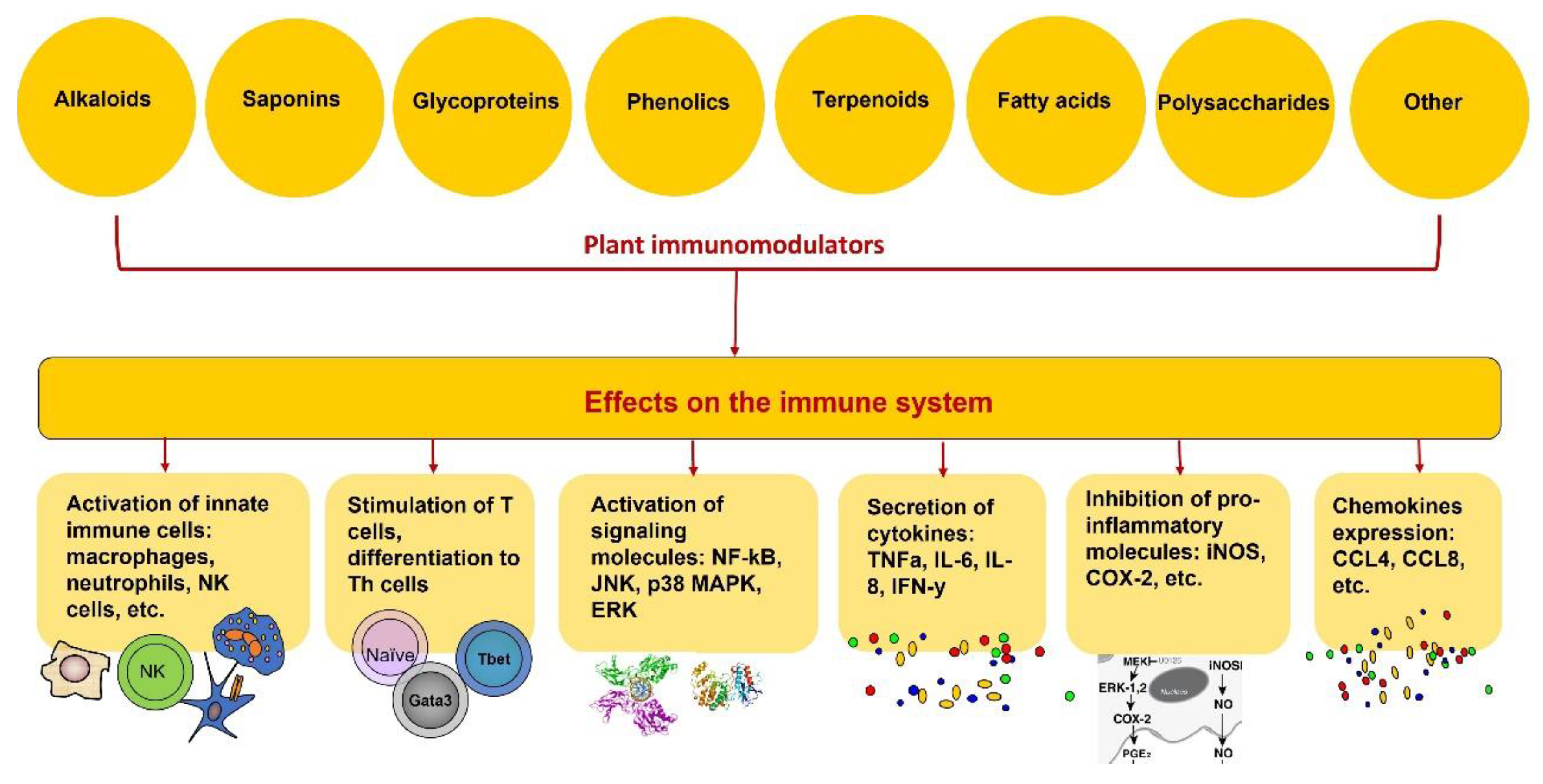

Table 1.
List of selected plants with immunomodulatory activity.
| Botanical name/Family. | Source countries | Part used | Bioactive-chemical constituent | Biological activity | Reference |
|---|---|---|---|---|---|
| Acacia catechu/ Fabaceae | India, East Africa | leaves, bark | flavonoids (quercetin, catechin, epicatechin) | antioxidant, immunomodulatory, hypoglycaemic | [17,35,49] |
| Achillea millefolium/Compositae | Northern Hemisphere | whole plant | Flavonoids, alkaloids, polyacetylenes, coumarins, triterpenes, lactones | anti-inflammatory, antispasmodic, antipyretic, diuretic | [50,51] |
| Andrographis paniculata/Acanthaceae | India, Sri Lanka | whole plant, leaves, stems, roots | diterpenoids (andrographolide), lactones, flavonoids, polysaccharides | immunomodulatory, hepatoprotective, antispasmodic, anticancer, anti-inflammatory, antiviral, anti-proliferative, anti-platelet | [52,53] |
| Aronia melanocarpa/ Rosaceae | North Amerika | fruits, bark, leaves | flavonoids (procyanidins anthocyanins), catechins, phenolic acids, ascorbic acid |
immunomodulatory, anti-inflammation, antioxidant, gastroprotective, hepatoprotective, antiproliferative, cardiovascular-protective, antioxidants | [20,54,55] |
| Pelargonium sidoides/ Geraniaceae | South Africa | roots, shoot, leaves | coumarins, phenols | immunomodulatory, antibacterial | [35,56] |
|
Zingiber officinale/ Zingiberaceae (ginger) |
Asia | roots, leaves | phenolic acid (eugenol, gingerols, shogaols, paradols) lactons, terpenes | immunostimulation, antimicrobial, antioxidant, analgesic, anti-inflammatory, anticancer, antihypertensive | [57,58] |
| Kalanchoe pinnata/Crassulaceae | Madagascar | leaves, flowers | flavonoid glycosides (quercitrin), bufadienolides, lectins, polyphenols | immunosuppressive, antifungal, antimicrobial, antiviral, wound healing (antiscar), anti-inflammatory | [59,60] |
|
Camellia sinensis/Theaceae (green tea) |
China, India, Nepal | leaves | catechins (epigallocatechin-3-gallate, epigallocatechin, epicatechin), triterpenoids, saponins | immunomodulatory, antioxidant, antiviral, anticancer, antifungal activities. | [20] |
| Cannabis sativa/Cannabaceae | Central Asia, widely cultivated around the world | leaves, seeds, inflorescence | cannabinoid (cannabidiol, cannabigerol, Δ9-tetrahydrocannabinol), terpenes, flavonoids | anti-inflammatory, immunosuppressive, neuroprotective, antioxidant | [61,62] |
| Capsicum species/ Solanaceae | Central and South America | fruits | provitamin A, vitamins (E, C) carotenoids, phenolic compounds ( capsaicinoids, luteolin, quercetin) | antioxidant, antimicrobial, antiseptic, anticancer, counterirritant, antioxidant, immunomodulator | [37] |
|
Cyclopia genistoides/Fabaceae (Honeybush) |
South Africa | flowers, leaves, stems | phenols, flavones, flavanones isoflavones, xanthones (mangiferin), coumestans, catechins (epigallocatechin-3-gallate), benzaldehyde derivates, phytoestrogens | immunomodulatory, anti-inflammatory, antioxidant, anti-proliferative, anticancer, cytoprotective | [63,64] |
| Euphorbia hirta/Euphorbiaceae | India, Australia | herb, leaves, roots | flavanoid glycoside, phenolic acids, alkaloids | anticancer, antioxidant, antibacterial, antifungal, antimalarial, anti-inflammatory, antiasthmatic | [17,54] |
| Ginkgo biloba/ Ginkgoaceae | China | leaves, seeds | flavonoids, terpenoids, alkylphenols, anthocyanidins, lignans, polyprenols polysaccharides, 4′-o-methylpyridoxine | immunomodulatory, antioxidants, anti-inflammation, anticancer, antidiabetic, antilipidemic, antimicrobial, anti-lipid peroxidation, antiplatelet, hepatoprotective, neuroprotective | [66] |
| Jatropha curcas/Euphorbiaceae | Mexico, Central America, Brazil | leaves, roots, stems | phenolics, flavonoids, sterols, saponins, phorbol esters, cyclic peptides, lignans, alkaloids, coumarins, terpenes | anti-inflammatory, antimicrobial, antioxidant | [67,68] |
|
Lycium barbarum/Solanaceae (Goji berry) |
China, Asia, Europe | fruits, leaves, roots | polysaccharides, scopoletin, carotenoids, flavonoids, vitamins | antioxidant, antiviral, anticancer, anti-inflammatory, cardioprotective | [20,69] |
| Matricaria chamomilla/ Asteraceae | Southeast Europe | flowers | terpenoids (α-bisabolol, chamazulene), flavonoids sesquiterpenes, coumarins, polyacetylenes | immunomodulatory, antioxidant, anti- inflammatory antiseptic, antispasmodic | [70,71] |
| Mahonia aquifolium/Berberidacea | Eastern Asia, North and Central America | leaves, bark | alkaloids, phenolics, flavonoids, quinones, vitamins, coumarins | anti-inflammatory, antifungal, antimicrobial, antiproliferative, hepatoprotective, analgesic antioxidant | [72,73] |
| Morus alba/Moraceae | Central and Eastern Asia, Caucasus, widely cultivated around the world | fruits, leaves, bark | flavonoids, anthocyanins, saponins, alkaloids, tannins, phenolic acids, anthocyanins, ascorbic acid, β-carotene | anticancer, antimicrobial, antidiabetic, immunomodulatory, cardioprotective, hepatoprotective, hypocholesterolaemic, | [17,74,75] |
| Vaccinium vitis-idaea/Ericaceae | Baltic countries (Europe), Russia, Canada | leaves, fruits | phenolic, arbutin, flavonol glycosides, proanthocyanidins | antioxidant | [76] |
| Cetraria islandica/ Parmeliaceae | Europe, North America | seeds, fruits, roots, leaves, stems, | dibenzofuranos, depsidones, fatty acids (lichesterinic acid, protolichesterinic acids), depsides, terpenes | immunomodulatory, antioxidant, cytotoxic, genotoxic, antigenotoxic antimicrobial, anticancer, antidiabetic, anti-inflammatory | [77] |
| Lavandula angustifolia/ Lamiaceae | Europe | stems, flowers | terpenes, polyphenols (rosmarinic acid, caffeic acid, lavandufurandiol, lavandunat), coumarins, flavonoids (apigenin, luteolin glycosides, catechin) | immunomodulatory, antioxidant, anti-inflammatory, analgesic, antibacterial | [78] |
Table 2.
Other selected plant-derived immunomodulatory compounds/molecules registered in https://www.clinicaltrials.gov/.
Table 2.
Other selected plant-derived immunomodulatory compounds/molecules registered in https://www.clinicaltrials.gov/.
| Chemical c compounds/molecules |
Mechanism | Clinical trials (number) |
Reference |
|---|---|---|---|
| Berberine | Regulate T- cells cytokines TNF-α, IL-2 and IL-4 production. | 84 | [220] |
| Piperine | Reduce IL-1β, IL-6, and TNF-α; regulate expression of COX-2, NOS-2, and NF-κB. | 28 | [221] |
| Xanthohumol | Inhibit NO production | 10 | [222] |
| Matrine | Reduced reactive oxygen species inflammatory mediators and myeloperoxidase and maleic dialdehyde activity |
2 | [223] |
| Daidzein | Decreases TNF-α, IL-1β, MCP-1, NO, and iNOS | 24 | [224] |
| Luteolin | Reduce secretion of INF-γ, IL-6, COX-2 and ICAM-1 Block heat shock protein 90 activity. |
18 | [225] |
| Apigenin | Downregulate expression of IL-1α, TNF-α, IL-8, COX-2 and iNOS; Decreased response of Th1 and Th17 cells. |
12 | [226] |
| Nobiletin | Inhibit COX-2 and iNOS expression by blocking NF-κB and MAPK signaling | 1 | [227] |
| Baicalein | Inhibit expression of iNOS, COX-2, TNF-α, IL-1β, PGE2, and TNF-α by regulating NF-κB and ER-dependent pathway. | 1 | [228,229] |
| Kaempferol | Reduce iNOS and COX-2 by suppressing STAT-1, NF-kappa B, and AP-1. Decrease expression of ICAM-1, VCAM-1 and MCP-1. | 5 | [224] |
| Rutin | Suppress production of TNF-α, IL-6. Activation of NF-κB and leukocyte migration. |
34 | [230] |
| Puerarin | Inhibit NF-κB and activation of STAT3. | 8 | [231] |
| Thymoquinone | Inhibit IL-1β, TNF-α, MMP-13, COX-2, and PGE2, MAPK p38, ERK1/2, and NF-kBp65. | 8 | [232] |
| Piceatannol | Inhibit iNOS expression and NF-kB, ERK, and STAT3. | 1 | [233] |
| Shikonin | Inhibit NF-κB activity and Th1 cytokines expression and induce Th2 cytokines. | 2 | [234] |
| Oleanolic acid | Reduce the level of IL-1α, IL-6, and TNF-α and adenosine deaminase activity. | 4 | [235] |
| Triptolide | Inhibits lymphocyte activation, IL-2, iNOS, TNF-α, COX-2, IFN-γ, NF-kB, NFAT, and STAT3. | 25 | [235] |
| Celastrol | Inhibit IL-2, iNOS, TNF-α, COX-2, adhesion molecules and topoisomerase II. | 2 | [236] |
| Tetrandrine | Regulates ERK/NF-κB signaling and inhibits activation of mesangial cells | 2 | [237] |
| Apocynin | Inhibit NADPH oxidase and suppress pro-inflammatory cytokines, CD4+ and CD8+T cells production. |
8 | [239] |
| 11-keto-β-boswellic acid | Decrease IL-1, IL-2, IL-4, IL-6, and IFN-γ | 1 | [240] |
Disclaimer/Publisher’s Note: The statements, opinions and data contained in all publications are solely those of the individual author(s) and contributor(s) and not of MDPI and/or the editor(s). MDPI and/or the editor(s) disclaim responsibility for any injury to people or property resulting from any ideas, methods, instructions or products referred to in the content. |
© 2024 by the authors. Licensee MDPI, Basel, Switzerland. This article is an open access article distributed under the terms and conditions of the Creative Commons Attribution (CC BY) license (http://creativecommons.org/licenses/by/4.0/).
Copyright: This open access article is published under a Creative Commons CC BY 4.0 license, which permit the free download, distribution, and reuse, provided that the author and preprint are cited in any reuse.


