

Submitted:
02 July 2024
Posted:
03 July 2024
You are already at the latest version
Abstract
The proliferation of Internet of Things (IoT) devices on Linux platforms has heightened concerns regarding vulnerability to malware attacks. This paper introduces a novel approach to investigating the behavior of Linux IoT malware by examining syscalls and library syscall wrappers extracted through static analysis of binaries, as opposed to the conventional method of using dynamic analysis for syscall extraction. We rank and categorize Linux system calls based on their security significance, focusing on understanding malware intent without execution.Feature analysis of the assigned syscall categories and risk ranking is conducted with statistical tests to validate their effectiveness and reliability in differentiating between malware and benign binaries. Our findings demonstrate that potential threats can be reliably identified with an F1 score of 96.86%, solely by analyzing syscalls and library syscall wrappers. This method can augment traditional static analysis, providing an effective preemptive measure to enhance Linux malware analysis. This research highlights the importance of static analysis in strengthening IoT systems against emerging malware threats.
Keywords:
ELF static analysis
; Linux system calls
; machine learning
; malware detection
1. Introduction
Internet of Things (IoT) are reshaping cyber-physical systems with unprecedented impact. By the end of this decade, an estimated 25.44 billion devices will be interconnected, predominantly as IoT devices, comprising 75% of the total device count [1].Recent reports, including the 2023 Zscaler ThreatLabz Enterprise IoT and OT Threat Report, highlight a staggering 400% surge in attacks targeting IoT devices [2]. The rapid integration of IoT technologies across various industries signals a continued escalation in such security incidents impacting various domains such as transportation, healthcare, and energy management. However, IoT devices lack security features and are inherently complex in terms of hardware and software design, making them vulnerable to cyber-attacks [3].
Linux systems are the backbone of numerous IoT devices [4]. This ubiquity has led to a noticeable uptick in malware designed to exploit Linux-based environments, as evidenced by a 50% increase in new Linux malware reported by AV-ATLAS in just one year [5].
The focus of Malware analysis is to examine malicious binaries (malware) to discern their behavior, purpose, and impact using a range of techniques and tools. This is typically done through Static Analysis, Dynamic Analysis or a hybrid of both these approaches. The extent of analysis is only limited by the objective - to quickly detect the malware or understand its functionality and behavior patterns such as network traffic,interactions with the system, evasion techniques and other features.
In this paper, we focus solely on static analysis to extract system calls (syscalls) and library syscall wrappers made by binaries to the Linux Kernel for ARM architecture-based Linux files, commonly known as ELF (Executable and Linkable Format) binaries. We analyze 1,117 ARM-based Linux IoT malware samples and 1,214 benign or non-malicious binaries. The syscall dataset created is evaluated using common machine learning classification models, such as Logistic Regression, Neural Networks, and Random Forest, to classify these binaries as malicious or benign.
While there are numerous research works where syscalls are used to analyze malware through dynamic analysis, to the best of our knowledge, there are no known research works that extract syscalls and library syscall wrappers from static analysis. Static analysis has the limitation of not capturing all the system calls made by a binary, as it cannot detect indirect system calls. In this study, we evaluate whether the limited syscalls and library syscall wrappers that can be extracted from the disassembly of the binary are still adequate for malware detection.
The main contributions of this paper are as follows:
- Systematic Linux syscall Categorization and Security Risk Ranking: We categorize and assign risk rankings to all extracted calls based on their potential security risks. The validity of these categories and rankings is confirmed through statistical analysis in this study.
- Static Analysis Dataset: We reverse-engineered 2,331 ARM architecture-based ELF binaries to extract syscalls and library syscall wrappers using static analysis and correlated with syscall categories and security risk ranking to create a comprehensive dataset, which includes the syscalls, category and security risk ranking for each syscall, along with added statistical features for each binary.
- Malware Detection:To demonstrate the reliability of using static analysis for malware detection based on system calls extracted from the disassembled binaries, we evaluate the dataset created with standard ML classification models such as Logistic Regression, Random Forest classifier, Support Vector Classification (SVC), and Multi-Layer Perceptron (MLP) Neural Network.
Although we focus on ARM binaries, our syscall extraction approach is architecture-agnostic due to the use of the popular reverse engineering tool radare2. Radare2 employs the ESIL (Evaluable Strings Intermediate Language) framework, which abstracts the underlying architecture details, allowing for consistent and accurate syscall extraction across different hardware platforms [6].
Binary lifting in static analysis has been successfully employed for malware variant classification by Ramamoorthy et al [7], where the Intermediate Representation (IR) of opcode sequences was used to create a dataset. In their study, a Random Forest Classification model achieved an F1 score of 97%.
The organization of this paper is as follows: Section 2 provides the background for the study, followed by Section 3, which describes relevant research work in the field of IoT malware detection. The methodology is explained in Section 4, including statistical analysis and machine learning models used for evaluation. Section 5 presents the results obtained using the proposed methods and includes an analysis of these results. Section 6 summarizes the conclusions, followed by Section 7, which discusses the limitations and future scope.
2. Preliminaries
In this section we discuss and provide an overview of malware static analysis and system and library syscall wrappers.
2.1. System and Library Calls
In ELF ARM binaries, both library and system calls re crucial and play an important role in program functionality. They enable binaries to interact with external resources, perform operations and access system-level functionalities.
- Syscalls: In Linux, a system call (syscall) is the primary interface through which user-space programs request services and access functionalities from the operating system kernel. It acts as a bridge between the user space, where applications run, and the kernel space, where core system functions reside. System calls enable programs to perform privileged operations and access restricted system resources, such as hardware interaction, process management, file I/O operations, network communication, and memory management as shown in Figure 1. Some system calls are architecture-specific, and their implementation and availability can vary between different hardware platforms (e.g., x86, ARM, MIPS). These differences are due to the unique characteristics and requirements of each architecture, necessitating specific handling within the kernel to optimize performance and compatibility [8].
- Library syscall wrappers: When using programming languages like C++ or Java, developers often use pre-built functions from libraries such as the GNU C Library glibc, which contains routines for file management, memory allocation, and computational tasks. When a program calls one of these library functions, it may require system-level functionalities that reside in kernel space, like hardware interaction or process management. Consequently, library functions often make system calls and provide wrapper functions to syscalls in order to perform these tasks as shown in Figure 1.
- Virtual syscalls: Many Linux distributions also provide optimization of certain syscalls called virtual syscalls. Virtual syscalls, or vDSO (virtual Dynamic Shared Object) calls, are a set of performance-optimized routines provided by the Linux kernel that user-space applications can use to execute certain system calls more efficiently. These virtual syscalls are mapped directly into the process address space, allowing some system call functionalities to be executed without the overhead of a traditional syscall. vDSO calls are generally captured through dynamic analysis, as they involve runtime components and optimizations. This study does not capture Virtual syscalls.
2.2. Linux Malware Static Analysis
Static malware analysis examines malicious software without execution, focusing on the code and structure of the malware to identify malicious patterns, behaviors, and potential threats. This method analyzes API calls, function calls, and data structures to understand malware logic and potential behaviors, such as file modifications, network communications, and privilege escalation attempts.
Static analysis, although powerful, has limitations - it cannot detect all system calls made during runtime, which are essential for fully understanding interactions with the operating system. Dynamic analysis complements this by capturing all interactions and changes, providing a comprehensive view of malware capabilities. The approach we propose does not seek to replace dynamic analysis; rather, it offers crucial insights into malware behavior without the need for execution.
In this paper, we introduce a novel approach that studies call patterns by extracting syscalls and library syscall wrappers from binaries through static analysis, forming the basis of the dataset used in our research.
3. Literature Review
In the past decade, malware has continued to pose a significant threat to global infrastructure. As the majority of the infrastructure systems heavily rely on Internet of Things (IoT), the importance of Linux malware analysis has become crucial, particularly because Linux is the preferred operating system for major IoT devices and servers. In this section, we present some of the previous literature on the usage syscalls to classify malware.
Asmitha et al [10,11] propose a novel non-parametric statistical approach using machine learning techniques for identifying previously unknown malicious Executable Linkable Files (ELF). They used a dataset of 226 linux malware samples and 442 benign samples from which syscalls (features) were dynamically extracted. Their proposed method prioritizes features through non-parametric statistical techniques such as the Kruskal-Wallis ranking test (KW) and Deviation From Poisson (DFP). Three learning algorithms (J48, Adaboost, and Random Forest) were used to create a prediction model using a minimal feature set extracted from the system calls. This approach yielded an optimal feature vector, resulting in an overall classification accuracy of 97.30% in identifying unknown malicious files.
Additionally, Phu et al [12] introduce a framework for analyzing MIPS ELF files based on syscall behaviors. They compiled a database of 3,773 MIPS ELF malware samples from Detux, IoTPOT, and VirusShare and execute them in a QEMU-based sandbox called F-sandbox, derived from Firmadyne and Detux. For their final feature set the authors take the 30 most common syscalls and apply the n-gram technique to construct the feature vectors. The authors then employ machine learning classifiers such as Support Vector Machines (SVM), Random Forest, and Naive Bayes to analyze the syscalls. Their experiments demonstrate that Random Forest achieves the high accuracy in classifying MIPS malware, with an accuracy of 97.44%.
Taking it a level further, Tahir and Qadir [13] propose a detection scheme for IoT malware using cross-architectural (MIPS, ARM and x86) analysis based on system calls. They had 69 system calls dynamically extracted from 1,048 samples of both IoT malware and benign binaries. They then trained five popular machine learning models: Support Vector Machine, Random Forest, Logistic Regression, Bagging, and Multi-layer Perceptron to detect the malware. The results showed that Random Forest achieved the highest detection accuracy at 99.04%. Additionally, their findings also suggested that feature sets based on system calls hold significant potential for detecting multi-architectural IoT malware.
Shobana and Poonkuzhali [14] carried out the same using deep leaning techniques. In their approach, the authors identified malware by analyzing its behavior through the sequence of system calls it generates during execution. The system calls made by IoT malware are captured using the Strace tool on Ubuntu. These recorded malicious system calls undergo preprocessing using n-gram techniques to extract necessary features. The resulting system calls are then categorized into two classes—normal and malicious sequences using a Recurrent Neural Network (RNN). The results reveal that using this technique produced 98% classification accuracy.
Abderrahmane et al [15] present a solution that will classify whether an Android application is malicious or not. The application is installed and executed simulating its usage. After execution, system calls generated by the Linux kernel are collected, processed, and fed into the neural network model that will be used to classify the application. The authors used a convolutional neural network for this research and their findings reveal that their solution could detect malicious applications with an accuracy of 93.29%.
Lastly, Ramamoorthy et al [7] focus on using binary lifting methods to perform static analysis and extract Intermediate Representation (IR) opcode sequences for analysis. The study introduces a series of statistical entropy-based characteristics derived from these opcode sequences. By concentrating solely on function metadata and opcode entropy, their approach is versatile across different architectures. It effectively identifies malware and accurately categorizes its variations, achieving an impressive F1 score of 97% .
To the best of our knowledge, existing research predominantly focuses on syscall extraction through dynamic analysis, using tools like strace to generate extensive syscall logs as shown in Table 1. This method requires executing malware within a controlled environment, which poses significant challenges in Linux due to the diversity of architectures and runtime environments. In contrast, our study uses a static analysis approach, extracting syscalls and library syscall wrappers directly from disassembled code. Although this method may not capture indirect syscalls to the kernel, we demonstrate that it remains an effective strategy for identifying malicious behavior.

Table 1.
Comparative study of research works that uses syscalls for malware detection.
| Research | Statistical Analysis | Architecture | Features Used | Dynamic/Static | Models | Accuracy | Comparison |
|---|---|---|---|---|---|---|---|
| Asmitha Vinod [10] | non-parametric statistical methods like Kruskal-Wallis ranking test (KW), Deviation From Poisson (DFP) | - | syscalls | Dynamic | J48, Adaboost, Random forest | 97.30% | Dynamic analysis* |
| Asmitha Vinod [11] | - | - | syscalls | Dynamic | Naïve bayes, J48, Adaboost, RF, IBK-5 | 97% | Dynamic analysis* |
| Phu et al [12] | n-gram, chi square | MIPS | syscalls | Dynamic | RF, NB, SVM | 97% | Dynamic analysis*, MIPS architecture-specific |
| Tahir Qadir [13] | - | x86, MIPS, ARM | syscalls | Dynamic | SVM, LR, RF, MLP, Bagging | Bagging, RF (99%) | Dynamic analysis* |
| Shobana Poonkuzhali [14] | - | - | syscalls | Dynamic | RNN | 98.7% | Dynamic analysis* |
| Abderrahmane et al [15] | - | ARM | log files, syscalls | Dynamic | CNN | 93.3% | Dynamic analysis*, ARM architecture-specific |
| Our research | chi squared test, Wilcoxon test | Multi architecture | syscalls, library syscall wrappers | Static | Linear Regression, Random Forest, SVC, Neural network | 96.86% | Static analysis requiring no execution or environment setup. Multi-architecture support. Can be combined with other static features for a higher accuracy. We conduct statistical analysis to validate syscall ranking and category assignment. These scores can be adjusted for various architectures. |
`*’ These works use Dynamic analysis which require a compatible environment to be setup and configured for the malware to execute. Moreover dynamic analysis tends to generate a high volume of syscalls within a short period, as the kernel performs various internal operations during its execution. This rapid generation of syscalls can lead to significant noise, with numerous irrelevant and redundant syscall that can obscure meaningful patterns.
4. Methodology
In this section, we provide a detailed explanation of the workflow that was utilized throughout our research. This workflow is structured into several distinct steps, each of which is outlined in this section and visualized in Figure 2 below.
4.1. Iot Malware Dataset
This paper concentrates exclusively on employing static analysis to identify system calls (syscalls) and library syscall wrappers utilized by binaries targeting the Linux Kernel in ARM architecture-based Linux files, which are typically referred to as ELF (Executable and Linkable Format) binaries. Our study involves the examination of 1,117 samples of ARM-based Linux IoT malware and 1,214 binaries categorized as benign or non-malicious, with 251 unique syscalls as shown in Figure Table 2. The raw binaries are extracted from open-source IoT malware ARM architecture binary dataset from [16] and [17]. We selected random samples of binaries containing fewer than 2000 functions to ensure that the reverse engineering process was batched to a manageable size. Subsequent stages are illustrated as shown in Figure 2.
4.2. Reverse Engineering
This study explores the identification of malicious behavior in ARM-based Linux IoT devices by analyzing syscalls and library syscall wrappers extracted solely from static analysis of ELF binaries. We employ radare2, a popular reverse engineering library, to extract syscalls and library syscall wrappers from global symbols, exports, imports, and call references within the binary.
4.3. Heuristics
Additionally, each syscall is assigned a risk level—High, Medium, or Low, reflecting its potential for malicious use. To validate the effectiveness of our categorization and ranking system, we perform a chi-squared analysis [18] to compare the distribution of syscalls between benign and malware samples. This statistical validation confirms the significant differentiation in syscall usage patterns between the malware and benign subsets.
Our dataset distribution is outlined in Table 2. The raw binaries are reverse engineered to extract the the following attributes: binary_id, hash, call_api, call_description, call_category, and call_rank.
Unlike Windows environment, Linux binaries have built-in debugging symbols with DWARF which is an integral part of the ELF format. This rich context contributes to gathering relevant symbols and their usage patterns, which is crucial for assessing the potential maliciousness of each call. We have systematically categorized all Linux system calls into the following ten categories based on their functionality:
Table 3.
Extended categorization of Linux syscalls
| Syscall category | Description |
|---|---|
| FileSystem | Handles file management operations such as reading, writing, and permissions. |
| Process | Manages process lifecycle such as creation, execution, and termination. |
| Memory | Controls memory allocation, deallocation, change and access critical for process management. |
| Network | Encompasses syscalls for network communication such as socket management, send, recv. |
| System | General system calls for services, system configuration and management. |
| Metadata | Involves retrieval and manipulation of file or system metadata. |
| Signal | Inter-process communication, and signal-driven interruptions. |
| Security | Key management, encryption, and access controls. |
| NonblockingIO | Non-blocking operations for input/output. |
| Time | Measuring time, manipulation. |
4.4. Statistical Feature Engineering
To enhance the predictive power of our models, we enriched our dataset with several engineered features derived from the syscall and library call data. These features aim to capture the nuances of syscall behavior that distinguish malware from benign software. The engineered features include:
- Call Count: The total number of system calls made by each binary. This feature reflects the general activity level of the binary, which can indicate suspicious behavior.
- Distinct Call Count: The number of unique syscalls made by each binary. A high variety of calls can be indicative of complex or unusual binary behavior.
- Category Frequency: For each of the ten syscall categories, we calculated the frequency of syscalls falling into each category per binary. This helps in understanding which types of operations are predominant in a binary, aiding in profiling typical and atypical behaviors.
- High-Risk Call Proportion: The proportion of syscalls that are ranked as ’High’ risk relative to the total number of syscalls. This feature specifically targets the detection of syscalls more commonly associated with malicious activities.
- Entropy of Calls: We calculated the entropy of syscall distribution within each category of a binary to measure the unpredictability and randomness of syscall usage, which can be higher in malware due to evasion techniques or diverse functionalities.
- Weighted Risk Score: By assigning weights to syscalls based on their assigned risk levels (High, Medium, Low), we computed an overall risk score for each binary. This score provides a quantitative measure of the potential threat posed by the binary based on the observed syscalls.
Each syscall in a binary is assigned a weight based on its risk rank (High, Medium, Low). The weighted rank score for each syscall can be calculated as:
where is the risk weight for syscall i, and is the count of syscall i within the binary.
The total rank score is the sum of all weighted rank scores across all syscalls in a binary:
where n is the number of different syscalls recorded for the binary.
The diversity score, calculated using Shannon entropy, measures the unpredictability or diversity of syscall ranks in a binary. It is defined as:
where is the proportion of syscalls of rank j (e.g., High, Medium, Low), and m is the number of different ranks.
The final score is a composite metric that combines the total rank score and the diversity score, providing an overall score for each binary:
These features were integrated into our analytical framework to provide a robust foundation for subsequent machine learning models to classify the samples effectively. By leveraging a combination of count-based, frequency-based, and information-theoretic metrics, we aim to capture a comprehensive profile of each binary’s behavior, significantly enhancing our malware detection capabilities.
4.5. Data Organization
We index the data with a binary_id for organizing syscalls within each binary, to facilitate aggregation and analysis at the binary level. By grouping syscalls by their respective binary_id, we ensure that behavioral patterns are accurately captured for the entire binary. This structured approach enhances the reliability of our analysis and improves the model’s ability to effectively learn and differentiate between distinct syscall patterns. The resulting syscall dataset created has the features as outlined in Table 4 for each binary_id.
4.6. Handling of Outliers
Outliers highlight extreme behaviors or unusual patterns that are characteristic of malicious activities. Therefore, we retain outliers in our dataset to capture such behavior patterns.
4.7. Statistical Feature Analysis
To validate the effectiveness of the categorized and ranked syscalls in differentiating malware from benign binaries, we employ a chi-squared test. This statistical method evaluates whether there is a significant difference in the distribution of syscall ranks between malware and benign samples.
The test procedure is as follows:
- Data Collection: We calculate the frequency of each syscall rank for both malware and benign binaries.
- Normalization: The frequencies are normalized to proportions within each group.
-
chi-squared Test: We perform the chi-squared test to determine if the observed differences in the distribution of syscall ranks are statistically significant.where are the observed frequencies of risk rank, and are the expected frequencies. We use the same methodology to assess the importance of syscall categories as well.
The results show p-value < in both cases, implying that the rankings are not just arbitrary, and assigned rankings correspond to observable differences in behavior between malware and benign binaries. This reinforces the idea that higher risk ranked syscalls and certain categories of syscalls such as Network, Process and Signal category syscalls are more critical in the context of malware activity. Also, the High risk ranked syscalls are statistically higher in malware subset than benign binaries.
To validate the statistical significance of the differences observed between the calculated final_score based on the entropy of the syscalls and their risk ranking, we employ the Mann–Whitney (Wilcoxon) U test. This non-parametric test is suitable for skewed data for comparison from two independent groups. Our analysis reveals a negligibly low p-value < , confirming that the final_score computed based on the Equation 4, can reliably differentiate between malware and benign samples as shown in Figure 5.
4.8. Machine Learning Classification Based on Static Extraction of Syscalls
The primary focus of this study is to identify malware based on syscalls and library syscall wrappers extracted from static analysis as opposed to dynamic execution of the malware. Based on the extracted syscalls, we outlined the statistical features added to the dataset in previous sections, which are based on syscall categorization and security risk ranking of the syscalls used by the binary.
In this section we discuss the feasibility of Machine Learning (ML) classification models on the created dataset. We have evaluated the approach and dataset with commonly used ML classification models: Logistic Regression, Random Forest, LinearSVC, and Multi-Layer Perceptron (MLP) Neural Network.
- Logistic Regression: To evaluate a simple yet effective baseline for binary classification.
- Random Forest: Random Forest classifier is robust in handling outliers and anomalies typical of malware, and suitable for complex interactions between features.
- LinearSVC: LinearSVC is often effective with high-dimensional data, and used for interpretability.
- Multi-Layer Perceptron (MLP) Neural Network: MLP is effective is capturing complex patterns and interactions in the data through layered architecture.
As we will see in the Results section, the strong performance of all the models suggest that our approach and dataset are well-suited for malware detection.
As detailed in the Data Organization section, to preserve the context of syscalls and library syscall wrappers within each binary, we train our models using grouped data. Syscall categories and risk ranking are One-Hot encoded to handle categorical data effectively. We then compute the Variation Inflation Factor (VIF) to identify and mitigate multicollinearity in our feature set.
The Generalized linear model (GLM) using ’glmnet’ statistical model package is employed with Lasso regression to train the glm model. Regularization is used to minimize overfitting and improve generalization.
The dataset is split with 80:20 ratio, ensuring a balanced representation through shuffling of batches grouped by binary_id to preserve the frequency and group of syscalls.
4.9. HyperParameters
Most of the standard default values from the ’scikit-learn’ library were retained and minimal tuning was required for the ML models. In this section, ee discuss the vectorization strategy and some of the hyperparameter settings of the individual models.
4.9.1. Vectorization
For text feature ’call_api’ (syscall name) we use TF-IDF (Term Frequency-Inverse Document Frequency) vectorizer, with a maximum of 500 distinct tokens (unique Linux system calls) to extract, and an n-gram range of (1, 1). For numeric features, the mean value is used for imputation and numeric values are standardized (normalize) by removing the mean and scaling to unit variance. Categorical features, syscall category (call_cat) and syscall risk ranking (call_rank), are OneHot encoded. The pipeline for the data preprocessing and vectorization strategy is shown in Figure 6.
-
RandomForestClassifier:Through GridSearch, we identified the optimal number of trees as 200. The default values were retained for maximum depth of the tree, which was set to None, and Gini impurity is used for the split criteria.
-
LinearSVC:For LinearSVC, we used the default ’squared-hinge’ loss function with an L2 regularization and a set the tolerance of for the stopping criteria.
-
MLP Classifier:For the Neural network model, we employed the rectified linear unit function (ReLU) for activation and the `adam’ solver for weight optimization, with an initial learning rate of 0.001.
Our dataset is supported by statistical features and validation which is evident from the comparable results across all ML models as discussed in the next section.
5. Results and Analysis
In this section, we compare and analyze the performance of various machine learning classification models on the syscall dataset comprising IoT malware and benign binaries. The primary objective is to evaluate the effectiveness of the ML models in distinguishing between malware and benign ELF binaries.
The performance metrics used to evaluate the models include accuracy, precision, and F1 score, defined as follows:
- Accuracy: The proportion of true results (both true positives and true negatives) among the total number of cases examined.where , , , and represent the number of true positives, true negatives, false positives, and false negatives, respectively.
- Precision: The proportion of true positive results in all positive predictions.
- F1 Score: The harmonic mean of precision and recall.
The performance metrics of the ML models are shown in Table 5. Random Forest classifier has the best performance with a F1 score of of about 97%. The optimal threshold for the final prediction was found to be 0.72, and the maximum F1 score 96.86%. The Random Forest Classifier ROC Curve is shown in the Figure 11.
5.1. Discussion
As observed from the results in Table 5, batching syscalls for a single binary in the course of training likely plays a crucial role in all ML model’s ability to detect malware binaries accurately since the the syscall frequency and order are maintained. Random Forest classifier performed the best, with a 96.8% F1 score likely due to the model’s ability to handle outlier data which is characteristic of malware binaries. For example, there could be rarely used syscalls, or a direct syscall instead of library wrappers in a malware which are anomalous behaviors.
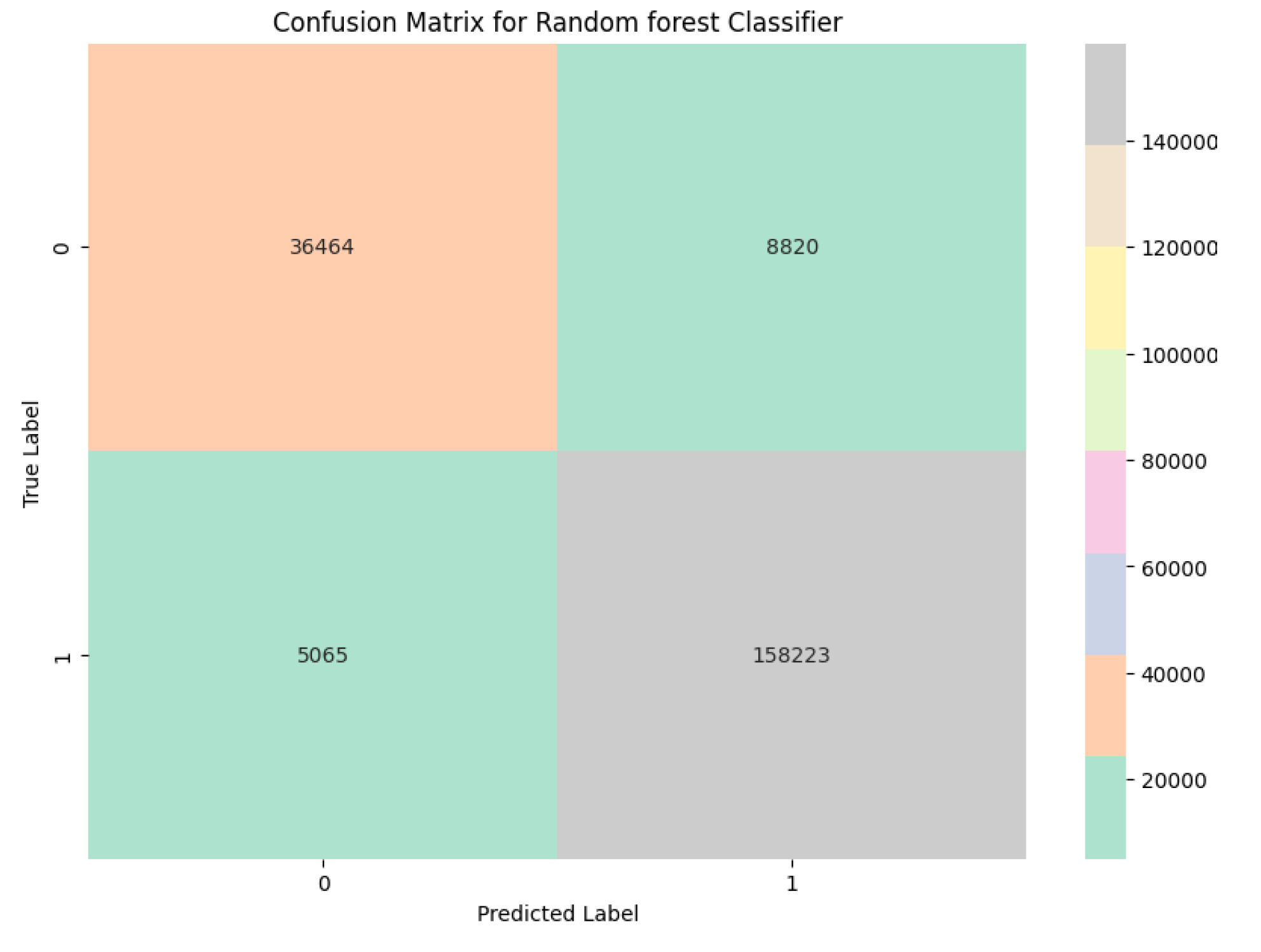
The confusion matrices for the machine learning classifiers provide detailed insights into the performance of each model in distinguishing between malware and benign binaries. The confusion matrix is a critical in understanding the classification performance, as it breaks down the results for the True Positives (TP), False Positives (FP), True Negatives (TN), and False Negatives (FN).
For example, As seen in Figure 10, Random Forest classifier was able to accurately classify 158,223 malware syscall binaries accurately with only 5,065 misclassification. Although malware binaries are characterized by extreme outliers, the Random Forest model demonstrates higher degree of accuracy and precision. The LinearSVC classifier, Logistic regression and MLP Neural Network all show similar number of True Positives as shown in Figure 7, Figure 8 and Figure 9 respectively.
Figure 7.
Logistic Regression classifier confusion matrix
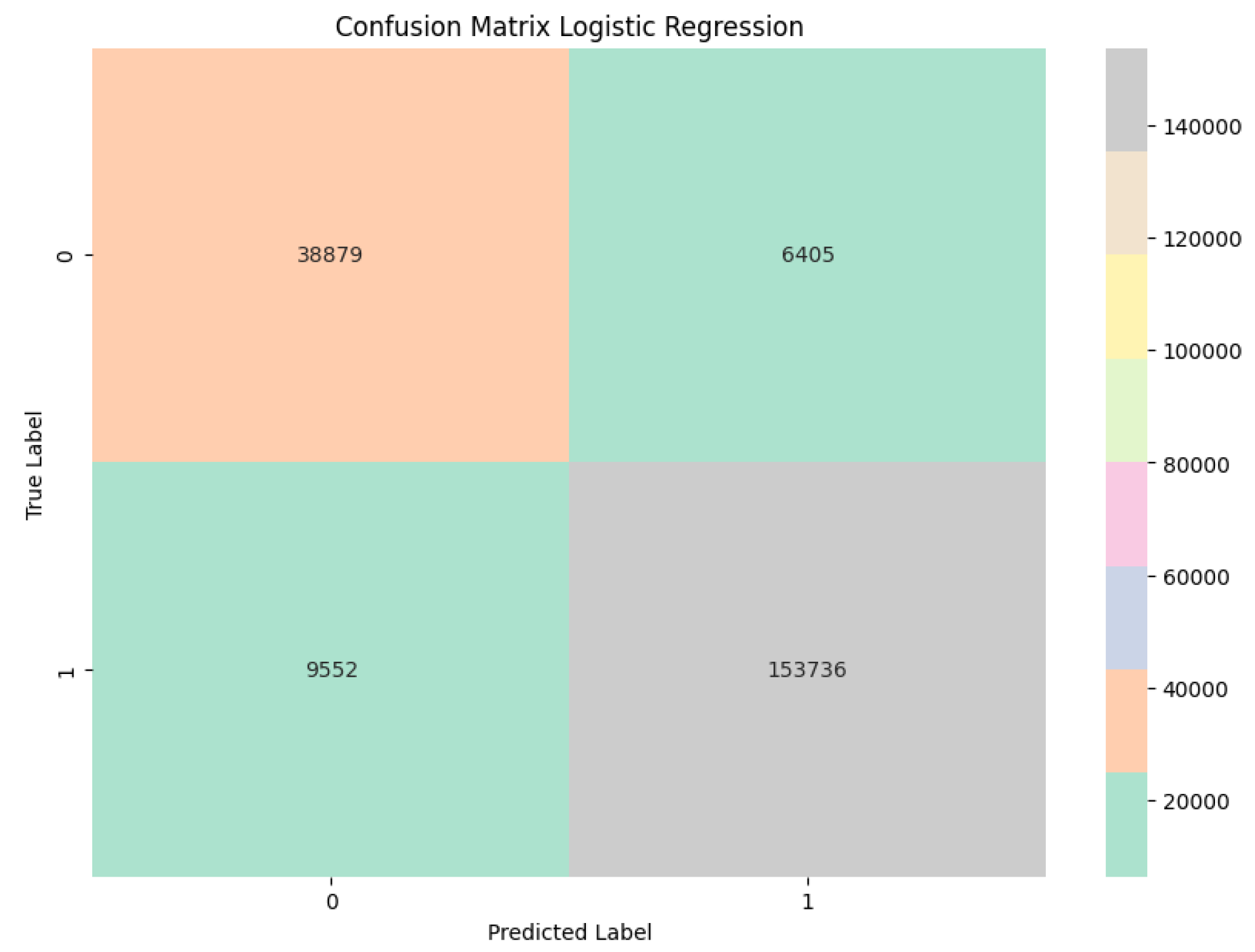
Figure 8.
Linear SVC classifier confusion matrix
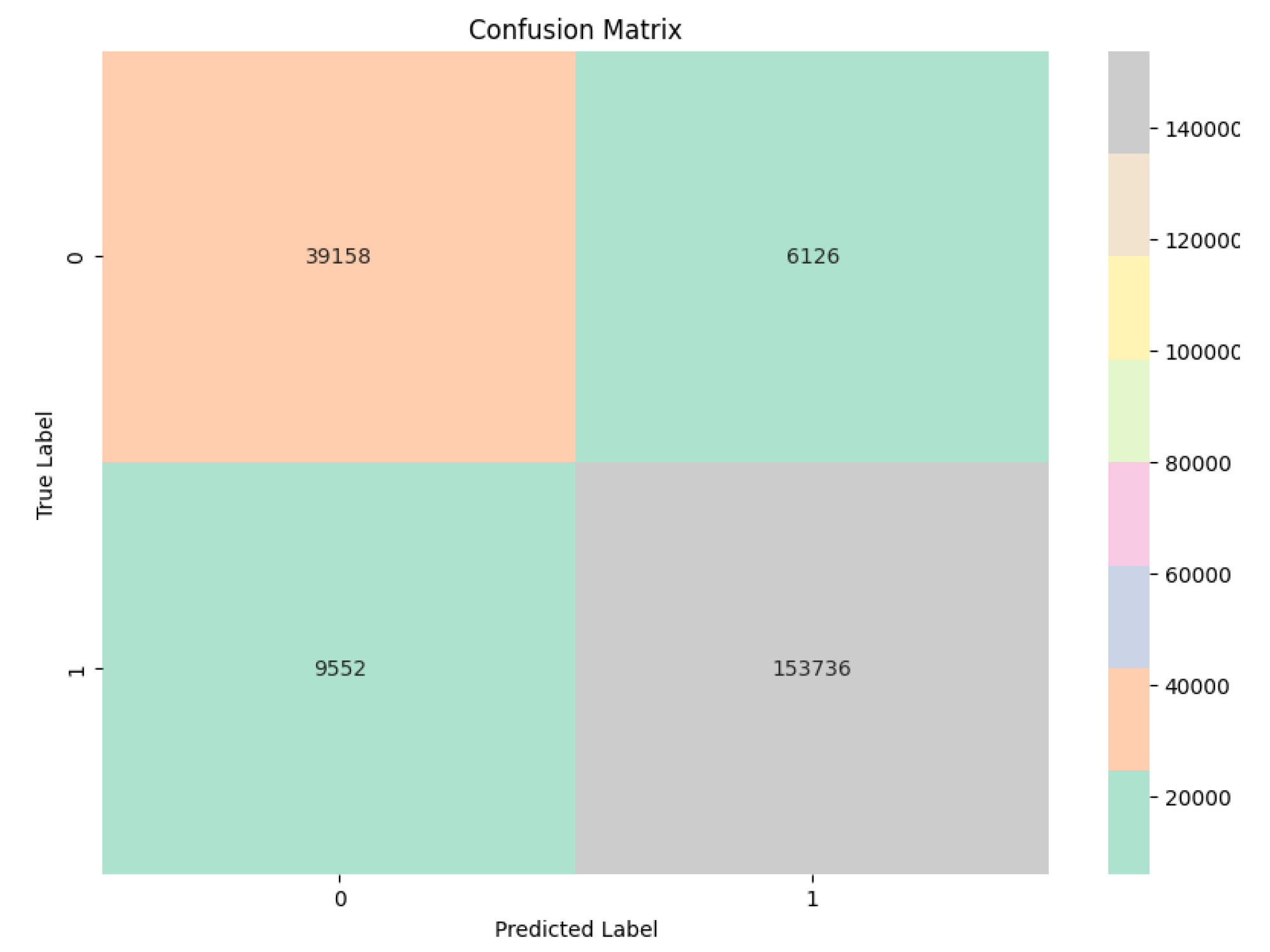
Figure 9.
MLP Neural Network confusion matrix
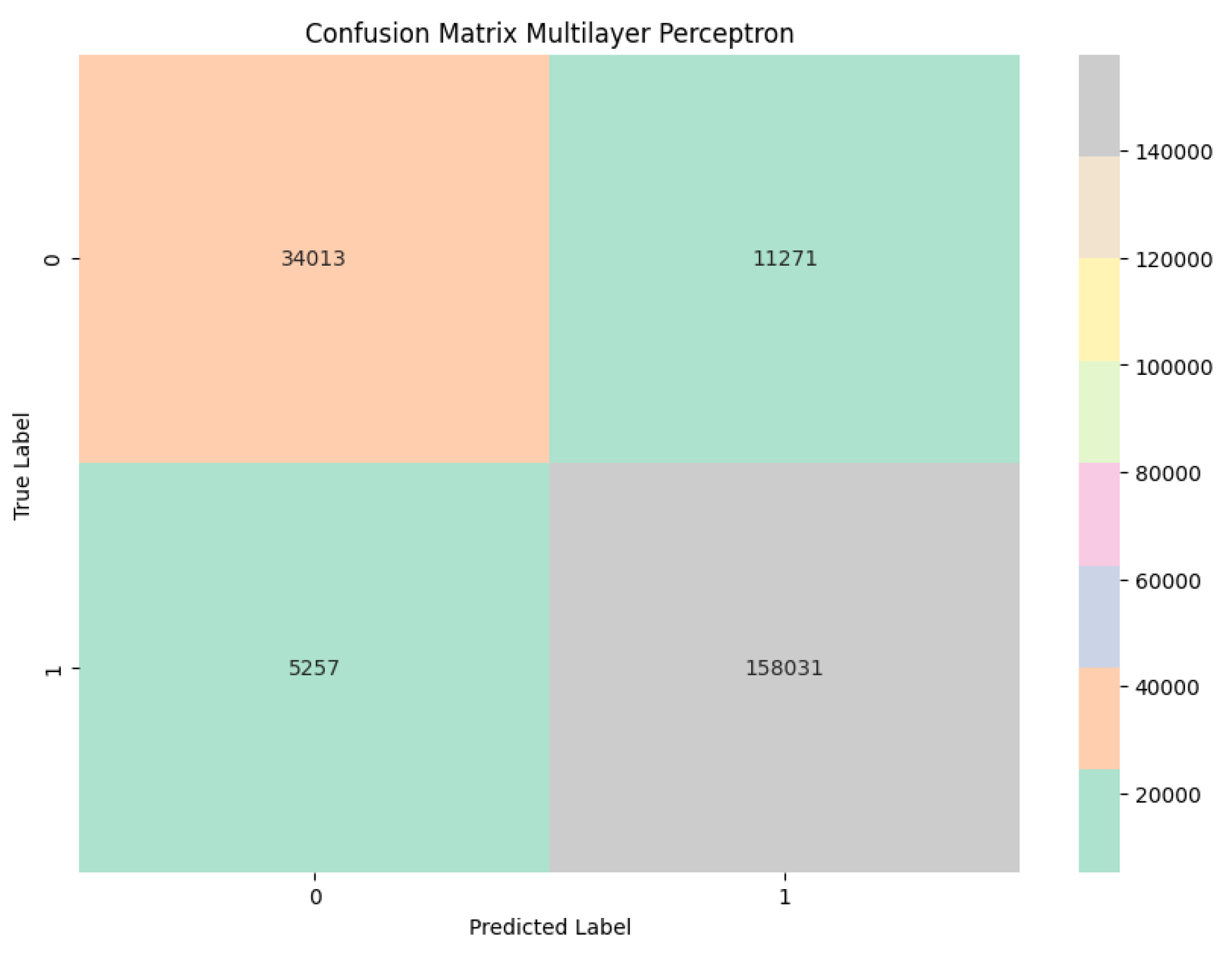
Figure 10.
Random Forest classifier confusion matrix
The calculated AUC (Area Under the Curve) score for the ROC (Receiver Operating Characteristic) curve of the Random Forest classifier is 0.964, which demonstrates robust performance under various threshold as shown in Figure 11. The optimal threshold was found to be 0.72, with a F1 score of 96.8%.
Figure 11.
Random Forest classifier Receiver Operating Characteristic (ROC) Curve with AUC Score
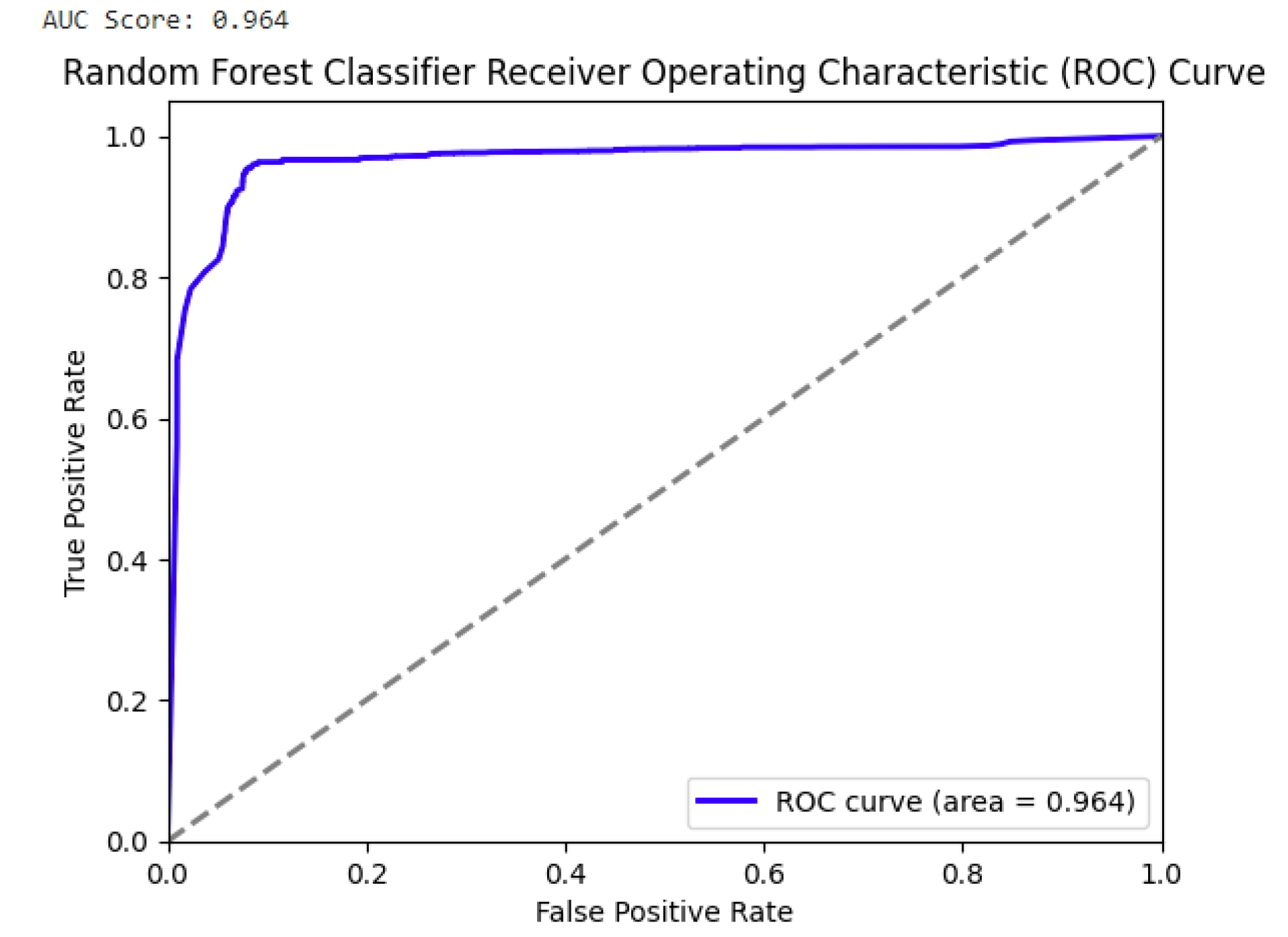
The results suggest that most ML classifier models are able to accurately identify malware behavior based on static syscall analysis, since the dataset includes statistical score for the binaries based on syscall ranking and category.
6. Conclusion
This study successfully demonstrates the viability of static analysis for detecting malware in Linux IoT systems by analyzing call patterns (syscalls and library syscall wrappers) extracted from ELF binaries. By ranking and categorizing calls based on their security implications, we have established a methodological framework that distinguishes between benign and malicious binaries effectively. The application of a chi-squared test further validates the significant differences in call patterns between these groups, reinforcing the reliability of our categorization and ranking system.
We demonstrate the efficacy analyzing of call pattern usage from static analysis by using Machine learning models such as glmnet with lasso regression, Random Forest classifier, SVC and MLP neural network. The models were able to perform malware detection with a high level of accuracy, as indicated by an Random Forest classifier F1 score of 96.86%. This is particularly significant given that this study solely uses system calls extracted using static analysis without any other significant contributing features that are important in static analysis such as sections, functions, strings and file header information. By bypassing the need for binary execution, our approach mitigates the risks associated with dynamic analysis and offers an effective alternative for malware detection.
7. Future Works
While this study demonstrates the viability of static analysis for detecting malware in Linux IoT systems with a high accuracy rate, it primarily focuses on syscalls and library syscall wrappers. However, this narrow focus may not capture all of the malware behavior patterns. Future research could consider incorporating additional static features, such as section headers, functions, and strings, for a comprehensive detection strategy.
Additionally, static analysis does not capture dynamically generated syscalls, potentially leading to incomplete data. The limitations of dynamic analysis is already discussed in this study. Augmenting static analysis with dynamic analysis in future studies could provide a more comprehensive understanding of malware behavior and improve detection rates.
Building on the findings of this study, future research will aim to extend the scope of the static analysis framework. The study could be also be extended to multiple architectures for evaluation, broadening its applicability in the field of IoT malware detection.
Author Contributions
Conceptualization, J.R., R.K., K.G, and N.S.; methodology, J.R.; software, J.R.; validation, J.R., R.K., K.G, N.S., and C.V.; formal analysis, J.R.; investigation, J.R. and R.K.; resources, N.S., and C.V.; data curation, J.R.; writing—original draft preparation, J.R., and K.G.; writing—review and editing, K.G., and J.R.; visualization, J.R., K.G, R.K.; supervision, R.K and N.S.; project administration, C.V.; funding acquisition, C.V.
Funding
This research received no external funding
Data Availability Statement
The syscall dataset created in the study is openly available at:
Conflicts of Interest
The authors declare no conflicts of interest.
References
- Howarth, J. 80+ Amazing IoT Statistics (2024-2030) — explodingtopics.com. https://explodingtopics.com/blog/iot-stats. [Accessed 09-05-2024].
- Zscaler ThreatLabz Finds a 400Year-over-Year. https://www.zscaler.com/press/zscaler-threatlabz-finds-400-increase-iot-and-ot-malware-attacks-year-over-year-underscoring. [Accessed 09-05-2024].
- Ngo, Q.D.; Nguyen, H.T.; Le, V.H.; Nguyen, D.H. A survey of IoT malware and detection methods based on static features. ICT express 2020, 6, 280–286. [Google Scholar] [CrossRef]
- Antony, A.; Sarika, S. A review on IoT operating systems. Int. J. Comput. Appl 2020, 176, 33–40. [Google Scholar] [CrossRef]
- AV-ATLAS Malware Portal. https://portal.av-atlas.org/malware, 2023. [Online; accessed 10-May-2023].
- Pancake.; others. The Official Radare2 Book: ESIL, 2024.
- Ramamoorthy, J.; Gupta, K.; Shashidhar, N.K.; Varol, C. Linux IoT Malware Variant Classification Using Binary Lifting and Opcode Entropy. Electronics 2024, 13, 2381. [Google Scholar] [CrossRef]
- Kerrisk, M. ; others. Linux Programmer’s Manual: syscalls, 2024. Online; accessed 18-June-2024.
- Jones, M. IBM Developer — developer.ibm.com. https://developer.ibm.com/articles/l-linux-kernel/. [Accessed 09-05-2024].
- Asmitha, K.; Vinod, P. Linux malware detection using non-parametric statistical methods. 2014 International Conference on Advances in Computing, Communications and Informatics (ICACCI). IEEE, 2014, pp. 356–361.
- Asmitha, K.; Vinod, P. A machine learning approach for linux malware detection. 2014 international conference on issues and challenges in intelligent computing techniques (ICICT). IEEE, 2014, pp. 825–830.
- Phu, T.N.; Dang, K.H.; Quoc, D.N.; Dai, N.T.; Binh, N.N. A novel framework to classify malware in mips architecture-based iot devices. Security and Communication Networks 2019, 2019, 1–13. [Google Scholar] [CrossRef]
- Tahir, I.; Qadir, S. Machine Learning-based Detection of IoT Malware using System Call Data 2022.
- Shobana, M.; Poonkuzhali, S. A novel approach to detect IoT malware by system calls using Deep learning techniques. 2020 International Conference on Innovative Trends in Information Technology (ICITIIT). IEEE, 2020, pp. 1–5.
- Abderrahmane, A.; Adnane, G.; Yacine, C.; Khireddine, G. Android malware detection based on system calls analysis and CNN classification. 2019 IEEE wireless communications and networking conference workshop (WCNCW). IEEE, 2019, pp. 1–6.
- Olsen, S.H.; OConnor, T. Toward a Labeled Dataset of IoT Malware Features. 2023 IEEE 47th Annual Computers, Software, and Applications Conference (COMPSAC). IEEE, 2023, pp. 924–933.
- Refade. IoT_ARM: A Collection of IoT Malware Samples for ARM Architecture, 2024.
- Tallarida, R.J.; Murray, R.B.; Tallarida, R.J.; Murray, R.B. Chi-square test. Manual of pharmacologic calculations: with computer programs.
- Pedregosa, F.; Varoquaux, G.; Gramfort, A.; Michel, V.; Thirion, B.; Grisel, O.; Blondel, M.; Prettenhofer, P.; Weiss, R.; Dubourg, V.; Vanderplas, J.; Passos, A.; Cournapeau, D.; Brucher, M.; Perrot, M.; Duchesnay, E. Scikit-learn: Machine Learning in Python. Journal of Machine Learning Research 2011, 12, 2825–2830. [Google Scholar]
Figure 1.
Architecture of the GNU/Linux operating system [9].
Figure 1.
Architecture of the GNU/Linux operating system [9].
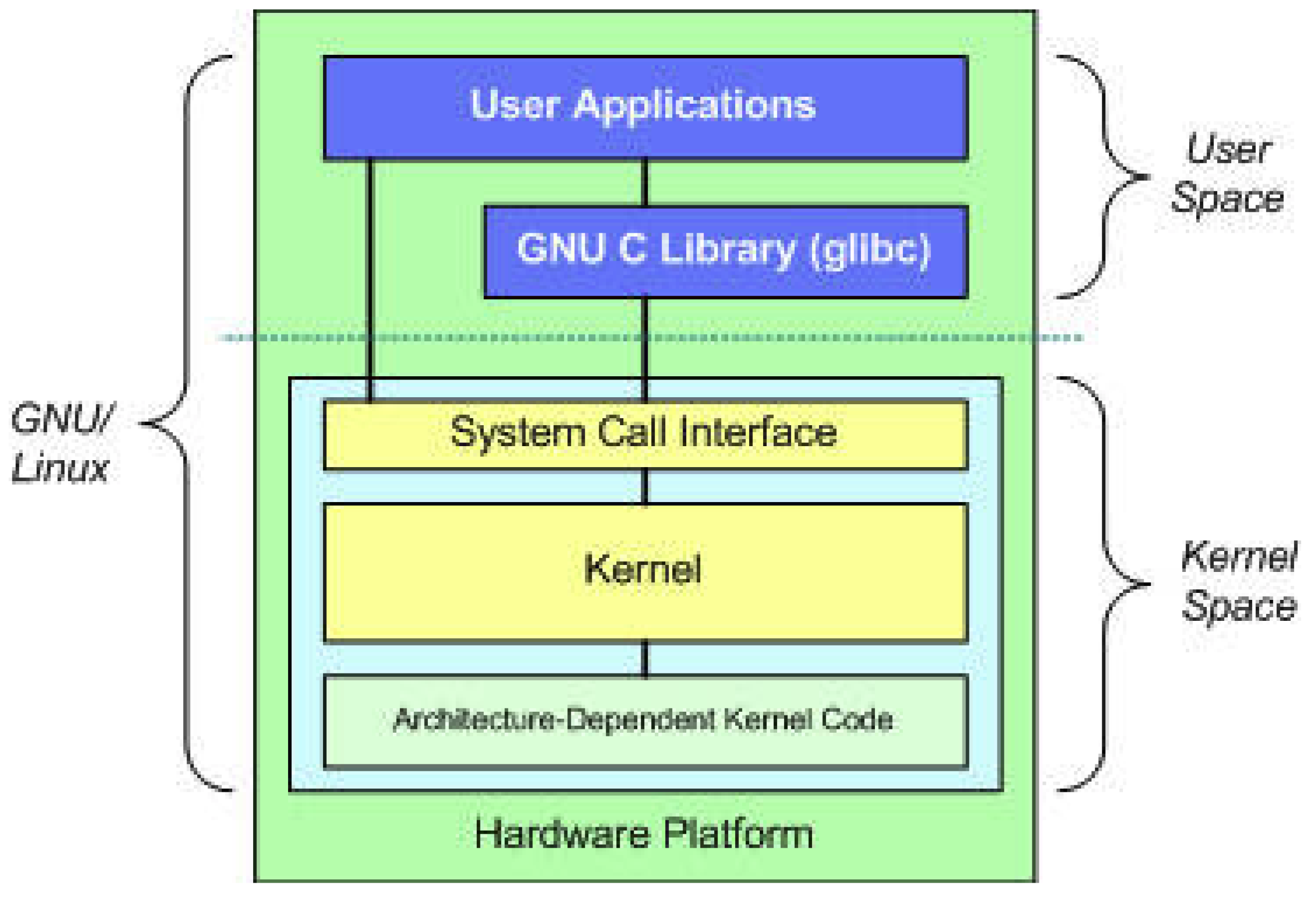
Figure 2.
Workflow of the proposed approach.
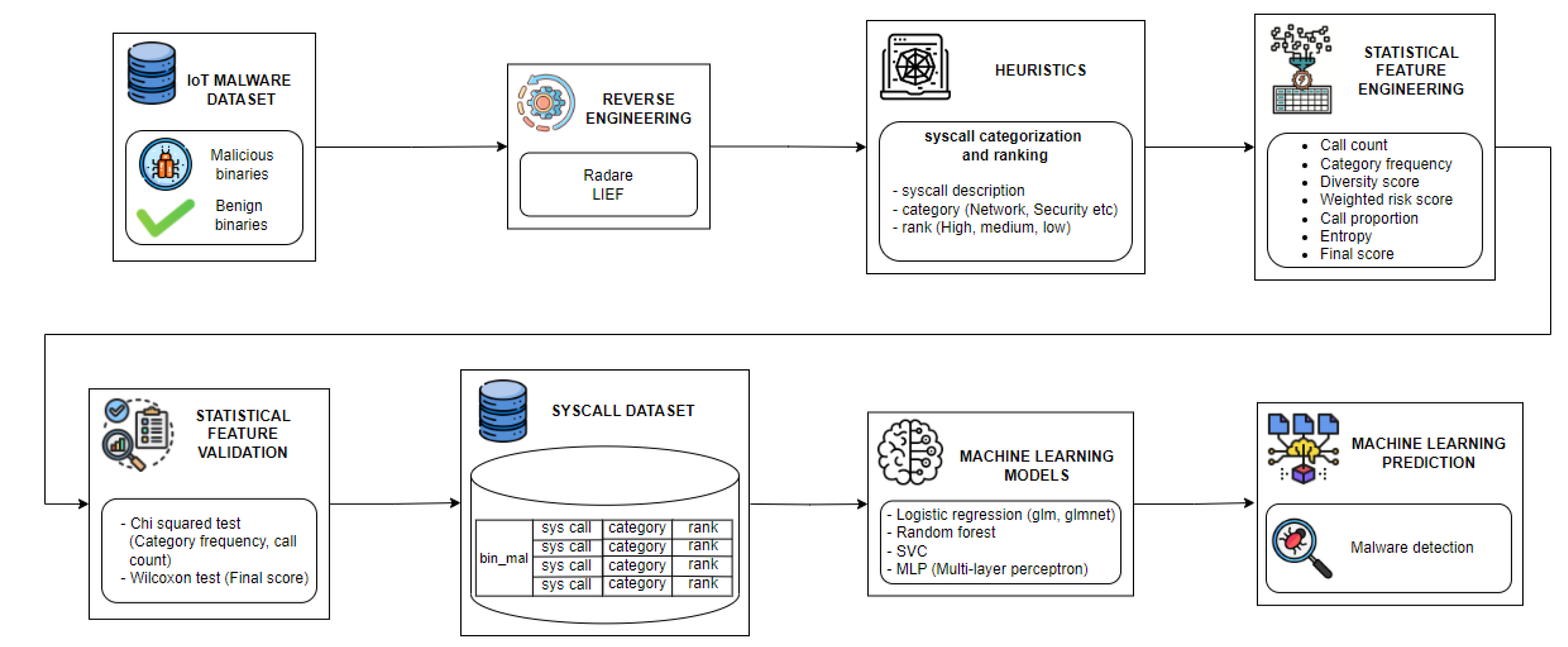
Figure 3.
Proportion of syscall category in Malware and Benign subsets
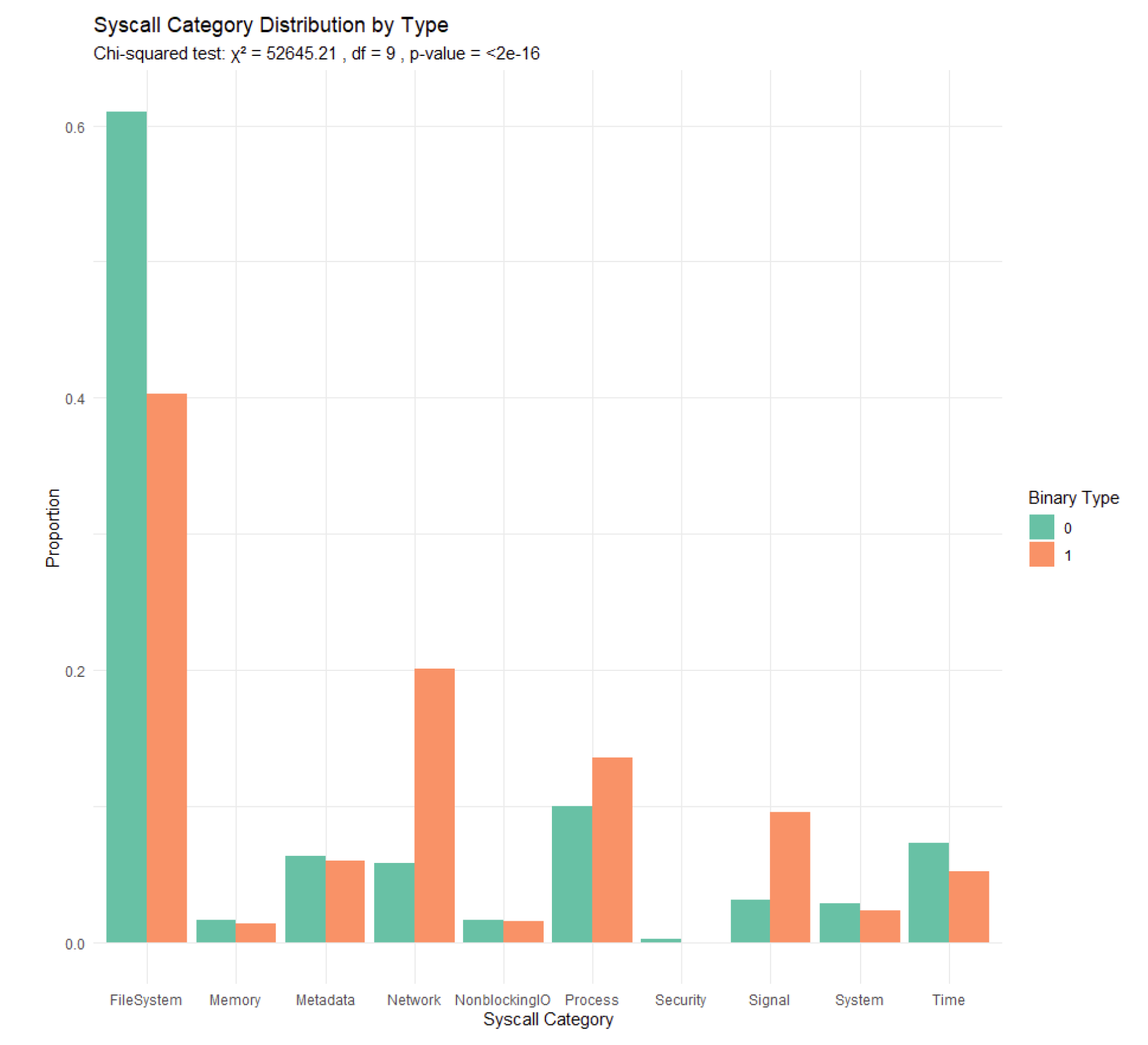
Figure 4.
Proportion of security risk ranking of Syscalls in Malware and Benign subsets
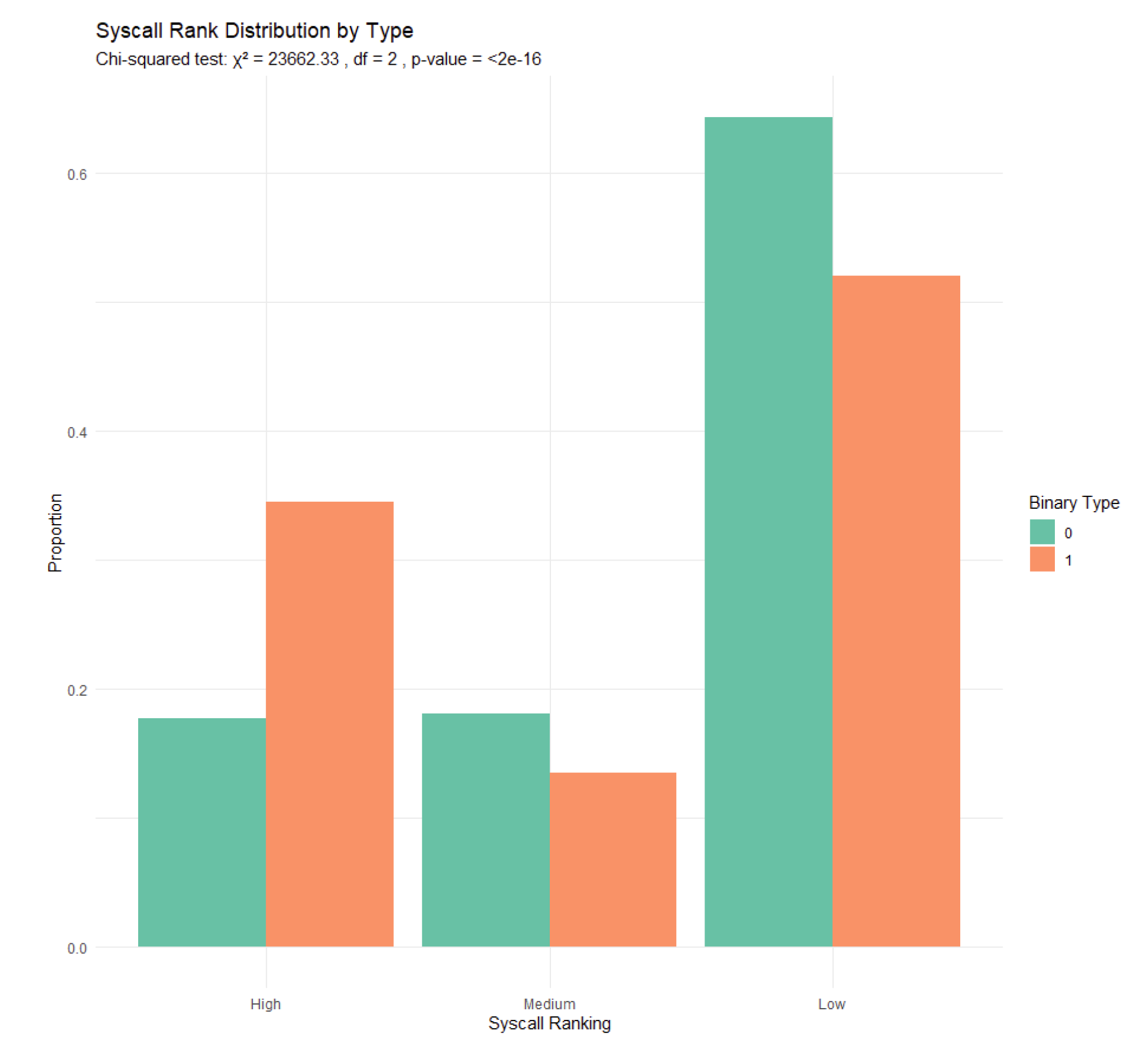
Figure 5.
Differences in final-score (Equation 4) between Malware and Benign subsets.
Figure 5.
Differences in final-score (Equation 4) between Malware and Benign subsets.
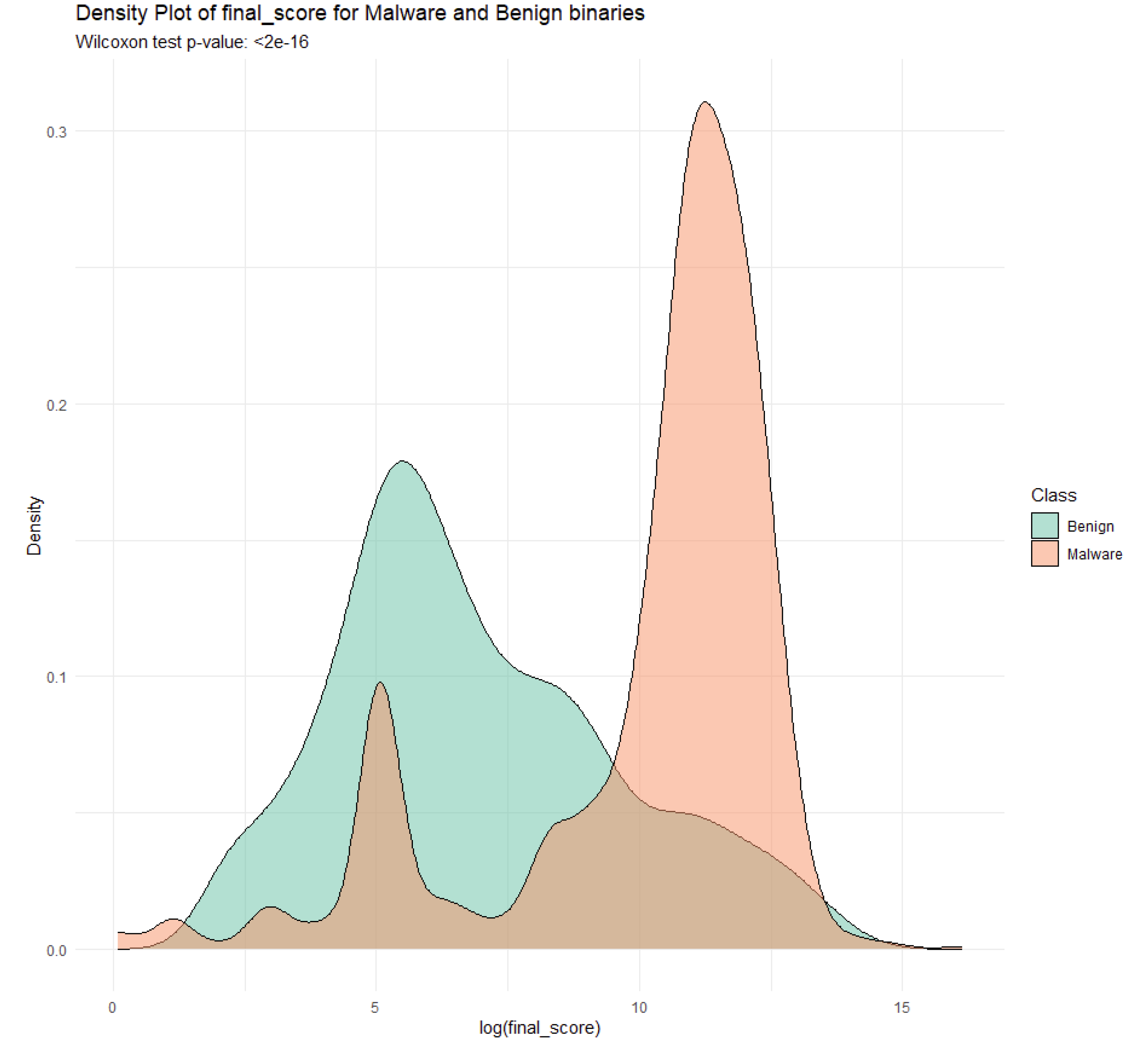
Figure 6.
Preprocessing pipeline
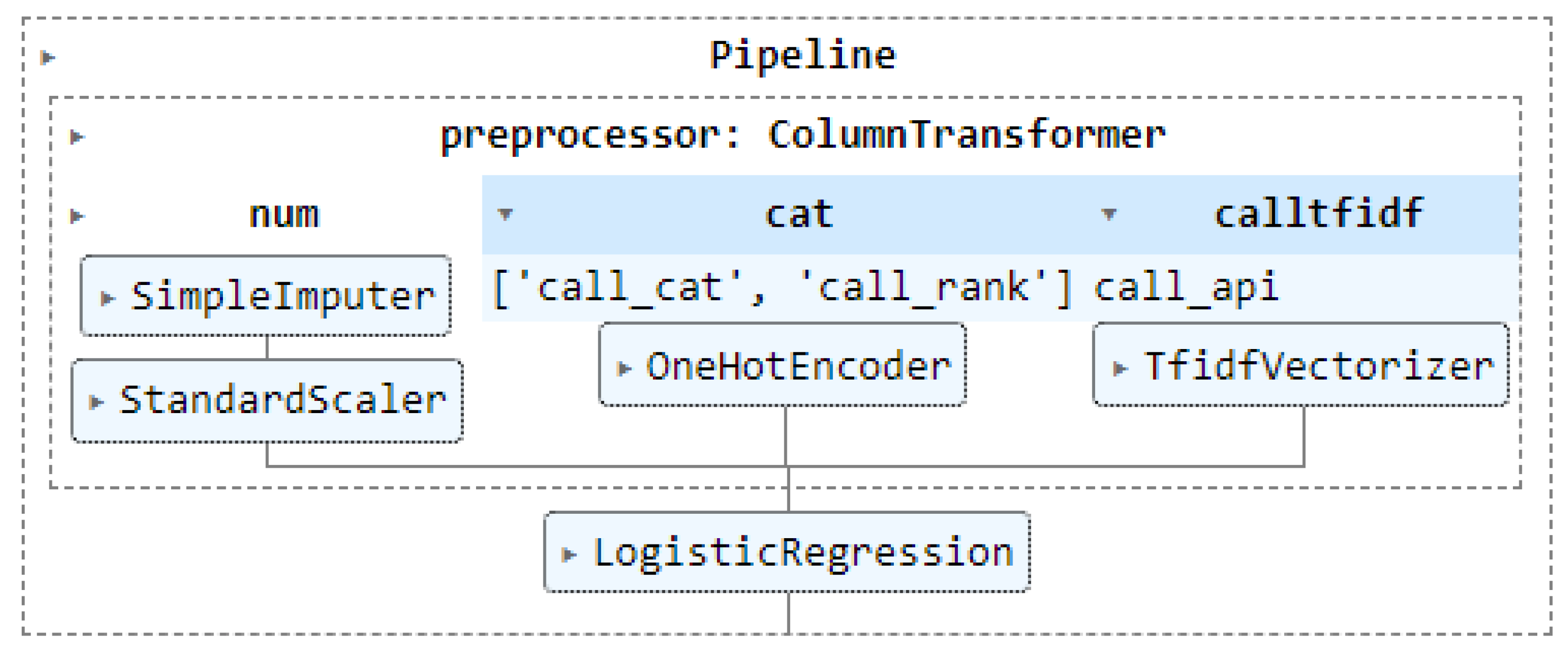
Table 2.
Counts of binary samples.
| Class | Binary Count | syscall Counts |
|---|---|---|
| Malware | 1,117 | 163,288 |
| Benign | 1,214 | 45,284 |
Table 4.
Description of the IoT Malware Syscall Analysis dataset.
| Dataset feature | Description |
|---|---|
| binary_id | Unique identifier for each binary |
| hash | Hash of the binary |
| Architecture | ARM - although our metholodolgy supports multiple architectures with binary lifting strategy |
| isMalware | Whether the binary is malicious or beningn |
| prc | 32-bit/64-bit |
| Endian | The endianess of the binary (LSB or MSB) |
| Stripped | Binary attributes indicating whether it is stripped of symbol information |
| call_api | Name of the syscall |
| call_desc | Description of the function of the syscall |
| call_type | syscall or lib (library syscall wrapper) |
| call_cat | Category of the syscall, Refer Table 3 |
| call_rank | Security risk level of the syscall based on its potential for malicious use (High, Medium, Low) |
| bin_all_call_cnt | Count of all the syscalls and lib calls in the binary |
| bin_dist_call_cnt | Count of the distinct syscalls and libcalls in the binary |
| bin_dist_cat_cnt | Count of each category of syscalls and libcalls |
| bin_each_api_cnt | Count of unique syscalls in the binary |
| bin_calls_per_cat | Number of calls per category in a binary |
| bin_dist_call_per_cat | Number of calls in each distinct category in a binary |
| call_rank_n | Number of syscalls in the binary with the current syscall rank |
| bin_calls_per_rank | Number of syscalls and libcalls in each rank per binary |
| std_dev_calls_per_cat | Standard deviation of the syscalls per category in a binary |
| mean_calls_per_cat | Mean of calls per category in a binary |
| average_rank | Average rank of the syscalls and libcalls in a binary |
| weighted_rank_score | Weight of the syscall, Refer Equation 1 |
| total_rank_score | Sum of all weighted rank scores across all syscalls in a binary, Refer Equation 2 |
| diversity_score | Unpredictability of the syscall ranks in the binary, Refer Equation 3 |
| final_score | Total rank score added to the diversity score, Refer Equation 4 |
| cat_concentration_index | Number of syscall categories in the binary (Unused) |
Table 5.
Performance metrics of machine learning models.
| Model | Accuracy | Precision | F1 Score |
|---|---|---|---|
| Random Forest | 93.34% | 94.71% | 96.86% |
| Logistic Regression | 92.34% | 96.0% | 95.06% |
| SVC | 92.48% | 96.16% | 95.14% |
| MLP NN | 92.07% | 93.34% | 95.03% |
Disclaimer/Publisher’s Note: The statements, opinions and data contained in all publications are solely those of the individual author(s) and contributor(s) and not of MDPI and/or the editor(s). MDPI and/or the editor(s) disclaim responsibility for any injury to people or property resulting from any ideas, methods, instructions or products referred to in the content. |
© 2024 by the authors. Licensee MDPI, Basel, Switzerland. This article is an open access article distributed under the terms and conditions of the Creative Commons Attribution (CC BY) license (http://creativecommons.org/licenses/by/4.0/).
Copyright: This open access article is published under a Creative Commons CC BY 4.0 license, which permit the free download, distribution, and reuse, provided that the author and preprint are cited in any reuse.


