

Submitted:
21 August 2024
Posted:
22 August 2024
You are already at the latest version
Abstract
Human-elephant conflict has become a conservation challenge in Asia and Africa resulting in considerable human fatalities annually. We deployed an AI-embedded camera-alert system in a conflict hotspot in West Bengal, India to determine if AI algorithms could accurately detect elephants and if real-time alerts that triggered a rapid response could prevent serious incidents. The system successfully detected elephants near villages (266 events) and transmitted real-time alerts (x̄ = 42 seconds) permitting quick response by field personnel to prevent conflict (x̄ = 18.2, SD = 12.4 min to arrival). Matriarch herds of elephants were detected mostly at night when human traffic was minimal; lone adult bulls, the class most prone to conflict, were detected day and night. Frequent detections of humans (33,217 events) on routes used by elephants highlighted the value of real-time monitoring especially during daytime. Twelve human fatalities and eighteen serious injuries occurred in the study area between 2019-2023 but none during deployment of the AI system, supporting the hypothesis that alerts integrated with rapid response can reduce conflict. Loss of lives and livelihoods underscore the urgency of applying this approach to other elephant ranges and adapting AI models to conflict-prone species to provide early warning and promote coexistence.
Keywords:
Human-Elephant Conflict
; Coexistence
; TrailGuard AI
; Real-time Alert
; Rapid Response
Introduction
Human-elephant conflict (HEC) has become one of the most acute problems facing wildlife managers and conservation researchers in Asia and Africa (Zimmerman et al., 2020; LaDue et al., 2021; Pandey et al., 2024). Where wild elephant populations persist in multi-use landscapes affected by extensive habitat loss, HEC has escalated to a crisis stage (Sampson et al., 2018; Schaffer et al., 2019; Gross et al., 2021; Matsuura et al., 2024). In both Asia and Africa, elephants are responsible for far more human deaths and injuries than any other mammal species, leading in many cases to public antagonism towards conservation efforts (Wakoli & Sitati, 2012; Goswami et al., 2014; Williams et al., 2020). In India alone, 1,579 human deaths have been recorded since 2019. Notably, during the same period, 490 elephant deaths due to unnatural causes were also reported (Choubey, 2023). The high rate of human fatalities caused by elephants (Natarajan et al., 2023; Singh et al., 2023; Pandey et al., 2024), and in some instances, retaliation killing, make solving or mitigating HEC a priority for state governments, often collaborating with local and global civil society organizations (Nayak & Swain, 2022; Pandey et al., 2024).
Efforts by researchers and managers to deter elephants from approaching human settlements have led to extensive field testing of various techniques, catalogued in field manuals for reducing HEC in Africa (King et al., 2022) and Asia (Project Elephant, Government of India & WWF-India, 2022). Such interventions include: excavation of trenches at village-forest boundaries; manual tracking with trained observers; use of manually or automatically triggered sound mechanisms (e.g., sirens, loud noises, and firecrackers); erection of fences (solar, bee hives, and spiny plants as a bio-fence); and fire used as a scare mechanism (Fernando et al., 2008; King et al., 2017; Neupane et al., 2018; Shaffer et al., 2019; Kamdar et al., 2022). However, the intelligence and extensive learning capabilities of elephants typically diminishes the effectiveness of such measures as elephants become habituated to existing deterrents (Nelson et al., 2003; Goodyear, 2015). Continued crop loss, loss of life and injuries, and other economic costs associated with HEC have led to the creation of compensation schemes (Jadhav & Barua, 2012; Mayberry et al., 2017; Terada et al., 2021). In many Asian countries, however, adequate compensation is often delayed, inadequate, or unavailable (DeMotts & Hoons, 2012; Gubbi, 2012; Chen et al., 2016; Guru & Das, 2021).
The emergence of new AI-based technologies can serve as force-multipliers to mitigate HEC if strategically placed sensors could accurately detect elephants and send real-time alerts to designated authorities. This integration would allow forest guards, organized as rapid response teams, to be deployed more effectively across conflict-prone areas before intrusions can escalate. The advantages would be even greater if: 1) the embedded-AI devices could be easily shifted in response to the wide-ranging movements of elephants; and 2) the AI could accurately detect elephants at night when visibility is poor, elephant activity is high, and encounters are most serious. Earlier, we successfully deployed an AI-embedded camera-alert system in one of India’s most important Tiger Conservation Landscapes (Kanha-Pench, Madhya Pradesh) and alerted village community representatives and forest rangers when tigers neared villages or grazing areas, thus keeping people and livestock safe (Dertien et al., 2023). Here, we report on use of a similar AI-embedded alert system deployed in an HEC hotspot in West Bengal, India to determine if such technology can lead to reduced conflict. Specifically, we hypothesized that: 1) elephants could be accurately identified by the AI during day or night; 2) elephants in human-dominated landscapes would avoid temporal overlap with humans by moving mostly at night time between natural habitats; and 3) real-time alerts of elephant movements could enable Rapid Response Teams (RRTs) to prevent conflicts from occurring and subsequent injuries.
Much of HEC in India, as elsewhere, can be attributed to humans occupying former elephant habitat in landscapes where elephant movements are largely unrestricted (Denninger-Snyder et al., 2019; Schaffer et al., 2019; Anoop et al., 2023; Singh et al., 2023). Even in conservation areas that are extensively fenced and insular, human-elephant coexistence—defined as a dynamic, but sustainable state in which elephants (and other wildlife) co-adapt to living in shared landscapes (Mekonen, 2020)—is the practical long-term conservation strategy. This preferred outcome applies to densely populated countries like India, which harbors over 60% of the extant populations of Asian wild elephants (Pandey et al., 2024). However, escalating human-wildlife conflict in unfenced regions threatens to undermine rewilding strategies now underway in many countries.
Collaborators and Study Area
This study was conducted in a multi-use landscape in a territorial forest division along the southern border of the Indian state of West Bengal between October 2023 – April 2024. This field effort was a collaboration among the West Bengal Forest Department (WBFD), the Japan International Cooperation Agency (JICA), Nightjar Technologies (as the technical partner) and RESOLVE (a non-profit, as the scientific partner) to provide real-time occurrence and movement data of elephants to relevant stakeholders living along the forest-village boundaries within the Jhargram Forest Division (Figure 1 inset). Permission to place camera-alerting systems was granted by the West Bengal Forest Department as all units were placed on forest department land. Forest department staff were major field collaborators in this study and represented among co-authors.
West Bengal supports a relatively small population of elephants (~700 individuals). Yet, like other states of the east-central region—Chhattisgarh, Jharkhand, and Odisha—conflict has resulted in a disproportionate loss of human lives (Figure 1) (Natarajan et al. 2023). The study area, the Jhargram Forest Division, epitomizes the problem: elephant habitat has been reduced to plantation-like forest islands, dominated by the native hardwood, sal (Shorea robusta), dispersed in a mosaic of human habitation. Jhargram district encompasses a geographical area of 3,100 km2; nearly 80% is under agriculture (~2,700 km2) and only 18% is covered by dry deciduous forests dominated by coppice crops of sal extending across 477 km2 and exotic monoculture over another 118 km2 (cumulatively 600 km2) (Mandal & Chatterjee 2021). Most of the 1.1 million people residing in Jhargram district are rural (97%) and a smaller fraction are urban dwellers (3%) (Chandramouli & General, 2011). Rural communities are composed of economically challenged scheduled castes and scheduled tribes (Santhal, Lodha, Sabar and Kheria), along with migrant populations from Odisha, Jharkhand, and Bihar (Figure 1). Most are subsistence farmers with small landholdings. Paddy (irrigated rice), lentils, mustard, maize, and vegetables are the main crops grown in the area. The dependence on forest resources includes fuelwood and the gathering of non-timber forest products such as the flowers of mahua (Madhuca latifolia), berries, and other edible species.
Jhargram’s Protected Forests category is divided into eight forest ranges. Sharing borders with the states of Jharkhand in the west, Odisha in the south, and the forest divisions of Kharagpur and Paschim Midnapore in the east and southeast, respectively, Jhargram links a larger elephant landscape that includes two elephant reserves (Singhbhum, in Jharkhand and Mayurjharna, in West Bengal) used by nearly 200 elephants (Singh et al. 2023). The study area is in a relatively dry region of the Chota-Nagpur plateau which experiences an annual water deficit. Yet, the presence of elephants in this larger landscape—particularly across the three districts of West Bengal—has increased eleven-fold since the 1950s (Singh et al. 2023). This population growth has increased interactions between humans and elephants across the entire Jhargram Forest division where 20-22 human deaths have been annually reported between 2021-2023.
Methods
Functioning of the TrailGuard AI Technology System
TrailGuard AI is a camera-alerting system that uses state-of-the-art machine learning algorithms to detect humans and wild animal species of interest and transmit detections in real time. The components include a camera unit with embedded AI to identify and filter objects of interest and connected to a communication unit equipped with a GSM-modem (or satellite) for real-time transmission of alerts to stakeholders. Only the cellular version of the system was used in this study. A more detailed description of the camera technology is presented in Dertien et al. (2023).
Senior staff of the WBFD stated guidelines for AI monitoring at the outset: 1) reduce the chances of elephants being “missed” when heading towards villages (i.e., going undetected, considered as false negatives); and 2) remove detections of humans using the same routes as elephants before transmission to end-users. The AI models and the monitoring protocol were adapted to address these concerns using a two-step process. First, AI inference was performed on the images by TrailGuard AI’s embedded computer vision chip; the AI algorithm can detect multiple classes including elephants and humans, which were the focus of this study, using a multi-class detector created by CVEDIA (CVEDIA.com). To address the problem of “missed detections” by the edge detector, we deliberately set the probability threshold for detecting the elephant output class to an extremely low level (0.20) to avoid any false negatives (missing the detection of elephants). Second, images with positive inferences were transmitted via the cellular network to the server, where an in-house trained model performed a second inference to: 1) independently verify and classify the object; and 2) filter out any remaining false positives before transmission to designated authorities (Figure 2). The advantage of edge-based AI is that only the output classes or single class required by the end-user will be transmitted and unneeded detected classes are stored for future analysis, but not sent (Figure 3a-h). Embedded AI also greatly prolongs battery life: cellular transmission of a 20-50KB image is about 20 times more costly than running inference on each trigger event so rejecting those that are blanks or of no value before transmission and shutting down the system immediately after inference saves greatly on power consumption.
To assess the reliability and capability of the AI-based models in detecting elephant presence, we calculated precision and recall for the output class for both the edge and server-based detectors. For the edge detector, we computed these statistics by analysing captured images and the respective inference results stored on the SD cards in each of the TrailGuard AI units deployed in the field (SM-Appendix 2). By substantially lowering the threshold value for the edge detector to 0.20 for the elephant output class, however, we deliberately designed or weighted our approach, under advisement from the WBFD, to favour high recall while potentially sacrificing precision. This decision reflected the need to detect approaching elephants in pitch darkness and against forest backgrounds where very low light and high noise might reduce the effectiveness of the AI. That up to 7,000 images can be transmitted over LTE on a single charge of the system’s battery supply allowed us to absorb additional false positives sent to the server without paying a penalty in power consumption.
Deployment of TrailGuard AI for Elephant Detection
The main focus of the deployment prioritized the prevention of conflict with humans which can occur at any time, rather than crop depredation, which is season-specific in the study area. To this end, thirty TrailGuard AI camera units were deployed in two phases between October and December 2023 in close coordination with WBFD staff. The camera units were placed on trails within forest department land used by elephants as confirmed in a reconnaissance phase by forest rangers and villagers (Figure S1, Appendix 1). These trails encompassed eight forest beats within four forest ranges of the study area. Monitoring began in early December 2023 and continued through April 2024. To enhance the performance of the motion sensor and the IR illuminator (for night operation) and thus the AI algorithm, TrailGuard AI units were placed within 10 m from the object moving along the trail. The AI algorithm is agnostic to the angle from which the object is detected; thus, we were able to elevate the placement of the units in trees, typically at a height of 7–10 m (Figure S2, Appendix 1). Elevating the camera and communications unit served three functions: enhanced gain of the antenna to improve signal strength; improved concealment to reduce detection of the system; and denying access to elephants as they are known to destroy camera traps set within reach of their trunks. To avoid frequent false triggers from humans, we attempted to locate camera-alert systems on narrow trails leading to larger trails or rights-of-way but still used by elephants as determined by spoor. The field deployment team included biologists from Nightjar Technologies and RESOLVE, local forest department staff members, Joint Forest Management Committee (JFMC) members, and local community members who helped in placing the camera systems elevated in trees.
Tests of Hypotheses
To test the first hypothesis on accuracy of the AI for elephant detections, we estimated the median detection probabilities for such detections during the study period. In order to test the AI filtering performance for non-target species, we estimated the number of false positives (detecting elephants when they were actually not present) and false negatives (inability to detect elephants when they were actually present) by the two-tiered filtering system from all detections across all locations.
To test our second hypothesis, we categorized elephant detections distributed across each forest beat in the study area. The detections were classified by temporal distribution and group composition. Temporal distribution was classified as a day-time detection (06:00-17:30 hours) or as a night-time detection (17:30 to 06:00 hours of the following day). For the purpose of this analysis, group composition was simplified as: a) lone bull; b) groups with bulls (>2 individuals that include bulls) and c) groups without bulls (>2 individuals that do not include bulls, essentially matriarch herds). We estimated the mean and standard deviations for the three group types separated temporally. Further, we used the Kruskal-Wallis test (Kruskal & Wallis, 1952), a non-parametric statistical test to assess the differences between the detections of group types across the temporal scale.
To test our third hypothesis, on assessing effectiveness of real-time elephant alerts to prevent conflict with humans, we compared the furnished records on human injuries and loss of human life as a baseline to evaluate any changes at the end of the study period. These statistics were computed for the same four-month sampling period (Dec-April) for four years, 2019-2020, 2020-2021, 2021-2022, and 2022-2023 defined as the pre-TrailGuard AI phase; the same interval (Dec-April), but in 2023-2024, was defined as the period of TrailGuard AI deployment. Additionally, we also compared the response time of the RRTs as the time of transmission for TrailGuard AI alerts relying on the traditional method of villagers relaying messages to forest department offices in the event of elephant incursions in locations where TrailGuard AI was not deployed. We computed the mean and standard deviation of the response times and compared it with the mean response times using traditional methods in the study area.
The advantages of real-time, AI-based alerts are maximized when images are transmitted to Rapid Response Teams (RRTs) stationed at strategic locations and alerts are integrated in the standard operating procedures (SOPs). This integration was discussed and implemented with forest staff prior to deployment (SM-Appendix 3).
To estimate the impact and value of resources allocated to rapid response, we first defined the effective area monitored by the TrailGuard AI camera-alert system. Specifically, we needed to determine the spatial extent accessible to rapid response teams upon receiving real-time alerts of elephant activity. The area of effective surveillance and response (hereafter AESR) was found to be influenced by three factors: 1) the average distance of guard posts where RRT teams were based from the site of deployment; 2) the mean response time of the RRTs upon receiving real-time elephant alerts (which can vary by season or road conditions); and 3) the estimated distance traversed by elephants in multi-use landscapes from the moment of detection to arrival of the RRT. Based on these variables, we calculated the AESR as a radial distance around the site where the TrailGuard AI camera-alert system was installed. These estimates were derived for the non-monsoon period when all roads were accessible and thus represent a maximum area of response. We assume that in other regions characterized by prolonged wet seasons or few access roads or during the summer monsoon, the AESR will encompass a smaller area and longer duration of response times. We defined response time of the RRT as the time elapsed between the receipt of the real-time alerts and the RRTs reaching the site of detection within the AESR. The time stamps reported by RRTs were entered into open data kit (ODK)-based web forms for elephant alerts, and the images on the server detecting the arrival of RRT members at the sites allowed accurate calculation of response times.
Results
Effective Detection of Elephants by AI
Total sampling effort across 30 camera units was 4,380 trap-nights, yielding 266 real-time alerts triggered by elephants (Figure 4). In support of our first hypothesis, the two-stage AI detector approach proved highly accurate: All the elephant detections exceeded the probability threshold (0.20) such that 100% of trigger events attributed to elephants were sent to the server. The elephants were detected with high median detection probability of 0.65 (Standard Error=0.02) for night time, and with an estimated median probability of 0.88 (SE=0.03) in the daytime. For the edge detector, the overall median probability of detection was estimated as 0.73 (SE=0.02).
Over the same interval, the TrailGuard AI alert system detected and filtered 33,217 human alerts from across all the sites by the edge detector. The detector on the server was even more accurate than the edge detector: only a small number of false positives of human alerts (N = 7; 0.02%) were transmitted to the end user. Transmission of other animal output classes in the model (i.e., domestic water buffaloes, cattle, wild boar, village dogs, wolves), when combined, accounted for only 27 events (0.08%) transmitted.
Temporal Classification of Real-Time Alerts for Elephants and Humans
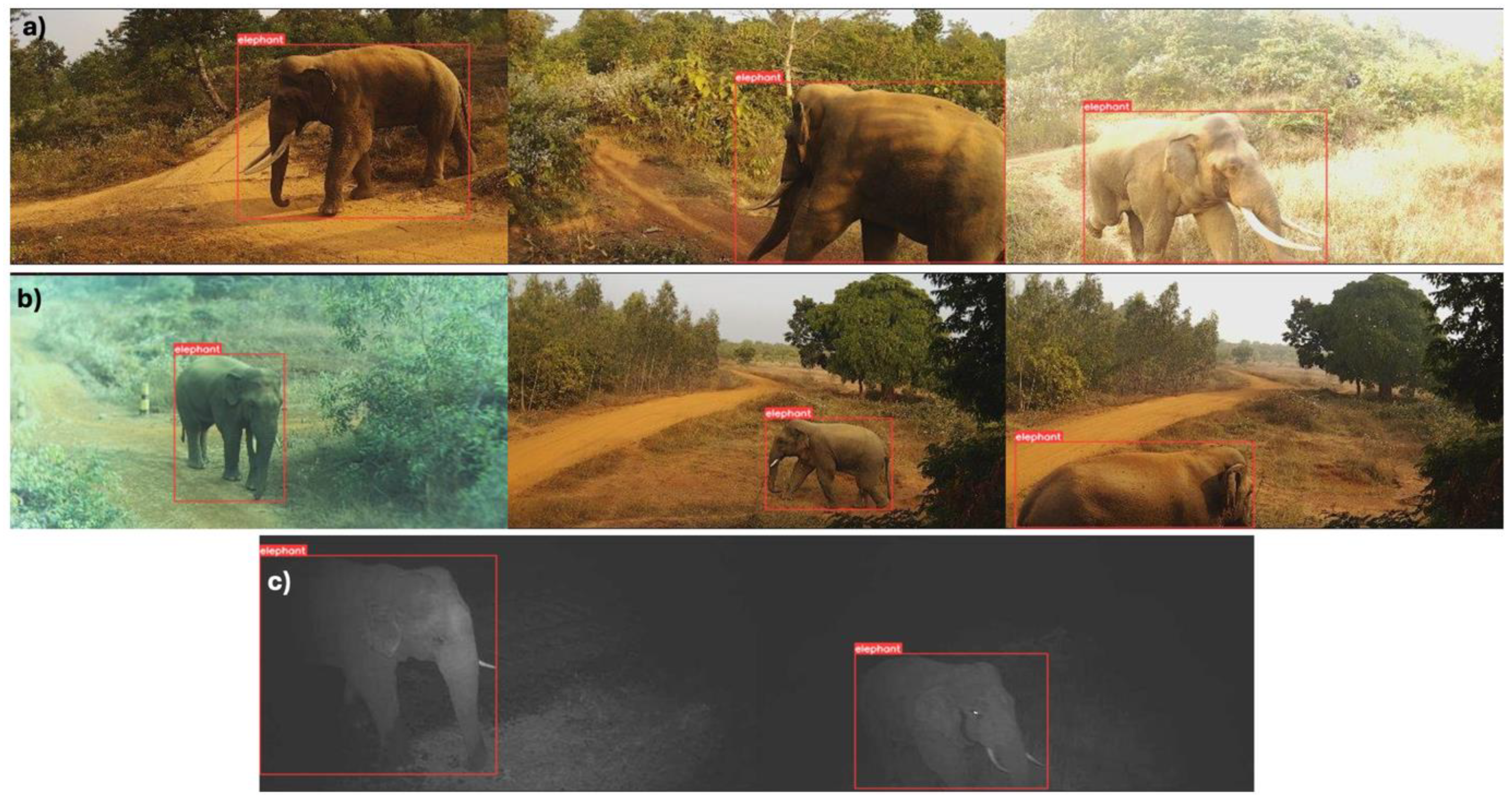
We recorded the majority of elephant detections in the night time (74.1%; n=197) and nearly 25.9% (n=69) during daytime. These data supported our second hypothesis, that overall, elephants shifted movements to night time to avoid interactions with humans. Further, when the data were disaggregated by sex and age, the lone bulls and groups with bulls were found to be active both in daylight and night-time. Groups without bulls were found to be more active in night time than in daylight but did not rise to the level of significance (p>0.05) (Figure 5a). Additionally, we identified 7-12 unique individual males in the study area, and recaptured three bulls on multiple occasions (Figure 6a-c).
Effect of the Technology on Reduction in Loss of Life and Injuries
Records on occurrence of human injuries are consistent with the hypothesis that introduction of the AI technology would result in a reduction of serious incidents. Before the deployment of TrailGuard AI, twelve human deaths and eighteen human injuries cumulatively were reported between December and April for pre-TrailGuard years (2019-2023) in the four ranges that formed the core study area. In comparison, after the deployment of TrailGuard AI, no human deaths and injuries were reported from the same period in 2023-2024 in the Area of Effective Surveillance and Response (AESR).
The real-time elephant alerts, received by primary recipients as push notifications, averaged 42 seconds elapsed time from trigger of the camera to receipt in a smart phone app. Also, in support of our third hypothesis, that real-time information on elephant movement significantly reduced the response time of RRTs and negative incidents, we calculated this interval of RRT to be x̄=18.2 minutes (SD = 12.4 minutes, range = 6-31 minutes) (Figure 5b). The mean interval in previous years prior to introduction of the camera-alerting system was x̄= 178 minutes (SD = 120 minutes, range = 58-298 minutes). More importantly, the slow dissemination of information from local communities to rangers of elephant activity made preventative action by RRTs unlikely.
The average distance of RRT stations from the TrailGuard AI deployment site was measured as 3.5 km and estimate of distance traversed by elephants in multi-use landscapes, beyond the boundaries of protected areas, was estimated to be 1-3 km/18.2 min (Srinivasaiah et al. 2012). Based on these variables, we determined the AESR to be a radial distance of 4-5 km around the site where the TrailGuard AI camera-alert system was installed.
RRTs responded to 40% of the elephant alerts within the AESR; these interventions occurred where there was a clear indication that elephants were approaching village boundaries. For 60% of the alerts within the AESR, rangers discerned by location and the direction of elephant movement that the individual or herd was transitioning between forest patches and avoiding village areas, and that no field intervention was necessary.
Discussion
The Role of AI-Based, Real-Time Alerts, and Rapid Response in Reducing Human-Elephant Conflict
This study demonstrates the potential for AI-embedded alerting systems to be part of the toolbox for mitigating HEC. Detections in this study represent the first-ever edge-based, AI-filtered, real-time alerts of wild Asian elephants with high accuracy. By receiving alerts in under a minute and obtaining the direction of movement of the individual(s), rapid response teams gained the situational awareness to determine where interventions were needed and, as importantly, where a response was deemed unnecessary, thus saving on resources. Second, the ability to distinguish lone bulls from herds and monitor their movements allowed field officials to allocate resources more effectively. RRTs initiated measures such as blocking trails and forest roads from human use until elephants crossed to the adjacent forest or were scared away using loud noises of human groups. Third, in support of our hypothesis that the real-time alerting system could improve efficiencies and reduce conflict, introduction of the technology effectively reduced the delay between the appearance of elephants in village areas and when rangers received reports, a reduction from 4-5 hours to an average of 18 minutes. Of utmost importance, there were no injuries or fatalities in the six months within the Area of Effective Surveillance and Response (AESR) when the TrailGuard AI system was in the field compared to 18 injuries and 12 deaths in the previous four years in the same locations. Fourth, by adding three layers of alerts—from the senior forest department officials to the forest beat-level office—a method for improved transparency was introduced to track the response of department staff. Finally, the capability of the system to filter out transmission of virtually all images of humans, in this use-case where such transmission was deemed a distraction, saved greatly on battery life.
The role of India’s Wildlife Landscapes for Testing New Technologies to Promote Coexistence
India’s natural landscapes that reconcile human welfare and conservation of charismatic large mammals also suffers high levels of human-wildlife conflict (HWC) thus undermining coexistence. India holds 60% each of the world’s population of tigers and elephants, more than all other Asian nations combined. The problems of HWC are particularly acute and generate national news when human fatalities occur, such as from train collisions with elephants, wildlife-related human deaths, and livestock depredations by charismatic large carnivores. The challenges are exacerbated due to high rural population densities bordering tiger and elephant reserves and the large numbers of subsistence farmers whose crops and livestock are subject to depredation by wildlife (Dertien et al. 2023). Thus, there is great urgency to minimize this problem while continuing the remarkable recovery of endangered large mammal populations in India—a rewilding—that India has witnessed over the past 20 years. The TrailGuard AI technology is one such example that serves multiple use-cases, acting as an early-warning system to prevent HWC and as a force-multiplier for forest rangers assigned to cover large areas where wide-ranging mammals such as elephants and tigers roam through buffer zones that border villages (Kshettry et al., 2020; Warrier et al., 2020; Dertien et al. 2023). The expanding 4G coverage along forest-village boundaries in rural India greatly enhances the potential of systems such as TrailGuard AI where real-time information on wildlife movements can help reduce negative interactions. The next challenge is to drive down the costs of optical sensors with embedded AI—through increases in volume of production, emergence of cheaper components, and government support—to make them ubiquitous in areas of conflict and monitor wildlife movements most effectively.
Another major advance in technology to reduce HWC is to couple AI-detection with autonomous, real-time deterrence. This development will require technologists working closely with wildlife managers, animal behaviorists, and other scientists to devise species-specific deterrence strategies for conflict-prone species. Some interesting possibilities might include testing the potential of predator (tiger) scents to deter Asiatic elephants upon the detection of the mega-herbivores by TrailGuard AI; olfactory deterrents using the scent of lions have been successfully tested on captive African elephants (Valenta et al., 2021). The vast research on acoustic systems can offer integration of automated sound deterrents with TrailGuard AI where sounds of predators or high pitch sounds of people talking in the vernacular language could be triggered upon detection of a conflict-prone species (Dampage et al., 2021). Where permitted, the integration of drone swarms with embedded AI to be launched upon detection by TrailGuard AI of intruding wildlife could deter elephants from entering croplands. At least African elephants seem not to habituate to the frequencies of drone propellers (Hahn et al., 2017). The commitment of monitoring endangered wildlife in India occurs at scales exceeding most countries in terms of investment and level of effort as witnessed by the all-India tiger census using thousands of camera traps (Qureshi et al. 2023). The key to successful scaling of these technologies globally will be largely determined by three features: low cost, ease-of-use, and durability.
From Reducing Conflict to Promoting Coexistence
Where elephant populations have recovered from episodes of ivory poaching due to enhanced surveillance, crime investigation, and prosecution of habitual offenders, there is a paradigm shift in focus from intensive protection to managing conflict and preventing retaliation (Graham et al. 2009; Gubbi et al. 2014; Goswami & Vasudev, 2017). Although 5% of India is covered by protected areas, single reserves are often not large enough to support viable populations of large area-sensitive mammals, which would require a metapopulation approach to conservation by facilitating dispersal. This finding is as true for tigers as it is for elephants across their range (Wikramanayake et al. 2011). For elephants and other wide-ranging large mammal species occupying landscapes that encompass multiple-use areas, human habitations, and agricultural areas, it is essential that corridors connecting source and satellite populations receive formal protection. In this regard, working closely with local communities to foster coexistence with wildlife is key to facilitate dispersal and recolonization of former habitats (Vasudev et al. 2023). Huang et al. (2024) showed that the stabilization of elephant populations in southern and eastern Africa was in part due to the presence of wildlife corridors that allowed elephants to disperse. The AI-based monitoring technology that we present here can also be used to monitor elephant movements through regional and local corridors. For example, in our study area, the elephants in the Jhargram forest division move into the neighboring states of Jharkhand to the west and Odisha to the south multiple times per year (Figure S1, Appendix 1) (Singh et al. 2023). The same phenomenon is true in other strongholds of the Asian elephant’s range in India and regionally where important forest reserves occur along state or national boundaries and elephants move across them (e.g., transboundary movement across Nepal and India (Naha et al. 2019; Ram et al. 2022)).
Further, our results on identification of individual elephants using a combination of TrailGuard AI and human intelligence has immense potential for conservation practitioners (Karczmarski et al. 2022). Training and testing out AI models with the capabilities to send out individual-animal specific alerts can be used by forest department staff in order to manage their limited financial resources for conflict mitigation in an effective manner. Thus, a sufficient density of strategically located camera-alert systems such as TrailGuard AI, can both monitor elephant movement near villages or in buffer zones and simultaneously maintain an image dossier of conflict-prone bull elephants, and trigger rapid response where necessary compare favourably to the costs associated with radio-collaring problem individuals (SM-Appendix 4).
In conclusion, AI technology, when applied appropriately to achieve a social good, can have important benefits for people and elephants. The ability of AI algorithms to detect the most common conflict-prone species and send real-time alerts, as shown in this study, offers promise for a future of coexistence and rewilding when applied to such species in other regions of the world.
Supplementary Materials
The following supporting information can be downloaded at the website of this paper posted on Preprints.org.
Author Contribution Statement
Sankarshan Rastogi: Conceptualization, Methodology, Field Investigation, Data Curation, Formal Analysis, Visualization, Validation, Writing – Original Draft Preparation, Writing – Review and Editing, Validation; Sumana Bhattacharyya and Kumar Vimal: Conceptualization, Methodology, Data Curation Resources, Writing – Reviewing and Editing; Piyush Yadav and Himmat Singh Negi: Conceptualization, Methodology, Field Investigation, Writing – Review and Editing; Eric Dinerstein: Conceptualization, Methodology, Supervision, Validation, Writing – Original Draft Preparation, Writing – Review and Editing; Andy Lee: Conceptualization, Methodology, Funding Acquisition, Project Administration, Visualization, Writing – Original Draft Preparation, Writing – Review and Editing, Validation; Wajid Ali Shah: Methodology, Field Investigation, Writing – Review & Editing; Yushi Nagano and Sasaki Hirari: Conceptualization, Methodology, Funding Acquisition, Validation, Writing – Review & Editing; Steve Gulick: Conceptualization, Software, Writing – Review & Editing
Data Availability Statement
The data that support the findings of this study are available on request from the lead author, SR.
Acknowledgments
We thank the staff of the West Bengal Forest Department and JICA for making this project possible. We also acknowledge the Divisional Forest Officer, Additional Divisional Forest Officer, and Range Officers from the Jhargram Forest Division for their field work support, and to residents and village groups for their participation and knowledge sharing. We acknowledge Mohit Khillari, Goutam Rana, Harish, and others for their valuable assistance in deploying the TrailGuard camera system. Funding for this project was provided by JICA, with support from the Amar Foundation, SeaDream Foundation, and the Weeden Family Foundation. We also thank C. Vynne, N. R. Hahn, S. Pimm, P. Leimgruber, R. Huang, R. Guldemond, C. Thouless, L. King, and N. Lakshminarayanan for their feedback on the manuscript.
Conflict of Interest Statement
SR, ED, AL, WAS, and SG are affiliated to Nightjar; PY and HSN are affiliated to Nightjar Technologies. Both entities develop and manufacture TrailGuard AI.
References
- Anoop, N. R., Krishnan, S., & Ganesh, T. (2023). Elephants in the farm–changing temporal and seasonal patterns of human-elephant interactions in a forest-agriculture matrix in the Western Ghats, India. Frontiers in Conservation Science, 4, 1142325. [CrossRef]
- Chandramouli, C., & General, R. (2011). Census of India 2011. Provisional Population Totals. New Delhi: Government of India, 409-413.
- Chen, P., Gao, Y., Lee, A. T., Cering, L., Shi, K., & Clark, S. G. (2016). Human–carnivore coexistence in Qomolangma (Mt. Everest) nature reserve, China: patterns and compensation. Biological Conservation, 197, 18-26.
- Choubey, A.K. (2023). Response to unstarred question no. 06 in Lok Sabha. Ministry of Environment, Forest & Climate Change, Government of India.
- Dampage, U., Thajudeen, R., Jasenthuliyana, S., & Jayawardena, J. (2021). Automated virtual elephant fence based on detection, alarming, and coordinated redirection of wild elephants. Environmental Monitoring and Assessment, 193, 1-14. [CrossRef]
- DeMotts, R., & Hoon, P. (2012). Whose elephants? Conserving, compensating, and competing in northern Botswana. Society & Natural Resources, 25(9), 837-851. [CrossRef]
- Denninger-Snyder, K., Mneney, P., Benjamin, B., Mkilindi, P., Mbise, N., 2019. Seasonal and spatial vulnerability to agricultural damage by elephants in the western Serengeti, Tanzania. Oryx 1–11. [CrossRef]
- Dertien, J.S., Negi, H., Dinerstein, E., Krishnamurthy, R., Negi, H.S., Gopal, R., Gulick, S., Pathak, S.K., Kapoor, M., Yadav, P. and Benitez, M., (2023). Mitigating human–wildlife conflict and monitoring endangered tigers using a real-time camera-based alert system. BioScience, 73(10), pp.748-757. [CrossRef]
- Fernando, P., Kumar, M. A., Williams, A. C., Wikramanayake, E., Aziz, T., & Singh, S. M. (2008). Review of human-elephant conflict mitigation measures practiced in South Asia (pp. 19-20). Gland, Switzerland: WWF.
- Goodyear, S. E. (2015). Habituation to auditory stimuli by captive African elephants (Loxodonta africana). [CrossRef]
- Goswami, V. R., & Vasudev, D. (2017). Triage of conservation needs: the juxtaposition of conflict mitigation and connectivity considerations in heterogeneous, human-dominated landscapes. Frontiers in Ecology and Evolution, 4, 144. [CrossRef]
- Goswami, V. R., Vasudev, D., & Oli, M. K. (2014). The importance of conflict-induced mortality for conservation planning in areas of human–elephant co-occurrence. Biological Conservation, 176, 191-198. [CrossRef]
- Graham, M. D., Douglas-Hamilton, I., Adams, W. M., & Lee, P. C. (2009). The movement of African elephants in a human-dominated land-use mosaic. Animal conservation, 12(5), 445-455.
- Gross, E. M., Lahkar, B. P., Subedi, N., Nyirenda, V. R., Klebelsberg, E., & Jakoby, O. (2021). Elephants in the village: Causes and consequences of property damage in Asia and Africa. Conservation Science and Practice, 3(2), e343. [CrossRef]
- Gubbi, S. (2012). Patterns and correlates of human–elephant conflict around a south Indian reserve. Biological Conservation, 148(1), 88-95. [CrossRef]
- Gubbi, S., Swaminath, M. H., Poornesha, H. C., Bhat, R., & Raghunath, R. (2014). An elephantine challenge: human–elephant conflict distribution in the largest Asian elephant population, southern India. Biodiversity and conservation, 23, 633-647.
- Guru, B. K., & Das, A. (2021). Cost of human-elephant conflict and perceptions of compensation: evidence from Odisha, India. Journal of Environmental Planning and Management, 64(10), 1770-1794. [CrossRef]
- Hahn, N., Mwakatobe, A., Konuche, J., de Souza, N., Keyyu, J., Goss, M., Chang’a, A., Palminteri, S., Dinerstein, E. and Olson, D., 2017. Unmanned aerial vehicles mitigate human–elephant conflict on the borders of Tanzanian Parks: a case study. Oryx, 51(3), pp.513-516. [CrossRef]
- Hahn, N.R., Wall, J., Denninger-Snyder, K., Goss, M., Sairowua, W., Mbise, N., Estes, A.B., Ndambuki, S., Mjingo, E.E., Douglas-Hamiliton, I. and Wittemyer, G., (2022). Risk perception and tolerance shape variation in agricultural use for a transboundary elephant population. Journal of Animal Ecology, 91(1), pp.112-123. [CrossRef]
- Huang, R. M., Maré, C., Guldemond, R. A., Pimm, S. L., & Van Aarde, R. J. (2024). Protecting and connecting landscapes stabilizes populations of the Endangered savannah elephant. Science Advances, 10(1), eadk2896. [CrossRef]
- Jadhav, S., & Barua, M. (2012). The Elephant Vanishes: Impact of human–elephant conflict on people’s wellbeing. Health & place, 18(6), 1356-1365.
- Kamdar, A., Baishya, H. K., Nagendra, H., Ratnam, J., Smith, D., & Sekar, N. (2022). Human–elephant conflict mitigation as a public good: what determines fence maintenance? Ecology and Society, 27(3).
- Karczmarski, L., Chan, S. C., Chui, S. Y., & Cameron, E. Z. (2022). Individual identification and photographic techniques in mammalian ecological and behavioural research—Part 2: Field studies and applications. Mammalian Biology, 102(4), 1047-1054. [CrossRef]
- King, L. E., Lala, F., Nzumu, H., Mwambingu, E., & Douglas-Hamilton, I. (2017). Beehive fences as a multidimensional conflict-mitigation tool for farmers coexisting with elephants. Conservation Biology, 31(4), 743-752. [CrossRef]
- King, L., Raja, N., Kumar, M., Heath, N., & Pope, F. (2022). Part I: Development of a new Human-Elephant Coexistence Toolbox for communities living with African savannah elephants (Loxodonta Africana). Pachyderm, 63, 153-157.
- Kruskal, W. H., & Wallis, W. A. (1952). Use of ranks in one-criterion variance analysis. Journal of the American statistical Association, 47(260), 583-621.
- Kshettry, A., Vaidyanathan, S., Sukumar, R., & Athreya, V. (2020). Looking beyond protected areas: Identifying conservation compatible landscapes in agro-forest mosaics in north-eastern India. Global ecology and conservation, 22, e00905. [CrossRef]
- LaDue, C. A., Eranda, I., Jayasinghe, C., & Vandercone, R. P. (2021). Mortality patterns of Asian elephants in a region of human–elephant conflict. The Journal of Wildlife Management, 85(4), 794-802. [CrossRef]
- Mandal, M., & Chatterjee, N. D. (2021). Forest landscape and its ecological quality: A stepwise spatiotemporal evaluation through patch-matrix model in Jhargram District, West Bengal State, India. Regional Sustainability, 2(2), 164-176.
- Matsuura, N., Nomoto, M., Terada, S., Yobo, C. M., Memiaghe, H. R., & Moussavou, G. M. (2024). Human-elephant conflict in the African rainforest landscape: crop-raiding situations and damage mitigation strategies in rural Gabon. Frontiers in Conservation Science, 5, 1356174. [CrossRef]
- Mayberry, A. L., Hovorka, A. J., & Evans, K. E. (2017). Well-being impacts of human-elephant conflict in Khumaga, Botswana: exploring visible and hidden dimensions. Conservation and Society, 15(3), 280-291. [CrossRef]
- Mekonen, S. (2020). Coexistence between human and wildlife: the nature, causes and mitigations of human wildlife conflict around Bale Mountains National Park, Southeast Ethiopia. BMC ecology, 20(1), 51. [CrossRef]
- Naha, D., Sathyakumar, S., Dash, S., Chettri, A., & Rawat, G. S. (2019). Assessment and prediction of spatial patterns of human-elephant conflicts in changing land cover scenarios of a human-dominated landscape in North Bengal. PloS one, 14(2), e0210580. [CrossRef]
- Natarajan, L., Nigam, P., & Pandav, B. (2023). Impacts of passive elephant rewilding: assessment of human fatalities in India. Environmental Conservation, 50(3), 186-191. [CrossRef]
- Nayak, M., & Swain, P. K. (2022). From fear to festivity: Multi-stakeholder perspectives on human-elephant conflict and coexistence in India. Journal of Public Affairs, 22(2), e2496.
- Nelson, A., Bidwell, P., & Sillero-Zubiri, C. (2003). A review of human-elephant conflict management strategies. People & Wildlife, A Wildlife Conservation Research Unit, Born Free Foundation Partnership.
- Neupane, B., Budhathoki, S., & Khatiwoda, B. (2018). Human-elephant conflict and mitigation measures in Jhapa District, Nepal. Journal of Forest and Livelihood, 16(1), 103-112. [CrossRef]
- Pandey, R. K., Yadav, S. P., Selvan, K. M., Natarajan, L., & Nigam, P. (2024). Elephant conservation in India: Striking a balance between coexistence and conflicts. Integrative Conservation. [CrossRef]
- Project Elephant, Government of India & WWF-India (2022) Yadav, S.P. & Pandey, R.K. (Eds.) Field manual for managing human-elephant conflict. New Delhi, India: WWF-India and Project Elephant, Government of India.
- Project Elephant, Government of India. (2020) Status and distribution of elephants in India. New Delhi, India: Ministry of Environment, Forest, and Climate Change, Government of India.
- Qureshi, Q., Jhala, Y. V., Yadav, S. P., & Mallick, A. (eds) (2023). Status of tigers, co-predators and prey in India, (2022). National Tiger Conservation Authority, Government of India, New Delhi, and Wildlife Institute of India, Dehradun.
- R Core Team (2023). R: A language and environment for statistical computing. R Foundation for Statistical Computing, Vienna, Austria. URL https://www.R-project.org/.
- Ram, A.K., Yadav, N.K., Subedi, N., Pandav, B., Mondol, S., Khanal, B., Kharal, D.K., Acharya, H.B., Dhakal, B.K., Acharya, K.P. and Baral, H.S. (2022). Landscape predictors of human elephant conflicts in Chure Terai Madhesh Landscape of Nepal. Environmental Challenges, 7, p.100458. [CrossRef]
- Sampson, C., McEvoy, J., Oo, Z.M., Chit, A.M., Chan, A.N., Tonkyn, D., Soe, P., Songer, M., Williams, A.C., Reisinger, K. and Wittemyer, G. (2018). New elephant crisis in Asia—Early warning signs from Myanmar. PLoS One, 13(3), p.e0194113. [CrossRef]
- Schaffer, L.J., Khadka, K.K., Van Den Hoek, J., Naithani, K.J., (2019). Human-Elephant Conflict: A Review of Current Management Strategies and Future Directions. Front. Ecol. Evol. 6, 235. [CrossRef]
- Singh, A., Kumara, H. N., Mahato, S., & Velankar, A. D. (2023). Anthropogenic driven range expansion of Asian elephant Elephas maximus in an agricultural landscape and its consequences in South West Bengal, India. Journal for Nature Conservation, 73, 126374. [CrossRef]
- Srinivasaiah, N. M., Anand, V. D., Vaidyanathan, S. & Sinha, A. (2012). Usual populations, unusual individuals: Insights into the behavior and management of Asian elephants in fragmented landscapes. PLoS ONE 7, e42571. [CrossRef]
- Terada, S., Yobo, C. M., Moussavou, G. M., & Matsuura, N. (2021). Human-elephant conflict around Moukalaba-Doudou National Park in Gabon: Socioeconomic changes and effects of conservation projects on local tolerance. Tropical Conservation Science, 14, 19400829211026775. [CrossRef]
- Valenta, K., Schmitt, M. H., Ayasse, M., & Nevo, O. (2021). The sensory ecology of fear: African elephants show aversion to olfactory predator signals. Conservation Science and Practice, 3(2), e333.
- Vasudev, D., Fletcher Jr, R. J., Srinivas, N., Marx, A. J., & Goswami, V. R. (2023). Mapping the connectivity–conflict interface to inform conservation. Proceedings of the National Academy of Sciences, 120(1), e2211482119.
- Wakoli, E. N., & Sitati, N. (2012). Analysis of temporal and distribution patterns of elephant attacks on humans and elephant mortality in Transmara District, Kenya. Greener Journal of Environment Management and Public Safety, 1(1), 27-37. [CrossRef]
- Warrier, R., Noon, B. R., & Bailey, L. (2020). Agricultural lands offer seasonal habitats to tigers in a human-dominated and fragmented landscape in India. Ecosphere, 11(7), e03080. [CrossRef]
- Wikramanayake, E., Dinerstein, E., Seidensticker, J., Lumpkin, S., Pandav, B., Shrestha, M., Mishra, H., Ballou, J., Johnsingh, A.J.T., Chestin, I. and Sunarto, S., (2011). A landscape-based conservation strategy to double the wild tiger population. Conservation Letters, 4(3), pp.219-227. [CrossRef]
- Williams, C., Tiwari, S.K., Goswami, V.R., De Silva, S., Kumar, A., Baskaran, N., Yoganand, K. and Menon, V. (2020). Elephas maximus. The IUCN red list of threatened species 2020: e. T7140A45818198. Retrieved, 12, p.2021.
- Zimmermann, A., McQuinn, B., & Macdonald, D. W. (2020). Levels of conflict over wildlife: Understanding and addressing the right problem. Conservation Science and Practice, 2(10), e259. [CrossRef]
Figure 1.
Spatial distribution of wild Asian elephant populations (orange polygons) distributed among 24 states in India (data from Government of India’s 2017 Elephant population census). The study area in the state of West Bengal, the Jhargram forest division, bordering the state of Jharkhand, is shown in the inset map.
Figure 1.
Spatial distribution of wild Asian elephant populations (orange polygons) distributed among 24 states in India (data from Government of India’s 2017 Elephant population census). The study area in the state of West Bengal, the Jhargram forest division, bordering the state of Jharkhand, is shown in the inset map.
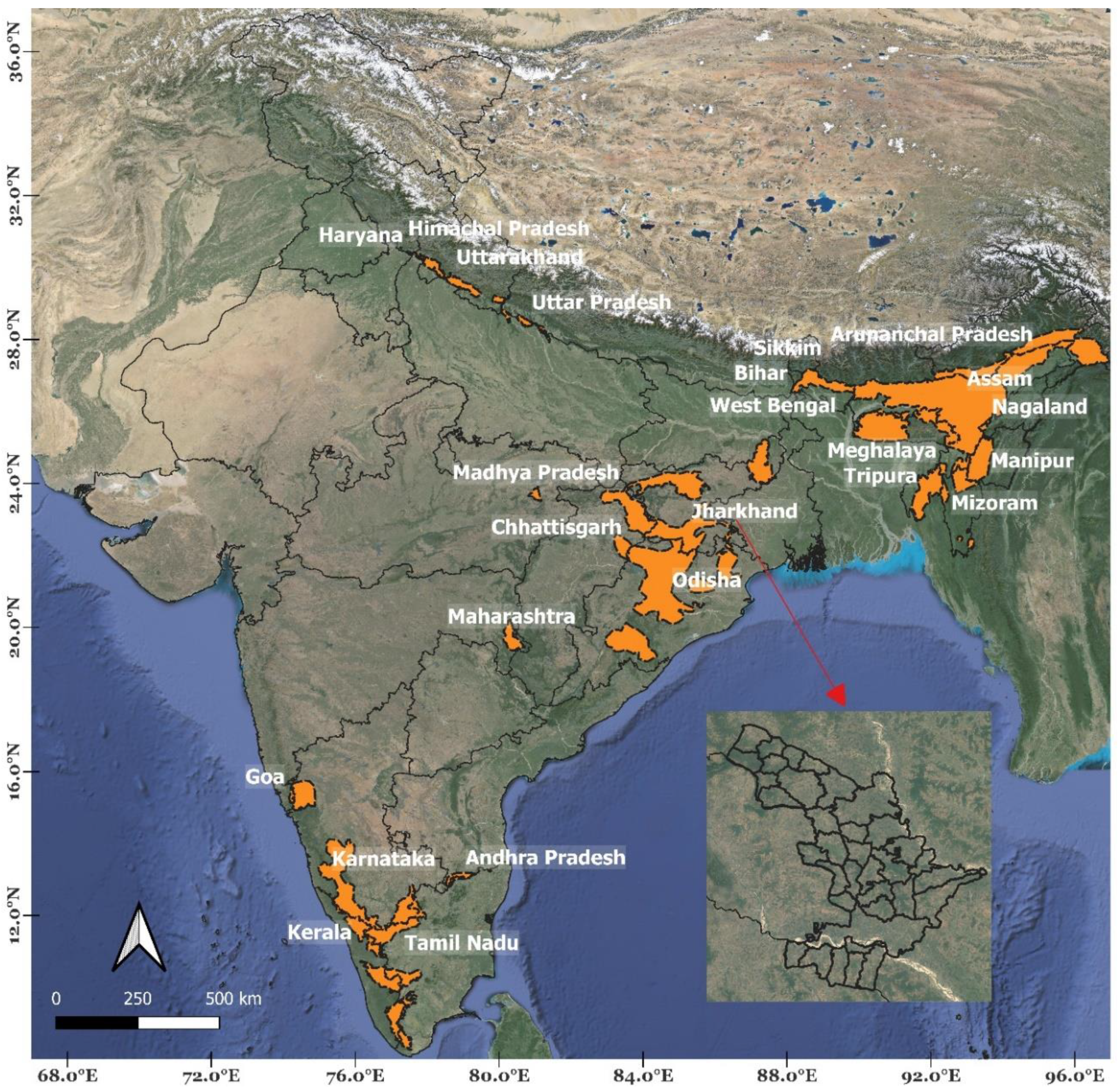
Figure 2.
Schematic describing the process from first detection of the species of interest (here, an elephant) to the filtering by AI models at two levels (i.e., on-the-edge and subsequently on the server) and transmission of images in real time to recipients. A “beat” is the Indian Forest Department’s smallest management unit.
Figure 2.
Schematic describing the process from first detection of the species of interest (here, an elephant) to the filtering by AI models at two levels (i.e., on-the-edge and subsequently on the server) and transmission of images in real time to recipients. A “beat” is the Indian Forest Department’s smallest management unit.
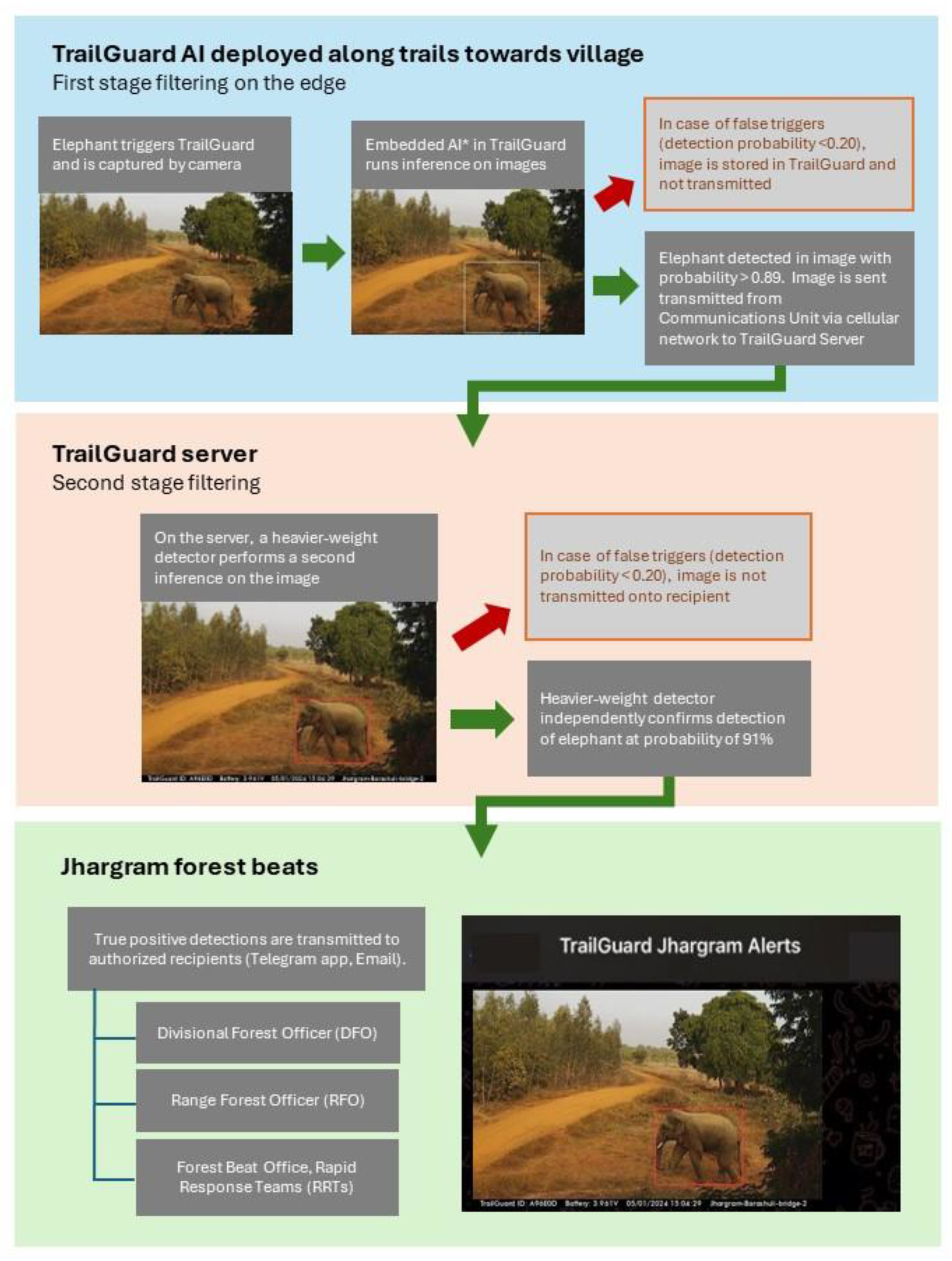
Figure 3.
a-h: Various output classes detected and filtered by the edge detector (AI model) in a multi-use landscape in the Jhargram Forest Division. To minimize alerts received by the Rapid Response Teams to elephants, frequent detections of humans on foot, riding bicycles, or traveling on motorcycles were not transmitted [a-c] but were instead recorded for future analysis on storage media (Appendix 1). Similarly, frequent detections of domestic livestock [d, f], or less frequently, native wildlife such as wild boar [e] and peninsular wolves [g], were recorded, but not transmitted. (These features are customizable by the end user).
Figure 3.
a-h: Various output classes detected and filtered by the edge detector (AI model) in a multi-use landscape in the Jhargram Forest Division. To minimize alerts received by the Rapid Response Teams to elephants, frequent detections of humans on foot, riding bicycles, or traveling on motorcycles were not transmitted [a-c] but were instead recorded for future analysis on storage media (Appendix 1). Similarly, frequent detections of domestic livestock [d, f], or less frequently, native wildlife such as wild boar [e] and peninsular wolves [g], were recorded, but not transmitted. (These features are customizable by the end user).
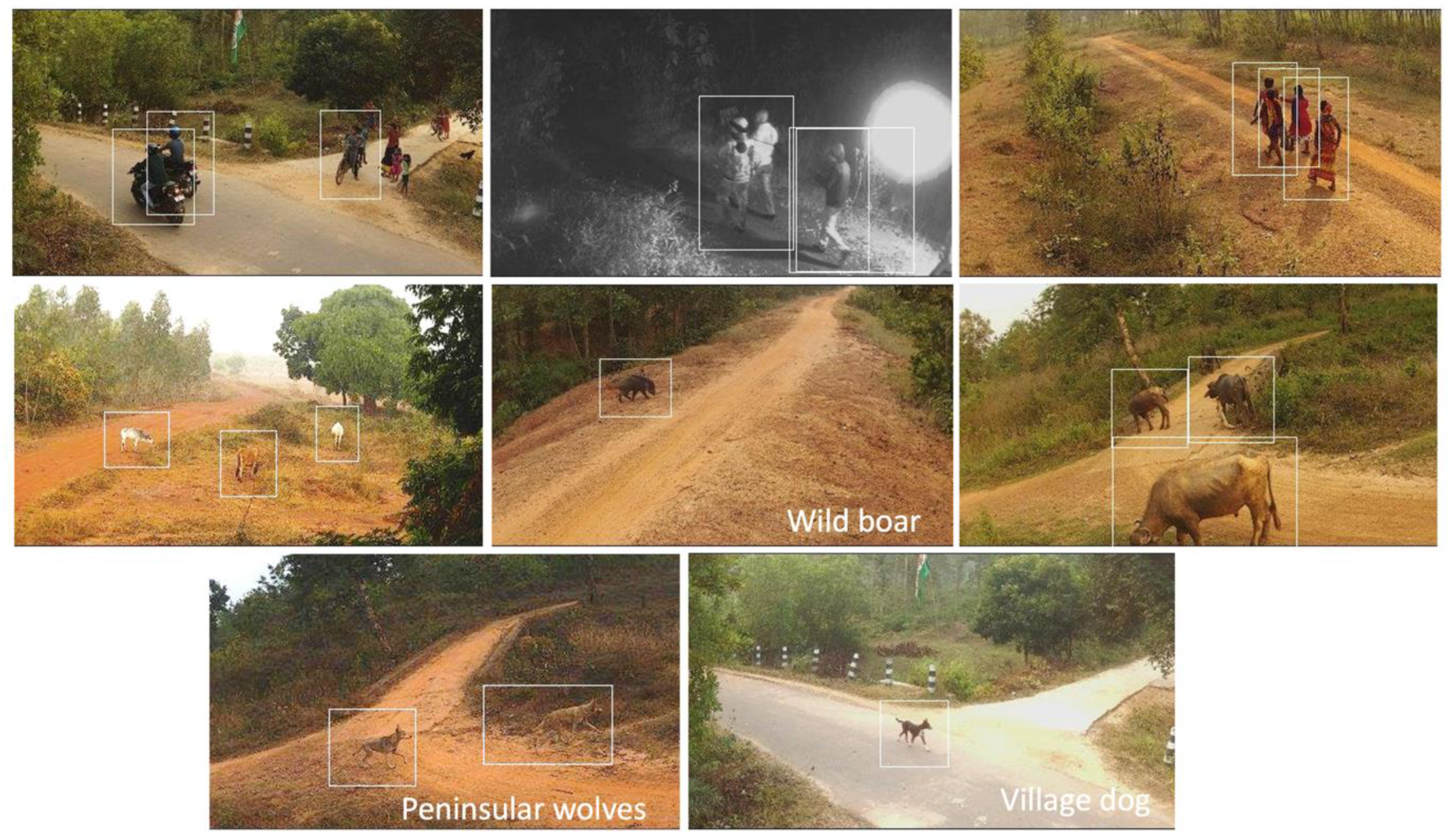
Figure 4.
a-l): The TrailGuard AI camera units installed in Jhargram forest division for four months detected and transmitted 266 elephant alerts in real time, including herds and lone bulls; 27.8% were day-time detections (4a-4f) and 72.2% of detections were at night (4g-4l).
Figure 4.
a-l): The TrailGuard AI camera units installed in Jhargram forest division for four months detected and transmitted 266 elephant alerts in real time, including herds and lone bulls; 27.8% were day-time detections (4a-4f) and 72.2% of detections were at night (4g-4l).
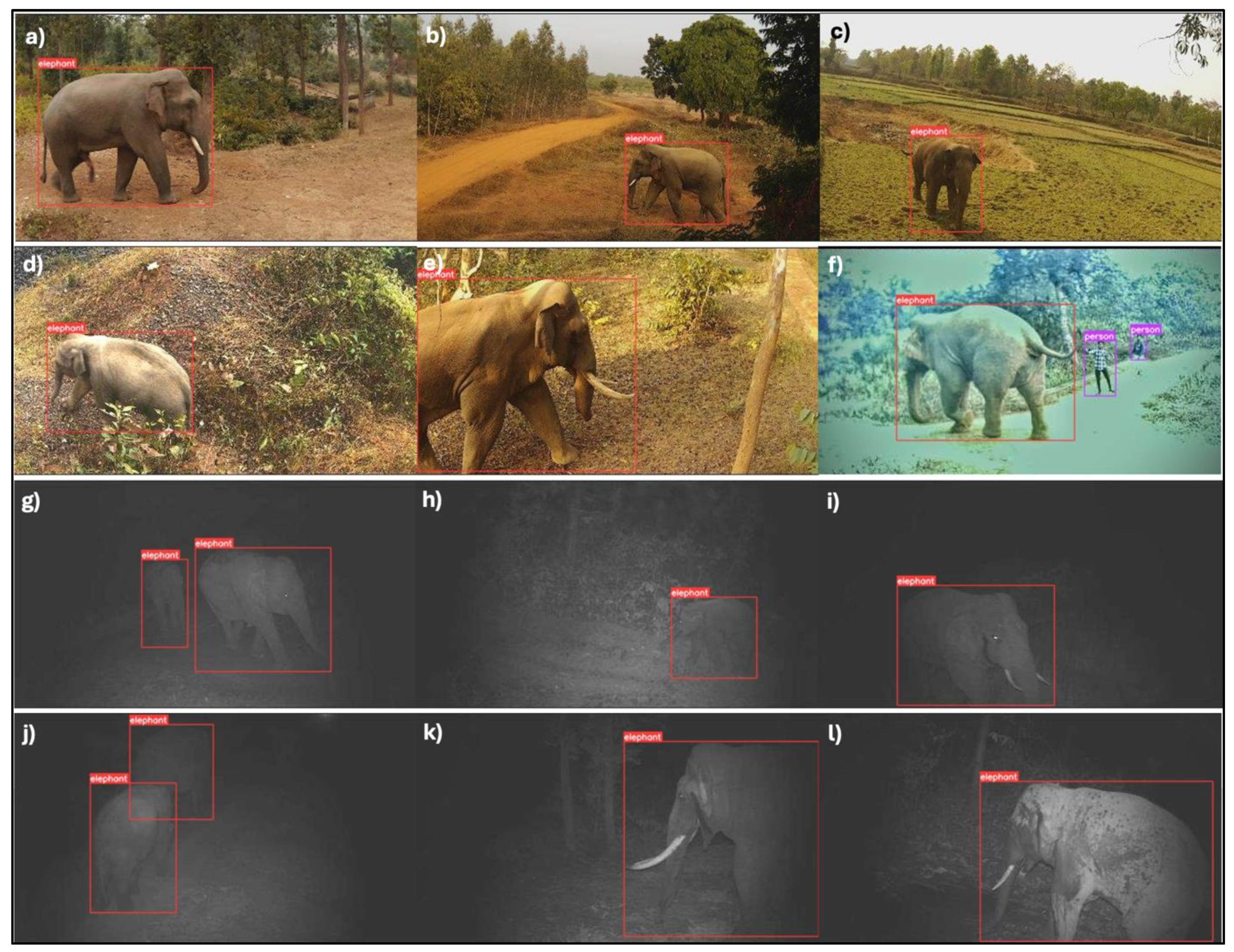
Figure 5.
a-b: a) Bar plot depicting the real-time alerts of elephants as classified by three group types—lone bulls, herds without bulls and herds with bulls partitioned by time of day, and; b) estimated mean response time of the RRTs to information on elephant presence before and after the deployment of TrailGuard AI system.
Figure 5.
a-b: a) Bar plot depicting the real-time alerts of elephants as classified by three group types—lone bulls, herds without bulls and herds with bulls partitioned by time of day, and; b) estimated mean response time of the RRTs to information on elephant presence before and after the deployment of TrailGuard AI system.
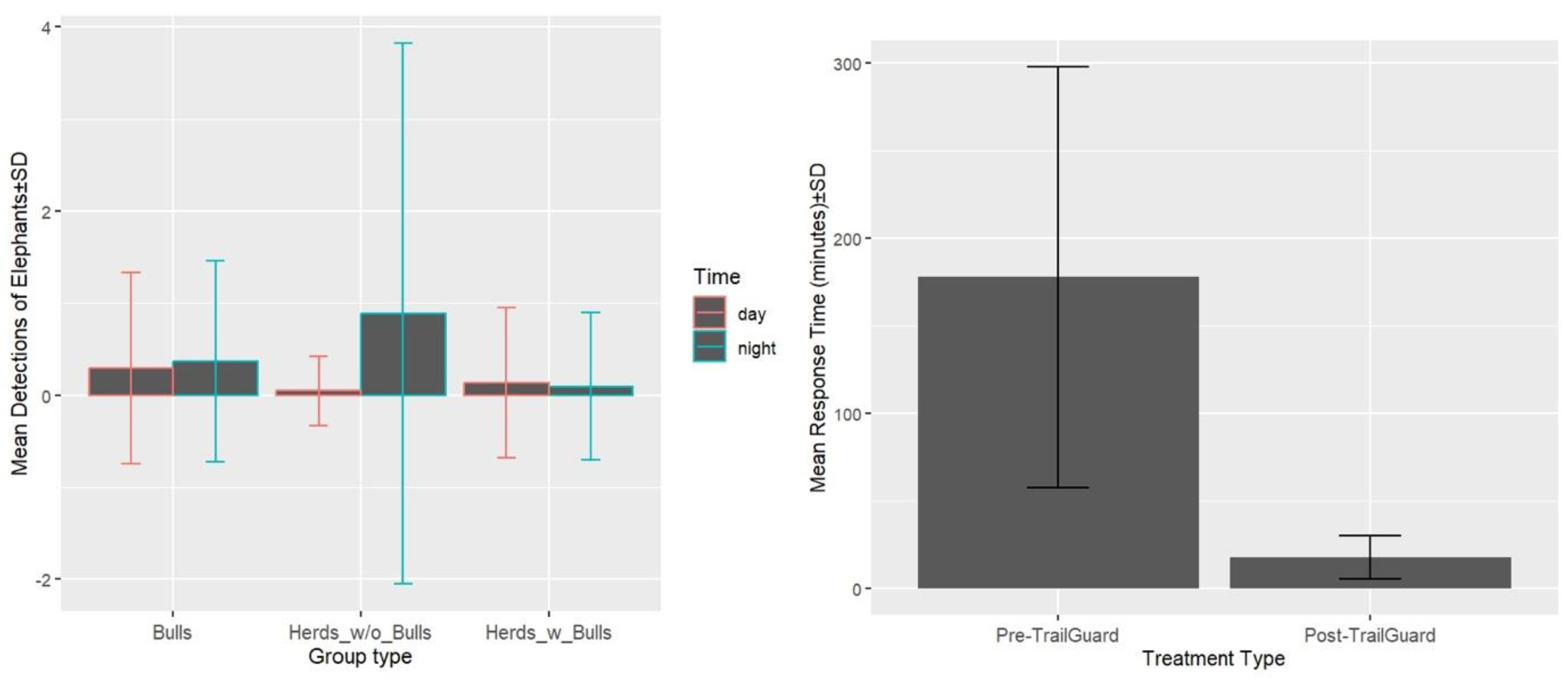
Figure 6.
a-c: Three lone bull elephants were re-identified at multiple sites. The re-identification was aided by key distinguishing body features: a) long tusks (Bull 1); b) distinct forehead (Bull 2); and c) a single tusk (Bull 3). Body features such as ear-folds, broken tusks, forehead shape, cuts due to infighting between individuals, and other features assisted in separation of individuals.
Figure 6.
a-c: Three lone bull elephants were re-identified at multiple sites. The re-identification was aided by key distinguishing body features: a) long tusks (Bull 1); b) distinct forehead (Bull 2); and c) a single tusk (Bull 3). Body features such as ear-folds, broken tusks, forehead shape, cuts due to infighting between individuals, and other features assisted in separation of individuals.
Disclaimer/Publisher’s Note: The statements, opinions and data contained in all publications are solely those of the individual author(s) and contributor(s) and not of MDPI and/or the editor(s). MDPI and/or the editor(s) disclaim responsibility for any injury to people or property resulting from any ideas, methods, instructions or products referred to in the content. |
© 2024 by the authors. Licensee MDPI, Basel, Switzerland. This article is an open access article distributed under the terms and conditions of the Creative Commons Attribution (CC BY) license (http://creativecommons.org/licenses/by/4.0/).
Copyright: This open access article is published under a Creative Commons CC BY 4.0 license, which permit the free download, distribution, and reuse, provided that the author and preprint are cited in any reuse.