

Submitted:
24 June 2024
Posted:
26 June 2024
You are already at the latest version
Abstract
Breast cancer (BC) is the most common invasive neoplasm and affects many women of working age. The return to work (RTW) of female survivors (BCSs) is associated with a better quality of life and longer survival. A tailored intervention to promote RTW was launched in 2022. A year later, the women were contacted to find out if RTW had occurred regularly and what their health conditions were compared to baseline. BCSs reported excessive fatigue, poor sleep quality, anxiety, depression and reduced work ability; these parameters had not improved significantly compared to baseline. Thematic analysis of the interviews confirmed the presence of personal, company and societal factors that could hinder or favor RTW. The interviews demonstrated that, even in an economically developed country that has provided numerous benefits for BCSs, protection is not always effective. Personalized intervention seems necessary to complete the process of reintegrating BCSs into their future working careers.
Keywords:
disability management
; longitudinal study
; welfare
; sleep
; anxiety
; depression
; fatigue
; work organization
; barriers
; facilitators
; workplace
1. Introduction
Breast cancer (BC) is the most frequent invasive neoplasm in females, with a global incidence of more than 2.3 million cases per year [1]. In the decade 2010-2019, the incidence of newly diagnosed cases increased by 0.5 percent annually, while there was a slight decrease in mortality [2]. Since BC often affects women of working age, it inevitably interfers with the earning [3,4,5] and employment opportunities [6] of those who survive breast cancer (breast cancer survivors, BCSs). Consequently, BC is not only the disease that causes the highest level of morbidity, mortality, and disability in women [7], but it is also the one that has the greatest economic impact [8].
The return to work (RTW) of BCSs is associated with a better prognosis [9] and quality of life [10]. For this reason, medical research must encourage RTW. After reporting prolonged absence from work, loss of work ability, and residual disability in BCSs one year after surgery, one of the few longitudinal studies available on BCSs suggested that a tailored policy in the workplace was needed to encourage RTW [11]. Unfortunately, to date there have been no significant applications of such a policy anywhere in the world. Although the medical field has recognized the importance of integrated care in treating BCSs and improving their quality of life [12,13], the involvement of the occupational physician in providing ergonomic initiatives to facilitate the RTW of BCSs remains an exceptional measure [14], albeit one of recognized effectiveness [15,16].
In 2022, to fill this gap, we launched an initiative aimed at improving the link between hospital care and the work environment [17]. Women who had completed acute treatment and intended to return to work were assisted with personalized intervention designed to examine their condition, residual health problems and disabilities in relation to occupational requirements and national policies on cancer survivors. Each patient was assisted by a team of occupational physicians who compared their clinical assessment with the work situation that was reconstructed on the basis of BCS reports. Each woman received advice on how to manage her health status in relation to work demands together with a letter for the doctor in charge of the health surveillance of workers. One year after this initial contact, we re-contacted the women to find out whether their reintegration into work had taken place smoothly and whether the advice given had been helpful.
The aims of this study were to check whether, one year after returning to work, the factors that could hinder or favor the return the same as those expected at baseline and to evaluate the effectiveness of the intervention carried out. To achieve these objectives, we combined a qualitative analysis of the BCS responses to an interview with a quantitative comparison of the values obtained from standardized questionnaires relating to certain critical aspects such as sleep, fatigue, mental balance, at baseline and at follow-up.
2. Materials and Methods
2.1. Study Design
In 2022, at baseline, BCSs requesting assistance in returning to work underwent a medical examination conducted by occupational doctors. In addition to an analysis of their clinical history and an evaluation of their current condition, the aim of the examination was to study their previous work experience by analyzing the work task and studying the perception of organizational justice of the work environment that the worker had developed before the onset of the disease. At baseline, some characteristics of psychophysical health (sleep, fatigue, work ability, anxiety, depression, happiness) were measured using standardized questionnaires, and the data were compared with a 5 times larger sample of women of the same age without BC, employed in companies monitored by the occupational doctors who were performing this study. The BCSs were also invited to participate in a semi-structured interview designed to obtain detailed information concerning their working environment conditions and investigate the factors that hindered or could have favored their return to work. The qualitative data emerging from the survey were analyzed using Thematic Analysis. Other details on this first part of the study can be found in the relevant publication [17].
At the end of the first medical examination, the occupational doctors prepared a letter of advice for the doctor in charge of the worker’s health surveillance aimed at improving the individual’s reintegration into her occupational environment.
One year after the first interview, the women were contacted again by telephone, for a short semi-structured interview in which they were asked if they had had a smooth RTW or if there had been any problems. On this occasion, the women were invited to complete a set of questionnaires online that were identical to those used at baseline.
An informed consent form outlining the objectives of the study and the purpose of the interview was given to each woman. The women were assured that their participation in the study was entirely optional and that they might leave the interviews at any moment without having to provide a reason. They were also assured that the survey was strictly confidential and anonymous. The project was approved by the Research Ethics Committee of the Università Cattolica del Sacro Cuore of Rome (project nr. 4672, approved February 14, 2022).
2.2. Questionnaire
The set of questionnaires included some standardized models.
Work ability was measured using the first question of the Italian version [18] of the Work Ability Index [19] that evaluates residual work ability compared to the maximum possessed during working life. This is known as the Work Ability Score (WAS). The convergent validity [20] and highly significant correlation [21] of this shortened version with the full questionnaire have been demonstrated. The WAS score varies from 0 to 10 and can be categorized into: poor (0–5 points), moderate (6, 7), good (8, 9), and excellent (10) work ability [22].
Perceived organizational justice (OJ) [23] was measured using the Italian version [24] of the Colquitt questionnaire [25] which is composed of 20 questions that distinguish procedural (PJ), distributive (DJ), interpersonal (IntJ) and informational justice (InfJ). All items have a 5-point Likert scale, graded from 1 to 5. Consequently, the total score (OJ) ranges from 20 to 100 points. In this study the reliability of the scale was 0.952. The subscale ranges and Cronbach’s alpha were as follows: PJ (7-35) 0.894; DJ (4-20) 0.908; IntJ (4-20) 0.922; InfJ (5-25) 0.879.
The quantity and quality of sleep were measured by means of the Italian version [26] of the 18-item Pittsburgh Sleep Quality index (PSQI) [27]. This questionnaire enables individuals to make a self-assessment of sleep duration and its quality. The score for sleep quality ranges from zero to 21; scores above 5 are considered indicative of poor sleep [28]. Cronbach’s alpha in this study was 0.856.
Perceived fatigue during work was measured using the 10-item Fatigue Assessment Scale (FAS) [29]. This scale is made up of 10 items graded from 1 to 5 and can consequently provide scores between 10 and 50. The score of 24 is considered the cut-off for defining clinical fatigue [30]. Reliability, measured by Cronbach’s alpha, was 0.885.
Anxiety and depression were measured using the Italian version [31] of the Goldberg scale [32] (GADS), composed of 18 binary questions that provide an anxiety score and a depression score. A worker with a score at the cut off for either scale (that is, 5 for anxiety or 2 for depression) has a 50% chance of having a clinically important disturbance; above these scores the probability percentage rises sharply. In this study, Cronbach’s alpha was 0.883 for the anxiety scale and 0.892 for the scale relating to depression.
Happiness was measured using the Abdel-Khalek single-item scale [33], graded 0-10.
2.3. Interview
The semi-structured interviews covered the following points:
1. What are your health conditions? What therapy are you underdoing? What are your current symptoms?
2. Are you working at present?
- if YES: When did you start again? What is your current job? Since you returned to work, how do you think your superiors have behaved? And your colleagues?
- if NO: why didn’t you go back to work?
3. Did the occupational health advice you received help you in any way?
2.4. Statistics
The variables we collected were tested for normality and their characteristics were described (mean, median, standard deviation, range). Scores for the questionnaires completed at follow-up were compared with the data collected at baseline using non-parametric tests (Wilcoxon matched pair signed rank test). A comparison of the scores of the non-parametric variables in the subgroups of the study sample was carried out using the Mann Whitney U exact significance test. The correlation between the variables of interest was studied with Spearman’s rho. Statistical analyses were performed using IBM SPSS Statistics for Windows, (Version 26.0. Armonk, NY: IBM Corp., release 15.0).
3. Results
A year after the first RTW interview, not all the women who participated in the research were working. In some cases, a new pathology or complications had occurred that required new treatment. In other cases, serious family problems, such as the need to care for a close family member, had compelled BCSs not to return to work. Of the 32 women screened in 2022, 26 were in service. All of them were invited to complete the online questionnaire; 17 accepted.
3.1. Quantitative Data
After resuming work, the BCSs’ opinion regarding the correctness of their work environment (OJ) did not change significantly (Colquitt’s score 70.1± 23.6 vs. 69.2 ± 14.8, related-samples Wilcoxon signed rank test p=0.286) from the one recorded at baseline; however, women who had returned to work generally made a more positive assessment of the organizational justice of their workplace than they had at baseline; only two of the BCSs indicated a worsening of their working climate, mainly due to a lack of interpersonal justice. Female workers who judged their RTW process positively reported a significantly higher level of organizational justice than other BCSs (Mann Whitney U exact significance test p=0.018).
The BCSs who returned to work judged their working capacity more positively than they did before returning to work (WAS score 6.5±3.4 vs. 4.9±28); the increase approached statistical significance without reaching it (Wilcoxon signed rank test p=0.058).
One year after returning to work, BCSs still had a high frequency of sleep problems. Average sleep duration was 6.8 ± 1.6 hours (range 4-9.5 hours). Sleep quality, measured by the PSQI, was 8.2 ± 4.6 points (range 2-15). Only 15% of women reported sleep quality that could be defined as “good”, i.e., less than 5 points on the PSQI. Sleep quality did not improve compared to baseline. On the contrary, the quality of sleep was worse than that of the same women at baseline (8.2± 4.6 vs. 6.2± 2.6), even if the difference did not reach statistical significance (related-samples Wilcoxon signed rank test p=0.065).
Fatigue measured with the FAS scale had an average score of 24.5±9.2 (range 10-41). The average score was higher than the cut-off, indicating excessive fatigue. More than 70% of the women who returned to work had chronic fatigue. Among BCSs, fatigue was slightly less than that reported at baseline (FAS score 24.5± 9.2 vs. 26.4 ± 9.1), but the difference was not significant (related-samples Wilcoxon signed rank test p=0.277).
Anxiety in the sample had a mean score of 5.7±2.9. Over 60% of women had a score above the cut-off and would probably have been diagnosed as “anxious” by a psychiatrist. The average score was higher than that measured at baseline (5.7±2.9 vs. 4.8±2.6), but the difference was not significant (related-samples Wilcoxon signed rank test p=0.385). The depression score was 4.1±3.1. Almost 70% of women were depressed. Depression symptoms had increased from the baseline (4.1±3.1 vs. 3.3±2.4), but the null hypothesis of invariance could not be rejected (Wilcoxon signed rank test p=0.357). The happiness score remained unchanged compared to the baseline (6.7±2.3 vs. 7.3±1.4; Wilcoxon p=0.173).
Perceived organizational justice in the workplace was inversely proportional to anxiety, depression, and poor sleep quality. Fatigue was directly proportional to anxiety, depression, and poor sleep quality. Age was not correlated with the quantitative variables (Table 1).
3.2. Qualitative Data
The thematic analysis of the data obtained from the interviews confirmed the three themes that had been observed at baseline: personal elements, factors linked to the company and to society. Each of these groups of factors can have a beneficial or detrimental effect on the RTW. Only when the three classes of factors simultaneously exert a positive effect is the RTW complete and totally satisfactory. The occupational doctor’s intervention aims at resolving the critical issues arising in each individual case (Figure 1).
3.2.1. Person-Related Factors
When they resumed work, almost all BCSs were on hormone treatment, often with induced menopause. Many of them manifested collateral symptoms (hot flashes, headaches). About a third of the women underwent oral chemotherapy treatment, with frequent side effects that were often gastrointestinal or more rarely, cutaneous (urticarial rash) or neuropathic. Two workers were awaiting surgical interventions (breast reconstruction, reoperation due to breast prosthesis dislocation). In addition to these iatrogenic symptoms, the most common problems were frequent fatigability, asthenia, and excessive fatigue. Bone, joint and muscle pain and lymphedema were present in about a tenth of the sample. Sleep quality was generally poor, and anxiety and depression were very common. A previous investigation had made it possible to identify some health-related factors that were an obstacle to work. These included physical problems (pain, fatigue, lymphedema) as well as motivational blocks, cognitive and neuropsychological problems (reduced concentration, decreased performance, apathy). Residual symptoms at the end of treatment constituted a significant obstacle to a full return to work, especially for women who performed manual tasks. The saleswoman from an appliance shop reported:
“The lymphoedema and the pain in my hand have made it very difficult for me to move objects and put them up on shelves. I work with the constant fear that my fingers will get stuck, and tools will fall out of my hand.”
In addition to the disorders attributable to BC, approximately a quarter of the BCSs had manifested other pathologies, including musculoskeletal disorders (carpal tunnel syndrome, scapulohumeral periarthritis), and neoplastic diseases (polyposis of the uterus, primary lung tumor, primary tumor of the colon) unrelated to BC. One of the patients, with previous diagnoses of multiple chemical sensitivity syndrome and asthma, had shown a significant worsening of symptoms after undergoing antiblastic therapies. About a fifth of the workers showed cognitive and neuropsychological problems (reduced concentration, lower performance, apathy, memory lapses), and insomnia. Motivational blocks were also reported:
“I currently have a lot of difficulty doing normal, common daily activities; there are days when I feel a complete refusal to do anything.”
Mental health was often at stake:
“I have severe depression, and serious sleep and memory problems. I am undergoing psychotherapeutic treatment,”
“I haven’t gone back to work because the very idea gives me an anxiety attack. I’m afraid I’m having a nervous breakdown.”
On the other hand, in many cases excellent surgical and medical treatment facilitated the return to work. Surgical breast reconstruction had often provided very satisfactory results, even improving body image.
“The results of the treatment were excellent. I resumed work sooner than expected.”
Work engagement was also of great importance. Female workers were often keen to highlight the benefits of returning to work.
“Work helped me a lot to recover my independence.”
3.2.2. Company-Related Factors
In the process of returning to work, company policies involving ergonomic and schedule adjustments, social support from colleagues and superiors, and other organizational measures, were of great importance. Positive experiences were prevalent:
“My colleagues were very attentive when I returned to work also because we have known each other for many years, and the office workers are like a family for me.”
“My boss and colleagues were very friendly and helpful; I have not had, and currently do not have any problems at work.”
“When I returned to work, my colleagues welcomed me warmly because they understood and were interested in my difficulties.”
“Both my colleagues and my direct superior helped me with everything possible. “
“My colleagues supported me. They were very nice and were also interested in learning about the path I had followed.
Unfortunately, company-related policies are not always positive. Sometimes the intention to protect the worker results in isolation and demotion. On other occasions, rather than reorganizing a job, managers simply exclude the worker from some tasks, implicitly placing a greater burden on colleagues who are called upon to carry out the assignment no longer entrusted to the worker. This does not encourage correct relationships between workers:
“I had a bit of trouble. I was not allowed to return to my previous job and was given a lower-level task. In my absence, my colleagues had taken my place. After many years of service, I was no longer taken into consideration. Others did not accept my illness and its concomitant disabilities. There are colleagues who complain that there are too many sick employees in the same work environment. It’s demoralizing that they no longer allow you to do what you’ve done all your life because of an illness.”
“The scheduled shift is too tiring for me; at the end of the day, I am exhausted, and I don’t have enough time to rest between shifts. The excessive tiredness is frustrating because I would like to be able to start and finish a task independently; it is annoying to have to ask colleagues to do things for me. To have more time to rest, I asked to be able to alternate morning and afternoon shifts, but this was not possible. The director suggested I work in a different department, but that’s not what I want.”
At other times, the company is explicitly against any adaptation and when the worker returns, she is expected to do the work she did before getting sick.
“When I returned to the company, the human resources manager asked me why I had gone to the hospital to be examined by the occupational doctors, stating that the doctors defend themselves by requesting an excessive number of precautions, and therefore, if I had presented their indications, I would have been fired”.
It is worth noting that the company that claimed it was unable to relocate a woman treated for breast cancer, is not a small or very small company belonging to the 97% of Italian companies in this category but is a global giant employing in our country alone, over 9,000 people. Another BCS confided to us that, in the intervening period, she had taken and won a public exam for a managerial role in an important state-controlled company with tens of thousands of employees but had been rejected in the pre-employment medical examination stage when she declared her illness.
A sizeable number of BCSs had to face a series of obstacles, overload (including frequent travel, excessive hours, new responsibilities) or underload (exclusion from tasks that they performed before and which were assigned to other colleagues), inadequate shifts (night shifts, long hours), environmental and ergonomic factors. The numerous examples of this kind included:
“I was afraid of returning to work because I knew that a highly responsible job absorbs you completely, marginalizing everything else. I had to avoid it because otherwise the work would overwhelm me. When I returned, I was treated normally, as if I had nothing wrong with me.”
“I was allowed to do my work from home. However, because I didn’t go into the office for months, I felt a bit left out. Before I was diagnosed with breast cancer, I thought I would have a career, which has now ended. I am cut off from progress projects, initiatives, and training projects as well as trips and missions. They don’t take me into consideration. I’m not sure if I would have had a career without breast cancer, but the company didn’t help me prove my reliability!
Often, the company did not respond promptly to a worker’s needs but intervened after occupational health consultancy:
“I had a somewhat traumatic return because I had on-going problems. When I got your letter, I turned to the corporate “ethics officer” who took charge of my situation,”
In some cases, difficulties do not appear immediately after resuming work but manifest themselves at a later stage. For example, it is well known that each BCS undergoes a series of check-ups for a period of five years. In order to do these check-ups, workers must necessarily be absent from work. This places them in a difficult situation, because although they are ill, they are not at home and therefore cannot respond to any medical control on the part of social security institutions that their employer may ask to intervene.
“The manager asks for a home visit to ascertain illness every time I take sickness leave to do my check-ups, even if I inform the company of the need to carry out a check-up on a certain day.”
Very often, the worker is removed from her task and, in fact, demoted.
“They placed me on the company toll-free number, I was practically demoted, but on the other hand I can’t do everything I did before at full speed.”
3.2.3. Society-Related Factors
Social support from family members can be an important factor in facilitating return to work, but family problems can be a strong obstacle:
“My mother now has cancer and I have to be close by to help her.”
“My real problems are family ones. My husband took my children away from me and hasn’t let me see them for 3 months”.
Italian law provides numerous legal and welfare benefits for workers with cancer. However, some workers have pointed out that there is unequal access to these benefits since only workers with a permanent contract can take advantage of them without losing their job. For those with a fixed-term contract, the mere declaration of a chronic pathology can be a reason for not renewing their post. Other workers report that asking for benefits such as exclusion from travel, missions, night work or extended hours, would damage their career prospects.
The recent pandemic led to national measures in favor of vulnerable workers, including BCSs, who were given the right to telework. This transitory and pandemic-related solution offered BCSs some advantages but also contained some pitfalls, because it made it difficult for them to keep their role without contact with colleagues and subordinates. Many companies maximized the use of teleworking during the pandemic, only to hastily return to in-person work as soon as the pandemic was over. This has often produced problems for BCSs.
“I would like to go back to the office. I am the head of an operational structure of 50 people, so I have many responsibilities on my shoulders. I don’t know if anything will happen to my job when I return. If I had to drive to go to work in-person, it would take me an hour plus an indefinite amount of time looking for a parking space, all time I save by staying at home. Staying at home enables me to manage my family and my fatigue. Even if I work from home a lot and arrive exhausted at the end of the day, I can organize my breaks better. During my lunch break, I can rest for 20 minutes in a much more comfortable environment than in the office, where it wouldn’t be possible to just lie down on the sofa. “
“I am responsible for a complex structure. I have never really stopped working and now I’m teleworking. Unfortunately, my bosses want to see people in the workplace, “they have to see you”. I will try to defend my two days of teleworking because I have two young children and getting to work and looking for a parking space is a difficult and tiring undertaking.”
Sometimes, the availability of legal measures designed to protect women is used against them, for example by imposing an unwanted transfer to a location close to the address of residence, or by requiring the worker to undergo a medico-legal assessment of work capacity. Unfortunately, BCSs frequently report this type of abuse.
One sector in which BCSs are not effectively protected is the financial sector. Some of them said they had been warned that it was not appropriate to ask to take out a mortgage to buy the family home; it would be better if the request were made only by the husband. This discrimination can cause even greater damage if the BCS also decides to divest herself of ownership of the family home or of the other assets for which she requests financing.
3.3. Occupational Health Consultancy
According to the workers, occupational health consultancy was useful mainly for providing training about their condition in relation to work:
“I came to you for consultancy to obtain information regarding legal protection for BCSs. It helped me not only from a personal point of view but also from a corporate point of view because I showed the letter you sent me to my company doctor and, thanks to your advice, was able to telework. I must say that having someone to shield you in some way was a very positive experience since you feel that you are not alone.”
“Occupational health consultancy was very helpful since it persuaded my company to open up job opportunities that had previously not been available for me.”
“The consultancy helped me because I wanted to be aware of the benefits I could take advantage of and the dangers I had to guard against.”
However, only a few of the BCSs used consultancy for the purpose for which it was intended, i.e., as an indication for the company doctor. Some workers said that the consultancy was useful from a personal point of view, but they did not feel the need to show it to the company doctor as their employers had already taken the necessary steps.
“Your advice helped me a lot because it humanized the problem; the company still helped me by allowing me to stay at home. The company protected me; the work was important to distract me.”
“The occupational health consultancy that you offered me was very useful to me from a personal point of view because of the information it provided. I did not need to show your letter because the company doctor had adopted all the indications it contained.”
Some workers said that if they had shown the consultancy to their company, they would have been fired.
“The occupational health consultancy that you gave me was of great help from a personal point of view due to the indications I received; I felt that someone had listened to the symptoms that I never imagined I would have in my life. I can’t say the same from a business perspective as the company was deaf to my needs.”
“I took advantage of your consultancy because I was very angry but, in the end, I went no further. I didn’t let anyone read it because I couldn’t risk losing my job.”
“I didn’t use your occupational health advice because in my company the proposal to “restructure the work task” would have involved demotion, so I only brought it up when I decided to abandon my job to go on leave and then retire.”
Despite the various difficulties experienced in their different companies, all the respondents were pleasantly surprised to have been contacted. They expressed an urgent need to be heard and to receive more attention for the numerous problems that arise during chronic illness. A woman who has overcome the acute phase of a disease is justly concerned about her health. With each new symptom, the question arises as to whether it could be a recurrence of the disease, an effect of the treatment or even a banal event of another kind. Very often, it is not easy to answer this question. It is also difficult for her to know what kind of workload could be tolerated and, conversely, what could be harmful. The return-to-work examination, which is provided for by law after long-term absences, cannot solve this type of problem.
“A lot is done in prevention and treatment, but in my chronic condition I feel rather isolated.”
4. Discussion
Our study provided an overview of the RTW process of women who have had BC. Thematic analysis confirmed that the three types of factors that can hinder or favor RTW are still present one year after returning to work. Quantitative analysis demonstrated that a year after returning to work, BCSs were still burdened by health problems such as sleep disorders, anxiety, and depression. The effort to resume occupational activities often resulted in excessive fatigue. However, women believed that their work capacity increased after RTW and on the whole were satisfied with occupational health counseling aimed at addressing individual physical, psychological and work-related challenges. Satisfaction with the intervention that helped them cope during the RTW process was also expressed for other tailored measures introduced for BCSs [36,37]. A review of the literature concluded that physical and multifunctional interventions tailored to the needs of the patient probably increase the RTW of people with cancer [38]. Almost all the women in our sample felt that the counseling was useful for informing them about the evolution of the disease and the work factors that might interfere with the disease. Many women established a contact between the university hospital occupational doctors and their general practitioner or the doctor in charge of their company health surveillance. In these cases, there was a rapid and full RTW that gave workers great satisfaction.
Unfortunately, this did not always happen, especially due to problems with company policies. Some women preferred not to present the consultancy report because they were afraid the company’s reaction would put their job at risk. Although our survey was conducted on a very limited sample, it demonstrated that the protection of workers with cancer is not universal, even in a country such as Italy that has a highly developed economy and comprehensive legislation for the protection of disabled persons.
Our study has shown that BCSs return to work with a burden of physical problems that persist after therapy. In previous literature, physical constraints were identified as one of the barriers to RTW [39,40,41]. A patient’s quality of life and RTW are significantly impacted by pain, particularly in the axilla and arm on the afflicted side [42,43]. In addition to being a direct result of the illness, pain can also result from radiation, chemotherapy, or surgery [44]. After one year, we observed that these problems had diminished in our sample. In fact, in recent years, more targeted treatment and technological progress in the medical field have reduced the frequency of these side effects [[45] Giacalone]. Furthermore, personalized rehabilitation treatment that employs a range of methods (such as lymphatic drainage [46,47], on-land [48] or aquatic exercises [49]) can lessen patient discomfort considerably and improve work readiness. However, these services are not always available, and many BCSs express their frustration at the lack of rehabilitation services for their condition and needs [50]. Research has shown that ergonomic interventions can help facilitate RTW [51]. Close coordination between the occupational physician and company management are needed to implement these interventions in the workplace. In this project our objective was to enhance this kind of communication so that every patient got the essential care they needed.
In our sample, more than 70% of participants reported feeling tired. For BCSs, cancer-related fatigue is the most prevalent and troubling symptom [52,53,54,55]. It frequently prevents them from going back to work. We observed that one year after returning to work it was the same as reported at baseline. A study showed that, during a two-year follow-up period, fatigue was identified as a chronic problem for 24 percent of BCSs [56]. An increasing body of research points to an inflammatory origin for the fatigue, which is closely associated with changes in the immunological and neuroendocrine systems [57]. Nonetheless, there has also been evidence of a link with other variables. Weight fluctuations, menopausal symptoms, coping mechanisms, social support, and metabolic alterations in BCSs are all frequently associated with fatigue [58]. Pain and depression [59], sleep difficulties, emotional symptoms, and neuromuscular fatigability were found to be the most significant predictors of chronic fatigue in cancer patients [60].
A problem that probably attracts less attention, but is of considerable importance, concerns sleep deprivation, which is typical in women with BC. One year after returning to work, 85% of the BCSs in our sample had poor sleep quality and short sleep duration. According to earlier research, BC patients frequently experience shorter sleep durations [61] and frequent sleep issues (difficulty falling asleep, nocturnal awakenings, and non-restorative sleep) such as insomnia [62]. They also manifest heightened symptoms of sleeplessness with no discernible improvement more than a year after diagnosis [63,64,65]. This can negatively affect their quality of life even years after treatment [66]. Cancer patients’ sleep disturbances may be a factor in reduced work performance and increased absenteeism [67].
Sleep disorders in BCSs are closely linked to psychosocial stress resulting from the disease itself, its treatment, and also the work environment. The literature has highlighted the etiopathogenetic role of iatrogenic factors (e.g., endocrine therapy [68], breast surgery [69], chemotherapy and/or radiotherapy [70,71,72], and the psychological impact of a breast cancer diagnosis (e.g., depression, anxiety, fear of recurrence [73]), as well as the possible role of host-tumor interaction molecular processes [74]. Our study points out that perceived low organizational justice may be a factor associated with poor sleep. Furthermore, it seems that sleep disturbance and cancer are related to one another, as cancer seems to encourage disturbed sleep and insufficient sleep encourages carcinogenesis and the advancement of cancer [74]. Another of our studies indicates a close relationship between the level of organizational justice perceived by the worker before the onset of the illness and the effectiveness of the RTW process [75]. Occupational stress factors and stress-induced lifestyles have often been associated with BC [76]. It has been hypothesized that work-related factors may influence the survival rate of BC patients [77]. However, no association between occupational stress and breast cancer has so far been demonstrated by meta-analytic studies [78].
Fatigue and sleep issues are linked to both anxiety and depression. In our sample, most subjects were depressed and anxious. According to published research, between 11% and 16% of BCS patients have mixed symptoms of depression and anxiety, and anxiety connected to cancer is linked to an increased risk of sleep disturbances [79]. Mental health issues represent a significant obstacle for RTW. In previous studies, anxiety [80] and depression [81,82,83]. were significantly associated with not going back to work. Changes in the hierarchy of life values due to BC are very important in the RTW process [84].
In our sample, the work ability reported by BCSs was still about half of what they believed it had been before the illness. Previous studies demonstrated that BC leads to at least one period of sick leave in the year following the diagnosis, and this causes costs estimated between 10 [85] and over 30 thousand euros [3] per patient. In cases with an unfavorable clinical course, BC progression leads to a reduced likelihood of employment, an increase in the number of workplace hours missed, and a more elevated cost burden [86]. Our sample included many women with a favorable course, for whom the disease was under control, but they nevertheless encountered considerable difficulties. All the problems found in our sample were present in previous literature studies that had focused on one of the specific factors. Loss of work-related productivity due to treatment is generally high. Chemotherapy after returning to work is associated with presenteeism costs comparable to those of absenteeism [87]. The sleep and emotional state problems that we observed in our sample are also of the utmost importance for productivity. Sleep disturbance impacted for 2 and 8% on healthcare expenditure and absenteeism, respectively [88]. Depression and a history of anxiety were associated with lower work ability in Australian BCSs [89]. According to an Australian study, productivity loss following return to work (RTW) was around four times higher in the depressed group than in the non-depressed group [89]. In accordance with what we found, a longitudinal Chinese study conducted within a year of RTW noted that BCSs showed significant productivity loss and activity impairment [11]. These data are universally known and explain why women who survive BC have difficulty keeping their jobs or finding work. Despite the numerous laws designed to protect BCSs, our case study shows that discriminatory behavior towards BCSs is present in both small and large companies.
The results of this study lead us to believe that companies that reinstate BC patients expect some kind of incentive. For example, in the first year of RTW, the State could make 50% of the salary paid to BCSs exempt from tax because a self-assessment of BCSs indicated that their illness had reduced their previous working capacity by approximately one half. In countries such as Italy where employers are obliged to pay an insurance premium for the risk of accidents and occupational diseases, insurance companies could exempt employers from paying this premium for BCSs.
Consideration should also be given to another problem that is closely linked to the inevitable loss of work ability that arises as a result of cancer. In cases where the company is unable to effectively adapt work tasks, a portion of the assignments previously carried out by the worker are dumped on other workers, thus creating possible tension between colleagues. Discrimination against disabled individuals, or ableism, is a condition that is becoming more common in the workplace [90]. Even though programs and rules have been created to encourage companies to handle disability in an appropriate way [91,92], they have not always reached their objectives. Reduced work ability is a significant predictor of workplace violence and bullying [93 Magnavita 2024 preprints]; therefore, BCSs may be exposed to unfair treatment and harassment more frequently than healthy colleagues.
Although our country provides universal and free healthcare, BC is always associated with economic losses for patients. This problem has been well documented in the literature. BC patients of working age face financial losses due to missed work and missed home productivity [94]. Minorities are disproportionately exposed to the economic problems associated with cancer [95,96]. A quarter of women with BC experience a reduction in income that is present even one year after returning to work [97]. Studies reported that non-manual workers may undergo the highest loss of productivity [98]. Moreover, unwanted work-related outcomes are more likely to occur for blue-collar workers who have lower household income, worse financial well-being, lower RTW self-efficacy, worse job satisfaction, worse illness perception, more physical symptom distress, impaired physical functioning, and unfavorable work conditions [11]. In Italy, almost 56,000 new cases of BC were recorded in 2023 [99]. Considering that a working woman earns 16,550 euros per year in our country [100], and that the employment rate for women in Italy is close to 50% [101], the income produced annually by female workers affected by BC is equal to 463 million euros per year, which corresponds to 2% of the State Budget Law. These figures show the economic impact of BC and the damage it can cause to the economy. Furthermore, in addition to the drop in income caused by the disease, we observed that a woman with BC has difficulty accessing credit and is therefore sometimes induced to divest herself of the assets she owns. To overcome this type of problem, a law has recently been passed in Italy that allows ‘oncological oblivion’, i.e., without breaching the contract, oncological patients can avoid declaring their pathology to bodies that provide finance; however, this measure only comes into force 10 years after recovery, and therefore does not concern the patients we observed.
An effective RTW for women with BC is associated not only with a better quality of life and greater survival [10,102], but also with clear beneficial economic effects for the individual, the company and society. For this reason, it is important that clinical care be integrated with occupational medicine measures. Hospital specialists should assist occupational doctors and companies in choosing measures that can promote a speedy recovery of work ability. Ergonomic intervention in the workplace should be accompanied by organizational measures that can reduce fatigue and sleep deprivation. Employers agree that providing tailored support to BCSs is a necessary measure to encourage RTW [103].
When BCSs return to work after suffering from fatigue, they require assistance in recovering from both physical and mental work-related exhaustion and in reaching a regular sleep schedule. This kind of intervention would bring an economic advantage as it would enhance BCSs’ work capacity. Since poor sleep is linked to mental health problems, stress management and good sleep hygiene should go hand in hand. It is also important to note that a low degree of perceived justice in the workplace is directly correlated with poor sleep quality. Therefore, the employer’s primary responsibility to BCSs is to enhance work organization.
Clearly, the occupational doctor who is an expert on labor problems, plays a vital role in assisting this process. A Swedish study demonstrated that BCSs who received advice and support on occupational matters or were encouraged to return to work had fewer sickness absences [104]. An efficient return to work depended largely on the nature of meetings with doctors; positive respectful encounters significantly reduced absenteeism in BCSs [105].
Women who have been successfully treated for BC still need medical assistance which is not currently provided by the hospital or the general practitioner. Prevention principles and the numerous benefits for workers with disabilities need to be carefully evaluated and applied rationally, so that they do not impede the resumption of healthy and safe work. Because of ambiguity in some welfare measures, a significant number of female workers in our sample did not apply to be registered as disabled or for legal benefits such as exemption from co-payment for health expenses, the possibility of working fewer hours or taking days off for medical treatment, because they feared that these benefits might cause them to lose their job. A meta-review indicates that BCSs continue to face challenges and require interventions to address these difficulties [106,107]. Our research indicates that many more studies are needed to clarify which measures are essential for the safety of women who have had BC and how a RTW can be implemented in a way that does not jeopardize future career prospects and full job satisfaction.
Our study had the advantage of being, to the best of our knowledge, the only longitudinal study that combines a qualitative investigation of the obstacles and factors favoring RTW with the quantification of levels of physical and mental disability. It attempted to combine medical techniques, such as examining patients, with the psychological investigation of their needs and the technical analysis of working conditions. Unlike other studies targeting a specific job sector or a pre-selected population, it included all women who requested assistance. As regards the factors favoring or hindering RTW, the researchers did not start from a hypothesis to be tested, but accepted all the observations of the BCSs and organized them through thematic analysis. It was thus possible to observe that some topics which the literature has largely dealt with, such as the physio-psychological conditions of BCSs, company policies and the benefits that society provides for cancer patients, can have an ambiguous effect, sometimes of benefit, sometimes of obstacle to RTW. The researchers were guided by the needs of the BCSs and sought the best compatibility between their work possibilities and the environment in which they had to return to being productive. However, it has important limitations. The main one is that it was based on a self-selected sample of women who asked for assistance from the occupational doctor at the end of their hospital treatment. The sample therefore is not representative of all the women with BC treated every year in our hospital. Nevertheless, it documented the numerous critical issues that the RTW process presents. The number of cases examined, although greater than that of other qualitative studies, is not sufficient to verify the significance of the differences observed in the quantitative variables. A greater number of patients is certainly necessary to verify some of the hypotheses that seem to emerge from these observations, for example that work ability tends to improve with the resumption of work and that fatigue progressively reduces. A longer observation period could allow us to verify the possible recovery of the investigated parameters.
5. Conclusions
Our project, created to help women with BC return to work, has documented the existence of three types of factors linked to the person, the company and society which can favor or hinder the process of recovering work activity. Some of the obstacles observed at the beginning of the process were still present one year after returning to work. Women reported a significant reduction in work ability that was mainly associated with fatigue, altered sleep patterns and the presence of symptoms of anxiety and depression. Personalized intervention designed to overcome obstacles and reintegrate women into their careers was greatly appreciated by BCSs. At the end of hospital treatment, women with BC need a personalized care path to recover their working capacity and improve satisfaction and the quality of life. Companies must be assisted in designing a tailored set of interventions for BCSs, while the medical sector must help women struggling to overcome the problems of chronic pathology.
Author Contributions
Conceptualization, N.M.; methodology, N.M; data curation, N.M. and I.M.; writing—original draft preparation, N.M.; writing—review and editing, N.M., I.M. and D.A.T. All authors have read and agreed to the published version of the manuscript.
Funding
This research received no external funding.
Institutional Review Board Statement
The study was conducted in accordance with the Declaration of Helsinki and approved by the Ethics Committee of Catholic University of the Sacred Hearth of Rome (project nr. 4672, approved 14 February 2022)
Informed Consent Statement
Informed consent was obtained from all subjects involved in the study.
Data Availability Statement
Authors’ Note: The data sets generated and analyzed during the current study are not publicly available due to the sensitive and identifiable nature of our qualitative data but are available from the corresponding author on reasonable request.
Acknowledgments
The entire research team would like to thank the women who participated in the study. We thank Ms. Simona Trotta for her help in booking appointments for occupational medicine examinations. We thank Ms. E. A. Wright for language revision.
Conflicts of Interest
The authors declare no conflict of interest.
References
- Sung, H.; Ferlay, J.; Siegel, R.L.; Laversanne, M.; Soerjomataram, I.; Jemal, A.; Bray, F. Global Cancer Statistics 2020: GLOBOCAN Estimates of Incidence and Mortality Worldwide for 36 Cancers in 185 Countries. CA Cancer J Clin 2021, 71, 209–249. [CrossRef]
- Giaquinto, A.N.; Sung, H.; Miller, K.D.; Kramer, J.L.; Newman, L.A.; Minihan, A.; Jemal, A.; Siegel, R.L. Breast Cancer Statistics. CA Cancer J Clin 2022, 72(6), 524-541. [CrossRef]
- Ferrier, C.; Thebaut, C.; Levy, P.; Baffert, S.; Asselain, B.; Rouzier, R.; Hequet, D. Absenteeism and indirect costs during the year following the diagnosis of an operable breast cancer: A prospective multicentric cohort study. J Gynecol Obstet Hum Reprod 2021, 50(6), 101871. [CrossRef]
- Chiu, K.; MacEwan, J.P.; May, S.G.; Bognar, K.; Peneva, D.; Zhao, L.M.; Yong, C.; Amin, S.; Bolinder, B.; Batt, K.; Baumgardner, J.R. Estimating Productivity Loss from Breast and Non-Small-Cell Lung Cancer among Working-Age Patients and Unpaid Caregivers: A Survey Study Using the Multiplier Method. MDM Policy Pract 2022, 7(2), 23814683221113846. [CrossRef]
- Su, T.T.; Azzani, M.; Tan, F.L.; Loh, S.Y. Breast cancer survivors: Return to work and wage loss in selected hospitals in Malaysia. Support Care Cancer 2018, 26(5), 1617-1624. [CrossRef]
- Ruiz de Azua, G.; Kousignian, I.; Vaz-Luis, I.; Di Meglio, A.; Caumette, E.; Havas, J.; Martin, E.; Martin, A.L.; Querel, O.; Vanlemmens, L.; Pistilli, B.; Coutant, C.; Cottu, P.H.; Merimeche, A.D.; Lerebours, F.; Tredan, O.; Jouannaud, C.; Levy, C.; Dumas, A.; Menvielle, G. Sustainable return to work among breast cancer survivors. Cancer Med 2023, 12(18), 19091-19101. [CrossRef]
- Trapani, D.; Ginsburg, O.; Fadelu, T.; Lin, N.U.; Hassett, M.; Ilbawi, A.M.; Anderson, B.O.; Curigliano, G. Global Challenges and Policy Solutions in Breast Cancer Control. Cancer Treat Rev 2022, 104, 102339. [CrossRef]
- Park, J.H.; Lee, S.K.; Lee, J.E.; Kim, S.W.; Nam, S.J.; Kim, J.-Y.; Ahn, J.-S.; Park, W.; Yu, J.; Park, Y.H. Breast Cancer Epidemiology of the Working-Age Female Population Reveals Significant Implications for the South Korean Economy. J Breast Cancer 2018, 21, 91–95. [CrossRef]
- Yang, Z.Y.; Chen, W.L.; Wu, W.T.; Lai, C.H.; Ho, C.L.; Wang, C.C. Return to Work and Mortality in Breast Cancer Survivors: A 11-Year Longitudinal Study. Int J Environ Res Public Health 2022, 19(21), 14418. [CrossRef]
- Emerson, M.A.; Reeve, B.B.; Gilkey, M.B.; Elmore, S.N.C.; Hayes, S.; Bradley, C.J.; Troester, M.A. Job loss, return to work, and multidimensional well-being after breast cancer treatment in working-age Black and White women. J Cancer Surviv 2023, 17(3), 805-814. [CrossRef]
- Ng, D.W.L.; So, S.C.Y.; Fielding, R.; Mehnert-Theuerkauf, A.; Kwong, A.; Suen, D.; Wong, L.; Fung, S.W.W.; Chun, O.K.; Fong, D.Y.T.; Chan, S.; Molasiotis, A.; So, W.K.W.; Lam, W.W.T. Return to work, work productivity loss and activity impairment in Chinese breast cancer survivors 12-month post-surgery: A longitudinal study. Front Public Health 2024, 12, 1340920. [CrossRef]
- Ke, Y.; Tan, Y.Y.; Neo, P.S.H.; Yang, G.M.; Loh, K.W.; Ho, S.; Tan, Y.P.; Ramalingam, M.B.; Quah, D.S.C.; Chew, L.; Si, P.E.H.; Tay, B.C.; Chan, A. Implementing an Inclusive, Multidisciplinary Supportive Care Model to Provide Integrated Care to Breast and Gynaecological Cancer Survivors: A Case Study at an Asian Ambulatory Cancer Centre. Int J Integr Care 2023, 23(1), 14. [CrossRef]
- Paolucci, T.; Bernetti, A.; Bai, A.V.; Segatori, L.; Monti, M.; Maggi, G.; Ippolitoni, G.; Tinelli, L.; Santilli, V.; Paoloni, M.; Agostini, F.; Mangone, M. The sequelae of mastectomy and quadrantectomy with respect to the reaching movement in breast cancer survivors: Evidence for an integrated rehabilitation protocol during oncological care. Support Care Cancer 2021, 29(2), 899-908. [CrossRef]
- Vayr, F.; Montastruc, M.; Savall, F.; Despas, F.; Judic, E.; Basso, M.; Dunet, C.; Dalenc, F.; Laurent, G.; Soulat, J.M.; Herin, F. Work adjustments and employment among breast cancer survivors: A French prospective study. Support Care Cancer 2020 28(1), 185-192. [CrossRef]
- Franco, G. Occupation and breast cancer: Fitness for work is an aspect that needs to be addressed. Med Lav 2013, 104(2), 87-92.
- Campagna, M.; Loscerbo, R.; Pilia, I.; Meloni, F. Return to Work of Breast Cancer Survivors: Perspectives and Challenges for Occupational Physicians. Cancers (Basel) 2020, 12(2), 355. [CrossRef]
- Magnavita, N.; Di Prinzio, R.R.; Meraglia, I.; Vacca, M.E.; Arnesano, G.; Merella, M.; Mauro, I.; Iuliano, A.; Terribile, D.A. Supporting Return to Work after Breast Cancer: A Mixed Method Study. Healthcare (Basel) 2023, 11(16), 2343. [CrossRef]
- Converso, D.; Sottimano, I.; Garzaro, G.; Guidetti, G.; Pira, E.; Viotti, S. Contribution to validation of the Italian version of work ability personal radar. Med Lav 2022, 113(6), e2022051. [CrossRef]
- Tuomi, K.; Ilmarinen, J.; Jahkola, A.; Katajarinne, L.; Tulkki, A. Work Ability Index, 2nd revised edn.; Helsinki: Finnish Institute of Occupational Health, 1998.
- El Fassi, M.; Bocquet, V.; Majery, N.; Lair, M.L.; Couffignal, S.; Mairiaux, P. Work ability assessment in a worker population: Comparison and determinants of Work Ability Index and Work Ability score. BMC Public Health 2013, 13, 305. [CrossRef]
- Magnavita, N.; Meraglia, I.; Viti, G., Borghese, L. The Work Ability Index (WAI) in the Healthcare Sector: A Cross-Sectional/Retrospective Assessment of the Questionnaire. Int J Environ Res Public Health 2024, 21(3), 349. [CrossRef]
- Gould, R.; Ilmarinen, J.; Järvisalo, J. Dimensions of Work Ability. Results from the Health 2000 Survey; Finnish Centre for Pensions: Helsinki, Finland, 2008; pp. 25–34.
- Elovainio, M.; Heponiemi, T.; Sinervo, T.; Magnavita, N. Organizational justice and health; review of evidence. G Ital Med Lav Ergon 2010, 32(3), B5-B9.
- Magnavita, N.; Bergamaschi, A. Justice at the workplace. Validation of the Italian version of Colquitt’s justice measurement questionnaire (JM20). Lo studio della giustizia sul lavoro. Validazione della versione italiana del JM20 di Colquitt. G Ital Med Lav Ergon 2008, 30(3), 2 Suppl: 449-450.
- Colquitt, J.A. On the dimensionality of organizational justice: A construct validation of a measure. J Appl Psychol 2001, 86, 386–400.
- Curcio, G.; Tempesta, D.; Scarlata, S.; Marzano, C.; Moroni, F.; Rossini, P.M.; Ferrara, M.; De Gennaro, L. Validity of the Italian version of the Pittsburgh Sleep Quality Index (PSQI). Neurol Sci 2013, 34(4), 511-9. [CrossRef]
- Buysse, D.J.; Reynolds, C.F.; Monk, T.H.; Berman, S.R.; Kupfer, D.J. The Pittsburgh Sleep Quality Index (PSQI): A new instrument for psychiatric research and practice. Psychiatry Res 1989, 28(2), 193-213.
- Grandner, M.A.; Kripke, D.F.; Yoon, I.Y.; Youngstedt, S.D. Criterion validity of the Pittsburgh Sleep Quality Index: Investigation in a non-clinical sample. Sleep Biol Rhythms 2006, 4(2), 129-139. [CrossRef]
- Michielsen, H.J.; De Vries, J.; Van Heck, G.L. Psychometric qualities of a brief self-rated fatigue measure: The Fatigue Assessment Scale. J Psychosom Res 2003, 54(4), 345-52.
- Cumming, T.B.; Mead, G. Classifying post-stroke fatigue: Optimal cut-off on the Fatigue Assessment Scale. J Psychosom Res 2017, 103, 147-149. [CrossRef]
- Magnavita, N. Ansia e depressione nei luoghi di lavoro. Il questionario A/D di Goldberg. Anxiety and depression at work. the A/D Goldberg Questionnaire. G Ital Med Lav Ergon 2007, 29(3), 670-671.
- Goldberg, D.; Bridges, K.; Duncan-Jones, P.; Grayson, D. Detecting anxiety and depression in general medical settings. BMJ 1988, 297(6653), 897-9.
- Abdel-Khalek, A.M. Measuring happiness with a single-item scale. Social Behavior and Personality: An international journal; Scientific Journal Publishers 2006; pp. 139-150. [CrossRef]
- Braun, V.; Clarke, V. Using Thematic Analysis in Psychology. Qualitative Research in Psychology 2006, 3, 77–101. [CrossRef]
- Tong, A.; Sainsbury, P.; Craig, J. Consolidated Criteria for Reporting Qualitative Research (COREQ): A 32-Item Checklist for Interviews and Focus Groups. Int J Qual Health Care 2007, 19, 349–357. [CrossRef]
- Petersen, K.S.; Hedeager Momsen, A.M.; Vinther-Nielsen, C. Return-to-work intervention while undergoing cancer treatment: Female cancer survivors’ experiences. Work 2023, 75(2), 495-506. [CrossRef]
- Sheppard, D.M.; O’Connor, M.; Jefford, M.; Lamb, G.; Frost, D.; Ellis, N.; Halkett, G.K.B. ‘Beyond Cancer’ Rehabilitation Program to Support Breast Cancer Survivors to Return to Health, Wellness and Work: Feasibility Study Outcomes. Curr Oncol 2023, 30(2), 2249-2270. [CrossRef]
- de Boer, A.G.; Tamminga, S.J.; Boschman, J.S.; Hoving, J.L. Non-medical interventions to enhance return to work for people with cancer. Cochrane Database Syst Rev 2024, 3(3), CD007569. [CrossRef]
- Tan, F.L.; Loh, S.Y.; Su, T.T.; Veloo, V.W.; Ng, L.L. Return to Work in Multi-Ethnic Breast Cancer Survivors--a Qualitative Inquiry. Asian Pac J Cancer Prev 2012, 13, 5791–5797. [CrossRef]
- Marinas-Sanz, R.; Iguacel, I.; Maqueda, J.; Mínguez, L.; Alquézar, P.; Andrés, R.; Pérez, E.; Sousa, R.; Moreno-Atahonero, E.; Solé, D.; et al. Facilitating Factors and Barriers in the Return to Work of Working Women Survivors of Breast Cancer: A Qualitative Study. Cancers (Basel) 2023, 15, 874. [CrossRef]
- Luo, S.-X.; Liu, J.-E.; Cheng, A.S.K.; Xiao, S.-Q.; Su, Y.-L.; Feuerstein, M. Breast Cancer Survivors Report Similar Concerns Related to Return to Work in Developed and Developing Nations. J Occup Rehabil 2019, 29, 42–51. [CrossRef]
- Zomkowski, K.; Cruz de Souza, B.; Moreira, G.M.; Volkmer, C.; Da Silva Honório, G.J.; Moraes Santos, G.; Flores Sperandio, F. Qualitative Study of Return to Work Following Breast Cancer Treatment. Occup Med (Lond) 2019, 69, 189–194. [CrossRef]
- Slaghmuylder, Y.; Lauwerier, E.; Pype, P. Survivors’ Perceptions Regarding the Follow-up of Pain Complaints after Breast Cancer Treatment: Distinct Coping Patterns. Front Psychol 2022, 13, 1063705. [CrossRef]
- Wang, K.; Yee, C.; Tam, S.; Drost, L.; Chan, S.; Zaki, P.; Rico, V.; Ariello, K.; Dasios, M.; Lam, H.; et al. Prevalence of Pain in Patients with Breast Cancer Post-Treatment: A Systematic Review. Breast 2018, 42, 113–127. [CrossRef]
- Giacalone, G.; Yamamoto, T. Supermicrosurgical Lymphaticovenous Anastomosis for a Patient with Breast Lymphedema Secondary to Breast Cancer Treatment. Microsurgery 2017, 37, 680–683. [CrossRef]
- Cho, Y.; Do, J.; Jung, S.; Kwon, O.; Jeon, J.Y. Effects of a Physical Therapy Program Combined with Manual Lymphatic Drainage on Shoulder Function, Quality of Life, Lymphedema Incidence, and Pain in Breast Cancer Patients with Axillary Web Syndrome Following Axillary Dissection. Support Care Cancer 2016, 24, 2047–2057. [CrossRef]
- Ezzo, J.; Manheimer, E.; McNeely, M.L.; Howell, D.M.; Weiss, R.; Johansson, K.I.; Bao, T.; Bily, L.; Tuppo, C.M.; Williams, A.F.; et al. Manual Lymphatic Drainage for Lymphedema Following Breast Cancer Treatment. Cochrane Database Syst Rev 2015, CD003475. [CrossRef]
- Algeo, N.; Bennett, K.; Connolly, D. Rehabilitation Interventions to Support Return to Work for Women with Breast Cancer: A Systematic Review and Meta-Analysis. BMC Cancer 2021, 21, 895. [CrossRef]
- Nissim, M.; Rottenberg, Y.; Karniel, N.; Ratzon, N.Z. Effects of aquatic exercise program versus on-land exercise program on cancer-related fatigue, neuropathy, activity and participation, quality of life, and return to work for cancer patients: Study protocol for a randomized controlled trial. BMC Complement Med Ther 2024, 24(1), 74. [CrossRef]
- Langer, D.; Tendler, S.; Bar-Haim Erez, A. A broad perspective on breast cancer: Participation, quality of life and return to work throughout the recovery process. Work 2023, 75(1), 325-337. [CrossRef]
- Sun, Y.; Shigaki, C.L.; Armer, J.M. Return to Work among Breast Cancer Survivors: A Literature Review. Support Care Cancer 2017, 25, 709–718. [CrossRef]
- Ruiz-Casado, A.; Álvarez-Bustos, A.; de Pedro, C.G.; Méndez-Otero, M.; Romero-Elías, M. Cancer-Related Fatigue in Breast Cancer Survivors: A Review. Clin Breast Cancer 2021, 21, 10–25. [CrossRef]
- Černíková, K.A.; Klůzová Kráčmarová, L.; Pešoutová, M.; Tavel, P. How Fatigue Affects Return to Work in Breast Cancer Patients. Klin Onkol 2022, 35, 290–296. [CrossRef]
- Rai, R.; Malik, M.; Valiyaveettil, D.; Ahmed, S.F.; Basalatullah, M. Assessment of late treatment-related symptoms using patient-reported outcomes and various factors affecting return to work in survivors of breast cancer. Ecancermedicalscience 2023, 17, 1533. [CrossRef]
- Tay, M.R.J.; Wong, C.J.; Aw, H.Z. Return to Work in Breast Cancer Patients following an Interdisciplinary Rehabilitation Program in a Community-Based Cancer Rehabilitation Center: A Pilot Study. Healthcare (Basel) 2024, 12(7), 805. [CrossRef]
- Servaes, P.; Gielissen, M.F.M.; Verhagen, S.; Bleijenberg, G. The Course of Severe Fatigue in Disease-Free Breast Cancer Patients: A Longitudinal Study. Psychooncology 2007, 16, 787–795. [CrossRef]
- Bower, J.E. Cancer-Related Fatigue--Mechanisms, Risk Factors, and Treatments. Nat Rev Clin Oncol 2014, 11, 597–609. [CrossRef]
- de Jong, N.; Courtens, A.M.; Abu-Saad, H.H.; Schouten, H.C. Fatigue in Patients with Breast Cancer Receiving Adjuvant Chemotherapy: A Review of the Literature. Cancer Nurs 2002, 25, 283–297; quiz 298–299. [CrossRef]
- Bower, J.E.; Ganz, P.A.; Desmond, K.A.; Rowland, J.H.; Meyerowitz, B.E.; Belin, T.R. Fatigue in Breast Cancer Survivors: Occurrence, Correlates, and Impact on Quality of Life. J Clin Oncol 2000, 18, 743–753. [CrossRef]
- Chartogne, M.; Rahmani, A.; Landry, S.; Bourgeois, H.; Peyrot, N.; Morel, B. Neuromuscular, Psychological, and Sleep Predictors of Cancer-Related Fatigue in Cancer Patients. Clin Breast Cancer 2021, 21, 425–432. [CrossRef]
- Fortner, B.V.; Stepanski, E.J.; Wang, S.C.; Kasprowicz, S.; Durrence, H.H. Sleep and Quality of Life in Breast Cancer Patients. J Pain Symptom Manage 2002, 24, 471–480. [CrossRef]
- Davidson, J.R.; MacLean, A.W.; Brundage, M.D.; Schulze, K. Sleep Disturbance in Cancer Patients. Soc Sci Med 2002, 54, 1309–1321. [CrossRef]
- Bean, H.R.; Diggens, J.; Ftanou, M.; Weihs, K.L.; Stanton, A.L.; Wiley, J.F. Insomnia and Fatigue Symptom Trajectories in Breast Cancer: A Longitudinal Cohort Study. Behav Sleep Med 2021, 19, 814–827. [CrossRef]
- Chang, W.-P.; Chang, Y.-P. Meta-Analysis of Changes in Sleep Quality of Women with Breast Cancer before and after Therapy. Breast Care (Basel) 2020, 15, 227–235. [CrossRef]
- Nakamura, Y.; Lipschitz, D.L.; Kuhn, R.; Kinney, A.Y.; Donaldson, G.W. Investigating Efficacy of Two Brief Mind-Body Intervention Programs for Managing Sleep Disturbance in Cancer Survivors: A Pilot Randomized Controlled Trial. J Cancer Surviv 2013, 7, 165–182. [CrossRef]
- Hwang, Y.; Conley, S.; Redeker, N.S.; Sanft, T.; Knobf, M.T. A Qualitative Study of Sleep in Young Breast Cancer Survivors: “No Longer Able to Sleep through the Night.” J Cancer Surviv 2023. [CrossRef]
- Gonzalez, B.D.; Grandner, M.A.; Caminiti, C.B.; Hui, S.-K.A. Cancer Survivors in the Workplace: Sleep Disturbance Mediates the Impact of Cancer on Healthcare Expenditures and Work Absenteeism. Support Care Cancer 2018, 26, 4049–4055. [CrossRef]
- Desai, K.; Mao, J.J.; Su, I.; Demichele, A.; Li, Q.; Xie, S.X.; Gehrman, P.R. Prevalence and Risk Factors for Insomnia among Breast Cancer Patients on Aromatase Inhibitors. Support Care Cancer 2013, 21, 43–51. [CrossRef]
- Van Onselen, C.; Aouizerat, B.E.; Dunn, L.B.; Paul, S.M.; West, C.; Hamolsky, D.; Lee, K.; Melisko, M.; Neuhaus, J.; Miaskowski, C. Differences in Sleep Disturbance, Fatigue and Energy Levels between Women with and without Breast Pain Prior to Breast Cancer Surgery. Breast 2013, 22, 273–276. [CrossRef]
- Costa, A.R.; Fontes, F.; Pereira, S.; Gonçalves, M.; Azevedo, A.; Lunet, N. Impact of Breast Cancer Treatments on Sleep Disturbances—A Systematic Review. Breast 2014, 23, 697–709. [CrossRef]
- Özer Güçlüel, Y.; Can, G. Evaluation of job stress and quality of life in individuals returning to work after cancer treatment. Eur J Oncol Nurs 2023, 66, 102381. [CrossRef]
- Hass, H.G.; Seywald, M.; Wöckel, A.; Muco, B.; Tanriverdi, M.; Stepien, J. Psychological distress in breast cancer patients during oncological inpatient rehabilitation: Incidence, triggering factors and correlation with treatment-induced side effects. Arch Gynecol Obstet 2023, 307(3), 919-925. [CrossRef]
- Hall, D.L.; Jimenez, R.B.; Perez, G.K.; Rabin, J.; Quain, K.; Yeh, G.Y.; Park, E.R.; Peppercorn, J.M. Fear of Cancer Recurrence: A Model Examination of Physical Symptoms, Emotional Distress, and Health Behavior Change. J Oncol Pract 2019, 15, e787–e797. [CrossRef]
- Walker, W.H.; Borniger, J.C. Molecular Mechanisms of Cancer-Induced Sleep Disruption. Int J Mol Sci 2019, 20, 2780. [CrossRef]
- Magnavita, N; Meraglia, I; Di Prinzio, R.R.; Terribile, D.A. Perceived justice in the workplace influences return to work after breast cancer. ICOH 2024 Congress, Marrakesh, Morocco (28/04/2024 to 03/05/2024).
- Mohan, A.; Huybrechts, I.; Michels, N. Psychosocial stress and cancer risk: A narrative review. Eur J Cancer Prev 2022, 31(6), 585-599. [CrossRef]
- Guseva Canu, I.; Bovio, N.; Arveux, P.; Bulliard, J.L.; Fournier, E.; Germann, S.; Konzelmann, I.; Maspoli, M.; Rapiti, E.; Grzebyk, M. Breast cancer and occupation: Non-parametric and parametric net survival analyses among Swiss women (1990-2014). Front Public Health 2023, 11, 1129708. [CrossRef]
- Yang, T.; Qiao, Y.; Xiang, S.; Li, W.; Gan, Y.; Chen, Y. Work stress and the risk of cancer: A meta-analysis of observational studies. Int J Cancer 2019, 144(10), 2390-2400. [CrossRef]
- Brintzenhofe-Szoc, K.M.; Levin, T.T.; Li, Y.; Kissane, D.W.; Zabora, J.R. Mixed Anxiety/Depression Symptoms in a Large Cancer Cohort: Prevalence by Cancer Type. Psychosomatics 2009, 50, 383–391. [CrossRef]
- Hequet, D.; Hamy, A.-S.; Girard, N.; Laas, E.; Coussy, F.; Rouzier, R.; Preau, M.; Delrieu, L.; Dumas, A.; Reyal, F. Variation over Time of the Factors Influencing Return to Work and Work Capacities after a Diagnosis of Breast Cancer: A Study on the Behalf of the Seintinelles Research Network. Support Care Cancer 2022, 30, 5991–5999. [CrossRef]
- Schmidt, M.E.; Scherer, S.; Wiskemann, J.; Steindorf, K. Return to Work after Breast Cancer: The Role of Treatment-Related Side Effects and Potential Impact on Quality of Life. European Journal of Cancer Care 2019, 28, e13051. [CrossRef]
- Hou, W.; Li, Q.; Liu, X.; Zeng, Y.; Cheng, A.S. Exploring the Employment Readiness and Return to Work Status of Breast Cancer Patients and Related Factors. Int J Nurs Sci 2021, 8, 426–431. [CrossRef]
- Rolland, A.-L.; Porro, B.; Kab, S.; Ribet, C.; Roquelaure, Y.; Bertin, M. Impact of Breast Cancer Care Pathways and Related Symptoms on the Return-to-Work Process: Results from a Population-Based French Cohort Study (CONSTANCES). Breast Cancer Res 2023, 25, 30. [CrossRef]
- Caumette, E.; Di Meglio, A.; Vaz-Luis, I.; Charles, C.; Havas, J.; de Azua, G.R.; Martin, E.; Vanlemmens, L.; Delaloge, S.; Everhard, S.; et. al. Change in the value of work after breast cancer: Evidence from a prospective cohort. J Cancer Surviv 2023, 17(3), 694-705. [CrossRef]
- Fu, A.Z.; Chen, L.; Sullivan, S.D.; Christiansen, N.P. Absenteeism and short-term disability associated with breast cancer. Breast Cancer Res Treat 2011, 130(1), 235-42. [CrossRef]
- Yin, W.; Horblyuk, R.; Perkins, J.J.; Sison, S.; Smith, G.; Snider, J.T.; Wu, Y.; Philipson, T.J. Association Between Breast Cancer Disease Progression and Workplace Productivity in the United States. J Occup Environ Med 2017, 59(2), 198-204. [CrossRef]
- Tachi, T.; Teramachi, H.; Tanaka, K.; Asano, S.; Osawa, T.; Kawashima, A.; Hori, A.; Yasuda, M.; Mizui, T.; Nakada, T.; Noguchi, Y.; Tsuchiya, T.; Goto, C. The impact of side effects from outpatient chemotherapy on presenteeism in breast cancer patients: A prospective analysis. Springerplus 2016, 5, 327. [CrossRef]
- Gonzalez, B.D.; Grandner, M.A.; Caminiti, C.B.; Hui, S.A. Cancer survivors in the workplace: Sleep disturbance mediates the impact of cancer on healthcare expenditures and work absenteeism. Support Care Cancer 2018, 26(12), 4049-4055. [CrossRef]
- Kim, S.Y.; Kissane, D.W.; Richardson, G.; Senior, J.; Morgan, J.; Gregory, P.; Birks, S.; Ooi, C.; Lipton, L.; Antill, Y.; Vereker, M.; Michael, N.; Bobevski, I. The role of depression and other psychological factors in work ability among breast cancer survivors in Australia. Psychooncology 2022, 31(2), 167-175. [CrossRef]
- Lindsay, S.; Fuentes, K.; Tomas, V.; Hsu, S. Ableism and Workplace Discrimination Among Youth and Young Adults with Disabilities: A Systematic Review. J Occup Rehabil 2023, 33(1), 20-36. [CrossRef]
- Derbyshire, D.W.; Jeanes, E.; Khedmati Morasae, E.; Reh, S.; Rogers, M. Employer-focused interventions targeting disability employment: A systematic review. Soc Sci Med 2024, 347, 116742. [CrossRef]
- Smith, D.L.; Atmatzidis, K.; Capogreco, M.; Lloyd-Randolfi, D.; Seman, V. Evidence-Based Interventions for Increasing Work Participation for Persons With Various Disabilities. OTJR (Thorofare N J) 2017, 37(2_suppl), 3S-13S. [CrossRef]
- Magnavita, N.; Meraglia, I. Poor work ability is associated with workplace violence in nurses. A longitudinal study. https://www.preprints.org/manuscript/202404.1864.
- Ekwueme, D.U.; Trogdon, J.G.; Khavjou, O.A.; Guy, G.P. Jr. Productivity Costs Associated With Breast Cancer Among Survivors Aged 18-44 Years. Am J Prev Med 2016, 50(2), 286-94. [CrossRef]
- Hastert, T.A.; Kirchhoff, A.C.; Banegas, M.P.; Morales, J.F.; Nair, M.; Beebe-Dimmer, J.L.; Pandolfi, S.S.; Baird, T.E.; Schwartz, A.G. Work changes and individual, cancer-related, and work-related predictors of decreased work participation among African American cancer survivors. Cancer Med 2020, 9(23), 9168-9177. [CrossRef]
- Su, T.T.; Azzani, M.; Tan, F.L.; Loh, S.Y. Breast cancer survivors: Return to work and wage loss in selected hospitals in Malaysia. Support Care Cancer 2018, 26(5), 1617-1624. [CrossRef]
- Khan, I.; Sawhney, R.; McClellan, S.; Chua, K.; Alfaraj, A.; Shevock, J.; Chun, D. Economic Impact of Cancer Diagnosis on Employment, Wages and Intent to Return to Work. Dela J Public Health 2023, 9(4), 54-56. [CrossRef]
- Zomkowski, K.; Bergmann, A.; Sacomori, C.; Dias, M.; Sperandio, F.F. Functionality and factors associated with work behaviour among Brazilian breast cancer survivors: A cross-sectional study. Work 2020, 67(4), 917-925. [CrossRef]
- AIRC Associazione Italiana Ricerca sul Cancro. Le statistiche del cancro. Available on: https://www.airc.it/cancro/informazioni-tumori/cose-il-cancro/numeri-del-cancro (accessed on 20 June 2024).
- Lungarella, R. Redditi delle donne, un gap di 7.700 euro. Il Sole 24 ore, 17 agosto 2022. Available at: https://www.ilsole24ore.com/art/redditi-donne-gap-7700-euro-AE8QQJsB (accessed on 20 June 2024).
- Giangrande N. Occupazione e salari delle donne in Italia. Un’analisi quantitativa. Fondazione Di Vittorio. Available on: https://www.fondazionedivittorio.it/sites/default/files/content-attachment/Occupazione%20e%20salari%20delle%20donne%20in%20Italia.%20Un%27analisi%20quantitativa.pdf (accessed on 20 June 2024).
- Rubion, E.; Bourdon, M.; Sébille, V.; Blanchin, M.; Bertin, M. Return to work and psychosocial trajectories after breast cancer: A longitudinal and sequential approach. Support Care Cancer 2024, 32(5), 307. [CrossRef]
- Bilodeau, K.; Gouin, M.M.; Fadhlaoui, A.; Porro, B. Supporting the return to work of breast cancer survivors: Perspectives from Canadian employer representatives. J Cancer Surviv 2023, 1, 9. [CrossRef]
- Söderman, M.; Friberg, E.; Alexanderson, K.; Wennman-Larsen, A. Women’s experiences of encounters with healthcare professionals’ regarding work after breast-cancer surgery and associations with sickness absence: A 2-year follow-up cohort study. Support Care Cancer 2019, 27(4), 1197-1206. [CrossRef]
- Månsson, T.; Lynøe, N.; Alexanderson, K.; Hinas, E.; Helgesson, G.; Friberg, E. Respectful encounters from healthcare professionals and return to work among 9032 long-term sick-listed due to cancer or due to other diagnoses: Results from a Swedish population-based survey. Support Care Cancer 2019, 27(9), 3555-3561. [CrossRef]
- King, R.; Stafford, L.; Butow, P.; Giunta, S; Laidsaar-Powell, R. Psychosocial experiences of breast cancer survivors: A meta-review. J Cancer Surviv 2024, 18(1), 84-123. [CrossRef]
- Heidkamp, P.; Hiltrop, K.; Breidenbach, C.; Kowalski, C.; Pfaff, H.; Geiser, F.; Ernstmann, N. Coping with breast cancer during medical and occupational rehabilitation: A qualitative study of strategies and contextual factors. BMC Womens Health 2024, 24(1), 183. [CrossRef]
Figure 1.
A complete and satisfactory return to work (RTW) requires the complementary efficiency of personal, company and societal factors.
Figure 1.
A complete and satisfactory return to work (RTW) requires the complementary efficiency of personal, company and societal factors.
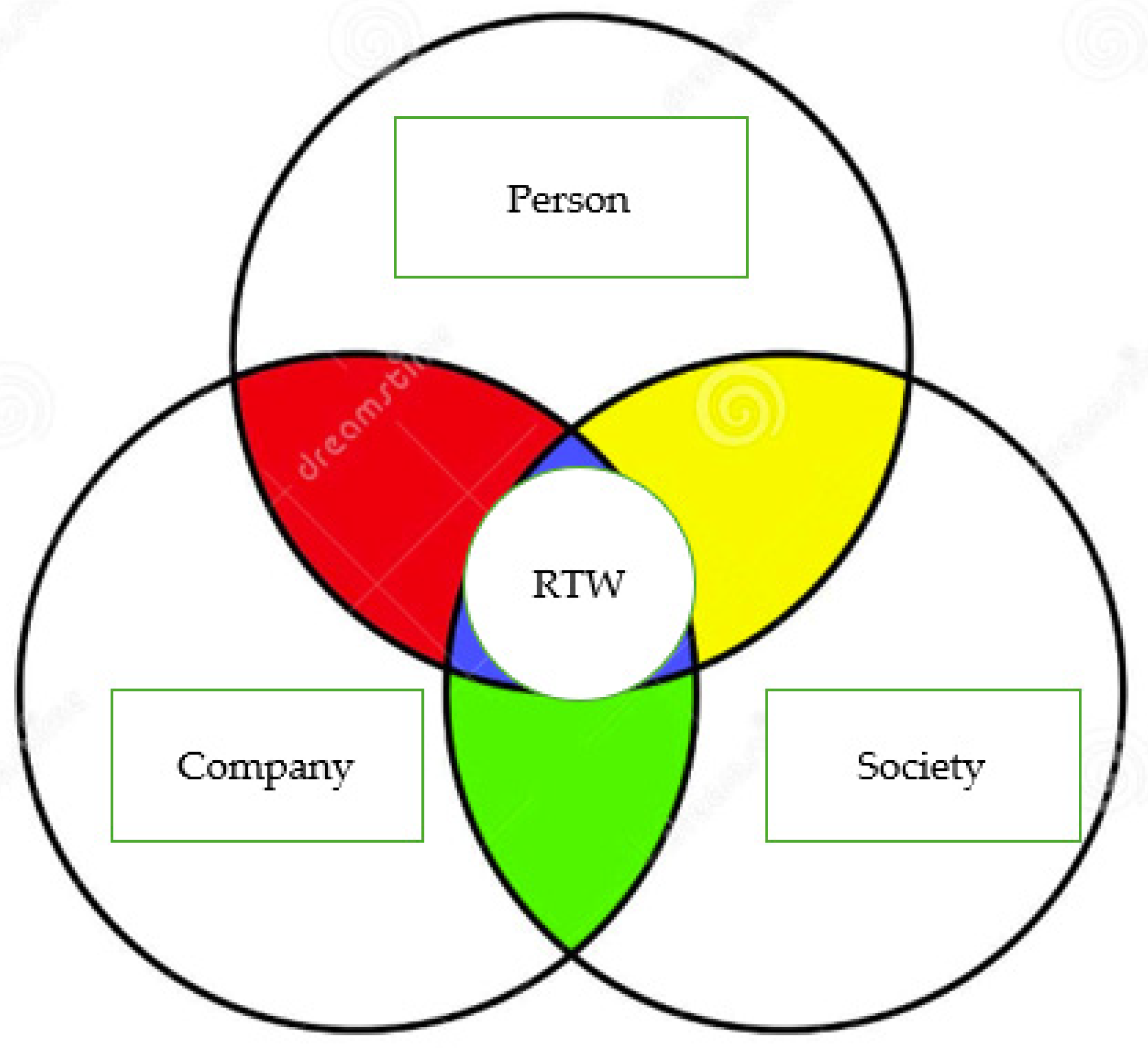

Table 1.
Correlation between the quantitative variables.
| Age | Justice | Anxiety | Depression | PSQI | Fatigue | ||
| Age | Spearman’s rho | 1.000 | 0.063 | -0.072 | 0.062 | 0.095 | 0.342 |
| Sig. (2-tailed) | . | 0.736 | 0.695 | 0.735 | 0.605 | 0.060 | |
| Justice | Spearman’s rho | 0.063 | 1.000 | -0.549** | -0.605** | -0.445* | -0.287 |
| Sig. (2-tailed) | 0.736 | . | 0.001 | 0.000 | 0.012 | 0.118 | |
| Anxiety | Spearman’s rho | -0.072 | -0.549** | 1.000 | 0.583** | 0.723** | 0.420* |
| Sig. (2-tailed) | 0.695 | 0.001 | . | 0.000 | 0.000 | 0.019 | |
| Depression | Spearman’s rho | 0.062 | -0.605** | 0.583** | 1.000 | 0.595** | 0.579** |
| Sig. (2-tailed) | 0.735 | 0.000 | 0.000 | . | 0.000 | 0.001 | |
| PSQI | Spearman’s rho | 0.095 | -0.445* | 0.723** | 0.595** | 1.000 | 0.521** |
| Sig. (2-tailed) | 0.605 | 0.012 | 0.000 | 0.000 | . | 0.003 | |
| Fatigue | Spearman’s rho | 0.342 | -0.287 | 0.420* | 0.579** | 0.521** | 1.000 |
| Sig. (2-tailed) | 0.060 | 0.118 | 0.019 | 0.001 | 0.003 | . |
Disclaimer/Publisher’s Note: The statements, opinions and data contained in all publications are solely those of the individual author(s) and contributor(s) and not of MDPI and/or the editor(s). MDPI and/or the editor(s) disclaim responsibility for any injury to people or property resulting from any ideas, methods, instructions or products referred to in the content. |
© 2024 by the authors. Licensee MDPI, Basel, Switzerland. This article is an open access article distributed under the terms and conditions of the Creative Commons Attribution (CC BY) license (http://creativecommons.org/licenses/by/4.0/).
Copyright: This open access article is published under a Creative Commons CC BY 4.0 license, which permit the free download, distribution, and reuse, provided that the author and preprint are cited in any reuse.