

Submitted:
19 June 2024
Posted:
21 June 2024
You are already at the latest version
Abstract
This study investigates stress perceptions, somatization, and coping strategies among 271 nursing and dentistry (n=126 and n=145, respectively), undergraduate and postgraduate students. For the study, an e-questionnaire was designed in a two-step process, uploaded in Google Forms and staying open for submissions during February 2024 in the School of Health Sciences, National and Kapodistrian University of Athens. In our sample, predominantly female (68.60%), the majority were undergraduates (80.10%). Females reported higher stress somatization (M=10.22, SD=5.23) compared to males (M=7.94, SD=6.14), with a moderate effect size (Cohen’s d=0.412, p
Keywords:
nursing students
; dentistry students
; stress somatization
; coping strategies
; gender differences
; academic stress
; stress management
; psychological support
; mentoring
; coaching in healthcare
1. Introduction
Stress among dental and nursing students is a well-documented phenomenon that encompasses various psychosocial and physiological dimensions (Li and Hansson 2020; Smolana et al 2022)[1,2]. Research has consistently highlighted the pervasive nature of stress in these academic disciplines, with studies indicating its detrimental impact on student's well-being and academic performance (Mocny-Pachońska et al 2020; Kadhila, & Sheelongo, 2023) [3,4]. While much attention has been devoted to understanding the psychological aspects of stress (Basudan et al 2017; Wu et al 2021) [5,6], less emphasis has been placed on its somatic manifestations, particularly among dental and nursing students (Arrieta-Vergara, et al 2019; Córdova Olivera, et al 2023)[7,8].
Somatization of stress refers to the phenomenon where psychological distress manifests as physical symptoms without discernible organic pathology (Feussner et al., 2022) [9]. This is particularly concerning in healthcare education due to the demanding nature of these disciplines and the potential implications for students' future clinical practice (Sperling et al., 2023) [10]. Among dental students, who face significant stressors during their education, somatization symptoms such as tension-type headaches with a positive association with painful TMD or bruxism are prevalent, linking these symptoms to stress and psychological functioning (Câmara-Souza et al., 2020) [11]. Research highlights the association between emotional stress and awake bruxism, with sleep disturbances also playing a role (Levartovsky et al., 2022) [12]. Awake bruxism, characterized by clenching and grinding of teeth during waking hours, is linked to psychological factors and perceived stress levels [11,13,14]. On the other hand, sleep bruxism has been correlated with stress and depression [15,16]. Factors such as academic workload, clinical requirements, and the competitive nature of the field contribute to high levels of psychological distress [17,18,19]. Also, demographic factors such as gender and age may additionally influence the experience of stress and somatization symptoms among dental students [20,21]. Studies show sex differences too in stress reactivity, suggesting gender socialization plays a role in stress responses [22]. Additionally, age-related differences in proprioceptive function and fine motor behavior may affect the manifestation of somatic symptoms (Liutsko et al., 2020) [23]. This stress can lead dentistry students to somatization in different parts of the body, where psychological distress is expressed through physical symptoms (Bal et al., 2022) [24].
Similarly, nursing students are not immune to the somatic effects of stress, with studies highlighting associations between stress and physical health outcomes (Zou et al 2023) [25]. Nursing students also encounter substantial stressors throughout their education, which can lead to somatization of stress and various physical health issues (Hamaideh, 2022,24) [26,27]. Recent studies have shed light on the prevalence and risk factors associated with stress among nursing students, highlighting the need for targeted interventions to support their well-being (Zulu 2021; Mishra, et al 2023; Mumba, et al 2023) [28,29,30]. Factors such as heavy workloads, academic pressure, and exposure to emotionally challenging situations during clinical placements contribute to the psychological distress experienced by nursing students (Hwang, &, Kim, 2022) [31]. This distress is expressed through physical health problems (Sonmez et al 2023) [32]. Additionally, the demanding nature of nursing education and clinical practice can exacerbate existing physical health conditions, further highlighting the importance of holistic support for nursing students (Labrague 2024) [33]. It is reported that sleep disturbances, musculoskeletal problems, and gastrointestinal issues are among the common somatic manifestations of stress reported by nursing students (Membrive-Jiménez et al 2022) [34]. Moreover, the experience of stress-induced somatic symptoms may vary based on demographic factors such as gender, age, and academic year [35,36,37]. Understanding these variations is essential for developing tailored programs to address the unique needs of nursing students and promote their overall well-being (Mikkonen, et al 2016; Lim et al 2022; Mínguez Moreno, et al 2023) [38,39,40].
However, comparative analyses between dental and nursing students regarding somatization of stress symptoms do not exist, diminishing our understanding of discipline-specific stressors and coping mechanisms. For this reason, this study aims to address this gap by examining the somatization of stress in dental and nursing undergraduate and postgraduate students at the Dentistry and Nursing department of a public university. More specifically, we seek to investigate the prevalence of somatization symptoms among dental and nursing students, along with perceived stress levels and their differences between the two disciplines. Additionally, the study seeks to identify the most common somatic manifestations of stress reported by students and determine if there are discipline-specific differences in the severity and frequency of these symptoms. The research also aims to explore resilience factors associated with lower levels of somatization symptoms and examine how coping strategies vary between dental and nursing students in response to stress-induced somatic symptoms. Furthermore, it investigates the impact of somatization symptoms on academic performance and well-being, considering demographic factors such as gender, age, family income, and academic year. The study also aims to gather perceptions of dental and nursing students regarding the effectiveness of existing support mechanisms in addressing stress in the academic environment. Ultimately, the findings may provide evidence for the development of targeted interventions and support mechanisms aimed at promoting the well-being of dental and nursing students.
2. Materials and Methods
The sample of the present study consisted of undergraduate (N1A=780) and postgraduate students of the Department of Dentistry (N1A=85) and accordingly of Nursing (N1B=808 and N2B=330) of the School of Health Sciences of the National and Kapodistrian University of Athens, Greece.
Based on similar studies in the field [41,42], this questionnaire study was conducted in two stages. Initially, a literature review was performed to formulate the initial questionnaire, which was then piloted with 10 students from each Department (5 undergraduate and 5 postgraduate) who voluntarily agreed to participate. Feedback from the pilot phase was used to refine the questionnaire, excluding factors not addressed adequately. The finalized questionnaire underwent review by a team of four professors specialized in this field (two from each Department) and was part of a bigger research project on the theme for the two departments. Subsequently, the questionnaire was uploaded to Google Forms and distributed to students to submit their answers in February 2024.
The lead researchers of each department obtained approval from their respective Ethics committees to ensure uniform participation. More specifically, the study was conducted following the Declaration of Helsinki, and approved by the Institutional Review Board (or Ethics Committee) of the Department of Dentistry (609/03.10.2023) and Nursing (467/26-10-2023) of the School of Health Sciences of the National and Kapodistrian University of Athens, Greece. The questionnaire, anonymous and devoid of personal data, was voluntary, and no compensation was provided. Each student completed the questionnaire only once. The questionnaire remained open for one month, with participation information and the link disseminated four times (every week) by each department's Secretariat.
The study questionnaire consisted of three distinct sections: 1) Part One (Q1-Q7: questions related to demographic characteristics), 2) Part Two (Q8-Q14: questions related to oral symptoms due to stress), and 3) Part Three (Q15-Q22: open-ended questions related to estimated stress factors, somatization of stress in the body, personal strategies followed to control stress and need for educational interventions). The questionnaire of the study and guidelines for fulfillment are presented in Appendix A and B.
Data analysis was performed with the statistical package IBM SPSS v. 28. Data for demographics and the stress somatization scale were analyzed by producing descriptive statistics. Stress somatization distribution was examined in terms of normality via skewness and kurtosis and was considered normally distributed (George & Mallery, 2019) [43]. Therefore, independent samples t-tests were used to assess differences in stress somatization between genders and departments. Qualitative data collected from open-ended questions were analyzed thematically and absolute and relative frequencies (n, %) were reported per theme/category and question. Potential differences in the theme/categories extracted between students’ genders and the department of study were assessed with chi-square tests of independence performed with Fisher exact test correction when needed (Field, 2017) [44]. Moreover, correlations of theme/category prevalence and stress somatization levels were examined with the non-parametric Spearman correlation coefficient.
3. Results
Analysis revealed that for stress somatization Cronbach’s alpha is 0.750. The sample consisted of 271 students, pursuing their undergraduate or postgraduate degree in the nursing department (n=126, 46.5%) or the dentistry department (n=145, 53.5%). The female gender was more prevalent (68.60% female students), while the majority, 80.10%, were undergraduate students, with 52.20% reporting a family income below 25,000€. (Table 1).
As presented in Table 2, there was a statistically significant, moderate difference, between male and female participants in stress somatization (p < .05, Cohen’s d = .412), with female students presenting increased levels of stress somatization (M=10.22, SD=5.23) compared to male students (M=7.94, SD=6.14) with dentistry students reporting more often on the subject than nursing students but in a non-statistically significant level. There were no statistically significant effects of educational level, year of studies, or family income on stress somatization.
The boxplots of students’ stress somatization by gender and department are reported schematically in Figure 1.
Breaking down the stress somatization to its seven items (Table 3, Figure 2), female participants reported hearing a sound from the temporomandibular joint during movements of the mandible (very true or always applicable) at a higher rate of 24.8% in contrast to 15.1% of male participants (p = .039). Also, female participants reported at a percentage of 43.1% that they experienced headaches, compared to a smaller ratio of 18.6% for male participants (p < .001). Finally, female participants reported 35.8% that they feel nervous or annoyed at their relationships in the student/work environment, compared to a smaller ratio of 26.7% for male participants (p < .001).
Moreover, dental students reported that they experienced clenching or grinding teeth during the day or night (42.7%), compared to a smaller ratio of 29.5% for nursing students (p = .010). There were no statistically significant effects of educational level, year of studies, or family income, neither on the composite stress somatization scale nor its respective items.
Students' responses to the open-ended questions were categorized based on their content relative to perceptions of stress, stress management strategies, and requirements. Table 4 presents the categories/themes extracted from the qualitative analysis, by students’ department (nursing/dental) and gender (male/female).
What does "stress" mean to you?
In the question about their interpretation of stress, the category “Inability to manage unexpected or difficult situations, Insecurity, Panic” gathered the largest percentage of responses (38.38%) which includes the insecurity, fear or panic caused by unexpected or difficult situations that are either happening or may happen in the future. Following, the second most frequent category was the one of “Restlessness and psychological pressure” (34.32%) and the category of “Physical Symptoms” manifested due to anxiety (19.93%) such as tachycardia, head and chest pains, stomach disorders, fatigue, etc.
A significant number of students explained stress as the difficulty in concentration and the disorganization of the person's thoughts and feelings (17.71%) which indicates the person's sudden reduced ability to concentrate, think productively and express their feelings. The remaining manifestations of anxiety include obsessive thoughts and overanalyzing (9.59%), the daily pressure of the individual to meet his obligations combined with the pressure of long-term goals (9.59%) and finally the fear of failure (6.64%).
The interpretation of stress as “Restlessness and psychological pressure” was more prevalent in dental students compared to nursing students (p < .05, 41.0% vs 28.2%, respectively, see Table 4). Moreover, nursing students who perceived stress as the “Inability to manage unexpected or difficult situations, Insecurity, Panic” were more likely to experience stress somatization symptoms (ρ = .276, p < .05), while for dental students, stress somatization was related to “Pressure to meet daily obligations/long-term goals” (ρ = .186, p < .05).
How and where in the body do you experience stress?
Regarding the physical symptoms with which anxiety manifests itself in students, the most common of them are heart and chest discomfort (41.8%), such as tachycardia and a feeling of heaviness in the chest, as well as digestive/nutritional disorders (41.41%) such as stomach pains, ulcers, constipation, anorexia, etc. Followed by headaches (36.33%), breathing difficulties (11.72%), general muscle tension (10.94%), such as tremors in the hands and the legs and sweating, or various skin diseases (10.55%). There were no significant differences between male and female participants or between dental and nursing departments, in the categories extracted for body manifestation of stress (see Table 3 and Table 5).
How do you feel you can improve your resilience?
In terms of the ways that students believe can help them improve their resilience to stress, the highest percentage of common acceptance is gathered by “Emotional balance and Self-awareness” (34.44%) a category that generally includes any effort to develop and improve one's identity. This is followed by “Managing Stressors” with an acceptance rate of 25.93%, which mainly includes voluntary exposure to uncertainty to gain experience in dealing with problems as well as other stress reduction strategies. Lower down, we see the category of “Psychotherapy and Psychological support” (17.41%) and immediately after the category of “Improving Physical Condition, Nutrition and Sleep” (10.74%). In addition, other methods of reducing stress include “better time management” (9.26%), “seeking social support” (7.41%) and “devoting oneself to study or work” (4.07%). It should be noted that the strategy of “Improving Physical Condition, Nutrition and Sleep” was more prevalent in dental students compared to nursing students (p<.05, 15.1% vs 6.5%, see Table 3).
What strategy do you follow to immediately (at the same time) deal with stressful situations?
The next two questions focus on two categories of coping strategies for stressful situations, the more immediate and short-term and the more systematic and long-term. Regarding the first category of strategies, the highest percentage of acceptance is gathered from the “Analysis of The Situation, Staying Cool, Self-Regulation” (38.70%) which sometimes includes self-animation techniques. This is followed by “Breathing Techniques” (32.95%) and other exercises that help to decompress and immediately relax, and the various methods of “Distraction from The Stressful Situation” (16.09%) which may include a dedication to work or other activities. Communicating and seeking “Social/Psychological Support” gathers acceptance from 14.56% and seeking free time to engage in “Hobbies and Recreational Activities” gathers acceptance from 12.26% of the sample. This is followed by “Physical Activity” (8.05%) and “Organization and Methodicality” (2.3%) which mainly concern the studies.
There was a statistically significant difference between male and female dental students’ acceptance of the strategy of “Social/Psychological Support”, with female dental students presenting a higher acceptance rate (20.0%), compared to male dental students (6.0%). No other significant differences were detected between dental and nursing departments, in the categories of short-term stress management (see Table 3 and Table 6).
What do you usually do when you are stressed for an extended period?
Now, studying the category of strategies for longer periods of stress, we again see that first in order of acceptance ranking comes the “Analysis of The Situation, Staying Cool” (31.87%) usually combined with positive thoughts, followed by the search for “Communication and Social/Psychological Support” (16.73%) mainly to friends and family or mental health professionals. “Distraction Combined with Entertainment” gathers 15.14% and “Strategic Thinking and Better Organization of Time”, 13.15%. This is followed by “Physical Activity” (12.35%), “Dedication to Study” (11.16%) and focus on “Personal Time and Personal Care” (10.76%) which includes, among other things, rest and good nutrition. Another strategy we see at the end is the appeal to one's “Spirituality” (6.77%) which includes techniques such as prayer, and meditation.
There was a statistically significant difference between male and female nursing students’ acceptance of the strategy of “Personal time and Personal Care”, with female nursing students presenting a lower acceptance rate (8.2%), compared to male nursing students (28.6%). No other significant differences were detected between dental and nursing departments, relative to long-term stress management (Table 3), yet, the “Patience, Doing Nothing” strategy was associated with higher levels of stress somatization (ρ = .204, p < .05). Moreover, “Analysis of the situation, staying cool, Positive thoughts” strategy was associated with decreased stress somatization levels (ρ = -.199, p < .05) for dental students, and “Physical Activity and Sports” strategy with decreased stress somatization levels (ρ = -.186, p < .05) for nursing students.
What would you suggest to your school administration to reduce the level of stress you and your fellow students experience?
The following are the suggestions of the students to the administration of the school for smoothing its malfunctions and alleviating the problems they face in their educational experience, which are perceived as the source of their daily stress. The most accepted and perhaps the most general category of solutions proposed by the students is “Revision of the educational Program, Better Organization, Staff evaluation” with proposals to expand it to 5 or 6 years of study, the revision of some courses to focus on more essential and practical knowledge and the better evaluation of the educational staff (45.16%). Another popular suggestion of the students was the “Improved communication and support”, mainly referring to the professors and supervisors (27.42%), asking for better treatment, greater understanding, and support, especially in their first steps of practical training.
Another important category was “Reduction of Curriculum Requirements and Hours, Flexibility in Studies” which includes proposals for easing the studies’ requirements and reducing teaching hours with greater flexibility and breaks (18.95%). Moreover, “Introduction of Psychological Support Programs” alongside the educational experience (18.55%) was also accepted by a significant number of students.
Finally, other proposals include the improvement of infrastructure and working conditions, especially in laboratories (5.65%), and better and more timely information from the faculty regarding study programs, laboratories, and exams and the changes that arise from time to time (3.23%).
There was a statistically significant difference between dental and nursing students’ acceptance of “Introduction of Psychological Support Programs”, with nursing students presenting a higher acceptance rate (24.3%), compared to dental students (11.8%). Also, dental students supported more strongly, compared to nursing students, the changes of “Revision of the educational Program, Better Organization, Staff evaluation” (51.2% vs 37.4%, p < .05) and “Improvement of physical spaces, infrastructure, and working conditions” (10.2% vs 1.7%, p < .05). It should be noted that “Reduction of Curriculum Requirements and Hours, Flexibility in studies” was a more prevalent requirement for female dental students compared to male dental students (26.2% vs 9.3%, p < .05)(Table 7).
Would you use the help of a coach to help you manage your anxiety?
From the responses of the students in the sample, we conclude that the majority is or would be positive about seeking coaching support within the faculty. The main motivation seems to be seeking advice on everyday issues and obviously in managing stress, while a less important motivation seems to be guidance in managing their time, improving their skills, and achieving their goals. Some of the characteristics they look for or would look for in a coach are to show understanding, to have empathy and confidentiality, to be encouraging but at the same time to be objective and realistic. Regarding the desired frequency with which the students would like to interact with a coach, one session per week gathers the largest percentage (56.45%), with one session per month following (25.81%).
There were no significant differences between male and female participants or between dental and nursing departments, in the coach acceptance categories (see Table 3). Yet, dental students who were willing to accept support from a coach were also experiencing more stress somatization symptoms (ρ = .243, p < .05), while negative attitudes towards coach support were linked with dental students’ reporting lower somatization symptoms (ρ = -.238, p < .05). No significant correlations were detected between nursing students’ acceptance of coach support and level of stress somatization (Table 8).
In the last open-ended question, students are asked to mention anything they find interesting about the stress they experience. In their answers, we can distinguish two main patterns.
The first concerns the problems and stressful situations that arise in their education/workplace. They find that the very high academic demands for laboratory and clinical performance, the large volume of work, and the speed with which they are required to prepare create a highly stressful situation for them.
“I am worried about my superiors who, however, do not have the appropriate knowledge to deal with a problem that arises and while they should admit it, they give instructions to their subordinates, who are not sure that it is the right action that they are indicating to be performed”.
“As someone who generally struggles in labs, I would like more internships before going into the clinics (e.g. if the dental school had one more year of internships before going into the clinics, I think it would be much better)”
The situation is aggravated by inadequate infrastructure, non-functional equipment, and insufficient support in critical educational processes. Other factors that increase psychological pressure are the increased responsibility they have in clinical practices and having to deal with real patients and difficult situations very quickly:
“The anxiety that next year we will enter the clinics and in some laboratories, half of the units may not work, as a result of which there is no proper simulation of a real clinical case. I'm getting anxious at the thought that next year I'll be dealing with a real patient that a mistake of mine could cost him dearly. It also worries me that if, for example, you are sick, it is very difficult to replace a laboratory. Also, if you miss a workshop, it means you are left behind in the next one. And obviously, the amount of reading is huge.”
“After my clinical practice, when I leave the hospital, without the clinic staff seeing me, I leave in tears. The conditions are very bad, I get tired both physically and psychologically, I can't study and I'm worried that I won't be able to get the material in the lessons.”
Of particular interest is the highlighting of a nursing participant, regarding the professional devaluation of nurses in Greece and the role of this devaluation in the psychological burden of nurses.
“Nurses experience extra stress in Greece because most people don't appreciate them. I know this is very hard to change. However, I saw that almost all the excellent nursing students continued their studies in another subject. None remained in the infirmary. There are these stereotypes in Greece that anyone who is a nurse is just someone who isn't good enough to be a doctor. If this doesn't stop most nurses will never feel fulfilled by their profession.”
The second pattern of responses focuses on proposed solutions to existing problems and changes they would like to see made in the existing system to reduce stress and improve the academic experience. These focus on improving contact with teaching staff with the main request being more understanding and support from teachers and teaching staff. More flexibility in academic procedures is also proposed, such as better management of examination times and more opportunities for replacements, but also restructuring of some programs and courses to better prepare for clinical applications, for more practical training, and focus on more essential knowledge. Finally, some student requests focus on strengthening available psychological services and psychological support programs in educational institutions: “Group therapy, a course that will focus on managing stress in the hospital and during the clinics I wish we had psychological support. Some students experienced traumatic events, if I hadn't been able to do psychotherapy on my own, I believe I would still be struggling for a long time with my emotions and anxiety.” or, “If there were psychologists at workplaces we could talk about what is troubling us” or “Due to everyone's many obligations, it would be good to communicate to resolve questions, but it is also important to be informed in time of material...courses to read as well as dates for exams”
4. Discussion
This study aims to investigate stress perceptions, somatization, and coping strategies among 271 nursing and dental undergraduate and postgraduate students from the Department of Dentistry and Nursing at the National and Kapodistrian University of Athens. The study seeks to provide a comprehensive understanding of how stress manifests physically and mentally in these students, how they cope with these challenges, and the need for educational interventions.
4.1. Prevalence of Somatization Symptoms among Dental and Nursing Students
The present study, regarding the prevalence of somatization symptoms among dental and nursing students, indicated that there were no statistically significant effects although they were relatively higher in dentistry rather than in nursing students. It also revealed that there are discipline-specific differences in the severity and frequency of somatization symptoms. Dental students had higher rates (41%) compared to nursing students (28.20%) in terms of somatization symptoms. Additionally, nursing students had more elevated levels of somatization of stress related to the inability to manage unexpected and difficult situations, insecurity, and panic, while dental students had more elevated levels of stress somatization related to the stress of meeting daily demands, compared to the stress of long-term goals. Generally, somatization symptoms among nursing and dental students are severely understudied. We can refer indicatively to the study of Feussner et al. (2022) [9], which indicated more severe somatization symptoms of dental students compared to medical students. On the other hand, nursing students may experience more somatization symptoms compared to medical students too due to factors such as rigorous clinical responsibilities and the emotional demands of patient care [45,46].
4.2. Difference of Perceived Stress Levels between Dental and Nursing Students
The perceived levels of stress, according to this study, in terms of the somatization of stress in nursing and dental students were presented at a higher level as “Inability to manage unexpected or difficult situations, insecurity, panic”, basically reported by nursing students and “Restlessness and psychological pressure”, from dentistry students. This difference corresponds to the nature of each discipline and the daily routines faced by students in each departments. Our data are in accordance with a study conducted in Australia among nursing, dental and pharmacy students on perceived stress levels and emotional intelligence [47]. The study demonstrated a significant negative correlation between emotional intelligence and perceived stress levels in nursing and pharmacy students. Perceived stress levels were significantly higher than the normative average for pharmacy and dental students and overall higher than nursing students [47]. Similar studies conducted on dental students showed moderate levels [48] and high levels of perceived stress respectively [49,50], while other studies concerned nursing students demonstrated moderate levels of perceived stress [27,51].
4.3. Somatic Manifestations of Stress
In our study, dental and nursing students commonly reported somatic manifestations of stress such as heart dysphoria, digestive disorders, and headaches, similar to findings elsewhere [9,52]. There were no significant differences between dental and nursing students regarding these symptoms, except for temporomandibular joint (TMJ) symptoms, where more females reported issues (24.8%) compared to males (15.1%). Additionally, female participants reported higher rates of tension-type headaches (43.1%) compared to males (18.6%), consistent with findings in nursing and dental student populations [53,54,55]. The study also found that headaches significantly impact academic performance and quality of life among health profession undergraduates, aligning with previous research (Bashatah et al., 2023) [56]. However, our study showed a lower use of medications (2.2%) compared to other self-management strategies reported in the literature, such as over-the-counter medications and relaxation techniques [56]. The prevalence of migraine-like headaches, exacerbated by perceived stress from events like the COVID-19 pandemic, highlights the need for interventions to manage stress and enhance students’ well-being (Tamulevicius et al., 2023) [57].
4.4. Demographic Factors Influencing the Experience of Stress-Induced Somatic Symptoms
The present study indicated that stress-induced somatic symptoms are significantly related to gender, with females demonstrating higher levels of stress somatization compared to males. In contrast, factors such as academic year, educational level, and family income did not show statistically significant effects on stress somatization. From a relevant descriptive cross-sectional study, it was reported that female nursing students who slept six hours or less, did not eat a balanced diet or exercise, attended public universities, had lower grade point averages, intended to leave nursing, and were dissatisfied with the nursing profession reported higher levels of perceived stress. Conversely, nursing students who were satisfied with their field and did not intend to leave it reported lower levels of perceived stress (Hamaideh et al., 2024) [27]. Also, female nursing students exhibited higher anxiety levels due to multiple factors, including lack of competence and having to deliver bad news (Valero-Chillerón et al., 2019) [58]. Overall, our findings align with previous research, highlighting gender differences in stress response due to developmental and biological factors [51,59], as well as differences in emotional stress responses related to gender [60].
Furthermore, age differences in emotional responses to daily stress have been documented, with older individuals showing different stress responses compared to younger individuals [61]. This age-related variation in stress response was also evident during the COVID-19 pandemic, where older adults experienced distinct stress levels and life changes impacting their psychological well-being (Birditt et al., 2021) [62]. On the other hand, an observational study involving dental students compared first-year and fifth-year students, indicating that older students experienced lower levels of perceived stress and anxiety (Owczarek et al., 2020) [63], which was not the case in our study. Additionally, an observational study involving nursing students in a Spanish university revealed that no student experienced high levels of depersonalization or low personal fulfillment, but depersonalization increased as the academic year progressed [58]. Research specific to dental students has also shown that the stress response to the dental school environment varies by year of study. Older and more advanced students tend to report lower stress levels, suggesting an adaptation or increased coping mechanisms over time [64,65] but was not proven on a statistical basis in our study.
4.5. Resilience Factors for Dentistry and Nursing Students
In the present study, resilience factors associated with lower levels of somatization symptoms among dental and nursing students included emotional balance and self-awareness (34.44%). This aligns with findings from Sperling et al. (2023) [66], who highlighted the importance of emotional regulation and self-awareness in reducing somatic symptoms among medical students. Similarly, another research indicated that self-reflection and emotional self-disclosure contribute significantly to post-traumatic growth in nursing students, reporting on the role of self-awareness in mental health resilience [67]. Furthermore, studies have shown that high levels of empathy, self-awareness, and effective stress management predict reduced perceived stress among nursing students [27] and promote well-being [68]. To prove this, Rasheed et al. (2021) [69], developed a measure of self-awareness among nurses, demonstrating its positive impact on stress reduction and mental health. Finally, others investigated the relationship between spiritual health, resilience, and happiness among dental students, finding that these factors were associated with lower somatization levels and higher happiness [70], as was the case in our study too.
4.6. Variation of Coping Strategies in Response to Stress-Induced Somatic Symptoms
In this study, we investigated coping strategies among dental and nursing students in response to stress-induced somatic symptoms. Short-term stress management strategies included situational analysis, maintaining composure, self-coercion techniques, self-regulation, breathing exercises, distraction, and social and psychological support. Female dental students showed a higher preference (20%) for social and psychological support compared to male dental students (6%), with no other significant differences observed between dental and nursing students [71]. Long-term stress management strategies involve situation analysis, maintaining composure, communication, social and psychological support, distraction combined with entertainment, strategic thinking, time management, sleep, physical activity, dedication to study, personal time, self-care (including rest and nutrition), and spirituality such as prayer and meditation, at a lower but significant rate [72]. Dental students in our study particularly emphasized the benefits of improved physical well-being, nutrition, and sleep (15.1%) compared to nursing students (6.50%). So, our findings support previous research indicating that regular physical activity and social support contribute to lower rates of somatic symptoms [27].
As reported in other studies, alternative ways of stress control such as prayer, meditation, and yoga are preferred among healthcare professionals [73,74]. Recent research has highlighted the positive impact of prayer on well-being, emphasizing its dynamic role in daily life. Newman et al. (2023) [75] found that engaging in prayer regularly can significantly enhance an individual's overall well-being by providing a sense of comfort and purpose. Additionally, it was reported that internal dialogue is a crucial mediator in this relationship, suggesting that prayer facilitates a constructive internal conversation that contributes to improved mental health and emotional stability [76]. Overall, there are insufficient studies in the literature to be associated with our study. Nevertheless, it is generally reported elsewhere that spirituality is associated with lower levels of depression and stress somatic symptoms in female healthcare students [31,77]. Despite this fact, the present study reported low percentages of spirituality in students' coping strategies. Possibly such initiatives could be used as vital components in promoting the psychological well-being of both dentistry and nursing students.
Significantly elevated levels of stress somatization were observed among participants who adopted a passive approach, characterized by "being patient and doing nothing else." This passive response to stress contradicts other findings that report that self-guided stress management interventions can effectively reduce stress in college students, highlighting the need for active coping strategies (Amanvermez et al., 2022) [78]. Furthermore, Bonnesen et al. (2020) [79] emphasized the importance of implementing proactive initiatives to prevent student stress, suggesting that merely waiting for stress to pass without acting can exacerbate somatic symptoms. Some additional studies reported that active coping was supportive of healthcare students' mental health [77] and was particularly protective of male healthcare students [77,80].
Dental students in our study effectively managed stress by employing cognitive strategies such as situational analysis and maintaining a calm demeanor, which correlated with lower levels of stress somatization. This approach aligns with research highlighting the importance of academic resilience and motivational intensity in managing stress (Yang & Wang, 2022) [81]. Resilient individuals are known to utilize positive emotions effectively, demonstrating the critical role of emotional regulation in reducing stress [82]. These findings prove the effectiveness of cognitive and emotional strategies in helping dental students reduce stress and its somatic effects. Conversely, nursing students achieved similar outcomes by engaging in physical activity and sports to control academic stress. The Mayo Clinic (2024) [83] supports these findings, noting that regular exercise enhances overall health and releases endorphins, which elevate mood and reduce stress as also mentioned elsewhere [84]. This distinction aligns with broader research on stress coping strategies among students where effective coping mechanisms in reducing academic stress and fatigue while strengthening self-control are discussed (Nweke et al. 2024) [85].
Furthermore, female nursing students in our study exhibited lower acceptance rates of personal time and personal care (8.20%) compared to male counterparts (28.60%), revealing a gender disparity influenced by societal expectations. It was reported accordingly that male nursing students often feel less constrained by traditional gender roles, leading to greater acceptance of personal care practices [86]. Gender-defined roles significantly affect nursing students' attitudes towards self-care, with females prioritizing patient care over personal well-being [87], as was the case in our study too. But self-care is crucial for maintaining overall well-being and professional effectiveness in nursing (Riegel et al., 2021) [88], underscored by the COVID-19 pandemic's impact on healthcare professionals' attitudes towards self-care [89]. Psychological interventions promoting resilience can enhance self-care practices among nursing students (Kunzler et al., 2020) [90], highlighting the need to address gender-specific barriers and cultivate a culture of self-care for their well-being and professional development.
4.7. Perceptions of Dental and Nursing Students Regarding the Effectiveness of Existing Support Mechanisms in Addressing Somatization Symptoms
This study highlighted dental and nursing students' perceptions of support mechanisms in addressing somatization symptoms, emphasizing areas for improvement such as curriculum revision, faculty organization, and psychological support programs. Dental students prioritized curriculum changes and better facilities, while nursing students favored psychological support and enhanced educational experiences. Female dental students expressed more interest in reducing study requirements and increasing flexibility compared to males. Concerns about supervisor support in demanding conditions were also noted [March-Amengual et al., 2022] [91]. Although direct studies on these mechanisms are lacking, the literature suggests that positive school environments and coping strategies contribute significantly to student health outcomes [92,93,94]. Tailored mental health interventions in dental education are also mentioned elsewhere to emphasize the importance of holistic approaches that integrate spiritual and emotional support most needed in these disciplines [95,96].
4.8. Importance of a Coach in Controlling the Phenomena
In our study, the importance of coaching in managing stress and somatization among dental and nursing students was highlighted. A majority of students viewed coaching positively, primarily for stress management, as well as for improving time management, skills, and achieving goals. Desired qualities in a coach include understanding, empathy, confidentiality, encouragement, goal orientation, and realism. Most students preferred weekly sessions (56.45%), while others opted for one to three sessions per month (25.81%). Dental students who accepted coaching tended to have higher somatization stress levels, whereas coaching acceptance did not correlate with stress levels among nursing students. Coaching has shown beneficial effects in managing stress and enhancing coping strategies among healthcare students, improving stress management compared to those without coaching [97,98]. Academic coaching, especially in online settings, has also been associated with improved student achievement and resilience [99]. Tailored coaching approaches support management skills and promote independence in research too [Martínez et al., 2021]. Implementing a coaching culture in academic settings not only addresses immediate stress-related issues but also equips students with long-term coping mechanisms crucial for professional growth [100,101,102,103]. This approach is particularly valuable in dentistry, where it enhances leadership and managerial skills to address unique challenges faced by students [104].
4.9. Developing Targeted Interventions and Support Mechanisms to Promote the Well-Being of Dental and Nursing Students
The findings of this study can guide the development of targeted interventions and support mechanisms to enhance the well-being of dental and nursing students. Key recommendations from the students include enhancing communication with teaching staff, extending internships, revising and replacing some courses, and strengthening available psychological services. There is an urgent need for improved support systems, flexible academic procedures, and better communication between students and teaching staff. Effective communication in healthcare education is critical, as improved interpersonal communication can enhance student support and reduce stress [105]. An interprofessional model promoting open communication behaviors among healthcare professionals can serve as a valuable framework for students in the two studied disciplines [106] to manage stress and improve job satisfaction [107]. Increased acceptance of coaching is also positively correlated with improved stress management outcomes. Conclusively, our findings identified specific training needs and interventions to enhance resilience, including stress management techniques and emotional regulation strategies, as mentioned elsewhere [108].
4.10. Limitations of the Study
This study has several acknowledged limitations. Firstly, while the sample size is adequate for statistical analysis, it is confined to nursing and dentistry students from a single institution, limiting its generalizability to students in other disciplines or institutions. Secondly, reliance on self-reported data introduces potential biases such as social desirability and recall bias [109,110]. The cross-sectional design precludes causal inference regarding the relationships between stress, somatization, and coping strategies. Additionally, the qualitative analysis of open-ended questions, while detailed, may be subject to researcher bias in categorizing responses. The study does not account for confounding factors like personality traits, pre-existing mental health conditions, or external stressors beyond the academic environment [111,112]. Lastly, the lack of longitudinal data limits understanding of how stress perceptions and coping strategies evolve over students' academic careers. Future research should address these limitations by utilizing larger, more diverse samples, employing longitudinal designs, and considering additional variables impacting student stress and coping mechanisms. Despite these limitations, the study reports on the importance of tailored interventions in educational settings to support nursing and dentistry students, enhancing their resilience and academic experience.
5. Conclusions
This study highlights gender and departmental differences in stress perception, somatization, and coping strategies among nursing and dentistry students. Female students reported higher stress somatization levels. Stress interpretations varied, with major themes including insecurity, psychological pressure, and physical symptoms. Nursing students associating stress with insecurity experienced higher somatization, while dental students linked stress to daily obligations and goals. Coping strategies focused on emotional balance, self-awareness, and stress management, with immediate techniques involving situational analysis and breathing, and long-term strategies including maintaining calm and seeking support. The study reveals academic pressures and inadequate infrastructure as key stress contributors, emphasizing the need for improved support systems, flexible academic procedures, and better communication. High acceptance for coaching support was linked to better stress management outcomes.
Author Contributions
Conceptualization, M.A. and P.M.; methodology, M.A. P.M..; software, M.A..; validation, M.A. P.M., A.K., T.K., A.S. nd G.M.; formal analysis, M.A.; A.S. and P.M.; investigation, M.A., P.M., G.M., A.K., A.S. and T.K.; resources, M.A., P.M., and A.K..; data curation, M.A., A.S. and P.M..; writing—original draft preparation, M.A., A.K., P.M., G.C., and T.K.; writing—review and editing, M.A., P.M., A.K., T.K., A.S. and G.M.; visualization, M.A., and P.M..; supervision, M.A.; project administration, M.A.; funding acquisition, M.A. All authors have read and agreed to the published version of the manuscript.
Funding
This research received no external funding.
Institutional Review Board Statement
The study was conducted in accordance with the Declaration of Helsinki, and approved by the Institutional Review Board (or Ethics Committee) of the Department of Dentistry (609/03.10.2023) and Nursing (467/26-10-2023) of the School of Health Sciences of the National and Kapodistrian University of Athens, Greece.
Informed Consent Statement
Informed consent was obtained from all subjects involved in the study.
Data Availability Statement
The original contributions presented in the study are included in the article/supplementary material, further inquiries can be directed to the corresponding author/s.
Acknowledgments
The authors wish to thank all participants of this study and the Hellenic Dental Association for supporting the project.
Conflicts of Interest
The authors declare no conflicts of interest.
Appendix A
Introductory message
ONLY FOR UNDERGRADUATE DENTAL and NURSING STUDENTS
The questionnaire of this study includes a general part (A) with demographic data, part (B) referring TMJ disorders due to stress and part C includes open-ended questions exploring participants' views on stress factors, somatization of stress in the body, strategies followed to control stress and need for educational interventions.
The survey is designed to be anonymous, ensuring that no personal information is collected during the process. Participation is voluntary and no reward of any kind is provided for your participation. You can fill in the questionnaire ONLY once. Completing the questionnaire implies acceptance of the personal data protection rules. The results of this study will be used for scientific publications and actions to improve working conditions in the departments involved. For observations, comments, and clarifications you can contact the research group.
Appendix B
Questionnaire
PART ONE
Q1. What is your gender?
Q2. What is your level of education (1- 5 years, degree/diploma) undergraduate, postgraduate, PhD, postdoctoral)
Q3. What is your place of origin?
Athens
Other urban center (capital of a prefecture)
Continental region (towns and villages)
Island region (towns and villages)
Other country outside Greece
Q4.Which dental specialty would you like to pursue in the future? (for dental students)
General dentistry
Pedodontics
Orthodontics
Oral surgery
Dentistry-sensitive dentistry
Endodontics
Periodontology
Stomatology/hospital dentistry
Prosthetics - implants
I will not practice dentistry
I am not a dental student
Q5. Which nursing specialization would you like to pursue? (for nursing students)
Community nursing
Psychiatric nursing
Surgical nursing
Pathological nursing
Emergency nursing
Oncology nursing
I will not practice nursing
I am not a nursing student
Q6.What is your family's annual income?
P1. less than 15.000 €
Ρ2. 15.001-25.000 €
Ρ3. 25.001-35.000 €
Ρ4. 35.001-50.000 €
P5. more than € 50.000
Ρ6. I do not know
Ρ7. I have never worried about this issue
Q7.1.What are you thinking of doing after graduation? (for dental students)
Ρ1. I will open my own clinic
Ρ2. I will work as a clerk in a colleague's office for a few years until I see what I can do
Ρ3. I will work as a dentist abroad
Ρ4. I will do postgraduate studies and work in a colleague's office at the same time
Ρ5. I will not practice clinical dentistry but will do something else in the field
Ρ6. I will do something else professionally
Ρ7. I will continue my studies in another discipline
Ρ8. I am not a student of dentistry
Q7.2 What do you plan to do when you graduate? (for nursing students)
Ρ1. I will work in a private clinic
Ρ2. I will work in a public hospital
Ρ3. I will do postgraduate studies
Ρ4. I will do something else professionally
Ρ5. I will continue my studies in another science
Ρ6. I am not a nursing student
PART TWO
This part of the study collects data on the somatization of stress and its effect on students' SGD issues. It will be answered on a scale:
0. = Never, not applicable
1. = Usually not applicable
2. = Applies and does not apply
3. = Very true
4. = Always applies
Q8.Do you experience pain in the facial area during the day and/or night?
Q9.Do you hear a sound from the temporomandibular joint during movements of the mandible?
Q10.Do you clench or grind teeth during the night and/or day?
Q11.Do you experience headaches?
Q12.Is your sleep disturbed?
Q13. Do you feel nervous-or/annoyed-at your relationships in the student/work environment?
Q14. Are you taking medication to calm down from the responsibilities of everyday life?
PART THREE
The seventh part includes open-ended questions aimed at gathering desired actions and initiatives intended for the management and handling of stress, as well as the improvement of resilience.
Q15.What does stress mean to you?
Q16.How and where in your body do you experience stress?
Q17.What does resilience mean to you?
Q18.How do you think you can improve your resilience?
Q19.What strategy/strategies do you follow to deal with stressful situations?
Q20.What do you usually do when you are stressed?
Q21.What would you suggest to your school administration to reduce the level of stress you and your fellow students experience?
Q22.Do you consider psychological resilience to be innate, or can it be cultivated?
References
- Li, Z.-S.; Hasson, F. Resilience, stress, and psychological well-being in nursing students: a systematic review. Nurse Educ. Today 2020, 90, 104440. [Google Scholar] [CrossRef]
- Smolana, A.; Loster, Z.; Loster, J. Assessment of stress burden among dental students: A systematic literature review and meta-analysis of data. Dent Med Probl. 2022, 59, 301–307. [Google Scholar] [CrossRef]
- Mocny-Pachońska, K.; Doniec, R.; Trzcionka, A.; Pachoński, M.; Piaseczna, N.; Sieciński, S.; Osadcha, O.; Łanowy, P.; Tanasiewicz, M. Evaluating the stress-response of dental students to the dental school environment. Peer J. 2020, 6, e8981. [Google Scholar] [CrossRef]
- Kadhila, J.G. , Sheelongo, F. An Exploration of Second-Year Student Nurse's Perceptions of Stress Towards Substandard Academic Performance at University, Windhoek, Khomas Region, Namibia. Int Internal Med J. 2023, 1, 11–17. [Google Scholar]
- Basudan, S.; Binanzan, N.; Alhassan, A. Depression, anxiety and stress in dental students. Int J Med Educ. 2017, 24, 179–186. [Google Scholar] [CrossRef]
- Wu, C.S.; Rong, J.R.; Huang, M.Z. Factors associated with perceived stress of clinical practice among associate degree nursing students in Taiwan. BMC Nurs. 2021, 7, 89. [Google Scholar] [CrossRef]
- Arrieta-Vergara, K.; Fortich-Mesa, N.; Tirado-Amador, L.; Simancas-Pallares, M. Common mental disorders and associated factors in dental students from Cartagena, Colombia. Revista Colombiana de Psiquiatría (English ed.), 2019, 48, 10–16. [Google Scholar] [CrossRef]
- Córdova Olivera, P.; Gasser Gordillo, P.; Naranjo Mejía, H.; La Fuente Taborga, I.; Grajeda Chacón, A.; Sanjinés Unzueta, A. Academic stress as a predictor of mental health in university students. Cogent Education, 2023, 10. [Google Scholar] [CrossRef]
- Feussner, O.; Rehnisch, C.; Rabkow, N.; Watzke, S. Somatization symptoms-prevalence and risk, stress and resilience factors among medical and dental students at a mid-sized German university. Peer J. 2022, 19, e13803. [Google Scholar] [CrossRef]
- Sperling, E.L.; Hulett, J.M.; Sherwin, L.B.; Thompson, S.; Bettencourt, B.A. Prevalence, characteristics and measurement of somatic symptoms related to mental health in medical students: a scoping review. Annals of Medicine 2023, 55. [Google Scholar] [CrossRef]
- Câmara-Souza, M.B.; Carvalho, A.G.; Figueredo, O.M.C.; Bracci, A.; Manfredini, D.; Rodrigues Garcia, R.C.M. Awake Bruxism frequency and psychosocial factors in college preparatory students. Cranio 2020, 14, 1–7. [Google Scholar] [CrossRef]
- Levartovsky, S.; Msarwa, S.; Reiter, S.; Eli, I.; Winocur, E.; Sarig, R. The Association between Emotional Stress, Sleep, and Awake Bruxism among Dental Students: A Sex Comparison. J. Clin. Med. 2022, 11, 10. [Google Scholar] [CrossRef] [PubMed]
- Endo, H.; Kanemura, K.; Tanabe, N.; Takebe, J. Clenching occurring during the day is influenced by psychological factors. J. Prosthodont. Res. 2011, 55, 159–164. [Google Scholar] [CrossRef]
- Winocur, E.; Uziel, N.; Lisha, T.; Goldsmith, C.; Eli, I. Self-reported bruxism associations with perceived stress, motivation for control, dental anxiety and gagging. J. Oral Rehabil. 2011, 38, 3–11. [Google Scholar] [CrossRef]
- Manfredini, D.; Winocur, E.; Guarda-Nardini, L.; Paesani, D.; Lobbezoo, F. Epidemiology of bruxism in adults: A systematic review of the literature. J. Orofac. Pain 2013, 27, 99–110. [Google Scholar] [CrossRef]
- Smardz, J.; Martynowicz, H.; Wojakowska, A.; Michalek-Zrabkowska, M.; Mazur, G.; Wieckiewicz, M. Correlation between sleep bruxism, stress, and depression-a polysomnographic study. J. Clin. Med. 2019, 8, 1344. [Google Scholar] [CrossRef]
- Elani, H.W.; Allison, P.J.; Kumar, R.A.; Mancini, L.; Lambrou, A.; Bedos, C. A systematic review of stress in dental students. J. Dent. Educ. 2014, 7, 226–242. [Google Scholar] [CrossRef]
- Alzahem, A.M.; van der Molen, H.T.; Alaujan, A.H.; Schmidt, H.G.; Zamakhshary, M.H. Stress amongst dental students: A systematic review. Eur. J. Dent. Educ. 2011, 15, 8–18. [Google Scholar] [CrossRef]
- Alzahem, A.M.; Van der Molen, H.T.; Alaujan, A.H.; De Boer, B.J. Stress management in dental students: A systematic review. Adv. Med. Educ. Pract. 2014, 5, 167–176. [Google Scholar] [CrossRef]
- Schmitt, D.P. , Realo, A., Voracek, M., Allik, J. (2008). Why can’t a man be more like a woman? Sex differences in Big Five personality traits across 55 cultures. J Personality Social Psychol, 2008, 94, 168–182. [Google Scholar] [CrossRef]
- Halpern, D.F. (2012). Sex Differences in Cognitive Abilities (4th ed.). Psychology Press.
- Dedovic, K.; Wadiwalla, M.; Engert, V.; Pruessner, J.C. The role of sex and gender socialization in stress reactivity. Dev. Psychol. 2009, 45, 45–55. [Google Scholar] [CrossRef]
- Liutsko, L.; Muiños, R.; Tous Ral, J.M.; Contreras, M.J. Fine motor precision tasks: Sex differences in performance with and without visual guidance across different age groups. Behav. Sci. 2020, 10, 36. [Google Scholar] [CrossRef]
- Bal, B.; Sarak, G.; Oral, K. Oral health-related quality of life and psychological states of dental students with temporomandibular disorders. J Dent Educ. 2022, 86, 1459–1467. [Google Scholar] [CrossRef] [PubMed]
- Zou, C.L.; Li, L.H.; Chen, Z.Q.; Liu, Y.; Lu, L. Association between stress and mental health among nursing students: A cross-sectional study. J Advanced Nursing, 2023, 79, 671–681. [Google Scholar]
- Hamaideh, S.H. Stress and coping strategies among nursing students during clinical training: A descriptive study. J Nursing Educ Practice, 2022, 12, 1–11. [Google Scholar]
- Hamaideh, S.H.; Abuhammad, S. Khait, A.A.; Al-Modallal, H.; Hamdan-Mansour, A.M.; Masa'deh, R.; Alrjoub, S. Levels and predictors of empathy, self-awareness, and perceived stress among nursing students: a cross-sectional study. BMC Nurs. 2024, 20, 131. [Google Scholar] [CrossRef]
- Zulu, B.M.; du Plessis, E.; Koen, M.P. Experiences of nursing students regarding clinical placement and support in primary healthcare clinics: Strengthening resilience. Health SA. 2021 Oct 29;26:1615. [CrossRef]
- Mishra, J.; Samanta, P.; Panigrahi, A.; Dash, K.; Behera, M.R.; Das, R. Mental Health Status, Coping Strategies During Covid-19 Pandemic Among Undergraduate Students of Healthcare Profession. Int J Ment Health Addict 202, 21, 562–574. [Google Scholar] [CrossRef]
- Mumba, M.N.; Horton, A.G.; Cole, H.; Dickson, B.; Brown, W.; Parker, K.; Tice, J.; Key, B.; Castillo, R.; Compton, J.; Cooney, A.; Devers, S.; Shoemaker, I.; Bartlett, R. Development and implementation of a novel peer mentoring program for undergraduate nursing students. Int J Nurs Educ Scholarsh. 2023, 15, 20. [Google Scholar] [CrossRef]
- Hwang, E.; Kim, J. Factors affecting academic burnout of nursing students according to clinical practice experience. BMC Med Educ 2022, 22, 346. [Google Scholar] [CrossRef]
- Sonmez, Y.; Akdemir, M.; Meydanlioglu, A.; Aktekin, M.R. Psychological Distress, Depression, and Anxiety in Nursing Students: A Longitudinal Study. Healthcare (Basel). 2023, 21, 636. [Google Scholar] [CrossRef]
- Labrague, L.J. Umbrella Review: Stress Levels, Sources of Stress, and Coping Mechanisms among Student Nurses. Nurs. Rep. 2024, 14, 362–375. [Google Scholar] [CrossRef]
- Fuente, G.A. Relation between Burnout and Sleep Problems in Nurses: A Systematic Review with Meta-Analysis. Healthcare (Basel). 2022, 21, 954. [Google Scholar] [CrossRef]
- Halpern, D.F. Sex Differences in Cognitive Abilities, 4th ed.; Psychology Press: New York, NY, USA, 2012. [Google Scholar]
- Liutsko, L.; Muiños, R.; Tous-Ral, J.M. Age-related differences in proprioceptive and visuo-proprioceptive function in relation to fine motor behaviour. Eur. J. Ageing 2014, 11, 221–232. [Google Scholar] [CrossRef]
- Schmitt, D.P.; Realo, A.; Voracek, M.; Allik, J. Why can’t a man be more like a woman? Sex differences in Big Five personality traits across 55 cultures. J. Personal. Soc. Psychol. 2008, 94, 168–182. [Google Scholar] [CrossRef]
- Mikkonen, K.; Elo, S.; Tuomikoski, A.M.; Kääriäinen, M. Mentor experiences of international healthcare students' learning in a clinical environment: A systematic review. Nurse Educ Today. 2016, 40, 87–94. [Google Scholar] [CrossRef]
- Lim, S.; Xin Min, L.; Chan, C.J.W.; Dong, Y.; Mikkonen, K.; Zhou, W. Peer mentoring programs for nursing students: A mixed methods systematic review. Nurse Educ Today. 2022, 119, 105577. [Google Scholar] [CrossRef]
- Mínguez Moreno, I.; González de la Cuesta, D.; Barrado Narvión, M.J.; Arnaldos Esteban, M.; González Cantalejo, M. Nurse Mentoring: A Scoping Review. Healthcare (Basel). 2023, 15, 2302. [Google Scholar] [CrossRef]
- Antoniadou, M.; Mangoulia, P.; Myrianthefs, P. Quality of Life and Wellbeing Parameters of Academic Dental and Nursing Personnel vs. Quality of Services. Healthcare 2023, 11, 2792. [Google Scholar] [CrossRef]
- Simonelli-Muñoz, A.J.; Balanza, S.; Rivera-Caravaca, J.M.; Vera-Catalán, T.; Lorente, A.M.; Gallego-Gómez, J.I. Reliability and validity of the student stress inventory-stress manifestations questionnaire and its association with personal and academic factors in university students. Nurse Educ Today. 2018, 64, 156–160. [Google Scholar] [CrossRef] [PubMed]
- George, D. , Mallery, P. IBM SPSS Statistics 25 Step by Step: A Simple Guide and Reference (15th ed.). New York: Routledge, 2019.
- Field, A. Discovering Statistics Using IBM SPSS Statistics Ed. 5. SAGE Publications, 2017.
- Behere, S.P.; Yadav, R.; Behere, P.B. A comparative study of stress among students of medicine, engineering, and nursing. Indian J Psychol Med. 2011, 33, 145–148. [Google Scholar] [CrossRef]
- Vo, T.N.; Chiu, H.-Y.; Chuang, Y.-H.; Huang, H.-C. Prevalence of stress and anxiety among nursing students: a systematic review and meta-analysis. Nurse Educ. 2022. [CrossRef]
- Foster, K.; Fethney, J.; Kozlowski, D.; Fois, R.; Reza, F.; McCloughen, A. Emotional intelligence and perceived stress of Australian pre-registration healthcare students: A multi-disciplinary cross-sectional study. Nurse Educ Today. 2018, 66, 51–56. [Google Scholar] [CrossRef]
- Ersan, N.; Dölekoğlu, S.; Fişekçioğlu, E.; İlgüy, M.; Oktay, İ. Perceived sources and levels of stress, general self-efficacy and coping strategies in preclinical dental students. Psychol Health Med. 2018, 23, 567–577. [Google Scholar] [CrossRef]
- Myint, K.; See-Ziau, H.; Husain, R.; Ismail, R. Dental Students' Educational Environment and Perceived Stress: The University of Malaya Experience. Malays J Med Sci. 2016, 23, 49–56. [Google Scholar]
- Veeraboina, N.; Doshi, D.; Kulkarni, S.; Patanapu, S.K.; Danatala, S.N.; Srilatha, A. Perceived stress and coping strategies among undergraduate dental students - an institutional-based study. Int J Adolesc Med Health. 2020, 7, 34. [Google Scholar] [CrossRef] [PubMed]
- Onieva- Zafra, M.D.; Fernández-Muñoz, J.J.; Fernández-Martínez, E.; García-Sánchez, F.J.; Abreu-Sánchez, A.; Parra-Fernández, M.L. Anxiety, perceived stress and coping strategies in nursing students: a cross-sectional, correlational, descriptive study. BMC Med Educ. 2020, 19, 370. [Google Scholar] [CrossRef]
- Glise K, Ahlborg G Jr, Jonsdottir IH. Prevalence and course of somatic symptoms in patients with stress-related exhaustion: does sex or age matter. BMC Psychiatry. 2014, 23, 118. [Google Scholar] [CrossRef]
- Nandha, R. Prevalence and clinical characteristics of headache in dental students of a tertiary care teaching dental hospital in Northern India. Inter J Basic Clin Pharmacol. 2013. [Google Scholar] [CrossRef]
- Xie, Y.J.; Lin, M.; Wong, Y.T.; Yan, L.; Zhang, D.; Gao, Y. Migraine Attacks and Relevant Trigger Factors in Undergraduate Nursing Students in Hong Kong: A Cross-Sectional Study. J Pain Res. 2022, 10, 701–713. [Google Scholar] [CrossRef]
- Panigrahi A, Kumar Behera B, Nath Sarma N. Prevalence, pattern, and associated psychosocial factors of headache among undergraduate students of health profession. Clinical Epidemiology and Global Health, 2020, 8, 365–370. [Google Scholar] [CrossRef]
- Bashatah, A.S.; Syed, W.; Al-Rawi, M.B.A.; Al Arifi, M.N. Assessment of Headache Characteristics, Impact, and Managing Techniques among Pharmacy and Nursing Undergraduates—An Observational Study. Medicina 2023, 59, 130. [Google Scholar] [CrossRef] [PubMed]
- Tamulevicius, N.; Save, R.; Gandhi, N.; Lubiak, S.; Sharma, S.; Aguado Loi, C.X.; Paneru, K.; Martinasek, M.P. Perceived Stress and Impact on Role Functioning in University Students with Migraine-Like Headaches during COVID-19. Int. J. Environ. Res. Public Health 2023, 20, 5499. [Google Scholar] [CrossRef] [PubMed]
- Valero-Chillerón, M.J.; González-Chordá, V.M.; López-Peña, N.; Cervera-Gasch, Á.; Suárez-Alcázar, M.P.; Mena-Tudela, D. Burnout syndrome in nursing students: An observational study. Nurse Educ Today. 2019, 76, 38–43. [Google Scholar] [CrossRef] [PubMed]
- Verma, R.; Balhara, Y.P.; Gupta, C.S. Gender differences in stress response: Role of developmental and biological determinants. Ind Psychiatry J. 2011, 20, 4–10. [Google Scholar] [CrossRef]
- Chaplin, T.M.; Hong, K.; Bergquist, K.; Sinha, R. Gender differences in response to emotional stress: an assessment across subjective, behavioral, and physiological domains and relations to alcohol craving. Alcohol Clin Exp Res. 2008, 32, 1242–1250. [Google Scholar] [CrossRef] [PubMed]
- Scott, S.B.; Sliwinski, M.J.; Blanchard-Fields, F. Age differences in emotional responses to daily stress: the role of timing, severity, and global perceived stress. Psychol Aging. 2013, 28, 1076–1087. [Google Scholar] [CrossRef]
- Birditt, K.S.; Turkelson, A.; Fingerman, K.L.; Polenick, C.A.; Oya, A. Age Differences in Stress, Life Changes, and Social Ties During the COVID-19 Pandemic: Implications for Psychological Well-Being. Gerontologist. 2021, 23, 205–216. [Google Scholar] [CrossRef]
- Owczarek, J.E.; Lion, K.M.; Radwan-Oczko, M. Manifestation of stress and anxiety in the stomatognathic system of undergraduate dentistry students. J Int Med Res. 2020, 48, 300060519889487. [Google Scholar] [CrossRef]
- Alzahem, A.M.; Van der Molen, H.T.; De Boer, B.J. Effect of year of study on stress levels in male undergraduate dental students. Adv Med Educ Pract. 2013, 18, 217–222. [Google Scholar] [CrossRef]
- Mocny-Pachońska, K.; Doniec, R.; Trzcionka, A.; Pachoński, M.; Piaseczna, N.; Sieciński, S.; Osadcha, O.; Łanowy, P.; Tanasiewicz, M. Evaluating the stress-response of dental students to the dental school environment. Peer J. 2020, 6, e8981. [Google Scholar] [CrossRef]
- Sperling, E.L.; Hulett, J.M.; Sherwin, L.B.; Thompson, S.; Bettencourt, B.A. Prevalence, characteristics and measurement of somatic symptoms related to mental health in medical students: a scoping review. Ann Med. 2023, 55, 2242781. [Google Scholar] [CrossRef] [PubMed]
- Lee, K.; Ahn, S. Self-Reflection, Emotional Self Disclosure, and Posttraumatic Growth in Nursing Students: A Cross-Sectional Study in South Korea. Healthcare 2023, 11, 2616. [Google Scholar] [CrossRef] [PubMed]
- Sodeify, R.; Moghaddam Tabrizi, F. Nursing Students' Perceptions of Effective Factors on Mental Health: A Qualitative Content Analysis. Int J Community Based Nurs Midwifery. 2020, 8, 34–44. [Google Scholar] [CrossRef]
- Rasheed, S.P.; Sundus, A.; Younas, A.; Fakhar, J.; Inayat, S. Development and Testing of a Measure of Self-awareness Among Nurses. Western Journal of Nursing Research. 2021, 43, 36–44. [Google Scholar] [CrossRef] [PubMed]
- Karahan, M.; Kiziltan Eliacik, B.B.; Baydili, K.N. The interplay of spiritual health, resilience, and happiness: an evaluation among a group of dental students at a state university in Turkey. BMC Oral Health. 2024, 21, 587. [Google Scholar] [CrossRef] [PubMed]
- Rafati, F.; Nouhi, E.; Sabzevari, S.; Dehghan-Nayeri, N. Coping strategies of nursing students for dealing with stress in clinical setting: A qualitative study. Electron Physician. 2017, 25, 6120–6128. [Google Scholar] [CrossRef]
- Ab Latif, R.; Mat Nor, M.Z. Stressors and Coping Strategies during Clinical Practice among Diploma Nursing Students. Malays J Med Sci. 2019, 26, 88–98. [Google Scholar] [CrossRef] [PubMed]
- Behan, C. The benefits of meditation and mindfulness practices during times of crisis such as COVID-19. Ir J Psychol Med. 2020, 37(4), 256–258. [Google Scholar] [CrossRef] [PubMed]
- Cocchiara, R.A.; Peruzzo, M.; Mannocci, A.; Ottolenghi, L.; Villari, P.; Polimeni, A.; Guerra, F.; La Torre, G. The Use of Yoga to Manage Stress and Burnout in Healthcare Workers: A Systematic Review. J Clin Med. 2019, 26, 284. [Google Scholar] [CrossRef]
- Newman, D.B.; Nezlek, J.B.; Thrash, T.M. The dynamics of prayer in daily life and implications for well-being. J Pers Soc Psychol. 2023, 124, 1299–1313. [Google Scholar] [CrossRef]
- Puchalska-Wasyl, M.M.; Zarzycka, B. Internal Dialogue as a Mediator of the Relationship Between Prayer and Well-Being. J Relig Health. 2020, 59, 2045–2063. [Google Scholar] [CrossRef] [PubMed]
- Saxon, L.; Makhashvili, N.; Chikovani, I.; Seguin, M.; McKee, M.; Patel, V.; Bisson, J.; Roberts, B. Coping strategies and mental health outcomes of conflict-affected persons in the Republic of Georgia. Epidemiology and Psychiatric Sciences. 2017, 2017. 26, 276–286. [Google Scholar] [CrossRef]
- Amanvermez, Y.; Zhao, R.; Cuijpers, P.; de Wit, L.M.; Ebert, D.D.; Kessler, R.C.; Bruffaerts, R.; Karyotaki, E. Effects of self-guided stress management interventions in college students: A systematic review and meta-analysis. Internet Interv. 2022, 12, 100503. [Google Scholar] [CrossRef] [PubMed]
- Bonnesen, C.T.; Jensen, M.P.; Madsen, K.R.; Toftager, M.; Rosing, J.A.; Krølner, R.F. Implementation of initiatives to prevent student stress: process evaluation findings from the Healthy High School study. Health Educ Res. 2020, 1, 195–215. [Google Scholar] [CrossRef]
- Seguin, M.; Roberts, B. Coping strategies among conflict-affected adults in low- and middle-income countries: A systematic literature review. Global Public Health. 2017, 12, 811–829. [Google Scholar] [CrossRef]
- Yang, S.; Wang, W. The Role of Academic Resilience, Motivational Intensity and Their Relationship in EFL Learners' Academic Achievement. Front Psychol. 2022, 26, 12:823537. [Google Scholar] [CrossRef]
- Tugade, M.M.; Fredrickson, B.L. Resilient individuals use positive emotions to bounce back from negative emotional experiences. J Pers Soc Psychol. 2004, 86, 320–333. [Google Scholar] [CrossRef] [PubMed]
- Mayo clinic. Exercise and stress: Get moving to manage stress. https://www.mayoclinic.org/healthy-lifestyle/stress-management/in-depth/exercise-and-stress/art-20044469#:~:text=Exercise%20increases%20your%20overall%20health,%2Dgood%20neurotransmitters%2C%20called%20endorphins. (accessed 15 June 2024).
- Childs, E.; de Wit, H. Regular exercise is associated with emotional resilience to acute stress in healthy adults. Front Physiol. 2014, 1, 161. [Google Scholar] [CrossRef]
- Nweke, G.E.; Jarrar, Y.; Horoub, I. Academic stress and cyberloafing among university students: the mediating role of fatigue and self-control. Humanit Soc Sci Commun 2024, 11, 419. [Google Scholar] [CrossRef]
- Yip, Y.C.; Yip, K.H.; Tsui, W.K. Exploring the Gender-Related Perceptions of Male Nursing Students in Clinical Placement in the Asian Context: A Qualitative Study. Nurs Rep. 2021, 1, 881–890. [Google Scholar] [CrossRef]
- Prosen, M. Nursing students' perception of gender-defined roles in nursing: a qualitative descriptive study. BMC Nurs. 2022, 4, 104. [Google Scholar] [CrossRef] [PubMed]
- Riegel, B.; Dunbar, S.; Fitzsimons, D.; Freedlande, K.; Leef, C.; Middletong, S.; Stromberg, A.; Vellonei, E.; Webber, D.; Jaarsma, T. Self-care research: Where are we now? Where are we going? Inter J Nursing Studies 2021, 16, 103402. [Google Scholar] [CrossRef] [PubMed]
- Smith, P.S.; Alaa, A.; Riboli Sasco, E.; Bagkeris, E.; El-Osta, A. How has COVID-19 changed healthcare professionals' attitudes to self-care? A mixed methods research study. PLoS One. 2023, 24, e0289067. [Google Scholar] [CrossRef] [PubMed]
- Kunzler, A.M.; Helmreich, I.; König, J.; Chmitorz, A.; Wessa, M.; Binder, H.; Lieb, K. Psychological interventions to foster resilience in healthcare students. Cochrane Database Syst Rev. 2020, 20, CD013684. [Google Scholar] [CrossRef]
- March-Amengual, J.M.; Cambra Badii, I.; Casas-Baroy, J.C.; Altarriba, C.; Comella Company, A.; Pujol-Farriols, R.; Baños, J.E.; Galbany-Estragués, P.; Comella Cayuela, A. Psychological Distress, Burnout, and Academic Performance in First Year College Students. Int J Environ Res Public Health. 2022, 12, 3356. [Google Scholar] [CrossRef] [PubMed]
- Gallagher, J.E.; Colonio-Salazar, F.B.; White, S. Supporting dentists' health and wellbeing - a qualitative study of coping strategies in 'normal times'. Br Dent J. 2021, 20, 1–9. [Google Scholar] [CrossRef]
- McColl, E.; Paisi, M.; Plessas, A. An individual-level approach to stress management in dentistry. BDJ Team 2022, 9, 13–16. [Google Scholar] [CrossRef]
- Wahid, M.H.; Sethi, M.R.; Shaheen, N.; Javed, K.; Qazi, I.A.; Osama, M. Effect of academic stress, educational environment on academic performance & quality of life of medical & dental students; gauging the understanding of health care professionals on factors affecting stress: A mixed method study. PLoS ONE 2023, 18, e0290839. [Google Scholar] [CrossRef]
- Plessas, A.; Paisi, M.; Bryce, M.; et al. Mental health and wellbeing interventions in the dental sector: a systematic review. Evid Based Dent 2022. [Google Scholar] [CrossRef]
- Jafarian-Amiri, S.R.; Zabihi, A.; Qalehsari, M.Q. The challenges of supporting nursing students in clinical education. J Educ Health Promot. 2020, 31, 9–216. [Google Scholar] [CrossRef]
- Johnson, J.; Simms-Ellis, R.; Janes, G.; Mills, T.; Budworth, L.; Atkinson, L.; Harrison, R. Can we prepare healthcare professionals and students for involvement in stressful healthcare events? A mixed-methods evaluation of a resilience training intervention. BMC Health Serv Res. 2020, 20, 1094. [Google Scholar] [CrossRef]
- Seemann, P.; Štofková, Z.; Poliaková, A.; Biňasová, V.; Loučanová, E. Coaching Approach as a Sustainable Means of Improving the Skills of Management Students. Adm. Sci. 2024, 14, 114. [Google Scholar] [CrossRef]
- Hawthorne , M.J. & Sealey, J.V. Academic Coaching in an Online Environment: Impact on Student Achievement. In M. Shelley & V. Akerson (Eds.), Proceedings of IConSES 2019-- International Conference on Social and Education Sciences 2019, 122-126. Monument, CO, USA: ISTES Organization.
- Martínez, K.G.; Jorge, J.C.; Noboa-Ramos, C.; Estapé, E.S. Coaching tailored by stages: A valua-ble educational strategy to achieve independence in research. J Clin Transl Sci. 2021, 5, e141. [Google Scholar] [CrossRef]
- Robinson, C.E. Academic/Success Coaching: A Description of an Emerging Field in Higher Education. (Doctoral dissertation). 2015. Retrieved from https://scholarcommons.sc.edu/etd/3148 (accessed 15 June 2024).
- Callaghan, G. Introducing a Coaching Culture within an Academic Faculty. Inter J Evidence Based Coaching and Mentoring, 2022, 20, 83–92. [Google Scholar]
- Warren, D.J. Academic coaching in higher education exploring the experiences of academic coaches. Electronic Theses and Dissertations. 2019, 2829. https://digitalcommons.memphis.edu/etd/2829 (accessed 15 June 2024).
- Antoniadou, M. Leadership and Managerial Skills in Dentistry: Characteristics and Challenges Based on a Preliminary Case Study. Dent J (Basel). 2022, 10, 146. [Google Scholar] [CrossRef] [PubMed]
- Chichirez, C.M.; Purcărea, V.L. Interpersonal communication in healthcare. J Med Life. 2018, 11, 119–122. [Google Scholar]
- Umoren, R.; Kim, S.; Gray, M.M. Interprofessional model on speaking up behaviour in healthcare professionals: a qualitative study. BMJ Leader 2022, 6, 15–19. [Google Scholar] [CrossRef] [PubMed]
- Vermeir, P. , Degroote, S., Vandijck, D., Mariman, A., Deveugele, M., Peleman, R., Verhaeghe, R., Cambré, B., & Vogelaers, D. Job Satisfaction in Relation to Communication in Health Care Among Nurses: A Narrative Review and Practical Recommendations. Sage Open, 2017, 7. [Google Scholar] [CrossRef]
- Schwitters, M.T.; Kiesewetter, J. Resilience status of dental students and derived training needs and interventions to promote resilience. GMS J Med Educ. 2023, 15, Doc67. [Google Scholar] [CrossRef]
- Rosenman, R.; Tennekoon, V.; Hill, L.G. Measuring bias in self-reported data. Int J Behav Healthc Res. 2011, 2, 320–332. [Google Scholar] [CrossRef]
- Latkin, C.A.; Edwards, C.; Davey-Rothwell, M.A.; Tobin, K.E. The relationship between social desirability bias and self-reports of health, substance use, and social network factors among urban substance users in Baltimore, Maryland. Addict Behav. 2017, 73, 133–136. [Google Scholar] [CrossRef]
- Alkhawaldeh, A.; Al Omari, O.; Al Aldawi, S.; Al Hashmi, I.; Ann Ballad, C.; Ibrahim, A.; Al Sabei, S.; Alsaraireh, A.; Al Qadire, M.; ALBashtawy, M. Stress Factors, Stress Levels, and Coping Mechanisms among University Students. Scientific World Journal. 2023, 29, 2026971. [Google Scholar] [CrossRef]
- Freire, C.; Ferradás, M.d.M.; Regueiro, B.; Rodríguez, S.; Valle, A.; Núñez, J.C. Coping Strategies and Self-Efficacy in University Students: A Person-Centered Approach. Front. Psychol. 2020, 11, 841. [Google Scholar] [CrossRef] [PubMed]
Figure 1.
Boxplots of students’ stress somatization by gender and department.
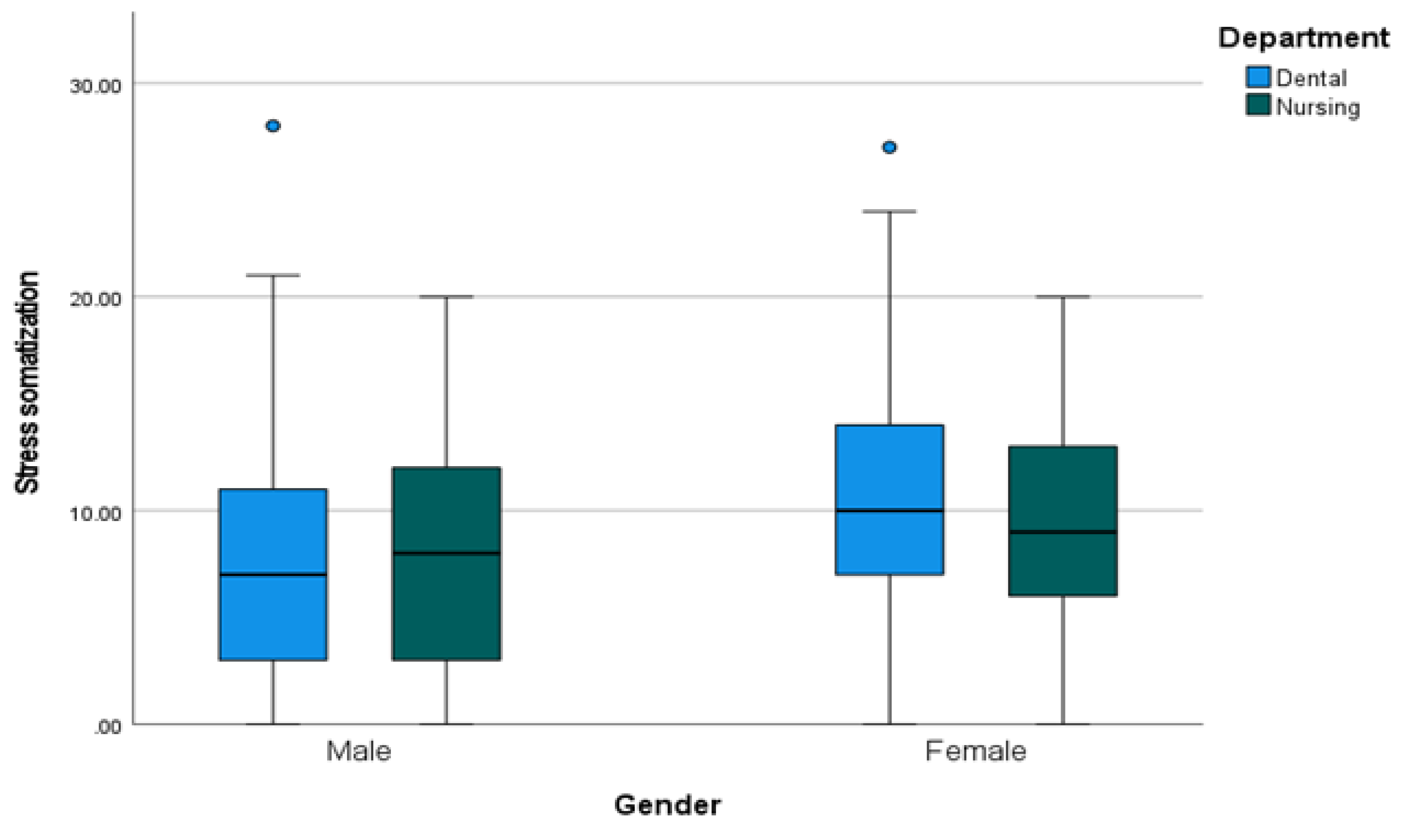
Figure 2.
Clustered bar chart of clenching or grinding teeth during day or night by department.
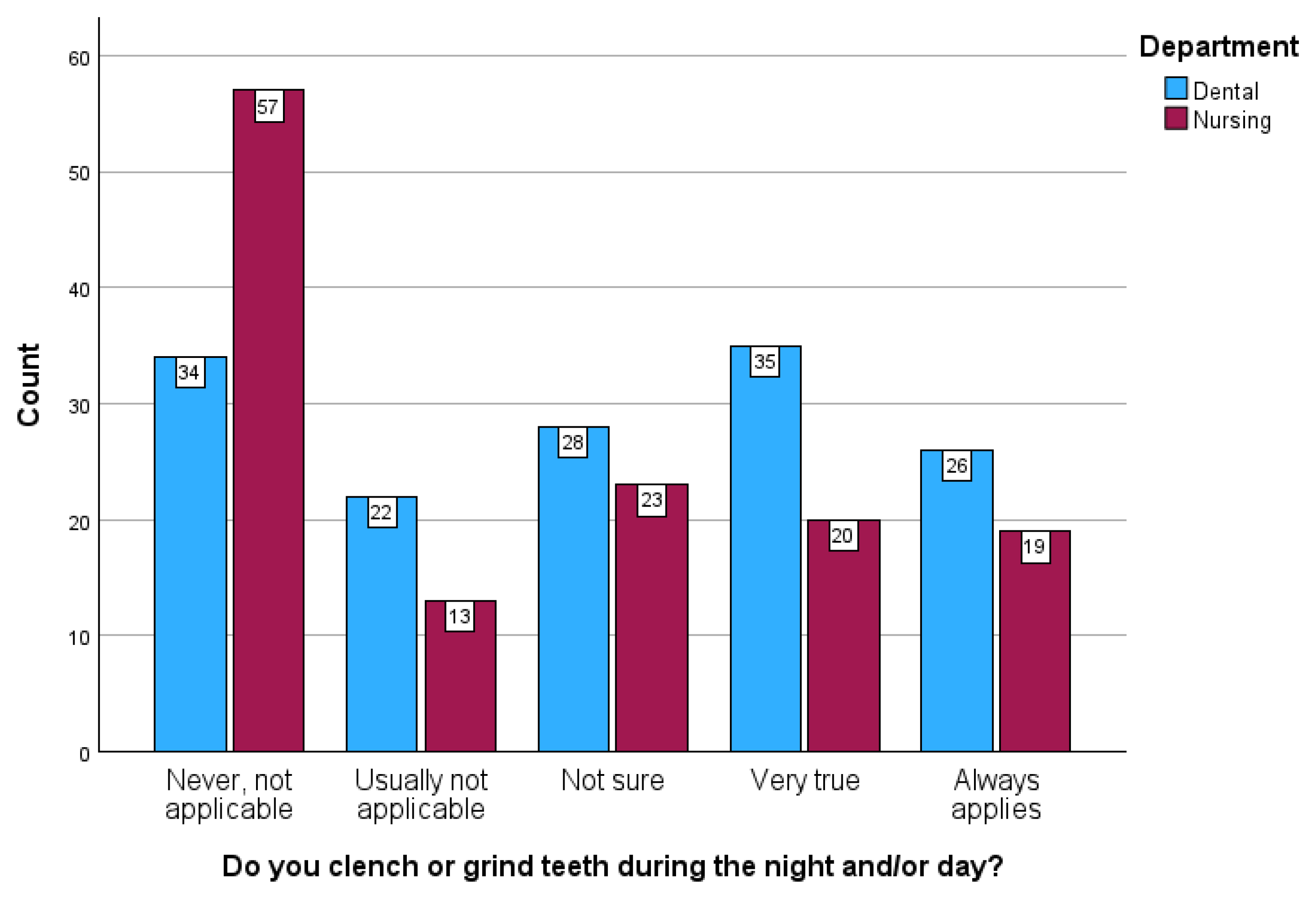

Table 1.
Sample descriptives per students’ department of studies.
| Total (N=271) |
Dental department (n=145, 53.5%) |
Nursing department (n=126, 46.5%) |
χ2 test results | |||||
|---|---|---|---|---|---|---|---|---|
| N | % | N | % | N | % | |||
| Gender | Male | 85 | 31.40% | 54 | 37.30% | 31 | 24.60% | χ2(1)=5, p = .025 |
| Female | 186 | 68.60% | 91 | 62.80% | 95 | 75.40% | ||
| Educational level | Postgraduate studies/PhD | 54 | 19.90% | 3 | 2.10% | 51 | 40.50% | χ2(1)=62.33, p < .001 |
| Undergraduate studies | 217 | 80.10% | 142 | 97.90% | 75 | 59.50% | ||
| Year of studies | 1st year | 12 | 4.3% | 5 | 3.4% | 7 | 5.3% | χ2(1)=62.17, p < .001 |
| 2nd year | 18 | 6.5% | 7 | 4.8% | 11 | 8.3% | ||
| 3rd year | 64 | 23.1% | 43 | 29.7% | 21 | 15.9% | ||
| 4th year | 52 | 18.8% | 18 | 12.4% | 34 | 25.8% | ||
| 5th year | 71 | 25.6% | 69 | 47.6% | 2 | 1.5% | ||
| Postgraduate students | 60 | 21.7% | 3 | 2.1% | 57 | 41.7% | ||
| Family income | < €15,000 | 32 | 16.20% | 14 | 14.60% | 18 | 17.80% | χ2(1)=24.71, p < .001 |
| €15,001-25,000 | 71 | 36.00% | 24 | 25.00% | 47 | 46.50% | ||
| €25,001-35,000 | 37 | 18.80% | 15 | 15.60% | 22 | 21.80% | ||
| €35,001-50,000 | 34 | 17.30% | 24 | 25.00% | 10 | 9.90% | ||
| > €50,000 | 23 | 11.70% | 19 | 19.80% | 4 | 4.00% | ||
Table 2.
Stress Somatization for students of different departments and genders.
| Stress somatization* | Department | ||||||
|---|---|---|---|---|---|---|---|
| Total (N=271) |
Dental (n=145, 53.5%) |
Nursing (n=126, 46.5%) |
|||||
| M | SD | M | SD | M | SD | ||
| Gender | Male (n=85, 31.4%) | 7.94A | 6.14 | 8.23a | 6.37 | 7.48a | 5.80 |
| Female (n=186, 68.6%) | 10.22B | 5.23 | 10.90a | 5.46 | 9.59a | 4.95 | |
| Total (Ν=271) | 9.51 | 5.62 | 9.92 | 5.93 | 9.06 | 5.23 | |
Note: Values in the same row or the same column not sharing the same subscript are significantly different at p< .05 in the two-sided independent samples t-tests. * Minimum = 0, Maximum=28.
Table 3.
Differences in Stress Somatization items by gender.
| Gender | |||||||
|---|---|---|---|---|---|---|---|
| Total | Male | Female | |||||
| N | % | N | % | N | % | ||
| 1.Do you experience pain in the facial area during the day and/or night? | Never, not applicable | 139 | 50.4% | 51a | 59.3% | 88a | 46.3% |
| Usually not applicable | 64 | 23.2% | 17a | 19.8% | 47a | 24.7% | |
| Not sure | 35 | 12.7% | 8a | 9.3% | 27a | 14.2% | |
| Very true | 31 | 11.2% | 7a | 8.1% | 24a | 12.6% | |
| Always applies | 7 | 2.5% | 3a | 3.5% | 4a | 2.1% | |
| 2.Do you hear a sound from the temporomandibular joint during movements of the mandible? | Never, not applicable | 131 | 47.5% | 49a | 57.0% | 82b | 43.2% |
| Usually not applicable | 41 | 14.9% | 7a | 8.1% | 34b | 17.9% | |
| Not sure | 44 | 15.9% | 17a | 19.8% | 27a | 14.2% | |
| Very true | 32 | 11.6% | 6a | 7.0% | 26a | 13.7% | |
| Always applies | 28 | 10.1% | 7a | 8.1% | 21a | 11.1% | |
| 3.Do you clench or grind teeth during the night and/or day? | Never, not applicable | 91 | 33.0% | 33a | 38.4% | 58a | 30.5% |
| Usually not applicable | 35 | 12.7% | 11a | 12.8% | 24a | 12.6% | |
| Not sure | 51 | 18.5% | 14a | 16.3% | 37a | 19.5% | |
| Very true | 54 | 19.6% | 15a | 17.4% | 39a | 20.5% | |
| Always applies | 45 | 16.3% | 13a | 15.1% | 32a | 16.8% | |
| 4.Do you experience headaches? | Never, not applicable | 52 | 18.8% | 30a | 34.9% | 22b | 11.6% |
| Usually not applicable | 64 | 23.2% | 25a | 29.1% | 39a | 20.5% | |
| Not sure | 62 | 22.5% | 15a | 17.4% | 47a | 24.7% | |
| Very true | 57 | 20.7% | 7a | 8.1% | 50b | 26.3% | |
| Always applies | 41 | 14.9% | 9a | 10.5% | 32a | 16.8% | |
| 5.Is your sleep disturbed? | Never, not applicable | 63 | 22.8% | 26a | 30.2% | 37b | 19.5% |
| Usually not applicable | 74 | 26.8% | 20a | 23.3% | 54a | 28.4% | |
| Not sure | 61 | 22.1% | 15a | 17.4% | 46a | 24.2% | |
| Very true | 51 | 18.5% | 17a | 19.8% | 34a | 17.9% | |
| Always applies | 27 | 9.8% | 8a | 9.3% | 19a | 10.0% | |
| 6. Do you feel nervous-or/annoyed-at your relationships in the student/work environment? | Never, not applicable | 58 | 21.0% | 33a | 38.4% | 25b | 13.2% |
| Usually not applicable | 60 | 21.7% | 17a | 19.8% | 43a | 22.6% | |
| Not sure | 67 | 24.3% | 13a | 15.1% | 54b | 28.4% | |
| Very true | 65 | 23.6% | 18a | 20.9% | 47a | 24.7% | |
| Always applies | 26 | 9.4% | 5a | 5.8% | 21a | 11.1% | |
| 7. Are you taking medication to calm down from the responsibilities of everyday life? | Never, not applicable | 236 | 85.5% | 73a | 84.9% | 163a | 85.8% |
| Usually not applicable | 18 | 6.5% | 3a | 3.5% | 15a | 7.9% | |
| Not sure | 10 | 3.6% | 3a | 3.5% | 7a | 3.7% | |
| Very true | 6 | 2.2% | 5a | 5.8% | 1a | 0.5% | |
| Always applies | 6 | 2.2% | 2a | 2.3% | 4a | 2.1% | |
Note: Values in the same row and subtable not sharing the same subscript are significantly different at p< .05 in the two-sided chi-square test.
Table 4.
Categories/themes extracted from open-ended questions relative to perceptions of stress, stress management strategies and requirements, by students’ department and gender.
Table 4.
Categories/themes extracted from open-ended questions relative to perceptions of stress, stress management strategies and requirements, by students’ department and gender.
| Total sample | Dental/Total | Nursing/Total | Dental/Male | Dental/Female | Nursing/Male | Nursing/Female | ||||||||
|---|---|---|---|---|---|---|---|---|---|---|---|---|---|---|
| N | % | N | % | N | % | N | % | N | % | N | % | N | % | |
| What does "stress" mean to you? | ||||||||||||||
| Physical symptoms | 54 | 19.9% | 26 | 18.7% | 26 | 21.0% | 7 | 13.7% | 19 | 21.6% | 6 | 18.8% | 20 | 21.7% |
| Restlessness And Psychological Pressure | 93 | 34.3% | 57a | 41.0% | 35b | 28.2% | 23 | 45.1% | 34 | 38.6% | 9 | 28.1% | 26 | 28.3% |
| Difficulty Concentrating, Disorganization of thoughts and feelings, Numbness | 48 | 17.7% | 26 | 18.7% | 20 | 16.1% | 9 | 17.6% | 17 | 19.3% | 8 | 25.0% | 12 | 13.0% |
| Obsessive thoughts | 26 | 9.6% | 17 | 12.2% | 8 | 6.5% | 6 | 11.8% | 11 | 12.5% | 2 | 6.3% | 6 | 6.5% |
| Insecurity, Inability to handle unexpected or difficult situations, Panic | 104 | 38.4% | 48 | 34.5% | 52 | 41.9% | 17 | 33.3% | 31 | 35.2% | 15 | 46.9% | 37 | 40.2% |
| Fear of failure, lack of confidence | 18 | 6.6% | 10 | 7.2% | 8 | 6.5% | 4 | 7.8% | 6 | 6.8% | 2 | 6.3% | 6 | 6.5% |
| Pressure to meet daily obligations/long-term goals | 26 | 9.6% | 11 | 7.9% | 15 | 12.1% | 5 | 9.8% | 6 | 6.8% | 2 | 6.3% | 13 | 14.1% |
| How and where in the body do you experience stress? | ||||||||||||||
| Heart or chest discomfort | 107 | 41.8% | 54 | 41.2% | 50 | 42.7% | 22 | 46.8% | 32 | 38.1% | 10 | 34.5% | 40 | 45.5% |
| Digestive Disorders, Anorexia | 106 | 41.4% | 48 | 36.6% | 53 | 45.3% | 17 | 36.2% | 31 | 36.9% | 14 | 48.3% | 39 | 44.3% |
| Breathing Difficulties, Cough | 30 | 11.7% | 14 | 10.7% | 15 | 12.8% | 4 | 8.5% | 10 | 11.9% | 3 | 10.3% | 12 | 13.6% |
| Headaches, Nausea | 93 | 36.3% | 44 | 33.6% | 48 | 41.0% | 18 | 38.3% | 26 | 31.0% | 11 | 37.9% | 37 | 42.0% |
| General Muscle Tension and Discomfort | 28 | 10.9% | 13 | 9.9% | 13 | 11.1% | 7 | 14.9% | 6 | 7.1% | 4 | 13.8% | 9 | 10.2% |
| Dental Symptoms | 19 | 7.4% | 12 | 9.2% | 7 | 6.0% | 3 | 6.4% | 9 | 10.7% | 3 | 10.3% | 4 | 4.5% |
| Sweating, itching and skin diseases | 27 | 10.5% | 14 | 10.7% | 11 | 9.4% | 5 | 10.6% | 9 | 10.7% | 5 | 17.2% | 6 | 6.8% |
| How do you feel you can improve your resilience? | ||||||||||||||
| Dedication to work or study | 11 | 4.1% | 4 | 2.9% | 7 | 5.7% | 1 | 2.0% | 3 | 3.4% | 0 | 0.0% | 7 | 7.5% |
| Psychotherapy and Psychological Support | 47 | 17.4% | 23 | 16.5% | 20 | 16.3% | 7 | 14.0% | 16 | 18.0% | 4 | 13.3% | 16 | 17.2% |
| Managing Stressors | 70 | 25.9% | 31 | 22.3% | 39 | 31.7% | 14 | 28.0% | 17 | 19.1% | 14 | 46.7% | 25 | 26.9% |
| Planning - Time Management | 25 | 9.3% | 9 | 6.5% | 16 | 13.0% | 2 | 4.0% | 7 | 7.9% | 3 | 10.0% | 13 | 14.0% |
| Improving Physical Condition, Nutrition and Sleep | 29 | 10.7% | 21a | 15.1% | 8b | 6.5% | 7 | 14.0% | 14 | 15.7% | 2 | 6.7% | 6 | 6.5% |
| Emotional Balance and Self-Awareness | 93 | 34.4% | 47 | 33.8% | 43 | 35.0% | 15 | 30.0% | 32 | 36.0% | 12 | 40.0% | 31 | 33.3% |
| Social Support and Socialization | 20 | 7.4% | 10 | 7.2% | 8 | 6.5% | 2 | 4.0% | 8 | 9.0% | 1 | 3.3% | 7 | 7.5% |
| I don’t know | 22 | 8.1% | 14 | 10.1% | 8 | 6.5% | 7 | 14.0% | 7 | 7.9% | 1 | 3.3% | 7 | 7.5% |
| What strategy do you follow to immediately (at the same time) deal with stressful situations? | ||||||||||||||
| Breathing and Relaxation Techniques | 86 | 33.0% | 45 | 33.3% | 40 | 33.6% | 15 | 30.0% | 30 | 35.3% | 8 | 28.6% | 32 | 35.2% |
| Distraction and thought management | 42 | 16.1% | 19 | 14.1% | 21 | 17.6% | 6 | 12.0% | 13 | 15.3% | 3 | 10.7% | 18 | 19.8% |
| Analysis of the situation, staying cool, self-regulation | 101 | 38.7% | 53 | 39.3% | 47 | 39.5% | 21 | 42.0% | 32 | 37.6% | 11 | 39.3% | 36 | 39.6% |
| Organization and methodicality | 6 | 2.3% | 5 | 3.7% | 1 | 0.8% | 1 | 2.0% | 4 | 4.7% | 0 | 0.0% | 1 | 1.1% |
| Physical activity | 21 | 8.0% | 9 | 6.7% | 11 | 9.2% | 2 | 4.0% | 7 | 8.2% | 4 | 14.3% | 7 | 7.7% |
| Talking with Others and Social/Psychological Support | 38 | 14.6% | 20 | 14.8% | 16 | 13.4% | 3a | 6.0% | 17b | 20.0% | 4 | 14.3% | 12 | 13.2% |
| Hobbies, Entertainment and Leisure | 32 | 12.3% | 13 | 9.6% | 18 | 15.1% | 7 | 14.0% | 6 | 7.1% | 6 | 21.4% | 12 | 13.2% |
| What do you usually do when you are stressed for a long period (e.g. during an exam) | ||||||||||||||
| Patience / Nothing | 38 | 15.1% | 18 | 13.8% | 20 | 17.7% | 4 | 8.7% | 14 | 16.7% | 4 | 14.3% | 16 | 18.8% |
| Distraction and Entertainment | 80 | 31.9% | 39 | 30.0% | 38 | 33.6% | 13 | 28.3% | 26 | 31.0% | 9 | 32.1% | 29 | 34.1% |
| Analysis of the situation, Staying cool, Positive thoughts | 31 | 12.4% | 17 | 13.1% | 12 | 10.6% | 9 | 19.6% | 8 | 9.5% | 3 | 10.7% | 9 | 10.6% |
| Physical Exercise and Sports | 42 | 16.7% | 25 | 19.2% | 16 | 14.2% | 6 | 13.0% | 19 | 22.6% | 7 | 25.0% | 9 | 10.6% |
| Communication, Psychological/Social Support | 27 | 10.8% | 14 | 10.8% | 13 | 11.5% | 5 | 10.9% | 9 | 10.7% | 3 | 10.7% | 10 | 11.8% |
| Personal time and Personal Care | 33 | 13.1% | 16 | 12.3% | 15 | 13.3% | 6 | 13.0% | 10 | 11.9% | 8a | 28.6% | 7b | 8.2% |
| Strategic Thinking and Organization | 28 | 11.2% | 18 | 13.8% | 9 | 8.0% | 7 | 15.2% | 11 | 13.1% | 1 | 3.6% | 8 | 9.4% |
| Dedication to study | 17 | 6.8% | 6 | 4.6% | 11 | 9.7% | 3 | 6.5% | 3 | 3.6% | 2 | 7.1% | 9 | 10.6% |
| Spirituality | 5 | 2.0% | 4 | 3.1% | 1 | 0.9% | 2 | 4.3% | 2 | 2.4% | 0 | 0.0% | 1 | 1.2% |
| What would you suggest to your school administration to reduce the level of stress you and your fellow students experience? | ||||||||||||||
| Reduction of Curriculum Requirements and Hours, Flexibility in studies | 47 | 18.9% | 26 | 20.5% | 21 | 18.3% | 4a | 9.3% | 22b | 26.2% | 4 | 12.9% | 17 | 20.2% |
| Introduction of Psychological Support Programs | 46 | 18.5% | 15a | 11.8% | 28b | 24.3% | 4 | 9.3% | 11 | 13.1% | 4 | 12.9% | 24 | 28.6% |
| Revision of the educational Program, Better Organization, Staff evaluation | 112 | 45.0% | 65a | 51.2% | 43b | 37.4% | 21 | 48.8% | 44 | 52.4% | 13 | 41.9% | 30 | 35.7% |
| Better and more timely information about the curriculum/labs/exams and the resulting changes | 8 | 3.2% | 4 | 3.1% | 3 | 2.6% | 1 | 2.3% | 3 | 3.6% | 1 | 3.2% | 2 | 2.4% |
| More practice, better preparation | 14 | 5.6% | 11a | 8.7% | 3b | 2.6% | 3 | 7.0% | 8 | 9.5% | 0 | 0.0% | 3 | 3.6% |
| Improvement of physical spaces, infrastructure and working conditions | 15 | 6.0% | 13a | 10.2% | 2b | 1.7% | 6 | 14.0% | 7 | 8.3% | 0 | 0.0% | 2 | 2.4% |
| Improved communication and support, Better treatment by teachers and supervisors | 68 | 27.3% | 40 | 31.5% | 26 | 22.6% | 16 | 37.2% | 24 | 28.6% | 6 | 19.4% | 20 | 23.8% |
| Would you use the help of a coach to help you manage your anxiety? | ||||||||||||||
| Positive about support from a coach | 141 | 53.8% | 70 | 52.2% | 68 | 56.7% | 22 | 45.8% | 48 | 55.8% | 15 | 48.4% | 53 | 59.6% |
| Negative about support from a coach | 106 | 40.5% | 57 | 42.5% | 44 | 36.7% | 24 | 50.0% | 33 | 38.4% | 15 | 48.4% | 29 | 32.6% |
| Preference for support from mental health counselors | 18 | 6.9% | 9 | 6.7% | 9 | 7.5% | 3 | 6.3% | 6 | 7.0% | 1 | 3.2% | 8 | 9.0% |
Table 5.
Spearman correlations between the categories of meaning and manifestation of stress and stress somatization, by students’ department.
Table 5.
Spearman correlations between the categories of meaning and manifestation of stress and stress somatization, by students’ department.
| Stress Somatization | ||
|---|---|---|
| Dental | Nursing | |
| What does "stress" mean to you? | ||
| Physical symptoms | -0.099 | -0.093 |
| Restlessness And Psychological Pressure | -0.055 | 0.03 |
| Difficulty Concentrating, Disorganization of thoughts and feelings, Numbness | -0.029 | 0.066 |
| Obsessive thoughts | 0.037 | 0.01 |
| Insecurity, Inability to handle unexpected or difficult situations, Panic | 0.032 | .276* |
| Fear of failure, lack of confidence | -0.114 | -0.074 |
| Pressure to meet daily obligations/long-term goals | .187* | -0.152 |
| How and where in the body do you experience stress? | ||
| Heart or chest discomfort | -0.089 | 0.036 |
| Digestive Disorders, Anorexia | -0.011 | 0.002 |
| Breathing Difficulties, Cough | -0.035 | 0.054 |
| Headaches, Nausea | -0.005 | -0.103 |
| General Muscle Tension and Discomfort | -0.06 | -0.016 |
| Dental Symptoms | 0.106 | 0.059 |
| Sweating, itching and skin diseases | -0.073 | 0.027 |
*Statistical significance between the two departments.
Table 6.
Spearman correlations between the categories stress management strategies and stress somatization, by students’ department.
Table 6.
Spearman correlations between the categories stress management strategies and stress somatization, by students’ department.
| Stress Somatization | ||
|---|---|---|
| Dental | Nursing | |
| How do you feel you can improve your resilience? | ||
| Dedication to work or study | 0.109 | -0.038 |
| Psychotherapy and Psychological Support | 0.127 | 0.059 |
| Managing Stressors | 0.006 | -0.065 |
| Planning - Time Management | 0.090 | -0.038 |
| Improving Physical Condition, Nutrition and Sleep | -0.112 | -0.060 |
| Emotional Balance and Self-Awareness | -0.059 | 0.061 |
| Social Support and Socialization | -0.111 | -0.080 |
| I don’t know | -0.091 | -0.013 |
| What strategy do you follow to immediately (at the same time) deal with stressful situations? | ||
| Breathing and Relaxation Techniques | 0.037 | -0.051 |
| Distraction and thought management | -0.001 | 0.008 |
| Analysis of the situation, staying cool, self-regulation | -0.154 | -0.075 |
| Organization and methodicality | 0.120 | -0.083 |
| Physical activity | 0.018 | -0.054 |
| Social/Psychological Support | 0.134 | -0.074 |
| Hobbies and Recreational Activities | -0.046 | 0.046 |
| What do you usually do when you are stressed for a long period? | ||
| Patience / Nothing | .204* | 0.058 |
| Distraction and Entertainment | 0.138 | -0.08 |
| Analysis of the situation, staying cool, Positive thoughts | -.199* | 0.153 |
| Physical Activity and Sports | 0.06 | -.186* |
| Communication, Psychological/Social Support | -0.023 | 0.000 |
| Personal time and Personal Care | -0.112 | -0.015 |
| Strategic Thinking and Organization | -0.166 | -0.025 |
| Dedication to study | -0.028 | -0.029 |
| Spirituality | -0.005 | -0.087 |
*Statistical significance between the two departments.
Table 7.
Spearman correlations between suggestions to school administration for better stress management support and stress somatization, by students’ department.
Table 7.
Spearman correlations between suggestions to school administration for better stress management support and stress somatization, by students’ department.
| What would you suggest to your school administration to reduce the level of stress you and your fellow students experience? | Stress Somatization | |
|---|---|---|
| Dental | Nursing | |
| Reduction of Curriculum Requirements and Hours, Flexibility in studies | 0.130 | 0.005 |
| Introduction of Psychological Support Programs | 0.101 | -0.183 |
| Revision of the educational Program, Better Organization, Staff evaluation | 0.086 | 0.012 |
| Better and more timely information about the curriculum/labs/exams and the resulting changes | -0.038 | 0.097 |
| More practice, better preparation | 0.030 | 0.049 |
| Improvement of physical spaces, infrastructure, and working conditions | -0.081 | -0.008 |
| Improved communication and support, better treatment by teachers and supervisors | 0.050 | 0.073 |
Table 8.
Spearman correlations between the categories of coach acceptance and stress somatization, by students’ department.
Table 8.
Spearman correlations between the categories of coach acceptance and stress somatization, by students’ department.
| Stress somatization | ||
|---|---|---|
| Dental | Nursing | |
| Positive about support from a coach | .243** | -0.077 |
| Negative about support from a coach | -.238** | 0.067 |
| Preference for support from mental health counselors | 0.059 | 0.026 |
**: significant correlation between stress somatization symptoms and need of a coach.
Disclaimer/Publisher’s Note: The statements, opinions and data contained in all publications are solely those of the individual author(s) and contributor(s) and not of MDPI and/or the editor(s). MDPI and/or the editor(s) disclaim responsibility for any injury to people or property resulting from any ideas, methods, instructions or products referred to in the content. |
© 2024 by the authors. Licensee MDPI, Basel, Switzerland. This article is an open access article distributed under the terms and conditions of the Creative Commons Attribution (CC BY) license (http://creativecommons.org/licenses/by/4.0/).
Copyright: This open access article is published under a Creative Commons CC BY 4.0 license, which permit the free download, distribution, and reuse, provided that the author and preprint are cited in any reuse.