
Submitted:
12 June 2024
Posted:
12 June 2024
You are already at the latest version
Abstract
Extreme climates such as droughts and hot extremes, may result in marked damage to crop yields and threaten regional and global food security. Maize is a major grain crop in Liaoning Province, severely affected by drought and hot events. The objective of this study is to advance an approach to estimate the risk of crop yield reduction under the compound dry-hot events (CDHE) in Liaoning Province. Results show that the ratio of stations experiencing compound dry-hot events during the twelfth leaf and maturity stage tended to increase on the time scale. On a spatial scale, the frequency of compound dry-hot events in central Liaoning Province was relatively low during the whole and various reproductive periods of maize. In addition to the twelfth leaf, western Liaoning Province is prone to compound dry-hot events. The high-risk area for the occurrence of the compound dry-hot events in maize is Chaoyang City, located in the western part of Liaoning Province, and the cities in the low-risk area account for about 64.3% of the total number of cities in Liaoning Province, mainly in the central and northern parts of Liaoning Province. Generally, this study emphasizes focusing on the impacts of compound dry-hot events on agricultural production and provides an index to assess the risk of compound dry-hot events on maize production.
Keywords:
compound dry-hot events (CDHE)
; the yield reduction of maize
; risk assessment
; Liaoning Province
1. Introduction
Climate is the main factor influencing the variability of crop yields [1, 2]. In recent years, nearly one-quarter of all damage and losses from climate-related disasters have occurred in developing countries. Drought and high temperatures have significantly reduced national cereal production by 9-10% [3]. Heat or drought can reduce crop yields by limiting carbon assimilation through photosynthesis, increasing carbon loss from respiration and limiting transpiration [4]. As the scale of future droughts and heat increases [5-8], compound dry and heat events (CDHE) are more hazardous than single disasters. Compared with the mid-twentieth century, compound heat and drought events during maize-growing seasons have increased [6, 9]. In particular, since approximately the 1950s, the global frequency of such events has roughly doubled [7, 10], with especially large increases in China [10]. In 2012, the combination of severe heat and drought enhanced the heat sensitivity of maize and wheat in the US Great Plains [11], and maize production declined by about 20% compared to the national average [12]. Extremely dry-hot events in Europe during May- July 2018 led to maize yield reduction and ecosystem degradation [13]. From 2017 to 2020, Liaoning Province experienced four consecutive years of drought. Rainfall during the maize reproductive period decreased by 51%, and the average maximum temperature was more than 3 °C higher than the same period of the normal years. Severe drought and sustained high temperatures happened in many places, and the area of the maize affected by the drought was as high as 772,467 hectares.
Therefore, more and more scholars have begun to pay attention to compound dry-hot events [14-17]. Measuring compound dry-hot events requires the selection or construction of a correlation index [18]. The easiest way to do this is to select events where drought and a given threshold number of high-temperature days occur together. This type of method can quickly and simply locate the onset of a compound dry-hot event, but it cannot comprehensively analyze the development of a compound dry-hot event. The impacts of compound dry-hot events depend not only on the frequency of their occurrence but also on the severity of their occurrence. Therefore, more and more scholars have assessed and quantified the hazards of compound dry-hot events by constructing composite indices [19, 20]. Mukherjee [21] et al. built a compound heat and drought index based on the modified Palmer Drought Index (sc_PDSI) and daily maximum temperature by copula function to identify compound heat and drought events in 26 climatic zones globally be-tween 1982 and 2016. Hao [22] et al. developed a Standardized Compound Event Indicator (SCEI) to characterize the severity and spatial distribution of compound dry heat events in Southern Africa and globally using a Meta-Gaussian model based on the SPI and STI in-dices. Li [23] et al. constructed a standardized compound dry and heat index (SCDHI) based on the joint construction of daily-scale SPEI and daily-scale STI. In previous studies, precipitation and temperature were mostly used to construct the compound dry-hot events. However, the evapotranspiration of vegetation is important for the impact of com-pound dry-hot events on crops. The SPEI can better characterize the drought condition by considering the effect of evapotranspiration than SPI, so the joint construction of SPEI and STI was chosen to characterize the compound dry-hot events in this study.
Liaoning Province is located on the east coast of the Eurasian continent, with a temperate continental monsoon climate, rolling hills on the east and west sides, and a frank plain in the center. There are four distinct seasons: short spring and autumn, rain and heat in the same season, and frequent climatic disasters. With global warming, overall temperatures in Liaoning Province have increased, precipitation has decreased during rainfall periods, then heat and drought events have occurred. Maize is the primary grain crop in Liaoning Province. As one of the main maize-producing areas, the amount of maize production in Liaoning Province is closely related to food security in the region. As of 2020, the sown area of maize in Liaoning Province reached 2,699,300 hectares, accounting for 76% of the province's grain crop area. The frequent occurrences of compound dry-hot events have caused huge economic losses, seriously affecting the social and economic development, and becoming an important factor restricting the sustainable development of resources and the environment in Liaoning Province.
Assessing the risk of crop yield losses caused by climatic and socioeconomic conditions is essential for sustainable agricultural production and investigating the uncertainties and risks associated with climate change [24, 25]. There have been preliminary studies on risk assessment or assessment of single meteorological hazards [26-29]. Still, there is a lack of research related to the assessment of compound dry-hot events in maize, especially as heat and drought have a huge impact on the yields of crops such as maize. Therefore, it is of great significance to study the maize yield loss caused by compound dry-hot events to establish a scientific monitoring and early-warning system to effectively mitigate the losses caused by compound dry-hot events, which is essential for achieving a stable increase in income and promoting the sustainable development of Liaoning agriculture.
This study intends to use the maize yield data of 14 cities in Liaoning Province from 2005 to 2020 as the basis. Separate the meteorological yield and combine the coefficient of variation of maize yield reduction, yield reduction risk index and the annual frequency of compound dry-hot events to analyze the yield disaster damage caused by compound dry-hot events in Liaoning Province and carry out the research on yield risk assessment in the Liaoning Province.
2. Study Area and Data Sources
2.1. Study Area
Liaoning Province is located in the southern part of Northeast China and comprises fourteen prefecture-level cities. It lies between 118°53′ and 125°46′ east longitudes and 38°43′ and 43°26′ north latitudes, with a land area of 148,600 square kilometers. The terrain is high in the north and low in the south, with the hills and mountains descending from east to west towards the central plains. The average temperature throughout the year is 8.8 °C, decreasing gradually from the coast to the inland, with a temperature difference of 5 °C between the north and the south. The average annual precipitation is 648 mm, with much rainfall concentrated in the summer months. Research manuscripts reporting large datasets that are deposited in a publicly available database should specify where the data have been deposited and provide the relevant accession numbers. If the accession numbers have not yet been obtained at the time of submission, please state that they will be provided during review. They must be provided prior to publication.
2.2. Data Sources
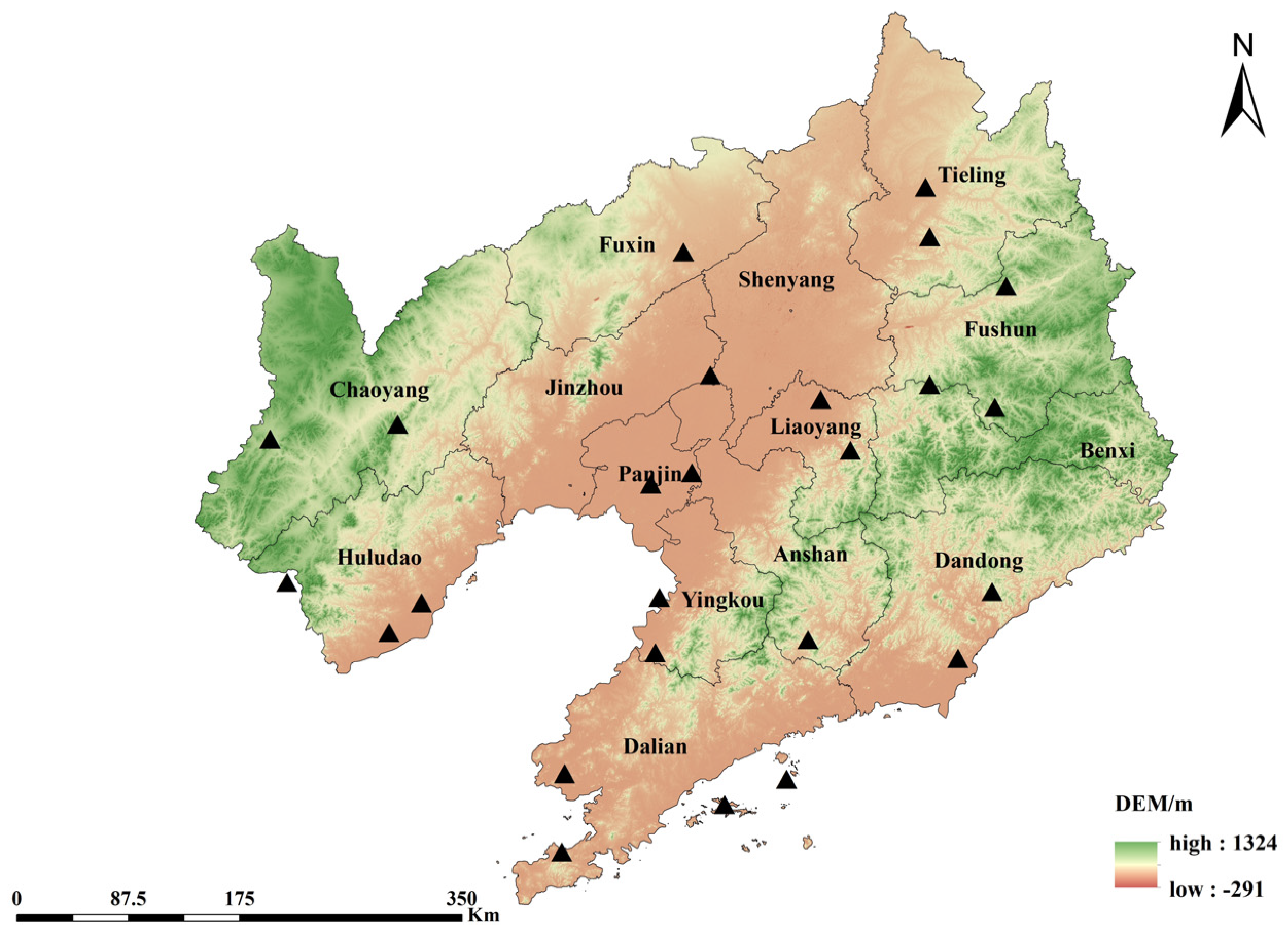
The meteorological observation data for this study were obtained from the China Meteorological Science Data Sharing Network (http://cdc.cma.gov.cn). Climatic data such as daily maximum temperature, daily minimum temperature, sunshine hours, relative humidity, wind speed and precipitation from 2005 to 2020 from meteorological stations in Liaoning Province were used to analyze the information from meteorological stations in 14 cities in Liaoning Province to calculate the compound dry-hot events. Maize sowing data are derived from the Liaoning Statistical Yearbook 2000-2021, downloaded from the Liaoning Provincial Bureau of Statistics(http://www.ln.stats.gov.cn/tjsj/sjcx/ndsj/), including data on the area sown to maize, the area under cultivation, production per unit area and total production in each city.
Figure 1.
Distribution of meteorological stations in Liaoning Province.
3. Methodology
3.1. Construction of Compound Dry-Hot Events
In this study, an index on compound dry and heat events was improved concerning Hao et al [15]. The Standardized Precipitation Evapotranspiration Index (SPEI) and the Standardized Temperature Index (STI) were used to represent dry and heat conditions for 2005-2020, respectively. The method for assessing the severity (X) of a compound dry and hot event is X = SPEI/STI. We, therefore, define a matrix X = G1 (P-E)/G2 (T), where the functions G1 (P-E) and G2 (T) are the marginal probability distribution functions of precipitation minus evapotranspiration and temperature, respectively. Then normalized X based on the SPEI. First, we fitted the marginal cumulative distribution F and then per-formed normalization according to the standard normal distribution Φ. We refer to this index as the e standardized dry heat index (SDHI), which can be expressed as:
In calculating the SDHI, three marginal distribution functions (i.e., G1, G2, and F) need to be fitted to calculate the marginal probability distribution using Gringorten’s empirical method:
Where i is the rank and n is the observation length.
Lower SDHI values indicate more severe compound dry and heat events. Since it was calculated using a standardized method similar to SPEI, we chose the same grading method for the compound dry-hot events. Therefore, concerning Wu [30] et al., a -0.5 threshold was chosen to define the occurrence of compound dry-hot events. This paper defines the ratio of the number of stations where a compound dry-hot event occurs to the total number of stations, referred to as the station ratio.
3.2. Yield Loss of Maize
The segregation of maize meteorological yield is currently the most commonly used research method to study the relationship between meteorological factors and maize yield. Maize yields are generally decomposed into three components: trend yield, meteorological yield, and random error (generally negligible). Therefore, actual maize yields are often decomposed into two components, trend and meteorological yields, expressed as follows:
Where Y is the actual v yield, Yt is the trend yield, and Yw is the meteorological yield. This study used a sliding average method of yield separation to obtain trend yield values with a window size of 5 years.
Relative meteorological yield can be obtained from the ratio of meteorological yield to trend yield:
Relative meteorological yields indicate the magnitude of food fluctuations and are comparable regardless of time and space. A positive value of Ya indicates that meteorological conditions are generally favorable for maize production and maize yields in-crease; a negative value indicates that meteorological conditions are usually unfavorable for maize production and maize yields decrease. Years of relative meteorological yields less than -5% are usually defined as disaster years. When Ya is negative, the absolute value of Ya is defined as the yield reduction rate:
3.3. Coefficient of Variation in Maize Yield Reduction
The coefficient of variation in maize yield reduction refers to the fluctuation of maize yield in the year of reduction. Larger values indicate greater inter-annual fluctuations in the impacts caused by meteorological hazards and more unstable yield losses; conversely, smaller dispersion means more stable yield losses. The value reflects, to some extent, the fluctuation of meteorological hazards in a certain area and the ability to prevent and mitigate disasters.
Where yi is the yield in the year of reduction and is the average yield in the year of reduction.
3.4. Yield Loss Risk Index
Since relative meteorological yields generally follow a normal or approximately normal distribution. The normal distribution test was performed on Yi to verify this assumption. Due to the small sample size, the Lilliefors goodness-of-fit test was chosen. For a few samples that did not fit the normal distribution, the normal conversion was conducted by the logarithmic method. Establish a normally distributed probability density function based on probability theory:
Then the probability that the random variable x occurs in the interval (x1, x2) is:
Where P is the risk probability and x1, x2 is the yield reduction rate. Based on the actual reduction in maize yield, the reduction rate is divided into four intervals [5%, 10%], [10%, 20%], [20%, 30%], and x>30%. The risk index is calculated as:
Where Qt is the intermediate variable; Q is the risk index in the interval (0, 1]; Pi is the interval probability, which is calculated by Equation (8); Ei is the median value of the interval, max is the maximum value of the spatial distribution of Qt, and the larger the value of IR, the greater the risk of yield loss.
3.5. Frequency of Compound Dry-Hot Events at Reduced Yields
Obtain yield reduction years due to compound dry-hot events based on yield reduction sequences and determine the probability of occurrence of compound heat and drought yield reduction years:
Where d is the year of yield reduction due to compound heat and drought; D is the total number of years counted, 16 years from 2005 to 2020.
3.6. Maize Compound Dry and Heat Events Loss Risk Index
The coefficient of variation of maize yield reduction, the yield loss risk index and the frequency of compound dry-hot events occurred in the selected disaster years to construct the maize compound dry and heat events loss risk index:
To order the risk type classification indicators, they were standardized using the extreme difference method:
The size of the M-value is between 0 and 1. The degree of risk increases with the in-crease of M-value.
Using natural breaks classification (Jenks) into four classes of low-risk region (0, 0.23], medium-risk region (0.23, 0.4], second highest risk region (0.4, 0.65], and high-risk region (0.65, 1].
4. Results and Analysis
4.1. Spatial and Temporal Variation Characterizations of the Compound Dry-Hot Events in Maize Growth Period
4.1.1. Time Variation Characteristics
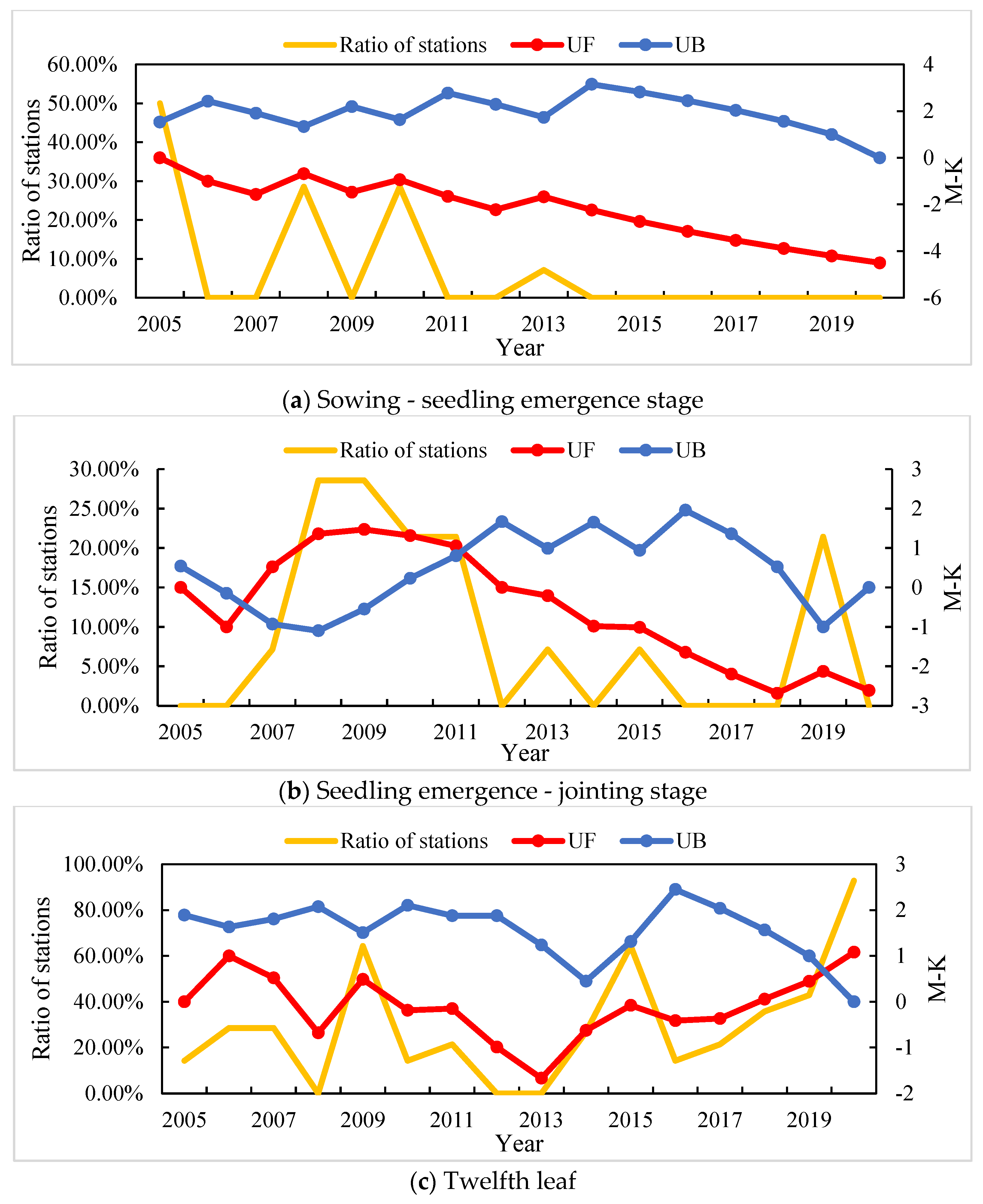
Figure 2 shows the station ratio of compound dry-hot events (SDHI<-0.5) occurring in different growth periods of maize in Liaoning Province. From Figure 2(a), it can be seen that the ratio of stations with compound dry-hot events during the sowing-seedling emergence stage is on a decreasing trend, with a maximum of seven stations experiencing compound hot and dry disasters in 2005. No stations experienced compound dry-hot events after 2013. The UF values are negative from 2005 to 2020, indicating a ‘downward’ trend in the number of stations experiencing compound dry-hot events, and the UF and UB curves do not intersect, suggesting that there is no sudden change in the number of stations.
From Figure 2(b), it can be seen that the ratio of stations experiencing compound dry-hot events during the seedling emergence-jointing stage shows a decreasing trend, with at most four stations experiencing compound dry-hot events in 2008 and 2009, and the ratio of stations experiencing compound dry-hot events fluctuating at about 5% from 2012 to 2018. The UF and UB curves intersect in 2007 and 2011, and the UF value is less than 0 after 2011, which means that the station ratio of compound dry-hot events shows a significant downward trend, i.e., the number of stations with compound dry-hot events decreases in this period.
From Figure 2(c), it can be seen that the ratio of stations with compound dry-hot events during the twelfth leaf showed an increasing trend, and the year with the highest number of stations with compound dry-hot events was 2020, with 13 stations, and only 2008, 2012 and 2013 had no stations with compound dry-hot events. The UF value was negative during 2010-2017, indicating that the number of stations with compound dry-hot events shows a ‘downward’ trend during this period. The intersection of the UF and UB curves in 2019 indicates that the compound dry-hot station ratio changes abruptly in that year, and the UF value is greater than 0 with an increasing trend after 2019, which means that the station ratio shows a significant upward trend after this period. After 2019, the UF value is greater than 0 with an increasing trend, which means that the compound dry-hot station ratio shows a significant upward trend after this year.
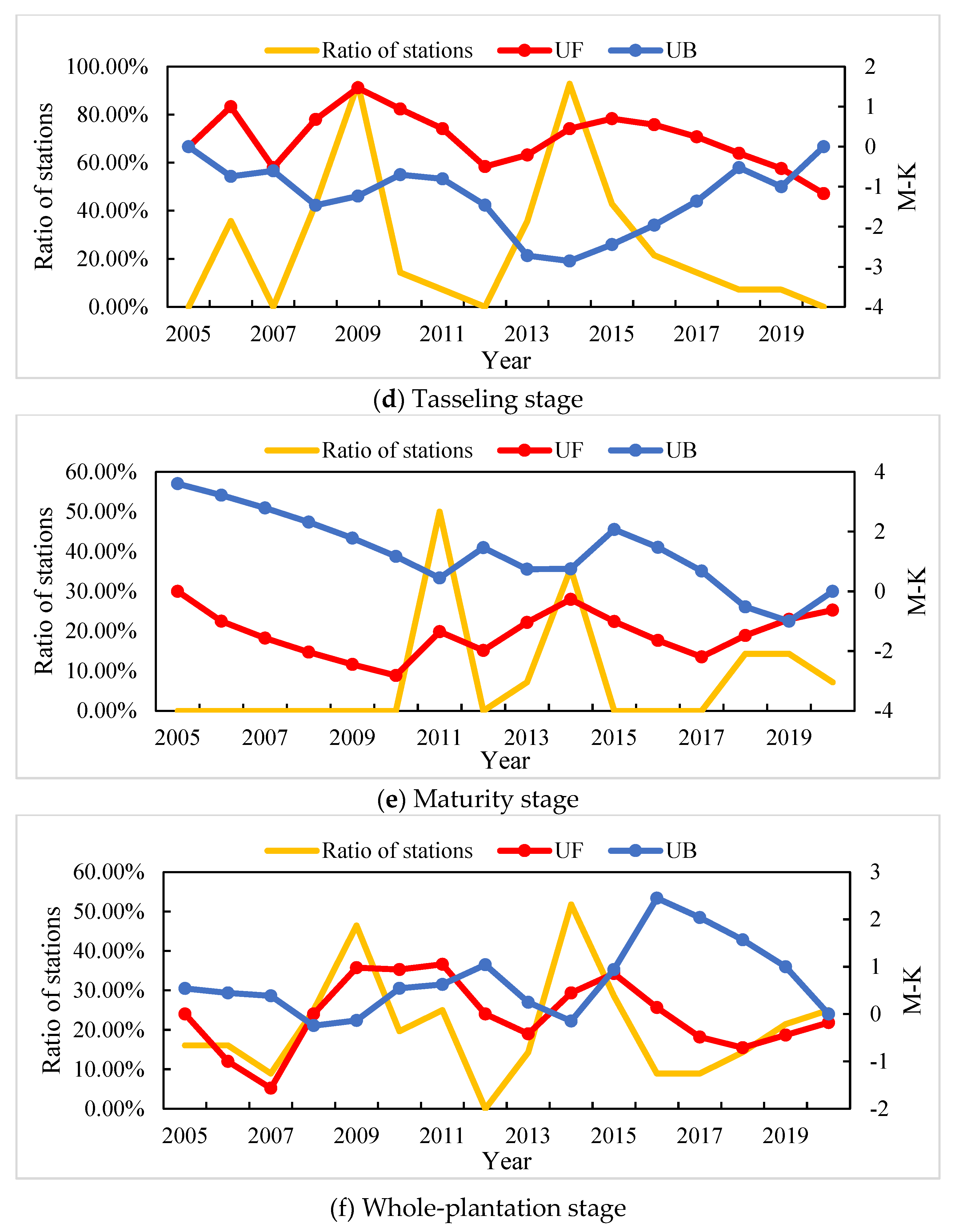
From Figure 2(d), it can be seen that the ratio of stations with compound dry-hot events during the tasseling stage showed a decreasing trend, in which the number of stations with compound dry-hot events in 2009 and 2014 was significantly higher than that of other years, which was 92.86%. The UF values are positive from 2005 to 2017 (except for 2012 and 2013), indicating that the number of stations with compound dry-hot events shows an ‘upward’ trend during this period. The UF and UB curves intersect in 2007 and 2019, indicating that the compound dry-hot station ratio changes abruptly in these years, and the UF value is greater than 0 with an increasing trend after the mutation in 2007, im-plying that the compound dry-hot station ratio shows a significant upward trend after that. After the mutation in 2007, the UF value is greater than 0 and shows an upward trend, which means that the ratio of compound dry-hot stations shows a significant up-ward trend after this period.
From Figure 2(e), it can be seen that the station ratio of compound dry-hot events during the maturity stage shows an increasing trend, with no stations experiencing compound dry-hot events before 2010, and up to seven stations experiencing compound dry-hot events in 2011. The UF and UB curves intersected in 2019, indicating that the compound dry-hot station ratio mutated in that year, and the UF value showed an upward trend after the mutation in 2019, which means that the compound dry-hot station ratio showed an upward trend after that.
Figure 2(f) shows the ratio of stations with compound dry-hot events throughout the whole-plantation stage, where the number of stations with compound dry-hot events was significantly higher in 2014 than in other years, at 51.79%. The UF and UB curves intersected in 2008, 2011, 2014 and 2015, indicating that the composite dry-hot station ratios were mutated in these years, and the UF values were all positive after the mutation, which implies that the compound dry-hot station ratios showed a significant upward trend after the mutation.
Overall, during the period 2005-2020, only 2012 never had a compound dry-hot event, and 2009 and 2014 had the highest number of compound dry-hot events, with 26 and 29 events, respectively. The proportion of stations experiencing compound dry-hot during the two maize reproductive stages showed an increasing trend, with the most significant in-crease during the trumpet stage, in addition, it can be seen that compound dry-hot events occurred more frequently during the twelfth leaf and the tasseling stage.
Figure 2.
Time series of compound dry-hot events occurrence at different growth stages of maize in Liaoning Province from 2005 to 2020.
Figure 2.
Time series of compound dry-hot events occurrence at different growth stages of maize in Liaoning Province from 2005 to 2020.
4.1.2. Spatial Characteristics
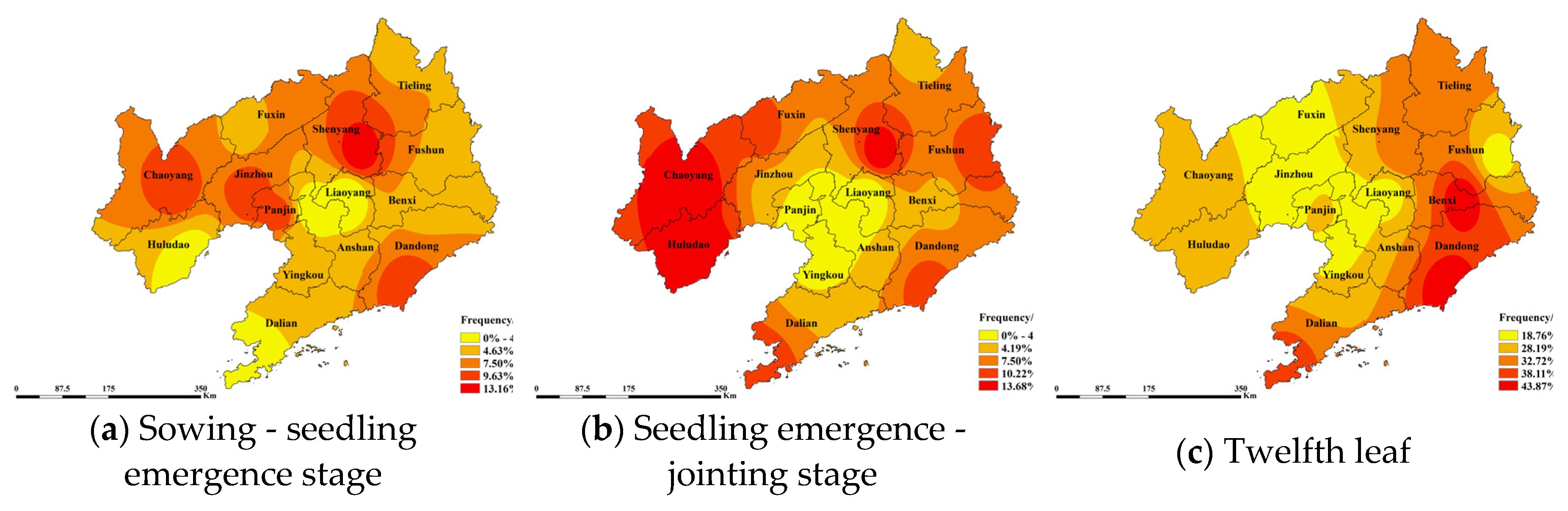
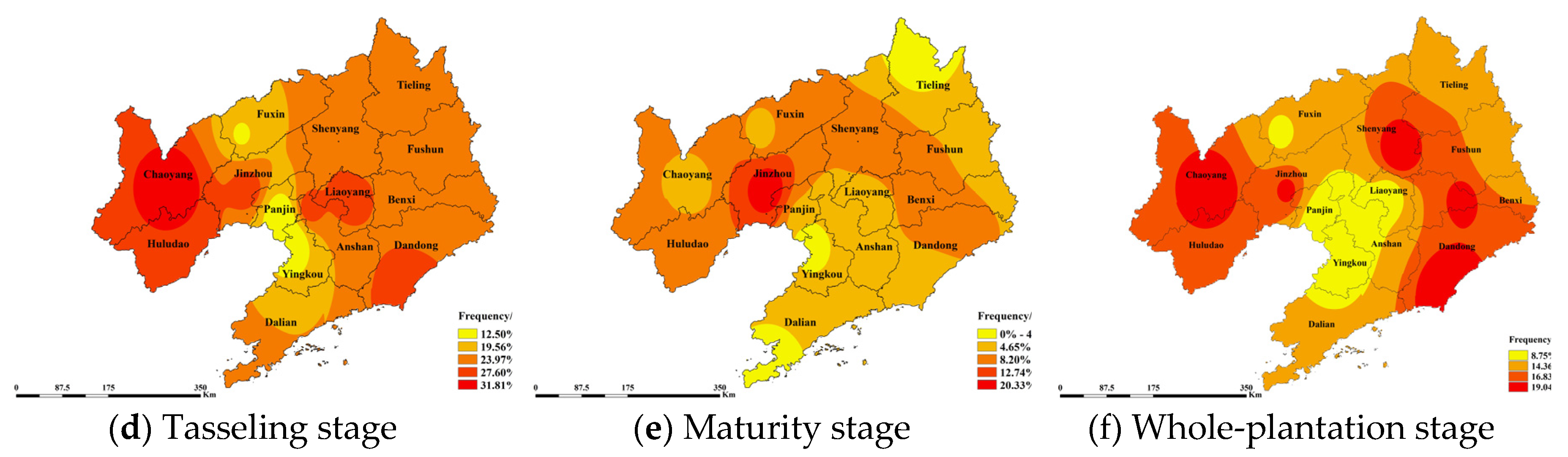
Calculate the frequency of occurrence of compound dry-hot events in each fertility stage of maize in Liaoning Province from 2005 to 2020, and interpolate the results as shown in Figure 3. There were also significant differences in the frequency of compound dry-hot events at different fertility stages. From Figure 3(a), it can be seen that there is no obvious regularity in the spatial distribution of the frequency of compound dry-hot events occurring during the sowing-seedling emergence stage. Shenyang is the city with the highest frequency of compound dry-hot events, with a frequency as high as 18.74%. Four of the cities did not experience compound dry-hot events during this period, concentrated in the central and southern parts of Liaoning Province.
From Figure 3(b), it can be seen that the frequency of compound dry-hot events occurred in the seedling emergence-jointing stage showed a spatial distribution of low in the middle and high in the surroundings, with the maximum value occurring in Shenyang City and Huludao City, where compound dry-hot events occurred for three times in total, and no compound dry-hot events were occurring in Anshan City, Liaoyang City, Panjin City and Yingkou City in this period.
From Figure 3(c), it can be seen that the frequency of compound dry-hot events that occurred in the twelfth leaf ranged from 18.76% to 50%, which was the most frequent period of compound dry-hot events during the maize reproductive period. The large-value area was concentrated in the eastern part of Liaoning Province, and the maximum value appeared in Benxi City and Dandong City, where a total of eight compound high-temperature drought disasters occurred. Low-value areas were concentrated in the central part of Liaoning Province, with the least number of compound high-temperature drought disasters occurring in Jinzhou City, with a total of three occurrences.
From Figure 3(d), it can be seen that the frequency of compound dry-hot events during the tasseling stage ranged from 12.50% to 37.49%, with the large-value area concentrated in the western part of Liaoning Province, the maximum occurring in Chaoyang City, where a total of six compound dry-hot events occurred, and the low-value area concentrated in the central part of Liaoning Province, with Yingkou City and Panjin City experiencing the smallest number of compound dry-hot events.
From Figure 3(e), it can be seen that the frequency of compound dry-hot events in the maturity stage ranged from 0 to 31.22%, with the high-value area concentrated in the western part of Liaoning Province, and the maximum value appeared in Jinzhou City. The low-value areas were distributed in the north, south and centre of Liaoning Province, in which Tieling, Dalian and Yingkou cities did not experience compound dry-hot events during the period.
From Figure 3(f), the frequency of compound dry-hot events during the whole-plantation stage ranged from 8.75% to 22.4%, with a spatial distribution trend of low in the middle and high in the surroundings. The high-value areas were mainly concentrated in the western and eastern parts of Liaoning Province, with the maximum values occurring in Dandong City and Chaoyang City. 64.28% of the stations had a frequency of compound dry-hot events higher than 15%, and the low-value areas were concentrated in the central part of Liaoning Province, with the lowest number of compound dry-hot events occurring in Yingkou City.
In general, the frequency of compound dry-hot events in central Liaoning Province is relatively low during the whole and various reproductive periods of maize. Except for the trumpet stage, western Liaoning Province is prone to compound dry-hot events. A total of 18 compound dry-hot events occurred in Shenyang city, followed by Chaoyang city and Dandong city (17 events) during all reproductive stages of maize. In terms of the characteristics of the occurrence of compound dry-hot events at different fertility periods, the average frequency of compound dry-hot events was greatest at the twelfth leaf and tasseling stage, which is the flowering period for early, medium and late maturing maize varieties. Changes in sowing dates can be taken to adjust the flowering period of maize to avoid high temperatures in late July and early August and reduce the impact of high temperatures on yield [31].
Figure 3.
Spatial distribution of compound dry-hot events occurrence at different growth stages of maize in Liaoning Province from 2005 to 2020.
Figure 3.
Spatial distribution of compound dry-hot events occurrence at different growth stages of maize in Liaoning Province from 2005 to 2020.
4.2. Variation Characteristics of in Maize Yield
4.2.1. Variation Characteristics of in Maize Yield
As seen from Figure 4, the yield of maize in Liaoning Province in the past 15 years has fluctuated up and down as a whole. In recent years, due to the level of agricultural technology, the replacement of varieties, and the rationalization of the amount of fertilizer applied, the total maize output has risen from 954,000 tons to 1,303,000 tons, showing an upward trend. During the period 2005-2020, the number of years of maize yield reduction in Liaoning Province was five, accounting for 31.25% of the total number of years, and the average disaster was a one-in-three-year event, indicating that maize production in Liaoning Province is more significantly affected by natural disasters. 2009 and 2014 were the two years with higher maize yield reductions, averaging 8.38%, which may be related to the years with more occurrences of compound dry-hot events. In 2010, 2015 and 2016, actual maize yields were high and, in some cases, even positive, but the corresponding years saw a reduction in yields. This trend suggests that meteorological hazards are an essential factor affecting maize yields.
4.2.2. Spatial Characteristics of the Coefficient of Variation in Maize Yield Reduction
The spatial distribution of the coefficient of variation of maize yield reduction from 2005 to 2020 is shown in Figure 5 to analyze the inter-annual variability and stability of maize yields. The high coefficient of variation implies that maize yields fluctuate greatly between years and that yields are susceptible to climatic and socio-economic conditions. The figure shows that there is no clear regularity or regionality in the distribution of the coefficient of variation of maize yield reduction. The values of the coefficient of variation of maize yield reduction ranged from 0 to 1.16, with the maximum value occurring in Anshan City in the centre of Liaoning Province, which is the region with the worst stability of maize yield reduction in the province. The high-value area is mainly distributed in the eastern part of Liaoning Province, with a few concentrated in the central and western parts. The coefficient of variation of maize yield reduction in Jinzhou City, Fuxin City, Tieling City, Shenyang City, and Liaoyang City were all less than 0.23, indicating that the fluctuations in maize yields in these areas were relatively stable.
4.2.3. Spatial Distribution of Yield Loss Risk
The Yield Loss Risk Index (YLRI) combines the rate of reduction in maize yield and its probability of occurrence at the corresponding level. The risk of maize yield loss in-creases with the Yield Risk Index, implying that maize yields are vulnerable to climatic conditions. Figure 6 shows the spatial distribution of the maize yield loss risk index in Liaoning Province from 2005 to 2020, with the high-value areas in the western and south-ern parts of Liaoning Province and the northern part of Liaoning Province having a lower yield loss risk. A comparison of Figure 5 with Figure 6 shows differences in the spatial distribution of the coefficient of variation for maize yield reduction and the yield loss risk index. These differences may be explained by the fact that the yield loss risk index is related only to climatic conditions. In contrast, the coefficient of variation of maize yield reduction is related to local socio-economic conditions (technological development, infrastructure and level of investment) and climatic conditions.
4.3. Risk Assessment of Compound Dry and Heat Events for Maize
4.3.1. Risk Assessment of Compound Dry and Heat Events for Maize
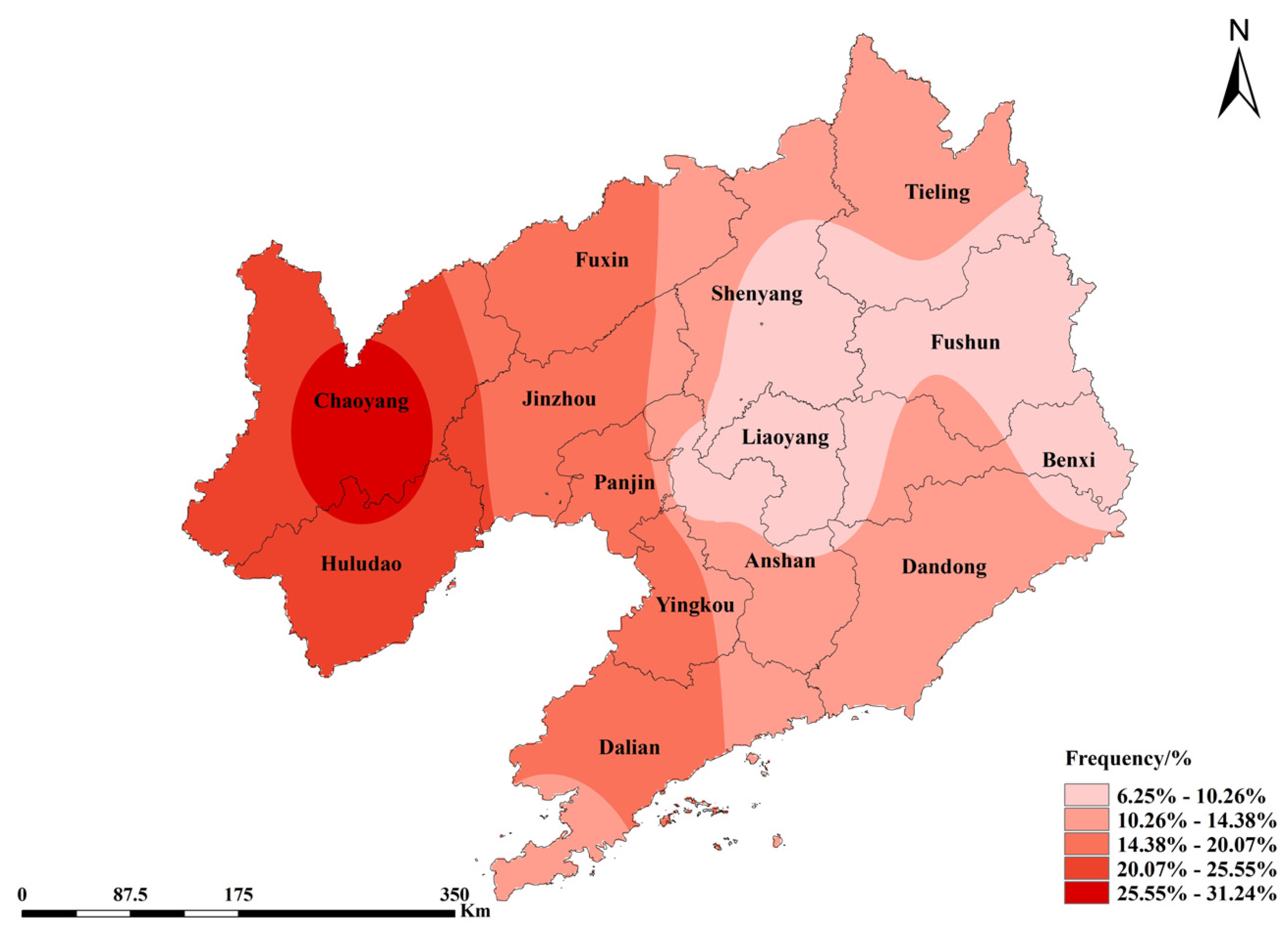
Calculate the frequency of compound dry-hot events occurrence in 2005-2020 maize yield reduction in Liaoning Province, and the interpolated results are shown in Figure 7. The frequency of compound dry-hot events occurred at the time of yield reduction spatially showed the distribution characteristics of decreasing from west to east, with the frequency of occurrence ranging from 6.25%-31.24%, with the large-value area concentrated in the western part of Liaoning Province, and the maximum value appeared in Chaoyang City, where a total of five compound dry-hot events occurred. Low-value areas were concentrated in the eastern part of Liaoning Province, with an average of two occurrences, and Fushun City and Shenyang City had the least number of compound dry-hot events, with one occurrence each. A total of 35.71% of the stations had a light drought frequency of 15% or more. Overall, western Liaoning Province has a higher frequency of compound dry-hot events during maize yield reduction, suggesting that western maize yield reduction is vulnerable to compound dry-hot events.
4.4. Risk Assessment of Compound Dry-Hot Events for Maize
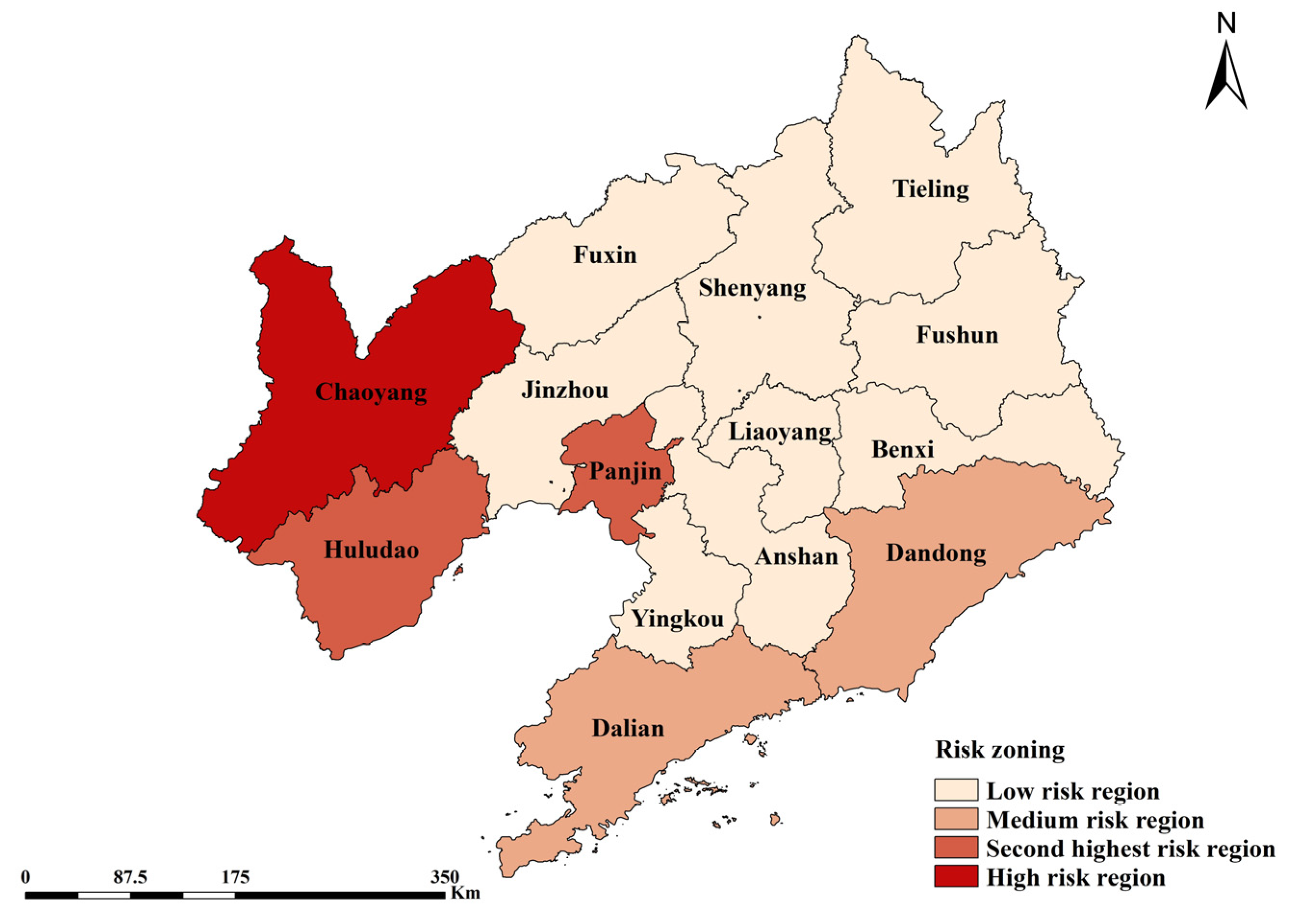
The risk value of compound dry-hot events for maize was calculated separately for each city in Liaoning Province, and the spatial distribution of compound dry-hot events for maize in Liaoning Province was obtained. As seen in Figure 8, there is obvious spatial variability in the risk of compound dry-hot events for maize in Liaoning Province. The low-risk zone is concentrated in the central and northern parts of Liaoning Province, with nine cities accounting for 64.3% of the total number of cities in Liaoning Province. The medium-risk area is concentrated in the southeastern part of Liaoning Province. Panjin City and Huludao City are the second highest-risk areas for the occurrence of compound dry-hot events in maize. Chaoyang City in the western part of Liaoning Province is a high-risk area for compound dry and heat events to maize. This region is located in the interior of northwestern Liaoning, with the lowest precipitation in the province and insufficient available water resources.
Overall, there was some difference in the spatial distribution characteristics of the maize compound dry and heat events loss risk index and the maize growth period com-pound dry-hot events. Among them, Chaoyang City is more consistent. At the same time, Shenyang City, as the city with the highest number of compound dry-hot events occurrences, is only a low-risk area, indicating that the compound dry-hot events have a relatively small impact on maize yields in Shenyang City. Due to topography and other factors, Panjin City, Dalian City, and Dandong City have also become medium-risk regions and second highest-risk regions.
Figure 8.
Compound Dry and Heat Events Risk Assessment for Maize in Liaoning Province, 2005-2020.
5. Discussion
Compound climate disasters have occurred frequently in many places in recent years [32-38]. These events have impacted China's agriculture, water resources, human health, infrastructure and ecosystems [15, 39, 40]. Serious constraints on sustainable economic and social development [41]. Of these, droughts occurring in conjunction with extreme heat are often referred to as compound dry and heat events, and they can have amplified impacts on agriculture, ecosystems and water resources that may be higher than those of a single disaster [42-44]. It has been shown that the frequency, duration and severity of compound dry-hot events increased significantly in Northeast China [45]. Numerous studies have shown that heat and drought will lower yields for major crops such as maize and wheat [46-48]. Yield declines are most significant when heat coincides with dry conditions [49, 50].
Based on the improved compound dry and heat index [15], we identified the com-pound dry-hot events during the maize growing period in Liaoning Province and analyzed their temporal and spatial distribution characteristics. Hao [19] et al. showed a general trend of increasing frequency of compound dry-hot events in the Northeast. From the time point of view, comparing the yield reduction rate with the number of compound dry-hot events occurring in the corresponding years, we can speculate that the compound dry-hot events have become the main meteorological disaster of maize yield reduction in Liaoning Province in recent years, this results is consistent with Shi [51] et al. From a space of perspective, more compound dry-hot events occur in the western part of Liaoning Province, which may be related to the decrease in precipitation and increase in temperature in the region in recent years [52, 53], this is consistent with the study by Wu [54] et al. The low occurrence of compound dry-hot events in central Liaoning Province may be due to the influence of an abnormal northwesterly airflow in Liaoning, in conjunction with an anomalously weak subtropical high pressure in the Pacific Ocean, which led to a cooling process and low precipitation in the central part of Liaoning Province [55]. Since evapotranspiration has a huge impact on maize growth and development, and SPEI also takes into account the effect of evapotranspiration compared to SPI, a combination of SPEI and STI was chosen to characterize the composite dry-hot scenario. Zhang [56] et al. assessed compound dry-hot events for multiple drought indicators and showed that SPEI is a better choice for compound dry-hot assessment in arid and semi-arid regions.
A complete understanding of the processes leading to compound heat and drought disasters is essential to provide reliable risk projections under climate change [57]. Various crop risk assessment methods or indicators have been applied [58-61]. Zhang [56] et al. conducted a risk assessment of compound dry-hot events in agriculture and obtained a significant increase in hazard in northeastern China. In previous studies, single-hazard meteorological disaster risk assessment combines four aspects of hazard, exposure, vulnerability and disaster prevention and mitigation capacity to construct a risk assessment model, which does not adequately consider the difficulty of quantifying the indicators in a multi-hazard situation. In this study, the probability of occurrence of different yield reduction rates, the coefficient of variation of maize yield reduction and the frequency of compound dry-hot events in the year of yield reduction were selected as three indicators to construct the maize compound dry and heat events risk assessment model. The index improves the spatial comparability of risks and effectively takes into account compound disasters. These results are crucial for agricultural decision support systems and climate change assessment in Liaoning Province [62].
The western region of Liaoning Province was the region with higher values of both the coefficient of variation for maize yield reduction and the yield loss risk index, indicating that maize yield variance in this region is more fluctuating and susceptible to disasters and changes in socio-economic levels, this result is consistent with Li et al [57]. Maize compound dry and heat events risk assessment low-risk region is large, and the level of urban development is fast, so more water resources extraction can be appropriately expanded to the maize planting area. The medium-risk region is located in the southeastern coastal area of Liaoning Province, where rainfall is abundant. Still, urban land use is extensive, and soil moisture is poor, so field management should be strengthened, and agricultural disaster-resistant techniques should be improved. Panjin City, Huludao City and Chaoyang City, the second highest and highest risk regions, should use early-maturing and drought-tolerant varieties, among others, when planting maize. Overall, maize risk was higher in western Liaoning Province from 2005 to 2020, this result is consistent with Zhang [63] et al. Tang [64] et al.'s study on the future risk of compound dry-hot in China suggests that the risk of compound dry-hot events is high in the northern part of the country. Irrigation currently increases yields of maize such as maize by 20%-30% [65]. It reduces the impact of weather extremes on maize yields [66, 67], but only 11% of the area in Liaoning Province is effectively irrigated. Therefore, it is essential to rationalize the exploitation of water resources to provide sufficient water for irrigation of maize. Comprehensive, accurate and rapid analyses of compound hazard intensity and risk are the basis for effective agrometeorological hazard risk management. Considering the nutritional value, economic value, and widespread cultivation of maize, our study can provide instructive information for future studies on the distribution and risk assessment of com-pound dry-hot events. It can also be extended to studies assessing the risk of other maize, including but not limited to food maize, to compound dry-hot events. In summary, this study analyses the risk assessment from the perspective of maize yield reduction and loss due to compound dry-hoy events, which targets disasters and can provide scientific guidance for preventing and mitigating maize disasters in Liaoning Province.
6. Conclusions
In this study, based on the data from 14 meteorological stations in Liaoning Province, we constructed the compound dry and heat index to analyze the spatial and temporal distribution characteristics of compound dry-hot events for maize in Liaoning Province during each growing period from 2005 to 2020. From the perspective of risk analysis of compound dry-hot events, the yield disaster loss division of maize, the main grain crop in Liaoning Province, was constructed. The main conclusions were as follows:
- Temporal characteristics of the compound dry-hot events over the maize reproductive period are shown: During 2005-2020, only 2012 had no compound dry-hot events, and 2009 and 2014 had the highest number of compound dry-hot events, with 26 and 29, respectively. compound dry-hot events occurred most frequently during the maize twelfth leaf, with a significant increasing trend, and the second highest number of compound dry-hot events occurred during the tasseling stage. Spatial distribution characteristics are shown: The frequency of compound dry-hot events in central Liaoning Province is low. In addition to the twelfth leaf, western Liaoning Province is prone to compound dry-hot events.
- The areas with high coefficients of variation for maize yield reduction were mainly located in the eastern part of Liaoning Province, with a few concentrated in the central and western parts of Liaoning Province. There were differences in the spatial distribution of the yield loss risk index and the coefficient of variation of maize yield reduction, with the high-value areas in the western and southern parts of Liaoning Province.
- There is some variability in the spatial distribution characteristics of the maize compound dry and heat events risk index and the maize growing period compound dry and heat index. The low-risk region is large, mainly in central and northern Liaoning Province. Chaoyang City in western Liaoning Province is the high-risk region for maize compound dry and heat events, and Panjin City and Huludao City are the second highest-risk regions.
Author Contributions
Conceptualization, R.W. and X.Z.; methodology, R.W.; software, X.Z.; validation, R.W., Y.W., L.C. and X.B; formal analysis, R.W. and X.Z.; investigation, R.W.; resources, R.W.; data curation, X.Z.; writing—original draft preparation, R.W. and X.Z.; writing—review and editing, R.W.; visualization, R.W.; supervision, R.W.; project administration, R.W.; funding acquisition, R.W. All authors have read and agreed to the published version of the manuscript.
Funding
This research was funded by” Liaoning Provincial Department of Education, grant number (LJKZ0615 and LJKQZ2021139)”.
Institutional Review Board Statement
Not applicable.
Informed Consent Statement
Informed consent was obtained from all subjects involved in the study.
Data Availability Statement
The data for this study were obtained from the China Meteorological Science Data Sharing Net-work (http://cdc.cma.gov.cn) and Liaoning Statistical Yearbook (http://tjj.ln.gov.cn/tjsj/sjcx/ndsj/).
Acknowledgments
The authors extend their appreciation to the anonymous reviewers for their thoughtful comments and valuable advice.
Conflicts of Interest
The authors declare no conflict of interest.
References
- Ray, D.K.; Gerber, J.S.; MacDonald, G.K.; West, P.C. Climate variation explains a third of global crop yield variability. Nat. Commun. 2015, 6, 5989. [CrossRef]
- Frieler, K.; Schauberger, B.; Arneth, A.; Balkovič, J.; Chryssanthacopoulos, J.; Deryng, D.; Elliott, J.; Folberth, C.; Khabarov, N.; Müller, C.; et al. Understanding the weather signal in national crop-yield variability. Earth's Futur. 2017, 5, 605–616. [CrossRef]
- Lesk, C.; Rowhani, P.; Ramankutty, N. Influence of extreme weather disasters on global crop production. Nature 2016, 529, 84–87. [CrossRef]
- Lesk, C.; Anderson, W.; Rigden, A.; Coast, O.; Jägermeyr, J.; McDermid, S.; Davis, K.F.; Konar, M. Compound heat and moisture extreme impacts on global crop yields under climate change. Nat. Rev. Earth Environ. 2022, 3, 872–889. [CrossRef]
- Ridder, N.N.; Ukkola, A.M.; Pitman, A.J.; Perkins-Kirkpatrick, S.E. Increased occurrence of high impact compound events under climate change. npj Clim. Atmospheric Sci. 2022, 5, 1–8. [CrossRef]
- Lesk, C.; Anderson, W. Decadal variability modulates trends in concurrent heat and drought over global croplands. Environ. Res. Lett. 2021, 16, 055024. [CrossRef]
- Sarhadi, A.; Ausín, M.C.; Wiper, M.P.; Touma, D.; Diffenbaugh, N.S. Multidimensional risk in a nonstationary climate: Joint probability of increasingly severe warm and dry conditions. Sci. Adv. 2018, 4, eaau3487. [CrossRef]
- Zscheischler, J.; Martius, O.; Westra, S.; Bevacqua, E.; Raymond, C.; Horton, R.M.; van den Hurk, B.; AghaKouchak, A.; Jézéquel, A.; Mahecha, M.D.; et al. A typology of compound weather and climate events. Nat. Rev. Earth Environ. 2020, 1, 333–347. [CrossRef]
- He, Y.; Hu, X.; Xu, W.; Fang, J.; Shi, P., Increased probability and severity of compound dry and hot growing seasons over world's major croplands. Science of the Total Environment 2022, 824, 153885.
- Wu, Y.; Miao, C.; Sun, Y.; AghaKouchak, A.; Shen, C.; Fan, X. Global Observations and CMIP6 Simulations of Compound Extremes of Monthly Temperature and Precipitation. GeoHealth 2021, 5. [CrossRef]
- Glotter, M.; Elliott, J. Simulating US agriculture in a modern Dust Bowl drought. Nat. Plants 2016, 3, 16193. [CrossRef]
- Haqiqi, I.; Grogan, D.S.; Hertel, T.W.; Schlenker, W. Quantifying the impacts of compound extremes on agriculture. Hydrol. Earth Syst. Sci. 2021, 25, 551–564. [CrossRef]
- Wu, H.; Su, X.; Singh, V. P., Blended Dry and Hot Events Index for Monitoring Dryﻗ°βHot Events Over Global Land Areas. Geophysical Research Letters 2021, 48, (24), e2021GL096181.
- Feng, S.; Wu, X.; Hao, Z.; Hao, Y.; Zhang, X.; Hao, F. A database for characteristics and variations of global compound dry and hot events. Weather. Clim. Extremes 2020, 30, 100299. [CrossRef]
- Hao, Z.; Hao, F.; Singh, V.P.; Zhang, X. Changes in the severity of compound drought and hot extremes over global land areas. Environ. Res. Lett. 2018, 13, 124022. [CrossRef]
- Wu, X.; Hao, Z.; Zhang, X.; Li, C.; Hao, F. Evaluation of severity changes of compound dry and hot events in China based on a multivariate multi-index approach. J. Hydrol. 2020, 583, 124580. [CrossRef]
- Zscheischler, J.; Westra, S.; Van Den Hurk, B. J.; Seneviratne, S. I.; Ward, P. J.; Pitman, A.; AghaKouchak, A.; Bresch, D. N.; Leonard, M.; Wahl, T., Future climate risk from compound events. Nature Climate Change 2018, 8, (6), 469-477.
- Albright, T.P.; Pidgeon, A.M.; Rittenhouse, C.D.; Clayton, M.K.; Flather, C.H.; Culbert, P.D.; Radeloff, V.C. Heat waves measured with MODIS land surface temperature data predict changes in avian community structure. Remote. Sens. Environ. 2011, 115, 245–254. [CrossRef]
- Hao, Z.; Hao, F.; Xia, Y.; Feng, S.; Sun, C.; Zhang, X.; Fu, Y.; Hao, Y.; Zhang, Y.; Meng, Y. Compound droughts and hot extremes: Characteristics, drivers, changes, and impacts. Earth-Science Rev. 2022, 235. [CrossRef]
- Hao, Z.; Hao, F.; Singh, V.P.; Zhang, X. Quantifying the relationship between compound dry and hot events and El Niño–southern Oscillation (ENSO) at the global scale. J. Hydrol. 2018, 567, 332–338. [CrossRef]
- Mukherjee, S.; Ashfaq, M.; Mishra, A.K. Compound Drought and Heatwaves at a Global Scale: The Role of Natural Climate Variability-Associated Synoptic Patterns and Land-Surface Energy Budget Anomalies. J. Geophys. Res. Atmos. 2020, 125. [CrossRef]
- Hao, Z.; Hao, F.; Xia, Y.; Singh, V.P.; Zhang, X. A monitoring and prediction system for compound dry and hot events. Environ. Res. Lett. 2019, 14, 114034. [CrossRef]
- Li, J.; Wang, Z.; Wu, X.; Zscheischler, J.; Guo, S.; Chen, X. A standardized index for assessing sub-monthly compound dry and hot conditions with application in China. Hydrol. Earth Syst. Sci. 2021, 25, 1587–1601. [CrossRef]
- Lobell, D.B.; Gourdji, S.M. The Influence of Climate Change on Global Crop Productivity. Plant Physiol. 2012, 160, 1686–1697. [CrossRef]
- Wang, C.; Zhang, J.; Huo, Z.; Cai, J.; Liu, X.; Zhang, Q., Prospects and progresses in the research of risk assessment of agro-meteorological disasters. Acta Meteorologica Sinica 2015, 73, (1), 1-19.
- Hao, L.; Zhang, X.; Liu, S., Risk assessment to Chinaﻗ°ﻷs agricultural drought disaster in county unit. Natural hazards 2012, 61, 785-801.
- Li, Y.; Ye, W.; Wang, M.; Yan, X. Climate change and drought: a risk assessment of crop-yield impacts. Clim. Res. 2009, 39, 31–46. [CrossRef]
- Zhao, H.; Gao, G.; Yan, X.; Zhang, Q.; Hou, M.; Zhu, Y.; Tian, Z. Risk assessment of agricultural drought using the CERES-Wheat model: a case study of Henan Plain, China. Clim. Res. 2011, 50, 247–256. [CrossRef]
- Guo, E.; Liu, X.; Zhang, J.; Wang, Y.; Wang, C.; Wang, R.; Li, D. Assessing spatiotemporal variation of drought and its impact on maize yield in Northeast China. J. Hydrol. 2017, 553, 231–247. [CrossRef]
- Wu, X.; Hao, Z.; Zhang, X.; Li, C.; Hao, F. Evaluation of severity changes of compound dry and hot events in China based on a multivariate multi-index approach. J. Hydrol. 2020, 583, 124580. [CrossRef]
- Li, E.; Zhao, J.; Zhang, W.; Yang, X. Spatial-temporal patterns of high-temperature and drought during the maize growing season under current and future climate changes in northeast China. J. Sci. Food Agric. 2023, 103, 5709–5716. [CrossRef]
- Hauser, M.; Orth, R.; Seneviratne, S.I. Role of soil moisture versus recent climate change for the 2010 heat wave in western Russia. Geophys. Res. Lett. 2016, 43, 2819–2826. [CrossRef]
- Sharma, S.; Mujumdar, P. Increasing frequency and spatial extent of concurrent meteorological droughts and heatwaves in India. Sci. Rep. 2017, 7, 1–9. [CrossRef]
- Li, X.; You, Q.; Ren, G.; Wang, S.; Zhang, Y.; Yang, J.; Zheng, G. Concurrent droughts and hot extremes in northwest China from 1961 to 2017. Int. J. Clim. 2018, 39, 2186–2196. [CrossRef]
- Kong, Q.; Guerreiro, S.B.; Blenkinsop, S.; Li, X.-F.; Fowler, H.J. Increases in summertime concurrent drought and heatwave in Eastern China. Weather Clim. Extrem. 2020, 28, 100242. [CrossRef]
- Wahl, T.; Jain, S.; Bender, J.; Meyers, S.D.; Luther, M.E. Increasing risk of compound flooding from storm surge and rainfall for major US cities. Nat. Clim. Chang. 2015, 5, 1093–1097. [CrossRef]
- van den Hurk, B.; van Meijgaard, E.; de Valk, P.; van Heeringen, K.-J.; Gooijer, J., Analysis of a compounding surge and precipitation event in the Netherlands. Environmental Research Letters 2015, 10, (3), 035001.
- Zheng, F.; Westra, S.; Sisson, S.A. Quantifying the dependence between extreme rainfall and storm surge in the coastal zone. J. Hydrol. 2013, 505, 172–187. [CrossRef]
- Xu, F.; Chan, T.O.; Luo, M. Different changes in dry and humid heat waves over China. Int. J. Clim. 2020, 41, 1369–1382. [CrossRef]
- Yu, R.; Zhai, P. Changes in compound drought and hot extreme events in summer over populated eastern China. Weather. Clim. Extremes 2020, 30, 100295. [CrossRef]
- Guo, J.; Mao, K.; Zhao, Y.; Lu, Z.; Xiaoping, L. Impact of Climate on Food Security in Mainland China: A New Perspective Based on Characteristics of Major Agricultural Natural Disasters and Grain Loss. Sustainability 2019, 11, 869. [CrossRef]
- Lesk, C.; Rowhani, P.; Ramankutty, N. Influence of extreme weather disasters on global crop production. Nature 2016, 529, 84–87. [CrossRef]
- Frank, D.A.; Reichstein, M.; Bahn, M.; Thonicke, K.; Frank, D.; Mahecha, M.D.; Smith, P.; Van Der Velde, M.; Vicca, S.; Babst, F.; et al. Effects of climate extremes on the terrestrial carbon cycle: concepts, processes and potential future impacts.. [CrossRef]
- Raymond, C.; Horton, R.M.; Zscheischler, J.; Martius, O.; AghaKouchak, A.; Balch, J.; Bowen, S.G.; Camargo, S.J.; Hess, J.; Kornhuber, K.; et al. Understanding and managing connected extreme events. Nat. Clim. Chang. 2020, 10, 611–621. [CrossRef]
- Zhang, Y.; Hao, Z.; Feng, S.; Zhang, X.; Hao, F. Comparisons of changes in compound dry and hot events in China based on different drought indicators. Int. J. Clim. 2022, 42, 8133–8145. [CrossRef]
- Ciais, P.; Reichstein, M.; Viovy, N.; Granier, A.; Ogée, J.; Allard, V.; Aubinet, M.; Buchmann, N.; Bernhofer, C.; Carrara, A.; et al. Europe-wide reduction in primary productivity caused by the heat and drought in 2003. Nature 2005, 437, 529–533. [CrossRef]
- LeComte, D., US Weather Highlights 2012: heat, drought, and sandy. Weatherwise 2013, 66, (3), 12-19.
- Qi, Y.; Zhang, Q.; Hu, S.; Wang, R.; Wang, H.; Zhang, K.; Zhao, H.; Ren, S.; Yang, Y.; Zhao, F.; et al. Effects of High Temperature and Drought Stresses on Growth and Yield of Summer Maize during Grain Filling in North China. Agriculture 2022, 12, 1948. [CrossRef]
- Ortiz-Bobea, A.; Wang, H.; Carrillo, C.M.; Ault, T.R. Unpacking the climatic drivers of US agricultural yields. Environ. Res. Lett. 2019, 14, 064003. [CrossRef]
- Carter, E.K.; Melkonian, J.; Riha, S.J.; Shaw, S.B. Separating heat stress from moisture stress: analyzing yield response to high temperature in irrigated maize. Environ. Res. Lett. 2016, 11, 094012. [CrossRef]
- Shi, Z.; Jia, G.; Zhou, Y.; Xu, X.; Jiang, Y. Amplified intensity and duration of heatwaves by concurrent droughts in China. Atmospheric Res. 2021, 261. [CrossRef]
- Zhang, L.; Zhang, S.; Guo, H.; Wang, P.; Wang, D.; Li, J., Variations and effects of agricultural climatic resources in suitable growth period of spring maize in northeast China. Acta Agriculturae Jiangxi 2018, 30, (2), 93-99.
- Wu, X.; Hao, Z.; Hao, F.; Li, C.; Zhang, X. Spatial and Temporal Variations of Compound Droughts and Hot Extremes in China. Atmosphere 2019, 10, 95. [CrossRef]
- Wu, X.; Hao, Z.; Hao, F.; Li, C.; Zhang, X. Spatial and Temporal Variations of Compound Droughts and Hot Extremes in China. Atmosphere 2019, 10, 95. [CrossRef]
- Zhao, S.; Ji, R.; Wang, S.; Li, X.; Zhao, S. Large-Scale Climate Factors of Compound Agrometeorological Disasters of Spring Maize in Liaoning, Northeast China. Atmosphere 2023, 14, 1414. [CrossRef]
- Zhang, Y.; Hao, Z.; Feng, S.; Zhang, X.; Hao, F. Comparisons of changes in compound dry and hot events in China based on different drought indicators. Int. J. Clim. 2022, 42, 8133–8145. [CrossRef]
- Li, X.; Fang, S.; Wu, D.; Zhu, Y.; Wu, Y. Risk analysis of maize yield losses in mainland China at the county level. Sci. Rep. 2020, 10, 1–12. [CrossRef]
- Jia, H.; Wang, J.; Cao, C.; Pan, D.; Shi, P. Maize drought disaster risk assessment of China based on EPIC model. Int. J. Digit. Earth 2012, 5, 488–515. [CrossRef]
- Qian, Y.; Mao, L.; Zhou, G., Changes in global main crop yields and its meteorological risk assessment. Transactions of the Chinese Society of Agricultural Engineering 2016, 32, (1), 226-235.
- Lu, J.; Carbone, G.J.; Gao, P. Detrending crop yield data for spatial visualization of drought impacts in the United States, 1895–2014. Agric. For. Meteorol. 2017, 237-238, 196–208. [CrossRef]
- Han, Y.; Fang, S.; Liang, H.; Zhou, L.; Zhou, G., Disaster risk regionalization of rice based on its reduction probability in Liaoning Province. Acta Ecol. Sin 2017, 37, 8077-8088.
- Li, X.; Fang, S.; Zhu, Y.; Wu, D. Risk Analysis of Wheat Yield Losses at the County Level in Mainland China. Front. Environ. Sci. 2021, 9. [CrossRef]
- Zhang, Y. T.; Hao, Z. C.; Zhang, Y., Agricultural risk assessment of compound dry and hot events in China. AGRICULTURAL WATER MANAGEMENT 2023, 277.
- Tang, Z.; Yang, T.; Lin, X.; Li, X.; Cao, R.; Li, W. Future changes in the risk of compound hot and dry events over China estimated with two large ensembles. PLOS ONE 2022, 17, e0264980. [CrossRef]
- Wang, X.; Müller, C.; Elliot, J.; Mueller, N.D.; Ciais, P.; Jägermeyr, J.; Gerber, J.; Dumas, P.; Wang, C.; Yang, H.; et al. Global irrigation contribution to wheat and maize yield. Nat. Commun. 2021, 12, 1–8. [CrossRef]
- Vogel, E.; Donat, M.G.; Alexander, L.V.; Meinshausen, M.; Ray, D.K.; Karoly, D.; Meinshausen, N.; Frieler, K. The effects of climate extremes on global agricultural yields. Environ. Res. Lett. 2019, 14, 054010. [CrossRef]
- Zaveri, E.; B. Lobell, D., The role of irrigation in changing wheat yields and heat sensitivity in India. Nature communications 2019, 10, (1), 4144.
Figure 4.
Maize production, trend production and reduction rates in Liaoning Province, 2005-2020.
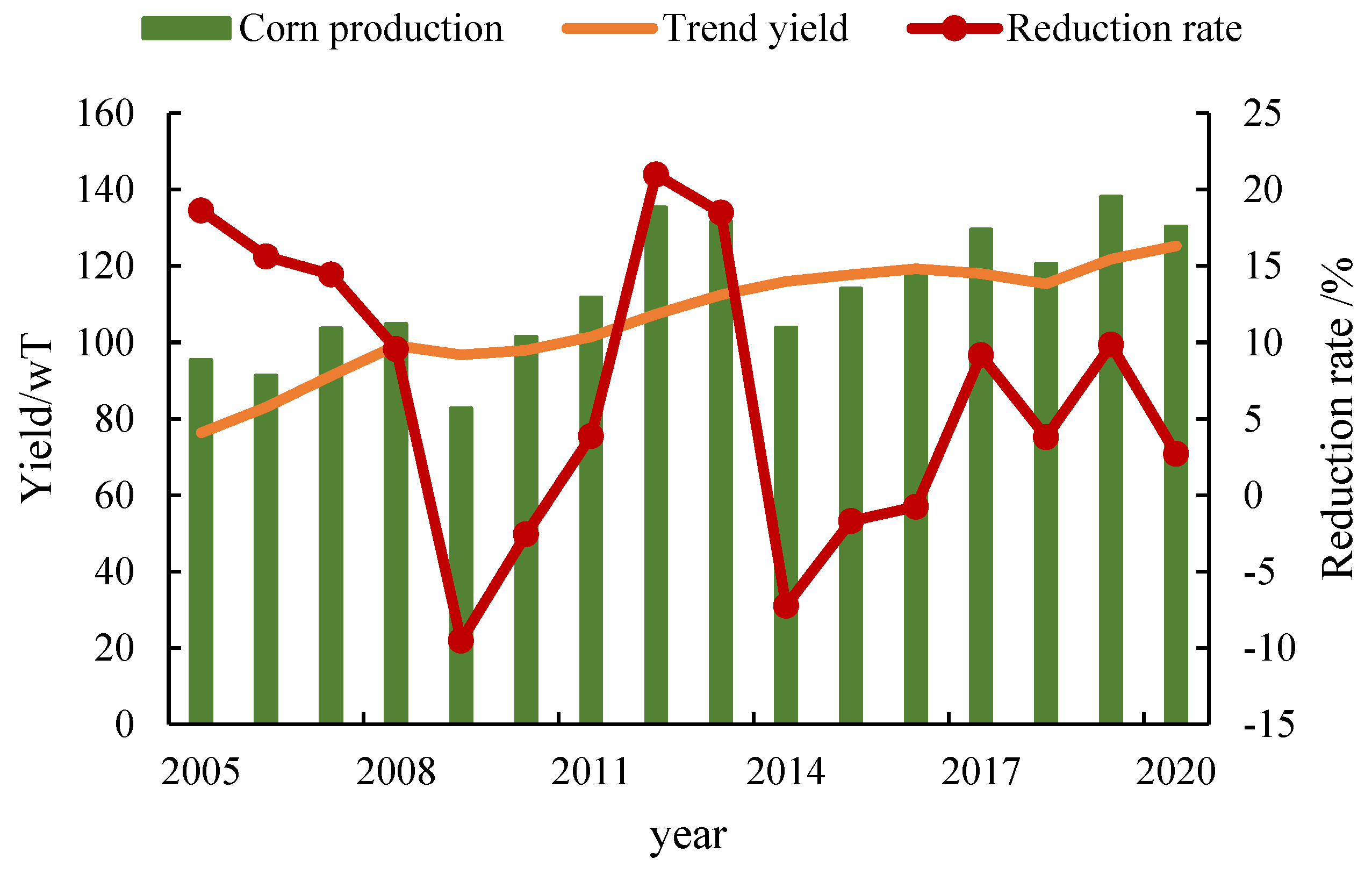
Figure 5.
Spatial distribution of coefficient of variation of maize yield reduction in Liaoning Province, 2005-2020.
Figure 5.
Spatial distribution of coefficient of variation of maize yield reduction in Liaoning Province, 2005-2020.
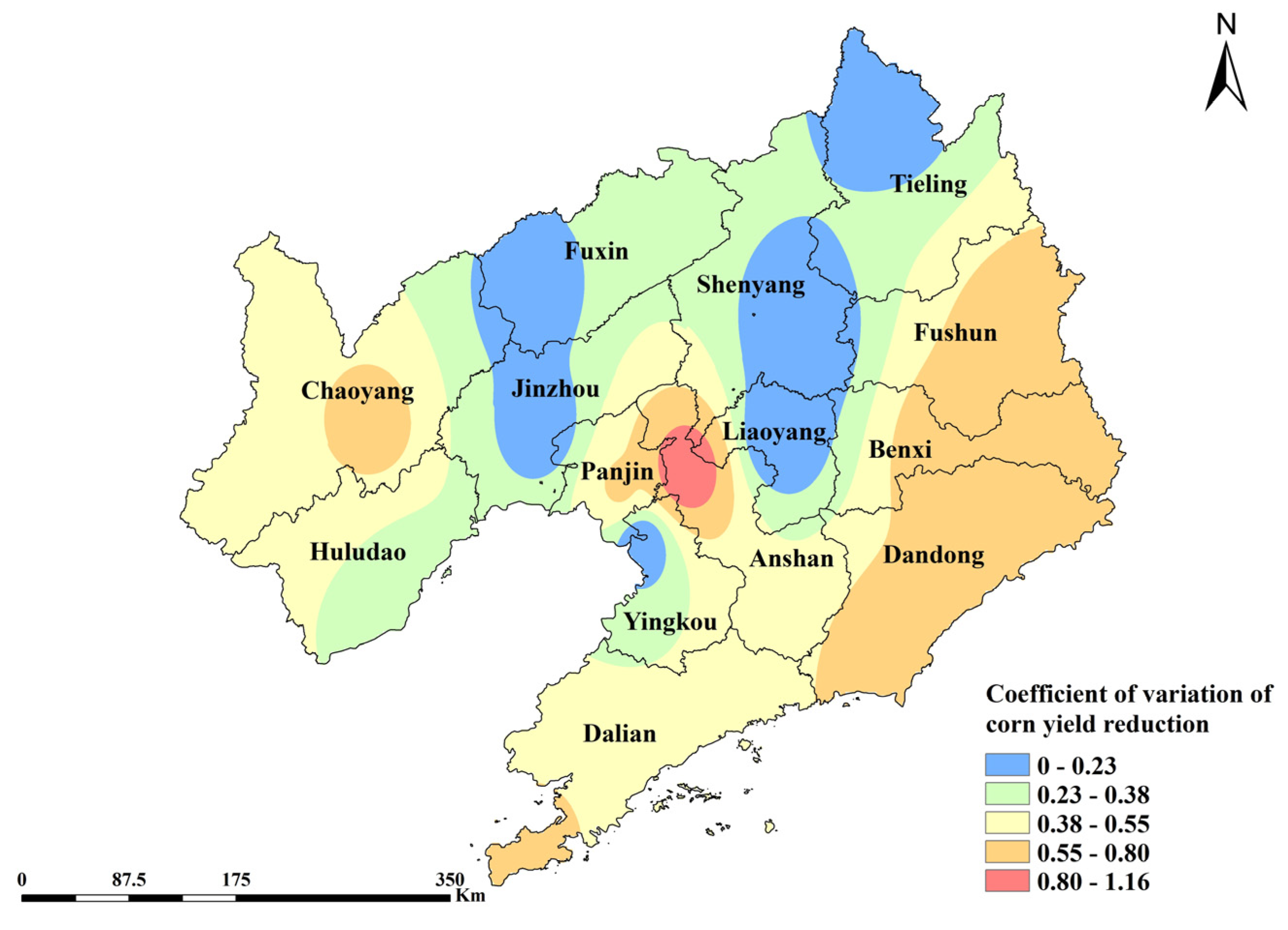
Figure 6.
Spatial Distribution of Yield Loss Risk Index in Liaoning Province, 2005-2020.
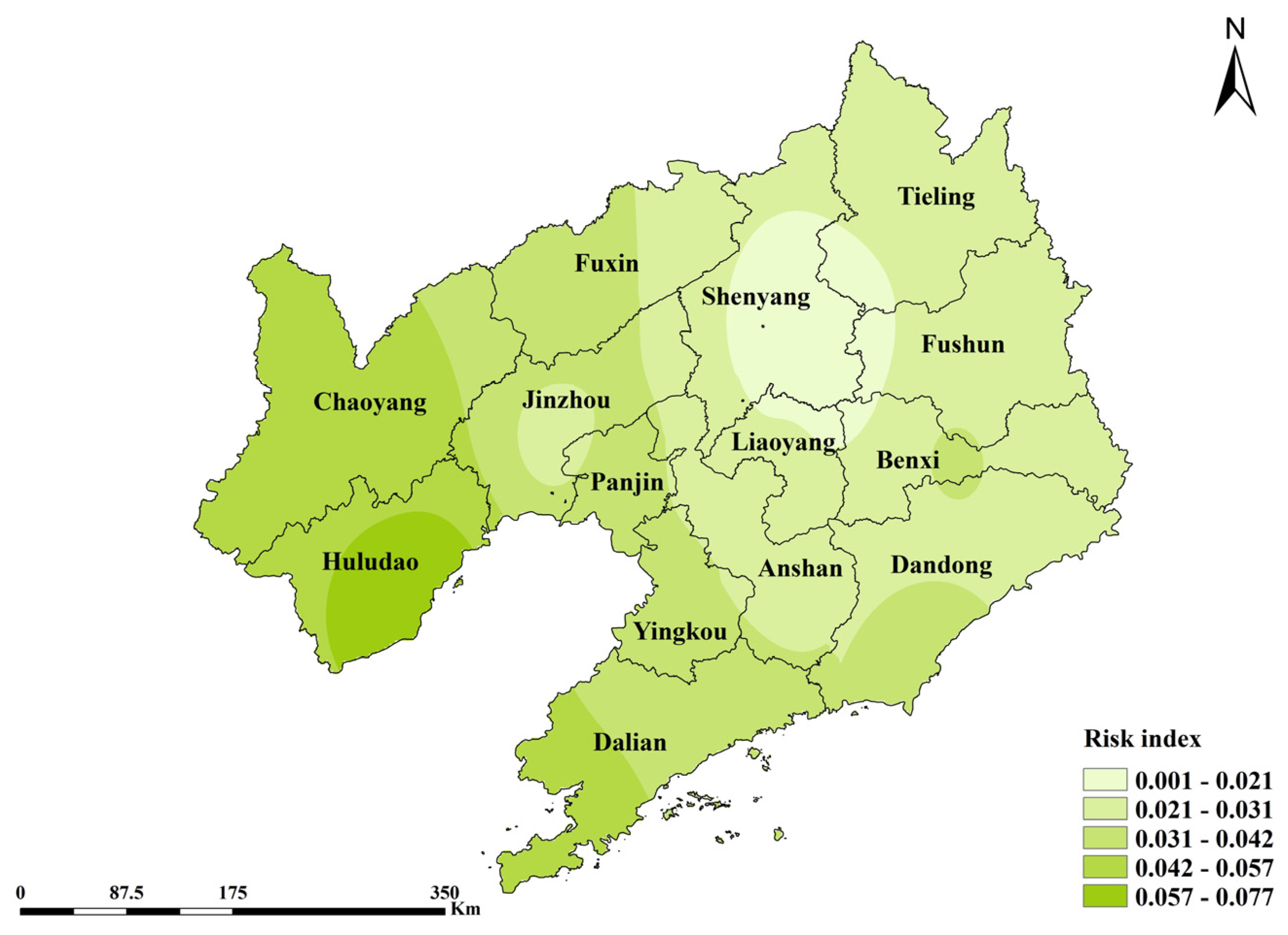
Figure 7.
Spatial distribution of compound high-temperature drought at yield reduction in Liaoning Province, 2005-2020.
Figure 7.
Spatial distribution of compound high-temperature drought at yield reduction in Liaoning Province, 2005-2020.
Disclaimer/Publisher’s Note: The statements, opinions and data contained in all publications are solely those of the individual author(s) and contributor(s) and not of MDPI and/or the editor(s). MDPI and/or the editor(s) disclaim responsibility for any injury to people or property resulting from any ideas, methods, instructions or products referred to in the content. |
© 2024 by the authors. Licensee MDPI, Basel, Switzerland. This article is an open access article distributed under the terms and conditions of the Creative Commons Attribution (CC BY) license (http://creativecommons.org/licenses/by/4.0/).
Copyright: This open access article is published under a Creative Commons CC BY 4.0 license, which permit the free download, distribution, and reuse, provided that the author and preprint are cited in any reuse.