

Submitted:
10 June 2024
Posted:
11 June 2024
You are already at the latest version
Abstract
It is well-known that simulation tools are essential for the design and optimization of wireless communication systems. In this paper proposes a python script that can be used for planning and predicting a connection link budget by analyzing its basic parameters. Our proposal consists of an application that calculates the connection budget for point-to-point links operating at 5 GHz, taking into account all the necessary microwave parameters. For validating the efficiency of the proposed tool, the paper presents comprehensive simulation results derived from comparing our tool to a couple of other simulation tools by means of calculating the same parameters.
Keywords:
link budget
; point to point
; python GUI
; simulation tools
1. Introduction
The evolution of wireless communication systems aims to achieve higher transmission rates, greater capacity and wider bandwidth. Especially with the fifth-generation technology (5G), which utilizes frequency ranges between two zones – one below 6 GHz and other in the millimeter wave zone - above 24 GHz [1]. This frequency range is widely used and frequently used by engineers and researchers in implementations, using the assistance of specialized simulation programs for their design.
Moreover, virtualization and simulation tools for designing and developing local IP LAN networks or IP devices are an option that allows engineers and developers to design and manage multiple network devices such as computers, servers, switches, routers, VLANs in various working environments [2]. Generally, simulation programs are widely used for the evaluation and analysis of wireless networks. The benefits of simulation are significant, such as simplifying the process of scenario modeling and adding the ability to change parameters easily, which can often be very complexive to parameterize in practice [3].
In reality, many theoretical calculations are required for the evaluation of wireless or microwave connections. This analysis is called link budget, a crucial approach to designing system reliability and availability. In microwave systems, a link budget calculates and provides information about losses and antenna gains of available power at the transmitter, propagation losses and losses from the transmitter and the receiver or losses caused by environmental factors [4].
Due to these reasons, the need for a development of new applications to assist in the design of microwave link budgets is very pressing. Meanwhile, the already existing simulation tools are often prohibitively expensive and necessitate the expertise of a specialist. Public institutions, in particular, face limited research and development budgets compared to multinational corporations. Open-source applications, offer greater agility, flexibility and present a promising solution.
In this survey it is proposed an effective method for calculating a link budget through the development of a graphical user interface (GUI) application script and the development of a local network monitoring tool using Python language. This application presents a simplified calculation of link budget for a point-to-point microwave wireless Ethernet Bridge connection scenario, which is part of a local LAN network, enabling users to extract information regarding the calculation of specific parameters. Subsequently, the results are compared to two real simulation programs, Airlink and LinkCalc, for the scenario used with the same parameters. The computed results match significantly those of Airlink, the program developed by the company that manufactures the equipment used for the same scenario.
The main points of this survey’s contribution are:
- Aims to propel digital transformation by emphasizing the indispensability of programming expertise in conjunction with wireless communication fundamentals.
- Promotes technological flexibility by embracing open-source development to create an application that provides multiple perspectives to resolve problems in the telecommunications field.
- The development of an open-source application that eliminates the need for specialized hardware and offers significant cost savings compared to industrial solutions.
- The rest of the study consists of related works, Section 2. Discussion about the theoretical background used in this paper, Section 3. The design of graphical user interfaces (GUI) is described in Section 4. Finally, the results and the conclusion of the proposed tool is given in Section 5 and Section 6 respectively.
2. Related Work
Several studies have developed graphical user interface software tools in the technical field of telecommunications for further advancement in telecommunications and networks.
The work in [5] presents an Ultra-Wide Band (UWB) system in which all link budget parameters have been calculated, such as antenna gain, transmitter power, output power, maximum receiver input power, and receiver noise level. All the parameters above are dependent on the environment in which the devices are located. This simulation program was developed with MATLAB software and the simulation results are validated through experimental measurements and the CST-Microwave Studio software.
In [6] it presents a simulation that operates as a software tool for wireless link budget calculation. This software computes the link budget and path profile similarly to other commercial software solutions. A comparison with other studies was conducted to validate its accuracy. The results were deemed acceptable based on the literature and lead to the conclusion that this proposed software functions correctly according to international standards.
In [7] it also presents a successful wireless link calculation designed using MATLAB. This MATLAB code was developed to compute and analyze the link budget, this software tool explores all the parameters, gains, and losses that may arise between a transmitter and receiver, applied in satellite communication.
Enriching the already existing research, this study is focusing on the design and calculation of transmission parameters in a point-to-point wireless Ethernet Bridge connection. It is also worth mentioning that developing a GUI environment using the Python programming language and the Tkinter library is considered to be a better choice due to its widespread use by engineers, scientists, and students for computer-related tasks [8], [9]. To sum up, by creating a scenario with these features provides an economical solution without the need for specialized equipment or deep technical programming knowledge.
3. Theoretical Background
The link budget is a theoretical calculation that incorporates factors of loss and gain, related to antennas and the propagation channel, in order to examine whether the connection is stable and operates without issues, at the maximum distance between transmitter and receiver [6].
3.1. Free Space Loss
It is obligatory to measure the losses due to distance and wavelength. The Free Space Path Loss (FSPL) depends on the frequency of the carrier signal and the distance between the transmitter and the receiver. The model is could be calculated by
where d is the distance in km and f is the frequency in GHz.
Lfs (dB) = 92,45 + 20log (d) + 20lg(f),
3.2. Effective Isotropic Radiated Power (EIRP)
The EIRP (Effective Isotropic Radiated Power) is the radio wave power measured at the main point of the antenna in dBm [8]. It is equal to the sum of the transmit power at the antenna (dBm) added to the antenna gain (dBi) at the transmitter, minus the cable losses. The EIRP can be expressed as
where Pt is the power of transmitter, Gt is the antenna gain of transmitter and Lt is the cable loss in transmitter.
EIRP (dBm) = Pt + Gt - Lt,
3.3. Received (RX) Signal Level Power
The received signal power (dBm) is expressed on the receiver is given as follows
where Gr is the antenna gain of receiver, Lr is the cable loss in the receiver’s station.
Rx = EIRP + Gr – Lfs - Lr
3.4. Fade Margin
Fade margin is the difference between the level of the received signal and the sensitivity of the receiver (in dB), aimed to ensure the required quality of service, is defined as
Fade Margin = Rx – Receiver Sensitivity
4. Operating Interface (GUI) Design
The proposed tool is designed to help a user ensure availability of local network and calculate all the propagation parameters and also ensure that the signal arrived sufficiently strong enough to receiver. The flowchart in Figure 1, shows the overall process of the tool.
Python is a general-purpose language used in engineering due to its versatile usability and functionality. In computer engineering, it is used for building websites and software, automating tasks, by conducting data analysis. These functions can be performed with distinct features in various systems. Most Python GUI frameworks offer parameters that enable the easy creation of a comprehensive interface with customized formatting. Notably, there are Python libraries for image processing (e.g., PIL), GUI development (e.g., Tkinter), web programming (e.g., CGI), symbolic mathematics (e.g., SymPy), etc. [8]. Specifically, the “Tk” Python library can enhance both the appearance and functionality of the GUI itself. On For this purpose, functions can be created and integrated from the interface using action control elements for processing of input data. The proposed tool being analyzed is developed in a free Python Integrated Development Environment (IDE) called Thonny.
Initially the user enters the static IP address of the wireless Ethernet Bridge or the IP of the devices already connected to the local network which he desires to scan. This selection is made by pressing the button "Ping" and can be executed right after clicking on the depicted topology. When the communication is successful the user enters the city name and the link budget parameters, then the application produces automatically all computed values, also the weather condition, which appears in the appropriate frame. Then, the user has a choice to input two locations (Station and Access Point) in order to initiate two web browsing (free-online) simulation tools of two industrial companies. In these two simulation tools the user can also input the same parameters, as in the proposed tool, above, so he can crosscheck the outcome.
5. Results and Discussion
5.1. Simulation Scenarios
In this section, an experimental scenario based on a real wireless Ethernet bridge connection from point to point is analyzed. The height of the TX antenna is 25 meters at Aghia Paraskevi (Access Point), and the RX antenna is 55 meters high on the transmission tower of Mount Hymettus (Station). Both points are part of the Hellenic Broadcast Corporation, which is the state-owned public radio and television broadcaster of Greece. The microwave transmission parameters are provided in Table 1, where both the transmitter and receiver in the link have the same types of antennas. For this experiment, the equipment of the transmitter and the receiver operates in the C band. They are both supplied by the Ubiquiti Networks company the model name is PowerBeam. The specific type is the 5ac-620 5 GHz, its specifications are described in the relevant datasheet [10].
5.2. Comparison Results between Different Simulation Tools
The proposed link budget script has been developed to calculate the received signal power by a transmitter and is used to determine the performance of wireless connection between two points. Additionally, with this tool we can also determine the difference between the minimum expected power (which is received) and the receiver’s sensitivity, called as link margin for each station. Certain constraints such as transmission power, free space loss, antenna gain, and cable loss at the transmitter are taken into account for the design of any transmission system. Therefore, link budgeting is often used to determine the sustainability of the design in order to overcome these constraints and for the system to meet the required specifications.
The mathematical formula for each field has been defined and shown always in the interface, so that the user can input the necessary data, for the completion of the formulas and by clicking on "Calculate," they can generate the results. These results are distinguished by the yellow background, as shown in Fig.2. The same data and parameters are being submitted also in both Airlink and LinkCalc application tools, in order to execute the same scenario, as shown in Figure 2 and Figure 3, respectively.
Some of the input data, such as transmitted power (Pt) and equivalent isotropically radiated power (E.I.R.P), can be expressed with more than one formula, however, only one formula is used in this proposed tool.
Figure 4 illustrates the variation of the received signal level at the maximum distance. The parameter values have minor differences between the three simulation tools, so the proposed scenario is being verified for all three tools. For demonstration reasons only we have also submitted in the same diagram the real-experimental curve of the assembly mentioned earlier, though in real life there are certain legal constrains, mainly because in practice the transmitted power is adjusted to around 20 dBm to be in compliance with the ETSI standard [11] (the E.I.R.P value limit is set below 36 dBm in Europe for frequencies at 5 GHz). As shown in Figure 4, all four curves have the same inclination and degradation degree but in different level of received signal strength.
Additionally, another function of this proposed tool should be mentioned, it contributes in monitoring the installed experimental equipment at the two points of the local network. The user has the ability to select the IP address of the device which he wishes to scan from a list of the internal IP addresses that is represented in a visual environment created and displaying the whole internal network. Essentially, in this Python scenario, this 'ping' function can only be used for predefined static IP addresses, as shown in Figure 5.
6. Conclusions
In this review, a GUI tool is being developed to automate the application design process for terrestrial microwave communication systems. The proposed tool, developed with the Python language, is capable for analyzing and calculating the link budget, which is a calculation of the gains and losses between the transmitter and receiver of a microwave communication system. The aim of this research is to present an affordable simulation design tool based on the mathematical expressions of the telecommunications theory. The results provided by the use of our simulation design tool are collected and demonstrated in comparison with the outcome results provided by the use of two professional tools. They appear in significant convergence for the same received signal level, indicating the validity sustainability and suitability of this tool, considering to be ready for use in real implementations. In addition to the uses of performing necessary calculations, that are already described, the tool can also offer the user the ability to easily scan the IP addresses of devices in the internal network, enabling complete administrative control of a local network with predetermined static IP addresses. It is also worth mentioning that industrial tools with similar purposes that are currently available, often require extensive training or significant financial investment. For the future, this Python GUI script could be enhanced by including system noise calculation and other similar features to determine various signal losses. Furthermore, this scenario could be built upon a web framework such as Django, Flask, or Falcon. To further enhance the practicality and flexibility of the proposed tool, it could incorporate a wider range of signal processing applications and develop in parallel an interactive virtual lab that could provide a hands-on learning experience.
References
- Z. Zhao, G. Wan and X. Huang, "Design of Dual-Band Frequency Selective Surface with Large Band Ratio for 5G Communication," 2020 IEEE 3rd Int. Conf. on Electr. Technol. (ICET), Chengdu, China, 2020, pp. 756-759. [CrossRef]
- I. Nedyalkov, "Studying the Traffic Flow between a Modeled and a Real IP Network," 2019 X Nat. Conf. with Int. Part. (ELECTRONICA), Sofia, Bulgaria, 2019, pp. 1-4.
- S. Y. Han, N. B. Abu-Ghazaleh and D. Lee, "Efficient and Consistent Path Loss Model for Mobile Network Simulation," in IEEE/ACM Trans. on Netw., vol. 24, no. 3, pp. 1774-1786, June 2016. [CrossRef]
- D. Nalineswari and N. Rakesh, "Link budget analysis on various terrains using IEEE 802.16 WIMAX standard for 3.5 GHz frequency," 2015 IEEE Int. Conf. on Electr., Comput. and Commun. Technol. (ICECCT), Coimbatore, India, 2015, pp. 1-5.
- S. I. Keceli, T. Ozbey, O. Ari and O. Sutcuoglu, "Link Budget Analysis &verifications for system design of GPR," 2015 16th Int. Radar Symp. (IRS), Dresden, Germany, 2015, pp. 463-468.
- W. M. D. R. Gunathilaka, H. G. C. P. Dinesh and K. M. M. W. N. B. Narampanawe, "Semi-automated microwave radio link planning tool," 2011 6th Int. Conf. on Ind. and Inf. Syst., Kandy, Sri Lanka, 2011, pp. 294-299.
- N. Ya'acob, J. Johari, M. Zolkapli, A. L. Yusof, S. S. Sarnin and N. F. Naim, "Link budget calculator system for satellite communication," 2017 Int. Conf. on Electric.., Electr. and Syst. Eng. (ICEESE), Kanazawa, Japan, 2017, pp. 115-119. [CrossRef]
- N. Kinayman, "Python for Microwave and RF Engineers [Application Notes]," in IEEE Microw. Mag., vol. 12, no. 7, pp. 113-122, Dec. 2011.
- R. Lytle, "The Numeric Python EM project," in Proc. IEEE Antennas Propag. Mag., vol. 44, no. 6, pp. 146-, Dec. 2002. [CrossRef]
- Ubiquiti Networks, “Power Beam ac High-Performance airMAX® Bridge Data Sheet,” 2015, [Online]. Available: https://dl.ubnt.com/datasheets/PowerBeam_ac/PowerBeam5ac_DS.pdf.
- 1ETSI EN 302 502 - Broadband Radio Access Networks (BRAN), 5,8 GHz fixed broadband data transmitting systems, Harmonised Standard covering the essential requirements of article 3.2 of Directive 2014/53/EU.
Figure 1.
Flowchart of the overall project.
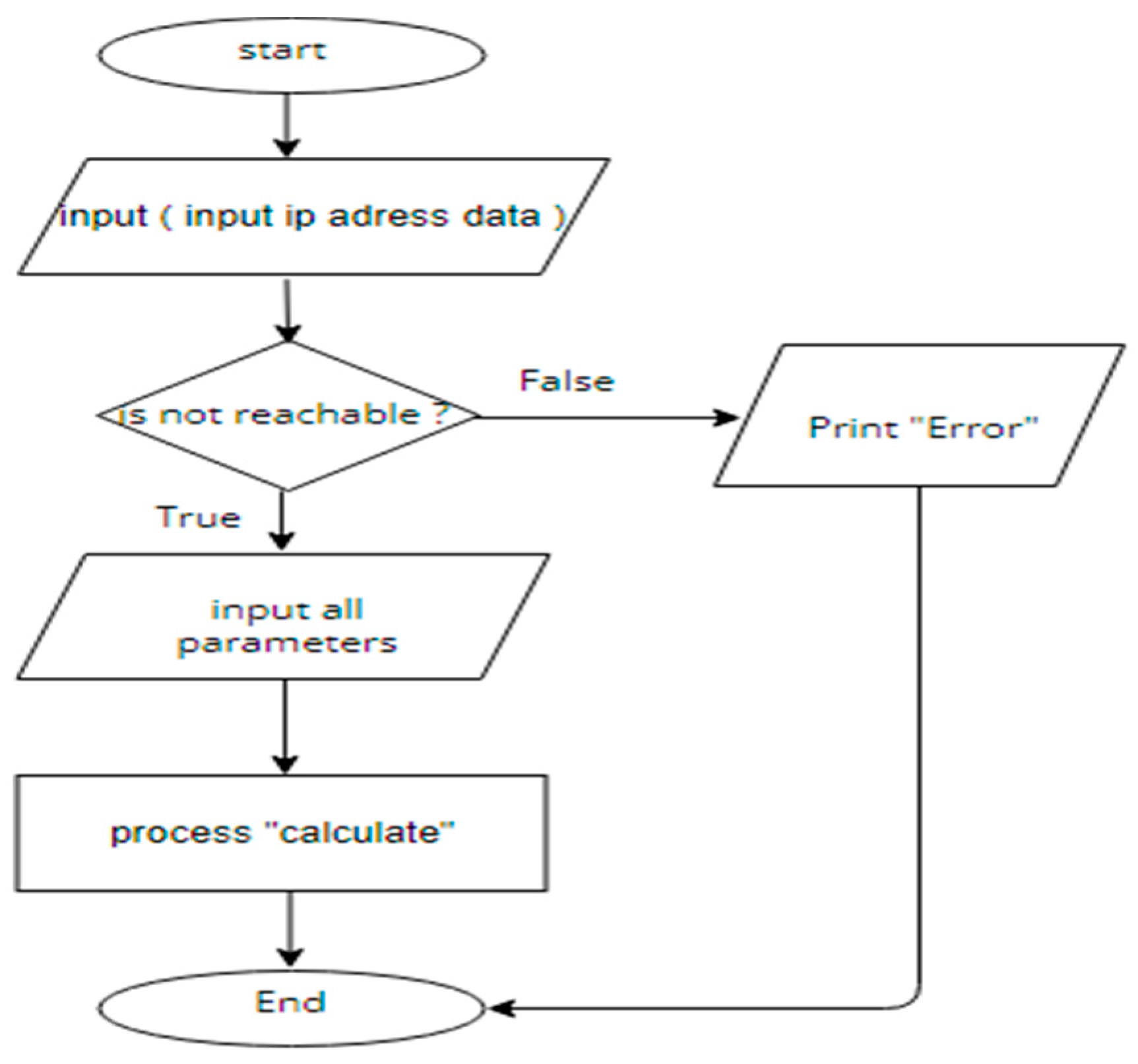
Figure 2.
Received Power Calculation of Airlink (Ubiquiti)
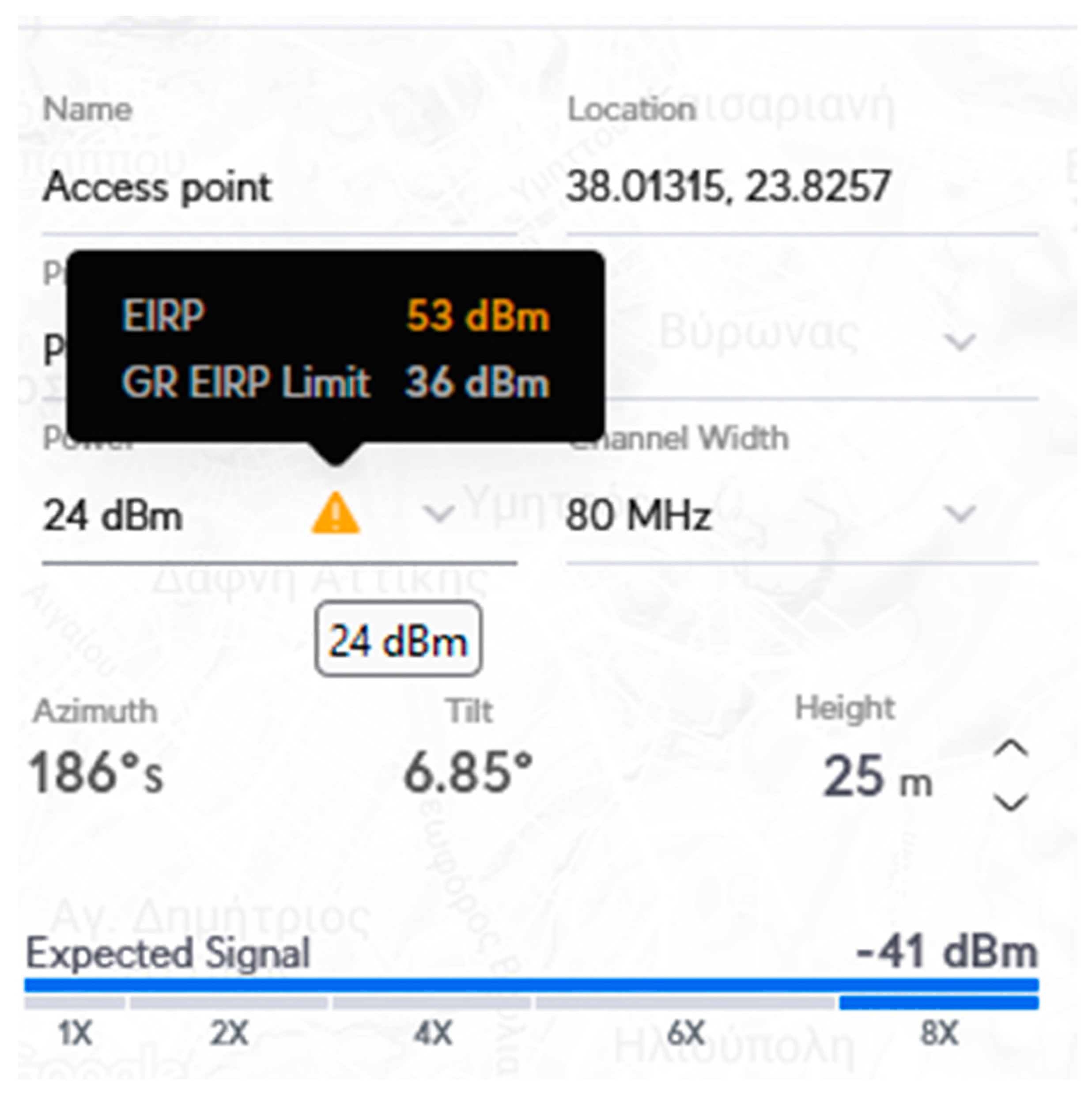
Figure 3.
Received Power Calculation, EIRP and Free Space Path Loss (FSPL) of LinkCalc.
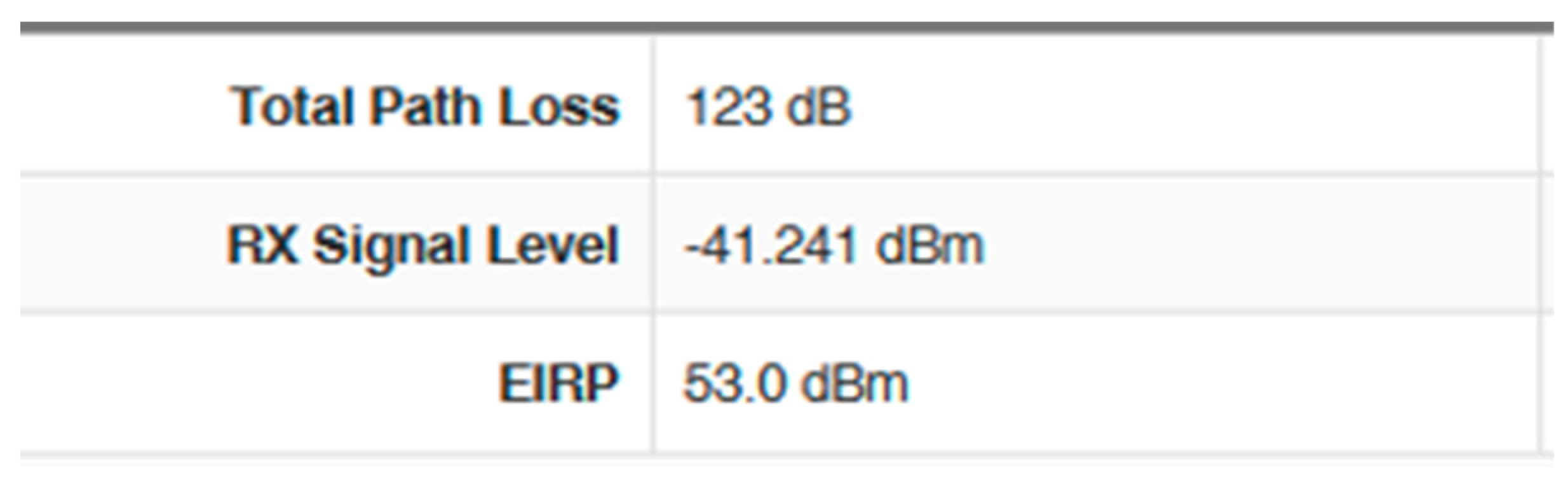
Figure 4.
Comparison of different simulation tools.
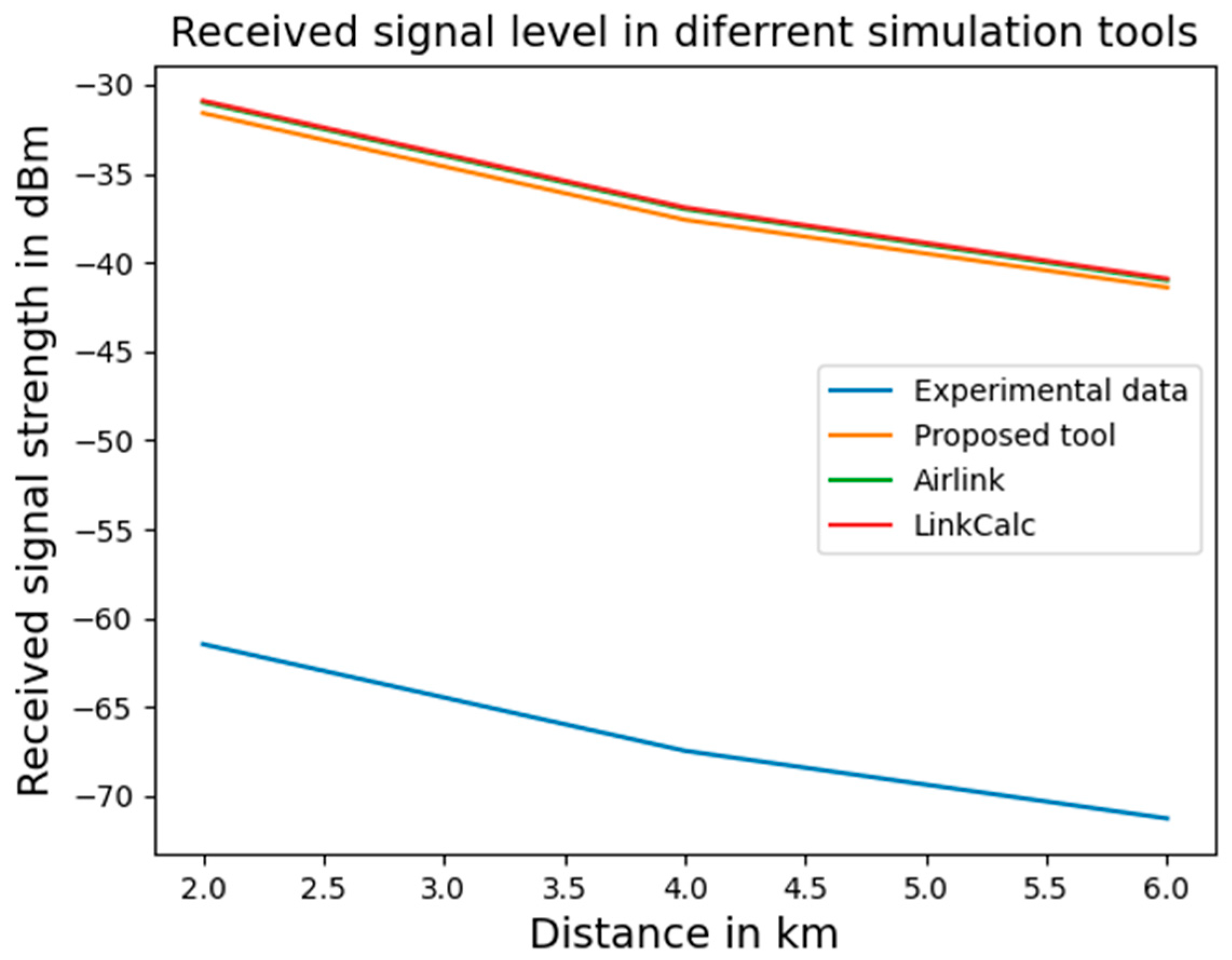
Figure 5.
Output of ping function in python script.
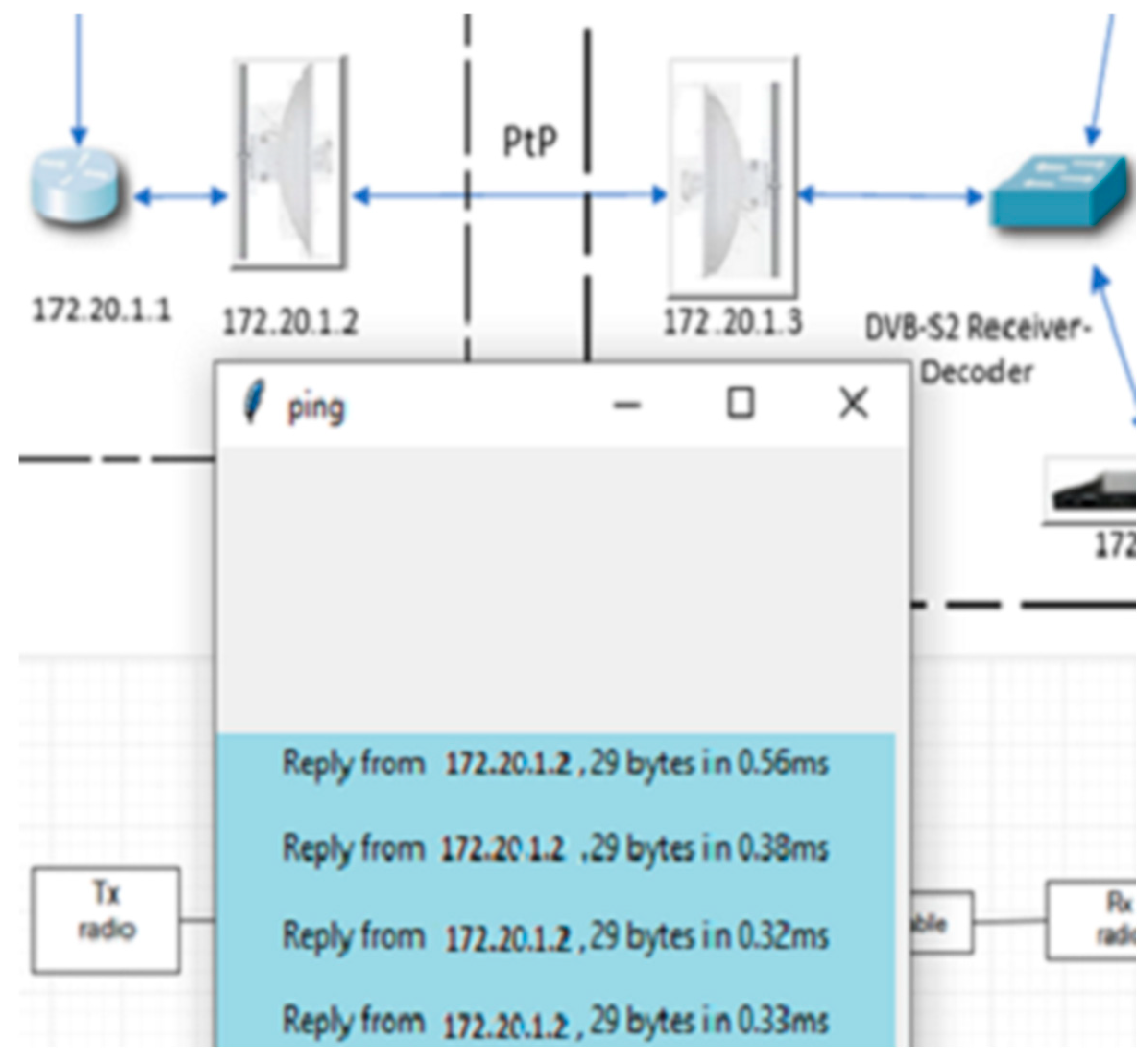

Table 1.
Temperature and wildlife count in the three areas covered by the study.
| Parameters | C-band |
|---|---|
| Frequency | 5.75 (GHz) |
| Distance | 6.175 km |
| Bandwidth | 80 MHz |
| Type of antenna | PowerBeam 5AC 620 |
| Polarization type | Horizontal |
| Antenna gain | 29 dBi |
| Max. transmitted output power | 24 dBm |
Disclaimer/Publisher’s Note: The statements, opinions and data contained in all publications are solely those of the individual author(s) and contributor(s) and not of MDPI and/or the editor(s). MDPI and/or the editor(s) disclaim responsibility for any injury to people or property resulting from any ideas, methods, instructions or products referred to in the content. |
© 2024 by the authors. Licensee MDPI, Basel, Switzerland. This article is an open access article distributed under the terms and conditions of the Creative Commons Attribution (CC BY) license (http://creativecommons.org/licenses/by/4.0/).
Copyright: This open access article is published under a Creative Commons CC BY 4.0 license, which permit the free download, distribution, and reuse, provided that the author and preprint are cited in any reuse.