
Submitted:
07 June 2024
Posted:
07 June 2024
You are already at the latest version
Abstract
With the introduction of policies to promote intangible cultural heritage into schools, intangible cultural heritage plays an increasingly important role in primary education. However, the implementation of the intangible cultural heritage policy in primary schools is mostly formalized, which leads to many problems in the introduction of intangible cultural heritage, such as mainly staying at the level of visual display and public opinion publicity, carrying out a small number of intangible cultural experience activities, and insufficient materialization and scenization of intangible cultural heritage, so that students cannot feel the inherent charm of intangible cultural heritage. In order to promote the development of intangible cultural heritage education, this paper uses the AGIL model of Parsons, literature analysis, case analysis and interview methods to study the promotion path of intangible cultural heritage in primary schools, and proposes solutions such as setting educational goals for school segments, setting up intangible cultural experience activities in schools, combining intangible cultural heritage with subject courses, and establishing a good maintenance mode. After the program is applied into practice, it is found that the use of storytelling by teachers to popularize the relevant knowledge of intangible cultural heritage is conducive to stimulating students' interest and prompting students to think. In addition, teaching and life practice should be combined, and students' five education should be emphasized at the same time to avoid teaching uniformity.
Keywords:
intangible cultural heritage education
; AGIL model
; cultural inheritance
; subject curriculum
1. Introduction
In 2003, UNESCO put forward the Convention for the Safeguarding of Intangible Cultural Heritage, which clearly stated that "the educational transmission of intangible cultural heritage, especially the educational transmission of heritage sites, is an extremely important way to protect and transmit the intangible cultural heritage" (Chen Qian, 2019). The document "Opinions on Implementing the Project of Inheriting and Developing Excellent Traditional Chinese Culture" issued by the Office of the Central Committee of the Communist Party of China and The General Office of the State Council emphasizes that inheriting excellent traditional Chinese culture is a rich nourishment for the continuous growth and development of the Chinese nation.
As can be seen from the following table, China is rich in intangible cultural heritage resources, but at present, non-genetic inheritance is in the predicament of no inheritance, and the society urgently needs effective solutions to the problem of non-genetic inheritance. If you want to deeply and permanently influence the inheritance of intangible cultural heritage, education is an essential step.

Table 1.
The number of national intangible cultural heritage projects in China is counted by provinces and in batches.
Table 1.
The number of national intangible cultural heritage projects in China is counted by provinces and in batches.
| Province | LT1 | LT2 | LT3 | LT4 | LT5 | Total | Province | LT1 | LT2 | LT3 | LT4 | LT5 | Total |
| Zhejiang | 46 | 97 | 60 | 30 | 24 | 257 | Shanxi | 24 | 30 | 11 | 13 | 13 | 91 |
| Shandong | 27 | 93 | 33 | 20 | 13 | 186 | Qinghai | 19 | 38 | 7 | 9 | 15 | 88 |
| Shanxi | 33 | 69 | 43 | 23 | 14 | 182 | Jiangxi | 19 | 16 | 11 | 24 | 18 | 88 |
| Beijing | 32 | 71 | 18 | 18 | 25 | 164 | Gansu | 23 | 30 | 8 | 7 | 15 | 83 |
| Guangdong | 42 | 56 | 30 | 18 | 18 | 164 | Liaoning | 22 | 31 | 7 | 7 | 9 | 76 |
| Hebei | 39 | 78 | 15 | 16 | 14 | 162 | Shanghai | 9 | 26 | 19 | 9 | 13 | 76 |
| Jiangsu | 37 | 62 | 27 | 19 | 16 | 161 | Guangxi | 22 | 10 | 9 | 12 | 18 | 71 |
| Guizhou | 40 | 61 | 24 | 15 | 19 | 159 | Jilin | 5 | 22 | 11 | 6 | 11 | 55 |
| Sichuan | 27 | 78 | 15 | 19 | 14 | 153 | Chongqing | 13 | 16 | 10 | 5 | 9 | 53 |
| Xinjiang | 25 | 61 | 31 | 18 | 14 | 149 | Tianjin | 7 | 10 | 5 | 11 | 14 | 47 |
| Fujian | 44 | 51 | 19 | 17 | 15 | 146 | Hainan | 13 | 16 | 6 | 5 | 4 | 44 |
| Hubei | 21 | 60 | 25 | 21 | 18 | 145 | Heilongjiang | 9 | 12 | 6 | 7 | 8 | 42 |
| Yuan | 36 | 47 | 22 | 17 | 23 | 145 | Ningxia | 3 | 5 | 2 | 8 | 10 | 28 |
| Hunan | 29 | 41 | 29 | 19 | 19 | 137 | Hong Kong | 2 | 0 | 4 | 4 | 2 | 12 |
| Henan | 26 | 56 | 13 | 18 | 12 | 125 | Macao | 2 | 1 | 3 | 2 | 3 | 11 |
| Neimenggu | 18 | 38 | 14 | 19 | 17 | 106 | Taiwan | / | / | / | / | / | / |
| Xizang | 23 | 36 | 16 | 13 | 17 | 105 | Total | 763 | 1352 | 567 | 463 | 465 | 3610 |
| Anhui | 26 | 34 | 14 | 14 | 11 | 99 |
Source: China Intangible Cultural Heritage network.
According to the characteristics of intangible cultural heritage, intangible cultural heritage has cultural, artistic and social characteristics. Through intangible cultural heritage education, students can get in touch with rich intangible cultural heritage, understand Chinese culture and history, and cultivate national pride and cultural identity. At the same time, intangible cultural heritage education can also improve students' innovative ability and practical ability. In addition, cultural inheritance helps to enhance a country's cultural soft power. Therefore, it is necessary to strengthen intangible cultural heritage education in primary school.
Scholars have done a lot of research on intangible cultural heritage education and achieved remarkable results. However, most of the existing studies focus on practical summary and analysis, while there are few studies from the sociological perspective.
At present, many schools carry out non-heritage education and publicity through lectures and other forms, and these initiatives have played a positive role in stimulating students' interest in learning non-heritage culture. However, from the perspective of “two creations” and sociology, NHE education is also facing real difficulties (Hu Diya, Li Xueting, Zhong Dandan, 2023). In recent years, the practice and publicity activities related to the protection of intangible heritage have not been comprehensively and systematically penetrated into the daily operation level, and the inheritance has become formalized, with a limited scale of dissemination, a weak continuity of dissemination, a limited content of dissemination, a single channel of publicity, a lack of fun in dissemination, and a lack of intangible cultural heritage-related elements in the campuses (Liu Zehui, 2022).
In view of the main problems of intangible cultural heritage education in schools, such as staying in the stage of exhibition and publicity, lack of experiect-related activities, and lack of materialization and scene display, this study focuses on how to implement intangible cultural heritage education in primary schools so that students can truly benefit from intangible cultural heritage. Through literature research, case analysis, interviews and curriculum practice, combined with the AGIL theoretical model, we can better understand the adaptability and flexibility of intangible cultural heritage education, clarify the educational goals and directions, make educational activities more targeted, integrate various resources, promote the diversification and synergy of intangible cultural heritage education, and inject new impetus into the development of non-genetic inheritance.
2. Theoretical Basis
Literature Review
"Intangible cultural heritage education" is defined as the concept and practice of promoting the recognition, respect and promotion of intangible cultural heritage in society through formal and non-formal education methods, so as to promote its inheritance (Yang Lihui, 2021). In the past two decades, scholars' research on intangible cultural heritage education has mainly focused on the relationship between intangible cultural heritage and education, the grafting of traditional non-genetic inheritance methods with modern education systems, and the construction of intangible cultural heritage teaching staff, etc. The research has made remarkable achievements, but there is still much to be done (Tan Tianmei, Daisy, 2021).
From the perspective of research methods, most research on intangible cultural heritage education adopts qualitative research methods, obtaining original data through observation and interview, and adopting inductive methods to form conclusions and theories. In the few existing quantitative studies, questionnaires are used to obtain the original data, and statistical analysis tools such as SPSS are processed and analyzed, so as to assist and verify the research conclusions. On the whole, most of the existing researches adopt the method of instrumental case study and literature analysis.
The results of a research project conducted in 2018 pointed out that the campus is a big classroom for ideological and moral education, and students should be educated wherever they look, and students should be given opportunities to participate and experience (Yang Li, 2018).
Scholars Tan Tianmei and Ou Suju sorted out the context of intangible cultural heritage research in China in the past 20 years, and on this basis proposed that intangible cultural heritage curriculum and teaching practice, and students' embodied cognition of intangible cultural heritage should be the important direction of future intangible cultural heritage education research. (Tian Mei Tan and Su Ju, 2021)
2. AGIL Model
AGIL model is a dynamic analysis model of social systems proposed by sociologist Parsons, commonly used to analyze the structural state and functional performance that social action systems have, including the four functional requirements of adaptation (A), goal realization (G), integration (I), and latency(L) (Zhang Qin, 2022).
Adaptation means that in order to exist, the system must obtain the required resources or means from the environment; goal realization is some kind of desired state, referring to the goal orientation of the action system; integration refers to coherence and coordination, so as not to let the system stray, disconnect and break; and maintenance pattern means that even if the system is temporarily interrupted, the original pattern can be maintained, and when it starts to operate again, it can ensure that the system is restored.
Figure 1.
Functional model of the AGIL.

3. Research Methods
This study adopts the method of interview and multi-case comparison. Data and sources include on-site interviews, as well as public information on the website.
3.1. Interview Method
3.1.1. Interview Subjects
In order to enrich the theoretical basis of this study and gain an in-depth understanding of students' attitude and learning situation towards intangible cultural heritage, this study selected 1 non-genetic inheritor, 2 teachers and 6 primary school students from three primary schools, namely Shanwei Huafu School, Magong School and Wutong School, as specific research objects for interview. This study developed its own interview outline and designed questions in four dimensions: channels of exposure to intangible cultural heritage, depth of knowledge about intangible cultural heritage in their hometowns, degree of importance attached to intangible cultural heritage in their schools, and willingness to learn about intangible cultural heritage in their schools, with a view to understanding students' attitudes towards and learning about intangible cultural heritage, and to obtaining formal and reliable first-hand information.
Table 2.
Basic information of the interviewees.
| Code | Gender | Interview method | Identity | School(city/village) | |
| A | Male | Group interview | student | Huafu School(city) | |
| B | Female | Group interview | student | Huafu School(city) | |
| C | Male | Individual interview | student | Magong School(city) | |
| D | Female | Individual interview | student | Magong School(city) | |
| E | Male | Group interview | student | Wutong School(village) | |
| F | Female | Group interview | student | Wutong School(village) | |
| G | Male | Group interview | inheritor | / | |
| H | Male | Individual interview | professoriat | South China Normal University | |
3.1.2. Interview Results
In the interview, most of the interviewed students said that they came into contact with intangible cultural heritage mainly through schools, museums and Internet media, etc. They did not know much about intangible cultural heritage in their hometown, and they were willing to learn intangible cultural heritage on campus. Meanwhile, most of the interviewed students hoped that the development form of intangible cultural heritage courses in schools could be interesting and innovative.
The interviewed non-inheritors said that they would be invited to campus to give lectures on the popularization of intangible cultural heritage knowledge, and agreed that the introduction of intangible cultural heritage into campus can promote students' aesthetic education. Through the investigation, it is also found that some urban schools will introduce non-genetic inheritors to teach and carry out a series of intangible cultural heritage activities, but they only stay at the level of lectures and performances. According to the information provided by the students, some schools invited special non-genetic bearers to teach on campus and organized campus art festivals, and its effectiveness was also recognized by the students. In addition, some respondents mentioned that schools need to charge extra fees to carry out intangible cultural heritage courses, which reduces parents' willingness to let students participate in the courses to a certain extent.
After further sorting out and classifying the interview results, it was found that urban schools paid more attention to intangible cultural heritage than rural schools, and rural schools basically did not organize activities related to intangible cultural heritage. It can be seen that intangible cultural heritage education presents a serious phenomenon of polarization. Some schools have set up relatively complete courses and are in long-term implementation, while some schools have not even carried out relevant intangible cultural heritage education activities. One of the key reasons for the small number of intangible cultural heritage teaching activities organized by rural schools is the shortage of intangible cultural heritage teachers and funds. Therefore, training intangible cultural heritage teachers to bring "teaching" to "teaching" may accelerate the promotion of intangible cultural heritage into rural schools.
3.2. Multiple Case Comparison Method
3.2.1. Case Selection
According to the method of theoretical sampling for conducting case studies, five schools, including three excellent cases and two innovative cases, were selected from the second “Intangible Cultural Heritage in Schools” Excellent Practice Cases and Innovative Cases supported by the Department of Intangible Cultural Heritage of the Ministry of Culture and Tourism, which is representative to a certain extent.
3.2.2. Case Description
(a) Excellent cases
In 2016, Guangzhou Yuexiu District Teachers' Training School tried to take primary and secondary schools as the main position of intangible cultural inheritance, fully explored and utilized the advantages of intangible cultural resources in the Guangfu area, hired intangible cultural heritage inheritors, and took art teachers as the main teaching objects to teach intangible cultural heritage project skills, to promote the teaching of learning to teach, and to carry out Guangfu cultural practice activities in accordance with local conditions.
Since 2012, Zhongshan Experimental School in Luanzhou City, Hebei Province, has been carrying out shadow work in schools, hiring masters to teach, writing school-based curriculum, completing the “Luanzhou Shadow School-Based Curriculum Teaching Materials”, promoting shadow into the audio-visual and art classrooms, arranging local repertoire, setting up school-level shadow museums and utilizing live broadcasting platforms for publicity.
Tongliang District, Chongqing Municipality, according to the actual situation of different schools and the characteristics of the dragon dance project to carry out targeted dragon dance teaching and training, and organizing the inheritors to carry out regular scheduled classes. In addition, the region also specifically recruited full-time dragon dance teachers to carry out dragon dance teaching activities, and organized the backbone of the dragon dance to offer dragon dance courses and create dragon dance teaching materials.
(b) Innovation cases
The primary school affiliated to Beijing Medical University has opened a series of online intangible cultural heritage courses. The school selected six courses as the children's learning content, and combined with the students' practical ability and learning interest, made a detailed teaching plan. In terms of teaching methods, online teaching and live display are carried out. Fuzhou Fujian Opera Art Inheritance and Development Center has long established a training and practice base for Fujian Opera, and has provided performances to benefit the people in some universities, primary and secondary schools. In recent years, performances in the form of "Fujian Opera + analysis and interaction", into Lianjiang Affiliated Primary School to give lectures on Fujian opera, to teach students the steps and figure in Fujian opera. In addition, the art backbone as the school Fujian opera teachers, teaching Fujian opera, Fuzhou opera songs, etc.
Table 3.
Basic Information on the sample studies.
| Kind | Organization | Training Target |
Category of intangible Cultural heritage |
Category of intangible Cultural heritage |
| Outstand cases |
Guangzhou Yuexiu district teacher training school | Teacher | Guangfu intangible cultural Heritage | Teach intangible cultural heritage project skillsTeach intangible cultural heritage project skills |
| Zhongshan Experimental School, Luanzhou City, Hebei Province | Student | shadow puppets | Preparation of school-based curriculum, live broadcast | |
| Tongliang District, Chongqing | Loong Dance | Create dragon dance teaching materials | ||
| Innovation cases |
Beijing Medical University affiliated primary School | Painting, paper cutting, Chinese knot, etc | Online course | |
| Fuzhou Min Opera art heritage and development center | fujian opera | Teach Fujian opera walking, skills |
3.2.3. Case Analysis
The above three good cases and two innovation cases, the cultivation of intangible education object of both teachers and students, the school of Guangzhou teachers training goal is to learn to promote teaching, to "teach" with "teaching", five school good or innovation point mainly lies in the intangible school-based curriculum, giving full play to the advantages of online platform, teach intangible art several aspects.
3.3. The Dilemma of Intangible Cultural Heritage Education under the AGIL Model
Combined with the interview and the above cases, it is not difficult to find that there are many problems in the intangible cultural heritage in the process of entering the campus.
3.3.1. The Dilemma of Adaptation Function
In the face of the changes brought about by digitization to all walks of life, the digital dissemination of intangible cultural heritage has become one of the core tasks for its inheritance and preservation (Xue Ke, Long Jingyi, 2020). Many intangible cultural heritage inheritors use new media platforms to integrate technology and intangible cultural heritage content for effective digital dissemination, but students tend to browse entertainment videos in their own time, and intangible cultural heritage disappears after a short period of “attracting fans”.
3.3.2. The Dilemma of Goal Achievement
In 2003, The General Office of the State Council proposed the Opinions on Strengthening the Protection of China's Intangible Cultural Heritage "successor the inheritance of intangible cultural heritage through social education and school education" (Hao Zhenyu, 2016). The goal of intangible cultural heritage education is not only to promote the inheritance of intangible cultural heritage, but also to give full play to the positive role of intangible cultural heritage, and to promote students' behavior development, mental development and mental growth. At present, most of the intangible cultural heritage education in China is only carried out in pictures, explanations, or a single way of teaching. Most of the implementation of intangible cultural heritage policies in primary schools is blind and formalized. Students' understanding of intangible cultural heritage still remains on the surface and cannot fully achieve the policy goals.
3.3.3. The Dilemma of Integrating Functions
In terms of integration, some local schools have begun to incorporate intangible culture into their school-based curricula, tapping into local resources to create schools with special characteristics; most schools only combine intangible culture with arts and sports disciplines such as fine arts and physical education, and less with the curricula of other disciplines, such as language and mathematics, and at the same time there is the phenomenon of a considerable portion of districts possessing a wealth of intangible cultural resources that no one is aware of.
3.3.4. The Dilemma of Latency
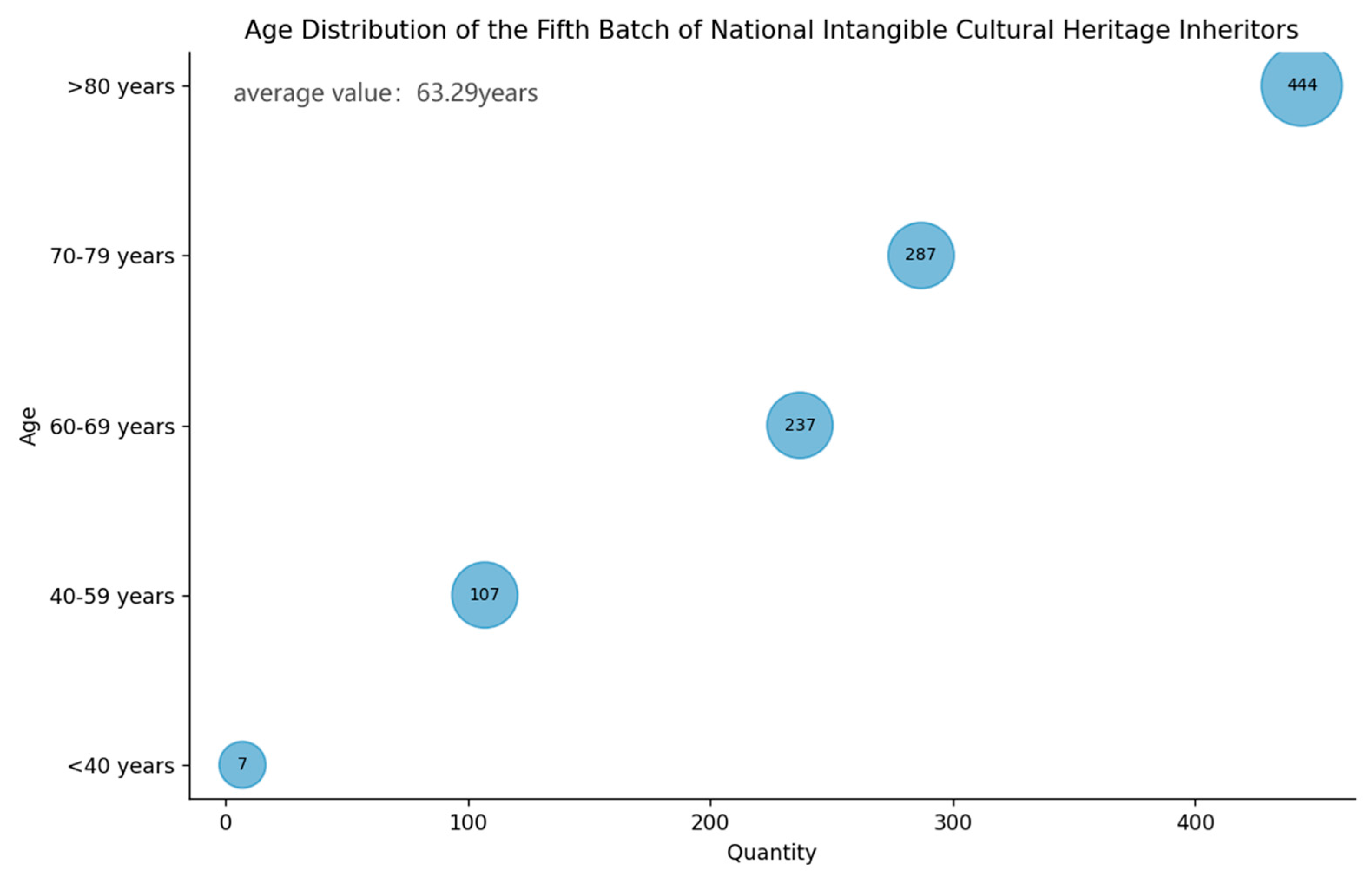
The inheritance of intangible culture is not something that can be achieved in one or two lectures or experiential classes, but rather in the immersion of a long-term cultural atmosphere. Some local schools have begun to integrate intangible culture into their school-based curricula and to tap local resources to create special schools, but there still exists a considerable portion of regional intangible cultural resources that cannot be renewed and utilized from generation to generation, and these regions tend to be backward in terms of education and economic level, in addition to which, the aging of intangible cultural heritage bearers is intensifying, which is also prompting the innovation of intangible cultural heritage education mode.
Figure 2.
Age distribution diagram of the fifth batch of national non-genetic inheritors.
4. Approaches to Optimize Intangible Cultural Heritage Education
In light of the efficient measures outlined in the case study, this research posits that the optimization pathway for the development of intangible cultural heritage education lies in targeted reforms based on four dimensions of the AGIL model: adaptation function, goal attainment function, integration function, and pattern maintenance function. Leveraging the positive roles of these four functions is crucial in addressing the current challenges in intangible cultural heritage education (see Figure 3).
4.1. Set Goals Based on Academic Segments
Firstly, it is important to clarify the objectives of primary education, which is to "cultivate socialist constructors and successors who are morally, intellectually, physically, aesthetically, and laborally developed." Secondly, it is necessary to integrate intangible cultural heritage education as an important component into the primary education objectives. Therefore, the purpose of intangible cultural heritage education in primary schools is not to train professional inheritors of intangible cultural heritage but to further achieve a win-win situation in the inheritance and educational improvement of intangible culture based on the objectives of primary education. Additionally, schools should consider students' age development, intellectual growth levels, learning cognitive patterns, and psychological acceptance levels to help students comprehensively, multi-levelly, and in-depthly learn about intangible cultural heritage. For younger students, the goal of intangible heritage education should focus on acquiring basic knowledge of intangible heritage projects; for older students, in addition to mastering fundamental knowledge of intangible heritage, they should also possess certain skills.
4.2. Launch Experience Activities Adaptive to the Campus Environment
To tap into local cultural resources, create a unique environment and atmosphere for intangible cultural heritage education, and establish the school's cultural characteristics. For instance, creating dedicated areas within the school premises as exhibition and experience zones for intangible heritage, displaying various intangible cultural works and related cultural products. Integrating the two areas to combine diverse aspects of intangible heritage education such as exhibition, experience, and innovative inheritance, supplemented with various learning methods to encourage students to delve into the humanistic spirit of intangible heritage. Conducting easily accessible intangible heritage experience activities for students such as paper-cutting, paper sculpture, and shadow puppetry, enabling students to engage in role-playing with masks, involving multiple senses in visual, auditory, and verbal activities, and guiding students to apply knowledge to problem-solving. Implementing activities like singing folk songs, creating stories to stimulate students' enthusiasm for learning, boosting self-confidence, and achievement; utilizing multimedia platforms, such as airing the "Road to Intangible Cultural Heritage" series during leisure time to alleviate student fatigue and enhance their understanding of intangible cultural heritage.
4.3. Integrating Resources: Combining Intangible Cultural Heritage with Subject Curriculum and Technology
In economically underdeveloped regions, enhancing teacher training and developing rich teaching resources are crucial steps to integrate intangible cultural heritage education with subject teaching effectively. The emergence of new media in information technology not only impacts traditional media but also transcends conventional educational methods (Xiang Z, Junxiao B, Jinli W, 2022). In economically developed areas, leveraging digital technology to intervene in intangible cultural heritage education is advantageous. Utilizing advanced technologies such as artificial intelligence and big data analysis to showcase and explain intangible cultural heritage can evoke students' interest with emotionally resonant and visually vivid multimedia. Specific measures include digitizing and informatizing intangible cultural heritage resources, managing school-based intangible cultural heritage public accounts, establishing on-campus intangible cultural heritage heritage centers, and incorporating cutting-edge technologies like VR to immerse students in the experience, bridging temporal and spatial distances with intangible cultural heritage.
4.4. Establishing a Sustainable Maintenance Model
Establishing a sound maintenance model is pivotal to sustaining the stable development of intangible cultural heritageeducation. At the teacher level, it is imperative to provide primary school subject teachers with theoretical and practical insights into intangible cultural heritage education, enhancing their intangible cultural heritage literacy as an additional driving force. Firstly, it is essential to formulate regulations and systems pertinent to school-based intangible cultural heritage education, judiciously assessing and evaluating the entire process and outcomes of intangible cultural heritage classroom teaching following teaching outlines and principles. Secondly, practical references for integrating intangible cultural heritage with subject knowledge should be provided.
5. Conclusion and Limitations
5.1. Research Conclusion
This study investigated the promotion paths of intangible cultural heritage arts within school campuses. Through the methods of literature analysis, case study, and interviews, it was found that there are current issues in the process of integrating intangible cultural heritage into schools, such as the lack of adjustments tailored to the educational environment of schools, the inadequacy of existing intangible cultural heritage education to meet policy objectives, underutilization of the interdisciplinary nature of intangible cultural heritage, and a lack of effective models for rural intangible cultural heritage education. Drawing on Parsons' AGIL model, this paper explores the promotion path of intangible cultural heritage arts in primary schools, emphasizing the importance of setting educational goals for different stages, integrating intangible cultural heritage with subject curricula, and establishing sustainable models to facilitate the development of intangible cultural heritage education.
Based on the above findings, the teacher education team has conducted initial research on how to implement intangible cultural heritage education in primary schools to enhance cultural inheritance and educational quality. A curriculum development model has been further established. Taking the examples of the traditional Shanwei drama "Haifeng West Qin Opera" and the Lufeng shadow play, the following model is derived by combining intangible cultural heritage with educational objectives(see Figure 4).
First, identify specific intangible cultural heritage elements and extract their unique features. For example, the intangible cultural heritage of West Qin Opera can be explored from the aspects of costumes, singing styles, and performances to extract characteristic elements such as patterns, storylines, and eye interactions. Second, starting from these unique elements, identify relevant subject areas in which to integrate them. By incorporating these elements into the curriculum through suitable teaching methods and strategies, aligning with subject teaching themes, and emphasizing holistic education encompassing moral, intellectual, physical, aesthetic, and labor aspects, educational design work for intangible cultural heritage courses is carried out. This includes both offline classroom practices and the development of online micro-lessons.
5.1.1. Teaching Preparation and Implementation
(1) Offline Practices
Team members have conducted a series of activities on "intangible cultural heritage courses" at schools such as Changsha School in Shanwei and Wutong Primary School. These activities include tea pounding and paper cutting experiences to allow primary school students to participate in the production process, providing them with a deeper understanding of intangible cultural heritage. During this process, close attention is paid to students' learning behaviors.
In the tea-pounding themed course, teaching methods such as teacher lectures and group discussions are utilized to introduce the basic knowledge of tea pounding, including the ingredients, production process, and reasons for its transmission. During the discussion session, it was observed that students already had a certain understanding of tea pounding before class and showed great interest in experiencing the production process. In the paper cutting experience course, students are first introduced to the basic knowledge of paper cutting, the methods of production, and the precautions to take. Subsequently, students are shown finished paper cutting pieces and then given the opportunity to freely engage in paper cutting activities.
(2) Online Courses
Integrating intangible cultural heritage such as Tibetan opera, West Qin opera, shadow play, and wheat straw painting with subjects like language, mathematics, English, and arts, comprehensive specialized teaching plans are designed to create online micro-lessons. There are two main reasons for choosing this approach: firstly, the majority of intangible cultural heritage inheritors are older and cannot serve as full-time teaching staff for extended periods; secondly, the low production cost and high flexibility of micro-lessons, coupled with teacher trainees as the main developers, facilitate the integration of theory and practice, promoting the enhancement of teacher trainees' skills.
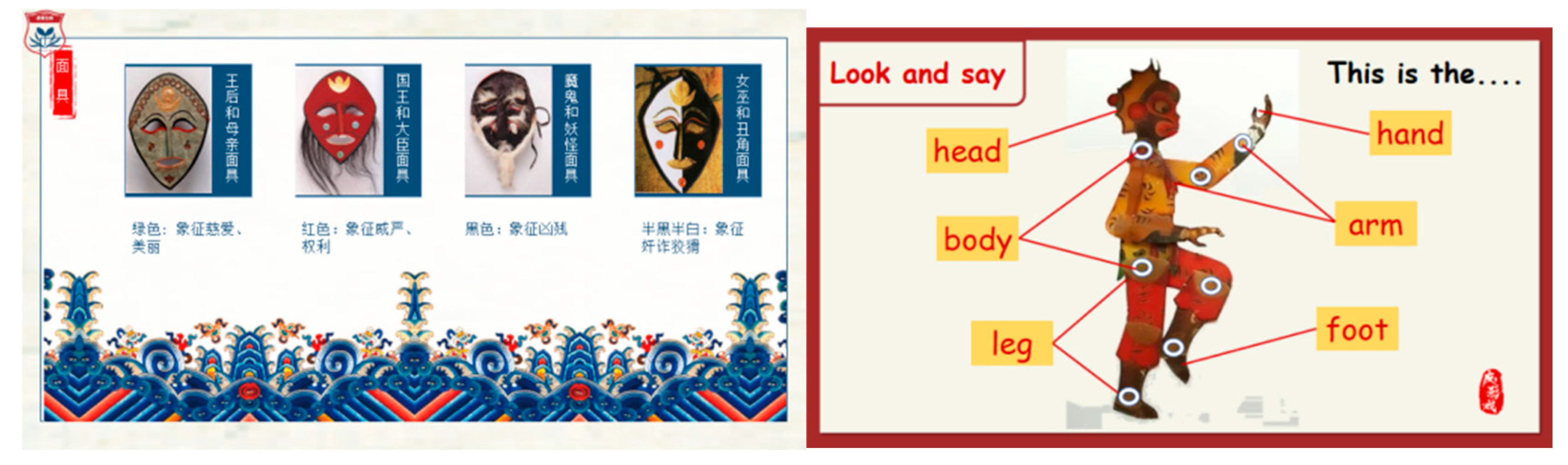
For instance, in the Chinese language micro-lesson, taking the fourth lesson "Tibetan Opera" from the sixth grade of the elementary Chinese textbook as an example, students are first exposed to the story of the lesson to activate their initial perception of Tibetan opera, extending their knowledge to facial makeup in traditional opera. In the mathematics micro-lesson, geometric knowledge is taught in conjunction with facial makeup patterns. In the English micro-lesson, based on the similarity between human body parts and shadow play figures, students are guided to describe themselves and the body parts of the shadow figure in English, following instructions to perform actions, engaging multiple senses in visual, auditory, and verbal activities during play.
Figure 5.
Partial course presentation.
5.1.2. Reflection and Improvement
After the class, we deeply reflected on the gains and shortcomings in the teaching design, implementation, and evaluation process. We found that students had a great interest in the making of pounded tea; however, due to our team's lack of prepared tools for tea pounding, we were unable to demonstrate the production process on-site. On one hand, some students were familiar with the process of tea pounding and had interest, leading to a lack of active participation in the course interactions. The lack of student engagement was evident as we did not establish evaluation criteria before the course and failed to collect student feedback afterward.
There are two main challenges in the course development model: first, developers may not extract the unique elements of intangible cultural heritage properly, hindering their integration into subject teaching. Therefore, it is necessary to select and extract these elements based on a thorough understanding of the educational objectives. Secondly, developers may struggle to fully leverage the unique elements to enhance subject teaching, potentially causing imbalances and testing the selection of teaching strategies and methods.
In conclusion, when conducting intangible cultural heritage education courses, instructors should adequately prepare, including familiarizing themselves with the production process, preparing the necessary tools for the course, and conducting surveys on students' understanding of the specific type of intangible cultural heritage before and after the course. Teachers can use storytelling and general knowledge dissemination related to intangible cultural heritage to spark students' interest, stimulate their thinking, integrate teaching with real-life practice, emphasize holistic student development, and avoid one-dimensional teaching. Additionally, it is important to establish an evaluation system for intangible cultural heritage education courses to promote cooperation among teachers and collective reflection, continuously improving the teaching process to enhance teaching effectiveness.
5.2. Limitations of the Study
The findings of this study can further enrich the research on the integration of intangible cultural heritage into primary school education and provide practical guidance for the application of intangible cultural heritage in primary school education. However, this study has at least three limitations. Firstly, we have not fully investigated teachers' intentions regarding the teaching of intangible cultural heritage. Secondly, it was challenging to gather a wider range of research data, which inevitably may have some impact on the research results. Thirdly, as the online courses are still in the preliminary stage of development and exploration, the online micro-lessons have not yet been widely promoted to primary school students.
We will continue to track the new developments and applications of intangible cultural heritage education, further explore the pathways for implementing intangible cultural heritage education to obtain more detailed research results. We aim to develop curriculum with intangible cultural heritage characteristics primarily in language, mathematics, English, music, physical education, arts, and crafts, conduct classroom teaching and evaluation, design specific practices of intangible cultural heritage education, provide guidance for the future training and direction of talents in intangible cultural heritage education, and promote the development of intangible cultural heritage education.
References
- Hu, D.; Li, X.; Zhong, D. The Dilemma and Optimisation Path of Intangible Cultural Heritage School Education under the Perspective of "Two Creations". Ethnic Education Research 2023, 34, 136–142. [Google Scholar]
- Zhang, Q. The dilemma and way out of the inheritance of school sports non-heritage education under AGIL model. Teaching and Management 2022, 40–43. [Google Scholar]
- Yang, L. From "Folklore Education" to "Non-heritage Education" - The Way of Local Practice of Non-heritage Education in China. Folklore Research 47–58+159. 2021. [Google Scholar]
- Tan, T.M.; Ou, S.J. Review and Reflection on the Research of Intangible Cultural Heritage Education in China in the Past Twenty Years. Journal of Chongqing College of Arts and Sciences (Social Science Edition) 2021, 40, 22–34. [Google Scholar]
- Liu, Z. Research on the Influencing Factors of Campus Inheritance of Intangible Cultural Heritage Based on Rooting Theory of Sports; Shenzhen University, 2020. [Google Scholar]
- Xue, K.; Long, J. New Challenges and Countermeasures for Digital Communication of Intangible Cultural Heritage in China. Cultural Heritage 2020, 140–146. [Google Scholar]
- Chen, X. Analysis of Strategies for Implementing Intangible Cultural Heritage Education and Teaching in Primary Schools. Sichuan Theatre 157–160+168.. 2019. [Google Scholar]
- Hao, Q. Ten-year review:A brief analysis of the protection of intangible cultural heritage inheritors in China. Art Observation 2016, 9–12. [Google Scholar]
- Zheng, X.; Bao, J.; Wang, J. Problems and Measures of Traditional Culture Education and Mental Health Education in Colleges and Universities under the New Media Environment. Journal of Environmental and Public Health 2022, 2022, 3370481. [Google Scholar] [CrossRef]
Figure 3.
AGIL modelling framework for intangible cultural heritage education.
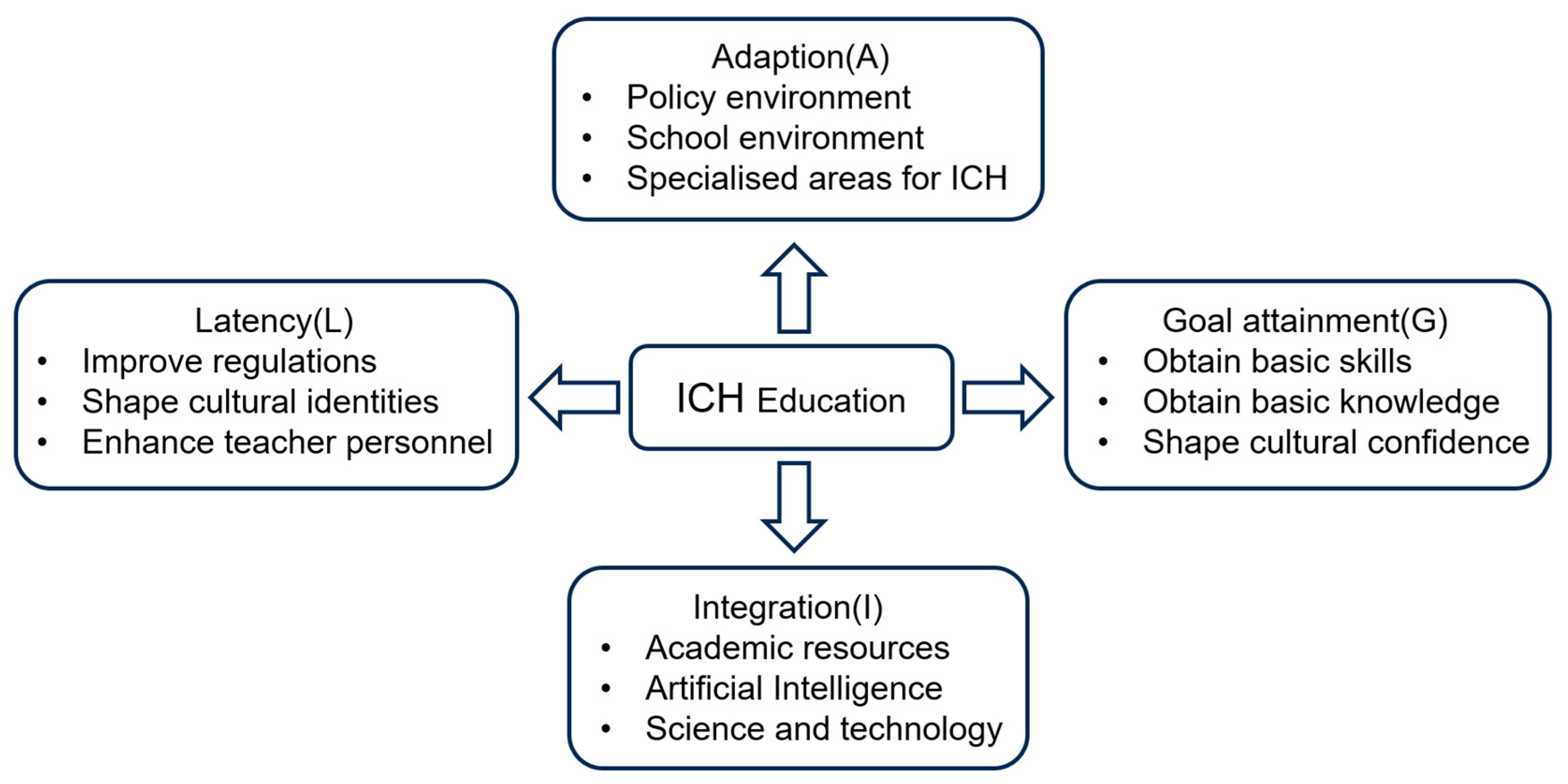
Figure 4.
Models of Curriculum Design.

Disclaimer/Publisher’s Note: The statements, opinions and data contained in all publications are solely those of the individual author(s) and contributor(s) and not of MDPI and/or the editor(s). MDPI and/or the editor(s) disclaim responsibility for any injury to people or property resulting from any ideas, methods, instructions or products referred to in the content. |
© 2024 by the authors. Licensee MDPI, Basel, Switzerland. This article is an open access article distributed under the terms and conditions of the Creative Commons Attribution (CC BY) license (http://creativecommons.org/licenses/by/4.0/).
Copyright: This open access article is published under a Creative Commons CC BY 4.0 license, which permit the free download, distribution, and reuse, provided that the author and preprint are cited in any reuse.