
Submitted:
30 May 2024
Posted:
03 June 2024
You are already at the latest version
Abstract
This paper aims to examine the potential for ecotourism development in the Pulicat Lake, a proposed Ramsar site situated in the Indian states of Andhra Pradesh and Tamil Nadu. Pulicat Lake has enormous potential for tourism and recreation; however, it is inevitable to ensure sustainable development in the region. The data for the study was collected using various methods, including case study techniques, qualitative interviews, observations, and information obtained from secondary sources. The study aimed to identify the sustainability dimensions of the location, including economic impact and income generation potentials through employment opportunities like field guides and travel companions. It is also examined the social impact on the local community and the development efforts made to reduce environmental pressures while conserving the flora and fauna. Additionally, the study discusses the possibilities and strategies for ornithological ecotourism at Pulicat Lake.
Keywords:
avitourism
; sustainable tourism
; community-based tourism
; economic feasibility
; Pulicat Lake
; India
Introduction
Ecotourism is a collaborative endeavor involving authorities, the tourism industry, local communities, and tourists themselves. Its aim is to provide visitors with the opportunity to explore authentic areas, appreciate nature and culture, and engage in learning experiences, all while ensuring the reasonable use of resources and fostering sustainable development” (Björk, 2000). Ecotourism integrates the three aspects of sustainable development, which includes, social, economic, and ecological impact (Das & Chatterjee, 2015; Fennell, 2001; Weaver, 2005). Given the detrimental impacts on both social and ecological aspects caused by the mass tourism, ecotourism emerges as a viable alternate solution (Weaver, 2001). As a result, the principles of ecotourism have expanded beyond ecological consideration such as nature focused activities and conservation efforts. They now encompass social values such as education, fair sharing (equitable) of benefits, ethical practices, and sustainable development (Donohoe & Needham, 2006).
Avitourism (Bird-watching tourism) is an emerging niche area of nature-based tourism (Bigges et al., 2011), this integrates all the three dimensions of sustainable development such as economic, social, and environmental (Li et al., 2013). Providing bird-watching tourism brings forth various benefits, such as promoting ecological conservation and safeguarding biodiversity. In addition, this form of tourism is sustainable as it contributes to the well-being of local communities and upholds land ownership rights (Pubhakka et al., 2011).
The existing literature reveals a significant knowledge gap in understanding the utilization of avitourism as a viable tourism product and its potential for promoting conservation efforts and sustainable development. Although research on avitourism predominantly focuses on North America, there is a pressing need to formulate strategies in developing countries to achieve sustainable outcomes (Steven et al., 2015); To address this gap in knowledge, this study explores the role of avitourism in integrating with ecotourism, as well as its prospects for fostering local community development and environmental conservation.
The objectives of the study are to identify the prospects of ecotourism in the proposed Ramsar site. To examine the opportunities, this study strives to check the avian population in the destination, the uniqueness of Pulicat lake, local communities residing nearby the lake, harmonizing nature and communities, field guide and travel companion, education and training, for promoting bird-watching and ecotourism. In this regard, this study employs a case study method to explore the objectives mentioned earlier.
The study is organized as follows: In section two, we delve into the literature concerning bird-watching tourism in India. Section three outlines the research method employed to address our research objectives. Moving forward, sections four and five analyze the findings and explore their implications, both in terms of theoretical insights and practical applications. Finally, in section six, we present our conclusion, drawing upon the study’s outcome.
Literature Review
Bird Watching Tourism
The study by Kutzner (2019) elaborated on the social-ecological resilience of bird-watching tour operations in the destination of Otago Peninsula, New Zealand. The strategies adopted by the tour operators for the environmental change escalated the engagement and activities on environmental conservation, collaboration to resolve the crisis, assistance on predation management, diversification of tour products by offering novel tour experience, customized the tour products, emphasis on conserving nature, and reducing the impact of climate change and reducing the pressure on exploiting the natural resources. The prospects of bird watching are examined in Poland (Kronenberg, 2016). The study conducted a SWOT analysis to identify the possibilities of bird watching given the diverse number of avifauna in the ecosystem. The weakness of the place is that the infrastructure is in the developing stage and inadequate to disseminate information on avitourism. The threat faced by the destination involves environmental degradation. On the other hand, in Zywkowo, Poland, the economic value associated with ecosystem services is explored related to white storks (Czajkowski et al., 2014). The findings indicate that people travel long distances for bird watching in the village. This study elaborates on the prospects of income that local communities can derive from avitourism. The other study identified that irrespective of bird watchers or pedestrians, some bird species judge the movement of bird enthusiasts as threatening and disturbing and also examined how the birdwatchers influence the escape distances of the East African bird species (Radkovic et al., 2017).
Bird-Watching Ecotourism in India
The present-day ecotourism in India may be traced back to the British period (Ranade, 2008). The Union Ministry has a specific plan for promoting ecotourism in the country with a mandate of responsibility and sustainability involving locals as of high importance. The State governments are keen on attracting tourists to explore various destinations and play a vital role in the eco-tourism initiative of identifying potential ecotourism spots in their respective states (Kannan, 2005). India is home to three bio-geographic zones (Indo-Malayan, Palaearctic, and Afro-Tropical), and varied climatic, topography and habitats attribute one of the bird-rich countries in the world with over 1330 species and about 14% of the world’s avifauna (Clements, 2007). In developed countries, the lakes, backwater areas, and beaches are used as a resource for ecotourism, nature-based tourism, and leisure tourism as they attract millions of tourists. As for India, the nation lacks planning due to a lack of knowledge in using ecosystem services other than regular ecotourism projects involving the local community. Birds are essential components of biodiversity; their healthy populations serve as a benchmark for the health of our ecosystems. Birdwatching is a major component of wildlife tourism and is one of the most rapidly growing pursuits. The mode of tourism is popular among western travellers who are increasing worldwide because of the paradigm shift in western society more environmentally concerned ‘green’ paradigm (Kellert, 1985; Applegate & Clark, 1987; Burger et al., 1995; Adams et al., 1997; Weaver, 2008). The trend is observed not only in the developed countries but also in developing countries like India (Karanth et al., 2012; Karanth et al., 2008), reflected in forming e-groups for birds (Birds of Bombay, Birds of NE India, Birds of Pune, Kerala Birders, Tamil birders etc.,), natural history and bird photography where participants make remarkable contributions. Unlike the developed countries, India is lagging in bird conservation because of the low priority given to conserving birds, the focus being on large mammals, which needs to be rectified. Pulicat Lake is one of the potential sites for a bird-watching ecotourism destination in India, where tourists can explore every facet of the tourism destination. It can be included in the tourist attractions list on India's tourism portals. Therefore, this paper is focused on and attempts to provide suggestions and alternate means of conserving and managing Pulicat Lake.
Study Area
Pulicat Lake (13° 40’ N and 80° 11’ E) is situated on the south coast of Andhra Pradesh and the north coast of Tamil Nadu on the eastern seaboard of India (Figure 1). It is spread over 720 sq. km and is India's second-largest brackish water lake after Chilika in Odisha. The geographical regions of the lake are declared as bird sanctuaries. The history and culture of Pulicat Lake date back to 300 B.C. and has been described as a grand port operational since the 15th century, prominently figured on the nautical charts of indigenous and foreign sea-faring communities along the east coast of India. The Cholas, Nayak, and Mogul rulers fought to garner its abundant port revenues. The entire area is vast, brackish to saline, with extensive mudflats. The historical Buckingham Canal runs along the eastern edge parallel to the Bay of Bengal, from Pedda Ganjam (15° 39 N and 80° 15’ E) in Andhra Pradesh (north) to Marakanam in Tamil Nadu (south). The sea influences the ecosystem at various places throughout the lake through inlets (at Durgarajupatnam, Rayadurg and Pazhaverkadu) connecting the lake with the Bay of Bengal, which is vital for the flora and fauna of Pulicat Lake. During the monsoon, freshwater enters this ecosystem through Swarnamukhi, Kalangi and Arani rivers.
The lake has several islands, of which the large ones are Sriharikota, Irakkam, Venadu and Pernadu. The vegetation comprises Tropical Dry Evergreen Forests (TDEF) declared Reserved Forests. The east coast of India is a bio-geographic unit recognized for three important flyways: Central Asian-South Asian Flyway, East Asian-Australian Flyway and the Western (or Central) Pacific Flyway. It has been estimated to be wintering ground for millions of waders and is an essential and overlapping migration route for different species of water birds (Mundkur, 2006; Straw et al., 2006). Pulicat Lake is an important coastal flyway used by several pelagic and coastal migrants, linking Point Calimere in Tamil Nadu with Chilika in Odisha (Kannan & Pandiyan, 2012). The lake supports five heronries (Kannan et al., 2008), harbouring 12 species of threatened birds (Islam & Rahmani, 2004).
Methodology
The data for this paper is collected based on field surveys, observations, and interactions with visitors and students. The study covers a period from 2000 to 2013 by participating in the flamingo festival and learning from the queries regarding images of bird photographs taken at Pulicat Lake by visitors and birdwatchers. The observations and interaction with visitors showed their interest in learning about birds and understanding the Pulicat ecosystem. However, many visitors were found ignorant about the name of the birds, bird books, binoculars, and location to sight birds. In addition to such direct data collection, published information on the avifauna of Pulicat Lake was also examined (Taher & Pittie, 1989; Rao & Mohapatra, 1993a; Rao & Mohapatra, 1993b; Rao & Mohapatra, 1994; Rao & Mohapatra, 1996; Mohapatra & Santharam, 1992; Taher & Pittie, 1996; Taher, 1996; Sivakumar & Manakadan, 2003; Sivakumar & Manakadan, 2005; Sivakumar & Manakadan, 2006; Kannan et al., 2008; Manakadan et al., 2009; Manakadan & Sivakumar, 2003; Manakadan & Sivakumar, 2004; Kannan & Pandiyan, 2012; Jacobson, 2010; Kannan, 2012; Manakadan et al., 2009; Govindan et al., 2015) to assess its potential and feasibility for promoting bird watching ecotourism in Pulicat Lake as a destination. As the English names of birds’ usage differed between books, to follow and encourage broad consistency in the use of bird’s English names among birdwatchers, the works of Rasmussen & Anderton (2005) and Gill & Wright (2006) are followed. BirdLife International follows the same directives and is the reconciled version of different names in authoritative works; thereby, the birdwatchers and communities communicate and help in streamlined bird conservation and reporting. The non-systematic assessment of the communities living in and around Pulicat Lake can be used in this initiative for continued support and involvement on a sustainable basis. Bird-watching packages are designed and recommended based on field observations in the Pulicat area. The importance of the packages is (a) each group of birds is peculiar and unique, (b) predicting the birdwatcher’s interest in a group is diverse, and (c) attracting beginners and intermediate birdwatchers and tourists. The strength and weaknesses of Pulicat Lake for implementing bird-watching ecotourism were analysed. The allied activity, especially feasibility, is kept in mind that the visitors should get the opportunity to personally and directly experience nature. To experience nature in different ways, opportunities if lead to greater understanding, appreciation, and enjoyment, increase public participation and contribute directly to the conservation of the lake biodiversity and benefit local communities by highlighting bird conservation.
Results and Discussion
Birds of Pulicat Lake
Pulicat Lake holds about 52.4% of bird species reported from Andhra Pradesh, 22.7% for India, and 4.4% from the world. A total of 251 species belong to 17 orders, and 67 families were reported from Pulicat Lake. Of the total species, 38.2% (96 species) appears to be residents, 37.5% (94 species) seems to be winter migrant, 19.9% (50 species) seems to be seasonal migrants, 0.8% (2 species) appears to be seasonal visitors, and 3.6% (9 species) appear to be vagrant. Of these, 44.6% (110 species) are water birds, and 11.6% (29 species) are birds of prey. Because of the vision and convenience, ecotourism packages were designed for birds of Pulicat under six categories, namely: Resident water birds (Package 1), Migrant water birds (Package 2); Shorebirds (Package 3), Resident Land and Forest birds (Package 4), Migrant Land and Forest birds (Package 5) and Birds of Prey (Package 6) (Table 1, Table 2, Table 3, Table 4, Table 5 and Table 6). The recommended packages represent the idea of using ecosystem services in a business, though this requires feasibility studies and expert consultations.
Geographical Uniqueness
The success of the tourism destination depends on transport, easy access, and the seasonality of a destination. Pulicat Lake is the second largest lake in India, with extensive geography naturally located in a strategic position. Pulicat can be quickly accessed and linked with various places. A fillip benefit for this destination is having a link with the National Highway (NH – 5, Chennai-Kolkatta highway), which has extensive connectivity with State highways and district roads. The lake can be accessed at various points from the southern and northern parts. Pulicat Lake can be reached from the south region at Tada, Bheemulavaripalem, Arambakkam, and Ramapuram. From the central area, it can be reached from the Sullurpet (towards the east) and the northern part via Naidupeta (town), connected to the village roads in Pulicat Lake. Pulicat Lake can also be reached by train from Chennai, as time-bound trains are running between Chennai (Tamil Nadu) to Sullurpet (Andhra Pradesh). The easy accessibility enables interested tourists to spend their weekend breaks, day trips, educational tours, or during their stopover on a long journey on the national highway. Secondly, weather conditions at different tourist destinations are crucial determinants of tourist attraction and arrival. The seasonality of Pulicat Lake can be recognized as follows from the tourist point of view: winter (January to February) and summer (March to May). For bird watchers, the monsoons are one of the prime factors stimulating them to pay a worthy visit. The season at Pulicat Lake is the South-west monsoon season (June to September) and the North-east monsoon (October to December). However, being an aquatic ecosystem, Pulicat attracts large numbers of water birds, and the best season for bird watching is from November to March (Table 2, Table 3, Table 4, Table 5, Table 6 and Table 7). In terms of management viewpoint, Pulicat Lake is open throughout the year and provides free access, which needs to be regulated by implementing the visitor’s fees system or following the suggestions mentioned (Karanth & DeFries, 2011; Karanth & DeFries, 2010) if applicable.
Development of Local Communities
In Pulicat, three significant communities, directly or indirectly, depend on the lake's natural resources: fishers, agricultural, and tribal communities. These communities live on either side of the lake or at the margins or in the nearby villages from where they have easy access. About 60,000 people belonging to the fisher community depend on this lake for livelihood. The increasing fisher folk population and dwindling fishery resources have added complexity and conflicts among the community due to the lack of fishing space. This has further escalated the exploitation of fishery resources due to modernized boats and fishing gear, which collapse and worsen the lake's ecological balance.
Similarly, there is a sizeable population of agricultural communities bordering the lake. The major crops cultivated around the lake's borders are paddy, black gram, and groundnut, which are rain-fed and seasonal (one-time crop in a year). Naturally, the lake bordering fields are coastal sandy and saline forms, unsuitable for profitable yields. Limited availability of fodder for their livestock drives them to less earning from the jobs. Compared to the above two communities, the most critical and vulnerable groups of people are the ‘Yanadis,’ an ethnic group that lives and is dependent on Pulicat Lake. These groups live in poverty and work mainly as laborers in menial jobs. Many of these people go fishing in Pulicat Lake, ponds, and streams and sell them in the nearby villages or towns. Yanadi is good at traditional medical knowledge and healing; however, their poverty results in the non-utilization of their capabilities.
Integrating Environmental Conservation and Upliftment of Local Communities
Bird watching is an essential component of conducting ecotourism in a planned and sustainable manner to utilize the ecosystem services economically without affecting the environment. Preliminary observation suggests that three communities exist that are economically disadvantaged, viz., fishers, agricultural and tribal (ethnic groups) in the area. However, in 1997 under the plan to improve the Biodiversity Conservation management in protected areas in the state, the government implemented Eco-development activities in and around the protected areas (Government of Andhra Pradesh, 1997). The plan has moral rules and regulations laid down to benefit communities, locals, and forestry resource dependents, including eco-tourism as one of the components throughout the state. The active participation and involvement of Eco - Development Committee (EDC) members have reduced in the Pulicat Lake area. The inhabitants and dependents of Pulicat Lake were not much aware of ecosystem services. Regular and active functioning, with a narrow focus on protected area conservation, risks overlooking local needs in areas where people and natural ecosystems must coexist (Merson et al., 2012). Therefore, it is the need of the hour to renew their bond with nature by adding bird watching and ecotourism as Pulicat Lake components.
Field Guide and Travel Companion
There are reference books (Grimmett et al., 1999; Ali & Ripley, 1987; Grimmett et al., 1998; Rasmussen & Anderton, 2005) and field guides on birds (Grimmett et al., 1998; Kazmierczak, 2000; Ali, 2002; Grewal, 1995; Ali, 1996; Kazmierczak & Singh, 1998; Kazeierczak & Perlo, 2000; Grimmett & Inskipp, 2005) that exclusively deal on birds and are well known to professionals and advanced birders. Additionally, several published scientific information concerning Pulicat Lake describes the history, culture, science, natural history, and economic resources. Professionals and advanced birdwatchers use the same. The success of conservation efforts depends on public participation. Unfortunately, many bird books are focused on professional touch covering all species together or groups of specialist birds and presented with much scientific information. The general public, beginner birdwatchers, and intermediate and amateur birders cannot understand the information. However, for bird-watching ecotourism as the sub-sector of the tourism industry, field guides and photo guides are crucial for bird-watching and are one of the best sources for field marks used to identify birds in the field. As Pulicat Lake is at a strategic point, the arrival of the public from all corners of India and the foreigners could increase if implemented in an organised manner. Therefore, choosing a language is one of the essential constraints when giving information about birds and the ecosystem to target all groups of people. Communication and sharing the information can be enhanced among the birding groups and with the professionals. Hence, it should not be restricted to one language. All the materials (books, pamphlets and handouts) prepared about the birds of Pulicat shall be in two regional languages (Telugu and Tamil), one national language (Hindi), and a global language (English).
Education and Training
The tribes and local communities in the Pulicat have indigenous knowledge of their social and cultural aspects. However, when describing or explaining it to tourists professionally, the targeted people in the communities have to be better equipped. In India, there are about a hundred dialects used by the communities. Therefore, choosing a single language for promoting bird-watching tourism in Pulicat may be a severe disadvantage. To educate about birds and bird watching, the targeted communities shall be trained in widely spoken words as part of their survival language skills to interact and communicate with the visitors. This may reduce domestic traveler’s difficulty and attract more birdwatchers and tourists to Pulicat Lake, who perceive bird watching as an industry. Bird watching can be done with the naked eye, but it requires visual enhancement devices like binoculars, spot-scopes and telescopes. There are essential tools for visually identifying birds and closely observing bird behaviour. Through conceptual and methodological field programmes, the communities must be trained in using and handling optics (binoculars, spotting scopes and telescopes). It is vital to insist that they record their sightings and observations in the notebook or by providing a designed datasheet and reporting or maintaining records. Such strategies will be helpful for the management of avian conservation.
Implications
Theoretical Implications
The study provides insights into ecotourism literature by examining the prospects of bird-watching ecotourism in the proposed Ramsar site - Pulicat Lake, India. The findings provide the factors wherein the stakeholders need to be accounted for in the destination to accomplish sustainability. Identifying the most commonly observed avian species, providing education and training, providing benefits to local communities, and environmental conservation are possibly significant to develop tourists’ experiences.
The study on bird-watching tourism contributes to the ecotourism literature by integrating bird-watching tourism and ecotourism and by demonstrating the economic, social, and environmental aspects of ecotourism development. The study also contributes by stating the diverse avian population in the proposed Ramsar site's geographical uniqueness, integrating social and environmental aspects, local communities’ development, and providing adequate training to imbibe knowledge and skills.
First, the result of this study has demonstrated the avian diversity and potential bird-watching ecotourism in the proposed Ramsar site - Pulicat Lake (Table 1). The availability of the birds throughout the year has been recorded systematically. Greater Flamingos are the charismatic species found in the destination, which can be positioned to attract birdwatchers and tourists. Studies have shown that the availability of these birds has motivated and increased tourists’ arrival to the tourism destinations (Yosef et al., 2012).
Secondly, it has elaborated on the geographical uniqueness of the destination. The destination is accessible from different parts of India and foreign countries. The literature has stated that accessibility and a decent infrastructure is prerequisite to attract tourists to the destination (Bhattacharya et al., 2003). In this regard, developing an infrastructure conducive to tourists is inevitable in the ecotourism destination (Cabral & Dhar, 2020).
Third, the findings have identified the need to develop Pulicat Lake's local communities and stated to utilise the indigenous knowledge by the fishermen, agricultural and tribal communities. The findings align with the literature that implementing ecotourism enhances the local communities’ development in the tourism destination (Scheyvens, 1999; Lee, 2013). The principle of ecotourism includes involving and engaging the local community (Das & Chatterjee, 2015) and cooperating with local authorities to engage in conservation efforts and disseminate the benefits to the local people (Stone & Wall, 2004).
Fourth, the study states the integration of environmental conservation and the development of local communities. The literature has observed the conflict between local communities and environmental conservation. For instance, in India, most of the protected areas do not have any tourist orientation programmes, which has resulted in the uncontrollable entry of tourists into the tiger reserves and negatively impacted the behaviour of the wildlife (Banerjee, 2010).
Fifth, the results have shown the necessity of drafting a tourist field guide and travel companion. The literature has stated the importance of the tour guide in achieving sustainability in the tourism destination (Weiler & Ham, 2002; Weiler & Kim, 2011).
Sixth, the study stated that education and training are essential to enhance the local communities' knowledge, skills, and abilities, which are essential to enhance service quality (Dhar, 2015). Providing environmental training develops environmental competencies (Cabral & Dhar, 2019) and results in environmental performance (Cabral & Jabbour in press). Such measures are required to provide tourists with a memorable experience and ensure sustainable development.
Practical Implications
The study aims to identify the prospects of bird-watching ecotourism in the proposed Ramsar site, primarily in the context of Pulicat Lake, India. The study provides valuable outputs for the local forest department to attract tourists by rendering a unique tour product to the visitors. The presence of a diverse avian population can be utilized to increase customer satisfaction in the proposed Ramsar sites by positioning it as an ecotourism initiative. This motivates the forest department to conserve the natural resources and support the tribal communities who depend on the lake for livelihood.
The findings of this study suggest insights for managers of tourism destinations in other potential sites. Pulicat Lake shed an example where bird-watching and ecotourism can be integrated to develop a tour product that attracts tourists and bird-watching enthusiasts to the destination. It is evident that Greater Flamingos and Spot-billed Pelicans are observed in the lake throughout the year. This can attract tourists and boost their willingness to pay for ecotourism that can be used for conservation activities and earnings for the local communities.
Providing adequate resources to visitors is an essential prerequisite for bird-watching ecotourism. The Forest Department and the lake management need to provide the types of equipment, especially binoculars, to enhance the visitors' experience. In the destination, which promotes bird watching, it is essential to spot various species of birds in the destination.
Conclusion
The tourism industry is highly competitive, with destinations vying for the attention of tourists. To enhance awareness and competitiveness, engaging activities such as bird watching and ecotourism have been identified as valuable products (Valentine, 1992). Unfortunately, the significance of ecotourism and environmental preservation often goes unrecognized due to a lack of coordination and cooperation among stake holders responsible for these areas (Chockalingam & Ganesh, 2010; Chaudhry et al., 2013). Achieving sustainable ecotourism in the long term necessitates careful planning, implementation and monitoring. Therefore, it is crucial to develop site-specific ecotourism policies and plans for Pulicat Lake. By empowering the marginalized community living in Pulicat Lake, ensuring their access to education and equal participation in society, scalable and sustainable financial institutions can be established through microfinance schemes. However, a comprehensive study is required to quantify the potential of bird-watching tourism and bird conservation for pullicat lake as part of this multidisciplinary initiative. To prevent detrimental effects and commercialization, a forward-thinking, consistent plan should be devised, involving ecologists, conservationists, communities, and stakeholders to safeguard the environment and ecological balance. The State Forest Department, in collaboration with the tourism department, should oversee all ecotourism-related operations near Pulicat Lake. Conserving birds undoubtedly brings substantial economic benefits, and various opportunities exist to engage communities and locals in bird-watching tourism. Effective organization and implementation of these efforts will not only generate revenue and foster community development but also contribute to bird conservation.
References
- Adams, C.E., Leifester, J., & Herron, J.S.C. “Understanding Wildlife Constituents: Birders and Waterfowl Hunters”. Wildlife Society Bulletin 1997, 25, 653-660.
- Ali, S. (2003): “The Book of Indian Birds”. 13th revised edition, Bombay Natural History Society, Mumbai, Oxford University Press, pp. 326.
- Ali, S., Ripley, S.D., & Dick, J.H. “Compact Handbook of the Birds of India and Pakistan: Together with those of Bangladesh, Nepal, Bhutan and Sri Lanka”. Oxford University Press, pp. 841.
- Applegate, J.E. & Clark, K.E. “Satisfaction levels of birdwatchers: An observation on the consumptive-nonconsumptive continuum”. Leisure Sciences 1987, 9, 129-134. [CrossRef]
- Banerjee, A. (2010): “Tourism in Protected Areas: Worsening Prospects for Tigers?” Economic & Political Weekly, 2010, 45, 27-29.
- Bhattacharya, A.K., Banerjee, S., & Saksena, V. (2003): “Local initiatives to localize ecotourism: An exploratory study in Kerwa, Van Vihar National Park catchments”. Tourism Recreation Research, 2003, 28, 97-102. [CrossRef]
- Biggs, D., Turpie, J., Fabricius, C., & Spenceley, A. (2011): “The value of avitourism for conservation and job creation - An analysis from South Africa”. Conservation and Society, 2011, 9, pp 80-90.
- Björk, P. (2000): “Ecotourism from a conceptual perspective, an extended definition of a unique tourism form”. International Journal of Tourism Research, Vol 2, No 3, pp 189-202.
- Burger, J., Gochfield, M., & Niles, L.J. (1995): “Ecotourism and birds in Coastal New Jersey: Contrasting Responses of Birds, Tourists, and Managers”. Environmental Conservation, 1995, 22, pp 56-65.
- Cabral, C., & Jabbour, C.J.C. (In press): “Understanding the human side of green hospitality management”. International Journal of Hospitality Management, Vol 88, https://doi.org/10.1016/j.ijhm.2019.102389. [CrossRef]
- Cabral, C., & Dhar, R.L. (2019): “Green competencies: Construct development and measurement validation”. Journal of Cleaner Production, 2019, 235, pp 887-900. [CrossRef]
- Cabral, C., & Dhar, R.L. (2020): “Ecotourism research in India: from an integrative literature review to a future research framework”. Journal of Ecotourism, 2020, 19, 23-49. [CrossRef]
- Chaudhry, P., Bhargava, R., Sharma, M.P., & Tewari, V.P. (2013): “Conserving urban lakes for tourism and recreation in developing countries: a case from Chandigarh, India”. International Journal of Leisure and Tourism Marketing, Vol 3, No 3, pp 267-281. Chockalingam, M., & Ganesh, A.A. (2010): “Problems encountered by tourists”. Business and Economic Horizons, 2010, 3, 68-72. [CrossRef]
- Clements, J.F., Schulenberg, T.S., Iliff, M.J., Sullivan, B.L., Wood, C.L., & Roberson, D. (2013): “The eBird/Clements checklist of birds of the world: version 6.8”. Downloaded from http://www.birds.cornell.edu.clementschecklist/download/.
- Czajkowski, M., Giergiczny, M., Kronenberg, J., & Tryjanowski, P. (2014): “The economic recreational value of a white stork nesting colony: A case of ‘stork village’ in Poland”. Tourism Management 2014, 40. 352-360.
- Das, M., & Chatterjee, B. (2015): “Ecotourism: A panacea or a predicament?”. Tourism Management Perspectives, 2015, 14, 3-16. [CrossRef]
- Dhar, R.L. (2015): “Service quality and the training of employees: The mediating role of organizational commitment”. Tourism Management, 2015, 46, 419-430. [CrossRef]
- Donohoe, H.M., & Needham, R.D. (2006): “Ecotourism: The evolving contemporary definition”. Journal of Ecotourism, 2006, 5, 192-210. [CrossRef]
- Fennell, D.A. (2001): “A content analysis of ecotourism definitions”. Current Issues in Tourism, 2001, 4, 403-421. [CrossRef]
- Gill, F.B. (2006): “Birds of the World: Recommended English Names”, Gill, F.B, and M.T. Wright (eds.) on behalf of the International Ornithologists’ Union, Princeton NJ: Princeton University Press, pp. 272.
- Government of Andhra Pradesh. (1997): “Andhra Pradesh Forestry Project - Bio-diversity Conservation-Formation of Eco-development Committees in Protected Areas - Guidelines by the Government - Orders - Issued”. Available at: forests.telangana.gov.in/Documents/People’sForestry/Go167.htm.
- Govindan, S., Ramanibai, R., & Balakrishnan, T. (2015): “Avifaunal diversity and status of Pulicat Lagoon in Tamil Nadu, India”. Zoo’s Print, 2015, 30, 24-27.
- Grewal, B. (2008): “A Photographic Guide to the Birds of India and Nepal”. New Holland Publishers, pp. 144.
- Grewal, B., Harvey, B., & Pfister, O. (2003): “A Photographic Guide to the Birds of India”. Princeton University Press, pp. 520.
- Grimmett, R., & Inskipp, T. (2005): “Birds of Southern India”. Helm Field Guides, pp. 240.
- Grimmett, R., Inskipp, C., & Inskipp, T. (1999): “Pocket Guide to the Birds of the Indian Subcontinent”. C. Helm, pp. 384.
- Grimmett, R., Inskipp, C., & Inskipp, T. (2011): “Birds of the Indian subcontinent”. 2nd Edition, Oxford University Press, pp. 480.
- Islam, M.Z., & Rahmani, A.R. (2004): “Important Bird Areas in India: Priority Sites for Conservation”. Indian Bird Conservation Network, Bombay Natural History Society and BirdLife International, pp. 157-158.
- Jacobsen, O.W. (2010): “Marbled Teal Marmaronetta angustirostris, a rare winter visitor on the Pulicat Lake, Andhra Pradesh”. Indian Birds, Vol 6, No 6, pp 161.
- Kannan, V. (2005): “Flamingo Festival at Pulicat Lake - IBA”. Mistnet, 2005, 6, 18.
- Kannan, V. (2012): “Vultures in Pulicat Lake”. Newsletter for Birdwatchers, 2012, 52, 92-93.
- Kannan, V., & Pandiyan, J. (2012): “Shorebirds (Charadriidae) of Pulicat Lake, India, with special reference to conservation”. World Journal of Zoology, 2012, 7, 178-191.
- Kannan, V., Manakadan, R., Rao, P., Mohapatra, K.K., Sivakumar, S., & Santharam, V. (2008): “The waterbirds of Pulicat Lake, Andhra Pradesh-Tamil Nadu, India including those in the adjoining wetlands and heronries”. Journal of the Bombay Natural History Society, 2008, 105, 162-180.
- KaranthK.K., & DeFries, R. (2010): “Conservation and management in human-dominated landscapes: Case studies from India”. Biological Conservation (Introduction to special issue), 2010, 143, 2865-2869. [CrossRef]
- Karanth, K.K., & DeFries, R. (2011): “Nature-based tourism in Indian protected areas: New challenges for park management”. Conservation Letters, 2011, 4, 137-149. [CrossRef]
- Karanth, K.K., Kramer, R., Qian, S., &Christensen, N.L. (2008): “Examining conservation attitudes, perspectives and challenges in India”. Biological Conservation, 2008, 141, 2357-2367. [CrossRef]
- Kazmierczak, K. (2008): “A Field Guide to the Birds of the Indian Subcontinent”. Bloomsbury Publishing Plc, pp. 352.
- Kellert, S.R. (1985): “Birdwatching in American Society”. Leisure Sciences, Vol 7, No 3, pp 343-360.
- Kazmierczak, K., & Singh, R. (1998): “A Birdwatchers’ Guide to India”. Cornell University, Prion, pp. 334.
- Kellert, S.R. (1985): “Birdwatching in American Society”. Leisure Sciences, 1998, 7, 343-360. .
- Kronenberg, J. (2016): “Birdwatchers’ wonderland? Prospects for the development of birdwatching tourism in Poland”. Journal of Ecotourism, 2016, 15, 78-94. [CrossRef]
- Kutzner, D. (2019): “Environmental change, resilience, and adaptation in nature-based tourism: conceptualizing the social-ecological resilience of birdwatching tour operations”. Journal of Sustainable Tourism, 2019, 27, 1142-1116. [CrossRef]
- Lee, T.H. (2013): “Influence analysis of community resident support for sustainable tourism development”. Tourism Management, 2013, 34, 37-46. [CrossRef]
- Li, F., Zhu, Q., & Yang, Z. (2013): “Birding tourism development in Sichuan, China”. Tourism Economics, 2013, 19, 257-273. [CrossRef]
- Manakadan, R., & Sivakumar, S. (2003): “Which nightjars could these be?” Newsletter for Birdwatchers, 2003, 43, 11-12.
- Manakadan, R., & Sivakumar, S. (2004): “Sighting of Water Rail Rallus aquaticus Linnaeus, 1758, in Sriharikota Island, Nellore district, Andhra Pradesh, India”. Newsletter for Ornithologists, 2004, 1, 15-16.
- Manakadan, R., Rao, P., Mohapatra, K.K., Sivakumar, S., David, J.P., Senthilmurugan, B. & Santharam, V. (2009): “The land bird of Sriharikota Island, Southern India and conservation issues”. Journal of the Bombay Natural History Society, 2009, 106, 15-29.
- Merson, J., Cooney, R. & Brown, P. (2013): “Conservation in a Crowded World: Case Studies from the Asia-Pacific”. University of New South Wales Press, pp. 368.
- Mohapatra, K.K., & Santharam, V. (1992): “Occurrence of the Phillppine Shrike Lanius cristatus lucionensis Linn., in coastal Andhra Pradesh”. Journal of the Bombay Natural History Society, 1992, 89, 255-256.
- Mundkur, T. (2006): “Flyway conservation in the Central Asian Flyway”. Workshop Introduction. In Waterbirds around the world. (Boere, G.C., C.A. Galbraith, & D.A. Stroud), (eds.). The Stationery Office, Edinburgh, UK, pp. 263.
- Puhakka, L., Salo, M., & Sääksjärvi, I.E. (2011): “Bird diversity, birdwatching tourism and conservation in Peru: A geographical analysis”. PLoS One, 2011, 6, e26786. [CrossRef]
- Radkovic, A.Z., Van Dongen, W.F.D., Kirao, L., Guay, P.J., & Weston, M.A. (2019): “Birdwatchers evoke longer escape distances than pedestrians in some African birds”. Journal of Ecotourism, 2019, 18, 100-106. [CrossRef]
- Ranade, P.S. (2008): “Managing Lake Tourism: Challenging Ahead”. Conference on Tourism in India - Challenges Ahead, 15-17 May 2008, IIMK, pp. 543-554.
- Rao, P., & Mohapatra, K.K. (1993a): “The wetland avifauna of Pulicat Bird Sanctuary, South India”. In Bird Conservation Strategies for the Nineties and Beyond. (Verghese, A., S. Sridhar, & A.K. Chakaravarthy), (eds.). Ornithological Society of India, Bangalore, pp. 12-14.
- Rao, P., & Mohapatra, K.K. (1993b): “Occurrence of the Lesser Frigate bird Fregata minor in Andhra Pradesh, India”. Journal of the Bombay Natural History Society, 1993, 90, 284.
- Rao, P., & Mohapatra, K.K. (1994): “Occurrence of certain bird species in and around Pulicat Bird Sanctuary”. Mayura, 1994, 11, 6-8.
- Rao, P., & Mohapatra, K.K. (1996): “Winter migrants seen at Pulicat Bird Sanctuary and Sriharikota Island during 1989-90 and 1990-91 season”. Mayura, 1996, 11, 9-11.
- Rasmussen, P.C., & Anderton, J.C. (2005). “Birds of South Asia: the Ripley Guide” Vol 1 & 2. Smithsonian Institution and Lynx Edicions, Washington, D.C. and Barcelona.
- Ryan, C., Ninov, I. & Aziz, H. (2012): “Ras Al Khor - Eco-tourism in constructed wetlands: post modernity in the modernity of the Dubai landscape”. Tourism Management Perspectives, 2012, 4, 185-197. [CrossRef]
- Scheyvens, R. (1999): “Ecotourism and the empowerment of local communities”. Tourism Management, 1999, 20, 245-249. [CrossRef]
- Sivakumar, S., & Manakadan, R. (2003): “Notes from Sriharikota”. Newsletter for Birdwatchers, 2003, 43, 91.
- Sivakumar, S., & Manakadan, R. (2005): “Decline of vultures in Sriharikota, Nellore district, Andhra Pradesh, India”. Indian Birds, Vol 1, No 1, pp 4.
- Sivakumar, S., & Manakadan, R. (2006): “Record of the Amur Falcon Falco amurensis Radde on Sriharikota Island, Nellore district, Andhra Pradesh”. Journal of the Bombay Natural History Society, 2006, 102, 339.
- Steven, R., Morrison, C., & Castley, J.G. (2015): “Birdwatching and avitourism: a global review of research into its participant markets, distribution and impacts, highlighting future research priorities to inform sustainable avitourism management”. Journal of Sustainable Tourism, 2015, 23, 1257-1276. [CrossRef]
- Stone, M., & Wall, G. (2004): “Ecotourism and community development: case studies from Hainan, China”. Environmental Management, 2004, 33, 12-24. [CrossRef]
- Straw, P.J., Gosbell, K.B. & Minton, C.D.T. (2006): “Shorebird research in the East Asian-Australiasian Flyway: looking to the future. In Waterbirds around the world”. (Boere, G.C., C.A. Galbraith, and D.A. Stroud, (eds.), The Stationery Office, Edinburgh, UK, pp. 328-331.
- Taher, H. (1996): “A week in Sriharikota with the BNHS bird ringing team”. Mayura, Vol 11, pp 43-53.
- Taher, S., & Pittie, A. (1989): “A checklist of Birds of Andhra Pradesh”. Published by the Authors, Hyderabad. ix+39 Pages.
- Taher, S., & Pittie, A. (1996): “Additions to “A checklist of Birds of Andhra Pradesh”. Mayura, 1996, 11, 1-5.
- Valentine, P. (1992): “Review: nature-based tourism” In: Special Interest Tourism. (Weiler, B. and C.M. Hall, (eds.), Belhaven Press, London, Great Britain, pp. 105-127.
- Weaver, D.B. (2001): “Ecotourism as mass tourism: contradiction or reality?” The Cornell Hotel and Restaurant Administration Quarterly, 2001, 42, 104-112. [CrossRef]
- Weaver, D.B. (2005): “Comprehensive and minimalist dimensions of ecotourism”. Annals of Tourism Research, Vol 32, No 2, pp 439-455.
- Weaver, D.B. (2008): “Ecotourism” (2nd ed.). Milton, Qld: John Wiley & Sons, Australia.
- Weiler, B., & Kim, A.K. (2011): “Tour guides as agents of sustainability: Rhetoric, reality and implications for research”. Tourism Recreation Research, 2011, 36, 113-125. [CrossRef]
- Weiler, B., & Ham, S.H. (2002): “Tour guide training: A model for sustainable capacity building in developing countries”. Journal of Sustainable Tourism, Vol 10, No 1, pp 52-69. Yosef, R. (2000): “Individual distances among Greater Flamingos as indicators of tourism pressure”. Waterbirds, 2002, 23, 26-31. [CrossRef]
Figure 1.
Map of Pulicat Lake.
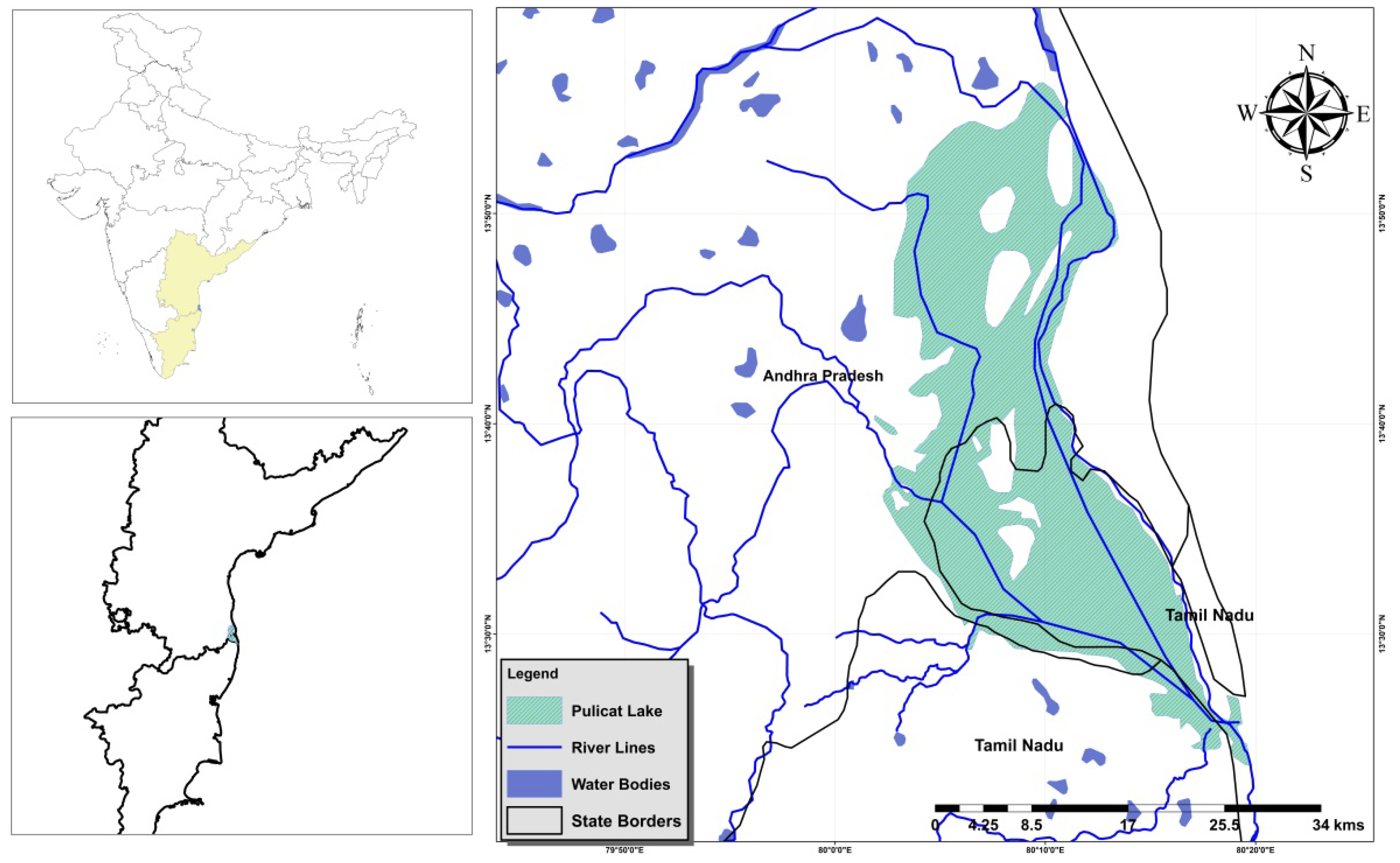

Table 1.
Recommended birdwatching package list of resident waterbirds of Pulicat Lake and its adjoins.
Table 1.
Recommended birdwatching package list of resident waterbirds of Pulicat Lake and its adjoins.
| S. No. | English Name | Species Name | Order | Family | Status in Pulicat | Seasonality | |||||||||||
|---|---|---|---|---|---|---|---|---|---|---|---|---|---|---|---|---|---|
| January | February | March | April | May | June | July | August | September | October | November | December | ||||||
| Winter | Summer | SWM | NEM | ||||||||||||||
| 1. | LITTLE GREBE | Tachybaptus ruficollis | Podicipidiformes | Podicipediade | R | • | • | • | • | • | |||||||
| 2. | SPOT-BILLED PELICAN | Pelecanus philippensis | Pelecaniformes | Pelecanidae | R | • | • | • | • | • | • | • | • | • | • | • | • |
| 3. | LITTLE CORMORANT | Phalacrocorax niger | Pelecaniformes | Phalacrocoracidae | R | • | • | • | • | • | • | • | • | • | • | • | • |
| 4. | INDIAN SHAG | Phalacrocorax fuscicollis | Pelecaniformes | Phalacrocoracidae | R | • | |||||||||||
| 5. | LITTLE EGRET | Egretta garzetta | Ciconiformes | Ardeidae | R | • | • | • | • | • | • | • | • | • | • | • | • |
| 6. | GREAT EGRET | Egretta alba | Ciconiformes | Ardeidae | R | • | • | • | • | • | • | • | • | • | • | • | • |
| 7. | INTERMEDIATE EGRET | Egretta intermedia | Ciconiformes | Ardeidae | R | • | • | ||||||||||
| 8. | GREY HERON | Ardea cinerea | Ciconiformes | Ardeidae | R | • | • | • | • | • | • | • | • | • | • | • | • |
| 9. | PURPLE HERON | Ardea purpurea | Ciconiformes | Ardeidae | R | • | • | • | • | • | • | • | • | • | • | • | • |
| 10. | EASTERN CATTLE EGRET | Bubulcus coromadus | Ciconiformes | Ardeidae | R | • | • | ||||||||||
| 11. | INDIAN POND-HERON | Ardeola grayii | Ciconiformes | Ardeidae | R | • | • | • | • | • | • | • | • | • | • | • | • |
| 12. | STRIATED HERON | Butorides striata | Ciconiformes | Ardeidae | R | • | • | • | • | ||||||||
| 13. | BLACK-CROWNED NIGHT-HERON | Nycticorax nycticorax | Ciconiformes | Ardeidae | R | • | • | • | • | • | • | • | • | • | • | • | • |
| 14. | YELLOW BITTERN | Ixobrychus sinensis | Ciconiformes | Ardeidae | R | • | • | ||||||||||
| 15. | CHESTNUT BITTERN | Ixobrychus cinnamomeus | Ciconiformes | Ardeidae | R | • | • | • | |||||||||
| 16. | BLACK BITTERN | Ixobrychus flavicollis | Ciconiformes | Ardeidae | R | • | • | ||||||||||
| 17. | PAINTED STORK | Mycteria leucocephala | Ciconiformes | Ciconidae | R | • | • | • | • | • | • | • | • | • | • | • | • |
| 18. | ASIAN OPENBILL | Anastomus oscitans | Ciconiformes | Ciconidae | R | • | • | • | • | • | • | • | • | ||||
| 19. | BLACK-HEADED IBIS | Threskiornis melanocephalus | Ciconiformes | Threskiornidae | R | • | • | • | • | ||||||||
| 20. | LESSER WHISTLING-DUCK | Dendrocygna javanica | Anseriformes | Anatidae | R | • | • | ||||||||||
| 21. | COTTON TEAL | Nettapus coromandelianus | Anseriformes | Anatidae | R | • | • | ||||||||||
| 22. | INDIAN SPOT-BILLED DUCK | Anas poecilorhyncha | Anseriformes | Anatidae | R | • | • | ||||||||||
| 23. | SLATY-BREASTED RAIL | Gallirallus striatus | Gruiformes | Rallidae | R | • | • | • | • | • | • | ||||||
| 24. | WHITE-BREASTED WATERHEN | Amaurornis phoenicurus | Gruiformes | Rallidae | R | • | • | • | • | • | • | • | • | • | |||
| 25. | COMMON MOORHEN | Gallinula chloropus | Gruiformes | Rallidae | R | • | • | • | • | • | • | • | • | ||||
| 26. | COMMON KINGFISHER | Alcedo atthis | Coraciiformes | Alcedinidae | R | • | • | • | • | • | • | • | • | • | • | • | • |
| 27. | WHITE-BREASTED KINGFISHER | Halcyon smyrnensis | Coraciiformes | Alcedinidae | R | • | • | • | • | • | • | • | • | • | • | • | • |
| 28. | LESSER PIED KINGFISHER | Ceryle rudis | Coraciiformes | Alcedinidae | R | • | • | • | • | • | • | • | • | • | • | • | • |
R = Resident; SWM = South-west monsoon; NEM = North-east monsoon; • = possible sighting occurs.
Table 2.
Recommended birdwatching package list of migrant waterbirds of Pulicat Lake and its adjoins.
Table 2.
Recommended birdwatching package list of migrant waterbirds of Pulicat Lake and its adjoins.
| S. No. | English Name | Species Name | Order | Family | Status in Pulicat | Seasonality | |||||||||||
|---|---|---|---|---|---|---|---|---|---|---|---|---|---|---|---|---|---|
| January | February | March | April | May | June | July | August | September | October | November | December | ||||||
| Winter | Summer | SWM | NEM | ||||||||||||||
| 1. | LARGE CORMORANT | Phalacrocorax carbo | Pelecaniformes | Phalacrocoracidae | VAG | • | |||||||||||
| 2. | ORIENTAL DARTER | Anhinga melanogaster | Pelecaniformes | Phalacrocoracidae | SM | • | • | • | • | • | |||||||
| 3. | LESSER FRIGATEBIRD | Fregata ariel | Pelecaniformes | Fregatidae | VAG | • | |||||||||||
| 4. | WESTERN REEF-HERON | Egretta gularis | Ciconiformes | Ardeidae | SM | • | |||||||||||
| 5. | EURASIAN BITTERN | Botaurus stellaris | Ciconiformes | Ardeidae | WM | • | |||||||||||
| 6. | WOOLLY-NECKED STORK | Ciconia episcopus | Ciconiformes | Ciconidae | WM | • | • | ||||||||||
| 7. | WHITE STORK | Ciconia ciconia | Ciconiformes | Ciconidae | VAG | • | |||||||||||
| 8. | GLOSSY IBIS | Plegadis falcinellus | Ciconiformes | Threskiornidae | SM | • | • | • | |||||||||
| 9. | INDIAN BLACK IBIS | Pseudibis papillosa | Ciconiformes | Threskiornidae | VAG | • | • | ||||||||||
| 10. | EURASIAN SPOONBILL | Platalea leucorodia | Ciconiformes | Threskiornidae | SM | • | • | • | |||||||||
| 11. | GREATER FLAMINGO | Phoenicopterus ruber | Ciconiformes | Phoenicopteridae | SM | • | • | • | • | • | • | • | • | • | • | • | • |
| 12. | LESSER FLAMINGO | Phoeniconaias minor | Ciconiformes | Phoenicopteridae | SM | • | • | • | • | ||||||||
| 13. | BAR-HEADED GOOSE | Anser indicus | Anseriformes | Anatidae | WM | • | • | ||||||||||
| 14. | RUDDY SHELDUCK | Tadorna ferruginea | Anseriformes | Anatidae | WM | • | |||||||||||
| 15. | COMB DUCK | Sarkidiornis melanotos | Anseriformes | Anatidae | WM | • | |||||||||||
| 16. | GADWALL | Anas strepera | Anseriformes | Anatidae | WM | • | |||||||||||
| 17. | EURASIAN WIGEON | Anas penelope | Anseriformes | Anatidae | WM | • | • | • | |||||||||
| 18. | NORTHERN SHOVELER | Anas clypeata | Anseriformes | Anatidae | WM | • | |||||||||||
| 19. | NORTHERN PINTAIL | Anas acuta | Anseriformes | Anatidae | WM | • | • | ||||||||||
| 20. | GARGANEY | Anas querquedula | Anseriformes | Anatidae | WM | • | |||||||||||
| 21. | COMMON TEAL | Anas crecca | Anseriformes | Anatidae | WM | • | |||||||||||
| 22. | MARBLED TEAL | Marmaronetta angustirostris | Anseriformes | Anatidae | VAG | • | |||||||||||
| 23. | RED-CRESTED POCHARD | Rhodonessa rufina | Anseriformes | Anatidae | WM | • | • | ||||||||||
| 24. | COMMON POCHARD | Aythya ferina | Anseriformes | Anatidae | WM | • | |||||||||||
| 25. | TUFTED DUCK | Aythya fuligula | Anseriformes | Anatidae | WM | • | • | ||||||||||
| 26. | WATER RAIL | Rallus aquaticus | Gruiformes | Rallidae | VAG | • | |||||||||||
| 27. | RUDDY-BREASTED CRAKE | Porzana fusca | Gruiformes | Rallidae | SM | • | |||||||||||
| 28. | PURPLE SWAMPHEN | Porphyrio porphyrio | Gruiformes | Rallidae | SM | • | • | • | |||||||||
| 29. | EURASIAN COOT | Fulica atra | Gruiformes | Rallidae | SM | • | |||||||||||
| 30. | BLACK-CAPPED KINGFISHER | Halcyon pileata | Coraciiformes | Alcedinidae | SM | • | |||||||||||
SM = Seasonal Migrant; VAG = Vagrant; WM = Winter Migrant; SWM = South-west monsoon; NEM = North-east monsoon; • = possible sighting occurs.
Table 3.
Recommended birdwatching package list of shorebirds and seabirds in Pulicat Lake and its adjoins.
Table 3.
Recommended birdwatching package list of shorebirds and seabirds in Pulicat Lake and its adjoins.
| S. No. | English Name | Species Name | Order | Family | Status in Pulicat | Seasonality | |||||||||||
|---|---|---|---|---|---|---|---|---|---|---|---|---|---|---|---|---|---|
| January | February | March | April | May | June | July | August | September | October | November | December | ||||||
| Winter | Summer | SWM | NEM | ||||||||||||||
| 1. | PHEASANT-TAILED JACANA | Hydrophasianus chirurgus | Charadriiformes | Jacanidae | SM | • | • | • | • | ||||||||
| 2. | PAINTED SNIPE | Rostratula benghalensis | Charadriiformes | Rostratulidae | WM | • | |||||||||||
| 3. | PACIFIC GOLDEN PLOVER | Pluvialis fulva | Charadriiformes | Charadriidae | WM | • | • | • | • | • | • | • | • | • | |||
| 4. | GREY PLOVER | Pluvialis squatarola | Charadriiformes | Charadriidae | WM | • | • | • | • | • | |||||||
| 5. | COMMON RINGED PLOVER | Charadrius hiaticula | Charadriiformes | Charadriidae | WM | • | • | ||||||||||
| 6. | LITTLE RINGED PLOVER | Charadrius dubius | Charadriiformes | Charadriidae | SM | • | • | • | • | • | • | • | • | • | • | • | • |
| 7. | KENTISH PLOVER | Charadrius alexandrinus | Charadriiformes | Charadriidae | SM | • | • | • | • | • | • | • | • | • | • | • | • |
| 8. | LESSER SAND PLOVER | Charadrius mongolus | Charadriiformes | Charadriidae | WM | • | • | • | • | • | • | ||||||
| 9. | GREATER SAND PLOVER | Charadrius leschenaultii | Charadriiformes | Charadriidae | WM | • | • | ||||||||||
| 10. | YELLOW-WATTLED LAPWING | Vanellus malabaricus | Charadriiformes | Charadriidae | SM | • | • | • | • | ||||||||
| 11. | RED-WATTLED LAPWING | Vanellus indicus | Charadriiformes | Charadriidae | R | • | • | • | • | • | • | • | • | • | • | • | • |
| 12. | PINTAIL SNIPE | Gallinago stenura | Charadriiformes | Scolopacidae | WM | • | • | • | |||||||||
| 13. | COMMON SNIPE | Gallinago gallinago | Charadriiformes | Scolopacidae | WM | • | • | • | • | • | • | • | |||||
| 14. | JACK SNIPE | Lymnocryptes minimus | Charadriiformes | Scolopacidae | WM | • | • | ||||||||||
| 15. | BLACK-TAILED GODWIT | Limosa limosa | Charadriiformes | Charadriidae | WM | • | • | • | • | • | • | • | • | • | • | • | |
| 16. | WHIMBREL | Numenius phaeopus | Charadriiformes | Charadriidae | WM | • | • | • | • | ||||||||
| 17. | EURASIAN CURLEW | Numenius arquata | Charadriiformes | Charadriidae | WM | • | • | • | • | • | • | • | • | • | • | • | • |
| 18. | SPOTTED REDSHANK | Tringa erythropus | Charadriiformes | Charadriidae | WM | • | • | • | • | ||||||||
| 19. | COMMON REDSHANK | Tringa totanus | Charadriiformes | Charadriidae | WM | • | • | • | • | • | • | • | • | • | • | • | • |
| 20. | COMMON GREENSHANK | Tringa nebularia | Charadriiformes | Charadriidae | WM | • | • | • | • | • | • | • | • | • | • | • | • |
| 21. | MARSH SANDPIPER | Tringa stagnatilis | Charadriiformes | Charadriidae | WM | • | • | • | • | • | • | • | • | • | • | ||
| 22. | GREEN SANDPIPER | Tringa ochropus | Charadriiformes | Charadriidae | WM | • | • | . | |||||||||
| 23. | WOOD SANDPIPER | Tringa glareola | Charadriiformes | Charadriidae | WM | • | • | • | • | • | • | • | • | • | |||
| 24. | TEREK SANDPIPER | Xenus cinereus | Charadriiformes | Charadriidae | WM | • | |||||||||||
| 25. | COMMON SANDPIPER | Actitis hypoleucos | Charadriiformes | Charadriidae | WM | • | • | • | • | • | • | • | • | • | • | • | |
| 26. | RUDDY TURNSTONE | Arenaria interpres | Charadriiformes | Charadriidae | WM | • | |||||||||||
| 27. | GREAT KNOT | Calidris tenuirostris | Charadriiformes | Charadriidae | WM | • | |||||||||||
| 28. | RED KNOT | Calidris canutus | Charadriiformes | Charadriidae | WM | • | |||||||||||
| 29. | LITTLE STINT | Calidris minuta | Charadriiformes | Charadriidae | WM | • | • | • | • | • | • | • | • | • | • | ||
| 30. | LONG-TOED STINT | Calidris subminuta | Charadriiformes | Charadriidae | WM | • | • | • | • | • | • | • | • | • | • | • | • |
| 31. | TEMMINCK’S STINT | Calidris temminckii | Charadriiformes | Charadriidae | WM | • | • | • | • | • | • | • | • | ||||
| 32. | DUNLIN | Calidris alpina | Charadriiformes | Charadriidae | WM | • | |||||||||||
| 33. | CURLEW SANDPIPER | Calidris ferruginea | Charadriiformes | Charadriidae | WM | • | • | • | |||||||||
| 34. | RUFF | Philomachus pugnax | Charadriiformes | Charadriidae | WM | • | • | • | • | • | • | • | • | • | • | ||
| 35. | BLACK-WINGED STILT | Himantopus himantopus | Charadriiformes | Recurvirostridae | WM | • | • | • | • | • | • | • | • | • | • | ||
| 36. | PIED AVOCET | Recurvirostra avosetta | Charadriiformes | Recurvirostridae | WM | • | - | • | • | • | • | • | • | ||||
| 37. | RED-NECKED PHALAROPE | Phalaropus lobatus | Charadriiformes | Phalaropinae | WM | • | • | ||||||||||
| 38. | EURASIAN THICK-KNEE | Burhinus oedicnemus | Charadriiformes | Burhinidae | R | • | • | • | • | ||||||||
| 39. | ORIENTAL PRATINCOLE | Glareola maldiivarum | Charadriiformes | Glareolidae | SM | • | • | • | |||||||||
| 40. | SMALL PRATINCOLE | Glareola lactea | Charadriiformes | Glareolidae | SM | • | |||||||||||
| 41. | HEUGLIN’S GULL | Larus heuglini | Charadriiformes | Laridae | WM | • | • | ||||||||||
| 42. | GREAT BLACK-HEADED GULL | Larus ichthyaetus | Charadriiformes | Laridae | WM | • | • | • | |||||||||
| 43. | BROWN-HEADED GULL | Larus brunnicephalus | Charadriiformes | Laridae | WM | • | • | • | • | ||||||||
| 44. | BLACK-HEADED GULL | Larus ridibundus | Charadriiformes | Laridae | WM | • | • | • | • | ||||||||
| 45. | GULL-BILLED TERN | Gelochelidon nilotica | Charadriiformes | Sternidae | WM | • | • | • | • | • | • | • | • | ||||
| 46. | CASPIAN TERN | Sterna caspia | Charadriiformes | Sternidae | WM | • | • | • | • | • | • | • | • | • | |||
| 47. | COMMON TERN | Sterna hirundo | Charadriiformes | Sternidae | WM | • | • | • | • | • | • | • | • | ||||
| 48. | LITTLE TERN | Sterna albifrons | Charadriiformes | Sternidae | WM | • | |||||||||||
| 49. | BLACK-BELLIED TERN | Sterna acuticauda | Charadriiformes | Sternidae | WM | • | • | ||||||||||
| 50. | BLACK TERN | Chlidonias niger | Charadriiformes | Sternidae | VAG | • | • | ||||||||||
| 51. | WHITE-WINGED TERN | Chlidonias leucopterus | Charadriiformes | Sternidae | WM | • | • | • | |||||||||
| 52. | WHISKERED TERN | Chlidonias hybridus | Charadriiformes | Sternidae | WM | • | • | ||||||||||
R – Resident; SM – Seasonal Migrant; WM – Winter Migrant; VAG – Vagrant; SWM = South-west monsoon; NEM = North-east monsoon; • = possible sightings occurs .
Table 4.
Recommended birdwatching package list of resident land and forest birds of Pulicat Lake and its adjoins.
Table 4.
Recommended birdwatching package list of resident land and forest birds of Pulicat Lake and its adjoins.
| S. No. | English Name | Scientific Name | Order | Family | Status in Pulicat | Seasonality | |||||||||||
|---|---|---|---|---|---|---|---|---|---|---|---|---|---|---|---|---|---|
| January | February | March | April | May | June | July | August | September | October | November | December | ||||||
| Winter | Summer | SWM | NEM | ||||||||||||||
| 1. | GREY FRANCOLIN | Francolinus pondicerianus | Galliformes | Phasianidae | R | • | • | • | • | • | • | • | • | • | |||
| 2. | RED SPURFOWL | Galloperdix spadicea | Galliformes | Phasianidae | R | • | • | • | • | • | |||||||
| 3. | GREY JUNGLEFOWL | Gallus sonneratti | Galliformes | Phasianidae | R | • | • | • | • | • | • | • | • | • | • | • | • |
| 4. | YELLOW-LEGGED BUTTONQUAIL | Turnix tanki | Gruiformes | Turnicidae | R | • | • | • | • | • | • | • | • | • | • | • | • |
| 5. | BARRED BUTTONQUAIL | Turnix suscitator | Gruiformes | Turnicidae | R | • | • | • | • | • | |||||||
| 6. | INDIAN STONE-CURLEW | Burhinus indicus | Charadriiformes | Burhinidae | R | • | • | • | • | • | • | • | • | • | • | • | • |
| 7. | ROCK DOVE | Columbia livia | Columbiformes | Columbidae | R | • | • | • | • | • | • | • | • | • | • | • | • |
| 8. | LAUGHING DOVE | Streptopelia senegalensis | Columbiformes | Columbidae | R | • | • | • | • | • | • | • | • | • | • | • | • |
| 9. | SPOTTED DOVE | Streptopelia chinensis | Columbiformes | Columbidae | R | • | • | • | • | • | • | • | • | • | • | • | • |
| 10. | ROSE-RINGED PARAKEET | Psittacula krameri | Psittaciformes | Psittacidae | R | • | • | • | • | • | • | • | • | • | • | • | • |
| 11. | SOUTHERN COUCAL | Centropus sinensis | Cuculiformes | Cuculidae | R | • | • | • | • | • | • | • | • | • | • | • | • |
| 12. | PLAINTIVE CUCKOO | Cacomantis merulinus | Cuculiformes | Cuculidae | R | • | • | • | • | • | • | • | • | ||||
| 13. | COMMON HAWK CUCKOO | Heirococcyx varius | Cuculiformes | Cuculidae | R | • | • | • | • | • | • | • | |||||
| 14. | INDIAN JUNGLE NIGHTJAR | Caprimulgus indicus | Caprimulgiformes | Caprimulgidae | R | • | • | • | • | ||||||||
| 15. | INDIAN LITTLE NIGHTJAR | Caprimulgus asiaticus | Caprimulgiformes | Caprimulgidae | R | • | • | • | • | ||||||||
| 16. | ASIAN PALM SWIFT | Cypsiurus balasiensis | Apodiformes | Apodidae | R | • | • | • | • | • | • | • | • | • | • | • | • |
| 17. | LITTLE SWIFT | Apus affinis | Apodiformes | Apodidae | R | • | • | • | • | • | • | • | • | • | • | • | • |
| 18. | LITTLE GREEN BEE-EATER | Merops orientalis | Coraciiformes | Meropidae | R | • | • | • | • | • | • | • | • | • | • | • | • |
| 19. | INDIAN ROLLER | Coracias benghalensis | Coraciiformes | Coracidae | R | • | • | • | • | • | • | • | • | • | • | • | • |
| 20. | COMMON HOOPOE | Upupa epops | Coraciiformes | Upupidae | R | • | • | • | • | • | • | • | • | ||||
| 21. | JERDON’S BUSH LARK | Mirafra affinis | Passeriformes | Alaudidae | R | • | • | • | • | • | • | • | • | • | • | • | • |
| 22. | ASHY-CROWNED FINCH-LARK | Eremopterix griseus | Passeriformes | Alaudidae | R | • | • | • | • | • | • | • | • | • | • | • | • |
| 23. | ORIENTAL SKYLARK | Alauda gulgula | Passeriformes | Alaudidae | R | • | • | • | • | • | • | • | • | • | • | • | • |
| 24. | PADDYFIELD PIPIT | Anthus rufulus | Passeriformes | Motacillidae | R | • | • | • | • | • | • | • | • | • | • | • | • |
| 25. | COMMON WOOD SHRIKE | Tephrodornis pondicerianus | Passeriformes | Prionopidae | R | • | • | • | • | • | • | • | • | ||||
| 26. | RED-WHISKERED BULBUL | Pycnonotus jocosus | Passeriformes | Pycnonotidae | R | • | • | ||||||||||
| 27. | RED-VENTED BULBUL | Pycnonotus cafer | Passeriformes | Pycnonotidae | R | • | • | • | • | • | • | • | • | • | • | • | • |
| 28. | COMMON IORA | Aegithina tiphia | Passeriformes | Aegithinidae | R | • | • | • | |||||||||
| 30. | CHESTNUT-SHOULDERED PETRONIA | Petronia xanthocollis | Passeriformes | Passeridae | R | • | • | ||||||||||
| 31. | INDIAN ROBIN | Saxicoloides fulicata | Passeriformes | Muscicapidae | R | • | • | • | • | • | • | ||||||
| 32. | ORIENTAL MAGPIE ROBIN | Copsychus saularis | Passeriformes | Muscicapidae | R | • | • | • | |||||||||
| 33. | WHITE-RUMPED SHAMA | Copsychus malabaricus | Passeriformes | Muscicapidae | R | • | • | • | • | • | |||||||
| 34. | YELLOW-BILLED BABBLER | Turdoides affinis | Passeriformes | Timallidae | R | • | • | • | |||||||||
| 35. | ZITTING CISTICOLA | Cisticola juncidis | Passeriformes | Cisticolidae | R | • | • | • | • | ||||||||
| 36. | GREY-BREASTED PRINIA | Prinia hodgsonii | Passeriformes | Cisticolidae | R | • | • | • | |||||||||
| 37. | ASHY PRINIA | Prinia socialis | Passeriformes | Cisticolidae | R | • | • | • | • | ||||||||
| 38. | PLAIN PRINIA | Prinia inornata | Passeriformes | Cisticolidae | R | • | • | • | |||||||||
| 39. | COMMON TAILORBIRD | Orthotomus sutorius | Passeriformes | Cisticolidae | R | • | • | • | • | • | |||||||
| 40. | PALE-BILLED FLOWERPECKER | Dicaeum erythrorhynchos | Passeriformes | Dicaeidae | R | • | • | • | • | • | • | ||||||
| 41. | PURPLE-RUMPED SUNBIRD | Nectarinia zeylonica | Passeriformes | Nectariniidae | R | • | • | • | • | • | |||||||
| 42. | PURPLE SUNBIRD | Nectarinia asiatica | Passeriformes | Nectariniidae | R | • | • | • | • | • | |||||||
| 43. | LOTEN’S SUNBIRD | Nectarinia lotenia | Passeriformes | Nectariniidae | R | • | • | • | • | • | • | • | • | • | |||
| 44. | INDIAN SILVERBILL | Lonchura malabarica | Passeriformes | Nectariniidae | R | • | • | • | • | • | • | • | • | • | |||
| 45. | WHITE-RUMPED MUNIA | Lonchura striata | Passeriformes | Estrildidae | R | • | • | • | • | • | • | • | • | • | |||
| 46. | BLACK-HEADED MUNIA | Lonchura malacca | Passeriformes | Estrildidae | R | • | • | • | • | • | • | • | • | • | |||
| 47. | HOUSE SPARROW | Passer domesticus | Passeriformes | Passeridae | R | • | • | • | • | • | • | • | • | • | • | • | • |
| 48. | BAYA WEAVER | Ploceus philippinus | Passeriformes | Ploceidae | R | • | • | • | |||||||||
| 49. | COMMON MYNA | Acridotheres tristis | Passeriformes | Sturnidae | R | • | • | • | • | • | • | • | • | • | • | • | • |
| 50. | BLACK DRONGO | Dicrurus macrocerus | Passeriformes | Dicruridae | R | • | • | • | • | • | • | • | • | • | • | • | • |
| 51. | ASHY WOODSWALLOW | Artamus fuscus | Passeriformes | Artamidae | R | • | • | • | |||||||||
| 52. | HOUSE CROW | Corvus splendens | Passeriformes | Corvidae | R | • | • | • | • | • | • | • | • | • | • | • | • |
| 53. | INDIAN JUNGLE CROW | Corvus macrorhynchos | Passeriformes | Corvidae | R | • | • | • | • | • | • | • | • | • | • | • | • |
R = Resident; SWM = South-west monsoon; NEM = North-east monsoon; • = possible sighting occurs.
Table 5.
Recommended birdwatching package list of migrant land and forest birds of Pulicat Lake and its adjoins.
Table 5.
Recommended birdwatching package list of migrant land and forest birds of Pulicat Lake and its adjoins.
| S. No. | English Name | Scientific Name | Order | Family | Status in Pulicat | Seasonality | |||||||||||
|---|---|---|---|---|---|---|---|---|---|---|---|---|---|---|---|---|---|
| January | February | March | April | May | June | July | August | September | October | November | December | ||||||
| Winter | Summer | SWM | NEM | ||||||||||||||
| 1 | BLUE-BREASTED QUAIL | Coturnix chinensis | Galliformes | Phasianidae | SM | • | |||||||||||
| 2 | LESSER FLORICAN | Sypheotides indica | Gruiformes | Otidae | SM | Not seen from 2000 to 2016 | |||||||||||
| 3 | ORIENTAL TURTLE DOVE | Streptopelia orinetalis | Columbiformes | Columbidae | SM | • | |||||||||||
| 4 | RED COLLARED DOVE | Streptopelia tranquebarica | Columbiformes | Columbidae | SM | • | • | ||||||||||
| 5 | ORANGE-BREASTED GREEN PEGION | Treron bicincta | Columbiformes | Columbidae | SM | • | • | • | |||||||||
| 6 | PLUM-HEADED PARAKEET | Psittacula cyanocephala | Psittaciformes | Psittacidae | SM | • | |||||||||||
| 7 | BLUE-FACED MALKOHA | Phaenicophaeus viridirostris | Cuculiformes | Cuculidae | SM | • | • | ||||||||||
| 8 | CHESTNUT-WINGED CUCKOO | Clamator coromandus | Cuculiformes | Cuculidae | WM | • | • | • | • | • | |||||||
| 9 | PIED CUCKOO | Clamator jacobinus | Cuculiformes | Cuculidae | SM | • | |||||||||||
| 10 | KOEL | Eudynamys scolopacea | Cuculiformes | Cuculidae | SM | • | • | • | • | ||||||||
| 11 | GREY-BELLIED CUCKOO | Cacomantis passerinus | Cuculiformes | Cuculidae | SM | • | • | • | • | ||||||||
| 12 | DRONGO CUCKOO | Surniculus lugubris | Cuculiformes | Cuculidae | SM | • | |||||||||||
| 13 | SMALL CUCKOO | Cuculus poliocephalus | Cuculiformes | Cuculidae | WM | • | • | ||||||||||
| 14 | SAVANNA NIGHTJAR | Caprimulgus affinis | Passeriformes | Caprimulgidae | WM | • | |||||||||||
| 15 | BLUE-TAILED BEE-EATER | Merops philippinus | Coraciiformes | Meropidae | WM | • | • | • | • | • | • | ||||||
| 16 | COPPERSMITH BARBET | Megalaima haemacephala | Piciformes | Capitonidae | SM | • | |||||||||||
| 17 | BLACK-RUMPED FLAMEBACK | Dinopium benghalense | Passeriformes | Picidae | SM | • | • | • | |||||||||
| 18 | INDIAN PITTA | Pitta brachyura | Passeriformes | Pittidae | SM | • | • | ||||||||||
| 19 | BARN SWALLOW | Hirundo rustica | Passeriformes | Hirundinidae | WM | • | • | • | • | • | • | • | • | • | |||
| 20 | RED-RUMPED SWALLOW | Hirundo daurica | Passeriformes | Hirundinidae | WM | • | • | ||||||||||
| 21 | WIRE-TAILED SWALLOW | Hirundo smithii | Passeriformes | Hirundinidae | SM | • | • | ||||||||||
| 22 | FOREST WAGTAIL | Dendronanthus indicus | Passeriformes | Motacillidae | WM | • | • | • | • | • | • | • | • | ||||
| 23 | WHITE WAGTAIL | Motacilla alba | Passeriformes | Motacillidae | WM | • | • | ||||||||||
| 24 | WHITE-BROWED WAGTAIL | Motacilla maderaspatansis | Passeriformes | Motacillidae | WM | • | |||||||||||
| 25 | WESTERN YELLOW WAGTAIL | Motacilla flava | Passeriformes | Motacillidae | WM | • | • | ||||||||||
| 26 | GREY WAGTAIL | Motacilla cinerea | Passeriformes | Motacillidae | WM | • | • | ||||||||||
| 27 | LARGE CUCKOO SHRIKE | Coracina macei | Passeriformes | Campephagidae | WM | • | |||||||||||
| 28 | BLACK-HEADED CUCKOO SHRIKE | Coracina melanoptera | Passeriformes | Campephagidae | WM | • | • | ||||||||||
| 29 | ASHY MINIVET | Pericrocotus divaricatus | Passeriformes | Campephagidae | WM | • | |||||||||||
| 30 | SMALL MINIVET | Pericrocotus cinnamomeus | Passeriformes | Campephagidae | VAG | • | |||||||||||
| 31 | ASIAN PARADISE FLYCATCHER | Terpsiphone paradisi | Passeriformes | Monarchidae | SM | • | • | ||||||||||
| 32 | BLACK-NAPED MONARCH | Hypothymis azurea | Passeriformes | Monarchidae | SM | • | |||||||||||
| 33 | WHITE-BROWED FANTAIL | Rhipidura aureola | Passeriformes | Rhipiduridae | SM | • | • | ||||||||||
| 34 | WHITE-BROWED BULBUL | Pyconotus lutelus | Passeriformes | Pycnonotidae | SM | • | • | • | • | ||||||||
| 35 | BROWN SHRIKE | Lanius cristatus | Passeriformes | Laniidae | WM | • | • | • | |||||||||
| 36 | BAY-BACKED SHRIKE | Lanius vitatus | Passeriformes | Laniidae | WM | • | • | ||||||||||
| 37 | LONG-TAILED SHRIKE | Lanius schach | Passeriformes | Laniidae | WM | • | • | • | |||||||||
| 38 | ORANGE-HEADED THRUSH | Zoothera citrina | Passeriformes | Turdidae | WM | • | • | ||||||||||
| 39 | ASIAN BROWN FLYCATCHER | Muscicapa latirostris | Passeriformes | Muscicapidae | SM | • | • | ||||||||||
| 40 | BROWN-BREASTED FLYCATCHER | Muscicapa muttui | Passeriformes | Muscicapidae | SM | • | |||||||||||
| 41 | RED-THROATED FLYCATCHER | Ficedula parva | Passeriformes | Muscicapidae | SM | • | • | ||||||||||
| 42 | BLUE-THROATED FLYCATCHER | Cyornis rubeculoides | Passeriformes | Muscicapidae | WM | • | • | • | • | • | • | • | • | ||||
| 43 | TICKELL’S BLUE FLYCATCHER | Cyornis tickelliae | Passeriformes | Muscicapidae | SM | • | • | ||||||||||
| 44 | INDIAN BLUE ROBIN | Luscinia brunnea | Passeriformes | Muscicapidae | WM | • | • | • | |||||||||
| 45 | YELLOW-EYED BABBLER | Chrysomma sinense | Passeriformes | Timallidae | SM | • | • | ||||||||||
| 46 | BLYTH’S REED-WARBLER | Acrocephalus dumetorum | Passeriformes | Sylviidae | WM | • | • | ||||||||||
| 47 | THICK-BILLED WARBLER | Acrocephalus aedon | Passeriformes | Sylviidae | WM | • | • | • | • | ||||||||
| 48 | GREENISH WARBLER | Phylloscopus trochiloides | Passeriformes | Sylviidae | WM | • | • | • | • | • | • | • | • | ||||
| 49 | LARGE-BILLED LEAF WARBLER | Phylloscopus magnirostris | Passeriformes | Sylviidae | WM | • | |||||||||||
| 50 | LESSER WHITETHROAT | Sylvia curruca | Passeriformes | Sylviidae | WM | • | • | ||||||||||
| 51 | ORIENTAL WHITE-EYE | Zosterops palebrosus | Passeriformes | Zosteropidae | SM | • | • | ||||||||||
| 52 | BRAHMINY STARLING | Temenuchus pagodarum | Passeriformes | Sturnidae | SM | • | |||||||||||
| 53 | ROSY STARLING | Sturnus roseus | Passeriformes | Sturnidae | WM | • | • | ||||||||||
| 54 | COMMON STARLING | Sturnus vulgaris | Passeriformes | Sturnidae | WM | • | |||||||||||
| 55 | EURASIAN GOLDEN ORIOLE | Oriolus oriolus | Passeriformes | Oriolidae | SM | • | • | ||||||||||
| 56 | ASHY DRONGO | Dicrurus leucophaeus | Passeriformes | Dicruridae | SM | • | • | ||||||||||
| 57 | WHITE-BELLIED DRONGO | Dicrurus caerulescens | Passeriformes | Dicruridae | SM | • | |||||||||||
| 58 | BRONZED DRONGO | Dicrurus aeneus | Passeriformes | Dicruridae | SM | • | |||||||||||
| 59 | SPANGLED DRONGO | Dicrurus hottentottus | Passeriformes | Dicruridae | SM | • | |||||||||||
| 60 | RUFOUS TREEPIE | Dendrocitta vagabunda | Passeriformes | Artamidae | SM | • | • | • | |||||||||
SM = seasonal migrant; WM = winter migrant; VAG = Vagrant; • = possible sighting occurs.
Table 6.
Recommended birdwatching package list of birds of prey of Pulicat Lake and its adjoins.
| S. No. | English Name | Species Name | Order | Family | Status in Pulicat | Seasonality | |||||||||||
|---|---|---|---|---|---|---|---|---|---|---|---|---|---|---|---|---|---|
| January | February | March | April | May | June | July | August | September | October | November | December | ||||||
| Winter | Summer | SWM | NEM | ||||||||||||||
| 1. | BLACK BAZA | Aviceda leuphotes | Falconiformes | Accipitridae | WM | • | • | ||||||||||
| 2 | ORIENTAL HONEY-BUZZARD | Pernis ptilorhyncus | Falconiformes | Accipitridae | VAG | • | |||||||||||
| 3 | BACK-WINGED KITE | Elanus caeruleus | Falconiformes | Accipitridae | R | • | |||||||||||
| 4. | BLACK KITE | Milvus migrans | Falconiformes | Accipitridae | R | • | |||||||||||
| 5. | BRAHMINY KITE | Haliastur indus | Falconiformes | Accipitridae | R | • | • | • | • | • | • | • | • | ||||
| 6. | WHITE-BELLIED SEA-EAGLE | Haliaeetus leucogaster | Falconiformes | Accipitridae | R | • | • | • | • | • | • | • | • | • | • | • | • |
| 7. | WHITE-RUMPED VULTURE | Gyps bengalensis | Falconiformes | Accipitridae | SV | • | • | • | • | ||||||||
| 8. | INDIAN VULTURE | Gyps indicus | Falconiformes | Accipitridae | SV | • | |||||||||||
| 9. | SHORT-TOED EAGLE | Circaetus gallicus | Falconiformes | Accipitridae | R | • | |||||||||||
| 10. | CRESTED SERPENT-EAGLE | Spilornis cheela | Falconiformes | Accipitridae | R | • | • | • | |||||||||
| 11. | MARSH HARRIER | Circus aeruginosus | Falconiformes | Accipitridae | WM | • | • | • | |||||||||
| 12. | PALLID HARRIER | Circus macrourus | Falconiformes | Accipitridae | WM | • | • | ||||||||||
| 13. | PIED HARRIER | Circus melanoleucos | Falconiformes | Accipitridae | WM | • | • | ||||||||||
| 14. | MONTAGU'S HARRIER | Circus pygargus | Falconiformes | Accipitridae | WM | • | • | ||||||||||
| 15. | INDIAN SHIKRA | Accipiter badius | Falconiformes | Accipitridae | R | • | • | ||||||||||
| 16. | BESRA SPARROWHAWK | Accipiter virgatus | Falconiformes | Accipitridae | WM | • | |||||||||||
| 17. | WHITE-EYED BUZZARD | Butastur teesa | Falconiformes | Accipitridae | R | • | • | • | |||||||||
| 18. | GREATER SPOTTED EAGLE | Aquila clanga | Falconiformes | Accipitridae | SM | • | • | ||||||||||
| 19. | BOOTED EAGLE | Hieraaetus pennatus | Falconiformes | Accipitridae | SM | No information exists on which month the species was sighted | |||||||||||
| 20. | OSPREY | Pandion haliaetus | Falconiformes | Pandionidae | WM | • | • | • | |||||||||
| 21. | COMMON KESTREL | Falco tinnunculus | Falconiformes | Falconidae | WM | • | • | ||||||||||
| 22. | AMUR FALCON | Falco amurensis | Falconiformes | Falconidae | WM | • | • | ||||||||||
| 23. | PEREGRINE FALCON | Flaco peregrinus | Falconiformes | Falconidae | WM | • | |||||||||||
| 24. | COMMON BARN-OWL | Tyto alba | Strigiformes | Tytonidae | R | • | • | • | • | • | • | • | • | • | • | • | • |
| 25. | INDIAN SCOPS-OWL | Otus bakkamoena | Strigiformes | Strigidae | R | No information exists on which month the species was sighted | |||||||||||
| 26. | INDIAN EAGLE-OWL | Bubo bengalensis | Strigiformes | Strigidae | R | • | • | • | • | • | • | • | • | • | • | • | • |
| 27. | BROWN FISH OWL | Ketupa zeylonensis | Strigiformes | Strigidae | R | No information exists on which month the species was sighted | |||||||||||
| 28. | MOTTLED WOOD OWL | Strix ocellata | Strigiformes | Strigidae | R | • | • | • | • | ||||||||
| 29. | SPOTTED OWLET | Athene brama | Strigiformes | Strigidae | R | • | • | • | • | • | • | • | • | • | • | • | • |
R – Resident; SM – Seasonal Migrant; SV – Seasonal Visitors; VAG – Vagrant; WM – Winter Migrant; SWM = South-west monsoon; NEM = North-east monsoon; • = possible sighting occurs.
Disclaimer/Publisher’s Note: The statements, opinions and data contained in all publications are solely those of the individual author(s) and contributor(s) and not of MDPI and/or the editor(s). MDPI and/or the editor(s) disclaim responsibility for any injury to people or property resulting from any ideas, methods, instructions or products referred to in the content. |
© 2024 by the authors. Licensee MDPI, Basel, Switzerland. This article is an open access article distributed under the terms and conditions of the Creative Commons Attribution (CC BY) license (http://creativecommons.org/licenses/by/4.0/).
Copyright: This open access article is published under a Creative Commons CC BY 4.0 license, which permit the free download, distribution, and reuse, provided that the author and preprint are cited in any reuse.