

Submitted:
30 May 2024
Posted:
31 May 2024
You are already at the latest version
Abstract
Heat waves represents a major concern for the tourism industry in the Mediterranean area. Therefore, it is necessary to deepen the study of the influence of high temperatures and their effects on tourist behavior. This research aims to develop a structural model that allows measuring how heat waves affect the behavior of external tourist demand in coastal destinations. The results are useful for the design by tourist destinations of adaptation measures to climate change. The proposed hypotheses have been contrasted using non-linear structural equations (SEM), estimated with data from the National Institute of Statistics on external demand in Spain. The results confirm lower tourist flows with the increase in high temperatures to the coasts of the Spanish Mediterranean area from traditional source markets, such as the United Kingdom. Furthermore, the tourist flow to the Balearic Islands decreases with high temperatures.
Keywords:
heat waves
; climate change
; tourists’ behavior
; tourist flows
; Structural Equation Modeling (SEM)
1. Introduction
The Mediterranean is one of the regions with the highest incidence of high-impact weather events (heat waves, droughts, floods and heavy precipitation) resulting from climate change [1].
In southern Europe, heat waves have increased both in the number of days of duration and average intensity [2], as has occurred in the summer of 2022 in Spain, Greece or Italy with record temperatures not seen since records have been kept [3]. Climate models predict an increase in this extreme climate phenomenon in the coming decades [4,5]. with warming for the Mediterranean area 20% faster than in the rest of the world [6].
This may lead to climate vulnerability in large coastal areas of Spain, which are oriented towards sun and beach tourism due to mild climatic conditions and significant socio-economic impacts. In Spain, the tourism sector's contribution to GDP reached 13.5% [7].
However, in this scenario, heat waves are beginning to influence tourists' future intentions as they consider not choosing certain areas of southern Europe as holiday destinations in favor of other less-hot places [8], choosing destinations that offer greater thermal comfort and the ability to engage in outdoor recreational activities without high temperatures [9]. In the case of periodic heat waves, this also leads to an adjustment in the length of stay [8]. Thus, high temperatures are already a determining factor for travel intentions, travel planning, and destination behavior of tourist demand.
As climate change becomes more evident, the influence of extreme weather events on the tourism sector has become a growing field of academic research, both from the supply and demand side [10,11,12]. Thus, there is still a need to expand knowledge on tourists' resilience to climatic conditions in visited tourism destinations and their behavioral responses.
With the aim of providing more knowledge on the influence of climate change on tourism demand for sun and beach, this paper proposes, estimates, and verifies through structural equation modeling (SEM), a nonlinear statistical model on the direct and moderating effect of heat waves on the behavioral response of external demand for sun and beach when configuring the trip.
This study proposes and verifies a model for two chronological periods, with and without heat waves, in July, the high summer season. The purpose is to determine whether variations in extreme weather conditions, such as heat waves, affect demand behavior differently within the same tourism system.
The empirical analysis has been estimated using data from the Statistics on Tourist Movements at Borders of the National Statistics Institute (NSI) on foreign tourist demand to Spain. The data from the four issuing countries with the highest tourist inflows to coastal areas in the summer season were used. The climatic series provided by the Weather Spanis State Agency (WSSA) were used to analyze heat waves.
Based on the protective motivation theory (PMT) orientation, enunciated by [13], and applied to tourism demand in other studies to explain individual motivations in response to hazards [14], those variables in the Statistics on Tourist Movements at Borders questionnaire that are considered to influence tourists' trip planning as a precautionary response to high temperatures, have been identified.
This study provides more information on the influence of heat waves on the behavioral decisions of international visitors as adaptation and prevention strategies to obtain greater climatic comfort in tourist destinations. Thus, the study results show decreased overnight stays or tourist flow to specific destinations during high temperatures.
Establishing crisis scenarios, such as extreme weather events associated with episodes of abnormally high temperatures and their effects on tourist behavior, will allow a more precise understanding of their tourist experience and future behavioral intentions (their loyalty to the destination). It also provides sun and beach destinations with information to carry out climate change adaptation measures aimed at their resilience and competitiveness [15].
After this introduction, in part 2 the conceptual foundations of the theoretical framework and hypotheses of the built model are presented, in part 3, methodology approach is described to present results in part 4. Discussion is done in part 5 and conclusions presented in part 6.
2. Conceptual Framework
Next, the conceptual foundations of the theoretical framework of the influence of climate change on the tourism sector are reviewed, specifically for sun and beach destinations. The different factors influencing the behavior of foreign tourists visiting Spain's coasts will also be addressed, focusing on the variables of the survey of tourist movements at the border (Statistics on Tourist Movements at Borders) explored in the proposed model.
2.1. Climate Change and Sun and Beach Destinations
The climate of the Spanish Mediterranean coast, with mild temperatures, is one of its great tourist attractions. However, it is already being modified by the effects of global warming [16], which could affect the flow of tourists and the competitiveness of destinations [17].
Climate change impacts include rising average sea levels and sea temperatures that directly influence the ecosystems of coastal destinations, such as the loss of sandy beaches.
The intensity of extreme phenomena caused by climate change is also manifested in droughts, which are directly related to the availability of water resources in tourist destinations and the behavior of their tourist demand. Thus, the availability of water conditions the activities to be carried out in the destination [18] or access to services in the accommodation, such as swimming pools.
2.1.1. Special Reference to Heat Waves
Although heat waves do not have a single definition, their characteristics involve temporary periods of unusually high, above-average temperatures lasting more than three days in specific areas [19].
In this study, we will take as a reference the definition given by the Weather Spanis State Agency [20], which considers a heat wave to be an episode of at least three consecutive days in which at least 10 % of the meteorological stations in Spain record maximum temperatures above the 95 % percentile of their daily maximum temperature series for July and August in the period 1971-2000.
In the Mediterranean area, heat waves are occurring more and more frequently with increases in both daytime and night-time temperatures, giving rise to "tropical nights" (temperatures above 20°C) with effects on the tourism sector. Coastal destinations will be increasingly hotter in summer, leading to increased climatic discomfort [21]. Therefore, adaptation and resilience measures are already necessary for "sun and beach" oriented tourist destinations [22].
Due to climate change in Spain, a significant increase in warm days and nights is expected in the Mediterranean coastal tourist areas. On the Spanish Mediterranean coast, projections for the period 2071-2100 place the annual temperature increase between four °C and six °C and longer duration of heat waves, which, together with high relative humidity values, will lead to a decrease in climatic comfort in these areas [20].
As of the date of this study, the most notable heat wave of those recorded in the Peninsula and the Balearic Islands was that of the summer of 2022. It was important for its long duration, 18 days in July, extension (44 provinces of the Spanish territory), and intensity with a heat wave anomaly of 4.5 °C [20].
2.2. Impact of Heat Waves on Tourist Behavior
Climatic changes, such as rising temperatures, can lead to intense heat waves that reduce the comfort of tourists [23]. These climatic conditions can influence visitors' behavior before and during the trip [24] and their future behavior, making them less likely to revisit the destination [25].
Among the behavioral decisions prior to making the trip, those related to the choice of destination stand out, with temperature being the most highly valued aspect [26,27]. This is the case in many northern European countries, which are the primary source of tourist flows to warmer destinations, such as the Mediterranean region, where temperature is an essential factor of attraction [28].
The analysis of the impact of heatwaves on demand confirms changes in tourist flows and revisits intentions associated with the tourist's socio-demographic profile, travel experience, and the climatic conditions of their place of origin as determining factors in the choice of destination and their perception of climatic comfort [29]. In this sense, tourists' different expectations and reactions to the climate of a destination according to the climatic conditions are related to those of their usual residence [26]. The relationships between climate variability and demand have also been analyzed in terms of the different main motivations and experiences into which they can be segmented [30]. Thus, the perception of climatic comfort in the destination is different for each typology of tourists, as is the case for sun and beach [31].
In this line, the comparison of tourism demand segments by activity and their influence on the choice of destination derived from the weather conditions to carry them out has been studied [32,33].
In the case of heat waves, their influence on the frequency of outdoor activities and the assessment of destination choice is confirmed [34,35]. Thus, weather shapes tourism activities by conditioning the schedules of activities to be carried out or tourist itineraries [36]. In the case of adverse weather conditions, tourists are inhibited in the consumption of tourist activities and movements [37], conditioning the tourist experience and influencing the length of stay in the destination [38], shortening the number of overnight stays [39].
The study on the evolution of visits to destinations that increase their heating level confirms scenarios with fewer overnight stays for several Spanish regions, including the Balearic Islands, Andalusia, and Catalonia. Spain will be one of the Mediterranean countries (after Cyprus, Greece, and Portugal) that will lose the most tourist flow [40].
Goods and services purchased by tourists at the destination and in the accommodation during extreme weather events can decrease supply and quality. This harms the value of the tourist experience and future intentions towards destinations and contracted accommodation [41]. Therefore, weather conditions are essential to memorable tourism experiences [42].
Even the segmentation of risk perception, derived from extreme weather events, is confirmed depending on the tourist experience in the destination [43].
The following hypotheses have been formulated based on the theoretical foundations set out in the literature:
Hypothesis 1 (H1). Heat waves influence tourist flows according to their country of residence.
Hypothesis 2 (H2). The country of residence of the tourist demand influences the choice of destination.
Hypothesis 3 (H3). Heat waves influence the choice of destination.
Hypothesis 4 (H4). The destination influences the type of accommodation contracted.
Hypothesis 5 (H5). Heat waves influence the type of accommodation contracted.
Hypothesis 6 (H6). The destination influences the number of overnight stays.
Hypothesis 7 (H7). Heat waves have an impact on the number of overnight stays.
2.3. Moderating Effect of Heat Waves
Heat waves are understood as a risk-conditioning factor that can modify tourist behaviour [44]. It is also a variable with significant influence on tourist destinations that entails the need for measures to adapt to climate change [45]. This study incorporates "heat wave" as a moderating variable in the relationships between the four variables of the model for two chronological periods in July 2022 with a heat wave and 2023 with only one heat wave. In this regard, the following hypotheses are proposed:
Hypothesis 8 (H8). Heat waves play a moderating role in the relationship between tourists' country of residence and destination choice.
Hypothesis 9 (H9). Heat waves play a moderating role in the relationship between the choice of destination and type of accommodation hired.
Hypothesis 10 (H10). Heat waves play a moderating role in the relationship between the destination and the number of overnight stays.
2.4. Proposed Conceptual Model
Derived from the above theoretical analysis and based on the posited hypotheses, the following conceptual model is proposed with the specific relationships and effects shown in Figure 3. The model is composed of 5 variables: tourists' country of residence, tourist destination visited, number of overnight stays, type of accommodation used and heat waves. Hypothetical relationships are established between the four variables relating to country of residence, destination visited, overnight stays, accommodation type and heat waves.
The variables described above are composed of different indicators. The country of residence variable is made up of 4 indicators: Germany, France, the Netherlands, United Kingdom. The tourist destination variable has four other indicators (Balearic Islands, Catalonia, Andalusia and the Canary Islands). 5 indicators make up the overnight stay’s variable (1 night, 2 to 3 nights, 4 to 7 nights, 8 to 15 nights, and more than 15 nights) and three indicators for the type of accommodation divided between hotels, other market accommodation, such as tourist flats and rural houses, and those that do not belong to any of the two previous categories (owned accommodation). Finally, heat wave is made up of a single indicator. A total of 17 indicator variables are included in the proposed model.
3. Methodology
3.1. Study Area
The Spanish coastline extends over 4,830 kilometers on the Spanish mainland and 3,049 kilometers outside the mainland, including the Balearic and Canary Islands [46].
Currently, the beaches of the Mediterranean coast and the Canary Islands are a major international sun and beach tourist destinations, making Spain the leading country in terms of volume of arrivals with this travel motivation. The leading Autonomous Communities receiving this tourist flow are mostly coastal: Catalonia, Andalusia, Valencia, the Balearic Islands, and the Canary Islands [47].
3.2. Data
The data analyzed for the estimation of the model and its hypotheses come from the Statistical Survey of tourist movements at the border (Statistics on Tourist Movements at Borders, https://www.ine.es), which analyses external demand to Spain, carried out by the National Statistics Institute (NSI). These statistics aim to determine the monthly number of non-resident visitors and their access routes. It also collects the main characteristics of the trips made (access route, main destination, country of residence, reason for the trip, and form of trip organization) [48].
We have used the data from the variables in the questionnaire which, following a review of the literature, are considered to be most likely to be influenced by the heatwave in the organization of the tourist's trip (main destination, country of residence, accommodation and overnight stays) and whose primary motivation is leisure.
For the analysis of the countries of origin, the four central countries of origin in terms of the number of international tourists (United Kingdom, France, Germany, and the Netherlands) in July 2022 and 2023 have been selected to simplify the proposed model. The data analysis focuses on July as the peak tourist season and potential candidate visitors for coastal tourism.
As for the destinations visited, four of the leading Autonomous Communities of destinations for international demand have also been selected for the periods analyzed: Balearic Islands, Catalonia, Andalusia, and the Canary Islands.
The questionnaire establishes three typologies to collect information on the accommodation type: hotels and similar, other market accommodation (such as tourist flat rentals), and non-market accommodation [49].
The Weather Spanis State Agency (WSSA) climatic series has been used to obtain data on heat waves and applied to two chronological scenarios with different temperature magnitudes. July 2022, the hottest month since WSSA data has been available, and July 2023, with hardly any heatwave episodes [20].
The sample size is n= 6556. Of these, 3363 surveys were conducted during July 2023 and 2893 during July 2022. Table 1 reflects their characteristics.
3.3. Data Analysis
This research aims to show the causal relationships between the following four latent variables: tourist destination, number of overnight stays, type of accommodation, and country of origin, estimated using structural equation modeling (SEM).
The use of structural equations as a methodology is justified by the exploratory nature of this research, as it allows for analysis of the relationships between latent variables (theoretical concepts) and indicators (empirical concepts) related by hypotheses in prediction-oriented research [50]. Thus, in social sciences, such as marketing or management, it is a suitable tool for finding causal relationships between concepts using indicators [51] due to its ability to address problematic modeling issues, such as non-normal distribution, which often occur in the field of social sciences [52].
In the area of tourism, empirical studies have also been conducted that analyze the causal relationships between various tourist behavioral factors using structural equations [53,54,55].
The statistical software WarpPLS 8.0 [56] was used to estimate nonlinear effects to test the full range of relationships between factors, allowing a closer approximation to reality. Parameter values were obtained by bootstrap [57] with 100 samples of a size equal to the sample size n=6556.
Their choice to estimate the proposed model was based on four main reasons: fit with the explorative nature of our model [58], the ability to analyze complex models with predictive accuracy, not requiring large samples due to the minimal requirements of PLS for sample size, and low demands, compared to other techniques, with respect to multinormality of the data [59,60].
3.4. Model Estimation and Fit Indices
The reliability and validity of the factors considered were first tested to verify the measurement model's quality. The structural model was then estimated to test the hypotheses.
Table 2 shows a summary of the values obtained together with the values of the indicators generally accepted in the literature. To assess the adequacy of the theoretical model in relation to the data collected in the study sample, the overall fit of the total theoretical model was analysed by assessing the following fit indices.
4. Results
4.1. Structural Models and Hypotheses Testing
To examine the overall fit of the proposed models, different criteria, such as the coefficient of determination (R²) were considered [61]. From the R² values of the four endogenous variables of the model (country of residence, tourist destination, number of overnight stays, and type of accommodation) with the heat wave, the amount of variation in the latent constructs can be indicated [58,60].
The values for R² range from 0 to 1, and the higher the values the better the prediction [51]. Values for R² of 0.27, 0.13, and 0.02 in PLS-SEM would imply substantial, moderate, and weak levels of variation, respectively [62]. Although values for R² of 0.10 are considered satisfactory [63].
The results obtained for the proposed structural model are presented graphically in Figure 3. The R² values were low (<0.10) for all the latent variables: country of origin (0.00), tourist destination (0.02), number of overnight stays (0.08), and type of accommodation (0.010). The coefficient of determination (R²) for the country of origin with a value of 0.00 indicates that there is no impact of the variable country of origin on the chosen tourist destination.
In the case of the tourist destination, with a value of 0.02, it indicates that the predictor variable "country of origin" explains 2% of the behavior of this factor. For the number of overnight stays, the coefficient of determination (R²) is 0.08, so the destination's impact is 8% on the behaviour of this factor. Finally, for the type of accommodation, the coefficient of determination (R²) is 0.010, so the impact of the destination on the behavior of this factor is shallow.
According to the results for the structural model (Figure 4) of the ten hypotheses put forward, six have been supported as they are accepted with a confidence level above 95%, p<0.05. Next (Table 3), the results for each hypothesis are presented:
Hypothesis 5 (H5) (β= -0.00, p=0.36) and hypothesis 7 (H7) (β= 0.02, p=0.11)have not been confirmed at the 95% confidence level, being slightly lower. Therefore, it indicates that heat waves do not significantly affect the type of accommodation hired (H5) or the number of overnight stays in the destination (H7).
Hypotheses 8 (H8) (β= 0.00, p=0.36) and hypothesis 9 (H9) (β = 0.01, p=0.14) concerning the moderating influence of heatwave between country of origin and destination (H8) and between destination and accommodation (H9), have also not been accepted at the 95 % confidence level. The absence or presence of heat waves does not significantly affect the relationship between the country of origin and the tourist destination visited (H8), nor the relationship between the tourist destination chosen and the type of accommodation booked (H9). The rest of the proposed hypotheses have been accepted (p<0.05).
Next, the values and signs resulting from the estimations of the coefficients of the structural equations that would explain the nonlinear relationships of the direct and moderating effects of the different latent variables present in the model are interpreted. Through this analysis, the theoretical hypotheses of the structural equation model that have been confirmed are tested.
Hypothesis 1 (H1) confirms the positive influence relationship between the heat wave and the tourists' country of origin (β = 0.03, p=0.01). Although the overall influence is positive, the United Kingdom indicator has a negative value (w=-0.672). The number of tourists from the United Kingdom is lower during the heatwave.
It is also observed that the relationship between destination choice is positively influenced by country of origin (β = 0.13, p<0.01), which supports hypothesis 2 (H2).
For hypothesis 3 (H3) the influence is positive between the heat wave and the chosen tourist destination (β = 0.07, p<0.01). The indicator for the Balearic Islands has a negative value (W=-0.964). The tourist flow to the Balearic Islands decreases with high temperatures.
In both hypothesis 4 (H4) and hypothesis 6 (H6), the relationship is positive for the coefficient values (β = 0. 31, p <0.01) and (β = 0.26, p <0.01) respectively. Thus hypothesis 4 (H4), shows that the most chosen tourist destinations lead to an increase in the hiring of certain types of accommodation by tourists. However, the indicator for hotel establishments shows a negative value (W=-0.964). Hypothesis 6 (H6) indicates that the greater concentration of tourist flow towards specific destinations increases the number of overnight stays.
The moderating influence of the heat wave on the relationship between destination and overnight stays is negative (H10) and confirms that heat waves cause overnight stays to decrease (β= -0.03, p<0.01) so that the length of stay is higher for the period when there are no extreme temperatures.
5. Discussion
The results confirm that the influence of heat waves in the countries of origin is primarily positive (H1). Therefore foreign demand for Spain continues to value the climate of the Mediterranean coast, even if temperatures are extreme. It is not confirmed that the absence or presence of high temperatures has a significant influence on the market of origin when choosing the destination (H8). This is demonstrated by the tourist inflow data for 2023 with a higher annual increase of foreign visitors after the heat waves of the summer of 2022 [47].
However, there is already a decrease in tourism flows to Spain from the largest source market, the UK, during heat waves (H1). This result is in line with research on European demand preferences towards more temperate destinations outside the Mediterranean area [8].
Associated with the above, the direct relationship between heat waves and the tourist destination chosen for summer holidays is also demonstrated (H3), as well as the country of origin and the destination (H2). In this sense, the tourist flow from Northern Europe continues to be attracted, mainly in the choice of destination, by sun and beach tourism and suitable temperatures [26,27,28].
Even though heat waves cause a decrease in the flow of tourists to particular destinations, such as the Balearic Islands, confirming a slight tendency for tourists to change their behavior during episodes of high temperatures.
In relation to accommodation, for those destinations with high demand, the results confirm the preference, on the part of tourists, for hiring establishments outside the hotel infrastructure in favor of tourist rentals (H4) [64].The choice of the type of accommodation hired is unrelated to the presence or absence of heat waves in the chosen tourist destination (H9). Nor is the choice of accommodation type influenced by high temperatures regardless of the destination visited (H5).
About overnight stays, there is an increase in overnight stays in the destinations with the highest tourist influx (H6), except for periods of heat waves that shorten the number of overnight stays compared to periods without high temperatures (H10). Predictions of a decrease in overnight stays for scenarios with rising temperatures in the Mediterranean area due to the loss of climatic comfort are confirmed [40].
However, regardless of the tourist destination, high temperatures do not influence the number of overnight stays (H7). Their result is in line with conclusions derived from other studies [65].
6. Conclusion and Implications
The study's main conclusion is that extreme weather events, in this case, heat waves, already impact the redistribution of demand and the behavioral behavior of tourists whose primary motivation for traveling is sun and beach destinations during the summer season. This research provides knowledge on the influence of heat waves on a segment of tourist demand with implications for the tourism sector, confirmed through the incorporation of climatic variables in a predictive model.
The most notable findings indicate lower tourist flows with the increase in high temperatures to the coasts of the Spanish Mediterranean area from traditional source markets, such as the United Kingdom. The search for new destinations in more temperate areas, the so-called coolcations, holidays in cooler places, as an alternative to traditional sun and beach destinations, are already a new trend in the travel sector in response to climate change [66] and modify traditional sun and beach tourism flows.
On the other hand, it is concluded that heat waves reflect a shortening of the length of stay in destinations with more foreign tourist flow, compared to less hot periods, with no relation to the type of accommodation hired, mainly tourist rentals. This finding is valuable for hotel accommodations to enhance their services and facilities as an attractive value for tourists during heat waves. Thus, these tourist establishments can direct their sales strategies specifically towards the most thermally sensitive tourists, such as the senior demand segment or families with children.
Also noteworthy is the finding of the influence of heat waves on the decision of tourists to choose a destination if it has certain characteristics, such as insularity. Thus, the combination of high temperatures and humidity (over 55%) in more maritime areas can lead to thermal sensations of 45 °C to 50 °C, reducing thermal comfort [20].
In this sense, heat waves would be a variable, along with others, that can predict a decrease in travel demand to specific destinations due to lower satisfaction in the tourism experience [65] influencing the resilience and competitiveness of tourism destinations [67].
The above findings indicate that an increase in extreme temperatures conditions the behavior of tourists and affects a decrease in tourism flows to Mediterranean coastal destinations. This information allows these destinations to redesign or implement tourism management measures adapted to the new realities derived from climate change. The need for measures to adapt the tourism sector to the climatic comfort of tourists conditions in both destinations and their establishments making it possible to reduce the vulnerability of the tourism industry [68].
In this sense, the diversification of the offer in sun and beach tourist destinations, through complementary products such as cultural or nature offer, can be a possible adaptation mechanism to extend the climatic comfort of visitors. Adapting the offer of activities in open spaces or incorporating new products in closed spaces would allow extending the stay of visitors or mitigating the negative effects of the decrease in tourist flow.
As a result of the above, it is necessary to rethink the tourism-oriented economy of this type of coastal destinations, adapting it to the new needs derived from the high summer temperatures.
The tourist offer will have to extend its closing hours by competitively offering all kinds of nighttime activities that are now mostly carried out during the day.
Currently, the need for seasonal changes in the tourist season, derived from high temperatures, is confirmed, extending it to the spring and early autumn months to alleviate the decrease in tourist flow in Mediterranean areas [69]. Therefore, new marketing strategies are needed in the issuing countries to deconcentrate the flow of tourists to non-summer periods.
The limitations of this study derive from the nature of the data. The survey of Tourist Movements at Borders collects data on international tourists, so the results do not apply to the behavior of domestic demand in the same scenario. Likewise, the research focuses on the major issuing countries (United Kingdom, France, Germany and the Netherlands) of tourist flows to Spain [47]. The rest of Spain's tourism markets outside Europe may present other behavioral characteristics.
As future lines of research, the framework of analysis could be extended to include outbound countries, as well as inland destinations, to compare the influence of heat waves on the behavior of tourists whose primary motivation is not linked to sun and beach tourism. Analyzing the different segments of tourist demand will allow destinations to develop differentiated strategies for adapting to extreme temperatures.
Author Contributions
M.-D.S.-S. has developed the theoretical framework; C.D.P.-H. has provided the discussion and conclusions, and J.-L.M.-B. has done the statistical analysis. All authors have read and agreed to the published version of the manuscript.
Funding
This research received no external funding.
Data Availability Statement
Data derived from public domain resources: https://www.ine.es/index.htm.
Conflicts of Interest
The authors declare no conflicts of interest.
References
- Tuel, A.; Eltahir, E. A. Why is the Mediterranean a climate change hot spot? Journal of Climate 2020, 33, 5829–5843. [Google Scholar] [CrossRef]
- Paredes-Fortuny, L.; Khodayar, S. Understanding the Magnification of Heatwaves over Spain: Relevant changes in the most extreme events. Weather and Climate Extremes 2023, 42, 100631. [Google Scholar] [CrossRef]
- Copernicus Climate Change Service. 2019. Available online: https://doi.org/10.24381/cds.126d9ce7 (accessed on 10 February 2024).
- Miró Pérez, J. J.; Olcina Cantos, J. Cambio climático y confort térmico. Efectos en el turismo de la Comunidad Valenciana. Investigaciones Turísticas 2020, 20, 1–30. [Google Scholar] [CrossRef]
- Lorenzo, M.N.; Alvarez, I. Future changes of hot extremes in Spain: towards warmer conditions. Nat Hazards 2022, 113, 383–402. [Google Scholar] [CrossRef]
- The Mediterranean Experts on Climate and environmental Change (MedECC). Climate and Environmental Change in the Mediterranean Basin – Current Situation and Risks for the Future. First Mediterranean Assessment Report [Cramer, W., Guiot, J., Marini, K. (eds.)]. Union for the Mediterranean, Plan Bleu, UNEP/MAP, Marseille, France, 632 pp., https://doi:10.5281/zenodo.4768833.
- NSI (National Statistics Institute). Available online: https://www.ine.es (accessed on 19 March 2024).
- Marriott Bonvoy. Future Travel Trends, 2024.
- Olcina Cantos, J.; Miró Pérez, J.J. Actividad turística y cambio climático en la Comunidad Valenciana. Alicante: Universidad de Alicante, Instituto Universitario de Investigaciones Turísticas; Valencia: Agència Valenciana del Turisme 2017, 130. https://doi:10.14198/2017-Actividad-Turistica-Com. Valenciana.
- Arabadzhyan, A.; Figini, P.; García, C.; González, M.M.; Lam-González, Y.E.; León, C.J. Climate change, coastal tourism, and impact chains–a literature review. Curr. Issues Tour 2020, 24, 2233–2268. [Google Scholar] [CrossRef]
- Lam-González, Y.E.; Galindo, C.G.; Hernández, M.M.G.; León, C.J. Understanding the heterogeneity of tourists’ choices under climate change risks: A segmentation analysis. Atmosphere 2020, 12, 22. [Google Scholar] [CrossRef]
- León, C.J.; Giannakis, E.; Zittis, G.; Serghides, D.; Lam-González, Y.E.; García, C. Tourists’ Preferences for Adaptation Measures to Build Climate Resilience at Coastal Destinations. Evidence from Cyprus. Tour. Plan. Dev. 2021. [Google Scholar] [CrossRef]
- Rogers, R. W. A protection motivation theory of fear appeals and attitude change. The Journal of Psychology 1975, 91, 93–114. [Google Scholar] [CrossRef] [PubMed]
- Ruan, W.; Kang, S.; Song, H. Applying protection motivation theory to understand international tourists’ behavioural intentions under the threat of air pollution: A case of Beijing, China. Current Issues in Tourism 2020, 23, 2027–2041. [Google Scholar] [CrossRef]
- Buckley, R. Climate change: tourism destination dynamics. Tourism Recreation Research, 2008, 33, 354–355. [Google Scholar] [CrossRef]
- Bujosa, A.; Rosello, J. (2011). Cambio climático y estacionalidad turística en España: un análisis del turismo doméstico de costa. Estudios de Economía Aplicada 2011, 9, 863–880. [Google Scholar]
- Roson, R; Sartori, M. Climate change, tourism and water resources in the Mediterranean: a general equilibrium analysis. International. Journal of Climate Change Strategies and Management 2014, 6, 212–228. [Google Scholar] [CrossRef]
- Gabarda-Mallorquí, A.; Garcia, X.; Ribas, A. Mass tourism and water efficiency in the hotel industry: A case study. Int. J. Hosp. Manag 2017, 61, 82–93. [Google Scholar] [CrossRef]
- Perkins, S.E.; Alexander, L. V. On the measurement of heat waves. Journal of climate 2013, 26, 13, 4500–4517. [Google Scholar] [CrossRef]
- WSSA (Weather Spanis State Agency). Available online: https://www.aemet.es (accessed on 4 February 2024).
- Olcina, J.; Serrano-Notivoli, R.; Miró. J.; Meseguer-Ruiz, O. Tropical nights on the Spanish Mediterranean coast, 1950-2014. Climate Research 2019, 78, 225–236. [Google Scholar] [CrossRef]
- Gómez Royuela, M. Impactos, vulnerabilidad y adaptación al cambio climático en el sector turístico. Madrid. Oficina Española de Cambio Climático. Ministerio de Agricultura, Alimentación y Medio Ambiente, 2016.
- Matzarakis, A.; Rammelberg, J.; Junk, J. Assessment of thermal bioclimate and tourism climate potential for central Europe—the example of Luxembourg. Theoretical and Applied Climatology 2013, 114, 193–202. [Google Scholar] [CrossRef]
- Moreno, A.; Amelung, B.; Santamarta, L. Linking beach recreation to weather conditions: a case study in Zandvoort, Netherlands. Tourism in Marine Environments 2008, 5, 111–119. [Google Scholar] [CrossRef]
- Hsu, J. L.; Sharma, P. Disaster and risk management in outdoor recreation and tourism in the context of climate change. International Journal of Climate Change Strategies and Management 2023, 15, 712–728. [Google Scholar] [CrossRef]
- Gössling, S.; Bredberg, M.; Randow, A.; Svensson, P.; Swedlin, E. Tourist perceptions of climate change: A study of international tourists in Zanzibar. Curr. Issues Tour 2006, 9, 419–435. [Google Scholar] [CrossRef]
- Rosselló-Nadal, J.; Riera-Font, A.; Cárdenas, V. The impact of weather variability on British outbound flows. Climatic Change 2011, 105, 281–292. [Google Scholar] [CrossRef]
- Jeuring, J. H. G.; Haartsen, T. The challenge of proximity: The (un)attractiveness of near-home tourism destinations. Tourism Geographies 2017, 19, 118–141. [Google Scholar] [CrossRef]
- Dubois, G.; Ceron, J.P.; Gössling, S.; Hall, C.M. Weather preferences of French tourists: Lessons for climate change impact assessment. Clim. Chang 2016, 136, 339–351. [Google Scholar] [CrossRef]
- Hamilton, J. M.; Maddison, D. J.; Tol, R, SJ. Climate preferences and destination choice: a segmentation approach. FNU-90, 2005.
- Moreno, A.; Amelung, B. Climate change and tourist comfort on Europe’s beaches in summer: A reassessment. Coast. Manag 2009, 37, 550–568. [Google Scholar] [CrossRef]
- Cavallaro, F.; Ciari, F.; Nocera, S.; Prettenthaler, F.; Scuttari, A. The impacts of climate change on tourist mobility in mountain areas. Journal of Sustainable Tourism 2017, 25, 1063–1083. [Google Scholar] [CrossRef]
- Wilkins, E.; de Urioste-Stone, S.; Weiskittel, A.; Gabe, T. Weather sensitivity and climate change perceptions of tourists: A segmentation analysis. In Tourism in Changing Natural Environments, 1rd ed; Routledge. 2020; pp. 81-97.
- Amengual, A.; Homar, V.; Romero, R.; Ramis, C.; Alonso, S. Projections for the 21st century of the climate potential for beach-based tourism in the Mediterranean. International Journal of Climatology 2014, 34, 3481–3498. [Google Scholar] [CrossRef]
- Gómez-Martín, M. B.; Armesto-López, X. A.; Martínez-Ibarra, E. The Spanish tourist sector facing extreme climate events: A case study of domestic tourism in the heat wave of 2003. International Journal of Biometeorology 2014, 58, 781–797. [Google Scholar] [CrossRef] [PubMed]
- Becken, S.; Wilson, J. The impacts of weather on tourist travel. Tourism Geographies 2013, 15, 620–639. [Google Scholar] [CrossRef]
- Day, J.; Chin, N.; Sydnor, S.; Cherkauer, K. Weather, climate, and tourism performance: A quantitative analysis. Tourism Management Perspectives 2013, 5, 51–56. [Google Scholar] [CrossRef]
- Adongo, C. A.; Badu-Baiden, F.; Boakye, K.A.A. The tourism experience-led length of stay hypothesis. Journal of outdoor recreation and tourism 2017, 18, 65–74. [Google Scholar] [CrossRef]
- Hsu, J. L.; Sharma, P. Disaster and risk management in outdoor recreation and tourism in the context of climate change. International Journal of Climate Change Strategies and Management 2023, 15, 712–728. [Google Scholar] [CrossRef]
- Matei, N. A.; García-León, D.; Dosio, A.; E Silva, F. B.; Barranco, R. R.; Ciscar, J. C. Regional impact of climate change on European tourism demand. Luxembourg: Publications Office of the European Union. 2023.
- de Almeida, A.M.M.; Machado, L.P. Madeira Island: Tourism, Natural Disasters and Destination Image. In Climate Change and Global Development. Market, Global Players and Empirical Evidence; Sequeira, T., Reis, L. Eds.; Springer; 2019, pp. 285-301.
- Jeuring, J. H. G.; Becken, S. Tourists and severe weather e an exploration of the role of ‘Locus of Responsibility’ in protective behaviour decisions. Tourism Management 2013, 37, 193–202. [Google Scholar] [CrossRef]
- Gössling, S.; Scott, D.; Hall, C.M.; Ceron, J.P.; Dubois, G. Consumer behaviour and demand response of tourists to climate change. Ann. Tour. Res. 2012, 39, 36–58. [Google Scholar] [CrossRef]
- Humagain, P.; Singleton, P. A. Examining relationships between COVID-19 destination practices, value, satisfaction and behavioral intentions for tourists' outdoor recreation trips. Journal of Destination Marketing & Management 2021, 22, 100665. [Google Scholar] [CrossRef]
- Olcina, J.; Vera-Rebollo, J. F. Adaptación del sector turístico al cambio climático en España. La importancia de las acciones a escala local y en empresas turísticas. Anales de geografía de la Universidad Complutense 2016, 36, 321–349. [Google Scholar] [CrossRef]
- National Geographic Institute. Available online: https://www.ign.es/web/ign/portal/obs-area-observacion-territorio (accessed on 25 April 2024).
- NSI (National Statistics Institute). Statistics on Tourist Movements at Borders, 2023. Available online: https://www.ine.es (accessed on 19 March 2024).
- Orgaz, B. C. Estadística de Movimientos Turísticos en Frontera y Encuesta de Gasto Turístico. Índice: Revista de Estadística y Sociedad 2021, 80, 16–20. [Google Scholar]
- NSI (National Statistics Institute). Statistics on Tourist Movements at Borders. Metodology, 2015. Available online: https://www.ine.es.
- Henlein, M.; Kaplan, A. A beginner’s guide to partial least squares analysis. Underst. Stat. 2004, 3, 283–297. [Google Scholar] [CrossRef]
- Hair, J. F.; Black, W. C.; Babin, B. J.; Anderson, R. E. Multivariate data analysis. 8nd ed.; Cengage. 2020.
- Hair Jr, J. F.; Sarstedt, M. : Hopkins, L.; Kuppelwieser, V. G. Partial least squares structural equation modeling (PLS-SEM): An emerging tool in business research. European business review 2014, 26, 106–121. [Google Scholar] [CrossRef]
- Yoon, Y.; Uysal, M. An examination of the effects of motivation and satisfaction on destination loyalty: A structural model. Tourism Management 2005, 26, 45–56. [Google Scholar] [CrossRef]
- Eusebio, C.; Vieira, A. L. Destination attributes’ evaluation, satisfaction and behavioural intentions: A structural modelling approach. International Journal of Tourism Research 2011, 15, 66–80. [Google Scholar] [CrossRef]
- Sánchez-Sánchez, M. D.; De-Pablos-Heredero; C. ; Montes-Botella, J. L. Direct and moderating effects of COVID-19 on cultural tourist satisfaction. European Research on Management and Business Economics 2024, 30, 100238. [Google Scholar] [CrossRef]
- Kock, N. Warp PLS 7.0. ScriptWarp Systems: Laredo, TX, USA, 2019.
- Efron, B.; Tibshirani, R. An introduction to the bootstrap. Chapman & Hall. CRC, 1993.
- Henseler, J. Partial least squares path modeling: Quo vadis? Quality and Quantity 2018, 52, 1–8. [Google Scholar] [CrossRef]
- Jöreskog, K.G.; Wold, H.O. Systems under Indirect Observation: Causality, Structure, Prediction. North Holland: Amsterdam, The Netherlands, 1982.
- Henseler, J.; Ringle, C.; Sinkovics, R. The Use of Partial Least Squares Path Modelling in International Marketing. Advances in International Marketing 2009, 20, 277–320. [Google Scholar] [CrossRef]
- Cheah, J.H.; Sarstedt, M.; Ringle, C.M.; Ramayah, T.; Ting, H. Convergent validity assessment of formatively measured constructs in PLS-SEM. International Journal of Contemporary Hospitality Management 2018, 30, 3192–3210. [Google Scholar] [CrossRef]
- Cohen, J. Statistical power analysis, 2rd ed.; Hillsdale NJ: Erlbaum, 1988. [Google Scholar]
- Lohmöller, J. B.; Lohmöller, J. B. Predictive vs. structural modeling: Pls vs. ml. In Latent variable path modeling with partial least squares 1989, 199-226.
- Jiménez, J. L.; Ortuño, A.; Pérez-Rodríguez, J. V. How does AirBnb affect local Spanish tourism markets? Empirical Economics 2022, 62, 2515–2545. [Google Scholar] [CrossRef]
- Caldeira, A. M.; Kastenholz, E. Tourists’ spatial behaviour in urban destinations: The effect of prior destination experience. Journal of Vacation Marketing 2018, 24, 247–260. [Google Scholar] [CrossRef]
- Condé Nast Traveller. The Biggest Travel Trends to Expect in 2024. Available online: https://www.cntraveler.com/story/travel-trends-2024 (accessed on 20 December 2023).
- Fitchett, J. M.; Robinson, D.; Hoogendoorn, G. Climate suitability for tourism in South Africa. Journal of Sustainable Tourism 2017, 25, 851–867. [Google Scholar] [CrossRef]
- Patterson, T.; Bastianoni, S.; Simpson, M. Tourism and climate change: two-way street, or vicious/virtuous circle? J Sustain Tour 2006, 14, 339–348. [Google Scholar] [CrossRef]
- Bilgin, B.; Bayindir, E.; Demiralay, Z.; Tufan Turp, M.; Nazan, A.; Levent Kurnaz, M. Human comfort analysis for Turkey’s coastal tourism in a changing climate. Theor Appl Climatol 2023, 154, 945–958. [Google Scholar] [CrossRef]
Figure 1.
Maximum temperature in the Peninsula and Balearic Islands (°C) on 14 July 2022. Source: Weather Spanis State Agency [20].
Figure 1.
Maximum temperature in the Peninsula and Balearic Islands (°C) on 14 July 2022. Source: Weather Spanis State Agency [20].
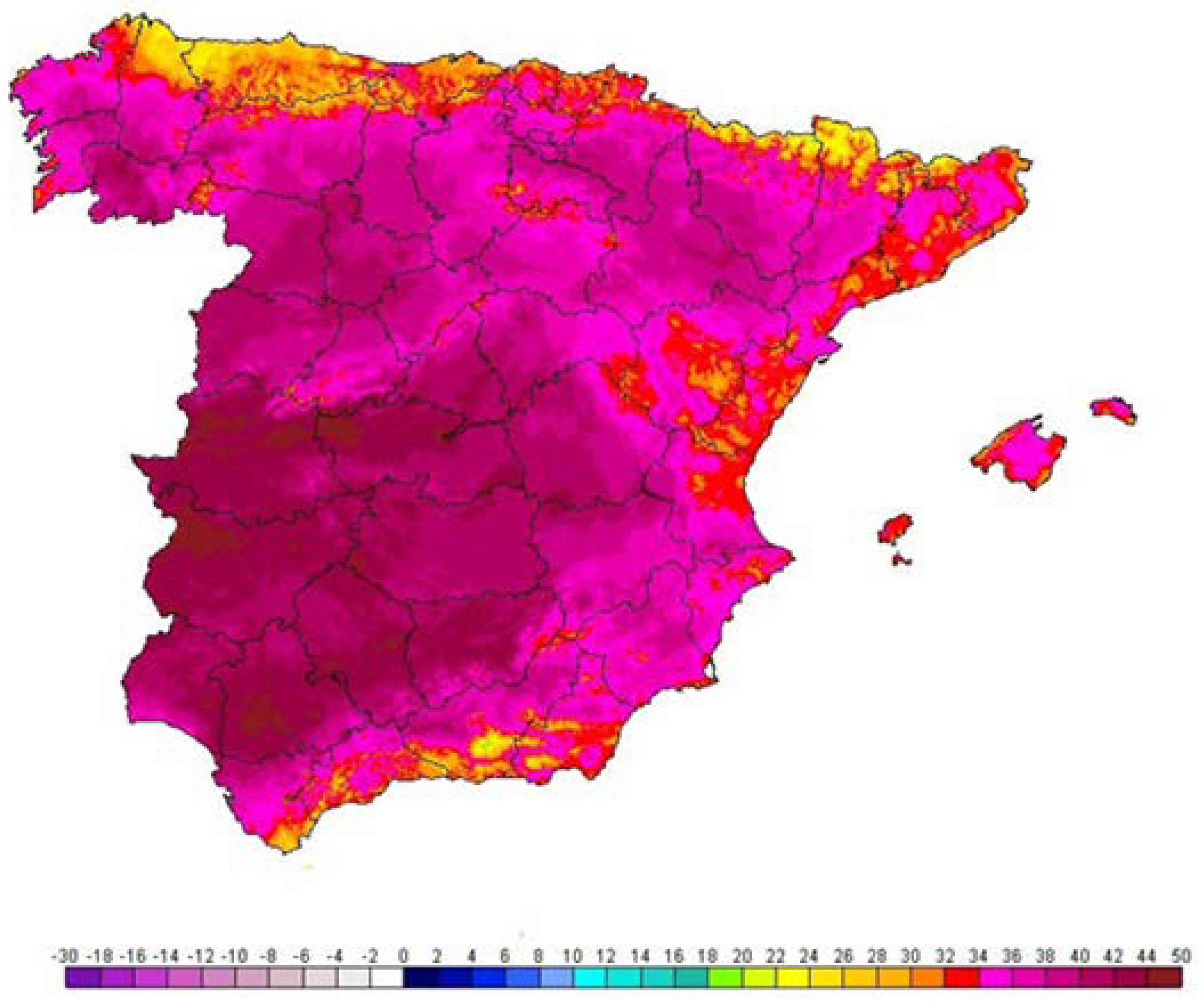
Figure 2.
Maximum temperature in the Canary Islands (°C) on 14 July 2022. Source: Weather Spanis State Agency [20].
Figure 2.
Maximum temperature in the Canary Islands (°C) on 14 July 2022. Source: Weather Spanis State Agency [20].
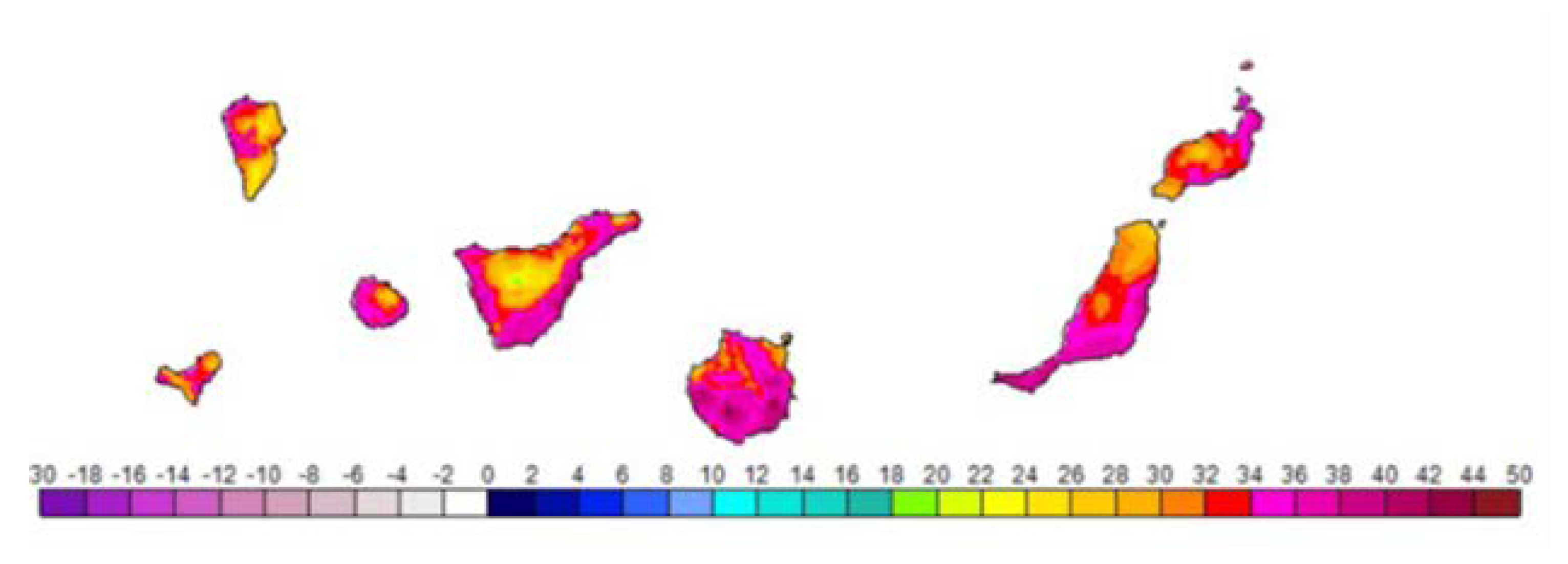
Figure 3.
Proposed model. Source: Own elaboration.
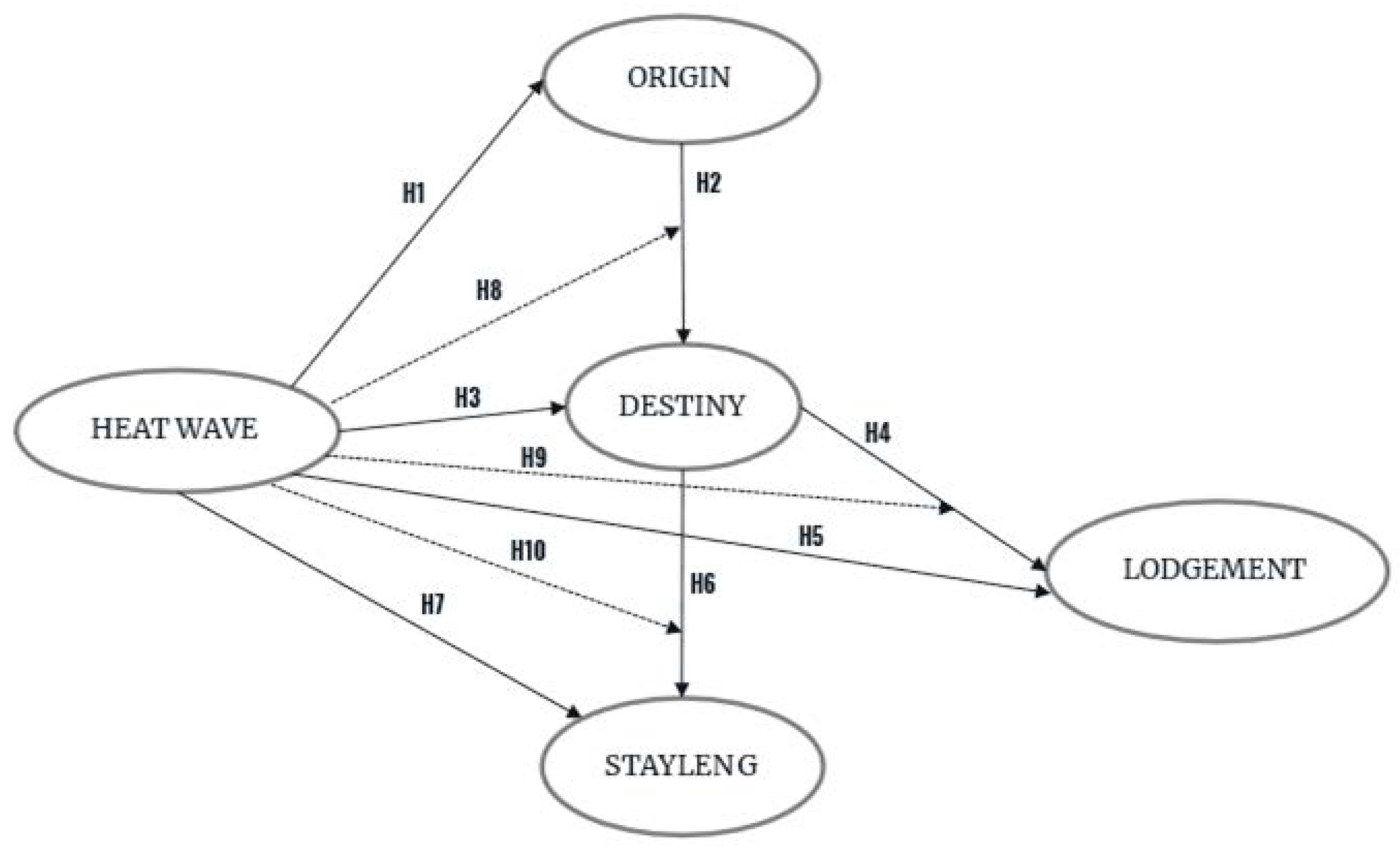
Figure 4.
Model results specifying the coefficients of determination. Source: The authors process data using WarpPLS 8.0.
Figure 4.
Model results specifying the coefficients of determination. Source: The authors process data using WarpPLS 8.0.
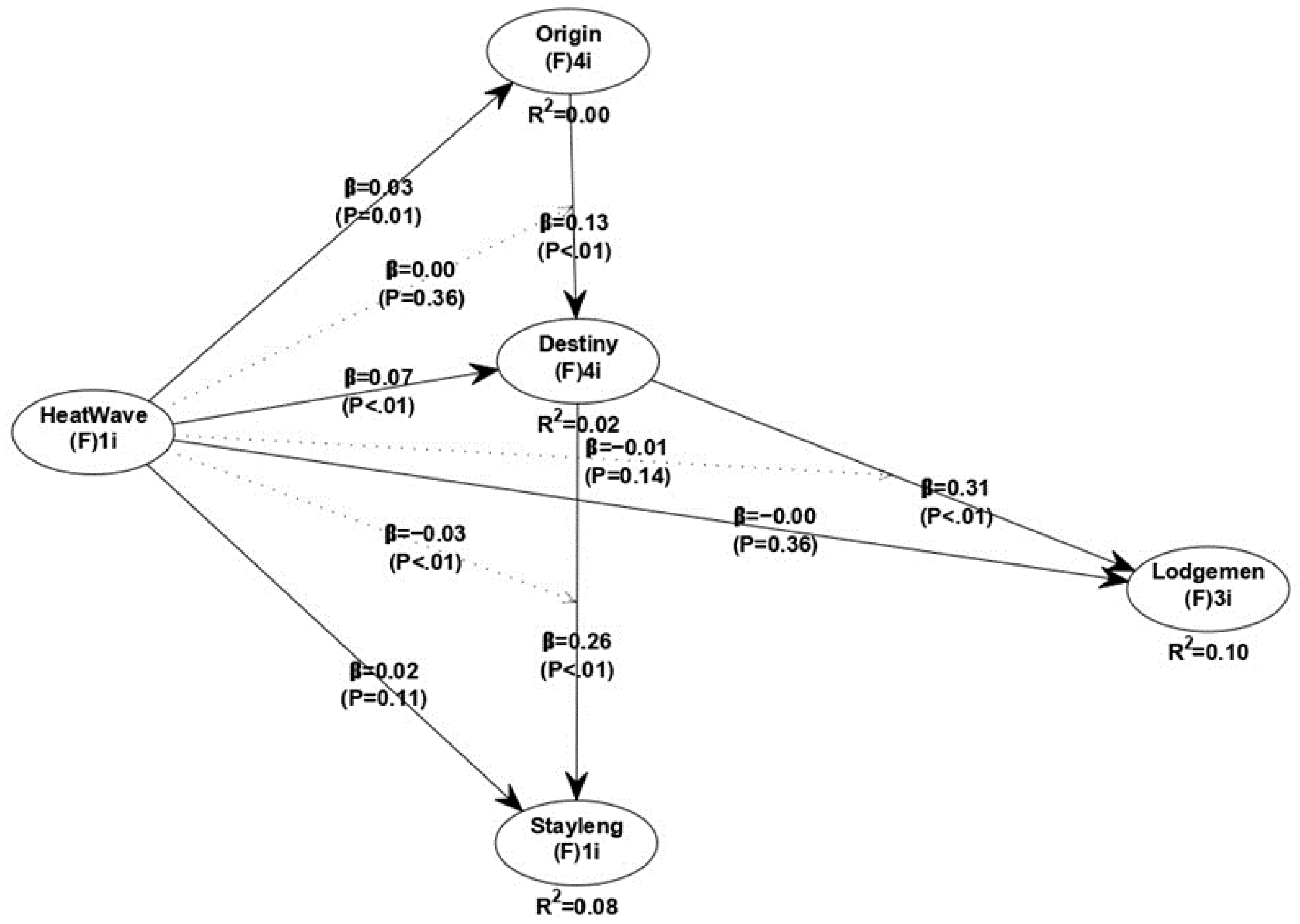

Table 1.
Characteristics of the sample. Source: National Statistics Institute (2015). [49].
Table 1.
Characteristics of the sample. Source: National Statistics Institute (2015). [49].
| Type of survey | Continuous on a quarterly basis. |
|---|---|
| Population scope | Non-residents in Spain who enter or leave Spain, whether or not they have stayed overnight. |
| Area | The entire national territory. |
| Reference period | Monthly. |
| Data collection | Interviews. |
Table 2.
Model fit and quality indices. Source: The authors' process data using WarpPLS 8.0.
| Index | Value | Value Interpretation |
|---|---|---|
| Average path coefficient (APC) | APC=0.087, P<0.001 | |
| Average R-squared (ARS) | ARS=0.053, P<0.001 | |
| Average adjusted R-squared (AARS) | AARS=0.053, P<0.001 | |
| Average block VIF (AVIF) | AVIF=2,681 | Acceptable if <= 5, ideally <= 3.3 |
| Average full collinearity VIF (AFVIF) | AFVIF=6.296 | Acceptable if <= 5, ideally <= 3.3 |
| TenenhausGoF (GoF) | GoF=0.201 | Small >= 0.1, medium >= 0.25, large >= 0.36 |
| Sympson's paradox ratio (SPR) | SPR=0.900 | Acceptable if >= 0.7, ideally = 1 |
| R-squared contribution ratio (RSCR) | RSCR=1,000 | Acceptable if >= 0.9, ideally = 1 |
| Statistical suppression ratio (SSR) | SSR=1,000 | Acceptable if >= 0.7 |
| Nonlinear bivariate causality direction ratio (NLBCDR) | NLBCDR=1.000 | Acceptable if >= 0.7 |
Table 3.
Assessment of the hypotheses.
| H1 | Heat wave → Origin (β = 0.03, p=0.01). | Confirmed hypothesis. |
| H2 | Origin → Destiny (β = 0.13, p<0.01), | Confirmed hypothesis. |
| H3 | Heat wave → Destiny (β = 0.07, p<0.01). | Confirmed hypothesis. |
| H4 | Destiny → Lodgment (β = 0. 31, p <0.01) | Confirmed hypothesis. |
| H5 | Heat wave → Lodgment (β= -0.00, p=0.36) | Unconfirmed hypothesis. |
| H6 | Destiny → Stayleng (β = 0.26, p <0.01) | Confirmed hypothesis. |
| H7 | Heat wave → Stayleng (β= 0.02, p=0.11) | Unconfirmed hypothesis. |
| H8 | Heat wave → (Origin → Destiny) (β= 0.00, p=0.36) | Unconfirmed hypothesis. |
| H9 | Heat wave → (Destiny → Lodgment) (β = 0.01, p=0.14) | Unconfirmed hypothesis. |
| H10 | Heat wave → (Destiny → Stayleng) (β= -0.03, p<0.01) | Confirmed hypothesis. |
Disclaimer/Publisher’s Note: The statements, opinions and data contained in all publications are solely those of the individual author(s) and contributor(s) and not of MDPI and/or the editor(s). MDPI and/or the editor(s) disclaim responsibility for any injury to people or property resulting from any ideas, methods, instructions or products referred to in the content. |
© 2024 by the authors. Licensee MDPI, Basel, Switzerland. This article is an open access article distributed under the terms and conditions of the Creative Commons Attribution (CC BY) license (http://creativecommons.org/licenses/by/4.0/).
Copyright: This open access article is published under a Creative Commons CC BY 4.0 license, which permit the free download, distribution, and reuse, provided that the author and preprint are cited in any reuse.