

Submitted:
28 May 2024
Posted:
29 May 2024
You are already at the latest version
Abstract
Promoting sustainable consumer behavior is now an obligation under new European legislation, requiring Life Cycle Assessment (LCA) for accurate environmental impact evaluation. Portugal is a key textile producer, edge in competitiveness in sustainable textile production, driven by electricity-reduced carbon footprint and closed-loop manufacturing. Additionally, while simple spreadsheets can estimate a product's carbon footprint, openLCA software, combined with ecoinvent database, greatly enhances environmental footprint calculations by integrating diverse impact categories, otherwise difficult to estimate. In this study, openLCA is used to evaluate the environmental footprint of a white T-shirt made in Portugal, with 50% recycled cotton from post-industrial wastes combined with 50% organic cotton from Turkey, to assist the design of environmental key performance indicators (KPI). The RECIPE and EF method (adapted) are used to calculate the environmental impacts and allow aggregation in a single score. The KPI related to the global warming impact is validated using a spreadsheet calculator. We propose an “Envi-Score” based on an A to E classification for benchmarking and better communication with the buyers. E is set as the normalized environmental impact of the European benchmark for a mixture material T-shirt encompassing cradle-to-gate boundaries. The introduction of recycled cotton proves to be environmentally beneficial over organic and conventional cotton. Organic cotton proves to be beneficial in comparison with conventional cotton for most environmental categories, except to the ones affected by the lower production yield, for example Land Use. The hotspots for the main impact categories are identified and finally proposed a labelling scheme, to clearly inform about the environmental performance of the products and avoid greenwashing, with the “Envi-Score” rate, carbon footprint, land use and water depletion.
Keywords:
Life cycle assessment (LCA)
; textile
; carbon footprint (CF)
; eco-labels
; key performance indicators (KPI)
; benchmark
1. Introduction
The urgency of harmonized sustainability criteria is clear and pushed by European legislation. On 30 March 2022, the European Commission announced a package of proposals to make sustainable products the norm[1], boost circular business models, and empower consumers for the green transition. The European Union (EU) Strategy for Sustainable and Circular Textiles[2] is one of the sectorial initiatives also presented, including requirements for textiles to make them last longer, easier to repair and recycle, with a minimum recycled content, produced respecting social rights, clear information and a Digital Product Passport tackle greenwashing, empower consumers and raise awareness about sustainable fashion, overproduction and overconsumption, and discourage the destruction of unsold or returned textiles. Also, propose mandatory Extended Producer Responsibility for textiles with eco modulation of fees, address the unintentional release of microplastics from synthetic textiles, restrict the export of textile waste and promote sustainable textiles globally, incentivize circular business models, including reuse and repair sectors, encouraging companies and Member States to support the objectives of the Strategy. Products and inputs should be tracked from the very start of the supply chain, guaranteeing traceability for all the outputs including information about their origin, location, and transformation process.
At the same time, the Commission published a proposal for a directive empowering consumers for the green transition[3], through better protection against unfair practices and better information, including the proposal for amendment to the Unfair Commercial Practices Directive and the Consumer Rights Directive 2011/83/EU resulting in new requirements, that are highly relevant for textile products. The new EU rules will ensure that consumers are provided with information at the point of sale about a commercial guarantee of durability as well as information relevant to repair, including a reparability score, whenever this is available. General environmental claims, such as “green”, “eco-friendly”, and “good for the environment”, will be allowed only if underpinned by recognized excellence in environmental performance, notably based on the EU Ecolabel, type I ecolabels, or specific EU legislation relevant to the claim. Voluntary sustainability labels covering environmental or social aspects must rely on a third-party verification or be established by public authorities using life cycle analysis methods, including the Product Environmental Footprint (PEF) method [4]. Moreover, there will be conditions for making green claims related to future environmental performance, such as “climate neutral by 2030”, and for comparing to other products.
Parallelly, the Initiative on substantiating green claims proposes to apply a standard methodology, based on Product and Organizational Environmental Footprint methods, to have reliable, comparable, and verifiable environmental claims and performance. The Commission Recommendation (EU) 2021/2279 of 15 December 2021 promotes the use of the Environmental Footprint methods, as ISO 14040 and ISO 14044 [5,6] in relevant policies and schemes related to the measurement and/or communication of the life cycle environmental performance of all kinds of products, including both goods and services and of organizations.
Nevertheless, in this actual regulation trend, still there isn’t a consensus regarding KPIs for identifying a “sustainable fashion product” for simple and trusted communication to consumers. Although PEF already encompasses the environmental dimensions, there was a lack of harmonization on the existent studies concerning boundaries, allocation criteria, or process considerations. Another issue related to LCA studies is the difficulty of checking the results because each one is based on combined information from different, and most of the time confidential sources[7].
The clothing manufacturing in Portugal is ranked 4th in Europe in 2023 (out of 26 total EU countries, after Italy, France, and Germany with an average growth of 3.2% per year between 2018 and 2023 [9], exporting mainly to other European countries. Since Portugal is focusing its differentiation strategy on sustainability, this study could be of utmost importance to highlight and demonstrate these efforts.
More than 15 kg of textile waste is generated per person in Europe every year. The largest source of textile waste is discarded clothes and home textiles from consumers which represent 85 % of the total textile waste [8] The generation of textile waste is problematic, as incineration and landfills—both inside and outside Europe—are its primary end destinations. The Waste Directive 2008/98/EC update enforces textile recycling in a circular economy. In Portugal, there are about 13 recycling units, from which Valérius 360 is cotton-specific.
A query search at Web of ScienceTM Core Collection database retrieved the results of Figure 1:
Q1 (LCA or "Life cycle a*" or "carbon footprint") and "T-shirt" ;
Q2 (LCA or "Life cycle a*" or "carbon footprint") and (Simapro or Gabi) ;
Q3 (LCA or "Life cycle a*" or "carbon footprint") and "openLCA" ;
Q4 (LCA or "Life cycle a*" or "carbon footprint") and (Simapro or Gabi) and "T-shirt";
Q5 (LCA or "Life cycle a*" or "carbon footprint") and "openLCA" and "T-shirt".
The search query allows us to conclude that there is a much broader use of Simapro or Gabi proprietary LCA software than openLCA open software for any environmental LCA (e-LCA) study (Q2 and Q3). Regarding T-shirt e-LCA studies Q1 there was identified only 16, one of which was a review from the authors [7] and none covering recycled cotton, openLCA in a Portuguese context, which are the novelties of our approach. For example, a virgin cotton study [9] in China, considered a “cradle-to-grave” approach, covering cotton cultivation and cotton fiber production, irrigation, commercial fertilizers, and pesticides, ginning (separation of seed and fiber), textiles manufacturing includes spinning, knitting, dyeing (pre-treatment, dyeing, post-treatment, and finishing) and making-up (cutting, sewing, and package), distribution, consumer use (wearing, washing, drying and ironing, taking electricity, detergent, and wastewater emission into account), and disposal through landfill. The potential environmental impacts are evaluated using the CML2001 and USEtox methodologies built into the GaBi version 6.0 software, including Climate change, abiotic depletion, acidification potential, photochemical ozone creation potential, eutrophication potential, water use, and toxicity. The distance of cotton transport by road is 3800 kilometers. It focused on identifying hotspots, for example, water use hotspot is cultivation while hotspot for Climate change (global warming potential) is electricity use and coal burning.
A virgin cotton study in Turkey[10], referring to textile exchange [11] for the organic cotton case study. GaBi 8.0 software with CML 2001 impact assessment methodology for global warming, acidification, and eutrophication potentials and a cradle-to-grave analysis of 1000 cotton T-shirts (250 kg). The distances between the cotton field to yarn factory, the yarn factory to the fabric supplier, and fabric mill to the shirt facility are 1092.4 km, 928.9 km, and 543.4 km, respectively, by road. Climate change retrieving 4.3 kg/kg T-shirt “cradle-to-gate”. Water depletion is not addressed.
Within the Google Search engine, two reports (Textile Exchange [11] and Cotton Inc [12]) were found for virgin organic and conventional cotton fiber that look at the environmental impact of Climate change, Water depletion, Primary energy demand, Acidification Potential, and Eutrophication Potential. Both reports try to align the stages considered and assumptions to ensure a fair comparison between the two fiber production pathways. It estimated for an average market regarding China, India, Turkey, and USA, 1.808 kg CO2 eq/kg conventional cotton fiber and 0.978 kg CO2 eq/kg organic fiber.
The carbon uptake at the cotton cultivation stage (1.54 kg CO2 eq/kg fiber) is not considered otherwise the values could be negative and at the end-of-life the carbon will be eventually released being part of a short carbon cycle. Water consumption (blue water) 2740 L/kg virgin cotton and 704 L/kg organic fiber.
Moreover, it was identified only one study dealing with recycling cotton yarn [13] in the context of Zhejiang province in China. It considers raw material acquisition, transportation, breaking, mixing, and spinning. The life cycle of virgin cotton yarn production was divided into raw material acquisition, transportation, mixing, and spinning. The distance between the cotton cultivation origin in Xinjiang province and the factory in Zhejiang province is assumed to be 4650 km by truck. The average distance between the factory of yarn manufacturers and the enterprises located in the local or nearby cities engaged in the recovery of waste clothes is assumed to be 100 km by truck. Both pathways obtain 1000 kg of yarn. Climate change, fossil depletion, water depletion, and human toxicity environmental impact categories were analyzed, using Gabi proprietary software and ReCipe midpoint (H) impact assessment, Climate change retrieved 11 kg CO2 eq/kg virgin conventional cotton yarn and 4.38 kg CO2 eq/kg recycled yarn. Water depletion retrieving 3514 m3 virgin yarn and 583 m3 recycled yarn.
It was identified a recent master thesis concerning the life cycle assessment of a knit fabric made in Portugal with recycled cotton (60%) and conventional cotton (40%) and its comparison with a knit fabric made with conventional cotton, using the GaBi software version 10.6 and ReCipe 2016 midpoint methodology, with hierarchical approach (H) to analyze climate change, fossil depletion, terrestrial acidification, freshwater eutrophication, human toxicity, freshwater ecotoxicity and terrestrial ecotoxicity impact categories. The life cycle considers the collection and transport of textile waste in a ratio of 20-30 km to the recycling unit, energy consumed in the recycling and spinning units, as well as the textile waste generated by these processes. Database figures were used for the remaining inventory inputs, including conventional cotton purchased on the global market, yarn dyeing (only for virgin yarn), and the knitting process. The production of 100 kg of knit fabric generated a Climate change impact of 484.72 kg CO2 eq recycled knit and 870.20 kg CO2 eq virgin conventional cotton knit. [14]
To better understand the limitations and the best way to harmonize criteria to benchmark environmental impacts on textile products, this study will cover a case study in Portugal that uses the “cradle-to-gate” approach to analyze the impacts of a T-shirt made with recycled cotton, combined with organic cotton and compare it with another T-shirt made just with organic cotton or conventional cotton. It is based on the primary data gently shared by the Portuguese company Valérius [15], a facility able to convert cotton textile waste into new yarn after being transformed into new jersey fabrics, finally used to produce more conscious garments. This Portuguese textile company handles the final garment manufacturing process and has close partnerships with knitting and dyeing house. Its recycling process can obtain, through a mechanical process, high-quality recycled cotton fibers with 20 mm length, although as usual[13], need to be blended with other virgin fibers to expand strength and durability. Organic cotton is one of the virgin fibers frequently used and will be considered in this study. Although the recycling process is thorough, some recycled fibres are too small and can’t be used in a textile context, so the company has added another site, to use it for the production of paper.
We expect to reach results that can be benchmarked with other studies and reference results, to contribute to the widespread utilization of openLCA software in the textile sector, and for a systematic methodology that can be used by the fashion industry to have a better understanding of how to create more eco-friendly products. Furthermore, highlight the textile recycling conditions in Portugal and the environmental benefits from turning waste into new products allowing a reduction of primary resources’ consumption, land occupied to produce natural fibers, stocks from overproduction, and unsold garments, chemicals, water, and energy consumption, less greenhouse gas emissions as well as a cutback in the total amount of textile materials discarded in landfills, which should be the last resort according to EU waste framework directive (Directive 2008/98/EC).
2. Materials and Methods
The e-Life Cycle Assessment will be based on the ISO 14040 [5]and 14044 [6], the Product Environmental Footprint Category Rules T-shirts[16], and openLCA software[17]. openLCA is an open-source and free software for Sustainability and Life Cycle Assessment that offers a large collection of data sets and databases, complemented with detailed insights into calculations and smart functionalities that make it easy to share and compare the models, which is of major importance when the objective is benchmark results.
The study uses the “cradle-to-gate” approach to analyze the environmental impact of a T-shirt made with 50% recycled cotton and 50% organic cotton. The life cycle for T-shirt production has been divided into the following stages: organic cotton fiber production (cultivation and ginning), recycled fiber production spinning, knitting, dyeing, finishing, cutting, and sewing (Figure 2). Transportation between stages of fiber production and yarn production, and cotton waste collection to the recycling unit are considered. A “cradle-to-gate” carbon footprint (ISO 14067[18]), based on an Excel Spreadsheet input/ output inventory and “open source” emission factors were also undertaken to compare against openLCA outcomes related to Climate change, and global warming potential 100 years (GWP100). The idea behind this approach is aligned with the GHG protocol [19] that opt to use an Excel spreadsheet approach, transparency, and open-sourcing [20]. The influence of the electricity mix of the power system in the years 2014 and 2021 is considered in the analysis, the hotspots are identified, and results compared with the literature.
2.1. Goal of the Study
The goal of the study is to quantify, with openLCA, the environmental footprint of a white Jersey T-shirt made, in Portugal, with 50% recycled cotton mixed with 50% organic cotton (scenario 1), and compare it with a T-shirt made with 100% organic cotton (scenario 2) and another one made with 100% conventional cotton (scenario 3). The study considered the production of the T-shirt, with Jersey knit (100%), with Ne30 yarn and bleached. The objective is to be able to understand if environmental impact can be reduced when using recycled cotton instead of 100% organic cotton fibers or 100% conventional cotton, support the identification of environmental KPI’s for benchmark, apart from testing the adequacy of openLCA for this kind of study on apparel. The outcome is validated for the GWP100 impact category.
2.2. Functional Unit
The functional unit (FU) of the product is going to be used as a reference, to normalize all the inputs and outputs of the LCA analysis. This study considered 1 kg of a Jersey white T-shirt as the FU and, since the T-shirt doesn’t have any other components, for the environmental footprint calculation of the final T-shirt (declared unit), it was assumed 1 short-sleeve white T-shirt with 200 g (considered as the average weight of a men’s T-shirt size 40).
2.3. System Boundaries
The study includes all the processes “cradle to gate” (and their inputs and outputs) starting with the transport of the textile waste from other production units) until the final production of the T-shit, including mechanical recycling, spinning, knitting, dyeing, and finishing, cutting, and sewing processes (as described at Figure 2). It also includes the conventional and organic cotton production impacts based on the openLCA v1.11.0 [17] and ecoinvent v3.7.1 APOS U 20201221 database, as well as transport between processes, but doesn’t include the T-shirt distribution, consumer use, or end-of-life, since these processes are not controlled at the production stage. The three types of T-shirts are produced through the same process of spinning, knitting, dyeing, finishing, cutting, and sewing, so the difference on the environmental impacts only came from the fibers production.
Figure 2.
System diagram with the cradle-to-gate boundary considered in the study.
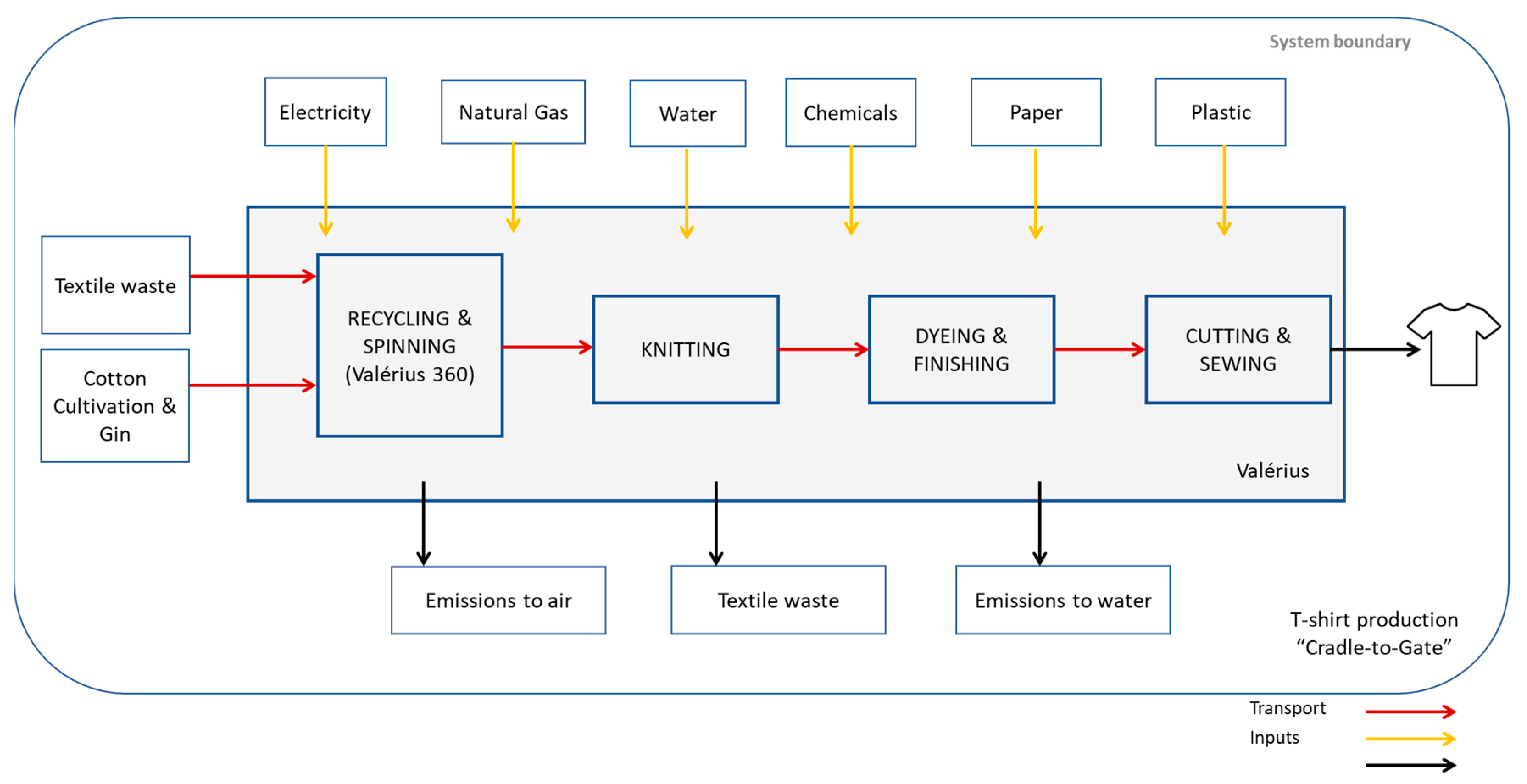
Since the study doesn’t include the use or disposal stage, the expected number of wears of the T-shirt [21] was not considered nor was its end-of-life. It is assumed that the performance of virgin versus 50% recycled T-shirt is the same.
2.4. Life Cycle Inventory
The life cycle inventory data for the T-shirt made with 50% recycled cotton and 50% organic cotton were provided by Valérius and are shown in Table 1. For the scenarios of the T-shirt made with 100% organic cotton and 100% conventional cotton, the same weight of these materials was considered to replace the total weight of fiber of the first scenario.
The pre-industrial textile waste is collected from units within a 50 km ratio and transported by 7.5-ton diesel trucks to unit Recycling unit where the recycled cotton yarn is produced through a physical process using electrical energy, water, natural gas, and chemical products (silicone product and paraffine). The recycling process starts with the waste cutting, the small pieces are immediately soaked with a softener solution and then vacuumed into another container to rest some more time until they are soft enough to pass to LaRoche griding process to become very loose recycled fibers, which are compressed to be stored or continue to the mixing of the recycled cotton fiber with organic cotton (or other sustainable virgin fibre) to get the strength characteristics to be spun into recycled yarn it is used new Open-end spinning technology, that allows savings and real-time reading of energy consumption [15]. In the case of this study, recycled yarn is mixed with organic cotton fibre produced in Turkey and transported to Portugal by container ship and truck until the spinning unit.
Recycled cotton yarns are transported to a knitting factory to produce recycled cotton knit, which is white bleached and finished in one of the company’s partner dyeing houses using a jet dyeing machine and a Ramula. All these processes are sourced with electrical energy from the grid and solar panels. Dyeing house also is feed with natural gas, water, and chemical products (dyeing and finishing). The white knit is moved to a very close factory equipped with automated cutting units and capacity for T-shirt manufacturing, using only electrical energy, some paper, and plastics that are reused or sent to recycling processes.
2.5. Data Source
Valérius 360 provided primary data for their core processes, information from upstream processes, including the production of conventional and organic cotton, and its transportation) was acquired by the ecoinvent v3.7.1 APOS U 20201221 database through openLCA v1.11.0 [17]. The Allocation at Point of Substitution (APOS) introduces the burden from previous at the point where the recycled is used, so has an additional impact on the final T-shirt made with recycled cotton. The system was defined considering each supply chain tier as unit processes (U), with the quantification of their individual inputs and outputs. The study considers the openLCA flows and providers as shown at Table 2.
According to the data provided, to produce 1 kg of white T-shirt will use 1.118 kg of cotton waste coming mainly from production wastes, combined with 0.95 kg of virgin cotton. The use of post-consumer textile waste is still very limited. The recycling process generates 0.17 kg of cotton lint waste, meaning an efficiency of 85% on the recycling process. Overall, the existent process leads to an efficiency of 48.3%.
The cotton waste generated it was used as the input for the Recycling unit through a “waste treatment process” following the openLCA material flow logic. This waste was not considered as “avoided waste” because it can be used in other processes (as producing other new products with lower value).
Ecoinvent database doesn’t include detailed chemicals applied in the process, so it was necessary to classify some of them as inorganic or organic chemical products, to after applying the suitable upstream process.
Inventory data was collected between October 2020 and September 2021. For a more accurate estimative of the Portuguese electricity emissions, it was considered the electricity mix in Portugal, provided by REN for 2021 [22] as presented in Table 2.

Table 3.
Portuguese electricity production mix, in 2021, [22] and characterization to define the openLCA providers for flow “electricity, high voltage”.
Table 3.
Portuguese electricity production mix, in 2021, [22] and characterization to define the openLCA providers for flow “electricity, high voltage”.
| Electricity Mix- Portugal 2021 | GWh | % | Characterization |
| Renewable generation | 29 526 | 53.0% | - |
| Hydro | 11 607 | 20.8% | Reservoir: 40.16% Run of the river: 59.84%[23] |
| Wind | 12 921 | 23.2% | 1-3 MW Turbine: 96.37% <1MW Turbine: 7.317% 1-3 MW Offshore: 0.04%* |
| Biomass Non-cogeneration Cogeneration |
1 837 1 432 |
3.30 % 2.57 % |
Wood chips, 6667 kW* Wood- GLO* |
| Solar | 1 729 | 3.10% | Solar tower power plant 20 MW- RoW* |
| Non-renewable generation | 15 607 | 28.0% | - |
| Coal | 694 | 1.25% | - |
| Natural Gas Non-Cogeneration Cogeneration |
10 976 3 653 |
19.7% 6.56% |
Combined cycle Conventional, 100 MW |
| Others Non-Cogeneration Cogeneration |
213 71 |
0.38% 0.13% |
Oil* |
| Pumped stored generation | 1 597 | 2.87% | - |
| Import (commercial schedules) | 8 957 | 16.1% | From Spain* |
| TOTAL | 55 687 | 100% | - |
*based on openLCA 2014 figures, since according to data available [24]
2.6. Assumptions
For the study, some assumptions had to be made, since the information available was not complete or the process wasn’t exactly equal all the time:
- Organic cotton and Conventional cotton are produced in the same location in Turkey for transport distance calculation, although the “fiber, cotton, organic” and “fiber, cotton” generic flow for the calculations.
- It was not considering the capture of CO2 in the fibers in the cultivation process.
- Tap water being used for recycling, dyeing, and finishing processes, and no production of wastewater on the recycling unit.
- Average distance for collecting the textile waste is 50 km.
- Renewable Solar energy produced and used by the knitting, dyeing, and finishing units was not included in the calculations as considered as with negligible impact.
- Road transport being done in Turkey and Portugal with EURO 6 freight lorry 3.5-7.5 metric Ton (348.5 km); Transport by the sea in containership from Turkey to Portugal (4559.6 km).
- Chemical products made with mixtures were grouped and classified as softeners (silicon products), “chemical, organic” and “chemical, inorganic”.
- Plastic and paper used in the Cutting process are considered as reused several times in the process, meaning the inputs are equal to the outputs.
- The yarns will be the only material used on the T-shirt, even will not have any accessories, composition, or care label, since the information will be printed inside the neck.
- On the openLCA calculation, it was not considered any cut-off, it was chosen to auto-link the default providers by unit processes.
- All the processes are the same for the different types of yarn. T-shirts without specific treatment (e.g. moisture transfer).
- The spinning machine doesn’t use significant quality of lubricant oil.
- At openLCA each process was converted into a product System, choosing the options “Auto-link processes”, “Prefer default providers” and “Unit Process”, so the cut-off wasn’t considered.
2.7. Limitations
The below limitations where identified:
- The study doesn’t include the T-shirt, packaging, or downstream processes as logistics, transport from the factory until the customer house and retail, use stage or end-of-life.
- Appearance, quality, or durability of the T-shirt made with recycled cotton versus the T-shirts made with virgin fibers was also not considered in the comparison.
- Primary data used in the study was provided by Valérius without any further verification or measurements made by this article’s authors. The allocation rules applied were not communicated, although processes are specific for this kind of production.
- Although used water from wells and dyeing unit uses river water, in the study it was applied a tap water flow.
- Impacts related to labour/workers were not considered.
2.8 Impact Assessment
The ReCipe 2016 mid-point (H) was used as the Impact Assessment Method, converting emissions and resources used in the product life cycle into 18 environmental impact categories/indicators, such as Fine particulate matter formation (kg PM2.5 eq); Fossil resource scarcity (kg oil eq); Freshwater ecotoxicity (kg 1,4-DCB); Freshwater eutrophication (kg P eq); Global warming (kg CO2 eq); Human carcinogenic toxicity (kg 1,4-DCB); Human non-carcinogenic toxicity (kg 1,4-DCB); Ionizing radiation (kBq Co-60 eq); Land use (m2a crop eq); Marine ecotoxicity (kg 1,4-DCB); Marine eutrophication (kg N eq); Mineral resource scarcity (kg Cu eq); Ozone formation, Human health (kg NOx eq); Ozone formation, Terrestrial ecosystems (kg NOx eq); Stratospheric ozone depletion (kg CFC11 eq); Terrestrial acidification (kg SO2 eq); Terrestrial ecotoxicity (kg 1,4-DCB) and Water consumption (m3). This method is frequently used in this scope and considers the Hierarchist (H) perspective, which is based on the scientific consensus about the time frame (100 years) and plausibility of impact mechanisms [25]. No Allocation method was considered.
At the stage of Normalization, it was necessary to recalculate the impact of the three T-shirts with the EF method (adapted) based on EF method 2.0. This method retrieves impact results in compatible units with the available Normalization factor per person-year [26].
2.9. Excel Spreadsheet Carbon Footprint for openLCA Validation
The carbon footprint (CF) is defined by part of an e-LCA that relates exclusively to the environmental category Climate Change, metric Global Warming Potential at 100 years, defined as GWP100 and measured in CO2 eq. The inventory of each stage of the T-shirt production is in Table 1.
Each input flow (mass or energy) is multiplied by the respective emission factor (EF) and added up to give the overall CF as defined in equation (1):
s stands for stage (cultivation, recycling, spinning, knitting,
i stands for the flow number at stage s
The EFs applied for the CF calculation are available in Table 4
In general, units were converted so that the EFs from Table 4 were consistent with the quantities used in the Life Cycle Inventory, although some flows required intermediate calculations to be aligned.
The EFs found for the extraction and distribution of natural gas depended on their energy content, meaning 1.14E-02 kg CO2 eq/MJ [29]. To obtain them in terms of mass flow, it was necessary to resort to the equation (2) and the Low Heat value (LHV) of 46.3 MJ/kg (NG EU Mix Pipped) [28].
The inventory is intended to consist almost exclusively of mass flows, in kilograms, except for water and electricity, which are desired in m3 and kWh, respectively. To achieve this goal, it was sometimes necessary to convert units, as for the transformation of natural gas volumetric flows (V), into mass flows (m), to which it resorts to the equation (4). The natural gas being at gaseous state, its properties are affected by ambient conditions, which prevents the direct application of equation (3) because, although the consumed volume is known, the corresponding density (ρ) is unknown. However, it is possible to determine the value of ρ because natural gas is an ideal gas with 17.5 kg/kmol Molecular Mass (M) [28], and the pressure (P) and temperature (T) conditions considered during the volume measurement are known (1 atm and 25℃).
R stands for gas constant
Once the density under the desired pressure and temperature conditions is known, the equation (4) can be applied.
n stands for the number of moles
The total chemical quantity was calculated by the sum of all the different chemical products included in the process.
Transport by road and sea was converted to the unit kg.km with the quantities transported in each step.
After the harmonization of all the quantities, the initial inventory was converted in the one available at Table 5.
3. Results
The following section presents a summary of the results of the LCA study, according to the openLCA outputs. To give visibility to the contribution of each main step or component, the environmental impacts were calculated for Electricity Portuguese Mix in 2021, transport for the importation processes, transport along the local supply chain, each fiber, each process, and finally for the three T-shirts scenarios.
It included some results from selected literature, to give context to the results achieved and help with the interpretation.
3.1. Electricity Modeling- Portuguese electricity mix in 2021
Electricity has an impact on the environmental burden of products and processes, and this is recognized by European Governments who are continually implementing policies and promoting new technologies to reduce the impact of energy production. To increase accuracy, the LCA of electricity generation in Portugal, during 2021, was updated at openLCA, by modifying the process “market for electricity, medium voltage | electricity, medium voltage | APOS, U – PT”, valid for the year 2014, from ecoinvent v3.7.1 APOS U 20201221, by using 2021 data from REN HUB [22], retrieving 237 g CO2 eq/kWh instead of the 487 g CO2 eq/kWh of the previous process for the Climate Change impact category. The former value was compared against the values found for the Portuguese power system (162 g CO2 eq/ kWh [22]), with coal power dismissed in January 2021, and the values of the database “OurWorld in data” [27] 219 g CO2 eq/kWh accounting for imports from Spain with coal feedstock. The openLCA value is higher because it included imports, extraction, and transport of feedstocks and infrastructure embedded materials of PowerPlants and thus considered validated the outcome of openLCA process (as shown at Table 6).
3.2. Transport-Logistics
Transport was evaluated for the scenario of “50% recycled cotton+ 50% organic cotton”, under two perspectives, the transport used to bring the imported fiber from Turkey to the spinning unit (the same distances were used for organic cotton and conventional cotton) and the sum of the transport to bring the textile wastes from the other units to the Recycling unit, with the transport between each step of the following processes (as applicable). The total environmental impact of transport on the global process is shown at Table 7, separately for the imported fiber and for local travels.
The transport of the imported fiber contributes with the most relevant impact, so it was associated to the importation of the organic cotton and conventional cotton, while the impact of the local transport was associated to each unit, as applicable.
3.3. Cotton Fibers- Recycled, Organic, and Conventional
As already referred, for the study it was considered the generic openLCA flows for the organic and conventional cotton (as identified in Table 2).
Table 8 shows the environmental impacts of the recycled lint versus the default impacts for organic cotton and conventional cotton (at the production location) and is clear that recycled cotton fibers can bring a major benefit for the categories as Global warming, Human non-carcinogenic toxicity, Land use.
According to Textile Exchange 2014 study[11], the Global warming Potential (GWP100) of organic cotton is 0.978 kgCO2 eq per 1 kg fiber, the main contribution was given by India with a share of 74% while openLCA applied an estimative for RoW (Rest of the World without India).
The global average GWP100 of conventionally grown cotton is calculated to be 1.808 kgCO2 eq per fiber kg as per Cotton Inc.'s study in 2012 (if not considering the capture of CO2 in the fibers) [12].
Organic Cotton makes the biggest contribution to the category Land use, other processes' contribution is neglectable for this category, although land occupation (one of the dimensions of land use) was not included on the Textile Exchange study since this indicator is indirectly proportional to the yield, and a low yield does not necessarily result is a high environmental profile [11], although is important to refer that this impact category refer to the relative species loss caused by specific land use type (annual crops, permanent crops, mosaic agriculture, forestry, urban land, pasture)[32].
On another side, according to the same study, the production of conventional cotton consumes 2,120 m3 of blue water per 1,000 kg cotton fiber, for producing 1 metric ton of organic cotton is consumed 15,000 m3of water. Blue water includes all the fresh water inputs but excludes rainwater, although water consumption in the Textile Exchange study includes green water (rainwater and moisture stored in the soil and used for plant growth)[32], that can justify the big difference when compared this reference value for organic cotton with the openLCA results, which refers to m3 of water consumed from m3 of water extracted. Figure 3 shows the results for each impact category of the respective project variants. For each indicator, the maximum result is set to 100% and the results of the other variants are displayed to this result.
Conventional cotton fiber production led to major impact on main part of the categories, except freshwater eutrophication, land use, marine eutrophication and stratospheric ozone depletion. Form the other hand, the impacts of recycled cotton fiber are far less for all the impact categories, bringing clear benefits to reduce environmental depletion.
3.4. T-Shirt Made with 50% Recycled and 50% Organic Cotton
The results of the environmental impact study of the white T-shirt under study are available in Table 9. Since LCA results are difficult to interpret on their own, the table compare the environmental impact of three variants: the white T-shirt made with 50% recycled cotton and 50% organic cotton (T-shirt 50%RC+50%OC), with a T-shirt made with 100% organic cotton (T-shirt 100% OC) and another one made with 100% conventional cotton (T-shirt 100% CC).
The recycled cotton content in the T-shirt brings a relevant contribution to relieve resources and environmental pressure in all the impact categories, when compared with the organic cotton (as shown at Figure 4). Freshwater eutrophication and land use show a worst performance, when compared with the T-shirt made conventional cotton, but these higher impacts come from the mixture with organic cotton, and not from the recycled cotton fiber itself.
According PEFCR [21], the most relevant impact categories for T-shirts are the Climate change, Particulate matter, Acidification, Freshwater eutrophication, Freshwater ecotoxicity, water use and Fossil resources use.
As initially defined, the white T-shirt under study is made with 200 g of 50% recycled cotton mixed with 50% organic cotton, with the following contribution for environmental depletion[11,32]:
- Climate change affects the environment on a global scale, is characterized by Global Warming Potential (GWP) that results from green gas emission, the consequences include increased average global temperature and sudden regional climatic changes. GWP quantifies the integrated infrared radiative forcing increase of a greenhouse gas (GHG), expressed in kg CO2 eq, and is the midpoint characterization factor selected for climate change impact category[32]. The GWP resulting from the green gases emitted from the production of this T-shirt adds up to 624 g CO2 eq, with main contributions largely depending on cotton-seed production and Portuguese electricity production mix.
- Particulate Matter considers the adverse health effects on human health caused by emissions of Particulate Matter (PM) and its precursors (NOx, SOx, NH3). The production of the T-shirt adds up to 1 g PM 2.5 equivalent. The main contribution comes from organic seed-cotton production.
- Acidification addresses impacts due to release of acidifying substances in the environment, related with the emissions of NOx, SOx, NH3, with effect on the acidification of soils and water, resulting in forest decline and lake acidification. The T-shirt has an estimated impact of less than 1 g SO2 equivalent with the organic seed cotton production accounting for the large proportion.
- Freshwater eutrophication results from the oxygen required for the degradation of dead biomass, due to high level of nutrients (mainly nitrogen and phosphorus) released from sewage outfalls and fertilized farmland and consequent accelerated growth of algae and other vegetation. The T-shirt production has a freshwater eutrophication potential of 2 g P to freshwater equivalents with the seed-cotton production as major contributor.
- Freshwater ecotoxicity addresses the toxic impact on an ecosystem, which damages individual species and changes the structure and function of the ecosystem. Ecotoxicity is a result of a variety of different toxicological mechanisms caused by the release of substances with a direct effect on the health of the ecosystem. The Freshwater ecotoxicity that results from the T-shirt production add up to of 65g 1,4-DCB equivalent, mainly from the disposal of wastewater from the dyeing a finishing unit and seed-cotton production.
- Water use addressed the water consumed from the water extracted (eg. via irrigation). The water consumed while producing one t-shirt is estimated in 10 m3, due to the electricity production from renewable sources and irrigation for the organic cotton-seed production.
- Fossil resources use is related to the increase in fossil fuel extraction, which causes an increase in costs due either to a change in production technique or to sourcing from a costlier location. The production of a T-shirt retrieves a Fossil Fuel Potential (FFP) of 195 g oil equivalent, from the fossil fuel combustion for electricity and transport, apart from natural gas in the spinning and dyeing and finishing units.
The main contributors’ processes (hotspots) for each impact category are identified at the Figure 5. With openLCA it was also possible to identify the main contributor processed along the supply chain.
The T-shirt made with 50% RC + 50% OC has an impact of 14 m2a crop eq on the land user category, 98.6% of this impact comes from the Organic Cotton fiber used as raw material on the spinning unit.
Organic cotton lint production generates more than 50% of the impact on categories as Fine particulate matter, Ozone formation, Fresh water eutrophication, Marine eutrophication, Land use and Stratospheric ozone depletion while Dyeing and Finishing gives the main contribution for Freshwater ecotoxicity, Terrestrial ecotoxicity, Human toxicity, Marine ecotoxicity and Mineral resource scarcity.
As already referred, the transport of the organic cotton from its origin until the factory it was incorporated in the Organic Cotton production and delivery at the spinning unit and transport between facilities it was incorporated in each process (as applicable), nevertheless the contribution for Climate Change category is less than 8%.
3.5. Data Quality Analysis- openLCA
LCA is a field in which commonly is coupled primary data collected in the processes under study with data bases that provide background life cycle inventory, and rarely if ever is collected data a “perfect” match for representing the system being modeled [33]. The data Quality assessment throw a Pedigree matrix supports the reproducibility of the study and reliability of the results.
The pedigree matrix was settled using the ecoinvent data quality system both for processes and flow, considering the following entries for primary data provided:
- Reliability: 3
- Completeness: 2
- Temporal Correlation: 1
- Geographical correlation: 1
- Further Technological Correlation: 1
Figure 6.
Impact analysis per 1 kg T-shirts (5 T-shirts); Recipe 2016 Midpoint (H) with the results per category and with the data quality retrived by openLCA.
Figure 6.
Impact analysis per 1 kg T-shirts (5 T-shirts); Recipe 2016 Midpoint (H) with the results per category and with the data quality retrived by openLCA.
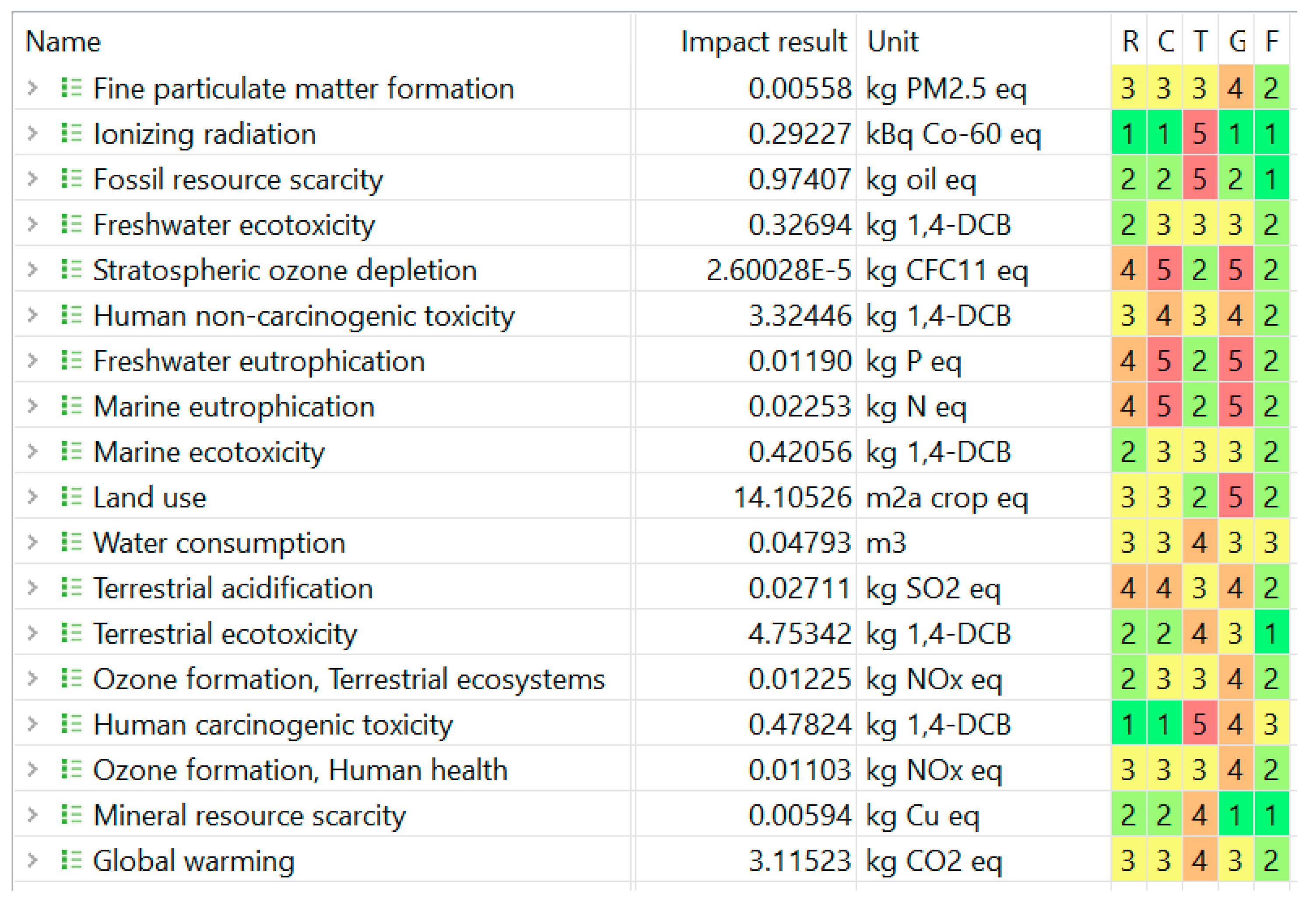
Global Warming retrieved 3.12 kg CO2 eq, with a classification of 3 for Reliability, Completeness and Geographic correlation, meaning most of the data came from non-verified data partly based on qualified estimates, with representative data from only some sites (<50%) relevant for the market considered or >50% of sites but from shorted periods, and data from area with similar production conditions. For Further Technological Correlation achieved a score of 2 since data from processes and materials under study. Temporal correlation got the worst classification (4) meaning that it used a significant amount of data with less than 15 years of difference in the time period of the data set.
3.6. Excel Spreadsheet Carbon Footprint- Results for the T-Shirt Made with 50% Recycled Cotton+50% Organic Cotton
Validation of openLCA results was done by comparing GWP100 result the CF assessed based on the Excel spreadsheet calculation, which retrieved that the impact is approximately 2.98 kg CO2 eq per functional unit (1 kg of product) and 0.60 kg CO2 eq per T-shirt (200 grams). The information about carbon footprint contribution per process and per flow, can be found in Table 10.
At Figure 7 is possible to see the percentage of the CF per flow and per process, including in this last case a comparison with the openLCA results.
Electricity, Organic Cotton lint and Natural Gas generate the major impact, being responsible for more than 85% of the total carbon emissions.
As is possible to see at Figure 7 above, the processes with higher contribution are organic cotton lint production, spinning, and Dyeing & Finishing, responsible for 90% of the GHG emissions, due to the high consumption of electricity, natural gas, and chemicals. These results are again plenty aligned with openLCA which retrieves a Global Warming total impact of 85% for these three processes. This means a difference of more 6% in the case of the results returned by the spreadsheet, mainly due to a higher impact for the organic cotton lint (37% for the spreadsheet versus 34% through openLCA) and Dyeing & Finishing processes (31% for the spreadsheet versus 25% through openLCA).
From the Excel spreadsheet, Transport by truck represents 4% of the global footprint, only 3% in the container ship, aligned with the 7% Global Warming impact retrieved by OpenLCA.
3.7. Normalisation
Environmental impacts were recalculated with the EF method (adapted) based on EF method 2.0 to enable normalisation. This is the Impact Assessment method of the Environmental Footprint initiative that considers 16 environmental categories which can be aggregated in a single score The normalisation was done by applying the Normalisation Factors (NF) of the JRC Technical Report 2017 [26], no weighting was considered for the calculation of a single score per T-shirt or comparison with the reference T-shirt on PEFC (PEF-RP)
Figure 8.
Single environmental score per 1 T-shirt with 200 g at the factory gate, and percentage of improvement versus the PEF-RPT-Shirt (excluding use).
Figure 8.
Single environmental score per 1 T-shirt with 200 g at the factory gate, and percentage of improvement versus the PEF-RPT-Shirt (excluding use).
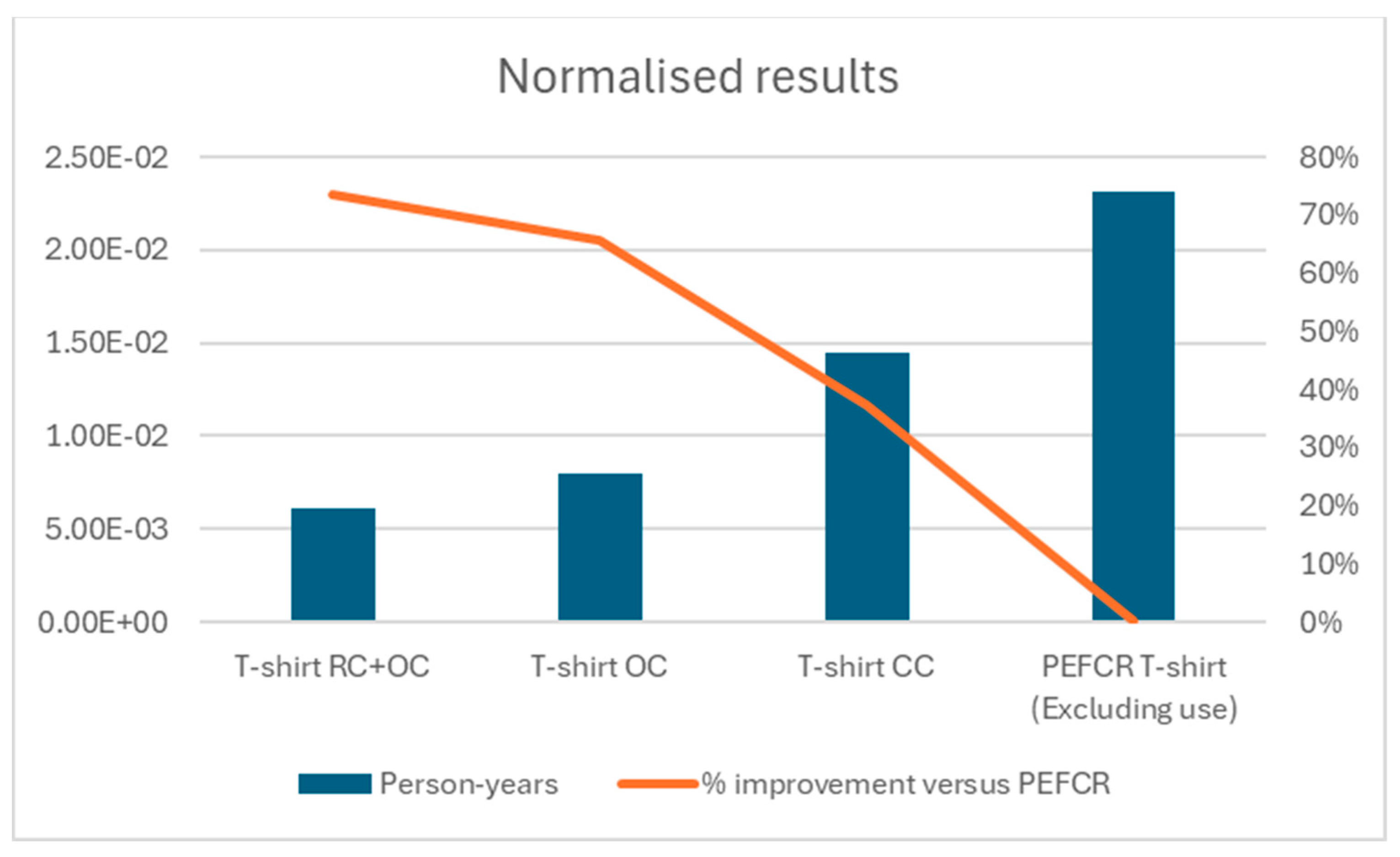
The normalization analysis demonstrates that the utilization of recycled cotton can lead to a 23% reduction in the environmental impact, when compared to the T-shirt manufactured solely with organic cotton. Furthermore, it exhibits a 58% improvement in environmental impact when contrasted with the T-shirt produced entirely from conventional cotton. These values are also compared with the PEFCR standard T-shirt, normalized for a T-shirt weighing 200 g, excluding the use phase, with emission of 10.6 kg CO2 eq/T-shirt and 0.0232 Person-years normalized environmental impact.
Scoring from A to E for enhanced consumer communication could be established by considering the normalized impact of the PEF-RP (Person-years), as the most adverse scenario (E). This figure reflects the typical environmental impact of a T-shirt in the current phase of defining new European Regulations, albeit not yet enforced. The optimal scenario (A) would hypothetically entail zero environmental impact, while B, C, and D denote incremental increases of 25% until reaching the worst-case scenario of E.
4. Discussion
Looking for KPIs to support the apparel sustainability scoring, that can give accurate insights to support the consumer decision at the point of sales, it was also possible to give a contribution to valorize the use of recycled cotton, the garments production in Europe and openLCA as open access software, for the calculation of the fashion products environmental burdens.
For the last few years, the Portuguese Government has been implementing several initiatives to reduce the use of Fossil resources in production, with a very positive impact on the reduction of GHG emissions. Modeling of the Portuguese electricity mix for the 2021 scenario improved the LCA results accuracy, since it is a hotspot for climate change, resulting in a reduction of 51% on the CO2 eq emission, when compared with the ecoinvent default electricity flow related to 2014 scenario. Portugal is world ranked at the 19th position of Low Carbon Power, which monitors the transition to low-carbon energy [34].
Production with virgin conventional cotton or organic cotton in Europe implies long-distance transport since local production is very limited. Although transport of the virgin fiber only has a 5% impact on the CO2 eq emission of the final product, this impact can be reduced to less than 3% when using the 50% of recycled fiber produced in Portugal. Comparing the impacts of each fiber at the lint gate, is possible to verify that recycled cotton lint has far less environmental impact with only 17% of the CO2 eq emission of the organic cotton and 5% of the conventional cotton, with consequent better environmental performance for the t-shirt made with a percentage of recycled cotton fibers.
Dyeing and finishing houses have the heaviest contribution to environmental burdens in T-shirt production, in the categories related with human toxicity and ecotoxicity, related with the intensive use of chemicals its processes. Some of the chemicals used were included on the existent generic flows according to the classification as inorganic or organic chemical products, after applying the suitable upstream process, so expected some uncertainty on these results.
The openLCA evaluation can be complemented with the verification of the chemical products datasheets against Manufacturing Restricted Substances Lists (MRSL) and for example the ZDHC MRSL [35].
Referring to the openLCA assessment, each 1 kg of T-shirt has a carbon footprint of 3.12 kg CO2 eq, this value was validated by the spreadsheet calculation based on open-source Emission factors, retrieving 2.98 kg CO2 eq/ kg. This 5% difference is acceptable, considering that openLCA integrates all the upstream impacts. With the validation of the GWP100, is assumed the validation of the accuracy of the remaining impact categories.
The environmental impact of one T-shirt was calculated considering the weight of 200 g per T-shirt and is summarized in Figure 9.
The proposed "Envi-Score" (A to E) is derived from the Nutri-Score, the nutritional rating system recommended by the European Commission to showcase the overall nutritional value of food products, well-recognized by consumers and widely adopted by retailers. It comprises five color categories (green, light green, yellow, orange, and red), correlating with the letters A (best) to E (worst), respectively. This scale aims to illustrate the environmental performance of products, facilitating quick and easy interpretation. By assigning an environmental score to each product, encompassing all environmental impacts into a single key performance indicator (KPI), consumer decision-making is simplified, also offering a comparison with a reference (PEF-RP, in this case). In this system, both T-shirts with 50% recycled cotton and 100% organic cotton achieved B grade while 100% conventional cotton T-shirt only got a C grade, showing lower overall environmental performance.
In addition to the environmental rating system, the label provides supplementary information regarding the product's carbon footprint, water usage, and land utilization, offering additional insights for consumer decisions when the sensitivity of the scale is insufficient to differentiate products with similar environmental performance. For instance, distinguishing between a T-shirt made with recycled cotton and one made solely with organic cotton, both achieving a B score, but with lower carbon footprint, water and land use in the first case.
Information about composition and product mass is incorporated into the environmental label, emphasizing the impact on environmental performance. Implementing such an environmental scoring and labeling system could effectively discourage greenwashing practices, prompting companies to innovate and produce products with lower environmental footprints compared to those commonly available at the time of the latest PEF-RP study update.
5. Conclusions
This paper summarizes the Life Cycle Assessment (LCA) calculations conducted using openLCA to examine the environmental impacts and environmental score of a T-shirt made in Portugal, containing 50% recycled cotton yarns, compared to an equivalent hypothetical T-shirt made solely with virgin cotton yarns (conventional or organic). The primary objective is to establish a set of Key Performance Indicators (KPIs) capable of summarizing the environmental performance of products for transparent communication to consumers.
Encouraging sustainable consumer behavior is not merely a suggestion but a legal requirement under new European legislation. Specifically, the legislation mandates the use of Life Cycle Assessment (LCA) to accurately assess the environmental impact of products. In industries like textiles, known for their significant pollution levels, comprehensive consumer information is now mandated to facilitate informed decision-making. Initiatives such as the Digital Product Passport are increasingly essential, offering consumers transparent details about a product's environmental footprint. Given the textile industry's importance in Portugal, it is imperative to swiftly adapt to these new requirements. However, Portugal also enjoys a competitive advantage in producing more sustainable textiles, thanks to factors such as reduced carbon footprint in electricity production and closed-loop integrated manufacturing processes covering all production stages. Virgin cotton fiber production in Portugal is limited, necessitating imports from distant regions with additional environmental footprints. This study demonstrates the potential for optimization through increased use of recycled cotton fibers.
Embracing these regulations presents Portugal with an opportunity not only to comply with legal obligations but also to bolster its position as a leader in sustainable textile production, potentially mitigating its disadvantage as a non-cotton-producing country through recyclability. This study only addresses "cradle to gate" environmental impacts, failing to demonstrate Portugal's advantage as a proximity producer to the European consumer market, with lower distribution impacts and small batch production tailored to demand, thus avoiding overproduction waste.
While estimating a product's impact on global warming can be done through a simple spreadsheet, openLCA, coupled with the ecoinvent database, significantly aids in calculating the environmental footprint of products by considering various impact categories. However, the drawback of openLCA lies in the cost of maintaining the database and the challenge of consumer comprehension.
In conclusion, the following KPIs and a template for the Environmental Label (Figure 10) are proposed to summarize the environmental performance of products:
- "Envi-Score": This KPI combines environmental impacts into a single metric by normalizing different impact categories into the same units (person-years) and comparison with the European reference defined at PEF-RP. It results in a scale from A (green) to E (red), aiming to illustrate product environmental performance for easy interpretation at the point of sale.
- Global Warming Potential expressed in grams of CO2 equivalent per product.
- Water use expressed in liters per product.
- Land use expressed in square meters of crop equivalent.
In the context of the energy transition, with the move towards fully decarbonized power supply, it is crucial to draw attention to other finite resources depleted during production, such as water consumption due to the threat of water scarcity and land use often associated with deforestation. Information about the "Bill of Materials" is included in the label, emphasizing the materials' impact on environmental performance, while the product's mass facilitates easier benchmarking.
Implementing such an environmental scoring and labeling system could effectively deter greenwashing practices, encouraging companies to innovate and develop products with reduced environmental footprints compared to those commonly available at the time of the latest PEF-RP study update. However, ensuring that the environmental performance of products can be accurately compared requires guaranteeing that these Key Performance Indicators (KPIs) are calculated using the same methodology and adhere to the same minimum requirements. This necessity can lead to exploring new areas of study, justified by the interest in expanding the scope of the analysis to include "cradle to grave" considerations and providing concrete information about product durability, in alignment with Product Environmental Footprint Category Rules (PEFCR), to enhance the conclusions. Additionally, emphasis is placed on the importance of establishing a dedicated process for assessing the toxicity of chemicals used in production, as well as addressing social aspects along the supply chain.
Author Contributions
Conceptualization, supervision, validation and revision C.S.; writing and editing, data curation, the investigation, formal analysis A.G. for OpenLCA and M.B. for carbon footprint Excel spreadsheet, M.N. data provider and verification.
Funding
This work was funded by the Portuguese Fundação para a Ciência e a Tecnologia (FCT) I.P./MCTES through national funds (PIDDAC) – UIDB/50019/2020 (https://doi.org/10.54499/UIDB/50019/2020), UIDP/50019/2020 (https://doi.org/10.54499/UIDP/50019/2020) and LA/P/0068/2020 (https://doi.org/10.54499/LA/P/0068/2020).
Institutional Review Board Statement
“Not applicable”
Informed Consent Statement
“Not applicable”
Acknowledgments
Special thanks to the data provided by Valérius 360 crucial for the life cycle inventory specific for Portugal.
Conflicts of Interest
The authors declare no conflict of interest.
References
- Comission, E. On Making Sustainable Products the Norm; 2022.
- European Commission EU Strategy for Sustainable and Circular Textiles; 2022.
- Comission, E. Proposal for a REGULATION OF THE EUROPEAN PARLIAMENT AND OF THE COUNCIL Establishing a Framework for Setting Ecodesign Requirements for Sustainable Products and Repealing Directive 2009/125/EC; 2022.
- European Commission Proposal for a DIRECTIVE OF THE EUROPEAN PARLIAMENT AND OF THE COUNCIL Amending Directives 2005/29/EC and 2011/83/EU as Regards Empowering Consumers for the Green Transition through Better Protection against Unfair Practices and Better Informatio; 2022.
- International Organization for Standardization ISO 14040 Environmental Management Life Cycle Assessment- Principles and Framework; 2006.
- International Organization for Standardization ISO 14044 Environmental Management, Life Cycle Assessment- Requirements and Guidelines; 2006.
- Gonçalves, A.; Silva, C. Looking for Sustainability Scoring in Apparel: A Review on Environmental Footprint, Social Impacts and Transparency. Energies 2021, 14, 3032. [Google Scholar] [CrossRef]
- McKinsey & Company Scaling Textile Recycling in Europe—Turning Waste into Value; 2022.
- Zhang, Y.; Liu, X.; Xiao, R.; Yuan, Z. Life Cycle Assessment of Cotton T-Shirts in China. Int. J. Life Cycle Assess. 2015, 20, 994–1004. [Google Scholar] [CrossRef]
- Kazan, H.; Akgul, D.; Kerc, A. Life Cycle Assessment of Cotton Woven Shirts and Alternative Manufacturing Techniques. Clean Technol. Environ. Policy 2020, 22, 849–864. [Google Scholar] [CrossRef]
- Textile Exchange The Life Cycle Assessment of Organic Cotton Fiber- Gobal Average; 2014.
- Cotton Incorportated Life Cycle Assessment of Cotton Fiber & Fabric Full Report; 2012.
- Liu, Y.; Huang, H.; Zhu, L.; Zhang, C.; Ren, F.; Liu, Z. Could the Recycled Yarns Substitute for the Virgin Cotton Yarns: A Comparative LCA. Int. J. Life Cycle Assess. 2020, 25, 2050–2062. [Google Scholar] [CrossRef]
- Pinto, C. da C.F. Life Cycle Assessment of a Fabric Knit Based on Conventional Cotton versus Recycled Cotton", Minho University, 2022.
- 360, V. Valerius 360. Available online: https://valerius360.pt/ (accessed on 19 October 2022).
- Pesnel, S.; Payet, J. Product Environmental Footprint Category Rules (PEFCR) T-Shirts; 2019.
- GreenDelta OpenLCA.
- ISO 14067:2018 Greenhouse Gases — Carbon Footprint of Products — Requirements and Guidelines for Quantification.
- WBCSD and WRI A Corporate Accounting and Reporting Standard. Revised Edition; 2013; ISBN 1-56973-568-9.
- UKDEFRA 2021 Government Greenhouse Gas Conversion Factors for Company Reporting. Methodology Paper for Conversion Factors Final Report.; 2021.
- Quantis; Sustainable Apparel Coalition Draft Product Environmental Footprint Category Rules (PEFCR)- Apparel and Footwear; 2021.
- REN Technical Data 21; Lisboa.
- Geologia, D.– D.G. de E. e Estatísticas Rápidas Das Renováveis; Lisbon, 2023.
- Institute of Mechanical Engineering and Industrial Management;; Portuguese Renewable Energy Association Wind Farms in Portugal; 2019.
- RIVM- National Institute for Public Health and the Environment ReCiPe 2016 v1.1; Bilthoven- The Netherlands, 2017.
- European Commission - Joint Research Centre - Institute for Environment and Sustainability Global Normalisation Factors for the Environmental Footprint and Life Cycle Assessment; 2017.
- Ritchie, H.; Rosado, P.; Roser, M. Carbon Intensity of Electricity Generation Part of the Following Publication (2023) - “Energy” Data Adapted from Ember, Energy Institute. Available online: https://ourworldindata.org/grapher/carbon-intensity-electricity (accessed on 12 February 2024).
- Prussi, M.; Yugo, M.; De Prada, L.; Padella, M.; Edwards, R. JEC Well-to-Tank Report 5; 2020.
- Prussi, M.; Yugo, M.; De Prada, L.; Padella, M.; Edwards, R. JEC Well-To-Wheels Report v5 Appendix 1-Pathways 1 Oil and Gas; 2020.
- Department for Business, E.& I.S.; Department for Energy Security & Net Zero Greenhouse Gas Reporting: Conversion Factors 2021; 2021.
- International Energy Agency Tracking Chemicals. Available online: https://www.iea.org/energy-system/industry/chemicals (accessed on 12 February 2024).
- Huijbregts, M.A.J.; Steinmann, Z.J.N.; Elshout, P.M.F.; Stam, G.; Verones, F.; Vieira, M.; Zijp, M.; Hollander, A.; van Zelm, R. ReCiPe2016: A Harmonised Life Cycle Impact Assessment Method at Midpoint and Endpoint Level. Int. J. Life Cycle Assess. 2017, 22, 138–147. [Google Scholar] [CrossRef]
- Edelen, A.; Ingwersen, W. Guidance on Data Quality Assessment for Life Cycle Inventory Data; 2016.
- Power, L.C. Low Carbon Power- Ranking. Available online: https://lowcarbonpower.org/ranking (accessed on 10 December 2023).
- ZDHC ZDHC Manufacturing Restricted Substance List. Available online: https://mrsl.roadmaptozero.com/ (accessed on 5 December 2023).
Figure 1.
Outcomes of the query search in the Web of Science TM Core collection.
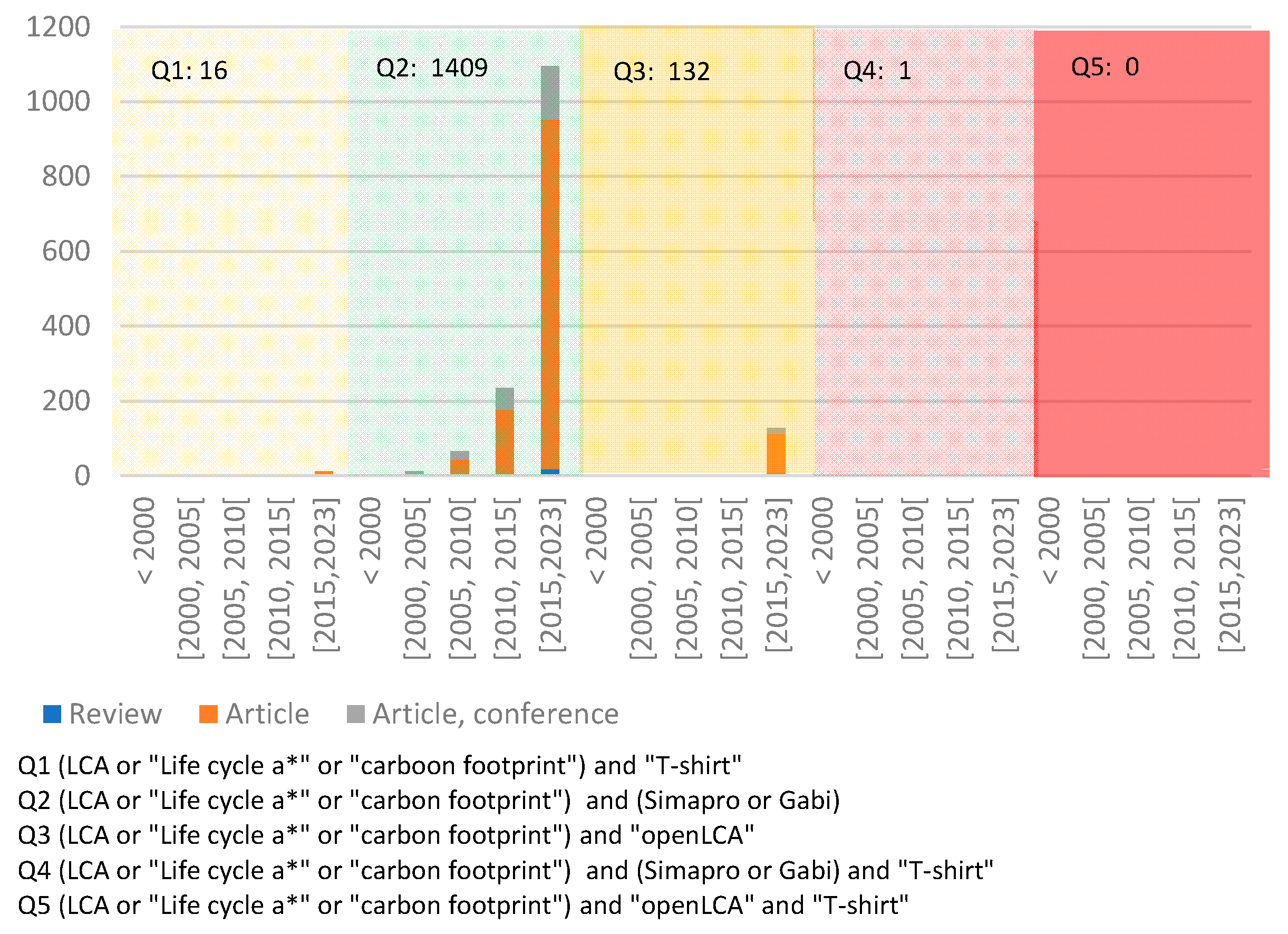
Figure 3.
Relative impact category results of the respective project variants: recycled cotton fiber (Rec Cotton ), organic cotton fiber (Org Cotton), and conventional cotton fiber (Conv Cotton).
Figure 3.
Relative impact category results of the respective project variants: recycled cotton fiber (Rec Cotton ), organic cotton fiber (Org Cotton), and conventional cotton fiber (Conv Cotton).
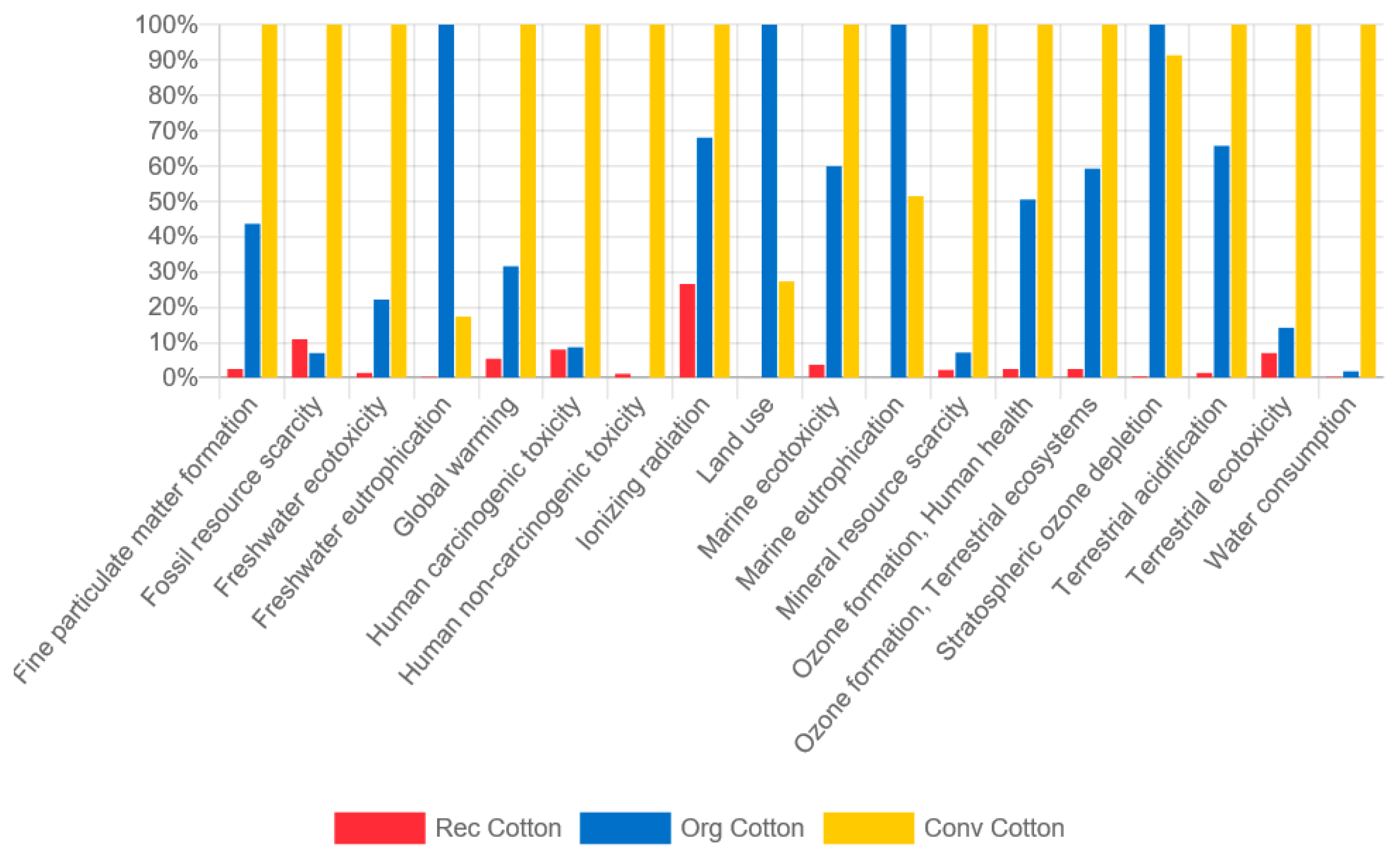
Figure 4.
This figure shows the LCIA results of the project variants for each LCA impact category. For each indicator, the maximum result is set, and the results of the other variants are displayed to this result. In the graphic, a larger area represents a higher environmental impact.
Figure 4.
This figure shows the LCIA results of the project variants for each LCA impact category. For each indicator, the maximum result is set, and the results of the other variants are displayed to this result. In the graphic, a larger area represents a higher environmental impact.
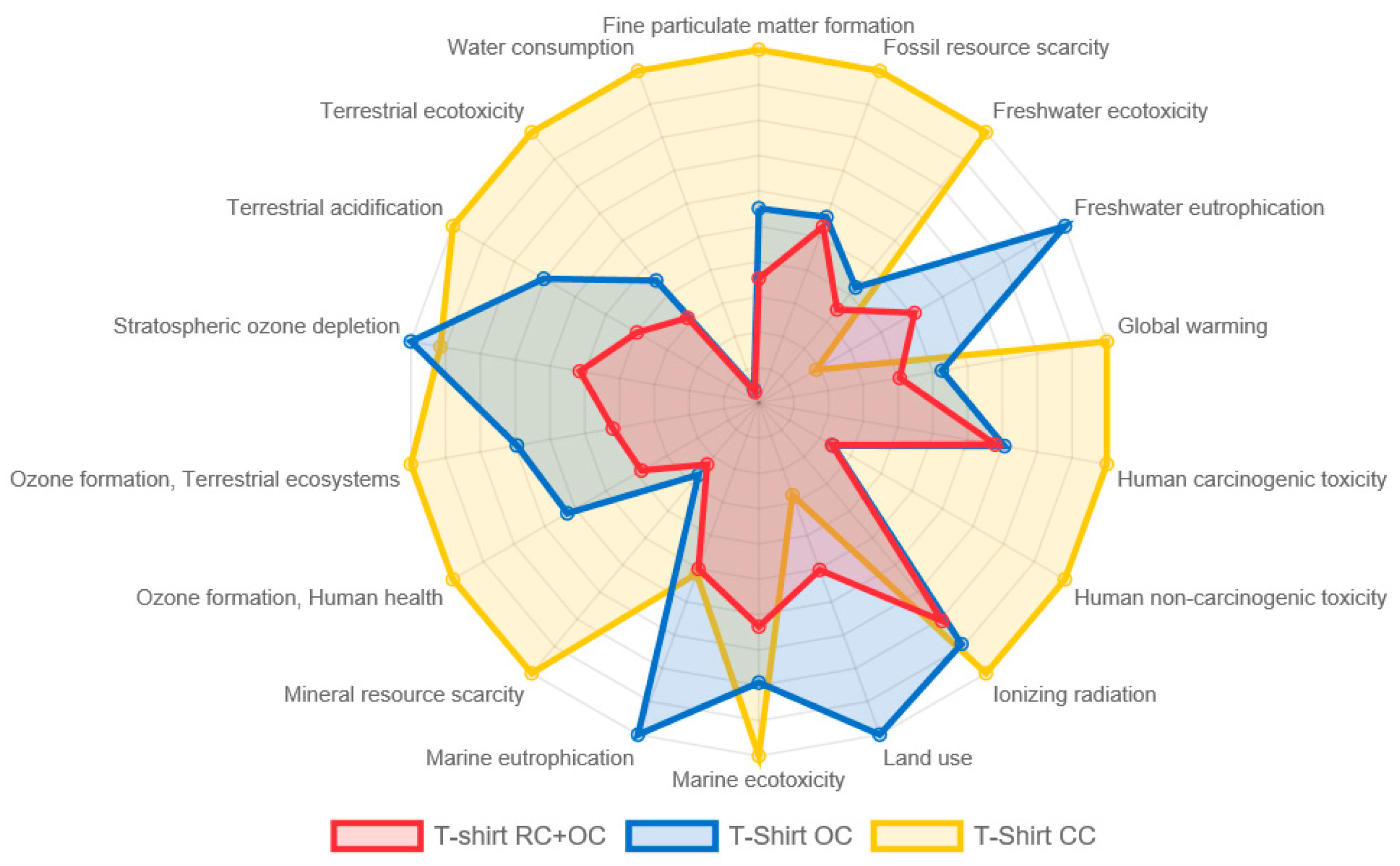
Figure 5.
Impact per process of the T-shirt made with 50% recycled cotton and 50% organic cotton.
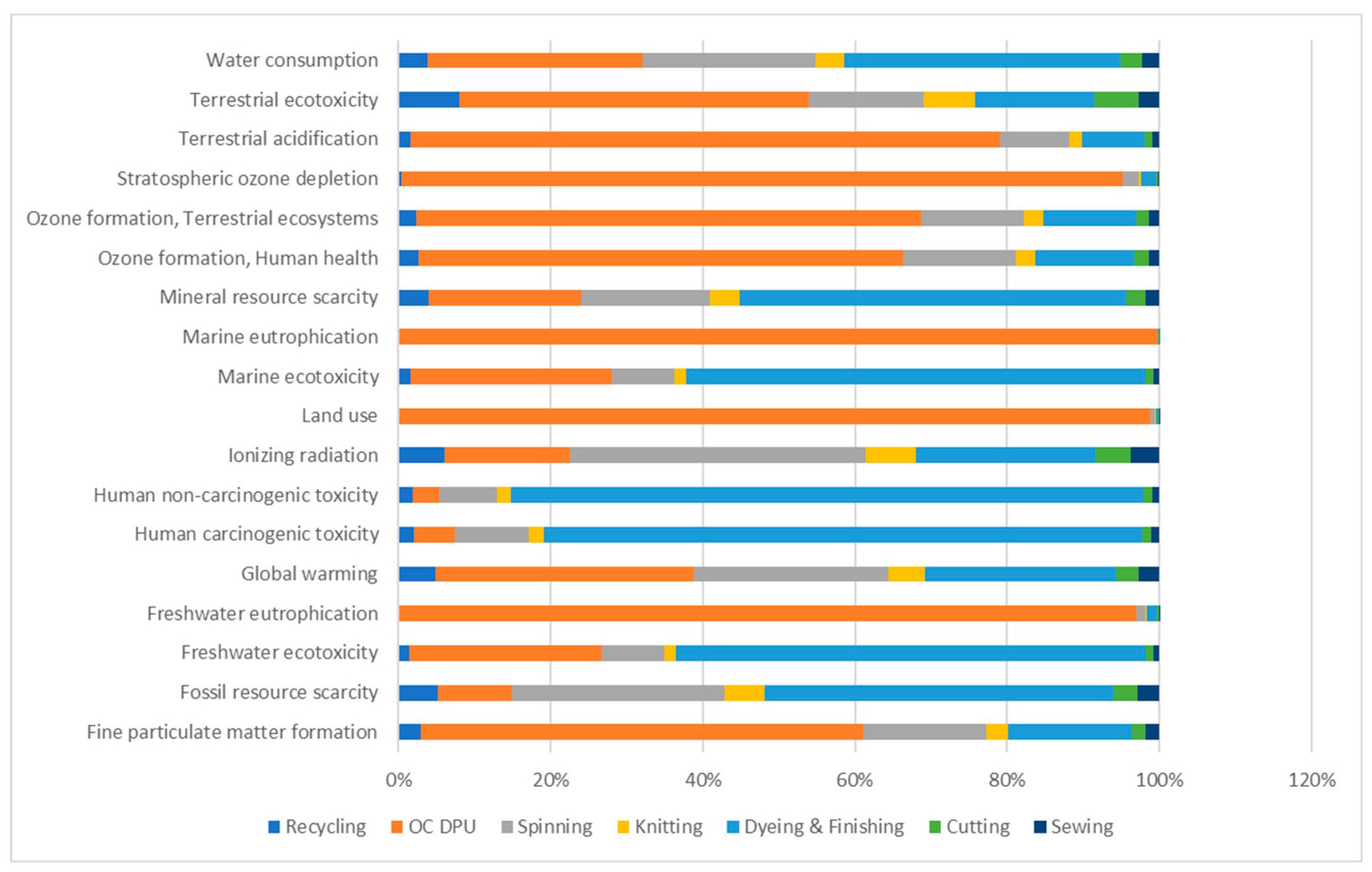
Figure 7.
a) Percentage of GWP100 impact per type per flow; (b) Percentage of GWP100 impact per type per process and comparison of the speadsheet and openLCA results. Organic Cotton (DPU) represents the impact generated by the organic lint cultivation, ginning and transportation from Turkey to recycling facility.
Figure 7.
a) Percentage of GWP100 impact per type per flow; (b) Percentage of GWP100 impact per type per process and comparison of the speadsheet and openLCA results. Organic Cotton (DPU) represents the impact generated by the organic lint cultivation, ginning and transportation from Turkey to recycling facility.
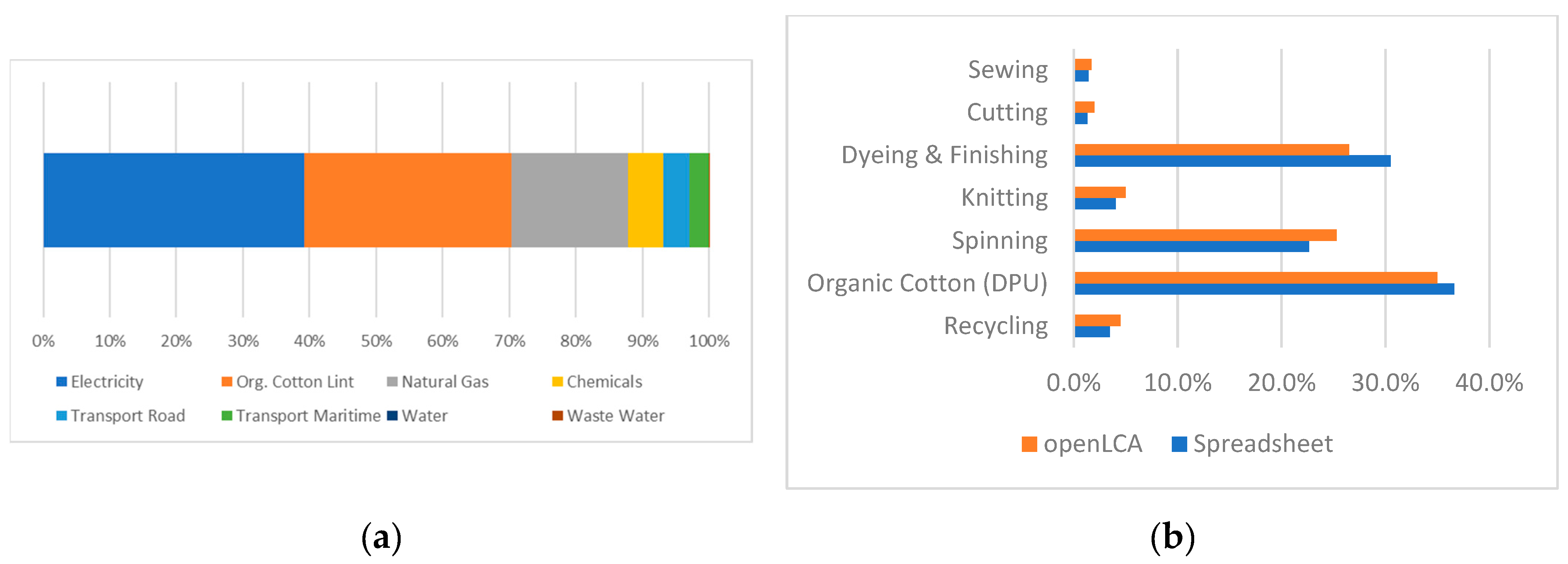
Figure 9.
Proposal for product labeling to inform consumers about the environmental impact of the T-shirt, through an environmental score (A to E) based on the KPI, normalized environmental impact, and the quantified KPIs carbon footprint, water use, and land use. These results are for the cradle-to-gate production, and don’t consider the use phase.
Figure 9.
Proposal for product labeling to inform consumers about the environmental impact of the T-shirt, through an environmental score (A to E) based on the KPI, normalized environmental impact, and the quantified KPIs carbon footprint, water use, and land use. These results are for the cradle-to-gate production, and don’t consider the use phase.
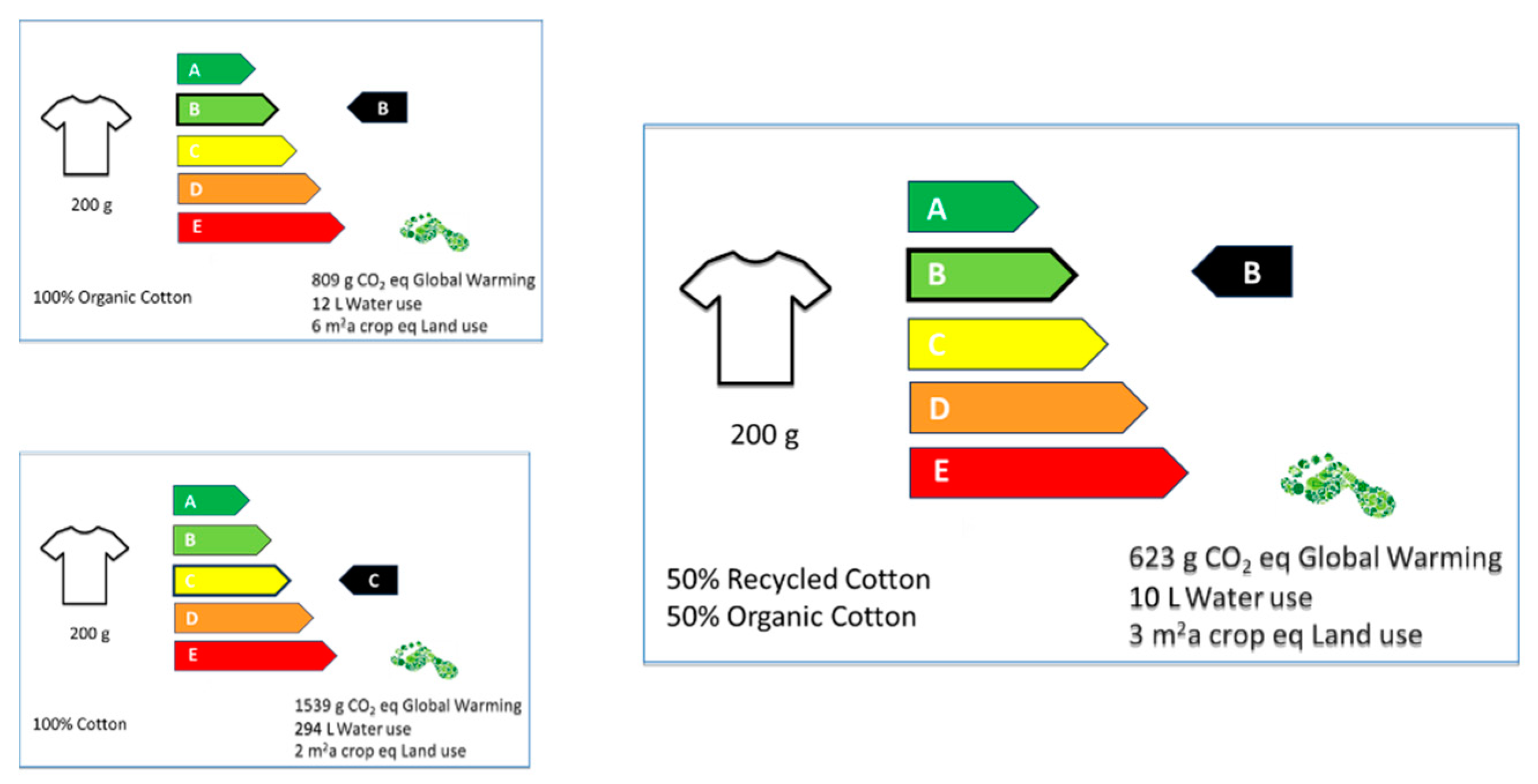
Figure 10.
Proposed template for Environmental Label.
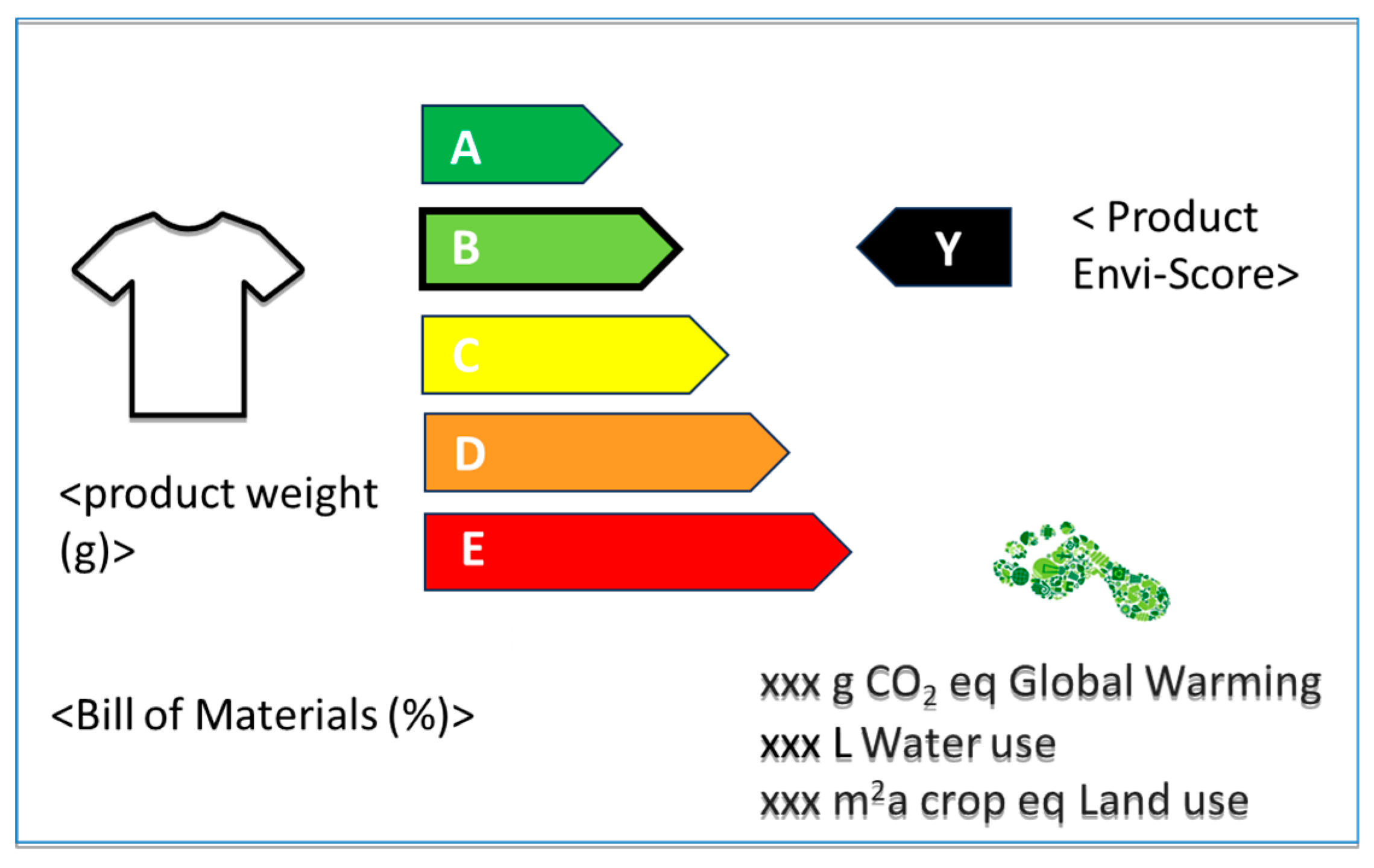
Table 1.
Inventory of inputs and outputs of the processes considered in the study boundaries.
| Process | Flow | Units | Quantity per T-shirt kg |
| INPUTS | |||
| Recycling | Electrical Energy- grid | kWh | 3.82E-01 |
| Water | kg | 2.50E-02 | |
| Textile Waste | kg | 1.12E+00 | |
| Chemical product- Softener | kg | 9.95E-04 | |
| Transport road | km | 5.00E+01 | |
| Organic Cotton | Organic cotton lint | kg | 9.50E-01 |
| at Spinning Unit | Transport road | km | 2.51E+02 |
| Transport container Turkey | km | 4.56E+03 | |
| Spinning | Electrical Energy- grid | kWh | 2.98E+00 |
| Natural Gas | Nm3 | 7.02E-03 | |
| Chemical product- Paraffin | kg | 4.47E-03 | |
| Knitting | Electrical Energy- grid | kWh | 4.80E-01 |
| Electrical Energy- solar | kWh | 2.20E-01 | |
| Transport road | km | 2.80E+01 | |
| Dyeing & Finishing | Electrical Energy- grid | kWh | 1.13E+00 |
| Electrical Energy- solar | kWh | 4.15E-01 | |
| Natural Gas | Nm3 | 2.26E-01 | |
| Water | kg | 1.80E+00 | |
| Transport road | km | 1.50E+01 | |
| Chemical product- Organic | kg | 3.24E-02 | |
| Chemicals Product- Inorganic | kg | 3.40E-03 | |
| Chemical Product- Softener | 5.25E-02 | ||
| Chemical Product- Hydroxide Peroxide | kg | 1.82E-02 | |
| Chemical Product- Sodium Hydroxide | kg | 4.54E-03 | |
| Chemical Product- Acetic Acid (80%) | kg | 1.82E-03 | |
| Cutting | Electrical Energy- grid | kWh | 1.69E-01 |
| Plastic | kg | 1.35E-02 | |
| Paper | kg | 1.17E-02 | |
| Transport road | km | 5.00E+00 | |
| Sewing | Electrical Energy- grid | kWh | 1.92E-01 |
| OUTPUTS * | |||
| Recycling | Textile waste | kg | 1.70E-01 |
| Spinning | Textile waste | kg | 1.90E-01 |
| Knitting | Textile waste | kg | 3.00E-02 |
| Dyeing &Finishing | Waste Water | kg | 2.55E+00 |
| Textile waste | kg | 1.70E-01 | |
| Cutting | Textile waste | kg | 2.60E-01 |
| Plastic | kg | 1.35E-02 | |
| Paper | kg | 1.17E-02 | |
| Sewing | Textile waste | kg | 2.50E-01 |
| All | Textile Waste (total) | kg | 1.07E+00 |
* except air emissions
Table 2.
openLCA flows and their providers considered for the study.
| openLCA Flows | Providers |
| acetic acid, without water, in 98% solution state | acetic acid production, product in 98% solution state | acetic acid, without water, in 98% solution state | APOS, U – RER |
| calendering, rigid sheets | calendering, rigid sheets | calendering, rigid sheets | APOS, U - RER |
| chemical, inorganic | market for chemicals, inorganic | chemical, inorganic | APOS, U - GLO |
| chemical, organic | market for chemical, organic | chemical, organic | APOS, U – GLO |
| electricity, medium voltage | market for electricity, medium voltage | electricity, medium voltage | APOS, U 2021 - PT |
| fibre, cotton, organic | fibre production, cotton, organic, ginning | fibre, cotton, organic | APOS, U - RoW |
| fibre, cotton | fibre production, cotton, ginning | fibre, cotton | APOS, U – RoW |
| hydrogen peroxide, without water, in 50% solution state | market for hydrogen peroxide, without water, in 50% solution state | hydrogen peroxide, without water, in 50% solution state | APOS, U - RER |
| kraft paper | market for kraft paper | kraft paper | APOS, U - RER |
| natural gas, low pressure | market for natural gas, low pressure | natural gas, low pressure | APOS, U - RoW |
| Paraffin | market for paraffin | paraffin | APOS, U - GLO |
| silicone product | market for silicone product | silicone product | APOS, U – RER |
| sodium hydroxide, without water, in 50% solution state | market for sodium hydroxide, without water, in 50% solution state | sodium hydroxide, without water, in 50% solution state | APOS, U - GLO |
| tap water | market for tap water | tap water | APOS, U - Europe without Switzerland |
| transport, freight, lorry 3.5-7.5 metric ton, EURO6 | transport, freight, lorry 3.5-7.5 metric ton, EURO6 | transport, freight, lorry 3.5-7.5 metric ton, EURO6 | APOS, U - RoW |
1 RER- European market; GLO- Global market; RoW- Rest of the world.
Table 4.
Emission factors applied for the GWP100 calculation.
| Flow | Emission Factors | Unit [kg CO2 eq] | Source |
| Electricity | 0.219 | /kWh | [27] |
| Natural Gas | 3.128 | /kg |
[28,29] Equation (2) |
| Well to Talk | 0.528 | /kg | |
| Direct emissions | 2.6 | /kg | |
| Water | 0.149 | /m3 | [30] |
| Wastewater | 0.272 | /m3 | [30] |
| Chemicals | 1.3 | / kg1 | [31] |
| Transport road2 | 3.23E-04 | /kg.km | [30] |
| Well to tank | 5.91E-05 | /kg.km | |
| Direct emissions | 2.64E-04 | /kg.km | |
| Transport Maritime3 | 1.97E-05 | /kg.km | [30] |
| Well to tank | 3.63E-06 | /kg.km | |
| Direct emissions | 1.61E-05 | /kg.km | |
| Organic cotton lint | 0.978 | /kg | [11] |
1 Primary chemical; 2 Heavy goods vehicle (>3.5 -7.5 Tonnes) 100%; 3 Container ship average.
Table 5.
Inventory for each supply chain process per 1 kg T-shirt.
| Process | Electricity (kWh) | Natural Gas (kg) | Water (m3) | Chemicals (kg) | Wastewater (m3) | Transport Road (kg.km) | Transport Maritime (kg.km) | Org. Cotton Lint (kg) |
| Recycling | 3.82E-01 | 0 | 2.50E-05 | 9.95E-04 | - | 5.60E+01 | - | 9,50E-01 |
| Organic Cotton at Spinning unit | - | - | - | - | - | 2.38E+02 | 4.33E+03 | |
| Spinning | 2.98E+00 | 5.02E-03 | - | 4.47E-03 | - | - | - | |
| Knitting | 4.80E-01 | - | - | - | - | 4.77E+01 | - | |
| Dyeing & Finishing | 1.13E+00 | 1.62E-01 | 1.80E-03 | 1.13E-01 | 2.55E-03 | 2.52E+01 | - | |
| Cutting | 1.69E-01 | - | - | - | - | 7.57E+00 | - | |
| Sewing | 1.92E-01 | - | - | - | - | - | - | |
| Total | 5.33E+00 | 1.67E-01 | 1.83E-03 | 1.18E-01 | 2.55E-03 | 3.74E+02 | 4.33E+03 | 9,50E-01 |
Table 6.
Environmental impact for Portuguese electricity production mix, in 2021 (per kWh).
| Indicator | Impact Result | Unit |
| Fine particulate matter formation | 0.000 | kg PM 2.5 eq |
| Ionizing radiation | 0.035 | kBq Co-60 eq |
| Fossil resource scarcity | 0.080 | kg oil eq |
| Freshwater ecotoxicity | 0.004 | kg 1,4-DCB |
| Stratospheric ozone depletion | 0.000 | kg CFC11 eq |
| Human non-carcinogenic toxicity | 0.063 | kg 1,4-DCB |
| Freshwater eutrophication | 0.000 | kg P eq |
| Marine eutrophication | 0.000 | kg N eq |
| Marine ecotoxicity | 0.005 | kg 1,4-DCB |
| Land use | 0.027 | m2a crop eq |
| Water consumption | 0.003 | m3 |
| Terrestrial acidification | 0.001 | kg SO2 eq |
| Terrestrial ecotoxicity | 0.190 | kg 1,4-DCB |
| Ozone formation, Terrestrial ecosystems | 0.001 | kg NOx eq |
| Human carcinogenic toxicity | 0.013 | kg 1,4-DCB |
| Ozone formation, Human health | 0.000 | kg NOx eq |
| Mineral resource scarcity | 0.000 | kg Cu eq |
| Global warming | 0.237 | kg CO2 eq |
Table 7.
Total environmental impact of transport on the global process (including virgin fiber importation and transportation within local production units).
Table 7.
Total environmental impact of transport on the global process (including virgin fiber importation and transportation within local production units).
| Indicator | Imported fiber | Local | Total | Unit |
| Fine particulate matter formation | 0.000 | 0.000 | 0.000 | kg PM 2.5 eq |
| Fossil resource scarcity | 0.053 | 0.023 | 0.076 | kg oil eq |
| Freshwater ecotoxicity | 0.004 | 0.002 | 0.006 | kg 1,4-DCB |
| Freshwater eutrophication | 0.000 | 0.000 | 0.000 | kg P eq |
| Global warming | 0.162 | 0.070 | 0.232 | kg CO2 eq |
| Human carcinogenic toxicity | 0.014 | 0.006 | 0.020 | kg 1,4-DCB |
| Human non-carcinogenic toxicity | 0.096 | 0.053 | 0.148 | kg 1,4-DCB |
| Ionizing radiation | 0.004 | 0.002 | 0.007 | kBq Co-60 eq |
| Land use | 0.004 | 0.002 | 0.006 | m2a crop eq |
| Marine ecotoxicity | 0.006 | 0.003 | 0.009 | kg 1,4-DCB |
| Marine eutrophication | 0.000 | 0.000 | 0.000 | kg N eq |
| Mineral resource scarcity | 0.000 | 0.000 | 0.001 | kg Cu eq |
| Ozone formation, Human health | 0.001 | 0.000 | 0.001 | kg NOx eq |
| Ozone formation, Terrestrial ecosystems | 0.001 | 0.000 | 0.001 | kg NOx eq |
| Stratospheric ozone depletion | 0.000 | 0.000 | 0.000 | kg CFC11 eq |
| Terrestrial acidification | 0.001 | 0.000 | 0.001 | kg SO2 eq |
| Terrestrial ecotoxicity | 1.122 | 0.589 | 1.712 | kg 1,4-DCB |
| Water consumption | 0.000 | 0.000 | 0.000 | m3 |
Table 8.
Environmental impact of each cotton fiber at the production location (per 1 kg fiber).
| Indicator- Cotton Fiber | Recycled | Organic | Conventional | Unit |
| Fine particulate matter formation | 0.000 | 0.003 | 0.007 | kg PM 2.5 eq |
| Fossil resource scarcity | 0.051 | 0.033 | 0.469 | kg oil eq |
| Freshwater ecotoxicity | 0.005 | 0.082 | 0.369 | kg 1,4-DCB |
| Freshwater eutrophication | 0.000 | 0.012 | 0.002 | kg P eq |
| Global warming | 0.155 | 0.903 | 2.859 | kg CO2 eq |
| Human carcinogenic toxicity | 0.010 | 0.011 | 0.122 | kg 1,4-DCB |
| Human non-carcinogenic toxicity | 0.064 | 0.004 | 5.573 | kg 1,4-DCB |
| Ionizing radiation | 0.018 | 0.045 | 0.067 | kBq Co-60 eq |
| Land use | 0.014 | 14.636 | 4.001 | m2a crop eq |
| Marine ecotoxicity | 0.007 | 0.110 | 0.183 | kg 1,4-DCB |
| Marine eutrophication | 0.000 | 0.024 | 0.012 | kg N eq |
| Mineral resource scarcity | 0.000 | 0.001 | 0.011 | kg Cu eq |
| Ozone formation, Human health | 0.000 | 0.006 | 0.012 | kg NOx eq |
| Ozone formation, Terrestrial ecosystems | 0.000 | 0.007 | 0.012 | kg NOx eq |
| Stratospheric ozone depletion | 0.000 | 0.000 | 0.000 | kg CFC11 eq |
| Terrestrial acidification | 0.000 | 0.021 | 0.032 | kg SO2 eq |
| Terrestrial ecotoxicity | 0.384 | 0.776 | 5.483 | kg 1,4-DCB |
| Water consumption | 0.002 | 0.014 | 0.757 | m3 |
Table 9.
This table shows the LCA results of the project variants: T-shirt made with 50% recycled cotton (RC) and 50% organic cotton (OC), a T-shirt made with 100% organic cotton and a T-shirt made with 100% conventional cotton (CC) . Each selected LCA category is displayed in rows and the project variants are in the columns. Values are presented per 1kg white T-shirt.
Table 9.
This table shows the LCA results of the project variants: T-shirt made with 50% recycled cotton (RC) and 50% organic cotton (OC), a T-shirt made with 100% organic cotton and a T-shirt made with 100% conventional cotton (CC) . Each selected LCA category is displayed in rows and the project variants are in the columns. Values are presented per 1kg white T-shirt.
| Indicator | T-shirt 50%RC+50%OC | T-shirt 100%OC | T-shirt 100%CC | Unit |
| Fine particulate matter formation | 0.01 | 0.01 | 0.02 | kg PM 2.5 eq |
| Fossil resource scarcity | 0.97 | 1.03 | 1.83 | kg oil eq |
| Freshwater ecotoxicity | 0.33 | 0.40 | 0.95 | kg 1,4-DCB |
| Freshwater eutrophication | 0.01 | 0.02 | 0.00 | kg P eq |
| Global warming | 3.12 | 4.05 | 7.70 | kg CO2 eq |
| Human carcinogenic toxicity | 0.48 | 0.50 | 0.70 | kg 1,4-DCB |
| Human non-carcinogenic toxicity | 3.32 | 3.39 | 13.94 | kg 1,4-DCB |
| Ionizing radiation | 0.29 | 0.32 | 0.36 | kBq Co-60 eq |
| Land use | 14.11 | 28.00 | 7.79 | m2a crop eq |
| Marine ecotoxicity | 0.42 | 0.53 | 0.66 | kg 1,4-DCB |
| Marine eutrophication | 0.02 | 0.05 | 0.02 | kg N eq |
| Mineral resource scarcity | 0.01 | 0.01 | 0.03 | kg Cu eq |
| Ozone formation, Human health | 0.01 | 0.02 | 0.03 | kg NOx eq |
| Ozone formation, Terrestrial ecosystems | 0.01 | 0.02 | 0.03 | kg NOx eq |
| Stratospheric ozone depletion | 0.00 | 0.00 | 0.00 | kg CFC11 eq |
| Terrestrial acidification | 0.03 | 0.05 | 0.07 | kg SO2 eq |
| Terrestrial ecotoxicity | 4.75 | 6.84 | 15.14 | kg 1,4-DCB |
| Water consumption | 0.05 | 0.06 | 1.47 | m3 |
Table 10.
Carbon Footprint of 1 kg T-shirt made with 50% Recycled Cotton and 50% Organic Cotton.
| GWP100 kg CO2 eq/ kg | Electricity | Natural Gas | Water | Chemicals | Wastewater | Transport Road | Transport Maritime | Org. Cotton Lint |
| Recycling | 8.37E-02 | 3.73E-06 | 1.29E-03 | - | 1.81E-02 | - | ||
| Organic Cotton at Spinning unit | - | - | - | - | - | 7.60E-02 | 8.55E-02 | 9.29E-01 |
| Spinning | 6.53E-01 | 1.57E-02 | - | 5.81E-03 | - | - | - | |
| Knitting | 1.05E-01 | - | - | - | - | 1.54E-02 | - | |
| Dyeing & Finishing | 2.47E-01 | 5.06E-01 | 2.68E-04 | 1.47E-01 | 6.94E-04 | 8.14E-03 | - | |
| Cutting | 3.70E-02 | - | - | - | - | 2.45E-03 | - | |
| Sewing | 4.20E-02 | - | - | - | - | - | - | |
| Total | 1.17E+00 | 5.22E-01 | 2.72E-04 | 1.54E-01 | 6.04E-04 | 1.21E01 | 8.55E02 | 9.29E-01 |
Disclaimer/Publisher’s Note: The statements, opinions and data contained in all publications are solely those of the individual author(s) and contributor(s) and not of MDPI and/or the editor(s). MDPI and/or the editor(s) disclaim responsibility for any injury to people or property resulting from any ideas, methods, instructions, or products referred to in the content. |
© 2024 by the authors. Licensee MDPI, Basel, Switzerland. This article is an open access article distributed under the terms and conditions of the Creative Commons Attribution (CC BY) license (http://creativecommons.org/licenses/by/4.0/).
Copyright: This open access article is published under a Creative Commons CC BY 4.0 license, which permit the free download, distribution, and reuse, provided that the author and preprint are cited in any reuse.