

Submitted:
06 May 2024
Posted:
07 May 2024
You are already at the latest version
Abstract
Household waste is the primary source of environmental pollution due to global population growth compared to other sources of waste. This research aims to develop a smart and integrated household waste management system framework. The resulting framework not only focuses on dimensions of information technology but also links it with other integrated dimensions. This research attempts to conduct a Systematic Literature Review (SLR) using the Preferred Reporting Items for Systematic Review and Meta-analysis (PRISMA) protocol to produce a smart and integrated household waste management framework. The framework's design is carried out by identifying the type of household waste management process based on the Integrated Sustainable Waste Management (ISWM) framework, dimensions that support smart household waste management, and stakeholders involved. The SLR results, namely dimensions and subdimensions that support the framework of a smart and integrated household waste management system, were validated by a resource person from the Indonesian Ministry of Environment and Forestry. The smart and integrated household waste management framework that has been developed in this research contains five main dimensions: Information Technology, Operational Infrastructure, Governance, Economy, and Social-culture. This framework also addresses stakeholder engagement to support smart household waste management systems and identifies waste management processes based on the ISWM framework. This research uses the PRISMA technique to provide a framework for smart and integrated household waste management systems in the initial stage. The proposed framework has been validated and can be further developed as a smart and integrated household waste management system. This research also contributes to the involvement of various dimensions identified to deal with waste problems.
Keywords:
smart household waste management system
; integrated household waste management system
; household waste
; framework
; integrated sustainable waste management
; PRISMA
1. Introduction
As the global population increases, household waste has become the primary source of environmental pollution compared to other types of waste from other sources [1]. Increasing the living standard and community welfare level without appropriate waste management infrastructure can trigger an increase in household waste [2]. The increase in household waste is also a contribution from unsustainable patterns of production and consumption, which is one of the concerns in Sustainable Development Goals (SDG) 13. A significant increase in household waste without proper management can lead to problems such as environmental damage and endangering human health [3]. Improper management of household waste can have an impact on human health; namely, it can cause injury to the body due to the effects of radiation or chemical content of waste, problems in psychological and social dimensions due to waste issues, long-term non-communicable diseases such as cancer, and diseases due to biological dimension such as outbreaks of worm infections, diarrhea, dysentery, or skin irritation [4]. Meanwhile, proper household waste management can reduce greenhouse gas emissions and support the achievement of carbon neutrality [5].The United Nations (UN) stated that efforts to support household waste management are the goals of the 12th SDG, namely responsible consumption and production [6].
Managing household waste in various countries requires various efforts, including using a smart system. A smart system for managing household waste can be a tool for achieving sustainability goals by reducing waste, increasing awareness and education, improving the economy, and developing information technology infrastructure. A smart system uses information technology components and data to address household waste problems [7]. Based on the Integrated Sustainable Waste Management (ISWM) framework, there are 11 waste management processes: generation, separation, collection, transfer, transport, treatment, disposal, reduction, reuse, recycling, and recovery [8]. Each process is expected to be supported by smart and integrated waste management. Previous research has shown that smart systems may be used to assist in the separation of household waste through The Convolution Neural Network (CNN) algorithm and machine vision technology through as system interface [9]. Apart from using smart systems for waste separation, this research also identifies smart systems for household waste collection from previous research. Chile has optimized the placement of waste collection locations by using network design systems that use the Large Neighbourhood Search (LNS) heuristic and the Mixed Integer Linear Programming (MILP) model [10]. Prior research has also made an effort to address the issue of household waste by designing a smart system for the waste transport process. Previous research has attempted to model the problem of stair waste collection through the design of travel routes for waste trucks in Portugal using the generalization of the Mixed Capacitated Arc Routing Problem (MCARP) and Geographic Information System (GIS) [11].
Smart systems can also be applied to other household waste management processes, such as waste recycling, waste disposal, or prediction of future waste generation. The use of a smart system in the recycling process is carried out by building an IoT-based recycling bin prototype that can detect the level of waste density and the decomposition process [12]. Other research has used the Analytical Hierarchy Process (AHP) and GIS methods to make decisions on household waste disposal management [13]. Forecasting to predict waste generation aim to support waste management planning. A deep learning approach using a multi-site Long Short Term Memory (LSTM) neural network was used to estimate the level of household waste generation in Denmark [14]. Machine learning modelling can predict waste generation in residential areas in Vietnam by identifying variables such as waste generation characteristics, demographics, economic level, and community consumption levels (Nguyen et al., 2021). The ensemble learning approach can also be used to predict waste generation and has been proven to be more accurate than other individual machine learning approaches [15].
Smart systems for household waste management are identified from previous research attempts to solve waste problems from just one process or part of the process. A smart system that facilitates all household waste management processes in an integrated manner has the potential to monitor and optimize waste management activities. Based on previous research, implementing a smart system in managing household waste has been proven to be able to reduce the amount of waste produced. Previous research has yet to be found that has developed a framework for smart and integrated household waste management for all processes. A framework for a smart and integrated household waste management system helps design, implement, and evaluate waste management strategies systematically. Strategies are useful for guiding actions and determining structured decisions regarding household waste handling. Smart systems for managing household waste identified from previous research attempt to complete only one or part of the process. This research attempts to conduct a Systematic Literature Review (SLR) using the Preferred Reporting Items for Systematic Review and Meta-analysis (PRISMA) protocol to produce a framework of smart and integrated household waste management. The design of the framework is carried out by first identifying the type of household waste management process based on the ISWM framework, dimension that support smart household waste management system, and stakeholders involved. The framework developed is integrated because it involves the entire waste management process and system integration. The primary dimension that has been identified are then used to design a framework of smart household waste management.
Aside from identifying primary dimensions, this research also identifies waste management processes and data. Identification of waste management processes aims to improve the performance of smart systems in waste management [16,17], the effectiveness of waste management resource allocation [18], and opportunities for process integration with smart systems such as sensors [19], machine learning algorithms [20], and communication network technologies [21]. Meanwhile, identifying data managed by smart waste management can support real-time monitoring to determine appropriate actions for waste management [18], determine more efficient management through optimizing waste transport vehicle routes [11], and the development of IoT-based solutions [22]. Identification of technology dimension based on processes and data is intended to support the framework of a smart and integrated household waste management system.
This research has four research questions, namely:
- RQ1. What types of household waste management processes are supported by smart waste management?
- RQ2. What dimensions support smart waste management for managing household waste?
- RQ3. What are the information technology subdimensions that support smart waste management for managing household waste?
- RQ4. What is a framework for a smart and integrated household waste management system?
The results of this research can be used as framework to be implemented in smart and integrated household waste management system for stakeholders. The framework of smart and integrated household waste management helps design sustainable development strategies [23]. In addition, a smart and integrated household waste management system can support policies for handling waste, appropriate waste management technology, and decision-making processes to support sustainable development goals (SDGs) [24]. Stakeholders could implement this framework to reduce household waste. Apart from that, this framework can also support a circular economy through the availability of smart separation and collection devices. This device can help household actors support circular economy strategies, namely reducing the amount of waste generated, reusing waste into valuable goods, and improving the environment.
This literature review is divided into several parts. Part 1 explains the background of the smart waste management system for managing household waste. Section 2 explains the systematic literature review methodology, namely, using PRISMA, and validation method. Section 3 explains bibliometric analysis and the analysis of the framework of smart and integrated household waste management system. Section 4 presents the discussion of the framework of smart and integrated household waste management system. Section 5 presents conclusions, implications, and suggestions for future research.
2. Materials and Methods
This literature review was prepared based on the results of a systematic literature review (SLR), adapting the preferred reporting items for systematic reviews and meta-analyses (PRISMA) protocol. PRISMA is an appropriate protocol for conducting literature observations because it encourages reviewers to document their review plans carefully to avoid making arbitrary decisions [25]. This systematic literature review involved three team members to conduct a series of activities: compiling the manuscript, developing selection criteria and bias assessment strategies, carrying out data extraction, determining the search strategy, processing statistics, providing feedback, and approving the manuscript. The systematic literature review revealed no changes, so there are no amendments.
PRISMA consists of four main components: determining eligibility criteria, selecting articles that have been obtained, carrying out data extraction and determining the quality of articles to reduce the risk of bias, and carrying out data synthesis [26]. The first stage is determining eligibility criteria, including identifying the characteristics of previous research using the Participants, Intervention, Comparison, and Outcome (PICO) criteria. Appropriate PICO criteria can support the determination of specific research questions. The second stage is selecting articles that have been obtained, which can be done by determining the number of independent reviewers at each stage. The third stage is to extract data based on several information such as demographics, research methodology, scope, etc. In the third stage, activities are also carried out to determine the quality of articles in order to lessen the likelihood of bias. This stage uses the identification method to assess the risk due to bias from previous research. The final stage is to carry out data synthesis based on the outcomes of quantitative analysis. Figure 1 shows the stages of PRISMA
This research uses the help of the CADIMA device. CADIMA is an online tool that supports collaboration in conducting literature reviews using the PRISMA protocol [27]. Previous research from the first stage is then uploaded to CADIMA for selection. The first stage in CADIMA is a literature search, which includes determining search strings from several data sources and ensuring that previous research is duplicated. The second stage is study selection by selecting the criteria list & keywords, determining consistency checks, and determining checks based on title and abstract, and continuing with full text. The third stage is data extraction, which includes determining appraisal criteria and data extraction columns and implementing data extraction based on the criteria. In CADIMA, the critical appraisal results are shown in a specific color, indicating that previous research can be continued to the data synthesis stage. The fourth stage is data synthesis based on the results of critical appraisal and extraction columns. At the end of the stage, CADIMA presented the SLR outcomes that have been carried out in the form of flow diagrams and data files.
The supporting dimensions and subdimensions of the framework for the smart household waste management system obtained from the SLR were then validated using questionnaire and interview methods. The resource person involved in the validation stage were environmental extension staff from the Directorate of Waste Management at the Indonesian Ministry of Environment and Forestry. The Indonesian Ministry of Environment and Forestry focuses on administering government affairs in the environmental and forestry sectors [28]. The Indonesian Ministry of Environment and Forestry is responsible for formulating and establishing policies for managing waste, hazardous, and toxic materials. The Indonesian Ministry of Environment and Forestry supports efforts to manage waste in Indonesia sustainably.
2.1. Determining Eligibility Criteria
SLR is intended to identify previous research that discusses smart waste management for managing household waste. This research identified process categories, managed data, and smart waste management dimensions for household waste. The results of the SLR are expected to provide insight into the framework of smart and integrated household waste management resulting from the identification of various dimension. Eligibility criteria are determined using the PICOC criteria. The population of this literature review is smart waste, intelligent waste, software for waste, waste information systems, IoT for waste, sensor-enabled waste, digital platform waste, digital solution waste, and household waste. The interventions in this literature review are business process, business flow, data, and information. This literature review compares smart waste components, smart waste elements, smart waste diagrams, and smart waste user requirements. The expected result of this literature review is a framework of smart and integrated household waste management. The research context of this literature review is research in household waste management.
This research uses exclusion and inclusion criteria to filter the quality of articles at the selection stage [25]. There are three selection stages: the starting stage, title and abstract selection, and full-text selection. At the initiation stage, the inclusion criteria applied to articles are that they match the search keywords, use English language, and have been published in the 2019-2023 period. The exclusion criteria at the initiation stage include articles that use languages other than English and are published outside 2019 to 2023. The next stage is the title and abstract selection stage. At this stage, inclusion criteria include smart waste management, intelligent waste management, software for waste, waste information systems, IoT for waste, sensor-enabled waste, waste digital platforms, waste digital solutions, household waste, domestic waste, or family waste. The exclusion criteria at this stage are resources that include demolition waste, commercial waste, government waste, municipal waste, construction waste, industrial waste, agricultural waste, water waste, emissions waste, medical waste, animal waste, medical waste, biomedical waste, or business waste. The next stage is the full-text selection stage. The inclusion and exclusion criteria at the full-text selection stage are the same as those at the title and abstract selection stages.
This systematic review uses search words according to PICO and information sources from electronic databases: Scopus, Science Direct, Emerald Insight, and IEEE Xplore. The literature chosen is in English. Inaccessible literature could be obtained through contact with the author. This research involved a literature search that adopted quantitative and qualitative methods. The literature search included article types, namely research articles, conference articles, year, and use of English. Search keywords were determined with the help of subject matter experts who have expertise in searching for systematic literature reviews through electronic journal databases. Search keywords can be duplicated for information sources from other electronic databases. This research explored PROSPERO to identify further research that was similar or relevant to the research to be conducted to avoid duplication of researchers. The Boolean search string used in this research is derived from the PICO criteria and can be duplicated for the journal databases that have been identified. The boolean search string for this research is ("smart waste" OR "intelligent waste" OR ((software OR “information systems” OR IoT OR “sensor-enabled” OR “digital platform” OR “digital solution”) AND "household waste")).
2.2. Article Selection
The outcome of the literature search was uploaded to the CADIMA software. CADIMA is software that supports collaborative article selection on SLR. Researchers evaluated the accuracy of search keywords and inclusion and exclusion criteria. The SLR stages with CADIMA include registering search keywords, database sources, and determining search results. All articles that satisfy the Boolean search string are entered into the CADIMA tool. Researchers screened titles and abstracts simultaneously and independently based on inclusion criteria. Researchers categorized the title and abstract screening results into three categories: suitable, not suitable, and possibly suitable. Researchers reviewed the categories that may be appropriate. If there are differences in mapping the title and abstract screening results between researchers, further discussions are held to reach the final results. Each researcher understands the results of title and abstract screening as the result of a joint decision.
The article selection stage aims to identify all articles that meet the requirements and can be included in the SLR process. At this stage, the selection criteria registered with CADIMA must obtain approval from all researchers. The research coordinator applied the selection criteria in two stages, namely the first stage on the title and abstract simultaneously, then the second on the full text. Keywords used in CADIMA include smart waste, intelligent waste, software, information systems, internet of things, IoT, waste sensors, digital platforms, digital solutions, sensors, sensor-enabled, household, household waste, business processes, business flow, data, information, components, elements, architecture. These keywords are grouped based on similar meanings and use different colors for different groups. The criteria list used is by the PICO that has been determined and is applied for checking the title and abstract, as well as the full text. This literature review requires passing a consistency check for full text via CADIMA, but the results of this stage were discussed with team members outside the CADIMA tool. This literature review found 2735 articles that met the inclusion criteria. Next, the researchers selected titles and abstracts with the help of the CADIMA tool and produced 84 previous studies suitable for full-text selection. This literature review carried out a full-text selection with 41 articles ideal for extraction. The articles consist of 12 from Scopus, 13 from Science Direct, one from Emerald Insight, and 15 from IEEE Xplore. PRISMA flow is presented in Figure 2.
2.3. Data Extraction
The data extraction stage begins by collecting article data that meets the full-text selection requirements. The researchers discussed the results of the data collection process to obtain feedback and joint decisions. If there are differences of opinion, the team resolved them through discussion. Based on identification from previous research, when data was unclear, the researcher contacted the author of the extracted article to obtain missing or unclear data. The data extraction stage was carried out with the help of the CADIMA device. At the data extraction stage, the researcher carried out three stages: defining critical appraisal criteria to support the validity test of the extraction results, carrying out critical appraisal, and determining the variables to be extracted. The first stage, namely defining critical appraisal criteria, is aimed at avoiding systematic errors resulting from internal validity testing and supporting the external validity of the research results. This stage also aims to determine the quality of resources to reduce the risk of bias. In the CADIMA tool, this stage begins by defining the critical appraisal criteria. The identified criteria helped test the validity of the extracted articles. This study also uses a scale of 1-3 to test the quality of the extracted articles. Scale 3 indicates the highest value, namely the high category.
In the first stage, researchers applied four criteria, namely criteria regarding the research context, types of data associated to waste in smart waste management, process categories supported by smart waste management, and technology that support smart waste management. In the research context criteria, to assess external validity, the research context of the article must identify household, domestic, or family waste. In the context of data types related to waste in a smart waste management system, the article must determine the primary data regarding waste and supporting waste data. Main waste data such as type of waste, weight of waste, photos or images of waste, etc. Meanwhile, waste-supporting data includes spatial data, incentive data, and others. In the waste management process criteria, the article must identify the generation, separation, collection, transfer, transport, treatment disposal, reduction, reuse, recycling, or recovery processes. In the technology component, the article must identify the technology components, namely sensors and IoT devices, data collection and communication, data processing and analytics, cloud-based platform, machine learning and AI, routing and scheduling optimization, user interfaces, alerts and notifications, integration with fleet management, energy management, and sustainability, security, and privacy, remote management and updates, feedback, and continuous improvement, reporting and analytics, regulatory compliance, or incentive programs. Each article was assessed based on these four criteria and mapped to value levels. An explanation of critical appraisal criteria is in Appendix A.
This literature review examines the quantitative aspects of the articles obtained. The critical appraisal results show that the average value of the appraisal outcome is 2.65 on a scale of 3 or the equivalent of 88.29%. This value is obtained from the average of all appraisal outcome scores for each article. Based on these values, 41 articles could be extracted and synthesized. The next stage is to determine the extracted variables. In the next stage, researchers extract data from previous articles containing demographic information, methodology, scope, research results, suggestions for future research, waste types, system features, and stakeholders involved. Data extraction was also carried out to obtain answers to research questions covering process categories supported by smart waste management, data related to waste in smart waste management, and dimensions that support smart waste management.
The literature review is expected to provide a primary outcome: the type of household waste management process supported by smart waste management, the data managed by smart waste management, and information technology dimensions of smart waste management for household waste. The primary outcomes identified are part of forming a framework for smart and integrated household waste management system. The priority of the primary outcome includes previous research that has identified waste management processes such as reuse, reduction, recycling, recovery, separation, collection, transport, generation, treatment, and disposal. Apart from that, the priority of previous research is identifying the information technology dimension that supporting smart household waste management. The review team assesses the quality of the SLR results to ensure the results match the entire SLR plan. The review team reviewed the SLR evidence obtained from CADIMA, including flow diagrams, literature search results, reference lists, selection criteria, consistency check evaluation, study selection outcomes, critical appraisal criteria, data extraction sheets, and critical appraisal outcomes.
2.3. Data Synthesis
The final stage is to carry out data synthesis based on the results of quantitative analysis that has been carried out on the quality of the articles. The extraction results from data items related to the research question were synthesized to produce a framework for smart and integrated household waste management. The smart and integrated household waste management framework is generated by identifying the dimension and stakeholders involved. Dimensions identified from previous research include information technology, operational infrastructure, governance, economy, and social culture. The data synthesis stage uses thematic analysis techniques, namely finding appropriate codes to collect into specific themes [29]. The themes determined are by the descriptions provided in the PRISMA checklist and critical appraisal criteria. The CADIMA tool helps in the process of finding specific codes according to the list of criteria and keywords that have been identified at the resource selection stage. The NVivo tool was used to assist in the thematic analysis of previous research.
2.4. Validation Method for Framework
The resource person involved in the validation stage is a staff member who serves as an environmental educator at the Directorate of Waste Management. The resource person involved has the competence to validate supporting components because he has four years of experience handling regulations and policies and monitoring Indonesia's national waste management information system. The Indonesian national waste management information system is a platform that manages data related to national waste management in Indonesia [30]. The resource person understands and has experience regarding household waste management in Indonesia.
The method used to validate dimensions of the smart and integrated household waste management system framework is through interviews and questionnaires. Resource persons fill out a questionnaire explaining dimensions of the framework. The researcher accompanies the resource person when completing it to ensure the resource person understands the statement points in the questionnaire. After the resource person completes the questionnaire, the researcher ensures that each dimension and subdimension has been answered according to the resource person's choice. The researcher asked the arguments for each yes or no choice regarding the subdimension requirements in the framework of the smart household waste management system. The interview method is used to find out the arguments of the sources.
3. Results
This section presents the results of data extraction and synthesis in accordance with the research question previously explained. This section shows the results of bibliometric analysis.
3.1. Bibliometric Analysis
Bibliometric analysis was carried out using the VOSviewer device. Bibliometric analysis was carried out using co-authorship analysis and co-occurrence of keywords. The results of the co-authorship analysis show that five authorship networks stand out and allow collaboration, namely Venkatesh, V.G., Zhang, A., Qu, T., Wan, M., and Liu, Y. Results of the co-authorship analysis are shown in Figure 3. The co-occurrence of keywords analysis results show 9286 keywords from 2735 records. Figure 4 shows keywords that appear more than 20 times. As a result of the co-occurrence of keywords analysis, some keywords stand out, namely waste management, internet of things, waste management system, waste disposal, recycling, bins, and deep learning.
3.1. Previous Research Demographics
This research conducted a literature review of 41 articles that focused on designing and implementing smart waste management for household waste. Based on the demographic distribution regarding the year of research, there are two articles in 2019, 8 in 2020, 8 in 2021, 16 in 2022, and 7 in 2023. Based on the demographic distribution in the journal database source, this literature review found that 15 articles come from IEEE, 13 from Science Direct, 12 from Scopus, and one from Emerald Insight. There are ten articles from China, three articles from Chile, three articles from India, two articles from Indonesia, two articles from Morocco, two articles from Portugal, and 1 article each from Denmark, Ecuador, Germany, Italy, Kazakhstan, Tunisia, Ukraine, United Kingdom, Vietnam, as well as seven articles without stating the country of origin. Based on the demographic distribution of previous research methodology types, the dominant type of research methodology was quantitative, with 31 studies. Meanwhile, the research methodology combines quantitative and qualitative, namely seven studies and only three qualitative studies. This condition shows that most of the previous research on smart waste management on household waste used quantitative research because it used numerical data rather than words.
3.2. Waste Types in Smart Household Waste Management System
This review identifies waste that originates from households. Twenty types of waste have been identified from previous research, including recycled waste, solid waste, hazardous waste, organic waste, inorganic waste, textile waste, dry waste, wet waste, residual waste, irrecoverable waste, electronic waste, biowaste, kitchen waste, food waste, plastic waste, paper waste, glass waste, metal waste, and perishable waste. Based on previous research identification, recycled waste is the most researched type in smart waste management. This review classifies waste types based on criteria and waste categories. The categories of waste types use waste taxonomy based on waste classification [31]. Textile waste is included in the solid waste category because not all types of textile waste can be recycled [32]. General waste is not included in the categories of hazardous waste, organic waste, or recyclable waste so that it can be categorized as non-recyclable waste or residual waste [33,34]. The components of perishable waste include bones, peel, and vegetables, and when landfilled, it produces a lot of leachates [35]. Therefore, perishable waste is included in the organic waste category. Mapping of waste types from previous research is presented in Table 1.
3.3. Waste Managemen Process Type
Waste management process identification is carried out using the ISWM framework as a reference. Based on identification from previous research, 11 processes have been identified: separation, collection, transfer, transport, generation, disposal, treatment, reduction, reuse, recycling, and recovery. Dimensions of the elements of ISWM framework can be used to map processes in waste management. The separation element is separation waste from its source [60]. The collection element is the collection of waste from the source; often, this element is integrated with separation [61]. The transfer element is the delivery of waste by the community to the provided disposal location; transportation element is the collection of waste by the government for disposal at the final disposal location [61]. Treatment elements are facilities, equipment, or methods for processing waste into final products before disposal at the last disposal location [61,62]. The disposal element is the facility or location of the final waste disposal site [60,61]. The reduce element is reducing waste from the source and reducing the amount of carbon embedded in the product when discarded as waste [61,63]. The reuse element is the reuse of a product after maintenance, repair, or remanufacturing efforts have been made to extend the benefits of a product [64]. The recycling element includes dismantling the product by reducing residue to a minimum [62]. The recovery element is the material recovery of a product [62]. Some examples of recovery elements are gas recovery in landfills as energy for burning incinerators and fuel for recycling [63].
Based on the SLR results, there is previous research used two processes in smart waste management that were developed: separation & collection, collection & transport, and transfer & transport. There are two studies that identify the reduction process in smart waste management systems, one study that identify the reduction, reuse, recycling, and recovery process, 16 studies that identify the separation process, 5 studies that identify the separation & collection process, 9 studies that identify the collection process, two studies that identifying the collection & transport process, one study identifying the transfer and transport process, three studies identifying the generation process, one study each that identified treatment processes, and disposal. Based on the results of the literature review, the type of waste management process that is often developed in smart waste management systems for household waste is separation. Mapping of waste management process types from previous research is presented in Table 2.
Numerous earlier research has shown that smart systems may be used to assist in the separation of waste. The Convolution Neural Network (CNN) algorithm and machine vision technology can assist household actors in separation waste automatically through a system interface [9]. A computer vision-based waste separation system in a conveyor prototype can separate waste based on colour and coordinate position [36]. IoT through sensors integrated with Android applications can also help sort waste [51]. This research uses three types of sensors: sensitivity sensors to detect movement, moisture sensors, and touch sensors to detect wet and dry waste. A household waste classification system using voice recognition has been proven to help sort waste by detecting types of waste based on human voices and detecting the fullness of waste containers [45].
Apart from using smart systems for waste separation, this research also identifies smart systems for household waste collection from previous research. Chile has optimized the placement of waste collection locations by using network design systems that use the Large Neighbourhood Search (LNS) heuristic and the Mixed Integer Linear Programming (MILP) model [10]. Determining the location of trash bins based on the Internet of Things (IoT) according to community conditions can also help the effectiveness of waste management in the area [21]. Prior research has also made an effort to address the issue of household waste by designing a smart system for the waste transport process. Previous research has attempted to model the problem of stair waste collection through the design of travel routes for waste trucks in Portugal using the generalization of the Mixed Capacitated Arc Routing Problem (MCARP) and Geographic Information System (GIS) [11]. GIS technology can help policymakers measure and map waste generation based on specific locations [52]. The use of GIS in the waste transfer and transport process can increase the efficiency of waste collection by optimizing routes by considering factors such as the quantity of waste produced, population density, location of waste bins, and vehicle capacity [17].
Smart systems can also be applied to other household waste management processes, such as waste recycling, waste disposal, or prediction of future waste generation. The use of a smart system in the recycling process is carried out by building an IoT-based recycling bin prototype that can detect the level of waste density and the decomposition process [12]. Other research has used the Analytical Hierarchy Process (AHP) and GIS methods to make decisions on household waste management [13]. This research resulted in a decision on a waste management model involving a waste recycling process and using energy recovery technology, which can increase energy supply and extend the landfill's life. Forecasting to predict waste generation aim to support waste management planning. A deep learning approach using a multi-site Long Short Term Memory (LSTM) neural network was used to estimate the level of household waste generation in Denmark [14]. Machine learning modelling can predict waste generation in residential areas in Vietnam by identifying variables such as waste generation characteristics, demographics, economic level, and community consumption levels [20]. The ensemble learning approach can also be used to predict waste generation and has been proven to be more accurate than other individual machine learning approaches [15].
3.3. Features of Smarrt Household Waste Management
This literature review has identified 23 features that support a smart waste management system. These features are allocating bin placement, allocating waste collection routes, tracking the waste supply chain/traceability, providing incentives according to transactions, identifying/weighing the amount of waste, suggesting adjustments to waste prices, analyzing waste data, predicting the amount of waste in a certain period, share information among stakeholders, provide a mechanism for giving feedback, generate waste collection reports or history, visualize separation performance, detect trash images for separation, support waste separation/classification, put the waste in the appropriate container, provides gamification elements, providing advice, guidance, information, and product offerings; marking readings with NFC, scan QR code, displays geographic data visualization, supporting decision making on waste management solutions, detecting the density level of waste containers, and provide notification of container density levels. These features are mapped with the waste management process and presented in Appendix B. Based on the identification results from previous research, the waste management process that has developed the most features is the collection process, which has 17 features.
3.4. Data Managed by Smart Household Waste Management System
This literature review has identified 31 data that support features in the smart waste management system. This data is mapped against features in the smart waste management system and waste management process. Data identified in this literature review include the location of waste containers/collections, trash bin capacity, vehicle capacity, waste collection routes, the position of transport vehicle, waste transportation travel time, total distance, duration of work shift, total amount/volume of waste, type of waste, waste deposit/collection time, prediction of the amount/volume of waste, the amount of waste that can be recycled, waste prices, waste fees, price adjustments, amount/weight of waste per category, weather, parties involved in waste management, the impact of waste management on the environment; spatial/geographical, spatial distribution of waste; pictures/photos of trash, fuel costs, waste humidity, deposit frequency, depositor identity, degree of container fullness, separation accuracy, voice keywords, and incentives/points.
3.5. Stakeholders Involved in Smart Household Waste Management System
This literature review has identified nine smart waste management system stakeholders. The stakeholders involved are mapped using the waste management process. The stakeholders involved in the reduction, reuse, recycling, and recovery process are the government, household actors, non-government organizations (NGOs), and product manufacturers. Table 3 explains the role of stakeholders in the reduction, reuse, recycling, and recovery process.
Meanwhile, there are six stakeholders in the separation process: the government, household actors, waste management service providers, NGOs, and scavengers. Table 4 explains the role of stakeholders in the separation process.
In the separation & collection process, five stakeholders are involved: the government, household actors, waste management service providers, waste recycling companies, and NGOs. Table 5 explains the role of stakeholders in the separation and collection process.
There are five stakeholders in the collection process: the government, household actors, waste management service providers, waste recycling companies, and NGOs. Table 6 explains the role of stakeholders in the separation and collection process.
There are four stakeholders in the collection and transport process: the government, household actors, waste management service providers, and mobile network operators. Table 7 explains the role of stakeholders in the collection and transport process.
There are two stakeholders in the generation process: the government and waste management service providers. Table 8 explains the role of stakeholders in the generation process. The government has a role in the disposal process, namely ensuring effective and sustainable waste management treatments [12]. Meanwhile, based on previous research, the recycling process in the smart waste management system needs to convey that stakeholders are involved.
3.6. Frameworks for Smart and Integrated Household Waste Management System
This literature review identifies five main dimensions supporting a smart household waste management system: Information Technology, Operational Infrastructure, Governance, Economy, and Social-culture. The five main dimensions are also supported by stakeholders involved in the smart household waste management system: Government Authority, Waste Management Company, Waste Recycling Company, Environmental NGO, Mobile Network Operator, Household, and Scavenger. Five main dimensions support every waste management process: Separation, Collection, Transfer, Transport, Treatment, Disposal, and Generation. These processes also support the Reduction, Reuse, Recycling, and Recovery principles. Each central dimension is supported by several subdimensions explained in the following subchapters. A framework image of smart and integrated household waste management system is available in Figure 5.
3.6.1. Information Technology Dimension
Information technology in smart and integrated household waste management systems comprises hardware, software, machine learning and artificial intelligence, network infrastructure, human-computer interaction, cloud computing, social media, and databases. It plays an essential role in supporting the entire waste management process. Table 9 presents descriptions and device support for the information technology dimension in the framework of the smart and integrated household waste management system.
In the hardware subdimension, there is a need for devices that can be used to take pictures of waste in the form of digital cameras and detect waste in the form of sensors. Digital cameras are used to take pictures of everyday waste [9,16,36], which can add to the collection of waste images [46]. Furthermore, waste images can be used for visual image analysis to be classified [43,44].
In the hardware subdimension, there is a need for sensor devices with functionality, namely to (1) detect the movement of people throwing rubbish into containers using motion sensors [51] and passive infrared (PIR) sensors [12]; (2) capturing images of trash using an image sensor [41]; (3) detecting the presence of waste using ultrasonic sensors [9,16,43] and infrared sensor [44]; (4) weighing the weight of the waste stored in the container [19,42] and to find out in more detail the type, weight and ratio of waste impurities [53] with using load-cell sensors [21,59]; (5) measuring the level of waste in the container using an ultrasonic sensor [21,22,37,49,59], overfill sensor [41], tracker sensor [43] infrared sensor [45]; (6) detecting the number of solid or liquid particles in the waste container using an ultrasonic sensor [12], (7) detecting wet or dry waste using a capacitive sensor based on water content [49], temperature and humidity sensors based on temperature and humidity levels [50], and moisture sensors and touch sensors [51]; (8) detecting the presence of metal waste using metallic sensors [49], induction sensors [46], and inductive proximity sensors [48,50]; (9) detecting the presence of plastic and wood waste using capacitance proximity sensors [48]; (10) storing and managing time in the waste recycling process, namely using a real-time clock (RTC) sensor [12].
In the software subdimension, there is a need for alerts and notifications, waste container location-allocation algorithms, data analytics, integration with geospatial information systems (GIS), mobile applications, web applications, scheduling and routing optimization, blockchain technology, voice recognition, machine learning, and artificial intelligence (AI). Alert is a tool that can be used to provide a message if the trash container is full so that it can be emptied immediately by the service provider [48,49] in the form of voice and message [41], email alert automatically [22]. There are also alerts to prevent expired food [67]. Apart from alerts, notifications also play an essential role. Notifications can take the form of a green indicator appearing for food that is about to expire [67], notifications in the system that there is news on government social media [65], and notifications to back-end waste management companies to cleaning trash cans on time [39].
The availability of waste container location-allocation algorithms helps determine the type, amount, and location of waste at collection locations using the mixed integer linear programming (MILP) model [10] and maximal covering location problem (MCLP) [57]. The availability of analytical data to predict patterns [19] and trends in waste collection in specific periods [42] helps support decision-making regarding price adjustments [18]. Integration with GIS can be helpful in managing waste services by displaying layers containing road segments, traffic signs and embedded buildings [11], displaying GPS coordinate locations [52], providing visualization of spatial parameters to support waste management plans [13], visualizing and analyzing the distribution of waste generation points, potential collection locations [57], storing and managing spatial data related to bin attributes, routes, and schedules, finding optimal routes [17], analyzing spatial data, managing geographic data, and connecting with decision-making support processes, namely AHP [66].
Mobile and web applications play an essential role in directly monitoring waste management services. The availability of complete mobile application functionality can help household owners manage their waste. Mobile applications can be used to monitor waste collection locations, order waste pick-up services, adjust drivers, book trash slots [39,51], communicate between smart device consumers in order to reduce food waste [67], guide users to the nearest waste collection point [22], and control all recycling processes via smartphone [12]. Users use web applications to communicate with smart devices [54] and monitor the user's level of trash container fullness [59]. Optimizing scheduling and routing in the vehicle fleet functions to support the efficiency of waste management services. Optimization of scheduling and routing based on efficient routes for the vehicle fleet, potential improvements in distance traveled, utilization rate per fleet compared to the existing system, and pick-up frequency [10]. An algorithm that can be used to support scheduling and routing optimization is the mixed capacitated arc routing problem (MCARP) [11].
The availability of blockchain technology helps ensure transparency and accountability. The blockchain technology that can be used is a hybrid blockchain [56] and the Private Ethereum Network to measure transactions linked to gas fees for each computing transaction [58]. Voice recognition technology is used in waste containers to detect the type of waste the user speaks of and rotate the system's waste container [45]. Gamification can encourage household participation in waste management through the availability of competitions, achievements, and prizes connected to the blockchain system [56].
The availability of machine learning and AI can support the waste management process through easy waste classification and prediction of the amount of waste generated. Artificial intelligence technology to predict waste can use a multi-site Long Short-Term Memory (LSTM) neural network, which is an artificial neural network using a deep-learning approach [14], Random Forest and K-nearest neighbor models [20], and ensemble learning [15]. Artificial intelligence technology that can be used to detect and classify waste includes machine vision technology and convolutional neural networks (CNN) algorithms [9,55], a neural network to train several photos of waste so that it can help in waste sorting based on color and location coordinates [36], multimodal cascaded convolutional neural network (MC-CNN) by combining DSSD, YOLOv4, and Faster-RCNN for automatic detection and classification of domestic waste [53], Lightweight CNN model using MobileNet V2 to accurately classify various types of waste, including recyclable waste, kitchen waste, hazardous waste and other waste [41], CNN and Random Forest to classify waste according to categories [43], CNN with the VGG16 type classifies captured waste images into categories of plastic, paper, and glass to order the trash container to open according to category [16], CNN with VGG16 identifies waste images with the registered dataset and sorts the waste [46], the GECM-EfficientNet model, which is part of AI, uses a dataset that has been trained to classify trash based on its categories [44], the K-nearest algorithm Neighbor (KNN) is used to classify bio and non-biodegradable waste levels and toxic gas concentrations [48]. The data recognition model can also be used for waste classification [40]. AI is used in facial recognition and image identification for authentication [42].
The network infrastructure subdimension includes technology to support data collection and data communication. In data collection, the use of barcode cards aims to identify user IDs after non-smartphone users register with local street agents [39]. Smartphone users get a QR code on the trash bag, which aims to identify household perpetrators based on user ID [39]. NFC reader and communication node technology can read product tags and communicate via WiFi with a router to a web application [54]. In data communication, the use of a Low-power Wide-area Network (LPWAN) with the NB-IoT type for transmitting container fullness data from solid waste containers to remote servers enables efficient monitoring and management of waste collection systems [37]. GSM technology can send SMS alerts when trash bins are full [49]. Developing an IoT LoRa network consisting of LoRa nodes, LoRa gateways, and servers in IoT-based waste containers can help network efficiency [21]. Other data communication technologies include data transmission using WiFi, smart gateways, and Bluetooth [47].
In the human-computer interaction subdimension, there are interface interactions to support information exchange between stakeholders [18], application prototypes equipped with gamification elements, tips, and information [19], and a prototype for monitoring waste in the electronic category [8]. Prototypes can be developed through mobile and website applications [65]. The subdimension of cloud computing technology plays a vital role in waste management services. Cloud computing technology is used as a smart fridge application platform [54], an Android application platform [51], and a platform for cloud resource management architecture that serves the needs of household actors [47]. Apart from that, cloud computing technology can be a LoRa system connected to an IoT platform in a cloud application and connected to the internet [21]. Cloud computing-based systems can be used as a platform to monitor if containers are full [39].
The use of social media subdimensions aims to introduce waste management behavior from household actors. The application of social media includes the availability of advertisements for sustainable IoT electronic waste management for households [8] and telegrams, which are used to connect with users [21]. Databases are useful for storing and managing data related to waste. Implementation of a database in the form of a centralized database to support an information exchange platform for stakeholders and data-analytics [18], a database that manages user login data, waste classification data, user payment data, integral data, announcement data and other data [40], a database that stores waste classification data [42], a database for storing photos of waste objects [16], a database for storing user data for each trash bag [39], stores data resulting from processing of the microcontroller board (MCU) node [59], stores data on resources integrated with IoT, namely the level of fullness of trash cans, vehicle routes, positions of waste workers [47]. Using cloud databases to collect and store information [22] can support operational efficiency in waste management.
3.6.2. Operational Infrastructure Dimension
The operational infrastructure consists of subdimensions: waste containers, recycling plants, transferring units, and transport trucks. It is useful for supporting the operational process of managing waste received from household actors. Table 10 presents a description and device support for operational infrastructure dimensions in the framework of the smart and integrated household waste management system.
The availability of waste containers with specific characteristics is helpful in facilitating the waste disposal process for household operators. Waste containers can have characteristics based on the type of size, price of the container, and the number of containers [10,21], equipped with a unique key in the form of RFID to open and close the container [56], equipped with a QR code or RFID from the user's identity on the bag which is registered to the blockchain to track specific users to get rewards or penalties according to their performance [56], can rotate up to 270 degrees [9], equipped with information technology [42,58], equipped with double doors to make it easier to replace waste and different colors to make it easier to distinguish types of waste [46]. Waste service managers can arrange various categories of waste bins according to their colors: blue recycling waste, red hazardous waste, green food waste, and gray waste bins [47]. The trash box for household actors opens automatically if a resident approaches and consists of 2 compartments, namely for biodegradable and non-biodegradable waste [48].
Recycling factories play an essential role in processing waste into recycled materials. Recycling plant availability can be determined based on location, status, and rpK. Loc indicates the location of the recycling plant, status corresponds to the status of the recycling plant if it receives waste as raw material or sends the final product for market distribution, and rpK is the public key of the recycling plant [58]. Apart from the waste recycling plant, the transferring unit also moves waste from one place to another [36]. The conveyor belt is a tool that can be used to move non-biodegradable waste from household waste containers [48]. Another tool that can be used to move waste from one location to another is a trash truck [53]. Trucks can be differentiated based on the color of the container and different pick-up schedules for certain types of waste [8].
3.6.3. Governance Dimensions
The governance dimension consists of subdimensions: guidance, policy, privacy, transparency, security, and trust. Table 11 presents the description and device support for governance dimensions in the framework of the smart and integrated household waste management system.
In the guidance subdimension, guidelines for managing waste can support sustainable waste management [8]. The government can make policies for stakeholders accompanied by feedback from stakeholders [18]. The government can also establish specific policies for product manufacturers to manage waste from their products, known as extended producer responsibility (EPR) [8]. Privacy is an effort by waste service providers to protect the personal data of system users. Privacy in the system is used by providing a pseudonym when the user makes a transaction [56]. Transparency in the use of the system can be done by combining transparent waste and recycling management performance information connected to penalty and reward policies to achieve the basis of an economic incentive system [56]. Household actors consider that transparency in their recycling performance provided fairness in providing incentives.
The use of blockchain technology can support system security efforts. Efforts to prevent unwanted user behavior, such as denial-of-service (DDoS) attacks or spam, can be done using economic security through charging transaction fees [56]. Blockchain technology also plays a vital role in forming trust. Blockchain technology supports increasing the trust of household actors through transparency and compliance with penalties and rewards [56]. The responsibility of household actors and waste service providers can be represented by accountability. Accountability from waste collectors helps achieve high flexibility and efficiency in the waste collection operations carried out. In contrast, accountability from household actors is shown by disposal data such as disposal time, weight, category, and accuracy, as well as related prizes that show the performance of the perpetrators [39].
3.6.4. Economy Dimensions
The economic dimension consists of the circular economy subdimension and the incentive program. Table 12 presents a description and device support for economic dimensions in the framework of the smart and integrated household waste management system.
The circular economy is a strategy to solve the increasing amount of waste generation by reusing waste recycling as a resource [19]. Circular economy strategies can be implemented by limiting single-use plastic, recycling plastic waste, and recovering plastic waste [52]. The circular economy strategy can be implemented using mobile and website applications. It can help household owners find places to collect recyclable waste so that it is not thrown into final landfills [52].
Implementation of incentive programs can increase the use of waste management systems among household actors [68]. Incentive programs can be carried out using the pay-as-you-throw (PAYT) type for household actors to get reward tokens based on recycling performance [56]. Incentive programs can be aimed at household actors to increase waste recycling behavior and at informal collectors from recycling companies to encourage them to work more actively [18]. Incentive programs can be carried out by giving points to users who make appropriate waste separation efforts [19] and providing penalties according to the results of incorrect waste classification [42]. Incentives are given as rewards, which were transferred to each household actor's wallet using blockchain [58]. Reward points are awarded based on the type, size, and quantity of recycled items [22]. The application of rewards and punishments in incentive programs needs to be supported by the government, the community, household actors, and local council bodies [39].
3.6.1. Social-Culture Dimensions
The social-culture dimension consists of subdimensions such as awareness, education, collaboration, participation, award programs, and feedback. Table 13 presents a description and device support for social-cultural dimensions in the framework of the smart and integrated household waste management system.
Awareness and attitude toward waste types can facilitate classification and automatically support smart systems [9]. Education is an effort to increase awareness and build common sense in sorting waste [8]. Education can be implemented in the system through the availability of tips and information features regarding various types of waste and how to dispose of them, which aims to increase user confidence and convenience [19]. Education can include information regarding the concepts of reduction, reuse, and recycling, as well as waste separation and environmentally friendly waste management at the household scale [65]. Education regarding the use of the system, especially regarding the functionality of the smart system, can support accountability for household actors [39]. Information for educational materials can come from government, academic, and environmental campaign plans and programs [65].
Collaboration is a cooperative effort between various stakeholders to solve household waste problems. Collaboration is realized through sharing information and resources regarding waste recycling between various parties [18,54]. The central government, communities, city councils, media organizations, non-governmental organizations, and volunteers monitor the performance behavior of household waste management using the collaboration concept [39]. Participation can be built from trust in protecting primary personal information data [18] and the availability of a system that is easy to use by household actors in sorting and classifying waste [47]. The participation of household actors can be maintained by having a fair and objective point acquisition and exchange system [42] and the availability of an IoT-based system that maintains accountability [39]. Rewards programs can encourage household involvement in managing their waste. Community administrators can routinely give awards to households with the best performance and publish the names of winners [39]. Feedback is information about a user's recycling performance that can help inform how well users sort waste into different recycling categories. Users may receive penalties for incorrect product categories [56]. Household actors can provide feedback on government policies and waste services provided by recycling companies [18]. Feedback can also be used to evaluate the ease of waste sorting [19].
3.6.4. Validation Results of the Smart and Integrated Household Waste Management System Framework
This research validates dimensions and subdimensions of the smart and integrated household waste management system framework. The questionnaire instrument accommodates all subdimensions, with 38 statements describing the subdimensions and representing the five main dimensions. The questionnaire instruments that support information technology dimensions total 19 statements, operational infrastructure dimensions total four statements, governance dimensions total seven statements, economic dimensions total two statements, and social-cultural dimensions total six statements. Based on the results of filling out the questionnaire, one statement from the information technology dimension does not support the framework of the smart and integrated household waste management system, namely voice recognition. The average calculated value of the questionnaire is 97.37%. Based on these values, the interviewee agreed that most of the subdimensions support the framework of a smart and integrated household waste management system. Therefore, the framework of the smart and integrated household waste management system remains the same.
The voice recognition subdimension is part of the information technology dimension. According to the source person, voice recognition is not needed if it is based on the social-culture conditions of households in Indonesia. There is a possibility that household actors do not pronounce the type of waste correctly, so the open waste container does not match the type of waste. For example, household perpetrators bring metal waste, but household perpetrators say glass. As a result, household waste containers opened the valve for glass waste types, giving rise to classification mismatches. The resource person stated that using sensors to detect types of waste is more appropriate for Indonesia than voice recognition. Voice recognition is still needed in a smart and integrated household waste management system to help household actors with visual limitations, the elderly, or children [47]. The presence of voice recognition needs to be equipped with sensor devices [45] or artificial intelligence [47].
4. Discussion
This research examines several previous studies on smart waste management systems for household waste. This research uses PRISMA as one of the SLR methods and identifies 41 previous studies that examined smart waste management systems for household waste. The majority of methodologies from previous research are quantitative because they design algorithms using a mathematical approach, predict waste generation, and measure the effectiveness of technology developed to solve problems. Several examples of quantitative research in the context of a smart waste management system for household waste were carried out to design a household waste collection network algorithm through bin-to-bin allocation [10,57], develop a hybrid model with a mathematical approach using MCARP [11], and predict waste generation using machine learning [11].
This research identifies four waste criteria based on previous research, namely the physical condition of the waste, the risk level of waste, the composition of waste materials, and the recovery feasibility of waste. Each criterion has several different types of waste. Based on The physical condition of the waste, the type of waste that dominates is solid waste [15,20,36,37,66]. Based on the risk level of waste, the most dominant type of hazardous waste [22,40,41,42,43,44,45,46,47]. The selection of hazardous waste as a type of waste shows that there is a focus on efforts to manage hazardous waste so that it does not hurt the environment. Based on the composition of waste material, organic waste is the type most widely developed using a smart waste management system in the context of household waste. However, the number of studies identifying inorganic waste is similar. Based on recovery feasibility waste, the type of recyclable waste is most researched because recycled waste covers 50% of all solid waste but ends up in landfills without any recycling process [58].
This research identifies 11 waste management processes supported by smart waste management in household waste. These business processes are listed as waste in the ISWM framework: separation, collection, transfer, transport, generation, disposal, treatment, reduction, reuse, recycling, and recovery. Based on the SLR results, separation is the waste management process most supported by smart waste management in household waste. Twenty-one studies have developed smart systems for sorting household waste [9,16,19,36,39,40,41,42,43,44,45,46,47,48,49,50,51,53,55,58,59]. A smart system to support the separation process can help to obtain recyclable waste so that it is not mixed with other waste so that recycled waste can become a resource for other parties [9].
This research identified 23 features supporting a smart household waste management system. There are three most features applied in the smart waste management system for household waste, namely detecting waste images for sorting [9,36,41,43,44,46,55], put the waste in appropriate containers [16,36,41,43,44,46,50,53], and detecting the density level of waste containers [12,13,42,45,48,49,50]. This research also identified 31 data that support the features of the smart waste management system for household waste. Three data sets are most commonly used in the smart waste management system for household waste: type of waste, volume of waste, and location of waste containers or collection. Identification of waste type data was found in most previous research that developed a smart waste management system for household waste. Seven stakeholders are involved in the smart waste management system for household waste: Government Authority, Waste Management Company, Waste Recycling Company, Environmental NGO, Mobile Network Operator, Household, and Scavenger. The involvement of all stakeholders can support the successful implementation of the smart household waste management system.
This research produces a smart and integrated household waste management system framework whose subdimensions have been validated by sources from the Indonesian Ministry of Environment and Forestry. The average value of the questionnaire calculations was 97.37%. Based on these values, it can be concluded that the interviewees agree that most of the subdimensions support the smart and integrated household waste management system framework. The framework developed not only focuses on information technology dimensions but also identifies the role of operational infrastructure, governance, and economic and social culture dimensions. Apart from that, the framework developed also identifies the roles and involvement of stakeholders in the smart and integrated household waste management system. The developed framework also integrates all processes identified by the ISWM framework. These processes are based on reduction, reuse, recycling, and recovery principles. Information technology must be supported by hardware, software, machine learning, artificial intelligence, network infrastructure, human-computer interaction, cloud computing, social media, and databases. Waste containers, recycling plants, trucks, and transferring units must support the operational infrastructure. Governance must be supported by guidance, policy, privacy, transparency, security, trust, and accountability. The economic dimension needs to be supported by implementing a circular economy and incentive programs. Social-cultural dimensions must be supported by awareness, education, collaboration, participation, award programs, and feedback. All dimensions of information technology need to be integrated to produce efficient, effective, and sustainable household waste management services.
5. Conclusions and Implications
This research presents a systematic literature review using the PRISMA method to examine the development of smart waste management for household waste. RQ1 identifies 11 household waste management processes supported by smart waste management. RQ2 identifies dimensions that support smart waste management for household waste. The dimensions identified in this research are used to design a smart and integrated household waste management system. RQ3 identifies dimensions of information technology that support smart waste management for managing household waste. The information technology dimension of the smart waste management system for household waste helps plan better waste management, streamline waste management operations, and optimize waste management. RQ4 was answered by developing a smart and integrated household waste management system framework.
This research provides a theoretical contribution, namely the availability of literature on the smart household waste management system framework identified from previous research using the SLR technique, namely PRISMA. The framework produced in this research integrates other dimensions besides information technology, which contribute to the success of household waste management through a smart household waste management system. This research provides a practical contribution, namely the availability of a framework for a smart and integrated household waste management system that can be developed into a waste management strategy for stakeholders in the era of digital transformation. Sources from the Indonesian Ministry of Environment and Forestry validated the framework produced in this research using questionnaire and interview methods.
This research has several areas for improvement in future research. This research does not focus on certain types of countries, such as differentiating between developing and developed countries. Differences in country types can impact the development of smart waste management systems used to manage household waste because the problems are also different. This research only identifies five dimensions of the smart household waste management system framework. Meanwhile, when referring to the ISWM framework, several other dimensions have yet to be identified in the framework developed by this research: institutional, environmental or health, political and legal. Meanwhile, the policy dimension has been identified in the governance dimension. Future research can identify other dimensions combined with a framework of a smart and integrated household waste management system. Future research can use this framework to validate with all stakeholders involved in household waste management, namely, waste management companies, waste recycling companies, environmental NGOs, mobile network operators, households, and scavengers.
Author Contributions
Conceptualization, Y.G.S. and Y.W.; methodology, I.E.; software, Y.W..; validation, I.E.; formal analysis, Y.W.; investigation, Y.W.; resources, Y.W.; data curation, I.E.; writing—original draft preparation, Y.W.; writing—review and editing, Y.W and I.E.; visualization, Y.W and Y.G.S.; supervision, Y.G.S; project administration, Y.W.; funding acquisition, Y.G.S and I.E. All authors have read and agreed to the published version of the manuscript.
Funding
This research received no external funding.
Institutional Review Board Statement
Not applicable
Informed Consent Statement
Informed consent was obtained from all subjects involved in the study.
Data Availability Statement
The data presented in this study are available on request from the corresponding author.
Conflicts of Interest
The authors declare no conflicts of interest.
Appendix A. Critical Appraisal Criteria
| Criteria | Addressed bias/element of external validity |
|
The study context should identify household, domestic, or family waste |
|
The study should identify data about the waste managed in smart waste management |
|
The study should identify the category of business processes supported by smart waste management. The Integrated Solid Waste Management (ISWM) framework identifies the business process category |
|
Show components of smart waste management architecture: Sensors and IoT Devices, Data Collection and Communication, Data Processing and Analytics, Cloud-Based Platform, Machine Learning and AI, Routing and Scheduling Optimization, User Interfaces, Alerts and Notifications, Integration with Fleet Management, Energy Management and Sustainability, Security and Privacy, Remote Management and Updates, Feedback and Continuous Improvement, Reporting and Analytics, Regulatory Compliance, Incentive Programs |
|
The study identifies stakeholders involved in the system, such as households, governments, waste management companies, scavengers |
Appendix B. Features of Smart Household Waste Management System
|
Process: Reduction |
|
Process: Reduction, Reuse, Recycling, and Recovery |
|
Process: Separation |
|
Process: Separation & Collection |
|
Process: Collection |
Process: Collection & Transport
|
|
Process: Transfer & Transport |
|
Process: Generation Predict the amount of waste in a certain period [14,15,20] |
|
Process: Treatment |
|
Process: Disposal |
References
- Tang, D.; Cai, X.; Nketiah, E.; Adjei, M.; Adu-Gyamfi, G.; Obuobi, B. Separate Your Waste: A Comprehensive Conceptual Framework Investigating Residents’ Intention to Adopt Household Waste Separation. Sustain. Prod. Consum. 2023, 39, 216–229. [Google Scholar] [CrossRef]
- Jia, Y.; Cheng, S.; Shi, R. Decision-Making Behavior of Rural Residents’ Domestic Waste Classification in Northwestern of China ——Analysis Based on Environmental Responsibility and Pollution Perception. J. Clean. Prod. 2021, 326, 129374. [Google Scholar] [CrossRef]
- Knickmeyer, D. Social Factors Influencing Household Waste Separation: A Literature Review on Good Practices to Improve the Recycling Performance of Urban Areas. J. Clean. Prod. 2020, 245, 118605. [Google Scholar] [CrossRef]
- Fadhullah, W.; Imran, N.I.N.; Ismail, S.N.S.; Jaafar, M.H.; Abdullah, H. Household Solid Waste Management Practices and Perceptions among Residents in the East Coast of Malaysia. BMC Public Health 2022, 22, 1–20. [Google Scholar] [CrossRef]
- Wen, Z.; Li, H.; Wang, Y.; Zhao, X.; Deng, X. Can the Implementation of Household Waste Classification Mitigate Greenhouse Gas Emissions in Beijing? A Comprehensive Analysis of Recent Trends and Future Scenarios. Heliyon 2023, 9, e23132. [Google Scholar] [CrossRef]
- United Nations SDGs Report 2023. Sustain. Dev. Goals Rep. 2023 Spec. Ed. 2023, 80.
- Anjum, M.; Shahab, S.; Umar, M.S. Smart Waste Management Paradigm in Perspective of IoT and Forecasting Models. Int. J. Environ. Waste Manag. 2022, 29, 34–79. [Google Scholar] [CrossRef]
- Razip, M.M.; Savita, K.S.; Kalid, K.S.; Ahmad, M.N.; Zaffar, M.; Abdul Rahim, E.E.; Baleanu, D.; Ahmadian, A. The Development of Sustainable IoT E-Waste Management Guideline for Households. Chemosphere 2022, 303, 134767. [Google Scholar] [CrossRef]
- Liang, Z.; Gumabay, M.V.N. Smart Household Waste Classification System Using Artificial Intelligence. Proc. - 2022 5th Int. Conf. Adv. Electron. Mater. Comput. Softw. Eng. AEMCSE 2022. [CrossRef]
- Blazquez, C.; Paredes-Belmar, G. Network Design of a Household Waste Collection System: A Case Study of the Commune of Renca in Santiago, Chile. Waste Manag. 2020, 116, 179–189. [Google Scholar] [CrossRef]
- Janela, J.; Mourão, M.C.; Santiago Pinto, L. Arc Routing with Trip-Balancing and Attractiveness Measures — A Waste Collection Case Study. Comput. Oper. Res. 2022, 147, 105934. [Google Scholar] [CrossRef]
- Harjoseputro, Y.; Julianto, E.; Handarkho, Y.D.; Ritonga, Y.I.T. Design and Implementation of Smart Waste Recycling Bin for the Household Environment Based on IoT. Sens. Rev. 2020, 40, 657–663. [Google Scholar] [CrossRef]
- Edderkaoui, R.; Khomsi, D.; Hamidi, A.; Baiti, H.B.; Souidi, H.; Elhachmi, D.; Aqil, M. Application of Analytical Hierarchy Process and GIS to Analyse Management Plans for Household and Similar Waste in Marrakech Prefecture, Morocco. Proc. - 2020 IEEE Int. Conf. Moroccan Geomatics, MORGEO 2020. [CrossRef]
- Cubillos, M. Multi-Site Household Waste Generation Forecasting Using a Deep Learning Approach. Waste Manag. 2020, 115, 8–14. [Google Scholar] [CrossRef]
- Namoun, A.; Hussein, B.R.; Tufail, A.; Alrehaili, A.; Syed, T.A.; Benrhouma, O. An Ensemble Learning Based Classification Approach for the Prediction of Household Solid Waste Generation. Sensors 2022, 22. [Google Scholar] [CrossRef] [PubMed]
- Rijah, U.L.M.; Abeygunawardhana, P.K.W. Smart Waste Segregation for Home Environment. ICARC 2023 - 3rd Int. Conf. Adv. Res. Comput. Digit. Transform. Sustain. Dev. [CrossRef]
- Sallem, R.; Serbaji, M.M.; Alamri, A.M.; Kallel, A.; Trabelsi, I. Optimal Routing of Household Waste Collection Using ArcGIS Application: A Case Study of El Bousten District, Sfax City, Tunisia. Arab. J. Geosci. 2021, 14. [Google Scholar] [CrossRef]
- Zhou, J.; Jiang, P.; Yang, J.; Liu, X. Designing a Smart Incentive-Based Recycling System for Household Recyclable Waste. Waste Manag. 2021, 123, 142–153. [Google Scholar] [CrossRef]
- Crome, C.; Graf-Drasch, V.; Hawlitschek, F.; Zinsbacher, D. Circular Economy Is Key! Designing a Digital Artifact to Foster Smarter Household Biowaste Sorting. J. Clean. Prod. 2023, 423, 138613. [Google Scholar] [CrossRef]
- Nguyen, X.C.; Nguyen, T.T.H.; La, D.D.; Kumar, G.; Rene, E.R.; Nguyen, D.D.; Chang, S.W.; Chung, W.J.; Nguyen, X.H.; Nguyen, V.K. Development of Machine Learning - Based Models to Forecast Solid Waste Generation in Residential Areas: A Case Study from Vietnam. Resour. Conserv. Recycl. 2021, 167, 105381. [Google Scholar] [CrossRef]
- Abidin, A.Z.Z.; Othman, M.F.I.; Hassan, A.; Murdianingsih, Y.; Suryadi, U.T.; Faizal, M. LoRa-Based Smart Waste Bins Placement Using Clustering Method in Rural Areas of Indonesia. Int. J. Adv. Soft Comput. its Appl. 2022, 14, 105–123. [Google Scholar] [CrossRef]
- Kang, K.D.; Kang, H.; Ilankoon, I.M.S.K.; Chong, C.Y. Electronic Waste Collection Systems Using Internet of Things (IoT): Household Electronic Waste Management in Malaysia. J. Clean. Prod. 2020, 252, 119801. [Google Scholar] [CrossRef]
- Zhang, Q.; Li, H.; Wan, X.; Skitmore, M.; Sun, H. An Intelligent Waste Removal System for Smarter Communities. Sustain. 2020, 12. [Google Scholar] [CrossRef]
- Fatimah, Y.A.; Govindan, K.; Murniningsih, R.; Setiawan, A. Industry 4.0 Based Sustainable Circular Economy Approach for Smart Waste Management System to Achieve Sustainable Development Goals: A Case Study of Indonesia. J. Clean. Prod. 2020, 269, 122263. [Google Scholar] [CrossRef]
- Shamseer, L.; Moher, D.; Clarke, M.; Ghersi, D.; Liberati, A.; Petticrew, M.; Shekelle, P.; Stewart, L.A.; Group, P. Preferred Reporting Items for Systematic Review and Meta-Analysis Protocols (PRISMA-P) 2015: Elaboration and Explanation. 2015, 7647, 1–25. [CrossRef]
- Moher, D.; Shamseer, L.; Clarke, M.; Ghersi, D.; Liberati, A.; Petticrew, M.; Shekelle, P.; Stewart, L.A.; Group, P. Preferred Reporting Items for Systematic Review and Meta-Analysis Protocols ( PRISMA-P ) 2015 Statement. 2015, 4, 1–9. 4. [CrossRef]
- Kohl, C.; Mcintosh, E.J.; Unger, S.; Haddaway, N.R.; Kecke, S.; Schiemann, J.; Wilhelm, R. Online Tools Supporting the Conduct and Reporting of Systematic Reviews and Systematic Maps : A Case Study on CADIMA and Review of Existing Tools. Environ. Evid. 2018, 1–17. [Google Scholar] [CrossRef]
- Indonesian Ministry of Environment and Forestry Organization Available online:. Available online: https://www.menlhk.go.id/profile/organization/ (accessed on 26 March 2024).
- Barnett-Page, E.; Thomas, J. Methods for the Synthesis of Qualitative Research: A Critical Review. BMC Med. Res. Methodol. 2009, 9. [Google Scholar] [CrossRef]
- Indonesian Ministry of Environment and Forestry Waste Management Performance Achievements Available online:. Available online: https://sipsn.menlhk.go.id/sipsn/ (accessed on 27 March 2024).
- Maghsoudi, M.; Shokouhyar, S.; Khanizadeh, S.; Shokoohyar, S. Towards a Taxonomy of Waste Management Research: An Application of Community Detection in Keyword Network. J. Clean. Prod. 2023, 401, 136587. [Google Scholar] [CrossRef]
- Zargar, T.I.; Alam, P.; Khan, A.H.; Alam, S.S.; Abutaleb, A.; Abul Hasan, M.; Khan, N.A. Characterization of Municipal Solid Waste: Measures towards Management Strategies Using Statistical Analysis. J. Environ. Manage. 2023, 342, 118331. [Google Scholar] [CrossRef]
- Leeabai, N.; Siripaiboon, C.; Taweengern, K.; Buttanoo, C.; Sujirapatpong, W.; Yimyam, D.; Takahashi, F.; Areeprasert, C. The Integrated Study of the Effects of Infographic Design on Waste Separation Behavior and the Behavioral Outcome Implementation on Waste Composting. Waste Manag. 2023, 169, 276–285. [Google Scholar] [CrossRef]
- Osman, A.M.; Ukundimana, Z.; Wamyil, F.B.; Yusuf, A.A.; Telesphore, K. Quantification and Characterization of Solid Waste Generated within Mulago National Referral Hospital, Uganda, East Africa. Case Stud. Chem. Environ. Eng. 2023, 7, 100334. [Google Scholar] [CrossRef]
- Wang, Y.; Chen, Z.; Ma, J.; Wang, J.; Li, L. Migration and Transformation of Main Components during Perishable Waste Bio-Drying Process. J. Environ. Manage. 2022, 319, 115720. [Google Scholar] [CrossRef]
- Nurkadem, K.; Karymsakova, N.; Mansurova, M. Disposal of Solid Household Waste Using Computer Vision. 2023 IEEE Int. Conf. Smart Inf. Syst. Technol. 2023, 474–478. [Google Scholar] [CrossRef]
- Yamnenko, J.; Kurdecha, V.; Gvozdetska, N. Domestic Solid Waste Disposal Logistic Optimization Using Internet of Things Technologies. UkrMiCo 2021 - 2021 IEEE Int. Conf. Inf. Telecommun. Technol. Radio Electron. Proc. [CrossRef]
- Benezzine, G.; Zouhri, A.; Koulali, Y. AHP and GIS-Based Site Selection for a Sanitary Landfill: Case of Settat Province, Morocco. J. Ecol. Eng. 2022, 23, 1–13. [Google Scholar] [CrossRef]
- Wang, B.; Farooque, M.; Zhong, R.Y.; Zhang, A.; Liu, Y. Internet of Things (IoT) -Enabled Accountability in Source Separation of Household Waste for a Circular Economy in China. J. Clean. Prod. 2021, 300, 126773. [Google Scholar] [CrossRef]
- Fu, L. Design and Development of Intelligent Community Management Service Platform Integrating Garbage Image Recognition and Classification. Int. Conf. Appl. Mach. Learn. Des. 2022, 4th. [Google Scholar]
- Xie, W.; Wang, X.; Li, S.; Xu, W.; Duan, X. A Household Garbage Classification and Collection Device Based on Machine Vision and Deep Learning. 2022 4th Int. Conf. Robot. Comput. Vision, ICRCV 2022. [CrossRef]
- Zhao, Z.; Yang, J.; Yu, K.; Wang, M.; Zhang, C.; Yu, B.; Zheng, H. Evaluation of a Data Driven Intelligent Waste Classification System for Scientific Management of Garbage Recycling in a Chinese Community. Environ. Sci. Pollut. Res. 2023, 30, 87913–87924. [Google Scholar] [CrossRef]
- Wong, S.Y.; Han, H.; Cheng, K.M.; Koo, A.C.; Yussof, S. ESS-IoT: The Smart Waste Management System for General Household. Pertanika J. Sci. Technol. 2023, 31, 311–325. [Google Scholar] [CrossRef]
- Feng, Z.; Yang, J.; Chen, L.; Chen, Z.; Li, L. An Intelligent Waste-Sorting and Recycling Device Based on Improved EfficientNet. Int. J. Environ. Res. Public Health 2022, 19. [Google Scholar] [CrossRef] [PubMed]
- He, H.; Li, Q. Design of Voice Recognition of Intelligent Household Waste Classification System. 2022, 113. [CrossRef]
- Lin, A.; Zhang, F. Design of Intelligent Household Separated-Waste Containers Based on Deep Learning. 5th Int. Conf. Intell. Robot. Control Eng. IRCE 2022 2022, 56–59. [Google Scholar] [CrossRef]
- Wan, M.; Qu, T.; Huang, M.; Li, L.; Huang, G.Q. Cloud-Based Product-Service Systems Platform for Household Solid Waste Classification Management. IET Collab. Intell. Manuf. 2020, 2, 66–73. [Google Scholar] [CrossRef]
- Dubey, S.; Singh, P.; Yadav, P.; Singh, K.K. Household Waste Management System Using IoT and Machine Learning. Procedia Comput. Sci. 2020, 167, 1950–1959. [Google Scholar] [CrossRef]
- Lopes, S.; MacHado, S. IoT Based Automatic Waste Segregator. 2019 6th IEEE Int. Conf. Adv. Comput. Commun. Control. ICAC3 2019 2019, 1–5. [Google Scholar] [CrossRef]
- Bhuvaneswari, M.; Tansin, K.; Ahamed, S.T.; Ram, N.T.S.; Prasath, S.V. Internet of Things Based Intelligent Waste Segregation and Management System for Smart Home Application. Proc. Seventh Int. Conf. Commun. Electron. Syst. (ICCES 2022).
- Jayanth, S.; Jayalakshmi, C.; Parthive, M.; Chandra Kala, V.; Uhasushma, B. An Android Application for Smart Garbage Monitoring System Using Internet of Things (IoT). Proc. - 7th Int. Conf. Comput. Methodol. Commun. ICCMC 2023, 1248. [Google Scholar] [CrossRef]
- Hidalgo-Crespo, J.; Álvarez-Mendoza, C.I.; Soto, M.; Amaya-Rivas, J.L. Quantification and Mapping of Domestic Plastic Waste Using GIS/GPS Approach at the City of Guayaquil. Procedia CIRP 2022, 105, 86–91. [Google Scholar] [CrossRef]
- Li, J.; Chen, J.; Sheng, B.; Li, P.; Yang, P.; Feng, D.D.; Qi, J. Automatic Detection and Classification System of Domestic Waste via Multimodel Cascaded Convolutional Neural Network. IEEE Trans. Ind. Informatics 2022, 18. [Google Scholar] [CrossRef]
- Cappelletti, F.; Papetti, A.; Rossi, M.; Germani, M. Smart Strategies for Household Food Waste Management. Procedia Comput. Sci. 2022, 200, 887–895. [Google Scholar] [CrossRef]
- Cai, H.; Cao, X.; Huang, L.; Zou, L.; Yang, S. Research on Computer Vision-Based Waste Sorting System. 2020 5th Int. Conf. Control. Robot. Cybern. CRC 2020 2020, 117–122. [Google Scholar] [CrossRef]
- Scott, I.J.; de Castro Neto, M.; Pinheiro, F.L. Bringing Trust and Transparency to the Opaque World of Waste Management with Blockchain: A Polkadot Parathread Application. Comput. Ind. Eng. 2023, 182, 109347. [Google Scholar] [CrossRef]
- Letelier, C.; Blazquez, C.; Paredes-Belmar, G. Solving the Bin Location–Allocation Problem for Household and Recycle Waste Generated in the Commune of Renca in Santiago, Chile Waste. Waste Manag. Res. 2022, 40, 154–164. [Google Scholar] [CrossRef]
- Gupta, Y. Sen; Mukherjee, S. A Reward-Based Framework for Recovery and Utilization of Recyclable Wastes Using Blockchain. Proc. - 2022 OITS Int. Conf. Inf. Technol. OCIT 2022. [CrossRef]
- Gunawan, T.; Hernawati, E.; Aditya, B.R. IoT-Based Waste Height and Weight Monitoring System. J. Comput. Sci. 2021, 17, 1085–1092. [Google Scholar] [CrossRef]
- Anschütz, J.; IJgosse, J.; Scheinberg, A. Putting Integrated Sustainable Waste Management into Practice; 2004; ISBN 9076639051.
- Mir, I.S.; Cheema, P.P.S.; Singh, S.P. Implementation Analysis of Solid Waste Management in Ludhiana City of Punjab. Environ. Challenges 2021, 2, 100023. [Google Scholar] [CrossRef]
- Ignatuschtschenko, E. Electronic Waste in China, Japan, and Vietnam: A Comparative Analysis of Waste Management Strategies. Vienna J. East Asian Stud. 2018, 9, 29–58. [Google Scholar] [CrossRef]
- United Nations Human Settlements Programme Solid Waste Management in the World’s Cities – Water and Sanitation in the World’s Cities 2010; 2010; Vol. 21; ISBN 9781849711692.
- Wilson, D.C.; Velis, C.A.; Rodic, L. Integrated Sustainable Waste Management in Developing Countries. Proc. Inst. Civ. Eng. Waste Resour. Manag. 2013, 166, 52–68. [Google Scholar] [CrossRef]
- Lühr Sierra, D. V.; Balinos, M.; Gatica, J.; Lagomarsino, C. Ciudad Limpia Valdivia: A Mobile and Web Based Smart Solution Based on Foss Technology To Support Municipal And Household Waste Collection. Int. Arch. Photogramm. Remote Sens. Spat. Inf. Sci. - ISPRS Arch. 2021, 46, 97–102. [Google Scholar] [CrossRef]
- Benezzine, G.; Zouhri, A.; Koulali, Y. Use of Gis for Digital Mapping and Spatial Analysis of Landfills: Case of the Settat Province in Morocco. Ecol. Eng. Environ. Technol. 2021, 22. [Google Scholar] [CrossRef]
- Phiri, G.; Trevorrow, P. Sustainable Household Food Management Using Smart Technology. Conf. Proc. 2019 10th Int. Conf. Dependable Syst. Serv. Technol. DESSERT 2019 2019, 112–119. [Google Scholar] [CrossRef]
- Vorobeva, D.; Scott, I.J.; Oliveira, T.; Neto, M. Adoption of New Household Waste Management Technologies: The Role of Financial Incentives and pro-Environmental Behavior. J. Clean. Prod. 2022, 362, 132328. [Google Scholar] [CrossRef]
Figure 1.
Stages of PRISMA.
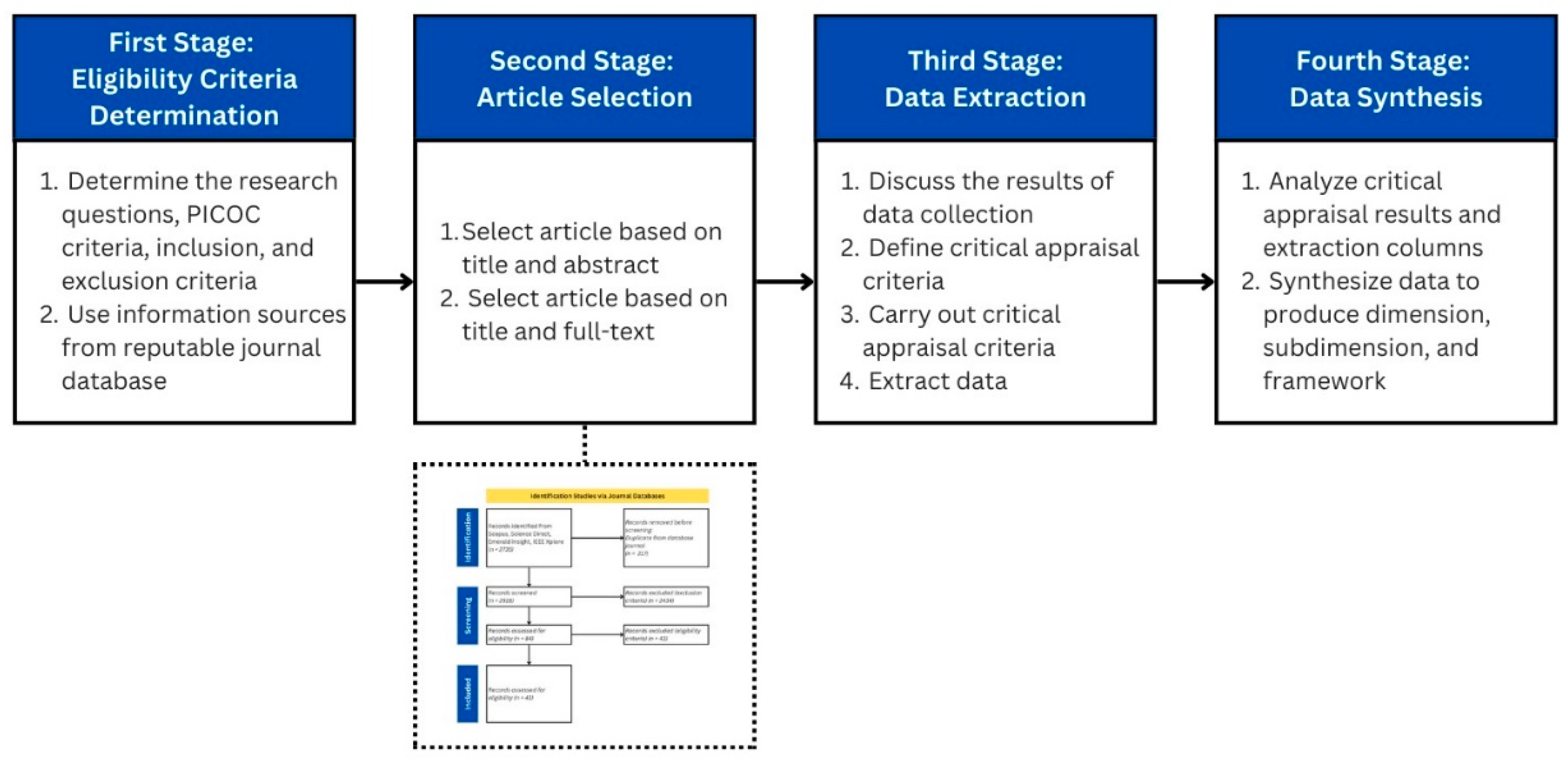
Figure 2.
PRISMA flow.
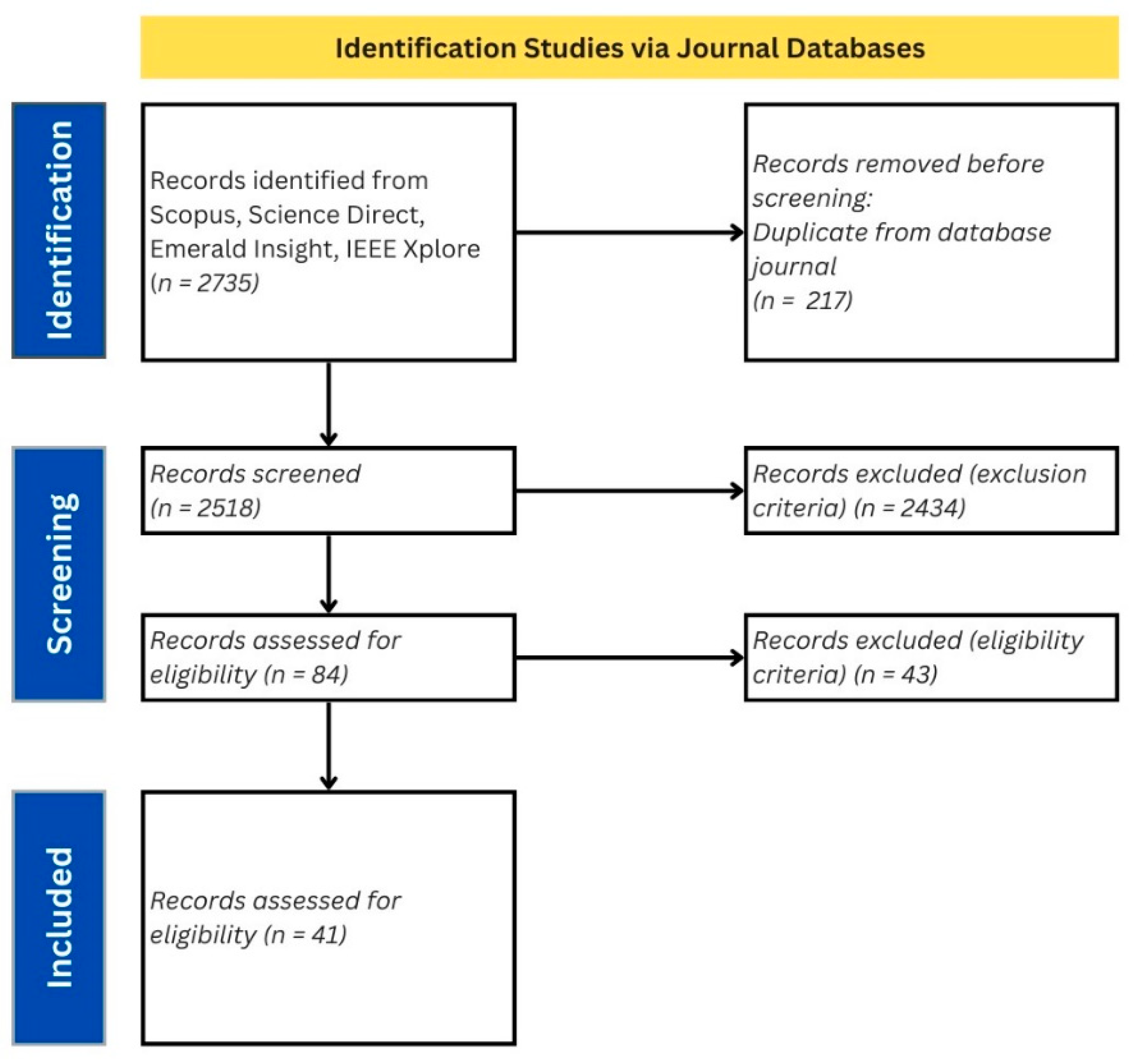
Figure 3.
Co-authorship analysis.
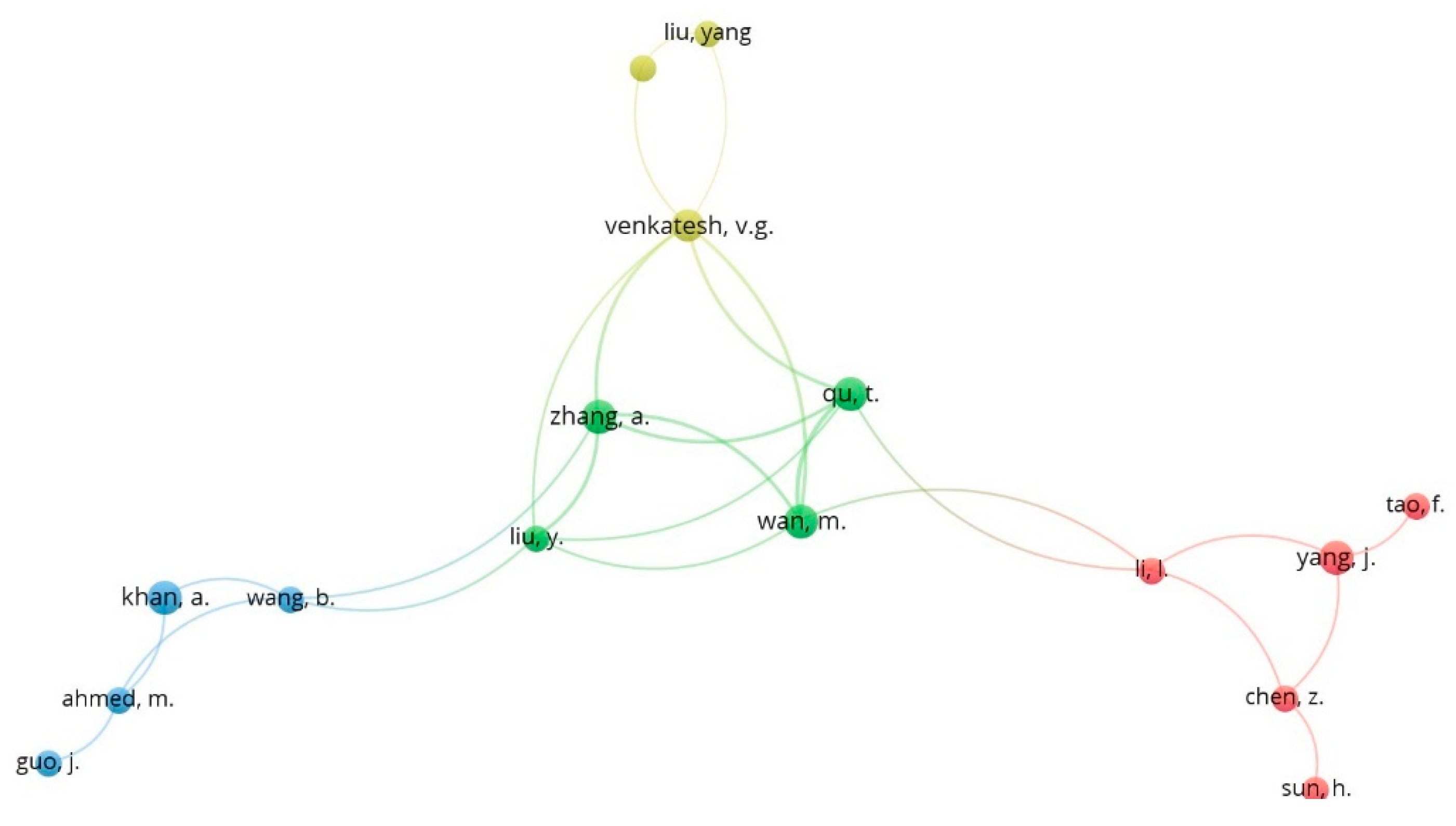
Figure 4.
Co-occurrence of keywords analysis.
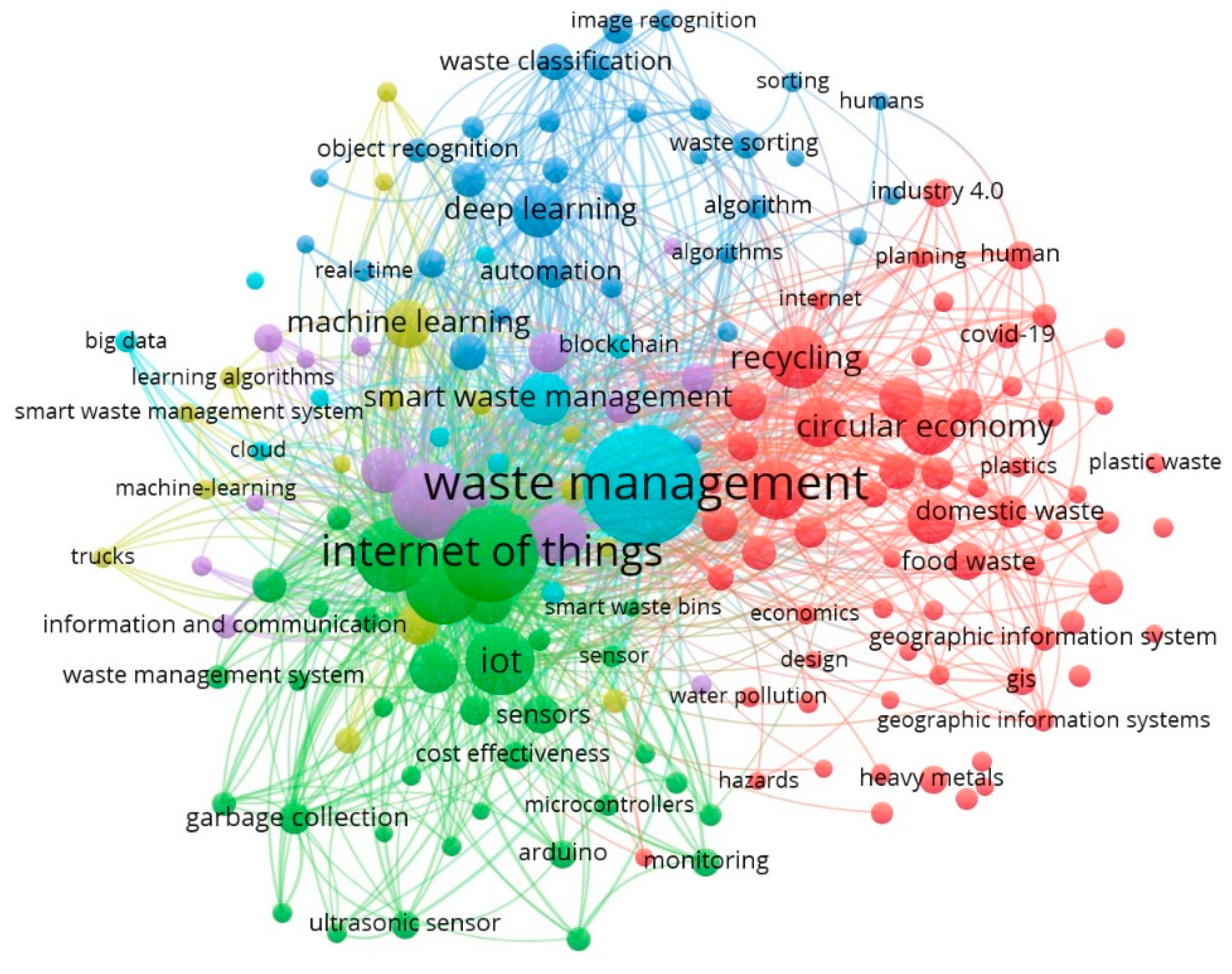
Figure 5.
Framework for a smart and integrated household waste management system.
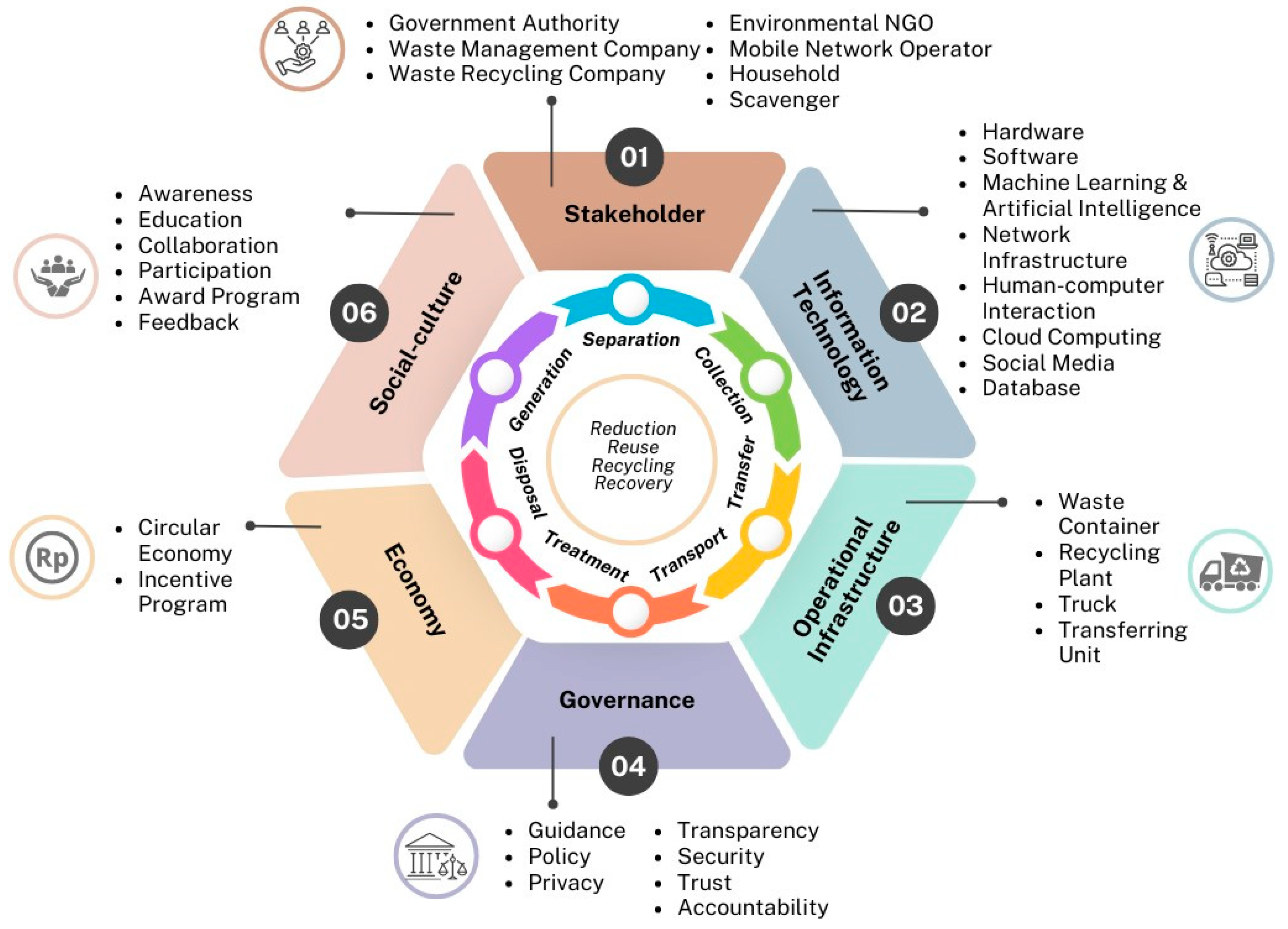

Table 1.
Mapping of waste types.
| No | Criteria | Category | Type |
|---|---|---|---|
| 1. | The physical condition of the waste | Solid waste | |
| |||
| 2. | The risk level of waste | Hazardous waste | Hazardous waste [22,40,41,42,43,44,45,46,47] |
| Electronic waste | Electronic waste [8] | ||
| 3. | Composition of waste materials | Inorganic waste | |
| |||
| |||
| |||
| |||
| |||
| Organic waste | |||
| |||
| |||
| |||
| |||
| |||
| 4. | Recovery feasibility of waste | Recyclable waste | Recycled waste [9,10,13,18,39,40,41,42,43,44,45,46,47,56,57,58,59] |
| Non-recyclable waste |
|
||
| |||
|
Table 2.
Mapping of waste management process.
| No | Process | Source |
|---|---|---|
| 1. | Separation | [9,19,36,40,41,43,44,46,47,48,49,50,51,53,55,59] |
| 2. | Collection | [10,18,21,22,52,56,57,65,66] |
| 3. | Separation & collection | [16,39,42,45,58] |
| 4. | Transfer | [17] |
| 5. | Transport | [17] |
| 6. | Collection & transport | [11,37] |
| 7. | Treatment | [12] |
| 8. | Disposal | [13] |
| 9. | Generation | [14,20] [15] |
| 10. | Reduction | [8,54] [67] |
| 11. | Reuse | [8] |
| 12. | Recycling | [8] |
| 13. | Recovery | [8] |
Table 3.
Stakeholder’s role in the reduction, reuse, recycling, and recovery process.
| Actor’s role |
|---|
Process: reduction, reuse, recycling, and recovery
|
Table 4.
Stakeholder’s role in the separation process.
| Actor’s role |
|---|
Process:separation
|
Table 5.
Stakeholder’s role in the separation and collection process.
| Actor’s role |
|---|
Process:separation and collection
|
Table 6.
Stakeholder’s role in the collection process.
| Actor’s role |
|---|
Process: Collection
|
Table 7.
Stakeholder’s role in the collection and transport process.
| Actor’s role |
|---|
|
Process: collection and transport |
Table 8.
Stakeholder’s role in the generation process.
| Actor’s role |
|---|
|
Process: generation |
Table 9.
Description of information technology dimensions
| Description | Devices | |
|---|---|---|
| Subdimension: hardware | ||
|
Digital camera | |
|
Sensor | |
| Subdimension: software | ||
|
Alert and notification | |
|
MILP/MCLP algorithm | |
|
Data analytic | |
|
GIS | |
|
Mobile & web application | |
|
Algoritma MCARP | |
|
Blockchain | |
|
Voice recognition | |
|
Gamification | |
| Subdimension: machine learning & AI | ||
|
CNN, MC-CNN, Lightweight CNN, GECM-EfficientNet, KNN, data recognition model | |
|
LSTM neural network, RF, KNN, ensemble learning | |
| Subdimension: network infrastructure | ||
|
QR code, barcode, NFC reader with communication node | |
|
NB-IoT, GSM, LoRA, Wi-Fi, smart gateway, Bluetooth | |
| Subdimension: human-computer interaction | ||
|
Mobile or web application prototype, gamification | |
| Subdimension: cloud computing | ||
|
Application platforms based on cloud computing | |
| Subdimension: social media | ||
|
Telegram | |
| Subdimension: database | ||
|
Cloud-based database | |
Table 10.
Description of operational infrastructure dimensions.
| Description | Devices |
|---|---|
|
Subdimension: Waste container The availability of waste containers with specific characteristics can make it easier for household actors to manage waste |
RFID-based key, user identity via QR code/RFID |
|
Subdimension: Recycling plant Availability of industrial facilities to process waste into new products through waste recycling activities |
Recycling facilities with location and product status data |
|
Subdimension: Transferring unit A tool can be used to move waste from one place to another |
Conveyor |
|
Subdimension: Truck Availability of tools to transport waste from one location to another |
Waste transport trucks |
Table 11.
Description of governance dimensions.
| Description | Devices |
|---|---|
|
Subdimension: Guidance There are guidelines for managing waste sustainably |
Guidelines for sustainable waste management |
|
Subdimension: policy Implement policies made by the government for all stakeholders |
Waste management policy |
|
Subdimension: Privacy Availability of efforts to protect personal data from users when using the system |
Using pseudonyms when making transactions |
|
Subdimension: Transparency Availability of information transparency of waste management carried out by household actors and connected to the policy of giving penalties and awards |
Transparency of user recycling performance |
|
Subdimension: Security There are efforts to prevent unwanted user behavior, such as DDos or spam |
Economic security through charging transaction fees |
|
Subdimension: Trust There is an element of trust in information disclosure in the system |
Using blockchain to increase trust |
|
Subdimension: Accountability Availability of responsibility from stakeholders for waste management performance |
Accountability of waste collectors and household actors |
Table 12.
Description of economic dimensions.
| Description | Devices |
|---|---|
|
Subdimension: Circular economy There is a strategy to reuse recycled waste into resources |
Implementation of circular economy strategies in digital applications |
|
Subdimension: Incentive program There is a program to provide rewards and punishments for the recycling performance of household actors |
Implementation of rewards and punishments through blockchain |
Table 13.
Description of social-culture dimensions.
| Description | Devices |
|---|---|
|
Subdimension: Awareness There are efforts to support the level of awareness of waste management |
Use of AI to support awareness |
|
Subdimension: Education There is a program to increase household knowledge regarding types of waste, how to manage it, and how to use smart systems |
Tips and information features |
|
Subdimension: Collaboration Various stakeholders have made collaborative efforts to solve household waste problems |
Collaboration in sharing information and monitoring household behavior |
|
Subdimension: Participation There is involvement of household actors to play a role in waste management |
A system with fair point acquisition and a system that protects personal data |
|
Subdimension: Award program There is a program that can encourage the involvement of household actors in managing their waste |
Publication of winners' names |
|
Subdimension: Feedback Availability of mechanisms to provide input or criticism of household waste management performance, services, and policies |
Feedback on performance, services, and management policies |
Disclaimer/Publisher’s Note: The statements, opinions and data contained in all publications are solely those of the individual author(s) and contributor(s) and not of MDPI and/or the editor(s). MDPI and/or the editor(s) disclaim responsibility for any injury to people or property resulting from any ideas, methods, instructions or products referred to in the content. |
© 2024 by the authors. Licensee MDPI, Basel, Switzerland. This article is an open access article distributed under the terms and conditions of the Creative Commons Attribution (CC BY) license (http://creativecommons.org/licenses/by/4.0/).
Copyright: This open access article is published under a Creative Commons CC BY 4.0 license, which permit the free download, distribution, and reuse, provided that the author and preprint are cited in any reuse.


