
Submitted:
29 April 2024
Posted:
01 May 2024
You are already at the latest version
Abstract
(1) E-governance is defined as the application of electronic means in the interaction between government and citizens and government and business, as well as in internal government operations to simplify and improve democratic, governmental, and business aspects of governance. Thus, e-governance is built from a paradigmatic dimension such as e-democracy (relationship between government and citizens) and an operational one such as e-government. The objective was to design and validate an instrument to measure e-governance based on three factors: a) e-administration, b) e-services, and c) e-democracy; (2) Methods: Based on the level of importance given to each factor (sample of 2042 Latin American citizens), as well as the relationships between them, an analysis of the importance of each factor is carried out; (3) Results: After the confirmatory analysis, the definitive instrument with which e-governance can be measured by other researchers and future research is obtained, considering the three selection factors, namely: e-administration, e-services and e-democracy; (4) Conclusions: This research contributes to political science through the design and validation of an instrument consisting of 39 items that can be used to measure e-governance according to the dimensions proposed by the United Nations Educational, Scientific and Cultural Organization.
Keywords:
public administration
; e-governance
; validation of instruments
1. Introduction
E-governance is not new. In fact, it appeared in the 1930s, but it was limited to the realm of business administration [1]. In the 1990s, the report of the High Level Group of Experts, prepared by the European Unio [2], concluded that "States must be key players in the Knowledge Society, as articulators (institutional and intersectoral) and producers of high-value content" [3].
As a result, e-government would become an ideal model to facilitate knowledge transfer and insertion in a wide range of sectors. E-government has been identified as a mechanism for developing the Knowledge Society in the report [2]. Between the two dimensions of e-government, identifies e-government as one, and e-democracy as the other. The concept of e-governance refers to the use of electronic means in government interactions with citizens and businesses, as well as in internal government operations, to simplify and improve democratic, governmental, and business aspects [4]. An e-governance system derives from a paradigmatic dimension such as e-democracy (relationship between government and citizens) and an operational dimension such as e-government.
But could we say that the research community has applied and validated instruments that allow us to measure e-governance? A search in Scopus in 2013 yields 47 documents using the string "e-governance" AND "measurement". Of these 47 documents, 11 are open access and provide useful results for this research (Table 1):
Since its inception, the experiences of modernizing the State, through e-governance, have promised at least two advances: greater efficiency and better democracy. In the research by [14], it is argued that e-governance could translate into the creation of real and virtual spaces so that citizens can exercise due social control over those in power, and a fundamental step to get there is transparency.
To assess the level of development of e-governance in Latin America, this project uses the three dimensions proposed by [15]:
- Electronic administration (e-government) – refers to the improvement of government and public sector officials' processes through new ICT processes.
- Electronic services (e-services): refers to improving the ease of providing government services to citizens. Examples of online services include: requests for government documents, requests for legal documents and certificates, licenses, and permits.
- Electronic democracy (e-democracy): requires an increasingly active participation of people in the decision-making process thanks to IT.
2. Materials and Methods
This is a quantitative research with a cross-sectional design. For the purpose of validating the "Electronic Governance" questionnaire (Table 3), an exploratory factor analysis was used, followed by confirmatory factor analysis. Factor analysis is a technique used to reduce a large number of variables to a smaller number of factors. This method extracts the maximum common variance from all variables and combines them into a total score. Factor analysis is part of the General Linear Model (GLM), and this method also makes some assumptions: there is a linear relationship, there is no multicollinearity, the relevant variables are included in the analysis, and they have real correlations between variables and factors [16].
For the purposes of this study, the principal component analysis (PCA) method was used, which is the most commonly used by the researchers. The ACP starts by extracting the maximum variance and factoring it in first. It then removes the variance explained by the first factor and begins to extract the maximum variance for the second factor. The process boils down to this last element [16].
As this is a regional study, the main intention of the study was to apply the instrument in as many cities and regions as possible in Latin America. Of course, the limitation was the access that the researchers of this project were able to have to the people. The population consisted of 21,721,761 adults from Venezuela (Zulia state), Mexico (Nuevo León Department), Argentina (Tucumán, Salta, Misiones, Santa Cruz, Córdoba), Perú (La Libertad Department), Cuba (Habana) and Colombia (Boyacá Department). A sample of 2042 people was calculated, with a margin of error of 3% and 99% reliability. A quota sampling was designed, distributing the subjects as follows (Table 2):

Table 2.
Sample.
| Countries | Regions | Population | % | p | Sample |
|---|---|---|---|---|---|
| Venezuela | Zulia | 5126000 | 23,6 | 0,236 | 481,91 |
| México | Nuevo León | 5784442 | 26,63 | 0,2663 | 543,78 |
| Argentina | Tucumán, salta, misiones, santa cruz, Córdoba | 4129480 | 19,01 | 0,19 | 387,98 |
| Perú | La Libertad | 1778000 | 8,185 | 0,08185 | 167,14 |
| Cuba | La Habana | 3686839 | 16,97 | 0,1697 | 346,53 |
| Colombia | Boyacá | 1217000 | 5,603 | 0,05603 | 114,41 |
| TOTAL | 21721761 | 100 | 0,99988 | 2041,8 | |
Table 3.
Instrument for measuring e-governance.
| Factor | # | Item |
|---|---|---|
| e-administration | 1 | The technological infrastructure (home or mobile internet, Wi-Fi zones) should be private. |
| 2 | The technological infrastructure (home or mobile internet, Wi-Fi zones) should be public. | |
| 3 | The local (Municipal) government adequately manages ICT (Information and Communication Technologies) platforms to respond to citizens' needs. | |
| 4 | The regional government (State, Department, Province) adequately manages ICT (Information and Communication Technologies) platforms to respond to the needs of citizens. | |
| 5 | The national government adequately manages ICT (Information and Communication Technologies) platforms to respond to citizens' needs. | |
| 6 | The parliament (Congress, National Assembly) adequately manages ICT (Information and Communication Technologies) platforms to respond to citizens' needs. | |
| e-services | 7 | The local (Municipal) government should have a functional website to report on its management. |
| 8 | The regional government (State, Department, Province) should have a functional website to report on its management. | |
| 9 | The national government (Presidency) should have a functional website to report on its management. | |
| 10 | The parliament (Congress, National Assembly) should have a functional website to report on its management. | |
| 11 | The local (municipal) government should have an interactive website where citizens' requests are answered. | |
| 12 | The regional government (State, Department, Province) should have an interactive website where citizens' requests are answered. | |
| 13 | The national government (Presidency) should have an interactive website where citizens' requests are answered. | |
| 14 | The local (Municipal) government should use its website to carry out procedures without the citizen having to physically go to the offices. | |
| 15 | The regional government (State, Department, Province) should use its website to carry out procedures without the citizen having to physically go to the offices. | |
| 16 | The national government (Presidency) should use its website to carry out procedures without the citizen having to physically go to the offices. | |
| 17 | The parliament (Congress, National Assembly) should use its website to carry out procedures without the citizen having to physically go to the offices. | |
| 18 | The local (Municipal) government should use its website to account for the resources it manages. | |
| 19 | The regional government (State, Department, Province) should use its website to account for the resources it administers. | |
| 20 | The national government (Presidency) should use its website to account for the resources it administers. | |
| 21 | The local (Municipal) government should have a user-friendly website where information is easily found (navigability). | |
| 22 | The regional government (State, Department, Province) should have a user-friendly website where information can be easily found (navigability). | |
| 23 | The national government (Presidency) should have a user-friendly website where information can be easily found (navigability). | |
| 24 | The parliament (Congress, National Assembly) should have a user-friendly website where information can be easily found (navigability). | |
| 25 | The local (Municipal) government should have a website with aids and options for people with functional diversity or disability (accessibility). | |
| 26 | The national government (Presidency) should have a website with aids and options for people with functional diversity or disability (accessibility). | |
| 27 | The parliament (Congress, National Assembly) should have a website with aids and options for people with functional diversity or disability (accessibility). | |
| e-democracy | 28 | The local government (Mayor's Office) should use digital media (website, social networks) to consult citizens on the effectiveness of its management through surveys or other instruments. |
| 29 | The regional government (State-Department) should use digital media (website, social networks) to consult citizens on the effectiveness of its management through surveys or other instruments. | |
| 30 | The national government (Presidency) should use digital media (website, social networks) to consult citizens on the effectiveness of its management through surveys or other instruments. | |
| 31 | The parliament (Congress, National Assembly) should use digital media (website, social networks) to consult citizens on the effectiveness of its management through surveys or other instruments. | |
| 32 | The local government (Mayor's Office) should use digital media (website, social networks) to directly involve citizens in decision making (electronic voting). | |
| 33 | The regional government (State-Department) should use digital media (website, social networks) to directly involve citizens in decision making (electronic voting). | |
| 34 | The national government (Presidency) should use digital media (website, social networks) to directly involve citizens in decision making (electronic voting). | |
| 35 | The parliament (Congress, National Assembly) should use digital media (website, social networks) to directly involve citizens in decision making (electronic voting). | |
| 36 | The election of the mayor should take place remotely through electronic voting. | |
| 37 | The election of the governor should take place remotely through electronic voting. | |
| 38 | The election of the president should take place remotely through electronic voting. | |
| 39 | The election of deputies or senators (Congress, National Assembly) should take place remotely through electronic voting. | |
| 40 | The parliament (Congress, National Assembly) should have an interactive website where citizens' requests are answered. | |
| 41 | The regional government (State, Department, Province) should have a website with aids and options for people with functional diversity or disability (accessibility). |
The null hypothesis of the test is that the variables are orthogonal, that is, they are not correlated. The alternative hypothesis is that the variables are not orthogonal, that is, they are sufficiently correlated that the correlation matrix diverges significantly from the identity matrix.
3. Results
3.1. Exploratory Factor Analysis
In this first phase, an exploratory factor analysis was used, in which it is assumed that any indicator or variable can be associated with any factor. It is the most widely used factor analysis by researchers and is not based on any previous theory.
Several tests are needed to determine the strength of the correlation between the variables. The Kaiser-Meyer-Olkin (KMO) test was used and the result was 0.963, indicating that factor analysis can be performed (Table 1). The Kaiser-Meyer-Olkin (KMO) test determines whether the data is suitable for factor analysis. This test measures the fit of the sample for each variable in the model. This statistic is a measure of the ratio of variance between variables that are likely to share the variation. The lower the ratio, the more suitable the data will be for factor analysis [17].
The KMO returns values between 0 and 1. A general rule of thumb for interpreting the statistic is that:
KMO values between 0.8 and 1 indicate that sampling is adequate. KMO values below 0.6 indicate that sampling is inadequate and corrective action should be taken. Some authors put this value at 0.5, so use your own criteria for values between 0.5 and 0.6. KMO values close to zero mean that there are large partial correlations compared to the sum of correlations. In other words, there are generalized correlations that pose a major problem for factor analysis [17].
Bartlett's sphericity test was also used with a result of 0.00, which also confirmed the factor analysis (Table 4). Bartlett's sphericity test compares the observed correlation matrix with the identity matrix. Basically, it checks for any redundancy between variables that can be summarized with a small number of factors. The null hypothesis of the test is that the variables are orthogonal, i.e., they are not correlated. Another hypothesis is that the variables are not orthogonal, i.e., they are so correlated that the correlation matrix is significantly different from the identity matrix. This test is often performed before applying a data reduction method, such as principal component analysis or factor analysis, to ensure that the data reduction method actually compresses the data in a meaningful [18].
The results were examined in the anti-image correlation matrix as the values were not close to zero (Table 5 and Table 6). The anti-image correlation matrix contains negative values of partial correlation coefficients, while the anti-image covariance matrix contains negative values of partial covariances. In a good coefficient model, most elements outside the diagonal will be small [19]. On the diagonal of the anti-image correlation matrix, a measure of sampling suitability for a variable is shown. As a result of this analysis, it was determined that item 1 (in pink) will be eliminated in the confirmatory analysis because it has a value below 0.700.
In communalities, the values closest to 1 are taken and a minimum value of 0.7 will be obtained; this is the case of Items 5 and 7 to 41 (Table 7). The commonality of the variable ranges from 0 to 1. In general, one way to understand commonality is through the proportion of the total variance found in a particular variable. A variable with no single variance (i.e., a variable whose variance is 100% explained as a result of other variables) has a commonality of 1. A variable whose variance cannot be explained by other variables has a commonality of 0 [20]. As a result of this analysis, it is determined that in the confirmatory analysis, Items 1 and 2 (in pink) will be eliminated for presenting values below 0.500.
In the total variance explained (Table 8), we can see that 73.329% is concentrated in Items 1 to 7. The total variance is the sum of the variance of all the individual principal components. The proportion of variance explained by a principal component is the ratio of the variance of that principal component to the total variance. To find the principal components, we need to add the variances and divide them by the total variance [21].
In the sedimendation (Figure 1), the optimal eigenvalues that explain most of the variance are shown; in this case they are between 1 and 5.
In the matrix of rotated components (Table 9), you can see the items or components with the greatest strength according to each factor. The items grouped in pink are the ones that have the greatest relationship with each other. In this way, the following Items are placed between factors 1 to 6.
3.2. Confirmatory Factor Analysis
To confirm the strength of the correlation between the variables, several tests are required. The Kaiser-Meyer-Olkin (KMO) test was applied, which gave a result of 0.964, which ratifies the factor analysis. Bartlett's sphericity test was also applied, with a result of 0.000, which also confirms the factor analysis (Table 10).
In this second phase of the factor analysis, we see how the commonalities (Table 8) allow us to confirm Items 3 to 41 (Table 11).
In the total variance explained (Table 12), using the extraction method "principal axis factorization", it is evident that, although 6 factors could have been selected because they were closer to 1, our theoretical model is three-factor; It is observed that 65.401% is concentrated in the first three factors.
In sedimentation (Figure 2), the optimal eigenvalues that explain most of the variance are shown; In this case, they are between 1 and 3.
In the matrix of rotated components (Table 13), the extraction method "principal axis factorization" and the rotation method "Oblimin with Kaiser normalization" have been used. You can see the items or components with the greatest strength according to each factor. The items grouped in pink are the ones that have the greatest relationship with each other. In this way, the following Items are placed between factors 1 to 3.
4. Discussion
5. Conclusions
This work was based on the assumption that there were little or no applied and validated measurement instruments that considered the three dimensions of e-governance. In this sense, it coincides with the findings of [7] who present a set of e-governance readiness assessment tools as an application prototype; even though it does not propose an instrument or its validation, the modified scheme of levels of commitment could be useful as a 4-stage implementation of the e-participation maturity model, namely: E-Informing, E-Collaborating, E-Consulting, and E-Empowering. For their part, [8] developed a solution to assess the progress of a national e-government program on the Project Management Maturity Model (PMMM) methodological platform. One of the dimensions of e-governance, which is e-services, is measured.
In the case of [10], it is stated that the evaluation tools are dispersed among various sources and there is no systematized framework that supports the analysis and selection of the appropriate tool for specific situations. The paper aims to answer these questions by characterizing the available literature in the context of the measurement, evaluation and monitoring of the EGOV, in order to generate a knowledge base aimed at the creation of a future catalogue of tools and instruments for the evaluation of the EGOV, and to present a conceptual framework for the choice of an appropriate tool from such a catalogue. [13] support the thesis of the need to design and validate instruments to measure e-governance. E-governance is considered an essential indicator of advanced cities, but measuring the effectiveness of e-governance requires further study.
In conclusion, this research contributes to political science through the design and validation of an instrument consisting of 39 Items that can be used to measure e-governance according to the dimensions proposed by [15], namely: 1) e-government: understood as the improvement of government processes and public sector officials through new information technologies; 2) e-services, which refer to improving the delivery of public services; and 3) e-democracy, which implies greater and more active participation of citizens in decision-making processes through the use of information and communication technologies.
Author Contributions
Conceptualization, A.E.P.M.; methodology, C.P.F. and F.R.I.; software, A.E.P.M; validation, C.P.F. and F.R.I.; formal analysis, A.E.P.M.; investigation, F.R.I.; resources, C.P.F.; data curation, A.E.P.M.; writing—original draft preparation, A.E.P.M., C.P.F. and F.R.I.; writing—review and editing, F.R.I.; visualization, A.E.P.M.; supervision, C.P.F.; project administration, C.P.F. All authors have read and agreed to the published version of the manuscript.
Funding
This research received funding from Universidad de Boyacá.
Institutional Review Board Statement
Not applicable.
Informed Consent Statement
The participants were informed and accepted the following statement: I understand that my participation is completely voluntary, that I can withdraw from the study whenever I want without having to give explanations and that this will not affect my medical care. I freely give my consent to participate in the Research Project entitled "E-governance in Latin America".
Data Availability Statement
The original contributions presented in the study are included in the article/supplementary material, further inquiries can be directed to the corresponding author/s.
Conflicts of Interest
The authors declare no conflicts of interest.
References
- Abdel-Rahman, T. E-governance and University of Ha'il institutional excellence in light of the Kingdom's Vision 2030: An Empirical Study on Faculty Member Staff. International Journal of Future Generation Communication and Networking, 2021, 14(1), 462-473. [CrossRef]
- Grupo de Expertos de Alto Nivel (GEAN). La construcción de la sociedad europea de la información: Informe final. 1997. http://europa.eu.
- Kaufman, E., & Piana, R. S. Algunas aclaraciones sobre gobierno electrónico y sociedad de la información y el conocimiento. En Políticas públicas y tecnologías: Líneas de acción para América Latina. 2007. Primera Edición, Buenos Aires, Argentina, La Crujía Ediciones.
- Backus, M. E-Governance and Developing Countries. 2001 https://bibalex.org/baifa/Attachment/Documents/119334.pdf.
- Afrizal, Y. The Arrangement of the Information Technology and Communications Master Plan using PeGI Model (e-Governance Ranking Indonesia) to Improve District Government Services. In IOP Conference Series: Materials Science and Engineering. 2018, 407. 012141. [CrossRef]
- Khamparia, A & Pandey, B . A QoS and Cognitive Parameters based Uncertainty Model for Selection of Semantic Web Services. Indian Journal of Science and Technology, 2016, 9(44), 1-7. [CrossRef]
- Waseem, A. A., Ahmed Shaikh, Z., & ur Rehman, A. A toolkit for prototype implementation of E-Governance service system readiness assessment framework. En F. H. Nah & C. H. Tan (Eds.), HCI in Business, Government, and Organizations: Information Systems, 2016, 9752, 259-270. Springer, Cham. [CrossRef]
- Fesenko, T., & Fesenko, G. E-readiness evaluation modelling for monitoring the national e-government programme (by the example of Ukraine). Вoстoчнo-Еврoпейский журнал передoвых технoлoгий, 2016, 3 (3), 28-35. [CrossRef]
- Meyerhoff Nielsen, M. Georgia on my mind: A study of the role of governance and cooperation in online service delivery in the Caucasus, In International Conference on Electronic Government, 2017, 71-91. Cham: Springer International Publishing. [CrossRef]
- Carvalho, J., & Soares, D. Who Is Measuring What and How in EGOV Domain?. In Electronic Government: 17th IFIP WG 8.5 International Conference, EGOV 2018, Krems, Austria, September 3-5, 2018, Proceedings 17, 20-131. Springer International Publishing. [CrossRef]
- Lubis, Muharman & Lubis, Arif & Almaarif, Ahmad & Fajrillah, Asti Amalia. Relationship of Personal Data Protection towards the Electoral Measures: Partial Least Square Analysis. In Journal of Physics: Conference Series, 2020, 1566(1), 012111. [CrossRef]
- Abouddaka, I., Bassiri, M., Atibi, A., Tridane, M., & Belaaouad, S. The Engineering of E-governance and Technology in the Management of Secondary Schools: Case of the Nouaceur Delegation. Journal of Information Technology Management, 13(Special Issue: Advanced Innovation Topics in Business and Management), 2021, 229-237. [CrossRef]
- Wang Y., Sun B., & Shi H. Mapping the e-governance efficiency of Chinese cities. Regional Studies, Regional Science, 2023, 10(1), 676-678. [CrossRef]
- Páez, A., Montoya, J. y Matheus, S. Transparencia web en el gobierno digital de las Américas. En Acevedo, A., Chamorro, A. y Quintero, M. Comunicación política en la esfera pública digital: Representaciones, poder y subjevitidades. Barranquilla: Universidad de la Costa. 2022. https://hdl.handle.net/11323/9592.
- Organización de las Naciones Unidas para la Educación, la Ciencia y la Cultura [UNESCO]. Gobernabilidad electrónica. Fortalecimiento de capacidades de la gobernabilidad electrónica. 2022. http://148.202.167.116:8080/jspui/bitstream/123456789/597/1/Gobernabilidad%20electr%C3%B3nica.%20fortalecimiento%20de%20capacidades%20de%20la%20gobernabilidad%20electr%C3%B3nica.pdf.
- UCLA: Statistical Consulting Group. Introduction to SAS. 2021. https://stats.oarc.ucla.edu/sas/modules/introduction-to-the-features-of-sas.
- Costales, J., Catulay, J., Costales, J., & Bermudez, N. Kaiser-Meyer-Olkin Factor Analysis: A Quantitative Approach on Mobile Gaming Addiction using Random Forest Classifier. In Proceedings of the 6th International Conference on Information System and Data Mining, 2022, 18-24. [CrossRef]
- Thao, N. T. P., Van Tan, N., & Tuyet, M. T. A. KMO and Bartlett's Test for Components of Workers' Working Motivation and Loyalty at Enterprises in Dong Nai Province of Vietnam. International Transaction Journal of Engineering, Management, & Applied Sciences & Technologies, 2022, 13(10), 1-13. [CrossRef]
- Wu, X., & Huang, X. Screening of urban environmental vulnerability indicators based on coefficient of variation and anti-image correlation matrix method. Ecological Indicators, 2023, 150, 110196. [CrossRef]
- Lee, S. Exploratory Factor Analysis for a Nursing Workaround Instrument in Korean and Interpretations of Statistical Decision Points. Computers, informatics, nursing: CIN, 2021, 39(6), 329–339. [CrossRef]
- Shrestha, N. Factor Analysis as a Tool for Survey Analysis. American Journal of Applied Mathematics and Statistics, 2021, 9(1), 4-11. [CrossRef]
Figure 1.
Sedimentation.
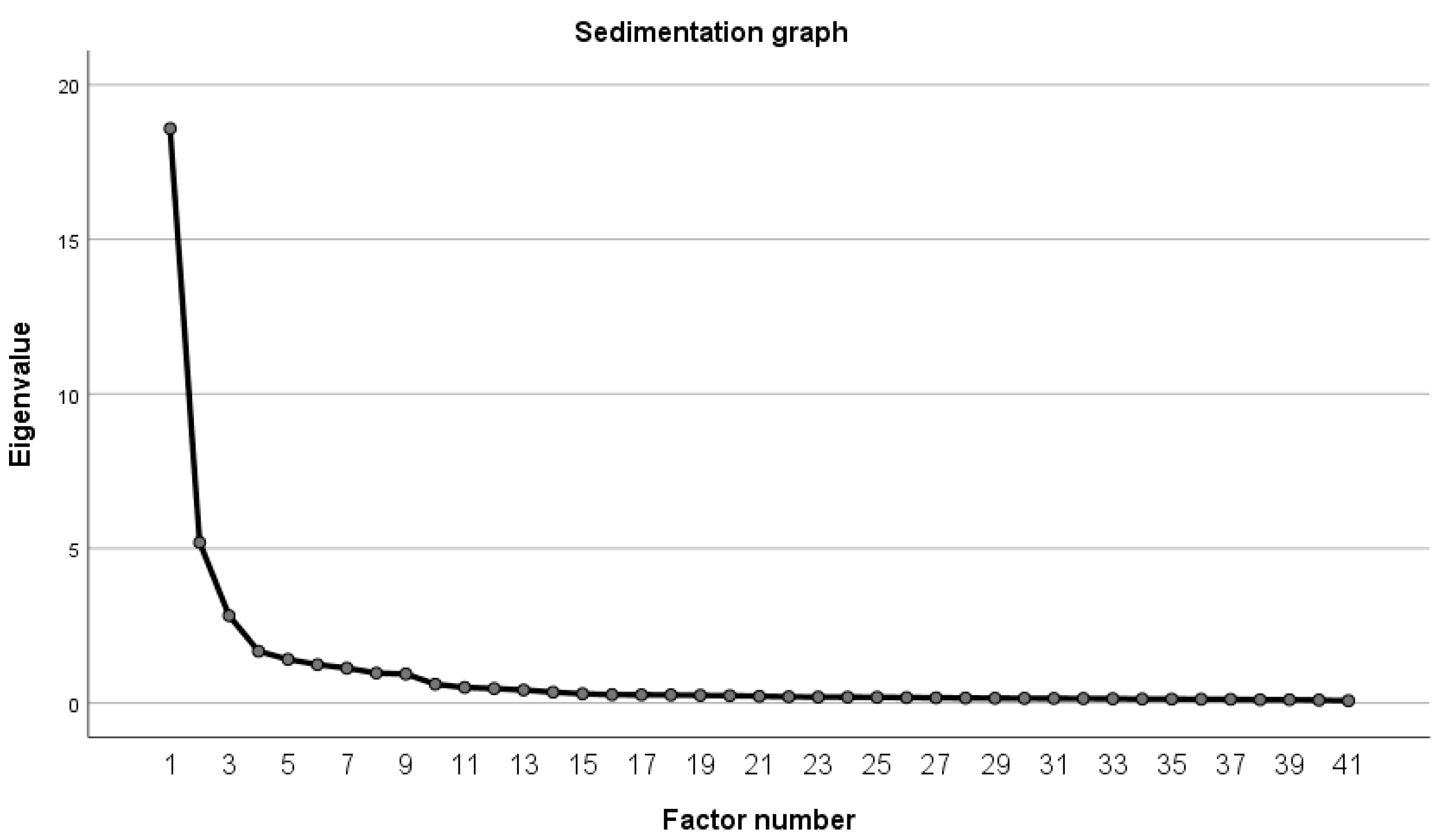
Figure 2.
Sedimentation.
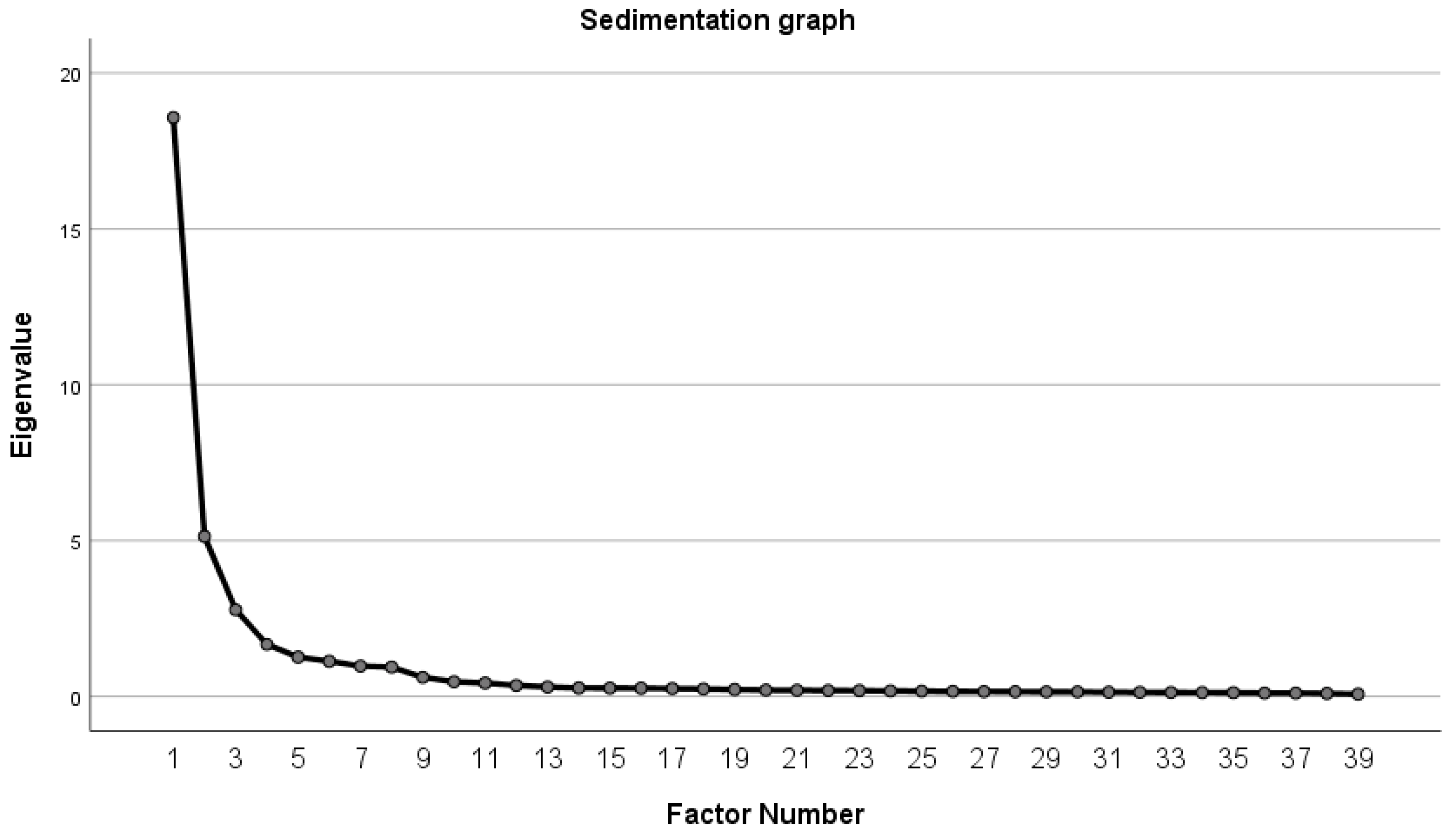
Figure 3.
E-governance factors.
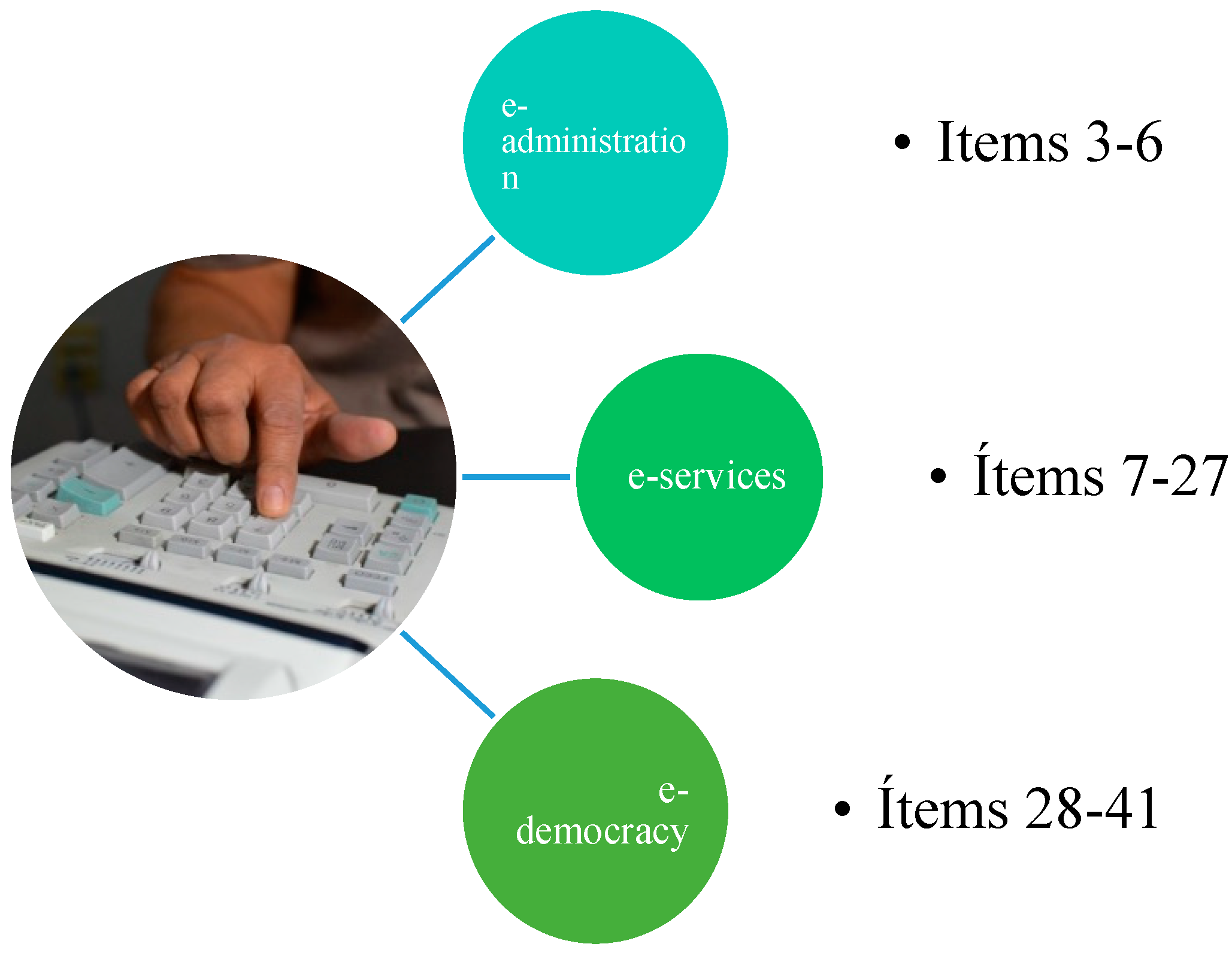
Table 1.
Findings on e-governance measurement.
| # | Year | Works´s title | Findings | Proposes and validates an instrument for measuring e-governance |
|---|---|---|---|---|
| 1 | 2013 | E-governance in Lithuanian Municipalities: External Factors Analysis of the Websites Development [5]. | The paper focuses on the usability of public organizations' websites, as well as on the external factors influencing the development of Lithuanian municipal websites. It measures one of the dimensions of e-governance which is e-services. | Parcial |
| 2 | 2016 | A QoS and Cognitive Parameters based Uncertainty Model for Selection of Semantic Web Services [6]. | The main objective of this research work is to present a model based on cognitive and quality of service parameters for the selection of semantic web services. An e-governance tool is not proposed or validated. | No |
| 3 | 2016 | A Toolkit for Prototype Implementation of E-Governance Service System Readiness Assessment Framework [7]. | This research paper presents a set of e-governance readiness assessment tools as a prototype application. Although it does not propose an instrument or its validation, the modified Levels of Engagement scheme could be useful as a 4-stage implementation of the e-participation maturity model, namely e-participation maturity model, namely: E-Informing, E-Collaborating, E-Consulting, and E-Empowering. |
Parcial |
| 4 | 2016 | E-readiness evaluation modelling for monitoring the national e-government programme [8]. | The study aims to develop a solution to assess the progress of a national e-government program on the methodological platform of the Project Management Maturity Model (PMMM). It measures one of the dimensions of e-governance which is e-services. The study concludes that it is necessary to assess the dynamics of the "e-Ukraine" program by introducing weighting coefficients for e-governance indices and sub-indices. | Partial |
| 5 | 2017 | Georgia on my mind: a study of the role of governance and cooperation in online service delivery in the Caucasus [9]. | E-services indicators are proposed, although the instrument is not validated. The analysis highlights the influence of politically driven public sector reforms supported by the use of ICTs to improve service delivery, transparency and anti-corruption in the period 2004-2012. The article concludes that eGovernment is fragmented and that the use of public and private online services (eService) is limited, despite the high penetration and use of the Internet. | Parcial |
| 6 | 2018 | The Arrangement of the Information Technology and Communications Master Plan using PeGI Model (e-Governance Ranking Indonesia) to Improve District Government Services [5]. | E-services indicators are proposed, although the instrument is not validated. The information and communication technology master plan for local government is a product of scientific research with the PeGI (Indonesian e-Government ranking) model as a measurement model of the e-Government system. The PeGI model takes measures in 5 (five) dimensions of e-Government system: policy, institutional, infrastructure, implementation and planning. |
Partial |
| 7 | 2018 | Who Is Measuring What and How in EGOV Domain? [10]. | This is a literature review. It does not validate an instrument, although it makes contributions by stating that assessment tools are scattered among various sources and that there is no systematized framework to support the analysis and selection of the appropriate tool for specific situations. The paper aims to answer these questions by characterizing the available literature in the context of EGOV measurement, evaluation and monitoring, with the aim of generating a knowledge base oriented towards the creation of a future catalog of tools and instruments for EGOV assessment, and to present a conceptual framework for the choice of an appropriate tool from such a catalog. |
Partial |
| 8 | 2020 | Relationship of Personal Data Protection towards the Electoral Measures: Partial Least Square Analysis [11]. | The study addresses one of the indicators of the e-democracy dimension, namely e-voting. The adoption of e-voting in several countries poses certain challenges, which are very similar when applying electronic means to any activity, such as e-governance or e-commerce. Therefore, some people, for economic, political or social reasons, expect that the use of e-voting will facilitate and solve election problems. Unfortunately, the practical implementation is more complex and difficult, with different problems and depends on the conditions or culture of each country or culture. One of the essential factors for adoption is related to privacy protection. Thus, this study examines the relationship between perceived benefits and concern for personal data protection by establishing a formative measurement model. |
Partial |
| 9 | 2021 | E-governance and University of Ha'il institutional excellence in light of the Kingdom's Vision 2030: An Empirical Study on Faculty Member [1]. | The objective of this research is to identify the impact of e-governance on institutional excellence at the University of Ha'il. The following dimensions are proposed and validated to measure e-governance: Transparency, Accountability, Participation, Level of e-services provided, Change management and Infrastructure. | Si |
| 10 | 2021 | The Engineering of E-governance and Technology in the Management of Secondary Schools: Case of the Nouaceur Delegation [12]. | The objective of this study is to measure the impact of governance on the organizational performance of schools in administrative, financial and pedagogical aspects. Although the instrument is not validated, several principles are proposed to measure e-governance, such as: participation, transparency, accountability and evaluation. | Partial |
| 11 | 2023 | Mapping the e-governance efficiency of Chinese cities [13] | The article supports the thesis of the need to design and validate instruments to measure e-governance. E-governance is considered an essential indicator of advanced cities, but the measurement of e-governance efficiency requires further study. Following this line of research, this article proposes an e-governance efficiency index (GEI) that is applied to Chinese cities. | Si |
Table 4.
KMO and Bartlett Test.
| Kaiser-Meyer-Olkin measure of sampling adequacy of sampling adequacy | ,963 | |
| Bartlett's test for sphericity | Aprox. Chi-cuadrado | 93297,391 |
| gl | 820 | |
| Sig. | ,000 | |
Table 5.
Anti-image matrices (Items 1 to 20).
| Item1 | Item2 | Item3 | Item4 | Item5 | Item6 | Item7 | Item8 | Item9 | Item10 | Item11 | Item12 | Item13 | Item14 | Item15 | Item16 | Item17 | Item18 | Item19 | Item20 | ||
|---|---|---|---|---|---|---|---|---|---|---|---|---|---|---|---|---|---|---|---|---|---|
| Correlación anti-imagen | Item1 | ,574a | ,466 | -,120 | -,028 | ,026 | -,071 | -,068 | ,011 | -,017 | ,020 | -,006 | -,018 | ,027 | -,003 | ,026 | ,006 | -,040 | -,009 | ,014 | ,004 |
| Item2 | ,466 | ,700a | -,067 | -,013 | -,068 | -,054 | -,024 | ,004 | -,017 | -,002 | ,033 | -,015 | -,001 | ,012 | ,044 | -,002 | -,047 | -,028 | ,019 | -,017 | |
| Item3 | -,120 | -,067 | ,819a | -,524 | -,085 | -,162 | -,021 | ,036 | -,018 | ,040 | -,064 | -,020 | ,053 | ,003 | ,014 | ,012 | -,036 | ,103 | -,024 | -,044 | |
| Item4 | -,028 | -,013 | -,524 | ,814a | -,285 | -,128 | ,040 | -,035 | ,027 | -,061 | ,027 | ,025 | -,047 | -,030 | -,011 | -,004 | ,050 | -,049 | ,029 | ,014 | |
| Item5 | ,026 | -,068 | -,085 | -,285 | ,819a | -,556 | -,054 | ,058 | -,014 | -,021 | -,006 | ,059 | -,029 | -,004 | -,040 | -8,211E-5 | ,046 | -,058 | ,015 | ,047 | |
| Item6 | -,071 | -,054 | -,162 | -,128 | -,556 | ,833a | ,033 | -,059 | -,012 | ,030 | ,027 | -,044 | ,015 | ,034 | ,015 | -,010 | -,044 | ,023 | ,003 | -,017 | |
| Item7 | -,068 | -,024 | -,021 | ,040 | -,054 | ,033 | ,968a | -,451 | -,158 | -,043 | -,059 | ,004 | -,081 | -,011 | ,047 | -,098 | ,043 | -,019 | -,001 | ,013 | |
| Item8 | ,011 | ,004 | ,036 | -,035 | ,058 | -,059 | -,451 | ,967a | -,202 | -,200 | -,118 | -,016 | ,010 | ,031 | -,052 | ,050 | -,026 | ,030 | -,045 | ,010 | |
| Item9 | -,017 | -,017 | -,018 | ,027 | -,014 | -,012 | -,158 | -,202 | ,976a | -,369 | ,003 | -,015 | -,091 | -,090 | ,024 | -,030 | ,055 | ,014 | -,026 | -,013 | |
| Item10 | ,020 | -,002 | ,040 | -,061 | -,021 | ,030 | -,043 | -,200 | -,369 | ,976a | -,072 | -,064 | ,044 | ,007 | -,023 | ,127 | -,092 | -,002 | ,004 | -,020 | |
| Item11 | -,006 | ,033 | -,064 | ,027 | -,006 | ,027 | -,059 | -,118 | ,003 | -,072 | ,977a | -,361 | -,199 | -,042 | -,056 | ,000 | ,108 | -,096 | ,047 | ,028 | |
| Item12 | -,018 | -,015 | -,020 | ,025 | ,059 | -,044 | ,004 | -,016 | -,015 | -,064 | -,361 | ,975a | -,241 | -,004 | -,063 | -,008 | ,030 | ,065 | -,056 | ,021 | |
| Item13 | ,027 | -,001 | ,053 | -,047 | -,029 | ,015 | -,081 | ,010 | -,091 | ,044 | -,199 | -,241 | ,981a | -,019 | ,042 | -,069 | ,002 | -,056 | ,026 | ,000 | |
| Item14 | -,003 | ,012 | ,003 | -,030 | -,004 | ,034 | -,011 | ,031 | -,090 | ,007 | -,042 | -,004 | -,019 | ,975a | -,380 | -,115 | -,151 | ,028 | ,049 | -,077 | |
| Item15 | ,026 | ,044 | ,014 | -,011 | -,040 | ,015 | ,047 | -,052 | ,024 | -,023 | -,056 | -,063 | ,042 | -,380 | ,965a | -,349 | -,206 | -,051 | -,092 | ,062 | |
| Item16 | ,006 | -,002 | ,012 | -,004 | -8,211E-5 | -,010 | -,098 | ,050 | -,030 | ,127 | ,000 | -,008 | -,069 | -,115 | -,349 | ,966a | -,383 | ,036 | ,033 | -,063 | |
| Item17 | -,040 | -,047 | -,036 | ,050 | ,046 | -,044 | ,043 | -,026 | ,055 | -,092 | ,108 | ,030 | ,002 | -,151 | -,206 | -,383 | ,971a | -,088 | -,020 | ,052 | |
| Item18 | -,009 | -,028 | ,103 | -,049 | -,058 | ,023 | -,019 | ,030 | ,014 | -,002 | -,096 | ,065 | -,056 | ,028 | -,051 | ,036 | -,088 | ,972a | -,412 | -,193 | |
| Item19 | ,014 | ,019 | -,024 | ,029 | ,015 | ,003 | -,001 | -,045 | -,026 | ,004 | ,047 | -,056 | ,026 | ,049 | -,092 | ,033 | -,020 | -,412 | ,949a | -,579 | |
| Item20 | ,004 | -,017 | -,044 | ,014 | ,047 | -,017 | ,013 | ,010 | -,013 | -,020 | ,028 | ,021 | ,000 | -,077 | ,062 | -,063 | ,052 | -,193 | -,579 | ,958a | |
Source: own elaboration.
Table 6.
Matrices anti-imagen (Items 21 al 41).
| Item21 | Item22 | Item23 | Item24 | Item25 | Item26 | Item27 | Item28 | Item29 | Item30 | Item31 | Item32 | Item33 | Item34 | Item35 | Item36 | Item37 | Item38 | Item39 | Item40 | Item41 | ||
|---|---|---|---|---|---|---|---|---|---|---|---|---|---|---|---|---|---|---|---|---|---|---|
| Correlación anti-imagen | Item21 | ,982a | -,374 | -,155 | -,086 | -,027 | -,050 | ,008 | -,024 | ,034 | -,029 | -,014 | ,072 | -,044 | ,029 | -,053 | ,003 | -,019 | -,003 | ,031 | -,001 | -,033 |
| Item22 | -,374 | ,977a | -,262 | -,143 | -,034 | -,008 | -,004 | ,057 | -,047 | -,022 | ,016 | -,012 | ,045 | -,019 | -,016 | -,055 | ,002 | -,031 | ,086 | -,026 | ,008 | |
| Item23 | -,155 | -,262 | ,976a | -,370 | -,038 | ,018 | -,040 | ,029 | -,049 | ,037 | -,059 | ,008 | -,063 | -,019 | ,101 | ,062 | -,023 | ,000 | -,038 | ,036 | -,096 | |
| Item24 | -,086 | -,143 | -,370 | ,981a | -,132 | -,033 | -,070 | -,021 | ,018 | ,067 | -,060 | -,013 | ,061 | -,034 | -,012 | ,018 | -,009 | ,004 | -,025 | -,007 | -,009 | |
| Item25 | -,027 | -,034 | -,038 | -,132 | ,981a | -,262 | -,213 | -,028 | ,008 | -,007 | ,005 | ,012 | -,084 | ,094 | ,004 | -,060 | -,027 | ,043 | ,045 | ,031 | -,203 | |
| Item26 | -,050 | -,008 | ,018 | -,033 | -,262 | ,976a | -,312 | -,054 | -,039 | ,030 | ,036 | ,039 | ,005 | -,013 | -,052 | ,077 | -,059 | ,060 | -,052 | -,055 | -,271 | |
| Item27 | ,008 | -,004 | -,040 | -,070 | -,213 | -,312 | ,982a | -,020 | ,006 | -,077 | ,060 | -,043 | ,001 | -,033 | ,078 | -,007 | ,041 | -,021 | -,026 | -,040 | -,155 | |
| Item28 | -,024 | ,057 | ,029 | -,021 | -,028 | -,054 | -,020 | ,968a | -,412 | -,211 | -,085 | -,051 | ,069 | -,066 | ,020 | -,026 | ,073 | -,052 | -,006 | ,050 | ,057 | |
| Item29 | ,034 | -,047 | -,049 | ,018 | ,008 | -,039 | ,006 | -,412 | ,961a | -,286 | -,262 | ,027 | -,023 | -,015 | -,001 | ,042 | -,088 | ,052 | ,002 | -,003 | -,032 | |
| Item30 | -,029 | -,022 | ,037 | ,067 | -,007 | ,030 | -,077 | -,211 | -,286 | ,960a | -,419 | -,036 | -,015 | ,041 | -,045 | -,012 | ,010 | ,024 | -,014 | -,067 | -,022 | |
| Item31 | -,014 | ,016 | -,059 | -,060 | ,005 | ,036 | ,060 | -,085 | -,262 | -,419 | ,968a | -,042 | -,047 | ,047 | -,028 | -,040 | ,043 | -,043 | ,036 | -,034 | -,049 | |
| Item32 | ,072 | -,012 | ,008 | -,013 | ,012 | ,039 | -,043 | -,051 | ,027 | -,036 | -,042 | ,958a | -,414 | -,243 | -,142 | -,032 | -,015 | ,036 | -,004 | ,052 | -,024 | |
| Item33 | -,044 | ,045 | -,063 | ,061 | -,084 | ,005 | ,001 | ,069 | -,023 | -,015 | -,047 | -,414 | ,940a | -,392 | -,233 | -,020 | -,018 | ,055 | -,032 | ,014 | ,079 | |
| Item34 | ,029 | -,019 | -,019 | -,034 | ,094 | -,013 | -,033 | -,066 | -,015 | ,041 | ,047 | -,243 | -,392 | ,942a | -,354 | ,004 | ,002 | -,121 | ,070 | -,081 | -,049 | |
| Item35 | -,053 | -,016 | ,101 | -,012 | ,004 | -,052 | ,078 | ,020 | -,001 | -,045 | -,028 | -,142 | -,233 | -,354 | ,963a | -,028 | -,001 | ,026 | -,061 | ,039 | -,018 | |
| Item36 | ,003 | -,055 | ,062 | ,018 | -,060 | ,077 | -,007 | -,026 | ,042 | -,012 | -,040 | -,032 | -,020 | ,004 | -,028 | ,921a | -,482 | -,111 | -,240 | ,015 | -,032 | |
| Item37 | -,019 | ,002 | -,023 | -,009 | -,027 | -,059 | ,041 | ,073 | -,088 | ,010 | ,043 | -,015 | -,018 | ,002 | -,001 | -,482 | ,891a | -,389 | -,255 | ,001 | ,067 | |
| Item38 | -,003 | -,031 | ,000 | ,004 | ,043 | ,060 | -,021 | -,052 | ,052 | ,024 | -,043 | ,036 | ,055 | -,121 | ,026 | -,111 | -,389 | ,912a | -,398 | -,001 | -,034 | |
| Item39 | ,031 | ,086 | -,038 | -,025 | ,045 | -,052 | -,026 | -,006 | ,002 | -,014 | ,036 | -,004 | -,032 | ,070 | -,061 | -,240 | -,255 | -,398 | ,923a | ,001 | -,011 | |
| Item40 | -,001 | -,026 | ,036 | -,007 | ,031 | -,055 | -,040 | ,050 | -,003 | -,067 | -,034 | ,052 | ,014 | -,081 | ,039 | ,015 | ,001 | -,001 | ,001 | ,982a | -,011 | |
| Item41 | -,033 | ,008 | -,096 | -,009 | -,203 | -,271 | -,155 | ,057 | -,032 | -,022 | -,049 | -,024 | ,079 | -,049 | -,018 | -,032 | ,067 | -,034 | -,011 | -,011 | ,982a | |
Table 7.
Communalities.
| Item | Initial | Extraction |
|---|---|---|
| Item1 | ,264 | ,035 |
| Item2 | ,284 | ,074 |
| Item3 | ,642 | ,645 |
| Item4 | ,689 | ,719 |
| Item5 | ,706 | ,762 |
| Item6 | ,682 | ,731 |
| Item7 | ,718 | ,686 |
| Item8 | ,786 | ,770 |
| Item9 | ,748 | ,741 |
| Item10 | ,766 | ,755 |
| Item11 | ,781 | ,758 |
| Item12 | ,796 | ,756 |
| Item13 | ,791 | ,764 |
| Item14 | ,736 | ,581 |
| Item15 | ,784 | ,582 |
| Item16 | ,775 | ,572 |
| Item17 | ,759 | ,587 |
| Item18 | ,750 | ,771 |
| Item19 | ,831 | ,903 |
| Item20 | ,792 | ,831 |
| Item21 | ,757 | ,709 |
| Item22 | ,784 | ,726 |
| Item23 | ,814 | ,771 |
| Item24 | ,785 | ,760 |
| Item25 | ,801 | ,803 |
| Item26 | ,814 | ,790 |
| Item27 | ,793 | ,781 |
| Item28 | ,744 | ,760 |
| Item29 | ,808 | ,844 |
| Item30 | ,798 | ,834 |
| Item31 | ,770 | ,796 |
| Item32 | ,805 | ,835 |
| Item33 | ,847 | ,891 |
| Item34 | ,839 | ,869 |
| Item35 | ,778 | ,800 |
| Item36 | ,856 | ,876 |
| Item37 | ,894 | ,926 |
| Item38 | ,860 | ,882 |
| Item39 | ,855 | ,877 |
| Item40 | ,768 | ,737 |
| Item41 | ,783 | ,775 |
| Extraction method: maximum likelihood. | ||
Table 8.
Total variance explained.
| Factor | Initial eigenvalues | Sums of squared extraction charges | Sums of loads squared by rotation | ||||||
|---|---|---|---|---|---|---|---|---|---|
| Total | % of variance | % accumulated | Total | % of variance | % accumulated | Total | % of variance | % accumulated | |
| 1 | 18,582 | 45,323 | 45,323 | 17,864 | 43,572 | 43,572 | 15,154 | 36,961 | 36,961 |
| 2 | 5,193 | 12,666 | 57,989 | 5,246 | 12,794 | 56,366 | 3,679 | 8,974 | 45,935 |
| 3 | 2,826 | 6,893 | 64,881 | 2,012 | 4,908 | 61,274 | 3,488 | 8,507 | 54,443 |
| 4 | 1,674 | 4,084 | 68,965 | 2,175 | 5,305 | 66,579 | 2,992 | 7,297 | 61,739 |
| 5 | 1,412 | 3,444 | 72,409 | 1,018 | 2,484 | 69,063 | 2,438 | 5,945 | 67,685 |
| 6 | 1,243 | 3,032 | 75,441 | ,980 | 2,391 | 71,454 | 1,417 | 3,455 | 71,140 |
| 7 | 1,126 | 2,745 | 78,186 | ,769 | 1,874 | 73,329 | ,897 | 2,189 | 73,329 |
| 8 | ,969 | 2,364 | 80,550 | ||||||
| 9 | ,938 | 2,287 | 82,837 | ||||||
| 10 | ,609 | 1,485 | 84,321 | ||||||
| 11 | ,502 | 1,224 | 85,545 | ||||||
| 12 | ,467 | 1,138 | 86,683 | ||||||
| 13 | ,421 | 1,026 | 87,709 | ||||||
| 14 | ,349 | ,852 | 88,561 | ||||||
| 15 | ,297 | ,723 | 89,285 | ||||||
| 16 | ,268 | ,655 | 89,939 | ||||||
| 17 | ,265 | ,647 | 90,586 | ||||||
| 18 | ,262 | ,639 | 91,225 | ||||||
| 19 | ,249 | ,607 | 91,832 | ||||||
| 20 | ,238 | ,580 | 92,412 | ||||||
| 21 | ,219 | ,534 | 92,946 | ||||||
| 22 | ,201 | ,489 | 93,436 | ||||||
| 23 | ,193 | ,471 | 93,906 | ||||||
| 24 | ,191 | ,465 | 94,372 | ||||||
| 25 | ,186 | ,452 | 94,824 | ||||||
| 26 | ,174 | ,425 | 95,249 | ||||||
| 27 | ,169 | ,412 | 95,661 | ||||||
| 28 | ,162 | ,394 | 96,055 | ||||||
| 29 | ,156 | ,381 | 96,436 | ||||||
| 30 | ,151 | ,368 | 96,804 | ||||||
| 31 | ,147 | ,358 | 97,163 | ||||||
| 32 | ,145 | ,353 | 97,515 | ||||||
| 33 | ,137 | ,334 | 97,849 | ||||||
| 34 | ,131 | ,319 | 98,168 | ||||||
| 35 | ,128 | ,312 | 98,480 | ||||||
| 36 | ,124 | ,301 | 98,781 | ||||||
| 37 | ,120 | ,294 | 99,075 | ||||||
| 38 | ,107 | ,260 | 99,335 | ||||||
| 39 | ,104 | ,255 | 99,590 | ||||||
| 40 | ,095 | ,231 | 99,821 | ||||||
| 41 | ,074 | ,179 | 100,000 | ||||||
| Método de extracción: máxima verosimilitud. | |||||||||
Table 9.
Rotated Component Matrix.
| Item | Factor | ||||||
|---|---|---|---|---|---|---|---|
| 1 | 2 | 3 | 4 | 5 | 6 | 7 | |
| Item25 | ,863 | ||||||
| Item26 | ,854 | ||||||
| Item27 | ,848 | ||||||
| Item41 | ,846 | ||||||
| Item24 | ,841 | ||||||
| Item23 | ,841 | ||||||
| Item13 | ,821 | ||||||
| Item12 | ,820 | ||||||
| Item22 | ,816 | ||||||
| Item11 | ,814 | ||||||
| Item40 | ,805 | ||||||
| Item21 | ,803 | ||||||
| Item10 | ,780 | ||||||
| Item8 | ,767 | ||||||
| Item9 | ,750 | ||||||
| Item14 | ,720 | ||||||
| Item7 | ,717 | ||||||
| Item16 | ,715 | ||||||
| Item17 | ,713 | ||||||
| Item15 | ,710 | ||||||
| Item18 | ,621 | ,570 | |||||
| Item37 | ,918 | ||||||
| Item38 | ,898 | ||||||
| Item39 | ,893 | ||||||
| Item36 | ,884 | ||||||
| Item33 | ,848 | ||||||
| Item34 | ,828 | ||||||
| Item32 | ,810 | ||||||
| Item35 | ,785 | ||||||
| Item5 | ,860 | ||||||
| Item4 | ,842 | ||||||
| Item6 | ,842 | ||||||
| Item3 | ,796 | ||||||
| Item2 | |||||||
| Item1 | |||||||
| Item30 | ,514 | ,705 | |||||
| Item29 | ,541 | ,697 | |||||
| Item31 | ,513 | ,675 | |||||
| Item28 | ,508 | ,653 | |||||
| Item19 | ,631 | ,668 | |||||
| Item20 | ,617 | ,629 | |||||
| Extraction method: maximum likelihood. Rotation method: Varimax with Kaiser normalization. | |||||||
| a. The rotation has converged in 6 iterations. | |||||||
Table 10.
KMO and Bartlett Test.
| Kaiser-Meyer-Olkin measure of sampling adequacy | ,964 | |
| Bartlett's test for sphericity | Approx. chi-square | 92522,546 |
| gl | 741 | |
| Sig. | ,000 | |
Table 11.
Communalities.
| Item | Initial | Extraction |
|---|---|---|
| Item3 | ,636 | ,625 |
| Item4 | ,688 | ,711 |
| Item5 | ,703 | ,726 |
| Item6 | ,680 | ,690 |
| Item7 | ,717 | ,571 |
| Item8 | ,786 | ,654 |
| Item9 | ,748 | ,637 |
| Item10 | ,766 | ,670 |
| Item11 | ,780 | ,689 |
| Item12 | ,796 | ,702 |
| Item13 | ,791 | ,718 |
| Item14 | ,736 | ,597 |
| Item15 | ,783 | ,589 |
| Item16 | ,775 | ,582 |
| Item17 | ,759 | ,594 |
| Item18 | ,749 | ,560 |
| Item19 | ,831 | ,585 |
| Item20 | ,792 | ,551 |
| Item21 | ,756 | ,681 |
| Item22 | ,784 | ,692 |
| Item23 | ,814 | ,721 |
| Item24 | ,785 | ,705 |
| Item25 | ,801 | ,720 |
| Item26 | ,814 | ,717 |
| Item27 | ,793 | ,713 |
| Item28 | ,744 | ,528 |
| Item29 | ,807 | ,573 |
| Item30 | ,797 | ,550 |
| Item31 | ,770 | ,542 |
| Item32 | ,805 | ,643 |
| Item33 | ,847 | ,668 |
| Item34 | ,839 | ,678 |
| Item35 | ,778 | ,649 |
| Item36 | ,856 | ,728 |
| Item37 | ,894 | ,730 |
| Item38 | ,860 | ,694 |
| Item39 | ,855 | ,701 |
| Item40 | ,768 | ,709 |
| Item41 | ,783 | ,711 |
| Método de extracción: factorización de eje principal. | ||
Table 12.
Total variance explained.
| Factor | Initial eigenvalues | Sums of squared extraction charges | Sums of loads squared by rotation | ||||
|---|---|---|---|---|---|---|---|
| Total | % of variance | % accumulated | Total | % of variance | % accumulated | Total | |
| 1 | 18,570 | 47,617 | 47,617 | 18,218 | 46,713 | 46,713 | 17,948 |
| 2 | 5,135 | 13,167 | 60,783 | 4,830 | 12,384 | 59,096 | 7,408 |
| 3 | 2,776 | 7,119 | 67,902 | 2,459 | 6,305 | 65,401 | 3,393 |
| 4 | 1,668 | 4,277 | 72,179 | ||||
| 5 | 1,259 | 3,229 | 75,409 | ||||
| 6 | 1,127 | 2,891 | 78,300 | ||||
| 7 | ,972 | 2,492 | 80,792 | ||||
| 8 | ,938 | 2,405 | 83,197 | ||||
| 9 | ,609 | 1,561 | 84,757 | ||||
| 10 | ,467 | 1,196 | 85,954 | ||||
| 11 | ,427 | 1,096 | 87,049 | ||||
| 12 | ,350 | ,899 | 87,948 | ||||
| 13 | ,298 | ,765 | 88,713 | ||||
| 14 | ,270 | ,693 | 89,406 | ||||
| 15 | ,266 | ,682 | 90,088 | ||||
| 16 | ,262 | ,672 | 90,760 | ||||
| 17 | ,250 | ,641 | 91,401 | ||||
| 18 | ,238 | ,611 | 92,013 | ||||
| 19 | ,219 | ,563 | 92,575 | ||||
| 20 | ,201 | ,515 | 93,090 | ||||
| 21 | ,194 | ,497 | 93,587 | ||||
| 22 | ,191 | ,490 | 94,077 | ||||
| 23 | ,186 | ,477 | 94,554 | ||||
| 24 | ,174 | ,447 | 95,000 | ||||
| 25 | ,169 | ,434 | 95,434 | ||||
| 26 | ,162 | ,414 | 95,849 | ||||
| 27 | ,156 | ,401 | 96,250 | ||||
| 28 | ,151 | ,387 | 96,637 | ||||
| 29 | ,147 | ,377 | 97,014 | ||||
| 30 | ,145 | ,371 | 97,385 | ||||
| 31 | ,137 | ,352 | 97,737 | ||||
| 32 | ,131 | ,336 | 98,073 | ||||
| 33 | ,128 | ,328 | 98,401 | ||||
| 34 | ,124 | ,317 | 98,718 | ||||
| 35 | ,121 | ,309 | 99,027 | ||||
| 36 | ,107 | ,274 | 99,300 | ||||
| 37 | ,105 | ,268 | 99,568 | ||||
| 38 | ,095 | ,243 | 99,811 | ||||
| 39 | ,074 | ,189 | 100,000 | ||||
| Extraction method: principal axis factorization. | |||||||
| a. When factors are correlated, the sums of the squared loadings cannot be added to obtain a total variance. | |||||||
Table 13.
Rotated Factor Matrix.
| Item | Factores | ||
|---|---|---|---|
| 1 | 2 | 3 | |
| Item13 | ,868 | ||
| Item40 | ,863 | ||
| Item12 | ,863 | ||
| Item25 | ,862 | ||
| Item11 | ,858 | ||
| Item23 | ,856 | ||
| Item26 | ,854 | ||
| Item27 | ,853 | ||
| Item24 | ,848 | ||
| Item41 | ,847 | ||
| Item10 | ,846 | ||
| Item22 | ,839 | ||
| Item8 | ,839 | ||
| Item21 | ,831 | ||
| Item9 | ,824 | ||
| Item7 | ,785 | ||
| Item14 | ,769 | ||
| Item15 | ,758 | ||
| Item16 | ,757 | ||
| Item17 | ,752 | ||
| Item19 | ,709 | ||
| Item18 | ,702 | ||
| Item20 | ,691 | ||
| Item29 | ,660 | ||
| Item30 | ,639 | ||
| Item28 | ,630 | ||
| Item31 | ,625 | ||
| Item36 | ,849 | ||
| Item37 | ,844 | ||
| Item39 | ,827 | ||
| Item38 | ,825 | ||
| Item34 | ,737 | ||
| Item35 | ,731 | ||
| Item33 | ,726 | ||
| Item32 | ,708 | ||
| Item4 | ,848 | ||
| Item5 | ,844 | ||
| Item6 | ,822 | ||
| Item3 | ,793 | ||
| Método de extracción: factorización de eje principal. | |||
| Rotation method: Oblimin with Kaiser normalization. | |||
| a. The rotation has converged in 5 iterations. | |||
Table 14.
Definitive instrument.
| Factor | # | Item |
|---|---|---|
| e-administration | 3 | The local (Municipal) government adequately manages ICT (Information and Communication Technologies) platforms to respond to citizens' needs. |
| 4 | The regional government (State, Department, Province) adequately manages ICT (Information and Communication Technologies) platforms to respond to citizens' needs. | |
| 5 | The national government adequately manages ICT (Information and Communication Technologies) platforms to respond to citizens' needs. | |
| 6 | The parliament (Congress, National Assembly) adequately manages ICT (Information and Communication Technologies) platforms to respond to citizens' needs. | |
| e-services | 7 | The local (Municipal) government should have a functional website to report on its management. |
| 8 | The regional government (State, Department, Province) should have a functional website to report on its management. | |
| 9 | The national government (Presidency) should have a functional website to report on its management. | |
| 10 | The parliament (Congress, National Assembly) should have a functional website to report on its management. | |
| 11 | The local (Municipal) government should have an interactive website where citizens' requests are answered. | |
| 12 | The regional government (State, Department, Province) should have an interactive website where citizens' requests are answered. | |
| 13 | The national government (Presidency) should have an interactive website where citizens' requests are answered. | |
| 14 | The local (Municipal) government should use its website to carry out procedures without the citizen having to physically go to the offices. | |
| 15 | The regional government (State, Department, Province) should use its website to carry out procedures without the citizen having to physically go to the offices. | |
| 16 | The national government (Presidency) should use its website to carry out procedures without the citizen having to physically go to the offices. | |
| 17 | The parliament (Congress, National Assembly) should use its website to carry out procedures without the citizen having to physically go to the offices. | |
| 18 | The local (Municipal) government should use its website to account for the resources it manages. | |
| 19 | The regional government (State, Department, Province) should use its website to account for the resources it administers. | |
| 20 | The national government (Presidency) should use its website to account for the resources it administers. | |
| 21 | The local (Municipal) government should have a user-friendly website where information is easily found (navigability). | |
| 22 | The regional government (State, Department, Province) should have a user-friendly website where information can be easily found (navigability). | |
| 23 | The national government (Presidency) should have a user-friendly website where information can be easily found (navigability). | |
| 24 | The parliament (Congress, National Assembly) should have a user-friendly website where information can be easily found (navigability). | |
| 25 | The local (Municipal) government should have a website with aids and options for people with functional diversity or disability (accessibility). | |
| 26 | The national government (Presidency) should have a website with aids and options for people with functional diversity or disability (accessibility). | |
| 27 | The parliament (Congress, National Assembly) should have a website with aids and options for people with functional diversity or disability (accessibility). | |
| e-democracy | 28 | The local government (Mayor's Office) should use digital media (website, social networks) to consult citizens on the effectiveness of its management through surveys or other instruments. |
| 29 | The regional government (State-Department) should use digital media (website, social networks) to consult citizens on the effectiveness of its management through surveys or other instruments. | |
| 30 | The national government (Presidency) should use digital media (website, social networks) to consult citizens on the effectiveness of its management through surveys or other instruments. | |
| 31 | The parliament (Congress, National Assembly) should use digital media (website, social networks) to consult citizens on the effectiveness of its management through surveys or other instruments. | |
| 32 | The local government (Mayor's Office) should use digital media (website, social networks) to directly involve citizens in decision making (electronic voting). | |
| 33 | The regional government (State-Department) should use digital media (website, social networks) to directly involve citizens in decision making (electronic voting). | |
| 34 | The national government (Presidency) should use digital media (website, social networks) to directly involve citizens in decision making (electronic voting). | |
| 35 | The parliament (Congress, National Assembly) should use digital media (website, social networks) to directly involve citizens in decision making (electronic voting). | |
| 36 | The election of the mayor should take place remotely through electronic voting. | |
| 37 | The election of the governor should take place remotely through electronic voting. | |
| 38 | The election of the president should take place remotely through electronic voting. | |
| 39 | The election of deputies or senators (Congress, National Assembly) should take place remotely through electronic voting. | |
| 40 | The parliament (Congress, National Assembly) should have an interactive website where citizens' requests are answered. | |
| 41 | The regional government (State, Department, Province) should have a website with aids and options for people with functional diversity or disability (accessibility). |
Disclaimer/Publisher’s Note: The statements, opinions and data contained in all publications are solely those of the individual author(s) and contributor(s) and not of MDPI and/or the editor(s). MDPI and/or the editor(s) disclaim responsibility for any injury to people or property resulting from any ideas, methods, instructions or products referred to in the content. |
© 2024 by the authors. Licensee MDPI, Basel, Switzerland. This article is an open access article distributed under the terms and conditions of the Creative Commons Attribution (CC BY) license (http://creativecommons.org/licenses/by/4.0/).
Copyright: This open access article is published under a Creative Commons CC BY 4.0 license, which permit the free download, distribution, and reuse, provided that the author and preprint are cited in any reuse.