

Submitted:
26 April 2024
Posted:
28 April 2024
You are already at the latest version
Abstract
The approach to the personal experience and previous ideas about Physical Education of future Primary Education teachers is a starting point of great interest for the teaching of the subject of Didactics of Physical Education. The study aims to investigate these prior beliefs and to verify to what extent this initial perception changes after taking the course on “Didactics of Physical Education”. A concurrent mixed-methods study was conducted, which included two data collection procedures: (1) a pre-experimental design with a single group featuring pre-test and post-test; (2) the analysis of students' autobiographical accounts of their school experience with physical education. The participants were students enrolled in the Bachelor’s degree program in Primary Education at the University of Santiago de Compostela (USC) who undertook the course last year. The results obtained reveal that after taking the subject of Didactics of Physical Education, students give greater value to more positive concepts of learning, socializing, participating, and playing, among others. Similarly, in the post-test, the assessment of concepts such as competitiveness and physical fatigue diminished. In their autobiographical memories, students associate good memories with relationships with classmates and the playful and socializing nature of the subject; and among the bad memories, they highlight the content related to physical performance, competitiveness, and lack of attention to the diversity of students and their individual characteristics.
Keywords:
beliefs
; preconceptions
; didactics of physical education
; concurrent mixed-study
; pre-service teacher education
1. Introduction
The main objective of pre-service teacher education is to train students to act as teachers when they start working at schools [1]. Teacher training programs offer content and skills that will enable future teachers to respond to the challenges they will necessarily face in real teaching contexts [2]. The current teaching degree program in our university is compose of four modules, foundations in education with 60 credits ECTS (sociology, psicology, family, childhood, community, school management and curriculum design). Second module (120 credits in total) is related with pedagogical content of the subjects in Primary Education (Sciences, Languagues, Mathematics, Art, Music and Physical Education, where “Didactics of Physical Education” is located. Third module is related with school placement and final degree project (52 credits ECTS) and fourth module is composed of optional credits. The final amount is 240 credits.
“Didactics of Physical Education” in our program is focused on the curriculum and methodology for teaching PE in primary schools by generalist primary education teachers. Therefore the intention is to give future primary teachers a general comprehension of what PE is and how it will be implemented in schools. It is therefore important to focus attention on the contents of teacher training programs, the competences that they contribute to developing, their orientations and philosophy, in order to help future teachers engage in a process of critical thinking on what they are learning, how they acquire this knowledge and how they can make it accessible to their learners [3]. Coe, Aloisi, Higgins and Elliot Major [4] identified six components of great teaching: pedagogical content knowledge, quality of instruction, classroom climate, classroom management, professional behaviors and teachers´beliefs. Constructivist theory focuses on the idea that learning is a process of active knowledge construction [5]. Graduates from education programs have an important background of experiences, drawn from their many years as learners, which conform their school biography [6,7], and that influences the way they interpret and process new information. These ideas possess great interpretative value and constitute the supporting framework on which their future learning is based, facilitating or preventing it.
This line of autobiographical and life history research [8,9] has also made important advances in the construction of teaching identity of Physical Education teachers [10,11,12,13,14]. Some authors have already insisted on the need to understand how these beliefs are formed from a very early age and how they can be conditioned, among other aspects, by what future teachers consider that have been good teachers [15,16]. The issues they deal with have to do with pre-service teachers’ perceptions of how they were taught, memories of good and bad teachers, the complexity of the teaching-learning process or the influence of school on their choice of a teaching vocation [17]. As Carter [18] remind us, the strength of a teacher educator is in their ability to deconstruct their own and others´ practice to demonstrate what effective learning and teaching are.
Therefore, we consider important to know the prior concepts [19,20,21] and beliefs regarding school, teaching-learning processes and Physical Education that prospective teachers bring with them [22,23,24,25,26,27,28,29,30,31,32,33]. These intuitive, generic ideas, drawn from their personal experiences, are resistant to change and act, if they are not explicitly and adequately addressed, as retaining dikes for initial training [34]. We believe that our job as teachers’ educators is to try to modify the teaching approaches our students bring. To do so we create a learning environment and set high expectations that encourage teachers to try out new ideas and where opportunities to reflect upon personal practice are encouraged.
As a starting point we consider what they already know. All students teachers will bring some experience to the table, and allowing them to talk about, share their impressions and try to deconstruct some of the practices they lived, is a powerful tool for reflection.
This work, whose results are presented below, is part of a broader research project developed within the framework of the subject Didactics of Physical Education which uses the autobiographical memories related to Physical Education of the students in the degree in Primary Education [35]. This article presents the results of the second part of the study, its aim being to investigate to what extent the students’ perception of the objective and components of Physical Education change after taking the course on “Didactics of Physical Education” in the degree in Primary Education at the University of Santiago de Compostela (USC). To do so, we will compare students’ previous assessment of Physical Education, based on their personal experience with their subsequent assessment once they have taken the course. Three main objectives were established:
- -
- To inquire about students’ experiences with physical education during their school trajectory through the autobiographical analysis of their best and worst memories.
- -
- To find out the beliefs and previous concepts on Physical Education that students, future Primary teachers, bring with them.
- -
- To compare the students’ perceptions of the components of the Didactics of Physical Education before and after taking the course.
2. Materials and Methods
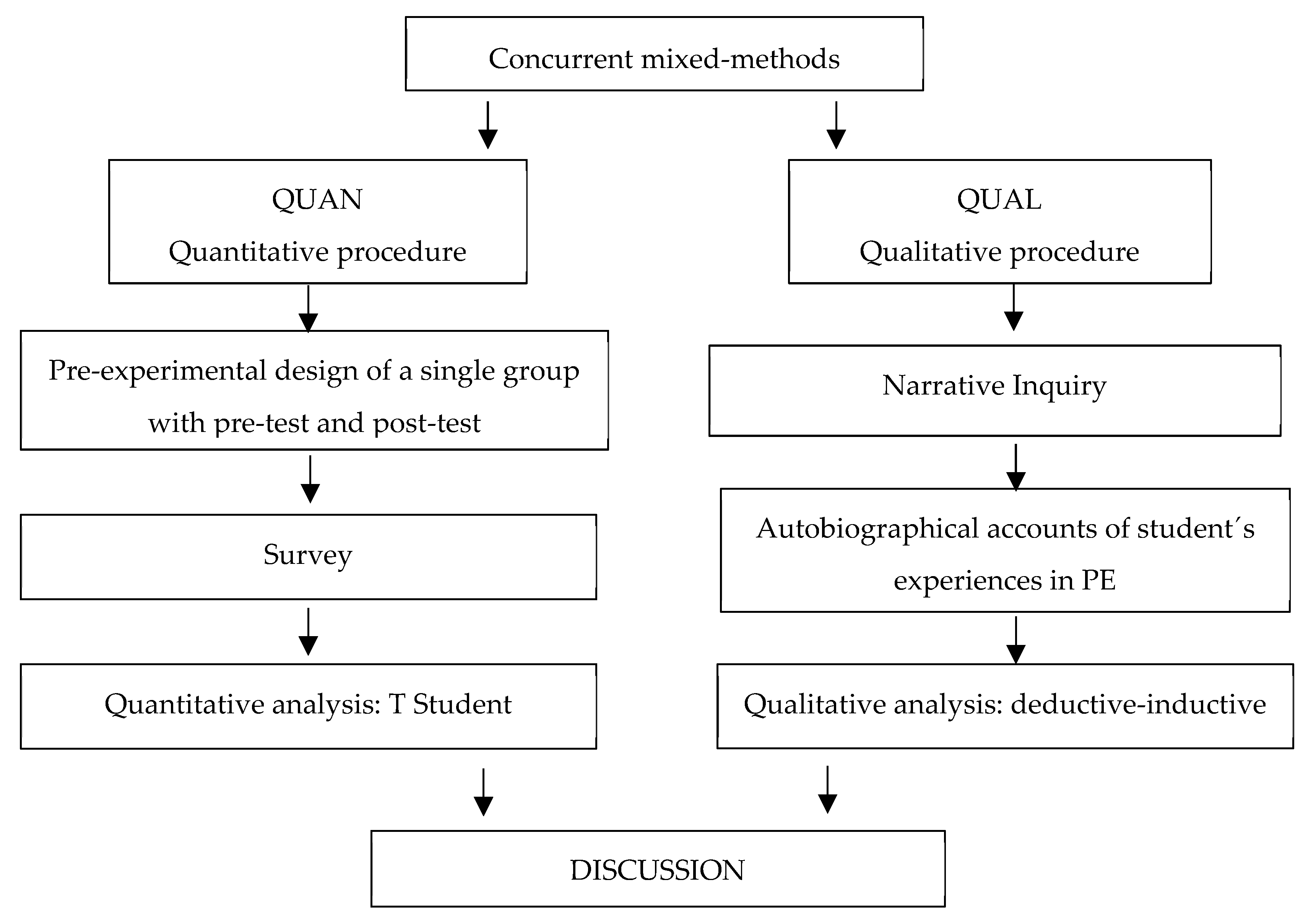
A concurrent mixed-methods study was conducted, involving the simultaneous collection of both quantitative and qualitative data [36]. The use of the mixed-methods approach entails a systematic set of research processes that includes the simultaneous collection of quantitative and qualitative data, followed by their integration and joint discussion to achieve a more comprehensive understanding of the studied phenomenon [37]. The selection of this method aligns with the formulated research objectives and allows for a more holistic response, enhancing the explanatory capacity of the results. Specifically, the combination of both methods will enable us to compare students’ perceptions of the content of the physical education subject before and after completing the course. Additionally, it will enrich the significance of these results with students’ narratives about their experience with physical education throughout their school trajectory. The study was conducted within the framework of the Didactics of Physical Education course in the Primary Education degree program at the University of Santiago de Compostela (Galicia, Spain).
The research design followed methodological recommendations on mixed methods [36,38,39,40]. The subsequent description outlines the process followed, identifying the two approaches.
2.1. Quantitative Procedure (QUAN)
A pre-experimental design of a single group with pre-test and post-test was carried out. There are three differentiated moments of the study that can be highlighted: (1) application of the pre-test during the first week of classes (1st week of February); (2) development of the subject ‘Didactics of Physical Education’ (February, March, April and the 1st and 2nd weeks of May); (3) application of the post-test during the last week of classes (2nd week of May).
The instrument used was an ad-hoc questionnaire comprising three content blocks: identification data, previous concepts and beliefs about Physical Education, and competences developed during the Didactics of Physical Education course. The configuration of questions in blocks 2 and 3 follow a Likert-type format, with a response scale from 1 (not at all) to 5 (very much), in order for participants to assess their degree of agreement with different concepts and considerations about Physical Education and Teaching Physical Education.
For its development, we took into consideration the results from previous research on students’ autobiographical memories, the characteristics that define the Didactics of Physical Education, and the methodological recommendations for making a data collection instrument of this nature provided by different authors [41,42,43]. Prior to its implementation, the instrument was revised by two experts in the development of research instruments in education and two specialists in the Didactics of Physical Education. The observations of this group of experts were considered for the final development of the data collection instrument.
2.2. Qualitative Procedure (QUAL)
The narrative method was employed through the analysis of students’ accounts of their personal experiences with the physical education subject. To achieve this, students were asked, during the first week of classes (1st week of February), to provide a brief narrative about their best and worst memories related to physical education during Primary Education. The utilization of this method was grounded in the significance of narratives and the narrative method for comprehending and expressing students’ previous educational experiences [44]. It aimed to explore how these experiences shape their beliefs regarding education in a specific subject, in this case, physical education. The narrative method enables the understanding of the sequence of events and situations involving thoughts, feelings, emotions, and interactions, as recounted by those who experienced them [36].
Figure 1.
Method.
2.3. Participants
A total of 59 students of the course “Didactics of Physical Education” from the Degree in Primary Education at the USC took part. 78% were women compared to 22% men. Most students are 19 years old on average (49.2%), followed by 20 (35.6%) and 21 (6.8%). Only 8.4% of the respondents are over 22 years old. Most of them indicate that they have participated in sports or extracurricular activities related to Physical Education (89.4%) and consider that this experience influences their future work as teachers (81.8%).
2.4. Data Collection and Information Analysis
(1) Quantitative analysis: The data collection instrument was applied in two moments: during the first week of class, prior to the development of the course of Didactics of Physical Education (pre-test) and three months later once the course had been completed (post-test). The quantitative analysis of information was made using the statistical package SPSS version 28.9. This consisted of both a descriptive analysis (frequencies, media, standard deviation) and a comparative analysis to compare the results obtained on the pre-test and the post-test (Student’s t-test).
(2) Qualitative analysis: Similarly, a qualitative analysis of the students’ narratives was conducted, employing an inductive procedure where categories emerged from the reading, organization of information, and analysis of the meanings within the narratives. In this process, two initial analysis categories were considered: (1) positive experiences and (2) negative memories, around which various subcategories emerged. Additionally, during the qualitative analysis, each student is identified with a specific code (S1, S2, S3… SX), and their responses are presented exactly as described by them.
3. Results
3.1. Beliefs and Previous Concepts about Physical Education
One of the key questions in our study was to find out students’ beliefs and previous concepts about Physical Education. The items to be assessed by students (Table 1) include both concepts that have traditionally been associated with Physical Education and others that respond to more innovative models in the teaching of physical education.
After applying the Student’s t-test, we found that there are statistically significant differences between the means obtained for all the concepts when comparing students’ personal experience with the subject of Physical Education (pre-test) with their perception of the level they consider these concepts should be present once they had taken the course (post-test) (p<0.01 for most of the concepts). More specifically, the perception of students after taking the course (post-test) improves in relation to more innovative and positive of Physical Education Didactics, such as learning, participation, socializing, fun and play. On the contrary, in the post-test, the evaluation of concepts such as competitivity and physical fatigue decreases.
3.2. Characteristics and Purpose of Physical Education Didactics
A set of items on the concept, characteristics and purpose of Physical Education Didactics were also considered with the aim of comparing students’ previous ideas derived from their personal experience (pre-test) with their perception of these same items once they had taken the course Didactics of Physical Education in the degree in Primary Education (post-test) (Table 2).
A first descriptive analysis of data shows that, in the post-test, the results exceed the 4 (somewhat agree to strongly agree) in all items. Thus, most students highlight, above other aspects, the fun and motivating component of Physical Education, indicating that is a way of learning while having fun and that it facilitates states of enjoyment and pleasure. Likewise, they highlight its importance in favouring social interaction and participation with others.
According to the results obtained with the Student’s t-test on the comparison between pre-test and post-test, statistically significant differences were found in all the items. In eight of these items this significance is p<0.01, while in two of them is p<0.05. These results show that once students have taken the course, their perception about the components that should be present in the teaching of Physical Education change. In all of the items the average assessment is higher in the post-test than in the pre-test. The greatest increase in the means of the post-test in relation to the pre-test is present in the following items: “It favours the development of decision-making skills”, “It represents a challenge, understood as something to overcome within learners’ possibilities” and “It is relevant learning in cognitive terms”.
3.3. Contributions of “Didactics of Physical Education” to Teaching Professional Competencies:
Once the course was completed, the surveyed students also assessed the degree to which they had worked the different key competences established in the course syllabus, included in the Resolution of 19 February 2015, of the University of Santiago de Compostela, which contains the curriculum for the Degree in Primary Education Teaching [45].
The average scores obtained show that in general terms, students consider that the course contributed to the development of all the competences described (Table 3). The highest average score was for: “favouring the acquisition of habits and skills for autonomous and cooperative learning among students” (4.63), followed by “helping to reflect on classroom practices in order to innovate and improve teaching work” (4.56). Then, they also highlighted the value of the subject for “acquiring teaching-learning procedures” (4.53), “stimulating and valuing effort, perseverance and personal discipline in students” (4.53) and “improving coexistence both inside and outside the classroom paying attention to the peaceful resolution of conflicts” (4.46). On the other hand, the competence with the lowest average rating is that of “facilitating the interrelation of disciplines between the different curricular areas of Primary Education” (3.97).
3.4. Positive and Negative Memories Regarding Physical Education
In the analysis of students’ narratives about their experiences in physical education, the majority associate their “positive memories” with the playful nature of the subject, emphasizing its connection to periods of fun and enjoyment through games.
“I have very fond memories; I couldn’t highlight any in particular. I remember having a great time in almost every session, mostly when we played dodgeball; I loved that game. Also, I remember that during Halloween, the Physical Education department organized outdoor games that were very entertaining and enjoyed by everyone” (S10).
“How much fun I had during the sessions with my classmates, especially in the Primary Education stage; I have better memories because the teacher organized very fun games...” (S12).
“The best stage in Physical Education for me was in Primary school. We played entertaining and fun games while learning at the same time” (S27).
In some narratives, this playful nature of physical education is contrasted with that of other subjects, highlighting its contribution to the “disconnection” from the usual school routine. Furthermore, students also emphasize the opportunity that this subject provided for socializing with classmates, especially during cooperative games.
“I also liked the atmosphere in the classroom, much more relaxed than in other subjects, where we could socialize with all classmates and get to know each other better” (S25).
“A different class, transcending the limits of the classroom and its classic rules, conducted standing, in motion, dynamically (...) with the playful touch they almost always had” (S38).
“The best memories of Physical Education are the moments and anecdotes I shared with my classmates; it was the time to disconnect from other subjects” (S39).
Similarly, some participants relate their positive memories in the subject to the teacher’s role, emphasizing its importance in learning through play.
“... thanks also to the teacher we had because we learned new things and had fun playing” (S5).
“The innovations by the teachers, taking advantage of seasons like autumn to do what we called ‘The chestnut games’” (S6).
“In primary school (...) the teacher tried to make us learn by playing with everyone” (S15).
“... we had an excellent teacher with whom we played a lot of games...” (S23).
“The best experiences in PE that I remember are related to the teacher we had in the third cycle of Primary school. His concern for us to learn and have a good time in class was evident” (S31).
When asked about their “negative memories,” the participating students mostly link them to experiences related to physical and endurance tests, especially in the later years. The students clarify that, in many cases, these physical fitness tests did not consider the diversity of students, leading to feelings of helplessness and discomfort in front of the rest of the group.
“The endurance tests, speed, strength, etc. Since we were only valued based on the results we achieved without taking into account our effort and abilities” (S7).
“When some teachers made us do somersaults as an exam in front of the whole class, without practicing much beforehand, as if everyone should know how to do them. And until you did something, you were there in front of everyone” (S9).
“The worst memory I have of Physical Education could be the physical endurance tests, like the Cooper test, which I never saw any usefulness in since many people struggled with it” (S25).
“When activities were carried out that did not adapt to each person’s abilities” (S62).
Some of the analyzed narratives point to the competitiveness that arose in certain moments in class, generally linked to the development of these physical tests.
“... comparisons between classmates, competitiveness, or activities related to performance in physical tests” (S8).
“The atmosphere of competitiveness that was created with my classmates, the low self-esteem it generated in me for not being ‘good’ in the subject, always being the last person chosen for teams, always at a lower competitive level than my class” (S35).
Other voices also include the teaching role in some of their worst memories, mainly linked to the aforementioned aspects: resistance tests, not considering the different characteristics of students, etc.
“... we had a teacher who conducted classes in the traditional method, focusing on high-demand exercises, and if you didn’t reach the expected level, it influenced our grade negatively” (S27).
“... my worst memories in Physical Education are related to the teacher who taught the subject in the second cycle” (S31).
“My worst memories are with a teacher who barely got involved in teaching practice...” (S40).
4. Discussion
The primary aim of this study is to investigate the beliefs and prior conceptions held by prospective teachers upon entering initial teacher training. To achieve this, we examine their recollections as students in schools and assess the extent to which students’ perceptions regarding the objectives and components of Physical Education shift after completing the course titled “Didactics of Physical Education” within the Primary Education degree program. For this endeavor, we will juxtapose students’ initial assessment of Physical Education, shaped by their personal experiences (pre-test), their subsequent assessment upon finishing the course (post-test), and their narrative recollections and memories of childhood.
Regarding students’ pre-existing beliefs and concepts about Physical Education, our findings align with observations made by other scholars concerning the significance attributed by prospective teachers to competitiveness [27], as well as the correlation identified between competitive sports and their attitudes toward Physical Education in schools. Indeed, these findings resonate with the societal perception of the subject, particularly evident in questionnaire items related to effort and competitiveness [32]. Furthermore, the connection drawn between competitiveness and traditional pedagogies in the instruction of Physical Education is noteworthy, albeit not analyzed in our study.
In recent academic years, we conducted an experiment in the Physical Education subject of the Primary Education Degree with the aim of highlighting the students’ experiences and memories throughout their school trajectory [35]. The majority of students express satisfaction with the subject both in Primary and Secondary Education, with slightly lower satisfaction in the latter. They associate positive memories with the subject to relationships with classmates and the classroom atmosphere. They particularly emphasize the playful and socializing nature of Physical Education as a means for building knowledge, collaboration, and enjoyment with classmates, especially in Primary Education. This characteristic is reinforced by the unique nature of Physical Education in the school context, deviating from classroom routines and teaching practices and creating a context of disconnection that promotes contact and increased personal interaction.
The teacher’s role, especially their commitment to the subject and concern for students, and the classroom atmosphere, have a greater influence than the specific content of the subject. These observations generally align with findings from previous studies [46,47].
Despite this predominant positive view, the analysis of students’ discourse regarding their autobiographical experience has revealed some negative experiences and memories. These negative aspects are identified with the content related to physical performance, relationships with the evaluation of individuals and their performance, and the lack of attention to the diversity of students. Excessive emphasis on competitiveness are also highlighted. These negative opinions toward Physical Education are especially directed at the Secondary Education stage. Similar results have been demonstrated in other studies [48,49] concerning fears in Physical Education and how they condition the subject’s assessment.
It is also worth highlighting the coincidence with other studies [29] on the importance given to values, and the fact that the results of our sample show outstanding scores in items such as participation, fun, socializing, learning and playing, which increase after taking the course.
In relation to the assessment that students’ give to basic competences addressed in the course, those related to the contents of the subject itself, its teaching-learning procedures and innovative practices are particularly noteworthy. These coincide with what has been pointed out by other studies [25] on the importance of knowledge of the contents of Physical Education, active participation in its activities and the need to put the contents of the subject into practice.
On the other hand, those competences linked to concepts of educational inclusion (values, diversity, gender, conflict resolution, equity, citizenship…), although maintaining high scores, are situated below other individualistic values which are closer to the tradition of effort inherent to Physical Education, mostly linked to perseverance and discipline. Likewise, it can also be noted that the lowest score is given to the interrelation of Physical Education with other subjects. From our perception, we could explain it based on the traditional ways of understanding Physical Education, which is taught in schools by “specialists”, in differentiated places and environments (the playground, gymnasium…), with its own contents (related to the body and movement) very different from the rest of the school subjects. This leads to an excessive fragmentation of teaching tasks in schools with a lack of knowledge of the educational intentions of Physical Education and a reductionism to aspects associated with sports and healthy habits [30].
Unless the prior beliefs and concepts that pre-service teachers bring with them are critically examined, students will tend to repeat them and perpetuate these models, especially those that generate deep emotions and that were experienced first-hand or in close environments [50]. With our work we have tried, as far as possible, to understand the beliefs that our students have about school Physical Education, the characteristics and purposes they attribute to it, the competences that are developed through Physical Education Didactics, contrasting the results when the course begins, and once it has been completed. Cautiously, we can say that the passage through the course increases the educational appreciation and beliefs towards Physical Education of the future teachers. As Wrench & Garrett [7] remind us, the process of becoming a teacher and the construction of teacher identity is interwoven with beliefs, experiences and learning that needs to be accommodated and negotiated over the course of the profession.
5. Conclusions
The impact of the role played by the teacher in the learning process of students is undeniable. In the construction of this teaching role, one of the factors to be considered is the prior experience and beliefs. The results obtained in this study evidence that the time spent in the course of “Didactics of Physical Education” changes the perception learners have towards deeply rooted beliefs and previous concepts in their way of conceiving the course. After taking the course (post-test), learners attribute more innovative and positive concepts to Physical Education, such as learning, socialization, participation or fun.
With the necessary precautions, we can affirm that participation in this research has provided us with evidence of the reflective component of this approach by the students. Alongside the deconstruction of perceived teaching practices, it aids in the modification, for the better, of approaches towards an educational conception of Physical EducationPrincipio del formulario.Final del formulario
Analyzing students’ discourse about their memories and experiences provides a framework for understanding various subject contents in Physical Education Didactics, especially the most common pedagogical models and how they influence and shape teaching practices in the classroom. Helping future teachers understand these models, the reasons supporting them, and the practices they promote contributes to a deeper understanding of the educational value of Physical Education in Primary Education. It also aids them in making curriculum decisions when formulating their pedagogical approaches in lesson plans for the subject and its implications for other subjects in Primary Education, ultimately contributing to the construction of their teaching identity.
Finally, it is worth highlighting the significance and value of this approach to the subject within the broader context of the degree program. We believe that this perspective is relevant for future Primary Education teachers since it critically situates personal experiences within the context of a subject, Physical Education Didactics, and a degree program, the General Primary Education Degree -without a specific mention of Physical Education-. For most students, this subject is considered residual, and they do not intend to delve into it since they will not be teaching it in their usual professional roles. Beyond any potential vocation towards teaching Physical Education, we find it important for their formation as future Primary Education teachers to familiarize themselves with different models and trends guiding Physical Education in schools. This knowledge can serve them in critically analyzing elements of the curriculum and teaching practices, fostering reflective teachers who make intelligent decisions in contexts of increasing uncertainty and complexity.
It should also be noted that the study has certain limitations, like the non-random selection of participants and the fact that it is based exclusively on the perception of the subjects involved. These limitations and the type of study do not allow us to generalize the results; although it does reaffirm the need to continue reflecting on how these beliefs and prior experiences influence the initial training of future Physical Education teachers. In this sense, we believe it is necessary to continue to study in depth how these beliefs may be conditioned by what students consider to have been good teachers and good references in the subject of Physical Education. Likewise, we consider that these first results should be complemented with other studies, for instance in different stages of initial training (after school placement) or in different periods of the professional development of teachers thus continuing the research done by previous studies [35].
References
- Loughran, J. J.; Hamilton, M. L.; LaBoskey, V. K.; & Russell, T. L. (Eds.). International handbook of self-study of teaching and teacher education practices, 2007, Vol. 12. Springer.
- Pérez, S.; Aburto, R.; Poblete, F.; Aguayo, O. The school as a space to become a teacher: experiencies of Physical Education teachers in training. Retos, 2022, 43, 27–35. [Google Scholar] [CrossRef]
- Korthagen, F.A.J.; Nuijten, E.E. Core reflection: Nurturing the human potential in students and teachers. In International Handbook of Holistic Education, J.P. Miller, K. Nigh, M.J. Binder, B. Novak, & S. Crowell, New York/London: Routledge, 2022; pp. 89-99.
- Coe, R.; Aloisi, C.; Higgins, S.; & Elliot Major, L. What makes great teaching? Review of the underpinning research. Centre for Evaluation and Monitoring. Durham University, 2014. What-Makes-Great-Teaching-REPORT.pdf (suttontrust.com).
- Twomey-Fosnot, C.; Stewart-Perry, R. , Constructivism: A Psychological Theory of Learning, in Constructivism: theory, perspectives, and practice (2nd ed), C. Twomey Fosnot, editor. Teachers College Press. 2005.
- Lortie, D. C. Schoolteacher: A Sociological Study. Chicago, IL, University of Chicago Press, 1975.
- Wrench, A.; Garrett, R. Identity work: stories told in learning to teach physical education. In Sport, Education and Society, 2012, 17(1), 1-19. [CrossRef]
- Goodson, I. F. Hacia un desarrollo de las historias personales y profesionales de los docentes. Revista Mexicana de Investigación Educativa, 2003, 8(19), 733–758.
- Bolívar, A. Las historias de vida del profesorado. Revista Mexicana de Investigación Educativa, 2014, 19(62), 711–734. http://www.scielo.org.mx/scielo.php?script=sci_arttext&pid=S1405-66662014000300004.
- Elías, M. La construcción de identidad profesional en los estudiantes del profesorado de Educación Primaria. Profesorado. Revista de Currículum y Formación de Profesorado, 2016, 20(3), 335-365. https://www.redalyc.org/pdf/567/56749100012.pdf.
- González-Calvo, G.; Arias-Carballal, M. A. Teacher´s personal-emotional identity and its reflection upon the development of his professional identity. The Qualitative Report, 2017, 22(6), 1693-1709. [CrossRef]
- Hortigüela, D.; & Hernando, A. “Dedícate a otra cosa”: estudio autobiográfico del desarrollo profesional de un docente universitario de Educación Física. Qualitative Research in Education, 2017, 6(2), 149-178. [CrossRef]
- Abreu, S. M. B. de; Nóbrega-Therrien, S. M.; & Silva, S. P. Experiência com narrativas autobiográficas na (auto)formação para a pesquisa de licenciandos em educação física. Revista Educaçao e Formaçao, 2017, 2(5), 183–194. [CrossRef]
- O’Bryant, Camille P.; Mary O’Sullivan; & Jeanne Raudensky. Socialization of Prospective Physical Education Teachers: The Story of New Blood. Sport, Education and Society, 2000, 5(2), 177–93. [CrossRef]
- Arnon, S.; Reichel, N. Who is the ideal teacher? Am I? Similarity and difference in perception of students of education regarding the qualities of a good teacher and of their own qualities as teachers. Teachers and Teaching: theory and practice, 2007, 13(5), 441-464. [CrossRef]
- Murphy, P. K.; Delli, L. A. M.; Edwards, M. N. The good teacher and the good teaching: comparing beliefs of second grade students, preservice teachers, and inservice teachers. The Journal of Experimental Education, 2004, 72(2), 69-92. [CrossRef]
- Harford, J.; Gray, P. Emerging from somewhere: Students teachers, professional identity and the future of teacher education research. In Overcoming fragmentation in teacher education policy and practice, B. Hudson, Ed., Cambridge University Press, 2017, pp. 27-48.
- Carter, A. Carter review of initial teacher training (ITT). London: DfE, 2015. Carter_Review.pdf (publish-ing.service.gov.uk).
- Gomez-Zwiep, S. Elementary teachers’ understanding of students’ science misconceptions: Implications for practice and teacher education. Journal of Science Teacher Education, 2008, 19 (5), 437–454. [CrossRef]
- Kambouri, M. Investigating early years teachers’ understanding and response to children’s preconceptions. European Early Childhood Education Research Journal, 2016, 24(6), 907–927. [CrossRef]
- Morrison, J. A.; Lederman, N. G. Science teachers’ diagnosis and understanding of students’preconceptions. Science Education, 2003, 87(6), 849–867. [CrossRef]
- Lerum, Øystein; Bartholomew, John; McKay, Heather; Resaland, Geir Kåre; Tjomsland, Hege E.; Anderssen, Sigmund Alfred; Leirhaug, Petter Erik; Moe, Vegard Fusche. Active Smarter Teachers: Primary School Teachers’ Perceptions and Maintenance of a School-Based Physical Activity Intervention. Translational Journal of the ACSM, 2019, 4(17), p 141-147. [CrossRef]
- Österling, L.; Christiansen, I. Whom do they become? A systematic review of research on the impact of practicum on student teachers’ affect, beliefs, and identities. International Electronic Journal of Mathematics Education, 2022, 17(4). [CrossRef]
- Grub, A. S.; Biermann, A.; Brünken, R. Process-based measurement of professional vision of (prospective) teachers in the field of classroom management. A systematic review. Journal for educational research online, 2020, 12(3), 75-102. [CrossRef]
- Chróinín, D. N.; O’Sullivan, M. Elementary Classroom Teachers’ Beliefs Across Time: Learning to Teach Physical Education. Journal of Teaching in Physical Education, 2016, 35(2), 97–106. [CrossRef]
- Matanin, M.; Collier, C. Matanin, M.; Collier, C. Longitudinal Analysis of Preservice Teachers’ Beliefs about Teaching Physical Education. Journal of Teaching in Physical Education, 2003, 22(2), 153–168. [CrossRef]
- Harvey, S.; O’Donovan, T. M. Pre-service physical education teachers’ beliefs about competition in physical education. Sport, Education and Society, 2013, 18(6), 767–787. [CrossRef]
- Del Valle, S.; De la Vega; R.; Martínez-Almira, M. M. Primary and Secundary School Physical Education Teacher´s Beliefs. Revista Internacional de Medicina y Ciencias de La Actividad Física y Del Deporte, 2015, 15(59), 506–526.
- Gutiérrez Sánchez, M.; Romero Sánchez, E.; Izquierdo Rus, T. Creencias del profesorado de Educación Física en Educación Primaria sobre la educación en valores. Educatio Siglo XXI: Revista de La Facultad de Educación, 2019, 37(3), 83–110. [CrossRef]
- González-Calvo, G; Gerdin, G.; Philpot, R.; Hortigüela-Alcalá, D. Wanting to become PE teachers in Spain: connections between previous experiences and particular beliefs about school Physical Education and the development of professional teacher identities. Sport, Education and Society, 2021, 26(8), 931–944. [CrossRef]
- Latorre Medina, Mª. J.; Pérez García, Mª. P.; Blanco Encomienda, F. J. Análisis de las creencias que sobre la enseñanza práctica poseen los futuros maestros especialistas en Educación Primaria y en Educación Física. Un estudio comparado. REIFOP, 2009, 12 (1), 85-105.
- Rivera García, E.; Trigueros Cervantes, C.; Doña, A. M. The Big Bang Theory o las reflexiones finales que inician el cambio. Revisando las creencias de los docentes para construir una didáctica para la Educación Física Escolar (The Big Bang Theory or the final reflections that trigger change. Reviewing teacher. Retos, 2020, 37, 652–659. [Google Scholar] [CrossRef]
- Hernández-Álvarez, J. L.; Velázquez-Buendía, R.; Martínez, M. E.; Díaz del Cueto, M. Creencias y perspectivas docentes sobre objetivos curriculares y factores determinantes de actividad física. Revista Internacional de Medicina y Ciencias de La Actividad Física y El Deporte, 2010, 10(38), 336–355. http://cdeporte.rediris.es/revista/revista38/ artcrencias160b.htm.
- Alonso, M. C.; Gómez-Alonso, M. T.; Pérez-Pueyo, Á.; Gutiérrez-García, C. Errores en la intervención didáctica de profesores de Educación Física en formación: perspectiva de sus compañeros en sesiones simuladas. Retos. Nuevas Tendencias en Educación Física, Deporte y Recreación, 2016, 29, 229-235. https://www.redalyc.org/articulo.oa?id=345743464044.
- Eirín-Nemiña, R. Reconstruyendo la materia de Didáctica de la Educación Física desde la perspectiva autobiográfica del alumnado (Reconstructing the subject of Didactics of Physical Education from students’ autobiographical perspective). Retos, 2020, 37, 628–633. [Google Scholar] [CrossRef]
- Hernández, R.; Fernández, C.; Baptista, P. Metodología de la investigación, 6ª edición, McGrawHill Education, México. 2014.
- Hernández-Sampieri, R. & Mendoza, C. (2018). Metodología de la investigación. Las rutas cuantitativa, cualitativa y mixta. México, Mc Graw Hill Education, 2018.
- Onwuegbuzie, A. J.; Johnson, R. B.; & Collins, K. M. Call for mixed analysis: A philosophical framework for combining qualitative and quantitative approaches. International Journal of Multiple Research Approaches, 2009, 3(2), 114–139. [CrossRef]
- Creswell, J. Mapping the Field of Mixed Methods Research. Journal of Mixed Methods Research, 2009, 3 (2), 95-108.
- Teddlie, C.; & Tashakkori, A. Foundations of Mixed Methods Research: Integrating Quantitative and Qualitative Approaches in the Social and Behavioral Sciences. Sage, London, 2009.
- Torrado, M. Estudios tipo encuesta. In Metodología de la investigación educativa, R. Bisquerra, Coord. Ed. La Muralla, Madrid, 2004, pp. 130-147.
- McMillan, J.H.; Schumacher, S. Investigación educativa, 5ª edición. Ed. Pearson. 2005.
- Fowler, F.J.; Cosenza, C. Writing Effective Questions. In International Handbook of Survey Methodology, E.D. Leeuw, J.J. Hox, and D.A. Dillman; Taylor and Francis Group, New York. 2008, pp. 136-160.
- Sabariego, M.; Massot, I.; & Dorio, I. Métodos de investigación cualitativa. In R. Bisquerra (Coord.). Metodología de la investigación educativa, 285-320. La Muralla, 2016.
- Resolución del 19 de febrero de 2015, de la Universidad de Santiago de Compostela, por la que se publica el plan de estudios de Graduado en Maestro de Educación Primaria. Boletín Oficial del Estado, nº 70, 25316-25320. https://www.boe.es/diario_boe/txt.php?id=BOE-A-2015-3086.
- Moreno, J. A. & Hellín, M. G. El interés del alumnado de Educación Secundaria Obligatoria hacia la Educación Física. Revista Electrónica de Investigación Educativa, 2007, 9(2), 1-20.
- Valencia-Peris, A. & Lizandra, J. Cambios en la representación social de la educación física en la formación inicial del profesorado. Retos. Nuevas Tendencias en Educación Física, Deporte y Recreación, 2018, 34, 230–235. [Google Scholar] [CrossRef]
- Molina Soria, M.; Pascual Arias, C. & López Pastor, V.M. El uso de sistemas de evaluación formativa y compartida en las aulas de educación física en Educación Primaria. Educación Física y Deporte, 2020; 39, 47–71. [Google Scholar] [CrossRef]
- Monforte, J. & Pérez-Samaniego, V. O medo em Educaçao Física: uma história reconhecível. Movimento. Revista de Educaçao Física da UFRGS,. [CrossRef]
- Haynes, J. E.; Quinn, F.; Miller, J. A. Teacher Biography: SOLO Analysis of Preservice Teachers’ Reflections of their Experiences in Physical Education. Australian Journal of Teacher Education, 2020; 45, 49–63. [Google Scholar] [CrossRef]

Table 1.
Pre-test and post-test comparison about key concepts related to Physical Education.
| Key concepts | Pre-test (mean1) |
Post-test (mean1) |
Student´s test T value |
Sig. |
|---|---|---|---|---|
| Competitiveness | 3.51 | 2.88 | 4,159 | 0.001** |
| Effort / Endeavour | 3.97 | 4.19 | -1,785 | 0.040* |
| Physical fatigue | 3.29 | 2.83 | 2,812 | 0.003** |
| Participation | 4.19 | 4.80 | -5,046 | 0.001** |
| Fun | 3.98 | 4.68 | -6,093 | 0.001** |
| Socializing | 4.03 | 4.69 | -5,403 | 0.001** |
| Learning | 3.69 | 4.78 | -10,791 | 0.001** |
| Play | 4.08 | 4.68 | -5,612 | 0.001** |
1 rating scale from 1 (not at all) to 5 (very much); * p < 0.05; ** p < 0.01.
Table 2.
Pre-test and post-test comparison about the characteristics that define Didactics of Physical Education (Student´s test).
Table 2.
Pre-test and post-test comparison about the characteristics that define Didactics of Physical Education (Student´s test).
| Characteristics | Pre-test (mean1) |
Post-test (mean1) |
T value | Sig. |
|---|---|---|---|---|
| It is a means of social interaction which facilitates participation with others | 4.51 | 4.76 | 3.089 | 0.002** |
| It is a way of learning while having fun, it has a playful and motivating component for student participation | 4.61 | 4.90 | 3.585 | 0.001** |
| It represents a challenge, understood as something to overcome within learners’ possibilities | 3.69 | 4.22 | 3.881 | 0.001** |
| It favours motor skills, in terms of individual improvement in accordance with his/her own possibilities | 4.28 | 4.53 | 2.264 | 0.014* |
| It is socially relevant learning | 4.07 | 4.59 | 4.186 | 0.001** |
| It is relevant learning in cognitive terms | 4.10 | 4.42 | 3.021 | 0.002** |
| It facilitates moments of pleasure and enjoyment | 4.44 | 4.64 | 2.188 | 0.016* |
| It favours the development of decision-making skills | 3.97 | 4.59 | 5.097 | 0.001** |
| It favours the development of autonomy in students | 4.24 | 4.59 | 3.708 | 0.001** |
| It allows students to reflect on the meaning of their experiences in the subject | 4.16 | 4.53 | 2.692 | 0.005** |
1 rating scale from 1 (not at all) to 5 (very much); * p < 0.05; ** p < 0.01.
Table 3.
Extent to which students consider that the subject contributes to the development of following competences.
Table 3.
Extent to which students consider that the subject contributes to the development of following competences.
| Competences | Mean1 | Standard Deviation |
|---|---|---|
| To know the curricular area of Physical Education in Primary Education | 4.27 | 0.611 |
| Acquire teaching-learning procedures | 4.53 | 0.626 |
| To facilitate disciplinary interrelation between different curricular areas of Primary Education | 3.97 | 0.742 |
| Encourage the design and regulation of teaching-learning environments in contexts of diversity | 4.22 | 0.750 |
| Stimulate gender equality, equity and respect of human rights, which make up the values of citizenship education | 4.22 | 0.767 |
| Improve the coexistence both inside and outside the classroom, paying attention to the peaceful resolution of conflicts | 4.46 | 0.597 |
| Stimulate and value effort, perseverance and personal discipline in students | 4.53 | 0.504 |
| To favour the acquisition of habits and skills for autonomous and cooperative learning among students | 4.63 | 0.488 |
| To help reflect on classroom practices inside the classroom in order to innovate and improve teaching work | 4.56 | 0.565 |
1 rating scale from 1 (not at all) to 5 (very much).
Disclaimer/Publisher’s Note: The statements, opinions and data contained in all publications are solely those of the individual author(s) and contributor(s) and not of MDPI and/or the editor(s). MDPI and/or the editor(s) disclaim responsibility for any injury to people or property resulting from any ideas, methods, instructions or products referred to in the content. |
© 2024 by the authors. Licensee MDPI, Basel, Switzerland. This article is an open access article distributed under the terms and conditions of the Creative Commons Attribution (CC BY) license (http://creativecommons.org/licenses/by/4.0/).
Copyright: This open access article is published under a Creative Commons CC BY 4.0 license, which permit the free download, distribution, and reuse, provided that the author and preprint are cited in any reuse.


