

Submitted:
17 May 2024
Posted:
19 May 2024
You are already at the latest version
Abstract
The interaction of matter when separated by a distance is a fundamental question, whether such interactions occur through instantaneous action at a distance or retarded interaction (principle of locality)? While the mainstream consensus favors the principle of locality, instantaneous action at a distance offers certain advantages. Previously, instantaneous action at a distance has been viewed as an appearance or representation from specific gauge choices of electromagnetic potentials (retarded). In this paper, we propose a novel approach that combines Weber’s electrodynamics with the concept of vacuum polarization to explore a new possible connection between the two viewpoints: instantaneous action at a distance and the locality principle. This new approach aligns with the observation of locality in signal/energy propagation while retaining the notion of instantaneous action at a distance.
Keywords:
Action at a Distance
; Principle of Locality
; Vacuum Polarization
; Weber’s Electrodynamics
; Wave Propagation
Introduction
How matter interacts at a distance is a fundamental question in physics [1,2]. Discussion of this question continues to evolve. Centuries ago, Newton introduced the law of universal gravitation between distant objects; Coulomb developed the force law between electric charges; and Weber expanded Coulomb’s force of electrostatics to electrodynamics by considering the effect of velocity and acceleration of charges. In these physical laws, it was assumed that the actions between distant objects (or charges) occur instantaneously, i.e. instantaneous action at a distance [3].
In the 19th century, electromagnetic radiation/waves were discovered [4]. The phenomena were explained by the wave equation derived from Maxwell’s equations. Then, Maxwell and many contemporaries believed in local interaction (retarded) instead of action at a distance [5]. In Maxwell-Lorentz electrodynamics, the interaction between charged particles is mediated by fields. One particle emits a field, which propagates at light speed. The field reaches and interacts with another particle, causing action.
In the early 20th century, Einstein introduced special relativity with the assumption of constant light speed in vacuum [6]. In this theory, no information or force can travel faster than the speed of light. Thus interaction of matter needs to obey locality, i.e. either retarded action at a distance or field mediated local interaction. This has become the accepted view in mainstream physics today, replacing the concept of instantaneous action at a distance. Retarded interaction was then introduced into physical laws, including gravitational theory [7], and Weber’s electrodynamics [8].
Nevertheless, there persist valid arguments both for and against the two theories, instantaneous action at a distance and retarded interaction [9]. Field theory (retarded interaction) has the distinct advantage of explaining most of the electromagnetic wave phenomena. However, it is not without its drawbacks [10], particularly in terms of the non-straightforward treatment of energy and momentum conservation among interacting particles [11,12]. Whereas instantaneous action at a distance has the distinct advantage of obeying Newton’s third law, thus naturally obeys energy and momentum conservation without seeking contributions from fields, although it does not directly account for the propagation of waves (signal/energy).
In earlier studies, attempts were made to reconcile both locality and instantaneous action at a distance [2]. For instance, the direct action theory was introduced [13], aiming to maintain consistency with wave propagation. However, this approach assumes both retarded and advanced field propagation, and it does not assign properties to the field. Despite creating an appearance of direct action at a distance, it is not strictly instantaneous. Another approach involves starting with Maxwell’s equations and derives Weber’s force under certain conditions [14], resulting in a force that has an apparent instantaneous action at a distance. Also, instantaneous action at a distance has been seen as a representation from specific gauge choices of electromagnetic potentials [15].
In this paper, we try to shed some light on this fundamental question from a new perspective. We first introduce Weber’s force law and the postulate of vacuum polarization. Subsequently, we consider instances of Weber’s force at play in both empty space and within a polarizable vacuum. The latter case demonstrates the locality of interaction within Weber’s electrodynamics given the vacuum polarization postulate. Finally, we discuss some potential implications of this new approach.
Weber’s Electrodynamics
Weber extended Coulomb’s static force law to the dynamic regime by incorporating the effect of charge velocity and acceleration [16]. As an alternative to Maxwell-Lorentz electrodynamics, Weber’s electrodynamics has been successfully applied to a number of electric phenomena [17], extended to high velocity particles [18,19], and used to derive an electric wave equation in the rest frame of the media (polarizable vacuum) [20]. Compared to Maxwell-Lorentz electromagnetism, Weber’s electrodynamics gives a much simpler form for particle-particle interaction forces.
According to Weber’s electrodynamics, two charge particles interact with each other, determined by their relative position, velocity and acceleration. The force exerted by one particle on the other is given by [21]
Where and are two electrical charges, is the force that charge exerts on charge , is the distance between the two charges, is the unit vector pointing from charge to charge , and are velocity and acceleration of charge relative to charge , is the dielectric constant and is the speed of light.
Vacuum Polarization
In quantum electrodynamics, vacuum polarization describes a process in which a background electromagnetic field produces virtual electron–positron pairs [22,23]. Similar and different to this well established concept, the vacuum was recently postulated to be a “sea” filled with positive-negative charge pairs [20]. In the absence of an external electric field, the positive-negative charge pairs can fully overlap each other (Figure 1) rendering the vacuum electrically neutral or unpolarized. However, the introduction of an external electric field prompts a relative displacement between positive and negative charges (Figure 1), resulting in vacuum polarization. It was demonstrated how the vacuum polarization postulate [24] can directly lead to electric wave propagation within Weber’s electrodynamics [20]. In this paper, we explore how instantaneous action at a distance may behave differently under this polarizable vacuum concept.
In this paper we choose a reference frame in which the vacuum is stationary. The displacement, velocity and acceleration of negative charge has the same value as that of positive charge within each pair, but with opposite direction.
where , , and are displacement, velocity, and acceleration of positive charge, , , and are displacement, velocity, and acceleration of negative charge.
Charge Interaction in an Empty Space
Let’s consider the case that the vacuum is fully empty (Figure 2). There is a test charge at position . At time zero, there is a charge assumed suddenly emerging at the origin. The charge in the assumption may be seen as an approximation of a charge concentration perturbation in real world. The force of charge exerted on charge equals (from Weber’s force or Coulomb’s law)
where and are the distance and unit vector from the origin to charge . Assuming the charge has a mass (or inertia) , then its acceleration, according to Newton’s second law, equals
According to Weber’s electrodynamics, the emerging charge causes an immediate reaction of the charge . Thus the acceleration of the charge happens at time zero. This is called instantaneous action at a distance.
Charge Interaction in Polarizable Vacuum
Let’s speculate that the vacuum is not fully empty, instead having the property of vacuum polarization (Figure 1). At time zero, a charge assumed emerging at the origin. According to Weber’s electrodynamics, the emerging charge instantaneously exerts a force to all the positive-negative charge pairs in the vacuum. In the meantime, each charge pair also exerts a force to all other charge pairs (Figure 3).
For example, the point charge exerts a force at a small volume of charge at . The force can be calculated with equation (1),
where is the acceleration of charge and is the charge density.
In the meantime, all other charges (positive charges contained in the charge pairs of polarized vacuum) will exert a force at the charge at . The force can be calculated with equation (1) and integration.
Where, is the position vector of , is the acceleration of , and the integration is with respect to . Because of spherical symmetry, .
And, all other charges (negative charge in charge pairs of vacuum) will exert a force at the charge at .
Where, is the position vector of and is the acceleration of .
Let’s neglect the mass of charge (the mass of positive-negative charges in vacuum is likely much smaller compared to that of physical particles) and its acceleration force (mass times acceleration). Additionally, the polarization force within a positive–negative charge pair may also be neglected since it is likely small compared to the force exerted by the nearby volume of charges. Then the force summation of all the forces exerted at the charge equals zero.
Thus
After some simplification,
Equation (10) holds for any at time zero. The unknown variable is . Since equation (10) is a nonlinear equation, it is difficult to solve it in a straightforward manner.
To get a solution of equation (10), let’s look into the point charge first. The point charge may be seen as an integration of a delta function at the origin,
where represents the whole vacuum space, and
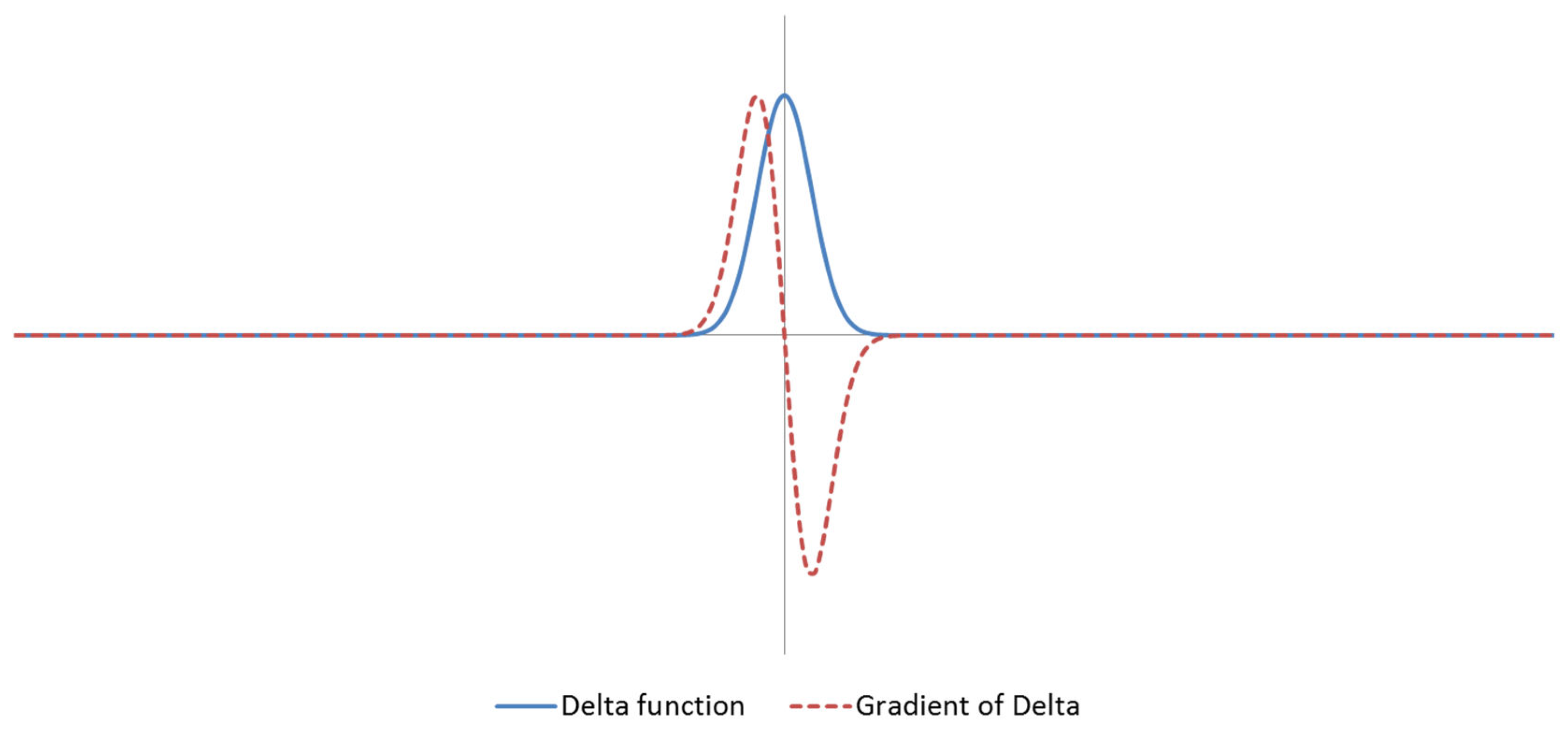
Delta function has been routinely used in physics and engineering to model point properties. Delta function value is zero everywhere except at coordinate zero, and its integral over the entire coordinate is equal to one. Thus delta function can be seen as a “local” function, so does the gradient of delta function.
We can assume a solution that takes the form , where is a constant to be determined, and is the gradient of a delta function. For any given non-zero , , thus . Then the solution has a property that , for any given .
Let’s explore individual components of equation (10) with the assumed solution. Since , we have . Thus
Because is anti-symmetric for and , and for any given , we have
Using equations (13, 14), equation (10) can be simplified to
Since where , equation (15) can be further simplified to
With further simplification, we have
If we insert our presumed expression for into equation (17), we obtain
Here, we have used a spherical coordinate system. After integration along and ,
Further integrating, we obtain
Re-arranging for yields,
Allowing us to arrive at a solution for the acceleration (solution uniqueness will be discussed in the next section),
Thus, the distribution of acceleration is:
Here, we have shown that our proposed solution satisfies equation (10) at time zero within the framework of the postulated polarizable vacuum. While the emerging charge is a local perturbation (delta function, equation 12), the acceleration caused by this charge is also a local phenomenon (gradient of delta function, equation 23) (Figure 4). This “local” effect appears to be aligned with the principle of locality.
The above finding may be understood in this way: The emerging charge affects the nearby vacuum first, causing acceleration. The vacuum at a distance does not immediately react to the appearance of the emerging charge, even though the emerging charge already applied an action on it. The action from the emerging charge and the action from the neighboring accelerating vacuum cancel each other (as manifested by zero acceleration at a distance).
Uniqueness of the Solution
The force balance equation in a polarizable vacuum (equation 10) may only have one single (unique) solution. The unknown of equation (10) is the one-dimensional acceleration function, which has an unknown value at each point, , on a positive real axis. On the other hand, the force balance equation holds at each point of the positive real axis too. Thus the number of equations is equal to the number of unknowns and it is highly likely that the equations for different values of are mutually independent. While this isn’t a complete proof, it does suggest that the solution presented in this context might be unique for this particular charge interaction scenario (Figure 3).
Discussion
In this study, we employed the postulate of vacuum polarization. The view of vacuum in physics has continued to develop over many years. Initially perceived as an empty space containing nothing (emphasis: no-thing), this perspective later shifted with the introduction of the ether concept. The ether was proposed as a medium filling the vacuum, serving as a conduit for light and electromagnetic wave propagation [25]. Later the Michelson–Morley experiment was performed to detect the ether wind [26]. However, the experiment’s null result led to the abandonment of the ether concept in mainstream physics. Subsequently, Maxwell’s electromagnetic wave was theorized to travel through space independently, without the need for a medium. With the advent of Einstein’s theory of relativity, the vacuum was redefined in accordance with space-time [27], appearing empty but endowed with certain properties. In the context of modern quantum physics, the vacuum is no longer considered as entirely empty. Instead, it has quantum fluctuations, including the creation and annihilation of virtual positive-negative particle pairs under the influence of external electric fields [22,23].
This paper has demonstrated a new proposal of the compatibility or potential connection between instantaneous action and the principle of locality. By employing Weber’s electrodynamics, we derived force balance equations governing charge interactions within a polarizable vacuum. Notably, for certain cases (such as charge pairs with displacement freedom in vacuum), these equations yield a localized solution for a local charge perturbation, aligning with the principle of locality. This approach not only holds promise for formulating an electric wave equation within Weber’s electrodynamics [20] but also preserves the fundamental concept and advantages of instantaneous action at a distance. Specifically, it adheres to Newton’s third law, ensuring the conservation of energy and moment. However, this paper has only worked on a simple setting and focused only on the interaction at time zero. Thus this paper may only be seen as the first step towards reconciling instantaneous action at a distance and the principle of locality, using Weber’s electrodynamics and polarizable vacuum.
A similar effort can also be found by Assis [28] (pp. 227-231) in which he contrasts action at a distance and contact action (locality). Assis highlights the pioneering work of Weber and Kirchhoff, who measured the propagation velocity along a complete circuit and identified as the velocity of light. He contends that although the action is conventionally deemed ‘instantaneous’, retardation is inevitably introduced for two primary reasons:
- Each charge possesses inertia, resulting in a response to applied force contingent on inertial mass.
- In dealing with a many body system, it behaves akin to an intermediate medium or carrier of information.
In the present paper, we circumvent the first reason by assuming negligible inertial mass for virtual vacuum charges. However, the second reason persists as we contemplate an array of positive and negative charge carriers. This acknowledgment becomes apparent when discussing the assumed solution of equation (10). Notably, the emerging charge initially influences the nearby vacuum, causing acceleration, while the vacuum at a distance does not respond immediately.
Regarding experiments, most observed phenomena demonstrate locality, such as the propagation of waves, energy, and signals in space. However, experiments measuring the propagation speed of Coulomb fields provide mixed conclusions, but tending to favor more instantaneous propagation [29]. Quantum experiments, such as quantum entanglement, seem to suggest either a faster than light speed of travel [30] or some non-local effect [31]. This theory presented in this paper stems from instantaneous action at distance, allowing for the possibility of non-local interaction or non-local effects. This characteristic renders it potentially compatible with both of the aforementioned experiments.
The approach developed herein posits instantaneous interaction between the source and receiver based on Weber’s force. According to this approach, all particles in the universe interact with each other instantaneously. While Mach’s principle [32] also suggests a universal mass influence, it doesn’t specify whether this influence is instantaneous or retarded. In the framework presented in this paper, given the assumptions made, the instantaneous interaction may exhibit a form of ’local’ effect, where distant interactions have less impact compared to local interactions, given that the interaction is inversely proportional to distance and/or the square of distance.
In the framework of special relativity, any signal traveling faster than light will cause causality breaking. This has been a significant reason against the notion of action at a distance. However, this paper shows that instantaneous action at distance does not necessarily cause signal/energy to travel faster than light speed. Instead, we show that instantaneous interaction has a locality appearance in the specific example presented in this paper.
This paper is an effort to expand Weber’s electrodynamics by introducing a simplified version of vacuum polarization. It is reasonable to wonder how this effort will reconcile with all aspects of established physics. Some questions are: How does the model deal with the doubts raised on stationary aether models? Does this model support ordinary electromagnetic waves (constant velocity c for all coordinate systems)? Would it give a different value for the permittivity of space? Is the model consistent with special relativity? How is this model related with QED (Quantum ElectroDynamics)? However, this paper has a very confined scope. The extensive questions listed here are the subject of future research.
Conclusions
Instantaneous action at a distance and the principle of locality have been historically seen as opposing views. And instantaneous action at a distance has been seen as an appearance or representation from specific gauge choices of electromagnetic potentials. However, this paper shows that they may potentially be compatible with each other in a new way based on Weber’s electrodynamics and our speculation regarding vacuum polarization. This new approach can be seen as a first step to explain the phenomena of locality, while retaining the concept and benefits of instantaneous action, including Newton’s action-reaction force law, and conservation of energy and momentum.
Acknowledgements
Q.L. thanks Steffen Kühn, and Juan Manuel Montes Martos for their constructive suggestions and feedback.
References
- Graneau, P., & Graneau, N. (1993) Newton versus Einstein: How matter interacts with matter. Sheffield: Carlton Press.
- Wolfgang Pietsch, On conceptual issues in classical electrodynamics: Prospects and problems of an action-at-a-distance interpretation. Studies in History and Philosophy of Science Part B: Studies in History and Philosophy of Modern Physics 2010, 41, 67–77. [CrossRef]
- Hesse, Mary B. (December 1955). "Action at a Distance in Classical Physics". Isis 1955, 46, 337–353. [CrossRef]
- Jeans, James (1947) The Growth of Physical Science. Cambridge University Press.
- James Clerk Maxwell (1st ed. 1873) A Treatise on Electricity and Magnetism, Vol II pages 426–438.
- Albert Einstein (1905) "Zur Elektrodynamik bewegter Körper", Annalen der Physik 17: 891; English translation On the Electrodynamics of Moving Bodies by George Barker Jeffery and Wilfrid Perrett (1923); Another English translation On the Electrodynamics of Moving Bodies by Megh Nad Saha (1920).
- Rothman, Tony. The Secret History of Gravitational Waves. American Scientist 2018, 106, 96–10. [CrossRef]
- Wesley, J. Weber electrodynamics extended to include radiation. Specul. Sci. Technol. 1987, 10, 50–53. [Google Scholar]
- Wolfgang Engelhardt, 2015, Relativity of time and instantaneous interaction of charged particles. American Journal of Modern Physics 2015, 4, 15–18.
- Moerkamp, Mischa. (2018). Field-free electrodynamics. DOI: arXiv:1806.10082v8.
- P. A. M. Dirac. Classical theory of radiating electrons. Proceedings of the Royal Society London. Series A 1938, 167, 148–169.
- J. A. Wheeler, R. P. Feynman. Interaction with the Absorber as the Mechanism of Radiation. Reviews of Modern Physics 1945, 17, 157–181. [CrossRef]
- Wheeler, J. A.; Feynman, R. P. (July 1949). "Classical Electrodynamics in Terms of Direct Interparticle Action". Reviews of Modern Physics 1949, 21, 425–433. [Google Scholar] [CrossRef]
- S. Kühn (2022) Inhomogeneous wave equation, Liénard-Wiechert potentials, and Hertzian dipoles in Weber electrodynamics. Electromagnetics 2022, 42, 571–593. [CrossRef]
- R. A. Villecco, 1993, Instantaneous action-at-a-distance representation of field theories. Phys. Rev. E 1993, 48, 4008–4026. [CrossRef] [PubMed]
- Assis, Andre & Torres, Hector. (2012). Comparison between Weber’s electrodynamics and classical electrodynamics. Pramana Journal of Physics 2000, 55, 393–404. [CrossRef]
- Baumgärtel, C.; Maher, S. Foundations of Electromagnetism: A Review of Wilhelm Weber’s Electrodynamic Force Law. Foundations 2022, 2, 949–980. [Google Scholar] [CrossRef]
- Li, Q. Extending Weber’s Electrodynamics to High Velocity Particles. Int. J. Magn. Electromagn. 2022, 8, 1–9. [Google Scholar]
- Montes, J.M. On the Modernisation of Weber’s Electrodynamics. Magnetism 2023, 3, 102–120. [Google Scholar] [CrossRef]
- Li, Q., & Maher, S. (2023). Deriving an Electric Wave Equation from Weber’s Electrodynamics. Foundations 2023, 3, 323–334.
- A. K. T. Assis and M. Tajmar, Rotation of a superconductor due to electromagnetic induction using Weber's electrodynamics, Annales de la Fondation Louis de Broglie, Vol. 44, pp. 111-123 (2019).
- Weinberg, S. (2002). Foundations. The Quantum Theory of Fields. Vol. I. Cambridge University Press. ISBN 978-0-521-55001-7.
- Karbstein, F. Probing Vacuum Polarization Effects with High-Intensity Lasers. Particles 2020, 3, 39–61. [Google Scholar] [CrossRef]
- Fukai, J. A Promenade Along Electrodynamics; Vales Lake Publishing: Pueblo West, CO, USA, 2003. [Google Scholar]
- Schaffner, Kenneth F. (1972), Nineteenth-century aether theories, Oxford: Pergamon Press, ISBN 978-0-08-015674-3.
- Michelson, Albert A.; Morley, Edward W. (1887). "On the Relative Motion of the Earth and the Luminiferous Ether". American Journal of Science. 34 (203): 333–345.
- Einstein, A. (1915) The Field Equations of Gravitation. In: The Berlin Years: Writings, 1914-1917 (English Translation Supplement) in the Collected Papers of Albert Einstein, Vol. 6, Princeton University Press, Princeton, 117.
- Assis, A.K.T. Weber’s Electrodynamics; Springer: Dordrecht, The Netherlands, 1994. [Google Scholar]
- Stefanovich, Eugene. (2023). Propagation speed of Coulomb force. What do experiments say? Researchgate. 2023-05 Preprint.
- Yin, Juan; Cao, Yuan; Yong, Hai-Lin; Ren, Ji-Gang; Liang, Hao; Liao, Sheng-Kai; Zhou, Fei; Liu, Chang; Wu, Yu-Ping; Pan, Ge-Sheng; Li, Li; Liu, Nai-Le; Zhang, Qiang; Peng, Cheng-Zhi; Pan, Jian-Wei (2013). "Bounding the speed of 'spooky action at a distance". Physical Review Letters 2013, 110, 260407.
- Francis, Matthew (30 October 2012). "Quantum entanglement shows that reality can't be local". Ars Technica.
- Bondi, Hermann; Samuel, Joseph (July 4, 1996). "The Lense–Thirring Effect and Mach's Principle". Physics Letters A 1996, 228, 121–126.
Figure 1.
An illustration of the vacuum polarization postulate for two states: unpolarized state (with overlapping charges) and polarized state (when an external electric field is applied).
Figure 1.
An illustration of the vacuum polarization postulate for two states: unpolarized state (with overlapping charges) and polarized state (when an external electric field is applied).
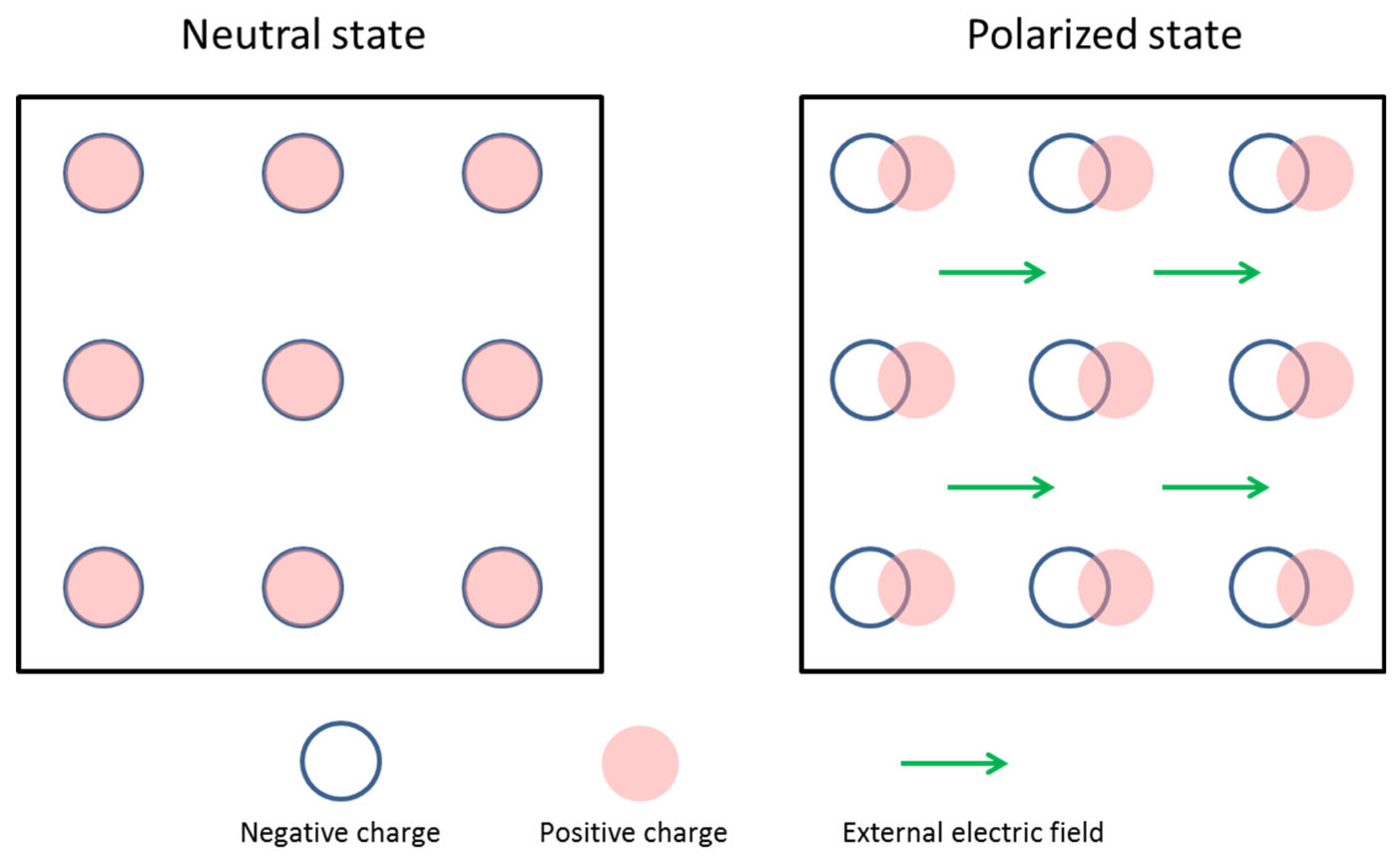
Figure 2.
Sketch illustrating how charge Q exerts an instantaneous force on charge q in empty space, which causes it to react immediately.
Figure 2.
Sketch illustrating how charge Q exerts an instantaneous force on charge q in empty space, which causes it to react immediately.
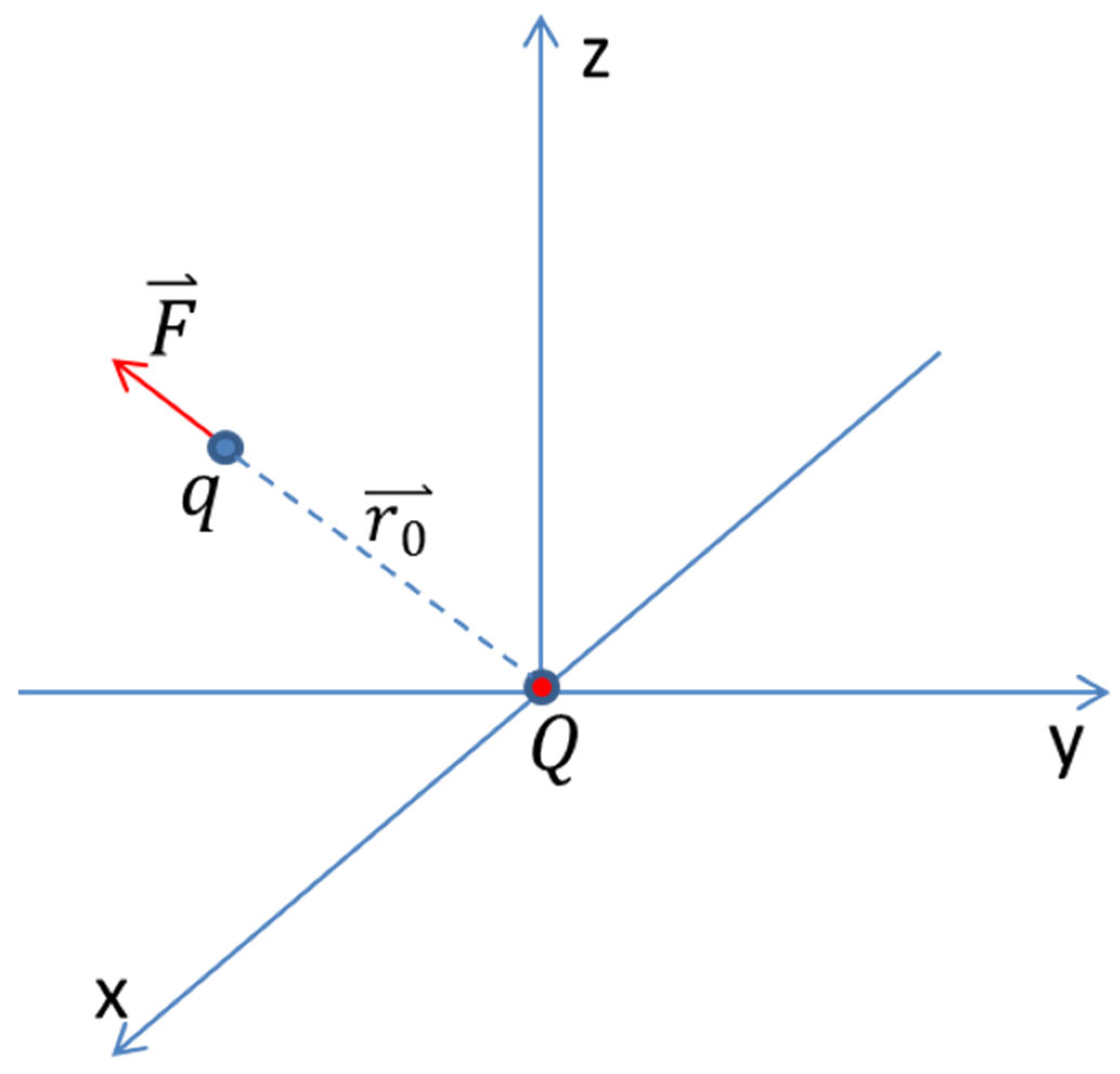
Figure 3.
Sketch illustrating some of the charge interactions within a polarized vacuum. Charge Q exerts a force on charge in the vacuum, while positive-negative charge pairs (, ) also exert a force on charge .
Figure 3.
Sketch illustrating some of the charge interactions within a polarized vacuum. Charge Q exerts a force on charge in the vacuum, while positive-negative charge pairs (, ) also exert a force on charge .
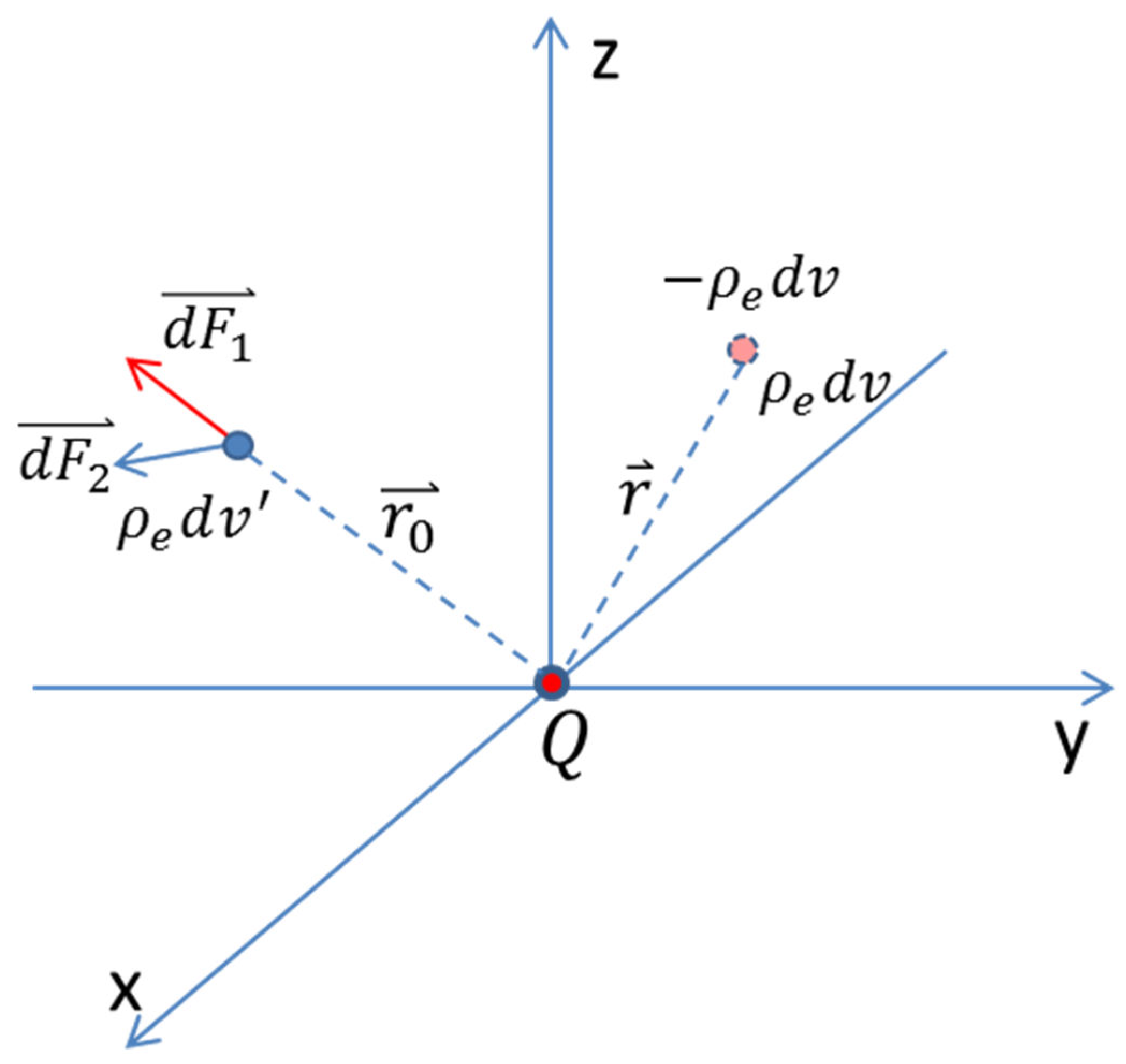
Figure 4.
One-dimensional schematic diagram showing delta function and gradient of delta function. Horizontal axis has been exaggerated and the value of both curves has been arbitrarily adjusted for illustrative purposes.
Figure 4.
One-dimensional schematic diagram showing delta function and gradient of delta function. Horizontal axis has been exaggerated and the value of both curves has been arbitrarily adjusted for illustrative purposes.
Disclaimer/Publisher’s Note: The statements, opinions and data contained in all publications are solely those of the individual author(s) and contributor(s) and not of MDPI and/or the editor(s). MDPI and/or the editor(s) disclaim responsibility for any injury to people or property resulting from any ideas, methods, instructions or products referred to in the content. |
© 2024 by the authors. Licensee MDPI, Basel, Switzerland. This article is an open access article distributed under the terms and conditions of the Creative Commons Attribution (CC BY) license (http://creativecommons.org/licenses/by/4.0/).
Copyright: This open access article is published under a Creative Commons CC BY 4.0 license, which permit the free download, distribution, and reuse, provided that the author and preprint are cited in any reuse.


