

Submitted:
06 April 2024
Posted:
08 April 2024
You are already at the latest version
Abstract
The paradigm shift has revealed a need among industrial designers to have entrepreneurial capabilities. Being the most effective modality to exercise discipline today. The implementation of this approach requires reviewing the discursive scaffolding that the design has been using to set immovable high standards of complexity and quality, reducing the field of professional action and limiting the intervention alternatives. This article considers the dynamics and trends in people's lifestyles, explores possible strategies and specific content for the entrepreneurial training required by design.
Keywords:
Industrial design
; entrepreneurship
; entrepreneurial ecosystem
; pedagogical strategies
1. Introduction
Recovering the words of Bonsiepe (2013), cognitive capitalism (post-industrial) is in a stage of development characterized by: 1. the growth of the service sector, 2. the replacement of use value by symbolic value, 3. the incorporation of affective practices (emotional design), 4. the organization of work in the form of projects, 5. the transformation of the work subject to act as an entrepreneur.
The latter is the most relevant aspect for the purposes of this essay. The characterization of the entrepreneurial professional is determined by the accumulation of self-organized skills that allow him to address complexity and interact with the different dimensions of the business sphere.
These interactions take place in a context determined by a territory and a network of particular actors, which will make up a unique entrepreneurial ecosystem (Alburquerque, 2004; Lavandera and Seibel, 2019).
Because “entrepreneurship is above all a local phenomenon,” how the productive framework and the entrepreneurial ecosystem function will be recognized, with the aim of understanding what the potential of the Argentine entrepreneurial ecosystem is (Carballo et al., 2017, p. 50).
2. The Business Framework and the Entrepreneurial Ecosystem
Each territory has a configuration in terms of the distribution and typology of companies that make it up, thus resulting in the formation of a unique network. But the mere formation of an industrial network does not guarantee recognition between the productive actors and their characteristics, thus wasting the synergistic potential. Finally, this results in a waste of available resources, conditioning productive efficiency, limiting collaborative work and possible joint innovation projects.
On the other hand, the concept of entrepreneurial ecosystem emerges as an evolution of the productive framework, and of traditional innovation models based on clusters (Thomas and Autio, 2019), structurally incorporating other key actors that provide interaction and favor the capitalization of synergies.
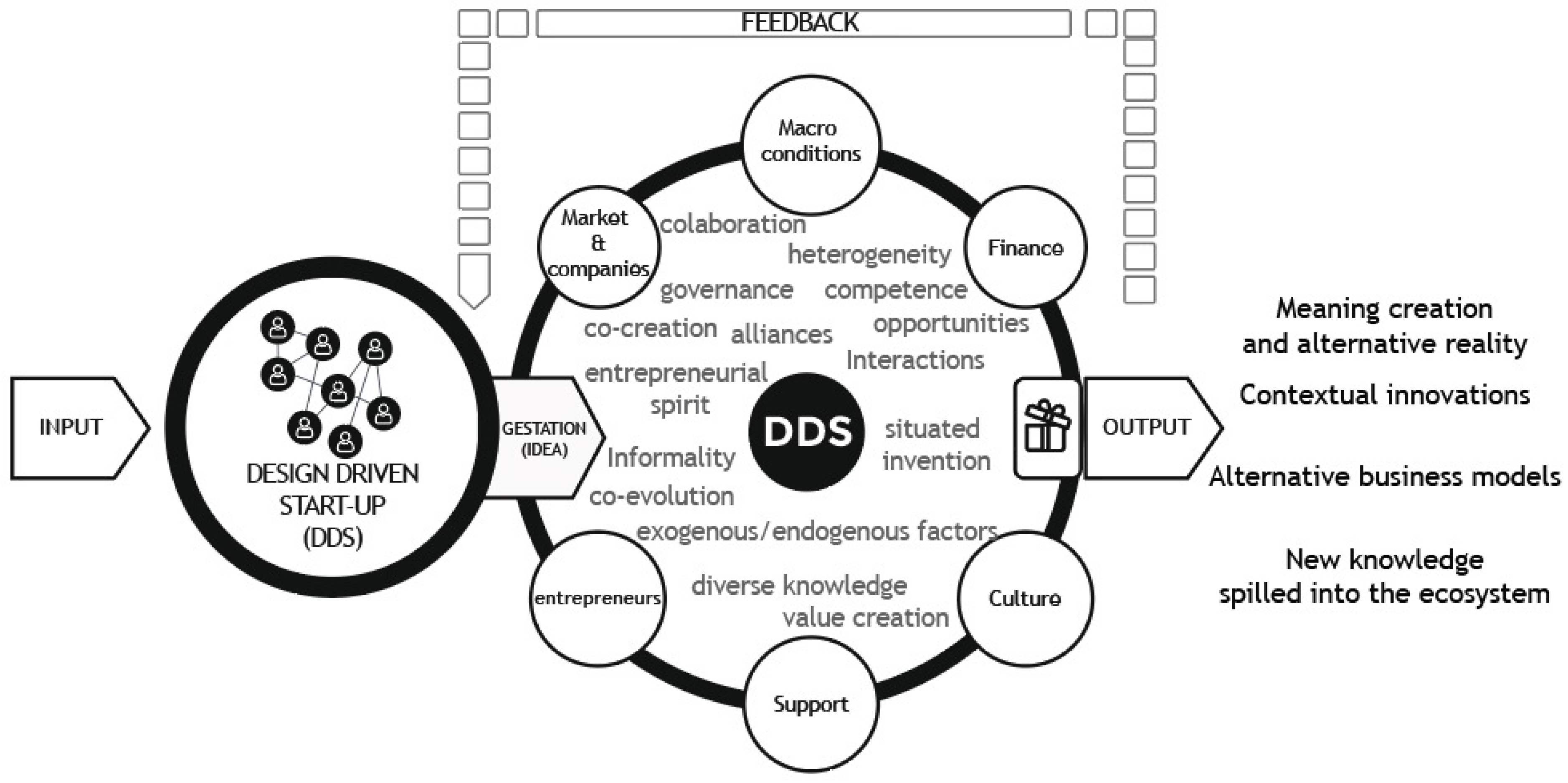
For the purposes of this work and considering the theoretical framework addressed in previous research, we understand the entrepreneurial ecosystem as a territorial linking device (Figure 1), in which a heterogeneous and interdependent set of actors, things and places are linked (formal and informally), to achieve results with levels of innovation higher than those they could achieve individually and giving rise to various governance relationships between them (Del Giorgio Solfa and D'Amico, 2019).
The entrepreneurial ecosystem is also characterized by:
- (a)
- Heterogeneity of actors and informality in interrelationships (Mason and Brown, 2014; Thomas and Autio, 2019).
- (b)
- Interdependence between actors (Cohen 2006; Isenberg, 2011; Stam and Spigel, 2016, Thomas and Autio, 2019).
- (c)
- Governance relationships (Thomas and Autio, 2019).
- (d)
- Dynamism and change of role of the actors.
- (e)
- Emergence, coevolution and resilience (Thomas and Autio, 2019).
- (f)
- Collaboration and competition.
- (g)
- Innovation: user-based business models (Thomas and Autio, 2019).
- (h)
- Higher levels of innovation.
- (i)
- Horizontal knowledge spillover (Thomas and Autio, 2019).
3. Designing the Entrepreneurial Designers
To plan specific strategies and content for the training of the entrepreneurial designer that the post-industrial scenario demands (Campi, 2020), it is necessary to know the main characteristics of the discursive scaffolding of both industrial design and entrepreneurship.
Understanding these discourses and the way they are integrated and articulated in the curriculum will affect the way students conceive their professional practice, consider the environment and develop the “entrepreneurial spirit”.
In the words of Galán: “the design workshop is a pedagogical device through which the student incorporates representations, habits, procedures and attitudes that characterize him as a member of the design community” (Galán, cited by Rondina and Becerra, 2008: p. 32).
The complexity of this challenge lies in the heterogeneity of said educational community and in the existence of diverse ways of practicing professional design (Campi, 2020).
However, regardless of the professional profile with which the student is (de)formed, designing –inevitably– implies entrepreneurial action and a critical sense that allows him or her to consider various situations and integrate different variables. That, although they appear to be unrelated to the development of the product, are decisive in completing a project.
Regarding the link between students and the scenarios in which they intervene, Galán (2008, p. 24), maintains that:
Our student has been sensitized to see himself as the author of objects, in predictable scenarios, this is his area of real development. He has not been prepared for dialogue with external actors, he does not read the context in its complexity. This stereotype of the profession is created every time that practical work fixes this imaginary, in which reality is absent or has been mutilated, through exercises unrelated to research.
Additionally, Dorst (2017, p. 13) explains the obsolescence of traditional design methodologies to address the open, complex, dynamic and interconnected problems present in the post-industrial era:
These open, complex, dynamic, interconnected problems do not fit well with the assumptions underlying our conventional problem-solving methods, because most of our conventional strategies were designed to operate in a hierarchically ordered and highly static and isolated “mini-world.” When problems arose, we could isolate them in a separate area, break them down into relatively simple subproblems and analyze them, create subsolutions and then put them together to form an overall solution that satisfied all the actors involved. If this divide-and-solve strategy failed, we could use the alternative strategy of exercising authority to “simplify” the extent of the problem by nullifying one of the parties, and impose a solution that satisfied the most powerful agent.
On the other hand, the design community is highly related to the issue of creativity and originality of the projects it carries out. Designers are key actors for innovation, and “the world expects new things from designers; This is the nature of design” (Margolín, 2005, p. 127). However, it is inappropriate to think about pedagogical strategies without a space-time anchor that acts as a frame of reference for the proposed innovations, and that contributes to the fragmentation of the linear, deterministic and progressive logic proposed by the Modern vision of design (Hui, 2020).
It is necessary to expand this vision, to address the needs and problems that are excluded from this logic or that are perceived by students as problems of lower rank than those required by other market segments.
This last aspect is related to another of the constitutive features of the predominant design imaginary, which is linked to an idea of excellence in the practices that define designers and in the final results they achieve.
Frequently, this idea of excellence is disjointed from the variables and problems that take place in real scenarios. In the words of Montero (2020, p. 105): “the moral problem of design in community terms is its own capacity to achieve excellence. The more excellent it is, the more disturbing it is for the community”.
In our interpretation, this unconscious tradition that only serves to feed the ego of designers, makes it impossible to resolve real and most urgent problems of all kinds, which can significantly impact various sectors of our society.
4. Bases for Entrepreneurial Teaching in Industrial Design
Understanding the current situation of many of the local productive networks in Argentina (Kantis et al., 2020), the potential that the entrepreneurial ecosystem offers us and the philosophical composition of design, requires us to adequately plan the training bases for entrepreneurial design.
This approach can be considered in three stages:
- Raising awareness of the entrepreneurial spirit.
- Training of entrepreneurial skills.
- Application in real scenarios.
4.1. Raising Awareness of the Entrepreneurial Spirit
In relation to the first stage, the role of the university is fundamental for the formation of entrepreneurial capabilities and for promoting the culture of entrepreneurship (Mason and Brown, 2014; Macías-Prada et al., 2023).
Through awareness-raising processes, which are not limited to providing specific tools for the formation of a new company or the opening of a new business, but also help to promote the entrepreneurial vocation in students in a broader sense (Zheng and Yang, 2011).
This approach seeks to train professionals to act in various areas of knowledge and, in our opinion, is consistent with various professional manifestations that industrial design is currently experiencing (Sohstein, 2005).
The importance of promoting the entrepreneurial spirit finds its justification in the theory of planned behavior (TCP). Ajzen (1991) states that beliefs, attitudes and intentions precede behavior, which is why the desire to undertake will be determined by multiple variables.
On the one hand, Fayolle points out that the most effective pedagogical strategies that encourage the entrepreneurial spirit are those: “centered on the student, and with practical meaning for the life project, since greater achievement is obtained in generating behaviors that favor entrepreneurship.” (Fayolle, 2017, p. 109). This vision coincides with that of Pallares et al. (2005), when they state that entrepreneurial training is linked to what the student experiences as “my personal strategic plan” (Pallares et al., 2005, p. 34), and they add that “The first company that we must design is life itself” (Ibidem, p. 40).
On the other hand, Mclntyre and Roche (1999, p. 33) understand entrepreneurial intention as: “the process of providing individuals with the concepts and skills to recognize opportunities that others may have overlooked and possess the insight and self-esteem to act where others may have hesitated.”
4.2. Entrepreneurial Skills Training
Regarding this second stage, in our opinion, a training proposal must identify the capabilities and attitudes that make up entrepreneurial action and how it is related to the design philosophy outlined above.
Among the various capabilities and traits that define an entrepreneur, we frequently find: problem solving, innovation, creativity, independence, self-confidence, communication skills, integrated uncertainty management (Hull et al., 1980; Waisburd, 2009); flexibility, tolerance for frustration, leadership and decision, taking responsibility, cooperating, networking, managing risk, self-learning, being proactive, having initiative (Hull et al., 1980; Fawson et al., 2015; Sanchez i Peris and Ros, 2014); self-efficacy (Zhao, Seibert, & Hills, 2005); perception of feasibility and net convenience (Segal, Borgia and Schoenfeld, 2005); in addition to family influence (Drennan, Kennedy and Renfrow, 2005).
Although up to this point, the capabilities and distinctive features are common for the entrepreneur in general, when addressing the perspective of the entrepreneurial designer we find some strengths and weaknesses, a consequence of traditional training paths.
Training in industrial design generally results in strengths, such as: the ability to create new solutions to a given problem, the comprehensive vision of the project, mastery of the design and development process of products, recognition of various materials and existing production technologies, the optimization of the economic, morphological and structural design considering the technology, the mastery of symbolic and morphological aspects of the products, and the ease of communicating graphically in 2 and 3 dimensions.
On the other hand, regarding the weaknesses of design training, we find: the obsessive search for design excellence, the excessive search for the approval of peers (design for design), the disqualification of design challenges linked to segments neglected by industry, the predilection for endogamous alliances, vanity, obstinacy and loss of objectivity in one's own idea.
4.3. Undertake from Design in Real Scenarios
Based on the above, any designer who intends to undertake must plan three basic aspects:
- (a)
- The technical capacity regarding the activity in which you are going to undertake.
- (b)
- The resources (your own or someone else's) with which you are going to do it.
- (c)
- The risk level of the context (Observatorio Pyme, 2018).
In other words, the answer must be given to: what? How? and where? is going to be undertaken.
Regarding the technical capacity regarding what is going to be undertaken (what?), each designer will explore the corresponding industrial sector or sectors based on their interests, in order to recognize their particular internal dynamics, looking for a way to problematize situations. and detecting opportunities for entrepreneurial intervention from industrial design.
In this approach, it will be key to promote sensitive observation of the environment and the creation of business models and viability schemes for future venture projects, as well as the establishment of –frameworks of reference– to achieve methodological innovation (Dorst, 2017).
Regarding the resources necessary to undertake (how?), design professionals must master a broad vision that allows them to conceive and differentiate the resources in terms of their typology and dimensions in order to evaluate them in the context of the entrepreneurial ecosystem.
Additionally, the evaluation of resources and the consideration of the corresponding actor map allows us to discover “...significant actors causing opportunities that we had not previously anticipated” (Dorst, 2015, p. 81).
In this framework, design management and strategic thinking integrate multiple linked tools that “allow the designer to navigate the network, detect connections, signs and rituals, dialogue with human and artificial actors, as well as negotiate with private, public, political and community entities” (Leiro, 2008, p. 25).
And finally, regarding the level of risk that comes from the context (where?), entrepreneurial designers will have the duty to be periodically informed about the basic indices and evolution of the economy, the general direction of politics, the public and industrial policies and any regulations (national or subnational) that may directly or indirectly involve the actions to be undertaken or any of the basic inputs involved. All these actions aimed at recognizing the context and identifying its dynamics must inevitably be located both in the chosen entrepreneurial ecosystem and in the corresponding industrial sector.
5. Final Considerations
Up to this point we have characterized this New Era and post-industrial design. We also understood the differences between the simple industrial framework and the entrepreneurial ecosystem.
In this framework, we analyze the work situation of industrial designers, observing the extinction of the dependency relationship as a form of employment relationship.
Consequently, we saw the need for designers to assume the role of entrepreneur, as one of the few alternatives for professional employment.
Based on the problematic situation determined by the contrast between traditional design training and the necessary capabilities to undertake industrially from design, strengths and weaknesses were identified.
Finally, the bases for teaching entrepreneurship for industrial design were proposed, identifying some aspects in the culture of design that deserve a reconsideration.
Up to this point we have explored, analyzed and reflected on the needs and possible strategies of entrepreneurial training for industrial designers.
We recognize that, in general, study programs integrate topics related to management and entrepreneurship among their subjects, which is currently insufficient. Therefore, it becomes evident that it is necessary to treat the entrepreneurial approach in the subjects or workshops where the projects are developed, thus guaranteeing their incorporation.
As a corollary, we have that each venture is born from an idea and from the general and particular conception of the environment, gathering and synthesizing the differential characteristics of each entrepreneurial ecosystem in a project or product. We thus reaffirm and highlight the capabilities that industrial designers have and envision the leading role they will have in this process.
Funding
The study was funded by the Scientific Research Commission of the Province of Buenos Aires [Grant # BEDOC21] and the Universidad Nacional de La Plata [Grant # 11/B411].
Disclosure Statement
No potential conflict of interest was reported by the authors.
References
- Ajzen, I. (1991). The theory of planned behavior. Organizational Behavior and Human Decision Processes, 50(2), 179-211. [CrossRef]
- Alburquerque, F. (2004). El enfoque del desarrollo económico local (Vol. 1, pp. 2-84). OIT.
- Bonsiepe, G (2013, Mayo). Modelos pedagógicos para o ensino de Design: Proposições para a século XXI [Video]. Conferencia FAU-USP. https://vimeo.com/85712871.
- Campi, I. (2020). ¿Qué es el diseño? G. Gili.
- Carballo, I. E., Belloni, M. C., López Amorós, M., & Fracchia, E. L. (2017). Emprendedorismo y políticas públicas. Una introducción a la literatura. Perspectivas de Políticas Públicas, (7)13, 37-88. [CrossRef]
- Cohen, B., Smith, B., & Mitchell, R. (2008). Toward a sustainable conceptualization of dependent variables in entrepreneurship research. Business Strategy and the Environment, 17(2), 107-119.
- Del Giorgio Solfa, F., & D’Amico, E. (2019). Complejidad y obstáculos del ecosistema emprendedor argentino: El lado B de un sueño emprendedor. Paper presented at the Proceeding of XIII Jornadas de Sociología: Las cuestiones de la Sociología y la Sociología en cuestión, University of Buenos Aires. http://hdl.handle.net/10915/94494.
- Dorst, K. (2017). Innovación y metodología: nuevas formas de pensar y diseñar. Experimenta.
- Drennan, J., Kennedy, J., & Renfrow, P. (2005). Impact of childhood experiences on the development of entrepreneurial intentions. The International Journal of Entrepreneurship and Innovation, 6(4), 231-238. [CrossRef]
- Fawson, C., Simmons, R., Yonk, R. (2015). Curricular and programmatic innovation at the inter- section of business ethics and entrepreneurship. In S. Hoskinson, & D. Kuratko (Eds.), Advances in the Study of Entrepreneurship, Innovation and Economic Growth (pp. 199.130). Emerald. [CrossRef]
- Fayolle, A. (2017). Entrepreneuriat théories et pratiques: Applications pour apprendre à entreprendre. Hachette.
- Galán, B. (2008). Diseño y complejidad. Revista Huellas, Búsquedas en Artes y Diseño, (6), 22-39.
- Hui, Y. (2020). Fragmentar el futuro: Ensayos sobre tecnodiversidad. Caja Negra.
- Hull, D. L., Bosley, J. J. & Udell, G. G. (1980). Renewing the Hunt for the Heffalump: Identifying Potential Entrepreneurs by Personality Characteristics. Journal of Small Business Management, 18, 11-18.
- Isenberg, D. (2011, May 11). The entrepreneurship ecosystem strategy as a new paradigm for economic policy: Principles for cultivating entrepreneurship. [Paper Presentation]. Institute of International and European Affairs, Dublin, Ireland.
- Kantis, H. , Gonzalo, M., Federico, J., & Garcia, S. I. (2020). Entrepreneurial ecosystems meet innovation systems: Building bridges from Latin America to the Global South. In A. Tsvetkova, J. Schmutzler & R. Pugh (Eds.), Entrepreneurial Ecosystems Meet Innovation Systems (pp. 41-60). Edward Elgar.
- Lavandera, M., & Seibel, E. (2019). El desarrollo territorial a través de la interacción de los actores del ecosistema emprendedor, promoviendo el emprendimiento y la innovación. In E. Herruzo-Gómez, B. R. Hernández-Sánchez, G. M. Cardella, & J. C. Sánchez-García (Eds.), Emprendimiento e innovación: oportunidades para todos (pp. 327-332). Dykinson.
- Leiro, R. (2006). Diseño: estrategia y gestión. Infinito.
- Macías-Prada, J. F., Silva, Y., & Zapata, A. M. (2023). The role of universities in Latin American social entrepreneurship ecosystems: a gender perspective. International Journal of Gender and Entrepreneurship. [CrossRef]
- Mason, C., & Brown, R. (2014). Entrepreneurial Ecosystems and Growth Oriented Entrepreneurship. OECD. http://www.oecd.org/cfe/leed/Entrepreneurial-ecosystems.pdf.
- Margolin, V. (2005). La política de lo artificial: ensayos sobre diseño. Designo.
- Mclntyre, J. R. , & Roche, M. (1999). University education for entrepreneurs in the United States: a critical and retrospective analysis of trends in the 1990s. Center for International Business Education and Research, Georgia Institute of Technology, Working Paper Series, 99/00-021.
- McIntyre, J. , & Roche, M. (1999). University education for entrepreneurs in the United States: A critical and retrospective analysis of trends in the 1990s. Georgia Institute of Technology.
- Montero, L. (2020). El diseño de nosotros mismos: una lectura filosófica del diseño. Experimenta.
- Observatorio Pyme (2018). Informe Especial: Natalidad Empresarial y Desarrollo Productivo. https://www.observatoriopyme.org.ar/project/natalidad-empresarial-y-desarrollo-productivo/.
- Pallares, Z., Romero, D., & Herrera, M. (2005). Hacer una empresa: un reto. Nueva empresa.
- Rondina, A. y Becerra, P. (2008). Diseño en proceso. MALBA - Fundación Costantini.
- Sanchez i Peris, F. J, & Ros Ros, C. (2014). Development of entrepreneurial competence through practicum in pedagogy degree. Procedia-Social and Behavioral Sciences, 139, 116-122.
- Segal, G., Borgia, D., & Schoenfeld, J. (2005). The motivation to become an entrepreneur. International Journal of Entrepreneurial Behavior & Research, 11(1) 42-57. [CrossRef]
- Sohstein, C. V. (2005). Inteligência empreendedora: o que você precisa saber para cuidar bem da sua empresa: especial para empresários de micro e pequenas empresas. Qualitymark.
- Stam, F. C., & Spigel, B. (2016). Entrepreneurial ecosystems. USE Discussion paper series, 16(13). https://www.uu.nl/sites/default/files/rebo_use_dp_2016_1613.pdf.
- Thomas, L. D. W. , & E. Autio (2019). Innovation ecosystems. In R. Aldag (Ed.), Oxford Research Encyclopedias of Business and Management. Oxford University Press.
- Waisburd, J. G. (2009). Pensamiento creativo e innovación. Revista Digital Universitaria, 10(12), 1-9. https://www.revista.unam.mx/vol.10/num12/art87/art87.pdf.
- Zhao, H., Seibert, S. E., & Hills, G. E. (2005). The mediating role of self-efficacy in the development of entrepreneurial intentions. Journal of Applied Psychology, 90(6), 1265-1272. [CrossRef]
- Li, Z., & Liu, Y. (2011). Entrepreneurship education and employment performance: An empirical study in Chinese university. Journal of Chinese Entrepreneurship, 3(3), 195-203. [CrossRef]
Figure 1.
Interrelationships in the entrepreneurial ecosystem.
Disclaimer/Publisher’s Note: The statements, opinions and data contained in all publications are solely those of the individual author(s) and contributor(s) and not of MDPI and/or the editor(s). MDPI and/or the editor(s) disclaim responsibility for any injury to people or property resulting from any ideas, methods, instructions or products referred to in the content. |
© 2024 by the authors. Licensee MDPI, Basel, Switzerland. This article is an open access article distributed under the terms and conditions of the Creative Commons Attribution (CC BY) license (http://creativecommons.org/licenses/by/4.0/).
Copyright: This open access article is published under a Creative Commons CC BY 4.0 license, which permit the free download, distribution, and reuse, provided that the author and preprint are cited in any reuse.