
Submitted:
20 March 2024
Posted:
21 March 2024
You are already at the latest version
Abstract
Biodiversity plays an important role in maintaining the ecological balance of the earth. The study of traditional knowledge related to biological resources is a hot issue in the field of international biodiversity conservation. Xishuangbanna is a key area of biodiversity and a cultural hotspot of international significance. According to the Technical Regulation for Classification, Investigation, and Inventory of Traditional Knowledge Relating to Biological Diversity issued by the Ministry of Ecology and Environment, we investigated and catalogued the traditional knowledge related to biodiversity of the Jino people who have lived in Xishuangbanna for generations, and collected 490 entries of traditional knowledge related to biodiversity of the Jino people. Drawing on the traditional knowledge diversity index calculation method proposed by Wang Guoping, the overall traditional knowledge α-diversity index of the Jino people is 0.63, indicating that the richness of the traditional knowledge of the Jinuo people is relatively high. The traditional culture related to biodiversity, the traditional knowledge related to agricultural genetic resources, and the traditional technology related to the sustainable utilization of biological resources are relatively rich and diverse. The diversity index is 0.86, 0.82 and 0.79 respectively. In addition, Xishuangbanna has invested a lot of energy in biodiversity protection, including the establishment of nature reserves, botanical gardens, zoos, ecological tea gardens and other species reserves, the promulgation of laws and policies related to biodiversity protection, and has achieved remarkable results in in-situ protection and ex-situ protection. On the basis of analyzing the progress and achievements of biodiversity conservation in Xishuangbanna, this study points out that Xishuangbanna faces challenges such as the loss of traditional knowledge, insufficient conservation efforts, and great changes in land use, and puts forward corresponding suggestions.
Keywords:
biodiversity conservation
; traditional knowledge
; diversity index of traditional knowledge
; progress
; achievements
1. Introduction
Biodiversity is the cornerstone for the survival and development of human society and one of the important indicators of the level of ecological civilization. As a national strategy, biodiversity conservation is related to human health and well-being. It is of great significance to the implementation of sustainable development and building a beautiful China [1]. The Global Assessment Report on Biodiversity and Ecosystem Services published by IPBES in 2019 pointed out that global biodiversity faces huge threats. The impact of human activities and land use changes have contributed to an increase in the risk of global species extinction and a decline in species population abundance, and has led to species’ extinction rates that are at least 10-100 times faster than natural background rates [2,3]. How to reverse the trend of biodiversity loss and species extinction in the future is the focus of researchers.
The Conference of the Parties at the 15th meeting of the Convention on Biological Diversity (COP 15) adopted the Kunming-Montreal Global Biodiversity Framework (GBF), which includes 4 long-term goals and 23 action goals. The GBF, which extends the biodiversity conservation and management strategies specified in the Aichi Biodiversity Goals, is crucial to stopping ecosystem degradation and reversing the trend of global biodiversity loss [4,5]. At the second phase of the COP15, the Xishuangbanna government hosted the theme meeting of "Regional Biodiversity Conservation and Cooperation". The meeting shared cases such as the protection and rescue of Asian elephants, the protection of the sacred forests of Dai people and the acquisition and benefit sharing of biological genetic resources and traditional knowledge. These cases show the effectiveness of biodiversity conservation in Xishuangbanna to the world and provide a reference for countries to implement the GBF. Xishuangbanna is one of Indo-Burma's biodiversity hotspots and occupies an important strategic position in global biodiversity conservation [6,7]. Its tropical forests play an important role in global terrestrial biodiversity [8]. Xishuangbanna has unique climatic conditions and diverse ecosystems, and is extremely rich in species and genetic resources. In terms of species diversity, according to the Xishuangbanna Yearbook (2021 edition), there are more than 5,000 species of plants in the state, including 153 species of endemic plants and 134 species of endangered plants. There are 762 species of vertebrates, including 529 species of terrestrial vertebrates and more than 3,000 species of invertebrates. The species resources are very rich [9]. According to the newly released List of National Key Protected Wild Plants and Animals Distributed in Various Cities of Yunnan Province (2021) by the Yunnan Provincial Forestry and Grassland Bureau, there are 174 species of wild plants under national key protection in Xishuangbanna, including 10 species under first-class protection and 164 species under second-class protection. There are 179 species of terrestrial wildlife under key state protection, of which 39 are under first class protection and 140 are under second class protection (Table 1).
At the same time, Xishuangbanna also has rich and valuable genetic resources, especially many cultivated plants and domestic animals with wide uses and high economic value. Their wild type or related species can be found in Xishuangbanna [10]. For example, cultivated mango can be found in Xishuangbanna in its wild relatives or the original species Mangifera sylvatica. Indian bison, monitor lizard and other species in Xishuangbanna are highly valuable genetic resources [11]. In addition, there are also some ancient relict species and endemic species in the state, such as Alsophila spinulosa and Cycas pectinata, which have great medicinal value. In terms of ecosystem diversity, Xishuangbanna has multiple ecosystems such as forests, rivers, wetlands, meadows and shrubs, among which the forest ecosystem is extremely rich in biodiversity and is the habitat of many organisms, with high ecological value [12]. According to the vegetation type classification standard of Yunnan Vegetation, the forest vegetation in Xishuangbanna can be divided into 7 main vegetation types, such as tropical rain forest, tropical monsoon forest, including 32 typical groups [13,14].
The current global biodiversity hotspots all have a common feature, that is, these areas are also rich in cultural diversity [15]. Xishuangbanna is not only a biodiversity hotspot, but also has rich ethnic and cultural diversity. Xishuangbanna has been inhabited by 13 ethnic groups for generations and has formed diverse ethnic ecological cultures, such as the firewood culture of the Dai people, the terraced field culture of the Hani people, and the slash-and-burn agricultural culture of the Jinuo people [16]. Ethnic minority communities are natural germplasm banks of local crop varieties, as well as the living museum of traditional farming techniques and ecological agriculture culture. The Jinuo people, who are engaged in rotation agriculture in Jinuo Mountain, are the people who mainly cultivate upland rice. According to the survey, before the 1950s, there were more than 100 upland rice varieties in Jinuo Mountain [17]. The Jinuo people used traditional ecological wisdom to preserve upland rice varieties and enrich the local agricultural germplasm resource bank. However, due to the planting of cash crops such as rubber and the loss of traditional knowledge, more than 30 traditional upland rice varieties have been lost today, and only 71 upland rice varieties are still preserved, including 16 early-maturing varieties, 35 medium-maturing varieties, and 20 late-maturing varieties [18]. Xishuangbanna is not only a region rich in biodiversity and traditional knowledge, but also a hotspot for the loss of genetic resources and traditional knowledge. It faces the urgent task of protecting biodiversity and related traditional knowledge. Strengthening and promoting the protection and sustainable use of traditional knowledge related to biodiversity is an important task of the China National Biodiversity Conservation Strategy and Action Plan (2023-2030). This study selected the Jinuo community, a long-dwelling ethnic group in Xishuangbanna, to conduct a survey on traditional knowledge related to biodiversity. A total of 490 entries of traditional knowledge were collected, and the diversity index of traditional knowledge was used for quantitative analysis to understand the richness of traditional knowledge of Jino people, so as to provide reference for sustainable utilization of biological resources. It also analyzes the progress, achievements and current challenges of biodiversity conservation in Xishuangbanna and puts forward corresponding suggestions, in order to provide a reference for Yunnan to strengthen biodiversity protection and promote the implementation of GBF.
2. Material and Methods
2.1. Study Area
Xishuangbanna Dai Autonomous Prefecture (21°08 '-22 °36'N, 99°56 '-101 °50'E) is the lowest latitude and terrain in Yunnan Province, with an elevation ranging from 477 to 2429 m. Xishuangbanna is located on the northern edge of the tropics south of the Tropic of Cancer and has a tropical monsoon climate. It governs Jinghong City, Menghai City and Mengla City [19]. The area has sufficient heat and rainfall and preserves the largest area of tropical rainforest and monsoon rainforest in China. It is extremely rich in species, including many rare, endangered and endemic species. It also plays an important role in biodiversity conservation [20]. Xishuangbanna covers an area of 19,124.5 square kilometers, accounting for only 0.2% land area of China, with more than 16% of the country's vascular plants, 22% of mammals and 36% of birds [21]. The forest coverage rate is as high as 81%. Xishuangbanna, the magical fertile soil, is home to 13 long-dwelling ethnic groups, including the Dai, Han, Hani, Bulang, Jinuo and so on, with a population of approximately 1.3 million. They live in the tropical rainforest and have worked hard for generations to protect the various flora and fauna in the tropical rainforest. Among them, Jinuo people is the last ethnic group approved by the State Council in China. They mainly live in the Jinuo Township of Jinuo Mountain in Jinghong City, located in the northeast of Jinghong City, 27 kilometers away from the urban area. Jinuo Mountain is one of the six major Pu'er tea mountains in Yunnan Province. It has superior climate conditions, rich biological resources, and strong ethnic customs [22]. There are many kinds of rare animals and plants growing in the territory. This paper selected 10 natural villages in Jinuo Township for field research, including Xiao Basa, Ba Ka Lao Zhai, Ba Ka Xiao Zhai, Ba Po, Si Tu Xiao Zhai, etc (Figure 1). A quantitative study was conducted on traditional knowledge related to biodiversity. Biodiversity protection and traditional knowledge protection complement each other and serve as carriers of each other. By studying the traditional knowledge of the Jinuo people, we hope to provide assistance for Xishuangbanna's biodiversity protection.
2.2. Study Methods
2.2.1. Literature Research
Collect papers and books related to biodiversity conservation in Xishuangbanna from well-known online scientific databases such as CNKI, Baidu Academic, Web of Science, Google Scholar, PubMed, and Wiley, and conduct a literature review on the progress Xishuangbanna has made in biodiversity conservation in recent years, especially in in-situ and ex-situ conservation. We also learned about the achievements of biodiversity protection in Xishuangbanna, which are mainly reflected in the remarkable achievements in the protection of ecosystems and wildlife under national key protection, and the strengthening of civil protection and public awareness of biodiversity. In addition, after reviewing relevant books and papers, preliminary data collection of traditional knowledge related to biodiversity was carried out, which provided literature materials for field research.
2.2.2. Survey and Cataloging
On the basis of literature research, from 2021 to 2023, we went to 10 natural villages of Jinuo Mountain in Jinghong City, Xishuangbanna for three times to complete a 50-day field survey, and collected 490 entries of traditional knowledge related to biodiversity of Jinuo people. Methods such as semi-structured interviews, key person interviews and group discussions were mainly used to comprehensively investigate the categories, quantity, distribution, characteristics of traditional knowledge utilization, protection status and threat factors of the Jinuo people's traditional knowledge related to biodiversity. Traditional knowledge entries are catalogued in accordance with the Technical Regulation for Classification, Investigation, and Inventory of Traditional Knowledge Relating to Biological Diversity issued by the Ministry of Ecology and Environment [23], which is also the first national standard for cataloguing and evaluating traditional knowledge in the world.
2.2.3. Traditional Knowledge Diversity Analysis
Biodiversity measurements include three spatial levels: alpha diversity(α-diversity), beta diversity(β-diversity) and gamma diversity(γ-diversity). α-diversity is the mean species diversity in a site at a local scale, while β-diversity and γ-diversity are concerned with the changes of communities in different habitats along environmental gradients and regional continental scale [24], which are significantly different from the distribution areas of traditional knowledge in spatial level. In this study, the research site is regarded as the local habitat where the whole ethnic community resides. Therefore, the Simpson index calculation method is used as the theoretical basis and the traditional knowledge diversity calculation method proposed by Wang Guoping [25]. The traditional natural village where traditional knowledge is located is regarded as its local habitat, and each type of traditional knowledge is regarded as species, then the number of traditional knowledge entries under each category can be regarded as the number of species, so as to calculate the diversity of traditional knowledge related to biological diversity (DTK) of the Jino people. The formula is as follows:
In the formula, N is the total number of traditional knowledge entries related to biodiversity recorded in the study, is the number of traditional knowledge entries for each category, and s is the number of traditional knowledge categories.
3. Results and Discussion
3.1. Protection of Traditional Knowledge Related to Biodiversity in Xishuangbanna
3.1.1. Survey and Cataloging of Traditional Knowledge Related to Biodiversity of the Jinuo people
The international community has recognized the dependence of many indigenous people and local communities on biological resources. Most indigenous and local communities are located in areas where the vast majority of the world's genetic resources are found [26]. Some of the productive lifestyles and customary laws of indigenous people can enhance and promote local biodiversity conservation and help maintain healthy ecosystems. Traditional knowledge plays a vital role in biodiversity conservation by guiding the sustainable use and management of natural resources. For example, some indigenous people are prohibited from entering sacred mountains at will, and there are also regulations on the frequency of gathering and hunting. The United Nations recently released a preliminary report warning that global biodiversity is declining at an unprecedented rate, and about one million species are currently at risk of extinction [27]. However, the report notes that biodiversity declines are much slower on lands ruled by indigenous peoples, which indicates the success of indigenous peoples in managing natural resources [28]. The Convention on Biological Diversity recognizes in its preamble that traditional knowledge makes possible the protection and sustainable use of biodiversity, defining traditional knowledge as:
Traditional knowledge refers to the knowledge, innovations and practices of Indigenous and local communities around the world. Developed from experience gained over the centuries and adapted to the local culture and environment, traditional knowledge is transmitted orally from generation to generation. It tends to be collectively owned and takes the form of stories, songs, folklore, proverbs, cultural values, beliefs, rituals, community laws, local language, and agricultural practices, including the development of plant species and animal breeds. Traditional knowledge is mainly of a practical nature, particularly in such fields as agriculture, fisheries, health, horticulture, and forestry [29,30].
Traditional knowledge related to the utilization of biological resources refers to the knowledge, innovations and practices created, passed on and developed by indigenous and local communities in their long-term production and living practices that contribute to the conservation and sustainable use of biodiversity [31]. In other words, the traditional knowledge related to the utilization of biological resources is the knowledge system for the identification and utilization of biological resources, and has an important guiding role for the development and utilization of biological resources. Xishuangbanna has a special geographical location and superior climatic conditions. In the long-term production and living process, various ethnic groups have formed different social cultures and production methods, as well as a large amount of traditional knowledge, which plays an important role in the management and utilization of biodiversity [32]. The Jinuo people living in the core area of the tropical rain forest are one of the long-dwelling ethnic groups in Xishuangbanna. They have formed a wealth of traditional knowledge about the utilization of natural resources. Before the reform and opening up, the Jinuo people were still engaged in slash-and-burn mountain agriculture. Traditional slash-and-burn agriculture is a way of livelihood that is compatible with the mountain ecological environment. It has a strict mountain land allocation, fallow, and management system. The rotational tillage system is the most basic farming system of the Jinuo people's slash-and-burn agriculture [33]. If there is enough forest land, a piece of forest land will usually be abandoned for thirteen years after one season of crops. This means that each clan in the village community must have more than thirteen pieces of forest land for this round of resting to proceed smoothly. The biggest advantage of the crop rotation system is that it can save a lot of cultivated land, help restore soil fertility and forest ecology and embody the rational development and utilization of land [34]. However, with the implementation of the policy of returning farmland to forest, giving up slash-and-burn agriculture and finding new ways of livelihood in the mountains is an inevitable choice for the Jinuo people to improve their living environment. Slash-and-burn as a knowledge system, in-depth study of it will help mountain peoples better find their own way of survival.
At present, China has carried out the investigation, protection and cataloguing of traditional knowledge. A team headed by Professor Xue Dayuan of Minzu University of China has started cataloguing 55 ethnic minorities’ traditional knowledge entries. From 2021 to 2023, our team went to Jinuo Mountain, Jinghong City, Xishuangbanna for three times to complete a 50-day field investigation, and collected 490 entries of traditional knowledge related to Jinuo people’s biodiversity(Table 2). Traditional knowledge is documented in detail, and mainly includes the following contents: First, an overview of traditional knowledge, which mainly includes the name and number, cultural and social background information of the region, distribution scope and attributes, and basic information about owners, users and beneficiaries of traditional knowledge [35]. Second is the connotation and characteristics of traditional knowledge, including natural distribution characteristics, economic characteristics, social characteristics, and cultural characteristics. At the same time, it also includes the economic benefits, social benefits and ecological benefits generated by traditional knowledge, as well as the current utilization situation. In addition, during the investigation and recording process, attention should also be paid to the threats and losses of traditional knowledge, such as the impact of foreign culture, ecological damage, religious influence, etc., and suggestions were made for taking further measures to protect and inherit the traditional knowledge related to biodiversity [36].
3.1.2. Diversity Analysis of Traditional Knowledge Related to Biodiversity of the Jinuo People
Traditional knowledge related to biodiversity of Jino people is divided into 5 categories, with 28 subcategories and a total of 490 cataloguing items. Therefore, s=5, N=490, and the DTK value of α-diversity index of traditional knowledge of Jino people is calculated as 0.63. The calculation process is as follows:
DTK=1- (168*167+241*240+27*26+45*44+9*8) /490*489=0.63
Similarly, each category of Jinuo traditional knowledge is treated as a separate research entity, and the α-diversity index DTK1 ~ DTK5 of each major category of traditional knowledge is calculated according to the subcategory classification. The results are shown in the table below (Table 3). The closer the DTK value is to 1, the higher the richness (total amount of traditional knowledge) and heterogeneity (category of traditional knowledge) of its traditional knowledge, and the higher the diversity of traditional knowledge in the region [25,37]. Judging from the calculation results, the overall traditional knowledge α-diversity index of the Jinuo people is 0.63, indicating that the traditional knowledge of Jino nationality is relatively rich, which is also consistent with the actual investigation. The traditional knowledge mastered by the Jinuo people is relatively rich and diverse, which lays the foundation for their protection of local natural resources and promotes the protection of local biodiversity.
For each major category of traditional knowledge, the traditional culture related to the Jinuo people’s biodiversity, the traditional knowledge related to breeding of agricultural genetic resources and the traditional technologies related to sustainable use of biological resources far exceed the overall diversity index level of the Jinuo people’s traditional knowledge. Their diversity indexes are 0.86, 0.82, and 0.79 respectively. Among them, the biodiversity-related traditional cultural diversity index of the Jinuo ethnic group is the highest, which shows that it has a large number and subcategories and a relatively even distribution. The diversity index of traditional knowledge of biogeographical indication products is 0.64, which is slightly higher than the overall diversity level of the Jinuo people’s traditional knowledge. The diversity index of traditional medical knowledge is 0.14, which is the lowest among the five categories of traditional knowledge. This is mainly because although this category of traditional knowledge has the largest amount, the number of subcategories of medical knowledge is extremely unevenly distributed. The quantity is mainly focused on the introduction, domestication, cultivation and conservation knowledge of traditional medicinal biological resources [38]. This subcategory accounts for as high as 92.53%, resulting in low diversity of traditional medicinal knowledge. The high proportion of medicinal biological resources indicates that the medicinal plant resources used by the Jinuo people are highly diverse and rich, which is also consistent with the results of previous studies. However, in the field investigation, we found that a considerable part of the utilization of these medicinal resources exists in herbal doctors. Due to the confidentiality of the specific prescriptions, coupled with the fact that some elderly doctors can only speak Jino language, it is difficult to communicate and investigate. Therefore, the amount of traditional knowledge related to medical prescriptions, treatments, and processing technology of medicinal materials documented in this study is less than the amount of traditional medicinal plants, resulting in a low diversity of traditional medicinal knowledge of the Jinuo people.
3.2. Progress in Biodiversity Conservation in Xishuangbanna
3.2.1. In-situ Conservation in Xishuangbanna
Article 8 of the Convention on Biological Diversity sets out clear requirements for in-situ conservation, including establishing protected area systems, promoting the sustainable use of biological resources and restoring degraded ecosystems. It regards in-situ conservation as the main method and ex-situ conservation as a supplement as an important means of biodiversity conservation [39]. In-situ conservation is of great significance in maintaining ecosystem services and functions, maintaining the reproduction and evolution of organisms and promoting material circulation and energy flow within the ecosystem [40,41]. Target 3 on protected areas is one of the core targets of GBF, which quantifies indicators related to the construction and management of protected areas. Its main content is that “ensure and enable that by 2030 at least 30 per cent of terrestrial, inland water, and of coastal and marine areas, especially areas of particular importance for biodiversity and ecosystem functions and services, are effectively conserved and managed through ecologically representative, well-connected and equitably governed systems of protected areas and other effective area-based conservation measures…” [42].
The establishment of nature reserves is an important measure to effectively protect ecosystems, maintain biodiversity, and save endangered wild animals and plants. At present, Yunnan Province has 161 nature reserves of various types and levels, with a total area of 2.86 million hectares [43]. Xishuangbanna has now established an in-situ biodiversity protection system based on nature reserves. By 2018, 9 nature reserves of different grades and types had been established (Table 4), accounting for 5.59% of the total number of nature reserves in the province. The total area of nature reserves is about 429,000 hectares, accounting for 14.98% of the province's nature reserves and 21.80% of the entire land area of Xishuangbanna [44], protecting natural resources mainly including forests, wetlands, wildlife and precious tree species. At the same time, the state government has also launched the preparation of wetland protection planning and the construction of wetland protection communities, and the state has completed the task of 52% wetland protection rate assigned by the provincial government [9]. It organized the overall planning of the fish nature reserve to promote the improvement of management efficiency of the fish nature reserve and ensure the scientific protection of fish and shrimp resources in the nature reserve. It also conducts species monitoring and assessment and background survey in the protected area. In addition, the state government has vigorously promoted the establishment of the Asian Elephant National Park, carried out the construction of food source bases and habitat transformation, improved the compensation mechanism for Asian elephant accidents, and promoted the harmonious coexistence of humans and elephants in the protected area. The pilot implementation of the national park system can not only achieve the protection of the flagship species of Asian elephants, but also promote the protection and restoration of tropical forests in their habitat [45].
Moreover, there is other effective area-based conservation measures (OECMs) proposed internationally. It serves as an important form of in situ conservation measures, covering areas such as natural sacred sites, nature conservation communities and community public interest sites [46]. It has important practical significance in greatly expanding the protected area of land and sea, filling the protection gap, and advocating the participation of local residents in protection [47]. Some sacred mountains and holy places in Xishuangbanna have rich biodiversity and are mainly managed and maintained by community residents [48,49]. For example, the Long Mountain of the Bulang people in Xishuangbanna is a sacred mountain, which can be divided into grave mountains, water source forests, scenic forests, etc. Different areas of the Long Mountain have different religious taboos, similar to the zoning management of nature reserves. In particular, the management of the grave mountain is even stricter, and no one is allowed to enter without permission, otherwise it will bring bad luck. The forest canopy density in Longshan is much higher than that of the collective forest near the village and the forest species structure is also more reasonable. The Long Mountain of the Bulang Nationality is a typical representative case of OECMs in China. The good protection of Long Mountain also provides a local implementation example for achieving GBF Target 3.
3.2.2. Ex-situ Conservation in Xishuangbanna
Ex-situ conservation is the main auxiliary method to in-situ conservation measures, as well as the basis for the return and introduction of rare and endangered plants to their natural habitats, the restoration and reconstruction of wild populations, and the guarantee for the preservation of germplasm resources. It plays an irreplaceable role in biodiversity conservation [50,51]. Xishuangbanna has the largest area of tropical rainforest in China, with a relatively concentrated distribution of species. In addition to a relatively complete in-situ protection system to protect local biodiversity, an ex-situ protection network consisting of botanical gardens, zoos, forest parks, seed banks, and microbial resource centers has gradually formed. The work of captive breeding of endangered animals and introduction and cultivation of rare and endangered plants was also carried out [52]. Yunnan Tea Science Research Institute and Xishuangbanna Agricultural Science Research Institute have also carried out the ex-situ protection of endangered species. In addition, the Xishuangbanna Tropical Botanical Garden has established 38 special plant areas, including the Dipterocarp Garden, the Southern Yunnan Botanical Area and the Ethnographic Botanical Garden. The garden covers an area of about 1125 hectares, and is an important platform for the research, collection, breeding and preservation of important tropical plant resources in China [53]. Xishuangbanna Tropical Botanical Garden has collected more than 13,000 species of living plants, 7623 species of ex-situ cultivated plants, of which 6641 species are native Chinese plants. There are 271 genera and 575 species of endangered and threatened plants under ex-situ conservation, and great progress has been made in ex-situ conservation [54]. This is a practical action to implement article 9 (c) of the Convention on Biological Diversity "to take measures for the recovery and rehabilitation of threatened species and, where appropriate, the reintroduction of such species to their natural habitats" [55].
3.3. Achievements in Biodiversity Conservation in Xishuangbanna
3.3.1. Ecosystem and National Key Protected Wildlife Protection
After years of development, Xishuangbanna has established an in-situ conservation system with nature reserves as the main body. There are 2 national nature reserves, 4 state-level reserves and 3 county-level nature reserves. The species protection rate in the protected areas is relatively high, and the wild animals and plants under key state protection are fully protected. Among them, Xishuangbanna National Nature Reserve is a comprehensive nature reserve that protects both forest ecosystems and wild animals and plants. It is also one of the earliest nature reserves in China to implement "one area, one law" [56]. The main objects of in-situ conservation in Xishuangbanna are tropical rainforest ecosystem, tropical monsoon rainforest ecosystem, tropical mountain evergreen broad-leaved forest ecosystem, etc. The wild plants under first-class national protection include Parashorea chinensis, Taxus wallichiana, etc (Table 5). The wild animals under first-class national protection include Pavo muticus, Syrmaticus humiae, etc (Table 6). According to surveys from experts of Xishuangbanna Tropical Botanical Garden, the wild plant protection rate in Xishuangbanna is as high as 96%, and the wild animal protection rate is as high as 98% [57].
In recent years, Xishuangbanna has also carried out a number of biodiversity conservation projects such as returning farmland to forest, protecting natural forests, and rescuing ancient tea trees. By the end of 2020, the forest area of the state was 1.555 million hectares. The forest coverage rate was as high as 81.34% and the forest growing stock was about 193 million cubic meters. Both forest coverage and forest growing stock have increased compared with before, and the ecological benefits of the forest have been further highlighted [9]. In addition to this, environmentally friendly rubber gardens, ecological tea gardens, precious arboretum and other parks have been established to protect biodiversity. A long-term positioning and monitoring sample plot for the Parashorea chinensis was established to mainly monitor the dynamic changes such as the phenology, seed number and germination, seedling renewal, individual growth, and death of the Parashorea chinensis. In this way, scientists can understand the impact of human activities on the renewal, growth and population dynamics of key protected plants, and then achieve the protection of the Parashorea chinensis [58]. At the same time, the government has actively promoted the protection of Plant Species with Extremely Small Populations (PSESP), which is a kind of wild plant with small population, narrow habitat, serious disturbance by human beings and danger of extinction at any time. Myristica yunnanensis belongs to PSESP. After field investigation, the staff of Xishuangbanna National Nature Reserve selected Myristica yunnanensis for field seed collection and ex-situ cultivation. After several months of careful cultivation, the ex-situ planted Myristica yunnanensis grew well [59]. This is a successful case of ex-situ conservation of PSESP in Xishuangbanna.
3.3.2. Increased Public Awareness of Biodiversity Conservation
The 2050 vision of the GBF is a world of living in harmony with nature. In order to realize this vision, urgent actions need to be taken in the next decade to stop and reverse the loss of biodiversity [60]. Reversing the trend of biodiversity decline is a common goal for all mankind and requires the participation of the whole society to form a universal protection network. Recently, government agencies have begun to recognize the importance of non-governmental protection forces, respect the indigenous culture and customs of indigenous people and local communities, and include local residents in conservation mechanisms, such as the establishment of nature protection communities and community co-management, so as to enhance public participation. At the same time, some non-governmental organizations have also provided new ideas and methods for biodiversity conservation and management, which has enhanced public awareness of environmental protection and shifted from cognition to conscious action on biodiversity conservation. In Xishuangbanna, large areas of tropical rainforest have been replaced by rubber forests with high economic value, forming a contiguous "green desert", which has seriously affected the services and functions of the local ecosystem [61]. In order to effectively protect and restore the tropical rainforest, the local government established the Xishuangbanna Tropical Rainforest Protection Foundation to raise protection funds from all walks of life and enhance public environmental awareness to promote private protection of the tropical rainforest. The Yunnan Green Environment Development Foundation has also launched a rainforest restoration project in Xishuangbanna, and encouraged local residents and students to participate in science popularization education to make the concept of biodiversity conservation more popular. Citizen science plays an important role in plant conservation. Volunteers record the plants they see and publish them on the website, including photos, discovery dates and coordinates, which can help people discover and protect species, thereby helping to achieve the ambitious goal of zero plant extinction [62]. It is mentioned in Goal A for 2050 of GBF, that is “human-induced extinction of known threatened species is halted”.
4. Challenges
(1) The loss of traditional knowledge related to biodiversity is serious. In the long-term production and living practices, ethnic groups have accumulated a large amount of traditional knowledge and technology related to the utilization of biological resources. The traditional knowledge involves many aspects such as agriculture, forestry, medicine, diet, literature and art. Under the imperfect intellectual property system, a lot of traditional knowledge is lost to foreign countries and used for business or patent applications, but the holders of traditional knowledge do not enjoy the benefits [63]. As production and lifestyle changes, traditional knowledge also faces the risk of disappearing. The Jinuo people living in Jinuo Mountain have developed slash-and-burn livelihood that is compatible with the environment. The slash-and-burn cultivation contains rich ecological wisdom and embodies the rational development and utilization of land [64]. With the development of the times, this way of livelihood has been abandoned and the related traditional knowledge such as agricultural calendars and sacrificial rituals have also disappeared. How to protect and inherit traditional knowledge and promote fair and equitable sharing of benefits arising from the utilization of traditional knowledge is a focus that the Xishuangbanna government should pay attention to in the process of protecting biological diversity.
(2) The protection of species is insufficient and there is a protection gap in Xishuangbanna. At present, relevant government departments pay more attention to the protection of rare and endangered species with economic value, social value and scientific research value, while not paying enough attention to the protection of other species, resulting in certain deviations in the scope of protection [65]. Xishuangbanna has established a relatively complete protected area system, but the protection scope of the designated protected areas is limited. These protected areas are separated by villages, farmland, roads, etc., and lack of connectivity, which hinders species exchange. Due to population growth and rapid economic development, forest land has been encroached and natural forest area has been reduced, resulting in serious fragmentation of wild animal habitats and the risk of population degradation and extinction, further leading to the loss of biodiversity.
(3) Land use changes dramatically. Land is the carrier of biodiversity, and the change of land use will lead to the loss of biodiversity and the decline of ecological service functions. Rational use of land is an important means to protect biodiversity. Due to population pressure and rapid socioeconomic development, land use in Xishuangbanna has undergone significant changes in recent years, mainly manifested in the sharp decrease in the area of natural forests, the fragmentation of tropical rainforests, and the continuous expansion of the areas of economic plantations such as rubber plantations and tea gardens. In the ten years from 2000 to 2010, rubber prices tripled, and the rubber planting area in Xishuangbanna increased by 1374.1 km2. The expanded rubber forests were mainly converted from forestland. As a result, there are a large number of unsuitable planting areas with "super altitude, super latitude and super slope", resulting in negative ecological effects such as water shortage, soil quality decline and biodiversity decrease in some areas. Due to the slowdown in rubber demand and the reduction in available land area after 2010, the rubber area of the whole state only increased by 97.1 km2 in 2018 [66,67]. In addition, as Xishuangbanna Pu er tea becomes more and more accepted by the public, the area of Xishuangbanna tea gardens increased dramatically between 2011 and 2016. The soaring price of tea makes tea farmers in high-altitude areas see business opportunities and they even cut down forests to grow tea. Unreasonable deforestation for tea planting changes the original habitat environment, and also changes the traditional planting methods of tea trees and the ecosystem of tea gardens [68].
5. Recommendations
(1) Protect the traditional culture of ethnic minorities, conduct surveys and catalogs of traditional knowledge related to biodiversity, and promote benefit sharing. Taking the Jinuo people as an example, through investigation and quantitative analysis, it has been found that the Jinuo people have rich traditional knowledge related to biodiversity, especially traditional culture related to biodiversity and traditional knowledge related to agricultural genetic resources. For thousands of years, this traditional knowledge has played an important role in the protection of natural sacred sites, agricultural germplasm resources and religious plants, and has had a profound impact on the long-term maintenance of biodiversity habitats. Therefore, it is necessary to carry out a background survey of traditional knowledge, not only for the Jinuo people, but also for other ethnic groups. It also conducts registrations and document cataloging, and establishes online databases to timely understand and update the preservation status of traditional knowledge related to biological resources in ethnic minority areas. Meanwhile, a system of obtaining and benefit-sharing genetic resources and related traditional knowledge will be established in Xishuangbanna to provide a model for the utilization of biological resources in China and even the world.
(2) Formulate local regulations for biodiversity protection in Xishuangbanna, strengthen the protection of wild animal and plant resources, and promote the improvement of the legal system for biodiversity protection. The legalization of biodiversity is the main path to mainstreaming biodiversity and is also a basic requirement for fulfilling the GBF. Xishuangbanna is one of the most biodiverse areas in China. In order to protect the local biological resources, the state government has formulated regulations on the management of nature reserves and the protection of forest resources. However, the scope of protection of these separate regulations is limited and the object of protection is relatively simple. Therefore, it is necessary to introduce a special law for biodiversity protection to make the scope of protection more comprehensive and make it possible to reverse biodiversity loss [69]. In terms of the protection of wild plants, we actively promote the protection of PSESP, the rescue of ancient tea trees, and the establishment of rare and endangered plant protection communities. In terms of the protection of wild animals, we should actively promote the preparatory work for the establishment of the Asian Elephant National Park, and continue to promote the cross-regional protection of the Asian elephant population and the construction of food source bases. At the same time, the construction of biological protection corridors is carried out to enhance the connectivity between nature reserves and prevent population isolation to achieve the purpose of biodiversity protection [70].
(3) Rationally utilize land resources to promote biodiversity conservation and sustainable resource utilization. Land use change has been the direct driving factor with the largest negative impact on nature since 1970 and is one of the major threats to biodiversity loss. Target 1 of GBF emphasizes the protection of highly important areas for biodiversity (including ecosystems with high ecological integrity) through spatial planning so that biodiversity loss is close to zero before 2030 [71]. In order to fulfill Target 1, the state government will strengthen spatial planning, rationally utilize land, build single rubber plantations and tea gardens into environmentally friendly rubber gardens and ecological tea gardens, and pay attention to the improvement of land utilization rate and the overall protection of the ecosystem [72]. Meanwhile, ecological protection red lines and cultivated land protection red lines must be strictly observed. The land use in the protected areas and ecological red lines is relatively stable, but the land use in the edge areas of the red lines changes rapidly, so attention should be paid to and rational planning should be carried out.
6. Conclusions
Xishuangbanna's natural forests are particularly rich in biodiversity. Although it only accounts for 0.2% of China's land area, it contains more than 25% of China's flora and fauna [73]. Xishuangbanna tropical rainforest is special and irreplaceable and has extremely high conservation value. There are 13 ethnic groups that have lived in Xishuangbanna for generations. The clothing, food, housing, transportation, medicine, health and religious beliefs of each ethnic group are closely related to the local biodiversity, creating a rich and colorful ethnic culture, including a large amount of traditional knowledge. Traditional knowledge is a hot topic in international conventions such as the Convention on Biological Diversity, mainly due to its important research value, economic potential and specific social and historical background. We conducted a survey on the Jinuo people living in the core area of the tropical rain forest. The Jinuo people have relatively rich traditional knowledge related to biodiversity and have played an important role in protecting local agricultural germplasm resources and species. However, the diversity index of their traditional medical knowledge is very low. This is mainly because the proportion of knowledge related to medicinal plants is high, the amount of traditional medical theoretical knowledge, traditional therapies, and drug processing technology is relatively small, and the heterogeneity of traditional knowledge is low. Due to the popularization of modern science and technology and the increase of medical choice opportunities, more people will choose modern medical treatment instead of folk herbal medicine. As a result, the traditional therapies of the Jinuo people have been affected, and the Jinuo medicine is facing the dilemma of inheritance. Strengthening the investigation and cataloging of traditional knowledge related to biodiversity of ethnic minorities, especially traditional medicinal knowledge, is an important way to protect local biological resources. By systematically reviewing the progress and effectiveness of biodiversity conservation in Xishuangbanna, this paper points out that it has established an in-situ conservation network mainly based on nature reserves, and ex-situ protection is also advancing in an orderly manner, and citizens' awareness of biodiversity protection is generally improved.
Funding
This study was funded by the National Social Science Fund of China (Grant No. 22BMZ032).
References
- Huang, G.; Ping, X.; Xu, W.; Hu, Y.; Chang, J.; Swaisgood, R.R.; Zhou, J.; Zhan, X.; Zhang, Z.; Nie, Y.; et al. Wildlife conservation and management in China: achievements, challenges and perspectives. Natl. Sci. Rev. 2021, 8, nwab042, . [CrossRef]
- IPBES. Global Assessment Report on Biodiversity and Ecosystem Services of the Intergovernmental Science-Policy Platform on Biodiversity and Ecosystem Services. IPBES Secretariat: Bonn, Germany, 2019.
- Williams, B.A.; Watson, J.E.; Butchart, S.H.; Ward, M.; Brooks, T.M.; Butt, N.; Bolam, F.C.; Stuart, S.N.; Mair, L.; McGowan, P.J.K.; et al. A robust goal is needed for species in the Post-2020 Global Biodiversity Framework. Conserv. Lett. 2020, 14, . [CrossRef]
- Geng, Y.J.; Tian, Y.; Li, J.S.; Xu, J. Progress and prospects of the Post-2020 Global Biodiversity Framework. Biodivers. Sci. 2020, 28,238-243. (in Chinese). [CrossRef]
- Shen, X.; Liu, M.; Hanson, J.O.; Wang, J.; Locke, H.; Watson, J.E.; Ellis, E.C.; Li, S.; Ma, K. Countries’ differentiated responsibilities to fulfill area-based conservation targets of the Kunming-Montreal Global Biodiversity Framework. One Earth 2023, 6, 548–559, . [CrossRef]
- Myers, N.; Mittermeier, R.A.; Mittermeier, C.G.; da Fonseca, G.A.B.; Kent, J. Biodiversity hotspots for conservation priorities. Nature 2000, 403, 853–858. [CrossRef]
- CEPF (Critical Ecosystem Partnership Fund). The biodiversity hotspots,2022; Available online: https://www.cepf.net/our-work/biodiversity (accessed on 29 November 2023).
- Feng, X.; Uriarte, M.; González, G.; Reed, S.; Thompson, J.; Zimmerman, J.K.; Murphy, L. Improving predictions of tropical forest response to climate change through integration of field studies and ecosystem modeling. Glob. Chang. Biol. 2018, 24, E213–E232, . [CrossRef]
- Chen, Y.F. Xishuangbanna Yearbook (Vol. 21); Yunnan Science and Technology Press: Kunming, China, 2021, ISBN 978-7-5587-3663-6. (in Chinese).
- Liu, H.M.; Xu, Z.F.; Xu, Y.K.; Wang, J.X. Practice of conserving plant diversity through traditional beliefs: a case study in Xishuangbanna, southwest China. Biodivers. Conserv. 2002, 11: 705-713. [CrossRef]
- Zhu, H.; Yan, L.C. Wild Seed Plants in Xishuangbanna of Yunnan; Science Press: Beijing, China, 2012, pp.10-26, ISBN 978-7-03-033462-6. (in Chinese).
- Zhang, F.; Wang, H.; Alatalo, J.M.; Bai, Y.; Fang, Z.; Liu, G.; Yang, Y.; Zhi, Y.; Yang, S. Spatial heterogeneity analysis of matching degree between endangered plant diversity and ecosystem services in Xishuangbanna. Environ. Sci. Pollut. Res. 2023, 30, 96891–96905, . [CrossRef]
- Wang, L.; Yang, Z.; Zhao, J.; Dao, T.; Guo, X. Sacred natural site and regional biodiversity conservation in Xishuangbanna. Agric. Sci. Technol. 2014, 15, 1797-1800.
- Zhu, H.; Wang, H.; Li, B.G.; Zhou, S.S.; Zhang, J.H. Study on forest vegetation in Xishuangbanna. Plant Sci. J. 2015, 33, 641-726. (in Chinese).
- Henle, K.; Alard, D.; Clitherow, J.; Cobb, P.; Firbank, L.; Kull, T.; McCracken, D.; Moritz, R.F.A.; Niemelä, J.; Rebane, M.; et al. Identifying and managing the conflicts between agriculture and biodiversity conservation in Europe–A review. Agric. Ecosyst. Environ. 2008, 124, 60–71, doi:10.1016/j.agee.2007.09.005.
- Jie, L.Y. A review of research on Yunnan’s biodiversity conservation and ecological views of ethnic minorities. J. Yunnan Minzu Univ. 2009, 26, 156-160. (in Chinese).
- Long, C.L.; Zhou, Y. Indigenous community forest management of Jinuo people's swidden agroecosystems in southwest China. Biodivers. Conserv. 2001, 10, 753-767. [CrossRef]
- Yin, L. Customary law of ethnic ecology and biodiversity protection: theory, value and approach. J. Ethn. Cult. 2022, 14, 15-28. (in Chinese).
- Shen, S.; Xu, G.; Li, D.; Clements, D.R.; Zhang, F.; Jin, G.; Wu, J.; Wei, P.; Lin, S.; Xue, D. Agrobiodiversity and in situ conservation in ethnic minority communities of Xishuangbanna in Yunnan Province, Southwest China. J. Ethnobiol. Ethnomedicine 2017, 13, 1–15, . [CrossRef]
- Zhang, J.-Q.; Mammides, C.; Corlett, R.T. Reasons for the Survival of Tropical Forest Fragments in Xishuangbanna, Southwest China. Forests 2020, 11, 159, . [CrossRef]
- Zhang, J.; Cao, M. Tropical forest vegetation of Xishuangbanna, SW China and its secondary changes, with special reference to some problems in local nature conservation. Biol. Conserv. 1995, 73, 229–238, . [CrossRef]
- Liu, S.; Yin, Y.; Cheng, F.; Hou, X.; Dong, S.; Wu, X. Spatio-temporal variations of conservation hotspots based on ecosystem services in Xishuangbanna, Southwest China. PLOS ONE 2017, 12, e0189368–e0189368, . [CrossRef]
- Ministry of Ecology and Environment. Technical Regulation for Classification, Investigation, and Inventory of Traditional Knowledge Relating to Biological Diversity. China,2014.
- Swingland, I.R. Biodiversity, definition of. Encycl. Biodivers. 2001, 1, 377-391.
- Wang, G.P.; Xue, D.Y.; Wen, Y.; Cheng, G.; Min, Q.W. Diversity of traditional knowledge related to utilization of biological resources by Tu nationality in China. Biodivers. Sci. 2019, ,27, 735-742.
- Ogar, E.; Pecl, G.; Mustonen, T. Science Must Embrace Traditional and Indigenous Knowledge to Solve Our Biodiversity Crisis. One Earth 2020, 3, 162–165, . [CrossRef]
- Rundle, H. Indigenous knowledge can help solve the biodiversity crisis. Sci. Am. 2019, 12.
- Mekonen, S.; Roles of traditional ecological knowledge for biodiversity conservation. J. Nat. Sci. Res. 2017, 7, 21-27.
- Langton, M.; Rhea, Z.M. Traditional Indigenous Biodiversity-related Knowledge. Aust. Acad. Res. Libr. 2005, 36, 45–69, . [CrossRef]
- CBD (Convention on Biological Diversity). Convention on Biological Diversity: Text and Annexes; UNEP: Nairobi, Kenya, 1992.
- Xue, D.Y.; Guo, L. On the concept and protection of traditional knowledge. Biodivers. Sci. 2009, 17, 135-142. [CrossRef]
- Liu, Y.; Ren, X.; Lu, F. Research Status and Trends of Agrobiodiversity and Traditional Knowledge Based on Bibliometric Analysis (1992–Mid-2022). Diversity 2022, 14, 950, . [CrossRef]
- Wang, Z.J.; Stephen, S., Young. Differences in bird diversity between two swidden agricultural sites in mountainous terrain, Xishuangbanna, Yunnan, China. Biol. Conserv. 2003, 110, 231-243. [CrossRef]
- Xu, J.C. People and Forests: Yunnan Swidden Agriculture in Human-Ecological Perspective. Agric. Hist. 2008, 82, 241.
- Liu, C.H.; Liu, D.M.; Yang, J.B.; Piao, J.L.; Xue, D.Y. Diversity analysis and protection countermeasure of traditional knowledge about biodiversity by Buyi ethnic group. J. Guizhou Norm. Univ. (Soc. Sci.) 2020, 5, 140-148. (in Chinese).
- Xiong, Y.; Long, C.L. Investigation, collation and protection of traditional Buyi medicine. J. Chin. Med. Mater. 2018, 41, 286-291. (in Chinese).
- Andermann, T.; Antonelli, A.; Barrett, R.L.; Silvestro, D. Estimating Alpha, Beta, and Gamma Diversity Through Deep Learning. Front. Plant Sci. 2022, 13, 839407, . [CrossRef]
- Al-Robai, S.A.; Ahmed, A.A.E.; Mohamed, H.A.; Ahmed, A.A.; Zabin, S.A.; Alghamdi, A.A.A. Qualitative and Quantitative Ethnobotanical Survey in Al Baha Province, Southwestern Saudi Arabia. Diversity 2022, 14, 867, . [CrossRef]
- Wang, W.; Li, J. In-situ conservation of biodiversity in China: Advances and prospects. Biodivers. Sci. 2021, 29, 133–149, . [CrossRef]
- Greenwood, O.; Mossman, H.L.; Suggitt, A.J.; Curtis, R.J.; Maclean, I.M.D. Using in situ management to conserve biodiversity under climate change. J. Appl. Ecol. 2016, 53, 885–894, . [CrossRef]
- Mestanza-Ramón, C.; Henkanaththegedara, S.M.; Vásconez Duchicela, P.; Vargas Tierras, Y.; Sánchez Capa, M.; Constante Mejía, D.; Jimenez Gutierrez, M.; Charco Guamán, M.; Mestanza Ramón, P. In-Situ and Ex-Situ Biodiversity Conservation in Ecuador: A Review of Policies, Actions and Challenges. Diversity 2020, 12, 315, doi:10.3390/d12080315.
- CBD (Convention on Biological Diversity). Kunming-Montreal Global Biodiversity Framework; CBD: Montreal, Canada, 2022.
- Qiu, C.; Hu, J.; Yang, F.; Liu, F.; Li, X. Human Pressures on Natural Reserves in Yunnan Province and Management Implications. Sci. Rep. 2018, 8, 1–9, . [CrossRef]
- Zhang, Z.Y.; Wen, Q.Z. Hua, Z.L. Yunnan Nature Reserve; Yunnan Science and Technology Press: Kunming, China, 2018; pp. 20-35, ISBN 759-992-74. (in Chinese).
- Chen, F.; Tang, F.L.; Wang, D.T.; Wang, M.J.; Sun, H.Y.; Sun, G.Z.; Wang, J.S.; Zong, L.P.; Zhao, W.F.; Yang, Z.C. Research on Asian Elephant National Park. For. Constr. 2019, 6, 23-29. (in Chinese).
- Alves-Pinto, H.; Geldmann, J.; Jonas, H.; Maioli, V.; Balmford, A.; Latawiec, A.E.; Crouzeilles, R.; Strassburg, B. Opportunities and challenges of other effective area-based conservation measures (OECMs) for biodiversity conservation. Perspect. Ecol. Conserv. 2021, 19, 115-120. [CrossRef]
- Jin, T.; Pu, J.Y.; Ma, J.Z. Other-effective area-based measures of global experiences and implications for Post-2020 biodiversity conservation in China. J. West China For. Sci. 2022,51, 1-8.
- Xu, Z. Conservation of biodiversity and cultural diversity are two sides of a coin: Xishuangbanna Dai’s ecological culture as an example. Biodivers. Sci. 2015, 23, 126–130, . [CrossRef]
- Ma, J.; Tam, C.; Li, T.; Yu, G.; Hu, G.; Yang, F.; Wang, J.; Wu, R. Sacred natural sites classification framework based on ecosystem services and implications for conservation. Conserv. Sci. Pr. 2022, 4, e12638, . [CrossRef]
- Long, C.-L.; Li, H.; Ouyang, Z.; Yang, X.; Li, Q.; Trangmar, B. Strategies for agrobiodiversity conservation and promotion: a case from Yunnan, China. Biodivers. Conserv. 2003, 12, 1145–1156, . [CrossRef]
- Canessa, S.; Converse, S.J.; West, M.; Clemann, N.; Gillespie, G.; McFadden, M.; Silla, A.J.; Parris, K.M.; McCarthy, M.A. Planning for ex situ conservation in the face of uncertainty. Conserv. Biol. 2015, 30, 599–609, . [CrossRef]
- Zomer, R.J.; Trabucco, A.; Wang, M.; Lang, R.; Chen, H.; Metzger, M.J.; Smajgl, A.; Beckschäfer, P.; Xu, J. Environmental stratification to model climate change impacts on biodiversity and rubber production in Xishuangbanna, Yunnan, China. Biol. Conserv. 2014, 170, 264–273, . [CrossRef]
- Liu, D.M.; Shi, J.P.; Li, J.S.; Xiao, N.W. Biodiversity conservation measures under the ecological security barrier strategy in Yunnan Province. Environ. Sustain. Dev. 2017, 42, 26-29. (in Chinese).
- Huang, H.W.; Zhang, Z. Current status and prospects of ex situ cultivation and conservation of plants in China. Biodivers. Sci. 2012, 20, 559-571. (in Chinese). [CrossRef]
- Glowka, L.; Burhenne-Guilmin, F.; Synge, H.; McNeely, J.A.; Gündling, L. A Guide to the Convention on Biological Diversity; IUCN Environmental Law Centre: Bonn, Germany, 1994.
- Song, Z.Y.; Dao, Y.Y. Resources status and management strategies of National Nature Reserve in Xishuangbanna. J. Anhui Agric. Sci. 2021, 49, 100-104. (in Chinese).
- Xishuangbanna Dai Autonomous Prefecture People's Government Protection Rate of National Key Protected Wild Animals and Plants in Xishuangbanna Prefecture. Available online: https://www.xsbn.gov.cn/lyj/81753.news.detail.dhtml?news_id=2865470.(accessed on 15 February 2024).
- Dou, L.; Zhang, W.; Deng, X.; Cao, M.; Tang, Y. Nine-year seed rain dynamics in Parashorea chinensis forest in Xishuangbanna, Southwest China. Biodivers. Sci. 2018, 26, 919–930, . [CrossRef]
- Ma, C.C.; Dai, J.; Xiao, Z.Q.; Du, F. Community structure and distribution of minimum population species of Myristica yunnanensis. Guihaia 2017, 37, 783-790. (in Chinese).
- Luo, M.; Guo, Y.; Ma, K.; Service, M.O.N.R.3.N.M.H.M. A brief introduction to the negotiations of the post-2020 global biodiversity framework. Biodivers. Sci. 2022, 30, 22654, . [CrossRef]
- Liu, W.-G.; Zhang, J.-Q.; Yan, Y.; Beckschäfer, P.; Kleinn, C.; Dossa, G.G.; Huai, J.-J.; Zhai, D.-L.; Song, L. Encouraging the reconversion of rubber plantations by developing a combined payment system. Glob. Ecol. Conserv. 2023, 43, . [CrossRef]
- Corlett, R.T. Achieving zero extinction for land plants. Trends Plant Sci. 2023, 28, 913–923, . [CrossRef]
- Xue, D.Y.; Cai, L. New hot topics in the Convention on Biological Diversity: Protection of traditional knowledge. Environ. Prot. 2006,24,72-74. (in Chinese).
- Yin, S.T. Research on the ethnic ecology of slash-and-burn farming of Jinuo people. Agric. Archaeol. 1988, 1, 318-334. (in Chinese).
- Huang, Z.; Bai, Y.; Alatalo, J.M.; Yang, Z. Mapping biodiversity conservation priorities for protected areas: A case study in Xishuangbanna Tropical Area, China. Biol. Conserv. 2020, 249, 108741, . [CrossRef]
- Ahrends, A.; Hollingsworth, P.M.; Ziegler, A.D.; Fox, J.M.; Chen, H.; Su, Y.; Xu, J. Current trends of rubber plantation expansion may threaten biodiversity and livelihoods. Glob. Environ. Chang. 2015, 34, 48–58, . [CrossRef]
- Zhai, J.H.; Liu, Y.; Xiao, C.W. Spatiotemporal changes and linear characteristics of rubber forests in Xishuangbanna from 1987 to 2018. Trop. Geogr. 2022,42, 1376-1385. (in Chinese).
- Min, S.; Huang, J.; Waibel, H.; Yang, X.; Cadisch, G. Rubber Boom, Land Use Change and the Implications for Carbon Balances in Xishuangbanna, Southwest China. Ecol. Econ. 2019, 156, 57–67, . [CrossRef]
- Qin, T.B., Liu, S.Y. A re-examination of China’s legal system for biodiversity conservation in the context of the CBD negotiations. Yuejiang Acad. J. 2022, 14, 95-104. (in Chinese).
- Li, L.-L.; Wang, Q.-Y.; Yang, H.-P.; Tao, Y.-X.; Wang, L.-X.; Yang, Z.-B.; Campos-Arceiz, A.; Quan, R.-C. Mobile animals and immobile protected areas: improving the coverage of nature reserves for Asian elephant conservation in China. Oryx 2023, 57, 532–539, . [CrossRef]
- Watson, J.E.M.; Venegas-Li, R.; Grantham, H.; Dudley, N.; Stolton, S.; Rao, M.; Woodley, S.; Hockings, M.; Burkart, K.; Simmonds, J.S.; et al. Priorities for protected area expansion so nations can meet their Kunming-Montreal Global Biodiversity Framework commitments. Integr. Conserv. 2023, 2, 140–155, . [CrossRef]
- Sarathchandra, C.; Abebe, Y.A.; Worthy, F.R.; Wijerathne, I.L.; Ma, H.; Yingfeng, B.; Jiayu, G.; Chen, H.; Yan, Q.; Geng, Y.; et al. Impact of land use and land cover changes on carbon storage in rubber dominated tropical Xishuangbanna, South West China. Ecosyst. Heal. Sustain. 2021, 7, . [CrossRef]
- James, H.; Yi, Z.F.; Timothy, M.; Zhao, J.W. Situational analysis report: Xishuangbanna autonomous Dai Prefecture Yunnan, China. World Agroforestry Center Working Paper 2015, 1-67.
Figure 1.
Map of the study area.
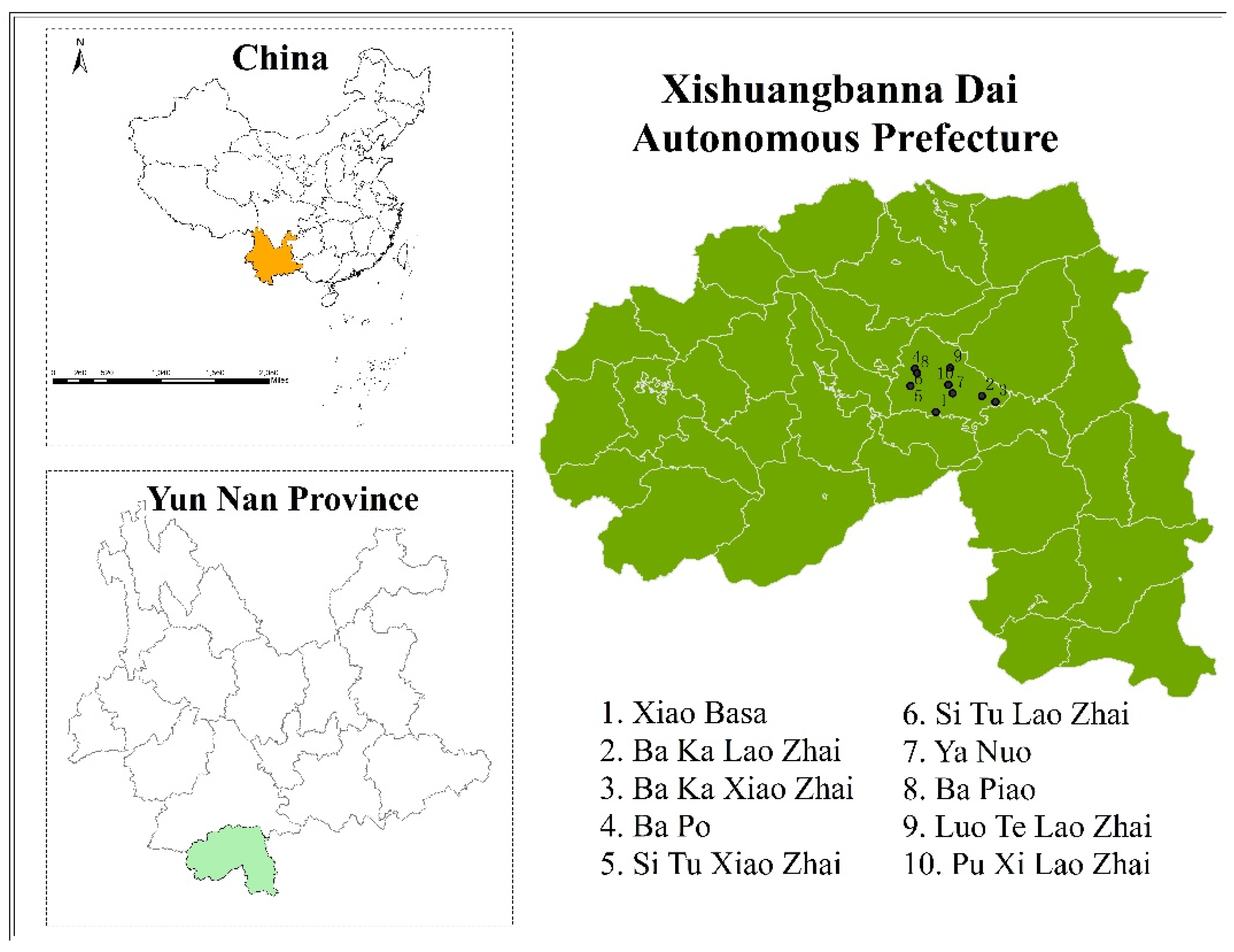

Table 1.
Number of national key protected wild plants and terrestrial wild animals in Xishuangbanna.
Table 1.
Number of national key protected wild plants and terrestrial wild animals in Xishuangbanna.
| Category | Subcategory | Number of species under national first-grade protection | Number of species under national second-grade protection |
|---|---|---|---|
| Wild plants | Gymnosperm | 4 | 5 |
| Angiosperm | 6 | 141 | |
| Lycophyte and Fern | - | 17 | |
| Bryophyte | - | 1 | |
| Total | 10 | 164 | |
| Wild animals | Bird | 15 | 117 |
| Mammal | 21 | 17 | |
| Amphibian | - | 1 | |
| Reptile | 3 | 5 | |
| Total | 39 | 140 | |
Table 2.
Number of traditional knowledge (TK) related to utilization of biological resources of Jino people.
Table 2.
Number of traditional knowledge (TK) related to utilization of biological resources of Jino people.
| Major Category | Subcategory | Number | Proportion |
|---|---|---|---|
| Traditional knowledge related to breeding of agricultural genetic resources | TK related to breeding of crop genetic resources | 36 | 21.43% |
| TK related to breeding of domestic animal genetic resources | 6 | 3.57% | |
| TK related to breeding of aquatic organism genetic resources | 5 | 2.98% | |
| TK related to breeding of forest genetic resources | 20 | 11.90% | |
| TK related to breeding ornamental plant genetic resources | 22 | 13.10% | |
| TK related to wild plant genetic resources conservation | 49 | 29.17% | |
| TK related to terrestrial wild animal genetic resources | 20 | 11.90% | |
| TK related to breeding of microbial genetic resources | 10 | 5.95% | |
| Traditional knowledge related to medicine | TK on the introduction, domestication, cultivation and conservation of traditional medicinal biological resources | 223 | 92.53% |
| Traditional medicine theories | 5 | 2.07% | |
| Traditional therapies | 3 | 1.24% | |
| Traditional processing technology of medicinal materials | 3 | 1.24% | |
| Traditional prescriptions | 5 | 2.07% | |
| TK of health care and disease prevention | 2 | 0.82% | |
| Traditional technologies related to sustainable use of biological resources | Traditional agricultural production technologies | 8 | 29.63% |
| Traditional printing and dyeing and textile technologies | 5 | 18.52% | |
| Traditional food processing technologies | 8 | 29.63% | |
| Traditional planning, design and construction techniques | 3 | 11.11% | |
| Other traditional technologies | 3 | 11.11% | |
| Traditional culture related to biodiversity | Religious beliefs and ecological ethics | 6 | 13.33% |
| Traditional festivals | 13 | 28.89% | |
| Customary law | 4 | 8.89% | |
| Traditional literature and art | 14 | 31.11% | |
| Traditional food culture | 2 | 4.44% | |
| Other traditional cultures | 6 | 13.33% | |
| Traditional knowledge of biogeographical indication products | TK related to food indication products | 3 | 33.33% |
| TK related to craft-marked products | 5 | 55.56% | |
| TK related to other geographical indication products | 1 | 11.11% |
Table 3.
Diversity index of various types of traditional knowledge of Jinuo people.
| Name | Total number | Number of subcategories | Diversity index |
|---|---|---|---|
| Traditional knowledge related to breeding of agricultural genetic resources | 168 | 8 | DTK1=0.82 |
| Traditional knowledge related to medicine | 241 | 6 | DTK2=0.14 |
| Traditional technologies related to sustainable use of biological resources | 27 | 5 | DTK3=0.79 |
| Traditional culture related to biodiversity | 45 | 6 | DTK4=0.86 |
| Traditional knowledge of biogeographical indication products | 9 | 3 | DTK5=0.64 |
Table 4.
Nature reserve categories of Xishuangbanna.
| No. | Name | Main protection type | Administrative region | Main protected object | Area (hm2) |
|---|---|---|---|---|---|
| 1 | Xishuangbanna National Nature Reserve | Forest ecosystem | Jinghong City, Mengla County, Menghai County | Forest ecosystems such as tropical rain forest and tropical monsoon forest, and rare wild animals and plants such as Asian elephants and parashorea chinensis | 242510.0 |
| 2 | Xishuangbanna Naban River Watershed National Nature Reserve | Forest ecosystem | Jinghong City, Menghai County | Tropical forest ecosystems dominated by tropical rain forest and tropical seasonal rain forest, and rare wild animals and plants | 26600.0 |
| 3 | Xishuangbanna Lancang-Mekong River Watershed State Nature Reserve | Wild animal | Mongla County | Fish resources such as soft-shelled turtle and gyrinocheilus aymonieri | 67.0 |
| 4 | Xishuangbanna Luosuo River State Nature Reserve | Wild animal | Mongla County | Aquatic wildlife and their habitats | 600.0 |
| 5 | Xishuangbanna Bulong State Nature Reserve | Forest ecosystem | Jinghong City, Menghai County | Forest ecosystems dominated by montane rain forest and rare wildlife resources | 35485.0 |
| 6 | Xishuangbanna Yiwu State Nature Reserve | Forest ecosystem | Mongla County | Ancient tea tree resources and national key protected wildlife resources | 33369.9 |
| 7 | Jinghong County Nature Reserve | Forest ecosystem | Jinghong City | Unique forest ecosystem and wild animals and plants under state key protection | 47258.0 |
| 8 | Menghai County Nature Reserve | Forest ecosystem | Menghai County | Forest ecosystems and rare and endangered wild animal and plant resources | 28315.7 |
| 9 | Mengla County Lancang River Green Triangle County Nature Reserve | Forest ecosystem | Mongla County | Forest ecosystems dominated by mountain rain forest, and rare and endangered wildlife resources | 14752.0 |
Table 5.
National key protected wild plants in Xishuangbanna.
| Plant group | Family | Chinese name | Scientific name |
|---|---|---|---|
| Gymnosperm | Cycadaceae | Bichisutie篦齿苏铁 | Cycas pectinata |
| Cycadaceae | Changyesutie长叶苏铁 | Cycas dolichophylla | |
| Cycadaceae | Danyusutie单羽苏铁 | Cycas simplicipinna | |
| Taxaceae | Xumihongdoushan须弥红豆杉 | Taxus wallichiana | |
| Angiosperm | Dipterocarpaceae | Wangtianshu望天树 | Parashorea chinensis |
| Dipterocarpaceae | Guangxiqingmei广西青梅 | Vatica guangxiensis | |
| Combretaceae | Echiteng萼翅藤 | Getonia floribunda | |
| Nyssaceae | Yunnanlanguoshu云南蓝果树 | Nyssa yunnanensis | |
| Orchidaceae | Piaodaidoulan飘带兜兰 | Paphiopedilum parishii | |
| Orchidaceae | Zimaodoulan紫毛兜兰 | Paphiopedilum villosum |
Table 6.
National key protected wild animals in Xishuangbanna.
| Animal groups | Family | Chinese name | Scientific name | Endemism |
|---|---|---|---|---|
| Birds | Phasianidae | Heijingchangweizhi黑颈长尾雉 | Syrmaticus humiae | — |
| Phasianidae | Huikongquezhi 灰孔雀雉 | Polyplectron bicalcaratum | Endemic to Yunnan | |
| Phasianidae | Lukongque绿孔雀 | Pavo muticus | — | |
| Columbidae | Xiaojuanjiu小鹃鸠 | Macropygia ruficeps | Endemic to Yunnan | |
| Gruidae | Chijinghe赤颈鹤 | Grus antigone | Endemic to Yunnan | |
| Laridae | Heyanou河燕鸥 | Sterna aurantia | Endemic to Yunnan | |
| Threskiornithidae | Caihuan彩鹮 | Plegadis falcinellus | — | |
| Accipitridae | Heiwujiu黑兀鹫 | Sarcogyps calvus | Endemic to Yunnan | |
| Accipitridae | Wudiao乌雕 | Clanga clanga | — | |
| Bucerotidae | Baihouxiniao 白喉犀鸟 | Anorrhinus austeni | Endemic to Yunnan | |
| Bucerotidae | Guanbanxiniao 冠斑犀鸟 | Anthracoceros albirostris | — | |
| Bucerotidae | Shuangjiaoxiniao 双角犀鸟 | Buceros bicornis | — | |
| Bucerotidae | Zongjingxiniao 棕颈犀鸟 | Aceros nipalensis | — | |
| Leiothrichidae | Languanzaomei 蓝冠噪鹛 | Garrulax courtoisi | — | |
| Emberizidae | Huangxiongwu 黄胸鹀 | Emberiza aureola | — | |
| Reptiles | Testudinidae | Aojialugui 凹甲陆龟 | Manouria impressa | — |
| Testudinidae | Miandianlugui 缅甸陆龟 | Indotestudo elongatea | — | |
| Varanidae | Yuanbijuxi 圆鼻巨蜥 | Varanus salvator | — | |
| Mammals | Lorisidae | Fenghou蜂猴 | Nycticebus bengalensis | — |
| Cercopithecidae | Beitengweihou北豚尾猴 | Macaca leonina | Endemic to Yunnan | |
| Cercopithecidae | Yinzhihuiyehou 印支灰叶猴 | Trachypithecus crepusculus | Endemic to Yunnan | |
| Hylobatidae | Baijiachangbiyuan北白颊长臂猿 | Nomascus leucogenys | Endemic to Yunnan | |
| Manidae | Chuanshanjia 穿山甲 | Manis pentadactyla | — | |
| Canidae | Chai豺 | Cuon alpinus | — | |
| Ursidae | Malaixiong马来熊 | Helarctos malayanus | — | |
| Viverridae | Dabanlingmao大斑灵猫 | Viverra megaspila | — | |
| Viverridae | Dalingmao大灵猫 | Viverra zibetha | — | |
| Viverridae | Xiaolingmao 小灵猫 | Viverricula indica | — | |
| Viverridae | Xiongli熊狸 | Arctictis binturong | — | |
| Viverridae | Xiaochili小齿狸 | Arctogalidia trivirgata | Endemic to Yunnan | |
| Viverridae | Gaolingmao缟灵猫 | Chrotogale owstoni | Endemic to Yunnan | |
| Felidae | Conglinmao丛林猫 | Felis chaus | — | |
| Felidae | Jinmao 金猫 | Catopuma temminckii | — | |
| Felidae | Yunbao云豹 | Neofelis nebulosa | — | |
| Felidae | Bao豹 | Panthera pardus | — | |
| Felidae | Hu虎 | Panthera tigris | — | |
| Elephantidae | Yazhouxiang亚洲象 | Elephas maximus | Endemic to Yunnan | |
| Tragulidae | Weishixilu威氏鼷鹿 | Tragulus williamsoni | Endemic to Yunnan | |
| Bovidae | Yeniu 野牛 | Bos gaurus | — |
Disclaimer/Publisher’s Note: The statements, opinions and data contained in all publications are solely those of the individual author(s) and contributor(s) and not of MDPI and/or the editor(s). MDPI and/or the editor(s) disclaim responsibility for any injury to people or property resulting from any ideas, methods, instructions or products referred to in the content. |
© 2024 by the authors. Licensee MDPI, Basel, Switzerland. This article is an open access article distributed under the terms and conditions of the Creative Commons Attribution (CC BY) license (http://creativecommons.org/licenses/by/4.0/).
Copyright: This open access article is published under a Creative Commons CC BY 4.0 license, which permit the free download, distribution, and reuse, provided that the author and preprint are cited in any reuse.