

Submitted:
20 March 2024
Posted:
21 March 2024
You are already at the latest version
Abstract
The present study aims to show on the one hand how easily one can get confused when doing research on the internet. Different platforms, fora and homepages supply the visitor with different - and sometimes contradictory - information. On the other hand, we show how to overcome these contradictions and produce valuable research based on almost all sources. For our study, we use the example of the Feit-Thompson conjecture, which is - in opposite to the well-known Feit-Thompson theorem - not widely known. We try to clarify the scientific literature on this topic and we embed our own result into the present state of art. We prove that pq−1p−1 does not divide qp−1q−1 if p and q are twin primes, i.e. p=q+2. Thus we prove that the Feit-Thompson conjecture is true for twin prime numbers.
Keywords:
Feit-Thompson conjecture
; prime numbers
; mathematical research
; research education
; twin primes
; generalized twin prime conjecture
1. Introduction
This paper has two main goals. On the one hand, we prove that the Feit-Thompson conjecture on prime numbers is also true for twin primes. On the other hand, we want to use the Feit-Thompson conjecture as an example for doing research with / despite contradictory sources, which can be easily accessed. As a result, we give a detailed overview of the scientific and more or less scientific literature on the state of art of the conjecture. The Feit-Thompson conjecture is - in contrast to the Feit-Thompson theorem - not widely known. Therefore the literature which can be found about it is not too much, but as it turns out, the little existing literature on the topic contains contradictions, which we want to clarify in the current paper. The present paper is organized as follows. We start with a short survey about prime numbers and pairs of twin prime numbers in Section 2. After that, we introduce the available contradictory sources to the reader in Section 3. In Section 4 we prove our own results on Feit-Thompson conjecture for twin primes. Finally, we draw our conclusions in Section 5.
2. Twin Primes
A pair of twin prime numbers is a pair of two prime numbers whose difference is i.e. they are neighbouring or consecutive odd numbers. The smallest pair of twin primes is The prime number 5 is the only prime number which is part of two distinct pairs of twin primes, since is also a pair of twin primes. A list of twin primes can be found at OEIS [1] under the entry A077800. Furthermore, for larger pairs of twin primes we know that they have the form for some natural number since all prime numbers greater than 2 and 3 lie next to a number which is divisible by 6 [2]. We can prove this statement easily in the following way. Every natural number can be expressed as for some integers k and The number r is called the remainder and If p is prime () and then r cannot be even, thus If then which implies that p is divisible by which is a contradiction to p prime. Therefore we have Since the difference of twin primes is 2 by definition, we have that is a pair of twin primes if and only if which implies for Actually, in 1957 the largest known pair of twin primes was [3], whereas today the largest known pair of twin primes is [4]. This fact shows how the development of computational ability on computers could speed up the state of art of prime search within the last century.
The famous twin prime conjecture says that there exist infinitely many pairs of twin primes, i.e. there exist infinitely many prime numbers such that is also a prime number. For some more background and elementary number theoretical knowdledge we refer the reader for example to [5] and [3]. For more details and recent developments on the twin prime conjecture, we refer the reader to [6] and for some history on the origin of the twin prime conjecture to [7].
A more general conjecture goes back to de Polignac [8] who conjectured that there is an infinite number of primes such that is also prime for some natural number The generalized form of the twin prime conjecture is connected to the (strong) Goldbach conjecture [9] which states that every integer greater than 4 can be expressed as the sum of two prime numbers [10].
For general several partial results were achieved during the last years. Zhang [11] showed that there exists a number such that there exist infinitely many prime numbers p and such that Maynard could improve this bound to [12]. Recently, Wright improved the bound of Maynard-Tao, Baker-Irving, and the participants of the project Polymath 8b in [13].
It is clear that for the conjecture of de Polignac coincides with the twin prime conjecture. Nevertheless, it is not sure when exactly was the first time the twin prime conjecture was stated, it may go back to Euclid’s time [14].
A prime number is called isolated if it is not part of a pair of twin primes. The sequence of the first isolated primes can be seen under A007510 in [1].
3. Contradictory Sources
Feit and Thompson published an introductory paper in 1962 [20] preceding their famous proof of their theorem on solvable groups [21]. In this introductory paper the authors state that "The validity of ... never divides if are distinct primes would also simplify the proof..." Based on this remark, we can state the Feit-Thompson conjecture:
Conjecture 1.
[Feit-Thompson] Let p and q be distinct prime numbers. Then does not divide
The first who referred to the remark of Feit and Thompson was Stephens in 1971 [22]. In his paper, the author gives a counterexample to the conjecture that for distinct primes p and q the numbers and are always coprime, i.e. their greatest common divisor is This conjecture was later called the Stephens conjecture:
Conjecture 2.
[Stephens] Let p and q be distinct prime numbers. Then and are coprime.
If this conjecture would have been true, then the Feit-Thompson conjecture would have been true as well. But the Stephens conjecture is not true [22] and therefore we still do not know if the Feit-Thompson conjecture is true or not, as Stephens concludes this in the last sentence of his paper. So, instead of one conjecture we have two conjectures which have a big difference in mathematical sense. This difference is important for any research on this topic. In the present paper, we investigate Conjecture 1, which is regarded as the real Feit-Thompson conjecture by the mathematical community.
Motose [23,24] was the first who differed between Feit-Thompson conjecture and Stephens conjecture. Motose shows partial solutions to the Feit-Thompson conjecture. Le shows in [25] that the Feit-Thompson conjecture is true if
In contrast to the previously mentioned sources, on Wolfram Math World [26] the following is stated: "The Feit-Thompson conjecture asserts that there are no primes p and q for which and have a common factor." Further, Le writes in [25] that "E.T.Parker observed that the very long proof by W.Feit and J.Thompson ... that every group of odd order is solvable would be shortened if it could be proved that never divides " This statement is remarkable and it is contradictory to the fact that Feit and Thompson themselves stated this in their paper [20]. Parkers name also occurs on the Wolfram Math website, again without reference.
The article on Wikipedia [27] remarks in "External links" the confusion of the Feit-Thompson conjecture and Stephens conjecture, but on Groups Wiki [28] this remark is missing.
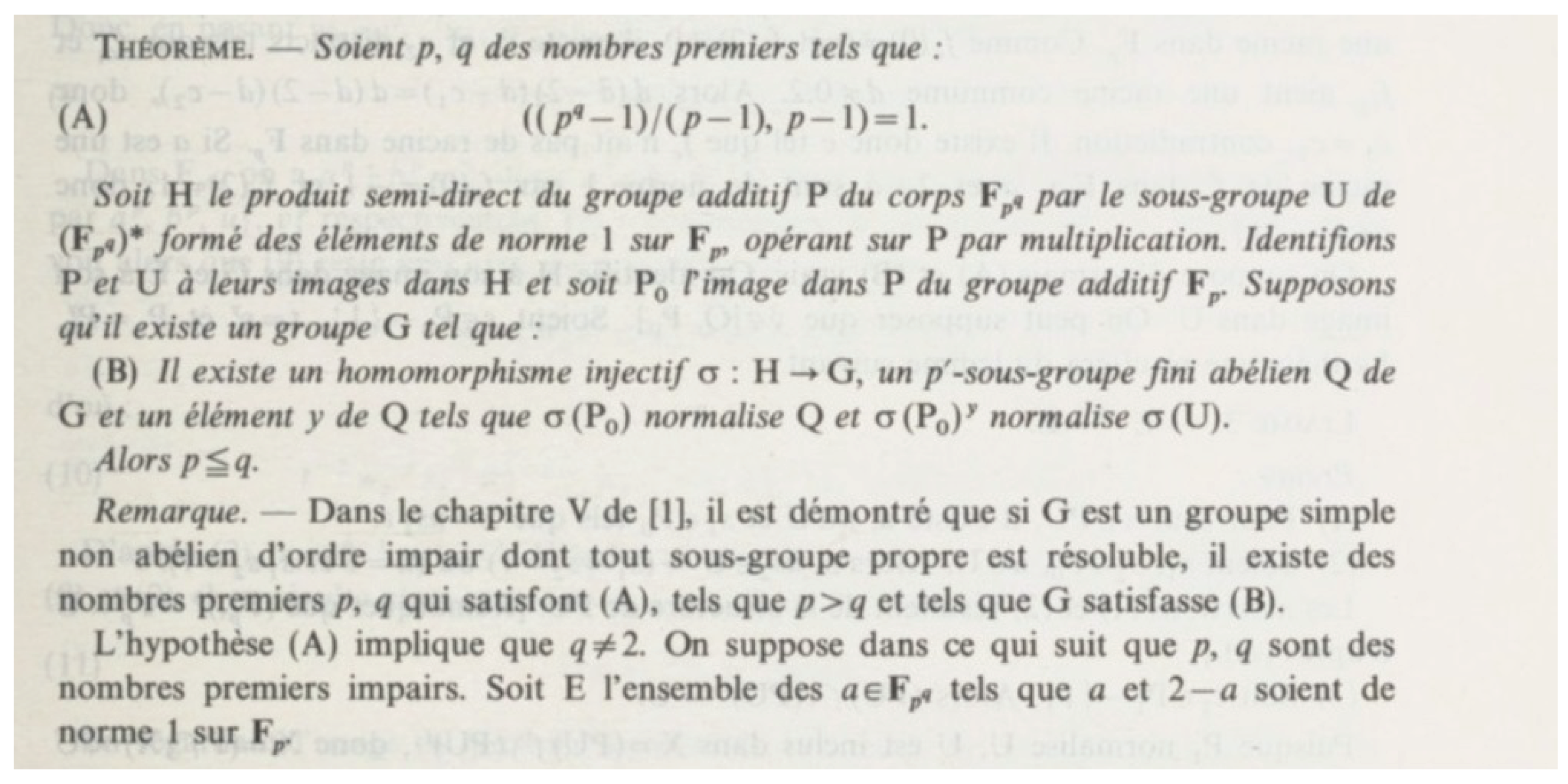
Things become even more interesting when reading the math overflow forum on this topic [29] where one user draws the attention to a paper of Peterfalvi [30] which simplifies the proof of the Feit-Thompson theorem by two pages. Peterfalvi’s proof is group theoretical and working on generators of groups. Indeed, if we go back to Feit’s and Thompson’s paper [20] then we can read in the last paragraph:
"The proof would be simplified considerably if it is true that nonabelian simple groups never contain self-normalizing cyclic subgroups. The validity of the con- jecture that never divides if are distinct primes would also simplify the proof, rendering unnecessary the detailed use of generators and relations. If it is true that nonidentity Sylow subgroups of simple groups always contain nonidentity abelian weakly closed subgroups, short proofs of the necessary group-theoretic lemmas could be given."
Indeed, the (positive) proof of the number theoretical Feit-Thompson conjecture would make the original proof of the Feit-Thompson theorem simpler, but this simplification was already achieved by the group theoretical approach of Peterfalvi [30].
Figure 1.
Extract from Peterfalvi’s paper [30]
Figure 1.
Extract from Peterfalvi’s paper [30]
Summarizing, we can say that the Feit-Thompson conjecture is not of much group theoretical interest any longer, but nevertheless it remains an unsolved number theoretical problem.
Both, the solution of the twin prime conjecture and the solution of the Feit-Thompson conjecture would be a great contribution to the field of Number Theory.
4. Embedding our Result into the Scientific Literature
4.1. Auxiliary Result
In the proof of our main result in the next section we will need the following Lemma, which we recall here. We use the notation of linear congruence and the notation for a divides b:
Lemma 1.
Let m be a positive integer. Then
and
.
and
since is odd.
4.2. Main Result and Proof
Theorem 1.
There do not exist twin primes p and such that divides
. First, we consider the case for some integer m and we show that in this case does not divide We assume indirectly that there exist p and prime numbers such that Then there exists such that
This implies that
Therefore we have either
or
where denotes the fractional part of
Considering the first case
if then by Lemma 1 cannot be divisible by Therefore we have a contradiction in this case. If then and therefore by Motose’s proposition [23] does not divide
Considering the second case, we denote Then we need to consider for which x we have
That means we need to solve
Since y can be even or odd, we need to solve the following congruences for some prime number p
and
We know that therefore Thus, we need to answer the question if for some Solving the following congruence
we get as the only possible solution. In the next section we will show that does not fulfill the Feit-Thompson conjecture. By the way, is not part of a twin prime pair.
4.3. The Cases
It is easy to see that if then needs to divide This is only possible for Similarly, if then needs to be a divisor of which is impossible for Furthermore, if then is a divisor of Since by assumption p is a prime number distinct from we have that p is odd. Therefore is even, whereas is odd, thus cannot be a divisor of Together with Le’s result [25] we have
5. Conclusion
In this paper, we had two goals (see Section 1). First, we proved in Section 4 that the Feit-Thompson conjecture is true for pairs of twin prime numbers by using elementary mathematical methods. According to Section 2, we may believe that this means for an infinite set of prime numbers we have that never divides
The Feit-Thompson conjecture remains unsolved in general.
For our second goal, we showed through an example how research questions can be found and answered in the times of digitalization. Since nowadays a lot of information and sources are available to a broad part of society through encyclopediae, fora, books, journals, etc. in the internet [31,32], it is necessary to sensitize the next generation of researchers for the advantages and disadvantages of research in the internet. People today have access to much more information than people ever had before, but not all information are complete and/or reliable. We need to learn to select useful and correct information from the mass of all information in order to build up our research on the right facts and correct information. On the one hand, it is good that many people have access to information today. On the other hand, information is not equal to education. The role of universities is changing, since universities have to deal with the fact that they are not the only place where knowledge is available [33,34,35,36]. Next to the Civic University movement, where universities try to change their education into a market-driven way of educating young employees for factories and companies [37], we should not forget about the research component. Universities need to remain also a place for research [38,39]. In order to make the improvement and development of science possible, we also need young researchers to be educated to do research among the wideness of information today. This education also needs to include the investigation of incomplete and even unreliable sources in order to educate researchers. We want to draw the attention of university leaders and educators to this - probably growing - problem of half-reliable, incomplete and confusing sources in both, scientific and more-or-less scientific literature, all easily accessible. The author believes that only if researchers are aware of the fact how easily they could do research based on non-reliable or only half-reliable sources will prevent science from developing into self-destructive or non-trustworthy directions in the future.
Data Availability Statement
The author declares that no data was used for the current research. All mentioned sources are freely accessible on the given platform.
Conflicts of Interest
The author declares that there is no potential conflict of interests, neither of personal origin nor of financial one.
References
- OEIS, F. The On-Line Encyclopedia of Integer Sequences Entry A077800. https://oeis.org/A077800, 2024.
- Kaldwell, C. Are all primes (past 2 and 3) of the forms 6n+1 and 6n-1? https://t5k.org/notes/faq/six.html, 2021.
- Hua, L.K. Introduction to number theory; Springer Science & Business Media, 2012.
- Caldwell, C. The Prime Database. https://t5k.org/primes/page.php?id=122213.
- Dujella, A. Number theory; Školska knjiga Zagreb, 2021.
- Sono, K. Recent progress on twin prime conjecture. RIMS Kôkyûroku Bessatsu 2020, B77, 3–28.
- Dunham, W. A note on the origin of the twin prime conjecture. Notices of the International Consortium of Chinese Mathematicians 2013, 1, 63–65.
- de Polignac, P.A. Recherches nouvelles sur les nombres premiers; 1851.
- López Nicolás, J.A. Advances in additive number theory. Bol. Soc. Parana. Mat. (3) 2023, 41, 20. Id/No 109. [CrossRef]
- Hardy, G.H.; Wright, E.M. An introduction to the theory of numbers; Oxford university press, 1979.
- Zhang, Y. Bounded gaps between primes. Annals of Mathematics 2014, pp. 1121–1174.
- Tao, T. Variants of the Selberg sieve, and bounded intervals containing many primes. https://terrytao.wordpress.com/tag/polymath8/, 2014.
- Wright, T. Prime tuples and Siegel zeros. Bull. Lond. Math. Soc. 2024, 56, 644–661. [CrossRef]
- Maynard, J. The twin prime conjecture. Japanese Journal of Mathematics 2019, 14, 175–206.
- Brun, V. Uber das Goldbachsche Gesetz und die Anzahl der Primzahlpaare. Arch. Mat. Natur. B 1915.
- Brun, V. La série 1/5+ 1/7+ 1/11+ 1/13+ 1/17+ 1/19+ 1/29+ 1/31+ 1/41+ 1/43+ 1/59+ 1/61+..., où les dénominateurs sont’nombres premieres jumeaux’est convergente ou finie. Bulletin des sciences mathématiques 1919, 43, 124–128.
- Croll, G.J. Bientropy, trientropy and primality. Entropy 2020, 22, 311.
- Pintz, J. A new explicit formula in the additive theory of primes with applications I. The explicit formula for the Goldbach problem and the Generalized Twin Prime Problem. Acta Arithmetica 2023, 210, 53–94. [CrossRef]
- Matomäki, K.; Merikoski, J. Siegel zeros, twin primes, Goldbach’s conjecture, and primes in short intervals. Int. Math. Res. Not. 2023, 2023, 20337–20384. [CrossRef]
- Feit, W.; Thompson, J.G. A solvability criterion for finite groups and some consequences. Proceedings of the National Academy of Sciences 1962, 48, 968–970. [CrossRef]
- Feit, W.; Thompson, J.G. Solvability of groups of odd order. Pacific Journal of Mathematics 1963, 13, ♪775–1029. https://doi.org/10.2140/pjm.1963.13.775. [CrossRef]
- Stephens, N. On the Feit-Thompson conjecture. Mathematics of Computation 1971, 25, 625. [CrossRef]
- Motose, K. Notes to the Feit-Thompson conjecture. Proceedings of the Japan Academy. Series A, Mathematical Sciences 2009, 85, 16–17. [CrossRef]
- Motose, K. Notes to the Feit-Thompson conjecture II. Proceedings of the Japan Academy. Series A, Mathematical Sciences 2010, 86, 131–132. [CrossRef]
- Le, M. A Divisibility I Problem Concerning Group Theory. Pure and Applied Mathematics Quarterly 2012, 8, 689–692. [CrossRef]
- Weisstein, E.W. Feit-Thompson conjecture. https://mathworld.wolfram.com/Feit-ThompsonConjecture.html.
- Wikipedia. Feit-Thompson conjecture. https://en.wikipedia.org/wiki/Feit-Thompson conjecture, 2022.
- Groupprops. Feit-Thompson conjecture. https://groupprops.subwiki.org/wiki/Feit-Thompson conjecture.
- Schlage-Puchta, J.C. Feit-Thompson conjecture. https://mathoverflow.net/questions/281043/feit-thompson-conjecture, 2017.
- Peterfalvi, T. Simplification of chapter VI of Feit and Thompson’s paper on odd order groups. C. R. Acad. Sci., Paris, Sér. I 1984, 299, 531–534.
- Boczkowski, P.J. Abundance: On the experience of living in a world of information plenty; Oxford University Press, 2021.
- Tulgan, B. Not everyone gets a trophy: How to manage generation Y; John Wiley & Sons, 2009.
- Hrubos, I.; et al. The changing role of universities in our society. Society and Economy. In Central and Eastern Europe, Journal of the Corvinus University of Budapest 2011, 33, 347–360.
- Moscardini, A.O.; Strachan, R.; Vlasova, T. The role of universities in modern society. Studies in Higher Education 2022, 47, 812–830. [CrossRef]
- Suzigan, W.; Rapini, M.; Albuquerque, E.; et al. A changing role for universities in the periphery. Textos para Discussão td 2011, 240.
- Antonelli, C.; Patrucco, P.P.; Rossi, F. The economics of knowledge interaction and the changing role of universities. In The Handbook of Innovation and Services; Edward Elgar Publishing, 2010.
- Liddle, J.; Addidle, G.D. The Changing Role of Universities in Society: Key Influences. The Role of Universities and HEIs in the Vulnerability Agenda 2022, pp. 33–51.
- Clark, B.R. Places of inquiry: Research and advanced education in modern universities; Univ of California Press, 2023.
- Johnston, A.; Wells, P.; Woodhouse, D. Examining the roles of universities in place-based industrial strategy: which characteristics drive knowledge creation in priority technologies? Regional Studies 2023, 57, 1084–1095. [CrossRef]
Disclaimer/Publisher’s Note: The statements, opinions and data contained in all publications are solely those of the individual author(s) and contributor(s) and not of MDPI and/or the editor(s). MDPI and/or the editor(s) disclaim responsibility for any injury to people or property resulting from any ideas, methods, instructions or products referred to in the content. |
© 2024 by the authors. Licensee MDPI, Basel, Switzerland. This article is an open access article distributed under the terms and conditions of the Creative Commons Attribution (CC BY) license (http://creativecommons.org/licenses/by/4.0/).
Copyright: This open access article is published under a Creative Commons CC BY 4.0 license, which permit the free download, distribution, and reuse, provided that the author and preprint are cited in any reuse.