

Submitted:
05 March 2024
Posted:
06 March 2024
You are already at the latest version
Abstract
Dangyang Valley is the cradle of Chinese ceramic culture. The production technology of Dangyangyu twisted porcelain has been included in China's national intangible cultural heritage list and is representative of the ceramic production technologies in China. The production of twisted porcelain originated in the Tang Dynasty of China, and after a war in the late Tang Dynasty, its production technology was lost. The production technique of exquisite twisted porcelain contains the technology of twisted molding that is unique in the world. People are amazed by the unique ceramic art it presents. However, its production craft has not been well inherited and developed. In this paper, through the theoretical dimension of extension semantics, the artistic characteristics of Dangyangyu twisted porcelain were taken as the core to extract its cultural expression and quantify the relationship between modeling semantics and culture.Also, with potential cultural connotations tapped, extension semantics were obtained through in-depth analysis and evaluation. The manufacturing technique of twisted porcelain can promote the integration of design extension semantics with its production process, thus continuously updating and developing the production process with the times. This study has provided method support for the development and inheritance of twisted porcelain culture, thus presenting the important promotion significance.
Keywords:
Extension semantics
; Intangible cultural heritage
; Twisted porcelain
; Manufacturing technique
1. Introduction
Chinese traditional ceramic culture and art are an important foundation for the progress of civilization today(Xiaobing Hu et al., 2022).Twisted porcelain, which first appeared in the Tang Dynasty, is a kind of ceramics made through the mixing and shaping of two or more kinds of porcelain clay with different shades together with special and complex manual porcelain-body-making techniques, as shown in Figure 1. With inspiration from the process of rhinoceros lacquerware, twisted porcelain was made through the application of the process technique of rhinoceros lacquerware to the production of ceramics. The process craft of twisted porcelain at that time used low-temperature pottery clay materials. With the development of twisted porcelain products and the maturity of firing technology, the materials of twisted porcelain utensils have changed from pottery clay to porcelain clay, with their application fields changing from funerary wares to practical products. The firing industry of twisted porcelain in the Song Dynasty had taken shape, with tens of thousands of households engaged in the porcelain-making industry. The porcelain-making craft of twisted porcelain has been passed down from generation to generation, with a stable operation mode established in the local area and the twisted porcelain industry reaching its prime in history.
Dangyang Valley was one of the “Four Porcelain Capitals” in the Northern Song Dynasty in China. The twisted porcelain produced there had high quality and complete varieties, with mass production realized in this area. The twisted porcelain unearthed in Dangyang Valley, Jiaozuo, in Henan province, has delicate and exquisite patterns and unique glaze colors. In the Yuan Dynasty, with continuous wars and social unrest, the demand for twisted porcelain gradually decreased. Therefore, the kiln in Dangyang Valley was dilapidated, and the process craft of twisted porcelain has been lost since then.Product semantics was developed and introduced by Krippendorff and Butter (1984: in Riley 2001) and is defined as the study of symbolic qualities of man-made shapes, in the cognitive and social context of their use. According to this definition, product semantics is concerned with the relationship between the user and the product on one hand, and the importance that objects assume in an operational and social context on the other hand. Intentionally or not, all manufactured products make a statement through shape, form, colour, texture, etc (Demirbilek O & Sener B, 2003).
2. Research Aim
Dangyangyu twisted porcelain is a Chinese national geographical indication product. Dangyang valley is located in Xiuwu County, Jiaozuo City, Henan Province in China. Located on the north bank of the Yellow River and backed by Taihang Mountain, Dangyang Valley has superior soil resources for the development of production craft of Dangyangyu twisted porcelain. With its identical internal and external patterns, each twisted porcelain product that enjoys the reputation of “a porcelain junzi being for real” is unique. Throughout design, one of the fundamental challenges is the restriction, for example, restriction on the element of arts and the value of design. The problem of compartmentalization requires key outy and beginning. Once in a while, new discoveries suggest changes to the organization (Zhang W et al., 2019).However, nowadays, due to the influence of globalization and modernization, some traditional heritage crafts have been marginalized(Helle H., 2010).there are few people who know the culture of twisted porcelain, and even fewer people learn its production craft. The identififi cation of design challenge will be made between lab-based and industrial tests, different cultures and facilities as well as other key areas (Anwar R et al., 2015). Therefore, the protection and popularization of twisted porcelain culture is relatively difficult. A significant finding of formgiving between two different domains which, industrial design and engineering design has defined the potential new design segment introduced in ceramic industries, However, with the predisposed of aesthetics and human sensation, it insists to investigate the principle of design requirements among the designer, artifacts and users, in order to aesthetically solve the appearance and consequences of form development(Anwar R et al., 2015). In this study, multiple field investigations have been carried out in Dangyang Valley, Xiuwu County, Henan province, with the aim of performing a comprehensive and multi-faceted research analysis on the craft of twisted porcelain.
Design is admissible to scientific inquiry because we can study how the relevant information can and should be processed(Maier J R A & Fadel G M.,2009). Combining topologically related theories to study contradictory problems that arise in the design process can provide a more comprehensive description of certain properties, the number of features, the range and the degree of things, and can then provide solutions to contradictory problems in design through formal transformations and algorithms(Wang Y et al.,2022).From the dimensions of production craft and artistic characteristics, this paper has explored the cultural connotations of twisted porcelain with the combination of extension theory and performed an analysis of extension semantics so as to develop an important method for promoting the innovation and development of intangible culture of twisted porcelain and provide a reference for the innovation and development of contemporary ceramics.
3. Materials and Method
3.1. Production Craft of Dangyangyu Twisted Porcelain in Xiuwu County
Design activity encompasses some of the highest cognitive abilities of human beings(Zainal Abidin S et al.,2009). Before the 1980s, the technique of twisted porcelain was lost. With the rise of the collection fever of ceramics, fragments of the remaining ceramics on the ground surface of the Dangyangyu kiln relic have almost been swept away by collection enthusiasts. During this period, the craft of twisted porcelain has received attention from and been explored by many scholars, with twisted porcelain being restored gradually.Field investigations show that the glaze formula and firing temperature of twisted porcelain are still lost, indicating that there is still a long way to go to restore the lost artistry of twisted porcelain from more than 600 years ago.In order to accomplish this restoration purpose, in this study, relevant fragments of twisted porcelain have been collected first. Ceramic color appearance is dependent on a series of inter-related processes(McLachlan F et al.,2022). Then, characteristics of twisted porcelain fragments at their cross sections were observed to analyze their pattern forms and mud structures, with the technological process of twisted porcelain explored through trial firing. In this period, countless tests were performed to produce the twisted porcelain product with similar patterns through firing, as shown in Figure 2.
Such experimental success shows us the prospect of twisted porcelain coming back to life and eventually regaining its brilliance in its hometown. By visiting the relic of the Dangyangyu kiln, we found the inheritors of the intangible heritage of local twisted porcelain and actually watched the whole process of twisted porcelain production, thus realizing the collection of twisted porcelain data. The firing process of Dangyangyu twisted porcelain is complex and laborious.
Firstly, in terms of material selection, kaolin on Taihang Mountain in the north of Dangyang Valley was selected as the raw material of Dangyangyu twisted porcelain. Containing rich alumina and silica, the kaolin here has the advantages of soft texture, high plasticity, and good cohesiveness, which is of great importance to the later firing of twisted porcelain. Then, the collected kaolin clods were smashed one after another immediately with a hammer. After that, these smashed clods were soaked in cold water and fully stirred to make the soils dissolve quickly. After soils were set aside for dissolving for a period of time, they were filtered through a fine sieve to remove impurities and make the mud texture more delicate. In addition, soils could be finely ground into the mud with a grinder, and then the mud was filtered through a fine sieve in an alternating and step-by-step way. Then, fermentation and water control were performed on the mud, which was then sealed in a vacuum bag for later use.
Next, color matching, trimming, and glaze pouring of the molding body were carried out. High-temperature pigments and mineral raw materials were cut and stacked and were fully kneaded after matching. After kneading, porcelain clay with different colors, such as red clay and green clay, was formed. In this section, colors necessary for the production of twisted porcelain were settled. Then, clay blocks with different colors were selected and arranged in the necessary pattern that was designed. After that, they were smashed into a flat block, which was cut from its side piece with a steel wire tool to observe its internal pattern effect. When a clear pattern was observed, there was no need to continue to smash the block. Otherwise, it should be continuously smashed. Then, the arranged and kneaded clay block was shaped, and during this process, such tools as a water absorption rod, pottery needle, and pottery rib were used. After that, the clay block was put on a pottery wheel to perform the throwing. During the modeling process of throwing, the pattern direction of the molding body should be noticed. In order to make the shape of the twisted porcelain meet the expectation and the thickness of the modeling body be moderate, such instruments as a trimming tool, rib tool, and sponge stick were used to trim the modeling body in order of being from the inside out. The modeling body with a trimmed shape was placed in a cool place indoors for natural drying. In this way, excess water in the modeling body could be removed. However, direct sunlight should be avoided. Therefore, the cracking and deformation of the modeling body during firing could be prevented. Immediately after that, glaze pouring inside the modeling body should be conducted, and then the external part of the modeling body was glazed with glaze perfectly combined with porcelain.
After that came the important stage of firing. Firstly, the modeling body was placed in the kiln furnace, and then the furnace door was closed tightly. The kiln furnaces used here can be divided into gas furnaces and electric furnaces. The twisting expansion coefficients of those different kinds of clay in the twisted porcelain are different. Therefore, temperature inaccurately controlled can lead to different expansion coefficients and different shrinkage rates among mud with different colors, thus making cracking and pores prone to appear on the glaze surface. Therefore, the top priority in twisted porcelain firing is to control the temperature. Throughout the firing process, it is necessary to observe the temperature inside the kiln and make sure that it follows the regular temperature curve. Step-by-step temperature rise was applied in the kiln firing. Temperature first rose slowly and then dropped and then rose again till it reached a horizontal level. After that, the temperature was continuously raised to around 1,000℃. Twisted porcelain perfectly fired was taken out of the kiln. After that, it should be rotated and wiped with a cord and gloves to keep its body clean and tidy. Through the porcelain-making process mentioned above, it can be found that there are four key technical difficulties to be overcome in the making process of Dangyangyu twisted porcelain, including the mastering of temperature curve, the preparation of glaze colors and glaze materials, the controlling of soil moisture and the controlling of shrinkage differences. Furthermore, the production of twisted porcelain is related to the local humidity and climate to a certain extent. With the progress of modern science and technology, the production craft of twisted porcelain will become more modern and standardized, with the processing of some raw materials and the firing process of utensils completed with modern machinery and equipment, which completely replace human labor.
3.2. Artistic Features of Dangyangyu Twisted Porcelain in Xiuwu County
3.2.1. Porcelain Types
In ancient China, porcelain has always been based on daily-use porcelain, supplemented by decorative porcelain(Lei L & Shouli Z.,2019). It should be noted that ceramics were not only of practical use but also of artistic value when decorated with raised ornaments or painted with colored clay(Gnesin & G.G, 2012). The artistic effects of ceramics can be mostly manifested with glazing, namely, overglaze, inglaze, and underglaze. Embellishment or artistic creation of ordinary ceramics can be realized through such methods as glazing, painting, carving, and pasting applied on their surfaces after their molding bodies take shape. However, artistic creation is performed on twisted porcelain before their molding bodies take shape. Among the plant modelings of twisted porcelain, such organic elements as plum blossoms, chrysanthemums, dandelions, and leaves are common, while the animal modelings of twisted porcelain are commonly designed with external contours of such animals as cows, deer, horses, and peacocks. Through the application of overall appearance shapes or local features of animals and plants, a relatively complete creative conceptual body can be constituted, presenting the inherent attributes of modeling object characteristics, such as the expressions contained in the objects, with the manifestations of emotions, ideas, culture, and aesthetics. Twisted porcelain is called “the porcelain of gentleman," with the expression of the true nature of being in line with a gentleman. Meanwhile, the application of animal and plant shapes exactly echoes the respect and praise for a gentleman. Such plants as plum blossom and chrysanthemum contain the noble virtues of tenacity and modesty. The implied meaning behind the selection of animals inherently representing elegance and beauty is to combine the objective existence of object appearances with their internal emotional expressions efficiently and is the carrier of people’s visual experience and noble sentiment.
3.2.2. Colors
The color of ceramic products have an embedded “DNA” that acts as a local “geo graphical and sociocultural singularity” through the specific characteristics of raw materials, time and place(Lobo C.,2020). Dangyang Valley in Xiuwu County has objective advantages in geographical conditions, including proper temperature and humidity, being backed by Taihang Mountain, and local porcelain clay raw materials for twisted porcelain firing. Such naturally endowed conditions as soils with high strength and good fire resistance, and rich mineral resources in Taihang Mountain are all conducive to the rebirth of the craft of twisted porcelain. However, in restoring the intangible cultural inheritance of twisted porcelain craft, the soil conditions in Dangyang Valley of Xiuwu County have restricted the development of twisted porcelain coloring.
Most initial finished products of twisted porcelain successfully fired at the kiln were black or white, with relatively single color types. With the increasing demand of consumers for porcelain colors and the development of twisted porcelain firing technology, color matching was performed on the basis of black and white porcelain clay. With white used as a basic color, brown, dark red, and gray-black clay was added and laminated with each other in an orderly fashion and with different angles, thus creating relatively distinct glaze colors. Then, molding bodies with different shapes were made and fired with the application of transparent glazing. Also, there are molding bodies that were fired with the application of yellow brazing or green glazing, which are called yellow glazing twisted porcelain or green glazing twisted porcelain.
3.2.3. Patterns
The ornamentation, known as the main means for the decoration of ceramics, is one of the key elements influencing the aesthetics of ceramic wares, and it, which can reflect people’s spiritual world better than modelling, has been highly thought of by designers ever since the emergence of ceramics(Liu W & Zhou X.,2020). The various decorative shapes of twisted porcelain are generated together with their molding bodies, and identical internal and external patterns can be seen on some fragments of broken twisted porcelain. Each molding body of twisted porcelain has a unique pattern, which has no duplicate and can not be copied. Therefore, every twisted porcelain is a unique and unparalleled work, which explains its relatively high artistic and collection values.
The unique shaping methods of twisted porcelain are particularly special. the whole body twisted clay have the inherent characteristics of "interconnection inside and outside, and the same outside and inside"(Hu S.,2022).Patterns made with these shaping methods, including rubbing, kneading, throwing, and beating, are lifelike. Also, ornamentation inside porcelain bodies is mainly composed of geometric shapes. With clear and smooth lines, these patterns are so fluid and sinuous that they look like they have been naturally created. The ornamentation types of Dangyangyu twisted porcelain have developed from several ones in the past to more than a dozen nowadays. Complex and diverse patterns can be created through the pressing and kneading of porcelain clay with different colors. Such patterns include flowing sand, spiral, and water wave patterns, as well as vivid patterns of chrysanthemums and feathers. The key overall style of twisted porcelain patterns is simple and elegant, and splendid yet not extravagant, with pure and warm colors generated.
4. Results
In the pre-design stage, accurately capturing the real needs of users, matching user aesthetics, and quickly matching user needs to deliver effective design solutions have become the focus of exploration in the fifield of product design (ZHU J et al.,2018). that it is essential to understand the relationship between basic form and the product character so that designers can achieve the goals of design and target their user by focusing on semantic element and syntactic analysis(Raif D M et al.,2022). Words are an important and influential way to help consumers know products widely and quickly.Therefore, in this paper, extension semantics has been used to analyze the cultural vocabulary of twisted porcelain. From fifty news reports and fifty relevant electronic documents published in recent years on twisted porcelain, imagery vocabulary from such different dimensions as spiritual connotations of artifacts themselves, creative emotions endowed by craftsmen, contextual meanings under historical times, and conceptual images of aesthetics were selected. Then, words frequently used were summarized and screened through a vigorous and standardized clustering method, with five representative image words selected among them. These five image words selected are harmony, craft, exquisiteness, demureness, and protection. The selection of multiple samples is to prevent the excessive subjective assessment of a single cultural concept or meaning of twisted porcelain and to maintain objectivity as much as possible.
In this study, an extension set under extension logic was established. In the set, the entity, event, and relationship elements refer to matter, action, and relationship, respectively, and meanwhile, these elements correspond to objects, features, and vectors of things, respectively. The cultural element of twisted porcelain design is defined as B, and a triple, with extension object, characteristic, and extension interval vector value defined as O, C, and P, respectively, is used to perform subjective analysis and objective evaluation of cultural characteristics and connotations. Thus, with qualitative and quantitative methods combined with each other, the internal relationship of twisted porcelain culture can be objectively expressed in an accurate and quantitative way. The formula of twisted porcelain cultural element is as follows:
O is the only design object in the element formula of twisted porcelain culture. However, O can have countless design features, which can be represented with an extension interval P (P=(Px, Py)). P represents the vector space of twisted porcelain culture, and Px and Py are both values of feature vectors, with a higher value of extension interval vector indicating a higher design value of the corresponding feature. Px represents the correlation degree of the cultural object of twisted porcelain, and its value is positively correlated with the correlation degree, with a higher value of Px indicating a larger correlation degree. Py represents the social value of design feature C, with a higher value of Py indicating a greater value of social value. The design value of the object feature can be expressed with the conversion of Px and Py. Then, qualification can be achieved for easy judgment of weight and assisted elaboration of internal correlations, thus being conducive to the application of cultural connotations and the guidance of design methods.
With those five selected keywords of cultural elements, namely, harmony, craft, exquisiteness, demureness, and protection, substituted into the element formula described above, the cultural semantics of twisted porcelain was analyzed and quantified, and the extension interval was calculated.
5. Discussion
In this study, the cultural semantics of twisted porcelain culture was investigated through an offline questionnaire method. With the first images, familiarity degrees and effective responses of questionnaire participants on twisted porcelain culture taken into account, their imagery demand and technical requirements were combined with each other to improve the demand adoption degree of cultural audience of twisted porcelain and facilitate the incubation of relevant products designed later.
A total of 300 participants aged between 20 and 60 were selected, with 150 male participants and 150 female participants. Also, participants with different understanding levels of twisted porcelain culture were selected to maintain the objectivity of the follow-up research. These selected participants were requested to choose the semantic words representing the culture of twisted porcelain according to their understanding, with different scores indicating different representative degrees of these words. An interval of 1-5 points was used to represent the semantic evaluation scores from low to high, and the statistical results on the choices of participants are as follow in Table 1.
Let the score of each imagery word be l points and the number of the corresponding participants be m. Therefore, the total score of the imagery word is l x m, with l ∈ [1,5] and m ∈ [1,300]. Thus, the correlation value Px between the extension feature and cultural element of twisted porcelain can be calculated with the following formula: .
Five students majoring in design were selected, and these students had a certain understanding of the internal culture of twisted porcelain. Through integrated consideration of connotations of cultural semantics with social relationship environment, evaluation was carried out with the combination of cultural semantics of twisted porcelain. The highest and lowest social values of the semantic in question were assigned with scores of 7 and 1, respectively. The statistical results are shown in Table 2.
Assume that the participant with a number of n scored the cultural semantic with t points, then the effectiveness score of the cultural semantic of twisted porcelain equals t x n, with n∈[1,5]and t∈[1,7]. Then, according to the above data, Py can be calculated with the formula as follows:
Given the extension interval P of the cultural semantics of twisted porcelain, through calculation, Table 3 can be obtained as below with the obtained information data substituted in turn into the formula(P=Px∙Py) to calculate the required Px and Py.
From the final results shown in Table 3, it can be seen that the word craft ranks first in the cultural semantics of twisted porcelain, indicating that craft is a relatively large design element that represents a relatively large extension interval or space of design. The above logical operations are based on the derivation of the theory of extensible primitives, with words transformed into quantified data.
Not only can these data be used as a design basis, but they also are to help the symbolization and signification of the cultural semantics of twisted porcelain. Meanwhile, the best semantics related to the twisted porcelain culture can be effectively sorted out to expand the extension influence of twisted porcelain culture and increase the derivative applicability of the intangible cultural heritage of twisted porcelain. These five words selected from the cultural characteristics of twisted porcelain art have certain limitations. Although they are representative words to a certain extent, these words can not fully represent the overall meaning. However, an extension interval of the cultural semantics of twisted porcelain has been provided in the design, which offers a new direction for the cultural innovation of twisted porcelain culture.
6. Conclusion
Based on the exploration of the craft and culture of twisted porcelain, this paper has integrated the application of the extensible primitive theory. Through the quantification, refinement, and convergence of characteristic data of the imagery vocabulary of twisted porcelain, those invisible and inconspicuous cultural factors have been utilized to realize the creative transformation of words into symbols. Also, those obtained data are used in the creative design of derivative products of the intangible cultural heritage of twisted porcelain, thus providing a design method support for the modern industrialization transformation of the intangible cultural heritage of twisted porcelain.
In the process of modernization, the production craft of Chinese Dangyangyu twisted porcelain cannot keep pace with the times and meet the demand of consumers. It remains in a backward state and cannot be innovated and transformed, resulting in slow overall development. Therefore, this paper has deeply investigated the culture of twisted porcelain, selected its representative cultural characteristics, and extracted its lexical semantics. However, the screening scope of twisted porcelain vocabulary in this study has some limitations in quantity. Therefore, it should be further discussed and analyzed in later studies. In this paper, extension semantics has been utilized to analyze the culture of twisted porcelain, further construct the model of extensive primitives, calculate the extension design interval, and quantify the relationship between twisted porcelain culture and characteristic vocabulary. The analysis of extension semantics can provide specific guidance for the creative design of twisted porcelain culture and a research idea for the design and development of the cultural resources of twisted porcelain.
Author Contributions
Guoxian Wang: Conceptualization, Methodology, Writing- Original draft preparation. Ph.D, Department of Innovative Materials Renewal Design, Kookmin University General Graduate School, Korea. E-mail:wangguoxian23@gmail.com;
Jungsik Jang: Supervision. Professor, Department of Innovative Materials Renewal Design, Kookmin University General Graduate School, Korea. E-mail:kmjanggo@kookmin.ac.kr
Acknowledgments
The authors would like to thank Kookmin University School for helpful discussions on topics related to this work. This work was supported by Professor Jungsik Jang. The author thanks Dr. Woojin Shin, Dr. Huiling Li, and Professor Yiwen for their help in this study.
References
- Anwar R, Hassan O H, Abidin S Z.(2015).Theoretical framework for ceramic design studies facing advanced mathematical educational research.Proceedings of the international symposium on research of arts, 333-342. [CrossRef]
- Anwar R, Abidin S Z, Hassan O H.(2015). A pattern in formgiving design: Giving priority to a principle solution in industrial design situation.Industrial engineering,331-340. [CrossRef]
- Demirbilek O, Sener B.(2003).Product design semantics and emotional response.Ergonomics 46(13-14): 1346-1360. [CrossRef]
- Gnesin, G.G.(2012). Revisiting the history of materials science on the origin and development of ceramic technology. Powder Metall Met Ceram 51, 496–501. [CrossRef]
- Helle, H. (2010).The magic of repetition ceramics: Art & perception.Issue 80,103-105.
- Hu S.(2022).Research on the Application of Twisted Clay Technology in Modern Daily Porcelain.World Scientific Research Journal,8, 471-474. [CrossRef]
- Lei L, Shouli Z.(2019). Analysis of the relationship between modeling and decoration in ceramic design.2019 International Conference on Economic Management and Cultural Industry.
- Lobo C.(2020).Ceramic products and their chromatic ‘DNA’markers. Color Cult Sci ,12(1):75-81. [CrossRef]
- Liu W, Zhou X.(2020).On applying the beauty of traditional culture to modern ceramic ornamental design.E3S Web of Conferences,179: 02002. [CrossRef]
- Maier J R A, Fadel G M. (2009).Affordance based design: a relational theory for design.Research in Engineering Design,20: 13-27. [CrossRef]
- Maier J R A, Fadel G M. (2009).Affordance based design: a relational theory for design.Research in Engineering Design,20: 13-27. [CrossRef]
- McLachlan F, Lyu M, Leng X.(2022).Lustrous wrappings: Complex color and collaborative practices in the contemporary ceramic facade. Color Research & Application. [CrossRef]
- Raif D M, Anwar R, Baharom M K.(2022).Influences of Gestalt Principles in Form-Giving: Industrial ceramics design. Environment-Behaviour Proceedings Journal,7, 227-233. [CrossRef]
- Wang Y, Zhao Q, Chen J, et al. (2022).Perceptual Quantitative Decision Making and Evaluation of Product Stylable Topology Design.Processes, 10(9): 1819. [CrossRef]
- Xiaobing Hu, Yuanqian Lai, Dan Zhao, Fang Tong, Yingshuang Hu, Yingzhuo Li.(2022).Ceramic Painting and Traditional Cultural Element Fusion Composition Design Based on Virtual Reality. Journal of Nanomaterials, vol13. [CrossRef]
- Zhang W, Walker S, Mullagh L.(2019).Craft and sustainability: Reflections on design interventions in craft sector in China, Proceedings of the International Association of Societies of Design Research (IASDR) Conference.
- Zainal Abidin S, Christoforidou D, Liem A.(2009).Thinking and re-thinking verbal protocol analysis in design research.the 17th International Conference on Engineering Design, Design Theory and Research Methodology.
- ZHU J, SU S, CHEN C, et al.(2018).Improved Interactive Genetic Algorithm for Product Configuration Design. China Mechanical Engineering, 29,2474. [CrossRef]
Figure 1.
Three-legged twisted porcelain tray(integral) from Gong county kiln in Tang Dynasty; Collection of Musée des Beaux-Arts de Paris, France.
Figure 1.
Three-legged twisted porcelain tray(integral) from Gong county kiln in Tang Dynasty; Collection of Musée des Beaux-Arts de Paris, France.
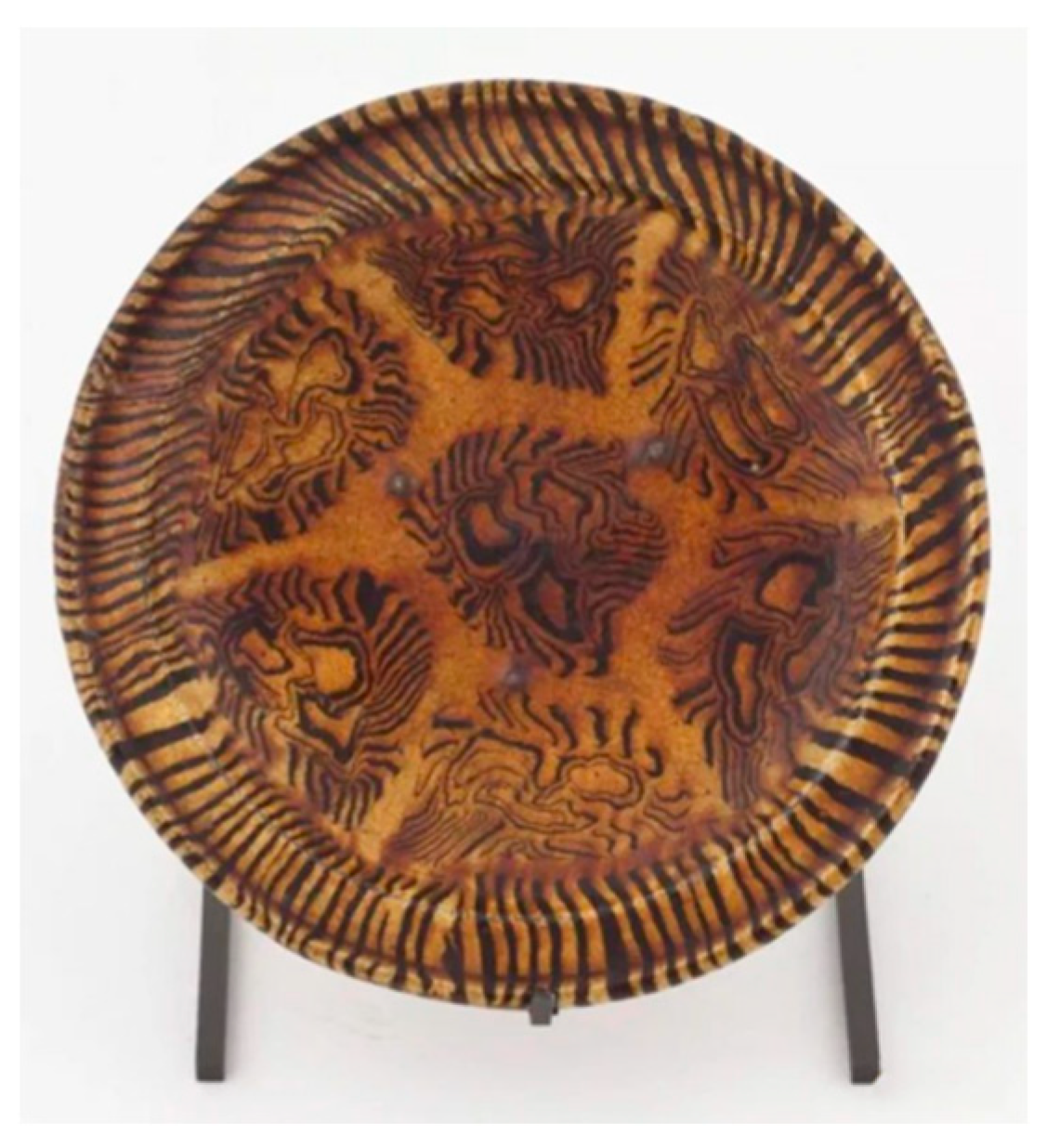
Figure 2.
Fragment of twisted porcelain,China.
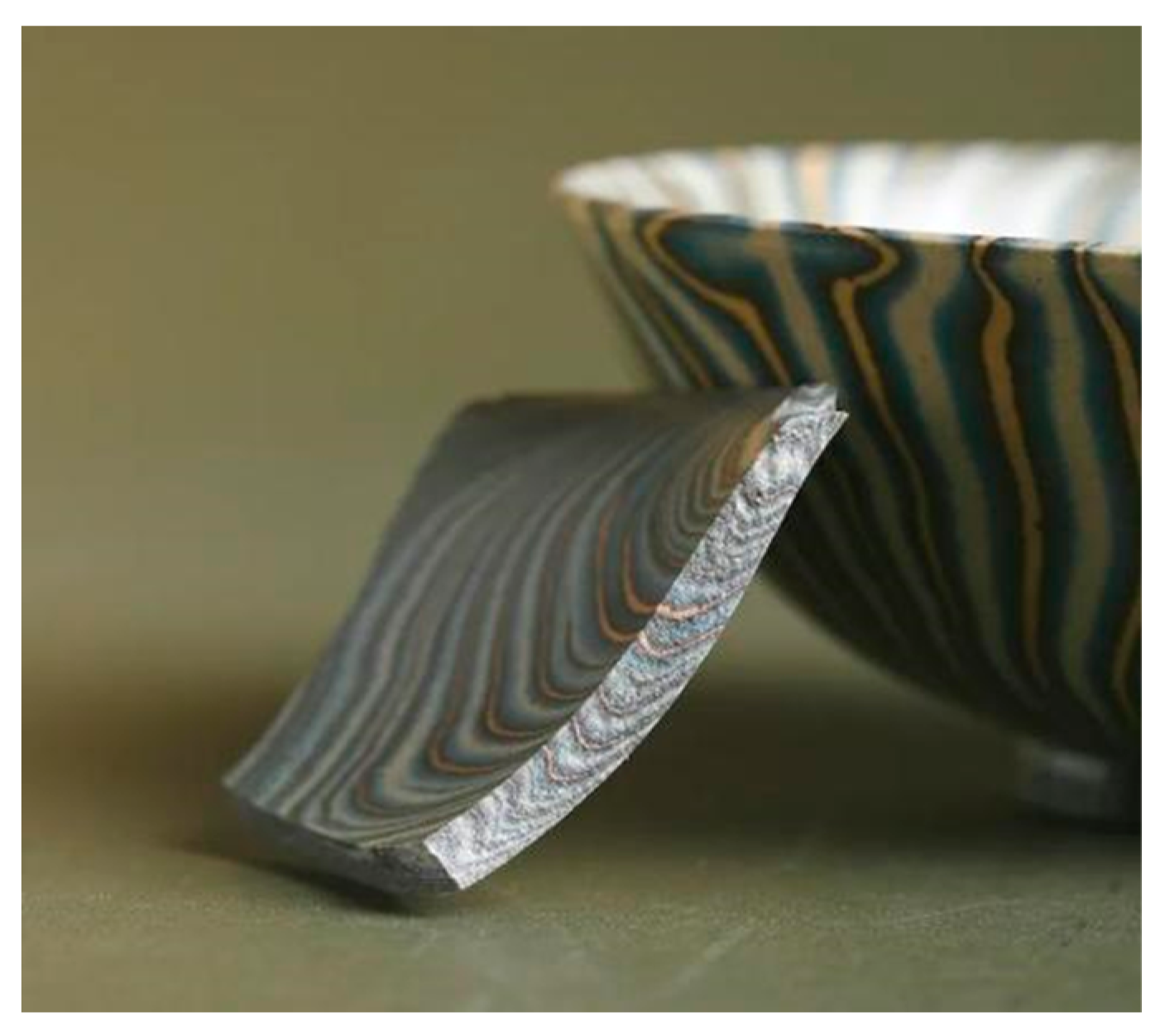

Table 1.
Score evaluation of extension semantics of imagery vocabulary.
| Imagery vocabulary | 1 point | 2 points | 3 points | 4 points | 5 points |
|---|---|---|---|---|---|
| Harmony | 13 | 20 | 28 | 110 | 129 |
| Craft | 40 | 20 | 80 | 50 | 110 |
| Exquisiteness | 83 | 10 | 15 | 70 | 122 |
| Demureness | 30 | 44 | 70 | 85 | 71 |
| Protection | 48 | 7 | 36 | 45 | 164 |
Table 2.
Social value evaluation of cultural semantics of twisted porcelain.
| Number | Harmony | Craft | Exquisiteness | Demureness | Protection |
|---|---|---|---|---|---|
| 1 | 4 | 5 | 5 | 3 | 6 |
| 2 | 3 | 6 | 5 | 2 | 4 |
| 3 | 1 | 4 | 4 | 2 | 5 |
| 4 | 5 | 4 | 3 | 1 | 5 |
| 5 | 4 | 5 | 5 | 4 | 6 |
Table 3.
Design interval of the cultural semantics of twisted porcelain.
| Calculation item | Harmony | Craft | Exquisiteness | Demureness | Protection |
|---|---|---|---|---|---|
| Px | 0.2716 | 0.222 | 0.2307 | 0.2273 | 0.2533 |
| Py | 10.6 | 14 | 12.8 | 7.4 | 15.8 |
| P | 2.87896 | 3.108 | 2.95296 | 0.030716 | 0.01603 |
Disclaimer/Publisher’s Note: The statements, opinions and data contained in all publications are solely those of the individual author(s) and contributor(s) and not of MDPI and/or the editor(s). MDPI and/or the editor(s) disclaim responsibility for any injury to people or property resulting from any ideas, methods, instructions or products referred to in the content. |
© 2024 by the authors. Licensee MDPI, Basel, Switzerland. This article is an open access article distributed under the terms and conditions of the Creative Commons Attribution (CC BY) license (http://creativecommons.org/licenses/by/4.0/).
Copyright: This open access article is published under a Creative Commons CC BY 4.0 license, which permit the free download, distribution, and reuse, provided that the author and preprint are cited in any reuse.


