
Submitted:
02 March 2024
Posted:
04 March 2024
You are already at the latest version
Abstract
Industry 5.0 philosophy recognizes the effectiveness and productivity of the industry sector to add value to society and place workers' comfort as it focal aim . The difference between Industry 5.0 and its predecessors, and unlike Industry 4.0, industry 5.0 thematic principles rely on a tripod of sustainable, human-centric and resilient, these thematic principles underlined the industry 5.0 vision of social value, improving work-safety , application of technology to produce wealth beyond jobs, research and innovation , and strengthen of industrial resilience and competitiveness. But recently, there is a general belief that a perfect storm is brewing for the future of work, brought about by ever-more concerning trends of displacement and low skill levels of workers competencies to handle the new technologies of industry 5.0 in emerging economies. This paper therefore, will discuss the desired twenty-first-century competencies that are needed in the workforce for Industry 5.0, two research questions guided the study to identify these twenty-first-century competencies, and how these competencies can be cultivated and inculcated in the education curriculum and policies of emerging economies and the potential of the adaptation of Industry 5.0 on these emerging economies. the study concluded that emerging economies must possess the ability to create policies that will advance social stability, resource preservation, and climate objectives, which will enable more productive production processes with lower waste and energy usage.
Keywords:
industrial revolution
; industry 4.0
; industry 5.0
; emerging economise
; sustainability
; competencies
; 20th century skills
1. Introduction
The term “21st-century competencies” may appear contemporary, but as [1] pointed out, these competencies are just ‘‘freshly necessary” competencies, and due to the emerging needs of knowledge-based economies, even more, important in modern-day existences [2]. Arguably, the twenty-first-century competencies are assumed to be necessary competencies that prepare individuals to participate in a multifaceted socioeconomic and political environment that is heavily influenced by globalisation and the digital revolution, which have contributed to the creation of a significant difference from the previous industrial age (e.g. industry 3.0 to 4.0) which started from mass production and economies of scale from industry to the optimization of the internet of things, animated and robotic production [3,4,5,6,7] maintained that the term 21st-century competencies are often used as an argument for redefining the goals for training or learning in accordance with the knowledge and skills required in the twenty-first century and the Industry 4.0. Nevertheless, a new industrial revolution, Industry 5.0, casts its shadow on the world and requires skills to overcome challenges such as global climate change, pandemics, and refugee crises. The pertinent question remains, are the 21st-century competencies sufficient to meet the challenges of the second half of the 21st century and what are the implications of Industry 5.0 for emerging economies, like Nigeria amongst other underdeveloped countries?
2. Heading toward Industry 5.0
Industry 4.0 refers to the rising digitalization of the whole value chain, as well as the ensuing interconnectedness of individuals, things, and technologies through actual (real-time) information exchange [8,9]. Industry 4.0 is the fourth revolution era of industrialisation, after the first industrial revolution (steam, water mechanisation), the second revolution (electricity, assembly lines and mass production), third revolution (computerization and automation) which led to the fourth industrial revolution (enhancement of smart and autonomous systems powered by data, AI, and machine learning) [10]. It is believed that Industry 4.0 is an optimised version of Industry 3.0 through the computerization and connectivity of the Internet of Things, sharing of information, and other disruptive innovations that were characteristics of Industry 3.0. [11] however, argued that Industry 4.0 stemmed from the profound changes in the industry which occurred as a result of the adoption of innovations and technologies in the world of work and businesses to enable the industry to generate individualized outputs through smarter and more efficient procedures from the supply chain to the distribution of goods and services, continuous data exchange between all subsystems in the organisation, speedier decision making, greater monitoring and management of the shop floor, more effective use of resources, and better planning of needs. [12].
The European Commission adopted 2021 the report “Industry 5.0: Towards a Sustainable, Human-centric, and Resilient European Industry”. [13] identified the main limitation of Industry 4.0 as the concentration of its thematic industrial landscape only on industrial productivity and versatility, over industrial sustainability and worker welfare [14]. Similarly, climate change, the crisis caused by greenhouse gas emissions primarily from the combustion of fossil fuel and gas emissions mainly from industries, causes an increase in temperatures, fires, droughts, and flooding, as well as substantial disturbances to ecosystems, society, and the economy. The consequences of climate change are severe and long-lasting, rendering technologically driven industrial revolutions obsolete. Recently, the global threat caused by the COVID-19 pandemic, which has had a catastrophic impact on global health and has compromised the safety of societies and economies globally, has resulted in the demand for some significant changes in the processes and policies of industry 4.0, making human-centricity (especially more human resource participation in the industrial landscape) and low-carbon supply chains as essential elements of smart industries [15,16].
Global climate change makes up changes in the global climate caused by increased human emissions of heat-trapping greenhouse gases, resulting in shrinking glaciers, rivers, and lakes, as well as shifting aquatic and terrestrial geographic ranges, which are already having widespread effects on the global environment. Similarly, since the introduction of Industry 0.4, manufacturing businesses and tech giants have contributed to problem-solving, inventiveness, and production strategies using big data technologies, internet of things, and AI. However, these breakthroughs came with significant negatives: sophisticated software and robot automation replacing employment, and the necessity for highly educated, trained and experienced individuals to manage elaborate operations [17].
Also, the COVID-19 pandemic has accelerated the adoption of digital technology that replaces human contact with technology in the workplace, education, commerce, and personal interactions, thereby constituting a complex frontier of tension of system shock between centripetal and centrifugal forces caused by the pandemic due to the imposition of mobility restrictions [18,19]. [20] argued that there is a need to prepare individuals for the work of the future, based on these complex frontiers of systematic shocks caused by the significant negative impact of Industry 4.0 and the adoption of digital technology that replaces human contacts with technology in the workplace. Understanding the competencies and nature of occupations of the future requires more research because understanding the triggers for skilling, upskilling, and re-skilling of people will ensure that regional economies can adapt to the transition by building the necessary infrastructure required for its development. Competence, rather than jobs, are the fundamental elements of the labour market [21].
The advent of Industry 5.0 is a reaction to the limitation of Industry 4.0, which is largely focused on automation and digitization. In the desire to build a more sustainable and efficient production process, Industry 5.0, is designed to combine the benefits of automation with the unique abilities and creativity of human workers to develop a more collaborative and adaptable production system that can better react to changing market demands and to bring back the human-centric and to conserves the resources offered by the planet in production through increased interaction and collaboration between humans and machines.
This paper is organized into 9 sections which are Introduction , Heading towards industry , Competence, Historical leap from industry 1.0 to 4.0 , Industry 5.0 competencies in the 21st century and beyond , Implication of industry 5.0 for competencies ,Implications of industry 5.0 for emerging economies ,Conclusion and limitation . The methodology of this paper is conceptual and descriptive, while the researchers utilized unobtrusive methods to integrate extant relevant research papers to answer the research questions and conclusion made. The research work main objectives is summarized as thus .
- To examine the core values of industry 5.0 and it implications on emerging economies, and how industry 5.0 can leapfrog these emerging economies into value drive sector.
- To identify competencies that are needed in the handling of new technologies of industry 5.0.
- To solicit for the adaptation of the core values of industry 5.0 in the training of workers in emerging economies towards being equipped with the skills to be competent in the 21 century .
- To discuss how industry 5.0 competences can be integrated into education and training curriculum in emerging economies .
The study is guided by two research questions:
What are the competencies that are needed for employees to thrive in the Industry 5.0 era, and how can these competencies be cultivated and integrated into education and training programmes?
What are the potential implications of Industry 5.0 on emerging economies, and how can these economies prepare for and use the opportunities?
3. Competence
There is no proper avenue to describe competencies without using the typology of Knowledge, Skill, and Attitude (KSA) developed as Bloom’s taxonomy which is centred on three domains of activities which are cognitive, affective, and psychomotor. [22,23,24] observed that the cognitive domain is concerned with cerebral abilities (knowledge), the affective domain with feelings or emotional areas (attitudes), and the psychomotor domain with physical or practical talents (skills); competency is often referred to with the formula – C = F(K, A, S) (competence =function of (knowledge , Attitude and Skill). Competence, according to [25], is an underlying personal attribute that is causally linked to higher performance in a job or circumstances that can be improved through training and development” [26].
Competency in the world of work is professed as the centrepiece of the strategies and procedures that drive corporate success and business expansion, that’s why organizations ensure that they are recruiting the right people and placing them in the proper places by explicitly identifying embedded competencies of the prospective candidate at the point of recruitment. Organizations require their personnel to have the best possible combination of competencies to contribute to the overall corporate objectives of the business. [27] argued that competence, in its wider context, enables businesses to grow and capitalize on their prospects and the nature of competitive advantages to integrate and reorganize internal and external competencies in response to a quickly changing environment of the business organisation in today’s world.
As the world is continually evolving, the demand for competencies in every organisation revolves around digital transformation, automation algorithms, Artificial intelligence, and smart technologies to monitor and operate a smart supply chain, logistics, and back-end systems of the organisations. [28] asserted that the significance of Industry 4.0 is tied to its advantages in the 21st century, which include the ability towards supporting businesses and service delivery organisations in finding solutions to problems by being more flexible and understanding how to adapt to market fluctuations in an effective manner. It may also improve the invention pace, speed up design operations, and create a customer-driven framework. The Industry 4.0 revolution is built on nine technology pillars which are “Big data and analytics, autonomous robots, simulation, horizontal and vertical system integration, the industrial Internet of Things, cybersecurity, the cloud, additive manufacturing, and augmented reality” are the essential technologies and innovations that bridge the digital world and when used together for the full potential of the Industry 4.0. [29].
3.1. Knowledge
Knowledge is an important part of competencies, as knowledge entails what a person knows, which is the utilization or putting into action of what learned is knowledge. Knowledge is the product of a relationship between intellect (capacity to learn) and circumstance (opportunity to learn), and so is more socially created. It includes theories and concepts, as well as implicit knowledge learned from doing certain activities [23]. The definition of knowledge is still a problem and an enigma, at least in the managerial sense, because knowledge must be defined as an operational concept appropriate for a business environment, rather than an idea appropriate for a transcending world of ideas [30]. [31] state that knowledge is a fluid amalgamation of framed experience, values, contextual information, and expert insight that serves as a framework for assessing and assimilating new experiences and information. It originates and is implemented in the brains of those who know. It often gets ingrained in organisational routines, procedures, practices, and conventions rather than just papers or archives.
[32] developed a taxonomy to explain how individuals process and adopt objects on an affective or emotional level which classified knowledge into four types which are: factual knowledge, conceptual knowledge, procedural knowledge, and meta-cognitive knowledge [33]. Factual knowledge refers to terms, facts, and information that must be learned to understand a subject; conceptual knowledge concerns the understanding of factual knowledge. Procedural knowledge [31] is the ability to understand how to do a given skill or activity and is related to techniques, processes, or equipment functioning. Same as the domain knowledge which is knowledge of a specific speciality in a discipline or field, in contrast to general (or domain-independent) knowledge. It is often used in reference to a more general discipline. It involves industry-specific skills, resources, software, procedures, knowledge, and experience [34]. Finally, meta-cognitive knowledge refers to an awareness of one’s thought processes and an understanding of the patterns behind them.
3.2. Skills
How to perform something (know-how) is referred to as skills. Amongst the many models and frameworks in recognition of the required skills for success in the 21st Century, [35] insists that the framework developed by The Partnership for 21st Century Skills, the P21 framework) is presently the most accepted and prominent framework. The P21 framework of 21st-century skills [36,37] identifies twelve skills, which are divided into three categories: Learning and Innovation skills, Digital Literacy skills and Career and Life skills. The Learning and Innovation skills are identified as central in this framework and consist of 4 skills: Creativity, Critical thinking, Communication, and Collaboration (the4Cs), alongside three literacy-focused skills ( information literacy, information and communication technology - ICT - literacy, and media literacy) and five career and life skills (flexibility & adaptability, initiative & self-direction, social & cross-cultural interaction, productivity & accountability, and leadership & responsibility) [36].
3.3. Attitude
Attitude is a fictitious construct that shows a person’s level of liking or disliking towards something. Attitudes are often favourable or negative feelings towards someone, a location, an object, or an event. Individual judgements are expressed through attitudes. The ability to choose, retain, or adjust one’s best attitudes for the moment is referred to as “Attitudinal Competency.” Individuals’ behaviour in a particular scenario may be regarded because of their attitude toward the issue [38]. [39] further argued that attitude is a judgement of a mental object, which includes anything a person can think of, from the commonplace to the abstract, such as things, people, groups, and ideas. Although most academics agree on these essential definitions, more sophisticated versions of the attitude notion differ significantly. Nevertheless, or is an important aspect of competencies.
4. Historical Leaps from Industry 1.0 to Industry 4.0
Product creation is as old as mankind, The first industrial revolution, which lasted from 1760 to 1840, began in the 18th century and characterized by machines powered by water and steam in the production of substantive goods to mass production because most of the 18th-century economies are relied on modest handicrafts and farming. [40] argued that this period is also known as the Steam Revolution Era because it brought about the transition from manual labour to the first production line, primarily in the textile sector. The primary motivator for the move was an improved quality of life. Transportation revolutionised the beginning of the twentieth century with the introduction of automobiles and aeroplanes. [41] also posited that the use of electrical power as an energy source, as well as the creation of the telegraph and the spread of railroads, were the defining players of Industry 2.0. The last two reduced the time it needed to travel and transmit products and information, making the world look smaller, reduced cost and production time, coupled with increased supply, these further stimulated worldwide economic growth [42,43]. [44] emphasized that challenges such as manufacturing competitiveness, efficiency, cost reduction, energy usage, and production optimization are needed for the introduction of Industry 3.0. The inclusion of automated systems or the concept of industrial automation into the assembly line is central to Industry 3.0. The third industrial revolution saw the introduction of computers, machinery, and automation in manufacturing which paved the way for the 4th industrial revolution, which is centred on the support of Internet connectivity, renewable energy, manufacturing, and automation in production [45,46]. Industry 4.0 is delineated on a technologically intense and digitally interconnected environment in which competencies such as decision-making, cultural and multicultural skills, lifelong learning, multidisciplinary thinking, problem-solving, and management of typical Industry 4.0 technologies are required [47,48]. However, [12] argued that there is no unanimity on the competencies needed for adequate employment in Industry 4.0 contexts, as the vital capability for future professionals in Industry 4.0 is the capacity to use their knowledge in many collaborative environments to provide value. The professional in Industry 4.0 must constantly learn from new environments and other professionals with various backgrounds and experiences. This may be carried out by implementing training programmes that encourage the continuing improvement of their abilities. While using the scientific mapping analysis to reveal the influence of individual skills in the use and implementation of technologies proposed by Industry [49] identified Connectivity, collaborative work, and man-machine interfaces as competencies that will benefit companies by making them more competitive and successful, and employees by eliminating repetitive activities and allowing them to work with knowledge.
5. Industry 5.0 Competencies in the 21ST Century and Beyond
Industry 5.0 is a forward-thinking perspective on the evolution of industry towards a human-centric, sustainable, and resilient production system that offers a prosperous development vision of industry by integrating social and environmental priorities into technological innovation, and the transition of emphasis from technologies to a systematic strategy of sustainable, human-centric, and resilient industrial landscape [14,50]. Industry 5.0 is a strategic approach that incorporates the perfect human partner and Cobots (collaborative robots) with human resources to allow personalizable independent production across business social networks. This, in turn, allows humans and machines to collaborate. Cobots (collaborative robots) are not programmable devices, but they can detect and understand the presence of humans. In this context, Cobots(collaborative robots) will be employed for repetitive chores and labour-intensive jobs, while humans will handle creativity and logical analysis [51]. It is a Human Industry, based on the sustainability principles of the 6Rs (Recognise, Reconsider, Realise, Reduce, Reuse, and Recycle) and centred on the notion of merging human creativity and know-how with the speed, productivity, and consistency of robots [51,52].
[14] further explained that Industry 5.0 existence is built on the existing Industry 4.0 paradigm by putting research and innovation at the forefront of the transition to a more sustainable, human-centric, and resilient European industry. It arose from the desire to better incorporate social and environmental goals into technical innovation, as well as to move the emphasis from individual technologies to a systematic approach. While Industry 5.0 also encompasses the varieties of developing technologies that have their origins in Industry 4.0, such as Additive Manufacturing, Cyber-Physical Systems, Big Data, Augmented, Extended, Virtual, and Mixed Reality, Digital Twins, 6G technology and beyond, IoT, Blockchain, and Cloud Computing are just a few examples as this is shown and illustrated in Figure 1, as the enablers of industry 5.0 [53]. Based on the features of human-centric, collaboration among humans, robots, and algorithms, the desire for a change in demand of employee core competencies and skills in the future towards adapting to the transformational framework of Industry 5.0 within the context of a global bioeconomy that is based on sustainability is, therefore, necessary as humans and robots will collaborate and work together. But [54] argued that many employees lack the competencies and expertise to work with new technologies such as artificial intelligence and robotics applications, resulting in a core competency gap that must be filled with new competencies in programming, artificial intelligence, machine language, intelligent systems control, and emerging technologies, while jobs that need repetitive operations and do not inspire employees’ creativity will have to be eliminated [55].
6. Implication of Industry 5.0 for Competencies
Based on the features of human-centric, collaboration among humans, robots, and algorithms, the desire for a change in demand of employee core competencies and skills in the future towards adapting to the transformational framework of Industry 5.0 within the context of a global bioeconomy that is based on sustainability is, therefore, necessary as humans and robots will collaborate and work together. But [55] argued that many employees lack the competencies and expertise to work with new technologies such as artificial intelligence and robotics applications, resulting in a core competency gap that must be filled with new competencies in programming, artificial intelligence, machine language, intelligent systems control, and emerging technologies, while jobs that need repetitive operations and do not inspire employees’ creativity will have to be eliminated. [56] posited that the combined power of humans and machines will generate new possibilities, and competencies, uncover value, and drive development, will create a culture that will encourage innovation, exploration, and inventiveness while embracing automation responsibly. As a result, many businesses will begin to engage in high-performance human-machine collaborations that enable greater degrees of automation to unlock previously untapped value [56,57].
While discussing the core competencies in Industry 5.0, [58] identify leadership competency as a basic requirement as these competencies enable managers to ascertain how jobs can be fragmented into smaller tasks and how many of these jobs (whether repetitious or not) are to be automated. Scalability issues should be considered since automation for the sake of automation will quickly become a costly experiment. The leadership competencies will assist the manager in navigating the integration of humans and intelligent systems in the organization through strategic thinking and decision-making skills, the ability to manage and lead diverse teams, adaptability to technological advancements, and effective communication and collaboration skills.
[59] also identified “soft skills” as an essential competency needed as the sustainable workforce of the future will be a hybrid, requiring employees with machine-related competence in the sense that, employees will be supplied with real-time data to support decision-making, enhancing their ability to connect with quickly expanding digital industrial systems, while autonomous robots will tackle monotonous and unpleasant activities that have been automated in an organization [60]. To understand exactly what soft skills are, [61] describes these as communicative qualities that improve interaction efficiency or a person’s ‘‘Emotional Intelligence Quotient”. [59] outlined some important soft skills including effective communication and interpersonal skills, empathy and emotional intelligence, analytical thinking and innovation, conflict management, and problem-solving skills. teamwork and collaboration. [62] describe soft skills as the human factor; this is because by merging workflows with intelligent systems, humans and robots use human brain capacity and creativity to boost process efficiency. Rather than assessing the potential of emerging technologies to boost efficiency, a human-centric approach places essential human wants and interests at the centre of the production process. Soft skills like critical and analytical thinking, problem-solving, communication skills, and creativity with flexibility are constantly in high demand by employers. This shows that the growing demand for ‘hard’ technical competencies is frequently strongly related to the rising demand for ‘soft’ competencies [63]. [64] also included critical thinking and analysis, analytical thinking and innovation emotional intelligence, and leadership and social influence as some of the soft skill competencies that are needed in the era of Industry 5.0.
At the World Economic Forum, [65] showed the top ten in-demand competencies that will be in high demand before 2025. These competencies are divided into 4 categories which are
- Problem-solving,
- Working with people,
- Technology use and development,
- Self-management
[66] further argued that human intelligence will have to shift to a higher order while technology and artificial technology will lower the cost of quality, be swift in the deployment of goods and services, and will be used for the greater good than distorted for private interests in the era of Industry 5.0. As a result, a highly vital set of soft skills including emotional intelligence, resilience, empathy, creativity, and critical thinking will fuel the journey to reaching a progressive and productive mentality for a better future, as there will be an expansion on the conventional focus on “STEM” (science, technology, engineering, and mathematics)and coding by re-emphasizing on a broader set of competences, such as critical thinking, social and soft skills, in addition to domain expertise, creativity, and imagination as defining qualities of future occupations [67].
Subsequently to improve the competitiveness and efficiency of the factories, the digital transformation and the use of technologies like Cobot, digital twins, artificial intelligence, and other enabling technologies of Industry 5.0. Industries in the future require new competencies from the workforce. Because technology will continue to play an increasingly considerable role in production and industry 5.0, there will always be a corresponding increase in the need for workers with a background in STEM-skilled training these STEM-skilled workers will design, develop, and maintain the cutting-edge technologies that underpin Industry 5.0, these professionals will be required at all the industries [68]. The digital and enabling technology advancements of Industry 5.0 can increase social inclusion, may provide information for up-skilling training programmes and can guarantee a two-way dialogue with society about emerging technologies [66]. Owing to the increased demand for STEM-trained personnel The European Commission has decided that both STEM and soft skills training should follow independent learning paths. The European Commission report stipulates that over 60% of employees in Industry 5.0 are skilled workers, suggesting that other types of employment are also being removed in addition to low-skilled work. To satisfy the needs of Industry 5.0, which entails the combination of innovative technology and human skills, it is crucial to upskill and reskill the workforce. Having STEM skills will help people adapt to Industry 5.0’s changing requirements and help businesses succeed in this new era of production [64,65,66].
To cultivate and integrate Industry 5.0 competencies into education and training programmes, [69] posited that Adapting teaching and learning strategies to Industry 5.0 technology is one of the biggest problems of Industry 5.0 in education. This can call for the creation of fresh educational strategies as well as the incorporation of technology in the classroom. which includes using artificial intelligence and machine learning in Industry 5.0 applications to tailor the educational experience for learners at earlier education programmes. [68] asserted that the workforce in Industry 5.0 will need to be ready to constantly learn about and adapt to new technologies, enablers of Industry 5.0, and processes since the rate of technological change is increasing. To guarantee that employees have the skills and knowledge necessary to stay up with the shifting needs of the workplace, establishments will need to invest in training and development programmes.
7. Implication of Industry 5.0 for Emerging Economies
Many experts have argued that Industry 5.0 can assist emerging economy countries in leapfrogging their economic growth by allowing them to embrace cutting-edge technology that boosts productivity, efficiency, and cost-cutting. In comparison to Industry 4.0, Industry 5.0 focuses on creating a sustainable, human-center, and resilient corporate environment, as well as the capacity to strategically optimize global supply chains (SCs) in the post-pandemic period [70,71,72]. An emerging economy is on its way to becoming a mature economy, characterised by fast development, industrialization, and modernization. These economies often have lower per capita income levels than industrialised economies, but they are undergoing fast expansion and increased economic activities. Furthermore, an emerging economy is also described as any country that shows general economic development and progress and is more engaged with global markets as it grows domestically and internationally. Emerging economies have strong GDP growth, enhanced FDI inflow, better commercial opportunities, and developing living standards. These marketplaces are quite cutthroat and are crucial to globalisation. Emerging market economies are those that show some, but not all, of the traits of a developed market [73].
Emerging economies often shift away from agricultural and resource-extraction-focused activities and towards industrial and manufacturing-related industries. Over the past 15 years, these economies have handled over two-thirds of the global GDP growth and more than half of new expenditures. Governments in these countries often adopt purposeful industrial and trade initiatives to foster economic growth and industrialisation. Brazil, Turkey, Russia, India, and China are a few of the nations that are developing most quickly Robust economic development, high per capita income, liquid equities and debt markets, accessibility to international investors, and a solid regulatory structure are examples of features of developed markets [74]. Industry 5.0 is the result of a change in emphasis from economic value to societal value and from welfare to wellness. This is due to a deliberate emphasis on shareholder value, as stakeholder value strengthens the industry’s role and commitment to society from providing products and services for profit to going above and beyond, towards the precedence of worker well-being in the manufacturing process and employing new technology to bring wealth beyond jobs and development while respecting the planet’s production constraints and supplementing the existing of Industry 4.0 strategy by placing research and innovation, especially at the service of the transition to a sustainable, human-centric, and resilient European industry has generated into Industry 5.0.
In ascertaining the potential implications of Industry 5.0 on emerging economies, and how these emerging economies can prepare for and leverage the opportunities of Industry 5.0, [75] reveals that one of the important strategies is the prioritizing of sustainable development, which goes beyond limiting climate harm to actively seeking good environmental and social effect. In the same breath, Industry must now act as a facilitator and speed up the pace of change. Therefore, emerging economies are to create guidelines and policies that will advance social stability, resource preservation, and climate objectives, which will enable more productive production processes with lower waste and energy usage. Establishing confidence with the investing community requires strong and stable governance. The ability of the government to exercise authority and control, the reliability of its institutions (including the rule of law and the prevention of corruption), and the strength of its legal system are necessary criteria required for confidence amongst the investment communities and to elicit infrastructure investment and development [76]. [77] further opined that the provision of a foundation for enhanced policy and regulation by governments of emerging economies will build a digital inclusion plan to help link rural regions, emphasize the necessity for developing digital skills for the industry 5.0, and guarantee data privacy, will enable those from underprivileged backgrounds equal opportunity to upskill themselves and engage in the digital economy, and promotes inclusion.
Furthermore, Industry 5.0 contributes to the technical advancement required for the industry to reaffirm its role as a source of solutions for our society and as a desirable employer for young people looking for a fulfilling career and industry workers, who may see their role changed, due to new skills required in the organisation through education and training [78]. This development is important as Industry 5.0 requires emerging economies to invest massively in training and education programs to develop the necessary skills for highly skilled personnel who can work collaboratively with machines and artificial intelligence.
This technical development and training will provide participants with the skills and information needed to adopt cutting-edge techniques and new technology; these programmes seek to close the skill gap that currently exists in the workforce. These programmes help people meet the needs of Industry 5.0, improve their technical abilities, and adjust to changing work settings by offering specialised training, vocational courses, and certificates. Initiatives for skill development also encourage innovation and entrepreneurship, enabling people to work for themselves and support economic expansion.
Investment in Research and Development (R&D) allows for the improvement of emerging economies’ technical prowess and promotes innovation. [79] postulated that Research and development (R&D) expenditures have the potential to supply novel technologies, goods, and procedures that boost output and efficiency, and generate employment opportunities that will stimulate the local economy. Additionally, by offering education and training programmes specifically designed to meet the demands of Industry 5.0, R&D expenditures can assist in closing the skill gap in the workforce [80] and enable the emerging economies to compete favourably on the world market and catch up to more developed economies. investment in research and development is important for the successful implementation of Industry 5.0.
[81] posited that governments and private organisations must invest in education and training to prepare people especially young individuals by giving them the skills they need to thrive in the industry 5.0 economy. This is important that workers in Industry 5.0 be ready to continually learn about and adapt to innovative technologies and processes since the rate of technological changes in the industry is accelerating. To make sure that employees have the skills and knowledge necessary to stay up with the shifting needs of the workplace, businesses will need to invest in training and development [82]. If these emerging economies take advantage of Industry 5.0’s potential by investing in education and training programmes, there will be a significant improvement in their manufacturing capabilities, including productivity, efficiency, and sustainability.
The industry-academic application or collaborations may result in the formation of innovative technologies, tailored solutions, and industry-driven research initiatives [83]. that cater to the unique requirements and difficulties of emerging economies. [80] argued that these alliances may also facilitate workforce upskilling and training, thus ensuring that individuals have the abilities and knowledge needed to succeed in the industry 5.0 age. Industry and academic collaborations may speed up the adoption and implementation of industry 5.0 by emerging economies, eventually boosting economic development and competitiveness in global markets, through cooperative initiatives including joint research centres and industry-sponsored scholarships [83]. Interlinking collaborations between the industry-academia and knowledge exchange between these two industries is essential to the implementation of Industry 5.0 as this will close the gap between concept and practice.
Emerging economies may create new goods and services that are in line with Industry 5.0 by fostering innovation and entrepreneurship. This aspect is centred on the building of strong digital infrastructures which will enable emerging nations to get the most out of innovative technologies like cloud computing, IoT, and artificial intelligence, which are essential elements of Industry 5.0. Furthermore, the building of a strong digital infrastructures can be created through the promotion of public-private partnerships which will help emerging economies use resources and expertise to accelerate the adoption of Industry 5.0, this would make it possible for the public and private sectors to take use of cutting-edge inventions and technology from industry 5.0 for their mutual gain and economic development, which can take the shape of funding, designing, and developing of the industry 5.0 infrastructures , cooperation between the public and private sectors on the research of novel technologies and solutions that will tackle social issues and promote economic progress, as well as data sharing systems amongst each partners .
Technology infrastructure, digital infrastructure, physical infrastructure, and supply chain infrastructure are the main elements of Industry 5.0 infrastructure. Intelligent machinery, automation, Internet of Things gadgets, big data, cloud computing, 6G networks, and blockchain are all examples of technological infrastructure. Connectivity and data storage are two components of digital infrastructure that are necessary for handling and analysing data. Manufacturing-related physical infrastructure includes buildings, machinery, and other tangible assets. Last but not least, supply chain infrastructure consists of the networks and systems that facilitate the transportation of products and services from suppliers to consumers, emerging economies must make investments in these many forms of infrastructure to allow effective and sustainable Industry 5.0 [84]. These investments in emerging economies should involve the inculcation of the 4 categories of competencies s identified by The Future of Job report which are Problem-solving, Working with people, Technology use and development, and Self-management to create a circular economy that is human-centric and sustainable.
8. Conclusions
This study discussed the core values of Industry 5.0 and its implication in emerging economies and how this new industrial revolution can leapfrog these emerging economies from technology-driven industrial status into a more value-driven sector. The study also observes that transformational technology advancements in industries have fundamentally altered the way industries operate, These industrial transformations have both social and economic repercussions, some of these repercussions are unintentional and undesired, while others are desired and purposeful. Industry 4.0 is technology-driven, much like its predecessors. while Industry 5.0 has made industries into a value-driven sector, this is because Industry 5.0 encompasses fundamental societal requirements, values, and burdens as its ultimate core values [85]. Industry 5.0 has a strong focus on sustainability, waste reduction and a decline in the environmental impact of manufacturing for a sustainable future through the application of the enabling technologies of Industry 5.0 which will be beneficial to emerging economies.
Martinez [80] recounted that industrial 5.0 advanced enabling technologies like Artificial intelligence have the potential to significantly reduce energy uses and emissions in industrial plants by, for instance, monitoring and optimizing energy usage, Robotics detect and remove waste at every stage of the production process, from raw materials to completed goods, and can even be employed to dismantle products so that their components can be recycled or reused when their usage cycles are coming to an end. The Internet of Things is utilized to monitor how materials move through the production process and identify prospects for material recycling and reuse, thus lowering the need for fresh resources in the process and building a manufacturing environment that is more sustainable for a circular economy.
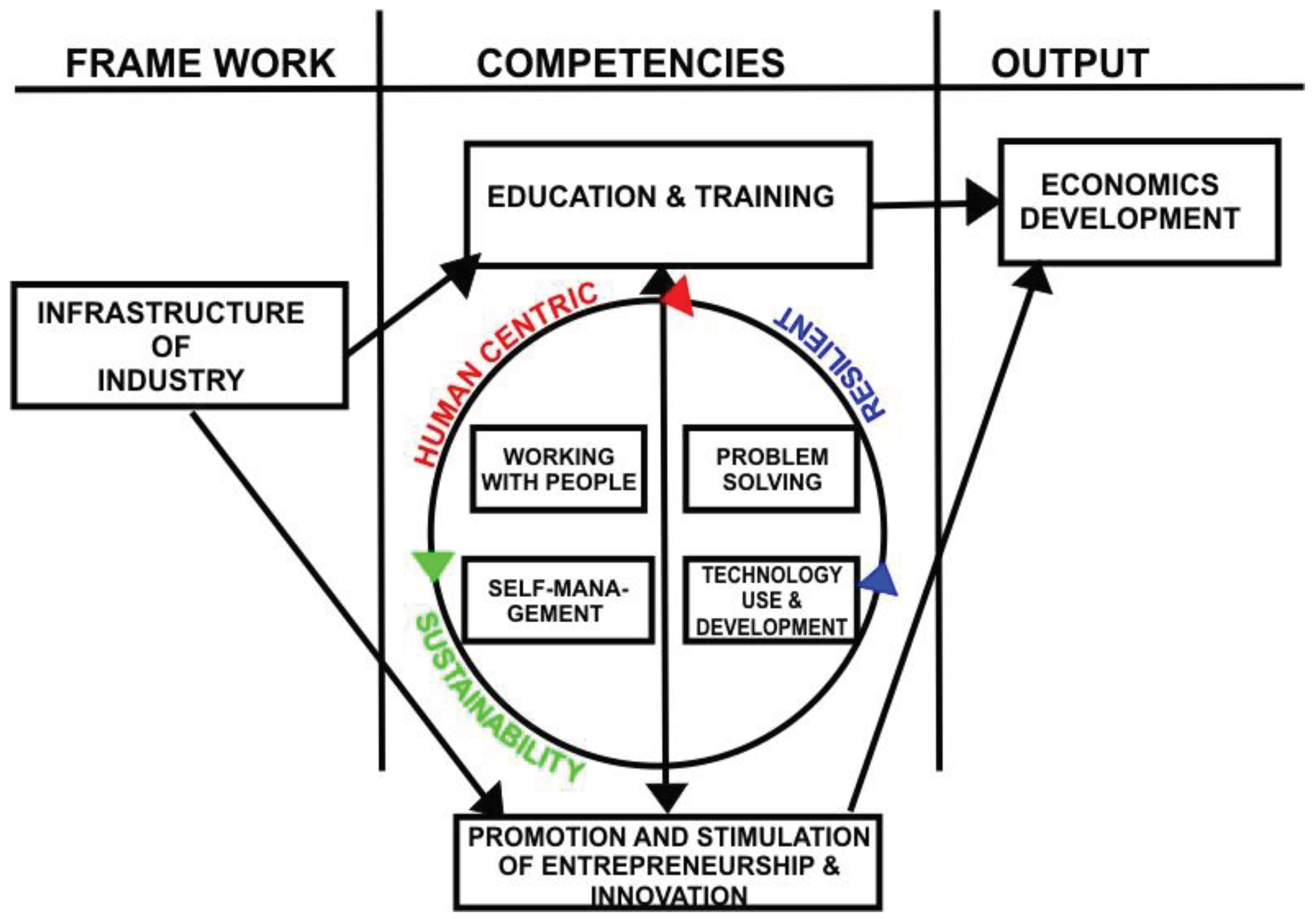
The research also identified competencies that are needed for employees to thrive in the Industry 5.0 era, as most industrial employees lack the modern competencies and to work with new technologies ( artificial intelligence and robotics applications) in the twenty-first-century workplace, thereby causing a competency gap that must be filled with ideal competencies in programming, artificial intelligence, machine language, intelligent systems control, and emerging technologies. Furthermore, as industries are refocusing their policies towards a smart social workplace which is included in Industry 5.0, there will be a massive engagement of human-machine collaborations that enable greater degrees of automation to unlock previously untapped values which will create a culture that will encourage innovation, exploration, and inventiveness in the place of work The study also identified leadership competency as a basic requirement for industry 5.0, which is shown in the Figure 2 diagram , as these competencies enable the managers in navigating the integration of humans and intelligent systems in the organization through strategic thinking and decision-making skills. Soft skills like critical and analytical thinking, problem solving, communication skills, and creativity with flexibility are identified as competencies needed in the industry 5.0 era, this competencies will enable Artificial intelligence and robots to use human brain capacity and creativity towards boosting process efficiency. Afterwards, competencies needed in Industry 5.0 were divided into 4 categories which are
- Problem-solving,
- Working with people,
- Technology use and development,
- Self-management
Furthermore , if these industry 5.0 competencies are cultivated and integrated into the education and training programs of emerging economies through STEM ( Science, Technology ,Engineering and Mathematics) the output will lead to economic development of these emerging economies . this aspect will also make the emerging economies to empower their workforce in driving innovation, engage competitively, and sustain growth in the digital era by fostering and integrating Industry 5.0 competences into their education and training programmes. Lastly, the study also discussed the potential implications of Industry 5.0 on emerging economies, and how these economies can it prepare for it and use the opportunities. It is observed that for emerging economies to utilise the potential of Industry 5.0, they must have the ability to create guidelines and policies that will advance social stability, resource preservation, and climate objectives, which will enable more productive production processes with lower waste and energy usage and allow its industries to act as the pace of change in the prioritizing of sustainable development. The emerging economies also need to establish confidence with the investing communities through a strong, stable control of their institutions with governance entrenched in democratic principles and the rule of law.
9. Limitation
This paper discussed the industry 5,0 and provide an historical insights on the importance of acquiring the desired twenty-first-century competencies that are needed in the workforce for Industry 5.0, in the emerging economies , unfortunately the methodology of the paper is conceptual and descriptive in nature ,as the researchers relays on few existent literatures of industry 5.0 .Base on the fact that there are no adequate statistics and data it have caused a constraint to the study . Similarly in future development this research should be empirical based , as this will give the study better representation of the reality on ground .
Author Contributions
Ikenga , G.U conceptualized and wrote the original manuscript . Sijde, P. C reviewed, edit and added input to the manuscripts.
Funding
This research was made possible by the sponsorship and support of the TEDFUND (Tertiary Education Trust Fund) Nigeria. Under grant TETF/ES/COE/DELTA STATE/TSAS/2019.
Data Availability Statement
The authors confirm that the data supporting the findings of this study are available within the article and its supplementary materials.
Acknowledgments
The authors would like to acknowledge and thank the anonymous reviewers and editors for their worthy assistances and contribution to an earlier draft of this article as well as members of the Science , Business and Innovation Unit of Vrije university , Amsterdam, Netherlands .
Conflicts of Interest
No potential conflict of interest was reported by the authors.
References
- Serhii, S . (2019). Industry 5.0: Announcing the Era of Intelligent Automation. Learn how to combine the strengths of humans and machines for manufacturing of the future. https://intellias.com/industry-5-0-announcing-the-era-of-intelligent-automation/.
- Rotherham, A., and Willingham, D. (2009). 21st century skills: The challenges ahead. Educational Leadership, 67(1), 16-21.
- Beetham, H. and Sharpe, R. (2013). Rethinking pedagogy for a digital age: Designing for 21st Century learning, 2nd edition, Oxon: Routledge.
- Loveless, A., & Williamson, B. (2013). Learning identities in a digital age: Rethinking creativity, education and technology. Routledge.
- Tortorella, G., Fogliatto, F. S., Kumar, M., Gonzalez, V., & Pepper, M. (2023). Effect of Industry 4.0 on the relationship between socio-technical practices and workers’ performance. Journal of Manufacturing Technology Management, 34(1), 44-66. [CrossRef]
- Binkley, M., Erstad, O., Herman, J., Raizen, S., Ripley, M., & Rumble, M. (2010). Draft white paper 1: Defining 21st century skills. Available online also at: http://cms. education. gov. il/NR/rdonlyres/19B97225-84B1-4259-B423-4698E1E8171A/115804/defining21stcenturyskills. pdf .
- Trilling, B. & Fadel, C. (2009). 21st Century Skills: Learning for Life in Our Times, Jossey-Bass, San Francisco, CA. USDHHS. (2003). U.S. Department of Health and Human Services Administration for Children and Families Program Announcement, Federal Register, Vol. 68(1310.
- Hecklau, F., Galeitzke, M., Flachs, S., & Kohl, H. (2016). Holistic approach for human resource management in Industry 4.0. Procedia Cirp, 54, 1–6. [CrossRef]
- Grzybowska, K., & Łupicka, A. (2017). Key competencies for Industry 4.0. Economics & Management Innovations, 1(1), 250-253.
- Marr, B. (September 2, 2018). What is Industry 4.0? Here’s A Super Easy Explanation For Anyone. https://www.forbes.com/sites/bernardmarr/2018/09/02/what-is-industry-4-0-heres-a-super-easy-explanation-for-anyone/?sh=59dad7929788.
- Hernandez-de-Menendez, M., Morales-Menendez, R., Escobar, C.A. et al. Competencies for Industry 4.0. Int J Interact Des Manuf 14, 1511–1524 (2020). [CrossRef]
- Rubmann, M., Lorenz, M., Gerbert, P., Waldner, M., Justus, J., Engel, P., Harnisch, M. (2015) Industry 4.0. The Future of Productivity and Growth in Manufacturing Industries. The Boston Consulting Group (April), pp. 1–20.
- Breque. M, De Nul .L, and Petridis A.(2021). Industry 5.0: towards a sustainable, human-centric and resilient European industry. Luxembourg, LU: European Commission, Directorate-General for Research and Innovation; 2021.
- Lu. Y, Xu. X, Wang .L.(2002). Smart manufacturing process and system automation – a critical review of the standards and envisioned scenarios. J Manuf Syst 2020;56: 312–25. [CrossRef]
- Goswami, D. (2021). “Climate crisis solutions”. Journal of Environmental Impact and Management Policy, 1(2): 5-11.
- Narayanamurthy, G., and Tortorella, G. (2021). “Impact of COVID-19 outbreak on employee performance–the moderating role of industry 4.0 base technologies”. International Journal of Production Economics, 234: 108075.
- Ovidiu, C. (2023). Industry 5.0 opportunities and challenges: bring your factory into the future. https://digitalya.co/blog/industry-5-opportunities-and-challenges/.
- Bailey, D., Clark, J., Colombelli, A., Corradini, C., De Propris, L., Derudder, B., Frates, U., Fritsch, M., Harrison, J., Hatfield, M., Kemeny, T., Kogler, D. F., Lagendijk, A., Lawton, P., Ortega-Argilés, R., Iglesias Otero, C., & Usai, S. (2020a). Regions in a time of pandemic. Regional Studies, 54(9), 1163–1174. [CrossRef]
- Ramirez, P. (2021). Technological revolutions, socio-technical transitions and the role of agency in new regional development paths: The case of Värmland’s transition to a regional bio-economy. Regional Studies. [CrossRef]
- Propris, L. and Bellandi, M. (2021) Regions beyond Industry 4.0, Regional Studies, 55:10-11, 1609-1616. [CrossRef]
- Lamri, J., and Lubart, T. (2021). Creativity and Its’ Relationships with 21st Century Skills in Job Performance. Kindai Management Review, 9, 75-91.
- Winterton. J, Delamare-Le Deist. F, and Stringfellow, E.(2008).Typology of Knowledge, Skills and Competences: Clarification of the Concept and Prototype. Volume 64 de CEDEFOP reference document, ISSN 1608-7089. CEDEFOP reference series, ISSN 1608-7089.
- Thijsen, J. G. 2000 Employability in the brandpunt. Aanzet tot verhaldering van een diffuus fenomen. Tijdschrift HRM 1. 7–34.
- Mulder, M. (2001). Competence development – Some background thoughts. The Journal of Agricultural Education and Extension, 7(4), 147–159. [CrossRef]
- Spencer, L.M. & Spencer, S. M. (1993), Competency at work, New York: Wiley.
- Moore, D. R., Cheng, M., & Dainty, A. R. J. (2002). Competence, competency and competencies: Performance assessment in organizations. Work Study, 51(6), 314–319.
- Greeven, M. J. and Xiaodong, Zhao, Developing Innovative Competences in an Emerging Business System: New Private Enterprises in Hangzhou’s Software Industry (August 2009 8,). ERIM Report Series Reference No. ERS-2009-045-ORG, Available at SSRN: https://ssrn.com/abstract=1466507.
- Koizumi, S. (2019). The light and shadow of the fourth industrial revolution. In Innovation beyond technology (pp. 63–86). Springer.
- Alhosani, H. M. M. G., Ahamat, A., & Ismail, N. (2021). Industrial Revolution 4.0 (IR 4.0) Competencies: A Literature Review Of Manufacturing Industry. Pt. 2 J. Legal Ethical & Regul. Isses, 24, 1.
- Bolisani, E., & Bratianu, C. (2018). Emergent knowledge strategies: Strategic thinking in knowledge management. Springer International Publishing.
- Davenport, T. and Prusak, L. (2000) . Working knowledge. How organizations manage what they know. Harvard Business School Press, Boston.
- Krathwohl, D. R. (2002). A Revision of Bloom’s Taxonomy: An overview. Theory Into Practice, 41(4), 212-218. [CrossRef]
- Komal, N.( November 19, 2020). The four types of knowledge you’ve experienced across your lifetime. https://www.linkedin.com/pulse/four-types-knowledge-youve-definitely-experienced-across-narwani/.
- Hjørland, B. &Albrechtsen, H. (1995). Toward A New Horizon in Information Science: Domain Analysis. Journal of the American Society for Information Science, 1995, 46(6), p. 400–425. [CrossRef]
- Dede, C. (2009) Immersive Interfaces for Engagement and Learning. Science, 323, 66-69. [CrossRef]
- Lamri, J. (2019). Relationship between 21st century skills and executives and managers professional performance (Doctoral dissertation, Université Paris Cité).
- Fadel, C. (2008). 21st-Century Skills: How Can You Prepare Students for the New Global Economy? OECD/CERI Paris: Global Lead, Education Cisco Systems, Inc.
- Dees, J. G. (2007). Taking social entrepreneurship seriously. SOCIETY-NEW BRUNSWICK-, 44(3), 24. [CrossRef]
- Bohner, G. and Dickel, N.(2011). Attitudes and Attitude Change. Annual Review of Bolisani, E., and Bratianu, C. (2018). The elusive definition of knowledge.In Bolisani, E. and Bratianu, C. ( 2018). Emergent knowledge strategies: Strategic thinking in knowledge management (pp. 1-22). Cham: Springer International Publishing. DOI: 10.1007/978-3-319-60656_1 (PDF) The Elusive Definition of Knowledge. Available from: https://www.researchgate.net/publication/318235014_The_Elusive_Definition_of_Knowledge [accessed December 2023].
- Ayush ,K .(September 29, 2019) Industry 1.0 to 4.0 .https://www.linkedin.com/pulse/industry-10-40-ayush-kumar/.
- Carmichae, S. (2022). Industry 2.0 introduction https://significans.com/blog/industry-2-0-introduction/.
- Prinsloo, J, Vosloo, J.C & Mathews, E,H. (2021)(1) (PDF) Towards Industry 4.0: A Roadmap for the South African Heavy Industry Sector. Available from:https://www.researchgate.net/publication/337326390_Towards_Industry_40_A_Roadmap_for_the_South_African_Heavy_Industry_Sector [accessed Jul 31 2023].
- Joseph, O.A. & Sridharan, R.( 2011). Analysis of dynamic due-date assignment models in a flexible manufacturing system. Journal of Manufacturing Systems, 30(1), pp. 28–40. [CrossRef]
- Sun, B., Jämsä-Jounela, S.L., Todorov, Y., Olivier, L.E. & Craig, I.K. (2017). Perspective for equipment automation in process industries. IFAC-PapersOnline, 50(2), pp. 65–70. [CrossRef]
- Malaysia a Changing Nation - Change Management.(2019) Lean Six Sigma and Industry 4.0.https://malaysiachange.wordpress.com/2019/03/06/lean-six-sigma-and-industry-4-0/.
- Eden, M. & Gaggl, P. (2018).On the welfare implications of automation. Review of Economic Dynamics, 29, pp. 15–43. [CrossRef]
- Coskun, S., Kayıkcı, Y., and Gençay, E.(2019) Adapting engineering education to Industry 4.0 vision. Technologies 7(1), 1–10 (2019). [CrossRef]
- Mohamed, M. (2018). Challenges and benefits of Industry 4.0: an overview. International Journal of Supply Operation and Management. 5(3), 256–265 (2018). [CrossRef]
- Kipper, L. M., Iepsen, S., Dal Forno, A. J., Frozza, R., Furstenau, L., Agnes, J., & Cossul, D. (2021). Scientific mapping to identify competencies required by Industry 4.0. Technology in Society, 64, 101454. [CrossRef]
- Xu, X., Lu, Y., Vogel-Heuser, B., & Wang, L. (2021). Industry 4.0 and Industry 5.0—Inception, conception and perception. Journal of Manufacturing Systems, 61, 530-535. [CrossRef]
- European Economic and Social Committee. (2018). Industry 5.0 Will Bring about a New Paradigm of Cooperation between Humans and Machines; European Economic and Social Committee: Brussels, Belgium, 2018; Available online: https://www.eesc.europa.eu/en/news-media/news/industry-50-will-bring-about-new-paradigm-cooperation-between-humans-and-machines (accessed on 5 August 2023).
- Maddikunta, P. K. R., Pham, Q.-V., B, P., Deepa, N., Dev, K., Gadekallu, T. R., Ruby, R., & Liyanage, M. (2022). Industry 5.0: A survey on enabling technologies and potential applications. Journal of Industrial Information Integration, 26, 100257. [CrossRef]
- Mukherjee, A.A, Raj, A and Aggarwal, S.(2023).Identification of barriers and their mitigation strategies for industry 5.0 implementation in emerging economies. International Journal of Production Economics, Volume 257,2023,108770, ISSN 0925-5273. [CrossRef]
- Wang, X.; Yu, B.; Han, X. (2017). Industry 5.0: Concept, Characteristics, and Future Trends. IEEE Access 2021, 9, 55183–55196. 43. McKinsey Global Institute. Jobs Lost, Jobs Gained: Workforce Transitions in a Time of Automation; McKinsey Global Institute: San Francisco, CA, USA, 2017.
- Nahavandi, S. (2019). Industry 5.0—A Human-Centric Solution. Sustainability 2019, 11, 4371. [CrossRef]
- Li, L. (2020). Education supply chain in the era of Industry 4.0. Systems Research and Behavioral Science, 37(4), 579-592. [CrossRef]
- Guidotti.R, Monreale. A, Ruggieri.S, Turini. F, Giannotti. F, Pedreschi.D.(2018) A survey of methods for explaining black box models. ACM Computer Survey 51(5):1–42.
- Kleinings, H. (2022). 8 Applications of Artificial Intelligence in Business. https://levity.ai/blog/8-uses-ai-business. Accessed: 21 December, 2023.
- Yadav, A. K. (2022). The essential skills and competencies of LIS professionals in the digital age: Alumni perspectives survey. Global Knowledge, Memory and Communication, 71(8/9), 837-856. https://doi.org/10.1108/gkmc-03-2021-0049. [CrossRef]
- Kaasinen, E., Anttila, A. H., & Heikkilä, P. (2022). New Industrial Work: Personalised Job Roles, Smooth Human-Machine Teamwork and Support for Well-Being at Work. In Human-Technology Interaction: Shaping the Future of Industrial User Interfaces (pp. 271-301). Cham: Springer International Publishing.
- Goleman, D. (2007). Social intelligence. Random house.
- Poláková M, Suleimanová JH, Madzík P, Copuš L, Molnárová I, Polednová J. Soft skills and their importance in the labour market under the conditions of Industry 5.0. Heliyon. 2023 Jul 27;9(8):e18670. [CrossRef]
- Börner, K., Scrivner, O., Gallant, M., Ma, S., Liu, X., Chewning, K., ... & Evans, J. A. (2018). Skill discrepancies between research, education, and jobs reveal the critical need to supply soft skills for the data economy. Proceedings of the National Academy of Sciences, 115(50), 12630-12637. [CrossRef]
- Demir, S., and Ercan, F. (2019). The effect of a self-awareness and communication techniques course on the communication skills and ways of coping with stress of nursing students: An interventional study in Ankara, Turkey. J Pak Med Assoc, 69(5), 659-665.
- Future of Jobs Report. (2020). Retrieved from: https://www.weforum.org/reports/the-future-of-jobs-report-2020.
- Güğerçin, S. & Güğerçin, U. (2021). How Employees Survive In The Industry 5.0 Era: In-Demand Skills Of The Near Future, International Journal of Disciplines Economics & Administrative Scienves Studies, (e-ISSN:2587-2168), Vol:7, Issue:31; pp:524-533.
- Zini, A (2023). Industry 5.0 and the future of work (JRC 2023).https://digital-skills-jobs.europa.eu/en/inspiration/research/industry-50-and-future-work-jrc-2023.
- The Welding Institute (2023, 06 April).Up-skill, industry 5.0 and the workforce. https://www.twi-global.com/media-and-events/press-releases/2023/up-skill-industry-5.0-and-the-workforce.
- Al-Emran. M and Al-Sharafi. M. (2022). Revolutionizing Education with Industry 5.0: Challenges and Future Research Agendas. International Journal of Information Technology and Language Studies(IJITLS)Vol. 6, Issue. 3, (2022). pp. 1-5International Journal of Information Technology and Language Studies (IJITLS).http://journals.sfu.ca/ijitls1.https://www.researchgate.net/publication/367077900_Revolutionizing_Education_with_Industry_50_Challenges_and_Future_Research_Agendas [accessed Aug 29 2023].
- Battini.D, Berti. N , Finco.S, Zennaro. I and Das. A.(2022)Towards Industry 5.0: A multi-objective job rotation model for an inclusive workforce. International Journal of Production Economics, Volume 250,2022,108619, ISSN 0925-5273.(https://www.sciencedirect.com/science/article/pii/S092552732200202X). [CrossRef]
- Fukuda. K. (2020)Science, technology and innovation ecosystem transformation toward society 5.0. International Journal of Production Economics, Volume 220,2020,107460,ISSN09255273.(https://www.sciencedirect.com/science/article/pii/S0925527319302701). [CrossRef]
- Khanzode, G. A, Sarma. P.R.S, Mangla. S. K, and Hongjun Yuan. H. (2021). Modelling the Industry 4.0 adoption for sustainable production in Micro, Small & Medium Enterprises, Journal of Cleaner Production, Volume 279, 2021, 123489, ISSN 0959-6526.(https://www.sciencedirect.com/science/article/pii/S0959652620335344. [CrossRef]
- Dheeraj, V. (2023) . Emerging Market. https://www.wallstreetmojo.com/emerging-market/.
- Gordon, S(May 11, 202).Emerging Market Economy Definition, How It Works, andExamples.https://www.investopedia.com/terms/e/emergingmarketeconomy.asp.
- European Commission, Directorate-General for Research and Innovation. (2021). Industry 5.0 – Human-centric, sustainable and resilient, Publications Office, 2021, https://data.europa.eu/doi/10.2777/073781.
- Global Infrastructure Hub (1 October 2020). These 5 countries lead the world in infrastructure governance. https://www.gihub.org/articles/these-5-countries-lead-the-world-in-infrastructure-governance/.
- Makinde, O. S., Adepetun, A. O., & Oseni, B. M. (2020). Modeling the gross domestic product of Nigeria from 1985 to 2018. Communications in Statistics: Case Studies, Data Analysis and Applications, 6(3), 353-363. [CrossRef]
- 79. Adel, A. (2022). Future of industry 5.0 in society: Human-centric solutions, challenges and prospective research areas. Journal of Cloud Computing, 11(1), 1-15. [CrossRef]
- Maddikunta, P.K, Pham. Q, Prabadevi B, Deepa, N Kapal Dev, Gadekallu, T.R., Rukhsana Ruby,M. and Liyanage,M. (2022).Industry 5.0: A survey on enabling technologies and potential applications . Journal of Industrial Information Integration, Volume 26, 100257, ISSN 2452-414X.(https://www.sciencedirect.com/science/article/pii/S2452414X21000558). [CrossRef]
- Kiernan, P. (2023). Essays on agriculture in macro-development (Doctoral dissertation, University of Minnesota).
- Martinez, L.S. (June 29, 2023). Industry 5.0: The Emerging Industrial Revolution and Next Frontier in Climate Action. https://www.linkedin.com/pulse/industry-50-emerging-industrial-revolution-next-leyva-martinez/.
- Kuppach, S. (June 7, 2023). Embracing Industry 5.0: Preparing Your Manufacturing Business for the Future. https://www.linkedin.com/pulse/embracing-industry-50-preparing-your-manufacturing-future-kuppachi/.
- Mukherjee, A.A ,Raj, A and Aggarwal, S.(2023).Identification of barriers and their mitigation strategies for industry 5.0 implementation in emerging economies. International Journal of Production Economics, Volume 257, 2023, 108770, ISSN 0925-5273. [CrossRef]
- Maddikunta, P.K.R.; Pham, Q.V.; Prabadevi, B.; Deepa, N.; Dev, K.; Gadekallu, T.R.; Ruby, R.; Liyanage, M. Industry 5.0: A survey on enabling technologies and potential applications. J. Ind. Inf. Integr. 2022, 26, 100257. [CrossRef]
- Wang, X.; Yu, B.; Han, X. (2017). Industry 5.0: Concept, Characteristics, and Future Trends. IEEE Access 2021, 9, 55183–55196. 43. McKinsey Global Institute. Jobs Lost, Jobs Gained: Workforce Transitions in a Time of Automation; McKinsey Global Institute: San Francisco, CA, USA, 2017.
Figure 1.
Industry 5.0 and Enabling Technologies. Source; Authors.
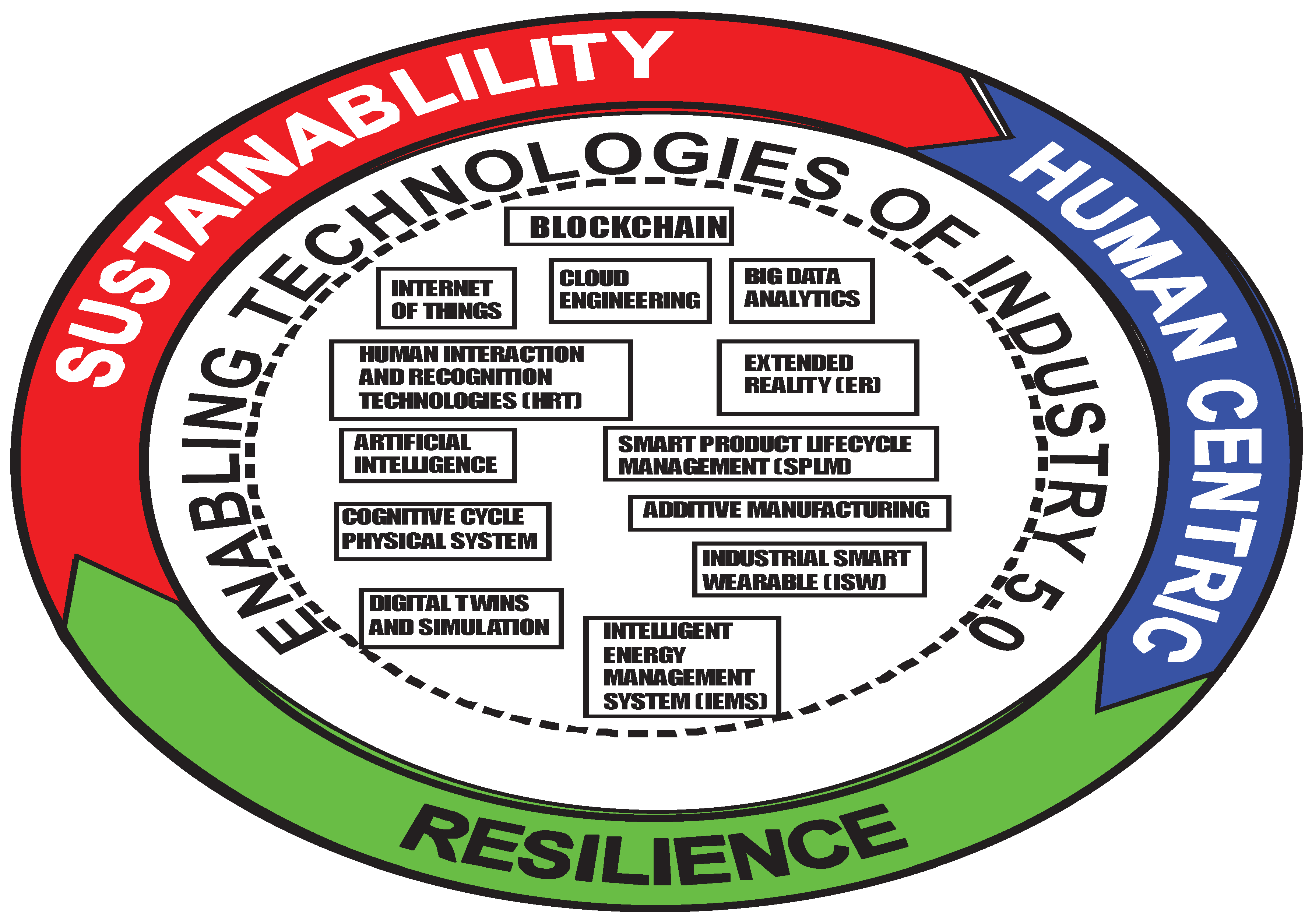
Figure 2.
The implications of Industry 5.0 on Emerging economies. source; the authors.
Disclaimer/Publisher’s Note: The statements, opinions and data contained in all publications are solely those of the individual author(s) and contributor(s) and not of MDPI and/or the editor(s). MDPI and/or the editor(s) disclaim responsibility for any injury to people or property resulting from any ideas, methods, instructions or products referred to in the content. |
© 2024 by the authors. Licensee MDPI, Basel, Switzerland. This article is an open access article distributed under the terms and conditions of the Creative Commons Attribution (CC BY) license (http://creativecommons.org/licenses/by/4.0/).
Copyright: This open access article is published under a Creative Commons CC BY 4.0 license, which permit the free download, distribution, and reuse, provided that the author and preprint are cited in any reuse.