

Submitted:
01 March 2024
Posted:
04 March 2024
You are already at the latest version
Abstract
Cellular Technology came into existence in Japan in 1979. From that time, we have seen many advances in technology. Currently, most of the person uses either 4G or 5G, among which 5G is a newer technology. 4G network was the first network to use LTE. LTE stands for Long Term Evaluation. Most people get confused between 4G and LTE, they assume both to be the same. In reality, LTE has evolved on the 4G technology. It was first introduced in 2008 to provide higher efficiency and data rates to the cellular network. It was designed to evolve the performance of the networks which includes the evolution of hardware components, optimization of software, power and cost efficiency. This work presents a study on LTE, LTE-A and VoLTE technology. We also discussed about the several packet scheduling algorithms that are being used for transmission of packets. It brings out new opportunities for the researchers to work on increasing the efficiency of those algorithms by modifications.
Keywords:
Packet Scheduling Algorithms
; Cellular Networks
; 4G
; LTE
; LTE-Advanced
; VoLTE
1. Introduction
Scheduling of packets is an important aspect in order to transmit data between two entities in Cellular Networks. It manages the order of transmission of data packets based on certain parameters that include priority, size, deadlines and more. The packet schedular can be thought of as a mediator between the two entities, which manages a queue for the packets to transmit the data. It has several functions that include division of large data into small packets, assigning them a unique ID for identification, sending the packets, receiving the packets, organizing at the time of arrival at the destination, processing and etc. Prior to the packet scheduling techniques, the circuit switching was used for a long time, which was later replaced due to higher resource wastages. The only goal behind using scheduling algorithms is to provide the requested resources to the data packets, which have data with them.
In wireless networks, the channel conditions are constantly changing due to factors such as interference, fading, and mobility. Therefore, packet scheduling algorithms need to take into account the varying channel conditions to maximize the network throughput and ensure fair distribution of resources among users.
A cellular network is a wireless mode of communication, which was initially introduced to communicate via voice calls, but is now equipped with several functionalities. Radio signals are used to transmit data packets via specified channels. At the initial stage, it was very difficult to ensure voice call connectivity for a long time, which was later resolved by the upgradation in the technology. Apart from voice calls, we can avail several functionalities like access to the internet with very high data rates, cloud services, messaging facilities, video conferencing and streaming, and many more which we use regularly.
NMTS (Nordic Mobile Telephone Systems)-based cellular network was launched in the period of 1980-81, which was the first international cellular network, later replaced by AMPS (Advanced Mobile Phone System) and TACS (Total Access Communication System) in around 1982-83, in countries like the United Kingdom, Italy and the United States. Channel capacity is 30KHz only, which can only provide us with voice calls. After these two, IMTS (Improved Mobile Telephone System) was introduced with two separate channels for sending and receiving signals, using 23 channels ranged between 150MHz – 450MHz. Later, the second generation was launched with digital signaling and GSM (Global System for Mobile Communication). This provided us with the functionality of SMS and MMS along with access to the internet. An identifier was used, which was SIM (Subscriber Identity Module). GSM was based upon TDMA [1] (Time Division Multiple Access) and CDMA (Code Division Multiple Access), which optimized the use of bandwidth, better consistency and provided higher data capacity. Based on GPRS (General Packet Radio Service), 2.5G was introduced, which is itself based on GMSK (Gaussian Modulation Shift Keying), providing a downlink speed of 80kbps and uplink speed of 20kbps. EDGE was introduced with the evolution of 2.75G with a maximum speed of 475kbps and average speeds in the range between 70kbps – 130kbps on both, downlink and uplink. It enabled PTT (Push to talk) services. Built upon IMT-2000 (International Mobile Telecommunication-2000) standards, 3G technology was introduced, with the core concepts of UMTS [2] (Universal Mobile Telecommunication Services). It provided a band of 2100MHz with speed ranging between 144kbps – 384kbps. Then, 3G used HSPA (High Speed Packet Access) connectivity that provided the peak data rates up to 7.2Mbps, which was being represented as symbol ‘H’, in the terms of cellular networks. It provides instant messaging at cheaper rates, covering an area of diameter of 5 miles.
With the evolution of LTE (Long Term Evolution), the fourth generation of cellular networks came into the existence [3,4]. Online gaming services, 3D and HD televisions, very less buffering, DVB (Digital Video Broadcast) were major applications of this technology. Apart from LTE, WiMAX also came into existence with the evolution of LTE, but it didn’t become much popular as of LTE. WiMAX (Worldwide Interoperability for Microwave Access) had higher latency, which degraded the user experience over LTE. 4G was the first IP based system, which used LTE, and had capacity speeds ranging between 10Mbps – 100Mbps. It derived several technologies like AR (Augmented Reality), IoT (Internet of Things) and etc. With all these facilities, the lagging points were security, encryption, spoofing, jamming, QoS support and etc [5]. Later generations of cellular networks are out of scope for this study, but the same is available at [6,7].
2. Long Term Evolution
In this section, we will be knowing LTE in detail. LTE is often mis-conceptualized as 4G or VoLTE. In actuality, LTE is neither 4G nor VoLTE, and the evolution of LTE has occurred on 4G technology of cellular networks. As mentioned in the previous section, LTE enables us to access faster data transfer rates with low latency and lower costs. LTE was developed and maintained by 3GPP (Third Generation Partnership Project), who also gave the standards for LTE. It is a standard for 4G wireless communication being followed globally. LTE work on IP flat networking structure and is commonly used for mobile, fixed and portable broadband access [8]. With the increased bandwidths, LTE enables us to access higher data rates. LTE is a redesigned version of 3G standards which consists a simplified network architecture, radio interface, MIMO (Multiple Input, Multiple Output), modulation methods and core IP based system. It can support voice in terms of VoLTE, video streaming, instant messaging, cloud computing as due to very high data rates. LTE is also termed as 4G LTE in several places.
Figure 1.
Network Architecture of Basic LTE [9].
Figure 1.
Network Architecture of Basic LTE [9].
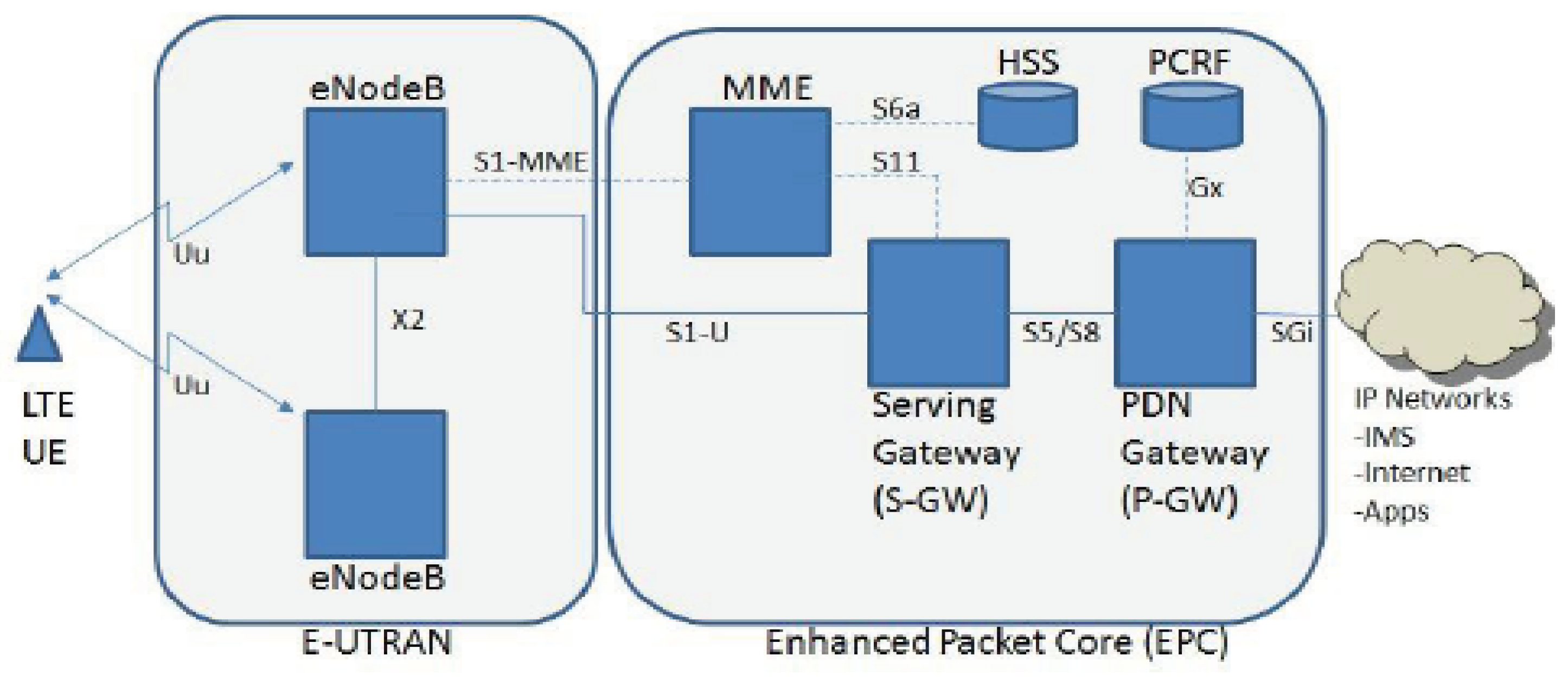
LTE is operated on TCP/IP architecture, apart from that, all the signaling and controlling functions are functional upon IP (Internet Protocol) [10]. A typical LTE network includes UE (User Equipments), EPC (Evolved Packet Core), E-UTRAN (Evolved Universal Terrestrial Radio Access Network) and an IP based network like the internet [9]. A UE may be any device that can be operated on 4G, connected to eNodeB, which itself is a part of E-UTRAN. EPC comprises of MME (Mobile Management Entity), HSS (Home Subscriber Server), PCRF (Policy and Charging Rules Function), S-GW (Serving Gateway) and P-GW (PDN Gateway). MME manages the access to the networks for US(s), while HSS is the database of subscribers within the system. PCRF collects all the information in real time, and take respective decisions for each active user on the network. S-GW is responsible for routing of the data packets whereas P-GW connects the entire EPC to the IP networks.
LTE is widely deployed around the world, with several operators offering LTE services to their subscribers. The adoption of LTE has enabled new services and applications, such as video streaming, online gaming, and IoT (Internet of Things) devices. The future of LTE is promising, with ongoing research and development to further enhance the network performance and support new use cases. The LTE standard has evolved over the years, with new features and capabilities added to improve the network performance and support new services. LTE-Advanced is an evolution of the LTE standard that provides even faster data speeds, higher spectral efficiency, and better coverage [11]. LTE-Advanced introduces new technologies such as Carrier Aggregation, which enables the aggregation of multiple frequency bands to increase the available bandwidth, and Coordinated Multi-Point (CoMP) [12], which improves the cell edge performance and reduces interference. In conclusion, LTE is a standard for wireless communication that provides high-speed data services to mobile phones and data terminals. LTE is based on OFDM and MIMO technologies, operates on different frequency bands and modes of operation, and has a network architecture consisting. In the next sections, we have discussed LTA Advanced and VoLTE along with several scheduling algorithms.
3. Long Term Evolution Advanced
An enhanced version of LTE, LTE-A (LTE Advanced) was introduced which offered data rates even faster than LTE with greater stability, by aggregating the channels, that allowed data to be downloaded from multiple sources at the same instinct. 4G+ and LTE+ are nothing just an acronym for LTE-A. Theoretically, peak data rate and average range for LTE-A was 300Mbps and 40Mbps – 90Mbps respectively [8]. In short, LTE-A was almost 3 times faster than LTE. One of the key features of LTE Advanced is carrier aggregation, which allows mobile devices to simultaneously use multiple frequency bands to increase data speeds. This means that LTE Advanced networks can combine different frequency bands to provide higher data rates to users.
LTE Advanced also uses advanced antenna technologies such as MIMO (Multiple Input Multiple Output) and beamforming, which help to improve network coverage and signal quality. MIMO allows multiple data streams to be transmitted and received over the same frequency, while beamforming enables the signal to be directed towards the user, reducing interference and improving overall network performance. In addition to these features, LTE Advanced also supports other technologies such as enhanced Inter-Cell Interference Coordination (eICIC) [13] and Coordinated Multipoint (CoMP) [12], which further enhance network performance and user experience.
The architecture of LTE-Advanced (LTE-A) is based on the same principles as the original LTE technology, as given in Figure 1. However, LTE-A introduces several enhancements to the architecture to support new features and improve performance. The LTE-A architecture is divided into two main parts: the Evolved Packet Core (EPC) and the LTE Radio Access Network (RAN). The EPC consists of several network elements that handle the core functions of the LTE network. These elements include the Mobility Management Entity (MME), Serving Gateway (SGW), Packet Data Network Gateway (PGW), and Policy and Charging Rules Function (PCRF). The MME handles the signaling between the LTE network and the user equipment (UE), such as call setup, handover, and authentication. The SGW acts as the interface between the EPC and the LTE RAN, while the PGW provides connectivity to external networks, such as the internet. The PCRF controls policy and charging rules for data services in the network. The LTE RAN consists of several network elements, including the evolved NodeB (eNB), which is the base station that provides the radio access for the network. The eNB communicates with the UE through the air interface, using OFDMA (Orthogonal Frequency Division Multiple Access) and MIMO (Multiple-Input Multiple-Output) technologies. The eNB also communicates with the EPC through the SGW.
One of the key enhancements introduced in LTE-A is carrier aggregation, which allows multiple carriers to be combined to provide higher data rates to the UE. Another enhancement is the use of Coordinated Multipoint (CoMP) transmission and reception, which improves network coverage and capacity by allowing multiple eNBs to work together to communicate with the UE. Overall, LTE Advanced is a significant improvement over 4G LTE and represents the next step in the evolution of mobile communication standards. Its advanced features make it well-suited to handle the growing demand for high-speed mobile data services and ensure that mobile networks can meet the needs of consumers and businesses in the years to come.
Another improved version of LTE was VoLTE [14] which stands for Voice-over LTE. It was designed in such a way, that user gets access to high-definition voice and video calls, to augment the user experience with better coverage and decreased power consumption. In traditional mobile networks, voice calls are transmitted over a separate circuit-switched network, while data is transmitted over a packet-switched network. However, with the advent of LTE, data transmission has become the primary function of mobile networks, and voice calls are now being transmitted over the same packet-switched network used for data. VoLTE works by converting voice calls into packets of data that are transmitted over the LTE network. The technology uses advanced voice codecs (compression/decompression algorithms) to ensure high-quality voice transmission, even in low-bandwidth situations.
One of the benefits of VoLTE is that it allows for faster call setup times compared to traditional circuit-switched networks. This is because VoLTE eliminates the need for a separate call setup procedure, which is required in circuit-switched networks. In addition, VoLTE supports features such as HD Voice (High Definition Voice) and Video Calling, which offer superior voice and video quality compared to traditional voice services. VoLTE also enables better utilization of network resources, as voice and data can be transmitted over the same network. This can lead to more efficient use of available spectrum and can help mobile network operators to reduce costs.
Overall, VoLTE is an important technology that allows for high-quality voice transmission over LTE networks. As LTE networks continue to evolve, VoLTE is expected to become increasingly prevalent, and traditional circuit-switched networks will likely be phased out in the years to come. In the next section, we will be looking out for some most common packet scheduling algorithms.
4. Scheduling Algorithms
The scheduling algorithms are an important aspect of LTE/LTE-A technology. In this section, we are going to explore the most commonly used scheduling algorithms in LTE/LTE-A technology. The scheduling algorithm is responsible for allocating radio resources to users in the network, based on their QoS (Quality of Service) requirements, channel conditions, and other network conditions. They are designed to be flexible and dynamic, allowing it to adapt to changing network conditions and user requirements. The algorithm takes into account the type of traffic being carried, such as voice or data, and allocates resources accordingly.
4.1. First Come First Serve
First Come First Serve (FCFS) is the simplest scheduling algorithm, which sends the packets according to their time of arrival [11]. When the traffic is very high, some packets might be kept waiting for a very long time, occurring starvation. Apart from this, the biggest advantage of FCFS is it is very easy to implement, but still, it does not give any surety about QoS.
4.2. Round Robin
Over FCFS, Round Robin (RR) scheduling is found to be better approach. It is simple and fair algorithm, which is practically used at several places. It works on the principle of ‘time-sharing systems’ [11]. Being a fair algorithms, all the packets are treated equally and in a cyclic queue, transmission takes place. The problem of starvation cannot occur in RR scheduling.
4.3. Strict Priority
Just like the name, in Strict Priority algorithm, priorities values are assigned, on the basis of which, channel is provided to the flow. Higher the priority, earlier the requests will be catered. So, it can be noted that, packets need to be starved, for the processing of their requests, as the lower classes will never be served until all the higher classes are served completely.
4.4. Earliest Deadline First
Earliest Deadline First (EDF), often called Shortest Remaining Time First (SRTF), is also a very commonly used scheduling algorithm. Packets are treated on the basis of deadlines in increasing order. Schedules with earlier deadlines are prioritized, on the basis of time dependent priority [12]. Starvation might occur in EDF too. With slight modifications for better protection and security, [13] & [14] proposed optimized algorithms.
4.5. Proportional Fair
Proportional Fair (PF) Scheduling Algorithm is another scheduling algorithm which is very much efficient and simple to implement too. It allocates radio services based on channel quality and throughput from each user [15]. It serves non-real time data streams. With greater efficiency, it optimizes the throughput and ensures fairness between the data flows [16]. The subcarrier is allocated to the user having most favorable conditions of transmission. PF notes down the channel quality and throughputs, which are later used to prioritize connections. It ensures increased capacity in CDMA.
4.6. Generalized Process Sharing
Generalized Processor Sharing (GPS) is also commonly termed as Fluid Flow Fair Queueing (FFQ). It is designed to serve error free wireline network connections. It guarantees to distribute all the resources in isolation from all the other streams. The first GPS packet adaptation was PGPS (Packet-by-packet GPS), which is also known to be WFQ (Weighted Fair Queueing), was actually based on system virtual time [17]. [18] introduced the algorithm in 1993, which proposed to serve queues in round robin manner. Due to isolations, it allowed absolute fairness.
4.7. Maximum Largest Weighted Delay First
Maximum Largest Weighted Delay First (M-LWDF) Scheduling Algorithm [19] was based upon the queue status and the channel quality indicator (CQI). It is most suited for ensuring QoS strict conditions and requirements that don’t consider any delays in CDMA-HDR systems. Scheduling of is based on priority metric M given by:
while is head of line packet delay of the user at time is the delay threshold of the user and denotes the maximum probability that head of the line packet delay for user [20].
4.8. Exponential Rule
To serve high data rates with increased throughput, Exponential Rule (EXP Rule) Scheduling was developed for RT and NRT data streams. It is a channel aware scheduling which head of line packet delay and CQI to support the delay sensitive traffic such as VoIP [21]. The transmission metric is calculated and given by:
where, signifies the channels spectral efficiency with the user at the sub-channel and , , and are adjustable characters.
4.9. Exponential/Proportional Fair
Exponential/Proportional Fair (EXP/PF) increases the priority of real time streams, hence are catered earlier to that of non-real time streams. It combines EXP Rule and PF scheduling algorithms, as suggested by the name too. EXP rule manages the delay constraints of the data stream while PF scheduling is responsible for throughput optimization. Scheduling metric for this algorithm is dependent upon the type of the user [20]. The scheduling metric M, is given as:
while, P(t) is average number of RT packets at time , and are constants [20].
4.10. Logarithm Rule
The ideology behind the development of Logarithm Rule (LOG Rule) was to ensure QoS support. It is done by making the network delay near to the average, providing increased efficiency. During studies, it was found out that this algorithm resembles to EXP rule at several extent. The computation metric for Log Rule is given by:
where , , and are adjustable constants. As for , it signifies the channels spectral efficiency with the user at the RB, where 1 ≤ ≤ N [22].
5. Conclusions
LTE is being used from around 2009, and many studies are still being conducted in the domain. It has made a huge contribution in the evolution of cellular network technologies which is also leading to more advanced technologies being involved in future generations of cellular networks. It comes with a wide range of services that enhance the user experience. With the evolution of advanced versions of LTE, including LTE-A and VoLTE, researchers noticed that there are lot more things that are still unexplored. This includes scheduling algorithms as well. As also mentioned in [27], amongst several scheduling algorithms, each of them has their own advantages and disadvantages, due to which, each of them has specified use cases. Apart from this, several studies are still being conducted in order to optimize these algorithms, be it in terms of fairness, delay, throughout or efficiency.
References
- Farooq, M., Ahmed, M. I., & Al, U. M. (2013). Future Generations of Mobile Communication Networks. Academy of Contemporary Research Journal, 2(1), 24-30.
- Vora, L. J. (2015). Evolution of mobile generation technology: 1G to 5G and review of upcoming wireless technology 5G. International Journal of Modern Trends in Engineering and Research, 2(10), 281-290.
- Rida, J. F. A. (2021). Overview of Development performance for Mobile Phone Wireless Communication Networks. In 2021 International Conference on Electrical, Computer and Energy Technologies (ICECET) (pp. 1-11). [CrossRef]
- David, K. "Is there any room or need for beyond 5G? 6G requirements and a first vision." In IEEE 5G Summit/IEEE Int. Symp. Personal Indoor and Mobile Radio Communications, 2017. [CrossRef]
- Khan, A. H., Qadeer, M. A., Ansari, J. A., & Waheed, S. (2009). "4G as a Next Generation Wireless Network." In 2009 International Conference on Future Computer and Communication (pp. 108). [CrossRef]
- Mihret ET, Haile G (2021) "4G, 5G, 6G, 7G and Future Mobile Technologies." J Comp Sci Info Technol Vol.9 No.2: 75.
- Rani P. Tidke, Pritee S. Uttarwar, Deepak S. Dandwate, Umesh J. Tupe. "A Literature Review on: Wireless Technologies from 0G to 7G." Iconic Research And Engineering Journals, Volume 4, Issue 6, 2020, pp. 59-64.
- 4G LTE explained (Long Term Evolution), https://www.thalesgroup.com/en/markets/digital-identity-and-security/technology/lte, last accessed 2023/05/24.
- Patel, S., Patel, K., Shah, V.: Survey on LTE Network Architecture and its Security Aspects. International Journal of Scientific Research in Computer Science, Engineering and Information Technology (IJSRCSEIT), 3(5), 1959-1961 (2018).
- Huang, J., Qian, F., Guo, Y., Zhou, Y., Xu, Q., Mao, Z. M., Spatscheck, O. (2013). An in-depth study of LTE. Proceedings of the ACM SIGCOMM 2013 Conference on SIGCOMM - SIGCOMM ’13. [CrossRef]
- LTE-ADVANCED IS THE REAL 4G, https://spectrum.ieee.org/lte-advanced-is-the-real-4g, last accessed 2023/05/24.
- Ahmadi, S. (2014). Coordinated Multipoint Transmission and Reception (CoMP). LTE-Advanced, 951–983. [CrossRef]
- Kimura, D., & Seki, H. (2012). Inter-cell interference coordination (ICIC) technology. Fujitsu Scientific & Technical Journal, 48(1), 89-94.
- Toskala, A., Holma, H., Hongisto, J., Kallio, J., Poikselkä, M., Voice Over LTE: VoLTE. Wiley, Germany (2012).
- Tsai, T.-Y., Chung, Y.-L., & Tsai, Z. (2010). Introduction to Packet Scheduling Algorithms for Communication Networks. Communications and Networking. [CrossRef]
- S. Chaudhry, and A. Choudhary, “Tune dependent priority scheduling for guaranteed QoS Systems,” in Proc. Sixth International Conference on Computer Communications and Networks, pp. 236-241, Sept. 1997.
- J. R. Piney, S. Sallent, “Performance Evaluation of a Normalized EDF Service Discipline,” in Proc. IEEE MELECON 2004, Dubrovnik, Croatia, May 2004.
- K. Zai, Y. Zhang, Y. Viniotis, “Achieving end-to-end delay bounds by EDF scheduling without traffic shaping,” in Proc. Infocom’01, 2001.
- Benchaabene, Y., Boujnah, N., & Zarai, F. (2016). Performance comparison of packet scheduling algorithms for voice over IP in LTE cellular network. 2016 4th International Conference on Control Engineering & Information Technology (CEIT). [CrossRef]
- Barayan, Y. and I. Kostanic (2013). Performance evaluation of proportional fairness scheduling in LTE. Proceedings of the World Congress on Engineering and Computer Science 2013, 23-25 October, 2013, San Francisco, USA.
- Ramis, J., Carrasco, L., Femenias, G., & Riera-Palou, F. (n.d.). Scheduling algorithms for 4G wireless networks. IFIP — The International Federation for Information Processing, 264–276. [CrossRef]
- Parekh, A. K., & Gallager, R. G. (1993). A generalized processor sharing approach to flow control in integrated services networks: the single-node case. IEEE/ACM Transactions on Networking, 1(3), 344–357. [CrossRef]
- Ameigeiras, P., Wigard J., Mogensen, P., Performance of the M-LWDF scheduling algorithm for streaming services in HSDPA, IEEE 60th Vehicular Technology Conference, 2004. VTC2004-Fall. 2004, Los Angeles, CA, USA, 2004, pp. 999-1003 Vol. 2. [CrossRef]
- Afroz, F., Sandrasegaran, K., & Ghosal, P. (2014). Performance analysis of PF, M-LWDF and EXP/PF packet scheduling algorithms in 3GPP LTE downlink. 2014 Australasian Telecommunication Networks and Applications Conference (ATNAC). [CrossRef]
- Ang, E. M., Wee, K. K., Pang, Y. H., & Lau, S. H. (2014). Two-Level Scheduling Framework with Frame Level Scheduling and Exponential Rule in Wireless Network. 2014 International Conference on Information Science & Applications (ICISA). [CrossRef]
- Ang, E. M., Wee, K., Pang, Y. H., & Phang, K. K. (2015). A performance analysis on packet scheduling schemes based on an exponential rule for real-time traffic in LTE. EURASIP Journal on Wireless Communications and Networking, 2015(1). [CrossRef]
- Kaur, J., Kumar, V., Vaisla, K. S., Ranswal, S. S. (2023). "Packet Scheduling Algorithm in Cellular Networks: Past, Present & Future." In: Proceedings of the 10th International Conference on Advanced Engineering and ICT-Convergence (ICAEIC-2023), Bangkok, Thailand, 07-09 Feb 2023. Vol. 6, No. 1, pp. 176-184.
Disclaimer/Publisher’s Note: The statements, opinions and data contained in all publications are solely those of the individual author(s) and contributor(s) and not of MDPI and/or the editor(s). MDPI and/or the editor(s) disclaim responsibility for any injury to people or property resulting from any ideas, methods, instructions or products referred to in the content. |
© 2024 by the authors. Licensee MDPI, Basel, Switzerland. This article is an open access article distributed under the terms and conditions of the Creative Commons Attribution (CC BY) license (http://creativecommons.org/licenses/by/4.0/).
Copyright: This open access article is published under a Creative Commons CC BY 4.0 license, which permit the free download, distribution, and reuse, provided that the author and preprint are cited in any reuse.


