

Submitted:
29 February 2024
Posted:
29 February 2024
You are already at the latest version
Abstract
This paper proposes a novel formulation of the fuzzy newsvendor problem for inventory management applications. This new formulation allows the use of any profit function. A new credibility estimation is proposed to explore the neighborhood around the most impactful demand scenarios. Further, a simulation procedure was designed for the different demand scenarios, which allows the comparison of the proposed approach with probabilistic demand curves. The fuzzy newsvendor problem is solved using a modified genetic algorithm (GA), where an initialization mechanism with null values is proposed. The new formulation of the fuzzy newsvendor problem together with the modified GA have shown to improve the average profit up to 55% in problems with low-budget scenarios.
Keywords:
Newsvendor problem
; Fuzzy newsvendor problem
; Inventory management
; Genetic algorithms
; Credibility estimation
1. Introduction
Every day, a newsvendor needs to buy journals based on an uncertain demand. Assuming that each journal has a fixed cost and selling price, if she/he asks for too many journals and the demand is not enough, there is a reduction in the profit. On the other hand, if the demand is higher than the number of journals ordered, potential sales do not occur, resulting in “lost profits” [1]. This dilemma of buying more or less newspapers, which is know as the newsvendor problem, can be used to model inventory management problems.
Several solutions can be found to solve several inventory management problems, [1,2,3]. When multi–items are considered, one deals with the Multi-Item Newsvendor Problem (MINP). In this problem it is important to consider the number of constraints and their type (cost, service level, etc.), the decision-making policies (as e.g. optimize expected profit, service level, etc.). Often, solutions are found using risk–averse techniques. Further, usually MINP use probability density functions to model the uncertain demand [4,5,6,7].
However, the demanded probabilistic density functions are difficult to derive in real scenarios, especially for innovative and disruptive products, where there is no sufficient data to accurately predict the demand probability distribution. It is possible to mitigate these limitations by including additional information from human expertise using e.g. fuzzy systems [8].
Fuzzy logic is a suitable tool to incorporate uncertain demands with a proven effectiveness in solving MINP [8,9,10]. A fuzzy environment can use few data points to describe uncertainty through meaningful membership functions. Furthermore, fuzzy logic offers an ideal environment to describe the vagueness of human thinking through mathematical operations, defining linguistic terms such as “the demand of a product is around 2000” [11].
The first fuzzy solution for an inventory management problem dates back to 1995 [12]. A year later, Petrov proposed the first fuzzy solution for newsvendor problems [8]. Analytical analyses in a fuzzy environment [8,13,14,15,16] are useful to specific cases, where it is possible to study a limited number of items in a well isolated economic environment. Problems arise when the number of items and their relations increase, leading to highly nonlinear problems, making analytical approaches hard to implement. Most of the recent fuzzy [17,18,19] and non-fuzzy [20,21,22,23,24] solutions focus on solving highly complex single–item problems, lacking the generalization to multi–item problems.
Fuzzy MINP problems are usually solved recurring to metaheuristic algorithms [9,10]. Inspired by real-world phenomena, metaheuristics use computational power to find solutions when the classical methods cannot, due to time and complexity. However, metaheuristics do not always guarantee that the solutions found are optimal. However, they can provide, at least, good results for highly complex optimization problems [25,26].
Shao proposed a genetic algorithm [27,28], to solve the newsvendor problem with a fuzzy environment [9]. This paper extended the fuzzy objective functions proposed in [8], with the adoption of credibility theory concepts [29,30]. In [9], Shao used the concepts of possibility, necessity and credibility of a fuzzy event, as well as the excepted value of a fuzzy variable [31] to derive objective functions for different decision-making policies.
In 2011, Taleizadeh [10] studied a variety of metaheuristic algorithms to solve a fuzzy single-period newsvendor problem and also proved the suitability of genetic algorithms for this problem.
This paper extends the formulation of the existing fuzzy newsvendor problem from single-item to multi-item problems, allowing its application to inventory problems. The proposed formulation is flexible, as it allows the use of any profit function. Further, this paper proposes the extension of the genetic algorithm in [10] to solve the fuzzy multi-item newsvendor problem, enhancing the work of [9] in both the generation and evaluation of solutions.
The paper is organized as follows. Section 2 describes classical and fuzzy multi-item newsvendor problems. The optimization artchtiecture proposed in this paper is described in Section 3. In this section, the optimization algorithm is described (which uses a genetic algorithm), and a novel method to estimate the credibility is proposed. Further, novel problem-specific genetic mechanisms are also proposed. The benchmark case studies are described in Section 4. A general simulation procedure, which is necessary for addressing both classical and fuzzy multi-item newsvendor problems is proposed in Section 5. Section 6 presents the obtained results, and the conclusions and future work are presented in Section 7.
2. Multi-Item Newsvendor Problem
This section introduces a novel fuzzy formulation for the multi-item newsvendor problem. Section 2.1 presents the classical approach with probabilistic demand curves. Section 2.2 explains the fundamentals of the fuzzy multi-item newsvendor problem.
2.1. Classical Multi-Item Newsvendor Problem
The classical formulation suggested in [32] uses a modified form of the original model proposed in 1964 [33]. This form minimizes the expected cost function, being this minimization equivalent to maximize an“expected profit” function [32]. Also, the original model used the salvage value of the leftover items instead of the environmental disposal cost. The model of the classical multi-item newsvendor problem is as follows:
subject to
The list of variables used in the classical multi-item newsvendor problem, and their respective description, which will be used throughout this paper are the following:
| n | Total number of items |
| Cost of revenue loss per unit of item i | |
| Cost incurred per item i for leftover | |
| Cost per unit of item i | |
| Ordering quantity of item i | |
| Demand of item i | |
| Demand probability density function of item i | |
| E | Expected cost function value |
| Available budget | |
| Profit target | |
| G | Total number of generations |
2.2. Fuzzy Multi-Item Newsvendor Problem
This section describes the fuzzy multi-item newsvendor problem. Section 2.2.1 starts by presenting the definitions of possibility, necessity, credibility and the expected value of a fuzzy demand. Then, Section 2.2.2 explains how membership grades can be estimated. The estimation of possibility, necessity, credibility is explained in Section 2.2.3. Finally, the estimation of the expected profit is described in Section 2.2.4.
2.2.1. Definitions
The possibility, necessity and credibility of fuzzy event presented in [29,30] are used in this paper. The concepts of possibility, necessity and credibility of a fuzzy event are defined as:
where is the fuzzy demand with the membership function , r is the profit value and u is the generic demand. Considering (3), (4) and (5), the expected value of a fuzzy demand is given by:
2.2.2. Membership grade estimation
In an MINP, the demand contain the proposed quantities for each item. Since each item has its unique demand membership function, it is fundamental to find a way of estimating the grade of a demand. This is the purpose of a conjunctive operator.
Let one assumes that is a demand vector of n items. The estimated membership grade of the demand vector is given by:
where is the estimated membership grade, and is the membership grade associated with each ordering quantity.
2.2.3. Possibility, necessity and credibility estimation
The possibility and necessity estimations of multi-item solutions from the demand vectors are computed, respectively, in the following way:
where is the profit function, U is the total number of random demand vectors and is a profit target.
The estimation of the credibility is based on the previous estimations of possibility and necessity as follows:
2.2.4. Expected profit estimation
To estimate the expected profit of a solution x, with ), it is possible to use credibility estimations for a high enough number of profit targets. To focus resources on plausible values, theses profit targets should be extracted from the interval defined by:
On the one hand, the interval lower limit corresponds to the scenario where no sales are made. On the other hand, the upper limit corresponds to the scenario where all purchased items are sold.
Assuming that the total number of profit targets is given by , the profit targets are equally distributed and the set of profit targets is defined by , where . Equations (13), (14) and (15) describe the steps to estimate the expected profit Eof a solution x:
The number of credibility samples is a crucial variable to this estimation. This variable must be studied to obtain the best possible trade-off between computational time and accuracy.
3. Proposed optimization architecture
The formulation of the fuzzy newsvendor problem is extended in this paper from single-item to multi-item problems, allowing its application to inventory problems. This is accomplished with an optimization architecture that combines a modified genetic algorithm and the expected profit estimation introduced in Section 2.2.4. Along with the common mechanisms of a genetic algorithm, crossover, mutation and selection [27], two novel components are added: a credibility estimation procedure, which is introduced in Section 3.1 and novel problem-specific genetic mechanisms, which are described in Section 3.2.
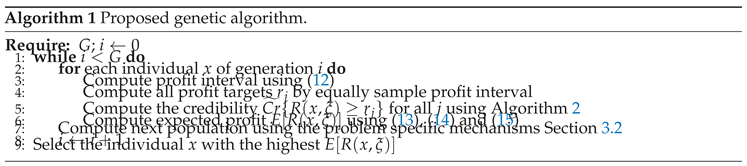
The proposed optimization architecture finds the solution with the highest expected profit, according to the fundamentals previously introduced in Section 2. Algorithm 1 details the proposed genetic algorithm to maximize the expected profit. This algorithm needs to estimate the credibility , which is explained in detail in Section 3.1 and Algorithm 2.
 |
3.1. Proposed credibility estimation
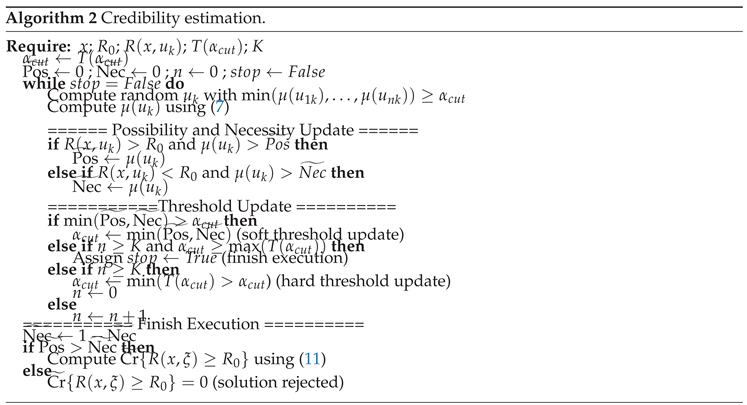
This section describes the proposed credibility estimation, which is presented in Algorithm 2. The main objective of this approach is estimate the credibility of a solution x generating a profit higher than a profit target . It repeats the estimation K times until it finds it. Estimations for different profit targets are further used to estimate the expected profit of the solution x, as it was previously described in Section 2.2.4.
The demand vector is randomly generated, and considered quantities that have a membership grade higher than a , which are defined by 10% quantiles, and as so can have the following values:
Further, the is always equal or greater than the minimum value between the highest membership grades found for both possibility and necessity. The progressively increases the minimal membership grade of the random demand vectors generated.
This is useful because the possibility estimation requires to find the demand vector with the highest membership grade that generates a profit higher than the profit target , as defined in (9). And, the necessity estimation requires to find the demand vector with the highest membership grade that generates a profit lower than the profit target , as defined in (10).
Note also that sometimes, due to the random generation, for low credibility solutions, the necessity estimation can be higher than the possibility estimation. Those results are impossible due to the nature of the problem, and therefore are automatically rejected by the algorithm.
 |
3.2. Novel problem-specific genetic mechanisms
This section describes problem-specific mechanisms, which are implemented in the architecture proposed in Algorithm 1. These methods enhance the set of solutions by 1) discarding materials in the initial population, 2) scaling chromosomes according to the available budget, and 3) introduce a problem-specific context to the crossover operator. This section proposed thus the chromosomes initialization, the solution resizing and the chromosome normalization, which are described in the next three sections.
3.2.1. Initialization with zero quantities
The initialization with zero quantities initializes chromosomes with a single non-zero ordering quantity . After selecting a random item i for the non-zero ordering quantity, the chromosome is resized as explained in Section 3.2.2 to scale to reach the available budget. If i is a profitable item, the chromosome is selected because the expected profit is higher than chromosomes containing less profitable items. This mechanism aims to select (and further combine) only the most profitable items.
3.2.2. Solution resizing
The solution resizing mechanism scales the chromosome ordering quantities to use all the available budget. It scales the quantities up or down without changing the relative proportions between them. On the one hand, this mechanism can transform over-budget solutions into feasible solutions by scaling them down. On the other hand, it can scale up under-budget solutions to use all the available budget. To apply this mechanism, the ordering quantities are resized to quantities by multiplying it by a resizing ratio, as follows:
3.2.3. Chromosome normalization
This normalization makes the crossover independent of the absolute values in x, by normalizing them according to the items with most expected demand value . In this paper, the most expected demand value comes from the item with the probabilistic density function , but it could also be the fuzzy value with the highest grade. To apply the chromosome normalization, first the ordering quantities must be normalized by applying the transformation:
where is the ordering quantity of item i, is the expected demand value of the probabilistic distribution of item i, and is the normalized ordering quantity of item i. After the crossover has been applied, all normalized ordering quantities must be de-normalized by multiplying them by .
4. Case Studies
The two benchmark case studies used in this paper have been presented in [32,34]. The optimization method presented in these papers is a Generic Iterative Method (GIM) with two different use cases: one with exponential demand distributions, which is described in Section 4.1, and the other with normal demand distributions, described in Section 4.2.
4.1. Case Study 1: Exponential demand distribution
The first case study was proposed in [32], where the item demand is exponentially distributed. An exponential distribution for demand with a mean value is described in (19) and (20), defining its probability density function and cumulative distribution function, respectively.
4.2. Case Study 2: Normal demand distribution
The second case study was proposed in [34] , and considers a normal distribution for demand . A demand distribution has the mean value and the standard deviation , see (21) and (22), defining its probability density function and cumulative distribution function, respectively.
where:
This case study includes 17 items, as shown in Table 3, and the available budget of 2500 CU.
5. Simulation procedure
This section presents a general simulation procedure for addressing both classical and fuzzy multi-item newsvendor problems. Studies on the fuzzy multi-item newsvendor problem [9,10,35] have been focusing on evaluating the performance of the solutions solely based on maximizing a fuzzy objective function. This approach raises questions, such as: “Is the objective function a good representation of reality?” or “Will the solution generate the expected results in a real scenario?”.
To address these issues, we propose the Algorithm 3, which uses demand vectors u, based on each item’s demand , to evaluate solutions, both fuzzy and non-fuzzy. The procedure simulates real scenarios by using a diverse range of demand vectors u, with a greater emphasis on probable vectors while still accounting for less likely ones. By computing the profit for each demand vector u with a given solution x, the average profit and profit standard deviation across all vectors can be determined.
 |
6. Results
This section presents the results using the proposed optimization architecture proposed in Section 3. The results are compared with previous classical and fuzzy newsvendor problems. The case studies presented in Section 4 are used to asses the performance of the proposed intelligent framework. These comparisons intend to understand if a more flexible framework — with the ability to incorporate complex profit functions and human expertise — can obtain better results in some sense than previous classical and fuzzy approaches that lack this kind of flexibility.
6.1. Impact of the novel problem-specific mechanisms
This section evaluates the impact of specific features on the performance of the intelligent framework. Each of the introduced problem-specific generic mechanisms presented in Section 3.2, namely: initialization with zero quantities, solution resizing and chromosome normalization are analysed separately.
First, Table 5 presents the influence of the initialization with zero quantities, introduced in Section 3.2.1, is only advantageous for case study 2. Therefore, it must be always tested for different instances.
The effect of the solution resizing feature, presented in Section 3.2.2, is shown in Table 6. It has a clear positive effect by eliminating unfeasible solutions and improving the profit. Therefore, this feature is always used in genetic algorithm.
The effect of normalizing the chromosome described in Section 3.2.3 is presented in Table 7. It can be seen the performance in terms of fitness and simulated profit is very slightly affected. Therefore, it is advantageous to try this mechnism in different instances.
6.2. Main Results
In this section, we present the main results of our study, which compares the performance of three different methods for solving the case studies in Section 4. The first method is the classical approach, introduced in Section 2.1, the second methods is the fuzzy genetic algorithm proposed in [9] and the third the fuzzy optimization architecture proposed in this paper, see Section 3.
Table 8 presents these results. It is clear for both case studies that the proposed approach clearly outperform the other two approaches in terms of profit for both case studies. It is however slightly worse in terms of standard deviation than the other two approaches for case study 2.
7. Conclusions
A novel formulation of the fuzzy newsvendor problem for inventory management applications was proposed. The designed framework implemented a fuzzy formulation to solve cases where there is insufficient data to predict the demand distributions and it is necessary to integrate human-expertise knowledge. One of the main contributions of this work is the redesign of the credibility estimation procedure, introducing a dynamic adjustment of a threshold to generate meaningful demand vectors, instead of using a purely random vector generation.
The proposed fuzzy optimization genetic algorithm is compared in two benchmark case studies. The proposed approach slightly outperform the classical approach. However, it clearly outperform the previous fuzzy approach. In the most complex case, case study 2, it improves the profit in 55%. The performance increase is the result of introducing a new initialization with null values that proved to be a valuable mechanism in low-budget scenarios, where there is the need for rejecting less profitable items.
The main advantage of this algorithm it is its flexibility. Despite using fixed costs to prove effectiveness against analytical approaches, this solution can work with nonlinear pricing models. To perform this, one only needs to integrate the pricing information when calculating profits in the credibility estimation. This is suggested for future work. Moreover, there is the possibility of changing performance measures. Profit was used to prove the effectiveness against analytical approaches, but the algorithm could prioritize the solutions that most satisfied possible costumer demand, by replacing the profit calculation with a service-level calculation.
Additionally, the proposed algorithm can also be implemented using parallel computing in a cloud environment, which drastically reduces execution time and makes the solution applicable in a real scenario.
Acknowledgments
This work was financed by national funds from the FCT (Foundation for Science and Technology), I.P., through IDMEC under LAETA, project UIDB/50022/2020.
References
- Choi, T.M. Handbook of Newsvendor Problems. International Series in Operations Research & Management Science.; Springer, 2012. [CrossRef]
- Wilson, E.B. The Mathematical Theory of Investment. Science 1888, 42, 248–249. [Google Scholar] [CrossRef]
- Mu, M.; Chen, J.; Yang, Y.; Guo, J. The Multi–product Newsvendor Problem : Review and Extensions. 2019 6th International Conference on Behavioral, Economic and Socio-Cultural Computing 2019, pp. 6–9.
- Lau, H.S.; Lau, A.H.L. The multi-product multi-constraint newsboy problem: Applications, formulation and solution. Journal of Operations Management 1995, 13, 153–162. [Google Scholar] [CrossRef]
- Lau, H.S.; Lau, A.H.L. The newsstand problem: A capacitated multiple-product single-period inventory problem. European Journal of Operational Research 1996, 94, 29–42. [Google Scholar] [CrossRef]
- Shi, J.; Zhang, G.; Sha, J. Jointly pricing and ordering for a multi–product multi–constraint newsvendor problem with supplier quantity discounts. Applied Mathematical Modelling 2011, 35, 3001–3011. [Google Scholar] [CrossRef]
- Shi, J.; Bao, Y. Multiproduct multiperiod newsvendor problem with dynamic market efforts. Discrete Dynamics in Nature and Society 2016, 2016. [Google Scholar] [CrossRef]
- Petrović, D.; Petrović, R.; Vujošević, M. Fuzzy models for the newsboy problem. International Journal of Production Economics 1996, 45, 435–441. [Google Scholar] [CrossRef]
- Shao, Z.; Ji, X. Fuzzy multi–product constraint newsboy problem. Applied Mathematics and Computation 2006, 180, 7–15. [Google Scholar] [CrossRef]
- Taleizadeh, A.A.; Barzinpour, F.; Wee, H.M. Meta-heuristic algorithms for solving a fuzzy single-period problem. Mathematical and Computer Modelling 2011, 54, 1273–1285. [Google Scholar] [CrossRef]
- Sousa, J.M.C.; Kaymak, U. Fuzzy Decision Making in Modeling and Control; World Scientific Inc., 2002.
- Shekarian, E.; Kazemi, N.; Abdul-Rashid, S.H.; Olugu, E.U. Fuzzy inventory models: A comprehensive review. Applied Soft Computing 2017, 55, 588–621. [Google Scholar] [CrossRef]
- Ishii, H.; Konno, T. A stochastic inventory problem with fuzzy shortage cost. European Journal of Operational Research 1998, 106, 90–94. [Google Scholar] [CrossRef]
- Li, L.; Kabadi, S.N.; Nair, K.P. Fuzzy models for single-period inventory problem. Fuzzy Sets and Systems 2002, 132, 273–289. [Google Scholar] [CrossRef]
- Dutta, P.; Chakraborty, D.; Roy, A.R. A single-period inventory model with fuzzy random variable demand. Mathematical and Computer Modelling 2005, 41, 915–922. [Google Scholar] [CrossRef]
- Dutta, P.; Chakraborty, D.; Roy, A.R. An inventory model for single-period products with reordering opportunities under fuzzy demand. Computers and Mathematics with Applications 2007, 53, 1502–1517. [Google Scholar] [CrossRef]
- Adhikary, K.; Roy, J.; Kar, S. A distribution-free newsboy problem with fuzzy-random demand. International Journal of Management Science and Engineering Management 2018, 13, 200–208. [Google Scholar] [CrossRef]
- Bhosale, M.R.; Latpate, R.V. Single stage fuzzy supply chain model with Weibull distributed demand for milk commodities. Granular Computing 2021, 6, 255–266. [Google Scholar] [CrossRef]
- Latpate, R.V.; Bhosale, M.R. Single cycle supply chain coordination model for fuzzy stochastic demand of perishable items. Iranian Journal of Fuzzy Systems 2020, 17, 39–48. [Google Scholar]
- Kouvelis, P.; Zhao, W. Supply chain contract design under financial constraints and bankruptcy costs. Management Science 2016, 62, 2341–2357. [Google Scholar] [CrossRef]
- Cohen, M.C.; Lobel, R.; Perakis, G. The impact of demand uncertainty on consumer subsidies for green technology adoption. Management Science 2016, 62, 1235–1258. [Google Scholar] [CrossRef]
- Ban, G.Y.; Rudin, C. The big Data newsvendor: Practical insights from machine learning. Operations Research 2019, 67, 90–108. [Google Scholar] [CrossRef]
- S., D.; Levine.; Chen, K.Y. Neural Network Modeling of Gist and Verbatim in Business Decision Making. International Joint Conference on Neural Networks (IJCNN) 2018, pp. 1-8.
- Kouvelis, P.; Zhao, W. Who should finance the supply chain? Impact of credit ratings on supply chain decisions. Manufacturing and Service Operations Management 2018, 20, 19–35. [Google Scholar] [CrossRef]
- Martí, R.; Reinelt, G. The Linear Ordering Problem. Applied Mathematical Sciences.; Springer, 2011. [CrossRef]
- Quintero-Duran, M.; Candelo, J.E.; Sousa, V. Recent trends of the most used metaheuristic techniques for distribution network reconfiguration. Journal of Engineering Science and Technology Review 2017, 10, 159–173. [Google Scholar] [CrossRef]
- Holland, J.H. Outline for a Logical Theory of Adaptive Systems. Journal of the ACM (JACM) 1962, 9, 297–314. [Google Scholar] [CrossRef]
- Jong, K.D.; Fogel, D.B.; Schwefel, H.P. A history of evolutionary computation. Handbook of Evolutionary Computation 1997. [Google Scholar] [CrossRef]
- Liu, B. Theory and Practice of Uncertain Programming. Studies in Fuzziness and Soft Computing.10.1007/978-3-7908-1781-2; Vol. 4, Springer-Verlag, 2002; pp. 57–71. [CrossRef]
- Liu, B. Uncertainty Theory. Studies in Fuzziness and Soft Computing. doi:10.1007/978-3-540-39987-2; Springer, 2004. [CrossRef]
- Liu, B.; Liu, Y.K. Expected value of fuzzy variable and fuzzy expected value models. IEEE Transactions on Fuzzy Systems 2002, 10, 445–450. [Google Scholar] [CrossRef]
- Abdel-Malek, L.; Montanari, R.; Morales, L.C. Exact, approximate, and generic iterative models for the multi-product Newsboy problem with budget constraint. International Journal of Production Economics 2004, 91, 189–198, Gosto da introdução. [Google Scholar] [CrossRef]
- Hadley, G.; Whitin, T.M. Analysis of Inventory Systems. Journal of the American Statistical Association 1964, 59. [Google Scholar] [CrossRef]
- Abdel-Malek, L.L.; Montanari, R. An analysis of the multi-product newsboy problem with a budget constraint. International Journal of Production Economics 2005, 97, 296–307. [Google Scholar] [CrossRef]
- Taleizadeh, A.A.; Shavandi, H.; Haji, R. Constrained single period problem under demand uncertainty. Scientia Iranica 2011, 18, 1553–1563. [Google Scholar] [CrossRef]

Table 1.
Data for Case study 1: revenue loss per unit, cost for leftover, cost per unit, and mean of demand for the six items.
Table 1.
Data for Case study 1: revenue loss per unit, cost for leftover, cost per unit, and mean of demand for the six items.
| Item | (CU) | (CU) | (CU) | |
|---|---|---|---|---|
| 1 | 7 | 1 | 4 | 200 |
| 2 | 12 | 2 | 8 | 225 |
| 3 | 30 | 4 | 20 | 112.5 |
| 4 | 30 | 4 | 10 | 100 |
| 5 | 40 | 2 | 13 | 75 |
| 6 | 45 | 5 | 15 | 30 |
Table 2.
Case Study 1: benchmark solution with ordering quantities per item.
| Item | 1 | 2 | 3 | 4 | 5 | 6 |
|---|---|---|---|---|---|---|
| 78.41 | 58.16 | 30.06 | 81.74 | 70.91 | 25.29 |
Table 3.
Data for Case study 2: revenue loss per unit, cost for leftover, cost per unit, mean and standard deviation of demand for the 17 items.
Table 3.
Data for Case study 2: revenue loss per unit, cost for leftover, cost per unit, mean and standard deviation of demand for the 17 items.
| Item | (CU) | (CU) | (CU) | ||
|---|---|---|---|---|---|
| 1 | 7 | 1 | 4 | 102 | 51 |
| 2 | 12 | 2 | 8 | 73 | 18.3 |
| 3 | 30 | 4 | 19 | 123 | 30.8 |
| 4 | 30 | 4 | 17 | 95 | 23.8 |
| 5 | 40 | 2 | 23 | 62 | 15.5 |
| 6 | 45 | 5 | 15 | 129 | 43 |
| 7 | 16 | 1 | 10 | 69 | 34.5 |
| 8 | 21 | 2 | 10 | 83 | 41,5 |
| 9 | 42 | 3 | 40 | 120 | 30 |
| 10 | 34 | 5 | 20 | 89 | 22.3 |
| 11 | 20 | 3 | 10 | 115 | 38.3 |
| 12 | 15 | 5 | 7 | 91 | 30.3 |
| 13 | 10 | 3 | 4 | 52 | 17.3 |
| 14 | 20 | 3 | 12 | 76 | 38 |
| 15 | 47 | 2 | 33 | 66 | 16.5 |
| 16 | 35 | 4 | 21 | 147 | 36.8 |
| 17 | 22 | 1 | 11 | 104 | 34.7 |
Table 4.
Case Study 2: solution showing the ordering quantities per item.
| Item | Item | ||
|---|---|---|---|
| 1 | 0 | 10 | 0 |
| 2 | 0 | 11 | 15.58 |
| 3 | 0 | 12 | 42.2 |
| 4 | 0 | 13 | 34.56 |
| 5 | 0 | 14 | 0 |
| 6 | 106.86 | 15 | 0 |
| 7 | 0 | 16 | 0 |
| 8 | 14.02 | 17 | 15.23 |
| 9 | 0 |
Table 5.
Results using the initialization with zero quantities
| Case study | Init. with zero quantities | Fitness | Simulated profit |
|---|---|---|---|
| 1 | Yes | 4167.9 | 2860.3 |
| 1 | No | 4940.9 | 2853.0 |
| 2 | Yes | 3741.9 | 3797.3 |
| 2 | No | 2229.9 | 2446.6 |
Table 6.
Results using solution resizing.
| Case study | Sol. resizing | Fitness | Unfeasible sol. | Simulated profit |
|---|---|---|---|---|
| 1 | Yes | 4167.9 | 0 | 2860.3 |
| 1 | No | 3945.1 | 250.4 | 2293.2 |
| 2 | Yes | 3741.9 | 0 | 3797.3 |
| 2 | No | 2208.8 | 122.2 | 2305.6 |
Table 7.
Results using chromosome normalization.
| Case study | Chromosome normalization | Fitness | Simulated profit |
|---|---|---|---|
| 1 | Yes | 4889.5 | 2827.4 |
| 1 | No | 4940.9 | 2853.0 |
| 2 | Yes | 3713.7 | 3755.7 |
| 2 | No | 3741.9 | 3797.3 |
Table 8.
Simulation results in terms of average profit and standard deviation of the profit.
| Case Study | Method | Average Profit | Profit St. Dev. |
|---|---|---|---|
| 1 | Classical approach | 2877.1 | 2.0 |
| 1 | Fuzzy GA from [9] | 2889.8 | 1.2 |
| 1 | Proposed approach | 2914.7 | 1.5 |
| 2 | Classical approach | 3869.4 | 0.5 |
| 2 | Fuzzy GA (as in [9]) | 2833.6 | 0.2 |
| 2 | Proposed approach | 3878.7 | 0.8 |
Disclaimer/Publisher’s Note: The statements, opinions and data contained in all publications are solely those of the individual author(s) and contributor(s) and not of MDPI and/or the editor(s). MDPI and/or the editor(s) disclaim responsibility for any injury to people or property resulting from any ideas, methods, instructions or products referred to in the content. |
© 2024 by the authors. Licensee MDPI, Basel, Switzerland. This article is an open access article distributed under the terms and conditions of the Creative Commons Attribution (CC BY) license (http://creativecommons.org/licenses/by/4.0/).
Copyright: This open access article is published under a Creative Commons CC BY 4.0 license, which permit the free download, distribution, and reuse, provided that the author and preprint are cited in any reuse.