

Submitted:
21 February 2024
Posted:
21 February 2024
You are already at the latest version
Abstract
This article describes the POTENTIALS project, which aimed to develop business models for the reuse of former industrial and mining sites in different regions. The project focused on the creation of eco-industrial parks as a result to enable sustainable energy production and reduce waste and pollution. A key aspect was the Territorial Impact Assessment (TIA), a new and complex policy assessment tool. Therefore, the TEQUILA (Territorial Efficiency Quality and Identity Layer Assessment) approach is used to describe the TIA and emphasizes its application in assessing the impact of EU policies and projects on territorial cohesion. It underlines the need for a differentiated understanding of the regional characteristics and potential impacts of policies; and stresses the importance of regionalized impact models for the assessment. Furthermore, the process and results of applying the TEQUILA methodology to assess the territorial impact of different scenarios of business models within the POTENTIALS project is given.
Keywords:
Impact Assessment
; Territorial analysis
; Post-Mining planning
; Risks and opportunities
; Impact Modelling
; Prediction
; Stakeholder management
; Transition
1. Introduction
The European Union actively promotes research in the field of energy transition with large budgets - in particular the associated transformation processes and the reuse of former industrial regions in transition [1]. The POTENTIALS project (Synergistic potentials of end-of-life coal mines and coal-fired power plants, along with closely related neighboring industries: update and re-adoption of territorial just transition plans), which has already ended (2021-2023), had the overarching goal of developing business models for the reuse of derelict land. This project was funded by the Research Fund for Coal and Steel (RFCS) and aimed to accelerate the ‘Just Transition Plans’ of the EU [2]. The expected outcome was the stimulation of new economic activities and job creation in coal regions in transition, along with sustainable and environmentally conscious approaches. Hereby, the research conducted is primarily aimed at policymakers, industry professionals in the energy and mining sectors, environmentalists, and researchers in sustainable energy and economic transition. The results of the project can be applied to develop sustainable business models, strategic planning for coal regions in transition, and integrate renewable energy and circular economy concepts. The innovative aspects of the work steps include forward-looking analysis to develop new business models that combine renewable energies, the circular economy and energy storage. In addition to the inclusion of stakeholders for surveys and the calculation of suitable scenarios for post-utilization integration, impact assessments were also carried out. In addition to social and economic analysis, this also included a territorial impact assessment [3].
The participatory research process allows the following work steps and results to be presented in detail.
The project has identified among several prequalified alternatives of business models eco-industrial parks as the most appropriate and exciting business model choice for the considered areas (Figure 1). To select the most suitable and feasible action for the specific areas, the following aspects have been considered: Green Deal policies, technical criteria, Technology Readiness Level (TRL), European taxonomy, synergistic potential, circular economy and sector coupling. The main objective of such eco-industrial parks on former coal mining areas, along with closely related neighboring industries, is to provide sustainable energy generation technologies comprising solar and wind energy production. With energy storage and geothermal energy for cooling as well as heating to the companies participating in the eco-industrial park, thereby waste and pollution is reduced by promoting short-distance transport and optimizing material, resource and energy flows within the industrial parks. This concept may be complemented with a green hydrogen plant or a biofuels production provided certain economic conditions. Sometimes there are territorial development plans that condition specific industrial development in the areas [4].
Besides some special internal territorial aspects of the coal sites inquired in the project, there are external territorial impacts for the economic, social and ecologic environment of the respective location and outside in the affiliated region, that have to be made an object of a comprehensive Territorial Impact Assessment (TIA), before taking definite political and commercial decisions. In the words of Eduardo Medeiros, one of the protagonists of territorial impact assessments in the European scientific sphere and editor of the only handbook on this subject: “Territorial Impact Assessment (TIA) is a relatively “new kid on the block” of policy evaluation” [5]. Resting upon the holistic notion of territory, which encompasses multiple analytic dimensions (economy, society, environment, government, spatial planning), TIA is the most complex, yet with the policy evaluation procedure, the largest potential to assess projects, programs and policies [5].” European and national legislations, directives, policies as well as all the special projects based on these political measures have different effects on territories, depending on their geographical and environmental characteristics, their history, culture, demographic and socio-economic development [6]. The Territorial Impact Assessment (TIA) aims to better understand these differences and support evidence-based policy and decision making [5]. Since the adoption of the European Spatial Planning Document (ESPD) in 1999, and the acknowledgement of Territorial Cohesion as a general EU objective in the Lisbon Treaty 2007, TIA gained more and more attention [7,8]. This led to different understandings and various approaches to TIA.
The study of Gaugitsch et al., in order of the European Committee of the Regions/Commission for Territorial Cohesion Policy and EU Budget (COTER), on the state of the art and challenges ahead for Territorial Impact Assessment, adopts a broad understanding of TIA and includes any methodology designed to assess territorial effects of legislations, policies and directives [9,10]. The selected variety shows the main advantages and limitations of TIA methodologies. Reviewed were the three main methodologies currently used at the EU level for ex-post assessments (LUISA and RHOMOLO) and other TIA methodologies more useful for an ex-ante approach as ESPON TEQUILA or ESPON EATIA, together with a discussion of main obstacles and main opportunities [11,12,13,14]. Each tool is consistent with the EU Guidelines concerning impact assessment (SEC(2009)92) and has specific characteristics and consequently different scopes of applications. Besides the use of distinctive methodologies or instruments, several European countries introduced strategies and guidelines to encourage assessing territorial impacts during policymaking processes and project development. Even while or after the policy making phase at the EU level has been completed, a TIA can explore the potential impacts of choices made during implementation at the national and regional level as it is the case with the Just Transition Mechanism for the transition of the European coal regions and their affected locations. All these approaches have produced a useful richness of experiences and lessons learnt [15].
A younger and very extensive prominent example for a TIA is the Territorial Impact Assessment on Climate Targets of the European Committee of Regions in 2021 [4]. Here is not the place to discuss this TIA in detail, but there have been some general conclusions that are relevant for the coal transition and the POTENTIALS project: Multi-level governance determines failure and success in climate action, winning and losing regions by the climate targets of the European Green Deal are not the same (coal regions are losing if not targeted and sufficiently supported in their transition), and distributing of know-how and funding among relevant actors is an important critical factor in this context [1,6].
2. Materials and Methods
Against this background is proposed and developed a modified TEQUILA approach as a TIA. All possible methods highlight different challenges and solutions for TIA related to comprehensiveness, participatory approaches, data challenges and time perspectives of TIA. At the same time, TIA methodologies have to echo the grown political and societal interest in the use of more broad and holistic policy and project evaluation methods to assess the main impacts at all territorial levels. This is necessary in order to fulfill the ultimate goal aiming at promoting, directly and/or indirectly, positive territorial development trends and, ideally, territorial cohesion processes [7].
The name TEQUILA is the acronym for Territorial Efficiency, Quality and Identity Layer Assessment and this approach aims to evaluate ex-ante the efficiency of a given European policy and the measures based on it to improve territorial cohesion, encompassing impacts across regions in terms of the economic competitiveness, environment and climate change, land-use and society. The methodology has been tested concerning the Common Agriculture Policy and the Common Transport Policy. A multi-criteria analysis and, if available, forecast models or specific scientific-based examinations in combination with statistical values for comparison and aggregation serve as basis, by defining the most relevant indicators that help to measure the territorial impacts.
TEQUILA is the pioneering quantitative model for TIA, developed by Roberto Camagni, on the request for building an operational model m for the ex-ante assessment of the territorial impact of EU policies, projects and regulations and had been addressed by Camagni originally and directly to the ESPON (European Space Observatory Network) managing authority [7].
The core of the TEQUILA approach are three summative macro-criteria (weighted by political preferences obtained from stated preference surveys among experts) which are defined, namely: territorial efficiency, territorial quality and territorial identity (all adding up to the concept of territorial cohesion as the output for policy evaluation):
- -
- Territorial efficiency refers to resource-efficiency with respect to energy, land and natural resources; competitiveness and attractiveness; internal and external accessibility of each territory
- -
- Territorial quality refers to the quality of living and working environment (including ecological aspects); living standards across territories; access to services of general interest, knowledge and other resources
- -
- Territorial identity refers to enhancing “social capital”: developing a shared vision of the future; safeguarding local specifications, strengthening productive vocations and competitive advantages of each territory.
Given the differentiated nature of geographic territories, a generalized assessment of the impact of policies or projects on the overall EU territory does not make much sense. On the other hand, a truly territorial assessment looking upon the specifications of a single region or area would be much more interesting and even crucial if it is able to take into consideration the following insights:
- -
- The intensity of the policy (or: project) application may be different in the different regions, or even nil.
- -
- Its territorial impact is likely to be different on the different regions, given their geographical and socio-economic specifications.
- -
- The importance of the single criteria in the assessment methodology is likely to be different in different regions: different development stages, different histories and cultures, different shared values would determine different views concerning the relative relevance of impacts on growth, on environment, on social wellbeing, on competitiveness.
Therefore, a regionalized territorial impact model has been built for the assessment of policies, programs, projects and integrated schemes, keeping in mind the request for simplicity, operationality and transparency. In the case of fully quantitative assessment, the central formula is:
TIMr = ∑c x Wc x PIMr,c x Sr,c
Where TIM = territorial impact (total or for each dimension: territorial efficiency, quality, identity); r = region, c = criterion or sub-criterion in the multicriteria analysis; PIMr,c = potential impact of policy or project (abstract) on region r and criterion c; Wc = weight of the criterion/subcriterion c with 0 ≤ Wc ≤ 1; ∑c Wc = 1; Sr,c = sensitivity of region r to criterion/sub-criterion c.
As Camagni has explained, the rationale for the previous equation comes from traditional risk assessment procedure, where risk = hazard (= potential risk) x vulnerability. Similarly, the territorial impact is seen as the product of a potential impact (PIM) times a sensitivity indicator S, expressing the specification of the region or the area and its preferences. Therefore, Sr,c is a set of regional or local characteristics, defining two main elements: the desirability D of the dimension/criterion in single regions/areas (technically: the territorial “utility function” indicating local preferences, measured by socio-economic indicators) and vulnerability V to impact (mainly geographic indicators):
Sr,c = Dr,c x Vr,c
Where Dr,c = desirability of criterion c for region r; Vr,c = vulnerability of region r to impact on criterion c.
The potential impact PIM is calculated through appropriate external quantitative models defining impacts on each criterion c and each region r, duly normalized as indicated above. D and V are designed as coefficients scaling up and down respectively the weight Wc and the PIMr,c of a given maximum percentage.
The quantitative indicators to be used for the desirability regional coefficient, e.g., a regional GDP effect, are in general the same used for impact, in their status form and not in their change consequent to the policy or project implementation. The vulnerability coefficient is mainly present in the environmental (or specific socio-economic) dimension/criteria and request ad-hoc indicators.
Regional receptivity (in case of positive effects of the policy or the project) could be quantified linking it to the quality of government or the project management, and utilized in case it is explicitly considered a plus in the allocation of funds; or due to experience it is set to 1 (neutral role).
The proposed “summative” evaluation procedure by the TEQUILA methodology (totally quantitative, totally qualitative or mixed) implies allowing compensation among criteria, namely that lower or even negative scores in one criterion may be compensated by higher or positive scores in another. Because this condition is not always socially accepted, non-compensatory multi-criteria approaches have also been developed. - That demonstrates the already proven flexibility and modifiability of the TEQUILA methodology [7].
The TEQUILA methodology is rather comprehensive in assessing different perspectives of territorial cohesion. It uses predominantly statistical calculations and professional judgements performed by external researchers. Although this provides detailed results, the outcomes are not always easy to interpret by policy makers and by the public in particular due to the use of normalized scales and the summative macro-criteria.
Therefore, it is possible that further deliberations are necessary to simplify this approach for the political manageability of project plans. In synthesis, the TEQUILA model introduces and applies itself a tailor-made version of a consolidated methodology, namely multi-criteria analysis in its simplest forms, able to build in both an analytical and synthetic (“summative”) form of an ex-ante territorial impact assessment of EU policies, programs, measures or projects on European regions.
Its flexibility, simplicity and transparency allow a utilization for differentiated policies or projects, utilizing at best the present availability of quantitative policy assessment studies in specific fields and integrating (or being substituted by that if necessary) in a consistent way qualitative expert judgement. It requires sometimes a bit of fantasy in connection with deeper sectoral and regional analysis, in order to devise the appropriate indicators, especially for the quality or immaterial dimensions of the territorial realm.
TEQUILA is particularly designed and equipped for comparative analyses and assessments of impacts of policy interventions and policy-supported projects, when the interest of administrations - from the European to the regional level – is “to have a picture at a glance” on relative impacts, both specific and summative, on a wide array of regions or for the selection of one project or more with different alternatives and territorial implications [7].
For the purpose of the TIA in the POTENTIALS project, it has been developed a modified TEQUILA approach to get a pragmatic tool that is as simple, applicable and employable as possible for deciders and stakeholders finally yet importantly for its integrality in Territorial Just Transition Plans. Of course, it has to be implemented in any way the central idea and basic framework of the TEQUILA methodology, namely the division of the three dimensions of territorial cohesion by the above introduced macro-criteria territorial efficiency, territorial quality and territorial identity. They are represented by the weights Wc in the formula TIMr c = ∑c x Wc x PIMr,c x Sr,c. (1) and get all the same weight of one third (33%) or as a number in the formula; 0,333. This is in accordance with the most examples of the TEQUILA methodology in practice and reflects the politically and societally acknowledged equality of these three dimensions for the territorial cohesion. Theoretically, it is readily possible to change these weights and give a different weight to certain macro-criteria due to political priorities.
More discussion has been necessary about the sub-components respectively sub-criteria of each macro-criteria of the assessment model. The sub-criteria stand for the different and measurable aspects relevant for the assessment and by that for the intensity of the impacts or, in other term, for the Sensitivity component of the formula Sr,c. The selection of the sub-criteria and the numbers given for them representing the weights assigned to single sub-criteria, are the most sensitive element in a multi-criteria analysis. They may be defined in multiple ways: through internal discussion among experts, through open discussions with policy makers and stakeholders, through Delphi procedures. Inside the model, the weights should be flexible in order to guarantee interactivity and, in all cases, they have to be perfectly transparent. Tests with changing weights allow the assessment of the sensitivity and stability of the outcome [8].
At first, the experts of the POTENTIALS project partners have set up an extensive list of 17 “direct result indicators” for the relevant scenario outputs. In further discussions about the application on the TIA this list of indicators has been condensed by the authors to the measurable sub-criteria of the TEQUILA approach and affiliated sub-weights. These collected sub-criteria and their sub-weights representing the Sensitivity component are a proposal and can be changed without a methodological problem by planning institutions, policy makers, stakeholders or alternative expert judgements in interactive meetings, if new or better insights in the specific regional and territorial project circumstances are speaking for another selection, assignment and weighting. Hence, in each case four sub-criteria remain for the three macro-criteria appropriately explained in the following way:
Territorial efficiency
- -
- Value added: The Value added reflects the economic efficiency relating to the return on investments (considering CAPEX, OPEX and profits) as well as salaries, interest and rental income generated by the action; it is the essential economic indicator of territorial efficiency and gets by the internal expert judgement the Sensitivity sub-weight of 0,4.
- -
- Introduction of process/product innovations: The sub-criteria process/product innovation reflects the contribution of the specific action to technological progress or to efficiency in a dynamic interpretation and can be measured as mentioned by specific patent applications; metered sub-weight 0,3.
- -
- Recycled waste: One of the purposes of the POTENTIALS project is to stimulate specific options to the circular economy and support the reduction of waste, which can be measured by “tons” of recycled waste (lower waste, more value); metered sub-weight 0,2.
- -
- Space required to develop the option: For a TIA and the dimension territorial efficiency it is important to assess how much of the space of the location is used again in a productive matter and how much space is nevertheless freed for other options (less space, more value), measured in square meters of usable ground; metered sub-weight 0,1.
Territorial quality
- -
- Estimated low GHG emissions during the lifetime of the applied technology: Because it is the aim of all projects connected to the European Green Deal (and so the POTENTIALS project) to pave the way to climate neutrality in the European Union and its territories, it is evident that the reduction of GHG emissions, measured in tons of CO2 equivalent, is now a must-have and a very weighty criteria for territorial quality; metered sub-weight 0,4.
- -
- Reduction of (other) environmental impacts: The territorial quality reflected by aspects of the environment is not restricted to GHG emissions, but has to recognize all other environmental impacts of an action to the territory outside the location, especially in the context of environmental life cycle assessments (LCA); it may be concentrated in this context on the pollution of air and water because other environmental aspects are recorded by other sub-criteria and can be measured by officially available indicators. It has to be taken into account that former coal activities had already to be in accordance to European legal standards for the environmental impact; metered sub-weight 0,2.
- -
- Environmental impact at the place of operation: Environmental impacts are not restricted to the territory outside of the location but could happen also at the place of operation. This is especially the case for soil at the place and corresponding indicators; metered sub-weight 0,2.
- -
- Quality of offered services within the project, especially stability of energy supply: Beside the environmental dimensions, the territorial quality is determined by the quality of offered services for the stability of energy supply. Above all, in case of the contribution to stability of the power supply for the surrounding industrial and/or residential areas, this could be measured by the specific SAIDI (System Average Interruption Duration Index); metered sub-weight 0,2.
Territorial identity
- -
- Capacity of renewable energy production: A central question for the territorial identity of a former energy producing area as an area of (end-of-life) coal mining and coal power generation is certainly the question of the capacity of new energy production by renewable energies, measured by the power generation capacity in MW (Megawatt). It must be taken into account that the new capacity of more sustainable energy production on the same territory will be lower than the old capacity of coal energy because of the lower energy density of renewable energies as wind and solar power; metered sub-weight 0,3.
- -
- Energy users connected to the smart grid: It is of similar importance for the territorial identity (as the capacity of renewable energy production), as an area of energy production, how many energy users and their magnitude are connected to the smart grid by the new operations and their services to the grid; metered sub-weight 0,2.
- -
- New Jobs created by the operation (full-time employment): Fundamentally important for the territorial identity and the subject of territorial cohesion in the affected region of closed coal mines and power plants is how many new jobs are created by the new operations at the location, measured in full-time equivalents; metered sub-weight 0,4.
- -
- New (full-time) researchers: Beside the new jobs in the (commercial) operations for energy production and services the application of new added innovative technologies will require research and development and thereby establishing some new specific job opportunities for researchers that should be recorded separately because of their special quality, but measured also in full-time equivalents; metered sub-weight 0,1 [5].
At least, for assessing the potential impacts of all sub-criteria in the region/territory, the component PIMr,c, in the TIM formula TIMr c = ∑c x Wc x PIMr,c x Sr,c, by impact values, it is necessary to transform the presumed impact of each sub-criteria in value scores normalized on a common interval through a value function that should for practical purposes be assumed to be linear. The value scores can be determined by expert judgements or the same assessment procedures as used for the weighting of the sub-criteria.
Mostly applied in the TEQUILA methodology and proposed also here is an ad hoc scaling with defining a relatively simple scale, for example and used here, in an interval between value scores of 0-5, which is easier to manage in operational terms and is only introducing a slightly higher level of subjectivity in the procedure as more complex scaling methods. Against this background, it is stimulated here an impact scale for the assessment of impact value scores for PIMr in the interval 0-5, expressing impacts of the meaning
- 0
- no
- 1
- low
- 2
- medium-low
- 3
- medium
- 4
- medium-high
- 5
- high impact.
The higher the value score, the higher the quantified positive impact on the respective dimension of territorial cohesion: The sum TIMr c of all weighted (by macro-criteria times sub-criteria) value scores represents the whole (positive) impact on territorial cohesion what can be also be considered in a differentiated way at each of the three dimensions territorial efficiency, quality and identity in dependence of the selected sub-criteria. Of course, the collection of sub-criteria is tailor-made for the TIA purpose of the project and guided by political priorities, but this is done in a fully transparent and understandable modus operandi and open to sensitivity analysis of each component of the result [8].
3. Results
After having done the conceptual preparatory work, the application of a TIM via the proposed modified TEQUILA approach with two examples of the scenario business models identified in the POTENTIALS project will be demonstrated. Both are focusing on the model of the Eco-Industrial Park, one example combined with hydrogen production (Example A) and one example combined with biofuels production (Example B).
Here the value scoring has been made only for the purpose of exemplification and comparison in abstract cases. These are no definite assessments representative for the POTENTIALS project partners, because the recommendation is to do these assessments, respectively the value scoring, for real projects in Just Transition Plans by selected circles of experts and/or the political and commercial deciders and their stakeholders in the concerning region, knowing all the concrete conditions, specific circumstances and details of the plan at the targeted locations [9].
The following Table 1 and Table 2 show the procedure and the results of the scoring for both examples.
Due to the value scores in these examples the positive territorial impact (TIMr c) and therefore the contribution to territorial cohesion is considerably higher in Example A (Eco-Industrial Park with Green H2 plant) with a total value score 3,24 than in Example B (Eco-Industrial Park with Biofuels production) with a total value score 2,85. The difference of 0,39 TIM score points in this TEQUILA model is composed by varying differences of the three dimensions. This can be shown by direct comparison of the TIM in each macro-criteria:

Table 3.
Dimensional Differences [8].
Table 3.
Dimensional Differences [8].
| Example A (Eco-Industrial Park with Green H2 plant) | Example B (Eco-Industrial Park with Biofuels production) | Difference of TIM in each macro criteria | |
|---|---|---|---|
| Territorial Efficiency | 1,14 | 0,81 | 0,23 |
| Territorial Quality | 1,26 | 0,94 | 0,32 |
| Territorial Identity | 0,84 | 1,10 | -0,26 |
| Total TIM | 3,24 | 2,85 | 0,39 |
By this comparison, we see the largest difference at the dimension territorial quality and the smallest at the dimension territorial identity with the dimension territorial quality quite exactly in the middle.
4. Discussion
A TIA may also be helpful and is even necessary to fulfill the official claim of the European Court of Auditors (ECA) in its Special Report on EU support to coal regions. The ECA Special Report provides an insight into the role of EU cohesion funds for the period 2014-2020 in the socio-economic and energy transitions in regions, where the coal industry is declining. In this period the EU cohesion policy funds had been provided 12,5 billion euros to support the socio-economic and energy transition of seven audited European coal regions. The central conclusion of this report is that the regional support in the time regarded “achieved little for climate transition” and had only “limited focus and impact on job creation and energy transition and that, despite overall progress, coal remains a significant source of greenhouse gas emissions in some Member States” [10]. Because the Just Transition Fund created in 2021 alone makes 19.3 billion euros available over the period of 2021-2027 to regions and sectors most affected by the transition, the auditors of the ECA “therefore call for the new Just Transition Fund to be used effectively and efficiently to alleviate the socio-economic impact on coal regions” [10]. Hence, the intended contribution of the POTENTIALS project to the mechanism and the measures of the EU Just Transition Fund and especially the TIA concept in this project could be helpful to fulfill these claims [1]. The importance of tools as a TIA and a modified TEQUILA approach for the transition of coal sites in may even increase in the years to come looking upon EU’s intended 2040 climate target and the path to climate neutrality by 2050. Achieving this target will require a number of conditions of which one will be, as confirmed by the European Commission, a greater focus on just transition that leaves no one and nor region behind [11].
5. Conclusion
Such an approach allows comparisons of all elements and at the same time their professional discussion, from the selection of the sub-criteria and their sub-weights to the value scoring. Of course, in this abstract, a comparison of the two examples is not taken into account. For example, if there is a site with neighboring industries having a relatively high demand of hydrogen and a low demand of biofuels or a local/regional industrial demand structure the other way around; or very special circumstances and requirements of the infrastructure favoring one or another option what naturally would make a crucial difference in the assessment. This makes clear, that the territorial impact assessment of actions and projects as in the POTENTIALS project must be site-specific and the results depend less on the methodology, but on the conditions in reality. Because of that, every TIA approach and the modified TEQUILA model developed, presented and recommended here, should be accompanied by a thorough inventory of the local/regional conditions and influencing factors as well as special investigations of critical factors.
Author Contributions
Conceptualization, van de Loo and Haske; methodology, van de Loo and Haske..; validation, van de Loo and Haske.; formal analysis, Haske.; investigation, van de Loo and Haske.; resource; .; writing—original draft preparation, van de Loo.; writing—review and editing, Haske.; visualization, van de Loo. All authors have read and agreed to the published version of the manuscript.
Funding
This research was funded by EU-RFCS (Research Fund for Coal and Steel), grant number 101034042.
Data Availability Statement
Every step of the research, the related analysis conducted and the results is available under the official website of the project POTENTIALS: https://potentialsproject.uniovi.es/.
Conflicts of Interest
The authors declare no conflicts of interest.
Abbreviations
| CAPEX | Capital Expenditures |
| COTER | European Committee of the Regions/Commission for Territorial Cohesion Policy and EU Budget |
| CO2 | Carbon Dioxide |
| ECA | European Court of Auditors |
| ESPD | European Spatial Planning Document |
| ESPON | European Space Observatory Network |
| GHG | Greenhouse Gas |
| H2 | Hydrogen |
| LCA | Life Cycle Assessment |
| MW | Megawatt |
| OPEX | Operational Expenditures |
| PIM | Potential Impact |
| POTENTIALS | Synergistic potentials of end-of-life coal mines and coal-fired power plants, along with closely related neighbouring industries: update and re-adoption of territorial just transition plans |
| RFCS | Research Fund for Coal and Steel |
| SAIDI | System Average Interruption Duration Index |
| TEQUILA | Territorial Efficiency, Quality and Identity Layer Assessment |
| TIA | Territorial Impact Assessment |
| TIM | Territorial Impact |
| TRL | Technology Readiness Level |
References
- European Commission. Available online: https://ec.europa.eu/regional_policy/funding/just-transition-fund_en (accessed on 15.02.2024).
- European Commission. Available online: https://research-and-innovation.ec.europa.eu/funding/funding-opportunities/funding-programmes-and-open-calls/research-fund-coal-and-steel-rfcs_en (accessed on 15.02.2024).
- POTENTIALS. Available online: https://potentialsproject.uniovi.es/index.php/work-progress/ (accessed on 06.02.2024).
- POTENTIALS. Available online: https://potentialsproject.uniovi.es/index.php/contacto/ (accessed on 15.02.2024).
- Medeiros, M. Introduction: A Handbook on Territorial Impact Assessment (TIA). In Territorial Impact Assessment, Medeiros, M., Eds.; Springer: Cham, Switzerland, 2020, pp. 1-6.
- COTER. Available Online: https://cor.europa.eu/en/our-work/Pages/Territorial-Impact-Assessment.aspx (accessed on 15.02.2024).
- European Environment Agency. Available online: https://www.eea.europa.eu/policy-documents/european-spatial-development-perspective-esdp (accessed on 15.02.2024).
- European Parliament. Available online: https://www.europarl.europa.eu/factsheets/en/sheet/5/the-treaty-of-lisbon (accessed on 15.02.2024).
- Gaugitsch, R.; Dalhammer, E.; Hsiung, C.-H.; Holstein, F.; Besana, F.; Zillmer, S.; Kruljac, D.; Ulied, M. State of the art and challenges ahead for Territorial Impact Assessments. In Study for the European Committee of the Regions; Commission for Territorial Cohesion Policy and EU Budget, Publications Office of the European Union: Belgium, Brussels, 2020, pp. 1-53.
- COTER. Available online: https://cor.europa.eu/en/our-work/commissions/Pages/coter.aspx (accessed on 15.02.2024).
- European Commission. Available online: https://joint-research-centre.ec.europa.eu/luisa_en (accessed on 15.02.2024).
- European Commission. Available online: https://joint-research-centre.ec.europa.eu/tedam/rhomolo-model_en (accessed on 15.02.2024).
- ESPON. Available online: https://www.espon.eu/topics-policy/publications/maps-month/territorial-impact-transport-policy-scenarios (accessed on 15.02.2024).
- ESPON. Available online: https://www.espon.eu/programme/projects/espon-2013/targeted-analyses/eatia-espon-and-territorial-impact-assessment (accessed on 15.02.2024).
- EUR-Lex. Available online: https://eur-lex.europa.eu/legal-content/EN/ALL/?uri=CELEX%3A32009D0092 (accessed on 16.02.2024).
- European Committee of the Regions. Available online: https://cor.europa.eu/en/engage/studies/Documents/TIA ClimateTargets final.pdf (accessed on 06.02.2024).
- Camagni, R. The Pioneering Quantitative Model for TIA: TEQUILA. In Territorial Impact Assessment, Medeiros, E., Eds.; Springer: Cham, Switzerland, 2020, pp. 27-53.
- POTENTIALS. Available online: https://potentialsproject.uniovi.es/wp-content/uploads/2023/07/D4.2-Economic-social-and-territorial-impact-assessment.pdf (accessed on 16.02.2024).
- POTENTIALS. Available online: https://potentialsproject.uniovi.es/index.php/acerca-de/ (accessed on 16.02.2024).
- ECA. Available online: https://www.eca.europa.eu/en/Pages/DocItem.aspx?did=62373 (accessed on 16.02.2024).
- EUR-Lex. Available online: https://eur-lex.europa.eu/legal-content/EN/TXT/?uri=COM%3A2024%3A63%3AFIN (accessed on 16.02.2024).
Figure 1.
Identification of the most suitable business model on former mining areas [3].
Figure 1.
Identification of the most suitable business model on former mining areas [3].
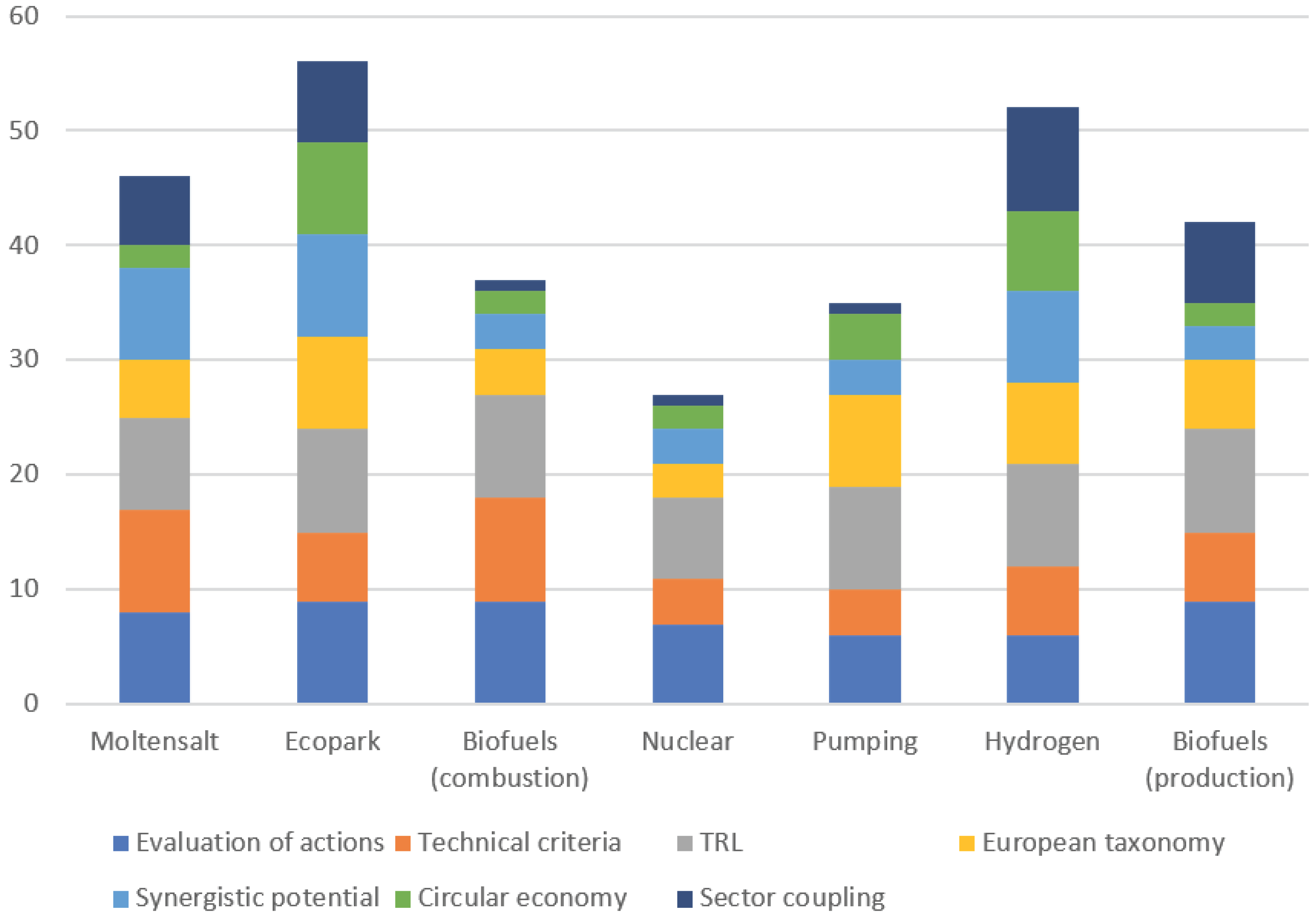
Table 1.
Example A: Eco-Industrial Plant with Green H2 plant [18].
Table 1.
Example A: Eco-Industrial Plant with Green H2 plant [18].
| Macro/Sub-Criteria | Weight (Macro) | Weight (Sub) | Value Score (Sub) 0-5 (PIMr,c) | TIM (Sub) (TIMc) |
|---|---|---|---|---|
| Territorial Efficiency | 0,333 | |||
| Value Added | 0,4 | 3 | 0,40 | |
| Process/Product Innovations | 0,3 | 4 | 0,40 | |
| Recycled Waste | 0,2 | 1 | 0,27 | |
| Space required | 0,1 | 3 | 0,07 | |
| Territorial Quality | 0,333 | |||
| Lower GHG Emissions | 0,4 | 3 | 0,40 | |
| Reduction of other environmental impacts outside the location | 0,2 | 5 | 0,33 | |
| Reduction of environmental impacts at the place of operation | 0,2 | 5 | 0,33 | |
| Quality of offered services | 0,2 | 5 | 0,20 | |
| Territorial Identity | 0,333 | |||
| Capacity of renewable energy production | 0,3 | 3 | 0,30 | |
| Energy users connected to smart grid | 0,2 | 1 | 0,07 | |
| Employment (number of jobs by operation) | 0,4 | 3 | 0,40 | |
| New job for researchers | 0,1 | 2 | 0,07 | |
| TIMr,c | 3,24 |
Table 2.
Example B: Eco-Industrial Park with Biofuels production [18].
Table 2.
Example B: Eco-Industrial Park with Biofuels production [18].
| Macro/Sub-Criteria | Weight (Macro) | Weight (Sub) | Value Score (Sub) 0-5 (PIMr,c) | TIM (Sub) (TIMc) |
|---|---|---|---|---|
| Territorial Efficiency | 0,333 | |||
| Value Added | 0,4 | 2 | 0,27 | |
| Process/Product Innovations | 0,3 | 4 | 0,40 | |
| Recycled Waste | 0,2 | 1 | 0,07 | |
| Space required | 0,1 | 2 | 0,07 | |
| Territorial Quality | 0,333 | |||
| Lower GHG Emissions | 0,4 | 2 | 0,27 | |
| Reduction of other environmental impacts outside the location | 0,2 | 3 | 0,20 | |
| Reduction of environmental impacts at the place of operation | 0,2 | 4 | 0,27 | |
| Quality of offered services | 0,2 | 3 | 0,20 | |
| Territorial Identity | 0,333 | |||
| Capacity of renewable energy production | 0,3 | 4 | 0,40 | |
| Energy users connected to smart grid | 0,2 | 1 | 0,07 | |
| Employment (number of jobs by operation) | 0,4 | 4 | 0,53 | |
| New job for researchers | 0,1 | 3 | 0,10 | |
| TIMr,c | 2,85 |
Disclaimer/Publisher’s Note: The statements, opinions and data contained in all publications are solely those of the individual author(s) and contributor(s) and not of MDPI and/or the editor(s). MDPI and/or the editor(s) disclaim responsibility for any injury to people or property resulting from any ideas, methods, instructions or products referred to in the content. |
© 2024 by the authors. Licensee MDPI, Basel, Switzerland. This article is an open access article distributed under the terms and conditions of the Creative Commons Attribution (CC BY) license (http://creativecommons.org/licenses/by/4.0/).
Copyright: This open access article is published under a Creative Commons CC BY 4.0 license, which permit the free download, distribution, and reuse, provided that the author and preprint are cited in any reuse.